Performance Appraisal
Seta A. Wicaksana
Founder and CEO
www.humanikaconsulting.com
Seta A. Wicaksana
0811 19 53 43
wicaksana@humanikaconsulting.com
• Managing Director of Humanika Amanah
Indonesia – Humanika Consulting
• Managing Director of Humanika Bisnis Digital
– hipotest.com
• Ahli Senior di Komite Kebijakan Pengelolaan
Kinerja Organisasi dan SDM (KPKOS) Dewan
Pengawas BPJS Ketenagakerjaan
• Wakil Dekan II dan Dosen Tetap Fakultas
Psikologi Universitas Pancasila
• Pembina Yayasan Humanika Edukasi Indonesia
• Penulis Buku ―SOBAT‖ Elexmedia Gramedia
2016
• Organizational Development Expertise
• Pengembang Alat Tes minat bakat BRIGHT
dan Sistem Tes Psikologi berbasis aplikasi di
hipotest.com
• Sedang mengikuti tugas belajar Doktoral (S3)
di Fakultas Ilmu Ekonomi dan Bisnis
Universitas Pancasila Bidang MSDM
• Fakultas Psikologi S1 dan S2 Universitas
Indonesia
• Mathematics: Cryptology sekolah ikatan dinas
Sandi Negara
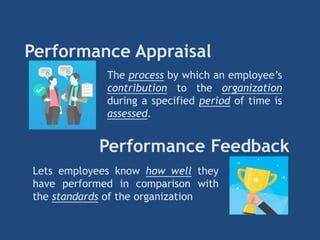
The process by which an employee’s
contribution to the organization
during a specified period of time is
assessed.
Lets employees know how well they
have performed in comparison with
the standards of the organization
Performance Feedback
Performance Appraisal
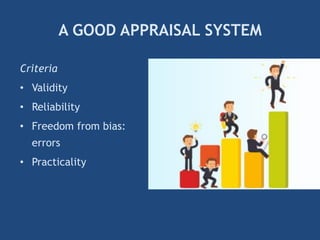
A GOOD APPRAISAL SYSTEM
Criteria
• Validity
• Reliability
• Freedom from bias:
errors
• Practicality
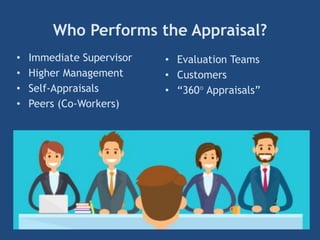
Who Performs the Appraisal?
• Immediate Supervisor
• Higher Management
• Self-Appraisals
• Peers (Co-Workers)
• Evaluation Teams
• Customers
• ―360° Appraisals‖
Supervisor Appraisal
Performance appraisal done by an
employee’s manager and often
reviewed by a manager one level
higher.
Self-Appraisal
Performance appraisal done by the
employee being evaluated, generally on an
appraisal form completed by the employee
prior to the performance review.
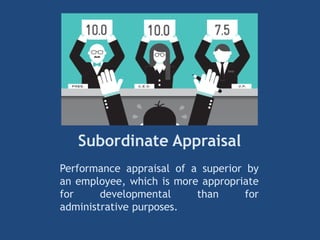
Subordinate Appraisal
Performance appraisal of a superior by
an employee, which is more appropriate
for developmental than for
administrative purposes.
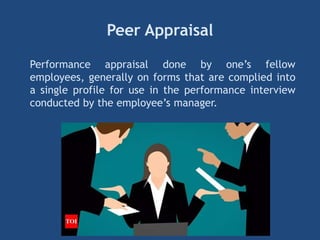
Peer Appraisal
Performance appraisal done by one’s fellow
employees, generally on forms that are complied into
a single profile for use in the performance interview
conducted by the employee’s manager.
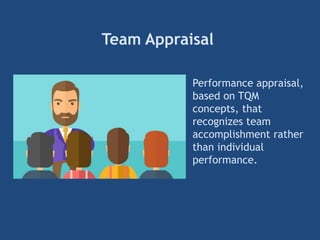
Team Appraisal
Performance appraisal,
based on TQM
concepts, that
recognizes team
accomplishment rather
than individual
performance.
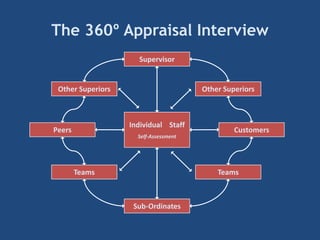
The 360º Appraisal Interview
Individual Staff
Self-Assessment
Supervisor
Other Superiors
Peers
Teams
Sub-Ordinates
Teams
Customers
Other Superiors
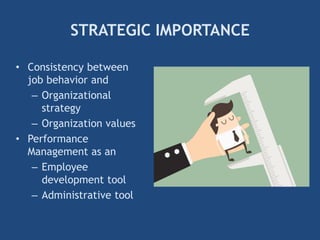
STRATEGIC IMPORTANCE
• Consistency between
job behavior and
– Organizational
strategy
– Organization values
• Performance
Management as an
– Employee
development tool
– Administrative tool
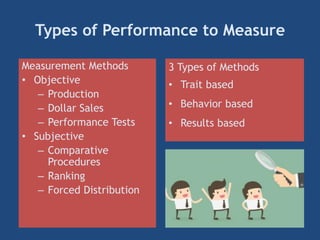
Types of Performance to Measure
3 Types of Methods
• Trait based
• Behavior based
• Results based
Measurement Methods
• Objective
– Production
– Dollar Sales
– Performance Tests
• Subjective
– Comparative
Procedures
– Ranking
– Forced Distribution
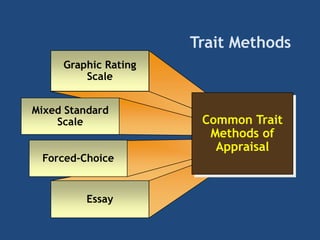
Trait Methods
Graphic Rating
Scale
Mixed Standard
Scale
Essay
Forced-Choice
Common Trait
Methods of
Appraisal
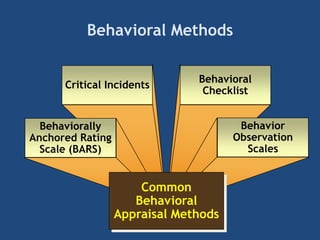
Behavioral Methods
Critical Incidents
Behavioral
Checklist
Behaviorally
Anchored Rating
Scale (BARS)
Behavior
Observation
Scales
Common
Behavioral
Appraisal Methods
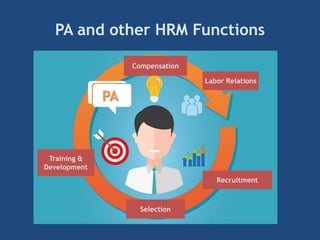
PA and other HRM Functions
Recruitment
Selection
Training &
Development
Compensation
Labor Relations
PA
Reasons for Appraisals
• Compensation "Pay for Performance"
• Job Performance Improvements
• Feedback to Subordinates
• Documentation for Decisions
• Goal Setting - Later Evaluation
• Promotion Decisions
• Identify Training Needs
• HR Planning
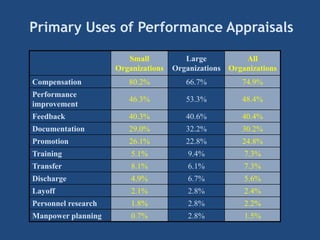
Primary Uses of Performance Appraisals
Small
Organizations
Large
Organizations
All
Organizations
Compensation 80.2% 66.7% 74.9%
Performance
improvement
46.3% 53.3% 48.4%
Feedback 40.3% 40.6% 40.4%
Documentation 29.0% 32.2% 30.2%
Promotion 26.1% 22.8% 24.8%
Training 5.1% 9.4% 7.3%
Transfer 8.1% 6.1% 7.3%
Discharge 4.9% 6.7% 5.6%
Layoff 2.1% 2.8% 2.4%
Personnel research 1.8% 2.8% 2.2%
Manpower planning 0.7% 2.8% 1.5%
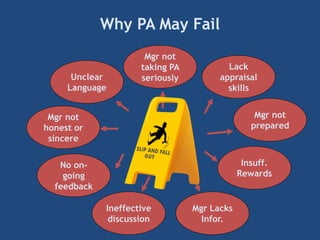
Why PA May Fail
Unclear
Language
Mgr not
taking PA
seriously
Mgr not
prepared
No on-
going
feedback
Mgr not
honest or
sincere
Ineffective
discussion
Lack
appraisal
skills
Mgr Lacks
Infor.
Insuff.
Rewards
Common Problems
• Failure to prepare for the
interview
• Failure to listen (80-20
ratio)
• Failure to maintain
objectivity
• Failure to provide
feedback—positive and/or
corrective
• Failure to follow-up
• Failure to document
performance – both good
and bad
Common Problems
• Misusing the performance
evaluation process to
address a disciplinary
problem
• Element of surprise
• Relying on
impressions/rumors, rather
than facts
• Inconsistent application of
performance evaluation
criteria
• Interpersonal issues
• Holding employees
responsible for
events/problems beyond
their control
Common Rater Biases
• Halo/horns effect
• Contrast effect
• First impressions
• Similar-to-me effect
• Negative and positive leniency tendency
• Spillover effect
• Recency effect
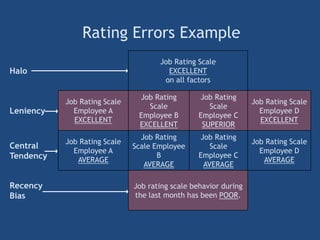
Rating Errors Example
Halo
Job Rating Scale
EXCELLENT
on all factors
Leniency
Job Rating Scale
Employee A
EXCELLENT
Job Rating
Scale
Employee B
EXCELLENT
Job Rating
Scale
Employee C
SUPERIOR
Job Rating Scale
Employee D
EXCELLENT
Central
Tendency
Job Rating Scale
Employee A
AVERAGE
Job Rating
Scale Employee
B
AVERAGE
Job Rating
Scale
Employee C
AVERAGE
Job Rating Scale
Employee D
AVERAGE
Recency
Bias
Job rating scale behavior during
the last month has been POOR.
Example
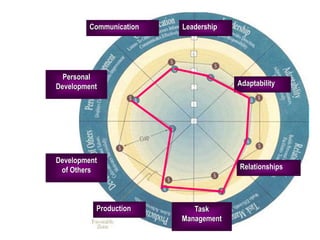
Relationships
Adaptability
LeadershipCommunication
Personal
Development
Development
of Others
Production Task
Management
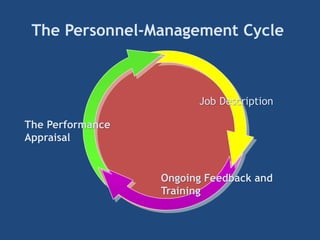
The Personnel-Management Cycle
Job Description
Ongoing Feedback and
Training
The Performance
Appraisal
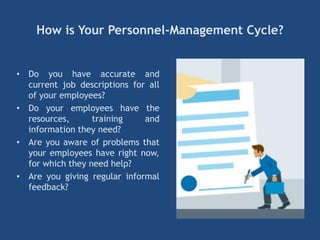
How is Your Personnel-Management Cycle?
• Do you have accurate and
current job descriptions for all
of your employees?
• Do your employees have the
resources, training and
information they need?
• Are you aware of problems that
your employees have right now,
for which they need help?
• Are you giving regular informal
feedback?
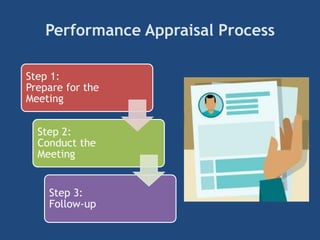
Performance Appraisal Process
Step 1:
Prepare for the
Meeting
Step 2:
Conduct the
Meeting
Step 3:
Follow-up
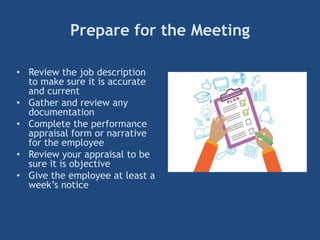
Prepare for the Meeting
• Review the job description
to make sure it is accurate
and current
• Gather and review any
documentation
• Complete the performance
appraisal form or narrative
for the employee
• Review your appraisal to be
sure it is objective
• Give the employee at least a
week’s notice
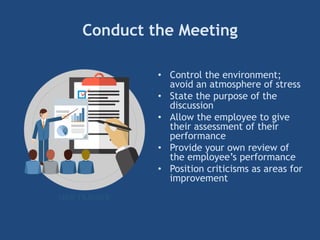
Conduct the Meeting
• Control the environment;
avoid an atmosphere of stress
• State the purpose of the
discussion
• Allow the employee to give
their assessment of their
performance
• Provide your own review of
the employee’s performance
• Position criticisms as areas for
improvement
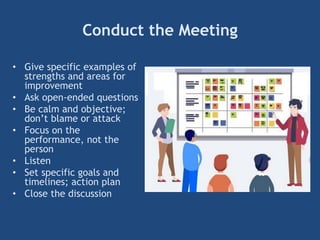
Conduct the Meeting
• Give specific examples of
strengths and areas for
improvement
• Ask open-ended questions
• Be calm and objective;
don’t blame or attack
• Focus on the
performance, not the
person
• Listen
• Set specific goals and
timelines; action plan
• Close the discussion
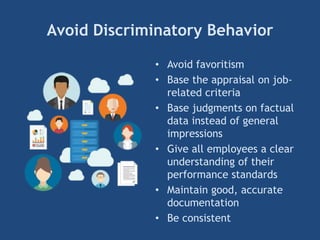
Avoid Discriminatory Behavior
• Avoid favoritism
• Base the appraisal on job-
related criteria
• Base judgments on factual
data instead of general
impressions
• Give all employees a clear
understanding of their
performance standards
• Maintain good, accurate
documentation
• Be consistent
Things to Remember
• Don’t make hasty
judgments.
• Be aware of nonverbals
– yours and the
employee’s
• Don’t be afraid of
silence
• Don’t interrupt when
the employee is
speaking
• Use ―I‖ statements
• Say what you mean
The Defensive/Hostile Employee
• Don’t object to the
employee’s reaction and
become defensive
• Use restatement to reflect
his/her negative comments
• Never accept abuse from an
employee under any
conditions
• Postpone the interview
• Have the employee prepare
a written summary of
his/her complaints
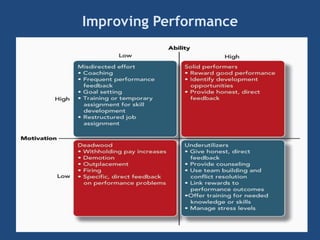
Improving Performance
Follow-up
• Provide frequent communication
and feedback (positive and
corrective)
• Maintain written records
(positive and negative)
• Respond promptly to requests
for help
• Conduct interim reviews
– Review goals/action plans
and timelines
• Evaluate your own performance
and its effect on your employees
Negative (Corrective) Feedback
• Behavior: state the
specific behavior that is
unacceptable
• Effect: Explain why the
behavior is unacceptable
• Expectation: Tell the
employee what you expect
to happen to change the
behavior
• Result: Let the employee
know what will happen if
the behavior continues or
changes
Source: Charles Cadwell. The Human Touch Performance Appraisal.
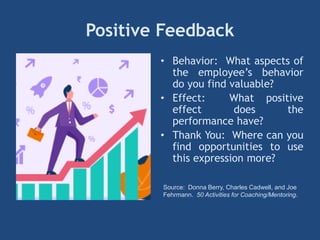
Positive Feedback
• Behavior: What aspects of
the employee’s behavior
do you find valuable?
• Effect: What positive
effect does the
performance have?
• Thank You: Where can you
find opportunities to use
this expression more?
Source: Donna Berry, Charles Cadwell, and Joe
Fehrmann. 50 Activities for Coaching/Mentoring.
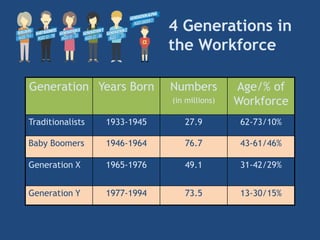
4 Generations in
the Workforce
Generation Years Born Numbers
(in millions)
Age/% of
Workforce
Traditionalists 1933-1945 27.9 62-73/10%
Baby Boomers 1946-1964 76.7 43-61/46%
Generation X 1965-1976 49.1 31-42/29%
Generation Y 1977-1994 73.5 13-30/15%
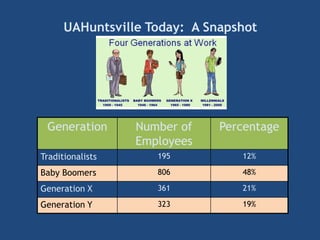
UAHuntsville Today: A Snapshot
Generation Number of
Employees
Percentage
Traditionalists 195 12%
Baby Boomers 806 48%
Generation X 361 21%
Generation Y 323 19%
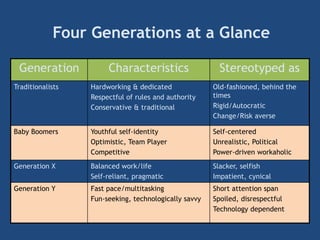
Four Generations at a Glance
Generation Characteristics Stereotyped as
Traditionalists Hardworking & dedicated
Respectful of rules and authority
Conservative & traditional
Old-fashioned, behind the
times
Rigid/Autocratic
Change/Risk averse
Baby Boomers Youthful self-identity
Optimistic, Team Player
Competitive
Self-centered
Unrealistic, Political
Power-driven workaholic
Generation X Balanced work/life
Self-reliant, pragmatic
Slacker, selfish
Impatient, cynical
Generation Y Fast pace/multitasking
Fun-seeking, technologically savvy
Short attention span
Spoiled, disrespectful
Technology dependent
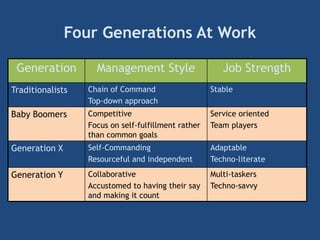
Four Generations At Work
Generation Management Style Job Strength
Traditionalists Chain of Command
Top-down approach
Stable
Baby Boomers Competitive
Focus on self-fulfillment rather
than common goals
Service oriented
Team players
Generation X Self-Commanding
Resourceful and independent
Adaptable
Techno-literate
Generation Y Collaborative
Accustomed to having their say
and making it count
Multi-taskers
Techno-savvy
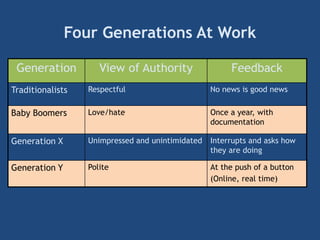
Four Generations At Work
Generation View of Authority Feedback
Traditionalists Respectful No news is good news
Baby Boomers Love/hate Once a year, with
documentation
Generation X Unimpressed and unintimidated Interrupts and asks how
they are doing
Generation Y Polite At the push of a button
(Online, real time)
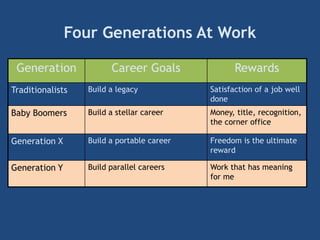
Four Generations At Work
Generation Career Goals Rewards
Traditionalists Build a legacy Satisfaction of a job well
done
Baby Boomers Build a stellar career Money, title, recognition,
the corner office
Generation X Build a portable career Freedom is the ultimate
reward
Generation Y Build parallel careers Work that has meaning
for me
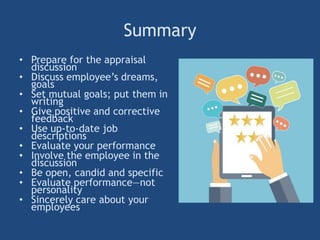
Summary
• Prepare for the appraisal
discussion
• Discuss employee’s dreams,
goals
• Set mutual goals; put them in
writing
• Give positive and corrective
feedback
• Use up-to-date job
descriptions
• Evaluate your performance
• Involve the employee in the
discussion
• Be open, candid and specific
• Evaluate performance—not
personality
• Sincerely care about your
employees

Performance Appraisal

  • 1.
    Performance Appraisal Seta A.Wicaksana Founder and CEO www.humanikaconsulting.com
  • 2.
    Seta A. Wicaksana 081119 53 43 wicaksana@humanikaconsulting.com • Managing Director of Humanika Amanah Indonesia – Humanika Consulting • Managing Director of Humanika Bisnis Digital – hipotest.com • Ahli Senior di Komite Kebijakan Pengelolaan Kinerja Organisasi dan SDM (KPKOS) Dewan Pengawas BPJS Ketenagakerjaan • Wakil Dekan II dan Dosen Tetap Fakultas Psikologi Universitas Pancasila • Pembina Yayasan Humanika Edukasi Indonesia • Penulis Buku ―SOBAT‖ Elexmedia Gramedia 2016 • Organizational Development Expertise • Pengembang Alat Tes minat bakat BRIGHT dan Sistem Tes Psikologi berbasis aplikasi di hipotest.com • Sedang mengikuti tugas belajar Doktoral (S3) di Fakultas Ilmu Ekonomi dan Bisnis Universitas Pancasila Bidang MSDM • Fakultas Psikologi S1 dan S2 Universitas Indonesia • Mathematics: Cryptology sekolah ikatan dinas Sandi Negara
  • 3.
    The process bywhich an employee’s contribution to the organization during a specified period of time is assessed. Lets employees know how well they have performed in comparison with the standards of the organization Performance Feedback Performance Appraisal
  • 4.
    A GOOD APPRAISALSYSTEM Criteria • Validity • Reliability • Freedom from bias: errors • Practicality
  • 5.
    Who Performs theAppraisal? • Immediate Supervisor • Higher Management • Self-Appraisals • Peers (Co-Workers) • Evaluation Teams • Customers • ―360° Appraisals‖
  • 6.
    Supervisor Appraisal Performance appraisaldone by an employee’s manager and often reviewed by a manager one level higher.
  • 7.
    Self-Appraisal Performance appraisal doneby the employee being evaluated, generally on an appraisal form completed by the employee prior to the performance review.
  • 8.
    Subordinate Appraisal Performance appraisalof a superior by an employee, which is more appropriate for developmental than for administrative purposes.
  • 9.
    Peer Appraisal Performance appraisaldone by one’s fellow employees, generally on forms that are complied into a single profile for use in the performance interview conducted by the employee’s manager.
  • 10.
    Team Appraisal Performance appraisal, basedon TQM concepts, that recognizes team accomplishment rather than individual performance.
  • 11.
    The 360º AppraisalInterview Individual Staff Self-Assessment Supervisor Other Superiors Peers Teams Sub-Ordinates Teams Customers Other Superiors
  • 12.
    STRATEGIC IMPORTANCE • Consistencybetween job behavior and – Organizational strategy – Organization values • Performance Management as an – Employee development tool – Administrative tool
  • 13.
    Types of Performanceto Measure 3 Types of Methods • Trait based • Behavior based • Results based Measurement Methods • Objective – Production – Dollar Sales – Performance Tests • Subjective – Comparative Procedures – Ranking – Forced Distribution
  • 14.
    Trait Methods Graphic Rating Scale MixedStandard Scale Essay Forced-Choice Common Trait Methods of Appraisal
  • 15.
    Behavioral Methods Critical Incidents Behavioral Checklist Behaviorally AnchoredRating Scale (BARS) Behavior Observation Scales Common Behavioral Appraisal Methods
  • 16.
    PA and otherHRM Functions Recruitment Selection Training & Development Compensation Labor Relations PA
  • 17.
    Reasons for Appraisals •Compensation "Pay for Performance" • Job Performance Improvements • Feedback to Subordinates • Documentation for Decisions • Goal Setting - Later Evaluation • Promotion Decisions • Identify Training Needs • HR Planning
  • 18.
    Primary Uses ofPerformance Appraisals Small Organizations Large Organizations All Organizations Compensation 80.2% 66.7% 74.9% Performance improvement 46.3% 53.3% 48.4% Feedback 40.3% 40.6% 40.4% Documentation 29.0% 32.2% 30.2% Promotion 26.1% 22.8% 24.8% Training 5.1% 9.4% 7.3% Transfer 8.1% 6.1% 7.3% Discharge 4.9% 6.7% 5.6% Layoff 2.1% 2.8% 2.4% Personnel research 1.8% 2.8% 2.2% Manpower planning 0.7% 2.8% 1.5%
  • 19.
    Why PA MayFail Unclear Language Mgr not taking PA seriously Mgr not prepared No on- going feedback Mgr not honest or sincere Ineffective discussion Lack appraisal skills Mgr Lacks Infor. Insuff. Rewards
  • 20.
    Common Problems • Failureto prepare for the interview • Failure to listen (80-20 ratio) • Failure to maintain objectivity • Failure to provide feedback—positive and/or corrective • Failure to follow-up • Failure to document performance – both good and bad
  • 21.
    Common Problems • Misusingthe performance evaluation process to address a disciplinary problem • Element of surprise • Relying on impressions/rumors, rather than facts • Inconsistent application of performance evaluation criteria • Interpersonal issues • Holding employees responsible for events/problems beyond their control
  • 22.
    Common Rater Biases •Halo/horns effect • Contrast effect • First impressions • Similar-to-me effect • Negative and positive leniency tendency • Spillover effect • Recency effect
  • 23.
    Rating Errors Example Halo JobRating Scale EXCELLENT on all factors Leniency Job Rating Scale Employee A EXCELLENT Job Rating Scale Employee B EXCELLENT Job Rating Scale Employee C SUPERIOR Job Rating Scale Employee D EXCELLENT Central Tendency Job Rating Scale Employee A AVERAGE Job Rating Scale Employee B AVERAGE Job Rating Scale Employee C AVERAGE Job Rating Scale Employee D AVERAGE Recency Bias Job rating scale behavior during the last month has been POOR.
  • 25.
  • 26.
    The Personnel-Management Cycle JobDescription Ongoing Feedback and Training The Performance Appraisal
  • 27.
    How is YourPersonnel-Management Cycle? • Do you have accurate and current job descriptions for all of your employees? • Do your employees have the resources, training and information they need? • Are you aware of problems that your employees have right now, for which they need help? • Are you giving regular informal feedback?
  • 28.
    Performance Appraisal Process Step1: Prepare for the Meeting Step 2: Conduct the Meeting Step 3: Follow-up
  • 29.
    Prepare for theMeeting • Review the job description to make sure it is accurate and current • Gather and review any documentation • Complete the performance appraisal form or narrative for the employee • Review your appraisal to be sure it is objective • Give the employee at least a week’s notice
  • 30.
    Conduct the Meeting •Control the environment; avoid an atmosphere of stress • State the purpose of the discussion • Allow the employee to give their assessment of their performance • Provide your own review of the employee’s performance • Position criticisms as areas for improvement
  • 31.
    Conduct the Meeting •Give specific examples of strengths and areas for improvement • Ask open-ended questions • Be calm and objective; don’t blame or attack • Focus on the performance, not the person • Listen • Set specific goals and timelines; action plan • Close the discussion
  • 32.
    Avoid Discriminatory Behavior •Avoid favoritism • Base the appraisal on job- related criteria • Base judgments on factual data instead of general impressions • Give all employees a clear understanding of their performance standards • Maintain good, accurate documentation • Be consistent
  • 33.
    Things to Remember •Don’t make hasty judgments. • Be aware of nonverbals – yours and the employee’s • Don’t be afraid of silence • Don’t interrupt when the employee is speaking • Use ―I‖ statements • Say what you mean
  • 34.
    The Defensive/Hostile Employee •Don’t object to the employee’s reaction and become defensive • Use restatement to reflect his/her negative comments • Never accept abuse from an employee under any conditions • Postpone the interview • Have the employee prepare a written summary of his/her complaints
  • 35.
  • 36.
    Follow-up • Provide frequentcommunication and feedback (positive and corrective) • Maintain written records (positive and negative) • Respond promptly to requests for help • Conduct interim reviews – Review goals/action plans and timelines • Evaluate your own performance and its effect on your employees
  • 37.
    Negative (Corrective) Feedback •Behavior: state the specific behavior that is unacceptable • Effect: Explain why the behavior is unacceptable • Expectation: Tell the employee what you expect to happen to change the behavior • Result: Let the employee know what will happen if the behavior continues or changes Source: Charles Cadwell. The Human Touch Performance Appraisal.
  • 38.
    Positive Feedback • Behavior:What aspects of the employee’s behavior do you find valuable? • Effect: What positive effect does the performance have? • Thank You: Where can you find opportunities to use this expression more? Source: Donna Berry, Charles Cadwell, and Joe Fehrmann. 50 Activities for Coaching/Mentoring.
  • 39.
    4 Generations in theWorkforce Generation Years Born Numbers (in millions) Age/% of Workforce Traditionalists 1933-1945 27.9 62-73/10% Baby Boomers 1946-1964 76.7 43-61/46% Generation X 1965-1976 49.1 31-42/29% Generation Y 1977-1994 73.5 13-30/15%
  • 40.
    UAHuntsville Today: ASnapshot Generation Number of Employees Percentage Traditionalists 195 12% Baby Boomers 806 48% Generation X 361 21% Generation Y 323 19%
  • 41.
    Four Generations ata Glance Generation Characteristics Stereotyped as Traditionalists Hardworking & dedicated Respectful of rules and authority Conservative & traditional Old-fashioned, behind the times Rigid/Autocratic Change/Risk averse Baby Boomers Youthful self-identity Optimistic, Team Player Competitive Self-centered Unrealistic, Political Power-driven workaholic Generation X Balanced work/life Self-reliant, pragmatic Slacker, selfish Impatient, cynical Generation Y Fast pace/multitasking Fun-seeking, technologically savvy Short attention span Spoiled, disrespectful Technology dependent
  • 42.
    Four Generations AtWork Generation Management Style Job Strength Traditionalists Chain of Command Top-down approach Stable Baby Boomers Competitive Focus on self-fulfillment rather than common goals Service oriented Team players Generation X Self-Commanding Resourceful and independent Adaptable Techno-literate Generation Y Collaborative Accustomed to having their say and making it count Multi-taskers Techno-savvy
  • 43.
    Four Generations AtWork Generation View of Authority Feedback Traditionalists Respectful No news is good news Baby Boomers Love/hate Once a year, with documentation Generation X Unimpressed and unintimidated Interrupts and asks how they are doing Generation Y Polite At the push of a button (Online, real time)
  • 44.
    Four Generations AtWork Generation Career Goals Rewards Traditionalists Build a legacy Satisfaction of a job well done Baby Boomers Build a stellar career Money, title, recognition, the corner office Generation X Build a portable career Freedom is the ultimate reward Generation Y Build parallel careers Work that has meaning for me
  • 46.
    Summary • Prepare forthe appraisal discussion • Discuss employee’s dreams, goals • Set mutual goals; put them in writing • Give positive and corrective feedback • Use up-to-date job descriptions • Evaluate your performance • Involve the employee in the discussion • Be open, candid and specific • Evaluate performance—not personality • Sincerely care about your employees