Human resources slide 1
PERFORMANCE
APPRAISAL
MANAGEMENT
Prof. Sitara Nazir
AGENDA
Human resources slide 2
1. DEFINATION
2. OBJECTIVES
3. IMPORTANCE
4. PURPOSES
5. EVOLUTION
6. PRINCIPLES
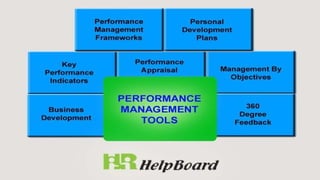
7. TOOLS
8. PROCESS
9. ADVANTAGES & DISADVANTAGES
10.360 DEGREE APPRISAL
Human resources slide 3
Lorem Ipsum is text of the printing
and typesetting industry.
EMPLOYEES ARE
MOTIVATED BY:
Lorem ipsum dolor sit amet,
consectetur adipiscing elit.
Lorem ipsum dolor sit amet,
consectetur adipiscing elit.
Lorem ipsum dolor sit amet,
consectetur adipiscing elit.
Lorem ipsum dolor sit amet,
consectetur adipiscing elit.
65%
50%
80%
35%
• Performance appraisal, often referred to as a performance review or
evaluation, is a systematic and structured process used by organizations to
assess and evaluate the job performance of their employees. It involves a
comprehensive review of an employee's work, accomplishments,
strengths, and areas for improvement within a specific timeframe.
• According to Edwin B Flippo, “Performance appraisal is a systematic,
periodic and so far as humanly possible, an impartial rating of an
employee’s excellence in matters pertaining to his present job and to his
potentialities for a better job.”
• According to Scott, Clothier and Spriegal, “Performance appraisal is a
record of progress for apprentices and regular employees, as a guide in
making promotions, transfer and demotions, as a guide is making lists for
bonus distributions, as a for seniority consideration and for rates of pay, as
an instrument for discovering hidden genius, and as asource of
information that makes conferences with employees helpful.”
DEFINATION
Human resources slide 4
STRATEGY HUMAN RESOURCES:
Lorem ipsum dolor sit amet
STRATEGY
HUMAN
RESOURCES:
Lorem ipsum dolor
sit amet
STRATEGY
HUMAN
RESOURCES:
Lorem ipsum dolor
sit amet
STRATEGY
HUMAN
RESOURCES:
Lorem ipsum dolor
sit amet
STRATEGY
HUMAN
RESOURCES:
Lorem ipsum dolor
sit amet
HUMAN RESOURCES
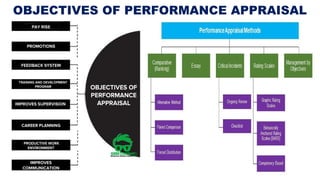
OBJECTIVES OF PERFORMANCE APPRAISAL
Human resources slide 5
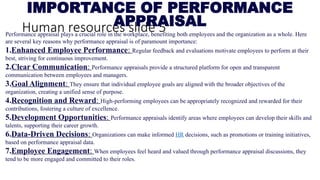
IMPORTANCE OF PERFORMANCE
APPRAISAL
Performance appraisal plays a crucial role in the workplace, benefiting both employees and the organization as a whole. Here
are several key reasons why performance appraisal is of paramount importance:
1.Enhanced Employee Performance: Regular feedback and evaluations motivate employees to perform at their
best, striving for continuous improvement.
2.Clear Communication: Performance appraisals provide a structured platform for open and transparent
communication between employees and managers.
3.Goal Alignment: They ensure that individual employee goals are aligned with the broader objectives of the
organization, creating a unified sense of purpose.
4.Recognition and Reward: High-performing employees can be appropriately recognized and rewarded for their
contributions, fostering a culture of excellence.
5.Development Opportunities: Performance appraisals identify areas where employees can develop their skills and
talents, supporting their career growth.
6.Data-Driven Decisions: Organizations can make informed HR decisions, such as promotions or training initiatives,
based on performance appraisal data.
7.Employee Engagement: When employees feel heard and valued through performance appraisal discussions, they
tend to be more engaged and committed to their roles.
Human resources slide 6
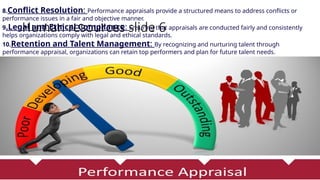
8.Conflict Resolution: Performance appraisals provide a structured means to address conflicts or
performance issues in a fair and objective manner.
9.Legal and Ethical Compliance: Ensuring that appraisals are conducted fairly and consistently
helps organizations comply with legal and ethical standards.
10.Retention and Talent Management: By recognizing and nurturing talent through
performance appraisal, organizations can retain top performers and plan for future talent needs.
Human resources slide 7
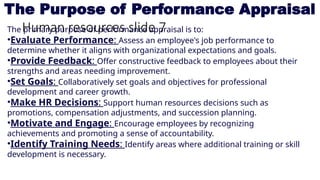
The Purpose of Performance Appraisal
The primary purpose of performance appraisal is to:
•Evaluate Performance: Assess an employee's job performance to
determine whether it aligns with organizational expectations and goals.
•Provide Feedback: Offer constructive feedback to employees about their
strengths and areas needing improvement.
•Set Goals: Collaboratively set goals and objectives for professional
development and career growth.
•Make HR Decisions: Support human resources decisions such as
promotions, compensation adjustments, and succession planning.
•Motivate and Engage: Encourage employees by recognizing
achievements and promoting a sense of accountability.
•Identify Training Needs: Identify areas where additional training or skill
development is necessary.
Human resources slide 8
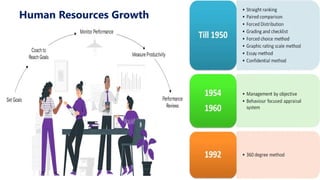
Human Resources Growth
Lorem ipsum dolor sit amet, consectetur adipiscing.
Our Team around the world
Sed ut perspiciatis unde omnis iste natus error sit voluptatem
accusantium doloremque laudantium, totam rem aperiam, eaque
ipsa quae ab illo inventore veritatis et quasi architecto beatae
vitae dicta sunt explicabo.
Human resources slide 9
Meet The Team
Lorem ipsum dolor sit amet, consectetur
Our Team around the world
Lorem ipsum dolor sit amet, consectetur
adipiscing elit, sed do eiusmod tempor
incididunt ut labore et dolore magna
aliqua. Ut enim ad minim veniam, quis
nostrud exercitation ullamco laboris nisi ut
aliquip ex ea commodo consequat.
Duis aute irure dolor in reprehenderit in
voluptate velit esse cillum dolore eu fugiat
nulla pariatur. Excepteur sint occaecat
cupidatat non proident, sunt in culpa qui
officia deserunt mollit anim id est laborum.
www.example.com
Ian
Hanssen
Flora
Berggren
Allan
Mattsson
Victoria
Lindqvist
Human resources slide 10
Thank You
Lorem ipsum dolor sit amet, consectetur
adipiscing elit.
Human resources slide 11
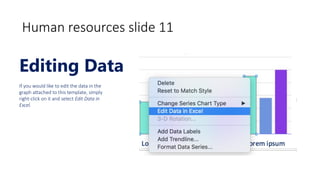
Editing Data
If you would like to edit the data in the
graph attached to this template, simply
right-click on it and select Edit Data in
Excel.

PERFORMANCE APPRISAL slide 1.pptx pgdm/mba

  • 1.
    Human resources slide1 PERFORMANCE APPRAISAL MANAGEMENT Prof. Sitara Nazir
  • 2.
    AGENDA Human resources slide2 1. DEFINATION 2. OBJECTIVES 3. IMPORTANCE 4. PURPOSES 5. EVOLUTION 6. PRINCIPLES 7. TOOLS 8. PROCESS 9. ADVANTAGES & DISADVANTAGES 10.360 DEGREE APPRISAL
  • 3.
    Human resources slide3 Lorem Ipsum is text of the printing and typesetting industry. EMPLOYEES ARE MOTIVATED BY: Lorem ipsum dolor sit amet, consectetur adipiscing elit. Lorem ipsum dolor sit amet, consectetur adipiscing elit. Lorem ipsum dolor sit amet, consectetur adipiscing elit. Lorem ipsum dolor sit amet, consectetur adipiscing elit. 65% 50% 80% 35% • Performance appraisal, often referred to as a performance review or evaluation, is a systematic and structured process used by organizations to assess and evaluate the job performance of their employees. It involves a comprehensive review of an employee's work, accomplishments, strengths, and areas for improvement within a specific timeframe. • According to Edwin B Flippo, “Performance appraisal is a systematic, periodic and so far as humanly possible, an impartial rating of an employee’s excellence in matters pertaining to his present job and to his potentialities for a better job.” • According to Scott, Clothier and Spriegal, “Performance appraisal is a record of progress for apprentices and regular employees, as a guide in making promotions, transfer and demotions, as a guide is making lists for bonus distributions, as a for seniority consideration and for rates of pay, as an instrument for discovering hidden genius, and as asource of information that makes conferences with employees helpful.” DEFINATION
  • 4.
    Human resources slide4 STRATEGY HUMAN RESOURCES: Lorem ipsum dolor sit amet STRATEGY HUMAN RESOURCES: Lorem ipsum dolor sit amet STRATEGY HUMAN RESOURCES: Lorem ipsum dolor sit amet STRATEGY HUMAN RESOURCES: Lorem ipsum dolor sit amet STRATEGY HUMAN RESOURCES: Lorem ipsum dolor sit amet HUMAN RESOURCES
  • 5.
  • 8.
    Human resources slide5 IMPORTANCE OF PERFORMANCE APPRAISAL Performance appraisal plays a crucial role in the workplace, benefiting both employees and the organization as a whole. Here are several key reasons why performance appraisal is of paramount importance: 1.Enhanced Employee Performance: Regular feedback and evaluations motivate employees to perform at their best, striving for continuous improvement. 2.Clear Communication: Performance appraisals provide a structured platform for open and transparent communication between employees and managers. 3.Goal Alignment: They ensure that individual employee goals are aligned with the broader objectives of the organization, creating a unified sense of purpose. 4.Recognition and Reward: High-performing employees can be appropriately recognized and rewarded for their contributions, fostering a culture of excellence. 5.Development Opportunities: Performance appraisals identify areas where employees can develop their skills and talents, supporting their career growth. 6.Data-Driven Decisions: Organizations can make informed HR decisions, such as promotions or training initiatives, based on performance appraisal data. 7.Employee Engagement: When employees feel heard and valued through performance appraisal discussions, they tend to be more engaged and committed to their roles.
  • 9.
    Human resources slide6 8.Conflict Resolution: Performance appraisals provide a structured means to address conflicts or performance issues in a fair and objective manner. 9.Legal and Ethical Compliance: Ensuring that appraisals are conducted fairly and consistently helps organizations comply with legal and ethical standards. 10.Retention and Talent Management: By recognizing and nurturing talent through performance appraisal, organizations can retain top performers and plan for future talent needs.
  • 10.
    Human resources slide7 The Purpose of Performance Appraisal The primary purpose of performance appraisal is to: •Evaluate Performance: Assess an employee's job performance to determine whether it aligns with organizational expectations and goals. •Provide Feedback: Offer constructive feedback to employees about their strengths and areas needing improvement. •Set Goals: Collaboratively set goals and objectives for professional development and career growth. •Make HR Decisions: Support human resources decisions such as promotions, compensation adjustments, and succession planning. •Motivate and Engage: Encourage employees by recognizing achievements and promoting a sense of accountability. •Identify Training Needs: Identify areas where additional training or skill development is necessary.
  • 11.
    Human resources slide8 Human Resources Growth Lorem ipsum dolor sit amet, consectetur adipiscing. Our Team around the world Sed ut perspiciatis unde omnis iste natus error sit voluptatem accusantium doloremque laudantium, totam rem aperiam, eaque ipsa quae ab illo inventore veritatis et quasi architecto beatae vitae dicta sunt explicabo.
  • 12.
    Human resources slide9 Meet The Team Lorem ipsum dolor sit amet, consectetur Our Team around the world Lorem ipsum dolor sit amet, consectetur adipiscing elit, sed do eiusmod tempor incididunt ut labore et dolore magna aliqua. Ut enim ad minim veniam, quis nostrud exercitation ullamco laboris nisi ut aliquip ex ea commodo consequat. Duis aute irure dolor in reprehenderit in voluptate velit esse cillum dolore eu fugiat nulla pariatur. Excepteur sint occaecat cupidatat non proident, sunt in culpa qui officia deserunt mollit anim id est laborum. www.example.com Ian Hanssen Flora Berggren Allan Mattsson Victoria Lindqvist
  • 13.
    Human resources slide10 Thank You Lorem ipsum dolor sit amet, consectetur adipiscing elit.
  • 14.
    Human resources slide11 Editing Data If you would like to edit the data in the graph attached to this template, simply right-click on it and select Edit Data in Excel.