Expected Learning Outcomes
•Explain the meaning and importance of performance
management
• Describe the process of performance management
• Explain the meaning and uses of performance appraisal
• Describe the methods/types/techniques of performance
appraisal
• Identify errors in performance appraisal and explain how these errors
can be eliminated
• How can you deal with poor performers?
Evolution
• In thepast performance management was
construed to mean controlling behavior of
employees
• The negative feedback was not communicated to
employees but kept it in files for future reference
• Confidential performance reports were replaced
by appraisals
• Today emphasis is put on results-oriented,
development, review & feedback
5.
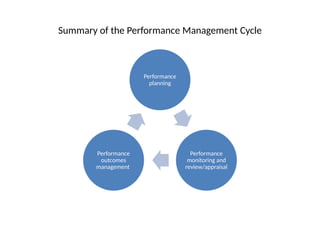
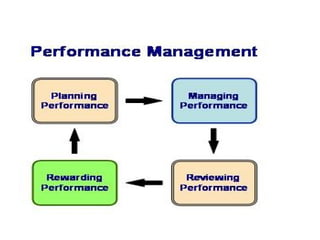
Summary of thePerformance Management Cycle
Performance
planning
Performance
monitoring and
review/appraisal
Performance
outcomes
management
6.
Prerequisites of agood performance
management
• Clearly defined goals/targets
• Top management support
• Clearly defined roles
• Employee participation
• Open communication
• Major performance indicators/parameters should be
clearly defined and measurable
• Consistency and fairness in application
• Recognition of outstanding performance
• Development based on identified improvement needs
7.
Meaning of performanceManagement
“the continuous process of identifying,
measuring and developing the
performance of individuals and
teams and aligning their
performance with the organization’s
goals”
8.
Performance Management process
1.Performance planning- set goals, objectives, targets
2. Performance and development agreement e.g.
performance contract signing
3. Continuous monitoring and feedback by supervisor
4. Performance appraisal
5. Giving performance appraisal feedback to employee
6. Taking action on feedback– e.g. rewards, training,
promotion
9.
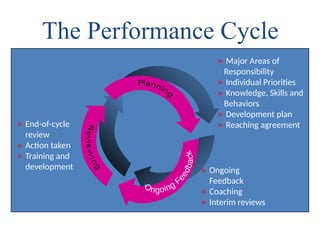
The Performance Cycle
»Major Areas of
Responsibility
» Individual Priorities
» Knowledge, Skills and
Behaviors
» Development plan
» Reaching agreement
» End-of-cycle
review
» Action taken
» Training and
development » Ongoing
Feedback
» Coaching
» Interim reviews
11.
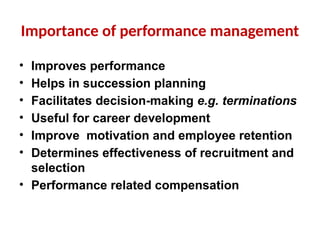
Importance of performancemanagement
• Improves performance
• Helps in succession planning
• Facilitates decision-making e.g. terminations
• Useful for career development
• Improve motivation and employee retention
• Determines effectiveness of recruitment and
selection
• Performance related compensation
12.
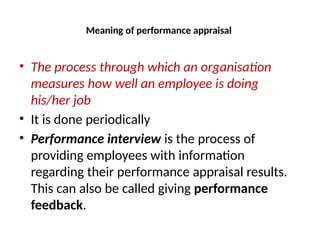
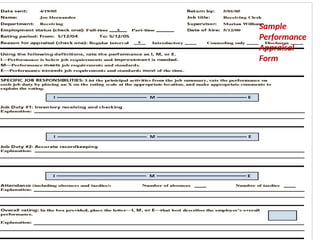
Meaning of performanceappraisal
• The process through which an organisation
measures how well an employee is doing
his/her job
• It is done periodically
• Performance interview is the process of
providing employees with information
regarding their performance appraisal results.
This can also be called giving performance
feedback.
13.
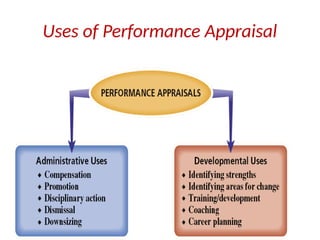
Importance of performanceappraisal
• Determines compensation or rewards
• Basis for staffing decisions e.g. demotion, retrenchment,
promotion, transfer
• Identification of training and development needs
• Improves the performance
• Career planning - it indicates an employees strengths and
weaknesses
• Succession planning – identify potential for promotion
• Assess how effective recruitment and selection were
• Motivate employees - need for achievement
Methods of performanceappraisal
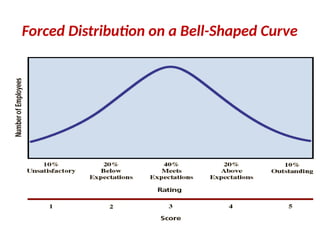
• Forced Distribution –the employees are
placed in pre-determined performance
categories e.g. in either top 20%, middle 60%,
or bottom 20%.
Methods of performance
appraisal
•Paired comparison method – every employee
is compared with every other employee on a
given trait and indicating who is the better
than the other.
• Then overall ranking of employees is done
19.
Methods of performanceappraisal
Alternate ranking method
• Involves ranking employees from the best to
the worst performer based on a set of traits
• List all employees to be ranked
• Then in a form, indicate who is the highest on
the characteristics being measured and also
the one who is lowest.
• Then choose the next highest and the next
lowest, alternating between highest and
lowest until all employees have been ranked
20.
Methods of performanceappraisal
• Graphic Rating Scales – it lists traits that an
ideal holder of the job is required to have, e.g.
reliability, team work, communication,
leadership, etc
• There is a scale on which the traits are
measured e.g. outstanding, average, below
average.
• The scores for all traits are summed up to get
total score for employee
21.
Methods of performanceappraisal
• Critical Incidents – the employee’s
performance is assessed based on recorded
major incidents (both positive and negative
incidents) of the employee’s behavior on the
job
• It may be used with a rating scale to enable
comparison of employees performance
22.
Methods of performanceappraisal
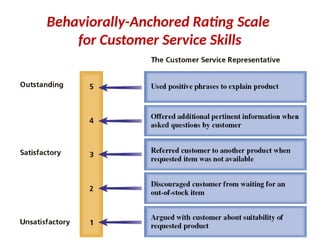
• Behaviourally Anchored Rating Scales
(BARS)– specific examples of good
behavior are rated on a scale.
Examples of poor performance
may also be listed and rated.
Methods of performanceappraisal
• Balanced score card – this is a tool of measuring
performance by measuring performance in four
aspects of a business: financial, customer focus,
internal business processes and learning and growth.
• Management by objectives – setting targets
together with employees and later assessing
performance based on attainment of those
objectives, and giving feedback to employee
25.
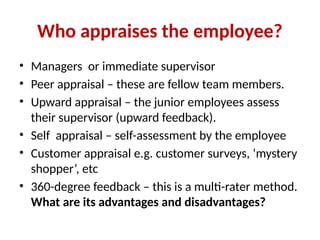
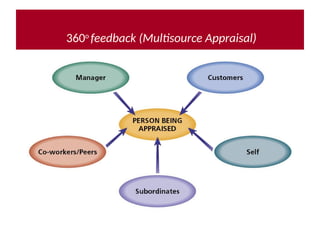
Who appraises theemployee?
• Managers or immediate supervisor
• Peer appraisal – these are fellow team members.
• Upward appraisal – the junior employees assess
their supervisor (upward feedback).
• Self appraisal – self-assessment by the employee
• Customer appraisal e.g. customer surveys, ‘mystery
shopper’, etc
• 360-degree feedback – this is a multi-rater method.
What are its advantages and disadvantages?
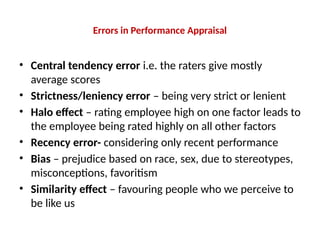
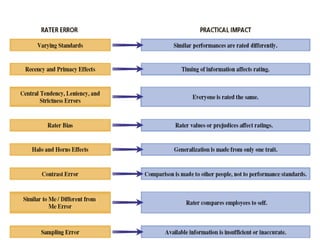
Errors in PerformanceAppraisal
• Central tendency error i.e. the raters give mostly
average scores
• Strictness/leniency error – being very strict or lenient
• Halo effect – rating employee high on one factor leads to
the employee being rated highly on all other factors
• Recency error- considering only recent performance
• Bias – prejudice based on race, sex, due to stereotypes,
misconceptions, favoritism
• Similarity effect – favouring people who we perceive to
be like us
29.
For performance appraisalsto be effective
• Record keeping throughout the period
• Fairness and transparency in the evaluation
• Evaluators should be skilled/trained
• Expectations should be clearly defined and
communicated
• Effective communication and feedback
between supervisors and the employees
Managing Poor performance
Toimprove poor performance, emphasize on:
• Identify and agree on problem and reasons for
it
• Continual skills development
• Monitor and give two-way feedback
• Focus on goals/objectives/results
• Facilitate employees- with resources, coaching
• Agree on action to improve performance
32.
Good vs BadPerformance Review Meeting
Features of a good appraisal meeting
• ?
Features of a bad appraisal meeting
• ?
33.
1. What arePerformance
Improvement Plans (PIP)?
2. What are the components of a
PIP?
34.
3. Discuss thecommon problems
faced in performance management