Human
Resource
Management
Presentation Topic:
Ethics and Employee
Rights and Discipline
© 2005 Prentice Hall Inc. All rights
reserved.
14–
2
After studying this chapter,
you should be able to:
1. Ethical behavior at work.
2. Important factors that shape ethical behavior at
work.
3. Specific ways in which HR management can
influence ethical behavior at work.
4. Employ fair disciplinary practices.
5. Important factors in managing dismissals
effectively.
Ethics and Fair Treatment at
Work
 Ethics
◦ The principles of conduct governing an
individual or a group; specifically, the
standards you use to decide what your
conduct should be.
◦ Ethical behavior depends on the
person’s frame of reference.
14–
4
Factors affecting ethical
decisions
 Normative judgments
◦ Judging something as good or bad, right or
wrong, better or worse. You are wearing
a great outfit ! Is a normative statement
 Moral standards (Morality)
◦ Society’s accepted standards for behaviors
that have serious consequences to its well-
being.
 Behaviors that cannot be established or changed
by decisions of authoritative bodies.
 Behaviors that override self-interest. 14–
5
Ethics and Fair Treatment at Work
(cont’d)
 Ethics and the law
◦ An behavior may be legal but unethical.
◦ An behavior may be illegal but ethical.
◦ An behavior may be both legal and ethical.
◦ An behavior may be both illegal and
unethical.
14–
6
Ethics, Fair Treatment, and
Justice
 Distributive justice
◦ The fairness and justice of a decision’s
result.
 Procedural justice
◦ The fairness of the process by which the
decision was reached.
 Interactional (interpersonal) justice
◦ The manner in which managers conduct
their interpersonal dealings with
employees.
14–
7
What Shapes Ethical Behavior at
Work?
 Individual factors
 Organizational factors
 The boss’s influence
 Ethics policies and codes
 The organization’s culture
14–
8
Individual factors
• There's No One smoking Gun:
Ethics Research Concluded that three factors combine to
determine the ethical choices a person makes. ‘Bad apples’, bad
cases, and bad barrels.’
Instead
‘bad apples’ (people who make unethical choices)
‘bad cases’ ( ethical situations ripe for unethical choices)
‘bad barrels’ (Environments which Foster unethical choices)
• Individual Characteristics
• Which ethical situations make for bad
• What are the ‘ bad barrels’?
14–
9
Organizational factors &
The boss’s influence
• Company Pressures:
If people did unethical things at work for personal Gain, it perhaps
would be understandable. One study asked employees to list their
reasons for taking unethical actions at work. For Most of these
employees ‘meeting schedule pressures’
• Pressure From The Boss:
According to one report ‘ The level of misconduct at work dropped
when employees said their supervisors exhibited ethical behaviour.
Only 25 percent of employees who agreed that their supervisors
‘set a good example of ethical business behaviour ‘ said they had
observed misconduct in the last year compared with 72 percent of
those who did not feel that their supervisors set good ethical
examples
14–
10
What Is Organizational
Culture?
The characteristic values, traditions, and behaviors a
company’s employees share.
 Clarifying expectations:
First managers should make clear their expectations with respect to
values they want subordinates to follow.
 Using signs and symbols:
Symbolism,- What the manager actually does and thus the signals
he or she sends. Managers need to ‘Walk the Talk’. They cant
expect to say
 Providing Physical Support:
The physical manifestations of managers values- The firm incentive
plans, disciplinary procedures, For instance signals Employees
regarding What they should and should not do , For example Does
the firm reward Ethical Behaviour?
14–
11
HR Methods to promote Ethics &
fair treatment
 Staffing and Selection
 Ethics Training
 Performance Appraisal
 Reward & Disciplinary Systems
14–
12
14–
13
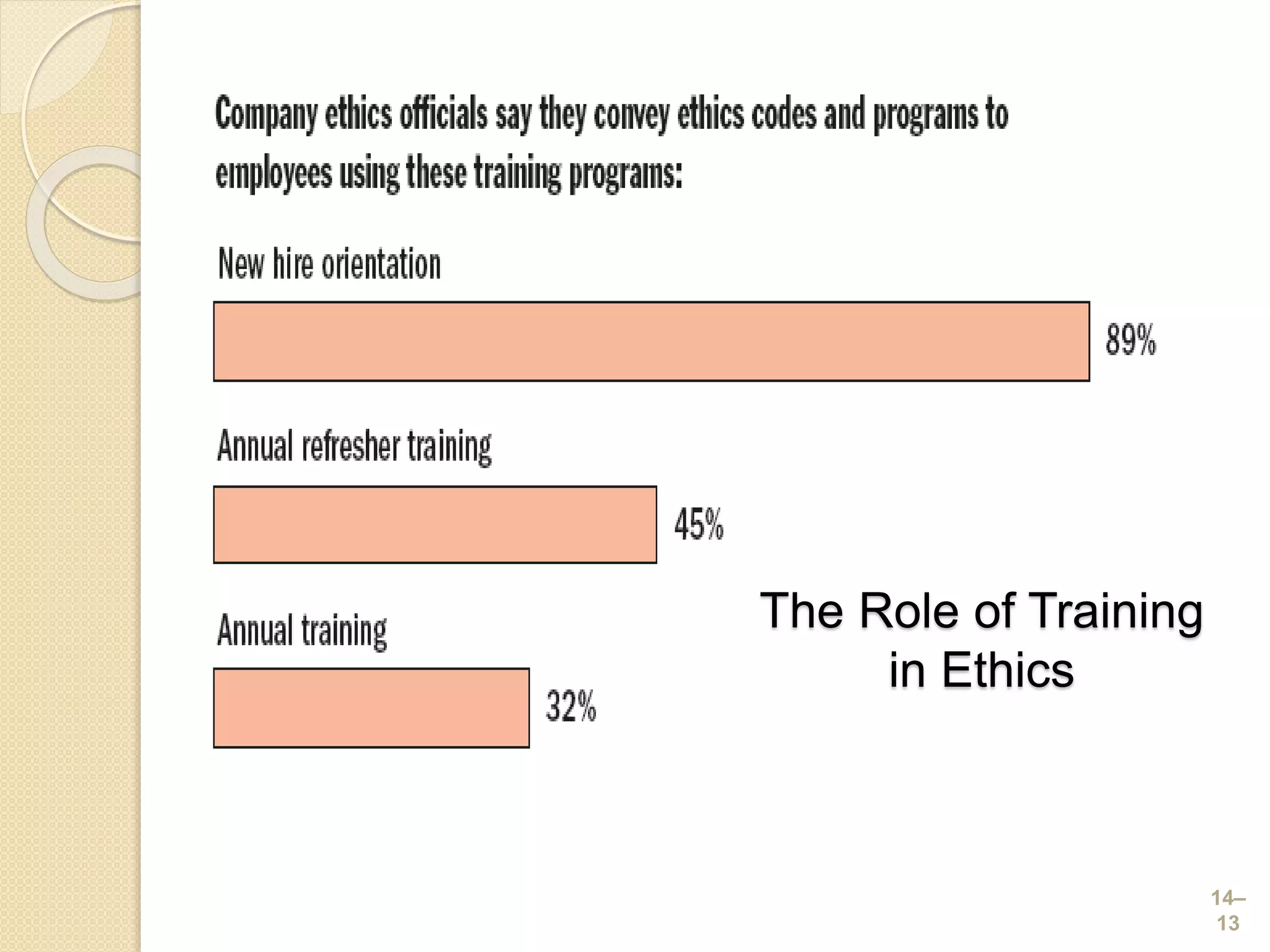
The Role of Training
in Ethics
14–
14
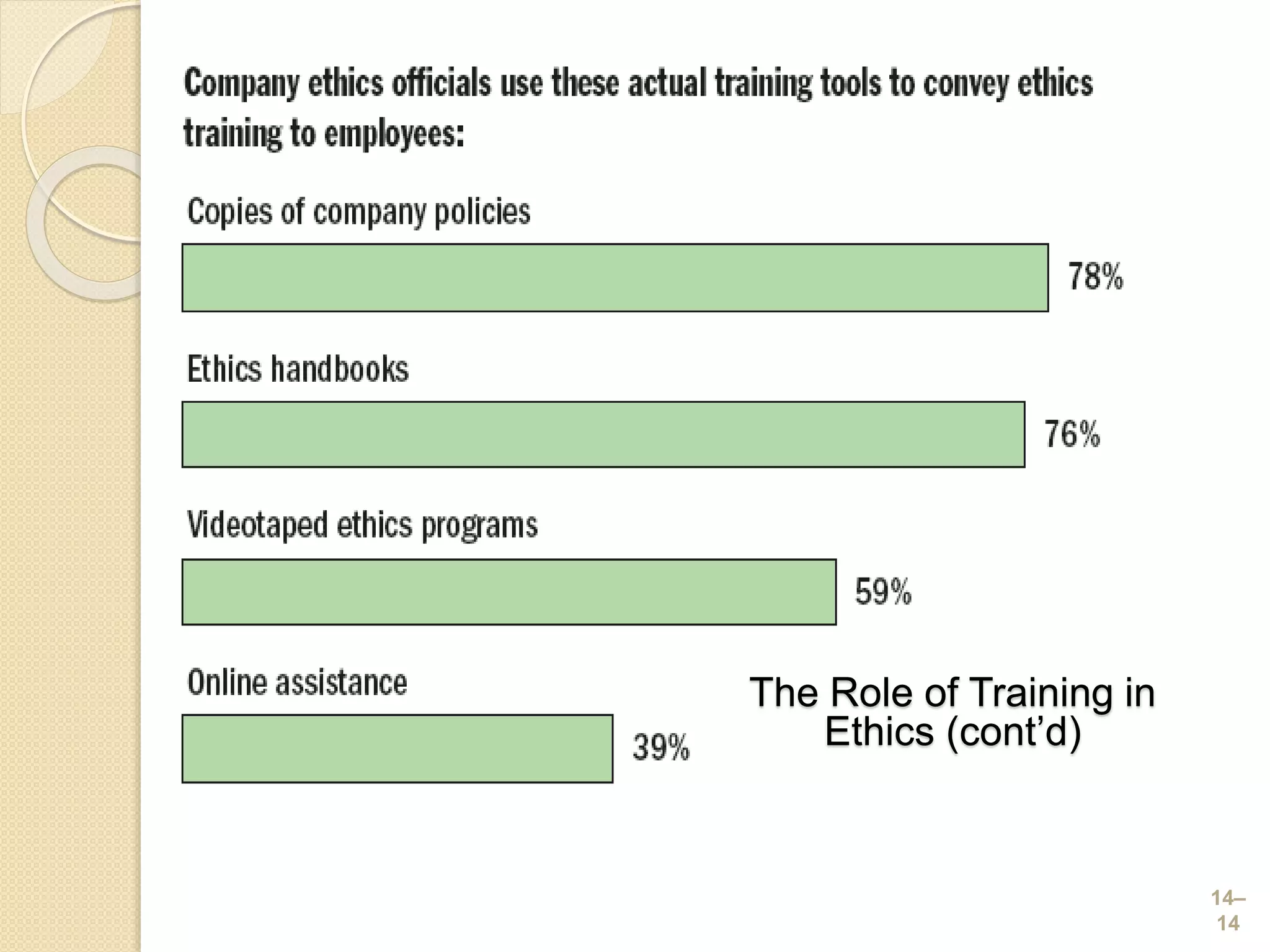
The Role of Training in
Ethics (cont’d)
Employee Discipline and
Privacy
 Basis for a fair and just discipline process
◦ Clear rules and regulations
It address issues such as theft, destruction of company property etc
Poor Performance is not Acceptable
Alcohol and drugs have no place at work
◦ A system of progressive penalties
The range and severity of the penalty reflects the type of offense
and number of occurrences. It range from oral warnings to
written warnings to suspension from the job to discharge.
14–
15
Positive, or Nonpunitive,
Discipline
Discipline without punishment, System of
discipline that focuses on the early
correction of employee misconduct, with
the employee taking total responsibility for
correcting the problem
14–
16
13-17
Positive Discipline Procedure
Terminate
First
Conference
(Oral Reminder)
Decision-
Making
Leave/Decision
Day
Second
Conference
(Written
Reminder)
Unsolved Unsolved
Unsolved
Employee Privacy
 Employee privacy violations upheld by courts:
◦ Intrusion (locker room and bathroom surveillance)
◦ Publication of private matters
◦ Disclosure of medical records
◦ Appropriation of an employee’s name or likeness
Employee Monitoring
It includes Biometrics using Physical traits such as finger prints
scans for identification.
Most employers are using iris scanning to verify employee
identity. It tends to be accurate authorization device.
Federal Aviation Authority uses it to control employees access
to its Computer system
14–
18
Managing Dismissals
 Dismissal
It is described as Involuntary termination of an
employee’s employment with the firm. Many dismissals
start with bad hiring decisions. Effective selection
process can reduce the need for many dismissals.
 Terminate-at-will rule
 Wrongful Discharge
14–
19
 Terminate-at-will rule
Without a contract, the employee can resign for any
reason, at will, and the employer can similarly dismiss the
employee for any reason (or no reason), at will.
Limitations on “terminate-at-will”
1. Implied contract exception
Employer statements about future employment create a
contractual obligation for the employer to continue to
employ the employee.
2. Good faith exception
 Suggests that employers should not fire employees
without good cause.
© 2005 Prentice Hall Inc. All rights
reserved.
14–
20
Wrongful Discharge
 Bases for wrongful discharge suits:
◦ Discharge does not comply with the law.
◦ Discharge does not comply with the contractual
arrangement stated or implied by the firm via its
employment application forms, employee manuals, or other
promises.
 Avoiding wrongful discharge suits
◦ Set up employment policies and dispute resolution
procedures that make employees feel treated fairly.
◦ Do the preparatory work that helps to avoid such suits.
14–
21
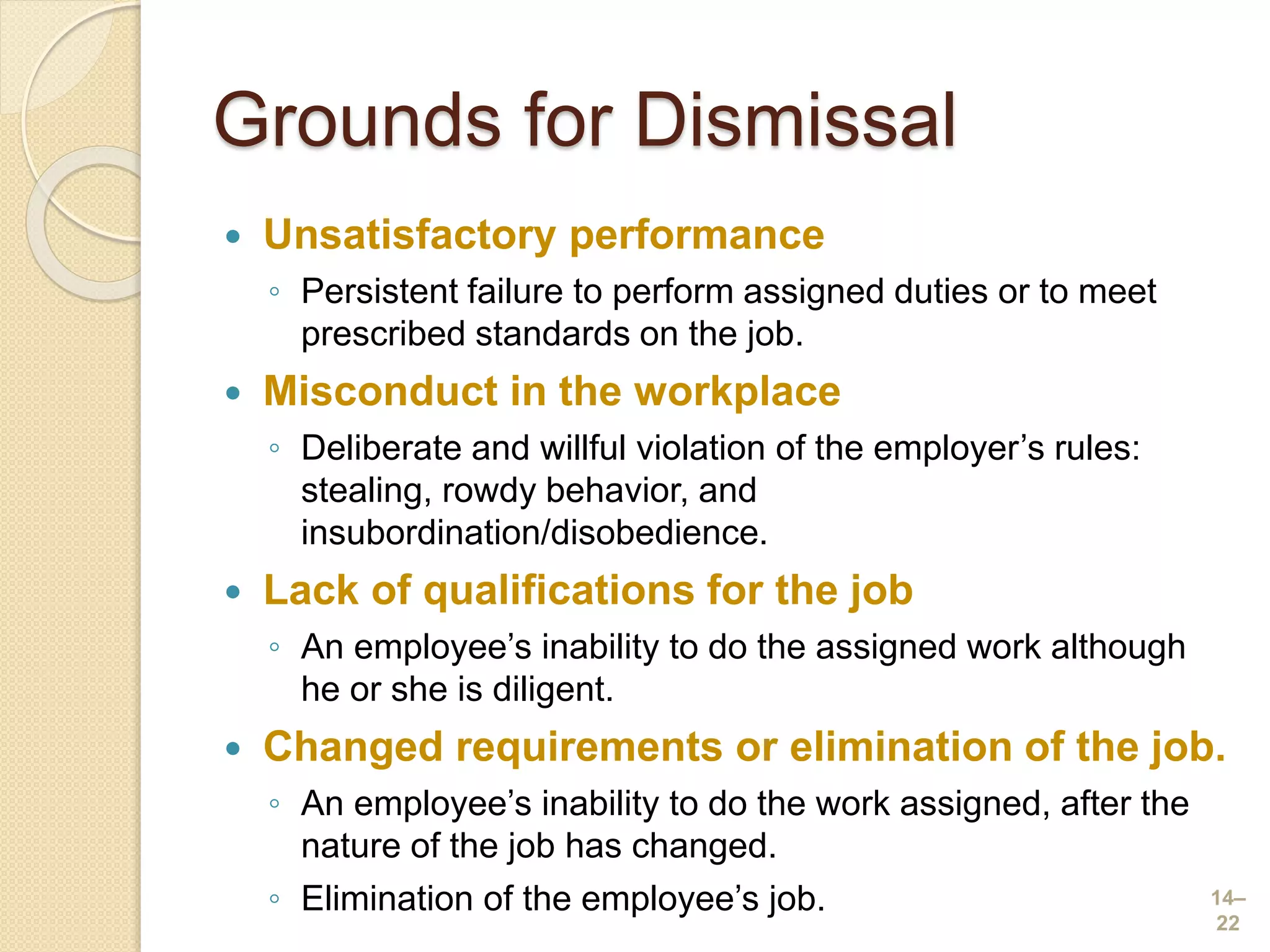
Grounds for Dismissal
 Unsatisfactory performance
◦ Persistent failure to perform assigned duties or to meet
prescribed standards on the job.
 Misconduct in the workplace
◦ Deliberate and willful violation of the employer’s rules:
stealing, rowdy behavior, and
insubordination/disobedience.
 Lack of qualifications for the job
◦ An employee’s inability to do the assigned work although
he or she is diligent.
 Changed requirements or elimination of the job.
◦ An employee’s inability to do the work assigned, after the
nature of the job has changed.
◦ Elimination of the employee’s job. 14–
22
Personal Supervisory Liability
Courts hold managers personally liable for supervisory actions
covered by fair labor standard act.
 Avoiding personal supervisory liability:
◦ Be familiar with federal, state, and local statutes and know
how to uphold their requirements.
◦ Follow company policies and procedures
◦ Be consistent application of the rule or regulation is
important.
◦ Don’t administer discipline in a manner that adds to the
emotional hardship on the employee.
◦ Do not act in anger.
◦ Utilize the HR department for advice regarding how to
handle difficult disciplinary matters.
14–
23
The Termination Interview
 Plan the interview carefully.
◦ Make sure the employee keeps the appointment time.
◦ Never inform an employee over the phone.
◦ Allow 10 minutes as sufficient time for the interview.
◦ Use a neutral site, never your own office.
◦ Have employee agreements, the human resource file, and
a release announcement (internal and external) prepared
in advance.
◦ Be available at a time after the interview in case questions
or problems arise.
◦ Have phone numbers ready for medical or security
emergencies.
14–
24
The Termination Interview
(cont’d)
 Get to the point.
◦ Do not beat around the bush by talking about the weather
or making other small talk. As soon as the employee
enters, give the person a moment to get comfortable and
then inform him or her of your decision.
 Describe the situation.
◦ Briefly explain why the person is being let go.
◦ Remember to describe the situation rather than attack the
employee personally. Emphasize that the decision is final
and irrevocable.
 Listen.
◦ Continue the interview until the person appears to be
talking freely and reasonably calmly about the reasons for
his or her termination and the support package (including
severance pay). 14–
25
The Termination Interview
(cont’d)
 Review all elements of the severance package.
◦ Describe severance payments, benefits, access to office
support people, and the way references will be handled.
However, under no conditions should any promises or
benefits beyond those already in the support package be
implied.
 Identify the next step.
◦ The terminated employee may be disoriented and unsure
what to do next.
◦ Explain where the employee should go next, upon leaving
the interview.
14–
26
Termination Assistance
 Outplacement Counseling
 Outplacement does not imply that the employer
takes responsibility for placing the person in a
new job.
 Outplacement counseling is part of the
terminated employee’s support or severance
package and is often done by specialized
outside firms.
14–
27
Layoffs & Downsizing
 Layoff are not terminations. It refers to having
selected employees take time off with expectation
that they will come back to work.
 Temporary layoffs occur when:
◦ There is no work available for employees.
◦ Management expects the no-work situation to be
temporary and probably short term.
◦ Management intends to recall the employees
when work is again available.
14–
28
Downsizing
 Downsizing refers to permanently
dismissing a relatively large proportion of
employees in an attempt to improve
productivity and competitiveness. Other
employees may resign to retire or to look for
better jobs.
© 2005 Prentice Hall Inc. All rights
reserved.
14–
29
Adjusting to Downsizings and
Mergers
 Guideline for implementing a reduction
in force:
◦ Identify objectives and constraints.
◦ Form a downsizing team.
◦ Address legal issues.
◦ Plan post-reduction actions.
◦ Address security concerns.
14–
30
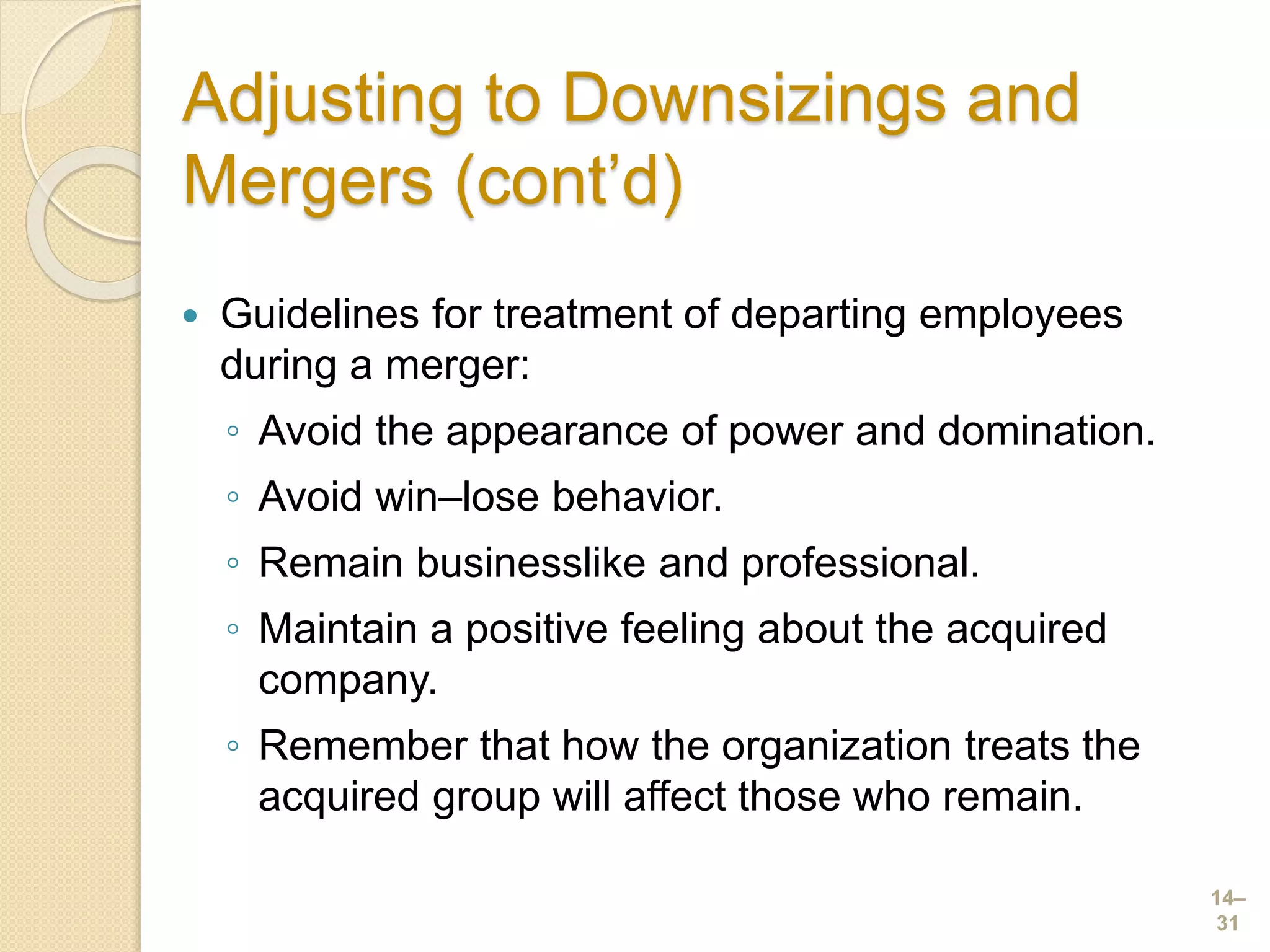
Adjusting to Downsizings and
Mergers (cont’d)
 Guidelines for treatment of departing employees
during a merger:
◦ Avoid the appearance of power and domination.
◦ Avoid win–lose behavior.
◦ Remain businesslike and professional.
◦ Maintain a positive feeling about the acquired
company.
◦ Remember that how the organization treats the
acquired group will affect those who remain.
14–
31
Employee Morale and
Behavior Improves
When Justice
Prevails
14–
32
Thank You
© 2005 Prentice Hall Inc. All rights
reserved.
14–
33

Human Resource Management, Ethics, Organizational Culture

  • 1.
  • 2.
    Presentation Topic: Ethics andEmployee Rights and Discipline © 2005 Prentice Hall Inc. All rights reserved. 14– 2
  • 3.
    After studying thischapter, you should be able to: 1. Ethical behavior at work. 2. Important factors that shape ethical behavior at work. 3. Specific ways in which HR management can influence ethical behavior at work. 4. Employ fair disciplinary practices. 5. Important factors in managing dismissals effectively.
  • 4.
    Ethics and FairTreatment at Work  Ethics ◦ The principles of conduct governing an individual or a group; specifically, the standards you use to decide what your conduct should be. ◦ Ethical behavior depends on the person’s frame of reference. 14– 4
  • 5.
    Factors affecting ethical decisions Normative judgments ◦ Judging something as good or bad, right or wrong, better or worse. You are wearing a great outfit ! Is a normative statement  Moral standards (Morality) ◦ Society’s accepted standards for behaviors that have serious consequences to its well- being.  Behaviors that cannot be established or changed by decisions of authoritative bodies.  Behaviors that override self-interest. 14– 5
  • 6.
    Ethics and FairTreatment at Work (cont’d)  Ethics and the law ◦ An behavior may be legal but unethical. ◦ An behavior may be illegal but ethical. ◦ An behavior may be both legal and ethical. ◦ An behavior may be both illegal and unethical. 14– 6
  • 7.
    Ethics, Fair Treatment,and Justice  Distributive justice ◦ The fairness and justice of a decision’s result.  Procedural justice ◦ The fairness of the process by which the decision was reached.  Interactional (interpersonal) justice ◦ The manner in which managers conduct their interpersonal dealings with employees. 14– 7
  • 8.
    What Shapes EthicalBehavior at Work?  Individual factors  Organizational factors  The boss’s influence  Ethics policies and codes  The organization’s culture 14– 8
  • 9.
    Individual factors • There'sNo One smoking Gun: Ethics Research Concluded that three factors combine to determine the ethical choices a person makes. ‘Bad apples’, bad cases, and bad barrels.’ Instead ‘bad apples’ (people who make unethical choices) ‘bad cases’ ( ethical situations ripe for unethical choices) ‘bad barrels’ (Environments which Foster unethical choices) • Individual Characteristics • Which ethical situations make for bad • What are the ‘ bad barrels’? 14– 9
  • 10.
    Organizational factors & Theboss’s influence • Company Pressures: If people did unethical things at work for personal Gain, it perhaps would be understandable. One study asked employees to list their reasons for taking unethical actions at work. For Most of these employees ‘meeting schedule pressures’ • Pressure From The Boss: According to one report ‘ The level of misconduct at work dropped when employees said their supervisors exhibited ethical behaviour. Only 25 percent of employees who agreed that their supervisors ‘set a good example of ethical business behaviour ‘ said they had observed misconduct in the last year compared with 72 percent of those who did not feel that their supervisors set good ethical examples 14– 10
  • 11.
    What Is Organizational Culture? Thecharacteristic values, traditions, and behaviors a company’s employees share.  Clarifying expectations: First managers should make clear their expectations with respect to values they want subordinates to follow.  Using signs and symbols: Symbolism,- What the manager actually does and thus the signals he or she sends. Managers need to ‘Walk the Talk’. They cant expect to say  Providing Physical Support: The physical manifestations of managers values- The firm incentive plans, disciplinary procedures, For instance signals Employees regarding What they should and should not do , For example Does the firm reward Ethical Behaviour? 14– 11
  • 12.
    HR Methods topromote Ethics & fair treatment  Staffing and Selection  Ethics Training  Performance Appraisal  Reward & Disciplinary Systems 14– 12
  • 13.
    14– 13 The Role ofTraining in Ethics
  • 14.
    14– 14 The Role ofTraining in Ethics (cont’d)
  • 15.
    Employee Discipline and Privacy Basis for a fair and just discipline process ◦ Clear rules and regulations It address issues such as theft, destruction of company property etc Poor Performance is not Acceptable Alcohol and drugs have no place at work ◦ A system of progressive penalties The range and severity of the penalty reflects the type of offense and number of occurrences. It range from oral warnings to written warnings to suspension from the job to discharge. 14– 15
  • 16.
    Positive, or Nonpunitive, Discipline Disciplinewithout punishment, System of discipline that focuses on the early correction of employee misconduct, with the employee taking total responsibility for correcting the problem 14– 16
  • 17.
    13-17 Positive Discipline Procedure Terminate First Conference (OralReminder) Decision- Making Leave/Decision Day Second Conference (Written Reminder) Unsolved Unsolved Unsolved
  • 18.
    Employee Privacy  Employeeprivacy violations upheld by courts: ◦ Intrusion (locker room and bathroom surveillance) ◦ Publication of private matters ◦ Disclosure of medical records ◦ Appropriation of an employee’s name or likeness Employee Monitoring It includes Biometrics using Physical traits such as finger prints scans for identification. Most employers are using iris scanning to verify employee identity. It tends to be accurate authorization device. Federal Aviation Authority uses it to control employees access to its Computer system 14– 18
  • 19.
    Managing Dismissals  Dismissal Itis described as Involuntary termination of an employee’s employment with the firm. Many dismissals start with bad hiring decisions. Effective selection process can reduce the need for many dismissals.  Terminate-at-will rule  Wrongful Discharge 14– 19
  • 20.
     Terminate-at-will rule Withouta contract, the employee can resign for any reason, at will, and the employer can similarly dismiss the employee for any reason (or no reason), at will. Limitations on “terminate-at-will” 1. Implied contract exception Employer statements about future employment create a contractual obligation for the employer to continue to employ the employee. 2. Good faith exception  Suggests that employers should not fire employees without good cause. © 2005 Prentice Hall Inc. All rights reserved. 14– 20
  • 21.
    Wrongful Discharge  Basesfor wrongful discharge suits: ◦ Discharge does not comply with the law. ◦ Discharge does not comply with the contractual arrangement stated or implied by the firm via its employment application forms, employee manuals, or other promises.  Avoiding wrongful discharge suits ◦ Set up employment policies and dispute resolution procedures that make employees feel treated fairly. ◦ Do the preparatory work that helps to avoid such suits. 14– 21
  • 22.
    Grounds for Dismissal Unsatisfactory performance ◦ Persistent failure to perform assigned duties or to meet prescribed standards on the job.  Misconduct in the workplace ◦ Deliberate and willful violation of the employer’s rules: stealing, rowdy behavior, and insubordination/disobedience.  Lack of qualifications for the job ◦ An employee’s inability to do the assigned work although he or she is diligent.  Changed requirements or elimination of the job. ◦ An employee’s inability to do the work assigned, after the nature of the job has changed. ◦ Elimination of the employee’s job. 14– 22
  • 23.
    Personal Supervisory Liability Courtshold managers personally liable for supervisory actions covered by fair labor standard act.  Avoiding personal supervisory liability: ◦ Be familiar with federal, state, and local statutes and know how to uphold their requirements. ◦ Follow company policies and procedures ◦ Be consistent application of the rule or regulation is important. ◦ Don’t administer discipline in a manner that adds to the emotional hardship on the employee. ◦ Do not act in anger. ◦ Utilize the HR department for advice regarding how to handle difficult disciplinary matters. 14– 23
  • 24.
    The Termination Interview Plan the interview carefully. ◦ Make sure the employee keeps the appointment time. ◦ Never inform an employee over the phone. ◦ Allow 10 minutes as sufficient time for the interview. ◦ Use a neutral site, never your own office. ◦ Have employee agreements, the human resource file, and a release announcement (internal and external) prepared in advance. ◦ Be available at a time after the interview in case questions or problems arise. ◦ Have phone numbers ready for medical or security emergencies. 14– 24
  • 25.
    The Termination Interview (cont’d) Get to the point. ◦ Do not beat around the bush by talking about the weather or making other small talk. As soon as the employee enters, give the person a moment to get comfortable and then inform him or her of your decision.  Describe the situation. ◦ Briefly explain why the person is being let go. ◦ Remember to describe the situation rather than attack the employee personally. Emphasize that the decision is final and irrevocable.  Listen. ◦ Continue the interview until the person appears to be talking freely and reasonably calmly about the reasons for his or her termination and the support package (including severance pay). 14– 25
  • 26.
    The Termination Interview (cont’d) Review all elements of the severance package. ◦ Describe severance payments, benefits, access to office support people, and the way references will be handled. However, under no conditions should any promises or benefits beyond those already in the support package be implied.  Identify the next step. ◦ The terminated employee may be disoriented and unsure what to do next. ◦ Explain where the employee should go next, upon leaving the interview. 14– 26
  • 27.
    Termination Assistance  OutplacementCounseling  Outplacement does not imply that the employer takes responsibility for placing the person in a new job.  Outplacement counseling is part of the terminated employee’s support or severance package and is often done by specialized outside firms. 14– 27
  • 28.
    Layoffs & Downsizing Layoff are not terminations. It refers to having selected employees take time off with expectation that they will come back to work.  Temporary layoffs occur when: ◦ There is no work available for employees. ◦ Management expects the no-work situation to be temporary and probably short term. ◦ Management intends to recall the employees when work is again available. 14– 28
  • 29.
    Downsizing  Downsizing refersto permanently dismissing a relatively large proportion of employees in an attempt to improve productivity and competitiveness. Other employees may resign to retire or to look for better jobs. © 2005 Prentice Hall Inc. All rights reserved. 14– 29
  • 30.
    Adjusting to Downsizingsand Mergers  Guideline for implementing a reduction in force: ◦ Identify objectives and constraints. ◦ Form a downsizing team. ◦ Address legal issues. ◦ Plan post-reduction actions. ◦ Address security concerns. 14– 30
  • 31.
    Adjusting to Downsizingsand Mergers (cont’d)  Guidelines for treatment of departing employees during a merger: ◦ Avoid the appearance of power and domination. ◦ Avoid win–lose behavior. ◦ Remain businesslike and professional. ◦ Maintain a positive feeling about the acquired company. ◦ Remember that how the organization treats the acquired group will affect those who remain. 14– 31
  • 32.
    Employee Morale and BehaviorImproves When Justice Prevails 14– 32
  • 33.
    Thank You © 2005Prentice Hall Inc. All rights reserved. 14– 33