Diploma
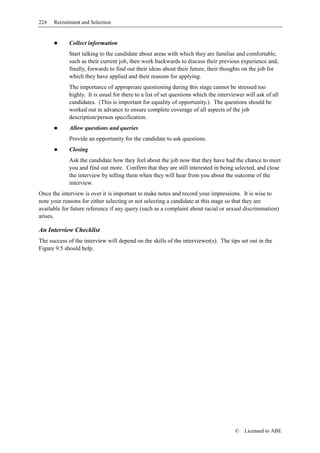
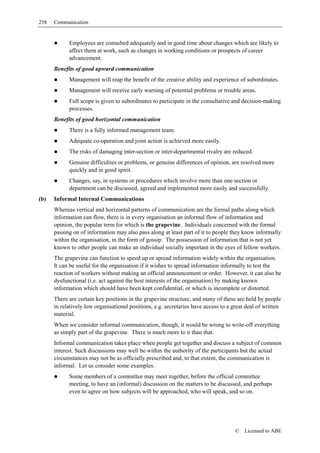
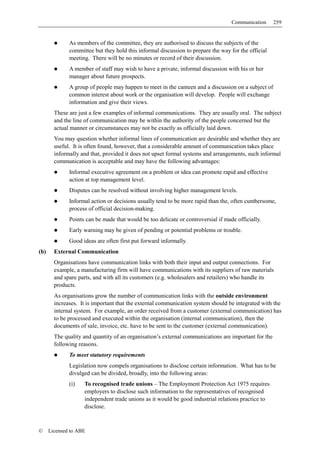
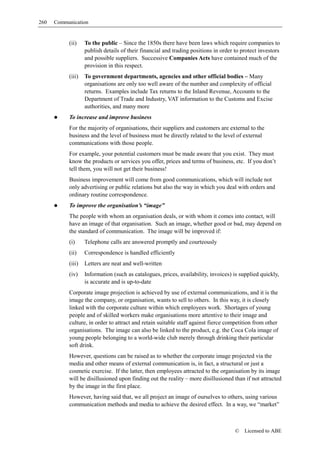
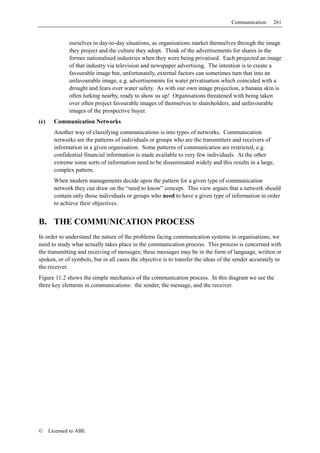
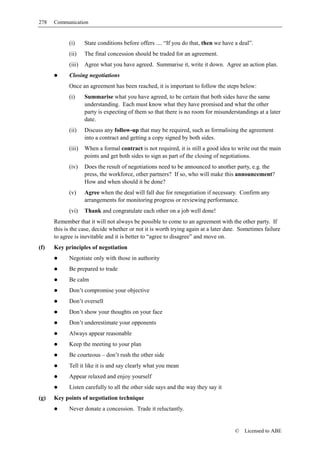
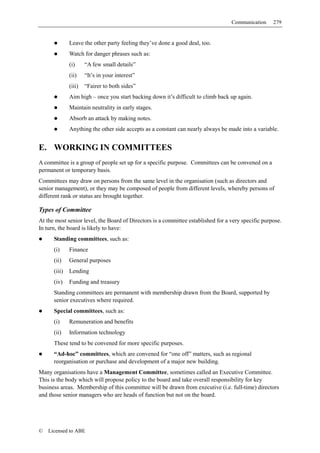
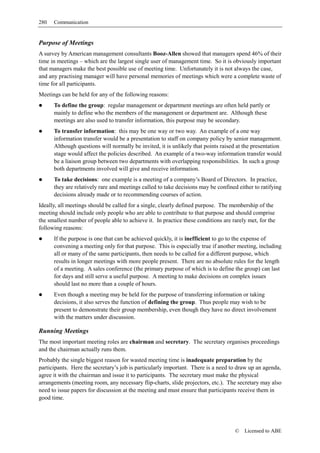
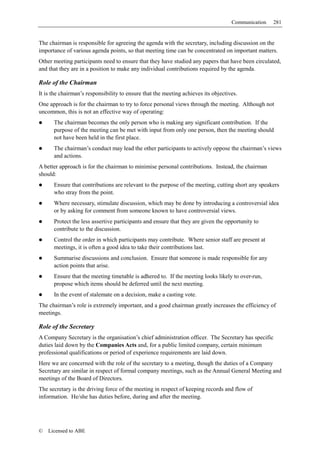
                               in
                     Business Administration

                              Study Manual


        Human Resource Management


                     The Association of Business Executives
William House • 14 Worple Road • Wimbledon • London • SW19 4DD • United Kingdom
                Tel: + 44(0)20 8879 1973 • Fax: + 44(0)20 8946 7153
                     E-mail: info@abeuk.com • www.abeuk.com
© Copyright RRC Business Training

© Copyright under licence to ABE from RRC Business Training                   abc
All rights reserved
No part of this publication may be reproduced, stored in a retrieval system, or transmitted in
any form, or by any means, electronic, electrostatic, mechanical, photocopied or otherwise,
without the express permission in writing from The Association of Business Executives.
ABE Diploma in Business Administration
                                 Study Manual


                   Human Resource Management

                                    Contents

Study                                    Title         Page
Unit

        Syllabus                                          i

 1      Management and Leadership                         1
          What is Management?                             2
          Leadership in the Context of Management        11
          Action-Centred Leadership                      14
          Leadership Styles                              17
          Contingency Theories of Leadership             20

 2      Management Accountability and Responsibility     25
          The Breadth of Accountability                  26
          Management and Social Responsibility           32
          Equal Opportunities                            36
          The Ethics of Managers                         44

 3      Management and the Changing Organisation         51
          Organisational Culture                         53
          The Learning Organisation                      58
          The Culture of Quality                         60
          The Culture of Enterprise                      62
          Business Process Re-Engineering                63
          The Impact of Globalisation                    66
          Current Trends in Organisations                69

 4      Management and Motivation                        77
          What is Motivation?                            78
          People at Work                                 78
          Needs Theories of Motivation                   85
          Models of Behaviour and Motivation             89
          Process Theories of Motivation                 92
          Excellence Theory and Motivation               95
5    Organising and Motivating                            97
       Delegation                                         99
       Empowerment                                       105
       Centralisation/Decentralisation                   110
       Gaining Commitment to Organisational Objectives   116
       Jobs                                              120
       Rewards                                           125

6    Management Control                                  133
       The Basic Elements of the Control Process         135
       Setting Standards                                 136
       Measuring and Comparing Performance               138
       Tackling Deviations from Standard                 140
       Control Systems                                   144
       Human Behaviour and Control Systems               147
       Performance Management                            150
       Disciplinary and Grievance Procedures             153

7    Managing and Enhancing Performance                  159
       Performance Appraisal Systems                     161
       The Appraisal Process                             165
       Management by Objectives                          170
       The Manager as Facilitator                        176
       Coaching                                          179
       Counselling                                       181
       Mentoring                                         183
       Dealing with Problem Performers                   184

8    Human Resource Planning                             187
       What is Human Resource Planning?                  188
       The Process of Human Resource Planning            189
       Trends in Employment                              195
       Changing Patterns of Work                         198

9    Recruitment and Selection                           205
       The Recruitment and Selection Process             206
       Defining the Vacancy                              207
       Casting the Net                                   215
       Selection Procedures                              220
       Employee Induction                                229

10   Employee Development                                233
       Organisations, Individuals and Development        234
       Identifying Training and Development Needs        239
       The Learning Process                              241
       Training Methods                                  248
11   Communication                      253
       Communication in Organisations   254
       The Communication Process        261
       Methods of Communication         265
       Effective Communication          269
       Working in Committees            279
i


                 Diploma in Business Administration – Part 2
                            Human Resource Management
                                             Syllabus


Introduction
It is a truism to claim that people are an organisational resource – indeed for some organisations, they
are the key resource, without which the organisation would be unable to deliver any meaningful
product or service to its customers. Like any resource, however, people may be used wastefully: they
may be employed at well below their potential, performing tasks which do not stretch their
capabilities and which are ultimately alienating in their psychological impact on the employees
involved. Alternatively, people may be managed and led in ways which inspire them to be highly
motivated and to demonstrate long-term commitment to both their roles and the organisation which
employs them. When this is achieved, the performance of its people becomes a major differentiator
for the organisation and a source of long-term competitive strength.
Human Resource Management is about the managerial and leadership processes which enable people
to give of their best in today’s turbulent working scenarios. To that end, the syllabus content is less
concerned with the academic study of human and organisational behaviour, but concentrates more on
the development of effective, pragmatic, yet innovative solutions to the issues surrounding the need to
maximise people’s productivity, efficiency and effectiveness.

Aims
Again this conceptual background, the aims for the module are as follows:
To develop the student’s knowledge and understanding of:
1.     Individual differences, especially in such fields as learning, personality, motivation and
       attitudes, with particular reference to the relevance of such differences for recruitment,
       selection, deployment, development, and employee performance in an organisational setting.
2.     The changing nature of the “psychological contact” between organisations and their employees,
       together with the implications for employability, flexible working, commitment, and
       managerial leadership.
3.     Each major dimension of human resource management in practice, i. e. human resource
       planning, recruitment, selection, induction, training/development, reward systems, and people
       review/appraisal.
4.     Techniques for effective communication in all work-related situations, i. e. with subordinates,
       with seniors, through collective representational procedures, and with teams.

Programme Content and Learning Objectives
Note that all the following objectives are concerned principally with practical application rather
than academic theory. Students will be expected to familiarise themselves with all relevant
underpinning theories, but the emphasis in the tuition process and in the examination will and
should concentrate on specific techniques for resolving human resource issues and for improving
people performance across all types of organisation.


©    Copyright ABE
ii


After completing the programme, the student should be able to:
1.    Differentiate the fundamental characteristics of people, with particular regard to such factors as
      culture, gender, ethnicity, personality, attitudes, and motivation, and assess the implications of
      such differences for the purposes of effective human resource management.
2.    Clarify the mechanisms for individual and organisational learning, including ways of enhancing
      the effectiveness of deliberate learning processes and of overcoming the barriers to productive
      learning, again with a focus on the significance of learning from the viewpoint of enhancing
      organisational effectiveness.
3.    Recognise the significance of the emergent “psychological contract” in terms of new employer
      expectations about “added value”, employability, and the factors which will continue to
      influence the nature of employment in the vast majority of organisations.
4.    Apply alternative systems of flexible working to meet fluctuating corporate needs.
5.    Accept the obligations of ethicality in governing the actions of managers, employees, and
      corporate entities.
6.    Acknowledge the differences between “management” and “leadership” against a background in
      which organisations are moving from a focus on compliance to a desire for commitment, and
      recommend the installation of appropriate mechanisms for generating employee commitment in
      all types of corporate setting.
7.    Maximise individual and collective employee performance, in specific organisational,
      functional, departmental or managerial scenarios, through effective motivation, job design,
      reward/recognition processes, and “performance management”.
8.    Handle difficult people-management situations through systematic grievance-handling
      mechanisms, directive or non-directive counselling, coaching, and ultimately by means of
      disciplinary action and dismissal.
9.    Apply each of the procedures and skills associated with the major arenas for personnel
      management, viz., human resource planning, recruitment, selection, induction,
      training/development, reward/recognition, review/appraisal, employee relations, welfare, health
      and safety responsibilities, discipline, and grievance-handling, in both remedial and continuous-
      improvement circumstances. [Several of these themes are mentioned elsewhere in the syllabus,
      but are repeated here in order to ensure completeness.]
10.   Communicate effectively in all relevant organisational situations, i.e., meetings, presentations,
      and negotiating.

Method of Assessment
By written examination. The pass mark is 40%. Time allowed 3 hours.
The question paper will contain:
Eight questions from which the candidate will be required to answer any four. All questions carry 25
marks.


                                                                                      ©   Copyright ABE
iii


Recommended Reading

Lead text
!       Torrington, D. and Hall, L. (1998), Human Resource Management; 4th edition, Prentice-Hall

Other recommended texts
!       Armstrong, M. (1998), Managing People: A Practical Guide; Kogan Page
!       White, A. (1998), The Essential Guide to Developing Your Staff; Piatkus
!       Herriot, P., Hirsch, W. and Riley, P. (1998), Trust and Transition: Managing Today’s
        Employment Relationship; Wiley
!       Goss, D. (1994), Principles of Human Resource Management; Routledge
!       Cushway, B. (1994), Human Resource Management; Kogan Page


Students should also read suitable quality newspapers and periodicals for articles about human
resource management (covering new techniques or applications in named companies), and if possible
should download up-to-date thinking via suitable search engines on the Internet.


©     Copyright ABE
iv


     ©   Copyright ABE
1


      Study Unit 1
      Management and Leadership

      Contents                                                    Page


      A.    What is Management?                                      2
            Towards a Definition                                     2
            Do Organisations need Management?                        4
            Management Processes                                     4
            Management Roles                                         6
            Management Activities                                    7


      B.    Leadership in the Context of Management                 11
            What is a Leader?                                       11
            Formal and Informal Leaders                             11
            Power and Leadership                                    12
            Leadership Qualities                                    13


      C.    Action-Centred Leadership                               14


      D.    Leadership Styles                                       17
            A Continuum of Leadership Styles                        17
            People v Production Orientation                         18
            Reddin’s 3D Theory                                      19
            Likert’s Employee-Centred Supervision                   20


      E.    Contingency Theories of Leadership                      20
            Fiedler's Contingency Model                             20
            Hersey and Blanchard’s Situational Leadership Model     21
            Handy’s Contingency Model                               22


©   Licensed to ABE
2     Management and Leadership


A. WHAT IS MANAGEMENT?
“Management” is one of those words which we all use and which we think we understand until we are
asked exactly what it means.
At its most general, management may be viewed as a process which enables organisations to achieve
their objectives. The inclusion of the word “process” tells us that something is going on. Thus, the
question “what is management?” is, perhaps, best turned into “what do managers do?”.

Towards a Definition
There are almost as many definitions of management as there are writers about the subject – and that
is a lot! We shall start here by briefly considering a number which illustrate the range of possible
views of the subject.
!     H Fayol
      An early classic definition was put forward by Fayol:
            “To manage is to forecast and plan, to organise, to command (we would now term
            this “to direct”), to coordinate and to control.”
      Fayol stresses the authoritative role of management – he does not mention motivation or any
      special qualities of leadership.
!     Making Resources Productive – Peter Drucker
      Peter Drucker, probably the most widely read present-day writer on general management, in his
      book “The Practice of Management” wrote:
            “Management is the organ of society specifically charged with making resources
            productive.”
      This is a wide-ranging claim, firmly pinning the need for a sense of social responsibility on
      managers. It is their task, according to this view, to take the resources available to society and
      make something better from them – to utilise staff and other resources in such a way that more
      will become available to all. In a real sense, he is claiming that the manager’s raison d’être is to
      make a better life for society.
      He also points out an analogy with the animal world (“Management: Tasks, Responsibilities,
      Practices”). He compares a business operated by an owner-entrepreneur with “helpers”, with
      an insect which is held together by a tough, hard skin. A business with managers is likened to a
      vertebrate animal with a skeleton. Land animals supported by a hard skin cannot grow beyond
      a few inches; to be larger, animals must have a skeleton. So, the need for management is
      associated with size. But as the skeleton has not evolved from the hard skin of the insect, so
      management is not a successor to the owner-entrepreneur – it is its replacement.
      When considering at which point the size of an organisation demands management, Drucker
      suggests that the need usually occurs when the number of employees reaches between 300 and
      1,000. There are, of course, exceptions to this rule and he quotes the case of a laboratory
      employing 20 scientists where, by the complexity of operations, the enterprise started to
      flounder without a management structure.


                                                                                     ©   Licensed to ABE
Management and Leadership        3


!     Artistic and Scientific Aspects – John Marsh
      John Marsh, a former director of the British Institute of Management (now the Institute of
      Management), was claiming much the same thing when he said:
            “Management is an art and a science concerned with the proper, systematic and
            profitable use of resources in all sections of a nation’s economy”.
      The use of resources to make a vast profit for an individual would not be a “proper” use.
      Marsh raises an interesting point by his use of the words “an art and a science”. Although
      many management techniques are “scientific” in the sense that they depend on quantification
      and objectivity, and much of management writing and research is scientific in that it depends on
      controlled experiments and measurement, there is still much of the art left. There are still many
      fields, and some might say they are the most important fields, where hunch, flair and intuition
      play a major part. This is why it is not possible to teach an individual to be a manager; he/she
      can only be helped to develop – to build on the potential that he/she has. In other words, you
      can teach people to manage better, but you cannot give them a basic managerial ability if they
      have not already got it.
!     Deciding and Delegating – R Falk, Rosemary Stewart
      A simpler, perhaps more practical definition, which has been accepted by most practising
      managers, is given by R Falk in his book “The Business of Management”. He defined
      management simply as:
            “Getting things done through people”.
      Here he is stressing the importance of people-management at the same time as stressing the
      difference between “doing” and “managing”. The technical content of a job is not managerial.
      For example, when the maintenance manager actually repairs a machine, he is not being a
      manager.
      Rosemary Stewart in “Reality of Management” adds a further dimension to this definition when
      she says management is:
            “Deciding what should be done, and then getting other people to do it”.
      As we shall see later, the decision-making facet of managerial life is one of the most important.
      Indeed, many writers feel that it is the most fundamental part of the manager’s task.
!     Establishing an Environment Conducive to Work – Koontz and O’Donnell
      There is a more sophisticated approach to the question, though, which offers an important
      insight into the manager’s role. This approach is typified by Koontz and O’Donnell, who say in
      “Principles of Management” that management is:
            “The accomplishment of desired objectives by establishing an environment
            favourable to performance by people operating in organised groups”.
      This is an important idea in that it suggests that management’s main objective is not to give
      orders and chase people about, but rather to create and maintain a work situation which is
      conducive to work. They do not, of course, simply mean the physical setting for the work and
      the provision of good working methods. They are concerned with providing the right
      motivational climate. In a very real sense, the manager is not only the boss, but also the servant
      of his employees. A large part of his job is to arrange the work to suit the needs of his
      employees.


©   Licensed to ABE
4     Management and Leadership


!     Need to Relate to the Environment – Kast and Rosenweig
      The word “environment” is used in another sense by two other writers, Kast and Rosenweig, in
      their book “The Management of Systems”. They see the firm as a system which exists within
      larger systems (its environment) and which must adjust to those larger systems in order to
      survive and grow. Their definition, then, is:
            “Management involves the coordination of human and material resources towards
            objective accomplishment. It is the primary force within organisations which
            coordinates the activities of the subsystems, and relates them to their
            environment”.
      Again, we see the stress on employment of resources and on objectives, but this definition tends
      to look outwards as well as inwards. It recognises that part of the management function within
      an organisation is to ensure that the organisation relates to what the environment demands.
      The authors developed their theories of organisations and management practices based on the
      general systems theory, which links the relevant disciplines from science, technology,
      sociology, etc. for the analysis of complex problems. A holistic rather than reductionist
      perspective is adopted.

Do Organisations need Management?
Many workers in firms and organisations express doubts as to whether they need managers, or at least
whether they need the degree of management to which they are subjected. A frequently heard lament
is “too many chiefs and not enough indians”. Certainly, there are examples of “over-management.
However, as the management experts Koontz, et al put it:
      “Management is essential in all co-operation, as well as at all levels of organisation in
      an enterprise”.
Only management can create the conditions under which an organisation can achieve its goals – an
organisation without management is like a rudderless ship.
However, we must go beyond the need for management and point to the fact that management must
be of an appropriate extent and quality for a given organisation. To pursue our ship analogy – it is
little use having a captain who steers the ship onto the rocks.

Management Processes
The above statements, being extracted from large works, tend to present a limited definition of
management, e.g. “getting things done through people” or “using resources to generate profits”.
These may be correct as far as they go, but they are single-dimension and do not explain the full range
of functions which managers perform within organisations. We need to develop an understanding of
all these.
Perhaps one of the better efforts at providing an all-embracing definition of management is that given
by E F L Brech:
      “Management is a social process entailing responsibility for effective planning and
      regulation of the operations of an enterprise in fulfilment of a given purpose”.
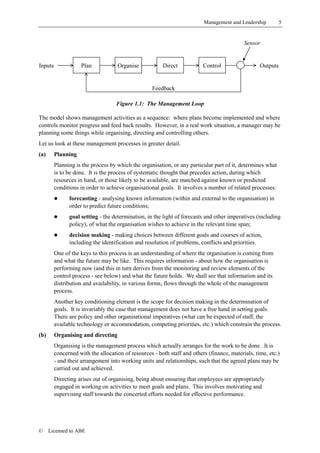
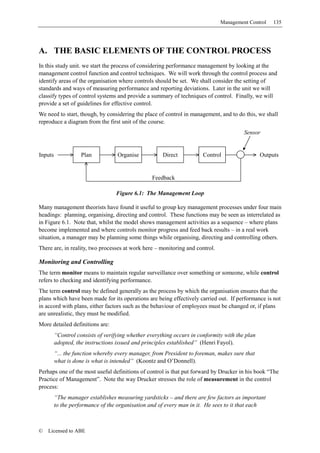
Many management theorists have found it useful to group key management processes under four main
headings: planning, organising, directing and control. These functions may be seen as interrelated as
follows:


                                                                                    ©   Licensed to ABE
Management and Leadership          5


                                                                                            Sensor


Inputs              Plan            Organise            Direct            Control                  Outputs


                                                    Feedback

                                    Figure 1.1: The Management Loop

The model shows management activities as a sequence: where plans become implemented and where
controls monitor progress and feed back results. However, in a real work situation, a manager may be
planning some things while organising, directing and controlling others.
Let us look at these management processes in greater detail.
(a)      Planning
         Planning is the process by which the organisation, or any particular part of it, determines what
         is to be done. It is the process of systematic thought that precedes action, during which
         resources in hand, or those likely to be available, are matched against known or predicted
         conditions in order to achieve organisational goals. It involves a number of related processes:
         !     forecasting - analysing known information (within and external to the organisation) in
               order to predict future conditions;
         !     goal setting - the determination, in the light of forecasts and other imperatives (including
               policy), of what the organisation wishes to achieve in the relevant time span;
         !     decision making - making choices between different goals and courses of action,
               including the identification and resolution of problems, conflicts and priorities.
         One of the keys to this process is an understanding of where the organisation is coming from
         and what the future may be like. This requires information - about how the organisation is
         performing now (and this in turn derives from the monitoring and review elements of the
         control process - see below) and what the future holds. We shall see that information and its
         distribution and availability, in various forms, flows through the whole of the management
         process.
         Another key conditioning element is the scope for decision making in the determination of
         goals. It is invariably the case that management does not have a free hand in setting goals.
         There are policy and other organisational imperatives (what can be expected of staff, the
         available technology or accommodation, competing priorities, etc.) which constrain the process.
(b)      Organising and directing
         Organising is the management process which actually arranges for the work to be done. It is
         concerned with the allocation of resources - both staff and others (finance, materials, time, etc.)
         - and their arrangement into working units and relationships, such that the agreed plans may be
         carried out and achieved.
         Directing arises out of organising, being about ensuring that employees are appropriately
         engaged in working on activities to meet goals and plans. This involves motivating and
         supervising staff towards the concerted efforts needed for effective performance.


©     Licensed to ABE
6     Management and Leadership


      The two elements are grouped together here because they combine in their effect on people.
      Organising involves both the division of the work into logical tasks and its allocation to staff,
      and the structural arrangement of staff into groups and organisational relationships. This point
      about organisational relationships is important. It implies that management is not just about the
      setting up of structures, but also the way they continue to operate - ensuring harmony in staff
      relationships, that staff are working appropriately, etc. There is a necessary overlap with the
      directing process here in respect of influencing relationships and monitoring their effect on
      performance, and also with the role of the personnel or human resource management function.
      Again it is worth noting the importance of the role of information and communication in the
      organising and directing elements of the management function. These involve not only the
      establishment of structures, but their on-going operation - working with people and ensuring
      their continuing understanding and commitment to organisational goals and the activities
      necessary for their achievement. This must require a level of communication to establish and
      maintain such conditions, and to ensure appropriate co-ordination of effort, particularly in times
      of rapid change such as we have experienced over recent years.
(c)   Controlling
      Management control is the process of monitoring and regulating performance to ensure that it
      conforms to the plans and goals of the organisation. This is not just some element added on to
      the end of the management process, but an integral part of it - control starts from the moment
      plans are put into action. It involves continuous monitoring and review of the way in which
      goals are being met through performance of the designated activities.
      A well expressed goal should include measurable targets or standards, together with a timescale
      for its achievement. These are the indices which, in an ideal world, performance is measured
      against - are the standards or targets being achieved, how well is progress being made towards
      the desired end?
      Control also involves taking the appropriate corrective action to ensure that what is actually
      happening is in accordance with the expectations of the planning process. This does not
      necessarily involve cracking down on staff who are not performing to the expected standards!
      It may, but it may also mean reviewing the plans and amending them where it can be
      demonstrated that they were defective in some way or that conditions have changed.
      Again, the process is heavily dependent upon information. Management information is crucial
      to assessing the level of achievement - financial reports, output totals, qualitative progress
      reports, etc. are the raw material of performance review. The results of this also feed back into
      the planning process as part of a on-going cycle in determining the next round of goals and
      plans (or even the review and amendment of the current ones).

Management Roles
One of the classic studies into the work of managers was conducted by the American Henry
Mintzburg in 1980. His analysis of the masses of detailed notes on exactly how managers spent their
time resulted in his developing a typology of management roles which provides a slightly different
overview of what management involves from the functional approach.
Mintzburg identified three general roles:
!     interpersonal - dealing with the maintenance of relationships with others within and outside
      the organisation;


                                                                                    ©   Licensed to ABE
Management and Leadership         7


!       informational - dealing with the gathering and provision of information, again within and
        outside the organisation;
!       decisional - dealing with organisational and operational problems and difficulties.
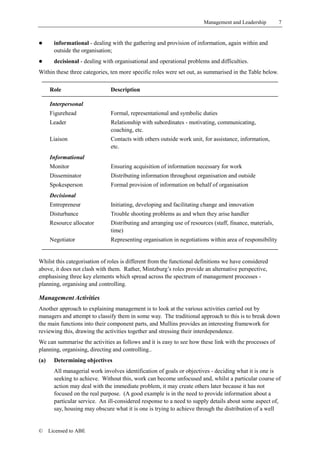
Within these three categories, ten more specific roles were set out, as summarised in the Table below.

      Role                      Description

      Interpersonal
      Figurehead                Formal, representational and symbolic duties
      Leader                    Relationship with subordinates - motivating, communicating,
                                coaching, etc.
      Liaison                   Contacts with others outside work unit, for assistance, information,
                                etc.
      Informational
      Monitor                   Ensuring acquisition of information necessary for work
      Disseminator              Distributing information throughout organisation and outside
      Spokesperson              Formal provision of information on behalf of organisation
      Decisional
      Entrepreneur              Initiating, developing and facilitating change and innovation
      Disturbance               Trouble shooting problems as and when they arise handler
      Resource allocator        Distributing and arranging use of resources (staff, finance, materials,
                                time)
      Negotiator                Representing organisation in negotiations within area of responsibility


Whilst this categorisation of roles is different from the functional definitions we have considered
above, it does not clash with them. Rather, Mintzburg’s roles provide an alternative perspective,
emphasising three key elements which spread across the spectrum of management processes -
planning, organising and controlling.

Management Activities
Another approach to explaining management is to look at the various activities carried out by
managers and attempt to classify them in some way. The traditional approach to this is to break down
the main functions into their component parts, and Mullins provides an interesting framework for
reviewing this, drawing the activities together and stressing their interdependence.
We can summarise the activities as follows and it is easy to see how these link with the processes of
planning, organising, directing and controlling..
(a)     Determining objectives
        All managerial work involves identification of goals or objectives - deciding what it is one is
        seeking to achieve. Without this, work can become unfocused and, whilst a particular course of
        action may deal with the immediate problem, it may create others later because it has not
        focused on the real purpose. (A good example is in the need to provide information about a
        particular service. An ill-considered response to a need to supply details about some aspect of,
        say, housing may obscure what it is one is trying to achieve through the distribution of a well


©     Licensed to ABE
8     Management and Leadership


      thought-out information leaflet. There are any number of inappropriate brochures about
      services which do not adequately tell people what they want to know and raise more questions
      than they answer.)
(b)   Defining the problems that need to be solved to achieve the objectives
      Having decided what it is one is seeking to achieve, the next step is to consider what problems
      must be overcome in doing it. It is easy to see the problems inherent in, say, resolving a
      problem of heavy traffic through a small rural village - difficulties of road widening, acquiring
      the land for a new road, dealing with dissenters, coping with the disruption of construction, etc.
      However, similar problems invariably occur in considering more mundane objectives - for
      example, just getting the morning’s post delivered to desks by 10.30am may raise issues of how
      the post is handled, the number of messengers employed (and what they will do for the rest of
      the day), etc. There are rarely issues which do not give rise to some sort of problem in their
      solution.
(c)   Searching for solutions to the problems which have been specified
      There is rarely just one solution to a problem, nor should management be about just picking one
      and living with it. The optimum method should be to generate a number of different ways of
      resolving the problems - road widening, new road construction, building a tunnel, etc. or
      decentralising post handling, expanding the work of the central post section, etc. There are
      obvious limits to how far management can go in searching for alternatives (particularly in terms
      of the time/cost implications), but having a range to evaluate will certainly help to clarify the
      “best” solution and probably assist in its acceptance.
(d)   Determining the best solutions to the problems
      This can be the most difficult activity. On the face of it, it is simply a matter of identifying
      effective solutions (ones that actually resolve the problems ) and then choosing the most
      efficient one. However, life is rarely that easy! In reality, there will have to be some
      compromise between effectiveness and efficiency (usually cost efficiency, but other constraints
      may also apply, such as political imperatives or availability of staff).
(e)   Securing agreement on implementation
      It may be thought that this is relatively straightforward, given that a systematic appraisal of
      alternatives has resulted in the “best” available solution being selected. However, others have
      invariably to be convinced of that as well - committees who have to agree and allocate the
      necessary funds, staff (and their representatives) who will be involved in the consequent
      changes, outside interests including government officials and sometimes ministers, dissenting
      groups and, if the issue is of sufficient importance, public opinion as well (through local and
      national media).
(f)   Preparation and issue of instructions
      This should be the easy part, but not necessarily - the activity is relatively simple, it is just that
      management is usually terrible at carrying it out! This is all about how one communicates
      decisions and directions about what needs to be done to give effect to them. The scope for
      misunderstandings, deliberate or misconceived interpretations, errors in distribution, bad
      timing, etc. is enormous. There is a real premium on the ability to prepare and disseminate
      clear, unambiguous and relevant information to the right people to the right time.


                                                                                        ©   Licensed to ABE
Management and Leadership       9


(g)     Execution of agreed solutions
        We could summarise the action necessary for this activity as being about organising, allocating
        resources and directing. Organising is the allocation of responsibilities and authority - the
        establishment of a structure of functions, roles and relationships. This is very much the difficult
        interface between the organisation’s objectives and its goals - to what extent does the former
        facilitate or hinder the achievement of the latter, and how easy is it to affect change to ensure
        compatibility. Allocating resources is about ensuring that the right people are in the right
        positions at the right time and with the right materials and equipment in order to achieve the
        desired ends. This must also involve ensuring the appropriate funding is available and that
        sufficient time has been allocated to enable the work to be done. Finally, directing is the
        business of appropriately leading, motivating and supervising the work of the members of the
        organisation. We stress “appropriately” because there is no one simple method of so doing - it
        will depend on the nature of the work, the nature of the workforce and the nature of the
        manager him/herself. Inappropriate direction can be counter-productive.
(h)     Devising and discharge of an auditing process
        The final management activity is the continuous monitoring and assessment of the extent to
        which the undertaking is successful. Success must be measured in terms of the achievement of
        the organisation’s goals as expressed in the chosen solution (remembering that the solution may
        have been a compromise that cannot be expected to be 100% effective in meeting the goals).
        The use of the term “audit” here draws a parallel with the process of checking and ensuring the
        authenticity of financial accounts - something that is well established and, by and large, done
        extremely well. More general management audits are less well established and less well done!
        Nevertheless, there is no substitute for a system of reviewing progress and controlling the
        implementation process.
There is a certain logic in considering these activities as a list since they tend to follow one after
another in the sequencing of a rational process. However, management is an on-going process, and at
any one time will involve activities across the range, often in the same project. It is impossible, in
reality, to compartmentalise these activities. In addition, it is important to note the way in which they
inter-relate and how one depends on another in order to complete the process. We can show this in
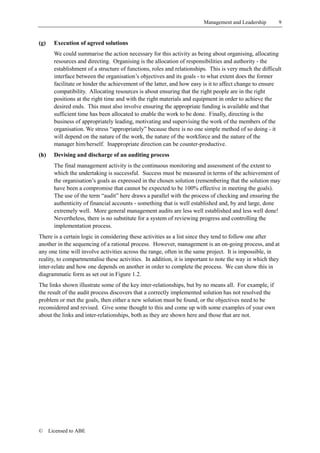
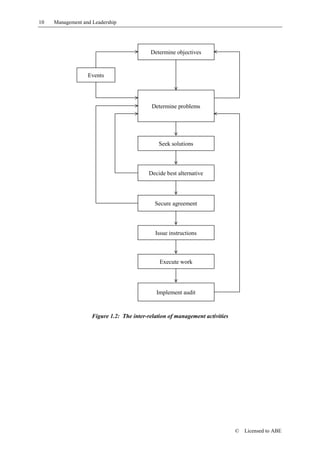
diagrammatic form as set out in Figure 1.2.
The links shown illustrate some of the key inter-relationships, but by no means all. For example, if
the result of the audit process discovers that a correctly implemented solution has not resolved the
problem or met the goals, then either a new solution must be found, or the objectives need to be
reconsidered and revised. Give some thought to this and come up with some examples of your own
about the links and inter-relationships, both as they are shown here and those that are not.


©     Licensed to ABE
10   Management and Leadership


                                           Determine objectives


                  Events


                                            Determine problems


                                              Seek solutions


                                          Decide best alternative


                                             Secure agreement


                                             Issue instructions


                                               Execute work


                                              Implement audit


                    Figure 1.2: The inter-relation of management activities


                                                                              ©   Licensed to ABE
Management and Leadership         11


B. LEADERSHIP IN THE CONTEXT OF MANAGEMENT
Many business people would contend that “management” and “leadership” are the same thing, as
many of the roles associated with a manager are similar to those expected of a leader. There is
certainly considerable overlap, and textbooks often use the words “manager” and “leader” as if they
are interchangeable.
Writing in the 1980s, Warren Bennis perhaps captured the difference between management and
leadership with his statement that “American businesses are over-managed but under-led”,
suggesting that a more inspirational attitude should be adopted by modern entrepreneurs. Tom Peters
and Robert Waterman built on this shortly afterwards, suggesting that managers needed to be
“facilitators” and “creators” rather than “controllers” or, in their words, “traffic cops”.

What is a Leader?
An organisation needs people who can direct staff towards the achievement of certain objectives.
These people we call “leaders”, and it is their responsibility to complete tasks with the assistance of
the group of staff at their disposal.
All managers and supervisors are leaders, because they need to motivate their team to achieve agreed
objectives. The task may vary from planning and carrying out a major restructuring of the company’s
organisation, to ensuring that the day’s work in a high-street outlet is processed and balanced.
There is no one correct way of effective leadership. It cannot be guaranteed that, because an
individual has certain characteristics, he will be a good leader. Charismatic leaders, who have the
ability to drive people willingly through difficult times (e.g. Churchill in World War II) have innate
natural talents. Of course, it is not sufficient just to possess these abilities - they must be used
effectively and developed over time. Most leaders need to work at their skills and, by training and
experience, build up the necessary qualities.

Formal and Informal Leaders
Managers in industry and commerce are appointed by the organisation to have authority over groups
of workers. The workers have no say in who the leader is but they have to work under him or her.
Such a leader will be the formal leader of the group - the leader chosen and appointed by the
management as part of the formal organisation. This does not mean, though, that this formal leader is
also the informal leader of the group. Often, a group throws up informal leaders who are different
from the formal leaders.
Moreover, a group may change its leader according to the situation. For example, if there are few
problems and all is going well, a likeable and easy-going leader who is technically expert at the “non-
management” part of his job may be acceptable. However, if times change and management tries to
enforce the rules to the letter and to change the technical nature of the work performed by the group,
then a different type of leader may be appointed by the group. This informal leader may be a much
stronger personality, perhaps less competent technically, but who is not afraid to offend people and
will resist the management’s demands for the sake of the group.
A group can thus have two leaders - the formal leader and the informal leader; it is to the benefit of
the management if these two types of leader are combined in one person. This depends, of course, on
the management’s being aware that there are informal leaders, and being able to do something about
it. In the army, for example, non-commissioned officers are selected from men who are and seem
likely to be informal leaders.


©   Licensed to ABE
12    Management and Leadership


The formal position of a leader does not therefore mean that he necessarily does lead. Successful
leadership is a combination of the:
!     Position of leader
!     Personality of the leader
!     Situation at the time
Recognising, then, that a group may have more than one leader at a time, and that the formal leader
may not lead in all things at all times, let’s define the (formal) leader as:
      The person who is responsible for motivating a group of individuals to perform the tasks
      required by the organisation within the constraints laid down.

Power and Leadership
Power is most simply defined as the ability of a person to influence the beliefs, attitudes, actions or
behaviour of others. It is a critical concept related to our study of leadership.
The nature of power in societies in general, and in organisations in particular, has been considered by
writers for many years. Three key early approaches were those of Max Weber, Emile Durkheim and
Vilfredo Pareto:
!     Weber undertook empirical studies of institutions as diverse as the military, the Church,
      governments and businesses. He concluded that social organisations were founded on
      hierarchy, authority and bureaucracy. Weber suggested that the core bases of institutions were
      clear rules, unambiguous tasks and discipline.
!     Durkheim believed that the establishment of values and norms in groups was crucial in
      controlling the conduct of people in organisations.
!     Pareto saw society as a series of related systems and subsystems which would be affected by
      internal and external influences. Central to his theory was that it was the task of the ruling
      classes to maintain social systems by providing the appropriate leadership. This idea is closely
      allied to the belief which still exists among some modern commentators that leaders are born,
      not made. This is a theme which we will explore further later.
In the study of management we are mainly concerned with legitimate power. It is most usually
observed in those who occupy certain positions in organisations and society as a whole. The position
of the person defines his or her power to others.
Power can be observed at many levels. To an owner-proprietor, power evolves from the ownership of
resources; in public service, power may be laid down by statute, which is in turn based on the rights of
those who make the laws to use the power vested in them by the electorate.
Power may be rooted in the knowledge or skills of an individual. The clearest example of this is a
barrister representing a client, or a college lecturer teaching students.
Referent power is that which arises from the personal characteristics or even charisma of an
individual. You can see this in many historic examples, such as the ability of Martin Luther to
accelerate the Reformation, or fanatical cult leaders who can bring about mass suicides. The power
here is based on the belief of people in the person. Note that in both these examples neither would
have much legitimate power. Referent power manifests itself today, for better or worse, in individuals
as diverse as rock stars, sporting heroes, some politicians (such as Nelson Mandela) and some
businessmen. This perhaps partially explains the enormous modern preoccupation with entrepreneurs
such as Richard Branson of “Virgin” and Anita Roddick of “The Body Shop”.


                                                                                      ©   Licensed to ABE
Management and Leadership         13


Power can arise from the ability of individuals to confer rewards. These might be financial rewards
or less quantifiable ones, such as the power to enhance or disrupt a production process. Your
examiner for this course has such power!
Finally, coercive power is that which is based on the ability to not only reward, but also to punish.
When a worker fears dismissal due to failure to meet standards or from having committed a
misdemeanour, this is based on the perception of coercive power.
Power in organisations, demonstrated by the right to take decisions and exercise discretion, is most
often determined by legitimate power, which is in turn based on the position of the individual. At the
same time, referent power can be observed vividly in both project groups and informal groups when
certain individuals come to the fore.

Leadership Qualities
There have been many attempts to define the qualities which are necessary in an effective leader. The
traits (or qualities) approach to defining leadership looks at good and bad leaders and lists their
characteristics. The trouble is that these lists tend to include every attribute known to man, and it is
clear that many (indeed, most) effective leaders do not possess many of them! Such lists also reflect
the views, experience and prejudices of whoever is compiling them.
This “personality” approach to leadership is now seen to be relatively fruitless. Leadership is an on-
going process which is difficult to link with static qualities of individuals. Different situations
produce different styles of leadership, and the person who can respond effectively to changing
demands is not one who is born with certain innate characteristics which enable him to be right every
time.
We shall therefore go no further down the road of the “qualities approach” other than to mention two
people - one a famous war-time military leader and the other a sociologist and writer of repute.
First, the soldier-leader, Lord Montgomery, defined a leader as:
      “One who can be looked up to, whose personal judgment is trusted, who can inspire and
      warm the hearts of those he leads, gaining their trust and confidence and explaining
      what is needed in language which can be understood”.
This is fine sounding language - but of little practical help to the manager on the shopfloor or in the
office. Just how does he accomplish these things?
The sociologist Chester Barnard states that a leader should have:
!     Skill
!     Technology
!     Perception
!     Knowledge
!     Physique
!     Memory
!     Imagination
!     Determination
!     Endurance
!     Courage


©   Licensed to ABE
14    Management and Leadership


Again, however, two things are clear. First, we all know leaders who do not have all of these
attributes. Second, what do you do to get them if they are not already there?
The traits approach is therefore unrewarding and, even bringing it up to date, all we can say is that
leaders tend to be easy social mixers, above average in “intelligence”, have sound judgment, be good
communicators (giving and receiving information), psychologically stable and good at assessing
situations.
The difficulties of the traits approach led to attempts to define leadership in terms of what leaders do
rather than what they are, and it is these approaches which we shall consider in the rest of this unit.

C. ACTION-CENTRED LEADERSHIP
Action-centred leadership has its roots in the 1950s and 1960s in the work of Professor John Adair,
who later went on to become the first Professor of Leadership appointed in the United Kingdom.
Predominantly interested in military history, Adair used his research to formulate a theory which
would also have valuable spin-offs as a training vehicle. Adair’s ideas were adopted first by the
Sandhurst Military Academy for training officer cadets and later by the Industrial Society Training
and Consultancy Organisation, which has offered thousands of courses for managers and supervisors
since the 1960s.
Adair’s theory is badged as action-centred leadership, but is more correctly referred to as the
functional leadership model. This title perhaps more correctly describes the nature of the model - it
focuses on what a leader does (in other words, his functions) rather than what a leader has to be.
Adair considered the age-old problem of whether leaders are born or made. There is certainly a strong
opinion held by many commentators that leaders often possess a range of personal attributes that are
inherent in their character. These attributes are either present at birth or developed at a very early age.
Whether credible or not, this idea is implicitly accepted by those who appoint or elect leaders by
focusing on upbringing and early educational experiences. For example, for many years the British
Army drew mainly from the upper classes and those who had followed a particular educational path
for their officers and commissioned ranks.
Adair concluded that it is almost certain that some leaders are naturally born with the necessary
attributes and that some people could never become leaders. It is equally possible, however, to
develop leadership skills in those less fortuitously endowed but possessed of managerial potential. He
pointed to instances from his empirical studies of famous characters in the past where leaders had
emerged solely from the actions in a variety of circumstances.
According to Adair, the three responsibilities of a leader are:
!     To define and achieve the task
!     To build up and maintain the team
!     To satisfy and develop the individuals within the team
Thus, there are task needs, team needs and individual needs - all of which have to be met.
Central to Adair’s theory is that the three crucial leadership functions have to be considered in
balance. A leader who concentrates all his actions on achieving the task, to the detriment of attention
to group and individual needs will not be effective - he will simply be regarded as a “slave driver”.
Likewise, a leader who focuses mainly on maintaining and developing the team or group may not
be able to pursue the task or pay attention to individual needs. Such a leader becomes “one of the
lads” and may not be able to keep a professional distance from emotional issues when difficult and
unpopular decisions have to be made. Lastly, a leader who focuses too much on the individual at the


                                                                                      ©   Licensed to ABE
Management and Leadership         15


expense of the other two areas will be labelled as one who has favourites and simply wants to create
proteges.
Adair’s former mentor at the Industrial Society, John Garnett, points out that the simplicity of the
theory can mask the fact that it can be extremely difficult to put into practice and requires constant
attention. Every day the leader has to ask:
!       What have I done to achieve the task?
!       What have I done to maintain and develop the team?
!       What have I done to develop the individuals in the team?
In Garnett’s words, leadership is not about a popularity contest. The action-centred approach requires
sensitivity and willingness to involve people - a hands-on and consultative approach. Quite often, the
leader will take all appropriate actions in respect of the three areas and then take an honest decision
which is intensely unpopular, but “you cannot take the salary and expect a round of applause”.
(a)     Task Needs
        As we know, if objectives are to be achieved, tasks need to be carried out by individuals or by
        groups of people. The leader has to produce certain results in achieving the task.
        This means that the leader will need to:
        !     Identify the task and the constraints
        !     Establish the priorities, check the resources available, and
        !     decide on action
        !     Brief the team and check the members’ understanding
        !     Report progress, monitor standards and maintain discipline
        !     Review the objectives and their attainment, and replan if
        !     necessary
(b)     Team Needs
        If the results are to be attained and the task achieved, then the group of people who are
        expected to do this has to be built up, motivated and held together as a team. It is the leader’s
        job to ensure that the group operates at maximum efficiency, and this involves resolving
        conflict within the group and coordinating and controlling it.
        This means that the leader will need to:
        !     Involve the team and share commitment with the members
        !     Consult and agree the standards and the structure of the team
        !     Answer queries from the team, encourage feedback and ideas,
        !     and their translation into action
        !     Coordinate, reconcile conflict and develop suggestions
        !     Recognise success and learn from failure


©     Licensed to ABE
16    Management and Leadership


(c)   Individual Needs
      Each individual within the group has their own individual needs, which must be satisfied if they
      are to be effective members of the group. Individuals need to know what their job is, what their
      responsibilities are and how well they are doing.
      This means that the leader will need to:
      !      Clarify the aims with each person and gain acceptance of them
      !      Assess each person’s skills, set targets and delegate
      !      Advise, listen and enthuse
      !      Assist, reassure, recognise effort and counsel
      !      Assess performance, appraise, guide and train
The job of the leader is to reconcile these three sets of needs. Over-emphasis on one will mean
falling short on the others, and this will lead to subsequent ineffectiveness.
The nature of the task and the situation will affect the emphasis which is given to each of the three
areas. For example, in a military situation the task is all-important and the individual is expected to
put personal needs subordinate to those of the group and to those of the task. However, in the
situation where you have a group of research scientists working together on a project, the emphasis
could be more individual-orientated. This would ensure that each individual member of the team is
allowed time and opportunity to think and to bring ideas to the group for discussion.
There is no set formula which will tell a leader what to do in any situation. What is done will depend
on how the conflicting interests of the task, the team and the individual are reconciled. Also, it will
depend on the background and character of the leader and on how the situation is interpreted.
The interrelationship between the three areas of need - achieving the task, building the team and
developing individuals - can be shown as three circles. Each circle intersects with the other two, and
failure in one will affect the others.


                                               Achieving
                                               the task


                                    Building            Developing
                                    the team            the individual


                                                 Figure 1.3

Ideally the three circles should overlap, so that the needs of achieving the task coincide with those of
meeting the needs of the team and with those of meeting the needs of the individual - but, of course,
this never happens! There is always conflict of some sort between the needs of the task, the team and
the individual. The leader must reconcile these needs - remembering that, as a member of the
management team, it is his primary job to get the task done.


                                                                                     ©   Licensed to ABE
Management and Leadership      17


Of course, the task is more likely to be successfully completed on time if the members of the team
work together as a team and are also individually happy at work. A tall order but one which the
manager/supervisor has to attempt!


D. LEADERSHIP STYLES
No matter what you decide to do in terms of an action-centred leadership approach, the way in which
you go about it will probably have a great effect on the outcome. In other words, your management
style is extremely important.
There is no one management style which is right in all situations - indeed, it is an important
management skill to select the appropriate style for each situation - although it is probably true to say
that, in Britain today, a style which is on the democratic end of the scale is more acceptable than a
style at the authoritarian end. It is important, however, to beware of value judgments in this area, and
we are not here talking about “right” or “wrong” styles!

A Continuum of Leadership Styles
A manager’s style can be seen as going from an extreme authoritarian style along a line to an extreme
democratic style - as illustrated in Figure 1.4 (based on the work of Tannenbaum and Schmidt).

       Autocratic                                                        Subordinate centred
       leadership                                                                leadership

         AUTHORITARIAN
         AREA
                                                                     DEMOCRATIC AREA


                Manager sells            Manager presents           Manager defines
                  decision                    tentative             limits and asks
                                         decisions, subject          group to make
                                             to change                  decision

    Manager makes          Manager presents           Manager presents            Manager permits
    and announces          ideas and invites          problems asks for           subordinates to
       decision                questions               ideas and makes            function within
                                                           decision                defined limits

                             Figure 1.4: Continuum of Leadership Styles

On the left-hand side of the diagram there is a large portion of the manager’s authority and only a
small portion of the left-hand vertical line represents subordinates’ freedom. On the right-hand side,
however, most of the vertical line represents subordinates’ freedom and only a small portion is the
manager’s authority. So, you can see that the diagram suggests a manager can operate at any place
along the bottom line, from total and utter control himself to none at all! Let’s look at the possibilities
in more detail.
!      The most authoritarian style is on the extreme left, where the boss decides and announces
       his/her decision to the employees.


©    Licensed to ABE
18    Management and Leadership


!     Next the boss goes beyond just announcing and tries to “sell” (and explain) the decision.
!     In the next style the boss invites questions after he/she has explained the decision.
!     Here the boss puts forward a tentative (or possible) decision and asks employees for their ideas
      on it.
!     The next style sees the manager presenting the problem, rather than his decision, and asking for
      ideas from the group on how to solve it.
!     This style is even more democratic; here the manager just sets limits (e.g. the amount of
      resources available) and asks the group to make the decision.
!     Finally, the most democratic style sees the group taking over the whole decision-making
      process.
Finally, another reminder that no one of these styles is “right” - the supervisor/manager has to find the
appropriate one for each situation and each person. The chart should be seen as a help in the analysis
of behaviour, in just the same way as the three circles of ACL.
People v Production Orientation
The Blake and Mouton managerial grid is a well-established training and development model in the
USA and Europe. The concept was developed in 1969 to look at leadership styles determined by:
!     Concern for people – staff morale and job security emphasised
!     Concern for production – emphasis on output and efficiency
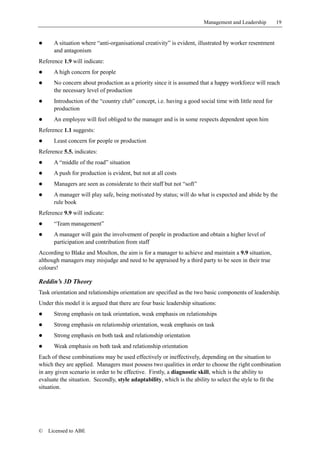
Figure 1.5 demonstrates five points where the grid indicates varying degrees of emphasis on the two
factors above.

            Concern for 9       1.9                                     9.9
                people


                          5                          5.5


                          1     1.1                                     9.1
                                 1                   5                   9
                                       Concern for production

                          Figure 1.5: Moulton and Blake Managerial Grid

Reference 9.1 will indicate:
!     An aim to maximise productivity
!     A situation where staff antagonism can exist


                                                                                     ©   Licensed to ABE
Management and Leadership       19


!     A situation where “anti-organisational creativity” is evident, illustrated by worker resentment
      and antagonism
Reference 1.9 will indicate:
!     A high concern for people
!     No concern about production as a priority since it is assumed that a happy workforce will reach
      the necessary level of production
!     Introduction of the “country club” concept, i.e. having a good social time with little need for
      production
!     An employee will feel obliged to the manager and is in some respects dependent upon him
Reference 1.1 suggests:
!     Least concern for people or production
Reference 5.5. indicates:
!     A “middle of the road” situation
!     A push for production is evident, but not at all costs
!     Managers are seen as considerate to their staff but not “soft”
!     A manager will play safe, being motivated by status; will do what is expected and abide by the
      rule book
Reference 9.9 will indicate:
!     “Team management”
!     A manager will gain the involvement of people in production and obtain a higher level of
      participation and contribution from staff
According to Blake and Moulton, the aim is for a manager to achieve and maintain a 9.9 situation,
although managers may misjudge and need to be appraised by a third party to be seen in their true
colours!

Reddin’s 3D Theory
Task orientation and relationships orientation are specified as the two basic components of leadership.
Under this model it is argued that there are four basic leadership situations:
!     Strong emphasis on task orientation, weak emphasis on relationships
!     Strong emphasis on relationship orientation, weak emphasis on task
!     Strong emphasis on both task and relationship orientation
!     Weak emphasis on both task and relationship orientation
Each of these combinations may be used effectively or ineffectively, depending on the situation to
which they are applied. Managers must possess two qualities in order to choose the right combination
in any given scenario in order to be effective. Firstly, a diagnostic skill, which is the ability to
evaluate the situation. Secondly, style adaptability, which is the ability to select the style to fit the
situation.


©   Licensed to ABE
20    Management and Leadership


Likert’s Employee-Centred Supervision
Rensis Likert was one of the most important contributors to the Human Relations School of
Management theory. He identified four basic management styles:
!     Exploitative/authoritative
!     Benevolent/authoritative
!     Consultative/authoritative
!     Participative group management
He argued that managers will achieve the best performance if they devote most of their attention and
resources to the human aspect of their staff’s problems and on building an effective working team. He
identified five conditions necessary for effective supervisory behaviour:
(a)   The principle of supportive relations - where each member of an organisation perceives their
      relationship and interaction with the “leaders/managers” as supportive, and as one that builds
      and maintains individual self-esteem.
(b)   Group methods of supervision - a manager can only maximise the capabilities of staff if each
      of them is part of an effective working group. This unit must exhibit a high level of group
      loyalty and expect high performance levels to be achieved by each team member.
(c)   High performance goals - for this to be achieved, a manager must be employee-centred,
      expect high performance levels, and enthusiastically project commitment for achieving those
      goals to subordinates.
(d)   Technical knowledge - a manager must be able to maintain credibility, either by possessing
      adequate knowledge or knowing where to find it quickly.
(e)   Coordinating, scheduling, planning - the manager’s role here is to communicate the views,
      goals and values of the group to other groups where appropriate, thereby becoming the link
      with the rest of the organisation.


E. CONTINGENCY THEORIES OF LEADERSHIP
The behaviourist approach of identifying leadership styles suffers from the problem that what
constitutes an effective style in one situation may not necessarily be so in another. A different
approach has, therefore, developed which sees effective leadership as constituting the most
appropriate style for the circumstances. Thus, leadership behaviour is contingent upon the
characteristics of the situation.
Clearly, there are a wide variety of situational characteristics which could be identified as being
conditioning factors on leadership behaviour, and a number of different approaches have, therefore,
been developed.

Fiedler's Contingency Model
Fiedler accepted the concept that leaders differ in the extent of their orientation to the task in relation
to their orientation to people, and put forward the view that any such orientation will be effective
given the right circumstances. The model aims to identify those situations in which each kind of
leader will be effective.
Fiedler proposed three factors which, to the extent that they each exist in any situation, affect the
“degree of favourability” for a leader. The factors are:


                                                                                       ©    Licensed to ABE
Management and Leadership      21


(a)     Position power
        This is the power which arises from the position of the leader in the organisation as distinct
        from his or her personality, knowledge or skill. Based on the position as leader, power can be
        exerted to comply with instructions and carry out tasks. Fiedler simply states that a leader with
        clearly defined position power can influence a group to a greater extent than one who does not
        enjoy position power.
(b)     Task structure
        Fiedler describes this as the ability to define tasks and the responsibility of individuals and
        groups to fulfil task requirements. If the task is clear, the leader can control the work process to
        a greater degree, as group members are deemed to be more clearly accountable.
(c)     Leader-member relations
        Whilst the business itself defines position power and task structure, the leader-member
        relationship is determined by the trust and belief of subordinates in the leader, and even the
        extent to which the leader is liked and respected.
Leader-member relations is seen as the most important factor, with strong group support for a leader
increasing the favourability of the situation. High task structure and strong positional power are also
seen as producing favourability.
The model proposes eight positions with different mixes of these factors along a continuum of
situational favourability and matches them against leadership style characterised as either relationship
or task orientated. At each end of the continuum – in those situations which are most favourable or
least favourable to the leader – the task-orientated leader will be effective, whereas in situations which
are only moderately favourable, the relationship-orientated leader will be most successful.
Fiedler argued that leaders cannot easily change their orientation and, hence, their leadership style.
They need, therefore, to analyse the degree of favourability in the situation and, where it does not
match their style, make adjustments – for example, by increasing task structure.

Hersey and Blanchard’s Situational Leadership Model
This approach is based on the theory that leadership behaviour is contingent upon one major
situational factor – that of the readiness of followers to act.
!       Leadership style is again postulated as being conditioned by the degree of task or relationship
        orientation, giving four possible styles (in a similar way to that shown previously in respect of
        Reddin's grid).
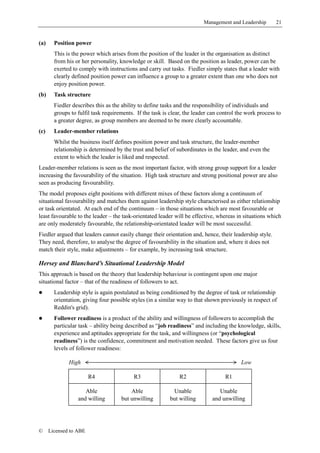
!       Follower readiness is a product of the ability and willingness of followers to accomplish the
        particular task – ability being described as “job readiness” and including the knowledge, skills,
        experience and aptitudes appropriate for the task, and willingness (or “psychological
        readiness”) is the confidence, commitment and motivation needed. These factors give us four
        levels of follower readiness:

              High                                                                        Low

                        R4                 R3                  R2                  R1

                     Able                Able               Unable              Unable
                  and willing        but unwilling         but willing       and unwilling


©     Licensed to ABE
22    Management and Leadership


The appropriate leadership style for each level of readiness is as follows:
R1:   “telling” – providing specific direction on what to do it and how to do it;
R2:   “selling” – giving direction, but also supportive of willingness and enthusiasm;
R3    “participating” – a supportive style emphasising two-way communication and collaboration to
      enhance motivation;
R4    “delegating” – where little direction or support is needed.
For example, if we consider a group of new employees, we might judge them to be in category R2 and
the appropriate style for working with them in the first few days of their employment would be
“selling”.

Handy’s Contingency Model
Charles Handy postulates four key elements in any management situation which influence the
effectiveness of leadership:
!     The manager
!     The work group
!     The task (the objective to be achieved)
!     The organisational context or environment, which is the culture and style of the organisation in
      which the work group operates
Managers have a natural preference towards a certain management style or range of (related) styles,
so to some extent, this element is fixed. As we have discussed above, the work group itself will also
have a range of styles which its members find most acceptable.
The task will suggest certain management styles. Tasks which require team members to contribute
skills and knowledge will lend themselves to a more participative style. Those in which the team
members are not expected to do anything other than carry out predetermined work in the most
efficient way tend to require a more authoritarian style.
The final element, that of context, depends on organisational culture. Some organisations have very
rigid and hierarchical cultures. They may find it difficult to tolerate work groups which adopt a
participative style. Other organisations, with a culture which places great emphasis on participation,
may not be willing to allow work groups to be operated on authoritarian lines. (We shall look at
culture in more detail in a later study unit.)
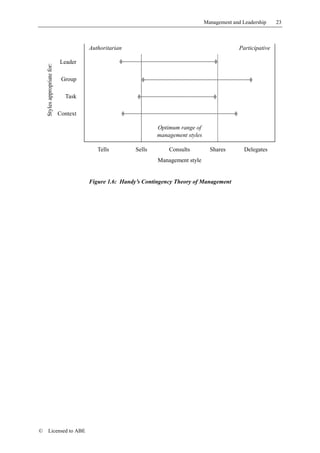
You will recall that Tannenbaum and Schmidt defined management style as a continuum. In other
words, none of these factors will impose a single management style on the situation. Instead, each
factor will define a range of styles which are acceptable. The manager should adopt a style which
overlaps with the range of styles which are acceptable to others. The situation is best shown
diagrammatically as in Figure 1.6.


                                                                                    ©    Licensed to ABE
Management and Leadership     23


                                        Authoritarian                                              Participative

                              Leader
    Styles appropriate for:


                               Group

                                Task

                              Context

                                                                 Optimum range of
                                                                 management styles

                                           Tells         Sells       Consults          Shares        Delegates
                                                                 Management style


                                        Figure 1.6: Handy’s Contingency Theory of Management


©      Licensed to ABE
24   Management and Leadership


                                 ©   Licensed to ABE
25


      Study Unit 2
      Management Accountability and Responsibility

      Contents                                                         Page


      A.    The Breadth of Accountability                                26
            Accountability to whom?                                      26
            The Concept of Externalities                                 28
            Stakeholder Theory                                           29


      B.    Management and Social Responsibility                         32
            The Social Responsibility Debate                             32
            Recent Issues in Social Responsibility                       33
            Techniques for Increasing Social Responsibility              35
            Combining Legal Requirements and Social Responsibilities     35


      C.    Equal Opportunities                                          36
            Unequal Treatment and Disadvantaged Groups                   37
            Equal Opportunities Legislation                              38
            Equal Opportunities Policies                                 42
            Management of Diversity                                      43


      D.    The Ethics of Managers                                       44
            Individual and Organisational Ethics                         45
            Whistle Blowing                                              46
            Stakeholder Theory and Business Ethics                       48
            Techniques for Developing Ethicality                         48


©   Licensed to ABE
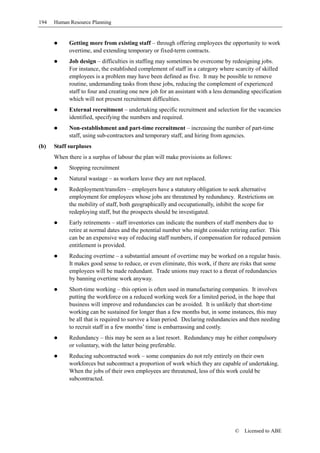
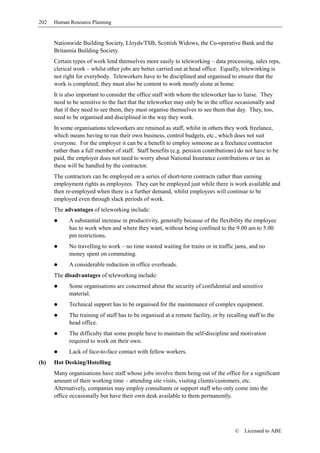
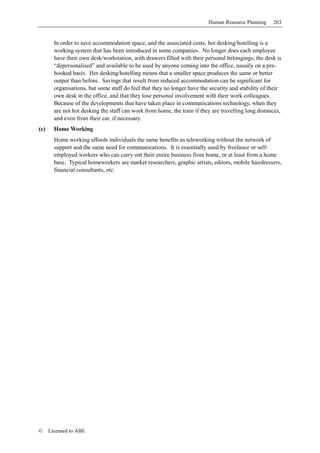
26    Management Accountability and Responsibility


A. THE BREADTH OF ACCOUNTABILITY
The responsibilities of managers relate to their accountability to various individuals and groups both
within and outside the organisation. In addition, managers are responsible for maintaining a high
standard of business ethics. In this context “ethics” means the treatment of moral questions and
behaving in an honourable way.

Accountability to whom?
Managers have to reconcile their responsibilities to a number of different groups. These are reviewed
below together with an outline of the way in which such accountability is regulated by the law.
(a)   Shareholders
      Being the owners of the company, shareholders must receive a return on their shares and,
      eventually, the market value of their shares must appreciate. One problem here is that in large
      business enterprises the gap between shareholders and the company itself has grown wide, and
      original objectives may be obscure.
      We can state what shareholders expect in terms of:
      !      Requirements concerning capital growth; and
      !      Requirements for a return on their original investment.
      As a rule, we can say that both expectations will be in general agreement with the company’s
      general aim. However, conflict arises where, for example, the firm wishes to reinvest a large
      proportion of the profits to finance future investment for expansion, rather than announce a
      larger share dividend. The only way to do this is to achieve a profit large enough to satisfy
      shareholders and at the same time allow enough money to invest in the future – clearly not an
      easy thing to accomplish!
      If the shareholders’ interests are not satisfied then there may be a loss of financial status, future
      borrowing problems for the company, and difficulty in achieving plans.
      The formation and registration of firms in the private sector is governed by the Companies and
      Partnership Acts. All limited companies have to register their Memorandum of Association
      with the Registrar of Companies and must have Articles of Association. The law dictates the
      information which must be disclosed in the published accounts.
      Acts of Parliament also govern the running of nationalised industries and government
      organisations.
(b)   Employees
      Irrespective of the kind of organisation, the interests of the employees must be considered.
      Employers, of course, have certain statutory obligations to safeguard the interests of workers
      (e.g. a duty to promote safe working practices) but moral obligations also exist. These moral
      obligations will be influenced by prevailing social attitudes and may be as compelling as the
      legal obligations. In recent years many firms have recognised a moral obligation to give
      workers a say in the running of the organisation or a share in the profits.
      Any organisation which does not adopt the current practices will find it difficult to recruit
      suitable staff. Thus it is in the interests of the organisation to provide favourable conditions of
      employment.


                                                                                       ©   Licensed to ABE
Management Accountability and Responsibility     27


        The basis of the legal relationship between an organisation and its employees is that of a
        contract of employment (a voluntary agreement into which employer and employee freely enter
        under the terms of common law). Both sides have a duty to behave reasonably and responsibly;
        employees should give faithful and honest service. In addition, there is a legal framework to
        ensure the fair treatment of employees at work and to prevent discrimination on various
        grounds. This is considered in detail later in the unit.
(c)     Suppliers
        Most organisations depend upon an external source of supply and all business enterprises
        depend upon outside markets. The well-being of these external suppliers is therefore vital.
        This emphasises the mutual interdependence of commercial bodies. Many enterprises will take
        positive measures to ensure that their supply lines remain intact, e.g. by offering long-term
        contracts of sale.
        In order to function in the wider economy, organisations have to make agreements with each
        other in order to establish the pattern of their behaviour to each other, e.g. to ensure the supply
        of raw materials or the delivery of finished goods on time. Such agreements are covered by the
        law of contract, which is part of common law. The law of contract developed from the rules of
        merchants dealing with each other in the Middle Ages and applies equally to agreements
        between large organisations and between private individuals.
        The parties agree on certain points and these become the terms of the contract. The more
        important of these terms are known as conditions, the less important are referred to as
        warranties.
        A breach of contract is deemed to have taken place if one party fails to comply with the terms.
        The most serious breach is of conditions – this entitles the injured party to rescind the contract
        and bring an action for damages. A breach of warranty only entitles the injured party to bring
        an action for damages.
        The law of contract enables organisations and individuals to enter into agreements with
        reasonable assurance that others will behave in such a way as to honour their side of the
        bargain.
(d)     Customers
        There are very few true monopolies, largely due to the prevalence of substitute products and
        brands. Competition tends to preserve the objective of customer satisfaction in firms to a far
        greater degree than would otherwise be the case. There has also been a considerable growth in
        consumer protection during recent years.
        However, conflict occurs between customer expectation and the price and quality of the goods
        being offered by the firm. The customer clearly desires low prices – conflicting with the
        profitability objective. Managerial decisions have to reconcile the customers’ interests with
        those of the organisation. In the long term, organisational objectives may be achieved only
        when the enterprise is able to satisfy the needs of sufficient customers to generate adequate
        sales revenue.
        In modern societies a movement has developed which sets out to guard and promote the
        interests of consumers against what is seen as the considerable power of the large firms who
        sell goods and services to the public. This movement is known as consumerism. It is argued
        that the need for such a movement arises because of a perceived imbalance between sellers and
        buyers. Sellers are seen as highly organised with large resources and the services of experts to


©     Licensed to ABE
28    Management Accountability and Responsibility


      help them market their products; consumers are seen as unorganised and lacking professional
      and expert advice.
      In order to redress the balance, two broad developments have taken place.
      !     Firstly, legislation has been enacted to protect consumers. Important Acts are the Trade
            Descriptions Act 1968; Fair Trading Act 1973; Consumer Credit Act 1974; Unfair
            Contract Terms Act 1977; Consumer Safety Act 1978; Sale of Goods Act 1979; Supplier
            of Goods and Services Act 1982; Consumer Protection Act 1987; and the Sale and
            Supply of Goods Act 1994. These Acts taken together provide protection for the
            consumer on the quality of goods; on their correct description; on fair guarantees; against
            wrongful or misleading advertising; on the safety of goods for their users; and against
            extortionate rates of interest being charged for credit.
      !     Secondly, consumer groups have been established which monitor the workings of the
            above Acts, and which promote further protection for buyers of goods and services.
            Some of these groups are official in the sense that they are publicly appointed; these are
            largely set up to look after the users of state-owned or near-monopoly enterprises, e.g. to
            protect the users of the Post Office, British Telecom and gas, electricity and coal
            consumers. There are also independent consumer groups like the Citizens Advice
            Bureaux, and the Consumers’ Association – the publishers of the consumers’ magazine
            “Which?”.
      Consumerism has become an important feature in the organisational environment of advanced
      societies, and as such managers have to take account of it. There have been examples of
      conflict between firms and the consumer movement over the necessity for, or nature of,
      consumer proposals or demands. However, wise management will take account of consumer
      ideas and use them to guide future product/service developments and organisational policies.
      The legal responsibilities of an organisation to its customers fall into two broad areas: firstly, to
      provide consumer choice; secondly, to ensure fair dealing. The objectives are that customers
      should get what they pay for and be able to have redress and compensation if they do not.
      These legal responsibilities to customers are governed by a number of Acts, as described above,
      and enforced by institutions, e.g. the trading standards departments of local authorities. The
      legislation is rooted in common laws which enable customers to receive fair dealing.
(e)   Society
      Current belief is that all organisations have an obligation to contribute to the well-being of the
      country’s economy and society as a whole. This may be thought of as an obligation to the
      government of the day, but expectations now extend to all types of organisations.
      Managers should demonstrate awareness of responsibilities to society in general. Many firms
      take great care in the provision of anti-pollution plans, even beyond the boundaries of legal
      requirements. Organisations often have training and development policies to assist in personal
      satisfaction. The long-term effect of such actions may well be an improvement in profitability;
      nevertheless, policies of this kind indicate an acknowledgement of general social needs.

The Concept of Externalities
Microeconomists distinguish between “private costs” and “social costs”.
!     Private costs are made up of the costs of production met by an enterprise, such as wages and
      salaries, fuel, transport and so on.


                                                                                      ©   Licensed to ABE
Management Accountability and Responsibility   29


!       Social costs are the costs to society as a whole of the actions of the business.
When private and social costs diverge, assuming they can be measured at all, the effects are called
“externalities”. These externalities can be positive or negative.
An example of a positive externality is the provision of street lighting in an urban area. This is
funded by local government, who in turn raise revenue from local taxation. The residents of the area
in which the lighting is installed benefit from it through greater safety from attack by muggers and
less risk of road accidents. Others will benefit, however, such as people from other districts and
towns who did not pay for the lighting but nevertheless gain some advantage from it.
A negative externality is the pollution caused by a factory. The private costs of production are borne
by the enterprise, whilst the social costs are born by society as a whole. This negative externality can
only be redressed by charging the cost of pollution to the company which owns the factory, or forcing
it to eliminate the pollution under threat of closure.
There are many other examples of externalities:
!       The National Health Service provides free treatment to those who do not fund it, e.g. if a
        foreign tourist collapses in the street.
!       The motor car causes enormous pollution, far in excess of any financial recompense paid by
        motorists in higher taxation (the government has announced measures to shift more of the
        burden onto motorists progressively as the millennium approaches).

Stakeholder Theory
So business organisations have responsibilities to a number of groups, and the very act of balancing
these responsibilities is a constraint on managers. In order to assist managers to cope with this
problem there has developed what is known as the stakeholder concept.
The idea behind the stakeholder concept is that there are certain groups which have specific interests
in a business. These interests may differ from one group to another, and sometimes the interests of
different groups may actually conflict with one another.
The concept can also be used to analyse the contributions and rewards in a given organisation. The
behaviour of the various stakeholders will have a profound effect on the organisation’s prospects.
In addition, the concept can reveal the way in which problems in a stakeholder group can threaten the
well-being of the whole organisation, such as where workers make excessive pay demands or
customers transfer their loyalty to a competitor.
(a)     Stakeholder groups
        We can consider stakeholder groups under three main headings – internal, connected and
        external stakeholder groups.
        !     Internal Stakeholders
              The objectives of employees and management are bound to have an influence on how
              the organisation is run. They are likely to be interested in:
              (i)     Continuity of employment.
              (ii)    Growth of the organisation in order to share in its prosperity.
              (iii)   The esteem arising from identification with success where possible.
              (iv)    Individual interests and goals, such as personal development and psychological
                      growth as well as material well-being.


©     Licensed to ABE
30   Management Accountability and Responsibility


     !     Connected Stakeholders
           Shareholders are not always part of the organisation itself, except in the case of
           managers and staff who hold equity in the company. They will have distinctive interests
           in the business, such as:
           (i)     A return on their investment in the form of dividends and an increase in the capital
                   value of their shares.
           (ii)    Concerns that the business performs within the law and reasonable ethical
                   parameters.
           (iii)   Participation in decision-taking through exercising rights to attend the Annual
                   General Meeting and vote.
           The organisation’s bankers will have specific concerns relating to the financial
           performance of the company, so that any short and long-term financing will be repaid
           with the minimum of risk. If the bank provides finance for a company, it will also wish
           to ensure that it is kept informed of the company’s financial condition.
           The customers of the enterprise require good quality goods and services at the right
           price. They also want to have access to products through convenient, low cost
           distribution channels. In addition, businesses are seeing increasing evidence of
           consumerism – customers being more demanding of enterprise not only in what they
           produce, but how they conduct themselves generally. The debate about a major football
           manufacturer using child labour in Asian countries is evidence of this – not only did it
           impact on the manufacturer, but it had a major effect on perceptions of large football
           league teams buying the merchandise.
           Lastly, suppliers have interests in:
           (i)     Ongoing and mutually beneficial business relationships;
           (ii)    Being paid on time.
     !     External Stakeholders
           External stakeholders are those generally unconnected with the business but who
           nevertheless have an interest in its activities. This category includes virtually everyone
           else.
           The government seeks compliance with legal requirements as well as:
           (i)     Ongoing creation of employment and wealth;
           (ii)    Revenues in the form of income tax, capital gains tax, corporation tax, National
                   Insurance contributions, value added tax and excise duties;
           (iii)   Information, such as statutory company returns and export/import information for
                   the Department of Trade and Industry.
           Local authorities have a specific concern with the economic activity that can be brought
           to their catchment area. They will also be interested in revenues through local taxation.
           A wider concern is the impact of the business on the local environment.
           The competitors of the business wish to ensure that there is fair competition and that all
           businesses operating in a sector are behaving ethically and in a climate of mutual respect.


                                                                                   ©   Licensed to ABE
Management Accountability and Responsibility     31


              Where a business has a professional body or trade association, this body will wish to
              ensure that activities fall within any codes or statements of practice agreed by its
              members.
              Lastly, the community wishes to ensure that any organisation produces its goods and
              services in a safe environment, protecting its workers and those living in the vicinity.
              Other stakeholders in this respect are the education and training providers, such as
              schools and colleges, who expect the business to provide information on job
              opportunities, information on what the company actually does and its contribution to
              society and (sometimes) a dialogue with secondary education providers to educate the
              young on industry and commerce generally (many companies have their employees make
              presentations to schools and colleges as public relations exercises to cement
              business/community relationships).
(b)     Coping with Stakeholders
        Organisations have to balance rewards to stakeholders with the contributions that stakeholders
        make to the firm. Some writers see dealing with stakeholders as an extension of the marketing
        concept: the organisation must “market” its views and values to all stakeholder groups.
        Sometimes conflicts which arise have no obvious solution but have to be balanced carefully and
        diplomatically. For example, during the early 1990s a minerals extraction company wanted to
        open a business at Rodel on the Isle of Harris in the Outer Hebrides. The positives emerging
        from this development were jobs and the economic stimulation to the area that always comes
        from a new enterprise setting up in a locality. The development was opposed in the strongest
        terms, however, by some in the local community as the firm considered it essential to have
        workers come in on Sundays. This conflicted directly with the religious beliefs of a sizeable
        section of the community, who as Free Presbyterians could not agree to this.
(c)     Problems with defining stakeholders
        There is a debate as to which stakeholder group is the dominant force, particularly between
        customers and shareholders in the privatised utilities. Top managers and directors have been
        criticised for awarding themselves large bonuses and share options – the so called “fat cat”
        debate where customers feel aggrieved.
        The analysis of stakeholders has been further complicated by the blurring of the lines between
        various groups.
        !     Many employees are also shareholders, due largely to being given bonus shares.
        !     In the case of retail stores and supermarkets, employees may be both shareholders
              and customers.
        !     Many customers may be shareholders in the firms which they patronise, if not directly
              then through pension or insurance schemes and unit trusts.
        This blurring can cause a conflict of interests for individuals. For example, as a customer the
        person may want lower prices, but as a shareholder the same person wants the firm to make
        higher profits.
        These developments make stakeholder analysis more problematic than when each stakeholder
        group had only its own interests to promote. Some modern managements have used the
        technique of “branding” to create an image of loyalty to unite the interests of stakeholders.
        Brands like “Virgin” give first priority to employees, because motivated staff will ensure


©     Licensed to ABE
32    Management Accountability and Responsibility


      customer satisfaction which in turn will increase sales, thus improving the return to
      shareholders.


B. MANAGEMENT AND SOCIAL RESPONSIBILITY
Organisations as open systems are closely entwined with their environments and as such have
responsibilities to the wider environment. Social responsibility refers to the liability to be called to
account for conduct that affects communities or society at large. Organisations are constrained in
their conduct by legislation which affects their relations with shareholders, employees, suppliers,
customers, society and the environment. However, there is a good deal of debate whether or not, or to
what extent, organisations have social responsibilities that go beyond their legal constraints.
The essence of social responsibility is summed up in this quotation from the Watkinson Report
(1973):
      “A company should behave like a good citizen in business. The law does not (and
      cannot) contain or prescribe the whole duty of a citizen. A good citizen takes account of
      the interests of others besides himself and tries to exercise an informal and imaginative
      ethical judgement in deciding what he should or should not do. This, it is suggested, is
      how companies should seek to behave.”

The Social Responsibility Debate
Although the above statement seems reasonable, it is possible to make a case against firms taking on
social responsibility. Consider the following points:
!     There are legal obligations on every organisation, and if an enterprise obeys these it is doing all
      that can be expected of it.
!     It is difficult to define just what being a good citizen means in terms of an organisation.
!     If an organisation goes beyond its legal obligations (e.g. by giving money to improve the
      environment of a community) it may be wasting scarce resources, which would be better
      employed by investing in the development of the organisation.
!     Many so-called good works in society are already being taken care of by charities, the
      government, etc., so there is no need for organisations, set up for other purposes, to become
      involved.
!     There is a conflict between social obligations and profit maximisation. The prime duty of a
      firm is to produce profits for its shareholders (who are the true owners of the firm). Frequently
      managers do not consult shareholders properly when they allocate money for social or
      community purposes.
!     It is not fair to give the responsibility for deciding on the amount and direction of social
      obligations to the managers.
However, there has been a change in attitude to social responsibility as many people have realised that
the decisions of business managers can have considerable effects on the environment, employees and
society at large. Actions which are perfectly legal and taken in pursuit of profit or efficiency can be
damaging – and managers have come to realise the responsibilities which rest upon them. This has
led to a climate of support for social responsibility.


                                                                                      ©   Licensed to ABE
Management Accountability and Responsibility     33


Points in favour of social responsibility include the following:
!       Legal obligations cannot cover every eventuality; there are many good causes that need a
        voluntary dimension (the Watkinson Report stressed this point).
!       Common social sense tells us that an organisation should act like a good citizen.
!       The amount of resources allocated to social obligations is relatively small and will not
        adversely affect the investment policies of an organisation.
!       Governments and charities, etc. do not have sufficient resources to meet all community needs,
        so if firms do not help many of these needs will go unmet.
!       Shareholders are not consulted on many decisions taken in organisations, and the money
        involved in moral obligations is not enough to make this an issue of shareholder interest.
!       Managers are well qualified to make decisions which may help the community or society.
!       Many moral obligations are, in fact, a form of enlightened self-interest for an organisation. For
        example, if a firm contributes to improving the environment in which it operates, this may raise
        the morale of its workers and make it easier to attract good-quality labour to live in the area and
        work for the firm.
!       Pollution of the environment and conservation of resources have become very topical issues.
        Organisations must take account of this or they will be at odds with the community where they
        operate.

Recent Issues in Social Responsibility
The above review of the debate highlights the issues which has brought the social responsibility of
organisations to the fore. In the last ten years there have been several high profile examples which
illustrate these issues, as is shown by the following two cases.
(a)     The Brent Spar Controversy
        This case concerned the decommissioning and disposal of the “Brent Spar” oil platform by
        Shell plc. It was decided that it would be best to dispose of the platform by sinking it in deep
        water in the North Atlantic Ocean. The proposal to do so immediately enraged environmental
        campaigners, who were deeply concerned about the consequences of this action. As well as the
        immediate pollution risk, the environmentalists expressed concern that this would set a
        precedent and lead to a situation in which the seas and oceans would be regarded as a large
        rubbish dump.
        The campaign against Shell was led by Greenpeace, which produced compelling facts and
        figures to back their argument that Shell’s proposal would lead to lasting environmental
        damage. Fuelled by the media, the controversy spread across European states and at one stage
        got out of control – in Germany, for example, some extreme groups set fire to Shell filling
        stations. Peaceful protests were thankfully more common, with Shell premises as well as
        government offices being subjected to picketing action by demonstrators.
        Despite formal sanction by the UK government for Shell’s proposal and the production of a
        persuasive business case by Shell apparently confirming that sinking the platform would be the
        best option, the company eventually backed down. The platform’s journey to its final resting
        place was stopped and it was towed to a Norwegian fjord to await a final decision.
        The controversy did not stop there. Greenpeace subsequently admitted that they got their own
        figures wrong, though it was stressed that their view had not changed on the issue. Then at the
        1997 Annual General Meeting of Shell plc, there were angry scenes as shareholders arrived at


©     Licensed to ABE
34    Management Accountability and Responsibility


      the venue for the meeting to a further barrage of protests by demonstrators about Shell’s policy
      on the environment, this time targeted at the company’s operations in Nigeria. At the meeting
      itself, searching questions were raised on environmental policy, though attempts to change
      policy by formal resolutions failed.
      The “Brent Spar” affair confirms the new importance placed on the social accountability of
      businesses by not just environmental pressure groups but also the public at large. The
      Greenpeace protest was not confined to a highly motivated group of environmentalists – the
      debate had an effect on the public conscience.
      The debate continues. Shell produced a very strong argument in favour of its proposed actions
      – sufficiently so to persuade the government of the day that it was right. On the other hand,
      many still wonder whether such issues are considered sufficiently thoroughly when there is an
      apparent conflict between profit motive and social consequence.
(b)   The UK National Lottery
      The company responsible for the National Lottery is Camelot plc. During 1997, there was a
      major controversy concerning the payment of large salary increases to the directors of the
      company. This followed an announcement by the incoming government that the management
      of the National Lottery would be reviewed and consideration would be given to administering it
      on a non-profit making basis in the future.
      The National Lottery has always been surrounded by controversy. Its launch was delayed for
      many years by strong lobbying by existing gambling organisations, who feared that it would
      erode their appeal to the paying customers. When it was launched, the selection of Camelot
      dismayed many, especially as this was to be a company driven by profit running an enterprise
      which was aimed (amongst other things) at raising money for good causes. Especially irate was
      Richard Branson, who had offered the services of his business empire and stated that he would
      run the National Lottery as a non-profit making venture.
      Camelot had to deal with several problems before the change of government in 1997. One
      issue was the proposed limitation of prizes – it was suggested that they would be “capped” in
      the event that there were too many claimants on the fund (this is standard practice in most
      European lotteries). There was also the inevitable conflict of interest between “haves” and
      “have nots”. The tabloid press argued long and hard against lottery grants to projects which
      were perceived to be the domain of the rich, such as opera houses and the arts. Lastly, there
      was the on-going argument that a company which is driven by a need to fulfil the needs of
      shareholders, which in turn can only be done by making a profit and paying the appropriate
      level of dividends, cannot possibly reconcile this with promoting the good of non-profit-making
      charities.
      In general, Camelot did not come out of the controversy particularly well. They were always
      quick to produce a sound business case for their actions, but one public perception was that
      they were “smug” and far too smart for their own good, especially when spokespersons for the
      company were interviewed by reporters.
      The debate came to a head with the pay increases for Camelot executives. This was seen by
      some as a cynical exercise to milk the product while the franchise was still held. A government
      cabinet minister held urgent talks with Camelot and it was eventually announced that a
      compromise had been reached, though exact details were not fully published.


                                                                                   ©   Licensed to ABE
Management Accountability and Responsibility      35


Techniques for Increasing Social Responsibility
(a)     Codes of Practice
        Voluntary codes of practice may be set by trade associations or professional bodies. Codes give
        details of what is and is not acceptable conduct by members of an association (e.g. ABTA has a
        code of practice for travel agents and tour operators). Codes provide guidance and monitoring
        of members’ behaviour and safeguards for the public or the environment.
        Organisations have an interest in making codes work effectively because if they fail the state
        may step in with legislation. An example of such a code is the City Code which guides Stock
        Exchange activities and conduct on takeovers and mergers.
(b)     Social Accounting and Social Audit
        In order to assess how well an organisation is meeting its obligations to the society in which it
        operates, it has been suggested that it should compile a social balance sheet. This interesting
        idea reverses many of the points of classical accounting, e.g. in terms of profit and loss, taxes
        paid by the organisation are treated as revenue (because they accrue to society) whereas fees
        and payments to the organisation are treated as costs (because they are paid by society).
        Society is seen as evaluating what it puts into the company and what it gets out of it.
        Social audit draws attention to the fact that a firm’s gain can sometimes be a loss to society.
        For example, if a firm makes unwanted workers redundant, this may increase productivity and
        profits for the firm, but it can become a cost to society as the state has to pay unemployment
        benefits.
        Critics of social accounting argue that many features of organisational and social activities
        cannot be measured in precise monetary terms; or that some calculations are so complex that it
        is difficult to reduce them to items in a social audit. Even supporters of social accounting admit
        that techniques are not yet sufficiently developed to give accurate reflections of the impact of
        an organisation’s activities on the society in which it operates.
        However, this does not mean that efforts to assess the social performance of an organisation
        should be abandoned. Organisations should present social reports which give information on
        both the positive and negative effects of their activities on society at large. All socially relevant
        areas should be included, e.g. contributions to education, research, effects on the environment,
        employment policies, taxation, etc. Social accounting could become a regular feature of
        organisation policy and reporting.
        Finally, remember that it is the firm itself which prepares its social balance sheet; it is not
        always an impartial statement of affairs.

Combining Legal Requirements and Social Responsibilities
Many enlightened managements are becoming convinced that they should meet their social
responsibilities in the fullest possible way, going beyond any legal requirements which apply. Rather
than seeing these responsibilities and requirements as constraints, many managements see them as
opportunities to act in such a way as to not only improve their own organisations but to improve
society at large.
Here, we consider this in respect of retirement and redundancy, and in the next section we look at the
issue of equal opportunities in employment in some detail.


©     Licensed to ABE
36    Management Accountability and Responsibility


(a)   Retirement and Redundancy
      With a number of trends manifesting themselves in modern society, the departure of a worker
      from an organisation offers an interesting example of the interplay between legal and social
      obligations of employers towards their workers. These trends include people living longer and
      retiring earlier, and increased redundancy as techniques change and productivity increases.
      The main legislation here is the Employment Rights Act 1996 which consolidated former
      relevant legislation. Conditions are stipulated as to when an employee should be taken to be
      dismissed by reason of redundancy. The qualifying conditions for workers being able to claim
      redundancy pay are listed and a formula is provided to work out an employee’s entitlement if he
      qualifies as having been made redundant. Thus an employer’s legal obligation to a worker
      made redundant is quite clear.
      However, many employers feel they have a moral obligation to those made redundant and
      sometimes to those taking retirement. It is now widely realised that an individual’s move from
      the world of work to that of non-work may pose psychological, social and economic problems.
      One of the main psychological problems is that of social isolation; sociological problems
      include the lack of meaningful activities and the repercussions on other family relationships;
      economic problems arise from more leisure time with less money to spend.
      The caring employer will introduce pre-redundancy and pre-retirement programmes to help
      employees prepare to adjust to the non-work situation. Such programmes might include
      psychological preparation, the encouragement of outside interests, and planned budgeting to
      make the best use of financial resources. Research reveals that if an individual can maintain
      social engagement (i.e. a high rate of social interaction) he can cope better with the change
      from work to non-work. Part-time or voluntary work can be of great assistance and forward-
      looking managements include ideas for such work in their programmes for those who will be
      leaving.
(b)   Outplacement
      The ideas of taking a social responsibility over and above legal rules to staff made redundant
      have been developed with the use of outplacement techniques. This deals specifically with the
      problems of redundancy, dismissals and early retirement of managers by using external
      consultants, paid for by the firm which has made the manager redundant, to help redundant
      managers to find new, rewarding posts.
      Outplacement consultants counsel managers to help them maximise their talents and skills; they
      do not find jobs for redundant managers. The essence of outplacement is to encourage
      redundant managers to “market” themselves – this entails improving job-search skills and
      rebuilding self-confidence. Outplacement therefore assists managers to get their careers
      moving again and assists the economy by bringing these experts back into the workforce as
      quickly as possible.


C. EQUAL OPPORTUNITIES
We discriminate against different types of people, consciously or unconsciously, in many aspects of
our life and work. This is not, in itself, a problem or a “bad thing“. For example, the process of
selection is specifically concerned with discrimination between people – by making decisions about
who and who not to shortlist, to interview and to appoint. Discrimination in this sense is perfectly
acceptable as long as it is done, and is seen to be done, on the basis of fair and equal treatment of the
people concerned. Forms of discrimination which are not based on such treatment have increasingly


                                                                                      ©   Licensed to ABE
Management Accountability and Responsibility      37


come to be seen as unacceptable, and in many cases have been the subject of legislation, making them
unlawful.
This has a particular impact on management practice. Managers need to ensure that they do not
discriminate unfairly in the decisions or actions that they may take with regard to employees, whether
prior to or during employment. Here, we shall review those aspects of legislation which apply
directly to these issues, and also explore how organisations meet the challenge of providing equal
opportunities. We then go on to consider the future of these issues, with particular reference to the
move away from a concern with equality per se towards the issue of managing cultural diversity.

Unequal Treatment and Disadvantaged Groups
There are certain groups in any society who are discriminated against. Members of such groups are
subjected to treatment which is different from that accorded to other people purely on the basis of
their membership of that group. Such unequal treatment derives from the prejudices and
preconceptions of the people with whom they have to deal, and needs to be seen as a problem of the
person or persons acting in a discriminatory manner, rather than a problem of the victim of the
discrimination.
Within the United Kingdom, there are three main groups which have been clearly identified, through
legislation, as suffering from such unfair discriminatory treatment:
!     women;
!     people from other racial background; and
!     disabled people.
To this list we can add one further group which is not currently the subject of legislation (although it
is elsewhere in the world) – older people.
These groups are, in this context, referred to as disadvantaged in that, as victims of persistent
discrimination, they have been excluded from playing their full part in society, or in particular parts of
it (for example, in employment).
Recognising the basis of discrimination is the first step towards establishing equal treatment for
disadvantaged groups. As we noted above, it derives from prejudice towards, and preconceptions
about, the members of such groups. On some occasions these attitudes are consciously and overtly
displayed, but very often the people holding them are not even aware that they influence their dealings
with other people. As such, many of the preconceptions are widely held, particularly in respect of
certain characteristics that these groups are assumed to possess and which are then used to pass
judgement on individual members.
This may be seen, in the context of employment, from the following list of attitudes about the above
four groups, as described by Torrington and Hall.
!     Women
      Women should not work – their place is in the home. They do not want much responsibility at
      work. Their home commitments (children) will impinge on their working life. Women are less
      mobile as they have to stay in the part of the country where their husband has a job.
!     People from other racial backgrounds
      They are require time-off for religious holidays which do not mesh with those of Christianity.
      Qualifications gained abroad are not as good as those to be found in the UK. The workforce
      will not want to work for a black supervisor. The ability to fill out an application form in good
      English is a requirement for someone who is being employed doing manual labour.


©   Licensed to ABE
38    Management Accountability and Responsibility


!     Disabled people
      A person in a wheelchair will be an embarrassment to other workers. Having a physical
      impairment also affects mental faculties. Someone who has suffered mental illness will
      automatically not be able to take any kind of pressure that the working environment could
      provide.
!     Older people
      Older people are less adaptable. They are not interested in coping with new technology. They
      will work much more slowly that those younger than themselves. They have become less
      interested their career.
As we have begun to note, the problem is particularly acute in the area of employment in general, and
of management in particular, where there decisions are constantly being made which affect the lives
and opportunities of individuals. As a result – partly driven by legislation and partly driven by good
practice – most organisations have adopted policies and practices designed to ensure the fair and equal
treatment of those with whom they have dealings (and note that this does not just cover their own
employees).
There is, though, a continuing concern to ensure the effectiveness of such policies and practices in the
face of the widespread existence of, particularly, unconscious prejudices and preconceptions in
society at large, which will invariably be reflected – to a greater or lesser extent – within the
organisation’s own workforce. The adoption of policies, of itself, does not eradicate the problem, and
control over practice has become more difficult with responsibility for more and more employee
issues being devolved to line management.

Equal Opportunities Legislation
This section is intended merely to outline briefly those aspects of the relevant legislation which have
an impact on employee resourcing in general terms. We are also concerned here specifically with the
law as it applies in the United Kingdom and, if you are studying this elsewhere, you may need to
investigate those aspects of legislation applicable to your own country (and compare them with the
position described here).
(a)   Legislation promoting sexual equality
      The main two pieces of legislation which promote sexual equality in employment are:
      !      The Equal Pay Act 1970
      !      The Sex Discrimination Act 1975
      The Equal Pay Act 1970
      This was the first piece of legislation which attempted to promote equality at work. It actually
      came into force in 1975 and sought to address the issue of parity between the pay of men and
      women who were doing work of equal value in the same employing organisation. (Note that
      this does not necessarily mean simply doing the same job, although that was the main concern
      in the early days when there were many instances of such inequitable treatment to be dealt
      with.)
      The Act specifies the occasions when the pay of a woman should be equal to that of a man as
      follows.


                                                                                    ©   Licensed to ABE
Management Accountability and Responsibility      39


      !     Like work
            This is where a woman can show that she is doing the same, or very similar, work as a
            man – i.e. where two people of different sex are doing exactly the same job. A good
            example of this would be two teachers, one male and one female, each teaching the same
            subject to children of the same age in either the same or different schools. If the work is
            the same, so too should the rate of pay be the same.
      !     Work rated as equivalent
            This where a woman can show that the job she is doing could be rated at the same level
            as that of different job held by a man and paid at a different level. Job evaluation
            schemes are normally used compare the knowledge and skills required to do different
            jobs and seek to establish parities between them, with different jobs often being grouped
            together in “families“ where they are considered equal even though the actual tasks
            involved may vary.
      !     Work of equal value
            This is concerned with work which may be shown to have an equivalence of value to the
            organisation, such that the pay one job less on the basis that it is held by a woman would
            amount to unfair treatment. Parity on this basis would be established in a similar way to
            the previous category by comparing indices of value to the organisation between
            different jobs.
      Note that either women or men may claim equal pay under this legislation, although the latter
      case is extremely rare.
      The Sex Discrimination Act 1975
      This Act came into force at the same time as the Equal Pay Act in 1975 and actively promotes
      the equal treatment of men and women in employment and certain other areas. In relation to
      employee resourcing, equal treatment can be considered to cover the following issues:
      !     recruitment and selection;
      !     opportunities for training and development;
      !     promotion and career development;
      !     benefits, including pay;
      !     dismissal.
      It is important to remember that this Act promotes equality between the sexes. Thus, claims
      can not only be made by women, but also by men who feel that they are being unfairly
      discriminated against in favour of women. Whilst these latter cases can be considered to be
      somewhat unusual, they started to grow in number during the 1990s.
      The Sex Discrimination Act 1975 is particularly important because it defines exactly what
      constitutes unlawful discrimination. There are two aspects to this, as follows.
      !     Direct discrimination
            This occurs where one person is treated less favourably than another on the grounds of
            their sex or marital status. The best example of this is in the area of recruitment
            advertising where restrictions may be placed on (or implied about) the sex of the person
            required for the job, when it could equally be done by someone of either sex.


©   Licensed to ABE
40    Management Accountability and Responsibility


            There are exemptions to this for jobs where there is a “genuine occupational
            qualification“ – those that can only be undertaken by a member of a particular sex for
            reasons of, for example, a need for authentic male or female characteristics, such as in
            modelling or acting. In such circumstances, direct discrimination is allowable.
      !     Indirect discrimination
            This occurs where a requirement is applied equally to both sexes, but one sex is
            proportionately less able to comply with it. For example, making a minimum number of
            year’s continuous service in a particular profession a job requirement may, in certain
            circumstances, be held to indirectly discriminate against women because they may have
            had a career break for maternity and child care reasons.
      One of the key aspects of this legislation is that it applies to all the dealings that an organisation
      has with individuals – not just those arising in the course of employment. So, with reference to
      the process of recruitment and selection, the requirements of the Act apply regardless of
      whether or not the person actually gets the job or, indeed, an interview for it. It is unlawful to
      discriminate on the grounds of sex in any part of the arrangements or decisions made as part of
      the process. Thus, you cannot discriminate in advertising, in interviewing, or in the terms and
      conditions of the job offer. A candidate – or even a potential candidate – may claim unlawful
      discrimination from the moment she or he sees the advertisement for the job. This means that
      the whole of the recruitment and selection process must be, and be seen to be, free from any
      sexual bias.
      In the event of a claim of discrimination, it is incumbent on the employer to prove that the
      person was treated fairly. This invariably means that documentary evidence must be produced
      to demonstrate not only that appropriate policies are in place to prevent discrimination, but also
      that they are applied in practice. So, for example, interview notes and individual assessments
      taken during a selection procedure need to be free of any bias and be kept for possible future
      reference.
      The same requirements as to arrangements and decisions being, and being seen to be, free from
      bias obviously apply during the course of employment. Thus, opportunities for training and
      development, or any other benefits, must comply with the legislation on unlawful
      discrimination.
(b)   Legislation promoting racial equality
      There has been legislation since 1968 making it unlawful for employers to discriminate directly
      on the grounds of race, colour, nationality or ethic origin. The Race Relations Act 1976, in
      replacing the 1968 Act, also made indirect discrimination illegal.
      The way in which the Race Relations Act 1976 defines unlawful discrimination and applies to
      employment is essentially the same as the Sex Discrimination Act 1975. Thus, unlawful
      discrimination may be direct or indirect in the same way as has been explained in relation to
      sex, and the Act applies at any point of contact between the individual and the organisation for
      whatever reason. Again, the onus is on the employer to prove fair and equal treatment in
      respect of a claim of discrimination.
(c)   Issues of disability
      Until 1995, issues concerning the employment of people with disability were governed by the
      Disabled Persons Employment Acts of 1994 and 1958. In 1995, these were replaced by the
      Disability Discrimination Act which considerably widened the scope of the requirements on


                                                                                       ©   Licensed to ABE
Management Accountability and Responsibility     41


      organisations to enable the employment of disabled people and prevent discrimination against
      them.
      For the purposes of the Act, disability is defined as:
            “A physical or mental impairment which has substantial or long-term adverse
            effect on a person’s ability to carry out normal day-to-day activity“
      Such “impairments“ include the following:
      !     mobility;
      !     dexterity;
      !     physical co-ordination;
      !     continence;
      !     ability to lift/carry;
      !     speech, hearing, eyesight;
      !     memory;
      !     ability to concentrate;
      !     perception of risk or physical danger.
      Employers have long had concerns about the employment of disabled people. Aside from
      prejudicial preconceptions of the kind we discussed previously, there are genuine concerns over
      required standards of attendance, health and safety at work, problems arising from individual
      health issues and the cost of alterations to premises and standard equipment. The legislation, in
      accepting a need to enable disabled people to have more equal access to employment, has
      increasingly put the onus on employers themselves to address and resolve these concerns.
      The 1994 Act established a quota system for employers over a certain size and required them to
      employ a certain percentage of people with disabilities. The 1995 Act abolished the quota
      scheme and put a duty on employers not to discriminate on grounds of disability in a similar
      way to that applied in respect of sex and race discrimination.
      The main provisions of the Disability Discrimination Act 1995 are as follows.
      !     It introduces a statutory right of non-discrimination against people with disabilities.
      !     It applies to employers with 20 or more employees.
      !     Employers have a duty to make reasonable adjustments to conditions and working
            environments to facilitate the employment of an identified disabled person.
      !     It has the support of a statutory code of practise.
      Discrimination occurs when an employer treats a person with a disability “less favourably“ for
      reasons relating to their disability without justification and/or by failing to make reasonable
      adjustments to their premises, policy, practise or procedures.
      The key to this statement is that it does allow discrimination in certain circumstances, often
      dependent on the nature of the disability, but eradicates it as a normal practice.
      As with the sex and race legislation considered previously, “less favourable“ treatment may be
      encountered in any of the following areas of employment practice:
      !     advertising, recruitment and selection;


©   Licensed to ABE
42    Management Accountability and Responsibility


      !      pay and conditions of service;
      !      training and development;
      !      promotion and career progression;
      !      other work-based opportunities and benefits;
      !      dismissal or other forms of termination of employment.
      Again, the legislation applies from the moment that an individual has contact with an
      organisation – he/she does not have to be in employment. The onus is also on the organisation
      to demonstrate fair and equal treatment in the case of a claim of discrimination.
      There are circumstances where what would otherwise be unlawful discrimination is permitted.
      Theses are where “less favourable“ treatment may be justified on the following specific
      grounds:
      !      that the less favourable treatment cannot be removed or made non-substantial by a
             reasonable adjustment on the part of either the employer or the employee;
      !      that another person who is not considered to be suffering from a disability is more
             appropriate for appointment;
      !      that the person with the disability is not able to fill the post.
      This first point raises the question as to what constitutes “reasonable adjustment“.
      The Act specifies the types of adjustment to working conditions and practices which it is
      incumbent upon the employer to explore in order to facilitate the employment of a disabled
      person. These include the following:
      !      adaptation of premises;
      !      job restructuring;
      !      part time or modified work schedules;
      !      reassignment to vacant posts;
      !      acquisition or modification of equipment;
      !      adjustments to examinations and training materials and activities;
      !      provision of readers, personal assistants or interpreters;
      !      providing adequate supervision.
      Where it is “reasonable“ to implement these adjustments, the employer must do so. The
      concept of reasonableness takes account of cost, practicality and disruption, although no cost
      ceiling is specified. It is also possible to provide financial or other outside help in order to
      achieve these aims.
      It is also important to note that no adjustment is necessary should the person concerned not
      admit to a disability.

Equal Opportunities Policies
The cornerstone of good employment practice in respect the equal and fair treatment of all employees
within the organisation is the “equal opportunities policy“.
It is rare for any organisation today not to have a some form of statement of its commitment to equal
opportunities and the procedures and practices which are required of its workforce to put it into effect.


                                                                                     ©   Licensed to ABE
Management Accountability and Responsibility        43


The policy needs to be overt and provided to all staff, and it is good practice to make it available to
any prospective members of staff by sending it out as a part of the recruitment literature.
The contents of an equal opportunities policy commonly follow a standard pattern, based on the
model developed by the Equal Opportunities Commission. The main elements are summarised below,
as adapted by Torrington and Hall.
!     Introduction:
      A statement of the desirability of the policy and the requirement that it be strictly adhered to.
!     Definitions:
      Direct and indirect discrimination defined.
!     General Statement of Policy:
      A commitment to equal treatment and the belief that this is also in the interests of the
      organisation. Staff in the organisation should be made aware of the policy and key personnel
      trained in it.
!     Possible Preconceptions:
      Examples of preconceptions that may be erroneously held about individuals due to their sex,
      race, marital status or disability.
!     Recruitment and Promotion:
      Care to be taken that recruitment information has an equal chance of reaching all areas of the
      community and that it does not indicate preference for one group of applicants. Care that job
      requirements are justifiable and that interviews are conducted on an objective basis. An
      intention not to discriminate in promotion.
!     Training:
      An intention not to discriminate, with some further details.
!     Terms and Conditions of Service:
      An intention not to discriminate
!     Monitoring:
      Nomination of a person responsible for monitoring the effectiveness of the policy and with
      overall responsibility for its implementation. An intention to review the policy and procedures.
      An intention to rectify any areas where employees/applicants are found not to be receiving
      equal treatment.
!     Grievance and Victimisation:
      An intention to deal effectively with grievances arising from unfair treatment and a note of the
      victimisation clauses in the relevant Acts.

Management of Diversity
The equal opportunities movement has now been in place since 1975 and, with over twenty year’s
experience behind them, some organisations are now looking for ways in which to integrate issues of
equality into business strategy in a more holistic way. Such an approach would move beyond simply
complying with the legislation – in the post-millennium organisational environment this has to be a
given. It would, rather, be promoting, through its employment policies, the concept of an integrated
workforce and not continuing to treat the issue of equality separately.


©   Licensed to ABE
44    Management Accountability and Responsibility


This integration of equal opportunities policies into mainstream management and organisational
culture has led to the diversity movement.
The diversity movement starts from a recognition of the differences between individuals in society –
age, sex, race, differing abilities, background, personality, work style, etc. – and accepts that an
organisation should encompass them all. It sets out to promote and celebrate the diversity of people
in the workforce (and in the organisation’s contacts with its environment) and to value their different
contributions and needs. It recognises that these differences can be a positive asset to the
organisation.
Managing diversity enables the issues of equality to be dealt with in a strategic framework. This
requires an organisational culture which addresses the obstacles faced by all individuals in a climate
of trust and mutual respect. In such circumstances, individuals from a whole range of different
backgrounds may be encouraged, and feel able, to put forward their views and ideas, influencing the
growth and cohesion of the organisation and thus improving competitiveness.
An example of diversity providing a direct organisational benefit may be seen in respect of attitudes to
older people. The stereotypical image is that organisations thrive with a younger workforce.
However, the average age of the population ins increasing, and an employer who recognises that the
value of diversity in the workforce has access to a much wider pool of talent.
Establishing a culture of diversity needs commitment from the top and active encouragement
throughout the organisation. It needs to be supported by appropriate management policies and
practices. For example, the development of more flexibility in working conditions can be a key
feature of enabling different groups to be involved in the organisation – and this may be seen in the
growth of more flexible and individual contracts of employment, the introduction of career breaks and
the establishment of flexible working hours. Many modern organisations are also developing
techniques of empowerment, this frees employees from close control and allows them to develop their
skills and talents. The concept can be applied to the management of diversity; rather than fixing all
employees in the straightjacket of close control and conformity, different types of diverse employees
can be encouraged to maximise their particular talents and insights.
In summary, then, it may be said that diversity will help the organisation grow and develop by
opening doors to more skills and talents. This can only be of advantage to the organisation as a
whole.


D. THE ETHICS OF MANAGERS
The terms “accountability” and ”social responsibility” refers to the way in which an organisation is
run and held responsible for its actions. The word “ethics” refers to actions which are held to be right
or wrong. The debate about business ethics centres around whether the only responsibility of
organisations and management is to maximise profits. This is the usual driving force behind the
founding of an enterprise and is an assumption of most microeconomic models used to analyse the
behaviour of firms.
This narrow view can, however, be tempered by alternative schools of thought which suggest, inter
alia, the following:
!     The utilitarian view – that the business should serve the greatest good of the greatest number;
!     The individualistic view – that moral behaviour should be cast in terms of long-term personal
      self-interest;


                                                                                    ©   Licensed to ABE
Management Accountability and Responsibility      45


!     The moral rights view – that organisations have a responsibility for the fundamental rights of
      human beings;
!     The justice view – moral behaviour is that which is objective, fair and equitable.
These are wider views of management responsibility. They can, and often do, conflict with the profit
motive espoused by the classicists.

Individual and Organisational Ethics
Ethics operate at two basic levels – the ethics of the individual manager and the wider ethics of the
whole organisation. Managers bring a set of values into their work situations, and these operate in
conjunction with the ethical culture of the organisation. Various organisations have an ethical stance,
which is revealed in general terms in their mission statements.
Unethical behaviour can take place at the individual level – e.g. insider trading of shares, leaking
information to competitors, harassment of employees. Unethical conduct at organisational level
includes pollution of the environment, exploitation of staff and customers, or a ruthless pursuit of
profit at any cost.
The problems which face managements pursuing higher ethical standards include: the pressures of
competition and rapid change; cost-cutting; a lack of public awareness and scrutiny of the activities of
the organisation; and clash of interests between the various stakeholders of the organisation.
The duty of managers to the owners of the enterprise is indisputable. If the owners do not receive a
return on capital, they will withdraw the capital or close the business, cutting their losses if necessary.
Modern day businesses must, however, take account of broader responsibilities for several reasons:
!     Despite deregulation and a general contraction of state involvement in enterprise, there are
      boundaries of tolerance shown by governments to certain practices (e.g. the Camelot
      controversy in 1997 as described earlier).
!     The government imposes a greater financial burden on businesses whose activities result
      directly or indirectly in divergence between social costs and private costs (such as private
      motoring and smoking, resulting in decisions to impose increases in tax on petrol and tobacco
      at higher rates of increase than the retail price index).
!     There are strong pressure groups who make it their business to ensure that organisations and
      their customers serve the general good (e.g. the Shell/Nigeria controversy, also Barclays
      Bank/apartheid in the 1970s).
!     New pressures arising from consumerism mean that businesses have to take account of
      customer concerns in the wider sense (e.g. the Cooperative Bank’s policy of not lending to
      countries with oppressive human rights records or to bodies associated with blood “sports”).
!     In industry itself, there are many entrepreneurs who support socially responsible policies (such
      as Anita Roddick, founder of the Body Shop).
Ethical considerations focus on individual managers behaving in an honourable way. There are many
management activities that offer a manager the opportunity to behave in either an ethical or an
unethical manner.
!     If the performance of a subordinate is unsatisfactory the ethical conduct of a manager would be
      to tell the subordinate and help him to improve; the unethical approach would be to let the
      situation deteriorate further and then dismiss the subordinate.
!     Knowing that older workers value security at work, it would be unethical to deliberately
      threaten them and make them feel insecure.


©   Licensed to ABE
46    Management Accountability and Responsibility


!     It is unethical to take the credit for the efforts of subordinates.
The essence of ethical behaviour is to follow a moral code which reflects values on how life should be
lived. This code would include such qualities as honesty; a concern for others; fairness; not taking
advantage of one’s status in the firm (e.g. sexual harassment of a subordinate is unethical conduct);
and taking account of wider social responsibilities. The more management comes to be seen as a
profession, the closer its ethics move towards those of the doctor, lawyer, etc.

Whistle Blowing
Whistle blowing is a controversial practice which, whilst not entirely new, became the subject of
fierce debate during the 1990s.
Whistle blowing may be defined as intervention by an employee to bring the wrongs (or perceived
wrongs) of the employer to the attention of the owners of the company, the government, or the public
at large.
Although most workers agree on what is right or what is wrong, there are many different attitudes to
whistle blowing. Some argue that the worker should have a conscience and speak out, while others
are more submissive about situations which are unpalatable to them – the latter are unlikely to
intervene.
The debate is clouded by the conflicting obligations imposed on most workers by a duty of secrecy
imposed by the contract of employment (as well as common law) and the duty to the company and the
public at large.
One of the highest profile examples of whistle blowing occurred not in a company but in the Civil
Service. A young civil servant, called Sarah Tisdall, discovered that government policy on nuclear
missiles was at odds with its public pronouncements on the issue. Apparently driven by her own
conscience to do what she believed to be right, she leaked documents to the press. The consequences
of her action were dismissal from the Civil Service and prosecution for offences under the Official
Secrets Act. She eventually served a custodial sentence when the case was proven against her.
There are many examples of whistle blowing which demonstrate a conflict of interests between the
duty of the employee to keep his secrets and his duty to the company or the common good.
!     In 1993, a chief executive of a large company was found to have sold his personal dwelling
      house to the company, sanctioned improvements costing many thousands of pounds and then
      bought the house back at the original price. He later argued that this was done with the full
      sanction of the board of directors. In the meantime, he was suspended from duty and later
      dismissed. Litigation was brought against him, instigated mainly by fairly newly-appointed
      directors. The former executive in turn counter-sued and the affair was eventually settled out of
      court. In this instance, it could be argued that he did nothing illegal or contrary to his terms of
      employment. There is no doubt, however, that he and his colleagues who sanctioned his actions
      failed in their fiduciary (moral) responsibility to the shareholders and the company itself.
!     In the same year, an executive in a different company was reported by members of staff for
      sexual harassment of female employees. The report was made by persons who had not been
      harassed but disapproved of the actions of their senior colleague. The case resulted in the
      resignation of the person concerned when, as a direct result of the action of the whistle blower,
      several other persons came forward with additional and similar complaints making the
      offender’s position untenable.
!     A final example concerns the actions of a young bar tender who became increasingly concerned
      about the actions of her immediate boss, who was in charge of bar and catering facilities. The


                                                                                    ©   Licensed to ABE
Management Accountability and Responsibility       47


      manager was an alcoholic, and perhaps not in the most suitable occupation. It was reported by
      the bar tender that her manager was accepting far too much alcoholic drink from customers
      when offered to the extent that this affected his ability to manage the bar. In addition, she
      claimed that when he put “two gins” in the complimentary drinks book, he was in fact taking
      two bottles, not dispensing two measures (you must assume from the case that the stock-taking
      routine left much to be desired). The consequence of this episode was that the bar tender was
      dismissed and the manager suffered no immediate consequence, though he died two years later
      of an alcohol-related illness.
So, should an employee keep quiet about a situation which he believes to be wrong, or should he let
his conscience take over and “blow the whistle”? Let’s take a look at the case for each.
The case for whistle blowing:
!     The employee has a moral duty not just to his work and his immediate boss, but to the company
      and society as a whole.
!     If a wrong is seen by a person, there may be other things happening which are unacceptable – it
      might be the “tip of the iceberg”.
!     If unacceptable behaviour is allowed to persist without redress, others will believe they can get
      away with the same thing.
!     Many whistle blowers act in the belief that the wrong-doer’s colleagues will be pleased to hear
      the information and will act on it.
!     Some consider that conscience is more important than job security – they will blow the whistle
      irrespective of personal consequences.
!     In many organisations, top-to-bottom training and development programmes such as “Putting
      People First” and programmes focusing on the corporate mission/objectives encourage the
      belief that all will act in the best interests of the company. If this is so, anyone who does not act
      in this way should expect others to act against him.
!     Sometimes whistle blowing is a statutory responsibility – a good example is policy on health
      and safety at work.
The case against whistle blowing:
!     Some believe that the employee should concentrate on doing his job and that the actions of
      others are nothing to do with him.
!     The situation may be misinterpreted – what may be seen as a breach of company rules or policy
      may turn out to be perfectly legitimate.
!     The employee can over-rate the importance of the perceived misdemeanours of others and cast
      himself in a bad light or even lose his job.
!     Some are reluctant to “blow the whistle” due to a “snitching” mentality – it is considered bad to
      tell tales on others.
!     It can be argued that the actions of others are none of the concern of the employee. If there is
      something wrong, let others find out for themselves.
!     Sometimes the employee can be on dangerous legal ground by “blowing the whistle”. If
      information is given to someone outside the organisation, this can be a breach of contract or
      even render the whistle blower liable to criminal action. It is common practice in many


©   Licensed to ABE
48    Management Accountability and Responsibility


      organisations for the terms and conditions of employment to bind the employee to secrecy even
      after he leaves.
Whether to “blow the whistle” or not is usually a matter for individual judgement or conscience. As
all employees are different, they will react in different ways as well as interpreting situations
differently.
Sometimes the whistle blowing can be done through a third party. For example, it is sometimes found
that a trades union representative can handle a difficult situation without exposing the individual to
recriminations. If anything, however, unions are becoming more aware of the need to act as moral
policemen. In late 1997, one such organisation stated that it was going to compile a “rogues’ gallery”
of employers and publicise their actions. Aimed primarily at identifying bad employment practices,
this initiative would appear to be an open door through which potential whistle blowers can move if
they believe a case has to be answered.
In an ideal world all managers and workers would behave honestly and ethically at all times. Sadly,
the very existence of employment legislation, consumer protection legislation and, more broadly,
restrictive practices legislation confirms that organisations and the people within them do not always
behave in the way we would like. After all, if they did the legislation would not have been needed in
the first place.

Stakeholder Theory and Business Ethics
The application of stakeholder theory is an important approach to the study of business ethics. Each
group of stakeholders has rights and responsibilities, and the organisation must meet their reasonable
expectations:
!     Shareholders seek a profitable return on their investments, so expect ethical financial standards.
!     Customers expect fair treatment and ethical dealing.
!     Employees expect to be treated with dignity and are not just a factor of production.
!     Suppliers expect fair business dealings.
!     The wider society expects green policies and social responsibility from organisations.
Examples of conflicting pressures include: shareholders seeking increased share value/dividends,
customers seeking lower prices/higher quality, employees seeking higher wages. Residents of an area
seeking industry to be located there so as to provide employment, while other residents fear pollution,
congestion, noise etc. is a common problem.
Managers pursuing an ethical policy must reconcile stakeholder expectations. They can make use of
codes of practice and ethical guidelines, and new models and techniques are now being developed.

Techniques for Developing Ethicality
(a)   The ethical decision model (EDM)
      This approach begins with an analysis of what is at stake in the ethical issue being considered.
      The analysis develops into how this issue affects the organisation, then the external constraints
      on ethical behaviour. The findings of the analysis are applied to the ethics of each functional
      area of the organisation, and are drawn together into an ethical audit.
      !      The activities of an organisation can impact on the environment, and the response of an
             ethical firm would include: pollution control; recycling; conservation of natural
             resources and energy; greening of the environment.


                                                                                    ©   Licensed to ABE
Management Accountability and Responsibility       49


        !     Ethical approaches to human resources include: promoting employee health, safety and
              welfare; tackling racism, ageism, bullying in the workplace; counselling for social
              problems and career development; not making use of surveillance technology for spying
              on workers.
        !     Ethical approaches to customers include: quality and service considerations; improved
              labelling to give customer information; fair treatment in all dealings.
        In summary, management should pursue the principles of justice, integrity and decency while
        still building long-term value for the firm.
(b)     EVR Congruence
        Ethics and values are closely associated with social responsibility but place the focus on the
        behaviour of managers. Managers should be fair and honourable in all of their dealings; they
        should not deliberately mislead. Managers should care for their customers, their staff and the
        environment.
        The concept of EVR congruence takes the three key elements:
        !     Environment
        !     Values
        !     Resources.
        These three elements have to be deployed to add value; that is to turn raw materials into goods
        and services which meet customers expectations. However, the elements have to be compatible
        with the values of a socially responsible management. Take for example the use of resources:
        it is not socially responsible to produce goods no matter how efficiently if it means harming the
        natural environment.
        EVR has implications for the quality of products and the quality of life of employees and all
        who come into contact with the organisation.


©     Licensed to ABE
50   Management Accountability and Responsibility


                                                    ©   Licensed to ABE
51


      Study Unit 3
      Management and the Changing Organisation

      Contents                                                          Page


      A.    Organisational Culture                                         53
            What is Organisational Culture?                                53
            Handy’s Typology of Organisational Culture                     54
            Influences on Organisational Culture                           56
            Culture Analysis                                               57
            Culture Management                                             57


      B.    The Learning Organisation                                      58
            Aspects of a Learning Organisation                             59
            Criticisms of the Concept                                      59


      C.    The Culture of Quality                                         60
            Quality Control                                                60
            Total Quality Management (TQM)                                 61
            Assessing Total Quality Management                             61
            Developments in the Culture of Quality                         62


      D.    The Culture of Enterprise                                      62
            Intrapreneurship                                               62
            Strategic Business Units and Internal Marketing                63


      E.    Business Process Re-Engineering                                63
            BPRE Defined                                                   64
            Types of BPRE                                                  64
            Characteristics of Re-engineered Processes                     65
            Holonics                                                       66


      F.    The Impact of Globalisation                                    66
            Globalisation and the Manager                                  67


                                                              (Continued over)


©   Licensed to ABE
52   Management and the Changing Organisation


     G.    Current Trends in Organisations                                    69
           Labour and Capital                                                 69
           Flexibility                                                        70
           Centralisation, Decentralisation and Empowerment                   70
           Strategic Business Units (SBUs)                                    71
           Diversification                                                    71
           Transnational Organisations                                        71
           The Flexible Firm                                                  72
           The Virtual Organisation                                           74


                                                              ©   Licensed to ABE
Management and the Changing Organisation     53


A. ORGANISATIONAL CULTURE
Management experts are placing increasing importance on the study and understanding of what is
sometimes termed organisational and other times corporate culture. The term organisational culture is
preferred by many experts as it has a wider application that goes beyond profit making companies and
embraces non profit making concerns, like charities; churches; associations etc.
Excellence theorists, like Peters, place strong emphasis on the part played by organisational culture in
influencing the success or failure of organisations in their pursuit of excellence.

What is Organisational Culture?
Culture may be defined as “the sum total of the beliefs, knowledge, attitudes of mind and customs to
which people are exposed in their social conditioning. Through contact with a particular culture,
individuals learn a language, acquire values and learn habits of behaviour and thought.”
Organisations possess some of the ingredients of a subculture. They have distinctive shared beliefs
and values which sometimes translate into policies and practices. People can instinctively get a “feel”
of an organisation which is often difficult to define but represents some intuitive “gut reaction” to the
nature of the business. Outside commentators will often say that a progressive business has a “buzz”
about it, or a conservative one feels “stuffy and formal”.
Organisational culture, then, refers to the deep-seated values of an organisation as they are manifested
in the ways in which people are expected to behave. The culture of an organisation can be observed
in the way in which it is structured (e.g. centralised or decentralised); in the way authority is
distributed (e.g. authoritarian or employee empowered) and along the lines of the analysis described
below. Organisational culture affects organisational climate.
Organisational climate refers to the ways in which people involved with the organisation (its
stakeholders, customers and its competitors) perceive that organisation, for example to what degree is
it customer friendly or how concerned is it with the welfare of its employees or to what degree does it
empower its employees.
Culture becomes apparent through many observable features of an enterprise:
!     Formal or informal structure
!     Centralised or decentralised decision-taking, and whether decisions are taken by committees or
      individuals
!     The extent to which innovative thinking is promoted and encouraged
!     Freedom of various levels of staff and management to take decisions and responsibility
      (empowerment)
!     Openness of communications, and even whether people are on first name terms
!     Layout and appearance of the factory or office
!     Formality of dress
!     Leadership styles adopted by managers
!     Educational attributes and intellect of employees
!     Acceptance or adversity to risk
!     Attitudes to teams


©   Licensed to ABE
54    Management and the Changing Organisation


!     Attitudes to training and development
!     Attitudes to change and particularly technology
!     Commitment to service and quality
As all these features contribute to the culture of the organisation, it must follow that each organisation
is unique in this respect. A textile company will have a different culture to an IT company; it is
perhaps less obvious that the organisational culture in Sainsbury’s will differ from that of Tesco.

Handy’s Typology of Organisational Culture
Building on an article by Roger Harrison in 1972, Charles Handy identified four organisational
cultures. These may not apply through the whole business – different constituent parts of the business
may have differing cultures.
(a)   Power Culture
      Handy gives names of Greek gods to illustrate each of the cultures. The power culture is
      attributed to Zeus. Like Zeus, the manager in this culture is the source of all power. It typifies
      the owner-manager who initially founds the business, and takes all the decisions and all the
      risks.
      Despite power emanating from a central source, there may be a limited amount of
      formalisation, rules, procedures and policies. The workers will rely on what has gone before.
      As the organisation is not rigidly structured, it can often adapt quickly to change, although its
      ability to do so efficiently depends entirely on the quality of those few key individuals trusted
      with decision-taking power.
      As these organisations grow the power of key decision-takers is likely to diminish, as they
      cannot control everything. In smaller businesses, the power culture can work well.
(b)   Role Culture
      This is a quasi-bureaucratic culture, which works by logic and reason. The role culture is
      represented as Apollo, the God of Reason.
      The role culture is typified by policies, procedures and practices which are formally laid down.
      Authority is clearly defined, as also are job descriptions, procedures for communications and
      other internal processes.
      Role culture enterprises are likely to have a narrow band of senior managers at the top, with a
      highly structured organisation set out below, each constituent part knowing its function.
      The role of the person is more important than the person in it, as the basis of appointment is the
      ability of the individual to perform that role.
      Fine examples of role culture are found in the British Civil Service and in the European
      Commission.
      Role culture is at its strongest during a period of little change, but organisations which fit this
      stereotype can find it extremely hard to adjust to changes in the external environment. While
      things remain the same, the individual is comfortable and secure in the role culture. During
      rapid change, however, the roles have to be redefined and the person has to adapt or move on.
      An ambitious person can find the role culture frustrating, unless he happens to find that his
      talents fit into progressively more attractive “boxes” as he attempts to move up the
      organisation.


                                                                                      ©    Licensed to ABE
Management and the Changing Organisation       55


(c)     Task Culture
        The task culture is one which is based on jobs or projects to be carried out. It is best illustrated
        by the matrix organisation used in some companies, where a line and staff organisation
        structure is complemented, or replaced altogether, by project or task forces.
        The emphasis here is on completing the job. Handy apportions no Greek god to this culture as
        getting effective performance is more important than power or individuals.
        The task culture is very different to the role culture in that the former is flexible and changeable
        to suit the job in hand. This is the opposite of the more rigid, bureaucratic role culture.
        Task culture can be ideal when the enterprise has to adapt quickly to changes in the external
        environment of its market place. It tends to thrive when:
        !     Markets are rapidly changing or volatile
        !     Speed of response to the customer is important
        !     Product life cycles of products and services are short
        Many large accountancy and consultancy firms now aspire to the task approach. It is quite
        usual, for example, for accountants employed to carry out auditing duties to be assigned to
        different teams while an audit is under way. The employee will therefore have different
        colleagues and a different boss, depending on what week it is.
        The most difficult issues for managers in the task culture are:
        !     Control of work
        !     Coordination of resources
        !     Achieving economies of scale
        !     Budgeting
(d)     Person Culture
        This is an existential culture, in which the individual is the main focus. The organisation and its
        structure exist to serve the individual’s objectives and aspirations. The person culture is about
        being able to “do one’s own thing”. Handy chooses Dionysus as its symbol, the Greek god of
        the self-orientated individual.
        This culture is found in diverse businesses such as some solicitors’ offices (where the principals
        choose their own specialisms and interests if they can), small businesses and small
        consultancies. Thus, if a self-employed training consultant likes working in Scotland, he may
        well try harder to develop business in Scotland to suit his own purposes. If the consultant
        wants to specialise in “training the trainer” courses, this is where the main focus of his
        marketing efforts will lie.
        Handy states that it is rare to find organisations with this culture, but two examples are The
        Body Shop and the Virgin Group, certainly in their early days. The organisations were founded
        on the idiosyncratic interests of the founders. In the case of Virgin, you find diversity of
        interests today that could never have been predicted.
Handy argues that modern organisations are marked by the change from role culture to task culture.


©     Licensed to ABE
56    Management and the Changing Organisation


Influences on Organisational Culture
Whilst it is difficult to tie down a meaningful definition of a culture, it is perhaps easier to identify
those factors which will influence the culture of an organisation and hence the structure it adopts to
pursue its objectives.
(a)   Origins
      The founding principles of the organisation will have a strong impact particularly where there
      remains a founding family involvement or a tie in to some particular set of values.
(b)   Size
      The organisation will tend towards adoption of the role culture if it is big and cumbersome. In
      such a business the person culture would be almost impossible to adopt – the structure tends to
      be more formal. Some US aerospace companies have been able to move in the direction of the
      task culture with widespread applications of matrix organisation. Some of the multinational
      accountancy firms have moved the same way.
(c)   Technology
      Companies which employ technology in their production processes generally have to sacrifice
      non-routine tasks for routine ones. In turn, routine operations are best suited to the role culture.
      If the technology is expensive, requiring close controls and supervision, this, too, suits role
      culture. If, on the other hand, the company employs technology for short job runs and
      individual batches of output, the power or task cultures may apply.
(d)   Goals and objectives
      Obviously, if goals and objectives are laid down by one or just a few very powerful individuals,
      the power culture is likely to apply.
      In decentralised organisations, where the business is broken down into divisions or semi-
      autonomous units, it is quite likely that the task culture and even the person culture will be
      evident.
(e)   External environment
      The external environment is made up of those forces which impact on the organisation from
      outside. There are six such sets of forces:
      !      Political
      !      Economic
      !      Social
      !      Technological
      !      Competitive
      !      Demographic
      Environmental change can critically affect organisational culture. If change is swift and
      relentless, the role culture is difficult to sustain. So, too, may the person culture be vulnerable
      if the markets move against the interests of the decision-taker.
      Diversity in the external environment can lead to a task culture being employed – get the job
      done, as the tasks are different to suit different segments. If, on the other hand, there is a
      standardised environment, this might suit a role culture.


                                                                                       ©   Licensed to ABE
Management and the Changing Organisation         57


        The power culture is best equipped to cope with external threats in the environment, provided
        the select group of decision-takers can complement their power with effective decisions.
(f)     Human resources
        People are the most diverse resource of all to the organisation and so the culture which suits
        best will depend on personal values, attitudes and beliefs.
        The individual who prefers the job tightly defined and prescriptive will almost certainly prefer
        the role culture, or in some cases the task culture. So, too, will the person who wants an
        undemanding and repetitive job.
        The expressive, creative, individual thinker, strong on conceptual ideas, will prefer the person
        culture, but may also flourish in a task culture and even a power culture.

Culture Analysis
The starting point of culture analysis is the organisation’s mission statement: is it clear and well
defined; is it communicated to and embraced by all levels of the organisation?
This leads to an analysis of behaviour patterns, both what is expected of them and whether their
actual behaviour lives up to these expectations. This analysis can apply to the interaction between the
organisation and its stakeholders.
The structure of the organisation (flat or tall; centralised or decentralised; bureaucratic or relatively
free of administrative rules) is a useful indicator of organisational culture.
The nature of leadership and the distribution of authority are key indicators of the type of culture
in an organisation. Leadership may be authoritarian or democratic; authority and decision making
may be concentrated at the top or spread downwards to teams working close to customers by
empowerment of employees.
The values of the organisation can be tested in practice by assessing the responsiveness to
stakeholder needs and expectations.
The entrepreneurial spirit of the culture is revealed by the degree of enterprise, innovation,
competitiveness, flexibility and drive for excellence of the organisation.
An important cultural quality of an organisation is its receptiveness to embrace change arising from
changes in its environment. Analysis asks whether the culture is proactive (anticipating and planning
for change) or reactive (coping with change as and when it arises).
Cultural analysis pays particular attention to the nature of the cultural climate, i.e. how employees
and other stakeholders view and evaluate the organisation.
Cultural climate elements pose the question of whether the organisation: is friendly or formal/distant;
is people oriented or task oriented; is characterised by conflict or co-operation between teams and
departments.

Culture Management
The function of culture management is to foster the most appropriate pattern of the culture elements
revealed by analysis to achieve organisational goals. This puts particular focus on the ability to cope
with change. Culture management may have to bring about change in some culture elements while
reinforcing other elements of the existing culture.
Excellence theorists argue that successful organisational cultures must have two key characteristics:


©     Licensed to ABE
58    Management and the Changing Organisation


!     The culture must be coherent: this means that all the cultural elements must be following a
      similar style and direction.
!     The culture must be flexible enough to cope with rapid changes in the environment.
It is not always easy to combine coherence which builds up over time, with flexibility which implies
change.
Schien points to the importance of leadership when managing cultures. Organisational culture can be
shaped by what elements or behaviour leaders rate as important, i.e. that is what leaders of
organisations, departments or teams set out to measure and control. Further what forms of cultural
behaviour leaders reward e.g. what earns promotion and higher status in a given organisation.
Excellence theorists put forward their ideas of what forms the basis of an excellent organisational
culture that should inform modern culture management. Heckman and Silva follow Schien in
stressing the crucial role of leadership, i.e. good leadership and clear vision should be customer
oriented, stressing quality and meeting market requirements.
Excellence supporters argue that the culture of the work place should encourage employees to thrive
and develop, making contributions through empowerment and being valued for their contributions.
People are an organisation’s most important asset.
Organisational cultures should be proactive, anticipating change and getting to the source of problems
before they become critical.
Culture should encourage vision so that everyone knows where the organisation is heading, not just
concentrating on the present.
The structure of an organisation should be simple and flat. Culture can be changed for the better by
re-engineering, usually delayering (stripping out layers of management) and empowering teams with
decision making authority in their work situations; but core values like quality and customer care
should be universal.
Managers should be out and about in the organisation talking and, particularly, listening to employees
and customers.
Organisational culture should have a focus on what the organisation does best.


B. THE LEARNING ORGANISATION
The idea of a learning or thinking organisation was put forward by the management expert Senge but
has been given wider application by other experts.
Senge argues that organisations should have the sort of culture which allows them to shape their own
futures to a far greater degree than has been the case in the past. Organisations must be constantly
improving their performance and in order to do this both management and employees must be actively
seeking ways in which they can improve performance. They must not be content to be “just doing
their job”.
Pedler summarises a wide-ranging approach by defining a learning organisation as one that
facilitates learning of all its members and continuously transforms itself. Pedler draws attention
to the fact that a learning organisation is more than the sum of the learning individuals who work in it,
crucial though those individuals are. A learning organisation must have a culture and a structure
suitable for learning to take place.


                                                                                     ©   Licensed to ABE
Management and the Changing Organisation      59


Learning organisations, then, bring together ideas of culture, structure and leadership. The idea of
learning organisations is a logical follow-up to organic theories which compare organisations with
human bodies. Organisations are made up of functioning parts which should act in harmony. They
adapt to and can influence their environments. Learning theorists go one step further by talking about
listening and learning organisations. Learning assists organisations to survive and develop.

Aspects of a Learning Organisation
!     The culture of a learning organisation should be liberating for those who work in it. Employees
      should be empowered, they should be involved in decision-making, there should be bottom-up
      contributions to the development of the organisation.
!     Excellence theorists like Peters emphasise the importance of encouraging staff not to be afraid
      to make mistakes. There should not be a culture of blame. The emphasis is on continuous
      experiment and improvement.
!     Another approach to culture is the suggestion to view and treat employees as customers. The
      root of this idea is found in stakeholder theory which sees customers as the dominant
      stakeholder; the learning approach brings employees to the centre of attention, they should be
      encouraged to learn from their work.
!     Learning theorists argue that a flat structure making use of multifunctional teams linked by
      efficient IT and open communications is conducive for organisations to learn. Many of the
      ideas of excellence theorists on flat, flexible structures can be used to guide a learning structure.
      The culture and structure of learning organisations are quite different from those of tall,
      bureaucratic, authoritarian organisations.
!     Leadership should be democratic/participative, sharing a vision of the way forward. Leaders
      should set an example of risk-taking and learning from mistakes. Leaders should be enablers,
      helping staff to learn and develop.
In order to create a learning organisation, management must recognise the need for change. The areas
where change may be needed are: leadership; structure; culture; empowerment of employees; and an
obsession with improving quality.

Criticisms of the Concept
Despite the popularity of the learning organisation concept, there are critics of this approach. From
the outset there have been problems with defining a learning organisation. Some definitions focus on
individuals learning how to learn, while others emphasise the culture and structure of the organisation.
Perhaps the most frequently voiced criticism is that managers only pay lip service to the concept of a
learning organisation; they make only cosmetic changes, e.g. they introduce carefully controlled
organisational development (OD) schemes.
Radical critics, like R. Harrison, argue that many managers jealously guard the control of learning. If
the distribution of power remains in the hands of top management, the culture of the organisation
cannot be conducive to learning.
Finally, critics argue that it is difficult to measure the degree to which a given organisation is a
learning organisation.
In summary, to make the learning organisation an effective idea measurable changes must take place
in leadership, structure and function. In addition individuals need development, encouragement to be
risk-takers, to be obsessed with quality and above all to embrace change and learning with


©   Licensed to ABE
60    Management and the Changing Organisation


enthusiasm. An assessment of the success of a learning organisation may be obtained by
benchmarking against other excellent organisations in similar spheres of activity.


C. THE CULTURE OF QUALITY
Many modern organisations have expanded the traditional notion of quality control with the wider
concept of the culture of quality. This way be thought of as being made up of three waves of activity:
!     The first focus falls on front line workers like production or sales employees. Management
      must create the culture that generates “an obsession with quality” and which encourages
      workers to play their part in the drive for quality and performance. This may mean training and
      encouraging employees to put forward their own ideas for improvements.
!     The focus of the second wave is on how things are run and done in the organisation, on
      functions and processes. Managers have to encourage new thinking on such things as the
      processing of orders and the administration of the organisation.
!     As the pursuit of continuously improving quality spreads throughout the organisation, the
      barriers between employees and managers break down as they all pursue the quality and
      performance goals.

Quality Control
Quality control is the function which sets out to ensure that goods and services of an acceptable
quality are produced by an organisation. As this may form part of a quality culture it is important to
understand its functions and techniques.
The basic techniques of quality control are:
!     Inspection: this is seen as a passive control in that work is performed, then inspected, then
      either judged acceptable or returned for rectification or scrapping.
!     Statistical sampling: in mass-production industries producing standardised goods it may be
      possible to inspect by using sampling techniques, that is inspecting only a number of units out
      of each batch produced.
Inspection places costs upon an organisation, and the discovery of below standard goods brings with it
the cost of making good the faults or of scrapping these items.
The benefits of inspection are that below standard goods are filtered out before they reach and
disappoint customers. Thus customer good-will is preserved.
Modern managements have come to realise that preventing below-standard goods or services from
being produced in the first place is the way to maximise benefits and minimise costs, this is termed
the dynamic approach to quality. The first step is to identify where quality problems may arise, these
include:
!     Workers’ problems – poor quality may arise from careless, uninterested, poorly trained, low
      morale, low motivation employees.
!     Management problems – poor quality may arise from inadequate leadership, poor planning,
      poor management training, and a lack interest in quality.
!     Working conditions – good working conditions are an important requirement for high quality.
Quality and quality control should not be the preserve of the quality control department. Rather, the
term “total quality control” (TQC) has been coined for the spread of a culture of quality throughout


                                                                                    ©   Licensed to ABE
Management and the Changing Organisation       61


the organisation. The essence of TQC is that every manager and every employee in an organisation
has a responsibility for quality.

Total Quality Management (TQM)
The management writer Tom Peters encapsulated the ideas of TQM when he argued that management
should be “obsessed with quality”; this means that quality should be the key strand that runs through
all management thinking.
Peters goes on to argue that it is useless to have vague ideas about what constitutes quality and about
how well an organisation is performing. He insists that there should be precise measurement of the
costs and benefits of the pursuit of quality.
A vital link between TQC and TQM is that the whole workforce should be involved in the search for
quality improvement. This means the creation of a culture of quality, or “quality as a way of life in
the organisation”.
(a)     Quality Circles (QCs)
        In order to bring about employee involvement, managements have made use of the technique
        known as quality circles. A quality circle may be defined as a voluntary group of employees
        who meet regularly with the objective of improving the way in which their organisation
        provides quality of goods and services for its customers.
        The benefits of QCs are as follows.
        !       The introduction of quality circles can change the whole atmosphere of an organisation;
                it breaks down the “them and us” barriers as employees come to feel that they are
                important and valued members of the organisation.
        !       This changed attitude provides a framework within which quality can be improved.
        !       QC membership improves the problem-solving skills of all those involved.

Assessing Total Quality Management
The essence of TQM is that the emphasis on quality should permeate the whole organisation.
Drucker identifies high performance areas which are critical to the long-term success of an
enterprise. It is useful to adapt Drucker’s key areas to the assessment of TQM. This may be done as
follows:

Market Standing                 How high is the reputation for quality of the firm in the eyes of its
                                customers, its competitors, its own employees and the public?
Innovation                      Are innovations and research and development activities geared towards
                                the continual improvement of quality?
Productivity                    Is any increased productivity compatible with maintaining and
                                increasing quality?
Resources                       Are the resources of the firm being directed to the pursuit of quality?
Profitability                   Are adequate profit levels being combined with quality goods and
                                services?
Manager Performance             Are managers giving quality the priority it deserves?
Worker Performance and          Are workers imbued with the idea of quality and are they putting this
Attitude                        into practice in their work?


©     Licensed to ABE
62    Management and the Changing Organisation


Public Responsibility        Do ideas of quality apply to the public good, e.g. high quality of
                             environmental concern, product safety, etc.?
Despite every effort of quality control there are some dissatisfied customers. Whether the business
offers a formal warranty or guarantee or not, these problems must be addressed. Customer
satisfaction is crucial and all reasonable complaints should be dealt with generously.

Developments in the Culture of Quality
Quality experts are making quality comparisons between organisations on a world wide scale. Two
important approaches are Best Practice Benchmarking (BPB) and World Class Manufacturing
(WCM). The essence of these techniques is strong customer focus, they set out to identify just what
the customers deem a first class product or an excellent supplier. BPB sets standards according to the
best practice found anywhere in the world. WCM stresses the need to meet the changes in customer
expectations. Both approaches stress quality and how the study of other excellent organisations can
help an organisation thrive. WCM stresses the need for the most up-to-date technology and
management skills. BPB stresses management commitment and encouraging employees to identify
best practice and adopt it.
BPB and WCM point to ways in which an organisation can achieve the culture of quality.


D. THE CULTURE OF ENTERPRISE
Running parallel with the pursuit of quality is the encouragement of a culture of enterprise.
Excellence theory argues that managers and employees must be ready to experiment, to take some
chances; to pursue new ideas and not to be afraid to make mistakes. These are the qualities of the
entrepreneur, which we see in many small businesses, but which are sometimes lost in large
organisations where an attitude of “playing it safe” can sometimes take hold. In order to combat this a
number of techniques have been put forward to encourage the culture of enterprise.

Intrapreneurship
The management expert Gifford Pinchot recognising the need for new frameworks within which new
management practices could thrive put forward his notion of intrapreneurship.
Pinchot set out to combine the entrepreneurial spirit of the small business with the economies of scale
of the large organisation.
When a large organisation wishes to introduce intrapreneurship it should take the following steps:
!     It should make known to its employees that it intends to offer the firm as an economic
      umbrella, providing resources and administrative cover to autonomous sections within the
      organisation.
!     It should identify potential entrepreneurs from among its managers and staff by asking for ideas
      or suggestions on new products or new ways of doing things.
!     It should allocate resources to good ideas and let the people who put forward the suggestions
      run the section that puts their own ideas into practice.
Advantages claimed for this approach include:
!     It spreads and encourages the culture of enterprise to all levels of the organisation.
!     It confers the advantages of employee participation.
!     It offers promotion by enterprise.


                                                                                     ©    Licensed to ABE
Management and the Changing Organisation         63


!     It raises morale.
!     It releases the entrepreneurial spirit which can only thrive if a person is near to the market or
      the production process and can exercise his own judgment and flair.
Like every other approach intrapreneurship has drawbacks, these include:
!     Intrapreneurship is costly in management time because all entrepreneurial ideas have to be
      studied and evaluated by senior management before some of them are given the go-ahead.
!     Many ideas are impractical and a waste of time.
!     Although those individuals or groups whose ideas are taken up and financed are well motivated
      and entrepreneurial, those whose ideas have been turned down may be disgruntled and suffer
      loss of morale.
!     When the organisation is backing a number of projects and ideas there can be competition for
      resources, which can lead to disunity in the organisation.
In conclusion intrapreneurship can be a useful technique to assist dramatic change, because it releases
entrepreneurial energy, it cuts through bureaucracy and constantly seeks and rewards new ideas.

Strategic Business Units and Internal Marketing
When large organisations produce a number of products or services they may split their activities into
a number of relatively autonomous divisions – these are known as strategic business units (SBUs).
SBUs develop entrepreneurial culture within large organisations by being responsible for the
developing, producing and marketing of their own product or service. Each SBU can be benchmarked
for effectiveness and efficiency, so there are strong incentives to perform well.
SBUs may be profit centres, that is the units are responsible for both revenues and costs.
Another technique that develops entrepreneurial culture is internal marketing. This involves
divisions, departments or units marketing their products or services to other units within the same
organisation. The providing units satisfy the needs of the other units just as if they were external
customers. They meet the consuming units’ needs for the right products at the right price; of the right
quality, in the right place at the right time. Supporters of internal marketing argue that it increases
effectiveness and efficiency by bringing the discipline and culture of the market into the organisation
itself.


E. BUSINESS PROCESS RE-ENGINEERING
Business process re-engineering (BPRE) is a set of techniques which businesses can use to compete
more effectively. It is also known as corporate re-engineering.
Much pioneering work has been carried out in this field in the 1990s and many companies have
implemented programmes to apply the principles.
BPRE involves “re-inventing” the enterprise. It requires managers to dismiss many of the ways in
which things have been done in the past.
Hammer and Champy, in their book “Re-engineering the Corporation” state that in order to
implement BPRE in an organisation managers must:
!     Abandon existing ideas of how the corporation should be managed;
!     Abandon well-established organisational/operating principles and procedures;


©   Licensed to ABE
64    Management and the Changing Organisation


!     Create new organisational/operating principles and procedures.
As early as 1982, Peters and Waterman, building on Drucker’s concept of the “intrapreneur”, stated
that many companies just needed a few “turned on geniuses” to “re-invent the future”.
BPRE is not just concerned with innovation; it draws heavily on total quality management (TQM),
notably the work of Crosby, motivation theory and practice, and marketing, especially Levitt’s work.

BPRE Defined
According to Parnaby, a business process may be defined as:
      “...a logically inter-related and integrated group of skills, tasks, workflows and
      competencies that have a clear interface with other processes.”
The business process involves the following actions:

          Inputs                    Processes add value                     Outputs


“Re-engineering”, according to Hammer and Champy, may be defined as:
      “...the fundamental re-thinking and radical re-design of businesses to achieve dramatic
      improvements in critical, complementary measures of performance such as cost, quality,
      service and speed.”
Two practical managers summarise BPRE more simply by offering the following notions:
      “BPRE is getting more with less”.
      “BPRE is scrapping the way we carry out our work and starting again with a blank sheet
      of paper”.
Many modern management writers contend that managers are too focused on their own specialisms
within the business process. This obscures their perceptions of the processes required to add value to
inputs and turn out products and services which entirely satisfy the customer.
This is perhaps inevitable: industry in particular has long espoused the principles of specialisation,
which breaks down work activities, sometimes into thousands of component tasks, to deliver final
goods and services.
In order to apply BPRE techniques, managers have to be persuaded to prioritise their thinking around
core business purposes rather than the actions required of the fragmented parts of the organisation,
such as departments, divisions and sections.
You can see from these initial ideas that BPRE is directly focused on strategic issues; in turn, it relies
upon the organisation being prepared to adopt a customer needs-orientated approach.

Types of BPRE
Johansson, McHugh, Pendlebury and Wheeler write of three types of BPRE:
(a)   To improve the performance of individual business functions:
      When applied in industry and commerce, this version of BPRE is synonymous with a cost-
      cutting exercise. For example:
      !      Delayering – taking out a whole level, or even several levels, of management,
             supervisors or staff in the organisational hierarchy;


                                                                                      ©    Licensed to ABE
Management and the Changing Organisation        65


        !     Downsizing – achieving efficiency through re-engineering processes so that the same job
              can be done by less people;
        !     Divestment – selling off or closing down parts of the operation – often seen as consistent
              with the Peters and Waterman ethos that “successful businesses stick to the knitting”.
(b)     To achieve corporate parity:
        This involves setting performance benchmarks or targets. They can be linked to sector
        standards or related to historic performance levels. Ideally, benchmarks should be challenging
        but attainable.
(c)     To achieve a breakpoint:
        Here consumer or market values are set down. They can be allied closely to customer
        satisfaction standards (e.g. one roadside restaurant’s aspiration to seat customers within x
        minutes, serve a drink within y minutes and take an order within z minutes, all linked to
        customer satisfaction goals).
        Breakpoints can be used effectively when new technological innovations are introduced.

Characteristics of Re-engineered Processes
Hammer and Champy identify the following characteristics:
(a)     Simple processes: BPRE is best implemented if processes can be kept as simple as possible.
        In order to meet customer demands, businesses have unwittingly built complex structures: there
        is a need to reverse this.
(b)     Combining tasks: fragmented tasks should be combined, resulting in functions which were
        formerly the responsibility of several individuals or teams falling to a single individual or team.
        The introduction of customer service teams is a classic application of this.
(c)     Empowerment: decision taking should take place lower down in the organisation structure.
        This enables customers to elicit faster responses and quicker decisions. There are also valuable
        spin-offs from this, such as more highly-motivated service staff. This idea is built to a degree
        on the work of Charles Handy (his federalism model) and the Peters and Waterman suggestion
        that radical decentralisation may be the way forward for successful enterprises.
        In organisations where centralised control is necessary, the application of information
        technology can often facilitate control whilst moving the apparent decision (in the eyes of the
        customer) to the point of sale.
(d)     Natural order: processes should follow a natural order. Re-engineering can improve outputs
        by:
        !     Convergence – identifying tasks that can be carried out simultaneously;
        !     Reduced time frames in the process – to eliminate the prospects of obsolescence or
              inconsistency between the start and end points of the process.
(e)     Multiple versions: there may be more than one version of the same process, e.g.
        !     Telephones: once a homogeneous service, it is now possible to see three types of
              payphone situated adjacently: conventional telephone, credit card operated and
              “premium access” for those in a hurry but with a higher minimum payment, (a product
              development brilliantly proposed by Edward de Bono in the 1970s but implemented
              much later).


©     Licensed to ABE
66    Management and the Changing Organisation


      !      Hospitals: the “triage” system breaks cases down into straightforward, medium-hard
             and difficult.
(f)   Location: work should be moved across conventional boundaries, taking place wherever it
      makes most sense. Traditional back office routines for life assurance underwriting, for
      example, can be performed by the adviser working with a lap-top PC in the client’s home.
      Technology-driven just-in-time (JIT) systems enable ordering and payment processes to be
      integrated.
(g)   Streamlining checking and control: this can be done without lowering standards by:

      !      Applying management by exceptions
      !      Using the Pareto Principle – the “80/20 rule”
(h)   Reduction of external contact points: by doing so, the total data and information collected
      requires less reconciliation and therefore less resources. IT systems can accelerate this
      markedly.
(j)   Case managers: these are responsible for the holistic relationship with the customer, providing
      a single point of contact. That person can then instigate all necessary tasks and “trouble-shoot”
      appropriately.

Holonics
Holonics and holonic networks are an extension of the BPRE concept.
A holonic network is defined by McHugh, Merli and Wheeler as:
      “...a set of companies (or partners) that act in an integrated or organic manner.”
Holonics is therefore concerned with building networks of units, each called a holon. Each holon is
included in the network in order to bring specifically determined value to the overall output.
There are four roles which can be fulfilled by holons:
!     Operational – each holon meets a specified operational function.
!     Resource provider – this supplies operational holons with centralised services (such as
      compliance network companies in financial services).
!     Integrator – to unify the processes.
!     Support – such as order processing or distribution (e.g. Wincanton and Stobart trucking
      companies in the UK).


F.    THE IMPACT OF GLOBALISATION
Globalisation is the process by which national barriers are breaking down in respect of the market in
which organisations operate. Some companies already regard the entire world as their target market,
whilst for others this will not be so for many years. For example, Coca Cola is a truly world brand,
readily identifiable by consumers in virtually every country. On the other hand, the giant life
assurance industry has few global players – even when companies such as Zurich Insurance and
Allianz work across frontiers, their products tend to follow the requirements of each single market
place.
The move towards a global market place has been accelerated by the growing acceptance that barriers
to trade are essentially unproductive and serve only to reduce the level of demand for goods and


                                                                                   ©   Licensed to ABE
Management and the Changing Organisation        67


services overall, as well as inhibit customer choice. Initiatives by the World Trade Organisation
(formerly GATT) constantly improve the prospects of free trade. Whereas once the existence of
trading blocs such as the European Union were seen to favour only the select few member countries to
the detriment of outsiders, the increase in cooperation between different nations and trading
organisations is gradually breaking down the barriers.
The most vivid illustration of global markets is in money business. The UK, and more specifically
London, is an acknowledged global financial centre, although the various markets for money and
financial products and services is not yet a perfect one. Different institutions know the considerable
advantages of trading across international frontiers as well as the many drawbacks.
Paul Hirst, writing in 1992, stated that “national economies and cultures are dissolving before the
great flows of trade, finance and information....unconstrained global markets for capital and goods
allow companies to allocate resources to maximise benefits for consumers”. This supports the view
that the world is becoming a single market as if borders did not exist.
The global market is an aspiration rather than a reality. In Britain you can buy a car made at home
(Rover), the EU (BMW), Japan (Mitsubishi) or Malaysia (Hyundai). This does not automatically
mean that the global market is with us yet. Many services remain subject to trade restrictions and
others will never cross international frontiers due to their very nature.
The global market for labour has developed slowly, though it is unlikely that this will ever mature to a
significant level, given immigration controls and different international emphases on skills and other
technical requirements.

Globalisation and the Manager
Although globalisation is a modern trend, multinational companies have been with us for some time.
Managers in such companies have to be aware of the different dimensions brought to their
organisations by the home and host countries’ sets of values, customs and attitudes.
If the entire world is the market place, it follows that this market must be observed not only in the
context of the final product but also in terms of resources for production, financing and marketing.
There are many aspects of this which affect the manager:
!     Decision-taking
      Different countries have entirely different cultures, so it is inevitable that decision-taking
      processes will vary across frontiers.
      For example, there has been much benefit for those UK companies which have imported the
      Japanese quality circles concept and adapted it for their own use, but it is impossible to
      transplant an entire system successfully from one country to another.
      One major difference between UK and Japanese companies is that the UK ones get into action
      relatively quickly on a given problem, whereas the Japanese spend significantly longer forming
      a consensus about what the problem actually is and formulating alternative courses of action.
      This is partly due to different company processes, but may also be explained by the fact that the
      two relevant groups of managers think in different ways. For a start, the UK is a Christian
      democracy whilst the Japanese are Shinto Buddhists.
!     Leadership Styles
      Some countries have much more didactic (instructional) approaches to leadership. In the UK
      we are taught to “consult before you decide” whenever possible – elsewhere this may not be so.
      In France it is much more acceptable to “speak one’s mind” before staff than in the UK: what a


©   Licensed to ABE
68   Management and the Changing Organisation


     French person would regard as a frank discussion might be taken as an insult by a British
     worker.
!    Motivation
     People from different cultures understandably respond to different motivational stimuli. In
     developed countries, the manager can often focus on recognition, advancement and meaningful,
     interesting work as motivators. In poorer countries, the lack of fulfilment of Maslow’s lower
     order needs, such as basic physiological needs and safety security needs, may predominate.
!    Personnel Policies
     Security of job tenure is extremely variable from country to country. So, too, are terms and
     conditions of employment. A white collar worker such as a teacher will get paid if he takes a
     day off due to illness. In many countries, there would be an automatic deduction of one day’s
     salary for the sick leave, as the person is expected to insure against loss of pay due to sickness;
     or the attitude would simply be that as the person had not worked, it is logical to withdraw the
     remuneration.
     Some EU countries have personnel policies which are more liberal than those in the UK, partly
     due to legislation arising directly or indirectly through the Social Chapter.
!    Organisation Structures
     If companies are to operate globally, then organisation structures must inevitably become more
     complex. Reporting lines may become extended, and there must certainly be less regular direct
     contact time between different parts of the enterprise.
!    Communications
     Globalisation has serious implications for the way different parts of the enterprise communicate
     with one another. The potential for face-to-face communications must recede, whilst
     dependence on more indirect methods (fax, e-mail, Internet, video-conferencing, etc.) must
     increase. Perhaps Herzberg’s aspiration to lower quantity but more quality in business
     communications will become a reality.
     When communication is face-to-face, the manager must be aware that cultural differences are
     highly important. Personal presentation skills are very important to American managers.
     Japanese managers instinctively “weigh up” the status of the person with whom they are
     communicating before selecting the words they use. Polish managers are extremely direct in
     manner but highly status conscious – they also expect to tell the person with whom they are
     communicating when first name terms are acceptable, just as the French reserve the right to
     switch from “vous” to “tu”.
!    Geographical Dispersal
     Dispersed production and marketing bring new challenges to the manager. In some cases a
     good will be produced in one country, processed in another and then exported back to the
     original country, posing control and coordination problems for the manager. Look at Fayol’s
     mechanics and dynamics of management, set out in the first study unit of the course. Virtually
     all of them are affected in this situation.
!    Technological Transfer
     Technology is a critical variable in establishing competitive differential advantage, but are the
     technologies employed in different countries compatible? An otherwise straightforward
     implementation programme in a single country can be complicated by such problems.


                                                                                    ©    Licensed to ABE
Management and the Changing Organisation       69


      Lawrence and Lorsch point out the extreme difficulties of harmonising the efforts of
      generalist managers and specialists in a single country – this problem multiplies across
      frontiers.
!     Costs
      If a company produces and markets its products on an entirely domestic basis, the relative costs
      of labour and capital are known and choices can be made. The trade-off between these costs
      may be different in other countries, making allocation decisions less straightforward.
!     Legal Environment
      Each country has its own laws, in respect of manufacturing, company statutes, employment law
      and marketing, etc.
!     Planning
      Planning is made more difficult in a global market due to such issues as:
      (i)     Greater risk
      (ii)    Less knowledge of local conditions
      (iii)   Lack of market intelligence
      (iv)    Currency risk
      (v)     Different inflation rates
      (vi)    Differing worker expectations of the enterprise
The global market therefore presents managers with the opportunity to use their skills in a wider
context, but with this comes inevitable new management issues to resolve.


G. CURRENT TRENDS IN ORGANISATIONS
As we have seen, recent years have brought about rapid and profound change in both customer
demands of organisations and the ways in which organisations marshall their resources to fulfil those
needs. The pressures for change have come from numerous sources:
!     Increased competition, brought about by consumerism and deregulation of markets
!     Development of the global economy as national boundaries have become less important
!     The emergence of new tenacious economies, such as the “tigers” and “dragons” (newly
      industrialised countries) of the Far East
!     Exponential advances in technology
Organisations respond to these changes in their own distinctive ways, so it is dangerous to generalise
on trends. Nevertheless, this section of the study unit focuses on some of the ways in which
organisations have adjusted to their environment.

Labour and Capital
Managers have increasingly adopted capital equipment, notably technology-based aids to production,
to achieve their business objectives, mostly at the expense of labour. In many fields of operation it has
been possible to achieve vast improvements in efficiency by capital investment and a corresponding
reduction in the workforce.


©   Licensed to ABE
70    Management and the Changing Organisation


This trend has resulted in important changes in employment. Down-sizing has become a byword for
reductions in numbers of people employed, to reduce costs and improve bottom-line performance.
Similarly, many organisations have undertaken a process of delayering whereby certain levels in the
organisation are removed. Thus an organisation with several levels of manager and supervisor (for
example, divisional managers, departmental managers, senior supervisors, supervisors, heads of
section and so on) might eliminate some levels. As many businesses promote on the basis of
experience, substantial cost savings can be made on salary and related costs. If you work in the public
sector or a services organisation, some of these factors may be very familiar to you.

Flexibility
Matrix management has been adopted to an increasing extent, enabling businesses to capitalise on
the specific skills which certain employees can bring to various tasks. We have already seen some
applications of this. This trend is inevitable in some respects – if an organisation is to be customer-
driven, it is necessary to develop products and services by harnessing feedback from those who deal
directly with customers. How better to do this than bring them onto teams where their feedback can
be considered at first hand?
Lawrence and Lorsch point to the benefits of having greater integration of generalists and
specialists, especially in organisations which constantly have to take new processes and technologies
on board.
Another trend is multiskilling. By equipping individuals with a wider array of knowledge and skills,
the workforce can be used much more flexibly. If a product or service enters the decline stage, people
who would otherwise be made redundant can sometimes be redeployed elsewhere. This is an
extension of the concepts of job enlargement and job enrichment, favoured by Herzberg as a way of
motivating staff.
Multiskilling is usually a deliberate policy, but its power can be demonstrated by an example which
arose in fortuitous circumstances. One organisation recruited a person as a van driver to deal with
deliveries, collect staff in the morning and take them home in the evening. In between, he was to
operate some basic printing equipment and photocopy documents for managers. His background was
working in the hotel trade as a porter. During the course of his employment he learned some basic
skills on Apple Macs, used for desktop publishing work. He moved on swiftly from this to
spreadsheets and became the most sought-after individual by executives for developing high-quality
outside presentation material. It is probable that in most organisations the people employed are
capable of much more than they are actually asked to do. Multiskilling is one way of making better
use of existing resources.
More part-timers, fewer full-timers: Handy suggests that in future organisations will employ more
part-time staff and take on external contractors at the expense of the more inflexible arrangement
of having a permanent staff complement. This is his “shamrock organisation” model, which we
consider later in the course.

Centralisation, Decentralisation and Empowerment
There is no doubt that personal accountability has increased in recent years. It is much harder for a
person intent on being a “passenger” in an organisation to survive in anything but the very short term.
Alongside this is the move towards greater empowerment of individuals to give them responsibility
for certain business results and the authority to carry out their own plans to achieve them.
Empowerment has two sides – the individual is liberated by the organisation to pursue his objectives
in the way he thinks fit, which can be an effective way of harnessing “intrapreneurial” abilities. On
the other hand, the risks can also be spectacular. During the 1980s one person nearly brought down a


                                                                                     ©   Licensed to ABE
Management and the Changing Organisation      71


major Irish financial institution by adopting a high-profit, high-risk strategy in the London reinsurance
market.
Empowerment implies greater decentralisation. In some businesses the opposite has occurred. In
banking, for example, many institutions have retracted authority from regional and branch level. This
has happened for two reasons. Firstly, the banks suffered substantial losses on wayward lending in the
1980s. Secondly, the technology now exists to control lending decisions centrally through techniques
such as credit scoring, which enables decisions to be taken at lower levels of management.
Empowerment can also work at non-managerial levels. If an organisation can synchronise personal
goals with corporate goals, individuals and teams often respond highly positively. An example of this
approach is the Saturn Corporation, a subsidiary of General Motors. The company is organised as a
collection of small, self-organising business units. Each team manages its own budget, stock, staffing
and other operational matters without intervention from senior management. As a result of the
approach, absenteeism fell significantly and workers’ commitment has increased. To help this along,
Saturn has introduced a comprehensive training programme so that each employee gets a minimum of
92 hours training each year.
At Dayton Hudson Corporation, a US retail group, empowerment has been introduced at the very top.
Members of the board have been encouraged to take a more hands-on approach to the business.
Power in the boardroom is distributed evenly and there is a two-way flow of information between
senior executives and board members, transcending formal communication lines. The directors are
involved in workforce planning. Non-executive (part-time) directors are members of the executive
committee.
We shall return to the issues of decentralisation and empowerment later in the course.

Strategic Business Units (SBUs)
We noted the development of SBUs above in consideration of the culture of enterprise. Here we shall
note as well the structural implications. Many organisations have moved towards a fragmented
approach to their business by dividing operations into SBUs. This sometimes implies having smaller,
sometimes separate, organisations under a group banner.
By establishing SBUs accountable for results in specific markets, the benefits of empowerment as
described above can be reaped. In addition, the organisation can readily focus on the rewards derived
from profit centres and the burden borne by cost centres.
In larger organisations this trend has become even more significant, to the extent that many companies
have actually demerged to form separate parts. Examples in 1996 include the Hanson Group and
British Gas. This is an interesting reversal of the conventional wisdom in the 1970s, when it was
considered that “big was beautiful” and organisations had to achieve economies of scale to survive.

Diversification
Diversification has occurred in many organisations in order to link processes and spread risk.
Diversification can be horizontal, such as Pepsi Cola’s acquisition of Kentucky Fried Chicken (both
products are in the food industry), or vertical, such as Lloyds Bank moving into estate agency
(whereby the bank can sell both the house and the mortgage).

Transnational Organisations
Historically, a company setting up outside its home territory puts an organisational structure in place
to implement its policies. There will be a head of operations with managerial and staff support.


©   Licensed to ABE
72    Management and the Changing Organisation


Blackstock contends that a new trend is emerging, away from minutely defined businesses each
individually managed and co-ordinated through a matrix. Instead, businesses are to be broad streams
with a portfolio of products built around a technology or a market. The crucial difference between
this and the traditional approach is that the transnational organisation will have businesses which can
choose where and how they operate. In any single country the business may organise and operate
quite differently from other countries.
The transnational organisation will not necessarily tie the organisation’s managers down to operating
in a single state. If their abilities can be applied internationally, the technology exists whereby this
can be done. The business does not have to take on all the necessary expertise to function, as this can
be derived from networking resources internationally. Thus, when a business problem arises in one
location, expertise can be drawn from any part of the world. In Blackstock’s words, “...cross-
business, international functional teams are charged with the responsibilities previously assumed by
headquarters staff”.
In practice it may always be necessary, if only for legal and compliance reasons, to have a
representative office with a management structure. There is every reason to believe that in future such
units may be smaller and far less significant in operational terms.

The Flexible Firm
Many of the above trends are encapsulated in the concept of the flexible firm. In this context,
“flexible” means having the ability to adapt quickly to changing situations. Rapidly changing
conditions in the environment, particularly those affecting the demand for a firm’s goods and services,
mean that it is vital for a firm to be able to respond quickly and in a flexible manner. This means that
the idea has implications for the structure and the activities of organisations
The characteristics of the flexible firm are summarised below.
(a)   Structure of the Firm
      The structure of the flexible firm draws for its inspiration on excellence theory, as put forward
      by Peters, Waterman and others. The structure is flat; various layers of management will have
      been stripped out of rigid, tall hierarchies. Departments, with their separate functions, are
      replaced by multi-functional, multi-skilled teams. The teams will be responsive to customer
      needs and their flexibility will ensure speedy customer service.
      All functions of the firm are so organised that they can expand, contract or change quickly.
(b)   Flexible Culture
      The culture of the flexible firm encourages the empowerment of staff and the establishment of
      informal networks between experts and specialists within the firm and between firm members
      and outside contacts, such as suppliers, customers, and other firms.
      The flexible culture encourages pro-active management which aims to anticipate changes,
      particularly in demand for the firm’s products and thus gain maximum benefit from flexibility.
(c)   Flexible Human Resources
      In modern organisations facing changes in the amount and nature of goods and services
      required by customers, there has to be flexibility in the workforce. This flexibility applies to
      the number of workers, the hours worked, the skills of the workforce, and their willingness to
      use these skills flexibly.


                                                                                    ©    Licensed to ABE
Management and the Changing Organisation         73


      The demand for workers or specialists can rise or fall over a period of time.
      !     When demand rises, there needs to be a pool of labour on which to draw. This pool may
            include:
            (i)     part-time workers whose hours can be increased;
            (ii)    full time workers who are prepared to work overtime;
            (iii)   short contract workers who can be employed for a given period;
            (iv)    agency workers who can be called in when needed.
            Human resources managers need to plan for the creation and functioning of this pool of
            labour. In addition the firm may help to meet increased demand by outsourcing certain
            activities. “Outsourcing” means passing activities previously carried out in the firm to
            outside specialists or contractors.
      !     When demand falls, the firm will need to reduce its human resources while avoiding
            heavy economic and social costs of redundancy. The flexible firm puts into reverse the
            policies which it used to increase human resources:
            (i)     part time workers’ hours are decreased;
            (ii)    overtime is cut;
            (iii)   short-term contracts are not renewed;
            (iv)    agency workers are not called in.
            This ability to contract can include “in-sourcing”, that is, bringing back into the firm
            activities outsourced in the expansionary periods. The flexible firm has considerable
            advantages over the inflexible firm in these periods of contraction.
      The implications of a flexible workforce extend into training and skills development. A multi-
      skilled worker is more flexible than a single skilled one, so training and development must set
      out to create multi-skilled employees. In addition, there must be a readiness on the part of
      workers to deploy these skills as needed by the firm; there is no place for strict demarcation of
      tasks in a flexible firm.
      The control of workers in a flexible firm differs from that in a less flexible organisation. The
      flexible firm is flat, so the span of control by managers over their staff is wide, which makes
      close control impossible. Furthermore, close control is inappropriate in a firm containing
      multi-skilled teams. These flexible workers can control their own work situations, relying on
      feedback from their customers to assess their performance.
      Another important implication of flexibility for human resources management is that of flexible
      reward systems. The nature of flexible working calls for rewards related to what workers are
      doing at a given time, for example:
      !     performance related pay;
      !     overtime and unsocial hours pay;
      !     bonus payments.
      Some firms offer a menu of rewards, allowing workers to select a mixture of salary and fringe
      benefits. In all cases employees must feel that they are adequately rewarded for their flexibility
      and for using a range of skills.


©   Licensed to ABE
74    Management and the Changing Organisation


(d)   Quality in Flexible Firms
      The flexible firm draws on the ideas of excellence theory in terms of quality. The whole
      workforce should be obsessed with quality. This quality of goods and services for customers
      gives the flexible firm competitive advantage over more traditional organisations.
Although there are many advantages of flexibility, as indicated above, criticisms do need to be made.
Critics argue that the flexible workforce may lack loyalty to the organisation compared to full-time,
long-standing employees of a traditional firm.
Flexible workers may suffer feelings of insecurity of income and employment because their fortunes
are more closely linked to the ups and downs of the firm and of the wider economy. Employees face
uncertainty, but this may be inevitable in modern organisational life. Peters says, “predictability is a
thing of the past”.

The Virtual Organisation
The concept of virtual organisations brings together ideas from excellence theory, re-engineering of
organisations, facilities management and information technology.
A virtual organisation is one where as many as possible of the functions and activities have been
outsourced to specialists or contractors.
The movement to virtual status began for many organisations when they outsourced such activities as
office cleaning, canteen facilities, delivery of goods etc. Then came the outsourcing of more
specialist functions like information technology. In the production sphere, just-in-time techniques led
the way to full outsourcing of parts production and even the production process itself. In virtual
organisations all the functions of human resource management may be outsourced to specialist firms,
and marketing and financial activities (invoicing, credit control etc.).
The term facilities management refers to this process. The essence of this concept is that the
activities of an organisation can be divided into a small core and a large non-core set of functions.
The management of the non-core functions is placed out to specialists or contractors. The core
activities are to provide ideas, guidance and co-ordination.
The consequences of the removal of functions previously carried out within the organisation are the
delayering and downsizing of the organisation:
!     Delayering refers to the stripping out of layers of management no longer needed to run the
      organisation. Thus the organisation becomes a flat structure.
!     Downsizing refers to the overall reduction of the workforce, as only core function employees
      are now required. These remaining employees are likely to be encouraged to work from home
      for at least part of their working time. This practice of telecommuting or teleworking is
      characterised by using IT and telecommunications technology to support interactive working at
      a distance.
      The reduction of demand for full-time working space in a firm’s office has given rise to hot
      desking. Rather than allocating each employee their own desk, these are held in common to be
      used by any staff member who is in the building at a given time. When virtually all office
      activities are outsourced or performed at a distance, the organisation is said to be de-officed.
The concept of virtual organisations and its attendant techniques have drawn both support and
criticism from management writers.


                                                                                     ©   Licensed to ABE
Management and the Changing Organisation          75


At a general level supporters argue that virtual organisations fit in with modern society. Customers
are increasingly using the internet; many employees favour teleworking; flat, flexible organisations
can respond to changing conditions.
Critics argue that virtual organisations lose control over crucial functions and that flexibility can be
found in flat or horizontal organisations. Horizontal organisations follow the re-engineering path of
replacing bureaucratic departmental structures with flexible multifunctional teams. However, the
teams remain as part of the organisation; team members are still employees. Critics of virtual
organisations say that they destroy company loyalty while horizontal team organisations maintain it.
At a more detailed level, each of the techniques used to create virtual organisations has its supporters
and critics:
!     Delayering is supported by the view that it tackles bureaucracy; decisions are made nearer to
      the customers; delays are avoided; morale and motivation are high because the workforce is
      empowered.
      Critics of delayering argue that stripping out layers of management removes rungs on the ladder
      of promotion, causing frustration among aspiring managers. In addition employees in
      delayered organisations have to be largely self-motivated and ready to take on the
      responsibilities of empowerment; not all employees are capable of this.
!     Downsizing is supported by the argument that labour productivity rises as it is the best workers
      who are retained. Furthermore, downsizing is often associated with an increased use of
      advanced technology.
      However, the workload of the remaining staff can be increased to the point of causing stress. In
      addition, if the organisation wishes to expand again it may well find problems.
!     Teleworking can increase productivity by cutting down time spent travelling. It is flexible and
      suits people with family commitments. It reduces use of cars and thus helps reduce pollution.
      However, some organisations lose control and cannot support their workers, and some
      teleworkers feel isolated.
!     Probably the greatest debate rages around outsourcing and facilities management. Supporters
      of outsourcing argue that it allows organisations to concentrate on core activities, and these are
      the things it does best. Outsourced non-core functions can be done by experts and specialists.
      Facilities management allows a firm to adjust to increases or decreases in demand at lower
      costs than doing everything itself.
      Critics of outsourcing are usually prepared to admit that facilities management may work well
      for routine functions like cleaning and catering. It may also have a place in certain specialised
      functions like advertising. However, when such functions as personnel management and whole
      processes of production are outsourced, this is felt to be a step too far. The benefits of
      excellence theory and re-engineering can be delivered without going to the extremes of virtual
      organisations.
In summary it would appear that the virtual approach may be appropriate for certain types of
organisation, for example advertising agencies and specialist creative firms. However, other types of
organisation may be better served by in-house multifunctional teams.


©   Licensed to ABE
76   Management and the Changing Organisation


                                                ©   Licensed to ABE
77


      Study Unit 4
      Management and Motivation

      Contents                                                        Page


      A.    What is Motivation?                                         78


      B.    People at Work                                              78
            Basic Behaviour Modification                                79
            Problems of People at Work                                  80
            Scientific Management Applied to Individuals at Work        83
            Human Relations Approach Applied to Individuals at Work     83
            The Concept of Morale                                       85


      C.    Needs Theories of Motivation                                85
            Maslow’s Hierarchy of Needs                                 86
            McClelland on Motivation                                    87
            Herzberg’s Two-factor Theory                                88


      D.    Models of Behaviour and Motivation                          89
            McGregor’s Theory X and Theory Y                            89
            Ouchi’s Theory Z                                            91
            Participative Management                                    91


      E.    Process Theories of Motivation                              92
            Expectancy Theory                                           92
            Equity Theory or Adam’s Social Exchange                     93
            Attribution Theory                                          93
            Handy’s Motivational Calculus                               94
            Psychological Contracts                                     94


      F.    Excellence Theory and Motivation                            95


©   Licensed to ABE
78    Management and Motivation


A. WHAT IS MOTIVATION?
People are an organisation’s most valuable and expensive resource, but they are the most difficult
element of an organisation to manage. You will remember that in the last unit we pointed to the way
in which management could be defined as “getting things done through people”. This is more easily
said than done.
People possess a variety of talents and they will react differently in different circumstances. In fact, in
many ways people are unpredictable. This means that, unlike machines, they are not interchangeable,
which creates problems for organisations, e.g. a person may work well one day but not the next, or
may cope well with pressures one day but fail to cope another day.
Motivation is concerned with WHY people do (or refrain from doing) things. A “motive” is a need or
a driving force within a person. The process of motivation involves choosing between alternative
forms of action in order to achieve some desired end or goal. As the following formula shows, goals
can be tangible – such as higher earnings – or intangible – such as personal reputation or prestige.

                  Motives               Selected                Goals or desired ends
                  or needs             behaviour               (tangible or intangible)


Understanding human behaviour can be a complex matter. A person’s motives may be clear to
himself but quite puzzling to others. On the other hand, a person may not understand his own
motives, even though these may be perfectly clear to a trained observer. On other occasions, both the
person concerned and those around him understand what his motives are. It is important for people in
management and supervisory positions to understand such alternatives, and to adapt their leadership
style accordingly.


B. PEOPLE AT WORK
Work has become an accepted part of the way of life of almost any society. In order to survive,
modern man must “labour by the sweat of his brow”, and he has settled for what Dunlop describes as
“the inevitable and eternal separation of industrial man into managers and managed”.
Human beings have various wants, desires and orientations to work.
In order to satisfy basic human wants, people must earn money and, consequently, they offer their
skills in return for work and reward. We might assume that they also endeavour to sell their
knowledge, skills and expertise for the greatest reward. However, some value other factors more
highly and will accept lower pay in exchange for, perhaps, status or a more “worthwhile” post.
What, then, motivates workers? Material rewards are certainly one aspect. There are, though, many
other inducements – for example, the opportunity for distinction and power, desirable conditions of
work, a chance to experience pride of workmanship, the feeling of working towards altruistic ideals,
pleasant association with others, the opportunity for participation in the course of events, and a feeling
of belonging.
We can divide motivation at work into internal and external motivation.
!     Internal Motivation – This is related to the work, where there is a close identity between the
      task itself and the human needs, e.g. where a cabinet-maker or motor-fitter derives satisfaction
      from a job well done.


                                                                                      ©   Licensed to ABE
Management and Motivation          79


!     External Motivation – This is independent of the task, i.e. the task is merely a means to an
      end; for instance, when a person works on an assembly line to get high wages.
During the Industrial Revolution, work became more specialised and mechanised. Whenever clashes
of interest developed, these were resolved in the traditional manner by offering financial incentives
and/or threatening the loss of employment – providing external motivation. This traditional “carrot
and stick” idea still lingers – the carrot often being money and the stick fear.
!     Money: The “great motivator”. It is a fact that most people go to work because they get paid
      to do so. However, this basic need for money will only make a worker turn up and do the
      acceptable minimum. Money is seen as a prime motivator to improve performance in situations
      such as the salesperson who earns commission. He/she is motivated to go that extra mile if it
      will close one more sale and earn an extra 5%, or workers on the factory line work that bit
      faster where performance related bonuses are used to maintain productivity.
      Note that there are a range of other “carrots” – or positive incentives – offered as an incentive
      to work, or to particular types of performance, including welfare amenities, holidays, etc.
!     Fear: The “big stick” theory is rather outdated now, but it is still occasionally appropriate to
      motivate people through fear, e.g. when the future of the company is in jeopardy if a certain
      task is not completed on schedule then letting staff know this will motivate them to work harder
      for fear of losing their jobs. This is, however, only a short-term measure as if it is used over a
      long period or too frequently it will demotivate and have the opposite effect.
      Other “sticks” – or negative incentives – are those distasteful consequences which a person will
      wish to avoid, such as reprimands or the possibility of dismissal.

Basic Behaviour Modification
When managers set out to get things done through people they have to ensure that employees perform
their work roles effectively and efficiently. The starting point of this effort is basic behaviour
modification.
This approach has a simple base, which has been expanded by management theorists. The starting
point is that most human beings are influenced in their work performance by the desire for reward and
the fear of punishment. An organisation is in the position both to reward and punish its employees. In
this simple behaviour model, the organisation does not need to take much account of human
differences because most people react similarly to the promise of the rewards for compliance with
work rules and the threat of punishment for breaking them.
Management theorists have tended to emphasise the reward side of this model because individuals can
be encouraged to become increasingly better workers, while the ultimate punishment is dismissal and
the worker is lost to the organisation. The term used for encouraging workers to meet the
expectations of the organisation is positive reinforcement.
Psychologists identify two types of positive reinforcement: extrinsic reinforcements of behaviour –
these are the outside influences and rewards such as money, extra holidays, company car, etc; and
intrinsic reinforcements of behaviour – these are “inside the individual” reward feelings, like
finding work interesting, feeling appreciated, etc.
Management has to operate behaviour modification for the advantage of the organisation, so has to
take account of the following points:
!     The desired behaviour must be defined and explained to the employees so that they know what
      is expected of them.


©   Licensed to ABE
80    Management and Motivation


!     The rewards and punishments need to be defined and explained to the employees.
!     A decision must be made whether to use extrinsic or intrinsic reinforcements or a combination
      of these.
!     There must be adequate monitoring of employee behaviour to see whether the reinforcements
      are having the desired effect.
While experts agree that the model has some sound points, it can be criticised in a number of areas:
!     Behaviour in human beings arises from attitudes, i.e. it is how people see the situation that
      guides their behaviour (e.g. employees may see a reward as a bribe so it may have the opposite
      effect to the one desired by management).
      Thus attitude change is the root of behaviour modification and this is a far more complex and
      difficult task than simple reward and punishment. Attitude research reveals that favourable
      attitudes may be encouraged by consulting employees, involving them and creating an
      atmosphere of reasonableness and caring in the organisation. Furthermore, negative attitudes
      can be reduced by management dealing swiftly with complaints and trying to make work life
      interesting for employees.
      Experience has shown that while the positive reinforcers (rewards) tend to work well, the
      negative reinforcers (punishments) may make workers hostile and create unfavourable attitudes
      which persist long after the punishment is over. Resentful workers may on the surface appear
      to be complying with the wishes of the organisation, but are not really giving of their best at
      work. Furthermore, when fellow workers see an individual punished it can make them
      resentful of the organisation and may adversely affect their behaviour.
!     The ideas behind behaviour modification take too little account of individual differences of
      personality; people are not like cogs in a machine.
The criticisms of behaviour modification show that the relationship between individuals and their
work lives is a complex one and can contain problems.

Problems of People at Work
Psychologists have used two key concepts to analyse problems which people experience in their work
roles.
(a)   Alienation
      Psychologists use this term to refer to the feelings of an individual when he is estranged from
      his situation at work. The individual feels that he is surrounded by obstacles that prevent him
      from fulfilling himself or making progress. Sometimes alienation is focused against the
      organisation, other times against management or even fellow workers. At its extreme, an
      individual may become alienated from his true self – this is when his work role is not a true
      expression of himself, e.g. the salesperson forced to sell goods in which he has little belief or
      confidence.
      Alienation is a state of mind which can arise from unsatisfactory work situations. Management
      theorists have analysed both the situations at work and the states of mind as follows.


                                                                                     ©   Licensed to ABE
Management and Motivation        81


                   OBJECTIVE WORK                              RESULTING SUBJECTIVE
                      CONDITION                                   STATE OF MIND

          A lack of power and influence over the         Feelings of being powerless, with worker
          work situation. Worker is strictly             feeling loss of control over his own life.
          controlled, and not consulted over
          decisions which affect him.
          The worker does not understand the             Feelings that working life is meaningless.
          purpose of the work he is called upon to
          perform.
          Situations which separate workers from         Feelings of isolation and of being alone in
          each other – noise, inability to move about    a hostile environment.
          the workplace or any factor which inhibits
          communication among workers.
          Situations which inhibit the use of the        Feelings of self-estrangement, and of not
          whole range of a person’s abilities and        being one’s true self. Feelings of putting
          talents.                                       on an act.


        Modern researchers have set about measuring the level of alienation among workers by using
        interviews and attitude tests and they have related their findings to the objective conditions
        under which people work. Alienation theory argues that an alienated worker will not be an
        effective employee of an organisation; management should therefore try to create work
        conditions which will not give rise to alienation in their employees.
(b)     Anomie
        Anomie has certain similarities with alienation in that it is a state of mind which arises in the
        individual from unsatisfactory work situations. However, the causes of anomie are to be found
        in the confusion that arises in large organisations. The individual may be faced with pressures
        and problems at work which he does not fully understand. We can summarise anomie as
        follows:

                   OBJECTIVE WORK                              RESULTING SUBJECTIVE
                      CONDITION                                   STATE OF MIND

          When an individual is not properly             Loneliness and a sense of isolation.
          integrated into a social or work group.
          When the norms which govern social             Confusion and no clear idea of how to
          behaviour are unclear, breaking down or        behave.
          contradictory.
          When there are confusions over values          The individual will have difficulty in
          and beliefs.                                   recognising right from wrong.


        The worker suffering from anomie will not prove to be an effective employee of an
        organisation. At the individual level anomie is a deep personal disturbance; if whole groups
        become anomic, there may be a total breakdown of cohesion within the organisation.


©     Licensed to ABE
82    Management and Motivation


      As with alienation, modern researchers set about measuring the level of anomie by the use of
      attitude testing. Their findings can point out any lack of clear leadership and confusion over
      norms and values, thus guiding management towards correcting the conditions which give rise
      to anomie within an organisation.
In addition, people at work may experience problems related to status and stress:
(c)   Status
      Social status refers to the amount of respect paid to an individual. A work role can confer
      prestige upon a person. Status may be perceived through the possession of symbols, e.g. salary,
      title of job, work surroundings, dress, company car, etc.
      Some management experts have used status symbols as positive reinforcers (rewards).
      However, status can be very divisive in an organisation, e.g. management dining rooms, car
      parks, toilets, etc. can cause resentment in those workers not allowed to use these facilities.
      Many modern theorists are becoming convinced of the value of the Japanese approach of
      reducing status differences, e.g. everyone to wear the firm’s uniform; single canteen; parking
      and toilet facilities for all staff, etc.
      So, the decision on whether to retain or reduce status symbol differences presents problems for
      management, while coping with status differences may present problems, too, for employees
      lower down in the organisation.
(d)   Stress
      Psychologists define stress as strain experienced by an individual over a period of time which
      impairs the ability of the individual to perform his role. Stress can produce physical or mental
      symptoms and can be generated by pressures and problems in the work situation. Furthermore,
      such symptoms of stress as tiredness, headaches and irritability can lead people into other
      problems like heavy drinking or excessive smoking which set up a vicious circle by creating
      even worse physical problems.
      Stress in the work situation has many causes, important among which are:
      !        Anomie – here we have one occupational problem, stress, arising from another
               occupational problem, anomie. When people are confused as to just what is expected of
               them and just how to go about their organisational goals they are likely to suffer from
               stress.
      !        Alienation – again stress arises from a work problem. Frustration about an individual’s
               place and worth in the organisation, or blocked progress, can give rise to stress.
      !        Role conflict – if a person finds certain aspects of his work role unattractive while being
               quite happy with other parts of the job.
      !        Personality clashes – stress may arise from conflicts with supervisors, subordinates
               and/or fellow workers, particularly if these conflicts are left unresolved.
      !        Poor communications – a lack of good communications can give rise to frustration and
               feelings of isolation at work and these can cause stress.
      !        Conflicting loyalties – if an individual has too many bosses all calling for attention to
               their instructions, this can give rise to stress.
      The above summary of the causes of stress tells us that we are dealing with a complex
      problem; it is widespread and can affect people at all levels of an organisation. However, we


                                                                                       ©   Licensed to ABE
Management and Motivation         83


      must remember that we are talking about high levels of excessive stress. Some experts argue
      that a certain amount of tension at work is functional; they argue that it is possible to be too
      comfortable and laid-back as this breeds complacency which is good neither for the individual
      nor the organisation.

Scientific Management Applied to Individuals at Work
The proponents of scientific management saw the problems of people at work as resulting from a
failure of management to properly integrate workers into their roles in the organisation. F W Taylor
was an early proponent of the dictum that workers should share the same goals as those of the
organisation, and the way to achieve this was through the application of scientific management
principles. He felt that the scientific approach to organisation and management would be accepted by
all as the best way to operate and it would result in everyone getting what they wanted – higher
output, higher pay, higher profits. Thus, management and labour would co-operate to accomplish the
best results.
The basis of this approach lay in the following principles.
!     Planning
      Many problems of employees arise because their work is not properly planned for them and
      workers do not know the best way in which their jobs should be done. We can see that this
      could give rise to anomie – the confusion of the individual in relation to his job. This in turn
      can generate excessive stress.
      In order to combat this situation scientific management puts forward its view that management
      should plan the jobs of workers and should establish the best way in which each job should be
      performed.
!     Time and motion study
      Many work-related problems arise because workers do not realise the one best way of
      performing a task. Management must use time and motion study to establish best practices.
!     Incentives
      Bonus payments and incentive schemes give good workers a sense of making progress, even if
      it is not possible to promote them.
!     Working conditions
      Management has a responsibility to provide good working conditions so that workers can
      achieve their full production potential.
!     Training
      Taylor and his followers believed that many of the problems of individuals at work arose
      because they had not been trained properly, so scientific management emphasises the
      importance of proper training. Good training not only improves production performance but
      also builds up the confidence of employees.
We can see that scientific management suggests a range of techniques that can be employed to cope
with at least some of the problems that arise when individuals work in organisations.
Human Relations Approach Applied to Individuals at Work
Many of the ideas of Elton Mayo can be deployed to assist the integration of individuals into their
work roles. Important among these are the following points:


©   Licensed to ABE
84    Management and Motivation


!     Individuals are social beings just as much as economic beings and will only perform well in
      organisations if their social needs are met.
!     Individuals expect to be treated as human beings in the workplace; they expect to be treated
      with dignity and politeness.
!     Individuals like to feel that they have some control over their own work situation; they
      appreciate being consulted over matters which affect them.
!     Good communications are crucial; people have a right to know what is going on in the
      organisation.
!     Grievances should be dealt with quickly; if not, people may brood and discontent festers.
!     Individuals value praise when they feel that they have earned it.
!     Individuals perform well in a secure environment; they react against uncertainty and threats.
!     Within enterprises there is an informal organisation of friendship groups, gossip and generally
      accepted norms and values. Management should take account of this, e.g. when changing a
      worker from one job to another.
The major breakthrough of the human relations approach was the realisation that people, unlike
machines, are not passive instruments of the organisation who will always pursue organisational
goals; in fact they often pursue goals which conflict with those of the organisation. The essence of the
practical application of the approach is to try to reconcile the needs of the organisation and the needs
of the individual. Figure 2.1 shows the two sets of needs which must be reconciled.

             INDIVIDUAL NEEDS                                ORGANISATIONAL NEEDS

               Physical well-being                                   High productivity
                  Job satisfaction                                   Low absenteeism
              Personal development                                        Co-operation
                   Achievement                                      Industrial harmony
            Respect from work group                             Constructive disagreements
                                                                   Low labour turnover


                 If needs are met                                     If needs are met


         Contented, productive workforce                      Contented, efficient workforce


                          Figure 2.1: Individual and Organisational Needs

Motivating workers involves inspiring them to contribute to the goals of the organisation. How a
manager goes about this will depend, to some extent, on what he believes people want from their
work.
The manager will set about finding out what motivates the people he/she is managing. There is no
simple answer to the problem of motivation, but modern theorists look to ways of going beyond the


                                                                                     ©   Licensed to ABE
Management and Motivation       85


simplistic views based on punishment and reward models, although these may still feature, to some
degree, in any motivation model that a manager may use.
It is now realised that other influences are often more important, and increasingly, it has been
recognised that, for people to behave in a way an organisation demands, there must be an integration
of the needs of the people and the demands of the organisation.
To motivate other people to perform to the best of their ability it is necessary to make them want to do
it for themselves.
Motivating others means giving them a reason to want to do something and there is a better way than
bribes and punishments. Create an environment where they will become self-motivated; help them
find the impetus from within themselves to work towards their own goals and rewards.
To become a successful motivator of other people you must learn to concentrate on certain factors that
make an employee feel good about him or herself, their role and the organisation. These are the
factors which improve an employee’s level of job satisfaction and include such things as:
!     Responsibility
!     Challenge
!     Self-improvement and personal growth
!     Recognition
!     Sense of achievement
For the manager to get the best out of those he/she is working with he/she must first appreciate the
needs of the staff and their motivation to work. It is a mistake to think that everyone feels the same
about the job or the company!

The Concept of Morale
Morale is the state of the individual’s or group’s complex of attitudes, judgements and feelings about
the work situation. We can view morale as covering job satisfaction or dissatisfaction. It is also a
person’s attitude towards voluntary co-operation to the full extent of his ability in the best interests of
the organisation.
Morale is not the same as “happiness”. Research shows that not all high-producing workers are
happy, and that not all low-producing workers are unhappy.
!     High morale exists when employees’ attitudes are favourable towards their jobs, their fellow
      workers and the undertaking, i.e. the total work situation.
!     Low morale exists when employees’ attitudes are antipathetic to the attainment of the
      undertaking’s objectives.


C. NEEDS THEORIES OF MOTIVATION
Each human being is an individual, and each individual's behaviour is not entirely (some would say
hardly at all!) rational – not always prompted by his conscious mind. However, psychology makes a
basic assumption that all behaviour has a cause: a person does something because of a basic
underlying reason (which may itself perhaps be irrational, perhaps unconscious, perhaps even such as
would be denied if it were suggested as the motivator). There is a cause-and-effect process at work in
all human behaviour. The most commonly accepted theory about causation of human behaviour is
“need theory”.


©   Licensed to ABE
86    Management and Motivation


Maslow’s Hierarchy of Needs
An American psychologist, Abraham H Maslow, is particularly associated with “needs” theory. In
1954 he published an expansion of the threefold classification of needs, which has found wide
acceptance, to the point where the phrase “hierarchy of needs” is now commonly used without
explanation.
Five Overlapping Needs
Maslow suggested that people are in a continuous state of motivation, and that the nature of that
motivation is variable and complex. Further, people rarely reach a state of complete satisfaction,
except for a short time. As one need is satisfied, another overlapping need assumes prominence and
motivates further effort until satisfied – when yet another clamours, as it were, for satisfaction.
Hence, we should think of a sequence or hierarchy of needs, rather than a simple list of human needs
driving us on. Read the following from the base upwards:

                                  5.      Self-actualisation

                          4.      Ego needs                         Secondary needs

                   3.     Social needs

             2.    Safety needs
                                                   Primary needs
      1.     Physiological needs


                                       Figure 2.2: Hierarchy of Needs

Now let’s look at each of these in turn, beginning with the most basic.
(a)   Physiological needs
      The obvious basic needs arise from a person’s instinct to stay alive and reproduce his kind – for
      food, water, sleep, sex, etc. In all except the most primitive communities, these needs largely
      take an intermediate form of a need for money.
(b)   Safety or security needs
      These are a subdivision of the material needs mentioned above (i.e. food, warmth, shelter).
      Man needs protection from the physical environment – housing of some sort, clothing (for
      warmth or protection from the sun), defence against natural dangers ( animals, insects, germs).
      In a developed country, security of employment is the intermediate need covering the basic
      ones.
(c)   Social needs (the need to belong or affection needs)
      These include the need to love and be loved, the need to give and receive affection, and a need
      for company and association with other people, extending to co-operation in joint effort. Is this
      not a powerful factor in the cohesion of work groups?
(d)   Ego needs (the need for social status, esteem and self-respect)
      People want to feel a certain pride in themselves – that their abilities are tested and proved
      adequate, that they are achieving something, and that they are useful as individuals.
      Complementary to this is a need for the respect of others, overlapping the need for belonging
      and affection. We want appreciation, a measure of acclamation, to be noticed among all the


                                                                                   ©   Licensed to ABE
Management and Motivation       87


        others and, at least, some degree of prestige and status. We all wish to enjoy the feeling of our
        worth as persons among other persons.
(e)     Self-actualisation (the need for personal status, self-realisation and accomplishment)
        This need is placed at the top of the hierarchy by Maslow. The person fortunate enough to
        satisfy the first four needs is still driven on by an urge to accomplish the uttermost of which he
        feels himself to be capable – to “reach the top” and, once there, to achieve complete success.
        Maslow describes this need as:
              “Man’s desire for self-actualisation ...... to become everything that one is capable
              of becoming”.
Significance of Maslow’s Hierarchy
The critical feature of Maslow’s analysis is the hierarchy, i.e. his suggestion that, as a need is satisfied,
another assumes major importance in an individual’s mind. This concept is now generally accepted.
The various needs are interdependent. The urges for accomplishment and growth emerge only when
the most basic needs have been satisfied: “Man is a perpetually-wanting animal”, said Maslow.
When the fortunate few get to the ultimate need – self-fulfilment – it seems this is the hardest to
satisfy, which means, also, that it can be a most powerful motivator.
The important elements in motivation to work are, therefore, unsatisfied or undersatisfied needs. To
be effective, an incentive should be designed and presented in such a way that the person to whom it
is offered will see it as a means of satisfying one or more of his needs, and so as his motive for
working.
Empirical research carried out since Maslow developed his theory substantiates the existence of the
various needs identified in the model. There is little evidence to date, however, that the needs
function as a true hierarchy.
The model has excellent applications as an introduction to management thinking on motivation
derived from human needs. It also has a place in training programmes for sales personnel, who have
to understand the needs of the customer as a first stage in the selling process.

McClelland on Motivation
D C McClelland is another theorist who was, from the early 1960s, concerned with the analysis of
human needs. He concentrated on three key needs:
!       Need for Affiliation
        The need of human beings for friendship and meaningful relationships.
!       Need for Power
        Some people seek power in their work situations; they wish to make a strong impression on
        people and events.
!       Need to Achieve
        To many people the sense of “getting on”, progressing or being promoted, is very important.
These three points relate to the functioning of people at various levels of authority in an organisation.
People “high up” will have a strong drive for power and making an impact. People in the middle
reaches have considerable achievement needs and compete with each other. At the lower levels, the
drive for affiliation should be strong.


©     Licensed to ABE
88    Management and Motivation


Herzberg’s Two-factor Theory
Frederick Herzberg, writing in the late 1950s and early 1960s, identified two distinct sets of needs in
individuals working in organisations: the need to avoid pain and discomfort and the need to develop
psychologically as a person. He identified two areas of concern for the organisation employing
people:
!     Hygiene Factors (or Extrinsic Factors)
      These include working conditions, company policy and administration, status and security of
      job, supervision, interpersonal relations and pay and salary. If these are not adequate there will
      be dissatisfaction, and work output will suffer. Drawing an analogy between a healthy
      organisation and a healthy person, Herzberg called these hygiene factors, in the sense that they
      prevent the “disease” of job dissatisfaction.
!     Motivators
      Under this heading, Herzberg included achievement of work tasks; recognition by supervisors
      of achievement and quality of work; the giving of increased responsibility as a reward for
      successful work efforts; the opportunity for psychological development in the work role and
      growth. Since these are the characteristics that people find intrinsically rewarding, people will
      work harder to satisfy them through their job.
We can present Herzberg’s two-factor theory in the following table:

            Hygiene Factors (Dissatisfiers)                           Motivators

        !   Pay                                            !     Achievement
        !   Fringe benefits                                !     Recognition for achievement
        !   Quality of supervision                         !     Meaningful, interesting work
        !   Company policy and administration              !     Advancement
        !   Working conditions                             !     Psychological growth
        !   Interpersonal relationships


It is important to understand that the hygiene factors and motivators are not mutually exclusive in
their effects. Herzberg acknowledges the short-term motivational impact of a pay rise or an
improvement in working conditions. These are, however, short lived. Once hygiene factors are
enhanced, the worker will sublimate back to the original level of output. In Herzberg’s words, “a
reward once given becomes a right”. To achieve genuine long-term motivation, it is necessary for the
leader to focus on the motivators.
Herzberg proposes several ways in which a higher level of motivation might be promoted:
!     Good quality training – the more a person can do, the more that person can be motivated.
!     Focus on quality of communications, rather than quantity – communication should be direct
      whenever possible.
!     Job rotation – improving the variety of tasks and responsibilities.
!     Job enlargement – making a person capable of more.


                                                                                    ©   Licensed to ABE
Management and Motivation         89


!       Job enrichment – creating meaningful, interesting work – Herzberg believes that it is difficult or
        impossible to achieve true motivation if the job is basically dull, repetitive or uninteresting.
In Herzberg’s model it is possible to avoid job dissatisfaction without necessarily achieving job
satisfaction. This is possible where an organisation meets a high level of hygiene factors but fails to
provide a high level of motivators.
Plausible though it sounds, in recent times Herzberg’s theory has been somewhat discredited, for two
main reasons:
!       His own data, which was limited, did not support it.
!       Other data does not support it.
Despite its shortcomings, the theory continues to attract a great deal of attention and it has stimulated
developments in work structuring.


D. MODELS OF BEHAVIOUR AND MOTIVATION

McGregor’s Theory X and Theory Y
Douglas McGregor developed a typology of two opposed views about employee behaviour, related to
Maslow’s categories of need, and considered their implications for management and motivation. The
two views are known as Theory X and Theory Y.
(a)     Theory X
        The starting point of McGregor’s approach was to postulate a view of employee behaviour
        based on managers and industrial theorists who saw workers as totally rational economic
        individuals. This perception rested on two key assumptions. Firstly, workers were rational
        beings, able to gather information about, and assess, their work situations. Secondly, having
        assessed the work situation, workers would be economically activated to optimise their position
        in the labour market; this they would do by selling their labour at the highest unit labour price.
        Workers would aim to obtain the highest possible pay for the least possible input of work effort.
        Hence, the economically rational worker would seek to push up wages and/or cut down hours
        of work – ideally he would try to do both.
        This traditional approach of management, which accepts the worker as a lazy, grasping
        individual who must be bribed or coerced into working, McGregor called Theory X. It rests on
        the following assumptions:
        !     The average human being dislikes work.
        !     The average human being will avoid work whenever possible.
        !     Not only is the average employee lazy but he/she also lacks ambition and does not wish
              to take on responsibilities.
        !     Because of the above characteristics, employees must be strictly controlled and directed.
        !     Control of employees must be backed by coercion and threats if the objectives of the
              organisation are to be achieved.
        !     The average person prefers to be directed, and not to have to think deeply for himself in
              the work situation.
        McGregor took issue with Theory X, on the following points:


©     Licensed to ABE
90    Management and Motivation


      !     Complete rationality of thought is rare in human beings, so it is a mistake to view the
            average worker as “rational economic man”. Social science research has revealed that
            many other influences play a part in shaping behaviour in the workplace. There are
            considerable individual differences between workers; also feelings, attitudes, norms and
            values all influence the conduct of employees. Any meaningful models of employee
            behaviour should be drawn from the work of modern social scientists and not from the
            traditional views of management.
      !     McGregor disputes the need for strict controls backed by threats; he argues that in many
            cases persuasion, consultation and discussion between management and workers are far
            more effective ways of achieving organisational goals. He goes on to argue that modern
            organisations are characterised by interdependence between management and workers
            and that this has to be recognised if the organisation is to prosper.
      !     Because management’s view of the nature of man is wrong, much of the action taken by
            management is also wrong. Frequently management’s policies run counter to the human
            nature of employees as revealed by social science research, and this can have disastrous
            results for the organisation.
      !     Because management is convinced of the laziness and irresponsibility of the workforce,
            it places most of the blame on the workers when things go wrong. McGregor argues that
            once this blinkered view of the nature of workers is broken, then managers can begin to
            question the efficiency and appropriateness of their own methods and styles of
            management.
      To sum up, McGregor sees as the basic fault of Theory X the fact that it is based on a false idea
      of human nature. All the rest of the theory follows logically if the human nature model is
      correct, but research proves the model to be wrong, therefore the whole theory is wrong.
(b)   Theory Y
      McGregor then put forward the set of assumptions which modern managers should act upon.
      He calls this Theory Y.
      !     The physical and mental effort people put into work is a natural human response; it is
            similar to the effort individuals make in games and sport. Hence, work can be enjoyable.
      !     Employees do not have to be controlled or threatened; they have reserves of self-control
            and self-motivation once they feel committed to the objectives of the organisation.
      !     Given the opportunities and training, employees will not only take, but also desire and
            seek, responsibilities.
      !     Employees have reservoirs of imagination, creativity and ingenuity, and given the right
            environment and encouragement they will use these to help solve problems in the work
            situation.
      !     In some modern organisations the potential of employees is not fully utilised; not only is
            this a waste of resources, but it is also causes frustration among the workforce. Hence,
            when workers do not co-operate to achieve organisational goals, the fault may lie in the
            structure of the organisation rather than in the workers.
      To sum up Theory Y, McGregor argues that management should assume that in many cases
      employees will contribute more to the organisation if they are treated as responsible, valuable
      and industrious people. Management should reduce controls but retain accountability, i.e. they


                                                                                   ©   Licensed to ABE
Management and Motivation    91


      should replace direction and threats with the giving of responsibility. The workplace should
      allow the worker to gain satisfaction in the pursuit of objectives to which he is committed.
Critics of McGregor have argued that some aspects of Theory Y are not practical, and that there is
more truth in Theory X than McGregor cares to admit. However, many management theorists have
pointed to the growing amount of evidence from research by social scientists that supports Theory Y.
We can say that McGregor has made an important contribution to our understanding of management
and workers in modern organisations.
Let us for a moment relate McGregor directly to Maslow. To satisfy social, egotistic and self-
fulfilment needs, management should apply Theory Y in the organisation. The four most basic
elements of Theory Y are as follows:
!     Decentralisation and delegation should take place in organisations where there are too close
      controls. This would give employees a degree of freedom to direct their own activities and
      assume new responsibilities.
!     Job enlargement should be introduced to encourage the acceptance of responsibility at the
      lower end of the organisation (see later in this study unit).
!     Participation and consultative management should be used to encourage people to direct
      their creative energies towards organisational objectives and to give employees some voice in
      decisions that affect them.
!     Performance appraisal for all levels of management should be carried out to find out how
      consistent management is with Theory Y. This will encourage the individual in management to
      take greater responsibility for planning and appraising his own contribution to organisational
      objectives. The effect of this on egotistical and self-fulfilment needs is said to be quite
      substantial.

Ouchi’s Theory Z
William Ouchi agreed with the basic ideas put forward by McGregor’s Theory Y and related these to
certain of the ideas he detected in Japanese organisations.
Ouchi’s theory argues that participation is a crucial motivator. Employees will be motivated to
higher levels of performance if they are involved in meaningful participation in decision-making in
their organisation. Employees should participate in groups and enter into consultations with
management to sort out problems and put forward ideas.
Ouchi took the idea of quality circles and developed it far beyond a concern for the quality of goods
and services produced by the organisation (important though this is). He said that the circles should
be a forum for employees’ ideas and a way in which employees could really influence the running of
the organisation. He concluded that a participating employee would be a well-motivated employee.
We shall look in more detail at the concept of quality circles later in the course.

Participative Management
The culmination of human relations and human behaviour approaches is presented by McGregor as
participative management style. Under this style of management employees feel valued and are
treated as individuals in the workplace. McGregor argues that if employees do not feel valued some
of them will spend more time and effort in attempting to defeat management’s objectives than they
would in achieving them.


©   Licensed to ABE
92    Management and Motivation


Participative management style is directed towards encouraging workers to be self-motivated as far as
possible in a given work situation; management tries to create an atmosphere of co-operation rather
than merely depending on rules and regulations.
Participative management tries to involve employees in decision-making, following the ideas of
Ouchi and techniques like quality circles. The whole basis of the participative style of management is
to do away with the “them and us” mentality in an organisation.


E. PROCESS THEORIES OF MOTIVATION
Needs theories try to identify the integral desires that influence behaviour – they are concerned with
the nature and context of motivating factors. By contrast, “process” theories concentrate on
elucidating the thought processes through which individuals determine their course of action. They
attempt to show how individuals determine the amount of effort that needs to be exerted.

Expectancy Theory
This is a cognitively-based motivational theory, put forward by V H Vroom. According to this theory
the strength of a tendency to act in a certain way depends on the strength of our expectation that the
act will be followed by a given outcome, and on the attractiveness of that outcome to us.
!     Attractiveness
      This is the importance we place on the potential outcome or reward that can be achieved on the
      job. This will consider the unsatisfied needs of the individual.
!     Performance-reward linkage
      This is the degree to which we believe that performing at a particular level will lead to a desired
      outcome.
!     Effort-performance linkage
      The probability which we perceive that exerting a given amount of effort will lead to
      performance.
Expectancy theory may sound complex but it is useful as a framework for diagnosis and identification
of changes needed to increase motivation. The strength of people’s motivation to perform (effort)
depends on how strongly they believe that they can achieve what is attempted. If they achieve the
goal (performance), there is the question of whether they will be adequately rewarded. If rewarded
by the organisation, will the reward satisfy their needs? The theory can be expressed by the formula:
      Motivational force (F) = Valency (V) × Expectancy (E)
Valency is the value of the outcome to the person; expectancy is the perceived likelihood of the
outcome. To understand this best, think what happens if either valence or expectancy are equal to
zero.
The importance of this approach is the emphasis that it places on the individuality and variability of
motivational forces, as distinct from the generalisations implied in the theories of Maslow and
Herzberg.
Porter and Lawler developed expectancy theory in the 1970s. They suggest that amount of effort
(motivation and energy exerted) put into work depends on:
!     The eventual reward
!     The amount of effort necessary to achieve that reward


                                                                                    ©    Licensed to ABE
Management and Motivation       93


!     How probable it is that the reward will be forthcoming
In turn the perceived effort and probability of getting a reward are influenced by past experience of
whether such rewards have materialised.

Equity Theory or Adam’s Social Exchange
Theoretically, pay should be a very convenient motivating force. Why, then, do relatively few
organisations deliberately use pay as a motivator?
Most organisations see pay as compensation, and many managers are rewarded not for particular
results but for seniority and experience. Seniority is the reward for success, and pay follows
seniority. Rarely does a boss earn less than his or her subordinate(s).
There must be large differentials in levels of pay, otherwise pay will not work as an incentive. In their
worry over differentials, organisations are very secretive about pay levels, which can be self-
defeating. Lacking knowledge of pay, individuals make estimates of other people’s wages and feel
they are less well paid. Organisations also follow rules for equity. This means paying a rate for the
job, rather than paying the employee for results. In a sense, it is not money that is a hygiene factor, as
Herzberg argues, but equity.
Adam’s social exchange, or equity, theory suggests that evaluation of rewards is based partly on
comparisons with others. If we perceive our ratio to be equal to that of others with whom we compare
ourselves (referents), a state of equity is said to exist. If the ratios are unequal, inequity exists. We
see ourselves as under-rewarded or over-rewarded.
The equity theory is not without its problems. There are still some key issues which are unclear, such
as:
!     How do employees select who is included in the other referent category?
!     How do they define inputs and outputs?
!     When, and how, do factors change over time?

Attribution Theory
Kelley’s attribution theory examines the way in which people explain success or failure, and the
impact on subsequent motivations.
Four variables are frequently used:
!     Ability
!     Effort
!     Task difficulty
!     Luck
For motivational purposes, effort is the key factor. If success or failure are explained in terms of the
level of effort, then it is possible that high motivation may follow. On the other hand, failure to obtain
promotion, say, may be attributed to difficulty and luck. Since it is out of their individual control,
people may give up trying to perform well. Attributions may be subject to distortions to protect or
enhance their self-esteem.
The attribution theory is extremely relevant when we consider how people judge others.


©   Licensed to ABE
94    Management and Motivation


Handy’s Motivational Calculus
Handy looks at motivation as though when a person takes a decision, he or she gives attention to three
sets of factors:
(a)   The individual’s personal needs
(b)   The desired outcome or results
(c)   The E factors:
      !      Effort
      !      Energy
      !      Excitement in attaining the desired outcome
      !      Enthusiasm
      !      Emotion
      !      Expenditure
The motivation decision will depend on:
(a)   The strength of the person’s needs.
(b)   The expectation that by contributing one of the Es, the individual will achieve one of the
      desired results.
(c)   The extent to which the result will contribute to satisfying the person’s needs.
There are certain prerequisites for the calculus to be completed:
!     The individual must be made aware of the intended results – it will then be known what has to
      be done and the commensurate rewards as well as how much E is necessary.
!     If actual results are not known, the individual will not know whether the E output was justified,
      so feedback on performance is vital.
Handy’s theory can be accused of gimmickry, but it does help us understand that we need to set
specific goals, preferably on a mutually-agreed basis. The theory also suggests that rewards can be
tied to standards. These standards can be variable, so a lesser expenditure of E will lead to lesser
standards and hence rewards.
The theory also goes some way to taking some elements of the simpler content theories (such as
needs, derived from Maslow) and the more modern process theories of Vroom and others.

Psychological Contracts
A psychological contract is the perceived relationship between the individual and the organisation,
and involves the various factors which bind the individual to the enterprise. They relate to the way
people feel about the organisation for which they work. The concept is essentially a dynamic one –
the nature of the contract will change over time and will be influenced by many variables. It will also
influence the factors which will motivate the individual.
Three examples of psychological contracts are:
!     A coercive psychological contract exists when a person works because they are forced to do so.
      They may be tied into the job because the salary and fringe benefits prevent them from moving
      elsewhere – they might not be able to achieve the same package from another employer and


                                                                                    ©    Licensed to ABE
Management and Motivation       95


       would have to lower their standard of living. Alternatively their age may render them relatively
       immobile.
!      A remunerative psychological contract exists when a person works for the money. The person
       may tolerate the job in order to attain the lifestyle it provides. This differs from the coercive
       contract - the remunerative contract may bind the person in the short term, only to be severed if
       a better deal is available elsewhere.
!      A collaborative psychological contract is one in which the worker is bound to the organisation
       by a belief that personal objectives can best be attained by enabling the organisation to fulfil its
       objectives. From an employer’s point of view, this is more likely to result in having a highly
       motivated workforce. The person’s desire to achieve can facilitate the company’s performance
       objectives.
As stated above, psychological contracts can change radically. In managerial and clerical professions,
“delayering” and “down-sizing” have become common features, with middle managers being
sacrificed in pursuit of greater cost-efficiency. Large-scale redundancies in hitherto “safe” jobs can
change the nature of the forces which bind the person to the organisation. A study in 1994 by the
Working Transitions outplacement consultancy suggested that redundancy programmes not only affect
the values, beliefs and drives of those who lose their jobs, but also those who remain with the
employer. Managers therefore have to be conscious of these changes in order to manage in an
increasingly volatile climate.
Professions which have been affected in this way include many branches of the Civil Service, banking
institutions and many organisations which have been through mergers and acquisitions.


F.     EXCELLENCE THEORY AND MOTIVATION
Excellence theories originate in the works of writers in the early 1980s, principally based on the work
of Tom Peters and Robert Waterman. The nature of these ideas is essentially one of observing
successes and failures in actual business scenarios and attempting to draw universal lessons which can
then be applied elsewhere. In other words, these are empirical studies.
Peters and Waterman did not set out to write specifically on motivation, but their work comments
much on the ability of successful companies to get a high level of commitment from their workers.
Among their conclusions were:
!      Original ideas and ingenuity are grossly under-utilised. Drucker’s idea of the “intrapreneur”
       (the original thinker and innovator) was extended to suggest that if such persons are employed,
       their gifts should be harnessed for the benefit of the organisation. The book cites one example
       where a company developed a successful product when it was discovered that a manager was
       working on it privately on an out-of-hours basis. In order for this to be done successfully, with
       the commitment of the person concerned, the individual has to see the benefit of putting all his
       energy into the organisation.
!      Peters and Waterman claim that they originally wanted to call their book “Management By
       Wandering Around”. To motivate workers, it is necessary to get close to the workers and
       understand the issues affecting them as well as their drives and motivations.
!      They believe that workers respond more positively when they feel more in control of their
       destiny. In one control group experiment, two teams were given the task of proof-reading some
       text material against a noisy background of a tape containing foreign speech, loud music and
       other distractions. One group had a button to cut off the noise whilst the other did not. The


©    Licensed to ABE
96    Management and Motivation


      group with the button made far less errors than the other group. It was found, however, that no-
      one had pressed the button! The fact that the workers felt in control made them work more
      effectively. Peters and Waterman record a direct application of this in a Ford Motor Company
      plant whereby any worker could (temporarily) stop the assembly line. This had stunning results
      in terms of increased productivity and reduced defect rates.
There are obvious lessons to be drawn from empirical theories, even though some of the ideas are
really just common sense codified. For example, Peters and Waterman noted that companies who
treat their staff and customers with respect and decency tend to do better than those who do not,
though it is surprising to note the extent to which the authors feel that the latter are common today.
By applying the lessons of the successful companies, others can usually benefit to some degree.
The empirical theories have several drawbacks:
!     What is successful today may not be so tomorrow. Of the 43 excellent companies identified by
      Peters and Waterman, at least 11 did not fit the “excellence” criteria only five years later.
!     It is not always possible to translate successful practices across cultures. Successful US
      motivation techniques may not apply in the UK or vice versa, and some of those of the Far East
      and Europe would be totally incompatible.


                                                                                     ©   Licensed to ABE
97


      Study Unit 5
      Organising and Motivating

      Contents                                                                        Page


      A.    Delegation                                                                  99
            Responsibility, Authority and Accountability                                99
            Conditions for Effective Delegation                                        100
            What is it that Superiors Delegate?                                        102
            The Process of Delegation                                                  102
            Barriers to Effective Delegation                                           103
            Techniques of Delegation                                                   103
            Advantages and Disadvantages of Delegation                                 104


      B.    Empowerment                                                                105
            Definition                                                                 105
            Ownership                                                                  105
            Teams and Leaders                                                          107
            Structure and Culture                                                      108
            Empowerment and Training                                                   109
            Evaluating Empowerment                                                     109
            Empowerment in Action (A Case Study)                                       109


      C.    Centralisation/Decentralisation                                            110
            Functions of Centralisation                                                110
            Functions of Decentralisation                                              111
            Advantages of Decentralisation                                             111
            Disadvantages of Decentralisation                                          111
            Factors Influencing Centralisation/Decentralisation                        112
            Federal Decentralisation                                                   113
            New Types of Decentralisation                                              114
            Recentralisation of Authority                                              115
            Creating a Culture to Assist Decentralisation and Delegation               115


                                                                           (Continued over)


©   Licensed to ABE
98   Organising and Motivating


     D.    Gaining Commitment to Organisational Objectives                  116
           Methods of Gaining Commitment                                    116
           The Work of Martin and Nicholls                                  117
           Targets                                                          119


     E.    Jobs                                                             120
           Job Satisfaction                                                 120
           Job Design                                                       121
           Job Rotation                                                     122
           Job Enlargement                                                  123
           Job Enrichment                                                   123
           Principles of Job Design                                         125


     F.    Rewards                                                          125
           Motivation and Pay                                               125
           Payment Systems                                                  126
           Contemporary Developments in Reward Systems                      129


                                                             ©   Licensed to ABE
Organising and Motivating    99


A. DELEGATION
When an organisation structures its work into jobs which are undertaken by employees it formally
assigns responsibility and delegates authority. The job holder is accountable for his or her actions
and his or her results.
Sisk defines the delegation of authority as “an organisational process that permits the transfer of
authority from superior to subordinate”. Thus whilst managers can delegate authority (so
subordinates can work with derived authority) they must assign responsibility.

Responsibility, authority and accountability
There are three generally agreed steps to the process of delegation, but note that there is considerable
variation in the terms used by management theorists to describe each of the three steps. The three
aspects of delegation, as used by Sisk, are:
        The assignment of responsibility
        The delegation of authority
        The creation of accountability
It is essential that delegation be carried out effectively, and we shall return to this in a moment.
(a)     Responsibility
        Koontz defines responsibility as “the obligation to accomplish assignments”. “Responsibility”
        in management terms refers only to duties, or work, that is specifically assigned.
        Once a person accepts responsibility for a task, or range of tasks, it is totally for him or her to
        achieve the task(s) in the way that appears most effective and efficient. (Given compliance
        with organisational policy and the law of the land.) It follows that responsibility should only be
        assigned to trusted members of staff, in line with their proven or believed capabilities. It is
        axiomatic that responsibility without authority is of no value since the “responsible” person will
        have no ability to initiate the actions necessary for task achievement.
(b)     Authority
        When a manager delegates authority to a person, he or she empowers that person to act for the
        delegator. In other words, to work with derived authority. It is therefore essential to ensure that
        those to whom one delegates have a clear understanding of what they are required to do, to
        achieve, and the limits of the authority that is delegated to them. If a manager does not, or
        cannot, delegate sufficient authority for the subordinate to carry through the task then
        accountability for the level of success rests with the delegator, not with the subordinate.
(c)     Accountability
        Accountability is created immediately responsibility and the necessary authority have been
        accepted. Acceptance of responsibility (assigned) and authority (delegated) means that an
        obligation is incurred. Thus no subordinate should accept responsibility without sufficient
        delegated authority.
The principles are quite clear, but the practice is not.
        It is unfortunately an everyday fact of real management life that responsibility is assigned, and
        subordinates held accountable, whilst the manager holds back the necessary authority. This is
        particularly true within Theory X organisations, and is normally a sign of a manager’s lack of


©     Licensed to ABE
100   Organising and Motivating


      self-confidence. Certainly it indicates a lack of trust in the subordinates, which will be noticed
      by them and which will affect their behaviour.
      It is not easy for a subordinate to insist on the delegation of sufficient authority, especially in
      the face of a direct order, and therefore many subordinates are frustrated, and many managers
      overworked.
      It can be extremely difficult to create and maintain a climate of trust within an organisation, yet
      without such a climate effective delegation is unlikely to take place.

Conditions for Effective Delegation
Virtually all organisations delegate, but not all delegate effectively. It is extremely difficult to achieve
effective delegation – Sisk establishes three conditions that must be met:
      Parity of authority and responsibility
      Absoluteness of accountability
      Unity of command
(a)   Parity of Authority and Responsibility
      For effective delegation the authority granted to a subordinate must equal the assigned
      responsibility. Too little, and the subordinate must consult the manager too often, and in some
      cases a decision cannot be implemented until the manager signs the necessary authority. If a
      manager has several subordinates, all suffering from a lack of authority, he or she may find
      each day occupied by a queue of staff, all needing to secure the manager’s approval. This can
      be very ego-satisfying, and a certain type of person will feel very secure in the knowledge that
      without him or her the place “would grind to a halt”. They are also likely to use the phrases
      such as: “If I’m not there to hold their hands nothing gets done.”
      Robert Townsend, in “Up the Organisation”, gives an example of how to delegate effectively.
      An important contract with a supplier is coming up for renewal. This is Townsend’s
      recommendation:
      “1.    Find the person in your organisation to whom a good contract will mean the most.
             (Can’t be more than two levels below you – there’s that organisation chart getting in the
             way.)
      2.     Take the pains to write on one sheet of paper the optimum and the minimum that you
             expect from each area of the contract.
      3.     Give your organisation (including Jean – the person you’ve picked to negotiate) a couple
             of days to discuss your outline, edit, subtract, add and modify. Then rewrite it, call Jean
             into the office (with her boss if there is one between you and her – I assume he’s in
             favour of this, or forget it).
      4.     With Jean on an extension phone, with the top person involved at each supplier, you say:
             “This is Jean. I’ve asked her to negotiate the contract. Whatever she recommends we’ll
             do. There is no appeal over her head. I want a signed contract in 30 days.”
             Now, I know that 99 out of 100 managers won’t take the risk. But is it a risk? Jean is
             closer to the point of use. She will be most affected by a bad contract. She knows how
             much the company gains or loses by a concession in each area (and they know that she
             knows). And she’ll spend full time on it for the next 30 days. Would you? I maintain
             the company will get a more favourable contract every time.


                                                                                       ©   Licensed to ABE
Organising and Motivating   101


              Note that you’ve given maximum authority and accountability to Jean. And you’ve been
              fair to (and put great pressure on) your suppliers by telling them the rules in advance.”
        Note the following points about this example.
              Nothing can be learned unless a junior is allowed to work alone. Not unaided, but
              without overt interference. Managers make mistakes, every one of them. They have to
              because they are working into an uncertain future, without perfect information. So it
              becomes a question of how many mistakes are reasonable, of what magnitude, and how
              fast the manager notices and responds with a revised decision.
              In Townsend’s example the situation was carefully prepared for the manager, and she
              would feel she could turn to her boss if she was in need of advice. She would not feel
              that she could shift the accountability off to somebody else. In taking the assignment she
              accepted the accountability. But she had been carefully chosen as the most suitable, and
              would be unlikely to fail. Townsend was taking a risk – but a carefully calculated one.
              When all goes well he gets a good contract and, more importantly, a high-motivated
              manager. The worst scenario would be a contract at minimum terms (Jean was not
              empowered to authorise except at minimum or above), and perhaps a manager who
              would require some TLC (tender-loving care) but who had learned a valuable lesson.
              Although full authority may be granted, it is not always possible for a manager to
              achieve the specified task(s). It is only reasonable to hold someone accountable for
              matters that are within his or her control. If interest rates are forced up by government,
              for example, a property developer is unlikely to be able to achieve the targets set whilst
              interest rates were low and forecast to remain so. (Witness Canary Wharf in London’s
              Docklands, which is one of the biggest and most publicised developments – yet it came
              to a halt during the period of the UK recession of the early 1990s.)
(b)     Absoluteness of Accountability
        Although responsibility may be assigned to subordinates and authority may be delegated to
        them, accountability to a superior can neither be assigned nor delegated.
        Within a typical organisation will be divisions, departments, sections, each dealing with matters
        that are successively more tactical. Nevertheless the chief executive is accountable to the
        shareholders for every action the organisation takes. Whilst he or she will assign responsibility
        for each function to a director, who will assign responsibility for parts of the function to
        managers, and whilst full authority will be delegated commensurate with responsibility, it is
        still a fact that the paint shop manager is accountable to the factory manager who is accountable
        to the production manager who is accountable to the production director, who is accountable to
        the chief executive, who is accountable to the shareholders. (And every shareholder will be
        accountable to someone for their choice of the organisation as an investment.)
(c)     Unity of Command
        Each subordinate should be accountable to one, and only one, superior. We all know that
        nobody can serve two masters well; and the converse is that each of two managers cannot take
        responsibility for half a subordinate. A clever junior, who wants an easy life, can easily play
        two bosses off against each other so that both think the junior is working hard for the other!
        Of course there is need for flexibility – as within a matrix organisation – but flexibility should
        never be allowed to disguise or diminish the clear line of accountability for day-to-day activity
        that must be to one, defined, superior.


©     Licensed to ABE
102   Organising and Motivating


What is it that Superiors Delegate?
We have given a general definition of delegation within an organisational structure, where a superior
delegates certain activities to a subordinate, but we need to look in closer detail at just what it is that is
being delegated. We can identify three types of delegation:
      Entrusting tasks to subordinates – when a superior allocates a job they normally undertake
      themselves to a person at a lower level in the organisational structure. Such jobs will usually be
      of some importance as they have formed part of the superior’s duties.
      Allocating authority to issue orders – trusting a subordinate to issue orders to those who
      would previously have received such orders directly from top management.
      Allocating decision-making in defined areas – a superior delegates decisions which
      previously she/he had made.

The Process of Delegation
The key steps in delegation are:
(a)   Planning
      There are number of aspects to this.
             deciding on the tasks and functions which could usefully be delegated;
             specifying the type of delegation – task, issuing orders and/or decision-making – and
             then making it more specific by listing the exact requirements and standards expected
             from the delegatee;
             selecting suitable delegatees by an assessment and appraisal of their competence in the
             light of what is expected. Skill(s), experience, attitude, workload, all have to be taken
             into account.
      As a general rule a superior should delegate whenever a subordinate shows the ability and
      enthusiasm to undertake a function being carried out by the superior. In practice delegation
      may be a “drip process”, i.e. the superior gives increments of authority to a subordinate. Once
      the subordinate shows him/herself capable of one part of a task or function, another part is fed
      to him/her. This incremental delegation allows potential to be developed in the delegatee.
(b)   Action
      Assign the duties and delegate commensurate authority. The delegatee will be informed of the
      above decisions and given exact details of objectives and standards expected, in writing. The
      process of accountability will also be explained.
      The delegator must be ready to answer any queries and should stress his/her confidence in the
      delegatee.
(c)   Control
      Establish the necessary controls – delegation is not synonymous with abdication. It is essential
      that the delegator retains the right to recall responsibility and authority, and that periodic reports
      on progress are made by the junior.
      The delegator does not wash his/her hands of the function when it is delegated (accountability
      demands that the delegator is him/herself accountable to superiors). However, the delegator
      does not want to give such close control that it undermines the confidence of the delegatee. A
      careful balance must be drawn between control, and freedom to get on with the job.


                                                                                        ©    Licensed to ABE
Organising and Motivating    103


        Well-constructed and thoughtful controls give assurance to the delegator that the job is being
        done properly and confidence to the delegatee that there is a fail-safe mechanism to prevent too
        much of a disaster if things go wrong.
(d)     Feedback
        The degree of success of delegation should be kept under review. The yardstick should be
        results. Has the delegatee achieved the objectives and standards set by the delegator? Not all
        delegation will be successful; if it fails, delegation should be rescinded.

Barriers to Effective Delegation
Problems can arise both in delegators and delegatees. Some managers may:
        Be reluctant to delegate – they may lack confidence in the subordinates or just wish to do
        everything themselves.
        Worry that subordinates may fail and that this will rebound onto them as they hold ultimate
        responsibility.
        Fear that subordinates will do the job better than they were doing it themselves, so showing
        them up in a bad light.
In the case of delegatees, they may find their new authority a cause for stress and worry. Delegated
authority can sometimes cause confusion and bad feeling in the organisation.

Techniques of Delegation
There are a number of techniques which can be deployed to help achieve effective delegation.
Important among these are:
(a)     Coaching
        The delegator helping and guiding the delegatee with the delegated function. Coaching can be
        intensive when the function is new and then gradually reduced as the delegatee grasps the
        situation.
(b)     Management by exception
        This technique aims to avoid an overload of functions on top management. MBE acts as a
        sieve; the manager establishes standards of performance and levels of decision-making and it is
        only when standards are not reached or decisions are of greater importance that the manager
        swings into action. So long as things are going along well and the decisions required are not of
        major importance, these functions are delegated to subordinates.
        Computers can assist MBE by taking over many routine matters. The advantage of MBE is that
        it divides functions into the less important, which are delegated, and the more important, which
        have the attention of top management. The result is a smooth-running organisation. However,
        MBE requires careful planning and sensitive operation.
(c)     Cost/benefit analysis of delegation
        In order to decide on the level of delegation to be deployed, it is useful to analyse the costs, e.g.
        possible lowering of performance, against the benefits or advantages, which may include the
        following:
              Delegation allows top managers to be more productive because they can get subordinates
              to assist them in achieving the objectives of the organisation.


©     Licensed to ABE
104   Organising and Motivating


            The time gained by managers allows them to improve the quality of their work.
            Delegation and particularly MBE filters out the more trivial issues that arise in the
            organisation.
            Delegation develops potential, skills and abilities in subordinates and increases their
            morale by making their work more challenging.

Advantages and Disadvantages of Delegation
(a)   Advantages
            Those who delegate well regard it as an opportunity to plan work systematically, at the
            same time as developing the team and individuals within it. Delegation helps each team
            member to realise his or her potential by gaining knowledge and developing skills. It is
            an essential part of the training process.
            Delegation provides the most significant test of manager versus leader. The traditional
            manager retains a high degree of control, requires the subordinate to report back on
            matters of detail. The leader maintains sufficient control for a particular subordinate at a
            particular time in order to help him or her through any difficulties. A leader does not
            take back control; he or she helps the subordinate and, between them, they solve the
            problem.
            As we saw in the study unit on motivation, building more responsibility into a job or
            giving employees greater autonomy or control of their work can be a powerful motivator,
            increasing both productivity and quality. People feel more involved in the job if they are
            given responsibility. Delegation helps to increase job satisfaction.
            By considering the nature of what is delegated, you can see that delegation develops the
            spread of authority in an organisation. Such a diffusion of task performance or issuing of
            orders and decision-making may be called for as an organisation decentralises.
            By delegating work it is possible to make use of individual and specialist skills that team
            members possess.
            Delegation is essential if managers are to be freed up to manage. Their time should be
            taken up by managerial responsibilities – planning, forecasting, controlling, organising
            and so on.
(b)   Disadvantages
            It is sometimes tempting to retain those jobs which are varied and interesting, and to
            delegate those jobs which are less desirable.
            Delegation involves people, and all people are different. They respond differently when
            placed in positions of responsibility.
            To delegate properly, it is necessary to communicate clearly, but not always desirable to
            state exactly how the task has to be carried out. People need space to function.
            Delegation involves risk. The person asked to carry out the task will not normally be as
            technically proficient as the manager, so the standard of work may drop, or the work may
            take longer. The person carrying out the task may also have to refer back frequently for
            instructions, disrupting other tasks.


                                                                                    ©   Licensed to ABE
Organising and Motivating   105


             Delegation creates fear that the job may not be completed properly. It can sometimes
             cause the manager to fear the subordinate as a “rising star”. This can cause substantial
             problems if the organisation is restructuring or delayering.
In conclusion, we can say that delegation helps a manager or supervisor to do the job in a better, more
efficient and often more effective way. It also helps others to fulfil their potential.
The success of a manager’s work can often be measured in terms of work performed for him by
others. Delegation enables the manager to multiply himself, divide his load and share his
responsibilities. Delegation involves entrusting the care of management to another.


B. EMPOWERMENT
Empowerment can offer an approach to organisations that will enable them to succeed, and treat
themselves, their staff and their customers well.
Empowerment offers a way of treating people with respect and honesty, which must be the signs of a
civilised society. It offers modus operandi for organisations that want to be successful in the climate
of constant change in which we now live. Empowerment offers a way to deal with the situations
where we don’t know the questions yet.

Definition
Consider the following two explanations of what empowerment means in practice:
      “The purpose of empowerment is to free someone from rigorous control by instructions
      and orders and give them freedom to take responsibility for their own ideas and actions,
      to release hidden resources which would otherwise remain inaccessible.” (Jan Carlson)
      “When managers are truly empowered, the burden of proof should be on head office to
      tell them why they can’t, rather than on them to prove why they should.” (Valerie
      Stewart)
Empowerment is the concept of giving people more responsibility about how they do their own jobs.
It is about giving more involvement in decision-making and more encouragement to investigate their
ideas fully. Empowerment is a process to increase efficiency and make greater use of each
individual’s contribution. It implies synergy; the whole can be greater than the sum of the parts.
Empowerment can be broken down into three distinct areas:
      Ownership
      Teams and leaders
      Structure and culture
We shall look at each of these in turn.

Ownership
Empowerment is about ownership. It is a way of involving people in the operations of the
organisation, so that they feel personal responsibility for their actions. If people feel that they own
their actions or decisions, then they are likely to be better actions or decisions.
We can consider this in the context of the stakeholder model we have met before. First, though, we
should look at the opposite model.


©   Licensed to ABE
106   Organising and Motivating


(a)   The Stockholder Model
      The traditional view of organisations is the stockholder model. The organisation is in existence
      to make profit for the shareholders (or stockholders).

                                                   Profit


                                               Shareholders


                                                    Staff


                                                Pensioners


                                       Figure 5.1: Stockholder Model

      If the objective of the organisation is solely to make a profit, then of course it can engage in
      ecologically unsound practices or, if the management believes that it will lead to profit, Theory
      X management practices. With this approach, no other factors need to be taken into account.
(b)   The Stakeholder Model
      The stakeholder model is a different approach, and one that seems much more pertinent to the
      new millennium. It is an approach that can take into account the external environment and
      interact with it. The model in its basic form looks like this:

                                  Employees                       Customers


                                              ORGANISATION


                              Shareholders                        Pensioners


                                                Community

                                       Figure 5.2: Stakeholder Model

            Employees
            The employees achieve reward and recognition, as both staff and management have an
            input in decision-making.
            Community
            The organisation has a commitment to the local community in terms of job opportunities
            and disposable income. It may provide facilities for outside use (such as sports grounds).
            At the macro community level there is a responsibility to be environmentally aware.
            This may be in terms of avoiding pollution or in building aesthetically pleasing offices.


                                                                                   ©   Licensed to ABE
Organising and Motivating    107


             Customers
             The customers are looking for reliability and value for money. They are also concerned
             with the wider implications, as shown, for example, by a campaign to boycott the goods
             of a Swiss-based confectionery manufacturer which was pushing the use of powdered
             milk for babies in the Third World. The campaign was based on the idea that they were
             doing this to make a fat profit rather than acting in the interests of the mothers and
             babies.
             Pensioners
             Those with an interest in the success of the organisation, such as pensioners and sub-
             contractors, are involved and kept informed.
             Shareholders
             The organisation still needs to perpetuate itself and there needs to be a return on
             investment, but what is also important in the financial market place is confidence and
             positive image.

Teams and Leaders
Successfully empowered organisations are based on teams that are working well and co-operatively.
A lot of work on organisational change concentrates on teams because they are the building blocks of
organisations.
Some of the activities that will be developed may include multi-skilling or, in other words, learning
each other’s jobs. The advantages will be in giving staff more skills, and providing the organisation
with more flexibility. Staff can be moved around in times of crises to do other work. In Japanese
companies, where lifetime employment has been guaranteed, staff are expected to do whatever the
organisation requires them to do. By giving staff more skills, their ability to do their job and their
satisfaction levels can both be raised.
A second important area for teams is encouraging them to contribute ideas on work methods. This
process may be achieved through systems such as quality circles or regular, formalised meetings. The
team may be encouraged to agree among its members how the work should best be organised and
distributed to achieve the team targets and the organisational goals. Bonus or performance pay
schemes may be introduced that reward the team rather than the individual.
The whole approach requires managers to lead their people and get the most out of them.
Organisations need to operate as inverted pyramids (see Figure 5.3). The frontline workforce are the
face of the organisation; they are the ones who interact with the customers. The role of management
is to manage that process and ensure that it works successfully. In this model, the board is the fulcrum
on which the organisation can change direction.
So, the managers are leaders, they constitute a resource and they need to lead in a way that will
encourage empowerment. They will need to act in strong participation and involvement mode. The
job of empowered managers is becoming harder. In the slimmer team, they will have to manage poor
performers and either train them or move them out. There is no room for slack: the other members of
the team deserve to be protected. Also, the leader will have to manage the appraisal process better. If
staff are to be left to “get on with it”, then the “it” needs to be very carefully agreed and worked out.
How will the manager measure the performance and how often?


©   Licensed to ABE
108   Organising and Motivating


                                            CUSTOMERS


                                          FRONT LINERS


                                          Management And
                                          Other Functions
                                            As Support


                                    BOARD PROVIDES VISION

                                  Figure 5.3: Inverted Pyramid Model

Some of the outcomes of empowerment for individuals and teams will be that jobs become more
interesting as individuals have more responsibility and the ability to influence events. This will lead
to increased motivation of the individual and improved morale for the team.

Structure and Culture
The organisation will need a culture that is open and responsive to change. The Japanese word
“Kaizen” means continuous improvement. When you learn a new skill you make tremendous
improvements in the early days but as you get more proficient the improvement gets smaller and
smaller.
For culture change to happen, there has to be clear commitment from senior management and
involvement and participation of all staff. Management will need to change from issuing directives
and acting in the way of the traditional pyramid (Figure 5.4). The new way will be to provide the
overall direction and vision, and then set targets, questions and challenges.

                                  BOARD PROVIDES DIRECTION


                                          MANAGEMENT


                                                STAFF


                                                USERS


                               Figure 5.4: Traditional Pyramid Model


                                                                                    ©   Licensed to ABE
Organising and Motivating    109


Empowerment and Training
A key change process in creating and maintaining an empowerment culture will be training and
development. Training needs to be used with top management to help them work through and plan
the changes required. Training can facilitate their “visioning”. Another key area is the training of
middle management. There will be a lot of uncertainty and fear about whether they will still have
jobs. Some managers will have to adopt a whole new way of managing their staff. Finally, the staff
will need influencing and assertiveness skills. After years of being told what to do they will need help
to change their approach. Assertiveness training is a good way to reach and change attitudes. Some
degree of influencing or communication skills will be useful, too, so that the empowered staff can
communicate with each other. One of the outcomes of empowerment is that there will be many staff
on the same level, who will be required to interact with each other. Influencing and assertiveness
skills can help to make these exchanges more successful.

Evaluating Empowerment
How will you know that the empowerment exercise has been worthwhile? Some of the obvious ways
of checking the success of the programme will be by random interviews at different levels to see how
jobs have changed. Do the job-holders have more responsibility? Are their departments being more
successful? There may be statistical evidence to show increased performance, decreased costs and
even decreased sick absence – an indicator of staff motivation.
Another well-used method would be the use of attitude surveys. These can be used before any
changes and then subsequently. Information can be gained on general satisfaction or involvement in
decision-making.

Empowerment in Action (A Case Study)
The subject of this case study is Harvester Restaurants, then a division of Forte’s, and in particular the
Dulwich restaurant. It was described by Jane Pickard in “Personnel Management” magazine
(November 1993).
The Harvester empowerment plan was highly structured and linked to delayering. Because of this it
was seen as highly threatening by many staff. The structure now is that a branch manager works with
a “coach”, who handles all training and some personnel issues. Everyone else is a team member of
some description.
In the first six months after empowerment was introduced staff turnover rose as those who did not
want to change, left. Many people lost status. One employee who had been taken on as an assistant
manager became a waitress. However, as she had some special skills she became a “team expert”.
(Having mastered special responsibilities or “accountabilities” makes one an expert.) A team can be
made up completely of experts. The experts are now elected by the team.
Accountabilities include recruitment, drawing up rotas or keeping track of sales targets. The
accountabilities were to replace traditional upwards promotion which was no longer available under
the flatter structure. The teams look after their own recruitment and promotion and the coach is
available for training. The changes have meant that waitresses and chefs are now accountable for
ordering their own stock, carrying out their own hygiene checks, dealing with customer complaints or
cashing up. Four people are empowered as “appointed people” to open up in the mornings and lock
up at night.
Each team on each shift has a co-ordinator. All members of the team take it in turns to take on this
role. It is a recognition that someone needs to make instant decisions. The staff are empowered to do
virtually anything except decide whether they will be empowered. They also have tight targets to


©   Licensed to ABE
110   Organising and Motivating


meet. Every waitress in the Dulwich branch is expected to sell a side order to every table. If they
don’t do this the team wants to know what went wrong.
Every restaurant in the chain is run in the same way, but there can still be local flexibility. A good
example of team decision-making is that one restaurant in a tourist area was so seasonal that staff
decided to give up summer holidays altogether and take them in the winter.


C. CENTRALISATION/DECENTRALISATION
No organisation can be totally centralised or totally decentralised. With complete centralisation no-
one, other than a small group of senior managers, could make any decisions – the result would be that
the organisation would be paralysed and unable to function. At the other extreme, complete
decentralisation would deprive an organisation of the overall planning, decision-making, co-
ordination and control that are the functions of top management – the organisation would fall apart.
There thus has to be an equilibrium between centralisation and decentralisation that allows both
centralised and decentralised authority to perform useful functions for the organisation.

Functions of Centralisation
(a)   Integration
      A strong central authority serves to hold together various parts of the organisation; it serves as a
      figurehead to which all departments, divisions, etc. of the organisation can relate. Senior
      management can be seen as the leaders ensuring that the various parts of the organisation
      perform as a team. In the event of disputes between departments or divisions, central authority
      takes on the role of a referee by making the decisions which resolve such conflicts.
(b)   Making Informed Decisions
      Top management can make important decisions because they have access to the whole range of
      information generated and collected by the organisation. At lower levels information is often
      partial so decision-making would be flawed.
(c)   Standardising Procedures
      If an organisation requires all its parts to behave in a similar way then it needs a strong
      centralised structure, so centralisation encourages a unity of style and purpose when this is
      desirable.
(d)   Economies of Scale
      Centralisation can endow a firm with economic benefits by drawing together certain of its
      activities, e.g. centralised buying can enable a firm to obtain higher discounts, or centralised
      administration may cut some costs.
(e)   Crisis Management
      When organisations face sudden serious emergencies, strong central authority can take swift,
      decisive action which will be effective throughout the organisation.
(f)   Establishing New Ventures
      At the outset of a new firm or a new venture, strong centralised authority can provide the
      leadership and vision required for success in getting established.


                                                                                     ©    Licensed to ABE
Organising and Motivating   111


Functions of Decentralisation
(a)     Reducing Pressure on Top Management
        Running a highly centralised organisation places heavy burdens on top managers. If some
        authority can be allocated to subordinates, this will ease pressures on senior management. The
        reduction of stress may result in more effective and efficient performances by top managers.
(b)     Encouraging Growth and Diversification
        Just as centralisation is functional for a new enterprise, so decentralisation may be useful for a
        growing or diversifying organisation because new products or different markets may present a
        variety of problems which are better coped with by the decentralisation of authority levels.
(c)     Developing Specialised Groups
        Some organisations require small groups of people sharing particular expertise who need
        authority to make certain decisions themselves.

Advantages of Decentralisation
Current management thinking approaches the centralisation/decentralisation debate by analysing the
potential advantages and disadvantages of decentralisation and then asking how they would apply to a
given organisation at a given time. The advantages of decentralisation include:
        Decentralised decision-making avoids the delay involved in having to refer problems to higher
        authority, so swift decisions can be made.
        Initiative is encouraged, in that people who are given responsibilities have to solve problems
        and make decisions for themselves.
        By allowing staff at lower levels of the organisation to make decisions, their jobs become more
        stimulating.
        When we break down an organisation into various parts and levels and give them authority, it is
        easier to assess how well these levels and parts are performing.
        When decisions are taken by those who have an intimate knowledge of a particular work
        situation and are well acquainted with the sorts of problems that can arise, the decisions made
        are more likely to be acceptable to the workers in that situation.
        When decision-making is allocated to lower levels in an organisation, employees learn the
        problems which are encountered when making decisions and are thus prepared for promotion.
        Wider allocation of authority improves morale, and workers feel they are being involved in the
        organisation.

Disadvantages of Decentralisation
        When authority is allocated to lower levels of an organisation there is a tendency for top
        management to lose touch with various parts of the organisation.
        A decentralised organisation needs a more talented management because more people are
        taking management decisions.
        Decentralisation requires lower levels of an organisation to take on authority, which they may
        feel to be properly the work of top management.
        Top management feel their importance diminished by allocating authority downwards.


©     Licensed to ABE
112   Organising and Motivating


Factors Influencing Centralisation/Decentralisation
The decision on where to strike a balance between centralisation and decentralisation in a given
organisation will depend on a number of factors. It is crucially important that an organisation selects
the optimum equilibrium point, because research shows the clear link between organisational structure
and performance.
(a)   Importance of the Decision
      What determines the importance of a decision will vary from one organisation to another, but in
      every organisation there is an area of decision-making that is seen as vital to its well-being.
      This key area of decision-making is usually reserved for the top people, and only the less
      important decisions are allocated to lower levels. Normally importance is related to cost, i.e.
      how much would it cost the organisation (in money or prestige or efficiency) if an unwise
      decision were made? High potential-cost decisions are not usually allocated downwards.
(b)   Size of the Organisation
      As organisations grow in size they tend to make greater use of delegation. The proprietor of a
      small firm may take all the major decisions himself. However, as the firm grows he has to
      delegate authority because he just does not have the time to make considered decisions on
      every issue. In large organisations we find different types of decision being taken at different
      levels of authority; these range from high potential-cost decisions taken by top people, to less
      important decisions taken by middle and lower levels of control.
(c)   Willingness of Top People to Delegate
      The amount of decentralisation in an organisation will also depend on the willingness of senior
      people to allocate authority to those below them. Some top managements are autocratic and
      wish to give all the orders themselves – they believe in tight control over their subordinates.
      On the other hand, some high level managements are democratic and believe in spreading
      decision-making as widely as possible throughout the organisation.
(d)   Willingness of Employees to Accept Responsibility
      Not only does authority have to be allocated by those above, but it also has to be accepted by
      those below if decentralised decision-making is to come into being. This calls for a spirit of co-
      operation within the organisation.
(e)   Availability of Management Talent
      It is not enough for employees to be willing to take decisions; they must also be capable of
      using this authority wisely. This calls for well-trained and experienced employees at the lower
      levels and in the various divisions of an organisation.
(f)   Rate of Growth
      Where organisations are growing rapidly we are likely to find decentralisation and rapid
      promotion through the levels of management. In a growing organisation, new divisions,
      departments and levels of management spring up and the existing top management becomes
      overloaded with decision-making problems; hence they are likely to allocate authority
      downwards.
      In contrast, a static or slow-growing organisation will continue to centralise its decisions at the
      top. There are no new areas calling for attention, so the existing management is unlikely to
      allocate any further authority to lower levels.
We can compare organisations with differing degrees of centralisation in Table 5.1.


                                                                                     ©   Licensed to ABE
Organising and Motivating     113


             Table 1.1: Characteristics of centralised and decentralised organisations

          High Degree of Decentralisation                    Low Degree of Centralisation

        Large organisation                                Small organisation
        Top people willing to delegate authority          Top people unwilling to delegate
                                                          authority
        Employees willing to accept                       Employees unwilling to accept
        responsibility                                    responsibility
        Large number of divisions and                     Few divisions or departments
        departments
        High availability of management talent            Low availability of management talent
        Fast-growing organisation                         Slow-growing or static organisation


Federal Decentralisation
In an effort to maximise the benefits of both centralisation and decentralisation, management experts
have put forward the concept of federal decentralisation.
The federal approach is described by Peter Drucker as an organisation which has both strong parts
and a strong centre. The federal idea takes account of the way in which many modern organisations
are expanding and divisionalising by products, customers or geographic areas. If these divisions are
to operate effectively they must have a degree of autonomy.
Federalism argues that each division should be seen as a profit centre and have its own functional
departments – this is what is meant by strong parts. In federal decentralisation each division is
responsible for the day-to-day running of its own affairs, thus maximising the advantages of
decentralisation. However, the strong centre of the organisation has its part to play. Drucker
describes it thus: “strong guidance from the centre through the setting of clear, meaningful and high
objectives for the whole”. The strong centre is also ultimately responsible for seeing that each
division achieves the objectives set for it – how these objectives are achieved is a matter for the
divisions themselves.
In a federally decentralisation organisation the functions of head office (the strong centre) are as
follows:
      To issue policies and set organisational objectives.
      To approve objectives suggested by the next-lower level.
      To undertake long-term planning, in particular any closures and major capital spending.
      To make senior appointments at the next-lower level.
      To provide those technical services where the advantages of scale and centralisation are clear
      (e.g. computers, legal advice, research).
      To develop the company image and ethos so that employees in all divisions feel they are valued
      members of the company.
Management theorists like Levitt and Whistler argue that even within federally decentralised
organisations there are pressures towards greater centralisation – these arise from the increasingly


©   Licensed to ABE
114   Organising and Motivating


important role of computers. Computers encourage centralisation because information flows to the
centre of organisations to be processed and analysed. However, this should not be allowed to change
the federal principles of which decisions should be taken at the centre and which should be taken in
the divisions.
In his book “The Age of Unreason”, Charles Handy describes the trend towards federalism which has
developed in recent years and is expected by him to continue.
Organisations have tended traditionally to control the constituent parts of the business from the centre.
Handy sees greater devolution of authority and a much greater degree of autonomy for the various
parts of each organisation’s business. He suggests that in a federal structure greater freedom of action
is permitted for each part of the business, relegating the core chief office function to the provision of
shared management services. As a consequence, central administration offices are inevitably going to
get smaller as each strategic business unit becomes more accountable for its own destiny.
Handy’s views have been borne out to a large degree in those organisations which have sought to
radically decentralise, and others (including British Gas, ICI and Hanson) which have demerged or
propose to do so.

New Types of Decentralisation
A new twist to the decentralisation debate has been introduced by management experts like Peters.
The thrust of their arguments is that it is not only the degree of decentralisation and delegation that is
important, but also the type of decentralisation.
The generally accepted form of decentralisation has been characterised by hierarchical delegation, i.e.
authority and decision-making has been passed down from higher to lower levels. In contrast, Peters
sees an organisation as a network of tasks that are best tackled by teams or task forces. Task forces
and work groups set up to achieve specific objectives are made up of individuals with specialist skills,
so professional and operative staff are drawn together into a co-ordinated team with shared goals.
Peters argues that teams or task forces are important building blocks in effective organisations. Task
forces have relatively few members (Peters suggests ten or less); they can be made up of members
drawn from high or lower levels of staff depending on the importance of the task being tackled.
Project teams or task forces are flexible – they come into being to tackle a given task and disband
when the task is finished – but the team spirit lives on ready for new task forces to be formed as
needed. Teamwork is more likely to be effective when team members are volunteers and not subject
to heavy bureaucratic controls.
Handy sees delegation as a way of developing new role cultures. Managers should not merely
delegate downward but should rather create vision for others to follow.
Peters argues that highly structured forms of organisation are not suitable for the changing conditions
of modern society – they either fail to integrate effectively or they integrate tasks at too high a cost
(economic and social) so they are inefficient.
In place of traditional structures Peters puts forward the simultaneous loose-tight concept. The tight
integrating element is shared values, e.g. quality and service to the customer. The loose element is the
coming into being of task forces with considerable autonomy on how to tackle tasks so long as the
task is completed and the core values are respected. Task disciplines arises from the values, e.g. there
should be no short-cuts on quality or service.
Peters argues that the links of authority should be few but crucial; the whole structure should be lean
and flexible. The essence of modern decentralisation is that decisions of all levels of importance
should be made where they are most effective.


                                                                                      ©   Licensed to ABE
Organising and Motivating   115


Recentralisation of Authority
The way in which authority is distributed in an organisation should not be seen as fixed. There will be
times when the organisation will be decentralising and other times when recentralisation is
appropriate.
Koontz et al define recentralisation as: “to centralise authority once decentralised.” Certain
functions which have been decentralised may need to be brought back into the centre.
Recentralisation may arise when emergencies or sudden changes of conditions call for crisis measures
to be controlled from the centre, e.g. the need to make across-the-board economies.
Recentralisation may be temporary – when the crisis is past, the functions are returned to the
divisions. However, certain changes in the organisational environment may call for a permanent
recentralisation of functions, e.g. a constant control of costs undertaken by the centre to make the
whole organisation more competitive.

Creating a Culture to Assist Decentralisation and Delegation
R J Cordiner argues that a culture conducive to decentralisation and delegation can be created by
following ten key principles:
(a)     Decentralisation should place decision-making as close as possible to where actions take place.
(b)     Decentralisation calls for a full spread of relevant information to decision-makers.
(c)     The authority delegated should be real, not just nominal.
(d)     Decentralisation requires confidence that associates in decentralised positions will have the
        capacity to make sound decisions in the majority of cases, and such confidence starts at the
        executive level. Unless the chairman and all other directors/managers have a deep personal
        conviction and an active desire to decentralise full decision-making responsibilities and
        authority, actual decentralisation will never take place. The managers must set an example in
        the art of full delegation.
(e)     Decentralisation requires understanding that the main role of staff or services is the rendering of
        assistance and advice to line operators through a relatively few experienced people, so that
        those making decisions can themselves make them properly.
(f)     Decentralisation requires realisation that the natural aggregate of many individually sound
        decisions will be better for the business and for the public than centrally planned and controlled
        decisions.
(g)     Decentralisation rests on the need to have general business objectives, organisation structure,
        relationships, policies, and measurements known, understood, and followed; but definition of
        policies does not necessarily mean uniformity of methods of executing such policies in
        decentralised operations.
(h)     Decentralisation can be achieved only when higher executives realise that authority genuinely
        delegated to lower echelons cannot, in fact, also be retained by themselves.
(i)     Decentralisation will work only if responsibility commensurate with decision-making authority
        is truly accepted and exercised at all levels.
(j)     Decentralisation requires personnel policies based on measured performance, enforced
        standards, rewards for good performance, and removal for incapacity or poor performance.


©     Licensed to ABE
116   Organising and Motivating


D. GAINING COMMITMENT TO ORGANISATIONAL
   OBJECTIVES
An effective organisation will always seek to synchronise its own objectives with those of work teams
and constituent individuals within them. When we considered motivation, we briefly explored
psychological contracts – those factors which bind organisations and the employees. There is a whole
range of factors which can influence this – some people will work just for the money, whilst others
may have a high degree of commitment to the organisation’s goals as these can help advance their
careers.
The corporate plan will have as an integral feature a mission statement and objectives which evolve
from it. These will be concerned with the achievement of key targets, ensuring that the profit motive
(or other motive as determined by the board) can be met. In order for this to be done, it is necessary
to get as much productivity out of employees and other resources as possible. A highly committed
workforce will assist immensely in this, whilst one which is ambivalent about the organisation’s
welfare will almost invariably perform less well.
The human resource plan should consider more than just supply and demand conditions for labour. It
should have built into it methodologies for developing staff so that they feel a valued part of the
organisation. All managers should be made aware of this crucial element of the organisation’s plan
and encouraged to act upon it. As well as being a centralised and specialist role, developing people is
a responsibility of all who manage or supervise staff.

Methods of Gaining Commitment
There are many tried and tested methods of gaining commitment to corporate objectives:
(a)   Clarification of Objectives
      This should be carried out on a “top down” basis. Some techniques such as team briefing can
      play a major part here. If the company operates a Management by Objectives system, there
      should be a direct link between strategic goals, tactical plans and operational targets.
(b)   On-going Review of Achievements
      Managers and supervisors at all levels should be made responsible for monitoring progress and
      matching this against overall business performance. The focus should be on strengths and what
      has gone well. In this way, each team can build on its successes.
(c)   Target Setting
      In the absence of targets, it is impossible to understand what has been achieved. Targets are
      therefore essential. As well as production targets there should also be others, such as quality
      management and even people management targets (such as reducing absenteeism, professional
      education and so on).
(d)   Good Quality Communication
      Organisations which communicate well as a whole are likely to be able to get employees
      committed to objectives. Communication should be direct, with a focus on quality, not
      quantity.


                                                                                   ©   Licensed to ABE
Organising and Motivating   117


(e)     Participation and Involvement
        MacGregor’s Theory Y model suggests that a substantial proportion of people working in an
        enterprise want to get involved and if permitted to do so can channel their creativity to the
        benefit of the organisation.
(f)     Walking the Job
        Peters and Waterman tell us that effective managers stay close to the “front line” to keep aware
        of issues and problems facing their teams. Further, in functions related to delivering products
        and services, managers should adopt an “up front” stance to ensure that customers are getting
        what they want.
(g)     Appropriate Reward Systems
        By rewarding effective performance in a monetary or some other way, employees reap direct
        rewards from their endeavours. Rewards need not just be bonuses – they can be:
              Simple recognition – the pat on the back
              Competitions – sales team of the year, etc.
              Advancement, personal development and growth, etc.
        We shall consider reward systems later.

The Work of Martin and Nicholls
Martin and Nicholls built their theory of gaining employee commitment on the work of empirical
management writers such as Peters and Waterman, whose “In Search of Excellence” highlights
successful practices of US companies and equivalent work in the UK and Japan. The theory is set out
in detail, with illustrative case studies, in “Creating a Committed Workforce” (1987).
The model proposed by Martin and Nicholls has three components, or “pillars”:
A sense of belonging to the organisation
A sense of excitement in the job
Confidence in management leadership
(a)     Sense of Belonging to the Organisation
        Here the organisation has to build personal relationships across the whole organisation by
        ensuring that the workforce is:
              Informed,
              Involved, and
              Sharing in success.
        Each of these can be promoted by specific actions of management. For example, keeping
        people informed requires good communications in all directions. Techniques such as team
        briefing and team building can enhance this process. Much pioneering work has been done
        here by the Industrial Society consultancy and training organisation, which specialises, inter
        alia, in leadership and team briefing programmes.
        Getting workers involved implies that management takes a consultative approach (see the work
        of Tannenbaum and Schmidt, and also the Blake and Mouton managerial grid) to leadership
        and seeks the views of workers to gain consensus on work issues and problems. Another
        management writer, John Garnett, stresses the need to differentiate between mere


©     Licensed to ABE
118   Organising and Motivating


      “participation”, or getting people’s views on work issues, and genuine “involvement”, whereby
      workers see very vividly their vital role in the entire work process.
      Sharing in success can involve a wide range of practices, both financial and non-financial, e.g.
      workers can share in success through share ownership schemes or through the recognition
      gained from belonging to a winning team.
(b)   Sense of Excitement in the Job
      This leads to motivation of the individual, a long-established factor confirmed by the work of
      Frederick Herzberg and others in the 1960s and 1970s. Martin and Nicholls argue that this
      sense of excitement can be gained from establishing:
            Pride,
            Trust, and
            Accountability for results.
      A person who has pride in his work and operates in an environment of mutual trust should
      readily be prepared to accept accountability. Pride in one’s work is a major driving force of
      outstanding performance. An extreme example of this is Aston Martin Lagonda, the luxury
      sports car manufacturer, where every activity involved in car assembly has incredibly high
      performance standards laid down. So obsessed is the company with quality that for many years
      it was prepared to sacrifice any profit at all in favour of producing only the best. Bankrolled by
      various different industrialists through the 20th century, Aston Martin Lagonda had the luxury
      of knowing that it could survive even without making money – something which few, if any,
      private sector enterprises can do today.
      Trust can only arise from breaking down traditional barriers between white collar (office)
      workers and blue collar (manual) workers, unions and management and so on. The UK’s
      disastrous track record here contrasts vividly with that of other Western European countries
      such as Germany and Sweden. Nevertheless Martin and Nicholls report significant progress in
      organisations such as Pilkington, glass manufacturers, and Jaguar Cars.
      Accountability for results can be put in place through actions and techniques such as
      decentralisation and empowerment, Management by Objectives and quality circles. All of these
      have an implicit danger of having a “fad” image in the UK, introduced as a “quick fix”. Martin
      and Nicholls report impressive results in companies such as Toyota in Japan and the Royal
      Bank of Scotland in the UK.
(c)   Confidence in Management Leadership
      Martin and Nicholls contend that confidence in management will be built by attention to:
            Authority,
            Dedication, and
            Competence.
      Managers have to assert their authority as decision-takers in the organisation. In the UK, this
      was seriously eroded during the 1960s and 1970s, as the manager/worker relationship
      deteriorated and the trades unions became more powerful. Changes in legislation as well as
      fundamental movements in attitudes by workers in a harsher and more unstable employment
      environment have contributed to improving the ability of managers to reassert themselves.
      Authority can be used positively or negatively – Martin and Nicholls state that this should not


                                                                                    ©   Licensed to ABE
Organising and Motivating   119


      be an exercise in managerial “machismo” but rather “part of a joint campaign to maintain
      standards and achieve competitive results”.
      The model also requires managers to be dedicated in their role as leaders, taking account of not
      only work demands but also responsibilities to teams and individual workers. Sometimes
      structural change in the organisation can accelerate this process, such as making tall
      organisations flatter, or “delayering”. Generally, a more open and trusting style can only come
      from managers themselves.
      Competence is concerned with doing the job better and maintaining high standards. Thus if the
      quality of output is out of line, or even totally uncompetitive, either the product or service
      should be dropped or drastic steps be taken to remedy the situation. In Central and Eastern
      Europe, many of the outside firms which have taken over former state-owned enterprises have
      had serious decisions to take in this respect. Examples include Daewoo’s acquisition of FSO
      Polonez in Poland and Volkswagen’s purchase of the Skoda car producer in the Czech
      Republic.

Targets
It is accepted by most modern managers that targets of achievement are essential so that success or
otherwise can be measured. Yet targets are often seen as intimidating and in extreme circumstances
can cause anxiety about job security. There is good reason for this in those high pressure
environments which demand constantly exceptional performance, though some would argue that
employees are made perfectly aware of this when they join the organisation concerned.
Many organisations use the acronym SMART in relation to targets. In order to be an effective spur to
better performance, targets should be:
      S      =     specific
      M      =     measurable
      A      =     achievable
      R      =     relevant
      T      =     trackable
There are many schools of thought on how best to apply targets. It is generally accepted that the most
effective use of targets is when they are mutually agreed and reviewed on an on-going basis rather
than imposed from above and used as a threat.
Targets can be used as a barometer of progress. If an individual is doing exceptionally well, his
success might have valuable lessons for others. Conversely, if a person is failing to meet targets, it
may be that successful practices of others can be adopted by him to improve the situation.


©   Licensed to ABE
120   Organising and Motivating


E. JOBS

Job Satisfaction
Job satisfaction and its opposite, job dissatisfaction, refer to the attitudes and feelings job holders have
towards their work. Morale can be viewed as a state of mind dependent on the degree of job
satisfaction experienced by an individual or group.
Factors which influence the level of job satisfaction which a job holder experiences fall into two
broad categories: intrinsic and extrinsic.
      Intrinsic influences refer to factors arising from the performance of the job itself. These
      include: whether the job has variety; whether it is challenging; whether it allows the job holder
      to use a wide range of talents or skills; whether the job holder has control over the work
      situation; and whether his/her views influence decisions affecting the job.
      Extrinsic influences refer to factors which fall outside of the doing of the job. These
      influences include: the pay or salary earned for doing the job; fringe benefits that accrue to the
      job holder; how well the individual integrates into the work group (the work of Mayo is
      important in this context) the nature of management and supervision (Mayo and McGregor
      stress this aspect). Success and recognition by superiors contribute to high job satisfaction.
(a)   Job satisfaction and motivation
      Mayo argued that by increasing job satisfaction the performance and productivity of workers
      could be increased. Other theorists have questioned this direct link, but where job satisfaction
      links with motivation (Herzberg) then performance improves. Vroom puts it thus:
             Performance = Ability × Motivation
      There is general agreement among experts that job dissatisfaction can have harmful effects on
      both job holders and the organisation. Research has associated job dissatisfaction/low morale
      with: high labour turnover; skills wastage; absenteeism; high accident rates; poor timekeeping;
      a lack of commitment to quality.
      The individual in a low job satisfaction situation may suffer frustration and stress. Although
      stress may arise from many quarters, it is the inability to deal with and manage stress that
      afflicts the individual who suffers job dissatisfaction.
(b)   Increasing Job Satisfaction
      Job satisfaction will be increased by careful job design which includes job enrichment, and a
      thoughtful consideration of the intrinsic and extrinsic factors. Experts argue as follows:
             Decentralisation and delegation should take place in organisations where there are “too
             close controls”. This would give employees a degree of freedom to direct their own
             activities and assume new responsibilities.
             Participation and consultative management should be used to encourage people to
             direct their creative energies towards organisational objectives and to give employees
             some voice in decisions that affect them.
      The management expert, W Ouchi, argues that participation is the crucial motivator and
      contributes greatly to job satisfaction. Employees will be motivated to higher levels of
      performance if they are involved in meaningful participation in decision-making in their


                                                                                       ©   Licensed to ABE
Organising and Motivating   121


        organisation. Employees should participate in groups and decisions should take account of the
        views of people actually doing the job.
(c)     Quality of Working Life (QWL) Approach
        The QWL technique draws together the ideas of job design, job satisfaction and performance
        appraisal and operationalises these. The starting point of QWL is the measurement of job
        satisfaction, so that areas for improvement can be identified. This is done by the use of
        questionnaires, with numerical scores allocated to the answers. Respondents are asked to rank
        features of work in order of importance. Free-expression interviews may also be undertaken, to
        allow employees to give their views on the job. However, critics argue that job satisfaction is
        better revealed by factors such as absenteeism, sickness rates and labour turnover.
        QWL tries to involve employees in identifying problems and suggesting solutions; the workers
        themselves say what is important to them, and management acts upon these ideas.
        Research reveals that job satisfaction can be increased if individuals are properly trained for the
        jobs they are expected to perform.

Job Design
The management expert, L E Davis, defines job design as:
        “The specification of the contents, methods and relationships of jobs in order to satisfy
        technological and organisational requirements as well as the social and personal
        requirements of the job holder.”
(a)     Scientific Management Approach
        As we have seen, prior to the Hawthorne experiments and the work of Maslow and Herzberg,
        management’s approach to worker motivation followed the scientific management approach of
        F W Taylor. He, along with Gilbreth, is regarded as the founder of what was originally
        termed Time and Motion Study and which has evolved into the modern discipline of Work
        Study.
        The primary objective of Taylor and Gilbreth was to determine the most efficient method of
        working, using what can be termed an “engineering approach”.
        Employees were regarded as just another production resource that could be organised to work
        efficiently in a predetermined way. The characteristics of this approach were as follows:
              Jobs were broken down into small, repetitive components so as to reduce skill
              requirements. (The car assembly line is, perhaps, the classic example.) This passed
              control to management and away from previously “skilled workers”.
              Employee motivation was based on a “carrot and stick” approach – the stick being the
              threat of such “punishments” as suspension or dismissal, and the carrot being such
              extrinsic rewards as pay and job security.
        Realisation gradually dawned, however, that in many cases the scientific management approach
        did not produce the expected results in terms of increased efficiency. Although a production
        line might be highly efficient in work study or engineering terms, the lack of job satisfaction
        resulted in a fall in motivation. This adversely affected overall performance, increased
        absenteeism and labour turnover, and caused a deterioration in industrial relations.
        You will note that the extrinsic rewards referred to in (b) above relate to Maslow’s lower level
        needs and to Herzberg maintenance factors. In order, therefore, to improve motivation,
        attention was directed towards Maslow’s higher level needs and Herzberg’s motivational


©     Licensed to ABE
122   Organising and Motivating


      factors. This resulted in the so-called intrinsic rewards – the restructuring or redesign of jobs
      to provide greater scope for an employee to use his/her abilities and skills and to give him/her
      greater control over the way he/she carries out his/her work.
(b)   Current Approach
      We can identify the two key strands of job design as:
             The achievement of organisational goals through efficient job performance; and
             Meeting the needs of the job holders for satisfaction from their work.
      There is a potential for conflict between all-out organisational efficiency and the human needs
      of employees, e.g. extreme division of labour can be efficient but the work may be so boring as
      to destroy the job satisfaction of the job holders.
      The tasks required of job holders will vary with different types of organisation and with the
      sorts of technology displayed, but every job will have its duties, responsibilities, methods and
      relationships between the job holder and other people working in the organisation. In the final
      analysis, these functions must be performed in a satisfactory way for the employee to retain
      his/her job. However, human needs for job satisfaction must also be respected and workers
      must be motivated to perform well. There are a number of ways in which this may be achieved.
      Here we develop the ideas of Herzberg which we described in the previous study unit.
      Remember though, that practical job design is based on motivation theory and the work
      characteristics which have been identified as increasing motivation, with the objective of trying
      to increase both work satisfaction and performance. However, any job design study must also
      consider factors which may limit the way the job can be redesigned – the technology involved;
      the cost of any additional equipment required for the “redesigned” job; the attitude of any trade
      unions involved and the employees themselves; management values and styles, etc.

Job Rotation
Job rotation is the simplest form of job restructuring or design and refers to moving workers from one
job to another – even though these jobs are of similar level of skills, they do at least afford a change
from boring routine.
The employee is given a greater variety of tasks, and for some this may give the opportunity to move
from a standing task to one which involves sitting down, thus avoiding physical strain. The
advantages for management are that job rotation rarely leads to a need for additional machinery and
tools, and employees become more flexible in their abilities and can cover holiday and sickness
absences more easily.
There are, however, a number of problems that are associated with job rotation:
      If job rotation is imposed by management it may be resisted by employees if it interferes with
      the development and functioning of the work group.
      Some individuals may prefer to be excellent at one task, rather than good at several tasks.
      The training required is likely to be more complex and extensive and therefore more expensive.
      The changeover situation may cause problems, e.g. if a workstation is left in a mess, or if a task
      is left unfinished.
According to Torrington and Hall (Personnel Management, A New Approach) the amount of change
for the employees concerned may be very limited. Birchall (1975) claimed that workers soon became


                                                                                      ©   Licensed to ABE
Organising and Motivating   123


familiar with each type of work and the actual work done was still repetitive, although he did report
that Volvo workers in Sweden expressed themselves in a positive way about job rotation.

Job Enlargement
Job enlargement refers to ways of making a job less boring by introducing more variety, e.g.
increasing the number of different tasks the worker has to perform.
This usually involves widening a job from a central task to include one or more related tasks, usually
of the same type as the original task. This means that as the member of staff is doing a wider range of
tasks he/she is less dependent on colleagues and can work at his/her own pace. It is argued that the
gains in performance by the worker with higher morale outweigh any loss of production from making
the work less specialised.
Job enlargement is often criticised on the basis that the enlarged job tends to consist of multiples of
the original task and nothing of any significance is added that will improve job satisfaction or
motivation. For management job enlargement may lead to requirements for additional equipment,
space and training; staff may quickly become familiar with the additional tasks and the motivational
effects may wear off.
An example of job enlargement was reported at the Endicott plant of IBM. The jobs of the operators
were redesigned to include the tasks (previously done by other groups) of machine set-up and output
inspection. In this case, benefits were reported to include improved quality, reduction in waste, less
idle time (operative and machine) and huge cost reductions in set-up and inspection.
However, Torrington and Hall point out that research evidence relating to worker behaviour and
attitudes to repetitive tasks is conflicting:
      Some workers seem to prefer repetitive jobs as they give a sense of security, and it may be this
      that gives the individual satisfaction.
      Enlarging a repetitive job may alter an employee’s job in such a way that he/she can no longer
      socialise or daydream, and it may be this part of the job that the individual finds attractive!
Results of research into job enlargement indicate inconsistent findings:
      Hackman and Lawler (1971) reported that workers in varied jobs were generally more
      satisfied and performed better than those with less variety.
      Kilbridge (1960) found that after enlargement of some industrial jobs workers preferred the
      pre-enlarged jobs.

Job Enrichment
This is a more ambitious technique which incorporates the ideas of job enlargement but goes much
further in changing the nature of jobs. Job enrichment supporters argue that a job may be enriched by
introducing more variety, but this can go far beyond giving the employee more tasks to do or job
rotation. The worker is given a greater opportunity for achievement and recognition and job
enrichment aims to increase the worker’s involvement in the organisation and/or the job. Job
enrichment ideas include:
      Job freedom, e.g. letting workers decide their own methods and pace of work so long as the job
      is done well.
      Participation, e.g. consultation on possible changes, more direct communication instead of
      going through formal channels.


©   Licensed to ABE
124   Organising and Motivating


      Delegated “control”, i.e. the operative performs his/her own inspection function on what he/she
      makes.
      Allocation of natural, meaningful modules of work, if not to the individual, at least to a work
      group; e.g. bench work rather than assembly-line work.
      Allowing employees to feel responsible for their own work performance. Ideally workers
      should have regular feedback direct to themselves on the quality and quantity of their
      performance at work.
In general, the worker is allowed to complete a whole or much larger part of a job, and the added tasks
are often of a different nature to the ones already performed – this is the difference between job
enrichment and job enlargement. Job enrichment may well expand the job to include supervisory or
managerial functions and elements of decision-making.
Lawler, Hackman and Kaufman implemented an early job enrichment programme in 1973,
redesigning the jobs of female telephone operators. Essentially the changes involved added initiative
and a relaxation of the control mechanisms of the company. For example, operators were allowed to
reply to customer requests in their own words, rather than in scripted phrases. They did not have to
obtain the supervisor’s permission to leave their posts to check records or go to the toilet. They were
given discretion to handle lengthy or complicated enquiries as they thought best, and to help out
operators engaged on other tasks during busy periods if they wished.
When organisations decide to make use of the job enrichment technique, they face certain problems
and limitations:
      Technology – Some forms of technology are strongly associated with boring repetitive jobs.
      Herzberg admits there are some jobs which simply cannot be enriched: he calls them “Mickey
      Mouse jobs, for Mickey Mouse men”. The only remedy here is automation.
      Cost – Some firms argue that, much as they would like to enrich the jobs of their employees,
      the cost of doing so would be so high it would make the firm uncompetitive, as they would
      have to raise prices to consumers.
      Trade unions – Sometimes trade unions oppose changes in jobs, e.g. unions can react against
      ideas which dilute strict trade and demarcation lines between jobs.
      Workers themselves – Some workers prefer stability in their jobs and may feel threatened by
      ideas of making their jobs more interesting.
Despite these problems, there are many positive views emerging on job design and enrichment. These
include the following:
      In the absence of technological breakthrough, real increases in productivity can only come from
      the more efficient use of the workforce.
      High labour costs have led to the need for the better use of people; some form of job design can
      often achieve this result.
      Today’s worker is often better educated than his/her predecessor and consequently expects
      more from his/her job. If he/she is not satisfied at work, he/she may express this by poor
      workmanship, absenteeism and high labour turnover.
      Behavioural scientists like Herzberg, McGregor, Likert, Porter and Lawler, etc., have led to
      examples being tried out, which in turn have provided evidence to indicate that individuals’
      needs should be taken into account if any form of organisation improvement is to be made.


                                                                                   ©    Licensed to ABE
Organising and Motivating     125


        The international publicity given to such experiments as those taking place in Volvo, Philips,
        Fiat, etc., prompted other work groups to ask for such “experiments”.

Principles of Job Design
The experiences of a number of behavioural scientists and industrial organisations have led to the
development of certain “principles” of job design. A number of psychological requirements have
been identified that exist for the large majority of persons at all levels of employment. These are:
(a)     The need for the content of the job to be reasonably demanding in terms of other than sheer
        endurance, and yet provide variety.
(b)     The need to be able to learn on the job and to go on learning, and have some measure of
        freedom in the way in which a person carries out his or her work.
(c)     The need for an area of decision-making where the individual can exercise his or her discretion.
(d)     The need for social support and recognition in the workplace.
(e)     The value of work groups given a high degree of autonomy over the work situation, i.e. to a
        large extent self-managing groups. These groups allocate tasks and ensure members have
        variety of work and the satisfaction of contributing to the team performance.
(f)     The value of multi-skilling, i.e. breaking down the old demarcation lines between types of job
        and the constant updating of skills.
(g)     Sufficient challenge in the job to lead to a sense of satisfaction when the task is completed
        satisfactorily.
(h)     The opportunity to have social interaction when doing the job and at other times.
(j)     The establishment of agreed targets/goals and appropriate feedback of results.


F.      REWARDS

Motivation and Pay
Many people associate motivation with pay. They see it as a direct link between increasing or
maintaining their standard of living, buying goods to satisfy their wants and desires, and being able to
afford holidays in order to alleviate role stress. When talking about motivation and pay, we need to
ask ourselves a simple question that may provide an answer to whether pay is a motivator. This
question is “Do we live to work, or work to live?” We can take both parts of the question and answer
them separately.
(a)     Do we live to work?
        Many people see pay as a motivator because it enables them to buy the things they want, live in
        the area they want and buy the car that they want. Maslow said that “humans are wanting
        beings; they always want more and what they want depends on what they already have”. This
        suggests that motivation is strongly linked to pay because, in many cases, the harder we work
        (such as overtime), the more reward we get (in terms of money), the more we have available to
        spend (disposable income).
        However, Herzberg stated that money is not a motivator, but a hygiene factor. This means that
        it is a dissatisfier rather than a motivator, and that when people get a certain level of salary,
        once they are used to it they become dissatisfied with it and want more.


©     Licensed to ABE
126   Organising and Motivating


(b)   Do we work to live?
      Many see work as a means to an end – providing just enough pay to “keep them alive and keep
      a roof over their heads”. People in this category are often motivated by intrinsic rewards, such
      as praise and recognition, rather than extrinsic rewards, such as pay and other associated
      benefits.

Payment Systems
Put very simply, a payment system is a method by which the salary or wage of an employee is
calculated. However, it has a significance to the organisation which goes far beyond this.
(a)   The aims of payment systems
      There are a variety of types of payment system, as we shall consider below. What they have in
      common, though, is that they all allow for different employees to be paid at different rates. The
      rates at which individuals, or groups of, employees are paid – and the ”differentials” or
      ”relativities” between individuals and groups – are important issues for an organisation (and,
      indeed, for an economy as a whole). They need to be addressed as part of the holistic design of
      a system.
      The establishment of a payment system clearly involves balancing the organisation’s interests
      with those of its employees. For the system to be effective, it needs to meet the following three
      criteria:
            take account of the needs of the organisation and of its employees;
            have the commitment of all sections and levels of management in the organisation; and
            have been developed, installed and maintained with the participation of employee
            representatives.
      To the organisation, the payment system must support the cost-effective achievement of its
      goals. Labour is often one of its highest costs, particularly in the service sector, and the overall
      cost needs to be balanced against other aims. These general aims are that the payment system
      should:
            be an integral part of the business strategy;
            be linked to human resource planning;
            facilitate change and development within the organisation;
            ensure that suitable staff may be recruited into the organisation;
            facilitate the deployment of staff to ensure maximum productivity; and
            relate to the continued attainment of high performance.
      In influencing recruitment, deployment and performance levels, the payment system is clearly
      linked to human resource management. From this perspective, payment systems need to:
            attract staff of the right calibre into the organisation, at all levels and in all types of job
            (including facilitating the payment of enhanced rates to attract staff in skills shortage
            areas and for short term contracts, where appropriate);
            encourage staff to make full use of their capabilities and develop their potential in
            striving to achieve the objectives set by the organisation;
            reward staff in accordance with their contribution;


                                                                                        ©   Licensed to ABE
Organising and Motivating    127


              prevent any loss of morale through dissatisfaction with pay – as per Herzberg’s notion of
              pay as a hygiene factor;
              encourage staff to stay with the organisation, if that is an objective;
              be seen to achieve these aims at least cost to the organisation.
(b)     Types of payment system
        There are two basic types of payment system:
              time, or flat rate, systems – in which pay is expressed as an hourly, weekly or annual rate;
              and
              performance related systems – where pay is linked to performance, with higher levels of
              performance leading to increased pay.
        The two systems are not mutually exclusive and are often combined in some way.
        Time, or flat rate, systems
        Virtually all organisations use flat rate systems to some extent.
        The basis of such systems is a rate of pay attached to particular jobs. Jobs will be graded to
        differentiate between them on the basis of such factors as the difficulty of tasks, skills required,
        level of responsibility, etc. (The way in which jobs are graded and differentiated, one against
        another, is considered in the next section on job evaluation.) Pay rates will then be expressed as
        an hourly, weekly or annual rate for the performance of the duties and responsibilities of the
        job.
        Part time employees will be paid a proportion of any weekly or annual rate in respect of the
        hours/days worked.
        Such systems have a number of advantages, including that:
              they are relatively easy to administer once the overall rate and differentials have been
              agreed and established;
              they are easily understood by employees and are not likely to lead to disputes, other than
              over basic rates;
              they help the forecasting of labour costs since salaries are a known factor and do not
              change, other than across the board in respect of, say, cost of living increases; and
              employees find it easy to check to see that they had been paid correctly.
        Flat rate systems do not, however, provide for incentives to improve productivity. Everyone is
        paid the same for the job, regardless of performance.
        Such systems are most appropriate in the following conditions:
              where the volume of work is difficult to measure;
              where work flow over a period is uneven;
              where the volume or pace of work is outside the control of the employee; and
              where considerations other than output are of more importance (although this is very
              unlikely).


©     Licensed to ABE
128   Organising and Motivating


      Incremental scales
      Many organisations, rather than having one pay rate attached to a job, have scales of pay related
      to them. An individual job-holder may qualify for a higher position on the scale, and thus a
      higher rate of pay for the job, according to various factors:
            performance – receiving additional increments on the scale may be linked to assessment
            of performance;
            length of service – with increments being awarded annually, thus rewarding staff who
            stay with the organisation;
            experience – recognising an (assumed) greater level of skill acquired through experience
            in the same or very similar work in the past;
            qualification – again recognising an (assumed) greater level of skill, as evidenced by the
            holding of relevant qualifications.
      Incremental scales tend to be associated with large organisations, particularly in the public
      sector, with fixed rates applying throughout the organisation or even to whole occupational
      groups, such as teaching or nursing. The details of pay rates attached to particular groups, and
      the conditions for receiving incremental increases, are agreed by a process of collective
      bargaining between employers and employees representatives. There are any number of
      advantages to collective bargaining in that it involves employees (through their trade unions) in
      the process and thereby gains their commitment, it produces nationally binding agreements and
      also takes the process of determining pay rates away from individual managers. However, it
      also tends to produce very inflexible schemes which do not allow for individual circumstances
      to influence pay rates, particularly in respect of the (local) market for skills and labour in
      general.
      Performance related pay systems
      Performance related pay has been an accepted payment system in many occupations for a long
      time – for example, salespersons earning commission on sales or manual workers being paid
      according to output (”piece-work”). Generally, such pay does not form the whole of the job-
      holder’s pay, but the proportion may vary from forming the largest part of his/her earnings to
      being only a minor addition to flat rate play.
      There has been a significant growth in performance related pay in all sectors of the economy in
      recent years as organisations have sought to find rewards systems which are linked more
      closely with performance. (This is related to the growing acceptance of the expectancy theory
      of motivation.)
      The traditional basis for this type of payment system has been the performance of the
      individual, but increasingly pay may be related to team performance or the performance of the
      organisation as a whole.
            Individual-based systems
            This relates directly to performance levels against agreed, measurable standards. It
            provides a strong incentive to meet such performance targets, but can be expensive to
            maintain (through the need to consistently measure performance and calculate
            consequent payments) and may lead to disputes about the standards themselves or the
            ability of individuals to meet them.


                                                                                   ©   Licensed to ABE
Organising and Motivating    129


              Team-based systems
              This has a number of benefits in improving team performance through encouraging co-
              operation, flexible working and multi-skilling, and the development of increased
              autonomy (and, hence, reduced supervision). In addition, it may be a lever for
              organisational change, through an emphasis on team working.
              On the other hand, it diminishes the role of the individual, compelling conformity and
              stifling creativity, and possibly having a negative effect on expectancy theory.
              Organisation-based systems
              These types of bonus schemes are based on the performance of the organisation in
              meeting its objectives, as measured by a variety of indices such as profit, share price, etc.
              They may be applied to the whole workforce or to particular sections of it (and are often
              confined to senior management levels).
              The basis of such systems are that employees have a direct stake in the overall
              performance of the organisation. This is enhanced where the bonus is paid as a
              distribution of shares, rather than as monetary bonuses, thus tying the value of the award
              to the continuing success of the organisation (remembering that share values may go
              down as well as up). For the organisation, such schemes are attractive in that they are
              only paid out of profits, and do not represent a permanent, on-going cost.
(c)     Non-pay rewards
        The benefits of employment are not solely confined to pay, although this is likely to be the most
        important aspect to both employers and employees. Most organisations provide a package of
        benefits beyond pay to attract and retain staff, including both monetary and non-financial
        rewards.
        Examples of such a non-pay rewards include:

                 Financial benefits                  Non-financial benefits

                 Sickness pay                        Leave entitlement
                 Superannuation scheme               Flexible working hours
                 Season ticket loan                  Career breaks
                 Removal expenses                    Additional maternity/paternity leave
                 Provision of a car                  Crèche
                 Clothing allowances                 Education facilities and study leave
                 Private medical insurance           Sports and social club facilities


        In addition, certain organisations provide incentive schemes linked to non-monetary rewards,
        such as additional leave for long service.

Contemporary Developments in Reward Systems
Until comparatively recently, there have been only a few variations in how pay is administered:
        Flat rate for the job – here the gross (pre-tax) wage or salary is expressed in weekly, monthly or
        annual terms, with stated rates for overtime


©     Licensed to ABE
130   Organising and Motivating


      Piece rates – this is where the worker is paid for what is produced – no output, no money
      Flat rate plus commission or sales-related element
The recent past has seen a considerable move towards performance-related reward. Whilst most
would accept that greater productivity should be rewarded accordingly, it is easier said than done to
have an entirely fair system – for example:
      Those who sell products or services which are in high demand will achieve good results,
      irrespective of their skill or diligence, but a very able sales person may achieve bad results
      because the product or service is inherently poor.
      It is difficult to quantify the value of output of many workers, such as those in management
      support functions and service industries.
      The economics of the business may not support a fair reward system, e.g. nearly everyone
      agrees that doctors and nurses are worth more in financial terms than they are paid, but the
      system cannot reward them appropriately without breaking the national budget.
      With an increasingly global market, a fair pay structure in one part of the business may be
      completely out of line with that in the same company’s overseas subsidiaries.
There are many ways of implementing performance-related reward systems. Ideally, they should have
a scientific basis, so that there is some measurement of the value of the work in terms of economic
contribution to the enterprise. This can be done through various techniques such as standard setting
and appraisal systems (which we consider in detail in the next unit).
Some of the methods of implementing performance-related rewards are as follows:
      Profit Centres
      Here the system is based on the contribution of each part of the business to overall
      performance. This is quite easy in an organisation with dispersed outlets, such as retail shops
      and financial institutions. A balance sheet and profit and loss account can be produced for each
      unit and rewards apportioned to individuals accordingly.
      It is more difficult, and sometimes impossible, to implement a reward system on this basis
      where employees are in a management services or support role. This inevitably creates conflict
      in businesses where sales performance is rewarded directly on results achieved but where
      support staff are remunerated on a flat salary basis. A computer operative, for example, might
      reasonably argue that his indirect contribution is as valuable, if not more so, in terms of sales
      database management than the front line salesman.
      Points Systems
      Points systems tend to be more flexible. The employee is set targets of achievement which
      result in points being awarded on an incremental basis. These can be tied in to annual
      performance review and appraisal systems. Also, as the focus of the business changes, the
      points awarded may be changed to reflect different priorities.
      Totally Results/Commission Driven
      In some sectors it is common to reward people entirely on results attained. Examples include
      some life assurance companies and double-glazing salesmen. There may or may not be some
      flat salary, but this is often a very small element of the remuneration package.


                                                                                     ©   Licensed to ABE
Organising and Motivating   131


      This system rewards consistently high-performers well, but has many disadvantages:
      (i)     A downturn in the market for the product or service can create hardship and (in
              Maslow’s parlance) anxiety about basic physiological and safety needs.
      (ii)    Again it is difficult to reward those in service and support functions fairly.
      (iii)   Turnover of personnel tends to be high due to the low level of long-term security
              afforded by the system.
      Sub-contracting
      Charles Handy highlights this feature of modern business in his “Shamrock organisation”
      model, which demonstrate show the core workforce is decreasing in importance as part-time
      workers and outside contractors become more important.
      Full-time employees are expensive in the long term and usually the highest cost resource.
      Conversely, when work is sub-contracted out, the business pays only for what it gets. Further,
      large businesses can often enjoy significant economies of scale when buying in by demanding
      substantial fee discounts for larger contracts. The more competitive the business of the external
      provider, the greater the leverage of the company buying in.
      The consequence of this is that businesses which can contract work out to external providers
      can reduce their full-time staff complement significantly, resulting in the now-common
      delayering and down-sizing seen in many businesses.
      Non-financial Rewards
      Some businesses which suffer cost pressures are able to remunerate in non-financial terms. The
      chairman of a health authority, Stephen Bragg, introduced a system whereby older, more
      expensive consultants would be expected to put less time in as they got older. They could then
      use this time as they wished, either to generate external fee income or take more leisure time.
      This model fits well with Vroom’s expectancy model, through which we learn that if more
      money is the preferred outcome, the consultant will generate outside work, whereas if the
      consultant’s preferred outcome is more time with the family, this will provide the motivating
      spur.
      In addition to rewarding through more time off, businesses can provide other non-financial
      incentives, such as payments-in-kind.
      Equity/Profit Share
      It is common practice in some organisations to reward employees through giving them equity in
      the business (free shares) or a stated share of the profits earned each year.
      Whichever method is used here, the consequence is that the worker obtains a direct reward
      from the overall earnings of the enterprise. Supporters of such systems stress the greater sense
      of “ownership” of the business, which should, theoretically at least, result in more money for
      better results and hence greater overall commitment to goals.
      Several privatised utilities have introduced these systems in the last 15 years.
      Subjective Awards
      Many of the more traditional businesses reward effort based on the subjective judgement of
      executives or managers. The person responsible for the individual or team decides what he/she
      thinks the person is worth in terms of additional remuneration each year.


©   Licensed to ABE
132   Organising and Motivating


      Many such systems work remarkably well despite the inevitable criticisms which can be
      levelled. The main problem is that some managers are more naturally grudging or demanding
      than others. Remember the Black and Mouton managerial grid? A “country club” manager is
      going to be much more benevolent in such a system than the “task leader”, resulting in
      unavoidable discrepancies between what is given and what is actually deserved.
      These systems also depend on being able to decide the overall size of the financial payment to
      be set aside for reward. Once decided, it is almost certain that some managers will fight harder
      for their people than others.
Competition for knowledge and skills within individual sectors is a major determinant of
remuneration. There are highly important issues here, especially for businesses where “intellectual
property” is a critical determinant of competitive edge:
(a)   Long v. Short-term Focus
      Some organisations have moved away from addressing long-term education and training needs
      in favour of shorter-term competencies – otherwise, what is to stop a person on whom many
      thousands of pounds have been spent going off to a competitor?
(b)   Golden Handcuffs
      This term refers to elements of the employment package specifically designed to tie the
      individual to the organisation. A financial or non-financial disincentive is built into the
      employee’s contract which is invoked if the person decides to leave.
(c)   Ownership
      Some businesses give the employee a stake in the product, either through equity participation or
      patent rights. One major bank, for example, permits an individual employee to retain patent
      rights over a smart card product so that both the individual and the organisation can benefit in
      the future.
      This type of action can appeal to the person whom Peter Drucker refers to as the
      “intrapreneur” – the ideas person who invents the future. It is also fairer, of course, to give a
      person who will be responsible for generating millions of pounds of future income a direct
      stake in the product or service instead of expecting him to be satisfied with a flat salary. If a
      person comes up with a genuinely revolutionary concept, no performance-related reward
      system can provide adequate return – there has to be an additional and more direct incentive.
(d)   Package Approach
      The package approach shifts the focus away from salary alone and towards the entire
      remuneration package. This also creates the effect of not letting competitors know exactly what
      is offered.
      The most common manifestation of this approach is seen in the appointments pages regularly
      when a package is offered on an “OTE” (on target earnings) basis, plus benefits “commensurate
      with the position”.


                                                                                     ©   Licensed to ABE
133


      Study Unit 6
      Management Control

      Contents                                                                         Page


      A.    The Basic Elements of the Control Process                                    135
            Monitoring and Controlling                                                   135
            Basic Elements of Control                                                    136


      B.    Setting Standards                                                            136
            Where to Set Standards                                                       136
            Types of Standards                                                           137
            Establishing Measurable Standards                                            137


      C.    Measuring and Comparing Performance                                          138
            Tolerance Limits                                                             138
            Benchmarking                                                                 139
            Reporting                                                                    139


      D.    Tackling Deviations from Standard                                            140
            Feedback                                                                     141
            Control Loops                                                                142
            Feed-forward Control                                                         142


      E.    Control Systems                                                              144
            Board Level Control – Planning, Programming and Budgeting Systems (PPBS)     145
            Control Techniques at Management Level                                       145


      F.    Human Behaviour and Control Systems                                          147
            Making Control Systems Work                                                  148
            Guidelines for Effective Controls                                            150


                                                                             (Continued over)


©   Licensed to ABE
134   Management Control


      G.    Performance Management                                            150
            Performance Evaluation                                            150
            Performance Management                                            151
            Performance Management and Performance Appraisal                  152


      H.    Disciplinary and Grievance Procedures                             153
            Discipline at the Workplace                                       153
            Essential Features of Disciplinary Procedures                     154
            Disciplinary Interviewing                                         155
            Grievance Procedures                                              156


                                                               ©   Licensed to ABE
Management Control     135


A. THE BASIC ELEMENTS OF THE CONTROL PROCESS
In this study unit. we start the process of considering performance management by looking at the
management control function and control techniques. We will work through the control process and
identify areas of the organisation where controls should be set. We shall consider the setting of
standards and ways of measuring performance and reporting deviations. Later in the unit we will
classify types of control systems and provide a summary of techniques of control. Finally, we will
provide a set of guidelines for effective control.
We need to start, though, by considering the place of control in management, and to do this, we shall
reproduce a diagram from the first unit of the course.
                                                                                        Sensor


Inputs              Plan           Organise           Direct           Control                  Outputs


                                                 Feedback

                                  Figure 6.1: The Management Loop

Many management theorists have found it useful to group key management processes under four main
headings: planning, organising, directing and control. These functions may be seen as interrelated as
in Figure 6.1. Note that, whilst the model shows management activities as a sequence – where plans
become implemented and where controls monitor progress and feed back results – in a real work
situation, a manager may be planning some things while organising, directing and controlling others.
There are, in reality, two processes at work here – monitoring and control.

Monitoring and Controlling
The term monitor means to maintain regular surveillance over something or someone, while control
refers to checking and identifying performance.
The term control may be defined generally as the process by which the organisation ensures that the
plans which have been made for its operations are being effectively carried out. If performance is not
in accord with plans, either factors such as the behaviour of employees must be changed or, if plans
are unrealistic, they must be modified.
More detailed definitions are:
         “Control consists of verifying whether everything occurs in conformity with the plan
         adopted, the instructions issued and principles established” (Henri Fayol).
         “... the function whereby every manager, from President to foreman, makes sure that
         what is done is what is intended” (Koontz and O’Donnell).
Perhaps one of the most useful definitions of control is that put forward by Drucker in his book “The
Practice of Management”. Note the way Drucker stresses the role of measurement in the control
process:
         “The manager establishes measuring yardsticks – and there are few factors as important
         to the performance of the organisation and of every man in it. He sees to it that each


©   Licensed to ABE
136   Management Control


      man in the organisation has measurements available to him which are focused on the
      performance of the whole organisation, and which at the same time focus on the work of
      the individual and help him to do it. He analyses performance, appraises it and
      interprets it. And again, as in every other area of his work, he communicates both the
      meaning of the measurements and their findings to his subordinates as well as to his
      superiors.”

Basic Elements of Control
The control process itself has three key elements.
      Setting standards – management have to establish the standards of performance which are to
      be met if the organisation is to achieve its objectives. They must establish the ways in which
      progress is to be measured and monitored, the degrees of deviation from standards which will
      be tolerated and what actions will be taken to correct failures to achieve required performance.
      Comparison – actual performance measurements must be compared against standards.
      Tackling deviations – when deviations from the standards expected by management are
      detected, appropriate corrective action must be taken.


B. SETTING STANDARDS
The setting of standards establishes the parameters for performance management. Without them, it is
not possible to measure outcomes in any meaningful or objective way.
There are three aspects to this:
      Setting objectives – every organisation will have objectives but when these are translated into
      specific objectives for sections of the organisation they need to be set in precise terms.
      Translating objectives into standards – a standard may be defined as a model or yardstick
      expressed in clearly measurable form. A simple example of a standard is the par set for a golf
      course – individual players compare their actual scores with the par score.
      Setting up the monitoring of progress – as plans become reality, their progress must be
      monitored and contingency plans held ready for use if things go wrong.

Where to Set Standards
Management must decide which areas of the organisation are to be given standards to achieve.
Drucker pinpoints those activities which are vital to the success of an organisation and should be
monitored against expected standards of performance. These key result areas are:
      Productivity – the amount of goods or services produced from a given input of resources. This
      is a crucial area for the success of an organisation so must be carefully monitored and
      controlled.
      Innovation – the source of new ideas, which should be monitored for progress if the
      organisation is to avoid stagnation.
      Resources – the financial, physical and human resources of the organisation must be planned
      and controlled.
      Management performance – the performance of managers must be monitored to see that it is
      up to the requirements of the organisation.


                                                                                   ©   Licensed to ABE
Management Control        137


      Worker performance – the control system must ensure that workers are performing up to the
      standards set for them.
      Market performance – management must ensure that the organisation is meeting the standards
      required of it by its customers.
      Public responsibility – the organisation must ensure certain standards of conduct so that it can
      meet its responsibilities to the community; these must be put in precise terms.
      Profitability – profits are the lifeblood of businesses, so must be monitored closely.

Types of Standards
Standards for each key result area must then be decided, so that the objectives of the undertaking,
department, etc. can be expressed in measurable terms, and progress towards achievement monitored.
Standards may be of the following types:
      Physical, e.g. number of items produced, sold, etc., ton-miles of freight carried, durability of a
      fabric, absentee rate (of labour).
      Cost, e.g. monetary, machine/hour cost, direct and indirect cost per unit produced.
      Capital standards, e.g. ratio of net profits to investment or return on investment.
      Revenue standards, e.g. revenue per bus passenger/mile, average sale per customer.
      Intangible standards – it is all too tempting to assert that measurable standards cannot easily be
      found in many key result areas.
It is sometimes argued that qualitative standards, e.g. the goodwill of a business or the morale of a
workforce, are difficult to measure, but modern techniques set out to bring these into measurable
terms.
Establishing Measurable Standards
For standards to be effective, both as a target for workers to achieve and as a benchmark on which to
base control, they must be measurable in some form. This relates to the ability of the control system –
be it mechanical in some way or by personal management intervention – to obtain the required
information about outcomes.
Obtaining the desired output information, particularly relating to detailed costing elements, can
involve a lot of effort in both attaining the data and its processing, and may not always be economic.
Further, some important variables in management systems are not easy to measure – for example,
employee satisfaction levels – and related variables which can be measured, such as good time-
keeping, absenteeism or staff turnover, may need to be used in their place.
Three main methods can be used to help establish measurable standards:
      Statistical data can be drawn from sources within and outside the undertaking. This is largely
      historical, being drawn from records. While an analysis of past performance is naturally a
      useful starting point, the drawback is that past performance (or performance in similar
      undertakings) may be only a fraction of possible performance.
      Appraisal of results in terms of experience and judgement is often inescapable, though the
      obvious reliance on the manager’s own values is an unfortunate drawback. Standards set by
      appraisal simply have to be used in some cases. The wise manager supplements them as far as
      possible by whatever statistical and engineered standards can be applied, and exercises due
      caution in using them.


©   Licensed to ABE
138     Management Control


        Engineered standards are based on an objective, quantitative analysis of a specific work
        situation. They are used especially for the measurement of machine output and for worker
        output. Machine capacity figures are usually supplied by the manufacturers, and present no
        problems. Worker output (for individuals or for groups of workers) can be assessed by time
        study, on the classical lines advocated by F W Taylor. The technique is not limited to shopfloor
        operatives but has been applied to clerical and sales staff, telephone operators, receptionists and
        others.


C. MEASURING AND COMPARING PERFORMANCE
In organisation theory the elements which record and measure performance are known as sensors.
Sensors may be machines which check production or people employed as controllers of quality or
output. Accurate recording and measurement is crucial for the operation of the control system.
Sensors need to be able to spot deviations from standards or feed back information to the control unit
so that it may compare the data with the standard.
Difficulties in measuring performance can be considerable. Closeness and frequency of control need
careful consideration. With the current emphasis on individual freedom and dignity, people resent
close supervision and meticulous control, so ultimately motivation is liable to suffer. In addition,
much control information can be misinterpreted or be misleading. Of course it should not be, if it is
well designed, but human frailty has to be taken into account.

Tolerance Limits
When we compare actual performance with planned standard performance, a relatively small
deviation may not be crucially important. The standard itself may allow for minor deviations; if this
is the case we talk of tolerance limits.
Tolerance limits usually have an upper and a lower level, within which performance is allowed to
fluctuate; only when performance breaches the limits is control activated to change performance (see
Figure 14.1).


      Measurements
                                                                                Upper limit of
                     x
                                                                                tolerance


                     y                                                          Standard set by
                                                                                organisation

                                                                                Lower limit
                     z
                                                                                of tolerance


                                                                               Time

                                      Figure 6.2: Tolerance Limits

An example of the use of tolerance limits might be the hours worked by an employee. The standard
set by the organisation (line y in the diagram) may be 40 hours per week. The upper tolerance level
may be 50 hours per week; up to this level the firm is prepared to tolerate employees working


                                                                                      ©   Licensed to ABE
Management Control     139


overtime (line x in the diagram). If an employee tries to work above the upper limit, the sensors (in
this case people checking worksheets) will detect the deviation and will trigger action from the control
unit, who will act to forbid excessive overtime. Likewise, if the lower tolerance level is 30 hours per
week (line z), where an employee fails to attend work for 30 hours the sensors will detect this and
report short working or absenteeism to the control unit, which will act to correct the situation.
The advantage of using tolerance limits is that it reduces the intervention of the control unit; so long
as the deviations do not have serious consequences for the organisation it is as well for control not to
intervene. The width of the tolerance band will depend on the circumstances, e.g. in precision
engineering the allowable deviation from standard will be very small indeed, whereas in other tasks in
an organisation there may be considerable leeway allowed for deviation from standard performance.

Benchmarking
The essence of the technique known as benchmarking is comparison.
Benchmarking can be applied to any activity within an organisation which is deemed important.
Here, we shall illustrate its use to assess the performance of human resource management – so the
areas of importance to HRM might include standards such as the rate of staff turnover, amount of
industrial disputes, number of industrial injuries or any of the activities relating to human resources
issues.
Benchmarking measures performance – for example, the rate of events – in one department or team
and compares it with the rate of the same event in another. Thus, it would be used to establish, for
example, whether the turnover of staff is greater in one department than in another. Benchmarking
can also compare performance between one organisation and another. Normally comparison is
between the unit under study and the best performer among other units, or between the unit under
study and the average of all the units. In benchmarking it is important to compare like with like, as
far as possible.
Benchmarking can be applied to individual behaviour or to performance. Thus, the absentee or
lateness record of a given employee may be compared with the average in a team or department, or
the performance of the best salesperson compared with the average of all the salespeople.
Benchmarking can reveal divergences between both best practice and performance and the average,
and can show when individuals, teams or organisations are underperforming the average. In order
that benchmarking be effective, measurements of behaviour or performance need to be accurate, and
any special circumstances that may be affecting behaviour need to be identified and taken into
account.
Having benchmarked a human resources issue, steps must be taken to spread the practices of high
performers to the others and to identify and rectify the causes of underperformance. Benchmarking is
not a one-off activity, rather it should be used to keep a continuous watch on the activities of human
resources and the constant pursuit of improved performances. The concept of benchmarking can be
linked to the concepts of effectiveness and efficiency by selecting the best ways to achieve goals and
the best use of resources.
Note that benchmarks can be used to examine performance in relation to any facet of organisational
activity, not just employee performance. It may be linked to effectiveness through measuring/
comparing goal achievement and to efficiency through looking at the use of resources.

Reporting
The results of comparisons between expected standards and actual performances are reported to the
control unit; this may be a manager or department head.


©   Licensed to ABE
140    Management Control


Two issues are important to the effectiveness of the reporting process.
       Span of control. There is a limit to the number of “performances” that a control unit can
       monitor. The extent of the span of control will vary with the nature of the task which must be
       controlled and the tolerance levels that can be allowed. Where tolerance limits are small, the
       span of control is reduced because control has to be ready to intervene if there is even a slight
       deviation from standard performance.
       Management by exception. In reporting, there is an ever-present danger of an “information
       explosion”. Top management can be deluged by a mass of facts and figures. One way of
       coping with this is by employing the technique of management by exception. This is a filter
       mechanism which ensures that only those facts and figures which differ from the set standards
       are referred to the top. While everything goes along normally there is no need for management
       to be concerned. Where matters are not going according to plan, details will be passed to
       superiors for corrective action to be taken. The advantages of this technique are that senior
       managers are not overloaded with routine information, and it allows delegation to take place
       while control is still maintained.


D. TACKLING DEVIATIONS FROM STANDARD
If performance is up to standard, no action is called for. However, where performance differs from
standard then steps must be taken to either:
       correct performance; or
       examine the standards themselves – if they are found to be unattainable, they may have to be
       revised.
The appropriate step will depend on correct decisions being made by the control unit. This in turn
will depend on accurate and relevant information and a high quality of interpretation and analysis.
In either case, a new standard or level of performance will then be measured and feed back
information to the control unit. If performance now reaches the required standard, no further action is
needed, but if performance and standards still diverge, further action must be taken.
Figure 6.3 illustrates a simple control process.

      Objectives, policies              Standards set by                   Measure and compare
          and plans                       organisation                  performance with standards


                                                        Control unit takes
                                                        corrective action


                       Revise objectives                                                 New
                       and/or standards                                              performance


                                      Figure 6.3: Control Process


                                                                                     ©   Licensed to ABE
Management Control     141


Feedback
We saw in Figure 6.3 that, after corrective action by a control unit, performance will be re-examined
and the information obtained fed back to the control unit so that the effects of the corrective action can
be assessed. Feedback can be classified as negative or positive.
(a)     Negative feedback
        This refers to a situation where performance is deviating in a given direction from the standard
        set, and where the control unit will apply pressure to change things in the opposite direction
        from that in which they are moving.
        Figure 6.4 shows performance falling in terms of production – as time passes production is
        heading downwards; hence the control unit must reverse this trend and raise production back up
        to the standard level.


        Units of
        Production                           Standard production level


                        Actual production

                                                                          Changes from control
                                                                          unit designed to act
                                                                          against falling
                                                                          production


                                                                                      Time

                                       Figure 6.4: Negative Feedback

(b)     Positive feedback
        This is where the indications are that the organisation should take steps to push performance in
        the direction in which it is already going, e.g. rising production performance.
        Figure 6.5 shows this positive type of feedback.


        Units of
        Production
                                                                          Changes from control
                         Actual production                                unit designed to
                                                                          further improve
                                                                          performance

                                             Standard production level


                                                                                      Time

                                        Figure 6.5: Positive Feedback


©     Licensed to ABE
142   Management Control


Another important point is the speed at which feedback takes place. If feedback is long delayed it
cannot be used effectively as a measure of performance; this problem is known as feedback lag and
should be avoided.

Control Loops
The way in which the control system handles deviations from the standard is often referred to as a
control loop. Control loops are classified into closed and open systems.
(a)   Closed-loop Control Systems
      This type of control simply measures the change in performance from the required standard and
      acts to correct it. For example, the thermostat in a heating system senses if the temperature has
      gone above the required setting and, if it has, it cuts off the power and so maintains the required
      temperature. However, it does not identify the cause of the deviation from standard – it merely
      corrects – no matter what the cause. This is a negative feedback control system.
(b)   Open-loop Control Systems
      This type of control goes beyond measurement and correction and analyses the causes of the
      deviation. In complex organisations there are many combinations of factors which may affect
      performance and make it deviate from standard. Open-loop control systems are designed to
      analyse and discover which elements are causing the deviation. They operate by changing
      some elements and then receiving feedback to inform them whether performance has improved.
      The technique here is one of experiment until the cause is found, and then action is taken to
      correct the elements found to be causing the deviation.
      If we take the example of falling production, the open-loop system would review the possible
      causes, e.g. physical conditions of work, the psychological state of the workforce and its
      morale, and the sociological conditions of group or organisational attitudes. It would then
      make changes in each of these areas in turn, measuring the effects of its action by feedback on
      changes in production performance. Having identified the problems causing the fall in
      production, it would increase the corrective measures until performance was back up to
      standard.
As we have said, control units are based on feedback, and this becomes even more important in open-
loop systems. Information must be of sufficient detail to enable the control to experiment until the
appropriate corrective measures are identified.
Closed-loop control systems are appropriate for relatively simple operations, where deviations are
brought about by relatively few causes. However, where operations are complex, open-loop control
systems need to be used. In a modern organisation we will thus have some operations controlled by
closed-loop systems and others by open-loop systems.

Feed-forward Control
Some organisational theorists have pointed out certain drawbacks to the idea of control by feedback.
Important among these is the time element; clearly it takes time for negative feedback to become
apparent and corrective action to be taken. In today’s rapidly changing economic environment, these
time lags can prove extremely costly to an organisation, e.g. delayed positive feedback can mean a
wasted opportunity in swiftly exploiting a market or a successful product.
In order to overcome such problems, some managements are developing feed-forward control. This is
a technique that attempts to predict future problems and opportunities. It uses models to simulate


                                                                                    ©   Licensed to ABE
Management Control      143


future conditions and identify alternative scenarios that the organisation may have to face. A feed-
forward control system sets out to build in responses in anticipation of future changes.
For effective feed-forward control, the key influences or variables that are acting on the project must
be identified and included in the model. These must be constantly updated so that an accurate picture
of the present can be used to build in possible future developments. The control element must
monitor changes and take appropriate corrective action. In a dynamic environment strategic (long-
term) forecasting is problematic.
Techniques to assist feed-forward control include the following:
(a)     Network analysis and critical path analysis (CPA)
        Network analysis is a generic term covering techniques which depict a project with an arrow
        diagram showing the sequence and relationship of the activities and events. Its purpose is to
        assist planning and control.
        The technique is used mainly in connection with major capital schemes, where the interlocking
        of manifold streams of activities is basic to progress being possible. A bottleneck or hold-up in
        one job can interfere with continuation of several others, or make starting another job
        impossible. Clearly some forward-looking control has special value where building schemes
        are concerned. The technique can be used, however, in other fields (and probably should be
        more often adopted), e.g. it has been found helpful in planning a big conference.
        Where the project is so complex that more than about 200 activities are involved, the network
        can usefully be fed into a computer, which can be programmed to cope with adjustments and
        updating as they become necessary.
        The basic network analysis technique consists of breaking down the work carried out in a given
        part of an organisation into small units, each of which is defined as an activity. When an
        activity is completed, it is divided from the next activity by what is termed an event. An
        activity is seen as the smallest unit of action that it is necessary to control; each activity is
        measured and compared with the set time allocated for it.
        Figure 6.6 gives a simple example of network analysis – arrows depict activities, circles portray
        events (i.e. the end of an activity).


                  1                2               3               4               5
                           A               B              C                D


              A       =   Plan activity
              B       =   Complete first stage of task
              C       =   Complete intermediate stage of task
              D       =   Complete final stage of task


                                          Figure 6.6: Network analysis

        In more complicated networks there may be a choice in the sequence in which activities are
        tackled, and some may be going on simultaneously. Each activity is timed, and the best
        possible sequence of activities is calculated in order to complete the task with the least wastage
        of time. This is termed critical path analysis.


©     Licensed to ABE
144   Management Control


      CPA is readily adapted to computer programming analysis of the numerous complex network
      paths to completion. It is used to identify slack in start and completion times of sub-elements
      and to quickly identify new priorities if unexpected events should change the network critical
      path.
(b)   Programme Evaluation and Review Technique (PERT)
      PERT is a more complex form of network analysis. Whereas critical path analysis uses a single
      estimate of time, PERT uses three estimates – optimistic, normal and pessimistic.
      Optimistic estimates assume that all goes well; normal estimates include a reasonable mix of
      favourable and unfavourable factors; and pessimistic estimates assume that a great deal goes
      wrong for the project. The times are estimated using statistical probabilities to take account of
      favourable and unfavourable factors. PERT is usually expressed as a formula:
                           Optimistic time + Pessimistic time + 4 x Most likely time
      Expected time =
                                                      6
      To take a simple example:
             Your project is to put up a shelf in your dining room
             Your optimistic time is 20 minutes (everything goes smoothly)
             Your pessimistic time is 100 minutes (everything goes wrong)
             Your most likely time is 30 minutes (most of it goes smoothly)
                            20 + 100 + (4 × 30)
             So we have:                        = 40 minutes (expected time)
                                     6
      When the PERT formula is used in large-scale projects, statistical techniques are used to
      estimate likely deviations from estimates.
CPA and PERT are techniques of feed-forward control in that they take account of the future
implications of problems arising out of earlier problems. These techniques should help to avoid
bottlenecks; they force managers to plan each step and how they should fit together.
However, there are certain problems and drawbacks with CPA and PERT. Managers must have the
skills to set up complex networks, the appropriate use of computers is called for, and time and cost
estimates can be a problem. It is a mistake to see PERT as a solution to planning and control; rather it
is a technique that ensures management will give proper attention to special projects.


E. CONTROL SYSTEMS
Control systems can be classified by reference to two criteria.
      From where does the control originate, i.e. who sets the standards and authorises the corrective
      measures when needed?
      What techniques are used in control?
Control in organisations can derive from top boardroom level, where the directors set the standards
needed to achieve the objectives of the organisation, or from management level, where more specific
controls are operated. Remember that the directors take the broad policy decisions and that
management translates these into more specific tasks, which they delegate to workers lower down in
the organisation.


                                                                                       ©   Licensed to ABE
Management Control     145


Board Level Control – Planning, Programming and Budgeting Systems (PPBS)
At director level, the allocation of resources to the various departments of an organisation may be
used as a means of control beyond being a purely financial decision. Planning, Programming and
Budgeting Systems (PPBS) help the directors make and monitor decisions for the achievement of
organisational goals.
The steps in PPBS are:
(a)     Identify objectives derived from the policy of the organisation.
(b)     Identify problems, and the resources needed to overcome these problems.
(c)     Break down the objectives into various key activities and calculate the costs of each activity.
(d)     Set up a budget for each activity, and an overall programme budget for the whole operation.
(e)     Use the programme budget and the activity budget as a check on performance and progress
        towards the desired outcomes.
The technique can be cascaded down through the organisation, so that at middle management level it
is essential concerned with operational budgets. At board level, the concern will be with strategic
objectives and overall programmes.

Control Techniques at Management Level
Managers performing the control function have a number of techniques at their disposal:
(a)     Budgets
        Budgets can have wide applications as control devices. They are the key link between the
        planning and control functions – budgets control resources and timescales.
        Budgets may be allocated by top management (as under PPBS) or by budget committees, or
        they may be set by individual managers, in consultation with their own management. It is
        important, though, that budgets should not be imposed on managers from the outside, without
        their full consultation and commitment. Each budget should be prepared by the executive
        responsible for earning the revenue or incurring the expenditure, subject to approval by
        departmental heads, the budget committee and the board of directors.
        Budgets have a great deal of flexibility in the way in which they may be prepared and operated.
        For example, the following elements may be varied according to the needs of the activity or
        programme:
              the categories of analysis (the framework both for the setting of the budgets and for the
              collection of costs);
              the form and frequency of budget statements;
              the number and length of control periods;
              the flexibility allowed in variations from the budget.
        They provide the opportunity, therefore, of monitoring progress and achievement of objectives
        in whichever way is most appropriate for the particular project, although there are invariably
        financial considerations which must be monitored in relation to their own timescales.


©     Licensed to ABE
146   Management Control


(b)   Quality Control
      We have already considered quality control as a technique to ensure acceptable standards earlier
      in the course. Quality control in its wider, dynamic application is an excellent example of a
      control technique.
(c)   Standard Costing
      This method of control is concerned with predicting the costs of future production. Standard
      costing techniques are similar to budgeting techniques in that both set out to predict future
      situations. The basic difference is that budgets set financial limits whereas standard costing
      approaches the problem from the other side, i.e. it starts with what it should cost to produce a
      certain amount of utilities under a given set of circumstances. As the actual performance is
      undertaken, it is compared with the standard, and any divergence is analysed. The feedback
      from actual performance compared with predetermined costs provides the basis of control
      through standard costing. If a department cannot justify increases in costs then the control
      mechanism is activated, and change needs to be introduced.
      When variance is detected between standard cost and actual cost, this is analysed into the
      various contributory causes, e.g. cost of raw materials, wages, etc.
      Standard cost control can be used in conjunction with budgetary control. Budgets set the
      overall plan; standard costs establish that part of the budget that concerns the cost of
      production.
(d)   Marginal Costing and Break-even Analysis
      This is concerned with the way in which certain costs vary with the level of output. Marginal
      costing measures the way costs change when output is increased or decreased by one unit.
      Many costs are variable, such as labour, raw materials, etc. and profits will also vary with the
      level of output. The control mechanism associated with marginal costing is based on finding
      out at which level of production the enterprise is profitable. Should this level not be reached,
      the intervention mechanism is activated, and either production will be raised or costs reduced,
      or the enterprise will be abandoned.
      Marginal costing is illustrated by the use of break-even point graphs (see Figure 6.7). This
      shows that, at a sales level of below 100 units, total costs are greater than total sales revenue;
      hence a loss accrues to the organisation. If sales fall below 100 units at the price being charged,
      the control mechanism should be activated as the firm cannot be allowed to continue operating
      at a loss. Intervention must either raise the price per unit or push production above the 100 unit
      level.


                                                                                    ©   Licensed to ABE
Management Control     147


                                Figure 14.7: Example of a break-even graph


(e)     Computerised Control Systems
        Modern organisations have the advantage of being able to use computers to assist control. The
        functions of such systems are to provide:
              Information for day-by-day control
              Information for strategic decisions
              Fast information for effective action
              Minimal consumption of time and effort
              Flexibility in the way in which information is accessed
              The ability to underline objectives


F.      HUMAN BEHAVIOUR AND CONTROL SYSTEMS
In all our consideration of control systems we must never overlook the fact that it is human beings
who are being controlled. Control mechanisms can exert pressures on individuals which may not
encourage them to give of their best to the organisation. Management faces the following basic
problem – the tighter they make the control process, the more likely they are to alienate their
employees. Even the linking of employee conformity with controls by bonuses or incentive payments
does not seem to solve this problem.
Many human beings have creative talents or allegiances to small groups that do not always fit well
with control mechanisms. Many employees see budgets, audit or control checks as mechanisms that
set out to report the unfavourable without giving due credit to all that goes right in the organisation.
Modern managements are trying to humanise their control systems by looking beyond narrow
financial objectives like profit maximisation, and taking account of the social needs of their
employees.


©     Licensed to ABE
148   Management Control


Making Control Systems Work
Managers realise that to obtain the co-operation of subordinates they need to take account of the
following points.
(a)   Choosing Appropriate and Realistic Standards
      Managers have to decide what standards they are going to use. For some operations a
      quantitative standard is appropriate, while for others a qualitative standard may be used, (e.g. if
      loyalty to the firm is being considered). Quantitative standards are mostly used because they
      are objective and more reliable.
      Whichever type of standard management decides to use, the key is that standards should be
      realistic, and that in most cases they should be flexible, so that if feedback indicates
      performance consistently below standard, even after corrective action has been taken, standards
      can be re-set. Before a manager can set a realistic standard he must understand the task or
      activity in question. He will obtain this knowledge from his own experience, from the advice
      of experts, and the results of time and motion study and any other research carried out into the
      activity.
(b)   Reducing Animosity to Control
      When setting standards and initiating controls, the manager must take account of the fact that
      most people do not like control being imposed on them; therefore control systems should be
      used only when the need for them is clearly established. Excessive numbers of standards are
      both confusing and annoying for those who have to comply with them.
      Another way to help overcome animosity towards control is to try to involve workers in setting
      standards. This helps to make standards more acceptable and more realistic.
      Once standards have been set, the details of just what is going to be expected from workers
      must be communicated to them in a clear and direct manner. Standards should be explained to
      the workers, especially the reasons why a certain activity has to be controlled for the good of
      the organisation as a whole. The good manager will convince employees of the need for set
      standards. One approach is to stress the fact that standards prevent people from failing to pull
      their weight.
(c)   Reviewing Standards
      Having set standards in accordance with the above guidelines, management cannot just leave
      things to rest. They have to take a dynamic approach – standards must be constantly reviewed.
      For example, if a production level was set as a standard using traditional machinery, the
      introduction of new machines and processes might mean it would have to be revised radically
      upwards. As the skill of a workforce is improved through training, standards may have to be
      raised. Management has to decide when standards should be changed and how often they
      should be reviewed.
(d)   Measuring Performance
      Management has to select key points at which measurement will take place. In every
      organisation there are sensitive areas. In most firms the level of revenue, or cash flowing into
      the organisation, and the level of expenses or cash flowing out of the firm, are two such
      important areas. Stock level is also of crucial concern to many firms; hence it should be
      regularly measured and compared with the standard level. In manufacturing organisations the
      quality of products needs to be regularly checked. Labour turnover, absenteeism and accident
      rates are also important.


                                                                                     ©   Licensed to ABE
Management Control     149


        Management will also have to decide which measurement techniques to employ: there is a
        wide range of technical devices available to check quality of production, etc. Managers will
        also make use of comparisons from other, similar manufacturing periods. In many cases
        management will select a random sample taken from a large number of performances. The
        random spot check can be a useful method of control. Managers should also keep their eyes
        open and make personal checks and measurements on the performance of workers.
        The good manager will keep his eye on the costs of the control system itself. Control systems
        should be accurate, and no larger than is really necessary.
(e)     Taking Corrective Action
        This is probably the most difficult function which management is called upon to perform in its
        exercise of control. Having discovered a deviation from the standards it has set, management
        has to come up with ideas on how to put it right. Many small or routine corrections can be
        dealt with through a set procedure. However, when new or difficult problems arise, there may
        be a serious dilemma for management. Managers must be able to analyse a problem in order to
        come up with a course of action which has a good chance of correcting the deviation from
        standard.
        Managers may have to dig deep below the surface to find the real causes of deviation. If we
        take a fall in production in a given period, we may find that this was caused by a strike; it may
        well be that corrective action by management will bring the strike to an end and production will
        again reach standard levels. However, the strike may be only a symptom of a deep-seated
        problem that will emerge again and again in some form or another to interfere with production.
        Hence, the corrective measures need to be directed at eradicating the cause of the strike, rather
        than just getting the employees back to work.
        Generally, corrective action should be thorough and look for root causes; but it should also be
        prompt. Where a procedure for intervention already exists it should be activated without delay.
        Where management has to investigate the root cause of divergence from standards, it should
        come up with its findings as soon as possible.
(f)     Feedback
        Managers should receive and digest feedback as quickly as possible. The new state of
        performance following corrective action will indicate whether such action has been effective.
        Managers must not see unfavourable feedback as an attack upon themselves; it merely tells
        them that their action has not been successful in correcting the deviation, so they must try
        again.
        The quantity and nature of inputs to a process will determine the nature of the outputs which
        are monitored. The resultant feedback is compared with the objectives. Deviations are
        controlled by adjusting inputs. The standard illustration of this depicts a person adjusting a
        shower, with one hand on the temperature controls and the other sensing the temperature. The
        brain assesses and actuates the inputs. Physical features will dictate the lag in response, which
        in turn influences the oscillation of the output. If the water is too hot then more cold is added
        and vice versa. This is known as negative feedback. If the cold and hot supplies should
        inadvertently be crossed over then the resultant effects would be positive feedback. This
        system is known as closed-loop control. If the shower controls taps were set to a graded
        temperature setting and you stepped into the shower without testing, this would be an example
        of open-loop control. The feedback loop is open and there is no monitoring of the output.


©     Licensed to ABE
150   Management Control


      The degree of control can depend on the nature of the organisation’s activities and management
      style. Where there is a high degree of creativity and commitment, such as in a research and
      development environment, open-loop control is more prevalent.

Guidelines for Effective Controls
Management experts offer the following guidelines to organisations seeking to improve their control
systems:
      A control system should be specifically tailored to the area in which it will function, so different
      control systems may be required for various sections or parts of an organisation, e.g. controls
      for the sales department may be different from those used in the production department.
      Management should make the appropriate use of feedback or feed-forward control; there is
      sometimes a tendency to neglect feed-forward types of control.
      The short term should not be emphasised at the expense of the long term; this happens
      sometimes because the long term is more difficult to control.
      The total control system should be flexible, i.e. controls must cope with changing conditions
      that may affect any of the parts of the organisation.
      All control systems should be in harmony with the plans and objectives which are being
      pursued by the organisation.
      Control systems should fit in with the structure of the given organisation; whenever possible
      control should be related to a given position in the organisation, and the holder of this position
      is then held accountable.
      Controls should be objective – this normally means measurable standards and performances,
      i.e. quantitative control. However, qualitative controls should also be objective in that they
      should be clearly stated and defined and not influenced by subjective judgements on the part of
      individual managers.
      Controls should be fully understood by those to whom they apply, and those employees should
      be consulted when standards are being set.
      Control should be essentially a process of self-control, i.e. employees held accountable for
      achieving targets should get direct feedback on their efforts.
      Controls should be held to a minimum and done away with if found to be unnecessary.


G. PERFORMANCE MANAGEMENT

Performance Evaluation
The value of the workforce depends on its members achieving adequate levels of competence. There
is a need, therefore, to undertake assessments of employee performance – on an individual or group
level. Such evaluation leads to a feedback on a range of matters.
Assessment of performance provides evidence on which to base judgements about the success of
recruitment and training provisions. It can also provide an important input into the salary system.
Assessment of the performance of staff should be a feature of supervisory responsibilities. Advising
employees is an important form of feedback since it offers encouragement. The manager or
supervisor also has to face the most demanding problem of dealing with an employee whose
performance is not satisfactory.


                                                                                     ©   Licensed to ABE
Management Control     151


The various motivation theories go to great lengths to identify means by which employees can be
encouraged to use greater effort in carrying out their duties. It is important to remember that effort, in
itself, is not a guarantee that an employee will achieve adequate performance standards. The
relationship between effort and performance may not be a direct one; it is quite possible that an
employee may use a great deal of effort in carrying out his duties, but fail to achieve success. Other
factors also affect the relationship between effort and performance.
(a)     Ability
        The employee may lack the ability to carry out his duties. It may be that he has been wrongly
        selected, or perhaps inadequately trained to carry out his work.
(b)     Targets
        In some cases where performance is inadequate, this is because the employee has not been
        made aware of the standards which are expected of him.
(c)     Resources
        In order to convert effort into performance, the employee has to have the resources necessary to
        discharge his or her duties. These can be subdivided as follows:
              Tools and Equipment
              Many tasks cannot be discharged to a high enough standard because of the poor standard
              of equipment rather than the lack of competence of the job-holder. For example, a
              computer programmer’s ability to produce working programmes may be impaired by any
              inadequacies of the hardware or software at his or her disposal.
              Information
              Delays or inefficiencies are often a result of the inadequacies of the information supplied
              to job-holders.
              Time
              Most of us can recall occasions when we were not entirely satisfied with something we
              had produced, but decided that it was not practical to achieve a higher standard in the
              limited time which we had available. In allocating tasks to staff, or in analysing any
              failures to achieve targets, a manager or supervisor should always make adequate
              allowance for the time available to carry out the work.
Each of these factors can affect the relationship between effort and performance. They should be
taken into account in making judgements about the standards of performance achieved.

Performance Management
A clear definition of performance management is provided by Michael Armstrong:
        “Performance management is a means of getting better results from the organisation,
        teams and individuals by understanding and managing performance within an agreed
        framework of planned goals, objectives and standards”.
Performance management, then, is a systematic approach to the management of people ensuring that:
        A shared vision of the organisation and its objectives is communicated clearly by top
        management
        Individual goals are agreed that take into account wider organisational goals


©     Licensed to ABE
152   Management Control


      Regular feedback and reviews of progress are held
      The review process identifies training, development and reward outcomes
      The system is driven by line management
      The effectiveness of the whole process is regularly evaluated
So, performance management relies on the establishment of clear, realistic performance goals between
the line manager and employees. The employee objectives may be expressed in terms of targets,
standards of performance or tasks to be completed.
Performance management systems tend to fall into two categories:
      Those that are reward driven, where the emphasis is on performance-related pay
      Those that are development driven, where the emphasis is on training and development as the
      key outcome of the process
Performance appraisal is a key ingredient of both categories.

Performance Management and Performance Appraisal
For many years, the focus for performance evaluation was the system built around performance
appraisal. We shall consider the process of performance appraisal in detail in the next unit.
Increasingly, though, the establishment of more comprehensive systems of performance management
is taking root in organisations as a means of measuring individual effectiveness. Appraisal systems
form a part of this – often, still, a central part.
Table 6.1 outlines the key characteristics of performance management, in comparison with those of
performance appraisal

                 Table 6.1: Performance management and performance appraisal

                Performance Management                     Performance Appraisal

            Performance should be managed             Done once a year with six
            throughout the year, not just at the      monthly/quarterly reviews (not
            annual appraisal                          always done)
            Performance management looks              Reviews past performance – makes
            forward                                   targets for future (not always done)
            Takes into account performance            Targets often not followed up or
            targets and uses indicators to            become out of date
            measure effectiveness
            Done for good of department and           Often done to appease human
            individual                                resources department – individual
                                                      suffers if done by untrained line
                                                      manager
            Done in line with organisation’s          Organisation’s objectives and
            objectives and strategy                   strategy are not always taken into
                                                      consideration


                                                                                   ©     Licensed to ABE
Management Control     153


H. DISCIPLINARY AND GRIEVANCE PROCEDURES
In this final section of the unit we shall consider the ultimate sanction available as part of the control
process – that of disciplinary action for inappropriate behaviour. We shall also consider the separate
issue of dealing with grievances here, not because this forms any part of control systems – it is, rather,
a means of regulating relationships within the organisation – but because the processes have many
features in common.

Discipline at the Workplace
One of the most difficult aspects of a supervisor or manager’s role is associated with the responsibility
for discipline. Few people relish the thought of bringing unacceptable behaviour into the open and
dealing with it. This is even more difficult if the problem leads eventually to warnings and dismissal.
Clearly such incidents can upset a team and its dynamics, although the cause of the disciplinary
attention may have also caused problems for the team member.
Discipline can be for any number of infringements but these are usually of laid down policy or
accepted norms of behaviour. There may be occasions where a team member’s behaviour outside the
workplace becomes a problem, i.e. excessive drinking, drug use, law breaking. In such
circumstances, if the company is being affected, the supervisor has to approach the problem within the
limits of the company’s disciplinary process.
Before we look at the disciplinary process, we must look at the general issue of discipline in the
office.
Since the 1970s there has been a recognised set of standards for dealing with the procedural aspects of
disciplinary matters. These standards are specified in a Code of Practice published by ACAS
(Advisory, Conciliation and Arbitration Service). In addition, the growing body of case law on unfair
dismissal – based on the rulings of appeal bodies, has been providing further guidance as to standards
of practice.
ACAS is engaged in a process of consultation on revisions to this Code of Practice, with the intention
of absorbing some of the lessons learned from case law. However, we need only concern ourselves
with the existing Code, the most important features of which are summarised below.
Note, first, the need for rules and procedures:
      Rules are necessary in order to promote fairness in the treatment of individuals and in the
      conduct of industrial relations. They set standards of conduct at work.
      Procedures help to ensure that standards are adhered to, and provide a fair method of dealing
      with alleged failures to observe them.
      It is important that employees know what standards of conduct are expected from them.
The above points are reinforced by the legal protection against unfair dismissal which employees
enjoy. It is therefore desirable that the contents of company rules and procedures should be carefully
prescribed by management through consultation with trade unions or staff associations.
While it is impossible to frame precise rules for dealing with all circumstances which may arise, it is
possible to:
      Specify rules which are clearly necessary to the safe and efficient performance of work.
      Ensure that these rules are well-known and understood, usually by issuing a copy to each
      employee during induction.


©   Licensed to ABE
154   Management Control


      Advise employees of the likely consequences of breaking rules – this applies in particular to
      rules which, if broken, would warrant summary dismissal.

Essential Features of Disciplinary Procedures
ACAS advises that procedures which are designed to encourage improvement in individual conduct
should conform to the following rules. They should:
      Be in writing.
      Specify to whom they apply.
      Provide for matters to be dealt with quickly.
      Indicate the disciplinary actions which may be taken.
      Specify the levels of management which have authority to take the various forms of
      disciplinary action, ensuring that immediate supervisors do not have the power to dismiss
      without reference to senior management.
      Provide for individuals to be informed of the complaints against them, and to be given an
      opportunity to state their case before decisions are reached.
      Give individuals the right to be accompanied by a trade union representative or by a fellow
      employee of their choice.
      Ensure that, except for gross misconduct, no employees are dismissed for a first breach of
      discipline.
      Ensure that disciplinary action is not taken until the case has been carefully investigated.
      Ensure that individuals are given an explanation for any penalty imposed.
      Provide a right of appeal, and specify the procedure to be followed.
Discipline must be consistent. The same action should be taken every time an infringement occurs
(although not necessarily the same punishment: there may be special circumstances). The matter
should be dealt with in private and an attempt should be made by the supervisor to deal with the
problem in an impersonal way. Grudges should not be borne on either side and once a matter has
been dealt with, both parties should move on.
Two aspects of the procedure should be emphasised:
      Types of disciplinary action
      It is common to find, in dismissal procedures, provision for progressive warnings to be
      prescribed for dealing with complaints which would not merit summary (instant) dismissal.
      Two or three stages of warning are common, ranging from oral reprimands to written warnings.
      Final warnings should be in writing, and should refer to the risk of dismissal if conduct does not
      improve.
      Some procedures provide for immediate progression to final warnings for offences of an
      intermediate degree of gravity, i.e. more than minor misconduct, but not gross misconduct.
      Records of warnings should be kept (confidentially). It is prudent to specify in the procedure
      the length of time that the warning remains operative. Once lapsed, records of warnings should
      be removed from the employee’s record.
      Some procedures provide for suspension from employment as a sanction to be used in some
      instances.


                                                                                    ©    Licensed to ABE
Management Control     155


      Appeals
      The grievance procedure (see later) may be used to double up as a procedure for appeals against
      disciplinary action. Alternatively, a distinct appeals procedure may be provided for. Speed is
      important in resolving appeals.
The formal procedure is only the “tip of the iceberg” in the disciplinary process. It is used when
alternative methods have failed to improve behaviour, or when the gravity of one-off offences justifies
formal action. Informal methods of exercising control include:
      Exhortation
      Casual reprimands (not recorded)
      Oblique approaches – letting the employee become aware that his conduct is being watched
Although the design and maintenance of disciplinary rules and procedures is commonly undertaken
by personnel managers and senior executives, many aspects of the operation of procedures are the
responsibility of non-specialist office managers and supervisors. Managers need training to acquire
knowledge of rules and procedures, and their role in applying the procedure. They should be made
aware of the scope of their authority, and know whom to contact for assistance.

Disciplinary Interviewing
The other aspect of disciplinary control of which a manager or supervisor should be aware is the need
to exercise great care in carrying out disciplinary interviews. This type of interview – to establish the
facts relating to alleged misconduct, or to reprimand or issue a formal warning or notice of dismissal –
can be a tense and stressful situation which, if not handled properly, could make a difficult situation
even more awkward.
If a manager has to discuss a behavioural or performance problem with a member of staff, the
following general approach might be adopted:
      Explain the problem as you see it
      Ask the subordinate to respond
      Listen to his or her viewpoint with an open mind
      Decide whether there is a gap between standards and performance
      If so, explore the reasons for the gap
      Ensure the subordinate knows the required standards
      Agree a realistic timetable for eliminating the gap
      Agree what coaching and/or training is required
      Fix a review date
      Keep a note of what was agreed at the interview
Remember that issues of discipline can be complex, and getting it wrong can involve the organisation
in considerable legal costs and unpleasant publicity. Take advice in these areas if you are at all
unsure.


©   Licensed to ABE
156   Management Control


Grievance Procedures
In defining grievance procedures, it would be helpful here to distinguish them from disciplinary
procedures:
      Grievance procedures are methods enabling employees to take up grievances which are of
      concern to them, e.g. complaints or dissatisfaction with their own managers. They allow the
      airing of discontents on an individual rather than a collective basis.
      Disciplinary procedures, as we have noted, are formal procedures for rectifying performance
      or behaviour that is considered by the organisation as unacceptable. They include rules
      regarding verbal and written warnings and penalties for misconduct, which ultimately will be
      dismissal.
The operation of an organisation, no matter how well-managed, will from time to time produce
grievances. Grievances may be of a minor nature and easily settled on an individual or personal level,
or of a major nature involving many of the workforce. In order that all types of grievances can be
dealt with, grievance procedures are essential so that employees have a recognised way to bring
matters to management’s attention. The exact procedures to be followed will depend on the size of
the organisation and the nature of the grievance. All workers should have the right to have grievances
heard, investigated and, if necessary, remedied.
Minor grievances involving an individual or a small number of workers can usually be dealt with
internally. A formal procedure should be established that enables complaints to be dealt with quickly
and equitably. A fair procedure which is well-publicised and agreed by the employees shows that
management are committed to fair treatment and ensures that each individual employee receives the
same treatment as everyone else. A small problem that remains unsolved can grow and become a
major issue.
Grievances of a major nature should be dealt with at a senior level and may involve trade unions.
Sometimes the services of an external body may be required to advise and mediate where problems
cannot be solved internally; it may be appropriate to call upon the services of ACAS.
(a)   Stages of the procedure
      The stages of a grievance procedure usually follow the pattern outlined below, with a maximum
      time lapse between each stage being clearly stated:
            The employee takes up the grievance with his immediate or first line supervisor. If the
            problem is not resolved, it can be taken through to the next stage.
            Department manager – at this and the next stage the employee may be accompanied by
            his/her employee representative or a colleague if he/she wishes.
            Senior manager.
      The results of meetings at all stages should be put in writing and copies issued to all the parties
      concerned.
      A right of appeal should be in place that allows for petition to the highest manager of the
      organisation after the process stages have been followed.
(b)   Characteristics of grievance procedures
      Procedures will vary from organisation to organisation, but it is often felt appropriate that the
      personnel specialist should not be involved at the earlier stages, except as a witness, in order to
      avoid clashes between line and staff functions. Personnel’s role in grievance is often at the end


                                                                                     ©   Licensed to ABE
Management Control       157


      of the procedure when all other avenues have failed and they become involved in the appeal
      process.
      An effective procedure should:
            Ensure fairness and consistency.
            Be simple to understand.
            Ensure speed in dealing with problems before they develop into larger ones which will be
            more difficult to rectify.
            Operate in a climate of good communications which fosters open criticism and honesty.


©   Licensed to ABE
158   Management Control


                           ©   Licensed to ABE
159


      Study Unit 7
      Managing and Enhancing Performance

      Contents                                                          Page


      A.    Performance Appraisal Systems                                 161
            The Purposes of Appraisal                                     161
            The Organisational Context of Appraisal Schemes               164


      B.    The Appraisal Process                                         165
            Who should do the Appraisal?                                  166
            Timing and Frequency of Appraisal                             166
            The Appraisal Interview                                       166
            Follow Up Action and Monitoring                               169
            Problems in the Process                                       169


      C.    Management by Objectives                                      170
            A Multi-functional Technique                                  170
            Setting Objectives                                            171
            The MBO Process                                               172
            Assessing MBO                                                 175


      D.    The Manager as Facilitator                                    176
            Problem-solving                                               176
            Delegation of Authority                                       177
            Appraisal                                                     177
            Training                                                      177
            Communication                                                 177
            Brainstorming                                                 177
            Cascade                                                       178
            Team Briefing                                                 179


                                                              (Continued over)


©   Licensed to ABE
160   Managing and Enhancing Performance


      E.    Coaching                                         179
            The Coaching Process                             179
            Skills Required                                  180
            The Manager as a Coach                           180


      F.    Counselling                                      181
            Counselling Techniques                           182


      G.    Mentoring                                        183


      H.    Dealing with Problem Performers                  184


                                              ©   Licensed to ABE
Managing and Enhancing Performance     161


A. PERFORMANCE APPRAISAL SYSTEMS
The competent manager will constantly monitor staff performance and make realistic and considered
comments on a day-to-day basis to assist and develop their effectiveness. A staff appraisal scheme
seeks to formally encapsulate the essence of that relationship and record comments from both sides at
an annual (or twice yearly) meeting. It is a snapshot of progress and achievement as seen at a
particular time, with ideas about improvement and development for the coming period.
Before going on to examine the role and nature of staff appraisal in organisations, it is important to
note that there is considerable disagreement and conflict surrounding the entire concept of appraisal.
There are two main reasons for this.
        There is a substantial lack of understanding concerning the overriding principles behind
        appraisal and about the best ways to carry it out. As a result, appraisal is viewed with distrust
        in some organisations and has lost credibility in others. It may be seen as alternatively a heavy
        handed tool of management on the one hand or an administrative chore with little value on the
        other.
        It is impossible for a good appraisal scheme to address more than a few of the various purposes
        for which appraisal may be used, although many organisations try to address them all. Some
        purposes sit happily together, whereas others are bound to conflict. All the purposes need to be
        addressed by a caring and developmental organisation, but different approaches need to be
        taken according to the desired result.
In contrast to these two gloomy viewpoints, it must be said that there are many organisations that have
first class appraisal schemes. They serve their purposes admirably and are well thought of by all
concerned because they are seen to be of value.
These two observations about the problems with staff appraisal do, though, provide us with a
framework for considering the concept - looking at the various purposes and the organisational
context - before going on to review the process of appraisal itself.

The Purposes of Appraisal
Staff appraisal schemes are all concerned with taking stock of the present situation and reviewing past
performance, and planning for the future. Within this very general description, though, there are a
number of different specific purposes and outcomes of the appraisal process.
(a)     The assessment of past effectiveness and setting of new performance targets
        The assessment of performance is a task that can and should be carried out at every level in an
        organisation, from the chief executive to the newest office junior. Granted, the criteria for
        judging will be different at those extremes, but the principle is the same.
        Standards for top managers will probably be based on corporate objectives whilst standards for
        say, clerical staff will be based on task performance. These standards of performance may be
        found in job descriptions, procedural manuals, professional codes of practice or other
        organisational statements describing what is expected from a competent employee.
        Appraisal can only address the achievement of standards or objectives if they have been clearly
        defined and understood by all concerned. It must be clear what levels of performance are
        acceptable, that the standards are valid and attainable, and that allowance will be made for
        factors outside the control of the individual.


©     Licensed to ABE
162   Managing and Enhancing Performance


      It should be remembered that not all aspects of a job can be assessed against objectives and
      targets. Unless productivity is actually quantifiable, which is more likely at the lower ends of
      the hierarchy, measuring success is difficult and open to misinterpretation. Frequently, the
      display of certain personality traits (such as reliability, integrity, creativity and judgement)
      needs to be considered and, with the difficulty of setting measurable standards for such
      characteristics, final evaluation may be open to the subjective perceptions, views and biases,
      etc. of the appraiser.
      The setting of performance targets for the forthcoming period, in the shape of an action plan, is
      not just a case of imposing objectives. In the context of appraisal it must be seen as a two-way
      exercise which locates the individual’s own objectives in the context of those of the
      organisation and the organisation’s support. Thus, this would include:
            agreement about the overall objectives of the department/section and of the individual
            within that context (ideally as embodied in an accurate, current and developmental job
            description);
            the establishment of the individual’s major priorities over the next period and the extent
            of managerial support needed for success;
            the identification of the individual’s key tasks within those priorities and the appropriate
            standards of performance in terms of quantity, quality, time and costs;
            the identification of, and agreement about, the level of support and guidance which
            should be offered by the manager to aid the individual to perform to those standards.
(b)   The assessment of present salary levels and setting of new levels and/or relation of
      performance to pay
      We saw in a previous unit that, increasingly, pay is being linked to performance. In order to
      establish that link, and measure performance as a basis for determining merit pay or bonuses,
      there needs to be some form of performance assessment. Many organisations use staff
      appraisal for this purpose, but this is fraught with difficulty.
      The main problem lies in the impossible marriage of a process concerned with improving the
      quality of performance with one which aims to provide information for salary review. It is
      clearly difficult to have a frank discussion about performance standards and achievements when
      there is a overriding implication that the discussion will be used to set salary levels. The
      employee is hardly likely to expose and discuss weakness at the risk of perhaps being penalised
      by the withholding of pay increases, and will probably try to over-emphasise achievements in
      compensation in order to qualify for the performance-related pay element.
      Thus, linking the two inevitably means that the pay issue will distort what should otherwise be
      an honest and truthful exchange about performance. It is generally considered best practice to
      try and divorce the two purposes and address them separately by different schemes at different
      times. However, surveys have shown that a substantial proportion of organisations do link
      them together (which may explain some of the distrust and lack of credibility associated with
      staff appraisal systems in some organisations).
(c)   The assessment of training and development needs, and identification of strategies for
      meeting them
      Whenever an assessment of performance is made there will be invariably an identified need for
      further training or development (unless the performer is excellent in every respect). Staff
      appraisal offers an ideal opportunity to managers and supervisors to discuss training needs and
      identify possible routes to achieving new knowledge and skills.


                                                                                    ©   Licensed to ABE
Managing and Enhancing Performance        163


        Any action plan should include a commitment to enable the individual to acquire these new
        abilities, and the appraiser should set time scales for the achievement of specific objectives.
        Any plans for training or development should encompass the needs of the section or department
        as well as the individual, as seen both at present and well into the future. The appraiser should
        capitalise on strengths, seek to remedy weaknesses and consider the individual’s career
        aspirations.
        (In some situations, or in certain organisations, training needs appraisals may be a completely
        separate exercise from appraisal related to performance, although it is difficult to envisage
        either one being discussed without reference to the other. Such approaches stem from a distrust
        of performance appraisal, a point we shall consider below.)
(d)     The assessment of potential for promotion and development of succession planning
        Organisations need to be clear about their future, and part of that clarity includes people who
        are going to run the show in years to come. Appraisal may help to identify those employees
        who show great potential - talent spotting - and groom them for future higher roles in the
        organisation. (In local government terms, this is often seen less as a parochial concern about
        the organisation as opposed to the local government service as a whole, with high flyers being
        marked out as being potential chief officers, perhaps, for any local authority in the future.)
        Succession planning should be an on-going process based on a sound knowledge of the
        employee group, their collective and individual abilities and the future needs of the unit. To be
        effective, a succession plan should address organisational needs over a two, five or even a ten
        year period. However, the complexities of setting staffing targets over a future period must be
        mentioned here. Many variables are in play, and the task is made more difficult by unexpected
        shifts in the national economic scene, in political demands, the availability of materials and
        funds, and the changing nature of service provision. Hence the personalisation of such
        activities, by endeavouring to identify and develop individuals for specific posts in the future, is
        fraught with problems.
        A key difficulty is finding an acceptable yardstick against which to measure “potential”. The
        excellence of present performance can be measured, as can an ability to analyse and address
        problems associated with the present post. However, any assessment of ability to tackle tasks
        in a possible job some time in the future can only be speculative and hypothetical.
        Clearly, people will stand out from the crowd as being likely to climb higher. These need to be
        given every opportunity to develop their skills and knowledge ready for eventual promotion
        and increase in responsibility. Such likely flyers may become evident at appraisal meetings
        (although the effective manager will notice latent ability as part of everyday supervision), but
        labelling people as potential top managers can be dangerous if anything more than two or three
        years’ development is envisaged. Disappointments can occur from both sides and plans can be
        spoiled or careers accelerated too fast.
(e)     The assessment of individual progress and assistance with career planning decisions
        Staff appraisal schemes focus attention on the individual’s performance in the job. As well as
        discussing improving performance in the job in the future, the process provides a natural forum
        for considering where he/she may be going in the future - both from the organisation’s
        perception and in view of the employee’s own aims and objective. Such discussion can inform
        both planned adjustments in job role and hence performance targets, and training and
        development plans.


©     Licensed to ABE
164   Managing and Enhancing Performance


      This is an example of the creative use of appraisal to meet compatible purposes within a single
      framework.
(f)   The enhancement of motivation and communication
      Rather than being a specified purpose of staff appraisal, this is a by-product of an effective
      scheme. It can generate an enormous amount of goodwill and respect for the organisation, and
      provide significant gains in the development of internal communication and individual
      motivation.
      The appraisal process should encourage a greater sense of belonging and a feeling of co-
      ownership; it should foster better communications between colleagues, upwards, downwards
      and sideways; it should stimulate on-going dialogue about successes and failures, hopes and
      aspirations, fears and excitements. Above all, it should give the organisation a powerful forum
      for individual and team development, personal growth and greater job satisfaction.
      From the individual employee’s point of view four elements are worthy of note:
            most people are pleased to have their work performance evaluated in order to have
            strengths emphasised and developed, to have the opportunity to discuss improving areas
            in which they are less effective, and to recognise the relevance of the part they play in the
            overall pattern of the enterprise;
            opportunities to discuss career development are often quite rare - the chance offered in
            appraisal can stimulate personal growth and set new targets for the future;
            a creative appraisal will allow the appraisee to make constructive comments about the
            level and quality of supervision received - an unusual and often very powerful
            opportunity for frankness and openness (few personnel/management texts mention the
            desirability of the appraisal meeting being as much about the employee appraising the
            manager as vice versa, with the attendant increase in worth and mutuality);
            the act of completing a careful and thorough appraisal is a source of motivation, with a
            consequent enhanced enthusiasm and commitment to the job and the organisation.

The Organisational Context of Appraisal Schemes
We noted above that some of the disagreement and conflict about appraisal derives from the
organisational context within which it is operated. In this section we explore some of the issues
involved.
(a)   Organisational culture
      Appraisal schemes will only flourish in an organisation where there is a culture for personal
      growth and corporate development. This is not easy to achieve and, to some extent, the older
      the organisation and the further its roots go back to less enlightened times, the more resistance
      is likely. There must also be a climate of comfort, encouragement and nurture.
            Where is appraisal most likely to fail?
            Where there is a bureaucratic structure which relies heavily on control and administrative
            complexity and perfection, appraisal schemes will be found to be paper-bound and rigid.
            A pluralist, them-and-us culture will see appraisal as a big-brother operation, seeking
            scapegoats and finding faults.


                                                                                    ©   Licensed to ABE
Managing and Enhancing Performance         165


              Where is appraisal most likely to succeed
              The organisation espousing concepts such as teamwork, creativity, clarity of mission,
              innovation, growth and empowerment will cultivate and nurture appraisal as a critical
              factor in their achievement. Where there is a sense of mutual learning and shared values
              and perceptions in an open and fair environment, appraisal will flourish to the great
              benefit of all concerned.
        Appraisal needs to be seen as an integral part of the organisation’s life and culture, not as an
        isolated, self-contained exercise. To that end, any scheme must be designed to reflect that
        culture and be consistent with internal practices and procedures.
(b)     Commitment and ownership
        At the heart of all appraisal schemes is a highly personal interaction between the appraiser and
        the appraisee. This interaction needs to be supported by a commitment from the organisation to
        make it a meaningful and relevant process in which both parties can put their trust. A necessary
        precondition for such a situation is that the scheme is not imposed from above, but is developed
        and implemented with the full support, co-operation and understanding of management and
        employees throughout the organisation.
        All of the following groups must be fully aware of their roles in the scheme, and their
        involvement in its planning and design in particular will help create a sense of ownership and
        commitment:
              senior management -who must be seen as giving the scheme the stamp of approval and as
              participating fully themselves as both appraisers and appraisees;
              managers and supervisors (as appraisers) - who must be committed to the success of their
              sections and of the individuals within them, and to the operation of a fair and objective
              appraisal system (in respect of both the appraisal itself and consequent support for, and
              monitoring of, action plans) to achieve that success;
              employees (including the above categories) as appraisees - who must be committed to the
              open exchange of the appraisal process and to the implementation of action plans, given
              the fairness and objectivity of the system;
              personnel and training administrators - who are responsible for the co-ordination and
              control of the process and implementing aspects of action plans which lie outside the
              scope of line managers;
              new employees - who need to be informed about the scheme and its benefits, and to be
              involved in it at an early stage.


B. THE APPRAISAL PROCESS
There are basically two elements to the appraisal process:
        the appraisal interview itself; and
        follow-up action and monitoring.
However, before considering the nature of the interview itself there are two other aspects of appraisal
schemes to note - who should conduct the appraisal and the frequency of appraisals.


©     Licensed to ABE
166   Managing and Enhancing Performance


Who should do the Appraisal?
There are a number of possibilities, with the option of using individuals or combinations of people:
      the immediate line manager (the “parent” approach) - clearly the one in the best position to
      have observed the individual and come to conclusions about his/her work, although superior-
      subordinate relationships are sometimes too strained to form an effective basis for appraisal;
      the line manager’s line manager (the “grandparent”) - being one hierarchic level removed, this
      person may have a more detached viewpoint, but may not have the day-to-day experience of
      working with or knowing the individual;
      a non-line manager specialist (the “step-parent”) - an effective approach where technical or
      very specialist activities take place which may be outside the professional understanding of the
      line manager (and which may include personnel specialists where more or extra expertise in
      inter-personal communication and behaviour is required);
      a combination of the immediate line manager with one or both of the other people above as a
      team to provide a comprehensive, but balanced view;
      self - often used amongst very senior people, self-assessment is becoming more popular,
      especially where there is an opportunity to propose personal development programmes and to
      choose whether or not any further appraisal discussions should take place and, if so, by whom.
      (It has been found that senior people, who do not wish to be appraised, may accept the idea of
      self-appraisal and will pursue it objectively and creatively.)

Timing and Frequency of Appraisal
Appraisal should be carried out to cover specific periods, the organisation deciding on the intervals.
Most schemes are annual, although six-monthly schemes are effective in smaller organisations. Any
interval is valid provided the employees know what it is and recognise the importance of the
interviews when they occur.
Ideally the whole organisation should conduct appraisals within a set time, say six weeks, in order to
focus attention on the process and ensure that everyone is covered at roughly the same time.
Spreading it out over the year is not conducive to goodwill and commitment.

The Appraisal Interview
An appraisal interview needs to cover three main areas:
      a review of past performance in the job during the preceding period - considered from both the
      appraiser and appraisee’s point of view;
      building an action plan for the next period - identifying realistic aims and targets, together with
      the necessary actions and support required to achieve them and dates for their achievement;
      a look into the future - enabling longer term plans to be formulated in respect of the individual’s
      aims and objectives, and considering any steps that can be taken to develop the individuals
      potential.
It is usual for action plans to be formally recorded so that they can be reviewed and referred to in
gaining support for development resources (such as training programmes). It is also usual that such
documentation needs to be agreed by the appraisee and signed to that effect.
As with all interviews, preparation is essential, and there are particular requirement relating to the
interview itself, as we discuss below.


                                                                                     ©    Licensed to ABE
Managing and Enhancing Performance       167


(a)     Preparation
        Both the appraiser and member of staff should prepare in advance for the interview. New
        employees should be fully informed of how the appraisal system works, its scope and
        limitations. In particular, new employees who are expected to appraise others should be trained
        fully in how to carry out appraisal effectively and in a manner consistent with the organisation’s
        own methodology.
        It is always necessary to send the right signals about the appraisal exercise, allowing sufficient
        time for it and stressing its importance to both the individual and the organisation as a whole.
        Stating that the appraisal interview will be fitted in when each party has “a few minutes to
        spare” sends the wrong signal entirely and betrays the appraiser’s attitude to the process.
        Before the appraisal is carried out, the appraiser should gather all necessary information so that
        constructive feedback on performance can be given. Having a look at last year’s appraisal is
        essential so that both parties can check progress against aspirations.
        Some systems operate by getting both parties to complete a pre-prepared questionnaire -
        essentially, both the manager and the subordinate appraise the subordinate. This can give
        useful guidelines on differences in perception between the two parties. If they differ radically,
        the appraisal will require the two persons to explore why this is so and what can be done about
        it.
        The appraiser should prepare fully and in writing, even if this is only in bullet point form.
        Preferred outcomes will exist for both parties, so there is some advantage in getting them to
        make pre-appraisal notes.
        The logistics of the appraisal are important. It is psychologically bad to have telephone
        interruptions or a noisy room. Absolute privacy is a minimum requirement - there may be
        sensitive issues to be discussed. Some managers insist that appraisals are conducted outside the
        work place.
(b)     The interview
        The face-to-face meeting between the appraiser and the appraisee is central part of the appraisal
        system. This is a formal interview in that it must comply with a number of procedural
        requirements in respect of documentation, but there is no reason why it should be formally
        conducted - in fact, the reverse is probably better. The best appraisals are those where there are
        as few barriers as possible; remember that the physical environment can itself be a barrier.
        The purpose of the appraisal should be stated. The appraiser might also wish to give an
        indication of time, though this should not imply that he is in a hurry to get it over with!
        A two-way exchange of ideas should be encouraged from the start. Most appraisers try to get
        the other person talking as quickly as possible. This can be highly effective to gauge early
        signals from the subordinate. This having been said, the appraiser must control the interview
        throughout to ensure that the objectives are met in full.
        The focus should be on strengths, not weaknesses, wherever possible. Good salespersons may,
        for example, be awful administrators, but the latter shortcoming might be tolerated as long as
        minimum standards as laid down are met and excellent sales performance continues. The
        message should be clear - everyone has weaknesses which must be acknowledged, but really
        effective performance can be attained by playing primarily to strengths.
        If a scoring system is used in the appraisal interview, this should be open so that both parties
        are aware of scores given and why this is so. Quantitative systems will often create differences


©     Licensed to ABE
168   Managing and Enhancing Performance


      between people, but these differences are not eliminated by covering over the information to go
      on the personnel file.
      Whilst focusing on strengths, it is important to bring any perceived shortfalls in performance
      into the open so that strategies can be agreed to tackle them. Targets or standards should be
      agreed, with frequent less formal review if necessary.
      The interview should highlight future expectations of the person in his job over the next period
      and also training and development requirements. This provides vital input in identifying
      training gaps, some of which will be unknown to the appraiser. It can also give clues on wider
      training implications - what affects this worker might also affect others.
      Action points should be recorded and agreed throughout, then summarised at the end of the
      interview.
      The meeting should not conclude until the appraisee has had the opportunity to raise any other
      matters. If there is insufficient time to deal with the main appraisal or the extra matters raised,
      a further interview can be arranged.
(c)   Giving praise or blame
      Praise must be earned. Continuous enthusiasm soon loses its effect. If you expect (and get)
      continuous high performance, the occasional comment acknowledging it is sufficient. What
      you must do is to praise the exceptional effort, ingenuity, initiative or whatever contribution it is
      which merits the extra recognition, and make sure that you do it at the time and not weeks or
      months later - or, worse, not at all.
      This kind of appraisal loses nothing by being given informally - in fact, rather the opposite.
      The recipient gains something in self-respect and the respect (usually) of his fellow workers, if
      it is overheard. You will gain in status as your people come to know that you are prepared to
      recognise and acknowledge good work openly.
      The other aspect of routine appraisal – blame or criticism – needs more careful handling.
      Work which is not up to standard also deserves - and should be given - prompt recognition.
      You will only be storing up trouble for yourself if you allow it to continue and then, much later,
      start raking up the past.
      The first thing you must do is to get this into proper perspective. Mistakes, carelessness,
      accidents, errors of judgment, below-par performance, do occur. Sometimes they are wilful or
      due to a “couldn’t care less” attitude. More often they arise from ignorance, lack of training or
      experience or some maladjustment in the person concerned.
      In most cases, then, simply to blame or to criticise - however natural it may seem - is not going
      to be your best approach. It will only produce feelings of resentment, possibly injustice, and
      even fear. What the individual really needs is your help - help to see what was wrong, why it
      was wrong, and how to avoid it in future. This may mean that you will have to probe to find
      out why things went wrong.
      For the simple, routine correction of performance which you do as the occasion arises and
      which you can handle informally, there is one very significant difference from recognising good
      performance. You can usefully do the latter in public; correction you should - as far as possible
      - always do in private.


                                                                                      ©   Licensed to ABE
Managing and Enhancing Performance       169


Follow Up Action and Monitoring
Having made an action plan, it is important that it should be followed through. This will involve
action on the part of both the employee and the supervisor.
This latter point should not be lost sight of, since the absence of action by management can render the
whole process ineffective. Employees often need support, advice and guidance to achieve new
targets, particularly where they are especially challenging, and it is management’s role to ensure that
such support is available. It is better if it is proactive rather than reactive to problems, so this implies
monitoring progress - on a formal and informal basis - rather than leaving everything until the next
appraisal in perhaps a year’s time.
It may well be, as well, that the action plan requires management to take action themselves - to
provide training, to make adjustments to job descriptions, to obtain new equipment, etc. Again, it is
important that any such action is taken promptly so that management is seen as carrying out its side of
the bargain.

Problems in the Process
(a)     Personal conflict, bias and non-communication
        Appraisal as we have considered it here will only succeed where there is a mutually trusting,
        respectful and developmental relationship between the appraiser and the appraisee.
        Unfortunately, the two parties are human beings with all the faults, preconceptions and
        idiosyncrasies of individual personality and subject to the normal problems of being able to
        communicate effectively! The problems which may arise from this must be clearly recognised
        and addressed within appraisal schemes.
        Of particular concern is that, where distrust or antagonism exists between the appraiser and
        appraisee, there is the potential for partiality, bias, prejudice, enmity, unfairness and
        devaluation. Whether such problems actually exist, or are just perceived to exist, the result is
        that the process will be effectively negated. In such cases, there must be the option of allowing
        the appraisee to be appraised by someone else - by a “grandparent” or “step-parent” (as noted
        above) - and for training to be provided for one or both parties to try and resolve the problems.
        The other main area of difficulty arises from personal perceptions, which we examine
        elsewhere in terms of their role as barriers to effective communication. The principal problems
        affecting the effective operation of the appraisal process - in terms of both the interpersonal
        communication itself and the recording of outcome - are receptivity, stereotyping, the halo
        effect and individual misperceptions such as projection, perceptual defence and self serving
        bias. It is not easy to avoid some of these problems, but we can and should be aware of them
        and the problems they can create for the effectiveness of appraisal. Every effort should be
        made to make clear, rational assessments of people as complete individuals.
(b)     Problems of ineffectiveness
        The most common grumble levelled at appraisal schemes is that nothing ever comes of them -
        no actions are taken, the papers are just filed away and forgotten, and it was all a waste of time.
        Unfortunately, many schemes do not have any follow-up and the criticisms are valid. What a
        waste of effort and energy! The good scheme will be active, even proactive, dynamic,
        progressive, developmental and used.
        Appraised staff must be given the training and development identified (compatible with
        opportunity and funding, of course). New experience must be offered, projects completed and


©     Licensed to ABE
170   Managing and Enhancing Performance


      additional responsibilities allocated. Opportunities to meet personal and operational objectives
      must be created.


C. MANAGEMENT BY OBJECTIVES

A Multi-functional Technique
The clue to the wide range of functions performed by MBO is to be found in the varied ways in which
it has been defined.
      J W Humble defines MBO as:
      “a dynamic system which seeks to integrate the company’s need to classify and achieve its
      profit and growth goals with the manager’s need to contribute and develop himself.”
      George Odiorne defines MBO as:
      “the superior and the subordinate managers of an organisation jointly define its common goals,
      define each individual’s major areas of responsibility in terms of the results expected of him and
      use these measures as guides for operating the unit and assessing the contribution of each of its
      members”.
      Koontz et al define MBO as:
      “a comprehensive managerial system that integrates many key managerial activities in a
      systematic manner, consciously directed toward the effective and efficient achievement of
      organisational and individual objectives”.
If we draw out the key elements of these definitions we can see the links between MBO and the
management activities we have already studied.
(a)   Planning
      Humble stresses the spread of corporate planning down through the organisation by the use of
      MBO techniques. Planning has to take account of individual as well as corporate objectives if
      it is to be implemented effectively (Koontz stresses this).
(b)   Leadership and Direction
      Odiorne stresses the contact between superiors and subordinates which sets objectives and
      assesses how well a given manager is achieving them. This interaction calls for leadership and
      direction skills on the part of the superior.
(c)   Communication
      The MBO process is essentially one of communication between senior and more junior
      managers. If the process is to be successful communication skills have to be developed and
      used by both parties.
(d)   Control
      MBO may be seen as a control device in that standards are set, results are monitored and
      feedback reaches superiors.
(e)   Motivation
      Drucker made an important link between MBO and motivation by stressing the self-control,
      self-directing and self-motivating nature of MBO.


                                                                                    ©   Licensed to ABE
Managing and Enhancing Performance      171


In addition MBO has links with:
        Performance appraisal - properly used MBO allows appraisal as part of an integrated process,
        rather than something outside normal managerial roles.
        Coordination - MBO forges links between managers at various levels in the organisation so
        increasing vertical coordination. The face-to-face contacts within the MBO technique are in
        keeping with Follett’s ideas on improving coordination.

Setting Objectives
The bedrock of MBO is the setting of objectives, so we will begin with a review of their key
characteristics.
(a)     Types of Objectives
        We can identify three basic types of objective:
              Time-specific
              This places a timetable on the achievement of the objectives; a given objective is to be
              achieved by a specific time.
              Benefit-specific
              This specifies the benefits which will accrue to the organisation, the section and the
              individual when an objective is achieved.
              Description-specific
              The aim should be to describe objectives in as precise terms as possible. Quantitative
              objectives should be set in exact figures; qualitative objectives should be described as
              accurately as possible.
(b)     Formation of Objectives
        There are three theories about the manner in which objectives are formed in an organisation:
              Traditionally it is held that the company’s objectives are those of the chief executive or,
              at the most, of the top management team. This is by far the most simple explanation
              and apparently fits in with the facts because it is the executives, after all, who actually
              state the objectives.
              However, it is also argued that the information on which objectives are set comes from
              subordinates, who place very firm constraints on action. You can see this in a
              conventional base-up planning system, where each section sets its own targets which are
              then integrated with the next level above.
              The third view is a combination of these two, namely that an organisation’s objectives
              are the result of a compromise, a “negotiated consensus of its influential participants”
              (Ansoff, “Corporate Strategy”).
        MBO is a technique which stresses the negotiation of objectives between superior and
        subordinate managers.
(c)     Scope of Objectives
        Objectives should be attainable and wherever possible measurable. Drucker argues that there
        are certain key areas in which objectives should be set:
              Market standing


©     Licensed to ABE
172   Managing and Enhancing Performance


            Innovation
            Productivity
            Physical and financial resources
            Profitability
            Manager performance and development
            Worker performance and development
            Public responsibility
      These are all appropriate areas for the application of MBO techniques.
(d)   How Objectives Change
      Objectives may change deliberately, or because of changed circumstances. The change may be
      permanent or temporary. Objectives may change because:
            The aspirations of the senior executives change, either due to the past performance of the
            organisation or comparison with some outside body.
            Pressure applied from inside the firm (e.g. from a union, or from new members of staff)
            can force change.
            From time to time some objectives will be more important than others - one of the facts
            of industrial life is that objectives are often conflicting, and the easiest way to deal with
            such a situation is to tackle them in individual time periods.
            Naturally, objectives are attained and must therefore be changed - an extreme example of
            this is the dissolution of a project team after reaching its objective.
            Organisations work in a dynamic environment over which they have only limited control.
            Environmental changes can have sudden and significant effects on objectives prepared
            under different circumstances. Objectives may have to change quickly. Where there is a
            tall hierarchy, this can be a slow and perhaps costly process.
(e)   Using Objectives
      To be of practical use, objectives should be:
            Clear, concise and understandable.
            Set with the subordinate, so that commitment may be obtained.
            Obtainable but challenging - to provide motivation.
            Non-conflicting, where possible.
            As quantified as possible, so that they may be used for control purposes.
            Not too numerous, to avoid confusion.
            Allotted to an individual - each employee should have a set of objectives, and each
            objective should be clearly the responsibility of an individual.

The MBO Process
The importance of MBO lies in the way in which it ensures that managers focus on the end results of
their activities rather than the activities themselves. This is a valuable contribution to effective


                                                                                     ©    Licensed to ABE
Managing and Enhancing Performance      173


management because it reduces the danger of managers becoming so caught up in the day-to-day
running of the organisation that they lose sight of their objectives.
In order to implement MBO it is essential to follow a set of steps in logical order.
(a)     Overall objectives
        Each manager in the organisation works out with his superior a clear definition of his job. In
        doing this, the exact purpose of the job is identified and the way each job fits into the overall
        structure of the organisation is recognised. This process allows the key areas which are crucial
        to the success of the organisation achieving its objectives to be pinpointed.
        This stage is a time for setting objectives and targets. However, objectives and targets are not
        passed down as orders from the top, but rather are negotiated between managers and their
        immediate superiors. It is crucial that a manager accepts as realistic the objectives being set for
        him. Objectives and targets should be precise and, wherever possible, measurable.
(b)     Key Results Analysis
        Having identified the objectives and targets for a manager, that manager then sets about an
        analysis of his job. He is called upon to identify the key tasks entailed in the job. Key tasks are
        those parts of the job which are the most crucial for a given manager to achieve his objectives.
        This exercise is carried out by the manager himself and constitutes the basis of an MBO form,
        which is used for analysis. An example of a simple MBO form is as follows:

           Key Task          Performance Standard         Controls Feedback            Improvement
                                   Measure                                              Suggestions


        The key tasks of a given manager’s job are listed in the first column. Into the performance
        standard measure section go details which show measures of how well a given task should be
        performed in order to achieve targets. If we take the example of a sales manager, the key tasks
        may be to increase sales and cut expenses in the selling of a given product in a given area. In
        this case the sort of information likely to be found in the performance standard measure section
        would be target sales and expenses figures and a time deadline to achieve these results. These
        would constitute a precise measure of success, put into numerical terms.
        The controls feedback column is where the manager records the actual results which have been
        achieved. Here our sales manager would put the actual sales and expenses for the given time
        period.
        The improvement suggestions column is self-explanatory, but remember that these must be the
        manager’s own ideas on how his performance can be improved. These ideas will be most
        crucial when the objectives of the performance standard section are not being met by the results
        in the controls feedback section. However, even when targets are being met there may be room
        for improvement so the manager should strive to come up with useful suggestions.
        When a manager has completed the key result analysis this information must be discussed with
        an immediate superior. This should be an in-depth discussion that goes into the analysis of the


©     Licensed to ABE
174   Managing and Enhancing Performance


      key jobs, the measures of success including the levels of the targets (e.g. conditions may have
      changed in the period since the targets were set) and, of course, the improvement suggestions.
      The manager and his superior then prepare an improvement plan, which they set out in another
      MBO form, the improvement form.
(c)   Improvement plan
      Below is a typical layout of an improvement plan. This takes the form of an MBO diary
      consisting of a restatement of the manager’s objective; then a column devoted to the personal
      action planned and agreed by the manager and his superior; a target date is agreed; then the
      diary records the date the target is achieved. The comment column records how the
      improvement came about or any new problems which arose.

        Objective       Personal Action      Target Date     Date Achieved     Comment
                            Planned


(e)   The Review System
      This is the stage of MBO where there is a regular review of the objectives set for managers and
      how well these are being achieved. The purpose of the review system is not to criticise or
      threaten managers who are not achieving targets, but rather to help them to make their own
      improvement suggestions more effective.
      The review system may reveal the need for training in certain management activities.
      Where the review system yields positive results it can identify managers of high potential and
      help to select candidates for promotion.
It is useful to see MBO as an integrated process, as shown in Figure 7.1.


                                                                                  ©   Licensed to ABE
Managing and Enhancing Performance        175


                     Corporate Plan                    Training and
                                                                                         Promotion
                  Strategic Objectives                 Development


                                                               Manager’s Potential Review
                    Operating Plan
                  Tactical Objectives

                                                                      Improvement Plan

                     Section Plan
                  Specific Objectives
                                                                   Performance Review


                                                                   Key Results Analysis
                 Manager’s Objectives
                                                                  Performance Standards


                                      Figure 7.1: The MBO cycle

Assessing MBO
We have already described the multifunction nature of MBO which confers considerable versatility on
the technique. However, there are a number of other, specific, advantages that can accrue from the
use of MBO.
(a)     Advantages of MBO
              Individual objectives are integrated with the objectives of the organisation - all those
              concerned feel that they are pulling in the same direction, so MBO encourages team
              building and team spirit.
              Suggestions for improvements come from those close to the problems which arise from
              running sections or departments, rather than from remote top management.
              MBO ensures that all managers know how well or badly they are doing in terms of
              achieving their objectives.
              MBO can identify training needs when managers need help to achieve their objectives.
              MBO puts the focus on planning for results rather than merely planning how work is to
              be done. Koontz puts great emphasis on using results as the arbiter of the effectiveness
              of planning. If results are not up to standard, there should be an overhaul of the role of
              the manager, the structure of the organisation and how it is controlled, and all other
              relevant areas.
(b)     Problems of MBO
        Despite its many advantages some experts have reservations about MBO, which include the
        following points:
              MBO must be fully understood, both in terms of the process and of the ideas that lie
              behind it. If top management introduces MBO without proper understanding, it can
              degenerate into just another means of checking up on people.


©     Licensed to ABE
176   Managing and Enhancing Performance


            Great care has to be taken with the setting of objectives; these must be realistic and
            precise. Realism of targets means that they must be attainable, taking account of the
            resources available. Precision of objectives means that wherever possible they should be
            measurable. Vague targets are useless.
            Objectives have to be constantly reviewed and updated to cope with changing situations
            and environments; thus MBO is an on-going technique. This, combined with the work
            involved in the process itself, makes MBO expensive in terms of management time.
            Some critics argue that time spent setting objectives, filling in records and consulting
            with superiors, would be better spent getting on with the job itself. Thus, care must be
            taken to ensure MBO does not get too bureaucratic.
            In efforts to get measurable targets, certain important unmeasurable objectives (e.g. the
            good name of the firm) may tend to be overlooked and neglected.
            Not all objectives can be harmoniously integrated. Some managers may pay lip service
            to organisational objectives, yet still go about their own objectives, e.g. empire-building
            in their own areas of the firm.
            Peters raises a telling criticism, not so much about MBO but rather about managements
            themselves. He argues that many managements pay lip-service to MBO but studies of
            their organisations reveal that MBO is not being properly practised.
            Criticism has been levelled at MBO on the grounds that it has its roots in scientific
            management and tends to ignore the personal objectives of the staff. A good manager
            would appreciate that individuals have their personal aspirations and would not ignore
            the human factors involved.
            Management must appreciate that organisational goals can be in conflict with those of
            the staff and should seek ways to achieve compatibility. This will encourage the full
            commitment sought from the staff.
To sum up, despite certain dangers and problems MBO, when properly deployed, can be a most useful
management technique. However, it cannot be introduced “on the cheap”; it needs adequate resources
and the full commitment of all concerned.


D. THE MANAGER AS FACILITATOR
Managers have a duty to develop individuals and teams for the benefit of the organisation’s
effectiveness. This is one of the crucial elements of effective leadership (the functional leadership
model). Proactive managers set not only targets for output of their divisions or departments, but also
people management targets. In this way the manager facilitates performance as well as development
and continuous learning.
In what ways may the manager act as a facilitator for the enhancement of performance?
We consider here some of the general techniques for working with others such that they are
empowered, informed and enabled to perform effectively. In the next sections, we examine three
specific techniques in more detail.

Problem-solving
The manager can assist the process of problem-solving and hence decision-taking by involving the
team. He should encourage the team to come up with their own solutions and, where possible, their


                                                                                    ©   Licensed to ABE
Managing and Enhancing Performance     177


own working methodologies. This practice can reap rich rewards, as people achieve a greater sense of
ownership by being more involved.
This process is not about abdication. The manager should not just leave the team to get on with the
job and ignore the consequences. To facilitate solutions in an effective way the manager should
support and monitor the team’s progress, intervening whenever necessary yet keeping sufficient
“distance” to avoid charges of interference.

Delegation of Authority
Earlier in the course we considered the benefits (as well as some of the risks) of delegation.
Herzberg’s theory teaches us that by giving people the ability to do things we provide the basis for
motivation. Only by then giving them the opportunity to put their capabilities into practice can we
truly motivate people to achieve.
Effective delegation is a skill which can only partially be taught. It is something which managers
learn to do better by putting it into practice.

Appraisal
As we have seen, the annual performance appraisal is an ideal opportunity for the manager to
facilitate positive development of the individual. By reviewing the person’s current and potential
future capabilities, a plan can be formulated to maximise the person’s contribution to the organisation
as well as make work a learning and growth experience.
The manager should agree targets mutually with the appraisee and then support and monitor that
person’s progress in attaining those results. Although the appraisal interview is the starting point, it
should not be regarded as the only time at which the manager is involved in personal development of
his staff. This should be an on-going feature of the role of the manager.

Training
Every line manager has a training responsibility. Some of this can be achieved by formal training
programmes, including signing off competencies. A further tool is coaching and counselling, which
we shall consider later in course.

Communication
To achieve business results, effective communication is vital. This is often one-to-one, but also on a
team basis. Again, this is a topic we shall examine in more detail later in the course.

Brainstorming
Brainstorming is a creative technique used to generate ideas from a small team (typically up to
10 persons).
A brainstorming session has the following characteristics:
Preparation
      A time should be set for the brainstorming session and a time limit for the length of the
      meeting.
      The group assembles to develop ideas on a specific issue - this can be new products or services,
      or potential solutions to problems affecting their work.


©   Licensed to ABE
178   Managing and Enhancing Performance


      The brainstorming session has to be led, though not necessarily by the formally-appointed team
      leader.
      It is essential to have a flip chart or white board available to record contributions.
Stage 1
      The subject of the brainstorming session is defined and members of the group are invited to call
      out ideas - these are charted up, with emphasis on generating as many ideas as possible.
      In this initial stage nothing is ruled out, however strange or unconventional it may appear.
      The list of ideas should be compiled as quickly as possible, allowing no time for discussion of
      each - detailed discussion comes later.
      By the end of the first stage there should be a large number of ideas, in list form, on the flip
      chart.
Stage 2
      The group moves on to eliminate those ideas which are unworkable or simply the result of “off
      the cuff” suggestions which it is immediately possible to rule out.
      The team leader deletes these from the flip chart, but only after everyone is satisfied that there
      is no mileage in moving each idea forward.
      This stage calls for slightly more detailed discussion.
Stage 3
      There should now be a list of ideas which can be built upon by members of the team.
      These should be examined in detail, and action plans developed or responsibilities allocated for
      moving things forward.
Brainstorming is a great technique for using the collective power of the individuals in a group. It
gives everyone an equal opportunity to contribute to the outcome as well as maximising the potential
for lateral thinking. It has to be carried out in an organised way, however, if time is not to be wasted
on a lengthy and unproductive session - it is easy for the group to try to “tease out” ideas too early in
the session, or to be dismissive of ideas which might be good ones.

Cascade
Cascading is a technique used by some organisations with a wide geographical spread of offices.
Under some circumstances it is important to communicate information so that everyone is aware of a
vital piece of intelligence, such as a competitor’s product launch, as soon as possible.
Cascading is carried out on a “top down” basis, most often by telephone. Senior management
communicates the information initially to a given number of persons at the next level down. These in
turn are charged with the responsibility of communicating the information to the next line, with each
person allocated a fixed number of calls to make. The process can be repeated on a multi-stage basis
as often as necessary. This technique has been used by banks, for example, with messages originated
at head office and moved down through regional offices, branches and suboffices. Once the cascade
exercise is complete, the originator of the message can follow it up with a more formal
communication, such as a memorandum.
This technique has obvious benefits of speed, but suffers all the problems of indirect communication.
The message can be distorted by a large number of factors, including the tendency for parts to be


                                                                                      ©   Licensed to ABE
Managing and Enhancing Performance      179


eliminated (or filtered) or even for some things to be added which were not part of the original
message. When clarification is sought, the sender of the message may not know the answers.
The need for cascading has been reduced by IT developments such as e-mail, video-conferencing and
on-line information systems.

Team Briefing
This technique was originally pioneered in the 1970s and is today used by many companies.
Team briefing is a more formal version of cascade. Again, a “top down” approach is essential and the
end purpose is to enhance the communication process in the organisation.
For team briefing to function, it must be possible to break the whole organisation down into small
teams of 4-18 persons (this range is suggested by the Industrial Society in its team briefing
programmes).
Team briefing should be regular - many organisations do this on a monthly basis.
The content of the team brief should focus on four aspects:
        Policy
        Products
        People
        Other points
Team briefings should take place face-to-face, backed as necessary by written background material.
They are ideally short sessions but highly focused. Some retail companies and financial services
organisations can incorporate team briefing into the half hour per week reserved for “closed for
training” sessions. The team leader has to be directly responsible for his team and trained in
communication skills, as well as in the concept of team briefing itself.


E. COACHING
Coaching is a form of developing others, and managers have a vital role to play in the development of
their staff by operating as a coach. Many managers accept this as sound commonsense and have a
genuine desire to play their part; but, for a variety of reasons - including time and work pressures, the
disapproval of others or a lack of willingness to break new ground - the desire is not always converted
into reality. However, there are advantages to managers from persevering in order to master the
technique, because it encourages them to assess their own attitude and practices towards the
development of others.

The Coaching Process
The process of coaching can be considered under the following headings:
(a)     Setting Tasks
        Tasks should be set that have a specific learning target, which is capable of being monitored;
        for example, dates for completion of identifiable parts of the task, the submission of reports etc.
        These targets should be appropriate to the learner’s ability, experience and development needs.


©     Licensed to ABE
180   Managing and Enhancing Performance


(b)   Monitoring Progress
      Regular meetings should be arranged in order to discuss what progress is being made towards
      achieving the learning targets.
(c)   Reviewing Performance
      When tasks have been completed, a review should be carried out which addresses such
      questions as:
            What went well?
            What went wrong?
            How could we improve on this?
            What should we do differently another time?
By carrying out the coaching in this way, trainees should learn how to improve their own performance
in the future.

Skills Required
The skills which are required of a coach include:
      The ability to listen to, and take notice of, others.
      An awareness of the feelings and needs of others.
      The ability to set clear, attainable goals.
      The ability to help others to identify their own strengths and weaknesses.
      A willingness to be supportive at all times.
Pointers that help managers to measure the level of their coaching include:
      Recording the time they devote to developing their staff.
      Whether specific “coaching assignments” or learning opportunities for staff are planned in
      advance.
      Whether staff are allowed to learn by experiences available through normal (business)
      activities.
      How many coaching situations are created.
      How much of the manager’s own work is done by others during their absence.
      The level of opportunity for staff to make suggestions for solving their own work problems.
Assisting others to manage their time more effectively is one way in which managers can create more
space for themselves, which they can then use to train and coach staff.

The Manager as a Coach
If we look at the relationship between sports teams or individuals and their coach, it becomes apparent
that a successful team is associated with an effective coach. If the relationship between the team and
the coach is poor then bad results follow. The same may be said of the relationship between a
manager acting in the role of coach and his work team.


                                                                                   ©   Licensed to ABE
Managing and Enhancing Performance       181


The attributes needed in the manager/coach are a friendly approach, an informed attitude and an
acceptable level of experience, in order to obtain and retain the necessary respect and loyalty from
their team.
Coaching staff should be an integral part of a manager’s job; whatever the manager is doing, he/she is
acting as a role model for others. This is especially so with respect to interpersonal and
communication skills.
In the past the managerial role concentrated on the areas of command and control, but these styles
have been superseded by one based on a partnership being established between manager and
managed, that achieves its best results through collaboration. It is this partnership between a manager
and his staff which empowers teams or individuals to perform to the highest levels of their
competence.
Coaching is a process of two-way communication, with its emphasis not on providing information
but on enabling recipients to achieve.
The benefits which good coaching can give to staff include the provision of opportunities to:
       Increase their knowledge
       Understand their job more fully
       Accept greater responsibility
       Be more involved in the decisions that affect their work role
It is for these reasons that acting as a coach enables a manager to develop a more fruitful relationship
with staff, to the advantage of both themselves and the organisation for which they work.


F.     COUNSELLING
Counselling is a key skill. It focuses especially on feelings. Feelings can block rational decision-
making and personal growth. They may be generated by incidents at work or at home. These feelings
dissipate our energy as, for example, we have a need to understand the direction of our career, or we
struggle with financial problems. Counselling is also a key tool for managing change. Counselling
allows individuals to work through and come to terms with changes.
The British Association of Counselling defines counselling as “helping people to help themselves”. A
way of interpreting this is to see counselling as a means of helping individuals with personal
problems. A personal problem that overwhelms one person may be only an irritation to another but
the problem is a “gap”. Counselling helps to bridge the “gap” between the current situation and the
desired one. Often problems are more felt or imagined than real, but if they are felt to be a problem
then they are a problem.
Three themes identified by Vaughan on counselling are:
       Counselling is a person-to-person form of communication marked by the development of a
       subtle emotional understanding, often called “empathy”.
       It is centred upon one or more problems of the person being counselled (the “client”).
       It is free from authoritarian judgments and coercive pressures by the counsellor.
Some of the advantages to managers of using counselling techniques are as follows:
       It is a process that helps people deal realistically with actual and/or imagined problems that are
       reducing performance or a sense of well-being.


©    Licensed to ABE
182   Managing and Enhancing Performance


      Counselling can be preventative in that it can be a way of alleviating or preventing stress.
      Helping clients identify feelings, emotions or misconceptions that prevent them from
      understanding their situation realistically.
      Enabling people to make appropriate choices between strategies.

Counselling Techniques
Different approaches to counselling exist and the approaches of the key schools of thought are:
      Psychoanalytical: concentrating on the past history and the internal dynamics of the “psyche”.
      Client-centred: non-directive counselling. The approach places more faith in, and gives more
      responsibility to, the client in problem-solving.
      Behavioural: applying principles of learning to the resolution of specific behaviour.
      Cognitive: a belief that people’s problems are created by how they conceptualise their world.
      Change the concepts and the feelings will change too.
      Affective: this is the Gestalt approach. Pain and distress accumulate and have to be discharged
      before the individual can become “whole” again.
A continuum of counselling styles can then be seen. The two extremes are directive and non-directive
counselling.


                                        Manager      Subordinate
                                       identifies    identifies
                                        problem      problem

                    Directive                                            Non-directive


                                       Manager       Subordinate
                                 solves problem      solves problem


                                Figure 7.2: Counselling Continuum

Perhaps the seminal work on the subject is by Gerald Egan in a book entitled “The Skilled Helper”.
Egan’s approach is person-centred rather than problem-centred. It is often only after trust has been
established that a client will discuss what is really bothering him. The good helper respects the client
for himself and not for the problems he brings.
(a)   Directive counselling
      The process may be seen in terms of three phases. Throughout, the helper must attend to the
      client, both physically and psychologically, and be “for” the client.
      Phase 1: Responding
      Client objectives: To explore his own behaviour
                         To examine his problem
      Helper skills: Empathy, concreteness, respect, genuineness


                                                                                    ©    Licensed to ABE
Managing and Enhancing Performance      183


        Phase 2: Stimulating
        Client objectives: To seek action-orientated self-understanding
                           To own the consequences of self-exploration
        Helper skills: Advanced empathy, self-disclosure, confrontation, immediacy
        Phase 3: Helping to act
        Client objectives: To act on his understanding
        Helper skills: Suggesting new directions, behavioural support, action programmes
(b)     Non-directive counselling
        Non-directive counselling operates by the client reaching his own decisions. The counsellor
        establishes a relationship of trust by empathy and being authentic. The counsellor can give
        relevant information about his credibility and reacts honestly without imposing his own
        opinions. The counsellor’s task is to facilitate the client’s own abilities and strengths so that he
        can experience the satisfaction of having defined and solved his own problems. The counsellor
        can provide additional information on points of fact or in situations where the client is
        incapable of generating alternative strategies.
        The two phases of non-directive counselling are:
        Phase 1: Establish Rapport
        Reduce anxiety, listen, show empathy, show respect, increase the client’s self-confidence, be
        “for” the client.
        Phase 2: Explore the Situation
        See world through client’s eyes, explore underlying problems, reflect, clarify and summarise,
        sensitively confront - if necessary, explore alternative solutions, allow client to select best
        solution, agree on realistic action plan.


G. MENTORING
Closely allied to the role of facilitator is that of mentor. The term “mentoring” implies a broader role
of the manager than just counselling and coaching. Mentoring involves supporting the employee in a
wider sense.
A mentor is someone within the organisation who can guide a trainee in the application of what they
have learned during training and then give them feedback on their performance. The mentor can also
act as a role model for the trainee and become a symbol of what they could achieve in the future.
The mentor’s function includes their being involved in:
        Counselling
        Guidance and support
        Assistance with sources of information.


©     Licensed to ABE
184   Managing and Enhancing Performance


The activities which they perform include:
      Managing - by helping trainees to manage themselves
      Encouraging - trainees to achieve their targets
      Nurturing - their trainees
      Training - where appropriate
      Openness - between trainees and themselves
      Responsibility by being responsive to trainees
Mentoring can provide benefits for both the trainee and the mentor, and for the organisation. It helps
trainees to find their feet more quickly and to establish a clear sense of their career path. Some of the
benefits include:

           For the Trainee                              For the Mentor

           Improving self-confidence                    The challenge of guiding a less
                                                        experienced employee
           Advice and guidance                          Gaining a different perspective on the
                                                        organisation
           Access to sources of information             A greater knowledge and
                                                        understanding of what is available


The mentor can help the trainee in a number of different ways, including:
      Regularly reviewing the trainee’s progress.
      Providing opportunities for development where there are gaps in the trainee’s experience,
      knowledge or understanding.
      Providing contact with other people or sources of information, or other help for the trainee.
Mentoring need not take up a lot of time - about ½ hour or so per week can be very productive - but it
provides an important link between training and the workplace, hence the mentoring role is a very
important one.


H. DEALING WITH PROBLEM PERFORMERS
Poor performance can become a real problem. Apart from ineffective performance itself, problems
may be demonstrated by:
      Frequent (usually short) absences
      Disruptive behaviour that impacts on others and affects their performance and productivity
      Refusing to use new equipment
      Working slowly – on purpose
      Adopting an attitude of “positive non-co-operation”
      Constantly resisting change – however good or necessary
      Sabotaging work or losing orders – on purpose


                                                                                     ©    Licensed to ABE
Managing and Enhancing Performance     185


      Emotional instability
      Constant personality clashes
In order for managers to “manage” the situation and prevent problem performers disrupting
operations, they must be prepared to understand the causes behind the problems. To do this they will
need to determine whether the behaviour demonstrated is due to the individual’s lack of ability, effort
or training. Managers also need to establish whether poor performance is caused, triggered or
exacerbated by stress, domestic problems, health problems or psychiatric problems.
It is vital that managers give problem performers an opportunity to redress the situation and improve
their performance. This means offering employees the full range of techniques we have discussed
above, including appraisal, coaching and counselling.
Torrington and Weightman (1985) produced a checklist indicating how managers can deal with
problem performers, as set out in Table 7.2.

                       Table 7.2: Strategies for Dealing with Problem Performers

     Strategy                                               Criteria

     Goal-setting             Mutually agree achievable, reasonable goals and set date to review
                              performance.
     Training                 Arrange appropriate training and development (on the job). Link
                              work and training.
     Dissatisfaction          Reconcile any areas of dissatisfaction, such as pay, working
                              conditions, etc.
     Discipline               Engage in informal discussion first. If this does not work, invoke
                              formal procedures.
     Reorganising             If problem is with work or job, reorganise it where possible.
     Management               Improve communication and leadership styles.
     Outside Agencies         Enlist help of agencies such as counselling services if poor/problem
                              performance is the result of domestic/personal problems.
     The Job                  Transfer the problem performer to another job, if appropriate, or
                              redesign the job.
     Peer Pressure            Try not to put the problem performer with peers who will put
                              pressure on him/her to change his/her attitude or behaviour. This
                              may lead to conflict.


©   Licensed to ABE
186   Managing and Enhancing Performance


                                           ©   Licensed to ABE
187


      Study Unit 8
      Human Resource Planning

      Contents                                          Page


      A.    What is Human Resource Planning?             188
            Role of Human Resource Planning              188
            Hard and Soft HRP                            188


      B.    The Process of Human Resource Planning       189
            Analysis of the Workforce                    190
            Labour Turnover                              191
            HR Demand and Supply Forecasting             193
            The HR Plan                                  193


      D.    Trends in Employment                         195
            The Labour Market                            195
            Changing Employment Patterns                 196
            Employment Relationships                     197


      F.    Changing Patterns of Work                    198
            Forms of Employment                          198
            Forms of Working – Time Based Methods        199
            Forms of Working – Location Based Methods    201


©   Licensed to ABE
188   Human Resource Planning


A. WHAT IS HUMAN RESOURCE PLANNING?
Like corporate and strategic management, human resource management has a role to play in the
continuity and longevity of the organisation. It does this by ensuring that the company’s corporate
functions (such as marketing, production, etc.) are staffed – and that these staff are able to contribute
to corporate success. HRM facilitates this by systematic human resource planning.
Human resource planning (HRP) has been defined as a technique to facilitate the acquisition,
utilisation, development and retention of a company’s human resources. These resources are
considered by some to be the organisation’s most valuable asset and, therefore, need to be deployed
with the maximum efficiency and effectiveness.

Role of Human Resource Planning
The prime role of HRP is to ensure that an organisation has the right quantity and quality of
employees doing the right things in the right place at the right time and at the right cost to the
organisation.
In achieving this, HRP has a number of more specific roles, as follows:
      To determine and facilitate the levels and types of recruitment that may be required
      To assess current levels and attributes of staffing and determine whether reductions are
      necessary (redundancy)
      To assess whether redeployment can be used as an alternative to downsizing
      To identify the need for training and development
      To assess current employment costs in relation to other organisational costs (wage costs account
      for over 60% of an organisation’s expenses)
HRP plays a vital role in the formulation of strategy within the organisation. An organisation cannot
function without people; thus the human resource planning activities become all the more important
because they forecast how many employees are required to carry out the organisation’s activities and
help it to meet customer demand for its products or services. HR directors are usually members of the
board and, as such, they have a specific role to play in the formulation of HR objectives, policies,
procedures, plans and strategy. These highlight the type of plans that contribute to the overall
corporate and strategic plan and, along with the finance plan, operational plan, marketing plan, etc,
help in the formulation of the overall corporate and strategic plan.

Hard and Soft HRP
Just as HRM has its hard and soft side so, too, does HRP. According to Torrington and Hall (1991)
soft HRP involves the assessment of four categories or areas:
      Defining where the company is now
      Defining where it wants to be in the future
      Analysing its external environment, influences and trends (over which it has no control)
      Formulating plans to implement necessary changes
These four categories are important stages in the strategic planning process. Soft HRP is concerned
with the formulation of the mission, goals, objectives and strategy of the organisation and how


                                                                                      ©   Licensed to ABE
Human Resource Planning     189


variables such as growth, product, life cycle, competitive advantage and HR development will impact
on its human resources.
Hard HRP concerns the determination of the type of activities the HR department will need to carry
out in order to ascertain the appropriate level of human resources; whether its current level is
sufficient; whether there is a deficiency in one department over another, etc. Again according to
Torrington and Hall, hard HRP activities include:
      Forecasting: the number of employees that will be required in the future to support the
      demand for the organisation’s products and services. This forecasting also includes assessment
      of the internal and external supply of human resources.
      Analysis: of how current employees are being utilised throughout the organisation and how
      this impacts on demand.
      Monitoring and review: reconciling HR plans with actual practice and facilitating
      amendments to plans as necessary.


B. THE PROCESS OF HUMAN RESOURCE PLANNING
The process of HR planning is complex, but in its simplest form it centres around two main activities:
      Demand – forecasting the demand for staff within the various corporate functions. It entails
      analysing the information and determining the numbers and attributes (knowledge, skills and
      attitudes) of staff that will be needed at any given time.
      Supply – ensuring that that the forecast level of demand can be met.
These activities must be proactive rather than reactive, which means that they must be planned. This
requires extensive information about the nature of employment and employees within the organisation
and of the labour market outside of it.
Failing to establish a correct balance between the supply of, and demand for, labour in an organisation
can lead to:
      Shortage of staff or of skills: if a business employs fewer staff than it requires, it is unlikely
      to be able to meet its production and sales targets, machinery and stock will be unused, and its
      trading profit is likely to be reduced.
      Surplus of staff: a business which finds itself employing more staff than it needs will incur
      wage and salary costs which cannot be funded from employing such staff on productive forms
      of activity.
These and other problems occur regularly in business, as employers have to adjust their trading plans
in accordance with continual changes in market place conditions. HRP cannot protect an organisation
from the need to adjust its personnel policies in response to changes in the market place. It can,
however, provide for a more orderly adjustment, by attempting to identify in advance the trends in
demand and supply of staff which indicate whether future needs should be met by recruitment and
training of new staff – or, alternatively, by reducing the size of the workforce. The importance of
HRP is that it provides the means of ensuring that personnel policies and their objectives are properly
integrated into the business policies, goals and objectives.


©   Licensed to ABE
190   Human Resource Planning


We can see that there are, therefore, four stages involved in the process of HRP:
      Analysis of Existing Resources
      A profile of the workforce, based on certain characteristics which are relevant for planning
      purposes – supplemented, in some instances, by analysis of certain issues, such as absenteeism
      or overtime working.
      HR Demand Forecasting
      An analysis of the staffing requirements necessary for the organisation to succeed in achieving
      its business objectives, taking into account the requirements of the corporate plan.
      HR Supply Forecasting
      A forecast of anticipated changes in the supply of labour – this takes account of anticipated
      losses from the existing workforce and the external supply of suitable staff from sources outside
      the organisation.
      HR Plan
      By bringing together information obtained from the first three stages, an analysis of the action
      required to bridge the gap between the demand forecast and the supply forecast is made. This
      action may determine the activities to be undertaken under several personnel policies.
Each of these activities is carried out on an ongoing basis. HRP can never be the kind of exercise
which is carried out, put into effect, and left for five years. In order to be of value it must be
maintained and adjusted to take account of new trends as they emerge. The forecasts which are made
at any given time can never be a precise prediction of what will happen to either the demand or supply
of labour. Policies based on such forecasts cannot therefore be maintained indefinitely; they must be
adjusted as new information becomes available.

Analysis of the Workforce
Any effective corporate planning depends on efficient information systems, and HRP is no exception.
An accurate picture of the composition of the workforce and analyses of important features of its
deployment are essential in HR planning.
The information which is required falls into the following main categories:
      Inventories of the existing workforce – a statistical analysis of the number of employees,
      divided into different categories. This will include the following breakdowns:
      (i)     The age breakdown of employees and the relevant concentration in each of the
              departments. The company will also need to determine whether there are any imbalances
              in age (such as a large number of older workers against young workers and school
              leavers).
      (ii)    The gender breakdown of employees and the relevant concentration in each department.
              This will identify any gender imbalance (more men in relation to women). The same
              applies to ethnic groups.
      (iii)   The breakdown of skills, which determines the skill composition of employees. This
              information can be obtained by the HR department administering a skills audit. This will
              give an indication of the existing skills within the organisation and highlight any areas of
              skills shortage; it may lead to external recruitment to meet these shortages or the
              implementation of training and development initiatives to bridge the gap.


                                                                                     ©    Licensed to ABE
Human Resource Planning   191


      Succession plans – to determine the type and calibre of managers available to succeed senior
      or middle managers who retire or leave.
      Movement of employees throughout the organisation including promotions, secondments and
      transfers.
      Use of staff – in many cases, a raw headcount of numbers employed is inadequate as a basis for
      planning future personnel policies which must take account of the objective of improving
      efficiency in the use of staff. For this purpose, information relating to one or more of the
      following topics may be needed:
      (i)     Overtime working
      (ii)    Absenteeism
      (iii)   Ineffective or wasted time
      (iv)    Efficiency in the use of labour
      Labour turnover – an analysis of the rates at which staff are leaving employment and of trends
      in the characteristics of such turnover (see below).
      Costs – personnel policies should, where possible, be based on information which identifies the
      cost implications of alternative courses of action. It is, for instance, useful to know at which
      point recruitment becomes more cost-effective than increased overtime working.

Labour Turnover
Labour turnover relates to the number of employees who exit the organisation. Employees leave an
organisation for a number of reasons, including:
      Dissatisfaction with the job
      Dissatisfaction with the company
      Inability to cope with responsibility
      Moving out of the area
      Retirement
      Inability to get on with colleagues and line managers
      Career advancement
      To have a baby
Not all these reasons are healthy for an organisation and they need to know both what the rate of
labour turnover is (and whether the rate is acceptable or not) and why staff are leaving.
The reasons for turnover can be investigated and monitored, by:
      Undertaking exit interviews with individuals who have decided to leave.
      Carrying out attitude surveys, which attempt to establish the way individuals feel about their
      jobs, their colleagues, the company, their working conditions, etc. This survey is done to try
      and pre-empt the individual’s decision to leave.
There are two analytical techniques for investigating the turnover rate.


©   Licensed to ABE
192   Human Resource Planning


(a)   Labour Turnover Index
      This tool establishes the rate at which employees leave the organisation. It involves the
      following simple calculation:
                      Number of leavers in a period (e.g. one year)
                                                                             × 100 = % turnover
             Average number of people employed in the period (e.g. one year)
      So, for example, if ABC Ltd employs 3,400 people and in 1998, 50 people left, the labour
      turnover index would be:
               50
                   × 100 = 1.5%
             3,400
      Calculating the labour turnover index allows companies to make comparisons with other
      companies in the same industrial sector and to compare the turnover of staff within different
      departments in the company.
(b)   Labour Stability Index
      The second index that HR managers can use is the labour stability index. This measures the
      level of employees who could have stayed with the company throughout the period being
      measured (could be a year). It is calculated by taking into account the number of employees
      with one full year’s service divided by the number of employees exactly one year before. The
      figure is then multiplied by 100 to determine the percentage stability:
                Number of employees with one year' s service
                                                                  × 100 = % turnover
             Number of employees employed exactly one year before
      We can illustrate this by use on example. At the start of 1998, ABC Ltd recruited 150
      employees. At the start of 1999, the company had 100 employees with one year’s service.
      Exactly a year previously it employed 3,400 people, but 50 people left during the year. The
      stability index would therefore be:
              100
                   × 100 = 3%
             3,400
Both the labour turnover and stability indices enable HR departments to monitor the comings and
goings of employees within the company. They also help with forecasting the levels of employees
needed to run the company efficiently.
It is hard to think of employees leaving a company as advantageous, but labour turnover does have its
benefits, including the following:
      It allows “new blood” to join the company. This enables the company to grow by the
      introduction of new ideas, knowledge, skills and attitudes. If new employees do not join the
      company, it will stagnate and become unresponsive to innovation, change and new processes.
      It allows the progression of employees through the company by means of promotion,
      secondment, succession, etc. It is also a way for the company to cope with surges in surplus
      staff – it reduces the need for redundancies.
On the other hand, there are a number of disadvantages:
      Disruption to the day-to-day operations as people leave and take their knowledge and skills
      with them. Labour turnover has long been seen by some as a negative employment factor. For
      example, many people see employees leaving as a sign of their dissatisfaction with the job, the
      company and their colleagues.


                                                                                   ©   Licensed to ABE
Human Resource Planning      193


        Escalating labour turnover can affect morale and production and foster a culture of what could
        be perceived as “uncaring employer syndrome”. This basically means that if employers do not
        monitor high labour turnover and take steps to reduce it, it may send messages to remaining
        employees that senior management does not care about their welfare, working conditions, etc.
High labour turnover is costly. The HR department needs to work with managers of corporate
functions to ensure that turnover is closely monitored and that the appropriate measures are taken to
prevent high turnover having a negative effect on the company.

HR Demand and Supply Forecasting
The HR demand forecast is an estimate of the numbers of staff required in order to carry out the level
of business or service which is anticipated. The basis of this should be a corporate forecast, from
which the manpower needs can be derived.
The HR forecast takes account of forecasts about the general economy, and those of the specific
business or organisation, to arrive at the conclusion of whether to increase or decrease staff, and
exactly what type of staff will be needed. This process is summarised in Figure 8.1.

             Stage 1                             Stage 2                             Stage 3

            Economic                        Business/service                   Human resources
            forecasts                          forecasts                          demand
             Inflation                         Expansion                           More staff
              Growth                          Contraction                          Fewer staff
             Savings                         Diversification                         Skills


                                 Figure 8.1: HR Demand Forecasting

The supply of labour will depend on the availability of suitable staff who can be recruited from
outside the organisation and the potential for developing existing employees to meet new
requirements.

The HR Plan
Once the company has analysed its position in terms of the current level of staff and the likely number
it will need to secure the continuation of its operations, it will determine whether it has a surplus or
deficiency of staff and/or skills. If demand for the company’s goods/products or services falls and
leads to a drop in output, a surplus of staff may be identified. Companies can make contingencies for
both a shortage and a surplus of staff.
(a)     Staff/skills shortages
        When there is a shortage of staff and/or skills the plan should make provisions along the
        following lines:
              Promoting existing staff – integrated with appraisal and development schemes.
              Redeployment of staff – secondments and transfers may be appropriate, particularly
              where surpluses exist in one part of the organisation but not another.
              Training: specifying numbers of staff in various categories who will require training,
              what kinds of courses are required, and resources needed.


©     Licensed to ABE
194   Human Resource Planning


            Getting more from existing staff – through offering employees the opportunity to work
            overtime, and extending temporary or fixed-term contracts.
            Job design – difficulties in staffing may sometimes be overcome by redesigning jobs.
            For instance, the established complement of staff in a category where scarcity of skilled
            employees is a problem may have been defined as five. It may be possible to remove
            routine, undemanding tasks from these jobs, reducing the complement of experienced
            staff to four and creating one new job for an assistant with a less demanding specification
            which will not present recruitment difficulties.
            External recruitment – undertaking specific recruitment and selection for the vacancies
            identified, specifying the numbers and required.
            Non-establishment and part-time recruitment – increasing the number of part-time
            staff, using sub-contractors and temporary staff, and hiring from agencies.
(b)   Staff surpluses
      When there is a surplus of labour the plan will make provisions as follows:
            Stopping recruitment
            Natural wastage – as workers leave they are not replaced.
            Redeployment/transfers – employers have a statutory obligation to seek alternative
            employment for employees whose jobs are threatened by redundancy. Restrictions on
            the mobility of staff, both geographically and occupationally, inhibit the scope for
            redeploying staff, but the prospects should be investigated.
            Early retirements – staff inventories can indicate the numbers of staff members due to
            retire at normal dates and the potential number who might consider retiring earlier. This
            can be an expensive way of reducing staff numbers, if compensation for reduced pension
            entitlement is provided.
            Reducing overtime – a substantial amount of overtime may be worked on a regular basis.
            It makes good sense to reduce, or even eliminate, this work, if there are risks that some
            employees will be made redundant. Trade unions may react to a threat of redundancies
            by banning overtime work anyway.
            Short-time working – this option is often used in manufacturing companies. It involves
            putting the workforce on a reduced working week for a limited period, in the hope that
            business will improve and redundancies can be avoided. It is unlikely that short-time
            working can be sustained for longer than a few months but, in some instances, this may
            be all that is required to survive a lean period. Declaring redundancies and then needing
            to recruit staff in a few months’ time is embarrassing and costly.
            Redundancy – this may be seen as a last resort. Redundancy may be either compulsory
            or voluntary, with the latter being preferable.
            Reducing subcontracted work – some companies do not rely entirely on their own
            workforces but subcontract a proportion of work which they are capable of undertaking.
            When the jobs of their own employees are threatened, less of this work could be
            subcontracted.


                                                                                    ©   Licensed to ABE
Human Resource Planning     195


D. TRENDS IN EMPLOYMENT

The Labour Market
If the company does not have the internal human resources that it needs to continue its operations, it
must look to the external labour market. The external labour market is basically a “pool” of potential
employees into which an organisation can tap, and as such can be local, national or international.
The features of the labour market which are significant include:
        The breakdown of the population in an area (its demography). Demography is the study of the
        population and its movements, and takes into consideration growth of, immigration into and
        migration from a particular area. It also includes the socio-economic (or class), age and gender
        breakdown. All these factors will have a direct effect on the type of skills, etc. that are
        concentrated in any area of the labour market.
        The availability of skills, qualifications, etc.
        The number of school leavers available and eligible to apply for jobs.
        How other companies compete for available labour and the type of package (pay, benefits and
        incentives) they are prepared to offer individuals in order to attract them.
        Unemployment in a particular area (areas of high unemployment may not be a good thing – the
        available labour may not have the skills employers want).
(a)     Demographic Change
        The most vivid feature of the UK economy at present is that the population is ageing. This is
        attributable to two factors:
              The birth rate is declining as families are content to have fewer children;
              The death rate is also declining as advances in medical science improve longevity.
        This means that the working population – generally those between 16 and 65 years of age – is
        decreasing gradually – both as a proportion of the total population and in total numbers.
        Writing in “The Age of Unreason”, Charles Handy anticipated that in the ten year period to the
        year 2000, the working population will decrease by 23%. This may present the opposite
        problem to the situation from 1980 to 1990, during which the working population actually
        increased, contributing to higher national and regional levels of unemployment.
        The ramifications of this shrinkage of the labour market are:
              Employers may be in a “seller’s market” for labour – as the working population reduces,
              potential recruits may be able to “pick and choose” rather more than they could have
              done in a tighter labour market.
              Skills shortages are inevitable – even when there were over two million persons
              unemployed there were skills shortages, so this problem must worsen.
              Following on directly from the last point, conventional economics suggest that the
              scarcity of labour in certain parts of the market will drive up the price (i.e. wage).
              Anticipating longer-term problems in funding the state pension scheme, workers may
              increasingly build pension and other retirement-related demands into wage bargaining
              situations.


©     Licensed to ABE
196   Human Resource Planning


      At any given time in the economy there is said to be “friction” in the labour market. This
      means that workers are not always of the right type, of the right skills or in the right place to
      fulfil the demand. Consequently, there will always be unfilled vacancies.
(b)   Other Labour Market Changes
      The labour market is also experiencing other changes.
             More school leavers are entering higher or further education – in the ten years up to
             2000, the numbers of school leavers staying in education rose from only three in ten to
             around eight in ten. The general level of education in the labour market is, therefore,
             rising – and this may mean greater expectations in respect of types of jobs and rewards.
             More young people are prepared to leave home early to live on their own and become
             more independent, making for greater flexibility and mobility in the labour market.
             A higher proportion of people (mainly women) wish to combine being a parent with a
             career, implying new ways of working and living.
             Generally, people are retiring earlier.

Changing Employment Patterns
The demands of employers are also changing. Managers have various resources at their disposal –
physical resources such as land and raw materials, capital machinery, plant and equipment and people.
However, the most expensive resource to the business is the full-time employee.
Most businesses know what their employees are capable of producing, but a fundamental problem is
that the demand for output is not constant – it will ebb and flow with the level of economic activity
between booms and slumps. Therefore, an organisation can find itself with the full-time workforce on
overtime one year and then idle the next.
Further, advances in technology mean that many processes formerly undertaken by human beings can
now be consigned to machines. As a consequence, large scale, labour-intensive processes are
becoming a thing of the past, with greater dependence on machines and less on people. Some of the
developments contributing to this are:
      Robotics in car manufacture
      Computer aided design/manufacture (CAD/CAM)
      Just in time (JIT) systems reducing the need for storage and handling of stock
      The use of call centre operations instead of retail outlets, etc.
      The growth of e-commerce and other internet applications.
One effect of this is that, as the labour market is contracting and the levels of education are rising, the
demand for unskilled labour is also contracting, but there is increasing demand for skilled employees
and for greater flexibility in the pattern of work itself. We consider some of the developments in
working patterns in the next section, but there is one significant development in “employment” to note
here.


                                                                                      ©   Licensed to ABE
Human Resource Planning       197


Employment Relationships
The establishment of an employment relationship involves creating two parties to a contract – the
employer and employee – for the provision of services in exchange for some form of benefit.
Such relationships date back to the Middle Ages and the formation of master-servant relationships,
often for just short periods. The labour market was literally a market then, with hiring fairs being held
around the country (the Nottingham Goose Fair being a good example).
The essence of these relationships was that one person – the master – contracted with another
individual – the servant – for services to be rendered in return for some consideration, which could be
cash or in kind. The terms of the contract would be agreed verbally and cemented with a handshake
to make it binding.
The law governing the framing of contracts of employment has grown enormously since then to
encompass a field of study on its own. Largely, this has been created by governments intervening in
the labour market to define what is and is not acceptable in the contract, invariably to redress the in-
built balance of power in favour of the employer by protecting or promoting the interests of
employees.
The details of employment law and the contract of employment are beyond our present purposes, but
we do need to note two different types of employment relationship. The first is the traditional form of
employment and the second represents a relationship which is becoming increasingly important.
      Contract of service
      The concept of employment is taken to cover those relationships which are contracts “of
      service“. These exist where the individual is permanently contracted with an organisation, or
      another person, to provide his/her labour. They also cover contracts for specified periods (i.e.
      temporary work) which may be under the same terms and conditions – albeit with some
      changes – as if they were permanent.
      This is reflected in the law as it defines employment for the purposes of the liability for and
      collection of taxation and national insurance, and for the eligibility and payment of social
      welfare benefits.
      These relationships are governed by a contract of employment which defines all aspects of the
      means of providing the service, the work, the remuneration, and the responsibilities of both
      parties. It is also heavily influenced by the law.
      Contracts for service
      These need to be distinguished from contracts of service. They are formed between
      organisations and individuals on the basis of a commercial contract to provide services, rather
      than an employment contract. The services provided will be of a specified type over a specified
      period for a specified payment. The individual will probably be self-employed – responsible
      for his/her own tax liability and national insurance – or working through an agency.
      The organisation effectively buys the service in much the same way as buying stationery from
      the shop. It is the end-product which is being bought – rather then, in the case of an
      employment contract, the employee. This creates a different form of working relationship, not
      governed by a contract of employment. The balance of power in such relationships may still lie
      with the organisation, but it may also be more equal, or even tilted towards the individual in
      some instances.
      This type of employment relationship is becoming increasingly significant in areas of work
      which demand high levels of skill, but is also being exploited by many other workers who want


©   Licensed to ABE
198   Human Resource Planning


      the flexibility to determine their own working patterns, rather than fit in with the pattern offered
      by the traditional contract of employment.


F.    CHANGING PATTERNS OF WORK
As we have seen, a significant feature of the modern business environment is relentless change. This
suggest that the patterns of employment will change but so, too, will the ways in which work is done.
For the organisation, alternatives to the traditional “nine to five” pattern of full-time, permanent
working offer the opportunity to provide themselves with more flexibility at lower cost. For the
individual worker, different working patterns offer the opportunity to fit work in with other
responsibilities and interests (domestic and social), as well as gaining more personal control over their
working lives.
There are a great many new patterns of work evolving – some based on computer technologies, but
many simply based on building greater flexibility into traditional types of job.

Forms of Employment
(a)   Part-time Workers
      Part-timers are often cheaper and can be more flexible. Furthermore, the company can lay off
      part-time workers more easily during slack periods and part-timers have fewer rights to
      statutory redundancy payments.
      Technology has made it easier for businesses to bring in new working methods. For example,
      using a PC and a modem a person who used to come to the office every day can work from
      home, making use of e-mail as well as “lower tech” devices such as fax machines.
(b)   Fixed/short-term Contract Workers
      Here, workers are taken on for a specified period in order to ensure that when the needs of the
      organisation change, the complexion of the labour force can be altered to reflect new needs.
      Fixed-term contracts are quite common in positions such as overseas appointments and
      domestic senior level/executive jobs. For the former, it means that the person entering the job
      knows that the work will last a specific time and enable both him and the employer to plan
      accordingly for the next time period. For the latter, this reduces the damage that can be done by
      having the wrong person to do the job for any longer than necessary.
      Fixed-term contracts can provide useful flexibility, but they do require careful planning in order
      to:
             Avoid getting the period of employment wrong, otherwise the person may stay too long
             as an unproductive resource, or alternatively have to have the contract “rolled over” for a
             new period;
             Avoid losing valuable people who might otherwise stay;
             Reduce or eliminate the likelihood of the fixed-term employee going off to a competitor
             with valuable intelligence;
             Gain the full commitment of the person, who after all will only be with the employer for
             a while and cannot be expected to foster the same loyalty as a “full timer”.


                                                                                     ©   Licensed to ABE
Human Resource Planning       199


(c)     Outside Contractors/Sub-contractors
        There are several advantages of outsourcing work to independent contractors:
              The business only has to pay for what it gets;
              The contractor may be negotiable on rates of pay or fees, especially if the business is
              competing with others for the same contracts;
              Contracts can be written precisely to reflect needs and can include clauses to invoke time
              or quality penalties;
              Often the outsourcing permits both the buyer and seller of the service to specialise;
              Long-term relationships can be built up between buyer and contractor.
        Many functions which were traditionally the domain of internal labour are now out-sourced.
        These include:
              Catering services
              Information technology services (often put out to bureaux)
              Printing and stationery
              Specialist advisory units
(d)     Self-employed Labour
        Many businesses now have people working for them who work on a self-employed basis, even
        if all the work is provided by one source. This is common in life assurance sales functions,
        where self-employed persons operate as direct sales personnel earning mainly commission.
        The “employer” has to take great care to ensure that quality standards are maintained and that
        the self-employed person does not have any conflicts of interest. Decisions also have to be
        taken on methods of pay and who provides any equipment or machinery.
(e)     Agencies
        An organisation can give itself more flexibility by using agency labour. There are many
        employment agencies, some of which specialise in certain fields of expertise.
        There are obvious dangers with quality control, especially when the relationship with the
        agency is not well-established. The turnover of agency personnel is also high, which can result
        in continuity problems.
(f)     Get the Customer to do the Work
        Technology now enables companies to deliver services on a DIY basis, e.g.
              Scanning your own goods at supermarkets
              Filling up the car with petrol and paying at the pump by debit or credit card
              Internet shopping

Forms of Working – Time Based Methods
(a)     Shift Working
        Shift working allows the production process to be ongoing so that the factory environment
        never really shuts down (apart from during holiday periods). It also enables the effective
        utilisation of employees and machinery.


©     Licensed to ABE
200   Human Resource Planning


      Different types of shift working systems include:
            The Continental System
            Organisations are increasingly moving over to a continental pattern of shift-working. It
            involves employees working a rota such as two mornings followed by two nights
            followed by two or three rest days. In some companies it means 12 hour shifts on each
            occasion worked, but it means that employees have “rest days” to catch up on lost sleep,
            etc. It is a popular option with some companies as it gives employees variety, and also
            means that staff have more time to spend with their families and on leisure activities.
            Three Shift System
            Here employees work a pattern of three shifts: mornings (7 am to 2 pm), afternoons (2
            pm to 10 pm) and nights (10 pm to 7 am). When employees work the night shift they
            usually work four nights (Monday to Thursday inclusive) and go home on Friday
            morning. Friday nights are left free. As you can imagine the night shift (as well as shift
            working per se) puts enormous psychological and physical stress on individuals.
(b)   Flexi-time
      Flexi-time gives employees the opportunity to determine when they come in to work and when
      they go home (within certain parameters). “Core time” is the time when employees are
      required to be at work (usually between 10.00 am and 4.00 pm). For example, if their normal
      working week is 37 hours individuals can determine the hours they work during each working
      day, around the core time, as long as the hours at the end of the week add up to 37. Companies
      usually have a recording mechanism to ensure that employees do not abuse the flexi-system.
(c)   Job Share
      One full-time job is shared between two employees working on a part-time basis, usually, but
      not necessarily, dividing the time (and the pay) equally between them. The earnings are also
      shared. Tasks are also shared equally between job-holders, thus increasing personal flexibility
      for workers.
      This is ideal for individuals who want to work, but only for a proportion of the normal working
      week. There is, clearly, a limiting factor in the reaction of many staff, who are dependent on
      income from full-time employment. There may be practical difficulties of liaison between the
      two part-time staff members in some cases, but these can be overcome. Job-sharing is most
      likely to appeal to staff who have domestic commitments and thus prefer part-time work to full-
      time work, or to older employees who may regard part-time work as a compromise between
      full-time work and retirement.
      Job sharing has become popular partly because of equal opportunities awareness. It provides a
      format, particularly for women with child responsibilities, to carry on with their jobs on a
      specialised part-time basis.
      Many organisations are critical of job sharing and believe that it is more expensive to run and
      harder to manage. However, the evidence seems to be that job sharers work harder and better –
      because they are doing what they want to do and are more motivated.
      Job sharing can be an effective tool to keep staff who might leave because they can’t or won’t
      work full time any more, and can work well for both employer and employees provided both
      employees are happy with the continuation of the arrangement. Difficulties can arise if one
      employee leaves or wishes to work full time.


                                                                                   ©   Licensed to ABE
Human Resource Planning     201


(d)     Annualised Hours
        An annual hours contract requires the employee to supply a given number of hours of labour
        over a 12 month period. It is usual to have arrangements to review quarterly or half yearly, to
        take account of changes in the business. Within the agreement the actual hours worked can
        vary from week to week and month to month. For example, the length of the working day can
        be varied up to, say, 9 hours a day in a period of peak demand. The extra hours worked in the
        busy period can be compensated by shorter days in the quieter period, or by aggregating the
        hours into blocks of time off.
        From this example you can see that annualised hours is a good strategy for businesses that have
        a demand for labour that is predictable but not regular. Annualised hours was first developed in
        the pulp and paper industries in Sweden and Finland. It allowed people to work more hours in
        the busy times and less at off-peak periods without the organisation having to employ more
        staff on temporary contracts or pay large overtime payments. It is also highly relevant when
        employing parents who wish to manage their time around school hours and holidays.
        Annualised hours are gaining popularity with employees and employers (although there is a
        suggestion that administratively they are more complicated to manage). The introduction of
        annualised hours can often be part of a change in management strategy where the objective is to
        alter working practices to reduce costs, increase flexibility and introduce new cultures.
        The benefits of annualised hours include:
              A reduction in overtime worked
              Lower labour costs
              Reduced absenteeism
              Greater flexibility
              Increased productivity
        The disadvantages include:
              Reluctance to work “pay back” hours
              Difficulties in organising shift cover
              The complexity of planning shift rotas
              Problems in scheduling holidays

Forms of Working – Location Based Methods
(a)     Teleworking
        Teleworking is working at a distance from one’s employer, either at home, on the road, or at a
        locally-based centre. Teleworkers use e-mail, mobile phones and faxes to keep in contact with
        their employers or customers. They can be supported, virtually, by video and
        audioconferencing and internet meetings, and also by fast delivery services for other materials.
        It has been the advance of this modern technology that has made it feasible for many people to
        carry out their jobs without working from an office. For example, a large insurance company in
        Surrey reorganised its sales structure and closed many of its regional offices. It found that it is
        far cheaper to set up individuals with the technology required to work from home than to run
        expensive offices in large cities. Many organisations are following suit, including the


©     Licensed to ABE
202   Human Resource Planning


      Nationwide Building Society, Lloyds/TSB, Scottish Widows, the Co-operative Bank and the
      Britannia Building Society.
      Certain types of work lend themselves more easily to teleworking – data processing, sales reps,
      clerical work – whilst other jobs are better carried out at head office. Equally, teleworking is
      not right for everybody. Teleworkers have to be disciplined and organised to ensure that the
      work is completed; they must also be content to work mostly alone at home.
      It is also important to consider the office staff with whom the teleworker has to liaise. They
      need to be sensitive to the fact that the teleworker may only be in the office occasionally and
      that if they need to see them, they must organise themselves to see them that day. They, too,
      need to be organised and disciplined in the way they work.
      In some organisations teleworkers are retained as staff, whilst in others they work freelance,
      which means having to run their own business, control budgets, etc., which does not suit
      everyone. For the employer it can be a benefit to employ someone as a freelance contractor
      rather than a full member of staff. Staff benefits (e.g. pension contributions) do not have to be
      paid, the employer does not need to worry about National Insurance contributions or tax as
      these will be handled by the contractor.
      The contractors can be employed on a series of short-term contracts rather than earning
      employment rights as employees. They can be employed just while there is work available and
      then re-employed when there is a further demand, whilst employees will continue to be
      employed even through slack periods of work.
      The advantages of teleworking include:
            A substantial increase in productivity, generally because of the flexibility the employee
            has to work when and where they want, without being confined to the 9.00 am to 5.00
            pm restrictions.
            No travelling to work – no time wasted waiting for trains or in traffic jams, and no
            money spent on commuting.
            A considerable reduction in office overheads.
      The disadvantages of teleworking include:
            Some organisations are concerned about the security of confidential and sensitive
            material.
            Technical support has to be organised for the maintenance of complex equipment.
            The training of staff has to be organised at a remote facility, or by recalling staff to the
            head office.
            The difficulty that some people have to maintain the self-discipline and motivation
            required to work on their own.
            Lack of face-to-face contact with fellow workers.
(b)   Hot Desking/Hotelling
      Many organisations have staff whose jobs involve them being out of the office for a significant
      amount of their working time – attending site visits, visiting clients/customers, etc.
      Alternatively, companies may employ consultants or support staff who only come into the
      office occasionally but have their own desk available to them permanently.


                                                                                      ©   Licensed to ABE
Human Resource Planning     203


        In order to save accommodation space, and the associated costs, hot desking/hotelling is a
        working system that has been introduced in some companies. No longer does each employee
        have their own desk/workstation, with drawers filled with their personal belongings; the desk is
        “depersonalised” and available to be used by anyone coming into the office, usually on a pre-
        booked basis. Hot desking/hotelling means that a smaller space produces the same or better
        output than before. Savings that result from reduced accommodation can be significant for
        organisations, but some staff do feel that they no longer have the security and stability of their
        own desk in the office, and that they lose personal involvement with their work colleagues.
        Because of the developments that have taken place in communications technology, when they
        are not hot desking the staff can work from home, the train if they are travelling long distances,
        and even from their car, if necessary.
(c)     Home Working
        Home working affords individuals the same benefits as teleworking without the network of
        support and the same need for communications. It is essentially used by freelance or self-
        employed workers who can carry out their entire business from home, or at least from a home
        base. Typical homeworkers are market researchers, graphic artists, editors, mobile hairdressers,
        financial consultants, etc.


©     Licensed to ABE
204   Human Resource Planning


                                ©   Licensed to ABE
205


      Study Unit 9
      Recruitment and Selection

      Contents                                             Page


      A.    The Recruitment and Selection Process           206


      B.    Defining the Vacancy                            207
            Job Analysis                                    207
            Job Descriptions                                209
            Person Specification                            212


      C.    Casting the Net                                 215
            Internal Sources                                215
            External Sources                                215
            Choosing the Correct Source                     217
            Recruitment Advertising                         217
            Form of Application                             218


      D.    Selection Procedures                            220
            Shortlisting                                    220
            Good Practice During the Pre-selection Stage    221
            References                                      222
            Selection Interviews                            222
            An Interview Checklist                          224
            Problems in Interviews                          226
            Testing                                         226
            Group Assessment Approaches                     228
            Making the Job Offer                            229


      E.    Employee Induction                              229
            Post-acceptance Letters                         230
            Induction Training                              230


©   Licensed to ABE
206   Recruitment and Selection


A. THE RECRUITMENT AND SELECTION PROCESS
People are the most important aspect in any business and management should make every effort to get
the right people in the right jobs at the right time. For a company to stay competitive it must recruit
and retain an efficient and effective team of employees.
Although the recruitment and selection processes work hand in hand (insofar as you cannot have one
without the other) there is a distinction between them.
      Recruitment involves the attraction of suitable candidates to vacant positions from both inside
      and outside the organisation.
      Selection involves the choosing of suitable candidates by means of the recruitment process.
The advent of the flexible workforce has encouraged companies to re-engineer their working and
recruitment practices. Recruitment and selection is no longer a straightforward process. Many
variables have to be taken into consideration, including employment status (full-time, permanent part-
time, temporary part-time, subcontractor, self-employed, etc.), the external labour market, and even
whether external recruitment is necessary. It is also important to ensure that the process is undertaken
fairly, and that means being aware of equal opportunities requirements.
Recruitment in organisations can be viewed as a systematic process. It has a number of stages, each
of which needs to be completed for the process to be a success. This process is outlined below in
Figure 9.1.

                                        Determine the vacancy


                                      Complete the job analysis


                                       Write the job description


                                   Draft the personnel specification


                             Advertise in suitable sources of recruitment


                            Receive applications and pre-select candidates


                           Hold interviews (and/or other selection method)


                                           Make a job offer


                                  Implement an induction programme


                      Figure 9.1: Stages in the Recruitment/Selection Process


                                                                                    ©   Licensed to ABE
Recruitment and Selection   207


B. DEFINING THE VACANCY
Recruitment is likely to be necessary when either an existing employee leaves or a new position is
created. Whatever the reason, though, there should initially be an assessment of whether there really
is a vacancy or whether the work could be done in some other way. Reorganisation of work or
training could solve the problem, and there is also the possibility of overtime or internal secondment
to cover the work.
Where it is determined that a vacancy does exist, there are a number of alternatives to undertaking the
full recruitment and selection procedure. This can be expensive and time-consuming and, where
appropriate, it may be better to fill the vacancy through:
        Subcontracting – A growing number of companies are subcontracting certain jobs in order to
        avoid oncosts such as national insurance contributions, sickness pay, etc.
        Agencies – The use of temporary agencies is yet another option. Temporary cover can be
        provided for occurrences like long-term sickness or maternity leave. Such workers are not
        directly employed by the company.
Internal recruitment is also a possibility. This is cheaper than external recruitment and has the
advantage of ensuring the appointment of someone already accustomed to the organisation’s culture
and values. However, the requirements of fair selection (particularly with reference to equal
opportunities) imply that the process should still be worked through in its entirety, with internal
advertising of the vacancy and proper selection procedures used to make the final decision.
Once it has been determined that a vacancy exists and needs to be filled, the first focus of the process
is on defining the requirements of the job. The first stage in this is job analysis.

Job Analysis
Job analysis is the process of collecting and analysing information about the tasks, responsibilities
and the context of jobs. The objective of this exercise is to provide the information on which the job
description and person specification may be based. It is, therefore, a key part of the process of
matching individuals to jobs.
A job analysis exercise involves two elements:
        defining the information required; and
        collecting the information from appropriate sources.
(a)     Information required
        The acquisition of useful data is a vital element in any job analysis exercise, so it is important
        that it is done in a systematic way. A checklist can be useful here. The checklist outlines the
        various categories under which information needs to be collected.
        You can see an example of a checklist (adapted from Torrington and Hall (1987)) set out in
        Figure 9.2.


©     Licensed to ABE
208   Recruitment and Selection


                                  HUMAN RESOURCE DEPARTMENT
                             Summary of data to be collected in job analysis
            Title of Job
            Outline title of job in unambiguous terms.
            Organisational Context
            Should include: location of job, department or division; chain of command (if
            appropriate); reporting relationships.
            Summary of Job
            This should provide a breakdown of the purpose of the job and its objectives.
            Content of the Job
            Should include a detailed description of the duties and responsibilities of the job,
            and its importance in relation to other jobs it may relate to.
            Physical Working Environment
            This should include the working conditions (office or shop floor); hours of work;
            salary/wages; associated benefits and incentives.
            Other Information
            Outline whether the job is open to “advancement” i.e. promotion; give an
            indication of the education and training requirements (if any).
            Performance Standards
            Indicate the systems that will be implemented to monitor performance (e.g.
            appraisals or professional development interviews) and state the review periods
            (whether quarterly or half-yearly).
            Human Requirements
            Describe the profile of the individual who must meet the job specification. This
            will be detailed in the personnel specification.


                                    Figure 9.2: Job Analysis Checklist

(b)   Information collection
      Among the more common methods of carrying out job analysis are:
            Observing the job – the observer has to check that he/she understands all the actions
            Interviewing the job-holder
            Work study techniques – measuring and timing actions
            Diary method – the job-holder completes a diary recording all actions
            Work performance – the analyst performs the job
            Critical incident technique – observing the key incidents in the job


                                                                                    ©   Licensed to ABE
Recruitment and Selection    209


        These all relate to examining the job itself, but a complete job analysis will also make reference
        to the perceptions of others to whom the job relates.
              Line manager/supervisor – he/she should have had day-to-day contact with the
              previous job-holder and know what is required. If the vacancy is a new job that has just
              been created, the line manager/supervisor should know the details of the activities the
              postholder will be doing.
              Colleagues/peers – these staff can provide details of how the job-holder should integrate
              with others and perform in group tasks. Note, though, that the job analysis must beware
              of personal bias intruding here and maintain a high degree of objectivity when obtaining
              the opinions of others.

Job Descriptions
The job description does basically that – it describes the job in terms of its duties, responsibilities and
purpose. It sets the parameters of the job by covering the total requirements – the who, what, where,
when and why. The key elements are as follows:
        The job title
        To whom the job-holder reports (possibly including an organisation chart to show where the job
        fits in)
        Primary objective or overview – the job’s main purpose
        Key tasks
        How the responsibilities are to be carried out
        Extent of responsibility
        Key contacts and basic conditions of work.
Job descriptions provide essential information to both the organisation and the potential employee:
(a)     To the individual:
              Provides information to the potential employee/job applicant so that s/he can determine
              whether or not the job is suitable
              Gives the potential employee (or the job-holder) the opportunity to set individual goals,
              objectives and targets
(b)     To the organisation:
              Enables the personnel specification to be written
              Gives the organisation an in-depth overview of the job
              Is the basis for a training needs analysis to be undertaken and appropriate training to be
              planned for, implemented and evaluated
              Provides an additional source of information during performance appraisals or
              professional development interviews
You can consider a job description as an authoritative document, or the blueprint that guides the
individual through day-to-day task achievement. However, job descriptions are not necessarily
definitive, i.e. they are not cast in tablets of stone, and as such can be reviewed and added to when
necessary.


©     Licensed to ABE
210   Recruitment and Selection


Job descriptions may vary in length and content depending on the duties, responsibilities and seniority
of the post. However, there are two basic rules for writing job descriptions. They should be:
      Unambiguous – they should be written in simple, straightforward terms and language. Jargon
      and semantics should be avoided at all costs, as this can lead to both job and role ambiguity.
      Succinct – the job description should not ramble on or contain unnecessary information. It
      should be to the point and as concise as possible.
Figure 9.3 gives an example of a job description (adapted from Cole (1997)).
Once the job description has been written and finalised with the line manager (who will be
responsible for the post-holder), the next stage in the recruitment process is the drafting of the
personnel specification.


                                                                                      ©   Licensed to ABE
Recruitment and Selection     211


                                        JOB DESCRIPTION

    Job Title: Human Resources Manager
    Reports to:     Human Resources Director

    Immediate Subordinates:      Human Resources Officer
                                 Safety Officer
                                 Training and Development Officer
                                 Occupational Health Nurse
    Purpose of the Job:
    Within the limits of human resources policies, to provide a full human resources service to line
    management and to provide a framework for maintaining good relationships between
    management and staff (including staff representatives).
    Responsibilities:
    1.    Ensuring the efficient recruitment and selection of suitable and sufficient employees to
          meet vacancies identified by department managers.
    2.    Implementing the company’s remuneration policy in accordance with laid-down
          procedures.
    3.    Advising line managers on employee relations and legal matters during negotiations
          with trade union representatives, at branch and local level.
    4.    Establishing and maintaining a regular programme of joint consultation with employee
          representatives and senior management.
    5.    Providing adequate training programmes for the induction of new recruits and training
          and development for managers and employees.
    6.    Advising department managers on management development programmes.
    7.    Maintaining adequate records for employees.
    8.    Providing a routine health and welfare service for all employees including arrangements
          for giving first aid.
    Economic Conditions:
    Salary will be commensurate with the grade and scope of the post, as laid out in the contract of
    employment.
    37 hours per week with five weeks’ holiday per year.
    Company car will be provided.
    Qualifications Required:
    Over 3 years’ experience in human resources management. Previous experience of negotiating
    with trade union representatives. Professional qualifications (including membership of the
    Institute of Personnel and Development) essential.


            Figure 9.3: Example of a Job Description for a Human Resources Manager


©   Licensed to ABE
212   Recruitment and Selection


Person Specification
The personnel specification is used in the recruitment process to provide recruiters with an “ideal”
profile of the candidate the company wishes to attract. In its simplest form, it is a psychological
blueprint of the candidate who, the company hopes, will possess the requisite knowledge, skills,
qualifications and experience to enable him/her to do the job efficiently and effectively.
There are two well-known models used by recruiters to construct these specifications:
      Seven point plan
      Fivefold grading system
We will now look at these in some detail.
(a)   Seven Point Plan
      This model was developed by Professor Alec Rodger in the 1950s. The model is based on
      seven headings and each candidate is “judged” or assessed under essential and desirable
      criteria within each category. The seven headings are:
            Physical Make-up
            This covers an individual’s personal appearance, dress sense, etc.
            Attainments
            This covers an individual’s education and training, qualifications, etc.
            General Intelligence
            This considers the “mental set” of the individual – how they respond to problem-solving
            and decision-making, how they think, etc. Some companies use psychological tests or
            intelligence tests to determine how “intelligent” an individual is. Of course, you cannot
            just rely on intelligence in the selection process. Just because someone scores highly in
            an intelligence test does not mean that he/she will be effective in the job. (We shall look
            at psychological tests in the next study unit.)
            Special Aptitudes
            This includes things like skill with words (essential for an editor and journalist), skill
            with figures (essential for quantity surveyors) etc.
            Interests
            This heading covers any outside interests the individual might have; these interests might
            make one candidate stand out from another. For example, if a job was being advertised
            for a journalist or editor and the candidate had an interest in creative writing or word
            games, this might give him/her the edge over another candidate.
            Disposition
            This covers the overall personality of the individual, including sense of humour,
            introvert/extrovert, etc. For example, the job of a leisure centre assistant who organises
            children’s birthday parties would not suit someone who did not have an outgoing
            personality and did not get on with children!
            Circumstances
            This covers any situation that makes the job unusual or demanding, such as frequent
            travel, unsociable working hours (such as a police officer or firefighter) etc.


                                                                                     ©   Licensed to ABE
Recruitment and Selection   213


        The seven point plan is split into essential and desirable categories. The essential criteria are
        what a candidate must possess, and the desirable criteria are the minimum standard that will
        be accepted.
        Figure 9.4 shows a typical example of a personnel specification used in the recruitment process
        based on this model. Recruiters use the seven criteria as benchmarks to design specifications to
        their own corporate look and feel. It is also important that recruiters take a balanced view of
        the essential and desirable qualities, to ensure that equal opportunities are not infringed. For
        instance, they should try to avoid making the specification so watertight or discriminatory that
        it restricts certain groups, be they women or ethnic minority groups, from applying.
(b)     Fivefold Grading System
        This system was devised by John Munro Fraser in 1978. The criteria are very similar to those
        in Rodgers’ plan and the model is intended to be a guide for recruiters. The fivefold grading
        system is as follows:
              Impact on others: this is very similar to “physical make-up” in the seven point plan.
              Acquired qualifications: this is similar to “general intelligence” in the seven point plan
              and also includes work experience.
              Innate abilities: this is similar to “general intelligence” in the seven point plan.
              Motivation: this relates to the individual’s ability to formulate and achieve his/her own
              objectives. It bear similarities to “special aptitudes” in the seven point plan.
              Adjustment: this relates to the disposition of the individual and how s/he relates to other
              people. Again, this is similar to “disposition” in the seven point plan.
You can see clearly from the above that both models are similar in their approach. Some people argue
that they are outdated and no longer have a role to play in the recruitment and selection process.
However, the seven point plan continues to be popular with some recruiters who use it to benchmark
the drafting of corporately-tailored personnel specifications.


©     Licensed to ABE
214    Recruitment and Selection


                                              ABC AIRLINES
                                      PERSONNEL SPECIFICATION


      Position: Flight Attendant
      Based:        Gatwick Airport

             Criteria                          Essential                        Desirable

      Physical Make-up                Weight in proportion to         None
                                      height, hearing and eyesight
                                      perfect. Neat, clean.
      Attainments                     GCSE level of education.        Experience in hospitality
                                                                      industry, nursing
      General Intelligence            Quick thinking/able to          None
                                      “think on feet”. Alert.
      Special Aptitudes               Ability to deal with            Fluency in one or more
                                      passengers in a firm,           language
                                      confident manner.
      Interests                       None.                           Interest in travelling
      Disposition                     Out-going personality.          Sense of humour
                                      Ability to work long periods
                                      under pressure. Ability to
                                      remain calm in a crisis.
      Circumstances                   Must live near the airport;     Domestic situation must be
                                      must be willing to stand for    flexible
                                      long periods of time; must
                                      be willing to work irregular
                                      hours and be away from
                                      home for long periods of
                                      time.


                  Figure 9.4: Example of a Personnel Specification for a Flight Attendant


                                                                                    ©    Licensed to ABE
Recruitment and Selection    215


C. CASTING THE NET
When authorisation to recruit has been granted, and a job and person specification have been
prepared, there is, first of all, a basic choice to be made as to whether applicants for employment
should be sought from within the organisation or whether it will be necessary to recruit from any one
or more of a number of external sources.

Internal Sources
The mechanics of contacting internal candidates are quite straightforward – details can be put on a
notice board, or published by means of a circular – in any organisation which employs staff in a
number of different offices. There are several advantages in recruiting staff internally, along with
several disadvantages.
(a)     Advantages
              It is cheap. Few direct costs are incurred.
              The advice of managers who know the applicants can be obtained. Written comments
              may be available if a performance appraisal system is in operation.
              Offering promotion to staff is a good policy. It helps to satisfy their ambitions,
              encourages them to seek promotion and may help to motivate the workforce to greater
              effort.
(b)     Disadvantages
              For many jobs, particularly those that are highly specialised, the number of applicants
              from internal sources is likely to be limited. If recruitment is only internal, the manager
              may then be required to accept an applicant who is less suitable.
              Delays sometimes result from the fact that a whole series of replacements have to be
              recruited, starting from a vacancy at the lowest level.
              Although there may be a motivational effect from offering promotion to some staff, there
              may also be a sense of grievance in those who are unsuccessful.

External Sources
There are several external recruitment sources which may be used, either on their own or in
combination. No single source is better or worse than the others. Managers must evaluate each
source in relation to its merits for particular vacancies.
        Casual Enquiries
        These occur where applicants write or call. It is a free source and applicants can be provided
        quickly.
        Recommendations
        These may be made by existing employers and other contacts and are often a cheap and quick
        source of new staff.
        There is, however, a potential problem in that the people recommended are likely to be of the
        same social and ethnic groups as existing staff. Therefore you may be preventing the same
        diversity from appearing as you would expect to find in the local environment. An individual


©     Licensed to ABE
216   Recruitment and Selection


      who could do the job but who is from a different social/ethnic group could claim that he or she
      has suffered racial discrimination if recruitment is mainly by way of recommendation.
      Advertising
      Many jobs are filled in response to advertisements. To be successful, the advertisement should
      be well-worded and placed in an appropriate medium. The choice of medium depends on the
      nature of the job, i.e. low-grade clerical jobs in local weekly newspapers, more specialised jobs
      in regional or national papers and sometimes in trade and professional journals. The cost and
      delay will be greater for these higher-grade positions.
      Job Centres
      These are located in High Street shopping centres and they act as an intermediary, introducing
      prospective applicants to employers who have notified vacancies to the job centre. The service
      is provided free of charge.
      Agencies
      Private employment agencies may operate on a nationwide or on a local basis and usually work
      on a “no placement, no fee” basis. Introductions are made to employers and if and when
      applicants are employed on a permanent basis a fee is charged which is usually a proportion of
      the starting salary.
      The service can be quick but is expensive. Most agencies specialise in a particular type of
      vacancy.
      Agencies have grown in importance in recent years and have the advantage of reducing costs in
      the recruitment process and providing specialist recruitment staff. However, the disadvantage
      is a loss of control over who is shortlisted and selected.
      Consultants (Headhunters)
      This type of agency is more expensive and is used for more demanding and high-ranking
      positions. The service provided usually includes advertising and preparing a profile.
      Preliminary interviews are carried out and a small number of applicants, well matched to the
      profile, are presented to the client.
      Universities and Colleges
      When the recruitment is for recently qualified graduates, it makes sense to contact the
      educational establishments directly. Most universities and colleges operate careers services,
      providing introductions to employers free of charge.
      Careers Offices
      These are a good source of school-leaver applicants for appropriate vacancies.
      The Internet
      Increasingly, certain types of job are being advertised in the Internet, a method which
      considerably extends the potential pool of candidates, although it does restrict the pool to those
      with access to computers and who are actively seeking jobs through this medium.


                                                                                    ©   Licensed to ABE
Recruitment and Selection   217


Choosing the Correct Source
The choice of recruitment sources for particular vacancies should take account of factors such as:
(a)     The speed with which it is necessary to fill the vacancies.
        Time is a difficult element to manage in the recruitment process. How long does it take to fill a
        vacancy? This will depend on various factors such as:
              The method chosen for attracting candidates:
              (i)    If advertising a vacancy, the time which can elapse between booking advertising
                     space in the next edition and the advert appearing can vary significantly depending
                     on the publication chosen, e.g. daily, weekly, monthly.
              (ii)   If internal recruitment or word of mouth is used the replacement can be found
                     almost instantly.
              The interview procedure used:
              (i)    A single interview.
              (ii)   A series of different interviews or tests.
              The period of notice that the successful candidate is required to work at their previous
              place of employment.
              It is possible that no suitable candidates apply at the first attempt and you have to wait
              until you can find a suitable person for the job. In some industries there are only certain
              times of the year when people change jobs, e.g. in education, where term-time is static,
              and in travel where jobs are seasonal, etc.
(b)     The costs involved
        Cost is an important element in effective recruitment. At one end of the scale word-of-mouth
        methods of attracting candidates cost nothing, whilst using headhunters or recruitment
        consultants costs a percentage of salary (and as this method is only likely to be used for top
        positions this means a considerable amount of money). Once candidates have been attracted
        time must be spent screening, selecting for interview, interviewing and testing them. There is a
        significant time cost tied up in these procedures.
        There is also the cost of work which is lost or productivity which falls due to staff being
        involved in the selection process and not having as much time to spend on their usual tasks.
        The position which is being filled may be empty for a time during the recruitment process and
        this may cause loss of production or a drop in activity.
(c)     Making sure you attract a pool of suitable applicants
        Quality should not be compromised without careful consideration. It is not always possible to
        employ the perfect person for the job, but it is definitely a mistake to limit the possible
        applicants because the constraints of time or money have put the pressure on.

Recruitment Advertising
The two most important decisions you must make when advertising a position are where to place the
advertisements, and what to put in them. If advertisements are wrongly placed or badly worded they
can be costly and ineffective at attracting the right candidates. You also want to avoid receiving a
flood of replies from unsuitable candidates due to advertisement misplacement or a misunderstanding
of the job’s requirements.


©     Licensed to ABE
218   Recruitment and Selection


The following guidelines will help in the design of effective recruitment advertisements.
(a)   Style
      The look of the advert may be the first impression of the company that the reader has. Use the
      company logo for identity and choose a clear, easily read typeface and layout. Think about
      whether you want to use the job title itself as a heading or prefer something else, such as an
      attention-grabbing catchline.
(b)   Content
      The list below gives the essential information which a good recruitment advertisement should
      include:
              Job title – the title should be attractive yet describe the job accurately; a “supervisor” in
              one company may be called a “manager” or “team leader” in another.
              Job content – duties and responsibilities (plus working hours). This does not need in-
              depth analysis, simply enough to give a fair idea of what the job involves.
              Location of job – especially important if the job requires some flexibility of location.
              Name and description of the organisation.
              Description of minimum qualifications and experience needed for the job.
              Any unique elements to this particular job, e.g. travel, wider responsibilities, etc.
              Rewards and prospects (if any).
              Clear instructions as to how to apply – whom to contact.
              Reference – so that records can be kept of response rates, etc.
      If you are careful it is possible to include all the above information in a surprisingly small
      amount of copy. There is no need to go into great detail about the job or the rewards at this
      stage.
      It is important to make the advertisement stand out from others in the same publication. As
      well as using design and layout to do this, the content should also contain some kind of USP
      (unique selling point) to make good applicants want to apply for your position first. The USP
      may be that the salary is good, that there are good prospects, lots of responsibility, security, a
      nice location, etc. – it doesn’t matter what it is but you should try to find something special to
      say about the job.

Form of Application
The number and quality of respondents to an advertisement depend not only on it being well written
and laid out, but also the way in which response is invited. The advertisement should state the way in
which application for the job may be made. There are two possibilities:
      by a curriculum vitae (CV); or
      by an application form.
It is still not unusual for applicants to be asked to write off for an application form, which makes for a
slow and drawn-out process with extra work involved on both sides. The best procedure is for the
advertisement to give interested candidates a telephone number and contact name so that they can
make initial enquiries by phone and get any additional information they need prior to applying


                                                                                       ©   Licensed to ABE
Recruitment and Selection   219


formally. This also helps to minimise the number of applications from candidates who do not fit the
requirements.
Alternative methods of application are the submission of CVs or application forms on-line through
computer communication.
(a)     Curriculum Vitae
        The curriculum vitae is a résumé or review of an individual’s life history. It provides an
        account of an individual’s qualifications, past working history, etc. A curriculum vitae is
        difficult to accept as a definitive document as it is open to manipulation and fabrication.
        Because of this interview questions should be particularly probing, in order to identify any
        candidates who may have been economical with the truth! A curriculum vitae should be two to
        three sides in length; any longer and it runs the risk of not being read!
        Advantages of the curriculum vitae include the following:
              They give candidates the opportunity to detail their experience in previous jobs
              There is no standard format so a certain degree of “flair” can be used in designing a
              curriculum vitae
        Disadvantages of the curriculum vitae include the following:
              They are open to fabrication and manipulation
              It can take longer to “study” a curriculum vitae than an application form
        Remember that every curriculum vitae is different, and as there is no set format they can take
        on a variety of guises.
(b)     Application Forms
        An application form is a selection tool that is specifically designed by companies to match
        candidates to a job in a structured way. Unlike a curriculum vitae, where the content and layout
        are determined by the candidate, the content and layout of the application form are determined
        by the company. In this way it can control (to a certain extent) the information candidates
        submit.
        Application forms vary from company to company, but the type of information required is very
        similar. Many companies prefer application forms to be completed in the candidate’s own
        handwriting. This allows the company to assess the candidate in terms of structure, neatness,
        comprehension, flair, etc.
        Advantages of using application forms include the following:
              They can help to speed up shortlisting
              They allow information to be submitted in a structured way
              They can assess “neatness”, sentence construction and “flair”
              They give the opportunity for graphology to be used
              They help the HR department structure questions for the interview in order to obtain
              information that may be ambiguous or absent from the form
        Disadvantages of using application forms include:
              Like a curriculum vitae, they can be open to manipulation


©     Licensed to ABE
220   Recruitment and Selection


             Candidates may restrict the information given so that it fits into the boxes provided; they
             may not continue on a separate sheet
      As with a curriculum vitae, application forms should be accompanied by a covering letter or
      letter of application.
      The Institute of Personnel and Development have produced a set of guidelines on application
      forms, in order to encourage and assist HR departments and recruiters to adopt best practice
      standards in recruitment and selection. They recommend that application forms should:
             Be realistic and appropriate to the level of the job
             Not request detailed personal information unless it is relevant to the job
             Use clear language
             Be accompanied by details of the job and clear information about the application and
             selection procedure
             State the procedure for taking up references, how these will be used and at what stage in
             the recruitment process they will be taken


D. SELECTION PROCEDURES
Selection starts when the candidates’ applications have all been received, usually by a specified cut-
off date. The first stage is to pre-select potentially suitable candidates from the total of applications
through the process of shortlisting. Following this, the final selection will be undertaken by one or
more of the following methods:
      interviewing – the most usual method;
      testing;
      group assessment.

Shortlisting
Shortlisting is the first stage of selection. It involves assessing the candidates’ applications to
determine their suitability for the post, with some being rejected and others being retained to go
forward to the final selection process.
The key to the process lies in assessment of the candidates’ suitability. This should be done in relation
to the person specification and the job description. These two items provide the criteria against which
information about the candidates may be compared. If they have been prepared properly in the earlier
stages of the recruitment process, the task of shortlisting is made considerably easier.
In order to ensure that the shortlisting process is fair, and may be seen to be fair, there are two factors
which should be applied:
      that the information about candidates which is taken into account is limited to that provided by
      them in their applications; and
      that the process is carried out by more than one person.
The most appropriate people to carry out the shortlisting are those who will subsequently be involved
in the final selection procedure. This provides for continuity in the application of assessments and
comparisons with the person specification across the different stages of selection, and builds up
knowledge and understanding about the candidates which can be valuable at the later stage. At a


                                                                                       ©   Licensed to ABE
Recruitment and Selection   221


minimum, good practice would suggest that the line manager for the job in question and an employee
resourcing specialist should be involved at both stages. It may not, though, be possible for all those
who will be involved at the later stage, particularly where this includes an interviewing panel, to be
included in the shortlisting panel.
It may sometimes be appropriate to include other people with an interest in the job in the shortlisting
process. This may be the case where team working is an essential feature of the post and the inclusion
of some or all of the existing team on the shortlisting panel may be useful.
Preliminary interviews are also sometimes used as a means of narrowing down numbers where there
are a large number of suitable applications. This approach provides the opportunity to meet a wider
range of candidates and explore their applications in greater detail before narrowing the field down
further for the final selection.
It also allows others to be involved in the selection process. It is likely that preliminary interviews
will be conducted by staff who will not subsequently be involved in the final selection procedure.
Thus, if the line manager will form part of the final interview panel, it may be appropriate to include
his/her manager in the preliminary interview process.

Good Practice During the Pre-selection Stage
It is important that “good practice” is adopted during the pre-selection of candidates for interview. It
not only promotes professionalism, but suggests to the candidates that they are not just a name on the
top of the curriculum vitae or application form. It is important, therefore, that:
      All applications are acknowledged (many companies send a postcard with the application form
      and ask candidates to add their details to it (plus a stamp) if they want their application to be
      acknowledged). Some companies (because of expense) state on the application form that if
      candidates do not hear from them within four weeks of the closing date they can assume that
      they have not been successful (i.e. not made the shortlist).
      Candidates’ details should be treated in strict confidence and only those who are directly
      involved in the recruitment and selection process should have access to them.
      Application forms should not be left lying around on a desk. They should be filed appropriately
      in a lockable filing cabinet or cupboard.
      The matching process incorporates the application form/curriculum vitae, job description and
      personnel specification. No other criteria should be used to select candidates for interview.
Adopting best practice standards portrays a good corporate image to candidates applying for jobs.
Many employers now term themselves equal opportunities employers and have policies and
procedures in place to discourage discriminatory practices in the workplace. One aspect of this is the
monitoring of applications to ensure that recruitment procedures are in line with such policies. To this
end, the majority of application forms ask candidates to state their age, nationality, ethnic origin,
gender and whether they have a disability. This information can then be used to:
      Monitor the level of disadvantaged groups that apply for jobs (disadvantaged groups are classed
      as: ethnic minority groups, women, the disabled, offenders, older workers).
      Monitor the balance or ratio of the above groups in the company so that positive action
      programmes can be implemented to increase the percentage employed (positive action
      programmes are implemented by police forces, to encourage ethnic minority groups and
      women to apply).


©   Licensed to ABE
222   Recruitment and Selection


References
All forms of application require candidates to supply references, usually two and including at least
one from the candidate’s current or last employer. It is usual to take up a person’s references once the
preliminary selection has been made as a way of confirming the choice and obtaining independent
information about the candidate’s suitability.
References can be helpful but again they must be treated with caution. There is usually an unknown
factor with references because you do not know the precise relationship between referee and
candidate. A reference may be:
      Biased in favour of the candidate due to a personal friendship
      Biased against the candidate due to a personal dislike
      Biased in favour of the candidate because the referee wants to get rid of them!
      Biased against the candidate because the referee wants to keep them!
      Impartial and accurate
You may get a more informative reference if you telephone the referee; in this way you may be able to
form a better impression of the referee’s true opinion of the candidate. It is important not to take up a
reference without the applicant’s consent.

Selection Interviews
Basically, an interview is a face-to-face meeting between the candidate and the interviewer or a panel
of interviewers. The interview is intended to be an exchange of information, not an interrogation –
the objectives are:
      to allow the organisation to assess the suitability of the candidate for the vacancy in question;
      and
      to allow the candidate to assess the suitability of the vacancy and the organisation for
      him/herself.
(a)   Types of Interview
      There are a variety of different methods of selection interviewing.
             One-to-one interviews
             Traditionally, this has been the most common form of selection interviewing, although it
             is open to criticism over its ability to guarantee fair and equal treatment where just one
             person is responsible for the process.
             As such, in most organisations, this type of interview has declined in importance,
             although it may still form a part of sequential interviewing, as described below.
             Paired interviews
             These are interviews conducted by two interviewers – usually the line manager in respect
             of the job concerned, together with a member of the employee resourcing function. This
             resolves the problem of ensuring fair and equal treatment associated with one-to-one
             interviews, whilst retaining their friendly and relaxed atmosphere, and not overwhelming
             the candidate.
             Such interviews are now becoming the norm for selection interviewing in most
             organisations.


                                                                                     ©   Licensed to ABE
Recruitment and Selection   223


              Appointments boards and panel interviews
              These types of interview are very common in the public sector, but are also growing in
              importance in the private sector. They involve a number of interviewers – usually
              between three and six – questioning the candidate, often with each concentrating on a
              different aspect of the job or person specification. There is only limited time available
              for each member of the panel to ask questions, but they do offer the opportunity to listen
              and observe the candidate whilst others are questioning him/her.
              The panel approach is used where there are a number of different interests which need to
              be represented in the selection process. This is normally only necessary for very senior
              appointments.
              Sequential interviewing
              Under this process, the candidate moves through a series of interviews – on a one-to-one
              or a paired basis – with different interviewers. Often each interview will concentrate on
              different aspects of the job or the person specification.
              The interviewers come together at the end of the process, with each having seen all the
              candidates, and discuss the performance of each candidate before arriving at a collective
              decision. This collective approach overcomes any problem of bias in a single one-to-one
              interview.
              Such interviews have a number of advantages over panel interviews in that the same
              variety of interests can be involved in the selection process, but more in-depth
              questioning can be pursued. With each interview lasting perhaps 20 minutes, there is a
              lot more opportunity to explore the candidate’s responses than in a panel of five people
              with interviews lasting about one hour. The process is also much less intimidating for the
              candidate.
(b)     Interview structure
        All interviews need a structure. The structure of a typical interview would be as follows:
              Opening
              It is quite usual for the inexperienced interviewer to be nervous, but being well prepared
              will minimise this problem. Candidates are also often a little nervous to start with and
              the interviewer’s first task is to encourage them to get over their nerves, relax, speak
              freely and perform well. It is best, then to begin gently, perhaps with some informal
              comments about the candidate’s journey or the weather. Then explain how you are
              approaching the interview, its format, when the appropriate time for their questions will
              be (as they come up or when you give the candidate a specific opportunity to ask
              questions) and how long the interview will take.
              Give information
              Give some background information about the company, the position you are interviewing
              for and your own position in the company.
              This information is important to the candidate and it will also allow him/her a bit of time
              to settle down before they have to contribute. Be careful not to overdo the detail at this
              stage; outline information is sufficient to begin with.


©     Licensed to ABE
224   Recruitment and Selection


             Collect information
             Start talking to the candidate about areas with which they are familiar and comfortable,
             such as their current job, then work backwards to discuss their previous experience and,
             finally, forwards to find out their ideas about their future, their thoughts on the job for
             which they have applied and their reasons for applying.
             The importance of appropriate questioning during this stage cannot be stressed too
             highly. It is usual for there to a list of set questions which the interviewer will ask of all
             candidates. (This is important for equality of opportunity.). The questions should be
             worked out in advance to ensure complete coverage of all aspects of the job
             description/person specification.
             Allow questions and queries
             Provide an opportunity for the candidate to ask questions.
             Closing
             Ask the candidate how they feel about the job now that they have had the chance to meet
             you and find out more. Confirm that they are still interested in being selected, and close
             the interview by telling them when they will hear from you about the outcome of the
             interview.
Once the interview is over it is important to make notes and record your impressions. It is wise to
note your reasons for either selecting or not selecting a candidate at this stage so that they are
available for future reference if any query (such as a complaint about racial or sexual discrimination)
arises.

An Interview Checklist
The success of the interview will depend on the skills of the interviewer(s). The tips set out in the
Figure 9.5 should help.


                                                                                       ©   Licensed to ABE
Recruitment and Selection   225


                                     INTERVIEW CHECKLIST

      Do:
            Introduce yourself. Say what position you hold and how it is relevant to the
            position for which you are interviewing.
            Explain the format of the interview.
            Listen. Listen to what the candidate is not saying as well as to what he/she is
            saying. Encourage the candidate by your body language: look interested, nod, etc.
            Ask open-ended questions, keeping them short and specific.
            Offer the chance to ask questions and take notes.
            Explain that you will be taking notes during the interview.
            Press the interviewee for a specific answer if he/she appears to be avoiding a
            question.
            Pause. If there is a gap after an answer, don’t rush to fill it. If you remain silent
            the candidate will often go on to offer further information which may not otherwise
            come to light.


      Don’t:
            Ask “Yes/No” questions.
            Take notes immediately after the candidate has made a slip up. It is best to put
            your pen down if you are being told about something difficult or personal. You
            may wish to note it later.
            Ask for information which is on the CV unless you need the candidate to expand
            on it.
            Make assumptions or guess answers.
            Patronise the interviewee.
            Ask leading questions.
            Criticise.
            Be aggressive; you will rarely see the best side of a candidate by being aggressive.
            Ask overtly complicated or gimmicky questions.


      Remember the 80:20 rule
      A good interviewer will be listening for 80% and talking for 20% of the time.


                                 Figure 9.5: Interviewing checklist


©   Licensed to ABE
226   Recruitment and Selection


Problems in Interviews
However objective interviewers may feel they are, there are times when things go wrong in
interviews. This is sometimes due to the inexperience of interviewers, their lack of training or errors
of judgement.
One particular problem is that of asking discriminatory questions. The IPD has noted the following
points for avoiding this:
      Ensure a clear job description has been defined and clear criteria set. Check that there is
      undisputed justification for any absolute criteria.
      Ensure the interviewing staff have been trained or otherwise briefed.
      Ensure that interviewers are aware of criteria being used.
      Ensure all candidates are asked the same questions about matters that might create a problem,
      e.g. overtime or travel commitments.
      Do not ask questions which are based on stereotyped assumptions.
Additional problems may arise in respect of the way in judgements are formed by the interviewer(s).
In particular, three issues need to be avoided.
      The Halo Effect
      This is where the interviewer or interviewers see the person in an “exalted” way because they
      have the same hobbies or interests, belong to the same golf club, went to a top school, are
      smartly dressed, etc. These perceptions often cloud the mind and judgement of the interviewer
      and the candidate gains a halo whether they are good or bad at doing their job.
      The Horns Effect
      This is the opposite of the halo effect. The interviewer takes a dislike to the candidate, their
      personality, the way they dress, etc. This alters the interviewer’s perception of the candidate
      and, no matter how good that candidate may be at doing the job, s/he gains a set of “horns”!
      Once the interviewer adopts this perception of the candidate, it is very difficult to shake off.
      This is why it is often important to have more than one person interviewing; it helps to avoid
      scenarios such as the halo and horns effect happening.
      Stereotyping
      This is where the interviewer’s perception of a candidate alters because the individual is a
      woman, black, Asian or disabled, etc. Some common societal stereotypes or preconceptions
      about the above groups are:
      (i)     That a woman’s place is in the home
      (ii)    That it will be difficult to get a group of white workers to work under a black or Asian
              team leader/supervisor
      (iii)   That disabled people are difficult to employ
Interview training will help to remove some or all of these preconceptions – but it very much depends
on the individual interviewer and his/her perceptions about society and the groups that live within it.

Testing
A growing number of recruiters are using a variety of testing techniques as part of the selection
procedure. These tests supplement the traditional interview as a selection method and include a


                                                                                     ©   Licensed to ABE
Recruitment and Selection    227


variety of styles and content. Of particular importance are psychometric tests which are designed to
test an individual’s mental capacity and process.
The most common forms of test used in selection are as follows.
      Intelligence Tests
      These test an individual’s intelligence quotient (IQ) or the individual’s capacity to think
      logically, quickly, and/or in a problem-solving situation. Recruiters must use these tests in the
      right context and view them as part of an holistic process and not as a process in itself. This is
      because a high IQ does not necessarily mean that the individual has the ability to carry out the
      tasks and responsibilities of the job or the personality to get on with people at all levels within
      the organisation.
      Personality Tests
      These are used by recruiters test or measure an individual’s character and personality. This
      would take into consideration the individual’s capacity to relate to and get on with other people,
      what motivates him/her and how ambitious he/she is. Such tests include the 16PF test (16
      scales which measure factors that influence behaviour) and the OPQ (occupational personality
      questionnaire – a series of questions which test the individual’s attitude to certain situations).
      Again, as with intelligence tests, these should be used holistically.
      Aptitude Tests
      These are used primarily to assess an individual’s ability to do the job for which s/he has
      applied. Aptitude tests include spatial reasoning and manual dexterity tests.
      Proficiency Tests
      Like aptitude tests, proficiency tests assess the ability of the individual to do the tasks involved
      in the job. The best known example of this is a keyboard skills test for speed and accuracy.
Although recruiters are increasingly making use of psychometric tests as part of the selection process,
they cannot always be relied upon to be valid and reliable. Recruiters should be aware of the
following points:
      Scoring highly on the tests we have mentioned does not mean that individuals will necessarily
      be good at carrying out the tasks and duties of the job. Such tests should be used with care.
      Testers should be qualified and trained to carry out the tests; in some cases they are members of
      the British Psychological Society, the body that regulates the use of tests.
      Tests are not always reliable, as individuals can try to choose questions which will give the best
      results. This can leave the tests open to manipulation.
      The nature of the tests often makes it difficult to remove bias. Women and some ethnic
      minority candidates tend not to perform well in such tests because of the way some of the tests
      are designed. This infringes the equal opportunities legislation which was brought in to protect
      individuals against race and sex discrimination.
In order to promote best practice standards in administering selection tests, the IPD has produced a
guideline document on psychological testing. This includes the following points about the way in
which they should be used.
      Everyone responsible for the application of tests, including evaluation, interpretation and
      feedback, should be trained at least to the level of competence recommended by the British
      Psychological Society.


©   Licensed to ABE
228   Recruitment and Selection


      Potential users should satisfy themselves that it is appropriate to use tests at all before
      incorporating tests into their decision-making process.
      Users should satisfy themselves that any tests they decide to use actually measure factors which
      are directly relevant to the employment situation.
      Users must satisfy themselves that all tests have been rigorously developed and that claims
      about reliability, validity and effectiveness are supported by statistical evidence.
      Care must be taken to ensure equality of opportunity among all those individuals required to
      take tests.
      The results of single tests should not be used as the sole basis of decision-making; this is
      particularly relevant with regard to personality tests.
In summary, although psychometric tests have their place and can be useful in terms of helping to
select the candidate for the job, they must be used holistically, taking into account the entire
recruitment and selection process. Testers must be qualified and trained to apply the tests and should
ensure that bias and subjectivity do not cloud their judgement.

Group Assessment Approaches
Psychological testing and interviews have their place in the selection process and, if conducted
appropriately, can prove to be effective selection tools. However, both methods have their limitations.
They cannot be relied upon to assess an individual’s ability or competence to interrelate with people,
cope in stressful situations, solve problems and work with or lead others.
One way of assessing these characteristics is to apply group assessment (or selection) methods.
Group assessment methods are used to:
      Assess how individuals behave in a group situation and how they interact with others
      Assess how individuals respond to “realistic” situations
      Assess how individuals think and respond to problems
      Identify individuals’ thoughts and views on particular topics
Plumbley (1985) identified three types of groups assessment methods:
      Leaderless groups: this is where six to eight candidates are asked to discuss a general topic of
      interest. The discussion is usually recorded and/or observed by assessors.
      Command or executive exercises: here the group is given a real case study and each
      individual is assigned a role s/he must fulfil. Each individual then outlines their views on the
      situation and how the particular problem can be solved.
      Group problem-solving: the group is allocated a task to solve. The group does not have a
      leader and must organise its own activities in order to reach an effective solution to the
      problem.
The above activities are usually undertaken in an assessment centre. The centre houses trained
assessors/selectors whose job it is to observe and assess the candidates’ abilities under set criteria,
such as “the ability to communicate effectively with others verbally”.
Advantages of such an approach include:
      Assessment can be done on a group basis
      It can be used for a variety of jobs, including management and supervisory positions


                                                                                      ©   Licensed to ABE
Recruitment and Selection    229


      It can be used as an additional selection tool to interviews and psychological tests
Disadvantages are that:
      Individuals may be unwilling to take part
      Individuals may not perform to the best of their ability in such a competitive situation
      An individual’s contribution can be difficult to measure, particularly if all candidates contribute
      equally
      It is expensive and time-consuming
      Assessment can take a couple of days and candidates may find it difficult to be available for
      this length of time

Making the Job Offer
It is likely that a choice will have to be made between candidates and this will mean comparing the
performance of candidates in the selection procedure(s) against the requirements of the person
specification. It is important to wait until you have seen all the candidates before making a decision.
The decision should, though, be made without delay as a good candidate may receive another offer in
the meantime.
Once you have decided on the right candidate for the job you must make him/her an offer. You should
know from your discussion with him/her what pay and conditions package will be acceptable to them.
If there are any qualifying conditions these should be mentioned, e.g. subject to references, health
check, etc.
Once the candidate has accepted the position you can reject any other candidates that you were
holding in reserve. It is best to tell these candidates that you were impressed by them and that the
decision was close as you may find that you need them in the future (or if the chosen candidate lets
you down at the last minute).


E. EMPLOYEE INDUCTION
Selecting the right candidate for the job is just the beginning; now it is time to convert the successful
applicant into a reliable and productive member of staff. We have already noted the high cost in terms
of both money and time that recruitment incurs. It is therefore obvious that it is better to retain good
employees than to be called upon to replace them regularly. The induction of a new employee is the
beginning of the process that may turn him or her into a long-term, loyal member of staff. Poor
induction demotivates people and demotivated staff will lead to high staff turnover.
The induction process begins even before the candidate is offered the job. The impressions formed at
interview or on other visits to the organisation’s premises will remain with the successful candidate
once they begin work. The attitude of company staff that the candidate has met and the style of
correspondence or telephone communications involved in the process of inviting the candidate to
interview and making the job offer will have given the new employee expectations of how he/she will
be treated. Written documentation will demonstrate the standards that the organisation finds
acceptable so, for example, a spelling mistake in a letter inviting a candidate to attend an interview
will have created a poor impression even before they have come to the premises.
It is therefore important that everyone involved in the recruitment and selection process, even if only
indirectly, is aware that they are out to impress.


©   Licensed to ABE
230   Recruitment and Selection


Post-acceptance Letters
Once an offer has been made and the successful candidate has accepted the position, it is necessary to
send a letter giving all the details which are required by the new employee. This letter should include
the following details which will be needed to prepare the employee for a successful first day at a new
workplace.
(a)   Starting Instructions
             Time: Usual start time or a little later to be sure that those necessary will be available to
             meet the new employee.
             Place: Which entrance? Report to reception or go to a specified office or department.
             Transport: Where should the car be left? What public transport is available?
             Appearance: Is there a uniform required? If so, from where should this be collected? If
             not, is there any particular dress code which the employee should know about?
             Documents: Are there any specific documents which the employee will need?
(b)   Package Details
             Starting salary and when it will be due for review.
             Overtime arrangements (if applicable).
             Details of car, health insurance, pension, etc. and any other “perks” to be included in the
             package.
(c)   Other Requirements
             Medical: Is the employee expected to have a medical?
             Catering: What facilities are available? If most employees bring a packed lunch as
             there are no facilities either nearby or on the premises this should be mentioned.
A lot of information can be provided in written form, along with the formal offer of employment and
the above information, in documents such as:
      Statement of particulars of employment which must be provided to new employees – this is a
      statutory requirement
      Employee handbooks, which some companies provide
      Safety policy statements (another statutory requirement)
      Pension scheme booklets
      Job description
There is a noticeable tendency for staff to leave during the early months of employment – during the
induction period. The stresses of induction are experienced by all new staff, and if not handled with
care can quite easily result in early resignation. So much for a careful recruitment and selection
process!
The reasons why induction is a stressful experience (the induction crisis) need to be examined.
Induction training can help to mitigate the stress and overcome the problems.

Induction Training
It is important that a systematic induction process is carried out effectively. The following guidelines
set out a comprehensive approach to achieving this.


                                                                                     ©    Licensed to ABE
Recruitment and Selection   231


(a)     First Day
        This is an important part of induction, with emphasis on:
              Introduction to other employees
              Establishing friendly relations with colleagues can help to provide psychological support
              and it assists the employee to get to know behavioural norms. Allocating a new member
              of staff a “friend” who can answer questions is often a sensible approach to take.
              Physical layout of the office
              A quick understanding of the layout of the premises, the location of departments,
              cloakrooms, canteen, etc. is helpful and necessary. Perhaps the “friend” could take the
              new employee on a “walkabout” to become familiar with the layout.
(b)     First Week
        Induction will normally continue on subsequent days of the first week covering such matters as:
              Explaining essential procedures, e.g. for claiming expenses, payment of wages, etc.
              Highlighting important safety provisions, e.g. fire evacuation procedures.
              Sparing some time at the end of the week to discuss first impressions and answer any
              queries.
(c)     Formal Courses
        Less immediately urgent matters can be given to new employees through formal courses. In
        large organisations induction courses may be held each week, but elsewhere they will be run
        when the numbers justify them. Topics covered may include:
              General information about the history and development of the company/organisation.
              Information about trading policies, company projects, etc.
              Descriptions of what each department is responsible for within the organisation.
              More detailed explanations of personnel policies and procedures.
(d)     End of probation period
        Most offers of employment specify a fixed period of, say, three or six months as a probationary
        period. Feedback should be provided to the employee during this period acknowledging
        success and pointing out weaknesses. At the successful completion of the probationary period
        the employee should be interviewed formally and given a letter confirming that his/her
        employment is now permanent.
        The induction process should not finish at this point – the manager/supervisor should have
        informal talks at regular intervals with the new member of staff to make sure that he/she
        continues to be happy in his/her job.
Induction training can be extremely cost effective if it succeeds in helping new employees to settle
down quickly. It can also help to reduce labour turnover in the early months of employment, saving
both inconvenience and costs.


©     Licensed to ABE
232   Recruitment and Selection


                                  ©   Licensed to ABE
233


      Study Unit 10
      Employee Development

      Contents                                           Page


      A.    Organisations, Individuals and Development    234
            Some Introductory Definitions                 234
            The Organisation and Development              235
            Management Development                        237
            Personal Development                          238


      B.    Identifying Training and Development Needs    239
            Assessing Individual and Corporate Needs      240
            Knowledge, Skills and Behaviour               241


      C.    The Learning Process                          241
            Learning Theory                               242
            Learning Styles                               243
            Skills Development                            245
            Motivation to Learn                           246
            Individual and Group Learning                 247
            The Importance of Feedback                    248


      D.    Training Methods                              248
            On-the-job Methods                            248
            Off-the-job Methods                           250


©   Licensed to ABE
234   Employee Development


A. ORGANISATIONS, INDIVIDUALS AND DEVELOPMENT
No organisation can function without people; in fact no organisation can function without developed
people. Appropriately trained and developed human resources can mean the difference between
organisational success and failure. Organisations are in a constant state of change: production
processes change in order to improve the quality and output of products; systems change in order to
improve the flow of inputs and outputs. If skills and knowledge are not also updated, then employees
will be unable to adapt to these changes.

Some Introductory Definitions
In considering the subject of employee development, we shall constantly make reference to the terms
development, training, learning and education. It is important to be clear about these at the outset.
      Development
      The Manpower Services Commission defined development as “the growth or realisation of a
      person’s ability, through conscious or unconscious learning” (1981). Thus, it more concerned
      with long-term individual, or organisational, development than short-term performance –
      although it encompasses this. It emphasises continuous learning and growth. For the
      organisation, it provides a focus to plan its own future through its human resources.
      Training
      Training has been defined as “a planned process to modify attitude, knowledge or skill
      behaviour through learning experience to achieve effective performance in an activity or range
      of activities”. Training is essentially concerned with short term performance – in respect of the
      job or task in hand. As such, it provides the preparation to undertake specific requirements by,
      usually, the development of particular skills – so, for example, it may include training to use a
      new piece of equipment or a new computer application, or to improve letter writing or report
      writing skills. It may also be linked to development plans, for either the individual and/or the
      organisation, in which case it may be applied to assist with career growth and the building of
      skills which may or may not be immediately required, but will be in the future.
      Education
      Education has been defined as activities which “aim to develop knowledge, skills, moral values
      and understanding required in all aspects of life rather than a knowledge and skill relating only
      to a limited sphere of activity”. As such, it encompasses the concept of why things happen,
      rather than simply how they happen (or can be made to happen). This can help to make skills
      more transferable. Education is also about the wider knowledge underpinning processes and
      procedures, and their contexts. It is, therefore, a key element of development and closely
      associated with professional development.
      Learning
      Learning is the process by which individuals acquire the knowledge, skills and
      behaviours/attitudes which they use to deal with all aspects of life. The study of learning is a
      whole subject in itself, but managers need to understand certain aspects of the process in order
      that they can enable others to learn and develop. It underpins the way in which effective
      training and education is provided, and a misunderstanding of the processes involved can easily
      render such provision ineffective. We shall consider learning later in the unit.


                                                                                   ©   Licensed to ABE
Employee Development    235


The Organisation and Development
Training and development are key factors in ensuring the effectiveness of an organisation’s workforce.
They are concerned with ensuring that employees have the necessary knowledge, skills and attitudes
to undertake the jobs that they currently hold, and that there is a pool of such attributes in the
workforce which will enable the organisation (or, by extension, the whole economy) to meet its future
needs.
It is important to be aware that training and development are not, as they are sometimes used,
universal panaceas for the ills of an organisation, or even an individual. They can certainly be applied
to resolve problems of effective performance, but such problems may need to be addressed by
alternative courses of action such as organisational change, the application of new equipment or
working practices, or even the redeployment of individuals. The purposes of training and
development need to be clearly understood as a basis for their appropriate use. From the
organisation’s point of view, they have been defined as:
      to maximise productivity or service provision;
      to develop the adaptability of the workforce;
      to develop the organisation as a whole;
      to increase job satisfaction, motivation and morale;
      to improve standards and safety at work;
      to make the best use of existing material, resources and equipment;
      to standardise working practices and procedures.
All organisations are faced with rapid and on-going change. This comes from both internal and
external forces:
      Internal forces:
      (i)     New products and services
      (ii)    New ways of doing things
      (iii)   New people and equipment in carrying out processes
      (iv)    Financial pressures, such as budgetary constraints
      External forces:
      (i)     Political changes, including legislation
      (ii)    Changes brought about by the economic cycle
      (iii)   Social and demographic changes creating new demands on the organisation, especially as
              customers become better informed and more demanding
      (iv)    Changes in the external technological environment
Proactive organisations adopt a positive approach to these challenges by seeking to incorporate
development in the strategic plan. This should chart not only where the organisation is going in the
medium to long term, but should also have constituent plans for each part of the organisation,
including human resources. Training and development are inextricably linked to the on-going process
of change.
Training originally evolved as one activity within the human resource management function. As a
consequence, many organisations have recruited trainers to work directly for the human resources


©   Licensed to ABE
236   Employee Development


manager. This link with human resources management continues today, though most accept that
training and development are of such importance to an organisation that there may be a fairly high
level executive (perhaps even at board level) responsible for these activities.
Some organisations recognise the value of development and are thus more proactive about it. The
1990s heralded an increase in the investment made in training and development, but this has not
always been the case. Only 20 years ago training, along with marketing, was often a “Cinderella”
activity in UK businesses, extremely vulnerable to cuts in budgets and other resources during times of
financial strain. The reasons for this are clear. Most managers would consider both training and
marketing to be vital activities, but many of the outcomes are difficult or impossible to quantify in
terms of tangible benefits to the enterprise. It is also costly and, in terms of financial constraint,
presents an easy target for savings since it does not immediately impact on production.
In 1985 Coopers and Lybrand published a major report on the state of training in organisations. The
report, entitled A Challenge to Complacency outlined the poor investment that organisations. It
further found that organisations were operating in a state of complacency and were failing to
recognise the importance of training.
The report:
      Encouraged companies to invest in human resource development.
      Encouraged companies to adopt a more systematic and planned approach, including the
      organisation of the training function and the utilisation of expert training and development
      practitioners.
      Encouraged companies to be more rigorous in the way they costed and evaluated training
      programmes to enable managers to appreciate its benefits and effectiveness to the organisation
      in relation to its cost.
      Encouraged the use of case studies to highlight best practice – how training can be used to help
      the company achieve its mission, corporate objectives and strategy and, importantly, how
      failure to train can stunt organisational growth and promote a culture of failure.
Some of the assumptions which underlay the position reported by Coopers and Lybrand may be
described as follows:
      The assumption that only well-off organisations can afford training.
      This is not correct. Any organisation, large or small, has a wealth of learning and training
      opportunities at its fingertips. Employers do not have to spend thousands of pounds on a
      training programme. Valuable learning and training experiences can be gained from:
      (i)     Observing others by job shadowing
      (ii)    Sitting by Nellie and watching what a trained person does on a day-to-day basis
      (iii)   Mentoring or coaching, etc.
      The assumption that education, training and development is the responsibility of the
      human resources department.
      It is true that training and development have to be someone’s responsibility – and it appears
      natural and logical that it should be the responsibility of the human resource department, as
      training and development forms part of human resource strategy and the human resource plan.
      However, laying the responsibility for training and development at human resources’ door
      should not be an excuse to ignore the whole organisation’s responsibility to ensure that
      training and development is carried out.


                                                                                   ©    Licensed to ABE
Employee Development      237


      (i)     Top management has a responsibility to ensure that it allocates sufficient money to
              support and finance development activity and that it forms part of the overall corporate
              strategy.
      (ii)    Line managers have a responsibility to ensure that they encourage their staff to develop
              themselves and that time is allocated for training and development activities.
      (iii)   Employees have a responsibility to ensure that they develop their knowledge, skills and
              experience and that training and development activities are mentioned in their formal
              appraisals.
      (iv)    Finally, the human resources department is responsible for ensuring that all training
              and development activities in the organisation are identified, planned for, implemented
              and evaluated in a cost effective way, with the organisation’s needs in mind and in line
              with the organisation’s objectives and strategy.
      The assumption that any training is relevant.
      In some ways any training is good – but it must be appropriate for the individual, the
      organisation and for the strategic direction of the company. Much money has been wasted over
      the years by companies who feel that they must train staff – but do so without any specific
      planning or focus. As such, training becomes just another chore and line managers and
      employees do not take it seriously. It is therefore vital that all training carried out is relevant
      and necessary and not merely training for training’s sake!
The changes in attitude towards training and development have been brought about by many factors:
      Change – in a constantly changing environment it is impossible to function without training
      and developing people – otherwise, how can they cope with new circumstances, issues and
      problems?
      People – as early as the 1930s, theorists such as Elton Mayo confirmed the strong
      identification of workers with their employers’ businesses – people generally want to be
      involved and want work to be a learning experience.
      Government – successive governments in the UK have focused on development through a
      wide range of initiatives in both education and training, within industry and commerce and in
      the general field of further and higher education.
      Compliance – various Acts of Parliament have forced many businesses to take training
      seriously, including:
      (i)     Health and safety and occupiers’ liability legislation
      (ii)    Minimum standards laid down for financial advisers
      Quality – the movement towards a total quality management approach by many organisations
      has meant that properly structured training programmes have to be in place so that quality
      cannot be compromised by poor output.

Management Development
Management development as a process is usually considered to be something for senior management
in the organisation. Of course, the development of managers is part of the general training and
development processes ensuring competence at all levels in the organisation, but the development of
senior management is generally a little different. Significantly, it is less about the development of
managers than the development of “management”. This implies a strong corporate focus and a team
approach as well as the concern for individual effectiveness.


©   Licensed to ABE
238   Employee Development


Thus, three dimensions may be seen:
      at the personal level – the ongoing acquisition of the skills and abilities necessary for the
      management of oneself and others, allied at this senior level with effective performance in
      respect of team working, high level communication skills (both within and outside the
      organisation) and, importantly, working with boards and committees in both formal and
      informal structures in the interplay of policy and decision making;
      in respect of the management team – the need to build and consolidate strong, innovative
      working relationships which provide for mutual respect and allow for individual abilities and
      aptitudes to be recognised and brought to bear as appropriate in corporate decision making;
      from the organisational perspective – the definition and development of the purposes and ethos
      of management itself within the organisation, and the structures and processes through which
      these may be effected.
Management development is concerned, then, with the totality of managing (running) the whole
organisation. It is not just about improving the knowledge, skills and attitudes of managers. It is
about effective management behaviour – the development of appropriate management styles and
practices from the top down in the search for improved performance in respect of the challenges
facing the organisation. It is an integral part of the planning and organising to meet corporate goals.
Management development activities focus on:
      Every manager within the company
      Future and present needs
      Self-development and performance – knowledge, experience, attitude and skills
      Team development and team working

Personal Development
Personal development may be seen as a process of preparing oneself to meet the future requirements
of one’s own career. In the rapidly changing conditions of the modern business environment, personal
development can assist progress and flexibility in employment, both within organisations and in the
wider labour market. Increasingly, the adaptability of individuals to change in order to meet new
needs, and the possession of appropriate skills, is seen as an important personal attribute. This
demands that the individual takes responsibility for him/herself.
The context within which a great deal of personal development takes place, is the organisation in
which individuals work. The focus for this is often the formal appraisal system with its emphasis on
two-way communication and the appraisee raising issues relevant to his/her development. However,
the emphasis in modern organisations is also often that individuals should take responsibility for their
own development. There is a view that the development process should be individual-led as much as
organisational-led. The function of management should be to encourage this self development and
channel it for the benefit of the individual and the organisation.
The process of personal development is very much the same as we shall consider below in relation to
training and development in general. However, it is essentially based on self audits of skills and gaps.
Career development is an important aspect of personal development in organisations. This involves
employees formulating their own personal development plans (PDPs) which outline objectives and
timescales for career development activities. Action plans/development plans should be reviewed on
a regular basis to see if objectives have been achieved. Many professional institutes require their


                                                                                     ©   Licensed to ABE
Employee Development      239


members to undertake continuous professional development (CPD) in order to keep their knowledge,
skills and experience up-to-date
Personal development also includes elements of employability – knowledge, competencies and skills
that enhance an employee’s employment portfolio. It also encompasses desirable experience that can
be transferred to another job. This very much places an emphasis on the individual organising his/her
own development activities. It is also a way of improving employee motivation and morale.


B. IDENTIFYING TRAINING AND DEVELOPMENT NEEDS
Misdirected training can not only waste time and resources, but also detract from the credibility of the
training and development function. There needs to be effective identification of training needs for the
following reasons:
      training can be expensive, and a faulty analysis of what is required can result in a significant
      waste of the organisation’s resources;
      an accurate training analysis enables limited training budgets to be directed towards activities
      which will achieve optimum benefits for the organisation;
      accurate information about training needs is essential to the specification of learning objectives
      and the design of appropriate training programmes;
      an organisation’s training plan should be based upon the assessment of training needs and their
      prioritisation.
Thus, training programmes should be implemented under a human resource plan which has identified
needs, both present and future, on the demand side and matched them to resources on the supply
side. The result of the match is identification of the training gap, which has to be bridged through a
mixture of training existing staff and the recruitment of new staff with the necessary skills (see
Figure 10.1). The training gap is the difference between what is actually happening, and what should
be happening.

      Present and future                    HUMAN
                                                                               Present resources
            needs                        RESOURCE PLAN


                                          IDENTIFICATION                        Human resource
        Business plan
                                            OF TRAINING                           stocktake
                                                GAP


                                          TRAINING PLAN
                                            AIMED AT
                                          BRIDGING GAP


                           Figure 10.1: Human Resource Development Plan


©   Licensed to ABE
240   Employee Development


Assessing Individual and Corporate Needs
There are two approaches towards the identification of training needs:
      assessing the needs of the individual; and/or
      assessing the needs of the organisation.
These are not mutually exclusive and most organisations will have procedures in place to assess the
needs from both perspectives.
(a)   Individual needs
      Within any group of employees doing the same work, there will be differences in individual
      needs for training, influenced by differences in aptitude or previous experience. These
      differences need to be identified if resources are not to be wasted on a “scatter gun” approach to
      training programmes based solely on generalisations about the whole workforce or particular
      occupational groups.
      The main methods of assessing these needs on an employee-by-employee basis are:
            the performance appraisal process – with each employee’s individual on-going training
            and development requirements being identified and discussed at the annual appraisal
            interview;
            in the absence of a formal appraisal process, by examining an employee’s individual
            output and quality records;
            by questionnaires, usually with a checklist of training topics, which ask employees
            individually whether they feel their work would benefit form further training.
            Supervisors are also usually asked to complete a similar questionnaire for each member
            of their work group.
      In both the initial analyses and in subsequent training plans, it is helpful to distinguish between
      immediate training needs within the employee’s current job and longer-term development
      needs. Employees’ suggestions about their own training often focus on the latter, citing courses
      and wider experience which might assist them in gaining a promotion or general professional
      qualifications. Supervisors’ views about their staff usually concentrate on training to improve
      current job performance. An effective training analysis takes both types of need into account
      and produces a training plan which strikes an acceptable balance.
(b)   Corporate needs
      By corporate needs, as opposed to individual needs, we are concerned with training and
      development designed to meet organisational objectives – at section, departmental and whole
      organisation levels. The focus is on groups of staff and their common needs as defined by
      management. There are three particular aspects to this:
            a concern to improve performance, whether derived from problems of effectiveness or
            not, which may require a corporate response – for example, time management or team
            building;
            a concern with consolidating or introducing new core values – such as quality
            management or customer service orientation;
            a concern to ensure the effective introduction of new products/services and/or working
            practices – such as the introduction of a new line in a shop, a new financial management
            system or the use of new equipment.


                                                                                    ©   Licensed to ABE
Employee Development     241


      Another way of viewing the corporate/individual distinction is to consider it as the separation of
      job-centred or occupational needs as opposed to employee-centred needs. The corporate
      approach focuses purely on the needs of the job irrespective of the individual filling it. The
      individual is, therefore, viewed collectively with others doing the same job. For example, it
      may be determined that time management should be an obligatory programme for all staff in
      the finance department, regardless of their age, experience and actual performance (and
      whether or not they had attended a similar programme with a previous employer). Some
      participants might, therefore, consider it money unwisely spent, but the needs of the department
      as a whole are considered to outweigh that.
      Recognition of the corporate dimension to training and development in this way locates it as an
      integral part of management at all levels in the organisation. It is a process which is central to
      the achievement of organisational goals and cannot, therefore, be sidelined as the concern of the
      personnel department or its training section. Both the identification of individual needs and the
      consideration and identification of corporate needs are the responsibility of those with the
      responsibility for the performance of employees – as individuals and collectively.

Knowledge, Skills and Behaviour
Once training/development needs have been identified, the particular form of activities which will
enable them to be met must be considered. In order to do this, it is important to be clear about exactly
what outcomes are expected – i.e. what are the knowledge, skills and behaviours which needs to be
developed.
The relevant questions are set out below.
      What do employees need to know in order to perform their jobs well?
      This may range from background information about the organisation to very detailed technical
      knowledge abut the individual work tasks;
      What skills or competences are required, and to what level?
      In many instances, knowledge by itself (for example, the theory of a technical process) is not
      enough to secure acceptable performance and there is a need to develop the necessary practical
      skills to be used in the job;
      What behavioural characteristics are needed?
      Although the general attributes of interest, commitment and enthusiasm are important for all
      jobs, for a training needs analysis this aspect needs more specific attention. There may, for
      example, be a need for some employees to develop a particular type or set of attitudes towards
      customer service, technical standards, work flexibility, cost-consciousness or even working
      together effectively.


C. THE LEARNING PROCESS
Learning is the acquisition of new skills, knowledge or attributes which can be demonstrated by a
relatively permanent change in an individual’s capabilities and/or behaviour.
Examples of learning include operating a piece of machinery such as a word processor (manipulative
skills), knowing the disciplinary process of the organisation (knowledge) or having the ability to
negotiate a change in working practices with staff representatives (interactive skills).


©   Licensed to ABE
242   Employee Development


Learning Theory
There have been a number of different approaches to trying to resolve the question of “how do we
learn?”.
      Behaviourism evolved through experimentation with animals. The stimulus-response theory
      (classical conditioning) was advocated by Pavlov (1927). He observed the way dogs salivated
      at the sight of food and found that the dogs could be conditioned to respond to a ringing bell.
      Operant conditioning was developed by Skinner (1953) whose research into rats identified
      that their behaviour could be altered by using positive and negative reinforcement. Positive
      reinforcement (or rewards) was given to the rat to promote responses, and negative
      reinforcement (taking the food away) was applied when the rat displayed non-compliant
      behaviour.
      Cognitive theory (Gestalt theory) revolves around the belief that learning is an holistic process
      and that it involves the mind, body and spirit. Cognitive theorists or humanists believe that
      humans have the ability to learn and think, store this learning and thinking, and then apply it to
      specific situations.
      Experiential learning was developed initially by Carl Rogers (1967). He believed in learning
      as an holistic process and advocated the importance of experiential learning (learning by doing)
      being adopted in the workplace because it is one of the most powerful ways in which
      individuals learn. Kolb (1974) built on the work of Rogers and formulated the experiential
      learning cycle.
Kolb’s experiential learning cycle reflects the fact that learning is an ongoing and continuous process.
This approach is now widely used as a means of managing learning. It stresses the need to learn from
practice and feedback, so that the process comprises, rather than a sequential series of events, a
continual series of circular patterns based on experience.

                                                 Experience


                             Application                            Reflection


                                             Conceptualisation


                           Figure 10.2: Kolb’s experiential learning cycle

      Experience
      Concrete experience is the basis of the cycle. We use experiences that we have had in the past,
      or take experiences which are new to us, in order to further our learning. These experiences
      may be structured and planned, or may be "accidental", in that they happen to us in the course
      of our work or our everyday living. They may be experiences which happen to us on our own,
      or involving others.
      Reflection
      Having been through an experience, the next stage of the cycle is about examining it in order to
      be able to identify what actually happened, what we became aware of, and how we felt about it.


                                                                                    ©   Licensed to ABE
Employee Development        243


      It is at this stage, also, that we begin to make an attempt to understand what the experience
      might mean for us, in terms of its significance, whether good or bad, if the experience seems to
      be something which tends to happen to us frequently, and what this means in terms of our
      learning to deal with it.
      Sometimes you will be able to go through this stage by thinking things through, consciously or
      unconsciously, on your own. At other times, you may find it helpful to talk your ideas over
      with another person.
      Conceptualisation
      Having made the experience "coherent" through reflection, we then go into the phase of
      conceptualisation. Here we generalise from the individual experience to start to look at how it
      can be used in other ways – in terms, perhaps, of principles and trends. Can any of the ideas
      which emerge be applied to similar situations? What common behaviour patterns might we
      begin to see emerging?
      Application
      We are now ready to test out our analysis of the experience by applying the ideas and principles
      identified. Application is active experimentation by modifying our behaviour after making
      decisions about how this might best be done and, then, in a sense, beginning the learning cycle
      again, by putting ourselves in the position of experiencing a situation afresh.
This cyclical process needs to be completed in full for effective learning to take place. If, for
example, one is tempted to jump from stage two to stage four without fully analysing and
conceptualising the experience, it is unlikely that any new behaviour will be effective or helpful –
there will be no true understanding of why things happened as they did, and no sense will be made of
the data which the experience generated.
A fundamental underlying principle in Kolb model is the responsibility of the person who is learning,
to identify what stage of the process he/she is at and, hence, to consider what seems to work best for
moving forward. The answer to this is going to be very different for each of us, as our individual
personalities, strengths and weaknesses are brought to bear in the learning situation.

Learning Styles
In this section, we will explore the idea that individuals have particular learning styles which they
tend to adopt most naturally. Kolb et. al. assert that:
      "As a result of our hereditary equipment, our particular life experience, and the demands
      of our present environment, most people develop learning styles that emphasise some
      learning abilities over others."
Consideration of your own learning styles will provide you with a useful tool for your own personal
growth and enable you to set up the best possible learning experiences for yourself. You may also be
able to develop strategies which help you to become stronger in styles which are less natural to you.
The work of Kolb et. al. has been refined by Honey and Mumford (1986) to develop four categories
of learning styles:
      the activist;
      the reflector;
      the theorist;
      the pragmatist.


©   Licensed to ABE
244   Employee Development


The four styles are described below in terms of the general characteristics associated with people of
each type. Note that these are “ideal types” – generalised statements applying to persons who might
fit the style perfectly. Such ideal types can rarely be applied to individuals in their entirety. Rather,
you will probably find that different aspects of each apply to you as an individual. The value of this
methodology lies in its ability to develop understanding of behaviours (in this case, learning) by
classifying them into broad groups.
Honey and Mumford also developed a comprehensive "learning styles questionnaire" which is
designed to enable individuals to identify their preferred natural learning style. However, even
without completing this, it is possible to give careful consideration to the four styles, and to consider
yourself in relation to each one.
      Activist
      Activists absorb themselves fully in new experiences and tend to jump in at the deep end. They
      are open-minded, enthusiastic, gregarious, flexible and thrive on challenge. The down side to
      this approach is that they act first and consider the consequences afterwards. They have
      “butterfly” attention spans – they get bored quickly and want to move on to the next activity.
      Reflector
      These people like to stand back and take it all in. They may take a minor role in discussions but
      will assimilate other people’s ideas readily. They are likely to be thoughtful and methodical
      and will demonstrate good listening skills. The weaknesses of this approach are that they are
      reluctant to participate, may be cautious and are endlessly revisiting the past.
      Theorist
      These people are able to integrate their observations into theories or patterns. They will be
      logical, rational, objective and disciplined. The disadvantages of this style are that theorists
      will have a low tolerance for chaos. They will probably have a tendency towards perfectionism
      and an intolerance of intuition and subjectivity.
      Pragmatist
      Pragmatists like to apply theories and concepts to practice. They like new ideas and seek them
      out and test them. These people are likely to be practical and realistic. The weaknesses could
      be that these types are task-oriented and like to get on with things without always testing the
      options.
So can you identify your preferred natural learning style, and how can this help you?
The first thing to note is that there is no "best" style. Each has its merits and they relate to different
aspects of the learning process. For example, you may have already begun to make some connection
between the four learning styles and the four stages of the experiential learning cycle:
      the activist will be most comfortable, and derive most learning, from the experience stage of the
      cycle;
      the reflector will be effective in the reflection stage (obviously!);
      the theorist will be most able to generalise and draw conclusions in the conceptualisation stage;
      and
      the pragmatist will be most effective in taking action in the application stage.
People develop by building on their strengths and tackling their weaknesses. Understanding your
strengths and weaknesses in how you learn can enable you to identify those situations in which


                                                                                      ©   Licensed to ABE
Employee Development     245


learning is most naturally effective, and those where you need to work harder at ensuring that learning
takes place.
For example, as you work through this course (or any other studies or new experiences), you will
encounter knowledge and skills which have to be learned. Appreciating your learning style means
that you should be aware of what approach works best for you, and which methods and opportunities
best facilitate your learning.
If you are a pragmatist, you may want to think constantly about what things means in terms of their
application, whereas if you are a reflector, you need to sit back and analyse the experience you have
gone through.
You may also want to reflect on the types of learning opportunity which best suit you. Pragmatists
will learn best by actually applying their knowledge and skills at the first opportunity, so on-the-job
training may be most appropriate, whereas reflectors may gain more from courses where there is time
to take in and reflect on new experiences.
You also need to be aware of the learning styles with which you are not so comfortable, but which
may, nevertheless, be necessary from time to time. For example, as part of this course, there is
obviously going to be a need to understand theoretical approaches to particular topics – in this module
as much as in others. If you are not naturally a theorist, you need to consider how you can
accommodate that style of learning when necessary – perhaps by setting yourself clear and
manageable targets which enable you to absorb theoretical concepts in digestible pieces.
In addition, you may now, or at some time in the future, be involved in facilitating learning for others.
This may be in the formal role of a trainer, but it can also be an almost unconscious part of
management. It is important, therefore, that you are able to identify the way in which others learn
most comfortably so that you can provide the best learning opportunities for them.
For example, you may be in the position of advising someone on the kind of training or further study
he/she could undertake. There are a range of options about the types of programme available, and a
key question will be about how the programme is delivered – the bias towards theory or practice, the
degree of research necessary, the amount of interaction involved, etc. Awareness of learning styles
can help in considering the most appropriate approach.

Skills Development
A skill is the ability to do something at a high level of performance.
It is invariably used to describe specialist movements or techniques – for example, dancing, operating
machinery, or horse riding. However, it is not confined to practical activities such as these. It can
also mean mental reasoning skills, skills with the senses (and we will be looking at listening in
particular later in the course), or interpersonal skills such as social interaction, working in groups,
presenting information, asking questions, etc.
Skills are initially learned by following a set of instructions. These instructions may be written down
or spoken, or they may be learned themselves by watching others perform the same activity (as a
demonstration, deliberately or otherwise). Going back to young children again, they acquire skills
constantly by watching, mostly, their parents – sometimes deliberately as in the case of learning to tie
shoelaces, or sometimes just from general observation, as in learning to use a knife and fork.
However, there are two important elements which lead to the improvement in performance necessary
to develop a skill.


©   Licensed to ABE
246   Employee Development


      Practice
      We need to try and re-try in order to become proficient at most skills. It can take a lot of
      practice over a long time to master some skills. Some we may never learn completely, no
      matter how hard we try (such as playing the piano), so whilst we may be able to do it to some
      level of performance, we might not claim it as one of our skills. It is also invariably the case
      that, if we don’t do something – practise the skill – for a while, our technical proficiency
      decreases.
      Feedback
      We have to have feedback to know whether we’re getting things right. We need to check our
      performance. Sometimes this is quite obvious – if the thing you are trying to do doesn’t work,
      or is not working in the way in which it should, then there is negative feedback. You have to
      try again. Sometimes, though, we need help from others to tell or show us where we are going
      wrong. Without this, we can incorporate mistakes into our performance, which can then be
      very difficult to unlearn.
      Note that feedback does not have to be, and indeed should not solely be, negative. Positive
      feedback helps us to know when we are getting things right, even if we haven’t totally mastered
      the whole skill at the time.

Motivation to Learn
Apart from the question “how do we learn?”, we also need to ask “why do people learn?”.
If you ask yourself why you are studying this course, I expect you may use terms such as “want”,
“wish” or “need”. In other words, you see it as a means to an end. We each want things which
provide us with satisfaction or pleasure, and we turn away from things which are offensive and cause
us displeasure or pain. We can see then that motivation is a key factor in the learning process.
What this means for a teacher is that it is necessary to provide conditions that will lead people to want
to direct their efforts towards the objectives which have been set. For a learner it means looking for a
good reason to learn.
Motivation to learn can take two forms:
(a)   Intrinsic – where the motivation does not depend on a reward outside the activity, but just the
      successful completion of the activity itself. Examples of intrinsic motivation include:
             The satisfaction of our curiosity over something that is unclear or unfinished, such as the
             completion of a crossword puzzle.
             The achievement of competence – in general we become good at those things which
             interest us, for example we set ourselves targets to achieve, such as a “personal best”
             time for a race or other sporting event.
             A means of knowing how well we are doing – watch the players around a pinball
             machine.
(b)   Extrinsic – where a reward is supplied from outside the activity. Examples of extrinsic
      rewards include:
             Praise or criticism.
             Financial rewards at work – although this type of reward is not easy to assess, many
             surveys on why people stay with a particular organisation and work hard while they are


                                                                                    ©    Licensed to ABE
Employee Development         247


              there have found the pay factor is commonly placed 6th or 7th, after such rewards as
              security, interesting work, welfare and co-workers.

Individual and Group Learning
(a)     Individual Learning
        In developing individuals, the teaching role is rather that of coach or counsellor. One-to-one
        training is usually carried out on-the-job by someone who is expert at a task instructing
        someone else who is trying to learn it – often referred to as “sitting next to Nellie”.
        In order to carry this out successfully we need to consider what this involves. Coaching is
        essentially the process of setting tasks, monitoring performance, reviewing and learning from
        performance:
              Setting tasks involves having a learning target, or objective, which is appropriate to the
              learner’s current ability and needs.
              Monitoring progress entails having regular meetings to discuss progress being made
              towards achieving the target.
              Reviewing and learning from performance includes reviewing when tasks have been
              completed and carrying out a post-mortem to decide:
              (i)     Why things went well
              (ii)    How it might be possible to improve on this in the future
              (iii)   How anything that did not go well might be avoided in the future
(b)     Group Learning
        In group learning, the process is generally controlled by a professional teacher or trainer. It
        invariably takes place “off the job”.
        Methods which encourage learning in the group situation include:
              Discussions – it is vital that people should learn to express themselves orally in a
              controlled manner within a working group. In a discussion group the experience of
              members is regarded as important. The group functions to encourage members in
              speaking, listening and clarifying thinking. The role of the group leader is to inspire,
              guide, involve and summarise.
              Syndicate work – for this the group is divided into small sub-groups, each of which is
              given a definite task or topic to explore and to report back on later to the whole group.
              This can involve reading, discussing, interviewing, role-playing and the provision of a
              written report.
              An extension of this method is project work, where a project is undertaken by the group,
              with each member performing some specific task(s), their respective findings being co-
              ordinated before the completed project is presented.
              Case history methods – a situation or incident is described up to the point where a key
              person or persons is about to take some action. At this point the group is asked to decide
              what they would do in this situation.
              Role-playing – group members are given particular roles to play and are then required to
              act out their parts, behaving in the way they think these characters would. Following


©     Licensed to ABE
248   Employee Development


            this, points arising are discussed. This type of activity is particularly useful in the field of
            human relations training.
            Tutorials – where small groups are allowed a good interchange of questions and answers
            in an informal setting.

The Importance of Feedback
We have mentioned that we all need to know how well we are performing, and this is especially true
in any learning situation. Indeed, one of the potential disadvantages of group learning can be the lack
of feedback to individuals in the group. It is essential that all learners know a channel of
communication is available should they require help or advice.
Feedback on progress is itself a powerful motivator to continuing learning. When you submit a
report, for example, you expect to get a quick and useful response, giving you an assessment of your
efforts and encouragement.
      Extrinsic feedback is information that the teacher gives to the learner about the effectiveness
      of their performance. If, for example, you were teaching someone oral presentation skills, it
      might be necessary to tell them to speak more slowly, or to restrict the movement of their
      hands, in order to be more effective.
      Intrinsic feedback, on the other hand, is that which the learner obtains through their own
      actions, as for instance if you carry out a cross-total check on a table of figures and find that it
      is correct. Here you do not need someone else to tell you it is right.
In skills learning, as we move, say, from the stage where a typist knows the positions of the keys and
which fingers to use on which parts of the keyboard, to where they reduce their errors to less than 1%
and begin to increase their typing speed rapidly, they need to rely less on extrinsic feedback and more
on intrinsic. At this point the skill learning becomes self-evaluative.


D. TRAINING METHODS
The choice of various methods of training is a key feature of effective employee development. Some
skill is required in identifying which method, or combination of methods, is suited to a particular
situation.
The basic distinction is between on-the-job methods and off-the-job methods.

On-the-job Methods
Learning on the job provides trainees with experience which is a combination of work-based
knowledge and the development of skills. As the trainee gains experience, the range and complexity
of tasks which he or she can undertake without detailed guidance increases. This process of learning
can be improved by several means.
(a)   Demonstration
      A preliminary to much learning by experience is for an experienced instructor to demonstrate to
      trainees how to carry out a particular task. Demonstration is an essential preliminary to
      operating most machines and equipment.
      Such training is sometimes referred to as “sitting by Nelly” and the attachment of trainee
      managers to a more senior manager – observing negotiations or interviews, etc. – is a similar
      approach.


                                                                                       ©   Licensed to ABE
Employee Development      249


        This approach has the disadvantage of not always providing the “learner” with an
        understanding of why something is done. “Nelly” often has no skills as a trainer and so is often
        unable to facilitate the learning process very effectively. In addition, the “learner” is likely to
        pick up bad habits as well as good ones.
(b)     Coaching
        Understanding and speed of learning can be improved substantially with effective coaching by
        an experienced instructor. “Coaching” is a term used to define the process by which a trainee
        learns by carrying out tasks under guidance from an experienced person. The instructor gives
        guidance and feedback to the trainee, and provides encouragement and assistance in
        overcoming difficulties.
        A great deal of coaching is provided on the job and, as such, is hard to distinguish from routine
        supervision. An ability to coach subordinates is a basic supervisory skill, and staff who have
        supervisory responsibilities have a training need to acquire coaching skills. Learning to drive is
        usually done through “coaching”.
(c)     Projects
        Assigning to trainees the task of investigating a problem and analysing potential solutions to
        that problem is a popular method of learning in the office. Considerable knowledge of work
        practices and procedures can be gained; analytical and problem-solving skills can be developed;
        and, in some cases, the opportunity to apply knowledge gained at college is available.
        Management training programmes frequently entail such project work. There is the advantage
        of this activity being distinct from routine work – performance is more easily monitored and
        relevant, specific feedback is provided.
(d)     Job rotation
        This can take the form of a series of relatively short-term training periods in a number of
        predetermined positions in different parts of a company. It is more likely as part of a
        programme for staff in junior positions who have been recruited recently.
        An alternative form is to transfer experienced staff to positions in functions or departments with
        which they may not be familiar, in order to widen the scope of their experience at later rather
        than earlier stages in their careers.
        This can provide a useful introduction into other functional areas of the business, e.g.
        operational staff working with marketing staff. Head office staff often benefit from an
        understanding of operational-level activities and vice versa. International companies often use
        this system to develop a cultural awareness which can be generated by working in different
        parts of the organisation. Job rotation can also offer staff the opportunity to develop
        management skills by running a smaller profit centre or strategic business unit. These activities
        are often vital to succession planning.
(e)     Attachments/secondments
        An alternative method of broadening the experience of staff is to provide for attachment or
        secondment to other divisions of the same business or, in some cases, to other organisations, of
        staff who are undergoing development programmes. One advantage of this method is that it
        should go some way towards overcoming one of the drawbacks of relying on “home-grown”
        talent, which is that the organisation may lack an influx of new ideas brought in by staff who
        are recruited externally.


©     Licensed to ABE
250   Employee Development


      Secondment to charities, other sectors, or work with suppliers or intermediaries can provide
      similar advantages.
(f)   Mentoring
      This involves a young manager taking guidance from an experienced manager, and it should be
      a two-way process. The junior gains from the experience of the more experienced manager,
      who in turn gains from having an enthusiastic helper with fresh ideas.
(g)   Assistants
      An individual may be developed by appointing him/her as assistant to a more senior person.
      Skills and aptitudes may be called forth in an assistant role.
(h)   Committees/quality circles
      Membership of these formal groups enables individuals to interact with more experienced or
      more senior staff. Individuals can be encouraged to contribute, make reports, etc.

Off-the-job Methods
(a)   Short courses
      These courses are generally concerned with the development of specific skills.
      They may be:
            Open – made up of course members from a variety of organisations. Whilst the content
            may not be tailored to the needs of your organisation or industry there is the advantage of
            exposure to other ideas and experiences, which helps to stimulate creativity and new
            approaches.
            Closed – courses which are developed for a specific organisation. The quality and inputs
            are controlled, so that the content of the course and the approach are tailored to the needs
            of the business. Company culture and team building can be valuable indirect benefits.
      Particular techniques associated with short courses are:
            Case studies – Here, trainees are presented with the task of solving simulated business
            problems described as case studies. Case studies can help to illustrate points which are
            difficult to explain by other means, and they contribute to the development of problem-
            solving and analytical skills.
            In-tray exercises – Here students are provided with such things as letters from
            customers, memos from staff, requests for information, etc., and they are observed
            working out how best to deal with this workload.
            Management games – The students are presented with business situations and data
            which they are required to analyse before making decisions. Their decisions are fed into
            a computer that gives a report which forms the basis for a new situation, which must then
            be analysed.
            Role-playing – Here trainees act out business situations from prepared briefs. This is the
            technique most suited to developing skills in dealing with people. Feedback can be
            provided by means of video recording and replay of CCTV. These exercises are time-
            consuming, but there is an increasing use of the method since the importance of social
            contact skills has been recognised.


                                                                                   ©    Licensed to ABE
Employee Development       251


(b)     Longer education-based courses
        Courses like the ABE Diploma, MBAs and other education courses are popular ways of
        developing either professional skills and understanding or management skills. Usually open in
        nature, such courses are increasingly available in a variety of modes:
              Distance learning
              Evening classes
              Intensive blocks
              Full time
(c)     Conferences, seminars and workshops
        Usually short, sharp inputs based on current topics, latest developments and updating sessions,
        conferences and seminars can be very valuable, though not always directly relevant to the
        organisation. They usually have the added advantage of offering the opportunity to network
        with others in the same industry or profession.
(d)     Programmed instruction
        Under this form of training, there is no direct involvement of an instructor, but programmed
        instruction is provided through a combination of the following:
              Books (or binders or prepared notes)
              Audio cassettes or discs
              Video cassettes or discs
              Television programmes
              Computers
        Trainees can use these courses when they have free time, whereas other methods require
        attendance at specific times. However, there is no feedback with the flexibility of a human
        instructor unless the instruction is provided at an Open Learning Centre where a facilitator may
        be available to give some assistance and answer queries.
        Developments in computer technology are extending the range of training materials available –
        for example, the use of multimedia, interactive CD-based programmes, and the development of
        centrally controlled broad training programmes delivered over company “intranets”.
(e)     Outdoor/outward bound programmes
        Some organisations have included outward bound schemes to assist individual and group
        development. The essence of these programmes is to place individuals in unfamiliar situations,
        e.g. rock climbing or facing the rigours of outdoor living. In these new situations people face
        unfamiliar tasks, e.g. navigating over rough country, crossing rivers, building shelters, finding
        food, etc.
        In order that development may take place, expert “enablers” guide the employees on these
        courses. Individuals and groups develop as they meet new challenges; confidence grows as
        problems are faced and overcome.
        Supporters of outward bound courses argue that team building, leadership qualities and
        problem-solving skills developed “in the field” can assist development in the work situation.


©     Licensed to ABE
252   Employee Development


                             ©   Licensed to ABE
253


      Study Unit 11
      Communication

      Contents                                                 Page


      A.    Communication in Organisations                      254
            Purposes of Communication                           254
            Channels of Communication in Organisations          256


      B.    The Communication Process                           261
            Sender                                              262
            Message                                             262
            Receiver                                            263
            Problems in the Process                             263
            Guidelines for Effective Communications             264


      C.    Methods of Communication                            265
            Written Communication                               265
            Oral Communication                                  266
            Non-verbal Communication                            266
            Selecting an Appropriate Method of Communication    267


      D.    Effective Communication                             269
            Making Formal Presentations                         269
            Effective Report Writing                            272
            Effective Listening                                 273
            Negotiation                                         273


      E.    Working in Committees                               279
            Types of Committee                                  279
            Purpose of Meetings                                 280
            Running Meetings                                    280
            Role of the Chairman                                281
            Role of the Secretary                               281


©   Licensed to ABE
254   Communication


A. COMMUNICATION IN ORGANISATIONS
Communication may be defined as the process of transmitting or exchanging information and
instructions. Ideas, orders, reports and explanations are all examples of the kind of material that flows
through the communication system of an organisation. A more detailed definition is:
      Communication is the activity whereby an individual or group conveys, consciously or
      unconsciously, information to another individual or group and, where necessary, evokes
      a response. The information may be facts, feelings or ideas. (adapted from Eric
      Moonman “The Manager and the Organisation”).
You should note the key points of this definition:
      Communication can be by, or to, a group – not just by or to individuals.
      Communication is often intended to evoke a particular response – and is effective only when it
      does, in fact, produce that response.
      Communication is not only of factual information, but it may be of feelings and/or ideas.
      The recognition of unconscious as well as conscious communication, so whenever we interact
      with others we are communicating.
Koontz makes a valuable addition to the definition of communication when he states:
      “Communication is the transfer of information from one person to another with the
      information being understood by both the sender and the receiver”.
Notice that to qualify as communication there has to be understanding at both ends of the process.

Purposes of Communication
In very broad terms, the purposes of communication may be grouped under three headings:
      Informative
      This is probably the first purpose that comes to mind, and one we can readily understand:
      giving facts and figures; making reports; giving explanations; describing events.
      Directive
      As a result of this type of communication, you expect that the receiver will change his or her
      behaviour (e.g. do something, or not do something; do it more quickly or slowly, or another
      way). Alternatively, the receiver would be expected to change his or her way of thinking.
      This type of communication may take the form of an express instruction or order; it may be
      persuasion or advice. Whatever the form, the purpose is to get the recipient to take a particular
      action or line of thought.
      Expressive
      This function can best be described as follows:
             “The way in which one expresses one’s feelings towards another.”
      For this purpose, communications may express praise or admiration for other people, perhaps
      of their performance or behaviour; they may express sympathy or understanding, show dislike
      or apportion blame. In all cases, you are telling other people what your feelings are towards
      them or about them, or something connected with them, such as their work or behaviour.


                                                                                    ©    Licensed to ABE
Communication       255


All of these broad purposes are easily identifiable in organisations, but if we are to appreciate the
importance of good communication for organisations, we must grasp the functions and goals that
communication fulfils for them. The functions of communication include:
      To bring about change – certain information is passed from one section or level of an
      organisation to effect change in the actions of the receivers, e.g. sales figures may influence the
      level of production when communicated.
      To sustain stability – information may be passed so that activities are continued in the same
      way; if existing behaviour is achieving objectives the message may mean: “Don’t change a
      winning game”.
      To lead people into a common purpose – Chester Barnard argued that this linking to achieve
      objectives was the most important function of communication.
      To integrate the activities of management – this is a wide-ranging function in that it makes
      communication responsible for:
      (i)     Linking the levels of the organisation together.
      (ii)    Linking the sections and departments of the organisations to each other ((i) + (ii) =
              structural integration).
      (iii)   In addition communication integrates the functions of management to see to it that all the
              things management do are pulling in the same direction towards achieving organisational
              goals ((iii) = functional integration).
      To establish links between an organisation and its environment – an organisation needs a
      two-way flow of information with sections of its environment, e.g. with customers, suppliers,
      governments, the community, etc.
In order to facilitate these functions, organisations need effective systems and channels of
communication. These may be said to be essential for the following purposes:
      To convey information about what is happening, both inside and outside the organisation.
      To inform staff of the organisation’s policies and objectives.
      To lay down rules and regulations governing the organisation, procedures and modes of
      behaviour, especially in specific situations (e.g. grievance).
      To provide explanations about the nature and implications of current (and foreseen) problems
      and to explain changes necessary.
      To stimulate action where necessary.
      To create the relationships necessary to enable people to work together successfully and achieve
      the objectives of the organisation.
      To create, confirm or modify the attitudes of members towards the corporate identity, or the
      corporate image.
      To enable collective decisions to be made and render them acceptable.
      To provide the means for upward communication of feedback from staff to management, which
      will give early warning of problems, provide the benefit of the skills and creative ability of
      staff, and encourage cohesion and co-ordination between the various sections of the
      organisation.


©   Licensed to ABE
256   Communication


Channels of Communication in Organisations
All organisations, irrespective of type and size, have a need for effective communication. The owner
of a one-person business must communicate with suppliers of goods, customers and others necessary
for the running of the business. He or she must also record transactions in the books of the company.
Problems of communication grow as organisations become more complex. This is so whether the
organisation is a commercial body, a private or public enterprise, a trade union or a social
organisation. Communication in multinational companies, nationalised industries, local authorities
and other large organisations tends to be very complex.
(a)   Formal Internal Communication
      This refers to the flow of information within an organisation. The formal lines of
      communication are those which are officially recognised and given official approval. They may
      be set down in the organisation structure, e.g. the rules and procedures for operation of the
      organisation, committee procedures, or the authority and responsibility allocated to particular
      jobs or sections. In all cases these lines of communication are officially recognised and they
      are those which members of the organisation are expected to use.
      There are several pathways of communication that can occur within an organisation:
            Vertical Communication
            Perhaps the most obvious is what is called vertical communication, i.e. the flow of
            information between levels of authority in the organisation. When the flow is from the
            top levels to lower levels we talk of downward vertical communication; when the flow is
            from lower levels back to the top we talk of upward vertical communication.
            Downward vertical communication follows the line of command – decisions made at
            the top have to be communicated and explained to the lower levels. We have seen that
            decisions taken at the top of an organisation are broadly-stated policies in line with
            organisational goals, but as these decisions become translated into action they must be
            detailed and specific. The nature of messages therefore changes as they move down the
            organisation – decisions have to be broken down to explain just what it is that has been
            decided and what the implications of this are for the level concerned. Broad policies
            become converted into orders and instructions.
            This process can present difficulties for communication systems. If the instructions are
            too brief they may not carry the exact meaning of what is required of the subordinates;
            on the other hand, if they are too detailed they may be so cumbersome that subordinates
            are confused. Another problem is the time it takes for instructions to reach the bottom of
            the organisation, and the accuracy of the instructions. Each level of the organisation
            must receive, interpret and develop in more specific form and then pass on the
            information, so clearly there is considerable room for error.
            Upward vertical communication involves the reverse of the downward process. What
            starts as detailed specific information at the lower levels has to be compressed into broad
            policy terms; the implications of the data have to be abstracted and passed on upwards.
            The messages flowing upwards are not orders or instructions – they are likely to consist
            of information on the progress being made at the lower levels, details of requirements for
            resources, problems being experienced, etc. Although not orders, these upward-flowing
            messages may exert pressure on management and affect policies because they reflect
            grassroots findings within the organisation, and management must take account of the
            attitudes of people and groups at the lower levels.


                                                                                   ©   Licensed to ABE
Communication        257


            The upward flow of information also faces problems. At each stage, detailed specific data
            has to be compressed, key details abstracted and then the reduced message passed on;
            there are considerable risks in this process that something of importance may be filtered
            out. Sometimes any criticisms and problems tend to be watered down as the information
            passes along, because those at one level do not wish to antagonise the people above them
            in the organisation – people do not like to be the bearers of bad news to their superiors.
            The time element is also crucial.
            Horizontal Communication
            Another important internal communication flow pattern is horizontal communication, i.e.
            between individuals in different departments or divisions within the same organisation.
            This form of communication may cut across the levels of authority. In Figure 4.1, you
            will see two forms of horizontal communication illustrated.
            Direct horizontal communication refers to the flow of information between individuals
            of similar rank or position, in different departments. In our example it is shown between
            middle management levels in the two departments, but it could be between any level in
            Department A and the similar level in Department B.
            Indirect horizontal communication refers to communication between one level in one
            department and a different level in another. In our example it is between middle
            management in Department A and foremen or supervisors in Department B.

                      Department A                                           Department B


                         Top                                                    Top
                      Management              Direct Horizontal              Management
                                               Communication
                        Middle                                                 Middle
                      Management                                             Management

                       Assistant                                              Assistant
                      Management              Indirect Horizontal            Management
                                                Communication
                Foremen/Supervisors                                      Foremen/Supervisors


                        Workers                                                  Workers


                                     Figure 11.1: Horizontal Communication

      Before we move on to consider informal communications, it is worth summarising the benefits
      which flow from effective formal channels.
      Benefits of good downward communication
            Everyone is fully aware of the organisation’s aims and objectives.
            Staff are aware of the content and consequences of policy directives.
            Staff properly understand changes in specific responsibilities or working instructions.


©   Licensed to ABE
258   Communication


            Employees are consulted adequately and in good time about changes which are likely to
            affect them at work, such as changes in working conditions or prospects of career
            advancement.
      Benefits of good upward communication
            Management will reap the benefit of the creative ability and experience of subordinates.
            Management will receive early warning of potential problems or trouble areas.
            Full scope is given to subordinates to participate in the consultative and decision-making
            processes.
      Benefits of good horizontal communication
            There is a fully informed management team.
            Adequate co-operation and joint action is achieved more easily.
            The risks of damaging inter-section or inter-departmental rivalry are reduced.
            Genuine difficulties or problems, or genuine differences of opinion, are resolved more
            quickly and in good spirit.
            Changes, say, in systems or procedures which involve more than one section or
            department can be discussed, agreed and implemented more easily and successfully.
(b)   Informal Internal Communications
      Whereas vertical and horizontal patterns of communication are the formal paths along which
      information can flow, there is in every organisation an informal flow of information and
      opinion, the popular term for which is the grapevine. Individuals concerned with the formal
      passing on of information may also pass along at least part of it to people they know informally
      within the organisation, in the form of gossip. The possession of information that is not yet
      known to other people can make an individual socially important in the eyes of fellow workers.
      The grapevine can function to speed up or spread information widely within the organisation.
      It can be useful for the organisation if it wishes to spread information informally to test the
      reaction of workers without making an official announcement or order. However, it can also be
      dysfunctional (i.e. act against the best interests of the organisation) by making known
      information which should have been kept confidential, or which is incomplete or distorted.
      There are certain key positions in the grapevine structure, and many of these are held by people
      in relatively low organisational positions, e.g. secretaries have access to a great deal of written
      material.
      When we consider informal communication, though, it would be wrong to write-off everything
      as simply part of the grapevine. There is much more to it than that.
      Informal communication takes place when people get together and discuss a subject of common
      interest. Such discussions may well be within the authority of the participants but the actual
      circumstances may not be as officially prescribed and, to that extent, the communication is
      informal. Let us consider some examples.
            Some members of a committee may meet together, before the official committee
            meeting, to have an (informal) discussion on the matters to be discussed, and perhaps
            even to agree on how subjects will be approached, who will speak, and so on.


                                                                                    ©    Licensed to ABE
Communication      259


              As members of the committee, they are authorised to discuss the subjects of the
              committee but they hold this informal discussion to prepare the way for the official
              meeting. There will be no minutes or record of their discussion.
              A member of staff may wish to have a private, informal discussion with his or her
              manager about future prospects.
              A group of people may happen to meet in the canteen and a discussion on a subject of
              common interest about work or the organisation will develop. People will exchange
              information and give their views.
        These are just a few examples of informal communications. They are usually oral. The subject
        and the line of communication may be within the authority of the people concerned but the
        actual manner or circumstances may not be exactly as officially laid down.
        You may question whether informal lines of communication are desirable and whether they are
        useful. It is often found, however, that a considerable amount of communication takes place
        informally and that, provided it does not upset formal systems and arrangements, such informal
        communication is acceptable and may have the following advantages:
              Informal executive agreement on a problem or idea can promote rapid and effective
              action at top management level.
              Disputes can be resolved without involving higher management levels.
              Informal action or decisions usually tend to be more rapid than the, often cumbersome,
              process of official decision-making.
              Points can be made that would be too delicate or controversial if made officially.
              Early warning may be given of pending or potential problems or trouble.
              Good ideas are often first put forward informally.
(b)     External Communication
        Organisations have communication links with both their input and output connections. For
        example, a manufacturing firm will have communications with its suppliers of raw materials
        and spare parts, and with all its customers (e.g. wholesalers and retailers) who handle its
        products.
        As organisations grow the number of communication links with the outside environment
        increases. It is important that the external communication system should be integrated with the
        internal system. For example, an order received from a customer (external communication) has
        to be processed and executed within the organisation (internal communication), then the
        documents of sale, invoice, etc. have to be sent to the customer (external communication).
        The quality and quantity of an organisation’s external communications are important for the
        following reasons.
              To meet statutory requirements
              Legislation now compels organisations to disclose certain information. What has to be
              divulged can be divided, broadly, into the following areas:
              (i)   To recognised trade unions – The Employment Protection Act 1975 requires
                    employers to disclose such information to the representatives of recognised
                    independent trade unions as it would be good industrial relations practice to
                    disclose.


©     Licensed to ABE
260   Communication


           (ii)    To the public – Since the 1850s there have been laws which require companies to
                   publish details of their financial and trading positions in order to protect investors
                   and possible suppliers. Successive Companies Acts have contained much of the
                   provision in this respect.
           (iii)   To government departments, agencies and other official bodies – Many
                   organisations are only too well aware of the number and complexity of official
                   returns. Examples include Tax returns to the Inland Revenue, Accounts to the
                   Department of Trade and Industry, VAT information to the Customs and Excise
                   authorities, and many more
           To increase and improve business
           For the majority of organisations, their suppliers and customers are external to the
           business and the level of business must be directly related to the level of external
           communications with those people.
           For example, your potential customers must be made aware that you exist. They must
           know the products or services you offer, prices and terms of business, etc. If you don’t
           tell them, you will not get their business!
           Business improvement will come from good communications, which will include not
           only advertising or public relations but also the way in which you deal with orders and
           ordinary routine correspondence.
           To improve the organisation’s “image”
           The people with whom an organisation deals, or with whom it comes into contact, will
           have an image of that organisation. Such an image, whether good or bad, may depend on
           the standard of communication. The image will be improved if:
           (i)     Telephone calls are answered promptly and courteously
           (ii)    Correspondence is handled efficiently
           (iii)   Letters are neat and well-written
           (iv)    Information (such as catalogues, prices, availability, invoices) is supplied quickly,
                   is accurate and is up-to-date
           Corporate image projection is achieved by use of external communications, and it is the
           image the company, or organisation, wants to sell to others. In this way, it is closely
           linked with the corporate culture within which employees work. Shortages of young
           people and of skilled workers make organisations more attentive to their image and
           culture, in order to attract and retain suitable staff against fierce competition from other
           organisations. The image can also be linked to the product, e.g. the Coca Cola image of
           young people belonging to a world-wide club merely through drinking their particular
           soft drink.
           However, questions can be raised as to whether the corporate image projected via the
           media and other means of external communication is, in fact, a structural or just a
           cosmetic exercise. If the latter, then employees attracted to the organisation by its image
           will be disillusioned upon finding out the reality – more disillusioned than if not attracted
           by the image in the first place.
           However, having said that, we all project an image of ourselves to others, using various
           communication methods and media to achieve the desired effect. In a way, we “market”


                                                                                     ©   Licensed to ABE
Communication     261


              ourselves in day-to-day situations, as organisations market themselves through the image
              they project and the culture they adopt. Think of the advertisements for shares in the
              former nationalised industries when they were being privatised. Each projected an image
              of that industry via television and newspaper advertising. The intention is to create a
              favourable image but, unfortunately, external factors can sometimes turn that into an
              unfavourable image, e.g. advertisements for water privatisation which coincided with a
              drought and fears over water safety. As with our own image projection, a banana skin is
              often lurking nearby, ready to show us up! Organisations threatened with being taken
              over often project favourable images of themselves to shareholders, and unfavourable
              images of the prospective buyer.
(c)     Communication Networks
        Another way of classifying communications is into types of networks. Communication
        networks are the patterns of individuals or groups who are the transmitters and receivers of
        information in a given organisation. Some patterns of communication are restricted, e.g.
        confidential financial information is made available to very few individuals. At the other
        extreme some sorts of information need to be disseminated widely and this results in a large,
        complex pattern.
        When modern managements decide upon the pattern for a given type of communication
        network they can draw on the “need to know” concept. This view argues that a network should
        contain only those individuals or groups who need to have a given type of information in order
        to achieve their objectives.


B. THE COMMUNICATION PROCESS
In order to understand the nature of the problems facing communication systems in organisations, we
need to study what actually takes place in the communication process. This process is concerned with
the transmitting and receiving of messages; these messages may be in the form of language, written or
spoken, or of symbols, but in all cases the objective is to transfer the ideas of the sender accurately to
the receiver.
Figure 11.2 shows the simple mechanics of the communication process. In this diagram we see the
three key elements in communications: the sender, the message, and the receiver.


©     Licensed to ABE
262   Communication


                                         Environment of channel

                                           Channel of message


           Sender                               Message                               Receiver


                      Codes ideas into                            Receives symbols
                                               Medium of
                       symbols and                                and decodes into
                                                message
                         transmits                                     ideas


                                         Feedback from receiver

                                         Environment of feedback


                              Figure 11.2: The Communication Process

Sender
The sender has certain functions to perform if the communication process is to work smoothly. He
must clarify his ideas, i.e. he must get it clear in his own mind just what it is he means to say. Next he
must code his ideas into the language or symbols he intends to use, bearing in mind that his main
objective is to transmit the ideas clearly to the receiver. In order to succeed, the sender must have a
good appreciation of the receiver and his circumstances. When a sender codes a message he needs to
pitch it at the level of understanding of the receiver; he should not pitch it so high that the receiver
fails to grasp its meaning, nor should he insult the receiver by pitching it at too low a level of
comprehension.
The sender must decide which symbols he is going to use for his message. In communications the
most frequently used symbols are words and figures, or bodily movements and signs. In close
contacts, tone of voice or facial expressions can also convey certain attitudes of the sender of the
message.
Having decided on appropriate symbols, the sender has to decide which medium to use. The medium
is defined as the means of transmission, e.g. by telephone, written memo or letter, or face-to-face
conversation. The sender must also decide on the channel he will use to send his message. The
channel is defined as the route which the message will take to reach the receiver, e.g. a written memo
may be delivered by hand to be absolutely sure that it is received (the channel selected is hand
delivery). Finally, the sender has a responsibility for the quality of transmission of the message,
e.g. has he spoken clearly if the medium is oral, or has he written clearly if the medium is in written
form?

Message
Having been coded from the ideas of the sender into symbols (words, figures, etc.) the message is
taken up by the medium and passed along its selected route. The route of a message involves a
particular environment, e.g. the oral message follows the route of sound waves through an


                                                                                     ©   Licensed to ABE
Communication     263


environment of noise from other quarters, or the written memo goes through the physical environment
of the organisation as it moves from one office to another.

Receiver
This is the person that the sender wishes to reach with his message. He receives the message and
decodes the symbols back into ideas. If the message has been correctly sent, clearly received and is
pitched at the correct level of understanding, the idea or image in the receiver’s mind should be very
like the one in the sender’s mind. Normally the receiver will send back a message to the sender to
confirm receipt of the sender’s communication. From this feedback the sender will usually be able to
tell how his message has been understood; if understanding is poor he will have to retransmit,
possibly altering the level of understanding (e.g. explaining in a more simple way) or changing the
medium (e.g. putting it in writing instead of saying it) or changing the route if there have been
problems with a given channel. Only when the sender receives positive feedback can it be assumed
that the transmission of the message has been effective.

Problems in the Process
Problems in the process will mean ineffective communication – or no communication at all. It is
important, therefore, to know where these obstacles to good communication lie.
(a)     Networks
        We have already stated that the extent and pattern of a communication network should embrace
        all those who need information and feedback to achieve their objectives. However, ascertaining
        just who should and who should not be included in a network requires care and constant
        updating.
(b)     Load
        The concept of load is related to the speed and nature of information flow. Where speed is low
        and the information is of a simple nature, we may have the problem of underload, i.e. a
        situation where the receiver could handle a higher quality and quantity of information.
        Underload gives rise to boredom and dissatisfaction in receivers, who feel that their talents are
        being underused. In contrast we have the problem of overload, where the flow of information
        is so great in quantity, complexity or both that the system cannot cope.
(c)     Medium and Content
        It is crucial that management select the appropriate medium, e.g. written, oral or visual; a
        wrong selection can impede effective communication.
        The content of a message should be adequate and appropriate. Communication experts offer
        the following guidelines:
               Never use a long word where a short one will do.
               Avoid jargon if an everyday English word will give the same meaning.
               If you can leave a word out do so.
               Never use the passive tense where you can use the active, e.g. do not say “Action was
               taken this morning” (passive), but “I took action this morning” (active expression). The
               reason for using the active is that it is more direct and honest. It is direct because it
               shows people initiate actions and it is honest because it states just who took action.


©     Licensed to ABE
264   Communication


(d)   Interpersonal problems
      Some of the most serious barriers to effective communication arise from human attitudes and
      behaviour:
            Lack of Willingness to Communicate
            Willingness to communicate in the first place may not exist. “There are far too many
            managers who are secretive about their intentions and who feel that there is some sort of
            loss of dignity or face – or even power – in making sure that, all down the line, everyone
            knows what they are about” wrote Roger Falk in “The Business of Management”. Status
            considerations apply, perhaps linked with security ones, if our sole possession of
            information helps us to feel irreplaceable.
            Subordinates may be unwilling to communicate upwards from fear of their senior’s
            attitudes: fear, perhaps, of his temper, or some supercilious trait of the “You’re not paid
            to think!” type. (Research shows that a fair proportion of the managers who pride
            themselves on the “ever-open door to my office” in fact have subordinates unwilling to
            communicate with them – for, apparently, good reason.)
            Preconceptions
            Preconceptions on the part of the transmitter and/or the receiver are a common source of
            misunderstanding. Rosemary Stewart stresses that, especially where people have
            different backgrounds and experience, they do not see and interpret things in the same
            way.
            A manager must learn two things from these points:
            (i)    He must take care that his own preconceptions do not unconsciously influence him
                   in framing or interpreting a communication.
            (ii)   He must allow – from his knowledge of his subordinates as individuals – for their
                   preconceptions, i.e. what will their “inner selves” read into what he says, writes or
                   does?
Guidelines for Effective Communications
We can summarise with the following guidelines for good communications:
      Include all persons in the network who should be included.
      Solve the problem of load either by redesigning the organisation so as to reduce load at heavily
      committed points, or arrange a system of queuing so that messages can be dealt with in
      sequence (ideally this should give priority to urgent messages). The well-organised
      communication system solves the problems of overload and underload.
      Be brief in the messages you send; simplicity is preferable to complexity. Use a direct style and
      simple effective words or symbols. Long, complicated messages lose their effectiveness
      because the receivers lose interest and concentration.
      Be accurate and precise. The good message has clear, accurate facts rather than vague
      estimates.
      Be swift but not over-hasty. Faster does not always mean better communications; speed should
      not be bought at the price of accuracy.
      Be selective in your message transmissions. Send only what needs to be communicated; there
      should be no unnecessary messages.


                                                                                    ©   Licensed to ABE
Communication       265


        The organisation should encourage two-way communication. The receiver should not only feed
        back to confirm receipt of a message but should also request clarification or ask any questions
        he feels necessary.
        Make the distortion in communication as little as possible by using as short a chain as is
        practicable for a given message.


C. METHODS OF COMMUNICATION
There are two main forms of medium for the transmission of information – written and oral
communication. We also need to consider the impact of non-verbal forms of communication,
including body language.

Written Communication
There are many sorts of written communication in frequent use:
        Informal note – this would be sent to close working colleagues.
        Letter – this would normally be used for external communications, e.g. to suppliers or
        customers. The memo is used internally.
        Forms – many communications are carried out on pre-printed forms. They can be used within
        the organisation and for external communication, e.g. order forms for suppliers.
        Notices – these are used to disseminate information to large numbers of people in the
        organisation. Often they are placed on noticeboards for all to read.
        Reports – these are more formal and set out to be a full and accurate summary of a particular
        topic of interest within the organisation.
        Press release or media news – these aim to convey information about the organisation to the
        public via the media, e.g. newspapers, TV, radio, etc.
        Training manuals and rulebooks – these set out the rules and regulations of the organisation.
(a)     Advantages of written communication
              Careful compilation, with the chance to amend first thoughts and easier comprehension
              through reflection.
              Wider dissemination is easy, through printing and duplication processes, in particular
              communication with absentees, e.g. those away sick.
              Permanency is straightforward, assuming there is a sound filing system.
(b)     Disadvantages of written communication
              Cost nowadays is a very real drawback, i.e. for labour (especially if a typist is used),
              postage, printing, etc.
              A mechanistic approach to organisation management will be assumed to exist if “putting
              it in writing” seems to be policy in the organisation, and there can be excessive formality.
              “Paper breeds paper” is unhappily one of the truest sayings.
              Obscurities are harder to clear up; an error means full circulation of all addressees again.
              Finally, permanency can be a drawback – amending or cancelling written instructions
              when they become out-of-date is a formidable task, rarely done thoroughly.


©     Licensed to ABE
266   Communication


Oral Communication
The main forms of oral communication are:
      Planned formal talk – this is a prepared talk on a given topic.
      Unplanned informal talk – this is oral communication given when we meet people in our
      regular activities within the organisation.
      Interviews – these may be arranged for many purposes, e.g. appointments, promotion,
      counselling.
      Telephone calls – a swift and simple way of passing information both within the organisation
      and as an external form of communication.
      Meetings – these can take several forms, e.g. groups or sections can hold meetings, committee
      meetings.
(a)   Advantages of oral communication
            Directness – the personality of each participant is brought to bear, so feelings and
            attitudes can be conveyed as well as facts. Each participant can see his relationship with
            others over the matters discussed.
            Understanding is surer, for questions can be raised and answered.
            Immediacy is both an advantage and a disadvantage; too often you think later of some
            important questions not asked, or some aspect of a complicated topic not clarified.
            When oral communications are conducted face-to-face, body language plays a large part
            in the transactions. If, for instance, a severe reprimand accompanied with a harsh tone is
            delivered, but is concluded with a wink, the meaning is turned upside down.
            Body language allied with oral transactions can often reveal much about what is not said
            and give a more revealing and reliable message.
(b)   Disadvantages of oral communication
            Perception of meaning is likely to be less accurate, as the receiver has little time to brood
            over the precise meaning of words and figures, and puzzle out what the transmitter really
            means. We can interpret what is communicated in one particular way, then realise later
            that there is an alternative meaning. Few of us can weigh words and phrases as carefully
            in oral communication as we do when dictating a letter or memorandum. There is no
            draft of the message to be pondered over and given to an assistant for his fresh mind to
            seek possible double meanings or obscurities. Thus, a misleading message is a danger.
            Impermanence can be a drawback, if later there is an argument about what was said.

Non-verbal Communication
We speak with our voices but “converse” with our bodies. Our movements, gestures, appearance and
facial expressions often convey meaning. Thus, the person who is speaking can emphasise or give
additional information, while a similar feedback from the listeners often conveys a good idea of their
reactions.
Let us consider a few examples.
(a)   Facial Expressions
            Raised eyebrows – surprise


                                                                                    ©   Licensed to ABE
Communication    267


                Lowered eyebrows – uncertainty
                Smiles – pleasure, agreement
                Frown – anger, disbelief
                Eyes closed – considering or bored
(b)     Gestures
        Movements of the body, hand, arm, feet may all communicate a message:
                Nodding or shaking of head
                “Thumbs up”
                Pointing
(c)     Movements
                Pacing up and down:
                Slowly – relaxed, deep in thought
                Quickly – worried, impatient
                Even standing up, sitting down or turning your back on the other person can indicate a
                message.
(d)     Appearance
        We are all aware of our appearance – and the appearance of others – and of how important self-
        presentation is to the individual and how each person likes to be seen in a favourable light by
        others. On the other hand, some people do not seem to worry how they appear – doesn’t that
        itself give a message?
These are just a few examples of methods of non-verbal communication. As we said before, we use
them widely but perhaps we may not be fully aware of their significance and how they can be used
effectively to give a message. They apply equally whether speaking to one person or to a whole
group of people, or even addressing a meeting.
We should mention one final method of non-verbal communication – communication by silence. Do
not forget that abstaining or deciding not to speak can often be a very effective way of giving a
message.

Selecting an Appropriate Method of Communication
When deciding whether to use written or oral communication (or a combinations of the two),
contingency theorists argue there is no single best way to communicate; rather the kind of
communication should be appropriate for the circumstances. This approach implies taking account of
the objectives of the communication, the nature of the information, the audience or receivers, the
culture and structure of the organisation, etc.
When considering which means of communication to use (e.g. telephone, letter, radio, telex), you
must be aware of the means available to you. In addition, you must be aware of the following factors:
(a)     Speed
        How soon must your message get to the other end?
                Now = telephone, e-mail
                Today = telex, fax


©     Licensed to ABE
268   Communication


             Tomorrow or within a few days = letter – first or second class?
(b)   Distance
      Distance usually means time. For example, whereas a letter to an address in the same town or
      area will arrive tomorrow, one to another country may take several days.
(c)   Time Zone
      If you are communicating with people in other parts of the world, they will be in different time
      zones. They may be hours ahead of or behind you – so, your common working hours in
      which you may telephone may be very restricted. For people on the other side of the world,
      their day-time is your night-time.
(d)   Accuracy
      Where accuracy of a message (e.g. figures or technical data) is concerned, a written means is
      preferable.
(e)   Record
      If a record of a message is required – and we have already indicated that it may be vital or
      mandatory for legal or commercial purposes – you will use a written means, unless a spoken
      message is recorded.
(f)   Secrecy and Security
      Are secrecy and security important aspects? Do you use recorded delivery, registered mail or
      special messenger?
(g)   Cost
      Obviously, the cost of the different means of communication is an important factor and should
      be considered – but do you know how much it costs in your organisation to get a letter prepared
      and despatched?
      As an example, it may be very convenient to give a car phone to a salesperson or an important
      member of staff who is always out and about – but it can be expensive. Also, do you provide
      such facilities “in case they are needed”?
(h)   Volume of Communications
      Look at this from two aspects:
             How many messages are there in a given period?
             To how many people are you sending those messages (or, perhaps, the same message)?
      If it is just one message to one person, then you may have a wide choice, but if you are sending
      communications regularly to a large number of people (e.g. monthly statements to customers),
      the choice is probably limited to the ordinary letter mail. Anything else would be at prohibitive
      cost, unsuitable, and could not be justified on any grounds.
(i)   Impression
      What sort of impression do you want, or need, to give to someone (a potential customer or
      client)?
      To some recipients, an individual word processed letter on high-quality paper with embossed
      heading would be impressive.


                                                                                   ©   Licensed to ABE
Communication     269


(j)     Skills and Training
        For particular means of communication, some special skills or training may be required.
        For example, a telex operator needs to have keyboard skills. For other people, speaking on the
        telephone or the writing of letters and reports does not come easily, and training may be
        required.
(k)     Special Needs
        Every type of organisation is different, and their communication needs differ even more. So, it
        is essential to consider their particular character and requirements and tailor the means of
        communication to suit. For example:
              Some organisations rely heavily on the telephone for contacts with customers.
              A mail-order company will use normal letter and parcel services for the bulk of its
              business.
        Each must have the appropriate facilities.
The above factors are those which you may need to consider when deciding on the particular means of
communication to use. Of course, they may not all be relevant to your organisation, and you may not
have all the means at your disposal. Very often, you may find that certain factors conflict; for
example, the need for speed and accuracy and the special care required for important documents may
lead to increased costs. In such circumstances, however, as with all other situations it is a question of
arriving at the optimum solution. Nevertheless, you must be aware of these various factors and ensure
that they are given due consideration.


D. EFFECTIVE COMMUNICATION
In this section we shall consider four key areas of communication for the modern manager.

Making Formal Presentations
A manager today cannot avoid presentations: they are an increasingly important and expected
communication format. It may be a short presentation of information at a meeting, or a longer, more
involved conference presentation. In addition to there being a greater call for presentations, the
audience also tends to be more demanding. Weaned on a diet of fast moving media entertainment,
attention spans tend to be low and boredom thresholds even lower. The effective manager will work
hard to polish the presentation tools needed to be a competent public presenter.
(a)     Objectives
        All communications should start with a careful consideration of their objectives. This need not
        be set out in detail as is the case with, say, training courses. However, it always pays to
        determine what you hope to achieve as a result of the communication. Only then can you start
        to plan its form.
(b)     Content
        Once you are clear about your objective you can start work on the content of your presentation.
        Begin by jotting down all your ideas. Don’t worry about order or priorities at this stage. Take
        this random list of ideas and highlight the main subject areas. Limit your topics to about three
        or four main subject areas as more will lead to something too complicated. Now try to group
        the other points on your list as secondary points under each of the main subject areas. If there


©     Licensed to ABE
270   Communication


      are points which do not slot easily into the main subject areas, you must consider whether or
      not they can usefully fit into your presentation. If these points are important and you feel that
      they cannot be left out perhaps you should redefine the main subject areas in order to include
      them. If they serve no real purpose, they should be omitted. Keep it as short and simple as
      possible. Logical structure, clear points and explanation or illustration where necessary will
      allow the audience to absorb the most from your presentation.
      It is a good idea to have a title for your presentation. The title should reflect your objective and
      subject matter so that the audience has some idea in advance of what they will hear. Choose
      something short (four or five words maximum) which will arouse interest.
(c)   Structuring a presentation
      When it comes to putting your points in order and beginning to structure your presentation, you
      may find that there is an obvious “natural” order. This may be in order of importance, in
      chronological order, in order of cause and effect, etc. If there is a natural order it is important to
      follow it as it will be the most easy format for your audience to follow. If no logical or natural
      order is evident then you will have to create the simplest and clearest order that you can. Try to
      arrange your points in a way that will flow from one to the next: perhaps pose a problem and
      then provide the solution, or explain a need and then offer the answer.
      Now add in the secondary points and begin to build the presentation. Do not write your
      presentation out in full. Note the main point with brief support information and secondary
      points. Note any examples you wish to include and write down phrases or points which link the
      sections to ensure a clear and logical flow. These outline notes will then guide you through
      your logical sequence of points while allowing you the flexibility to alter your language and
      speed, etc. to suit the reaction of your audience. By speaking “off-the-cuff” in this way your
      presentation will sound more convincing, enthusiastic and confident.
      The presentation should have a clear introduction, middle and conclusion. The old maxim of
      “Tell them what you’re going to tell them, tell them and then tell them what you’ve told them”
      stands true. The audience’s attention is at its best at the very beginning of your presentation
      and rises again when they hear that you are coming to an end. Your introduction should
      preview your content so that your audience can follow it more easily. Your conclusion should
      highlight the main points that you have made to consolidate the information in their minds.
      You may wish to write out your introduction and conclusion in full to ensure that it is clear and
      that you don’t miss anything. However, do not learn it word-for-word as it will sound wooden
      and lack-lustre. Attempt to absorb its outline and any specific phrases or quotes that you want
      to use to illustrate your points and then deliver your talk with spontaneity and enthusiasm.
(d)   The presenter
      The way in which you deliver your presentation will affect your success just as much as its
      structure and content. Your personal appearance, body language, how you cope with nerves
      and how you field questions or interruptions will all influence the way in which the audience
      receives your message.
      Your aim is to appear confident and knowledgeable with a clear purpose and a professional
      approach. It is important to be in touch with your audience. Establish eye contact with as many
      of them as you can and react to signals you receive from them. Are they getting bored? Are
      people nodding or shaking their heads? Do the members of the audience seem to be following
      the points you are making?


                                                                                       ©   Licensed to ABE
Communication      271


        Remember that first impressions are very important. Make sure that you are dressed
        appropriately and comfortably. Even if you are very nervous try to look calm. Take your time,
        take a deep breath and smile!
(e)     Visual aids
        It can add interest and variety to a presentation if you use visual aids to help illustrate points.
        Don’t add in visual aids for the sake of it – only use them if they help to make a point more
        clearly. Be sure to choose something which is suitable for the venue you are using, e.g.
        showing a video on a 12” TV screen or holding up a tiny article on the stage of a 500-seat
        conference centre would be completely pointless and would detract from what may have
        otherwise been a good presentation.
        Some of the visual aids you might choose would include:
              Charts (pre-drawn or done on a flip chart as you talk)
              Slides
              Before/after pictures
              Demonstrations
              Video or film
              Maps
              Blackboard
              Handouts
              Overhead projector
              Flip charts
              Props
              Stunts
              Audience plants
              Sound effects
        If you choose to use handouts it is best to pass them round at the point in your presentation
        where they become relevant. If they are handed out before you begin, they will distract people
        and be read out of context. If you wish your audience to have read a handout before the
        presentation it is advisable, where possible, to send it out in advance and request that people
        read it before they attend.
        Whichever aids you choose to use make sure that they are relevant and effective. Check
        beforehand that any equipment is working, that your slides are in the right order, that your
        audience plant knows when to ask his question or make his interruption, etc. There is nothing
        more distracting than a badly used aid in the middle of a presentation.
(f)     Rehearsal and delivery
        It is important to rehearse your presentation before you do it in front of your main audience.
        This is necessary in order to:
              Time how long it will run
              Allow you the opportunity to make changes if points seem jumbled


©     Licensed to ABE
272   Communication


             Give you practice at using your aids
             Assess your delivery technique
      Learn the basic structure of your presentation and the way that the points link together. Write
      these on to small cards and number their order; use these cards as prompts to guide you but
      choose your words as you go along. This will sound far more “honest” and convincing than
      learning the speech word-for-word and then stumbling through it or reading from a script.
      Rehearse out loud. If you can find a colleague with some knowledge of the subject to listen to
      you it will help. Your friend can tell you if your ideas are clear and whether you sound
      convincing. Some people like to rehearse on tape so that they can listen to it and identify any
      problem areas. If you can video yourself rehearsing even better. Watch out for any irritating or
      repetitious movements or speech patterns, such as scratching your head, waving one hand in the
      air or constantly saying: “If you know what I mean” “Okay..” or “Now then” etc.
      Varying the speed of delivery and volume and tone of your voice are useful tools in speech
      making. By suddenly changing the speed at which you are speaking or by a sudden drop or
      increase in volume you can add emphasis to a point. Generally you should speak more slowly
      than in conversation and loud enough so that everyone can hear you. If you find it a strain to
      make your voice heard, arrange for a microphone to be available rather than attempting to shout
      your way through your presentation.
      Part of your rehearsal should include a full practice with any visual or other aids you are using.
      Do this in the venue where you are speaking, with the actual equipment that you will be using.
      Make sure you are familiar with any equipment and check that there are back-up facilities (such
      as a spare bulb for the overhead projector, etc.) just in case.
      Be prepared for questions. If you intend to hold a question and answer session at the end you
      should let the audience know this and ask them to save their questions until then. If you want
      them to ask questions during your presentation then you should invite them to do so. If you
      have assessed your audience effectively when preparing your speech you should have
      anticipated their questions and built them into your presentation. Should a question be asked
      during your speech try to answer it quickly and get back to your talk as soon as you can. It can
      be off-putting to the audience if you leave questions unanswered until the end as it can look as
      though you don’t know the answer or are avoiding the point raised.

Effective Report Writing
Effective report writing requires many of the same skills as spoken presentations in so far as good
structure, clarity and accurate assessment of the target audience lead to success.
As with letters, the written report should be made to look appealing and interesting so that people are
encouraged to read it. It is a good idea to provide a summary at the beginning to assist a busy
“audience” in understanding its basic content without having to read all the detail. You should also
provide a list of contents so that different sections of your report can be accessed without having to
search through the whole thing.
When preparing a report you should again first consider your objective in writing it, your intended
audience and the result you wish to achieve from its presentation. One important decision is how
much information to include: it is always best to keep the report as clear and simple as possible. Not
only is it more likely to be read if it is short, but the background information often confuses. If you
feel that the reader should have access to certain information such as research data, consider including
it as an appendix outside the main body of the report.


                                                                                    ©   Licensed to ABE
Communication      273


The structure of a report should be as follows:
      Executive summary – one page summary of the report’s objective and findings
      Contents list with page numbers
      Introduction and background
      Main body of the report using natural or logical structure if possible. Divide it into sections or
      chapters for clarity and present the report in an easily digestible manner using lots of white
      space, subheadings, different type sizes, underlining, numbered or bullet points, etc.
      Conclusion
      Appendices
To make a favourable impression a report should be given a title and bound. The method of binding
should allow for easy use of the report – preferably allowing it to open flat.

Effective Listening
Listening is a very important management skill and one few of us are ever taught. To be effective
listeners we must notice both verbal and non-verbal clues – listening to how a person sounds and
watching how he/she behaves.
Our own preconceptions about a person, or our personal beliefs, attitudes and individual priorities, can
all affect our ability to listen properly to what is being said. If the subject is a sensitive or emotive one
we may react to the subject matter, introducing preconceived ideas before giving the person who is
speaking time to say their piece. If we are being criticised a defensive reaction may stop us listening
to the message properly.
The following pointers will help you to improve your listening techniques.
      Concentrate: Listen attentively to what the other person is saying, looking for non-verbal
      clues such as their body language. “Read between the lines” of what they say by listening to
      their tone of voice and their level of confidence.
      Look the part: Look attentive. Don’t slouch, have your hands in your pockets or doodle
      whilst you are listening. Pay attention, be still and look at the person when they are speaking to
      you.
      Encourage them: Prompt, reassure and support the person speaking to you by your body
      language and reaction to their message. “Yes, I understand”, “Go on. Please continue”, and
      “I see. How interesting” will encourage them to feel that their message is being received.
      Look at them without staring and nod/shake your head, etc. to show your reaction. Do not
      interrupt – if you want to ask something or introduce an idea, wait until they have reached an
      appropriate gap in what they are saying.
Little is as demotivating as going to talk to your manager and feeling that he/she is not listening. It
makes the individual feel unimportant, insignificant and rejected – of little value to the team.
Negotiation
Many of the communication activities which involve the manager entail negotiation. Within the team
there may be negotiation over holiday rotas, workload allocation or changes which are required as
part of a current plan.
How a manager presents objectives and strategies to his/her team and negotiates the detail of their
implementation and outcome can have a significant impact on the motivation of staff.


©   Licensed to ABE
274   Communication


The word “negotiation” seems to carry images of winners and losers, deadlocks and conflicts and all
the combative vocabulary of warfare. This is unfortunate as in business negotiations the targets are
agreement and compromise and the negotiating parties should be seen as partners rather than enemies.
This is true whether the manager is negotiating with staff or customers – we are all on the same side!
The art of good negotiations is for both parties to win; we are seeking win/win solutions. Both parties
should leave satisfied from a successful negotiation. If one side loses then negotiation has not taken
place – but if there is the perception of a loser the skilled negotiator provides an avenue of retreat,
allowing the loser to withdraw with dignity. It is too easy to “win” a battle and lose a war!
The member of staff who feels he/she has lost in a negotiation with the manager is liable not only to
be demotivated, but also to unsettle the other members of the team with complaints and grievances.
(a)   What is negotiation?
      Negotiation is a process by which parties in a conflict attempt to resolve that conflict by
      agreement. “Conflict” is not synonymous with disruption, feud, quarrel, etc. Conflicts can be
      of:
            Interests – where terms of doing business have not been settled or are being
            renegotiated.
            Rights – where there is a difference of interpretation about an existing agreement.
      When seeing negotiations as a process for resolving conflicts it is essential to centre on the
      issue which is in conflict and not upon the relationship in total. Because parties differ on an
      issue it does not follow that they have no common interest overall. It is essential to determine
      the central issue(s) and focus tightly upon them without allowing distractions to obscure and
      complicate the negotiation. It would be only too easy to let a negotiation with a member of the
      team become a grievance interview.
      You must always assume that both or all parties have an interest in resolving any conflict and
      finding a win/win solution. However, that does not mean accepting a resolution at any price.
      The manager will be bound by company policy, perhaps on pay or conditions of service,
      outside which negotiation is not possible. In fact we are all experienced negotiators: it is one
      of the earliest skills used by children seeking an extension to their bedtime curfew or an extra
      £1 spending money. You will find you can learn many negotiation techniques by watching
      others. The successful manager must work hard to perfect the skills of negotiation – they are a
      key tool.
      The essentials of good negotiating skills are:
            Preparation
            Control
            Tactics
(b)   Preparation
      As with so many activities the key to success lies in thorough planning.
            Know your objectives. What would the best possible outcome be for you? What would
            you be prepared to accept if this is not achievable?
            Know how far you can go. Make sure that you are aware of the limits of your authority.
            It is possible that you could be offered a deal which affects or involves another area of
            the business, e.g. a modified payment system or a revised holiday schedule. Have you


                                                                                   ©   Licensed to ABE
Communication       275


              the authority to make these decisions on behalf of others? You must never agree to
              something in negotiations only to have to renege on it later. Be sure your agreement with
              a member of your own team does not have implications for personnel and policy which
              take it outside your authority.
              Know your business. Have all necessary information at your finger tips before you start
              negotiating. Be fully informed about all aspects of your business/project which are
              relevant to the negotiation.
              Know the other party. Try to find out as much as you can about the other party. If it’s
              a member of your team or a colleague you probably have a lot of information already, but
              try to put yourself in his/her shoes. What are his/her concerns likely to be? What do you
              think he/she will want from the negotiation?
              If it’s an external client, who will you be dealing with and what are they like? What is
              their business? What are their desired objectives from these negotiations likely to be?
(c)     Control in negotiations
        In a negotiating situation you are meeting another party with a common interest in order to
        come to a mutually satisfactory arrangement: it may be a salary review with a valued
        employee, a settlement over a dispute where tempers are running high, a sales contract with a
        new supplier, or a revision of your contract with your search and selection agency. Every
        negotiation will be different but many of the same rules will apply. Control should be
        established in the following areas:
              Venue
              The venue chosen for negotiations should be carefully considered. Whose home ground
              should it be on? Neutral territory may be best if there is conflict. Your office with you
              behind the desk is a formal setting and there is likely to be a perception of “unfair” power
              in the mind of your team member and a win/lose scenario.
              Atmosphere
              What kind of mood do you wish to create? A friendly atmosphere is most helpful if you
              wish to hold productive discussions. Both parties will be weighing each other up at the
              beginning of a negotiation and such things as the seating arrangements, the hospitality
              offered and the way you greet each other all influence how the other party sees you. Will
              you sit in easy chairs and chat over a coffee, or have you set out pens and paper on
              opposite sides of a board room table ready for a battle?
              Attitudes
              You must maintain self-control throughout negotiations. Do not get angry, rise to the bait
              or insult the other party. Be professional at all times.
(d)     Tactics in negotiation
        Successful negotiating can be like a game with strategies, tactics and point scoring, but unlike a
        game there should not be winners and losers. The ideal result of successful negotiations should
        be that both parties are winners: each should come away satisfied with the deal that they have
        made. If one party is unhappy with their side of the bargain they will carry out their duties
        begrudgingly and it will be even harder to agree the next time the deal needs to be revised.
        The way in which negotiating situations are handled differs greatly depending on the
        personalities involved, the comparative positions of strength of the two parties, the type of


©     Licensed to ABE
276   Communication


      outcome required and the relationship between the two parties. The type of negotiation you are
      in will affect your style in relation to how you open discussions; how you bid; how you interact
      with the other party; and how you close.
(e)   The phases of negotiation
            Research
            Research the other party and form assumptions concerning their position, likely
            requirements, concessions they may make, sticking points, strategy. Negotiation relies
            on identifying accurately at the preparation stage:
            (i)     The other party’s needs
            (ii)    Your needs
            (iii)   The point of balance
            (iv)    Their likely initial stance
            (v)     How they can be moved from their initial stance to the point of balance
            (vi)    Value of your potential concessions to the other party
            (vii) Benefits of their potential concessions to you
            (viii) Concessions they could/will give, and how their cost can be minimised
            The cost of a concession to one party is not likely to equal its perceived value in the eyes
            of the other. A day off in lieu of overtime may be valued more highly yet cost less to the
            firm than overtime payments.
            Preparation
            (i)     Define your objectives, from those you would like to get, through to those you
                    must get.
            (ii)    Consider what concessions you might make and what you require in return.
            (iii)   Decide what information you require and what information you are going to
                    disclose.
            (iv)    Prepare a simple strategy to achieve your objectives – but keep it flexible.
            Discuss and signal
            (i)     Opening the negotiations
                    How do you begin? Do you wish to “lay your cards on the table” straight away or
                    do you want to spend time sounding out the “opposition”? In most circumstances
                    it is best to have a period of relaxed chat in order to break the ice. Is the other
                    party relaxed and confident, or anxious? Are they taking control of these early
                    discussions or allowing you to lead?
            (ii)    Interaction between parties
                    The way you interact with the other party depends on the variables mentioned
                    above, i.e. personalities, comparative positions of strength between the two sides,
                    the importance or urgency of the required outcome, etc. Adopt a style of your own
                    which is suitable to the individual circumstances of each negotiation.


                                                                                    ©   Licensed to ABE
Communication      277


                   It is a good idea to begin by touching on areas on which you are both agreed. This
                   will introduce a mood of co-operation, demonstrating how much common ground
                   there is between you. Later in your discussions, if things appear to be proceeding
                   slowly or if there is conflict, it can be useful to come back to these areas of
                   agreement in order to re-establish a more conspiratorial or co-operative attitude.
      Use this initial phase to:
      -     Test assumptions
      -     Exchange information
      -     Explore interests and inhibitions
      -     Listen and watch for signals
      -     Recognise, confirm, enlarge, reward signals
      In due time move into the next phase.
            Propose and package
            Proposals are suggestions which advance the negotiation. They move the parties to the
            negotiation closer together. Use non-committal terms such as “What if ....”, “consider”,
            “maybe”.
            Never interrupt. Question, clarify, summarise, then respond. A proposal is stronger than
            an argument. The best response to a proposal is a considered counter-proposal. Re-
            present the same proposal but in a different form – one which matches the expressed
            interests and inhibitions of the other party.
            Your tactics of bidding
            This will depend on personal style and on how strong a position you are in. There are
            two basic choices: go high or go low.
            (i)    Bidding high
                   Go straight in with your optimum solution. If you are “buying”, offer them a low
                   price; if you are “selling”, ask a high price or high commission levels. This is
                   usually only possible as a tactic if you are in a position of strength and it may or
                   may not work. This “take it or leave it” attitude can appear arrogant and even if
                   you get away with it this time, next time round the shoe may be on the other foot
                   and you will be made to pay for your bullying tactics. This is particularly true in
                   the work environment where such an approach can be very demotivating.
            (ii)   Bidding low
                   It is normal practice during negotiations for the “buyer” to start with a low bid
                   which establishes the floor for negotiations. Care should be taken to ensure this
                   bid is not too low as to be derisory – causing offence to the other party and souring
                   the negotiation. Both high and low bids must be defensible.
                   Both parties can then move towards a settlement within these parameters.
            Bargain and agree
            A stage of trade and exchange. The key form is “If ... then” as in “If you will take only
            one week’s holiday at Easter, then we will grant the extended holiday request for
            September”.


©   Licensed to ABE
278   Communication


            (i)     State conditions before offers .... “If you do that, then we have a deal”.
            (ii)    The final concession should be traded for an agreement.
            (iii)   Agree what you have agreed. Summarise it, write it down. Agree an action plan.
            Closing negotiations
            Once an agreement has been reached, it is important to follow the steps below:
            (i)     Summarise what you have agreed, to be certain that both sides have the same
                    understanding. Each must know what they have promised and what the other
                    party is expecting of them so that there is no room for misunderstandings at a later
                    date.
            (ii)    Discuss any follow-up that may be required, such as formalising the agreement
                    into a contract and getting a copy signed by both sides.
            (iii)   When a formal contract is not required, it is still a good idea to write out the main
                    points and get both sides to sign as part of the closing of negotiations.
            (iv)    Does the result of negotiations need to be announced to another party, e.g. the
                    press, the workforce, other partners? If so, who will make this announcement?
                    How and when should it be done?
            (v)     Agree when the deal will fall due for renegotiation if necessary. Confirm any
                    arrangements for monitoring progress or reviewing performance.
            (vi)    Thank and congratulate each other on a job well done!
      Remember that it will not always be possible to come to an agreement with the other party. If
      this is the case, decide whether or not it is worth trying again at a later date. Sometimes failure
      to agree is inevitable and it is better to “agree to disagree” and move on.
(f)   Key principles of negotiation
            Negotiate only with those in authority
            Be prepared to trade
            Be calm
            Don’t compromise your objective
            Don’t oversell
            Don’t show your thoughts on your face
            Don’t underestimate your opponents
            Always appear reasonable
            Keep the meeting to your plan
            Be courteous – don’t rush the other side
            Tell it like it is and say clearly what you mean
            Appear relaxed and enjoy yourself
            Listen carefully to all the other side says and the way they say it
(g)   Key points of negotiation technique
            Never donate a concession. Trade it reluctantly.


                                                                                      ©   Licensed to ABE
Communication     279


              Leave the other party feeling they’ve done a good deal, too.
              Watch for danger phrases such as:
              (i)     “A few small details”
              (ii)    “It’s in your interest”
              (iii)   “Fairer to both sides”
              Aim high – once you start backing down it’s difficult to climb back up again.
              Maintain neutrality in early stages.
              Absorb an attack by making notes.
              Anything the other side accepts as a constant can nearly always be made into a variable.


E. WORKING IN COMMITTEES
A committee is a group of people set up for a specific purpose. Committees can be convened on a
permanent or temporary basis.
Committees may draw on persons from the same level in the organisation (such as directors and
senior management), or they may be composed of people from different levels, whereby persons of
different rank or status are brought together.

Types of Committee
At the most senior level, the Board of Directors is a committee established for a very specific purpose.
In turn, the board is likely to have:
      Standing committees, such as:
      (i)     Finance
      (ii)    General purposes
      (iii)   Lending
      (iv)    Funding and treasury
      Standing committees are permanent with membership drawn from the Board, supported by
      senior executives where required.
      Special committees, such as:
      (i)     Remuneration and benefits
      (ii)    Information technology
      These tend to be convened for more specific purposes.
      “Ad-hoc” committees, which are convened for “one off” matters, such as regional
      reorganisation or purchase and development of a major new building.
Many organisations have a Management Committee, sometimes called an Executive Committee.
This is the body which will propose policy to the board and take overall responsibility for key
business areas. Membership of this committee will be drawn from executive (i.e. full-time) directors
and those senior managers who are heads of function but not on the board.


©   Licensed to ABE
280   Communication


Purpose of Meetings
A survey by American management consultants Booz-Allen showed that managers spend 46% of their
time in meetings – which are the largest single user of management time. So it is obviously important
that managers make the best possible use of meeting time. Unfortunately it is not always the case,
and any practising manager will have personal memories of meetings which were a complete waste of
time for all participants.
Meetings can be held for any of the following reasons:
      To define the group: regular management or department meetings are often held partly or
      mainly to define who the members of the management or department are. Although these
      meetings are also used to transfer information, this purpose may be secondary.
      To transfer information: this may be one way or two way. An example of a one way
      information transfer would be a presentation to staff on company policy by senior management.
      Although questions will normally be invited, it is unlikely that points raised at the presentation
      stage would affect the policies described. An example of a two-way information transfer would
      be a liaison group between two departments with overlapping responsibilities. In such a group
      both departments involved will give and receive information.
      To take decisions: one example is a meeting of a company’s Board of Directors. In practice,
      they are relatively rare and meetings called to take decisions may be confined either to ratifying
      decisions already made or to recommending courses of action.
Ideally, all meetings should be called for a single, clearly defined purpose. The membership of the
meeting should include only people who are able to contribute to that purpose and should comprise
the smallest number of people able to achieve it. In practice these conditions are rarely met, for the
following reasons:
      If the purpose is one that can be achieved quickly, it is inefficient to go to the expense of
      convening a meeting only for that purpose. This is especially true if another meeting, including
      all or many of the same participants, then needs to be called for a different purpose, which
      results in longer meetings with more people present. There are no absolute rules for the length
      of a meeting. A sales conference (the primary purpose of which is to define the group) can last
      for days and still serve a useful purpose. A meeting to make decisions on complex issues
      should last no more than a couple of hours.
      Even though a meeting may be held for the purpose of transferring information or taking
      decisions, it also serves the function of defining the group. Thus people may wish to be
      present to demonstrate their group membership, even though they have no direct involvement
      with the matters under discussion.

Running Meetings
The most important meeting roles are chairman and secretary. The secretary organises proceedings
and the chairman actually runs them.
Probably the single biggest reason for wasted meeting time is inadequate preparation by the
participants. Here the secretary’s job is particularly important. There is a need to draw up an agenda,
agree it with the chairman and issue it to participants. The secretary must make the physical
arrangements (meeting room, any necessary flip-charts, slide projectors, etc.). The secretary may also
need to issue papers for discussion at the meeting and must ensure that participants receive them in
good time.


                                                                                    ©   Licensed to ABE
Communication   281


The chairman is responsible for agreeing the agenda with the secretary, including discussion on the
importance of various agenda points, so that meeting time can be concentrated on important matters.
Other meeting participants need to ensure that they have studied any papers that have been circulated,
and that they are in a position to make any individual contributions required by the agenda.

Role of the Chairman
It is the chairman’s responsibility to ensure that the meeting achieves its objectives.
One approach is for the chairman to try to force personal views through the meeting. Although not
uncommon, this is not an effective way of operating:
      The chairman becomes the only person who is making any significant contribution. If the
      purpose of the meeting can be met with input from only one person, then the meeting should
      not have been held in the first place.
      The chairman’s conduct may lead the other participants to actively oppose the chairman’s views
      and actions.
A better approach is for the chairman to minimise personal contributions. Instead, the chairman
should:
      Ensure that contributions are relevant to the purpose of the meeting, cutting short any speakers
      who stray from the point.
      Where necessary, stimulate discussion, which may be done by introducing a controversial idea
      or by asking for comment from someone known to have controversial views.
      Protect the less assertive participants and ensure that they are given the opportunity to
      contribute to the discussion.
      Control the order in which participants may contribute. Where senior staff are present at
      meetings, it is often a good idea to take their contributions last.
      Summarise discussions and conclusion. Ensure that someone is made responsible for any
      action points that arise.
      Ensure that the meeting timetable is adhered to. If the meeting looks likely to over-run,
      propose which items should be deferred until the next meeting.
      In the event of stalemate on a decision, make a casting vote.
The chairman’s role is extremely important, and a good chairman greatly increases the efficiency of
meetings.

Role of the Secretary
A Company Secretary is the organisation’s chief administration officer. The Secretary has specific
duties laid down by the Companies Acts and, for a public limited company, certain minimum
professional qualifications or period of experience requirements are laid down.
Here we are concerned with the role of the secretary to a meeting, though the duties of a Company
Secretary are similar in respect of formal company meetings, such as the Annual General Meeting and
meetings of the Board of Directors.
The secretary is the driving force of the meeting in respect of keeping records and flow of
information. He/she has duties before, during and after the meeting.


©   Licensed to ABE
282   Communication


(a)   Before the meeting
      It is the responsibility of the secretary to:
             Ensure that the minutes of the last meeting have been prepared well in advance for either
             prior circulation or distribution on the day of the meeting.
             Ensure that recommendations and resolutions from the last meeting have been
             communicated fully to relevant persons so that all necessary follow-up action can take
             place.
             In consultation with the chairman, prepare the agenda for the meeting by communicating
             with all committee/board members and anyone else who has responsibility for bringing
             matters to the meeting.
             Ensure that those preparing working papers for the meeting make these available in good
             time for preparation and circulation prior to the meeting, or for laying round the table at
             the meeting itself.
             Prepare an aide-memoire for the chairman, setting out detail on agenda items and
             including information such as who is to lead the discussion on each item.
             Record any pre-meeting comments from committee/board members on matters arising
             from the minutes.
             Notify time, date, venue and proposed duration of the meeting – these details are
             normally sent out with the agenda.
             Prepare the meeting room.
             Record apologies for absence received in advance.
             Deal with pre-meeting queries from committee/board members.
(b)   During the Meeting
      At the meeting, the secretary should:
             Have all previous minutes and other records available should the meeting call upon
             him/her to consult them.
             Have the formal copy of the minutes ready to be signed by the chairman once the content
             has been approved by the meeting.
             Have the terms of reference of the committee/board available should there be a need to
             check whether matters are within the brief of the meeting.
             Note whether a quorum (minimum number of members) is present for the meeting to
             convene.
             Make comprehensive notes on all matters discussed so that a true and accurate record of
             proceedings can be made afterwards.
             In particular, record resolutions (actions agreed upon by the meeting) and
             recommendations (formal recommendations to a higher committee or board) so that these
             can be acted upon.
             Advise the chairman on any constitutional aspects of the meeting.


                                                                                    ©   Licensed to ABE
Communication        283


(c)     After the Meeting
        As soon as the meeting has finished, the secretary should write up the minutes while they are
        fresh in his/her mind. On matters which are not absolutely clear, he/she should liaise with the
        chairman to ensure that his/her understanding is correct.
        In addition to these responsibilities at meetings, a Company Secretary has additional duties,
        such as registration of company documents and communications with shareholders.


©     Licensed to ABE

human resource management

  • 1.
    Diploma in Business Administration Study Manual Human Resource Management The Association of Business Executives William House • 14 Worple Road • Wimbledon • London • SW19 4DD • United Kingdom Tel: + 44(0)20 8879 1973 • Fax: + 44(0)20 8946 7153 E-mail: info@abeuk.com • www.abeuk.com
  • 2.
    © Copyright RRCBusiness Training © Copyright under licence to ABE from RRC Business Training abc All rights reserved No part of this publication may be reproduced, stored in a retrieval system, or transmitted in any form, or by any means, electronic, electrostatic, mechanical, photocopied or otherwise, without the express permission in writing from The Association of Business Executives.
  • 3.
    ABE Diploma inBusiness Administration Study Manual Human Resource Management Contents Study Title Page Unit Syllabus i 1 Management and Leadership 1 What is Management? 2 Leadership in the Context of Management 11 Action-Centred Leadership 14 Leadership Styles 17 Contingency Theories of Leadership 20 2 Management Accountability and Responsibility 25 The Breadth of Accountability 26 Management and Social Responsibility 32 Equal Opportunities 36 The Ethics of Managers 44 3 Management and the Changing Organisation 51 Organisational Culture 53 The Learning Organisation 58 The Culture of Quality 60 The Culture of Enterprise 62 Business Process Re-Engineering 63 The Impact of Globalisation 66 Current Trends in Organisations 69 4 Management and Motivation 77 What is Motivation? 78 People at Work 78 Needs Theories of Motivation 85 Models of Behaviour and Motivation 89 Process Theories of Motivation 92 Excellence Theory and Motivation 95
  • 4.
    5 Organising and Motivating 97 Delegation 99 Empowerment 105 Centralisation/Decentralisation 110 Gaining Commitment to Organisational Objectives 116 Jobs 120 Rewards 125 6 Management Control 133 The Basic Elements of the Control Process 135 Setting Standards 136 Measuring and Comparing Performance 138 Tackling Deviations from Standard 140 Control Systems 144 Human Behaviour and Control Systems 147 Performance Management 150 Disciplinary and Grievance Procedures 153 7 Managing and Enhancing Performance 159 Performance Appraisal Systems 161 The Appraisal Process 165 Management by Objectives 170 The Manager as Facilitator 176 Coaching 179 Counselling 181 Mentoring 183 Dealing with Problem Performers 184 8 Human Resource Planning 187 What is Human Resource Planning? 188 The Process of Human Resource Planning 189 Trends in Employment 195 Changing Patterns of Work 198 9 Recruitment and Selection 205 The Recruitment and Selection Process 206 Defining the Vacancy 207 Casting the Net 215 Selection Procedures 220 Employee Induction 229 10 Employee Development 233 Organisations, Individuals and Development 234 Identifying Training and Development Needs 239 The Learning Process 241 Training Methods 248
  • 5.
    11 Communication 253 Communication in Organisations 254 The Communication Process 261 Methods of Communication 265 Effective Communication 269 Working in Committees 279
  • 7.
    i Diploma in Business Administration – Part 2 Human Resource Management Syllabus Introduction It is a truism to claim that people are an organisational resource – indeed for some organisations, they are the key resource, without which the organisation would be unable to deliver any meaningful product or service to its customers. Like any resource, however, people may be used wastefully: they may be employed at well below their potential, performing tasks which do not stretch their capabilities and which are ultimately alienating in their psychological impact on the employees involved. Alternatively, people may be managed and led in ways which inspire them to be highly motivated and to demonstrate long-term commitment to both their roles and the organisation which employs them. When this is achieved, the performance of its people becomes a major differentiator for the organisation and a source of long-term competitive strength. Human Resource Management is about the managerial and leadership processes which enable people to give of their best in today’s turbulent working scenarios. To that end, the syllabus content is less concerned with the academic study of human and organisational behaviour, but concentrates more on the development of effective, pragmatic, yet innovative solutions to the issues surrounding the need to maximise people’s productivity, efficiency and effectiveness. Aims Again this conceptual background, the aims for the module are as follows: To develop the student’s knowledge and understanding of: 1. Individual differences, especially in such fields as learning, personality, motivation and attitudes, with particular reference to the relevance of such differences for recruitment, selection, deployment, development, and employee performance in an organisational setting. 2. The changing nature of the “psychological contact” between organisations and their employees, together with the implications for employability, flexible working, commitment, and managerial leadership. 3. Each major dimension of human resource management in practice, i. e. human resource planning, recruitment, selection, induction, training/development, reward systems, and people review/appraisal. 4. Techniques for effective communication in all work-related situations, i. e. with subordinates, with seniors, through collective representational procedures, and with teams. Programme Content and Learning Objectives Note that all the following objectives are concerned principally with practical application rather than academic theory. Students will be expected to familiarise themselves with all relevant underpinning theories, but the emphasis in the tuition process and in the examination will and should concentrate on specific techniques for resolving human resource issues and for improving people performance across all types of organisation. © Copyright ABE
  • 8.
    ii After completing theprogramme, the student should be able to: 1. Differentiate the fundamental characteristics of people, with particular regard to such factors as culture, gender, ethnicity, personality, attitudes, and motivation, and assess the implications of such differences for the purposes of effective human resource management. 2. Clarify the mechanisms for individual and organisational learning, including ways of enhancing the effectiveness of deliberate learning processes and of overcoming the barriers to productive learning, again with a focus on the significance of learning from the viewpoint of enhancing organisational effectiveness. 3. Recognise the significance of the emergent “psychological contract” in terms of new employer expectations about “added value”, employability, and the factors which will continue to influence the nature of employment in the vast majority of organisations. 4. Apply alternative systems of flexible working to meet fluctuating corporate needs. 5. Accept the obligations of ethicality in governing the actions of managers, employees, and corporate entities. 6. Acknowledge the differences between “management” and “leadership” against a background in which organisations are moving from a focus on compliance to a desire for commitment, and recommend the installation of appropriate mechanisms for generating employee commitment in all types of corporate setting. 7. Maximise individual and collective employee performance, in specific organisational, functional, departmental or managerial scenarios, through effective motivation, job design, reward/recognition processes, and “performance management”. 8. Handle difficult people-management situations through systematic grievance-handling mechanisms, directive or non-directive counselling, coaching, and ultimately by means of disciplinary action and dismissal. 9. Apply each of the procedures and skills associated with the major arenas for personnel management, viz., human resource planning, recruitment, selection, induction, training/development, reward/recognition, review/appraisal, employee relations, welfare, health and safety responsibilities, discipline, and grievance-handling, in both remedial and continuous- improvement circumstances. [Several of these themes are mentioned elsewhere in the syllabus, but are repeated here in order to ensure completeness.] 10. Communicate effectively in all relevant organisational situations, i.e., meetings, presentations, and negotiating. Method of Assessment By written examination. The pass mark is 40%. Time allowed 3 hours. The question paper will contain: Eight questions from which the candidate will be required to answer any four. All questions carry 25 marks. © Copyright ABE
  • 9.
    iii Recommended Reading Lead text ! Torrington, D. and Hall, L. (1998), Human Resource Management; 4th edition, Prentice-Hall Other recommended texts ! Armstrong, M. (1998), Managing People: A Practical Guide; Kogan Page ! White, A. (1998), The Essential Guide to Developing Your Staff; Piatkus ! Herriot, P., Hirsch, W. and Riley, P. (1998), Trust and Transition: Managing Today’s Employment Relationship; Wiley ! Goss, D. (1994), Principles of Human Resource Management; Routledge ! Cushway, B. (1994), Human Resource Management; Kogan Page Students should also read suitable quality newspapers and periodicals for articles about human resource management (covering new techniques or applications in named companies), and if possible should download up-to-date thinking via suitable search engines on the Internet. © Copyright ABE
  • 10.
    iv © Copyright ABE
  • 11.
    1 Study Unit 1 Management and Leadership Contents Page A. What is Management? 2 Towards a Definition 2 Do Organisations need Management? 4 Management Processes 4 Management Roles 6 Management Activities 7 B. Leadership in the Context of Management 11 What is a Leader? 11 Formal and Informal Leaders 11 Power and Leadership 12 Leadership Qualities 13 C. Action-Centred Leadership 14 D. Leadership Styles 17 A Continuum of Leadership Styles 17 People v Production Orientation 18 Reddin’s 3D Theory 19 Likert’s Employee-Centred Supervision 20 E. Contingency Theories of Leadership 20 Fiedler's Contingency Model 20 Hersey and Blanchard’s Situational Leadership Model 21 Handy’s Contingency Model 22 © Licensed to ABE
  • 12.
    2 Management and Leadership A. WHAT IS MANAGEMENT? “Management” is one of those words which we all use and which we think we understand until we are asked exactly what it means. At its most general, management may be viewed as a process which enables organisations to achieve their objectives. The inclusion of the word “process” tells us that something is going on. Thus, the question “what is management?” is, perhaps, best turned into “what do managers do?”. Towards a Definition There are almost as many definitions of management as there are writers about the subject – and that is a lot! We shall start here by briefly considering a number which illustrate the range of possible views of the subject. ! H Fayol An early classic definition was put forward by Fayol: “To manage is to forecast and plan, to organise, to command (we would now term this “to direct”), to coordinate and to control.” Fayol stresses the authoritative role of management – he does not mention motivation or any special qualities of leadership. ! Making Resources Productive – Peter Drucker Peter Drucker, probably the most widely read present-day writer on general management, in his book “The Practice of Management” wrote: “Management is the organ of society specifically charged with making resources productive.” This is a wide-ranging claim, firmly pinning the need for a sense of social responsibility on managers. It is their task, according to this view, to take the resources available to society and make something better from them – to utilise staff and other resources in such a way that more will become available to all. In a real sense, he is claiming that the manager’s raison d’être is to make a better life for society. He also points out an analogy with the animal world (“Management: Tasks, Responsibilities, Practices”). He compares a business operated by an owner-entrepreneur with “helpers”, with an insect which is held together by a tough, hard skin. A business with managers is likened to a vertebrate animal with a skeleton. Land animals supported by a hard skin cannot grow beyond a few inches; to be larger, animals must have a skeleton. So, the need for management is associated with size. But as the skeleton has not evolved from the hard skin of the insect, so management is not a successor to the owner-entrepreneur – it is its replacement. When considering at which point the size of an organisation demands management, Drucker suggests that the need usually occurs when the number of employees reaches between 300 and 1,000. There are, of course, exceptions to this rule and he quotes the case of a laboratory employing 20 scientists where, by the complexity of operations, the enterprise started to flounder without a management structure. © Licensed to ABE
  • 13.
    Management and Leadership 3 ! Artistic and Scientific Aspects – John Marsh John Marsh, a former director of the British Institute of Management (now the Institute of Management), was claiming much the same thing when he said: “Management is an art and a science concerned with the proper, systematic and profitable use of resources in all sections of a nation’s economy”. The use of resources to make a vast profit for an individual would not be a “proper” use. Marsh raises an interesting point by his use of the words “an art and a science”. Although many management techniques are “scientific” in the sense that they depend on quantification and objectivity, and much of management writing and research is scientific in that it depends on controlled experiments and measurement, there is still much of the art left. There are still many fields, and some might say they are the most important fields, where hunch, flair and intuition play a major part. This is why it is not possible to teach an individual to be a manager; he/she can only be helped to develop – to build on the potential that he/she has. In other words, you can teach people to manage better, but you cannot give them a basic managerial ability if they have not already got it. ! Deciding and Delegating – R Falk, Rosemary Stewart A simpler, perhaps more practical definition, which has been accepted by most practising managers, is given by R Falk in his book “The Business of Management”. He defined management simply as: “Getting things done through people”. Here he is stressing the importance of people-management at the same time as stressing the difference between “doing” and “managing”. The technical content of a job is not managerial. For example, when the maintenance manager actually repairs a machine, he is not being a manager. Rosemary Stewart in “Reality of Management” adds a further dimension to this definition when she says management is: “Deciding what should be done, and then getting other people to do it”. As we shall see later, the decision-making facet of managerial life is one of the most important. Indeed, many writers feel that it is the most fundamental part of the manager’s task. ! Establishing an Environment Conducive to Work – Koontz and O’Donnell There is a more sophisticated approach to the question, though, which offers an important insight into the manager’s role. This approach is typified by Koontz and O’Donnell, who say in “Principles of Management” that management is: “The accomplishment of desired objectives by establishing an environment favourable to performance by people operating in organised groups”. This is an important idea in that it suggests that management’s main objective is not to give orders and chase people about, but rather to create and maintain a work situation which is conducive to work. They do not, of course, simply mean the physical setting for the work and the provision of good working methods. They are concerned with providing the right motivational climate. In a very real sense, the manager is not only the boss, but also the servant of his employees. A large part of his job is to arrange the work to suit the needs of his employees. © Licensed to ABE
  • 14.
    4 Management and Leadership ! Need to Relate to the Environment – Kast and Rosenweig The word “environment” is used in another sense by two other writers, Kast and Rosenweig, in their book “The Management of Systems”. They see the firm as a system which exists within larger systems (its environment) and which must adjust to those larger systems in order to survive and grow. Their definition, then, is: “Management involves the coordination of human and material resources towards objective accomplishment. It is the primary force within organisations which coordinates the activities of the subsystems, and relates them to their environment”. Again, we see the stress on employment of resources and on objectives, but this definition tends to look outwards as well as inwards. It recognises that part of the management function within an organisation is to ensure that the organisation relates to what the environment demands. The authors developed their theories of organisations and management practices based on the general systems theory, which links the relevant disciplines from science, technology, sociology, etc. for the analysis of complex problems. A holistic rather than reductionist perspective is adopted. Do Organisations need Management? Many workers in firms and organisations express doubts as to whether they need managers, or at least whether they need the degree of management to which they are subjected. A frequently heard lament is “too many chiefs and not enough indians”. Certainly, there are examples of “over-management. However, as the management experts Koontz, et al put it: “Management is essential in all co-operation, as well as at all levels of organisation in an enterprise”. Only management can create the conditions under which an organisation can achieve its goals – an organisation without management is like a rudderless ship. However, we must go beyond the need for management and point to the fact that management must be of an appropriate extent and quality for a given organisation. To pursue our ship analogy – it is little use having a captain who steers the ship onto the rocks. Management Processes The above statements, being extracted from large works, tend to present a limited definition of management, e.g. “getting things done through people” or “using resources to generate profits”. These may be correct as far as they go, but they are single-dimension and do not explain the full range of functions which managers perform within organisations. We need to develop an understanding of all these. Perhaps one of the better efforts at providing an all-embracing definition of management is that given by E F L Brech: “Management is a social process entailing responsibility for effective planning and regulation of the operations of an enterprise in fulfilment of a given purpose”. Many management theorists have found it useful to group key management processes under four main headings: planning, organising, directing and control. These functions may be seen as interrelated as follows: © Licensed to ABE
  • 15.
    Management and Leadership 5 Sensor Inputs Plan Organise Direct Control Outputs Feedback Figure 1.1: The Management Loop The model shows management activities as a sequence: where plans become implemented and where controls monitor progress and feed back results. However, in a real work situation, a manager may be planning some things while organising, directing and controlling others. Let us look at these management processes in greater detail. (a) Planning Planning is the process by which the organisation, or any particular part of it, determines what is to be done. It is the process of systematic thought that precedes action, during which resources in hand, or those likely to be available, are matched against known or predicted conditions in order to achieve organisational goals. It involves a number of related processes: ! forecasting - analysing known information (within and external to the organisation) in order to predict future conditions; ! goal setting - the determination, in the light of forecasts and other imperatives (including policy), of what the organisation wishes to achieve in the relevant time span; ! decision making - making choices between different goals and courses of action, including the identification and resolution of problems, conflicts and priorities. One of the keys to this process is an understanding of where the organisation is coming from and what the future may be like. This requires information - about how the organisation is performing now (and this in turn derives from the monitoring and review elements of the control process - see below) and what the future holds. We shall see that information and its distribution and availability, in various forms, flows through the whole of the management process. Another key conditioning element is the scope for decision making in the determination of goals. It is invariably the case that management does not have a free hand in setting goals. There are policy and other organisational imperatives (what can be expected of staff, the available technology or accommodation, competing priorities, etc.) which constrain the process. (b) Organising and directing Organising is the management process which actually arranges for the work to be done. It is concerned with the allocation of resources - both staff and others (finance, materials, time, etc.) - and their arrangement into working units and relationships, such that the agreed plans may be carried out and achieved. Directing arises out of organising, being about ensuring that employees are appropriately engaged in working on activities to meet goals and plans. This involves motivating and supervising staff towards the concerted efforts needed for effective performance. © Licensed to ABE
  • 16.
    6 Management and Leadership The two elements are grouped together here because they combine in their effect on people. Organising involves both the division of the work into logical tasks and its allocation to staff, and the structural arrangement of staff into groups and organisational relationships. This point about organisational relationships is important. It implies that management is not just about the setting up of structures, but also the way they continue to operate - ensuring harmony in staff relationships, that staff are working appropriately, etc. There is a necessary overlap with the directing process here in respect of influencing relationships and monitoring their effect on performance, and also with the role of the personnel or human resource management function. Again it is worth noting the importance of the role of information and communication in the organising and directing elements of the management function. These involve not only the establishment of structures, but their on-going operation - working with people and ensuring their continuing understanding and commitment to organisational goals and the activities necessary for their achievement. This must require a level of communication to establish and maintain such conditions, and to ensure appropriate co-ordination of effort, particularly in times of rapid change such as we have experienced over recent years. (c) Controlling Management control is the process of monitoring and regulating performance to ensure that it conforms to the plans and goals of the organisation. This is not just some element added on to the end of the management process, but an integral part of it - control starts from the moment plans are put into action. It involves continuous monitoring and review of the way in which goals are being met through performance of the designated activities. A well expressed goal should include measurable targets or standards, together with a timescale for its achievement. These are the indices which, in an ideal world, performance is measured against - are the standards or targets being achieved, how well is progress being made towards the desired end? Control also involves taking the appropriate corrective action to ensure that what is actually happening is in accordance with the expectations of the planning process. This does not necessarily involve cracking down on staff who are not performing to the expected standards! It may, but it may also mean reviewing the plans and amending them where it can be demonstrated that they were defective in some way or that conditions have changed. Again, the process is heavily dependent upon information. Management information is crucial to assessing the level of achievement - financial reports, output totals, qualitative progress reports, etc. are the raw material of performance review. The results of this also feed back into the planning process as part of a on-going cycle in determining the next round of goals and plans (or even the review and amendment of the current ones). Management Roles One of the classic studies into the work of managers was conducted by the American Henry Mintzburg in 1980. His analysis of the masses of detailed notes on exactly how managers spent their time resulted in his developing a typology of management roles which provides a slightly different overview of what management involves from the functional approach. Mintzburg identified three general roles: ! interpersonal - dealing with the maintenance of relationships with others within and outside the organisation; © Licensed to ABE
  • 17.
    Management and Leadership 7 ! informational - dealing with the gathering and provision of information, again within and outside the organisation; ! decisional - dealing with organisational and operational problems and difficulties. Within these three categories, ten more specific roles were set out, as summarised in the Table below. Role Description Interpersonal Figurehead Formal, representational and symbolic duties Leader Relationship with subordinates - motivating, communicating, coaching, etc. Liaison Contacts with others outside work unit, for assistance, information, etc. Informational Monitor Ensuring acquisition of information necessary for work Disseminator Distributing information throughout organisation and outside Spokesperson Formal provision of information on behalf of organisation Decisional Entrepreneur Initiating, developing and facilitating change and innovation Disturbance Trouble shooting problems as and when they arise handler Resource allocator Distributing and arranging use of resources (staff, finance, materials, time) Negotiator Representing organisation in negotiations within area of responsibility Whilst this categorisation of roles is different from the functional definitions we have considered above, it does not clash with them. Rather, Mintzburg’s roles provide an alternative perspective, emphasising three key elements which spread across the spectrum of management processes - planning, organising and controlling. Management Activities Another approach to explaining management is to look at the various activities carried out by managers and attempt to classify them in some way. The traditional approach to this is to break down the main functions into their component parts, and Mullins provides an interesting framework for reviewing this, drawing the activities together and stressing their interdependence. We can summarise the activities as follows and it is easy to see how these link with the processes of planning, organising, directing and controlling.. (a) Determining objectives All managerial work involves identification of goals or objectives - deciding what it is one is seeking to achieve. Without this, work can become unfocused and, whilst a particular course of action may deal with the immediate problem, it may create others later because it has not focused on the real purpose. (A good example is in the need to provide information about a particular service. An ill-considered response to a need to supply details about some aspect of, say, housing may obscure what it is one is trying to achieve through the distribution of a well © Licensed to ABE
  • 18.
    8 Management and Leadership thought-out information leaflet. There are any number of inappropriate brochures about services which do not adequately tell people what they want to know and raise more questions than they answer.) (b) Defining the problems that need to be solved to achieve the objectives Having decided what it is one is seeking to achieve, the next step is to consider what problems must be overcome in doing it. It is easy to see the problems inherent in, say, resolving a problem of heavy traffic through a small rural village - difficulties of road widening, acquiring the land for a new road, dealing with dissenters, coping with the disruption of construction, etc. However, similar problems invariably occur in considering more mundane objectives - for example, just getting the morning’s post delivered to desks by 10.30am may raise issues of how the post is handled, the number of messengers employed (and what they will do for the rest of the day), etc. There are rarely issues which do not give rise to some sort of problem in their solution. (c) Searching for solutions to the problems which have been specified There is rarely just one solution to a problem, nor should management be about just picking one and living with it. The optimum method should be to generate a number of different ways of resolving the problems - road widening, new road construction, building a tunnel, etc. or decentralising post handling, expanding the work of the central post section, etc. There are obvious limits to how far management can go in searching for alternatives (particularly in terms of the time/cost implications), but having a range to evaluate will certainly help to clarify the “best” solution and probably assist in its acceptance. (d) Determining the best solutions to the problems This can be the most difficult activity. On the face of it, it is simply a matter of identifying effective solutions (ones that actually resolve the problems ) and then choosing the most efficient one. However, life is rarely that easy! In reality, there will have to be some compromise between effectiveness and efficiency (usually cost efficiency, but other constraints may also apply, such as political imperatives or availability of staff). (e) Securing agreement on implementation It may be thought that this is relatively straightforward, given that a systematic appraisal of alternatives has resulted in the “best” available solution being selected. However, others have invariably to be convinced of that as well - committees who have to agree and allocate the necessary funds, staff (and their representatives) who will be involved in the consequent changes, outside interests including government officials and sometimes ministers, dissenting groups and, if the issue is of sufficient importance, public opinion as well (through local and national media). (f) Preparation and issue of instructions This should be the easy part, but not necessarily - the activity is relatively simple, it is just that management is usually terrible at carrying it out! This is all about how one communicates decisions and directions about what needs to be done to give effect to them. The scope for misunderstandings, deliberate or misconceived interpretations, errors in distribution, bad timing, etc. is enormous. There is a real premium on the ability to prepare and disseminate clear, unambiguous and relevant information to the right people to the right time. © Licensed to ABE
  • 19.
    Management and Leadership 9 (g) Execution of agreed solutions We could summarise the action necessary for this activity as being about organising, allocating resources and directing. Organising is the allocation of responsibilities and authority - the establishment of a structure of functions, roles and relationships. This is very much the difficult interface between the organisation’s objectives and its goals - to what extent does the former facilitate or hinder the achievement of the latter, and how easy is it to affect change to ensure compatibility. Allocating resources is about ensuring that the right people are in the right positions at the right time and with the right materials and equipment in order to achieve the desired ends. This must also involve ensuring the appropriate funding is available and that sufficient time has been allocated to enable the work to be done. Finally, directing is the business of appropriately leading, motivating and supervising the work of the members of the organisation. We stress “appropriately” because there is no one simple method of so doing - it will depend on the nature of the work, the nature of the workforce and the nature of the manager him/herself. Inappropriate direction can be counter-productive. (h) Devising and discharge of an auditing process The final management activity is the continuous monitoring and assessment of the extent to which the undertaking is successful. Success must be measured in terms of the achievement of the organisation’s goals as expressed in the chosen solution (remembering that the solution may have been a compromise that cannot be expected to be 100% effective in meeting the goals). The use of the term “audit” here draws a parallel with the process of checking and ensuring the authenticity of financial accounts - something that is well established and, by and large, done extremely well. More general management audits are less well established and less well done! Nevertheless, there is no substitute for a system of reviewing progress and controlling the implementation process. There is a certain logic in considering these activities as a list since they tend to follow one after another in the sequencing of a rational process. However, management is an on-going process, and at any one time will involve activities across the range, often in the same project. It is impossible, in reality, to compartmentalise these activities. In addition, it is important to note the way in which they inter-relate and how one depends on another in order to complete the process. We can show this in diagrammatic form as set out in Figure 1.2. The links shown illustrate some of the key inter-relationships, but by no means all. For example, if the result of the audit process discovers that a correctly implemented solution has not resolved the problem or met the goals, then either a new solution must be found, or the objectives need to be reconsidered and revised. Give some thought to this and come up with some examples of your own about the links and inter-relationships, both as they are shown here and those that are not. © Licensed to ABE
  • 20.
    10 Management and Leadership Determine objectives Events Determine problems Seek solutions Decide best alternative Secure agreement Issue instructions Execute work Implement audit Figure 1.2: The inter-relation of management activities © Licensed to ABE
  • 21.
    Management and Leadership 11 B. LEADERSHIP IN THE CONTEXT OF MANAGEMENT Many business people would contend that “management” and “leadership” are the same thing, as many of the roles associated with a manager are similar to those expected of a leader. There is certainly considerable overlap, and textbooks often use the words “manager” and “leader” as if they are interchangeable. Writing in the 1980s, Warren Bennis perhaps captured the difference between management and leadership with his statement that “American businesses are over-managed but under-led”, suggesting that a more inspirational attitude should be adopted by modern entrepreneurs. Tom Peters and Robert Waterman built on this shortly afterwards, suggesting that managers needed to be “facilitators” and “creators” rather than “controllers” or, in their words, “traffic cops”. What is a Leader? An organisation needs people who can direct staff towards the achievement of certain objectives. These people we call “leaders”, and it is their responsibility to complete tasks with the assistance of the group of staff at their disposal. All managers and supervisors are leaders, because they need to motivate their team to achieve agreed objectives. The task may vary from planning and carrying out a major restructuring of the company’s organisation, to ensuring that the day’s work in a high-street outlet is processed and balanced. There is no one correct way of effective leadership. It cannot be guaranteed that, because an individual has certain characteristics, he will be a good leader. Charismatic leaders, who have the ability to drive people willingly through difficult times (e.g. Churchill in World War II) have innate natural talents. Of course, it is not sufficient just to possess these abilities - they must be used effectively and developed over time. Most leaders need to work at their skills and, by training and experience, build up the necessary qualities. Formal and Informal Leaders Managers in industry and commerce are appointed by the organisation to have authority over groups of workers. The workers have no say in who the leader is but they have to work under him or her. Such a leader will be the formal leader of the group - the leader chosen and appointed by the management as part of the formal organisation. This does not mean, though, that this formal leader is also the informal leader of the group. Often, a group throws up informal leaders who are different from the formal leaders. Moreover, a group may change its leader according to the situation. For example, if there are few problems and all is going well, a likeable and easy-going leader who is technically expert at the “non- management” part of his job may be acceptable. However, if times change and management tries to enforce the rules to the letter and to change the technical nature of the work performed by the group, then a different type of leader may be appointed by the group. This informal leader may be a much stronger personality, perhaps less competent technically, but who is not afraid to offend people and will resist the management’s demands for the sake of the group. A group can thus have two leaders - the formal leader and the informal leader; it is to the benefit of the management if these two types of leader are combined in one person. This depends, of course, on the management’s being aware that there are informal leaders, and being able to do something about it. In the army, for example, non-commissioned officers are selected from men who are and seem likely to be informal leaders. © Licensed to ABE
  • 22.
    12 Management and Leadership The formal position of a leader does not therefore mean that he necessarily does lead. Successful leadership is a combination of the: ! Position of leader ! Personality of the leader ! Situation at the time Recognising, then, that a group may have more than one leader at a time, and that the formal leader may not lead in all things at all times, let’s define the (formal) leader as: The person who is responsible for motivating a group of individuals to perform the tasks required by the organisation within the constraints laid down. Power and Leadership Power is most simply defined as the ability of a person to influence the beliefs, attitudes, actions or behaviour of others. It is a critical concept related to our study of leadership. The nature of power in societies in general, and in organisations in particular, has been considered by writers for many years. Three key early approaches were those of Max Weber, Emile Durkheim and Vilfredo Pareto: ! Weber undertook empirical studies of institutions as diverse as the military, the Church, governments and businesses. He concluded that social organisations were founded on hierarchy, authority and bureaucracy. Weber suggested that the core bases of institutions were clear rules, unambiguous tasks and discipline. ! Durkheim believed that the establishment of values and norms in groups was crucial in controlling the conduct of people in organisations. ! Pareto saw society as a series of related systems and subsystems which would be affected by internal and external influences. Central to his theory was that it was the task of the ruling classes to maintain social systems by providing the appropriate leadership. This idea is closely allied to the belief which still exists among some modern commentators that leaders are born, not made. This is a theme which we will explore further later. In the study of management we are mainly concerned with legitimate power. It is most usually observed in those who occupy certain positions in organisations and society as a whole. The position of the person defines his or her power to others. Power can be observed at many levels. To an owner-proprietor, power evolves from the ownership of resources; in public service, power may be laid down by statute, which is in turn based on the rights of those who make the laws to use the power vested in them by the electorate. Power may be rooted in the knowledge or skills of an individual. The clearest example of this is a barrister representing a client, or a college lecturer teaching students. Referent power is that which arises from the personal characteristics or even charisma of an individual. You can see this in many historic examples, such as the ability of Martin Luther to accelerate the Reformation, or fanatical cult leaders who can bring about mass suicides. The power here is based on the belief of people in the person. Note that in both these examples neither would have much legitimate power. Referent power manifests itself today, for better or worse, in individuals as diverse as rock stars, sporting heroes, some politicians (such as Nelson Mandela) and some businessmen. This perhaps partially explains the enormous modern preoccupation with entrepreneurs such as Richard Branson of “Virgin” and Anita Roddick of “The Body Shop”. © Licensed to ABE
  • 23.
    Management and Leadership 13 Power can arise from the ability of individuals to confer rewards. These might be financial rewards or less quantifiable ones, such as the power to enhance or disrupt a production process. Your examiner for this course has such power! Finally, coercive power is that which is based on the ability to not only reward, but also to punish. When a worker fears dismissal due to failure to meet standards or from having committed a misdemeanour, this is based on the perception of coercive power. Power in organisations, demonstrated by the right to take decisions and exercise discretion, is most often determined by legitimate power, which is in turn based on the position of the individual. At the same time, referent power can be observed vividly in both project groups and informal groups when certain individuals come to the fore. Leadership Qualities There have been many attempts to define the qualities which are necessary in an effective leader. The traits (or qualities) approach to defining leadership looks at good and bad leaders and lists their characteristics. The trouble is that these lists tend to include every attribute known to man, and it is clear that many (indeed, most) effective leaders do not possess many of them! Such lists also reflect the views, experience and prejudices of whoever is compiling them. This “personality” approach to leadership is now seen to be relatively fruitless. Leadership is an on- going process which is difficult to link with static qualities of individuals. Different situations produce different styles of leadership, and the person who can respond effectively to changing demands is not one who is born with certain innate characteristics which enable him to be right every time. We shall therefore go no further down the road of the “qualities approach” other than to mention two people - one a famous war-time military leader and the other a sociologist and writer of repute. First, the soldier-leader, Lord Montgomery, defined a leader as: “One who can be looked up to, whose personal judgment is trusted, who can inspire and warm the hearts of those he leads, gaining their trust and confidence and explaining what is needed in language which can be understood”. This is fine sounding language - but of little practical help to the manager on the shopfloor or in the office. Just how does he accomplish these things? The sociologist Chester Barnard states that a leader should have: ! Skill ! Technology ! Perception ! Knowledge ! Physique ! Memory ! Imagination ! Determination ! Endurance ! Courage © Licensed to ABE
  • 24.
    14 Management and Leadership Again, however, two things are clear. First, we all know leaders who do not have all of these attributes. Second, what do you do to get them if they are not already there? The traits approach is therefore unrewarding and, even bringing it up to date, all we can say is that leaders tend to be easy social mixers, above average in “intelligence”, have sound judgment, be good communicators (giving and receiving information), psychologically stable and good at assessing situations. The difficulties of the traits approach led to attempts to define leadership in terms of what leaders do rather than what they are, and it is these approaches which we shall consider in the rest of this unit. C. ACTION-CENTRED LEADERSHIP Action-centred leadership has its roots in the 1950s and 1960s in the work of Professor John Adair, who later went on to become the first Professor of Leadership appointed in the United Kingdom. Predominantly interested in military history, Adair used his research to formulate a theory which would also have valuable spin-offs as a training vehicle. Adair’s ideas were adopted first by the Sandhurst Military Academy for training officer cadets and later by the Industrial Society Training and Consultancy Organisation, which has offered thousands of courses for managers and supervisors since the 1960s. Adair’s theory is badged as action-centred leadership, but is more correctly referred to as the functional leadership model. This title perhaps more correctly describes the nature of the model - it focuses on what a leader does (in other words, his functions) rather than what a leader has to be. Adair considered the age-old problem of whether leaders are born or made. There is certainly a strong opinion held by many commentators that leaders often possess a range of personal attributes that are inherent in their character. These attributes are either present at birth or developed at a very early age. Whether credible or not, this idea is implicitly accepted by those who appoint or elect leaders by focusing on upbringing and early educational experiences. For example, for many years the British Army drew mainly from the upper classes and those who had followed a particular educational path for their officers and commissioned ranks. Adair concluded that it is almost certain that some leaders are naturally born with the necessary attributes and that some people could never become leaders. It is equally possible, however, to develop leadership skills in those less fortuitously endowed but possessed of managerial potential. He pointed to instances from his empirical studies of famous characters in the past where leaders had emerged solely from the actions in a variety of circumstances. According to Adair, the three responsibilities of a leader are: ! To define and achieve the task ! To build up and maintain the team ! To satisfy and develop the individuals within the team Thus, there are task needs, team needs and individual needs - all of which have to be met. Central to Adair’s theory is that the three crucial leadership functions have to be considered in balance. A leader who concentrates all his actions on achieving the task, to the detriment of attention to group and individual needs will not be effective - he will simply be regarded as a “slave driver”. Likewise, a leader who focuses mainly on maintaining and developing the team or group may not be able to pursue the task or pay attention to individual needs. Such a leader becomes “one of the lads” and may not be able to keep a professional distance from emotional issues when difficult and unpopular decisions have to be made. Lastly, a leader who focuses too much on the individual at the © Licensed to ABE
  • 25.
    Management and Leadership 15 expense of the other two areas will be labelled as one who has favourites and simply wants to create proteges. Adair’s former mentor at the Industrial Society, John Garnett, points out that the simplicity of the theory can mask the fact that it can be extremely difficult to put into practice and requires constant attention. Every day the leader has to ask: ! What have I done to achieve the task? ! What have I done to maintain and develop the team? ! What have I done to develop the individuals in the team? In Garnett’s words, leadership is not about a popularity contest. The action-centred approach requires sensitivity and willingness to involve people - a hands-on and consultative approach. Quite often, the leader will take all appropriate actions in respect of the three areas and then take an honest decision which is intensely unpopular, but “you cannot take the salary and expect a round of applause”. (a) Task Needs As we know, if objectives are to be achieved, tasks need to be carried out by individuals or by groups of people. The leader has to produce certain results in achieving the task. This means that the leader will need to: ! Identify the task and the constraints ! Establish the priorities, check the resources available, and ! decide on action ! Brief the team and check the members’ understanding ! Report progress, monitor standards and maintain discipline ! Review the objectives and their attainment, and replan if ! necessary (b) Team Needs If the results are to be attained and the task achieved, then the group of people who are expected to do this has to be built up, motivated and held together as a team. It is the leader’s job to ensure that the group operates at maximum efficiency, and this involves resolving conflict within the group and coordinating and controlling it. This means that the leader will need to: ! Involve the team and share commitment with the members ! Consult and agree the standards and the structure of the team ! Answer queries from the team, encourage feedback and ideas, ! and their translation into action ! Coordinate, reconcile conflict and develop suggestions ! Recognise success and learn from failure © Licensed to ABE
  • 26.
    16 Management and Leadership (c) Individual Needs Each individual within the group has their own individual needs, which must be satisfied if they are to be effective members of the group. Individuals need to know what their job is, what their responsibilities are and how well they are doing. This means that the leader will need to: ! Clarify the aims with each person and gain acceptance of them ! Assess each person’s skills, set targets and delegate ! Advise, listen and enthuse ! Assist, reassure, recognise effort and counsel ! Assess performance, appraise, guide and train The job of the leader is to reconcile these three sets of needs. Over-emphasis on one will mean falling short on the others, and this will lead to subsequent ineffectiveness. The nature of the task and the situation will affect the emphasis which is given to each of the three areas. For example, in a military situation the task is all-important and the individual is expected to put personal needs subordinate to those of the group and to those of the task. However, in the situation where you have a group of research scientists working together on a project, the emphasis could be more individual-orientated. This would ensure that each individual member of the team is allowed time and opportunity to think and to bring ideas to the group for discussion. There is no set formula which will tell a leader what to do in any situation. What is done will depend on how the conflicting interests of the task, the team and the individual are reconciled. Also, it will depend on the background and character of the leader and on how the situation is interpreted. The interrelationship between the three areas of need - achieving the task, building the team and developing individuals - can be shown as three circles. Each circle intersects with the other two, and failure in one will affect the others. Achieving the task Building Developing the team the individual Figure 1.3 Ideally the three circles should overlap, so that the needs of achieving the task coincide with those of meeting the needs of the team and with those of meeting the needs of the individual - but, of course, this never happens! There is always conflict of some sort between the needs of the task, the team and the individual. The leader must reconcile these needs - remembering that, as a member of the management team, it is his primary job to get the task done. © Licensed to ABE
  • 27.
    Management and Leadership 17 Of course, the task is more likely to be successfully completed on time if the members of the team work together as a team and are also individually happy at work. A tall order but one which the manager/supervisor has to attempt! D. LEADERSHIP STYLES No matter what you decide to do in terms of an action-centred leadership approach, the way in which you go about it will probably have a great effect on the outcome. In other words, your management style is extremely important. There is no one management style which is right in all situations - indeed, it is an important management skill to select the appropriate style for each situation - although it is probably true to say that, in Britain today, a style which is on the democratic end of the scale is more acceptable than a style at the authoritarian end. It is important, however, to beware of value judgments in this area, and we are not here talking about “right” or “wrong” styles! A Continuum of Leadership Styles A manager’s style can be seen as going from an extreme authoritarian style along a line to an extreme democratic style - as illustrated in Figure 1.4 (based on the work of Tannenbaum and Schmidt). Autocratic Subordinate centred leadership leadership AUTHORITARIAN AREA DEMOCRATIC AREA Manager sells Manager presents Manager defines decision tentative limits and asks decisions, subject group to make to change decision Manager makes Manager presents Manager presents Manager permits and announces ideas and invites problems asks for subordinates to decision questions ideas and makes function within decision defined limits Figure 1.4: Continuum of Leadership Styles On the left-hand side of the diagram there is a large portion of the manager’s authority and only a small portion of the left-hand vertical line represents subordinates’ freedom. On the right-hand side, however, most of the vertical line represents subordinates’ freedom and only a small portion is the manager’s authority. So, you can see that the diagram suggests a manager can operate at any place along the bottom line, from total and utter control himself to none at all! Let’s look at the possibilities in more detail. ! The most authoritarian style is on the extreme left, where the boss decides and announces his/her decision to the employees. © Licensed to ABE
  • 28.
    18 Management and Leadership ! Next the boss goes beyond just announcing and tries to “sell” (and explain) the decision. ! In the next style the boss invites questions after he/she has explained the decision. ! Here the boss puts forward a tentative (or possible) decision and asks employees for their ideas on it. ! The next style sees the manager presenting the problem, rather than his decision, and asking for ideas from the group on how to solve it. ! This style is even more democratic; here the manager just sets limits (e.g. the amount of resources available) and asks the group to make the decision. ! Finally, the most democratic style sees the group taking over the whole decision-making process. Finally, another reminder that no one of these styles is “right” - the supervisor/manager has to find the appropriate one for each situation and each person. The chart should be seen as a help in the analysis of behaviour, in just the same way as the three circles of ACL. People v Production Orientation The Blake and Mouton managerial grid is a well-established training and development model in the USA and Europe. The concept was developed in 1969 to look at leadership styles determined by: ! Concern for people – staff morale and job security emphasised ! Concern for production – emphasis on output and efficiency Figure 1.5 demonstrates five points where the grid indicates varying degrees of emphasis on the two factors above. Concern for 9 1.9 9.9 people 5 5.5 1 1.1 9.1 1 5 9 Concern for production Figure 1.5: Moulton and Blake Managerial Grid Reference 9.1 will indicate: ! An aim to maximise productivity ! A situation where staff antagonism can exist © Licensed to ABE
  • 29.
    Management and Leadership 19 ! A situation where “anti-organisational creativity” is evident, illustrated by worker resentment and antagonism Reference 1.9 will indicate: ! A high concern for people ! No concern about production as a priority since it is assumed that a happy workforce will reach the necessary level of production ! Introduction of the “country club” concept, i.e. having a good social time with little need for production ! An employee will feel obliged to the manager and is in some respects dependent upon him Reference 1.1 suggests: ! Least concern for people or production Reference 5.5. indicates: ! A “middle of the road” situation ! A push for production is evident, but not at all costs ! Managers are seen as considerate to their staff but not “soft” ! A manager will play safe, being motivated by status; will do what is expected and abide by the rule book Reference 9.9 will indicate: ! “Team management” ! A manager will gain the involvement of people in production and obtain a higher level of participation and contribution from staff According to Blake and Moulton, the aim is for a manager to achieve and maintain a 9.9 situation, although managers may misjudge and need to be appraised by a third party to be seen in their true colours! Reddin’s 3D Theory Task orientation and relationships orientation are specified as the two basic components of leadership. Under this model it is argued that there are four basic leadership situations: ! Strong emphasis on task orientation, weak emphasis on relationships ! Strong emphasis on relationship orientation, weak emphasis on task ! Strong emphasis on both task and relationship orientation ! Weak emphasis on both task and relationship orientation Each of these combinations may be used effectively or ineffectively, depending on the situation to which they are applied. Managers must possess two qualities in order to choose the right combination in any given scenario in order to be effective. Firstly, a diagnostic skill, which is the ability to evaluate the situation. Secondly, style adaptability, which is the ability to select the style to fit the situation. © Licensed to ABE
  • 30.
    20 Management and Leadership Likert’s Employee-Centred Supervision Rensis Likert was one of the most important contributors to the Human Relations School of Management theory. He identified four basic management styles: ! Exploitative/authoritative ! Benevolent/authoritative ! Consultative/authoritative ! Participative group management He argued that managers will achieve the best performance if they devote most of their attention and resources to the human aspect of their staff’s problems and on building an effective working team. He identified five conditions necessary for effective supervisory behaviour: (a) The principle of supportive relations - where each member of an organisation perceives their relationship and interaction with the “leaders/managers” as supportive, and as one that builds and maintains individual self-esteem. (b) Group methods of supervision - a manager can only maximise the capabilities of staff if each of them is part of an effective working group. This unit must exhibit a high level of group loyalty and expect high performance levels to be achieved by each team member. (c) High performance goals - for this to be achieved, a manager must be employee-centred, expect high performance levels, and enthusiastically project commitment for achieving those goals to subordinates. (d) Technical knowledge - a manager must be able to maintain credibility, either by possessing adequate knowledge or knowing where to find it quickly. (e) Coordinating, scheduling, planning - the manager’s role here is to communicate the views, goals and values of the group to other groups where appropriate, thereby becoming the link with the rest of the organisation. E. CONTINGENCY THEORIES OF LEADERSHIP The behaviourist approach of identifying leadership styles suffers from the problem that what constitutes an effective style in one situation may not necessarily be so in another. A different approach has, therefore, developed which sees effective leadership as constituting the most appropriate style for the circumstances. Thus, leadership behaviour is contingent upon the characteristics of the situation. Clearly, there are a wide variety of situational characteristics which could be identified as being conditioning factors on leadership behaviour, and a number of different approaches have, therefore, been developed. Fiedler's Contingency Model Fiedler accepted the concept that leaders differ in the extent of their orientation to the task in relation to their orientation to people, and put forward the view that any such orientation will be effective given the right circumstances. The model aims to identify those situations in which each kind of leader will be effective. Fiedler proposed three factors which, to the extent that they each exist in any situation, affect the “degree of favourability” for a leader. The factors are: © Licensed to ABE
  • 31.
    Management and Leadership 21 (a) Position power This is the power which arises from the position of the leader in the organisation as distinct from his or her personality, knowledge or skill. Based on the position as leader, power can be exerted to comply with instructions and carry out tasks. Fiedler simply states that a leader with clearly defined position power can influence a group to a greater extent than one who does not enjoy position power. (b) Task structure Fiedler describes this as the ability to define tasks and the responsibility of individuals and groups to fulfil task requirements. If the task is clear, the leader can control the work process to a greater degree, as group members are deemed to be more clearly accountable. (c) Leader-member relations Whilst the business itself defines position power and task structure, the leader-member relationship is determined by the trust and belief of subordinates in the leader, and even the extent to which the leader is liked and respected. Leader-member relations is seen as the most important factor, with strong group support for a leader increasing the favourability of the situation. High task structure and strong positional power are also seen as producing favourability. The model proposes eight positions with different mixes of these factors along a continuum of situational favourability and matches them against leadership style characterised as either relationship or task orientated. At each end of the continuum – in those situations which are most favourable or least favourable to the leader – the task-orientated leader will be effective, whereas in situations which are only moderately favourable, the relationship-orientated leader will be most successful. Fiedler argued that leaders cannot easily change their orientation and, hence, their leadership style. They need, therefore, to analyse the degree of favourability in the situation and, where it does not match their style, make adjustments – for example, by increasing task structure. Hersey and Blanchard’s Situational Leadership Model This approach is based on the theory that leadership behaviour is contingent upon one major situational factor – that of the readiness of followers to act. ! Leadership style is again postulated as being conditioned by the degree of task or relationship orientation, giving four possible styles (in a similar way to that shown previously in respect of Reddin's grid). ! Follower readiness is a product of the ability and willingness of followers to accomplish the particular task – ability being described as “job readiness” and including the knowledge, skills, experience and aptitudes appropriate for the task, and willingness (or “psychological readiness”) is the confidence, commitment and motivation needed. These factors give us four levels of follower readiness: High Low R4 R3 R2 R1 Able Able Unable Unable and willing but unwilling but willing and unwilling © Licensed to ABE
  • 32.
    22 Management and Leadership The appropriate leadership style for each level of readiness is as follows: R1: “telling” – providing specific direction on what to do it and how to do it; R2: “selling” – giving direction, but also supportive of willingness and enthusiasm; R3 “participating” – a supportive style emphasising two-way communication and collaboration to enhance motivation; R4 “delegating” – where little direction or support is needed. For example, if we consider a group of new employees, we might judge them to be in category R2 and the appropriate style for working with them in the first few days of their employment would be “selling”. Handy’s Contingency Model Charles Handy postulates four key elements in any management situation which influence the effectiveness of leadership: ! The manager ! The work group ! The task (the objective to be achieved) ! The organisational context or environment, which is the culture and style of the organisation in which the work group operates Managers have a natural preference towards a certain management style or range of (related) styles, so to some extent, this element is fixed. As we have discussed above, the work group itself will also have a range of styles which its members find most acceptable. The task will suggest certain management styles. Tasks which require team members to contribute skills and knowledge will lend themselves to a more participative style. Those in which the team members are not expected to do anything other than carry out predetermined work in the most efficient way tend to require a more authoritarian style. The final element, that of context, depends on organisational culture. Some organisations have very rigid and hierarchical cultures. They may find it difficult to tolerate work groups which adopt a participative style. Other organisations, with a culture which places great emphasis on participation, may not be willing to allow work groups to be operated on authoritarian lines. (We shall look at culture in more detail in a later study unit.) You will recall that Tannenbaum and Schmidt defined management style as a continuum. In other words, none of these factors will impose a single management style on the situation. Instead, each factor will define a range of styles which are acceptable. The manager should adopt a style which overlaps with the range of styles which are acceptable to others. The situation is best shown diagrammatically as in Figure 1.6. © Licensed to ABE
  • 33.
    Management and Leadership 23 Authoritarian Participative Leader Styles appropriate for: Group Task Context Optimum range of management styles Tells Sells Consults Shares Delegates Management style Figure 1.6: Handy’s Contingency Theory of Management © Licensed to ABE
  • 34.
    24 Management and Leadership © Licensed to ABE
  • 35.
    25 Study Unit 2 Management Accountability and Responsibility Contents Page A. The Breadth of Accountability 26 Accountability to whom? 26 The Concept of Externalities 28 Stakeholder Theory 29 B. Management and Social Responsibility 32 The Social Responsibility Debate 32 Recent Issues in Social Responsibility 33 Techniques for Increasing Social Responsibility 35 Combining Legal Requirements and Social Responsibilities 35 C. Equal Opportunities 36 Unequal Treatment and Disadvantaged Groups 37 Equal Opportunities Legislation 38 Equal Opportunities Policies 42 Management of Diversity 43 D. The Ethics of Managers 44 Individual and Organisational Ethics 45 Whistle Blowing 46 Stakeholder Theory and Business Ethics 48 Techniques for Developing Ethicality 48 © Licensed to ABE
  • 36.
    26 Management Accountability and Responsibility A. THE BREADTH OF ACCOUNTABILITY The responsibilities of managers relate to their accountability to various individuals and groups both within and outside the organisation. In addition, managers are responsible for maintaining a high standard of business ethics. In this context “ethics” means the treatment of moral questions and behaving in an honourable way. Accountability to whom? Managers have to reconcile their responsibilities to a number of different groups. These are reviewed below together with an outline of the way in which such accountability is regulated by the law. (a) Shareholders Being the owners of the company, shareholders must receive a return on their shares and, eventually, the market value of their shares must appreciate. One problem here is that in large business enterprises the gap between shareholders and the company itself has grown wide, and original objectives may be obscure. We can state what shareholders expect in terms of: ! Requirements concerning capital growth; and ! Requirements for a return on their original investment. As a rule, we can say that both expectations will be in general agreement with the company’s general aim. However, conflict arises where, for example, the firm wishes to reinvest a large proportion of the profits to finance future investment for expansion, rather than announce a larger share dividend. The only way to do this is to achieve a profit large enough to satisfy shareholders and at the same time allow enough money to invest in the future – clearly not an easy thing to accomplish! If the shareholders’ interests are not satisfied then there may be a loss of financial status, future borrowing problems for the company, and difficulty in achieving plans. The formation and registration of firms in the private sector is governed by the Companies and Partnership Acts. All limited companies have to register their Memorandum of Association with the Registrar of Companies and must have Articles of Association. The law dictates the information which must be disclosed in the published accounts. Acts of Parliament also govern the running of nationalised industries and government organisations. (b) Employees Irrespective of the kind of organisation, the interests of the employees must be considered. Employers, of course, have certain statutory obligations to safeguard the interests of workers (e.g. a duty to promote safe working practices) but moral obligations also exist. These moral obligations will be influenced by prevailing social attitudes and may be as compelling as the legal obligations. In recent years many firms have recognised a moral obligation to give workers a say in the running of the organisation or a share in the profits. Any organisation which does not adopt the current practices will find it difficult to recruit suitable staff. Thus it is in the interests of the organisation to provide favourable conditions of employment. © Licensed to ABE
  • 37.
    Management Accountability andResponsibility 27 The basis of the legal relationship between an organisation and its employees is that of a contract of employment (a voluntary agreement into which employer and employee freely enter under the terms of common law). Both sides have a duty to behave reasonably and responsibly; employees should give faithful and honest service. In addition, there is a legal framework to ensure the fair treatment of employees at work and to prevent discrimination on various grounds. This is considered in detail later in the unit. (c) Suppliers Most organisations depend upon an external source of supply and all business enterprises depend upon outside markets. The well-being of these external suppliers is therefore vital. This emphasises the mutual interdependence of commercial bodies. Many enterprises will take positive measures to ensure that their supply lines remain intact, e.g. by offering long-term contracts of sale. In order to function in the wider economy, organisations have to make agreements with each other in order to establish the pattern of their behaviour to each other, e.g. to ensure the supply of raw materials or the delivery of finished goods on time. Such agreements are covered by the law of contract, which is part of common law. The law of contract developed from the rules of merchants dealing with each other in the Middle Ages and applies equally to agreements between large organisations and between private individuals. The parties agree on certain points and these become the terms of the contract. The more important of these terms are known as conditions, the less important are referred to as warranties. A breach of contract is deemed to have taken place if one party fails to comply with the terms. The most serious breach is of conditions – this entitles the injured party to rescind the contract and bring an action for damages. A breach of warranty only entitles the injured party to bring an action for damages. The law of contract enables organisations and individuals to enter into agreements with reasonable assurance that others will behave in such a way as to honour their side of the bargain. (d) Customers There are very few true monopolies, largely due to the prevalence of substitute products and brands. Competition tends to preserve the objective of customer satisfaction in firms to a far greater degree than would otherwise be the case. There has also been a considerable growth in consumer protection during recent years. However, conflict occurs between customer expectation and the price and quality of the goods being offered by the firm. The customer clearly desires low prices – conflicting with the profitability objective. Managerial decisions have to reconcile the customers’ interests with those of the organisation. In the long term, organisational objectives may be achieved only when the enterprise is able to satisfy the needs of sufficient customers to generate adequate sales revenue. In modern societies a movement has developed which sets out to guard and promote the interests of consumers against what is seen as the considerable power of the large firms who sell goods and services to the public. This movement is known as consumerism. It is argued that the need for such a movement arises because of a perceived imbalance between sellers and buyers. Sellers are seen as highly organised with large resources and the services of experts to © Licensed to ABE
  • 38.
    28 Management Accountability and Responsibility help them market their products; consumers are seen as unorganised and lacking professional and expert advice. In order to redress the balance, two broad developments have taken place. ! Firstly, legislation has been enacted to protect consumers. Important Acts are the Trade Descriptions Act 1968; Fair Trading Act 1973; Consumer Credit Act 1974; Unfair Contract Terms Act 1977; Consumer Safety Act 1978; Sale of Goods Act 1979; Supplier of Goods and Services Act 1982; Consumer Protection Act 1987; and the Sale and Supply of Goods Act 1994. These Acts taken together provide protection for the consumer on the quality of goods; on their correct description; on fair guarantees; against wrongful or misleading advertising; on the safety of goods for their users; and against extortionate rates of interest being charged for credit. ! Secondly, consumer groups have been established which monitor the workings of the above Acts, and which promote further protection for buyers of goods and services. Some of these groups are official in the sense that they are publicly appointed; these are largely set up to look after the users of state-owned or near-monopoly enterprises, e.g. to protect the users of the Post Office, British Telecom and gas, electricity and coal consumers. There are also independent consumer groups like the Citizens Advice Bureaux, and the Consumers’ Association – the publishers of the consumers’ magazine “Which?”. Consumerism has become an important feature in the organisational environment of advanced societies, and as such managers have to take account of it. There have been examples of conflict between firms and the consumer movement over the necessity for, or nature of, consumer proposals or demands. However, wise management will take account of consumer ideas and use them to guide future product/service developments and organisational policies. The legal responsibilities of an organisation to its customers fall into two broad areas: firstly, to provide consumer choice; secondly, to ensure fair dealing. The objectives are that customers should get what they pay for and be able to have redress and compensation if they do not. These legal responsibilities to customers are governed by a number of Acts, as described above, and enforced by institutions, e.g. the trading standards departments of local authorities. The legislation is rooted in common laws which enable customers to receive fair dealing. (e) Society Current belief is that all organisations have an obligation to contribute to the well-being of the country’s economy and society as a whole. This may be thought of as an obligation to the government of the day, but expectations now extend to all types of organisations. Managers should demonstrate awareness of responsibilities to society in general. Many firms take great care in the provision of anti-pollution plans, even beyond the boundaries of legal requirements. Organisations often have training and development policies to assist in personal satisfaction. The long-term effect of such actions may well be an improvement in profitability; nevertheless, policies of this kind indicate an acknowledgement of general social needs. The Concept of Externalities Microeconomists distinguish between “private costs” and “social costs”. ! Private costs are made up of the costs of production met by an enterprise, such as wages and salaries, fuel, transport and so on. © Licensed to ABE
  • 39.
    Management Accountability andResponsibility 29 ! Social costs are the costs to society as a whole of the actions of the business. When private and social costs diverge, assuming they can be measured at all, the effects are called “externalities”. These externalities can be positive or negative. An example of a positive externality is the provision of street lighting in an urban area. This is funded by local government, who in turn raise revenue from local taxation. The residents of the area in which the lighting is installed benefit from it through greater safety from attack by muggers and less risk of road accidents. Others will benefit, however, such as people from other districts and towns who did not pay for the lighting but nevertheless gain some advantage from it. A negative externality is the pollution caused by a factory. The private costs of production are borne by the enterprise, whilst the social costs are born by society as a whole. This negative externality can only be redressed by charging the cost of pollution to the company which owns the factory, or forcing it to eliminate the pollution under threat of closure. There are many other examples of externalities: ! The National Health Service provides free treatment to those who do not fund it, e.g. if a foreign tourist collapses in the street. ! The motor car causes enormous pollution, far in excess of any financial recompense paid by motorists in higher taxation (the government has announced measures to shift more of the burden onto motorists progressively as the millennium approaches). Stakeholder Theory So business organisations have responsibilities to a number of groups, and the very act of balancing these responsibilities is a constraint on managers. In order to assist managers to cope with this problem there has developed what is known as the stakeholder concept. The idea behind the stakeholder concept is that there are certain groups which have specific interests in a business. These interests may differ from one group to another, and sometimes the interests of different groups may actually conflict with one another. The concept can also be used to analyse the contributions and rewards in a given organisation. The behaviour of the various stakeholders will have a profound effect on the organisation’s prospects. In addition, the concept can reveal the way in which problems in a stakeholder group can threaten the well-being of the whole organisation, such as where workers make excessive pay demands or customers transfer their loyalty to a competitor. (a) Stakeholder groups We can consider stakeholder groups under three main headings – internal, connected and external stakeholder groups. ! Internal Stakeholders The objectives of employees and management are bound to have an influence on how the organisation is run. They are likely to be interested in: (i) Continuity of employment. (ii) Growth of the organisation in order to share in its prosperity. (iii) The esteem arising from identification with success where possible. (iv) Individual interests and goals, such as personal development and psychological growth as well as material well-being. © Licensed to ABE
  • 40.
    30 Management Accountability and Responsibility ! Connected Stakeholders Shareholders are not always part of the organisation itself, except in the case of managers and staff who hold equity in the company. They will have distinctive interests in the business, such as: (i) A return on their investment in the form of dividends and an increase in the capital value of their shares. (ii) Concerns that the business performs within the law and reasonable ethical parameters. (iii) Participation in decision-taking through exercising rights to attend the Annual General Meeting and vote. The organisation’s bankers will have specific concerns relating to the financial performance of the company, so that any short and long-term financing will be repaid with the minimum of risk. If the bank provides finance for a company, it will also wish to ensure that it is kept informed of the company’s financial condition. The customers of the enterprise require good quality goods and services at the right price. They also want to have access to products through convenient, low cost distribution channels. In addition, businesses are seeing increasing evidence of consumerism – customers being more demanding of enterprise not only in what they produce, but how they conduct themselves generally. The debate about a major football manufacturer using child labour in Asian countries is evidence of this – not only did it impact on the manufacturer, but it had a major effect on perceptions of large football league teams buying the merchandise. Lastly, suppliers have interests in: (i) Ongoing and mutually beneficial business relationships; (ii) Being paid on time. ! External Stakeholders External stakeholders are those generally unconnected with the business but who nevertheless have an interest in its activities. This category includes virtually everyone else. The government seeks compliance with legal requirements as well as: (i) Ongoing creation of employment and wealth; (ii) Revenues in the form of income tax, capital gains tax, corporation tax, National Insurance contributions, value added tax and excise duties; (iii) Information, such as statutory company returns and export/import information for the Department of Trade and Industry. Local authorities have a specific concern with the economic activity that can be brought to their catchment area. They will also be interested in revenues through local taxation. A wider concern is the impact of the business on the local environment. The competitors of the business wish to ensure that there is fair competition and that all businesses operating in a sector are behaving ethically and in a climate of mutual respect. © Licensed to ABE
  • 41.
    Management Accountability andResponsibility 31 Where a business has a professional body or trade association, this body will wish to ensure that activities fall within any codes or statements of practice agreed by its members. Lastly, the community wishes to ensure that any organisation produces its goods and services in a safe environment, protecting its workers and those living in the vicinity. Other stakeholders in this respect are the education and training providers, such as schools and colleges, who expect the business to provide information on job opportunities, information on what the company actually does and its contribution to society and (sometimes) a dialogue with secondary education providers to educate the young on industry and commerce generally (many companies have their employees make presentations to schools and colleges as public relations exercises to cement business/community relationships). (b) Coping with Stakeholders Organisations have to balance rewards to stakeholders with the contributions that stakeholders make to the firm. Some writers see dealing with stakeholders as an extension of the marketing concept: the organisation must “market” its views and values to all stakeholder groups. Sometimes conflicts which arise have no obvious solution but have to be balanced carefully and diplomatically. For example, during the early 1990s a minerals extraction company wanted to open a business at Rodel on the Isle of Harris in the Outer Hebrides. The positives emerging from this development were jobs and the economic stimulation to the area that always comes from a new enterprise setting up in a locality. The development was opposed in the strongest terms, however, by some in the local community as the firm considered it essential to have workers come in on Sundays. This conflicted directly with the religious beliefs of a sizeable section of the community, who as Free Presbyterians could not agree to this. (c) Problems with defining stakeholders There is a debate as to which stakeholder group is the dominant force, particularly between customers and shareholders in the privatised utilities. Top managers and directors have been criticised for awarding themselves large bonuses and share options – the so called “fat cat” debate where customers feel aggrieved. The analysis of stakeholders has been further complicated by the blurring of the lines between various groups. ! Many employees are also shareholders, due largely to being given bonus shares. ! In the case of retail stores and supermarkets, employees may be both shareholders and customers. ! Many customers may be shareholders in the firms which they patronise, if not directly then through pension or insurance schemes and unit trusts. This blurring can cause a conflict of interests for individuals. For example, as a customer the person may want lower prices, but as a shareholder the same person wants the firm to make higher profits. These developments make stakeholder analysis more problematic than when each stakeholder group had only its own interests to promote. Some modern managements have used the technique of “branding” to create an image of loyalty to unite the interests of stakeholders. Brands like “Virgin” give first priority to employees, because motivated staff will ensure © Licensed to ABE
  • 42.
    32 Management Accountability and Responsibility customer satisfaction which in turn will increase sales, thus improving the return to shareholders. B. MANAGEMENT AND SOCIAL RESPONSIBILITY Organisations as open systems are closely entwined with their environments and as such have responsibilities to the wider environment. Social responsibility refers to the liability to be called to account for conduct that affects communities or society at large. Organisations are constrained in their conduct by legislation which affects their relations with shareholders, employees, suppliers, customers, society and the environment. However, there is a good deal of debate whether or not, or to what extent, organisations have social responsibilities that go beyond their legal constraints. The essence of social responsibility is summed up in this quotation from the Watkinson Report (1973): “A company should behave like a good citizen in business. The law does not (and cannot) contain or prescribe the whole duty of a citizen. A good citizen takes account of the interests of others besides himself and tries to exercise an informal and imaginative ethical judgement in deciding what he should or should not do. This, it is suggested, is how companies should seek to behave.” The Social Responsibility Debate Although the above statement seems reasonable, it is possible to make a case against firms taking on social responsibility. Consider the following points: ! There are legal obligations on every organisation, and if an enterprise obeys these it is doing all that can be expected of it. ! It is difficult to define just what being a good citizen means in terms of an organisation. ! If an organisation goes beyond its legal obligations (e.g. by giving money to improve the environment of a community) it may be wasting scarce resources, which would be better employed by investing in the development of the organisation. ! Many so-called good works in society are already being taken care of by charities, the government, etc., so there is no need for organisations, set up for other purposes, to become involved. ! There is a conflict between social obligations and profit maximisation. The prime duty of a firm is to produce profits for its shareholders (who are the true owners of the firm). Frequently managers do not consult shareholders properly when they allocate money for social or community purposes. ! It is not fair to give the responsibility for deciding on the amount and direction of social obligations to the managers. However, there has been a change in attitude to social responsibility as many people have realised that the decisions of business managers can have considerable effects on the environment, employees and society at large. Actions which are perfectly legal and taken in pursuit of profit or efficiency can be damaging – and managers have come to realise the responsibilities which rest upon them. This has led to a climate of support for social responsibility. © Licensed to ABE
  • 43.
    Management Accountability andResponsibility 33 Points in favour of social responsibility include the following: ! Legal obligations cannot cover every eventuality; there are many good causes that need a voluntary dimension (the Watkinson Report stressed this point). ! Common social sense tells us that an organisation should act like a good citizen. ! The amount of resources allocated to social obligations is relatively small and will not adversely affect the investment policies of an organisation. ! Governments and charities, etc. do not have sufficient resources to meet all community needs, so if firms do not help many of these needs will go unmet. ! Shareholders are not consulted on many decisions taken in organisations, and the money involved in moral obligations is not enough to make this an issue of shareholder interest. ! Managers are well qualified to make decisions which may help the community or society. ! Many moral obligations are, in fact, a form of enlightened self-interest for an organisation. For example, if a firm contributes to improving the environment in which it operates, this may raise the morale of its workers and make it easier to attract good-quality labour to live in the area and work for the firm. ! Pollution of the environment and conservation of resources have become very topical issues. Organisations must take account of this or they will be at odds with the community where they operate. Recent Issues in Social Responsibility The above review of the debate highlights the issues which has brought the social responsibility of organisations to the fore. In the last ten years there have been several high profile examples which illustrate these issues, as is shown by the following two cases. (a) The Brent Spar Controversy This case concerned the decommissioning and disposal of the “Brent Spar” oil platform by Shell plc. It was decided that it would be best to dispose of the platform by sinking it in deep water in the North Atlantic Ocean. The proposal to do so immediately enraged environmental campaigners, who were deeply concerned about the consequences of this action. As well as the immediate pollution risk, the environmentalists expressed concern that this would set a precedent and lead to a situation in which the seas and oceans would be regarded as a large rubbish dump. The campaign against Shell was led by Greenpeace, which produced compelling facts and figures to back their argument that Shell’s proposal would lead to lasting environmental damage. Fuelled by the media, the controversy spread across European states and at one stage got out of control – in Germany, for example, some extreme groups set fire to Shell filling stations. Peaceful protests were thankfully more common, with Shell premises as well as government offices being subjected to picketing action by demonstrators. Despite formal sanction by the UK government for Shell’s proposal and the production of a persuasive business case by Shell apparently confirming that sinking the platform would be the best option, the company eventually backed down. The platform’s journey to its final resting place was stopped and it was towed to a Norwegian fjord to await a final decision. The controversy did not stop there. Greenpeace subsequently admitted that they got their own figures wrong, though it was stressed that their view had not changed on the issue. Then at the 1997 Annual General Meeting of Shell plc, there were angry scenes as shareholders arrived at © Licensed to ABE
  • 44.
    34 Management Accountability and Responsibility the venue for the meeting to a further barrage of protests by demonstrators about Shell’s policy on the environment, this time targeted at the company’s operations in Nigeria. At the meeting itself, searching questions were raised on environmental policy, though attempts to change policy by formal resolutions failed. The “Brent Spar” affair confirms the new importance placed on the social accountability of businesses by not just environmental pressure groups but also the public at large. The Greenpeace protest was not confined to a highly motivated group of environmentalists – the debate had an effect on the public conscience. The debate continues. Shell produced a very strong argument in favour of its proposed actions – sufficiently so to persuade the government of the day that it was right. On the other hand, many still wonder whether such issues are considered sufficiently thoroughly when there is an apparent conflict between profit motive and social consequence. (b) The UK National Lottery The company responsible for the National Lottery is Camelot plc. During 1997, there was a major controversy concerning the payment of large salary increases to the directors of the company. This followed an announcement by the incoming government that the management of the National Lottery would be reviewed and consideration would be given to administering it on a non-profit making basis in the future. The National Lottery has always been surrounded by controversy. Its launch was delayed for many years by strong lobbying by existing gambling organisations, who feared that it would erode their appeal to the paying customers. When it was launched, the selection of Camelot dismayed many, especially as this was to be a company driven by profit running an enterprise which was aimed (amongst other things) at raising money for good causes. Especially irate was Richard Branson, who had offered the services of his business empire and stated that he would run the National Lottery as a non-profit making venture. Camelot had to deal with several problems before the change of government in 1997. One issue was the proposed limitation of prizes – it was suggested that they would be “capped” in the event that there were too many claimants on the fund (this is standard practice in most European lotteries). There was also the inevitable conflict of interest between “haves” and “have nots”. The tabloid press argued long and hard against lottery grants to projects which were perceived to be the domain of the rich, such as opera houses and the arts. Lastly, there was the on-going argument that a company which is driven by a need to fulfil the needs of shareholders, which in turn can only be done by making a profit and paying the appropriate level of dividends, cannot possibly reconcile this with promoting the good of non-profit-making charities. In general, Camelot did not come out of the controversy particularly well. They were always quick to produce a sound business case for their actions, but one public perception was that they were “smug” and far too smart for their own good, especially when spokespersons for the company were interviewed by reporters. The debate came to a head with the pay increases for Camelot executives. This was seen by some as a cynical exercise to milk the product while the franchise was still held. A government cabinet minister held urgent talks with Camelot and it was eventually announced that a compromise had been reached, though exact details were not fully published. © Licensed to ABE
  • 45.
    Management Accountability andResponsibility 35 Techniques for Increasing Social Responsibility (a) Codes of Practice Voluntary codes of practice may be set by trade associations or professional bodies. Codes give details of what is and is not acceptable conduct by members of an association (e.g. ABTA has a code of practice for travel agents and tour operators). Codes provide guidance and monitoring of members’ behaviour and safeguards for the public or the environment. Organisations have an interest in making codes work effectively because if they fail the state may step in with legislation. An example of such a code is the City Code which guides Stock Exchange activities and conduct on takeovers and mergers. (b) Social Accounting and Social Audit In order to assess how well an organisation is meeting its obligations to the society in which it operates, it has been suggested that it should compile a social balance sheet. This interesting idea reverses many of the points of classical accounting, e.g. in terms of profit and loss, taxes paid by the organisation are treated as revenue (because they accrue to society) whereas fees and payments to the organisation are treated as costs (because they are paid by society). Society is seen as evaluating what it puts into the company and what it gets out of it. Social audit draws attention to the fact that a firm’s gain can sometimes be a loss to society. For example, if a firm makes unwanted workers redundant, this may increase productivity and profits for the firm, but it can become a cost to society as the state has to pay unemployment benefits. Critics of social accounting argue that many features of organisational and social activities cannot be measured in precise monetary terms; or that some calculations are so complex that it is difficult to reduce them to items in a social audit. Even supporters of social accounting admit that techniques are not yet sufficiently developed to give accurate reflections of the impact of an organisation’s activities on the society in which it operates. However, this does not mean that efforts to assess the social performance of an organisation should be abandoned. Organisations should present social reports which give information on both the positive and negative effects of their activities on society at large. All socially relevant areas should be included, e.g. contributions to education, research, effects on the environment, employment policies, taxation, etc. Social accounting could become a regular feature of organisation policy and reporting. Finally, remember that it is the firm itself which prepares its social balance sheet; it is not always an impartial statement of affairs. Combining Legal Requirements and Social Responsibilities Many enlightened managements are becoming convinced that they should meet their social responsibilities in the fullest possible way, going beyond any legal requirements which apply. Rather than seeing these responsibilities and requirements as constraints, many managements see them as opportunities to act in such a way as to not only improve their own organisations but to improve society at large. Here, we consider this in respect of retirement and redundancy, and in the next section we look at the issue of equal opportunities in employment in some detail. © Licensed to ABE
  • 46.
    36 Management Accountability and Responsibility (a) Retirement and Redundancy With a number of trends manifesting themselves in modern society, the departure of a worker from an organisation offers an interesting example of the interplay between legal and social obligations of employers towards their workers. These trends include people living longer and retiring earlier, and increased redundancy as techniques change and productivity increases. The main legislation here is the Employment Rights Act 1996 which consolidated former relevant legislation. Conditions are stipulated as to when an employee should be taken to be dismissed by reason of redundancy. The qualifying conditions for workers being able to claim redundancy pay are listed and a formula is provided to work out an employee’s entitlement if he qualifies as having been made redundant. Thus an employer’s legal obligation to a worker made redundant is quite clear. However, many employers feel they have a moral obligation to those made redundant and sometimes to those taking retirement. It is now widely realised that an individual’s move from the world of work to that of non-work may pose psychological, social and economic problems. One of the main psychological problems is that of social isolation; sociological problems include the lack of meaningful activities and the repercussions on other family relationships; economic problems arise from more leisure time with less money to spend. The caring employer will introduce pre-redundancy and pre-retirement programmes to help employees prepare to adjust to the non-work situation. Such programmes might include psychological preparation, the encouragement of outside interests, and planned budgeting to make the best use of financial resources. Research reveals that if an individual can maintain social engagement (i.e. a high rate of social interaction) he can cope better with the change from work to non-work. Part-time or voluntary work can be of great assistance and forward- looking managements include ideas for such work in their programmes for those who will be leaving. (b) Outplacement The ideas of taking a social responsibility over and above legal rules to staff made redundant have been developed with the use of outplacement techniques. This deals specifically with the problems of redundancy, dismissals and early retirement of managers by using external consultants, paid for by the firm which has made the manager redundant, to help redundant managers to find new, rewarding posts. Outplacement consultants counsel managers to help them maximise their talents and skills; they do not find jobs for redundant managers. The essence of outplacement is to encourage redundant managers to “market” themselves – this entails improving job-search skills and rebuilding self-confidence. Outplacement therefore assists managers to get their careers moving again and assists the economy by bringing these experts back into the workforce as quickly as possible. C. EQUAL OPPORTUNITIES We discriminate against different types of people, consciously or unconsciously, in many aspects of our life and work. This is not, in itself, a problem or a “bad thing“. For example, the process of selection is specifically concerned with discrimination between people – by making decisions about who and who not to shortlist, to interview and to appoint. Discrimination in this sense is perfectly acceptable as long as it is done, and is seen to be done, on the basis of fair and equal treatment of the people concerned. Forms of discrimination which are not based on such treatment have increasingly © Licensed to ABE
  • 47.
    Management Accountability andResponsibility 37 come to be seen as unacceptable, and in many cases have been the subject of legislation, making them unlawful. This has a particular impact on management practice. Managers need to ensure that they do not discriminate unfairly in the decisions or actions that they may take with regard to employees, whether prior to or during employment. Here, we shall review those aspects of legislation which apply directly to these issues, and also explore how organisations meet the challenge of providing equal opportunities. We then go on to consider the future of these issues, with particular reference to the move away from a concern with equality per se towards the issue of managing cultural diversity. Unequal Treatment and Disadvantaged Groups There are certain groups in any society who are discriminated against. Members of such groups are subjected to treatment which is different from that accorded to other people purely on the basis of their membership of that group. Such unequal treatment derives from the prejudices and preconceptions of the people with whom they have to deal, and needs to be seen as a problem of the person or persons acting in a discriminatory manner, rather than a problem of the victim of the discrimination. Within the United Kingdom, there are three main groups which have been clearly identified, through legislation, as suffering from such unfair discriminatory treatment: ! women; ! people from other racial background; and ! disabled people. To this list we can add one further group which is not currently the subject of legislation (although it is elsewhere in the world) – older people. These groups are, in this context, referred to as disadvantaged in that, as victims of persistent discrimination, they have been excluded from playing their full part in society, or in particular parts of it (for example, in employment). Recognising the basis of discrimination is the first step towards establishing equal treatment for disadvantaged groups. As we noted above, it derives from prejudice towards, and preconceptions about, the members of such groups. On some occasions these attitudes are consciously and overtly displayed, but very often the people holding them are not even aware that they influence their dealings with other people. As such, many of the preconceptions are widely held, particularly in respect of certain characteristics that these groups are assumed to possess and which are then used to pass judgement on individual members. This may be seen, in the context of employment, from the following list of attitudes about the above four groups, as described by Torrington and Hall. ! Women Women should not work – their place is in the home. They do not want much responsibility at work. Their home commitments (children) will impinge on their working life. Women are less mobile as they have to stay in the part of the country where their husband has a job. ! People from other racial backgrounds They are require time-off for religious holidays which do not mesh with those of Christianity. Qualifications gained abroad are not as good as those to be found in the UK. The workforce will not want to work for a black supervisor. The ability to fill out an application form in good English is a requirement for someone who is being employed doing manual labour. © Licensed to ABE
  • 48.
    38 Management Accountability and Responsibility ! Disabled people A person in a wheelchair will be an embarrassment to other workers. Having a physical impairment also affects mental faculties. Someone who has suffered mental illness will automatically not be able to take any kind of pressure that the working environment could provide. ! Older people Older people are less adaptable. They are not interested in coping with new technology. They will work much more slowly that those younger than themselves. They have become less interested their career. As we have begun to note, the problem is particularly acute in the area of employment in general, and of management in particular, where there decisions are constantly being made which affect the lives and opportunities of individuals. As a result – partly driven by legislation and partly driven by good practice – most organisations have adopted policies and practices designed to ensure the fair and equal treatment of those with whom they have dealings (and note that this does not just cover their own employees). There is, though, a continuing concern to ensure the effectiveness of such policies and practices in the face of the widespread existence of, particularly, unconscious prejudices and preconceptions in society at large, which will invariably be reflected – to a greater or lesser extent – within the organisation’s own workforce. The adoption of policies, of itself, does not eradicate the problem, and control over practice has become more difficult with responsibility for more and more employee issues being devolved to line management. Equal Opportunities Legislation This section is intended merely to outline briefly those aspects of the relevant legislation which have an impact on employee resourcing in general terms. We are also concerned here specifically with the law as it applies in the United Kingdom and, if you are studying this elsewhere, you may need to investigate those aspects of legislation applicable to your own country (and compare them with the position described here). (a) Legislation promoting sexual equality The main two pieces of legislation which promote sexual equality in employment are: ! The Equal Pay Act 1970 ! The Sex Discrimination Act 1975 The Equal Pay Act 1970 This was the first piece of legislation which attempted to promote equality at work. It actually came into force in 1975 and sought to address the issue of parity between the pay of men and women who were doing work of equal value in the same employing organisation. (Note that this does not necessarily mean simply doing the same job, although that was the main concern in the early days when there were many instances of such inequitable treatment to be dealt with.) The Act specifies the occasions when the pay of a woman should be equal to that of a man as follows. © Licensed to ABE
  • 49.
    Management Accountability andResponsibility 39 ! Like work This is where a woman can show that she is doing the same, or very similar, work as a man – i.e. where two people of different sex are doing exactly the same job. A good example of this would be two teachers, one male and one female, each teaching the same subject to children of the same age in either the same or different schools. If the work is the same, so too should the rate of pay be the same. ! Work rated as equivalent This where a woman can show that the job she is doing could be rated at the same level as that of different job held by a man and paid at a different level. Job evaluation schemes are normally used compare the knowledge and skills required to do different jobs and seek to establish parities between them, with different jobs often being grouped together in “families“ where they are considered equal even though the actual tasks involved may vary. ! Work of equal value This is concerned with work which may be shown to have an equivalence of value to the organisation, such that the pay one job less on the basis that it is held by a woman would amount to unfair treatment. Parity on this basis would be established in a similar way to the previous category by comparing indices of value to the organisation between different jobs. Note that either women or men may claim equal pay under this legislation, although the latter case is extremely rare. The Sex Discrimination Act 1975 This Act came into force at the same time as the Equal Pay Act in 1975 and actively promotes the equal treatment of men and women in employment and certain other areas. In relation to employee resourcing, equal treatment can be considered to cover the following issues: ! recruitment and selection; ! opportunities for training and development; ! promotion and career development; ! benefits, including pay; ! dismissal. It is important to remember that this Act promotes equality between the sexes. Thus, claims can not only be made by women, but also by men who feel that they are being unfairly discriminated against in favour of women. Whilst these latter cases can be considered to be somewhat unusual, they started to grow in number during the 1990s. The Sex Discrimination Act 1975 is particularly important because it defines exactly what constitutes unlawful discrimination. There are two aspects to this, as follows. ! Direct discrimination This occurs where one person is treated less favourably than another on the grounds of their sex or marital status. The best example of this is in the area of recruitment advertising where restrictions may be placed on (or implied about) the sex of the person required for the job, when it could equally be done by someone of either sex. © Licensed to ABE
  • 50.
    40 Management Accountability and Responsibility There are exemptions to this for jobs where there is a “genuine occupational qualification“ – those that can only be undertaken by a member of a particular sex for reasons of, for example, a need for authentic male or female characteristics, such as in modelling or acting. In such circumstances, direct discrimination is allowable. ! Indirect discrimination This occurs where a requirement is applied equally to both sexes, but one sex is proportionately less able to comply with it. For example, making a minimum number of year’s continuous service in a particular profession a job requirement may, in certain circumstances, be held to indirectly discriminate against women because they may have had a career break for maternity and child care reasons. One of the key aspects of this legislation is that it applies to all the dealings that an organisation has with individuals – not just those arising in the course of employment. So, with reference to the process of recruitment and selection, the requirements of the Act apply regardless of whether or not the person actually gets the job or, indeed, an interview for it. It is unlawful to discriminate on the grounds of sex in any part of the arrangements or decisions made as part of the process. Thus, you cannot discriminate in advertising, in interviewing, or in the terms and conditions of the job offer. A candidate – or even a potential candidate – may claim unlawful discrimination from the moment she or he sees the advertisement for the job. This means that the whole of the recruitment and selection process must be, and be seen to be, free from any sexual bias. In the event of a claim of discrimination, it is incumbent on the employer to prove that the person was treated fairly. This invariably means that documentary evidence must be produced to demonstrate not only that appropriate policies are in place to prevent discrimination, but also that they are applied in practice. So, for example, interview notes and individual assessments taken during a selection procedure need to be free of any bias and be kept for possible future reference. The same requirements as to arrangements and decisions being, and being seen to be, free from bias obviously apply during the course of employment. Thus, opportunities for training and development, or any other benefits, must comply with the legislation on unlawful discrimination. (b) Legislation promoting racial equality There has been legislation since 1968 making it unlawful for employers to discriminate directly on the grounds of race, colour, nationality or ethic origin. The Race Relations Act 1976, in replacing the 1968 Act, also made indirect discrimination illegal. The way in which the Race Relations Act 1976 defines unlawful discrimination and applies to employment is essentially the same as the Sex Discrimination Act 1975. Thus, unlawful discrimination may be direct or indirect in the same way as has been explained in relation to sex, and the Act applies at any point of contact between the individual and the organisation for whatever reason. Again, the onus is on the employer to prove fair and equal treatment in respect of a claim of discrimination. (c) Issues of disability Until 1995, issues concerning the employment of people with disability were governed by the Disabled Persons Employment Acts of 1994 and 1958. In 1995, these were replaced by the Disability Discrimination Act which considerably widened the scope of the requirements on © Licensed to ABE
  • 51.
    Management Accountability andResponsibility 41 organisations to enable the employment of disabled people and prevent discrimination against them. For the purposes of the Act, disability is defined as: “A physical or mental impairment which has substantial or long-term adverse effect on a person’s ability to carry out normal day-to-day activity“ Such “impairments“ include the following: ! mobility; ! dexterity; ! physical co-ordination; ! continence; ! ability to lift/carry; ! speech, hearing, eyesight; ! memory; ! ability to concentrate; ! perception of risk or physical danger. Employers have long had concerns about the employment of disabled people. Aside from prejudicial preconceptions of the kind we discussed previously, there are genuine concerns over required standards of attendance, health and safety at work, problems arising from individual health issues and the cost of alterations to premises and standard equipment. The legislation, in accepting a need to enable disabled people to have more equal access to employment, has increasingly put the onus on employers themselves to address and resolve these concerns. The 1994 Act established a quota system for employers over a certain size and required them to employ a certain percentage of people with disabilities. The 1995 Act abolished the quota scheme and put a duty on employers not to discriminate on grounds of disability in a similar way to that applied in respect of sex and race discrimination. The main provisions of the Disability Discrimination Act 1995 are as follows. ! It introduces a statutory right of non-discrimination against people with disabilities. ! It applies to employers with 20 or more employees. ! Employers have a duty to make reasonable adjustments to conditions and working environments to facilitate the employment of an identified disabled person. ! It has the support of a statutory code of practise. Discrimination occurs when an employer treats a person with a disability “less favourably“ for reasons relating to their disability without justification and/or by failing to make reasonable adjustments to their premises, policy, practise or procedures. The key to this statement is that it does allow discrimination in certain circumstances, often dependent on the nature of the disability, but eradicates it as a normal practice. As with the sex and race legislation considered previously, “less favourable“ treatment may be encountered in any of the following areas of employment practice: ! advertising, recruitment and selection; © Licensed to ABE
  • 52.
    42 Management Accountability and Responsibility ! pay and conditions of service; ! training and development; ! promotion and career progression; ! other work-based opportunities and benefits; ! dismissal or other forms of termination of employment. Again, the legislation applies from the moment that an individual has contact with an organisation – he/she does not have to be in employment. The onus is also on the organisation to demonstrate fair and equal treatment in the case of a claim of discrimination. There are circumstances where what would otherwise be unlawful discrimination is permitted. Theses are where “less favourable“ treatment may be justified on the following specific grounds: ! that the less favourable treatment cannot be removed or made non-substantial by a reasonable adjustment on the part of either the employer or the employee; ! that another person who is not considered to be suffering from a disability is more appropriate for appointment; ! that the person with the disability is not able to fill the post. This first point raises the question as to what constitutes “reasonable adjustment“. The Act specifies the types of adjustment to working conditions and practices which it is incumbent upon the employer to explore in order to facilitate the employment of a disabled person. These include the following: ! adaptation of premises; ! job restructuring; ! part time or modified work schedules; ! reassignment to vacant posts; ! acquisition or modification of equipment; ! adjustments to examinations and training materials and activities; ! provision of readers, personal assistants or interpreters; ! providing adequate supervision. Where it is “reasonable“ to implement these adjustments, the employer must do so. The concept of reasonableness takes account of cost, practicality and disruption, although no cost ceiling is specified. It is also possible to provide financial or other outside help in order to achieve these aims. It is also important to note that no adjustment is necessary should the person concerned not admit to a disability. Equal Opportunities Policies The cornerstone of good employment practice in respect the equal and fair treatment of all employees within the organisation is the “equal opportunities policy“. It is rare for any organisation today not to have a some form of statement of its commitment to equal opportunities and the procedures and practices which are required of its workforce to put it into effect. © Licensed to ABE
  • 53.
    Management Accountability andResponsibility 43 The policy needs to be overt and provided to all staff, and it is good practice to make it available to any prospective members of staff by sending it out as a part of the recruitment literature. The contents of an equal opportunities policy commonly follow a standard pattern, based on the model developed by the Equal Opportunities Commission. The main elements are summarised below, as adapted by Torrington and Hall. ! Introduction: A statement of the desirability of the policy and the requirement that it be strictly adhered to. ! Definitions: Direct and indirect discrimination defined. ! General Statement of Policy: A commitment to equal treatment and the belief that this is also in the interests of the organisation. Staff in the organisation should be made aware of the policy and key personnel trained in it. ! Possible Preconceptions: Examples of preconceptions that may be erroneously held about individuals due to their sex, race, marital status or disability. ! Recruitment and Promotion: Care to be taken that recruitment information has an equal chance of reaching all areas of the community and that it does not indicate preference for one group of applicants. Care that job requirements are justifiable and that interviews are conducted on an objective basis. An intention not to discriminate in promotion. ! Training: An intention not to discriminate, with some further details. ! Terms and Conditions of Service: An intention not to discriminate ! Monitoring: Nomination of a person responsible for monitoring the effectiveness of the policy and with overall responsibility for its implementation. An intention to review the policy and procedures. An intention to rectify any areas where employees/applicants are found not to be receiving equal treatment. ! Grievance and Victimisation: An intention to deal effectively with grievances arising from unfair treatment and a note of the victimisation clauses in the relevant Acts. Management of Diversity The equal opportunities movement has now been in place since 1975 and, with over twenty year’s experience behind them, some organisations are now looking for ways in which to integrate issues of equality into business strategy in a more holistic way. Such an approach would move beyond simply complying with the legislation – in the post-millennium organisational environment this has to be a given. It would, rather, be promoting, through its employment policies, the concept of an integrated workforce and not continuing to treat the issue of equality separately. © Licensed to ABE
  • 54.
    44 Management Accountability and Responsibility This integration of equal opportunities policies into mainstream management and organisational culture has led to the diversity movement. The diversity movement starts from a recognition of the differences between individuals in society – age, sex, race, differing abilities, background, personality, work style, etc. – and accepts that an organisation should encompass them all. It sets out to promote and celebrate the diversity of people in the workforce (and in the organisation’s contacts with its environment) and to value their different contributions and needs. It recognises that these differences can be a positive asset to the organisation. Managing diversity enables the issues of equality to be dealt with in a strategic framework. This requires an organisational culture which addresses the obstacles faced by all individuals in a climate of trust and mutual respect. In such circumstances, individuals from a whole range of different backgrounds may be encouraged, and feel able, to put forward their views and ideas, influencing the growth and cohesion of the organisation and thus improving competitiveness. An example of diversity providing a direct organisational benefit may be seen in respect of attitudes to older people. The stereotypical image is that organisations thrive with a younger workforce. However, the average age of the population ins increasing, and an employer who recognises that the value of diversity in the workforce has access to a much wider pool of talent. Establishing a culture of diversity needs commitment from the top and active encouragement throughout the organisation. It needs to be supported by appropriate management policies and practices. For example, the development of more flexibility in working conditions can be a key feature of enabling different groups to be involved in the organisation – and this may be seen in the growth of more flexible and individual contracts of employment, the introduction of career breaks and the establishment of flexible working hours. Many modern organisations are also developing techniques of empowerment, this frees employees from close control and allows them to develop their skills and talents. The concept can be applied to the management of diversity; rather than fixing all employees in the straightjacket of close control and conformity, different types of diverse employees can be encouraged to maximise their particular talents and insights. In summary, then, it may be said that diversity will help the organisation grow and develop by opening doors to more skills and talents. This can only be of advantage to the organisation as a whole. D. THE ETHICS OF MANAGERS The terms “accountability” and ”social responsibility” refers to the way in which an organisation is run and held responsible for its actions. The word “ethics” refers to actions which are held to be right or wrong. The debate about business ethics centres around whether the only responsibility of organisations and management is to maximise profits. This is the usual driving force behind the founding of an enterprise and is an assumption of most microeconomic models used to analyse the behaviour of firms. This narrow view can, however, be tempered by alternative schools of thought which suggest, inter alia, the following: ! The utilitarian view – that the business should serve the greatest good of the greatest number; ! The individualistic view – that moral behaviour should be cast in terms of long-term personal self-interest; © Licensed to ABE
  • 55.
    Management Accountability andResponsibility 45 ! The moral rights view – that organisations have a responsibility for the fundamental rights of human beings; ! The justice view – moral behaviour is that which is objective, fair and equitable. These are wider views of management responsibility. They can, and often do, conflict with the profit motive espoused by the classicists. Individual and Organisational Ethics Ethics operate at two basic levels – the ethics of the individual manager and the wider ethics of the whole organisation. Managers bring a set of values into their work situations, and these operate in conjunction with the ethical culture of the organisation. Various organisations have an ethical stance, which is revealed in general terms in their mission statements. Unethical behaviour can take place at the individual level – e.g. insider trading of shares, leaking information to competitors, harassment of employees. Unethical conduct at organisational level includes pollution of the environment, exploitation of staff and customers, or a ruthless pursuit of profit at any cost. The problems which face managements pursuing higher ethical standards include: the pressures of competition and rapid change; cost-cutting; a lack of public awareness and scrutiny of the activities of the organisation; and clash of interests between the various stakeholders of the organisation. The duty of managers to the owners of the enterprise is indisputable. If the owners do not receive a return on capital, they will withdraw the capital or close the business, cutting their losses if necessary. Modern day businesses must, however, take account of broader responsibilities for several reasons: ! Despite deregulation and a general contraction of state involvement in enterprise, there are boundaries of tolerance shown by governments to certain practices (e.g. the Camelot controversy in 1997 as described earlier). ! The government imposes a greater financial burden on businesses whose activities result directly or indirectly in divergence between social costs and private costs (such as private motoring and smoking, resulting in decisions to impose increases in tax on petrol and tobacco at higher rates of increase than the retail price index). ! There are strong pressure groups who make it their business to ensure that organisations and their customers serve the general good (e.g. the Shell/Nigeria controversy, also Barclays Bank/apartheid in the 1970s). ! New pressures arising from consumerism mean that businesses have to take account of customer concerns in the wider sense (e.g. the Cooperative Bank’s policy of not lending to countries with oppressive human rights records or to bodies associated with blood “sports”). ! In industry itself, there are many entrepreneurs who support socially responsible policies (such as Anita Roddick, founder of the Body Shop). Ethical considerations focus on individual managers behaving in an honourable way. There are many management activities that offer a manager the opportunity to behave in either an ethical or an unethical manner. ! If the performance of a subordinate is unsatisfactory the ethical conduct of a manager would be to tell the subordinate and help him to improve; the unethical approach would be to let the situation deteriorate further and then dismiss the subordinate. ! Knowing that older workers value security at work, it would be unethical to deliberately threaten them and make them feel insecure. © Licensed to ABE
  • 56.
    46 Management Accountability and Responsibility ! It is unethical to take the credit for the efforts of subordinates. The essence of ethical behaviour is to follow a moral code which reflects values on how life should be lived. This code would include such qualities as honesty; a concern for others; fairness; not taking advantage of one’s status in the firm (e.g. sexual harassment of a subordinate is unethical conduct); and taking account of wider social responsibilities. The more management comes to be seen as a profession, the closer its ethics move towards those of the doctor, lawyer, etc. Whistle Blowing Whistle blowing is a controversial practice which, whilst not entirely new, became the subject of fierce debate during the 1990s. Whistle blowing may be defined as intervention by an employee to bring the wrongs (or perceived wrongs) of the employer to the attention of the owners of the company, the government, or the public at large. Although most workers agree on what is right or what is wrong, there are many different attitudes to whistle blowing. Some argue that the worker should have a conscience and speak out, while others are more submissive about situations which are unpalatable to them – the latter are unlikely to intervene. The debate is clouded by the conflicting obligations imposed on most workers by a duty of secrecy imposed by the contract of employment (as well as common law) and the duty to the company and the public at large. One of the highest profile examples of whistle blowing occurred not in a company but in the Civil Service. A young civil servant, called Sarah Tisdall, discovered that government policy on nuclear missiles was at odds with its public pronouncements on the issue. Apparently driven by her own conscience to do what she believed to be right, she leaked documents to the press. The consequences of her action were dismissal from the Civil Service and prosecution for offences under the Official Secrets Act. She eventually served a custodial sentence when the case was proven against her. There are many examples of whistle blowing which demonstrate a conflict of interests between the duty of the employee to keep his secrets and his duty to the company or the common good. ! In 1993, a chief executive of a large company was found to have sold his personal dwelling house to the company, sanctioned improvements costing many thousands of pounds and then bought the house back at the original price. He later argued that this was done with the full sanction of the board of directors. In the meantime, he was suspended from duty and later dismissed. Litigation was brought against him, instigated mainly by fairly newly-appointed directors. The former executive in turn counter-sued and the affair was eventually settled out of court. In this instance, it could be argued that he did nothing illegal or contrary to his terms of employment. There is no doubt, however, that he and his colleagues who sanctioned his actions failed in their fiduciary (moral) responsibility to the shareholders and the company itself. ! In the same year, an executive in a different company was reported by members of staff for sexual harassment of female employees. The report was made by persons who had not been harassed but disapproved of the actions of their senior colleague. The case resulted in the resignation of the person concerned when, as a direct result of the action of the whistle blower, several other persons came forward with additional and similar complaints making the offender’s position untenable. ! A final example concerns the actions of a young bar tender who became increasingly concerned about the actions of her immediate boss, who was in charge of bar and catering facilities. The © Licensed to ABE
  • 57.
    Management Accountability andResponsibility 47 manager was an alcoholic, and perhaps not in the most suitable occupation. It was reported by the bar tender that her manager was accepting far too much alcoholic drink from customers when offered to the extent that this affected his ability to manage the bar. In addition, she claimed that when he put “two gins” in the complimentary drinks book, he was in fact taking two bottles, not dispensing two measures (you must assume from the case that the stock-taking routine left much to be desired). The consequence of this episode was that the bar tender was dismissed and the manager suffered no immediate consequence, though he died two years later of an alcohol-related illness. So, should an employee keep quiet about a situation which he believes to be wrong, or should he let his conscience take over and “blow the whistle”? Let’s take a look at the case for each. The case for whistle blowing: ! The employee has a moral duty not just to his work and his immediate boss, but to the company and society as a whole. ! If a wrong is seen by a person, there may be other things happening which are unacceptable – it might be the “tip of the iceberg”. ! If unacceptable behaviour is allowed to persist without redress, others will believe they can get away with the same thing. ! Many whistle blowers act in the belief that the wrong-doer’s colleagues will be pleased to hear the information and will act on it. ! Some consider that conscience is more important than job security – they will blow the whistle irrespective of personal consequences. ! In many organisations, top-to-bottom training and development programmes such as “Putting People First” and programmes focusing on the corporate mission/objectives encourage the belief that all will act in the best interests of the company. If this is so, anyone who does not act in this way should expect others to act against him. ! Sometimes whistle blowing is a statutory responsibility – a good example is policy on health and safety at work. The case against whistle blowing: ! Some believe that the employee should concentrate on doing his job and that the actions of others are nothing to do with him. ! The situation may be misinterpreted – what may be seen as a breach of company rules or policy may turn out to be perfectly legitimate. ! The employee can over-rate the importance of the perceived misdemeanours of others and cast himself in a bad light or even lose his job. ! Some are reluctant to “blow the whistle” due to a “snitching” mentality – it is considered bad to tell tales on others. ! It can be argued that the actions of others are none of the concern of the employee. If there is something wrong, let others find out for themselves. ! Sometimes the employee can be on dangerous legal ground by “blowing the whistle”. If information is given to someone outside the organisation, this can be a breach of contract or even render the whistle blower liable to criminal action. It is common practice in many © Licensed to ABE
  • 58.
    48 Management Accountability and Responsibility organisations for the terms and conditions of employment to bind the employee to secrecy even after he leaves. Whether to “blow the whistle” or not is usually a matter for individual judgement or conscience. As all employees are different, they will react in different ways as well as interpreting situations differently. Sometimes the whistle blowing can be done through a third party. For example, it is sometimes found that a trades union representative can handle a difficult situation without exposing the individual to recriminations. If anything, however, unions are becoming more aware of the need to act as moral policemen. In late 1997, one such organisation stated that it was going to compile a “rogues’ gallery” of employers and publicise their actions. Aimed primarily at identifying bad employment practices, this initiative would appear to be an open door through which potential whistle blowers can move if they believe a case has to be answered. In an ideal world all managers and workers would behave honestly and ethically at all times. Sadly, the very existence of employment legislation, consumer protection legislation and, more broadly, restrictive practices legislation confirms that organisations and the people within them do not always behave in the way we would like. After all, if they did the legislation would not have been needed in the first place. Stakeholder Theory and Business Ethics The application of stakeholder theory is an important approach to the study of business ethics. Each group of stakeholders has rights and responsibilities, and the organisation must meet their reasonable expectations: ! Shareholders seek a profitable return on their investments, so expect ethical financial standards. ! Customers expect fair treatment and ethical dealing. ! Employees expect to be treated with dignity and are not just a factor of production. ! Suppliers expect fair business dealings. ! The wider society expects green policies and social responsibility from organisations. Examples of conflicting pressures include: shareholders seeking increased share value/dividends, customers seeking lower prices/higher quality, employees seeking higher wages. Residents of an area seeking industry to be located there so as to provide employment, while other residents fear pollution, congestion, noise etc. is a common problem. Managers pursuing an ethical policy must reconcile stakeholder expectations. They can make use of codes of practice and ethical guidelines, and new models and techniques are now being developed. Techniques for Developing Ethicality (a) The ethical decision model (EDM) This approach begins with an analysis of what is at stake in the ethical issue being considered. The analysis develops into how this issue affects the organisation, then the external constraints on ethical behaviour. The findings of the analysis are applied to the ethics of each functional area of the organisation, and are drawn together into an ethical audit. ! The activities of an organisation can impact on the environment, and the response of an ethical firm would include: pollution control; recycling; conservation of natural resources and energy; greening of the environment. © Licensed to ABE
  • 59.
    Management Accountability andResponsibility 49 ! Ethical approaches to human resources include: promoting employee health, safety and welfare; tackling racism, ageism, bullying in the workplace; counselling for social problems and career development; not making use of surveillance technology for spying on workers. ! Ethical approaches to customers include: quality and service considerations; improved labelling to give customer information; fair treatment in all dealings. In summary, management should pursue the principles of justice, integrity and decency while still building long-term value for the firm. (b) EVR Congruence Ethics and values are closely associated with social responsibility but place the focus on the behaviour of managers. Managers should be fair and honourable in all of their dealings; they should not deliberately mislead. Managers should care for their customers, their staff and the environment. The concept of EVR congruence takes the three key elements: ! Environment ! Values ! Resources. These three elements have to be deployed to add value; that is to turn raw materials into goods and services which meet customers expectations. However, the elements have to be compatible with the values of a socially responsible management. Take for example the use of resources: it is not socially responsible to produce goods no matter how efficiently if it means harming the natural environment. EVR has implications for the quality of products and the quality of life of employees and all who come into contact with the organisation. © Licensed to ABE
  • 60.
    50 Management Accountability and Responsibility © Licensed to ABE
  • 61.
    51 Study Unit 3 Management and the Changing Organisation Contents Page A. Organisational Culture 53 What is Organisational Culture? 53 Handy’s Typology of Organisational Culture 54 Influences on Organisational Culture 56 Culture Analysis 57 Culture Management 57 B. The Learning Organisation 58 Aspects of a Learning Organisation 59 Criticisms of the Concept 59 C. The Culture of Quality 60 Quality Control 60 Total Quality Management (TQM) 61 Assessing Total Quality Management 61 Developments in the Culture of Quality 62 D. The Culture of Enterprise 62 Intrapreneurship 62 Strategic Business Units and Internal Marketing 63 E. Business Process Re-Engineering 63 BPRE Defined 64 Types of BPRE 64 Characteristics of Re-engineered Processes 65 Holonics 66 F. The Impact of Globalisation 66 Globalisation and the Manager 67 (Continued over) © Licensed to ABE
  • 62.
    52 Management and the Changing Organisation G. Current Trends in Organisations 69 Labour and Capital 69 Flexibility 70 Centralisation, Decentralisation and Empowerment 70 Strategic Business Units (SBUs) 71 Diversification 71 Transnational Organisations 71 The Flexible Firm 72 The Virtual Organisation 74 © Licensed to ABE
  • 63.
    Management and theChanging Organisation 53 A. ORGANISATIONAL CULTURE Management experts are placing increasing importance on the study and understanding of what is sometimes termed organisational and other times corporate culture. The term organisational culture is preferred by many experts as it has a wider application that goes beyond profit making companies and embraces non profit making concerns, like charities; churches; associations etc. Excellence theorists, like Peters, place strong emphasis on the part played by organisational culture in influencing the success or failure of organisations in their pursuit of excellence. What is Organisational Culture? Culture may be defined as “the sum total of the beliefs, knowledge, attitudes of mind and customs to which people are exposed in their social conditioning. Through contact with a particular culture, individuals learn a language, acquire values and learn habits of behaviour and thought.” Organisations possess some of the ingredients of a subculture. They have distinctive shared beliefs and values which sometimes translate into policies and practices. People can instinctively get a “feel” of an organisation which is often difficult to define but represents some intuitive “gut reaction” to the nature of the business. Outside commentators will often say that a progressive business has a “buzz” about it, or a conservative one feels “stuffy and formal”. Organisational culture, then, refers to the deep-seated values of an organisation as they are manifested in the ways in which people are expected to behave. The culture of an organisation can be observed in the way in which it is structured (e.g. centralised or decentralised); in the way authority is distributed (e.g. authoritarian or employee empowered) and along the lines of the analysis described below. Organisational culture affects organisational climate. Organisational climate refers to the ways in which people involved with the organisation (its stakeholders, customers and its competitors) perceive that organisation, for example to what degree is it customer friendly or how concerned is it with the welfare of its employees or to what degree does it empower its employees. Culture becomes apparent through many observable features of an enterprise: ! Formal or informal structure ! Centralised or decentralised decision-taking, and whether decisions are taken by committees or individuals ! The extent to which innovative thinking is promoted and encouraged ! Freedom of various levels of staff and management to take decisions and responsibility (empowerment) ! Openness of communications, and even whether people are on first name terms ! Layout and appearance of the factory or office ! Formality of dress ! Leadership styles adopted by managers ! Educational attributes and intellect of employees ! Acceptance or adversity to risk ! Attitudes to teams © Licensed to ABE
  • 64.
    54 Management and the Changing Organisation ! Attitudes to training and development ! Attitudes to change and particularly technology ! Commitment to service and quality As all these features contribute to the culture of the organisation, it must follow that each organisation is unique in this respect. A textile company will have a different culture to an IT company; it is perhaps less obvious that the organisational culture in Sainsbury’s will differ from that of Tesco. Handy’s Typology of Organisational Culture Building on an article by Roger Harrison in 1972, Charles Handy identified four organisational cultures. These may not apply through the whole business – different constituent parts of the business may have differing cultures. (a) Power Culture Handy gives names of Greek gods to illustrate each of the cultures. The power culture is attributed to Zeus. Like Zeus, the manager in this culture is the source of all power. It typifies the owner-manager who initially founds the business, and takes all the decisions and all the risks. Despite power emanating from a central source, there may be a limited amount of formalisation, rules, procedures and policies. The workers will rely on what has gone before. As the organisation is not rigidly structured, it can often adapt quickly to change, although its ability to do so efficiently depends entirely on the quality of those few key individuals trusted with decision-taking power. As these organisations grow the power of key decision-takers is likely to diminish, as they cannot control everything. In smaller businesses, the power culture can work well. (b) Role Culture This is a quasi-bureaucratic culture, which works by logic and reason. The role culture is represented as Apollo, the God of Reason. The role culture is typified by policies, procedures and practices which are formally laid down. Authority is clearly defined, as also are job descriptions, procedures for communications and other internal processes. Role culture enterprises are likely to have a narrow band of senior managers at the top, with a highly structured organisation set out below, each constituent part knowing its function. The role of the person is more important than the person in it, as the basis of appointment is the ability of the individual to perform that role. Fine examples of role culture are found in the British Civil Service and in the European Commission. Role culture is at its strongest during a period of little change, but organisations which fit this stereotype can find it extremely hard to adjust to changes in the external environment. While things remain the same, the individual is comfortable and secure in the role culture. During rapid change, however, the roles have to be redefined and the person has to adapt or move on. An ambitious person can find the role culture frustrating, unless he happens to find that his talents fit into progressively more attractive “boxes” as he attempts to move up the organisation. © Licensed to ABE
  • 65.
    Management and theChanging Organisation 55 (c) Task Culture The task culture is one which is based on jobs or projects to be carried out. It is best illustrated by the matrix organisation used in some companies, where a line and staff organisation structure is complemented, or replaced altogether, by project or task forces. The emphasis here is on completing the job. Handy apportions no Greek god to this culture as getting effective performance is more important than power or individuals. The task culture is very different to the role culture in that the former is flexible and changeable to suit the job in hand. This is the opposite of the more rigid, bureaucratic role culture. Task culture can be ideal when the enterprise has to adapt quickly to changes in the external environment of its market place. It tends to thrive when: ! Markets are rapidly changing or volatile ! Speed of response to the customer is important ! Product life cycles of products and services are short Many large accountancy and consultancy firms now aspire to the task approach. It is quite usual, for example, for accountants employed to carry out auditing duties to be assigned to different teams while an audit is under way. The employee will therefore have different colleagues and a different boss, depending on what week it is. The most difficult issues for managers in the task culture are: ! Control of work ! Coordination of resources ! Achieving economies of scale ! Budgeting (d) Person Culture This is an existential culture, in which the individual is the main focus. The organisation and its structure exist to serve the individual’s objectives and aspirations. The person culture is about being able to “do one’s own thing”. Handy chooses Dionysus as its symbol, the Greek god of the self-orientated individual. This culture is found in diverse businesses such as some solicitors’ offices (where the principals choose their own specialisms and interests if they can), small businesses and small consultancies. Thus, if a self-employed training consultant likes working in Scotland, he may well try harder to develop business in Scotland to suit his own purposes. If the consultant wants to specialise in “training the trainer” courses, this is where the main focus of his marketing efforts will lie. Handy states that it is rare to find organisations with this culture, but two examples are The Body Shop and the Virgin Group, certainly in their early days. The organisations were founded on the idiosyncratic interests of the founders. In the case of Virgin, you find diversity of interests today that could never have been predicted. Handy argues that modern organisations are marked by the change from role culture to task culture. © Licensed to ABE
  • 66.
    56 Management and the Changing Organisation Influences on Organisational Culture Whilst it is difficult to tie down a meaningful definition of a culture, it is perhaps easier to identify those factors which will influence the culture of an organisation and hence the structure it adopts to pursue its objectives. (a) Origins The founding principles of the organisation will have a strong impact particularly where there remains a founding family involvement or a tie in to some particular set of values. (b) Size The organisation will tend towards adoption of the role culture if it is big and cumbersome. In such a business the person culture would be almost impossible to adopt – the structure tends to be more formal. Some US aerospace companies have been able to move in the direction of the task culture with widespread applications of matrix organisation. Some of the multinational accountancy firms have moved the same way. (c) Technology Companies which employ technology in their production processes generally have to sacrifice non-routine tasks for routine ones. In turn, routine operations are best suited to the role culture. If the technology is expensive, requiring close controls and supervision, this, too, suits role culture. If, on the other hand, the company employs technology for short job runs and individual batches of output, the power or task cultures may apply. (d) Goals and objectives Obviously, if goals and objectives are laid down by one or just a few very powerful individuals, the power culture is likely to apply. In decentralised organisations, where the business is broken down into divisions or semi- autonomous units, it is quite likely that the task culture and even the person culture will be evident. (e) External environment The external environment is made up of those forces which impact on the organisation from outside. There are six such sets of forces: ! Political ! Economic ! Social ! Technological ! Competitive ! Demographic Environmental change can critically affect organisational culture. If change is swift and relentless, the role culture is difficult to sustain. So, too, may the person culture be vulnerable if the markets move against the interests of the decision-taker. Diversity in the external environment can lead to a task culture being employed – get the job done, as the tasks are different to suit different segments. If, on the other hand, there is a standardised environment, this might suit a role culture. © Licensed to ABE
  • 67.
    Management and theChanging Organisation 57 The power culture is best equipped to cope with external threats in the environment, provided the select group of decision-takers can complement their power with effective decisions. (f) Human resources People are the most diverse resource of all to the organisation and so the culture which suits best will depend on personal values, attitudes and beliefs. The individual who prefers the job tightly defined and prescriptive will almost certainly prefer the role culture, or in some cases the task culture. So, too, will the person who wants an undemanding and repetitive job. The expressive, creative, individual thinker, strong on conceptual ideas, will prefer the person culture, but may also flourish in a task culture and even a power culture. Culture Analysis The starting point of culture analysis is the organisation’s mission statement: is it clear and well defined; is it communicated to and embraced by all levels of the organisation? This leads to an analysis of behaviour patterns, both what is expected of them and whether their actual behaviour lives up to these expectations. This analysis can apply to the interaction between the organisation and its stakeholders. The structure of the organisation (flat or tall; centralised or decentralised; bureaucratic or relatively free of administrative rules) is a useful indicator of organisational culture. The nature of leadership and the distribution of authority are key indicators of the type of culture in an organisation. Leadership may be authoritarian or democratic; authority and decision making may be concentrated at the top or spread downwards to teams working close to customers by empowerment of employees. The values of the organisation can be tested in practice by assessing the responsiveness to stakeholder needs and expectations. The entrepreneurial spirit of the culture is revealed by the degree of enterprise, innovation, competitiveness, flexibility and drive for excellence of the organisation. An important cultural quality of an organisation is its receptiveness to embrace change arising from changes in its environment. Analysis asks whether the culture is proactive (anticipating and planning for change) or reactive (coping with change as and when it arises). Cultural analysis pays particular attention to the nature of the cultural climate, i.e. how employees and other stakeholders view and evaluate the organisation. Cultural climate elements pose the question of whether the organisation: is friendly or formal/distant; is people oriented or task oriented; is characterised by conflict or co-operation between teams and departments. Culture Management The function of culture management is to foster the most appropriate pattern of the culture elements revealed by analysis to achieve organisational goals. This puts particular focus on the ability to cope with change. Culture management may have to bring about change in some culture elements while reinforcing other elements of the existing culture. Excellence theorists argue that successful organisational cultures must have two key characteristics: © Licensed to ABE
  • 68.
    58 Management and the Changing Organisation ! The culture must be coherent: this means that all the cultural elements must be following a similar style and direction. ! The culture must be flexible enough to cope with rapid changes in the environment. It is not always easy to combine coherence which builds up over time, with flexibility which implies change. Schien points to the importance of leadership when managing cultures. Organisational culture can be shaped by what elements or behaviour leaders rate as important, i.e. that is what leaders of organisations, departments or teams set out to measure and control. Further what forms of cultural behaviour leaders reward e.g. what earns promotion and higher status in a given organisation. Excellence theorists put forward their ideas of what forms the basis of an excellent organisational culture that should inform modern culture management. Heckman and Silva follow Schien in stressing the crucial role of leadership, i.e. good leadership and clear vision should be customer oriented, stressing quality and meeting market requirements. Excellence supporters argue that the culture of the work place should encourage employees to thrive and develop, making contributions through empowerment and being valued for their contributions. People are an organisation’s most important asset. Organisational cultures should be proactive, anticipating change and getting to the source of problems before they become critical. Culture should encourage vision so that everyone knows where the organisation is heading, not just concentrating on the present. The structure of an organisation should be simple and flat. Culture can be changed for the better by re-engineering, usually delayering (stripping out layers of management) and empowering teams with decision making authority in their work situations; but core values like quality and customer care should be universal. Managers should be out and about in the organisation talking and, particularly, listening to employees and customers. Organisational culture should have a focus on what the organisation does best. B. THE LEARNING ORGANISATION The idea of a learning or thinking organisation was put forward by the management expert Senge but has been given wider application by other experts. Senge argues that organisations should have the sort of culture which allows them to shape their own futures to a far greater degree than has been the case in the past. Organisations must be constantly improving their performance and in order to do this both management and employees must be actively seeking ways in which they can improve performance. They must not be content to be “just doing their job”. Pedler summarises a wide-ranging approach by defining a learning organisation as one that facilitates learning of all its members and continuously transforms itself. Pedler draws attention to the fact that a learning organisation is more than the sum of the learning individuals who work in it, crucial though those individuals are. A learning organisation must have a culture and a structure suitable for learning to take place. © Licensed to ABE
  • 69.
    Management and theChanging Organisation 59 Learning organisations, then, bring together ideas of culture, structure and leadership. The idea of learning organisations is a logical follow-up to organic theories which compare organisations with human bodies. Organisations are made up of functioning parts which should act in harmony. They adapt to and can influence their environments. Learning theorists go one step further by talking about listening and learning organisations. Learning assists organisations to survive and develop. Aspects of a Learning Organisation ! The culture of a learning organisation should be liberating for those who work in it. Employees should be empowered, they should be involved in decision-making, there should be bottom-up contributions to the development of the organisation. ! Excellence theorists like Peters emphasise the importance of encouraging staff not to be afraid to make mistakes. There should not be a culture of blame. The emphasis is on continuous experiment and improvement. ! Another approach to culture is the suggestion to view and treat employees as customers. The root of this idea is found in stakeholder theory which sees customers as the dominant stakeholder; the learning approach brings employees to the centre of attention, they should be encouraged to learn from their work. ! Learning theorists argue that a flat structure making use of multifunctional teams linked by efficient IT and open communications is conducive for organisations to learn. Many of the ideas of excellence theorists on flat, flexible structures can be used to guide a learning structure. The culture and structure of learning organisations are quite different from those of tall, bureaucratic, authoritarian organisations. ! Leadership should be democratic/participative, sharing a vision of the way forward. Leaders should set an example of risk-taking and learning from mistakes. Leaders should be enablers, helping staff to learn and develop. In order to create a learning organisation, management must recognise the need for change. The areas where change may be needed are: leadership; structure; culture; empowerment of employees; and an obsession with improving quality. Criticisms of the Concept Despite the popularity of the learning organisation concept, there are critics of this approach. From the outset there have been problems with defining a learning organisation. Some definitions focus on individuals learning how to learn, while others emphasise the culture and structure of the organisation. Perhaps the most frequently voiced criticism is that managers only pay lip service to the concept of a learning organisation; they make only cosmetic changes, e.g. they introduce carefully controlled organisational development (OD) schemes. Radical critics, like R. Harrison, argue that many managers jealously guard the control of learning. If the distribution of power remains in the hands of top management, the culture of the organisation cannot be conducive to learning. Finally, critics argue that it is difficult to measure the degree to which a given organisation is a learning organisation. In summary, to make the learning organisation an effective idea measurable changes must take place in leadership, structure and function. In addition individuals need development, encouragement to be risk-takers, to be obsessed with quality and above all to embrace change and learning with © Licensed to ABE
  • 70.
    60 Management and the Changing Organisation enthusiasm. An assessment of the success of a learning organisation may be obtained by benchmarking against other excellent organisations in similar spheres of activity. C. THE CULTURE OF QUALITY Many modern organisations have expanded the traditional notion of quality control with the wider concept of the culture of quality. This way be thought of as being made up of three waves of activity: ! The first focus falls on front line workers like production or sales employees. Management must create the culture that generates “an obsession with quality” and which encourages workers to play their part in the drive for quality and performance. This may mean training and encouraging employees to put forward their own ideas for improvements. ! The focus of the second wave is on how things are run and done in the organisation, on functions and processes. Managers have to encourage new thinking on such things as the processing of orders and the administration of the organisation. ! As the pursuit of continuously improving quality spreads throughout the organisation, the barriers between employees and managers break down as they all pursue the quality and performance goals. Quality Control Quality control is the function which sets out to ensure that goods and services of an acceptable quality are produced by an organisation. As this may form part of a quality culture it is important to understand its functions and techniques. The basic techniques of quality control are: ! Inspection: this is seen as a passive control in that work is performed, then inspected, then either judged acceptable or returned for rectification or scrapping. ! Statistical sampling: in mass-production industries producing standardised goods it may be possible to inspect by using sampling techniques, that is inspecting only a number of units out of each batch produced. Inspection places costs upon an organisation, and the discovery of below standard goods brings with it the cost of making good the faults or of scrapping these items. The benefits of inspection are that below standard goods are filtered out before they reach and disappoint customers. Thus customer good-will is preserved. Modern managements have come to realise that preventing below-standard goods or services from being produced in the first place is the way to maximise benefits and minimise costs, this is termed the dynamic approach to quality. The first step is to identify where quality problems may arise, these include: ! Workers’ problems – poor quality may arise from careless, uninterested, poorly trained, low morale, low motivation employees. ! Management problems – poor quality may arise from inadequate leadership, poor planning, poor management training, and a lack interest in quality. ! Working conditions – good working conditions are an important requirement for high quality. Quality and quality control should not be the preserve of the quality control department. Rather, the term “total quality control” (TQC) has been coined for the spread of a culture of quality throughout © Licensed to ABE
  • 71.
    Management and theChanging Organisation 61 the organisation. The essence of TQC is that every manager and every employee in an organisation has a responsibility for quality. Total Quality Management (TQM) The management writer Tom Peters encapsulated the ideas of TQM when he argued that management should be “obsessed with quality”; this means that quality should be the key strand that runs through all management thinking. Peters goes on to argue that it is useless to have vague ideas about what constitutes quality and about how well an organisation is performing. He insists that there should be precise measurement of the costs and benefits of the pursuit of quality. A vital link between TQC and TQM is that the whole workforce should be involved in the search for quality improvement. This means the creation of a culture of quality, or “quality as a way of life in the organisation”. (a) Quality Circles (QCs) In order to bring about employee involvement, managements have made use of the technique known as quality circles. A quality circle may be defined as a voluntary group of employees who meet regularly with the objective of improving the way in which their organisation provides quality of goods and services for its customers. The benefits of QCs are as follows. ! The introduction of quality circles can change the whole atmosphere of an organisation; it breaks down the “them and us” barriers as employees come to feel that they are important and valued members of the organisation. ! This changed attitude provides a framework within which quality can be improved. ! QC membership improves the problem-solving skills of all those involved. Assessing Total Quality Management The essence of TQM is that the emphasis on quality should permeate the whole organisation. Drucker identifies high performance areas which are critical to the long-term success of an enterprise. It is useful to adapt Drucker’s key areas to the assessment of TQM. This may be done as follows: Market Standing How high is the reputation for quality of the firm in the eyes of its customers, its competitors, its own employees and the public? Innovation Are innovations and research and development activities geared towards the continual improvement of quality? Productivity Is any increased productivity compatible with maintaining and increasing quality? Resources Are the resources of the firm being directed to the pursuit of quality? Profitability Are adequate profit levels being combined with quality goods and services? Manager Performance Are managers giving quality the priority it deserves? Worker Performance and Are workers imbued with the idea of quality and are they putting this Attitude into practice in their work? © Licensed to ABE
  • 72.
    62 Management and the Changing Organisation Public Responsibility Do ideas of quality apply to the public good, e.g. high quality of environmental concern, product safety, etc.? Despite every effort of quality control there are some dissatisfied customers. Whether the business offers a formal warranty or guarantee or not, these problems must be addressed. Customer satisfaction is crucial and all reasonable complaints should be dealt with generously. Developments in the Culture of Quality Quality experts are making quality comparisons between organisations on a world wide scale. Two important approaches are Best Practice Benchmarking (BPB) and World Class Manufacturing (WCM). The essence of these techniques is strong customer focus, they set out to identify just what the customers deem a first class product or an excellent supplier. BPB sets standards according to the best practice found anywhere in the world. WCM stresses the need to meet the changes in customer expectations. Both approaches stress quality and how the study of other excellent organisations can help an organisation thrive. WCM stresses the need for the most up-to-date technology and management skills. BPB stresses management commitment and encouraging employees to identify best practice and adopt it. BPB and WCM point to ways in which an organisation can achieve the culture of quality. D. THE CULTURE OF ENTERPRISE Running parallel with the pursuit of quality is the encouragement of a culture of enterprise. Excellence theory argues that managers and employees must be ready to experiment, to take some chances; to pursue new ideas and not to be afraid to make mistakes. These are the qualities of the entrepreneur, which we see in many small businesses, but which are sometimes lost in large organisations where an attitude of “playing it safe” can sometimes take hold. In order to combat this a number of techniques have been put forward to encourage the culture of enterprise. Intrapreneurship The management expert Gifford Pinchot recognising the need for new frameworks within which new management practices could thrive put forward his notion of intrapreneurship. Pinchot set out to combine the entrepreneurial spirit of the small business with the economies of scale of the large organisation. When a large organisation wishes to introduce intrapreneurship it should take the following steps: ! It should make known to its employees that it intends to offer the firm as an economic umbrella, providing resources and administrative cover to autonomous sections within the organisation. ! It should identify potential entrepreneurs from among its managers and staff by asking for ideas or suggestions on new products or new ways of doing things. ! It should allocate resources to good ideas and let the people who put forward the suggestions run the section that puts their own ideas into practice. Advantages claimed for this approach include: ! It spreads and encourages the culture of enterprise to all levels of the organisation. ! It confers the advantages of employee participation. ! It offers promotion by enterprise. © Licensed to ABE
  • 73.
    Management and theChanging Organisation 63 ! It raises morale. ! It releases the entrepreneurial spirit which can only thrive if a person is near to the market or the production process and can exercise his own judgment and flair. Like every other approach intrapreneurship has drawbacks, these include: ! Intrapreneurship is costly in management time because all entrepreneurial ideas have to be studied and evaluated by senior management before some of them are given the go-ahead. ! Many ideas are impractical and a waste of time. ! Although those individuals or groups whose ideas are taken up and financed are well motivated and entrepreneurial, those whose ideas have been turned down may be disgruntled and suffer loss of morale. ! When the organisation is backing a number of projects and ideas there can be competition for resources, which can lead to disunity in the organisation. In conclusion intrapreneurship can be a useful technique to assist dramatic change, because it releases entrepreneurial energy, it cuts through bureaucracy and constantly seeks and rewards new ideas. Strategic Business Units and Internal Marketing When large organisations produce a number of products or services they may split their activities into a number of relatively autonomous divisions – these are known as strategic business units (SBUs). SBUs develop entrepreneurial culture within large organisations by being responsible for the developing, producing and marketing of their own product or service. Each SBU can be benchmarked for effectiveness and efficiency, so there are strong incentives to perform well. SBUs may be profit centres, that is the units are responsible for both revenues and costs. Another technique that develops entrepreneurial culture is internal marketing. This involves divisions, departments or units marketing their products or services to other units within the same organisation. The providing units satisfy the needs of the other units just as if they were external customers. They meet the consuming units’ needs for the right products at the right price; of the right quality, in the right place at the right time. Supporters of internal marketing argue that it increases effectiveness and efficiency by bringing the discipline and culture of the market into the organisation itself. E. BUSINESS PROCESS RE-ENGINEERING Business process re-engineering (BPRE) is a set of techniques which businesses can use to compete more effectively. It is also known as corporate re-engineering. Much pioneering work has been carried out in this field in the 1990s and many companies have implemented programmes to apply the principles. BPRE involves “re-inventing” the enterprise. It requires managers to dismiss many of the ways in which things have been done in the past. Hammer and Champy, in their book “Re-engineering the Corporation” state that in order to implement BPRE in an organisation managers must: ! Abandon existing ideas of how the corporation should be managed; ! Abandon well-established organisational/operating principles and procedures; © Licensed to ABE
  • 74.
    64 Management and the Changing Organisation ! Create new organisational/operating principles and procedures. As early as 1982, Peters and Waterman, building on Drucker’s concept of the “intrapreneur”, stated that many companies just needed a few “turned on geniuses” to “re-invent the future”. BPRE is not just concerned with innovation; it draws heavily on total quality management (TQM), notably the work of Crosby, motivation theory and practice, and marketing, especially Levitt’s work. BPRE Defined According to Parnaby, a business process may be defined as: “...a logically inter-related and integrated group of skills, tasks, workflows and competencies that have a clear interface with other processes.” The business process involves the following actions: Inputs Processes add value Outputs “Re-engineering”, according to Hammer and Champy, may be defined as: “...the fundamental re-thinking and radical re-design of businesses to achieve dramatic improvements in critical, complementary measures of performance such as cost, quality, service and speed.” Two practical managers summarise BPRE more simply by offering the following notions: “BPRE is getting more with less”. “BPRE is scrapping the way we carry out our work and starting again with a blank sheet of paper”. Many modern management writers contend that managers are too focused on their own specialisms within the business process. This obscures their perceptions of the processes required to add value to inputs and turn out products and services which entirely satisfy the customer. This is perhaps inevitable: industry in particular has long espoused the principles of specialisation, which breaks down work activities, sometimes into thousands of component tasks, to deliver final goods and services. In order to apply BPRE techniques, managers have to be persuaded to prioritise their thinking around core business purposes rather than the actions required of the fragmented parts of the organisation, such as departments, divisions and sections. You can see from these initial ideas that BPRE is directly focused on strategic issues; in turn, it relies upon the organisation being prepared to adopt a customer needs-orientated approach. Types of BPRE Johansson, McHugh, Pendlebury and Wheeler write of three types of BPRE: (a) To improve the performance of individual business functions: When applied in industry and commerce, this version of BPRE is synonymous with a cost- cutting exercise. For example: ! Delayering – taking out a whole level, or even several levels, of management, supervisors or staff in the organisational hierarchy; © Licensed to ABE
  • 75.
    Management and theChanging Organisation 65 ! Downsizing – achieving efficiency through re-engineering processes so that the same job can be done by less people; ! Divestment – selling off or closing down parts of the operation – often seen as consistent with the Peters and Waterman ethos that “successful businesses stick to the knitting”. (b) To achieve corporate parity: This involves setting performance benchmarks or targets. They can be linked to sector standards or related to historic performance levels. Ideally, benchmarks should be challenging but attainable. (c) To achieve a breakpoint: Here consumer or market values are set down. They can be allied closely to customer satisfaction standards (e.g. one roadside restaurant’s aspiration to seat customers within x minutes, serve a drink within y minutes and take an order within z minutes, all linked to customer satisfaction goals). Breakpoints can be used effectively when new technological innovations are introduced. Characteristics of Re-engineered Processes Hammer and Champy identify the following characteristics: (a) Simple processes: BPRE is best implemented if processes can be kept as simple as possible. In order to meet customer demands, businesses have unwittingly built complex structures: there is a need to reverse this. (b) Combining tasks: fragmented tasks should be combined, resulting in functions which were formerly the responsibility of several individuals or teams falling to a single individual or team. The introduction of customer service teams is a classic application of this. (c) Empowerment: decision taking should take place lower down in the organisation structure. This enables customers to elicit faster responses and quicker decisions. There are also valuable spin-offs from this, such as more highly-motivated service staff. This idea is built to a degree on the work of Charles Handy (his federalism model) and the Peters and Waterman suggestion that radical decentralisation may be the way forward for successful enterprises. In organisations where centralised control is necessary, the application of information technology can often facilitate control whilst moving the apparent decision (in the eyes of the customer) to the point of sale. (d) Natural order: processes should follow a natural order. Re-engineering can improve outputs by: ! Convergence – identifying tasks that can be carried out simultaneously; ! Reduced time frames in the process – to eliminate the prospects of obsolescence or inconsistency between the start and end points of the process. (e) Multiple versions: there may be more than one version of the same process, e.g. ! Telephones: once a homogeneous service, it is now possible to see three types of payphone situated adjacently: conventional telephone, credit card operated and “premium access” for those in a hurry but with a higher minimum payment, (a product development brilliantly proposed by Edward de Bono in the 1970s but implemented much later). © Licensed to ABE
  • 76.
    66 Management and the Changing Organisation ! Hospitals: the “triage” system breaks cases down into straightforward, medium-hard and difficult. (f) Location: work should be moved across conventional boundaries, taking place wherever it makes most sense. Traditional back office routines for life assurance underwriting, for example, can be performed by the adviser working with a lap-top PC in the client’s home. Technology-driven just-in-time (JIT) systems enable ordering and payment processes to be integrated. (g) Streamlining checking and control: this can be done without lowering standards by: ! Applying management by exceptions ! Using the Pareto Principle – the “80/20 rule” (h) Reduction of external contact points: by doing so, the total data and information collected requires less reconciliation and therefore less resources. IT systems can accelerate this markedly. (j) Case managers: these are responsible for the holistic relationship with the customer, providing a single point of contact. That person can then instigate all necessary tasks and “trouble-shoot” appropriately. Holonics Holonics and holonic networks are an extension of the BPRE concept. A holonic network is defined by McHugh, Merli and Wheeler as: “...a set of companies (or partners) that act in an integrated or organic manner.” Holonics is therefore concerned with building networks of units, each called a holon. Each holon is included in the network in order to bring specifically determined value to the overall output. There are four roles which can be fulfilled by holons: ! Operational – each holon meets a specified operational function. ! Resource provider – this supplies operational holons with centralised services (such as compliance network companies in financial services). ! Integrator – to unify the processes. ! Support – such as order processing or distribution (e.g. Wincanton and Stobart trucking companies in the UK). F. THE IMPACT OF GLOBALISATION Globalisation is the process by which national barriers are breaking down in respect of the market in which organisations operate. Some companies already regard the entire world as their target market, whilst for others this will not be so for many years. For example, Coca Cola is a truly world brand, readily identifiable by consumers in virtually every country. On the other hand, the giant life assurance industry has few global players – even when companies such as Zurich Insurance and Allianz work across frontiers, their products tend to follow the requirements of each single market place. The move towards a global market place has been accelerated by the growing acceptance that barriers to trade are essentially unproductive and serve only to reduce the level of demand for goods and © Licensed to ABE
  • 77.
    Management and theChanging Organisation 67 services overall, as well as inhibit customer choice. Initiatives by the World Trade Organisation (formerly GATT) constantly improve the prospects of free trade. Whereas once the existence of trading blocs such as the European Union were seen to favour only the select few member countries to the detriment of outsiders, the increase in cooperation between different nations and trading organisations is gradually breaking down the barriers. The most vivid illustration of global markets is in money business. The UK, and more specifically London, is an acknowledged global financial centre, although the various markets for money and financial products and services is not yet a perfect one. Different institutions know the considerable advantages of trading across international frontiers as well as the many drawbacks. Paul Hirst, writing in 1992, stated that “national economies and cultures are dissolving before the great flows of trade, finance and information....unconstrained global markets for capital and goods allow companies to allocate resources to maximise benefits for consumers”. This supports the view that the world is becoming a single market as if borders did not exist. The global market is an aspiration rather than a reality. In Britain you can buy a car made at home (Rover), the EU (BMW), Japan (Mitsubishi) or Malaysia (Hyundai). This does not automatically mean that the global market is with us yet. Many services remain subject to trade restrictions and others will never cross international frontiers due to their very nature. The global market for labour has developed slowly, though it is unlikely that this will ever mature to a significant level, given immigration controls and different international emphases on skills and other technical requirements. Globalisation and the Manager Although globalisation is a modern trend, multinational companies have been with us for some time. Managers in such companies have to be aware of the different dimensions brought to their organisations by the home and host countries’ sets of values, customs and attitudes. If the entire world is the market place, it follows that this market must be observed not only in the context of the final product but also in terms of resources for production, financing and marketing. There are many aspects of this which affect the manager: ! Decision-taking Different countries have entirely different cultures, so it is inevitable that decision-taking processes will vary across frontiers. For example, there has been much benefit for those UK companies which have imported the Japanese quality circles concept and adapted it for their own use, but it is impossible to transplant an entire system successfully from one country to another. One major difference between UK and Japanese companies is that the UK ones get into action relatively quickly on a given problem, whereas the Japanese spend significantly longer forming a consensus about what the problem actually is and formulating alternative courses of action. This is partly due to different company processes, but may also be explained by the fact that the two relevant groups of managers think in different ways. For a start, the UK is a Christian democracy whilst the Japanese are Shinto Buddhists. ! Leadership Styles Some countries have much more didactic (instructional) approaches to leadership. In the UK we are taught to “consult before you decide” whenever possible – elsewhere this may not be so. In France it is much more acceptable to “speak one’s mind” before staff than in the UK: what a © Licensed to ABE
  • 78.
    68 Management and the Changing Organisation French person would regard as a frank discussion might be taken as an insult by a British worker. ! Motivation People from different cultures understandably respond to different motivational stimuli. In developed countries, the manager can often focus on recognition, advancement and meaningful, interesting work as motivators. In poorer countries, the lack of fulfilment of Maslow’s lower order needs, such as basic physiological needs and safety security needs, may predominate. ! Personnel Policies Security of job tenure is extremely variable from country to country. So, too, are terms and conditions of employment. A white collar worker such as a teacher will get paid if he takes a day off due to illness. In many countries, there would be an automatic deduction of one day’s salary for the sick leave, as the person is expected to insure against loss of pay due to sickness; or the attitude would simply be that as the person had not worked, it is logical to withdraw the remuneration. Some EU countries have personnel policies which are more liberal than those in the UK, partly due to legislation arising directly or indirectly through the Social Chapter. ! Organisation Structures If companies are to operate globally, then organisation structures must inevitably become more complex. Reporting lines may become extended, and there must certainly be less regular direct contact time between different parts of the enterprise. ! Communications Globalisation has serious implications for the way different parts of the enterprise communicate with one another. The potential for face-to-face communications must recede, whilst dependence on more indirect methods (fax, e-mail, Internet, video-conferencing, etc.) must increase. Perhaps Herzberg’s aspiration to lower quantity but more quality in business communications will become a reality. When communication is face-to-face, the manager must be aware that cultural differences are highly important. Personal presentation skills are very important to American managers. Japanese managers instinctively “weigh up” the status of the person with whom they are communicating before selecting the words they use. Polish managers are extremely direct in manner but highly status conscious – they also expect to tell the person with whom they are communicating when first name terms are acceptable, just as the French reserve the right to switch from “vous” to “tu”. ! Geographical Dispersal Dispersed production and marketing bring new challenges to the manager. In some cases a good will be produced in one country, processed in another and then exported back to the original country, posing control and coordination problems for the manager. Look at Fayol’s mechanics and dynamics of management, set out in the first study unit of the course. Virtually all of them are affected in this situation. ! Technological Transfer Technology is a critical variable in establishing competitive differential advantage, but are the technologies employed in different countries compatible? An otherwise straightforward implementation programme in a single country can be complicated by such problems. © Licensed to ABE
  • 79.
    Management and theChanging Organisation 69 Lawrence and Lorsch point out the extreme difficulties of harmonising the efforts of generalist managers and specialists in a single country – this problem multiplies across frontiers. ! Costs If a company produces and markets its products on an entirely domestic basis, the relative costs of labour and capital are known and choices can be made. The trade-off between these costs may be different in other countries, making allocation decisions less straightforward. ! Legal Environment Each country has its own laws, in respect of manufacturing, company statutes, employment law and marketing, etc. ! Planning Planning is made more difficult in a global market due to such issues as: (i) Greater risk (ii) Less knowledge of local conditions (iii) Lack of market intelligence (iv) Currency risk (v) Different inflation rates (vi) Differing worker expectations of the enterprise The global market therefore presents managers with the opportunity to use their skills in a wider context, but with this comes inevitable new management issues to resolve. G. CURRENT TRENDS IN ORGANISATIONS As we have seen, recent years have brought about rapid and profound change in both customer demands of organisations and the ways in which organisations marshall their resources to fulfil those needs. The pressures for change have come from numerous sources: ! Increased competition, brought about by consumerism and deregulation of markets ! Development of the global economy as national boundaries have become less important ! The emergence of new tenacious economies, such as the “tigers” and “dragons” (newly industrialised countries) of the Far East ! Exponential advances in technology Organisations respond to these changes in their own distinctive ways, so it is dangerous to generalise on trends. Nevertheless, this section of the study unit focuses on some of the ways in which organisations have adjusted to their environment. Labour and Capital Managers have increasingly adopted capital equipment, notably technology-based aids to production, to achieve their business objectives, mostly at the expense of labour. In many fields of operation it has been possible to achieve vast improvements in efficiency by capital investment and a corresponding reduction in the workforce. © Licensed to ABE
  • 80.
    70 Management and the Changing Organisation This trend has resulted in important changes in employment. Down-sizing has become a byword for reductions in numbers of people employed, to reduce costs and improve bottom-line performance. Similarly, many organisations have undertaken a process of delayering whereby certain levels in the organisation are removed. Thus an organisation with several levels of manager and supervisor (for example, divisional managers, departmental managers, senior supervisors, supervisors, heads of section and so on) might eliminate some levels. As many businesses promote on the basis of experience, substantial cost savings can be made on salary and related costs. If you work in the public sector or a services organisation, some of these factors may be very familiar to you. Flexibility Matrix management has been adopted to an increasing extent, enabling businesses to capitalise on the specific skills which certain employees can bring to various tasks. We have already seen some applications of this. This trend is inevitable in some respects – if an organisation is to be customer- driven, it is necessary to develop products and services by harnessing feedback from those who deal directly with customers. How better to do this than bring them onto teams where their feedback can be considered at first hand? Lawrence and Lorsch point to the benefits of having greater integration of generalists and specialists, especially in organisations which constantly have to take new processes and technologies on board. Another trend is multiskilling. By equipping individuals with a wider array of knowledge and skills, the workforce can be used much more flexibly. If a product or service enters the decline stage, people who would otherwise be made redundant can sometimes be redeployed elsewhere. This is an extension of the concepts of job enlargement and job enrichment, favoured by Herzberg as a way of motivating staff. Multiskilling is usually a deliberate policy, but its power can be demonstrated by an example which arose in fortuitous circumstances. One organisation recruited a person as a van driver to deal with deliveries, collect staff in the morning and take them home in the evening. In between, he was to operate some basic printing equipment and photocopy documents for managers. His background was working in the hotel trade as a porter. During the course of his employment he learned some basic skills on Apple Macs, used for desktop publishing work. He moved on swiftly from this to spreadsheets and became the most sought-after individual by executives for developing high-quality outside presentation material. It is probable that in most organisations the people employed are capable of much more than they are actually asked to do. Multiskilling is one way of making better use of existing resources. More part-timers, fewer full-timers: Handy suggests that in future organisations will employ more part-time staff and take on external contractors at the expense of the more inflexible arrangement of having a permanent staff complement. This is his “shamrock organisation” model, which we consider later in the course. Centralisation, Decentralisation and Empowerment There is no doubt that personal accountability has increased in recent years. It is much harder for a person intent on being a “passenger” in an organisation to survive in anything but the very short term. Alongside this is the move towards greater empowerment of individuals to give them responsibility for certain business results and the authority to carry out their own plans to achieve them. Empowerment has two sides – the individual is liberated by the organisation to pursue his objectives in the way he thinks fit, which can be an effective way of harnessing “intrapreneurial” abilities. On the other hand, the risks can also be spectacular. During the 1980s one person nearly brought down a © Licensed to ABE
  • 81.
    Management and theChanging Organisation 71 major Irish financial institution by adopting a high-profit, high-risk strategy in the London reinsurance market. Empowerment implies greater decentralisation. In some businesses the opposite has occurred. In banking, for example, many institutions have retracted authority from regional and branch level. This has happened for two reasons. Firstly, the banks suffered substantial losses on wayward lending in the 1980s. Secondly, the technology now exists to control lending decisions centrally through techniques such as credit scoring, which enables decisions to be taken at lower levels of management. Empowerment can also work at non-managerial levels. If an organisation can synchronise personal goals with corporate goals, individuals and teams often respond highly positively. An example of this approach is the Saturn Corporation, a subsidiary of General Motors. The company is organised as a collection of small, self-organising business units. Each team manages its own budget, stock, staffing and other operational matters without intervention from senior management. As a result of the approach, absenteeism fell significantly and workers’ commitment has increased. To help this along, Saturn has introduced a comprehensive training programme so that each employee gets a minimum of 92 hours training each year. At Dayton Hudson Corporation, a US retail group, empowerment has been introduced at the very top. Members of the board have been encouraged to take a more hands-on approach to the business. Power in the boardroom is distributed evenly and there is a two-way flow of information between senior executives and board members, transcending formal communication lines. The directors are involved in workforce planning. Non-executive (part-time) directors are members of the executive committee. We shall return to the issues of decentralisation and empowerment later in the course. Strategic Business Units (SBUs) We noted the development of SBUs above in consideration of the culture of enterprise. Here we shall note as well the structural implications. Many organisations have moved towards a fragmented approach to their business by dividing operations into SBUs. This sometimes implies having smaller, sometimes separate, organisations under a group banner. By establishing SBUs accountable for results in specific markets, the benefits of empowerment as described above can be reaped. In addition, the organisation can readily focus on the rewards derived from profit centres and the burden borne by cost centres. In larger organisations this trend has become even more significant, to the extent that many companies have actually demerged to form separate parts. Examples in 1996 include the Hanson Group and British Gas. This is an interesting reversal of the conventional wisdom in the 1970s, when it was considered that “big was beautiful” and organisations had to achieve economies of scale to survive. Diversification Diversification has occurred in many organisations in order to link processes and spread risk. Diversification can be horizontal, such as Pepsi Cola’s acquisition of Kentucky Fried Chicken (both products are in the food industry), or vertical, such as Lloyds Bank moving into estate agency (whereby the bank can sell both the house and the mortgage). Transnational Organisations Historically, a company setting up outside its home territory puts an organisational structure in place to implement its policies. There will be a head of operations with managerial and staff support. © Licensed to ABE
  • 82.
    72 Management and the Changing Organisation Blackstock contends that a new trend is emerging, away from minutely defined businesses each individually managed and co-ordinated through a matrix. Instead, businesses are to be broad streams with a portfolio of products built around a technology or a market. The crucial difference between this and the traditional approach is that the transnational organisation will have businesses which can choose where and how they operate. In any single country the business may organise and operate quite differently from other countries. The transnational organisation will not necessarily tie the organisation’s managers down to operating in a single state. If their abilities can be applied internationally, the technology exists whereby this can be done. The business does not have to take on all the necessary expertise to function, as this can be derived from networking resources internationally. Thus, when a business problem arises in one location, expertise can be drawn from any part of the world. In Blackstock’s words, “...cross- business, international functional teams are charged with the responsibilities previously assumed by headquarters staff”. In practice it may always be necessary, if only for legal and compliance reasons, to have a representative office with a management structure. There is every reason to believe that in future such units may be smaller and far less significant in operational terms. The Flexible Firm Many of the above trends are encapsulated in the concept of the flexible firm. In this context, “flexible” means having the ability to adapt quickly to changing situations. Rapidly changing conditions in the environment, particularly those affecting the demand for a firm’s goods and services, mean that it is vital for a firm to be able to respond quickly and in a flexible manner. This means that the idea has implications for the structure and the activities of organisations The characteristics of the flexible firm are summarised below. (a) Structure of the Firm The structure of the flexible firm draws for its inspiration on excellence theory, as put forward by Peters, Waterman and others. The structure is flat; various layers of management will have been stripped out of rigid, tall hierarchies. Departments, with their separate functions, are replaced by multi-functional, multi-skilled teams. The teams will be responsive to customer needs and their flexibility will ensure speedy customer service. All functions of the firm are so organised that they can expand, contract or change quickly. (b) Flexible Culture The culture of the flexible firm encourages the empowerment of staff and the establishment of informal networks between experts and specialists within the firm and between firm members and outside contacts, such as suppliers, customers, and other firms. The flexible culture encourages pro-active management which aims to anticipate changes, particularly in demand for the firm’s products and thus gain maximum benefit from flexibility. (c) Flexible Human Resources In modern organisations facing changes in the amount and nature of goods and services required by customers, there has to be flexibility in the workforce. This flexibility applies to the number of workers, the hours worked, the skills of the workforce, and their willingness to use these skills flexibly. © Licensed to ABE
  • 83.
    Management and theChanging Organisation 73 The demand for workers or specialists can rise or fall over a period of time. ! When demand rises, there needs to be a pool of labour on which to draw. This pool may include: (i) part-time workers whose hours can be increased; (ii) full time workers who are prepared to work overtime; (iii) short contract workers who can be employed for a given period; (iv) agency workers who can be called in when needed. Human resources managers need to plan for the creation and functioning of this pool of labour. In addition the firm may help to meet increased demand by outsourcing certain activities. “Outsourcing” means passing activities previously carried out in the firm to outside specialists or contractors. ! When demand falls, the firm will need to reduce its human resources while avoiding heavy economic and social costs of redundancy. The flexible firm puts into reverse the policies which it used to increase human resources: (i) part time workers’ hours are decreased; (ii) overtime is cut; (iii) short-term contracts are not renewed; (iv) agency workers are not called in. This ability to contract can include “in-sourcing”, that is, bringing back into the firm activities outsourced in the expansionary periods. The flexible firm has considerable advantages over the inflexible firm in these periods of contraction. The implications of a flexible workforce extend into training and skills development. A multi- skilled worker is more flexible than a single skilled one, so training and development must set out to create multi-skilled employees. In addition, there must be a readiness on the part of workers to deploy these skills as needed by the firm; there is no place for strict demarcation of tasks in a flexible firm. The control of workers in a flexible firm differs from that in a less flexible organisation. The flexible firm is flat, so the span of control by managers over their staff is wide, which makes close control impossible. Furthermore, close control is inappropriate in a firm containing multi-skilled teams. These flexible workers can control their own work situations, relying on feedback from their customers to assess their performance. Another important implication of flexibility for human resources management is that of flexible reward systems. The nature of flexible working calls for rewards related to what workers are doing at a given time, for example: ! performance related pay; ! overtime and unsocial hours pay; ! bonus payments. Some firms offer a menu of rewards, allowing workers to select a mixture of salary and fringe benefits. In all cases employees must feel that they are adequately rewarded for their flexibility and for using a range of skills. © Licensed to ABE
  • 84.
    74 Management and the Changing Organisation (d) Quality in Flexible Firms The flexible firm draws on the ideas of excellence theory in terms of quality. The whole workforce should be obsessed with quality. This quality of goods and services for customers gives the flexible firm competitive advantage over more traditional organisations. Although there are many advantages of flexibility, as indicated above, criticisms do need to be made. Critics argue that the flexible workforce may lack loyalty to the organisation compared to full-time, long-standing employees of a traditional firm. Flexible workers may suffer feelings of insecurity of income and employment because their fortunes are more closely linked to the ups and downs of the firm and of the wider economy. Employees face uncertainty, but this may be inevitable in modern organisational life. Peters says, “predictability is a thing of the past”. The Virtual Organisation The concept of virtual organisations brings together ideas from excellence theory, re-engineering of organisations, facilities management and information technology. A virtual organisation is one where as many as possible of the functions and activities have been outsourced to specialists or contractors. The movement to virtual status began for many organisations when they outsourced such activities as office cleaning, canteen facilities, delivery of goods etc. Then came the outsourcing of more specialist functions like information technology. In the production sphere, just-in-time techniques led the way to full outsourcing of parts production and even the production process itself. In virtual organisations all the functions of human resource management may be outsourced to specialist firms, and marketing and financial activities (invoicing, credit control etc.). The term facilities management refers to this process. The essence of this concept is that the activities of an organisation can be divided into a small core and a large non-core set of functions. The management of the non-core functions is placed out to specialists or contractors. The core activities are to provide ideas, guidance and co-ordination. The consequences of the removal of functions previously carried out within the organisation are the delayering and downsizing of the organisation: ! Delayering refers to the stripping out of layers of management no longer needed to run the organisation. Thus the organisation becomes a flat structure. ! Downsizing refers to the overall reduction of the workforce, as only core function employees are now required. These remaining employees are likely to be encouraged to work from home for at least part of their working time. This practice of telecommuting or teleworking is characterised by using IT and telecommunications technology to support interactive working at a distance. The reduction of demand for full-time working space in a firm’s office has given rise to hot desking. Rather than allocating each employee their own desk, these are held in common to be used by any staff member who is in the building at a given time. When virtually all office activities are outsourced or performed at a distance, the organisation is said to be de-officed. The concept of virtual organisations and its attendant techniques have drawn both support and criticism from management writers. © Licensed to ABE
  • 85.
    Management and theChanging Organisation 75 At a general level supporters argue that virtual organisations fit in with modern society. Customers are increasingly using the internet; many employees favour teleworking; flat, flexible organisations can respond to changing conditions. Critics argue that virtual organisations lose control over crucial functions and that flexibility can be found in flat or horizontal organisations. Horizontal organisations follow the re-engineering path of replacing bureaucratic departmental structures with flexible multifunctional teams. However, the teams remain as part of the organisation; team members are still employees. Critics of virtual organisations say that they destroy company loyalty while horizontal team organisations maintain it. At a more detailed level, each of the techniques used to create virtual organisations has its supporters and critics: ! Delayering is supported by the view that it tackles bureaucracy; decisions are made nearer to the customers; delays are avoided; morale and motivation are high because the workforce is empowered. Critics of delayering argue that stripping out layers of management removes rungs on the ladder of promotion, causing frustration among aspiring managers. In addition employees in delayered organisations have to be largely self-motivated and ready to take on the responsibilities of empowerment; not all employees are capable of this. ! Downsizing is supported by the argument that labour productivity rises as it is the best workers who are retained. Furthermore, downsizing is often associated with an increased use of advanced technology. However, the workload of the remaining staff can be increased to the point of causing stress. In addition, if the organisation wishes to expand again it may well find problems. ! Teleworking can increase productivity by cutting down time spent travelling. It is flexible and suits people with family commitments. It reduces use of cars and thus helps reduce pollution. However, some organisations lose control and cannot support their workers, and some teleworkers feel isolated. ! Probably the greatest debate rages around outsourcing and facilities management. Supporters of outsourcing argue that it allows organisations to concentrate on core activities, and these are the things it does best. Outsourced non-core functions can be done by experts and specialists. Facilities management allows a firm to adjust to increases or decreases in demand at lower costs than doing everything itself. Critics of outsourcing are usually prepared to admit that facilities management may work well for routine functions like cleaning and catering. It may also have a place in certain specialised functions like advertising. However, when such functions as personnel management and whole processes of production are outsourced, this is felt to be a step too far. The benefits of excellence theory and re-engineering can be delivered without going to the extremes of virtual organisations. In summary it would appear that the virtual approach may be appropriate for certain types of organisation, for example advertising agencies and specialist creative firms. However, other types of organisation may be better served by in-house multifunctional teams. © Licensed to ABE
  • 86.
    76 Management and the Changing Organisation © Licensed to ABE
  • 87.
    77 Study Unit 4 Management and Motivation Contents Page A. What is Motivation? 78 B. People at Work 78 Basic Behaviour Modification 79 Problems of People at Work 80 Scientific Management Applied to Individuals at Work 83 Human Relations Approach Applied to Individuals at Work 83 The Concept of Morale 85 C. Needs Theories of Motivation 85 Maslow’s Hierarchy of Needs 86 McClelland on Motivation 87 Herzberg’s Two-factor Theory 88 D. Models of Behaviour and Motivation 89 McGregor’s Theory X and Theory Y 89 Ouchi’s Theory Z 91 Participative Management 91 E. Process Theories of Motivation 92 Expectancy Theory 92 Equity Theory or Adam’s Social Exchange 93 Attribution Theory 93 Handy’s Motivational Calculus 94 Psychological Contracts 94 F. Excellence Theory and Motivation 95 © Licensed to ABE
  • 88.
    78 Management and Motivation A. WHAT IS MOTIVATION? People are an organisation’s most valuable and expensive resource, but they are the most difficult element of an organisation to manage. You will remember that in the last unit we pointed to the way in which management could be defined as “getting things done through people”. This is more easily said than done. People possess a variety of talents and they will react differently in different circumstances. In fact, in many ways people are unpredictable. This means that, unlike machines, they are not interchangeable, which creates problems for organisations, e.g. a person may work well one day but not the next, or may cope well with pressures one day but fail to cope another day. Motivation is concerned with WHY people do (or refrain from doing) things. A “motive” is a need or a driving force within a person. The process of motivation involves choosing between alternative forms of action in order to achieve some desired end or goal. As the following formula shows, goals can be tangible – such as higher earnings – or intangible – such as personal reputation or prestige. Motives Selected Goals or desired ends or needs behaviour (tangible or intangible) Understanding human behaviour can be a complex matter. A person’s motives may be clear to himself but quite puzzling to others. On the other hand, a person may not understand his own motives, even though these may be perfectly clear to a trained observer. On other occasions, both the person concerned and those around him understand what his motives are. It is important for people in management and supervisory positions to understand such alternatives, and to adapt their leadership style accordingly. B. PEOPLE AT WORK Work has become an accepted part of the way of life of almost any society. In order to survive, modern man must “labour by the sweat of his brow”, and he has settled for what Dunlop describes as “the inevitable and eternal separation of industrial man into managers and managed”. Human beings have various wants, desires and orientations to work. In order to satisfy basic human wants, people must earn money and, consequently, they offer their skills in return for work and reward. We might assume that they also endeavour to sell their knowledge, skills and expertise for the greatest reward. However, some value other factors more highly and will accept lower pay in exchange for, perhaps, status or a more “worthwhile” post. What, then, motivates workers? Material rewards are certainly one aspect. There are, though, many other inducements – for example, the opportunity for distinction and power, desirable conditions of work, a chance to experience pride of workmanship, the feeling of working towards altruistic ideals, pleasant association with others, the opportunity for participation in the course of events, and a feeling of belonging. We can divide motivation at work into internal and external motivation. ! Internal Motivation – This is related to the work, where there is a close identity between the task itself and the human needs, e.g. where a cabinet-maker or motor-fitter derives satisfaction from a job well done. © Licensed to ABE
  • 89.
    Management and Motivation 79 ! External Motivation – This is independent of the task, i.e. the task is merely a means to an end; for instance, when a person works on an assembly line to get high wages. During the Industrial Revolution, work became more specialised and mechanised. Whenever clashes of interest developed, these were resolved in the traditional manner by offering financial incentives and/or threatening the loss of employment – providing external motivation. This traditional “carrot and stick” idea still lingers – the carrot often being money and the stick fear. ! Money: The “great motivator”. It is a fact that most people go to work because they get paid to do so. However, this basic need for money will only make a worker turn up and do the acceptable minimum. Money is seen as a prime motivator to improve performance in situations such as the salesperson who earns commission. He/she is motivated to go that extra mile if it will close one more sale and earn an extra 5%, or workers on the factory line work that bit faster where performance related bonuses are used to maintain productivity. Note that there are a range of other “carrots” – or positive incentives – offered as an incentive to work, or to particular types of performance, including welfare amenities, holidays, etc. ! Fear: The “big stick” theory is rather outdated now, but it is still occasionally appropriate to motivate people through fear, e.g. when the future of the company is in jeopardy if a certain task is not completed on schedule then letting staff know this will motivate them to work harder for fear of losing their jobs. This is, however, only a short-term measure as if it is used over a long period or too frequently it will demotivate and have the opposite effect. Other “sticks” – or negative incentives – are those distasteful consequences which a person will wish to avoid, such as reprimands or the possibility of dismissal. Basic Behaviour Modification When managers set out to get things done through people they have to ensure that employees perform their work roles effectively and efficiently. The starting point of this effort is basic behaviour modification. This approach has a simple base, which has been expanded by management theorists. The starting point is that most human beings are influenced in their work performance by the desire for reward and the fear of punishment. An organisation is in the position both to reward and punish its employees. In this simple behaviour model, the organisation does not need to take much account of human differences because most people react similarly to the promise of the rewards for compliance with work rules and the threat of punishment for breaking them. Management theorists have tended to emphasise the reward side of this model because individuals can be encouraged to become increasingly better workers, while the ultimate punishment is dismissal and the worker is lost to the organisation. The term used for encouraging workers to meet the expectations of the organisation is positive reinforcement. Psychologists identify two types of positive reinforcement: extrinsic reinforcements of behaviour – these are the outside influences and rewards such as money, extra holidays, company car, etc; and intrinsic reinforcements of behaviour – these are “inside the individual” reward feelings, like finding work interesting, feeling appreciated, etc. Management has to operate behaviour modification for the advantage of the organisation, so has to take account of the following points: ! The desired behaviour must be defined and explained to the employees so that they know what is expected of them. © Licensed to ABE
  • 90.
    80 Management and Motivation ! The rewards and punishments need to be defined and explained to the employees. ! A decision must be made whether to use extrinsic or intrinsic reinforcements or a combination of these. ! There must be adequate monitoring of employee behaviour to see whether the reinforcements are having the desired effect. While experts agree that the model has some sound points, it can be criticised in a number of areas: ! Behaviour in human beings arises from attitudes, i.e. it is how people see the situation that guides their behaviour (e.g. employees may see a reward as a bribe so it may have the opposite effect to the one desired by management). Thus attitude change is the root of behaviour modification and this is a far more complex and difficult task than simple reward and punishment. Attitude research reveals that favourable attitudes may be encouraged by consulting employees, involving them and creating an atmosphere of reasonableness and caring in the organisation. Furthermore, negative attitudes can be reduced by management dealing swiftly with complaints and trying to make work life interesting for employees. Experience has shown that while the positive reinforcers (rewards) tend to work well, the negative reinforcers (punishments) may make workers hostile and create unfavourable attitudes which persist long after the punishment is over. Resentful workers may on the surface appear to be complying with the wishes of the organisation, but are not really giving of their best at work. Furthermore, when fellow workers see an individual punished it can make them resentful of the organisation and may adversely affect their behaviour. ! The ideas behind behaviour modification take too little account of individual differences of personality; people are not like cogs in a machine. The criticisms of behaviour modification show that the relationship between individuals and their work lives is a complex one and can contain problems. Problems of People at Work Psychologists have used two key concepts to analyse problems which people experience in their work roles. (a) Alienation Psychologists use this term to refer to the feelings of an individual when he is estranged from his situation at work. The individual feels that he is surrounded by obstacles that prevent him from fulfilling himself or making progress. Sometimes alienation is focused against the organisation, other times against management or even fellow workers. At its extreme, an individual may become alienated from his true self – this is when his work role is not a true expression of himself, e.g. the salesperson forced to sell goods in which he has little belief or confidence. Alienation is a state of mind which can arise from unsatisfactory work situations. Management theorists have analysed both the situations at work and the states of mind as follows. © Licensed to ABE
  • 91.
    Management and Motivation 81 OBJECTIVE WORK RESULTING SUBJECTIVE CONDITION STATE OF MIND A lack of power and influence over the Feelings of being powerless, with worker work situation. Worker is strictly feeling loss of control over his own life. controlled, and not consulted over decisions which affect him. The worker does not understand the Feelings that working life is meaningless. purpose of the work he is called upon to perform. Situations which separate workers from Feelings of isolation and of being alone in each other – noise, inability to move about a hostile environment. the workplace or any factor which inhibits communication among workers. Situations which inhibit the use of the Feelings of self-estrangement, and of not whole range of a person’s abilities and being one’s true self. Feelings of putting talents. on an act. Modern researchers have set about measuring the level of alienation among workers by using interviews and attitude tests and they have related their findings to the objective conditions under which people work. Alienation theory argues that an alienated worker will not be an effective employee of an organisation; management should therefore try to create work conditions which will not give rise to alienation in their employees. (b) Anomie Anomie has certain similarities with alienation in that it is a state of mind which arises in the individual from unsatisfactory work situations. However, the causes of anomie are to be found in the confusion that arises in large organisations. The individual may be faced with pressures and problems at work which he does not fully understand. We can summarise anomie as follows: OBJECTIVE WORK RESULTING SUBJECTIVE CONDITION STATE OF MIND When an individual is not properly Loneliness and a sense of isolation. integrated into a social or work group. When the norms which govern social Confusion and no clear idea of how to behaviour are unclear, breaking down or behave. contradictory. When there are confusions over values The individual will have difficulty in and beliefs. recognising right from wrong. The worker suffering from anomie will not prove to be an effective employee of an organisation. At the individual level anomie is a deep personal disturbance; if whole groups become anomic, there may be a total breakdown of cohesion within the organisation. © Licensed to ABE
  • 92.
    82 Management and Motivation As with alienation, modern researchers set about measuring the level of anomie by the use of attitude testing. Their findings can point out any lack of clear leadership and confusion over norms and values, thus guiding management towards correcting the conditions which give rise to anomie within an organisation. In addition, people at work may experience problems related to status and stress: (c) Status Social status refers to the amount of respect paid to an individual. A work role can confer prestige upon a person. Status may be perceived through the possession of symbols, e.g. salary, title of job, work surroundings, dress, company car, etc. Some management experts have used status symbols as positive reinforcers (rewards). However, status can be very divisive in an organisation, e.g. management dining rooms, car parks, toilets, etc. can cause resentment in those workers not allowed to use these facilities. Many modern theorists are becoming convinced of the value of the Japanese approach of reducing status differences, e.g. everyone to wear the firm’s uniform; single canteen; parking and toilet facilities for all staff, etc. So, the decision on whether to retain or reduce status symbol differences presents problems for management, while coping with status differences may present problems, too, for employees lower down in the organisation. (d) Stress Psychologists define stress as strain experienced by an individual over a period of time which impairs the ability of the individual to perform his role. Stress can produce physical or mental symptoms and can be generated by pressures and problems in the work situation. Furthermore, such symptoms of stress as tiredness, headaches and irritability can lead people into other problems like heavy drinking or excessive smoking which set up a vicious circle by creating even worse physical problems. Stress in the work situation has many causes, important among which are: ! Anomie – here we have one occupational problem, stress, arising from another occupational problem, anomie. When people are confused as to just what is expected of them and just how to go about their organisational goals they are likely to suffer from stress. ! Alienation – again stress arises from a work problem. Frustration about an individual’s place and worth in the organisation, or blocked progress, can give rise to stress. ! Role conflict – if a person finds certain aspects of his work role unattractive while being quite happy with other parts of the job. ! Personality clashes – stress may arise from conflicts with supervisors, subordinates and/or fellow workers, particularly if these conflicts are left unresolved. ! Poor communications – a lack of good communications can give rise to frustration and feelings of isolation at work and these can cause stress. ! Conflicting loyalties – if an individual has too many bosses all calling for attention to their instructions, this can give rise to stress. The above summary of the causes of stress tells us that we are dealing with a complex problem; it is widespread and can affect people at all levels of an organisation. However, we © Licensed to ABE
  • 93.
    Management and Motivation 83 must remember that we are talking about high levels of excessive stress. Some experts argue that a certain amount of tension at work is functional; they argue that it is possible to be too comfortable and laid-back as this breeds complacency which is good neither for the individual nor the organisation. Scientific Management Applied to Individuals at Work The proponents of scientific management saw the problems of people at work as resulting from a failure of management to properly integrate workers into their roles in the organisation. F W Taylor was an early proponent of the dictum that workers should share the same goals as those of the organisation, and the way to achieve this was through the application of scientific management principles. He felt that the scientific approach to organisation and management would be accepted by all as the best way to operate and it would result in everyone getting what they wanted – higher output, higher pay, higher profits. Thus, management and labour would co-operate to accomplish the best results. The basis of this approach lay in the following principles. ! Planning Many problems of employees arise because their work is not properly planned for them and workers do not know the best way in which their jobs should be done. We can see that this could give rise to anomie – the confusion of the individual in relation to his job. This in turn can generate excessive stress. In order to combat this situation scientific management puts forward its view that management should plan the jobs of workers and should establish the best way in which each job should be performed. ! Time and motion study Many work-related problems arise because workers do not realise the one best way of performing a task. Management must use time and motion study to establish best practices. ! Incentives Bonus payments and incentive schemes give good workers a sense of making progress, even if it is not possible to promote them. ! Working conditions Management has a responsibility to provide good working conditions so that workers can achieve their full production potential. ! Training Taylor and his followers believed that many of the problems of individuals at work arose because they had not been trained properly, so scientific management emphasises the importance of proper training. Good training not only improves production performance but also builds up the confidence of employees. We can see that scientific management suggests a range of techniques that can be employed to cope with at least some of the problems that arise when individuals work in organisations. Human Relations Approach Applied to Individuals at Work Many of the ideas of Elton Mayo can be deployed to assist the integration of individuals into their work roles. Important among these are the following points: © Licensed to ABE
  • 94.
    84 Management and Motivation ! Individuals are social beings just as much as economic beings and will only perform well in organisations if their social needs are met. ! Individuals expect to be treated as human beings in the workplace; they expect to be treated with dignity and politeness. ! Individuals like to feel that they have some control over their own work situation; they appreciate being consulted over matters which affect them. ! Good communications are crucial; people have a right to know what is going on in the organisation. ! Grievances should be dealt with quickly; if not, people may brood and discontent festers. ! Individuals value praise when they feel that they have earned it. ! Individuals perform well in a secure environment; they react against uncertainty and threats. ! Within enterprises there is an informal organisation of friendship groups, gossip and generally accepted norms and values. Management should take account of this, e.g. when changing a worker from one job to another. The major breakthrough of the human relations approach was the realisation that people, unlike machines, are not passive instruments of the organisation who will always pursue organisational goals; in fact they often pursue goals which conflict with those of the organisation. The essence of the practical application of the approach is to try to reconcile the needs of the organisation and the needs of the individual. Figure 2.1 shows the two sets of needs which must be reconciled. INDIVIDUAL NEEDS ORGANISATIONAL NEEDS Physical well-being High productivity Job satisfaction Low absenteeism Personal development Co-operation Achievement Industrial harmony Respect from work group Constructive disagreements Low labour turnover If needs are met If needs are met Contented, productive workforce Contented, efficient workforce Figure 2.1: Individual and Organisational Needs Motivating workers involves inspiring them to contribute to the goals of the organisation. How a manager goes about this will depend, to some extent, on what he believes people want from their work. The manager will set about finding out what motivates the people he/she is managing. There is no simple answer to the problem of motivation, but modern theorists look to ways of going beyond the © Licensed to ABE
  • 95.
    Management and Motivation 85 simplistic views based on punishment and reward models, although these may still feature, to some degree, in any motivation model that a manager may use. It is now realised that other influences are often more important, and increasingly, it has been recognised that, for people to behave in a way an organisation demands, there must be an integration of the needs of the people and the demands of the organisation. To motivate other people to perform to the best of their ability it is necessary to make them want to do it for themselves. Motivating others means giving them a reason to want to do something and there is a better way than bribes and punishments. Create an environment where they will become self-motivated; help them find the impetus from within themselves to work towards their own goals and rewards. To become a successful motivator of other people you must learn to concentrate on certain factors that make an employee feel good about him or herself, their role and the organisation. These are the factors which improve an employee’s level of job satisfaction and include such things as: ! Responsibility ! Challenge ! Self-improvement and personal growth ! Recognition ! Sense of achievement For the manager to get the best out of those he/she is working with he/she must first appreciate the needs of the staff and their motivation to work. It is a mistake to think that everyone feels the same about the job or the company! The Concept of Morale Morale is the state of the individual’s or group’s complex of attitudes, judgements and feelings about the work situation. We can view morale as covering job satisfaction or dissatisfaction. It is also a person’s attitude towards voluntary co-operation to the full extent of his ability in the best interests of the organisation. Morale is not the same as “happiness”. Research shows that not all high-producing workers are happy, and that not all low-producing workers are unhappy. ! High morale exists when employees’ attitudes are favourable towards their jobs, their fellow workers and the undertaking, i.e. the total work situation. ! Low morale exists when employees’ attitudes are antipathetic to the attainment of the undertaking’s objectives. C. NEEDS THEORIES OF MOTIVATION Each human being is an individual, and each individual's behaviour is not entirely (some would say hardly at all!) rational – not always prompted by his conscious mind. However, psychology makes a basic assumption that all behaviour has a cause: a person does something because of a basic underlying reason (which may itself perhaps be irrational, perhaps unconscious, perhaps even such as would be denied if it were suggested as the motivator). There is a cause-and-effect process at work in all human behaviour. The most commonly accepted theory about causation of human behaviour is “need theory”. © Licensed to ABE
  • 96.
    86 Management and Motivation Maslow’s Hierarchy of Needs An American psychologist, Abraham H Maslow, is particularly associated with “needs” theory. In 1954 he published an expansion of the threefold classification of needs, which has found wide acceptance, to the point where the phrase “hierarchy of needs” is now commonly used without explanation. Five Overlapping Needs Maslow suggested that people are in a continuous state of motivation, and that the nature of that motivation is variable and complex. Further, people rarely reach a state of complete satisfaction, except for a short time. As one need is satisfied, another overlapping need assumes prominence and motivates further effort until satisfied – when yet another clamours, as it were, for satisfaction. Hence, we should think of a sequence or hierarchy of needs, rather than a simple list of human needs driving us on. Read the following from the base upwards: 5. Self-actualisation 4. Ego needs Secondary needs 3. Social needs 2. Safety needs Primary needs 1. Physiological needs Figure 2.2: Hierarchy of Needs Now let’s look at each of these in turn, beginning with the most basic. (a) Physiological needs The obvious basic needs arise from a person’s instinct to stay alive and reproduce his kind – for food, water, sleep, sex, etc. In all except the most primitive communities, these needs largely take an intermediate form of a need for money. (b) Safety or security needs These are a subdivision of the material needs mentioned above (i.e. food, warmth, shelter). Man needs protection from the physical environment – housing of some sort, clothing (for warmth or protection from the sun), defence against natural dangers ( animals, insects, germs). In a developed country, security of employment is the intermediate need covering the basic ones. (c) Social needs (the need to belong or affection needs) These include the need to love and be loved, the need to give and receive affection, and a need for company and association with other people, extending to co-operation in joint effort. Is this not a powerful factor in the cohesion of work groups? (d) Ego needs (the need for social status, esteem and self-respect) People want to feel a certain pride in themselves – that their abilities are tested and proved adequate, that they are achieving something, and that they are useful as individuals. Complementary to this is a need for the respect of others, overlapping the need for belonging and affection. We want appreciation, a measure of acclamation, to be noticed among all the © Licensed to ABE
  • 97.
    Management and Motivation 87 others and, at least, some degree of prestige and status. We all wish to enjoy the feeling of our worth as persons among other persons. (e) Self-actualisation (the need for personal status, self-realisation and accomplishment) This need is placed at the top of the hierarchy by Maslow. The person fortunate enough to satisfy the first four needs is still driven on by an urge to accomplish the uttermost of which he feels himself to be capable – to “reach the top” and, once there, to achieve complete success. Maslow describes this need as: “Man’s desire for self-actualisation ...... to become everything that one is capable of becoming”. Significance of Maslow’s Hierarchy The critical feature of Maslow’s analysis is the hierarchy, i.e. his suggestion that, as a need is satisfied, another assumes major importance in an individual’s mind. This concept is now generally accepted. The various needs are interdependent. The urges for accomplishment and growth emerge only when the most basic needs have been satisfied: “Man is a perpetually-wanting animal”, said Maslow. When the fortunate few get to the ultimate need – self-fulfilment – it seems this is the hardest to satisfy, which means, also, that it can be a most powerful motivator. The important elements in motivation to work are, therefore, unsatisfied or undersatisfied needs. To be effective, an incentive should be designed and presented in such a way that the person to whom it is offered will see it as a means of satisfying one or more of his needs, and so as his motive for working. Empirical research carried out since Maslow developed his theory substantiates the existence of the various needs identified in the model. There is little evidence to date, however, that the needs function as a true hierarchy. The model has excellent applications as an introduction to management thinking on motivation derived from human needs. It also has a place in training programmes for sales personnel, who have to understand the needs of the customer as a first stage in the selling process. McClelland on Motivation D C McClelland is another theorist who was, from the early 1960s, concerned with the analysis of human needs. He concentrated on three key needs: ! Need for Affiliation The need of human beings for friendship and meaningful relationships. ! Need for Power Some people seek power in their work situations; they wish to make a strong impression on people and events. ! Need to Achieve To many people the sense of “getting on”, progressing or being promoted, is very important. These three points relate to the functioning of people at various levels of authority in an organisation. People “high up” will have a strong drive for power and making an impact. People in the middle reaches have considerable achievement needs and compete with each other. At the lower levels, the drive for affiliation should be strong. © Licensed to ABE
  • 98.
    88 Management and Motivation Herzberg’s Two-factor Theory Frederick Herzberg, writing in the late 1950s and early 1960s, identified two distinct sets of needs in individuals working in organisations: the need to avoid pain and discomfort and the need to develop psychologically as a person. He identified two areas of concern for the organisation employing people: ! Hygiene Factors (or Extrinsic Factors) These include working conditions, company policy and administration, status and security of job, supervision, interpersonal relations and pay and salary. If these are not adequate there will be dissatisfaction, and work output will suffer. Drawing an analogy between a healthy organisation and a healthy person, Herzberg called these hygiene factors, in the sense that they prevent the “disease” of job dissatisfaction. ! Motivators Under this heading, Herzberg included achievement of work tasks; recognition by supervisors of achievement and quality of work; the giving of increased responsibility as a reward for successful work efforts; the opportunity for psychological development in the work role and growth. Since these are the characteristics that people find intrinsically rewarding, people will work harder to satisfy them through their job. We can present Herzberg’s two-factor theory in the following table: Hygiene Factors (Dissatisfiers) Motivators ! Pay ! Achievement ! Fringe benefits ! Recognition for achievement ! Quality of supervision ! Meaningful, interesting work ! Company policy and administration ! Advancement ! Working conditions ! Psychological growth ! Interpersonal relationships It is important to understand that the hygiene factors and motivators are not mutually exclusive in their effects. Herzberg acknowledges the short-term motivational impact of a pay rise or an improvement in working conditions. These are, however, short lived. Once hygiene factors are enhanced, the worker will sublimate back to the original level of output. In Herzberg’s words, “a reward once given becomes a right”. To achieve genuine long-term motivation, it is necessary for the leader to focus on the motivators. Herzberg proposes several ways in which a higher level of motivation might be promoted: ! Good quality training – the more a person can do, the more that person can be motivated. ! Focus on quality of communications, rather than quantity – communication should be direct whenever possible. ! Job rotation – improving the variety of tasks and responsibilities. ! Job enlargement – making a person capable of more. © Licensed to ABE
  • 99.
    Management and Motivation 89 ! Job enrichment – creating meaningful, interesting work – Herzberg believes that it is difficult or impossible to achieve true motivation if the job is basically dull, repetitive or uninteresting. In Herzberg’s model it is possible to avoid job dissatisfaction without necessarily achieving job satisfaction. This is possible where an organisation meets a high level of hygiene factors but fails to provide a high level of motivators. Plausible though it sounds, in recent times Herzberg’s theory has been somewhat discredited, for two main reasons: ! His own data, which was limited, did not support it. ! Other data does not support it. Despite its shortcomings, the theory continues to attract a great deal of attention and it has stimulated developments in work structuring. D. MODELS OF BEHAVIOUR AND MOTIVATION McGregor’s Theory X and Theory Y Douglas McGregor developed a typology of two opposed views about employee behaviour, related to Maslow’s categories of need, and considered their implications for management and motivation. The two views are known as Theory X and Theory Y. (a) Theory X The starting point of McGregor’s approach was to postulate a view of employee behaviour based on managers and industrial theorists who saw workers as totally rational economic individuals. This perception rested on two key assumptions. Firstly, workers were rational beings, able to gather information about, and assess, their work situations. Secondly, having assessed the work situation, workers would be economically activated to optimise their position in the labour market; this they would do by selling their labour at the highest unit labour price. Workers would aim to obtain the highest possible pay for the least possible input of work effort. Hence, the economically rational worker would seek to push up wages and/or cut down hours of work – ideally he would try to do both. This traditional approach of management, which accepts the worker as a lazy, grasping individual who must be bribed or coerced into working, McGregor called Theory X. It rests on the following assumptions: ! The average human being dislikes work. ! The average human being will avoid work whenever possible. ! Not only is the average employee lazy but he/she also lacks ambition and does not wish to take on responsibilities. ! Because of the above characteristics, employees must be strictly controlled and directed. ! Control of employees must be backed by coercion and threats if the objectives of the organisation are to be achieved. ! The average person prefers to be directed, and not to have to think deeply for himself in the work situation. McGregor took issue with Theory X, on the following points: © Licensed to ABE
  • 100.
    90 Management and Motivation ! Complete rationality of thought is rare in human beings, so it is a mistake to view the average worker as “rational economic man”. Social science research has revealed that many other influences play a part in shaping behaviour in the workplace. There are considerable individual differences between workers; also feelings, attitudes, norms and values all influence the conduct of employees. Any meaningful models of employee behaviour should be drawn from the work of modern social scientists and not from the traditional views of management. ! McGregor disputes the need for strict controls backed by threats; he argues that in many cases persuasion, consultation and discussion between management and workers are far more effective ways of achieving organisational goals. He goes on to argue that modern organisations are characterised by interdependence between management and workers and that this has to be recognised if the organisation is to prosper. ! Because management’s view of the nature of man is wrong, much of the action taken by management is also wrong. Frequently management’s policies run counter to the human nature of employees as revealed by social science research, and this can have disastrous results for the organisation. ! Because management is convinced of the laziness and irresponsibility of the workforce, it places most of the blame on the workers when things go wrong. McGregor argues that once this blinkered view of the nature of workers is broken, then managers can begin to question the efficiency and appropriateness of their own methods and styles of management. To sum up, McGregor sees as the basic fault of Theory X the fact that it is based on a false idea of human nature. All the rest of the theory follows logically if the human nature model is correct, but research proves the model to be wrong, therefore the whole theory is wrong. (b) Theory Y McGregor then put forward the set of assumptions which modern managers should act upon. He calls this Theory Y. ! The physical and mental effort people put into work is a natural human response; it is similar to the effort individuals make in games and sport. Hence, work can be enjoyable. ! Employees do not have to be controlled or threatened; they have reserves of self-control and self-motivation once they feel committed to the objectives of the organisation. ! Given the opportunities and training, employees will not only take, but also desire and seek, responsibilities. ! Employees have reservoirs of imagination, creativity and ingenuity, and given the right environment and encouragement they will use these to help solve problems in the work situation. ! In some modern organisations the potential of employees is not fully utilised; not only is this a waste of resources, but it is also causes frustration among the workforce. Hence, when workers do not co-operate to achieve organisational goals, the fault may lie in the structure of the organisation rather than in the workers. To sum up Theory Y, McGregor argues that management should assume that in many cases employees will contribute more to the organisation if they are treated as responsible, valuable and industrious people. Management should reduce controls but retain accountability, i.e. they © Licensed to ABE
  • 101.
    Management and Motivation 91 should replace direction and threats with the giving of responsibility. The workplace should allow the worker to gain satisfaction in the pursuit of objectives to which he is committed. Critics of McGregor have argued that some aspects of Theory Y are not practical, and that there is more truth in Theory X than McGregor cares to admit. However, many management theorists have pointed to the growing amount of evidence from research by social scientists that supports Theory Y. We can say that McGregor has made an important contribution to our understanding of management and workers in modern organisations. Let us for a moment relate McGregor directly to Maslow. To satisfy social, egotistic and self- fulfilment needs, management should apply Theory Y in the organisation. The four most basic elements of Theory Y are as follows: ! Decentralisation and delegation should take place in organisations where there are too close controls. This would give employees a degree of freedom to direct their own activities and assume new responsibilities. ! Job enlargement should be introduced to encourage the acceptance of responsibility at the lower end of the organisation (see later in this study unit). ! Participation and consultative management should be used to encourage people to direct their creative energies towards organisational objectives and to give employees some voice in decisions that affect them. ! Performance appraisal for all levels of management should be carried out to find out how consistent management is with Theory Y. This will encourage the individual in management to take greater responsibility for planning and appraising his own contribution to organisational objectives. The effect of this on egotistical and self-fulfilment needs is said to be quite substantial. Ouchi’s Theory Z William Ouchi agreed with the basic ideas put forward by McGregor’s Theory Y and related these to certain of the ideas he detected in Japanese organisations. Ouchi’s theory argues that participation is a crucial motivator. Employees will be motivated to higher levels of performance if they are involved in meaningful participation in decision-making in their organisation. Employees should participate in groups and enter into consultations with management to sort out problems and put forward ideas. Ouchi took the idea of quality circles and developed it far beyond a concern for the quality of goods and services produced by the organisation (important though this is). He said that the circles should be a forum for employees’ ideas and a way in which employees could really influence the running of the organisation. He concluded that a participating employee would be a well-motivated employee. We shall look in more detail at the concept of quality circles later in the course. Participative Management The culmination of human relations and human behaviour approaches is presented by McGregor as participative management style. Under this style of management employees feel valued and are treated as individuals in the workplace. McGregor argues that if employees do not feel valued some of them will spend more time and effort in attempting to defeat management’s objectives than they would in achieving them. © Licensed to ABE
  • 102.
    92 Management and Motivation Participative management style is directed towards encouraging workers to be self-motivated as far as possible in a given work situation; management tries to create an atmosphere of co-operation rather than merely depending on rules and regulations. Participative management tries to involve employees in decision-making, following the ideas of Ouchi and techniques like quality circles. The whole basis of the participative style of management is to do away with the “them and us” mentality in an organisation. E. PROCESS THEORIES OF MOTIVATION Needs theories try to identify the integral desires that influence behaviour – they are concerned with the nature and context of motivating factors. By contrast, “process” theories concentrate on elucidating the thought processes through which individuals determine their course of action. They attempt to show how individuals determine the amount of effort that needs to be exerted. Expectancy Theory This is a cognitively-based motivational theory, put forward by V H Vroom. According to this theory the strength of a tendency to act in a certain way depends on the strength of our expectation that the act will be followed by a given outcome, and on the attractiveness of that outcome to us. ! Attractiveness This is the importance we place on the potential outcome or reward that can be achieved on the job. This will consider the unsatisfied needs of the individual. ! Performance-reward linkage This is the degree to which we believe that performing at a particular level will lead to a desired outcome. ! Effort-performance linkage The probability which we perceive that exerting a given amount of effort will lead to performance. Expectancy theory may sound complex but it is useful as a framework for diagnosis and identification of changes needed to increase motivation. The strength of people’s motivation to perform (effort) depends on how strongly they believe that they can achieve what is attempted. If they achieve the goal (performance), there is the question of whether they will be adequately rewarded. If rewarded by the organisation, will the reward satisfy their needs? The theory can be expressed by the formula: Motivational force (F) = Valency (V) × Expectancy (E) Valency is the value of the outcome to the person; expectancy is the perceived likelihood of the outcome. To understand this best, think what happens if either valence or expectancy are equal to zero. The importance of this approach is the emphasis that it places on the individuality and variability of motivational forces, as distinct from the generalisations implied in the theories of Maslow and Herzberg. Porter and Lawler developed expectancy theory in the 1970s. They suggest that amount of effort (motivation and energy exerted) put into work depends on: ! The eventual reward ! The amount of effort necessary to achieve that reward © Licensed to ABE
  • 103.
    Management and Motivation 93 ! How probable it is that the reward will be forthcoming In turn the perceived effort and probability of getting a reward are influenced by past experience of whether such rewards have materialised. Equity Theory or Adam’s Social Exchange Theoretically, pay should be a very convenient motivating force. Why, then, do relatively few organisations deliberately use pay as a motivator? Most organisations see pay as compensation, and many managers are rewarded not for particular results but for seniority and experience. Seniority is the reward for success, and pay follows seniority. Rarely does a boss earn less than his or her subordinate(s). There must be large differentials in levels of pay, otherwise pay will not work as an incentive. In their worry over differentials, organisations are very secretive about pay levels, which can be self- defeating. Lacking knowledge of pay, individuals make estimates of other people’s wages and feel they are less well paid. Organisations also follow rules for equity. This means paying a rate for the job, rather than paying the employee for results. In a sense, it is not money that is a hygiene factor, as Herzberg argues, but equity. Adam’s social exchange, or equity, theory suggests that evaluation of rewards is based partly on comparisons with others. If we perceive our ratio to be equal to that of others with whom we compare ourselves (referents), a state of equity is said to exist. If the ratios are unequal, inequity exists. We see ourselves as under-rewarded or over-rewarded. The equity theory is not without its problems. There are still some key issues which are unclear, such as: ! How do employees select who is included in the other referent category? ! How do they define inputs and outputs? ! When, and how, do factors change over time? Attribution Theory Kelley’s attribution theory examines the way in which people explain success or failure, and the impact on subsequent motivations. Four variables are frequently used: ! Ability ! Effort ! Task difficulty ! Luck For motivational purposes, effort is the key factor. If success or failure are explained in terms of the level of effort, then it is possible that high motivation may follow. On the other hand, failure to obtain promotion, say, may be attributed to difficulty and luck. Since it is out of their individual control, people may give up trying to perform well. Attributions may be subject to distortions to protect or enhance their self-esteem. The attribution theory is extremely relevant when we consider how people judge others. © Licensed to ABE
  • 104.
    94 Management and Motivation Handy’s Motivational Calculus Handy looks at motivation as though when a person takes a decision, he or she gives attention to three sets of factors: (a) The individual’s personal needs (b) The desired outcome or results (c) The E factors: ! Effort ! Energy ! Excitement in attaining the desired outcome ! Enthusiasm ! Emotion ! Expenditure The motivation decision will depend on: (a) The strength of the person’s needs. (b) The expectation that by contributing one of the Es, the individual will achieve one of the desired results. (c) The extent to which the result will contribute to satisfying the person’s needs. There are certain prerequisites for the calculus to be completed: ! The individual must be made aware of the intended results – it will then be known what has to be done and the commensurate rewards as well as how much E is necessary. ! If actual results are not known, the individual will not know whether the E output was justified, so feedback on performance is vital. Handy’s theory can be accused of gimmickry, but it does help us understand that we need to set specific goals, preferably on a mutually-agreed basis. The theory also suggests that rewards can be tied to standards. These standards can be variable, so a lesser expenditure of E will lead to lesser standards and hence rewards. The theory also goes some way to taking some elements of the simpler content theories (such as needs, derived from Maslow) and the more modern process theories of Vroom and others. Psychological Contracts A psychological contract is the perceived relationship between the individual and the organisation, and involves the various factors which bind the individual to the enterprise. They relate to the way people feel about the organisation for which they work. The concept is essentially a dynamic one – the nature of the contract will change over time and will be influenced by many variables. It will also influence the factors which will motivate the individual. Three examples of psychological contracts are: ! A coercive psychological contract exists when a person works because they are forced to do so. They may be tied into the job because the salary and fringe benefits prevent them from moving elsewhere – they might not be able to achieve the same package from another employer and © Licensed to ABE
  • 105.
    Management and Motivation 95 would have to lower their standard of living. Alternatively their age may render them relatively immobile. ! A remunerative psychological contract exists when a person works for the money. The person may tolerate the job in order to attain the lifestyle it provides. This differs from the coercive contract - the remunerative contract may bind the person in the short term, only to be severed if a better deal is available elsewhere. ! A collaborative psychological contract is one in which the worker is bound to the organisation by a belief that personal objectives can best be attained by enabling the organisation to fulfil its objectives. From an employer’s point of view, this is more likely to result in having a highly motivated workforce. The person’s desire to achieve can facilitate the company’s performance objectives. As stated above, psychological contracts can change radically. In managerial and clerical professions, “delayering” and “down-sizing” have become common features, with middle managers being sacrificed in pursuit of greater cost-efficiency. Large-scale redundancies in hitherto “safe” jobs can change the nature of the forces which bind the person to the organisation. A study in 1994 by the Working Transitions outplacement consultancy suggested that redundancy programmes not only affect the values, beliefs and drives of those who lose their jobs, but also those who remain with the employer. Managers therefore have to be conscious of these changes in order to manage in an increasingly volatile climate. Professions which have been affected in this way include many branches of the Civil Service, banking institutions and many organisations which have been through mergers and acquisitions. F. EXCELLENCE THEORY AND MOTIVATION Excellence theories originate in the works of writers in the early 1980s, principally based on the work of Tom Peters and Robert Waterman. The nature of these ideas is essentially one of observing successes and failures in actual business scenarios and attempting to draw universal lessons which can then be applied elsewhere. In other words, these are empirical studies. Peters and Waterman did not set out to write specifically on motivation, but their work comments much on the ability of successful companies to get a high level of commitment from their workers. Among their conclusions were: ! Original ideas and ingenuity are grossly under-utilised. Drucker’s idea of the “intrapreneur” (the original thinker and innovator) was extended to suggest that if such persons are employed, their gifts should be harnessed for the benefit of the organisation. The book cites one example where a company developed a successful product when it was discovered that a manager was working on it privately on an out-of-hours basis. In order for this to be done successfully, with the commitment of the person concerned, the individual has to see the benefit of putting all his energy into the organisation. ! Peters and Waterman claim that they originally wanted to call their book “Management By Wandering Around”. To motivate workers, it is necessary to get close to the workers and understand the issues affecting them as well as their drives and motivations. ! They believe that workers respond more positively when they feel more in control of their destiny. In one control group experiment, two teams were given the task of proof-reading some text material against a noisy background of a tape containing foreign speech, loud music and other distractions. One group had a button to cut off the noise whilst the other did not. The © Licensed to ABE
  • 106.
    96 Management and Motivation group with the button made far less errors than the other group. It was found, however, that no- one had pressed the button! The fact that the workers felt in control made them work more effectively. Peters and Waterman record a direct application of this in a Ford Motor Company plant whereby any worker could (temporarily) stop the assembly line. This had stunning results in terms of increased productivity and reduced defect rates. There are obvious lessons to be drawn from empirical theories, even though some of the ideas are really just common sense codified. For example, Peters and Waterman noted that companies who treat their staff and customers with respect and decency tend to do better than those who do not, though it is surprising to note the extent to which the authors feel that the latter are common today. By applying the lessons of the successful companies, others can usually benefit to some degree. The empirical theories have several drawbacks: ! What is successful today may not be so tomorrow. Of the 43 excellent companies identified by Peters and Waterman, at least 11 did not fit the “excellence” criteria only five years later. ! It is not always possible to translate successful practices across cultures. Successful US motivation techniques may not apply in the UK or vice versa, and some of those of the Far East and Europe would be totally incompatible. © Licensed to ABE
  • 107.
    97 Study Unit 5 Organising and Motivating Contents Page A. Delegation 99 Responsibility, Authority and Accountability 99 Conditions for Effective Delegation 100 What is it that Superiors Delegate? 102 The Process of Delegation 102 Barriers to Effective Delegation 103 Techniques of Delegation 103 Advantages and Disadvantages of Delegation 104 B. Empowerment 105 Definition 105 Ownership 105 Teams and Leaders 107 Structure and Culture 108 Empowerment and Training 109 Evaluating Empowerment 109 Empowerment in Action (A Case Study) 109 C. Centralisation/Decentralisation 110 Functions of Centralisation 110 Functions of Decentralisation 111 Advantages of Decentralisation 111 Disadvantages of Decentralisation 111 Factors Influencing Centralisation/Decentralisation 112 Federal Decentralisation 113 New Types of Decentralisation 114 Recentralisation of Authority 115 Creating a Culture to Assist Decentralisation and Delegation 115 (Continued over) © Licensed to ABE
  • 108.
    98 Organising and Motivating D. Gaining Commitment to Organisational Objectives 116 Methods of Gaining Commitment 116 The Work of Martin and Nicholls 117 Targets 119 E. Jobs 120 Job Satisfaction 120 Job Design 121 Job Rotation 122 Job Enlargement 123 Job Enrichment 123 Principles of Job Design 125 F. Rewards 125 Motivation and Pay 125 Payment Systems 126 Contemporary Developments in Reward Systems 129 © Licensed to ABE
  • 109.
    Organising and Motivating 99 A. DELEGATION When an organisation structures its work into jobs which are undertaken by employees it formally assigns responsibility and delegates authority. The job holder is accountable for his or her actions and his or her results. Sisk defines the delegation of authority as “an organisational process that permits the transfer of authority from superior to subordinate”. Thus whilst managers can delegate authority (so subordinates can work with derived authority) they must assign responsibility. Responsibility, authority and accountability There are three generally agreed steps to the process of delegation, but note that there is considerable variation in the terms used by management theorists to describe each of the three steps. The three aspects of delegation, as used by Sisk, are: The assignment of responsibility The delegation of authority The creation of accountability It is essential that delegation be carried out effectively, and we shall return to this in a moment. (a) Responsibility Koontz defines responsibility as “the obligation to accomplish assignments”. “Responsibility” in management terms refers only to duties, or work, that is specifically assigned. Once a person accepts responsibility for a task, or range of tasks, it is totally for him or her to achieve the task(s) in the way that appears most effective and efficient. (Given compliance with organisational policy and the law of the land.) It follows that responsibility should only be assigned to trusted members of staff, in line with their proven or believed capabilities. It is axiomatic that responsibility without authority is of no value since the “responsible” person will have no ability to initiate the actions necessary for task achievement. (b) Authority When a manager delegates authority to a person, he or she empowers that person to act for the delegator. In other words, to work with derived authority. It is therefore essential to ensure that those to whom one delegates have a clear understanding of what they are required to do, to achieve, and the limits of the authority that is delegated to them. If a manager does not, or cannot, delegate sufficient authority for the subordinate to carry through the task then accountability for the level of success rests with the delegator, not with the subordinate. (c) Accountability Accountability is created immediately responsibility and the necessary authority have been accepted. Acceptance of responsibility (assigned) and authority (delegated) means that an obligation is incurred. Thus no subordinate should accept responsibility without sufficient delegated authority. The principles are quite clear, but the practice is not. It is unfortunately an everyday fact of real management life that responsibility is assigned, and subordinates held accountable, whilst the manager holds back the necessary authority. This is particularly true within Theory X organisations, and is normally a sign of a manager’s lack of © Licensed to ABE
  • 110.
    100 Organising and Motivating self-confidence. Certainly it indicates a lack of trust in the subordinates, which will be noticed by them and which will affect their behaviour. It is not easy for a subordinate to insist on the delegation of sufficient authority, especially in the face of a direct order, and therefore many subordinates are frustrated, and many managers overworked. It can be extremely difficult to create and maintain a climate of trust within an organisation, yet without such a climate effective delegation is unlikely to take place. Conditions for Effective Delegation Virtually all organisations delegate, but not all delegate effectively. It is extremely difficult to achieve effective delegation – Sisk establishes three conditions that must be met: Parity of authority and responsibility Absoluteness of accountability Unity of command (a) Parity of Authority and Responsibility For effective delegation the authority granted to a subordinate must equal the assigned responsibility. Too little, and the subordinate must consult the manager too often, and in some cases a decision cannot be implemented until the manager signs the necessary authority. If a manager has several subordinates, all suffering from a lack of authority, he or she may find each day occupied by a queue of staff, all needing to secure the manager’s approval. This can be very ego-satisfying, and a certain type of person will feel very secure in the knowledge that without him or her the place “would grind to a halt”. They are also likely to use the phrases such as: “If I’m not there to hold their hands nothing gets done.” Robert Townsend, in “Up the Organisation”, gives an example of how to delegate effectively. An important contract with a supplier is coming up for renewal. This is Townsend’s recommendation: “1. Find the person in your organisation to whom a good contract will mean the most. (Can’t be more than two levels below you – there’s that organisation chart getting in the way.) 2. Take the pains to write on one sheet of paper the optimum and the minimum that you expect from each area of the contract. 3. Give your organisation (including Jean – the person you’ve picked to negotiate) a couple of days to discuss your outline, edit, subtract, add and modify. Then rewrite it, call Jean into the office (with her boss if there is one between you and her – I assume he’s in favour of this, or forget it). 4. With Jean on an extension phone, with the top person involved at each supplier, you say: “This is Jean. I’ve asked her to negotiate the contract. Whatever she recommends we’ll do. There is no appeal over her head. I want a signed contract in 30 days.” Now, I know that 99 out of 100 managers won’t take the risk. But is it a risk? Jean is closer to the point of use. She will be most affected by a bad contract. She knows how much the company gains or loses by a concession in each area (and they know that she knows). And she’ll spend full time on it for the next 30 days. Would you? I maintain the company will get a more favourable contract every time. © Licensed to ABE
  • 111.
    Organising and Motivating 101 Note that you’ve given maximum authority and accountability to Jean. And you’ve been fair to (and put great pressure on) your suppliers by telling them the rules in advance.” Note the following points about this example. Nothing can be learned unless a junior is allowed to work alone. Not unaided, but without overt interference. Managers make mistakes, every one of them. They have to because they are working into an uncertain future, without perfect information. So it becomes a question of how many mistakes are reasonable, of what magnitude, and how fast the manager notices and responds with a revised decision. In Townsend’s example the situation was carefully prepared for the manager, and she would feel she could turn to her boss if she was in need of advice. She would not feel that she could shift the accountability off to somebody else. In taking the assignment she accepted the accountability. But she had been carefully chosen as the most suitable, and would be unlikely to fail. Townsend was taking a risk – but a carefully calculated one. When all goes well he gets a good contract and, more importantly, a high-motivated manager. The worst scenario would be a contract at minimum terms (Jean was not empowered to authorise except at minimum or above), and perhaps a manager who would require some TLC (tender-loving care) but who had learned a valuable lesson. Although full authority may be granted, it is not always possible for a manager to achieve the specified task(s). It is only reasonable to hold someone accountable for matters that are within his or her control. If interest rates are forced up by government, for example, a property developer is unlikely to be able to achieve the targets set whilst interest rates were low and forecast to remain so. (Witness Canary Wharf in London’s Docklands, which is one of the biggest and most publicised developments – yet it came to a halt during the period of the UK recession of the early 1990s.) (b) Absoluteness of Accountability Although responsibility may be assigned to subordinates and authority may be delegated to them, accountability to a superior can neither be assigned nor delegated. Within a typical organisation will be divisions, departments, sections, each dealing with matters that are successively more tactical. Nevertheless the chief executive is accountable to the shareholders for every action the organisation takes. Whilst he or she will assign responsibility for each function to a director, who will assign responsibility for parts of the function to managers, and whilst full authority will be delegated commensurate with responsibility, it is still a fact that the paint shop manager is accountable to the factory manager who is accountable to the production manager who is accountable to the production director, who is accountable to the chief executive, who is accountable to the shareholders. (And every shareholder will be accountable to someone for their choice of the organisation as an investment.) (c) Unity of Command Each subordinate should be accountable to one, and only one, superior. We all know that nobody can serve two masters well; and the converse is that each of two managers cannot take responsibility for half a subordinate. A clever junior, who wants an easy life, can easily play two bosses off against each other so that both think the junior is working hard for the other! Of course there is need for flexibility – as within a matrix organisation – but flexibility should never be allowed to disguise or diminish the clear line of accountability for day-to-day activity that must be to one, defined, superior. © Licensed to ABE
  • 112.
    102 Organising and Motivating What is it that Superiors Delegate? We have given a general definition of delegation within an organisational structure, where a superior delegates certain activities to a subordinate, but we need to look in closer detail at just what it is that is being delegated. We can identify three types of delegation: Entrusting tasks to subordinates – when a superior allocates a job they normally undertake themselves to a person at a lower level in the organisational structure. Such jobs will usually be of some importance as they have formed part of the superior’s duties. Allocating authority to issue orders – trusting a subordinate to issue orders to those who would previously have received such orders directly from top management. Allocating decision-making in defined areas – a superior delegates decisions which previously she/he had made. The Process of Delegation The key steps in delegation are: (a) Planning There are number of aspects to this. deciding on the tasks and functions which could usefully be delegated; specifying the type of delegation – task, issuing orders and/or decision-making – and then making it more specific by listing the exact requirements and standards expected from the delegatee; selecting suitable delegatees by an assessment and appraisal of their competence in the light of what is expected. Skill(s), experience, attitude, workload, all have to be taken into account. As a general rule a superior should delegate whenever a subordinate shows the ability and enthusiasm to undertake a function being carried out by the superior. In practice delegation may be a “drip process”, i.e. the superior gives increments of authority to a subordinate. Once the subordinate shows him/herself capable of one part of a task or function, another part is fed to him/her. This incremental delegation allows potential to be developed in the delegatee. (b) Action Assign the duties and delegate commensurate authority. The delegatee will be informed of the above decisions and given exact details of objectives and standards expected, in writing. The process of accountability will also be explained. The delegator must be ready to answer any queries and should stress his/her confidence in the delegatee. (c) Control Establish the necessary controls – delegation is not synonymous with abdication. It is essential that the delegator retains the right to recall responsibility and authority, and that periodic reports on progress are made by the junior. The delegator does not wash his/her hands of the function when it is delegated (accountability demands that the delegator is him/herself accountable to superiors). However, the delegator does not want to give such close control that it undermines the confidence of the delegatee. A careful balance must be drawn between control, and freedom to get on with the job. © Licensed to ABE
  • 113.
    Organising and Motivating 103 Well-constructed and thoughtful controls give assurance to the delegator that the job is being done properly and confidence to the delegatee that there is a fail-safe mechanism to prevent too much of a disaster if things go wrong. (d) Feedback The degree of success of delegation should be kept under review. The yardstick should be results. Has the delegatee achieved the objectives and standards set by the delegator? Not all delegation will be successful; if it fails, delegation should be rescinded. Barriers to Effective Delegation Problems can arise both in delegators and delegatees. Some managers may: Be reluctant to delegate – they may lack confidence in the subordinates or just wish to do everything themselves. Worry that subordinates may fail and that this will rebound onto them as they hold ultimate responsibility. Fear that subordinates will do the job better than they were doing it themselves, so showing them up in a bad light. In the case of delegatees, they may find their new authority a cause for stress and worry. Delegated authority can sometimes cause confusion and bad feeling in the organisation. Techniques of Delegation There are a number of techniques which can be deployed to help achieve effective delegation. Important among these are: (a) Coaching The delegator helping and guiding the delegatee with the delegated function. Coaching can be intensive when the function is new and then gradually reduced as the delegatee grasps the situation. (b) Management by exception This technique aims to avoid an overload of functions on top management. MBE acts as a sieve; the manager establishes standards of performance and levels of decision-making and it is only when standards are not reached or decisions are of greater importance that the manager swings into action. So long as things are going along well and the decisions required are not of major importance, these functions are delegated to subordinates. Computers can assist MBE by taking over many routine matters. The advantage of MBE is that it divides functions into the less important, which are delegated, and the more important, which have the attention of top management. The result is a smooth-running organisation. However, MBE requires careful planning and sensitive operation. (c) Cost/benefit analysis of delegation In order to decide on the level of delegation to be deployed, it is useful to analyse the costs, e.g. possible lowering of performance, against the benefits or advantages, which may include the following: Delegation allows top managers to be more productive because they can get subordinates to assist them in achieving the objectives of the organisation. © Licensed to ABE
  • 114.
    104 Organising and Motivating The time gained by managers allows them to improve the quality of their work. Delegation and particularly MBE filters out the more trivial issues that arise in the organisation. Delegation develops potential, skills and abilities in subordinates and increases their morale by making their work more challenging. Advantages and Disadvantages of Delegation (a) Advantages Those who delegate well regard it as an opportunity to plan work systematically, at the same time as developing the team and individuals within it. Delegation helps each team member to realise his or her potential by gaining knowledge and developing skills. It is an essential part of the training process. Delegation provides the most significant test of manager versus leader. The traditional manager retains a high degree of control, requires the subordinate to report back on matters of detail. The leader maintains sufficient control for a particular subordinate at a particular time in order to help him or her through any difficulties. A leader does not take back control; he or she helps the subordinate and, between them, they solve the problem. As we saw in the study unit on motivation, building more responsibility into a job or giving employees greater autonomy or control of their work can be a powerful motivator, increasing both productivity and quality. People feel more involved in the job if they are given responsibility. Delegation helps to increase job satisfaction. By considering the nature of what is delegated, you can see that delegation develops the spread of authority in an organisation. Such a diffusion of task performance or issuing of orders and decision-making may be called for as an organisation decentralises. By delegating work it is possible to make use of individual and specialist skills that team members possess. Delegation is essential if managers are to be freed up to manage. Their time should be taken up by managerial responsibilities – planning, forecasting, controlling, organising and so on. (b) Disadvantages It is sometimes tempting to retain those jobs which are varied and interesting, and to delegate those jobs which are less desirable. Delegation involves people, and all people are different. They respond differently when placed in positions of responsibility. To delegate properly, it is necessary to communicate clearly, but not always desirable to state exactly how the task has to be carried out. People need space to function. Delegation involves risk. The person asked to carry out the task will not normally be as technically proficient as the manager, so the standard of work may drop, or the work may take longer. The person carrying out the task may also have to refer back frequently for instructions, disrupting other tasks. © Licensed to ABE
  • 115.
    Organising and Motivating 105 Delegation creates fear that the job may not be completed properly. It can sometimes cause the manager to fear the subordinate as a “rising star”. This can cause substantial problems if the organisation is restructuring or delayering. In conclusion, we can say that delegation helps a manager or supervisor to do the job in a better, more efficient and often more effective way. It also helps others to fulfil their potential. The success of a manager’s work can often be measured in terms of work performed for him by others. Delegation enables the manager to multiply himself, divide his load and share his responsibilities. Delegation involves entrusting the care of management to another. B. EMPOWERMENT Empowerment can offer an approach to organisations that will enable them to succeed, and treat themselves, their staff and their customers well. Empowerment offers a way of treating people with respect and honesty, which must be the signs of a civilised society. It offers modus operandi for organisations that want to be successful in the climate of constant change in which we now live. Empowerment offers a way to deal with the situations where we don’t know the questions yet. Definition Consider the following two explanations of what empowerment means in practice: “The purpose of empowerment is to free someone from rigorous control by instructions and orders and give them freedom to take responsibility for their own ideas and actions, to release hidden resources which would otherwise remain inaccessible.” (Jan Carlson) “When managers are truly empowered, the burden of proof should be on head office to tell them why they can’t, rather than on them to prove why they should.” (Valerie Stewart) Empowerment is the concept of giving people more responsibility about how they do their own jobs. It is about giving more involvement in decision-making and more encouragement to investigate their ideas fully. Empowerment is a process to increase efficiency and make greater use of each individual’s contribution. It implies synergy; the whole can be greater than the sum of the parts. Empowerment can be broken down into three distinct areas: Ownership Teams and leaders Structure and culture We shall look at each of these in turn. Ownership Empowerment is about ownership. It is a way of involving people in the operations of the organisation, so that they feel personal responsibility for their actions. If people feel that they own their actions or decisions, then they are likely to be better actions or decisions. We can consider this in the context of the stakeholder model we have met before. First, though, we should look at the opposite model. © Licensed to ABE
  • 116.
    106 Organising and Motivating (a) The Stockholder Model The traditional view of organisations is the stockholder model. The organisation is in existence to make profit for the shareholders (or stockholders). Profit Shareholders Staff Pensioners Figure 5.1: Stockholder Model If the objective of the organisation is solely to make a profit, then of course it can engage in ecologically unsound practices or, if the management believes that it will lead to profit, Theory X management practices. With this approach, no other factors need to be taken into account. (b) The Stakeholder Model The stakeholder model is a different approach, and one that seems much more pertinent to the new millennium. It is an approach that can take into account the external environment and interact with it. The model in its basic form looks like this: Employees Customers ORGANISATION Shareholders Pensioners Community Figure 5.2: Stakeholder Model Employees The employees achieve reward and recognition, as both staff and management have an input in decision-making. Community The organisation has a commitment to the local community in terms of job opportunities and disposable income. It may provide facilities for outside use (such as sports grounds). At the macro community level there is a responsibility to be environmentally aware. This may be in terms of avoiding pollution or in building aesthetically pleasing offices. © Licensed to ABE
  • 117.
    Organising and Motivating 107 Customers The customers are looking for reliability and value for money. They are also concerned with the wider implications, as shown, for example, by a campaign to boycott the goods of a Swiss-based confectionery manufacturer which was pushing the use of powdered milk for babies in the Third World. The campaign was based on the idea that they were doing this to make a fat profit rather than acting in the interests of the mothers and babies. Pensioners Those with an interest in the success of the organisation, such as pensioners and sub- contractors, are involved and kept informed. Shareholders The organisation still needs to perpetuate itself and there needs to be a return on investment, but what is also important in the financial market place is confidence and positive image. Teams and Leaders Successfully empowered organisations are based on teams that are working well and co-operatively. A lot of work on organisational change concentrates on teams because they are the building blocks of organisations. Some of the activities that will be developed may include multi-skilling or, in other words, learning each other’s jobs. The advantages will be in giving staff more skills, and providing the organisation with more flexibility. Staff can be moved around in times of crises to do other work. In Japanese companies, where lifetime employment has been guaranteed, staff are expected to do whatever the organisation requires them to do. By giving staff more skills, their ability to do their job and their satisfaction levels can both be raised. A second important area for teams is encouraging them to contribute ideas on work methods. This process may be achieved through systems such as quality circles or regular, formalised meetings. The team may be encouraged to agree among its members how the work should best be organised and distributed to achieve the team targets and the organisational goals. Bonus or performance pay schemes may be introduced that reward the team rather than the individual. The whole approach requires managers to lead their people and get the most out of them. Organisations need to operate as inverted pyramids (see Figure 5.3). The frontline workforce are the face of the organisation; they are the ones who interact with the customers. The role of management is to manage that process and ensure that it works successfully. In this model, the board is the fulcrum on which the organisation can change direction. So, the managers are leaders, they constitute a resource and they need to lead in a way that will encourage empowerment. They will need to act in strong participation and involvement mode. The job of empowered managers is becoming harder. In the slimmer team, they will have to manage poor performers and either train them or move them out. There is no room for slack: the other members of the team deserve to be protected. Also, the leader will have to manage the appraisal process better. If staff are to be left to “get on with it”, then the “it” needs to be very carefully agreed and worked out. How will the manager measure the performance and how often? © Licensed to ABE
  • 118.
    108 Organising and Motivating CUSTOMERS FRONT LINERS Management And Other Functions As Support BOARD PROVIDES VISION Figure 5.3: Inverted Pyramid Model Some of the outcomes of empowerment for individuals and teams will be that jobs become more interesting as individuals have more responsibility and the ability to influence events. This will lead to increased motivation of the individual and improved morale for the team. Structure and Culture The organisation will need a culture that is open and responsive to change. The Japanese word “Kaizen” means continuous improvement. When you learn a new skill you make tremendous improvements in the early days but as you get more proficient the improvement gets smaller and smaller. For culture change to happen, there has to be clear commitment from senior management and involvement and participation of all staff. Management will need to change from issuing directives and acting in the way of the traditional pyramid (Figure 5.4). The new way will be to provide the overall direction and vision, and then set targets, questions and challenges. BOARD PROVIDES DIRECTION MANAGEMENT STAFF USERS Figure 5.4: Traditional Pyramid Model © Licensed to ABE
  • 119.
    Organising and Motivating 109 Empowerment and Training A key change process in creating and maintaining an empowerment culture will be training and development. Training needs to be used with top management to help them work through and plan the changes required. Training can facilitate their “visioning”. Another key area is the training of middle management. There will be a lot of uncertainty and fear about whether they will still have jobs. Some managers will have to adopt a whole new way of managing their staff. Finally, the staff will need influencing and assertiveness skills. After years of being told what to do they will need help to change their approach. Assertiveness training is a good way to reach and change attitudes. Some degree of influencing or communication skills will be useful, too, so that the empowered staff can communicate with each other. One of the outcomes of empowerment is that there will be many staff on the same level, who will be required to interact with each other. Influencing and assertiveness skills can help to make these exchanges more successful. Evaluating Empowerment How will you know that the empowerment exercise has been worthwhile? Some of the obvious ways of checking the success of the programme will be by random interviews at different levels to see how jobs have changed. Do the job-holders have more responsibility? Are their departments being more successful? There may be statistical evidence to show increased performance, decreased costs and even decreased sick absence – an indicator of staff motivation. Another well-used method would be the use of attitude surveys. These can be used before any changes and then subsequently. Information can be gained on general satisfaction or involvement in decision-making. Empowerment in Action (A Case Study) The subject of this case study is Harvester Restaurants, then a division of Forte’s, and in particular the Dulwich restaurant. It was described by Jane Pickard in “Personnel Management” magazine (November 1993). The Harvester empowerment plan was highly structured and linked to delayering. Because of this it was seen as highly threatening by many staff. The structure now is that a branch manager works with a “coach”, who handles all training and some personnel issues. Everyone else is a team member of some description. In the first six months after empowerment was introduced staff turnover rose as those who did not want to change, left. Many people lost status. One employee who had been taken on as an assistant manager became a waitress. However, as she had some special skills she became a “team expert”. (Having mastered special responsibilities or “accountabilities” makes one an expert.) A team can be made up completely of experts. The experts are now elected by the team. Accountabilities include recruitment, drawing up rotas or keeping track of sales targets. The accountabilities were to replace traditional upwards promotion which was no longer available under the flatter structure. The teams look after their own recruitment and promotion and the coach is available for training. The changes have meant that waitresses and chefs are now accountable for ordering their own stock, carrying out their own hygiene checks, dealing with customer complaints or cashing up. Four people are empowered as “appointed people” to open up in the mornings and lock up at night. Each team on each shift has a co-ordinator. All members of the team take it in turns to take on this role. It is a recognition that someone needs to make instant decisions. The staff are empowered to do virtually anything except decide whether they will be empowered. They also have tight targets to © Licensed to ABE
  • 120.
    110 Organising and Motivating meet. Every waitress in the Dulwich branch is expected to sell a side order to every table. If they don’t do this the team wants to know what went wrong. Every restaurant in the chain is run in the same way, but there can still be local flexibility. A good example of team decision-making is that one restaurant in a tourist area was so seasonal that staff decided to give up summer holidays altogether and take them in the winter. C. CENTRALISATION/DECENTRALISATION No organisation can be totally centralised or totally decentralised. With complete centralisation no- one, other than a small group of senior managers, could make any decisions – the result would be that the organisation would be paralysed and unable to function. At the other extreme, complete decentralisation would deprive an organisation of the overall planning, decision-making, co- ordination and control that are the functions of top management – the organisation would fall apart. There thus has to be an equilibrium between centralisation and decentralisation that allows both centralised and decentralised authority to perform useful functions for the organisation. Functions of Centralisation (a) Integration A strong central authority serves to hold together various parts of the organisation; it serves as a figurehead to which all departments, divisions, etc. of the organisation can relate. Senior management can be seen as the leaders ensuring that the various parts of the organisation perform as a team. In the event of disputes between departments or divisions, central authority takes on the role of a referee by making the decisions which resolve such conflicts. (b) Making Informed Decisions Top management can make important decisions because they have access to the whole range of information generated and collected by the organisation. At lower levels information is often partial so decision-making would be flawed. (c) Standardising Procedures If an organisation requires all its parts to behave in a similar way then it needs a strong centralised structure, so centralisation encourages a unity of style and purpose when this is desirable. (d) Economies of Scale Centralisation can endow a firm with economic benefits by drawing together certain of its activities, e.g. centralised buying can enable a firm to obtain higher discounts, or centralised administration may cut some costs. (e) Crisis Management When organisations face sudden serious emergencies, strong central authority can take swift, decisive action which will be effective throughout the organisation. (f) Establishing New Ventures At the outset of a new firm or a new venture, strong centralised authority can provide the leadership and vision required for success in getting established. © Licensed to ABE
  • 121.
    Organising and Motivating 111 Functions of Decentralisation (a) Reducing Pressure on Top Management Running a highly centralised organisation places heavy burdens on top managers. If some authority can be allocated to subordinates, this will ease pressures on senior management. The reduction of stress may result in more effective and efficient performances by top managers. (b) Encouraging Growth and Diversification Just as centralisation is functional for a new enterprise, so decentralisation may be useful for a growing or diversifying organisation because new products or different markets may present a variety of problems which are better coped with by the decentralisation of authority levels. (c) Developing Specialised Groups Some organisations require small groups of people sharing particular expertise who need authority to make certain decisions themselves. Advantages of Decentralisation Current management thinking approaches the centralisation/decentralisation debate by analysing the potential advantages and disadvantages of decentralisation and then asking how they would apply to a given organisation at a given time. The advantages of decentralisation include: Decentralised decision-making avoids the delay involved in having to refer problems to higher authority, so swift decisions can be made. Initiative is encouraged, in that people who are given responsibilities have to solve problems and make decisions for themselves. By allowing staff at lower levels of the organisation to make decisions, their jobs become more stimulating. When we break down an organisation into various parts and levels and give them authority, it is easier to assess how well these levels and parts are performing. When decisions are taken by those who have an intimate knowledge of a particular work situation and are well acquainted with the sorts of problems that can arise, the decisions made are more likely to be acceptable to the workers in that situation. When decision-making is allocated to lower levels in an organisation, employees learn the problems which are encountered when making decisions and are thus prepared for promotion. Wider allocation of authority improves morale, and workers feel they are being involved in the organisation. Disadvantages of Decentralisation When authority is allocated to lower levels of an organisation there is a tendency for top management to lose touch with various parts of the organisation. A decentralised organisation needs a more talented management because more people are taking management decisions. Decentralisation requires lower levels of an organisation to take on authority, which they may feel to be properly the work of top management. Top management feel their importance diminished by allocating authority downwards. © Licensed to ABE
  • 122.
    112 Organising and Motivating Factors Influencing Centralisation/Decentralisation The decision on where to strike a balance between centralisation and decentralisation in a given organisation will depend on a number of factors. It is crucially important that an organisation selects the optimum equilibrium point, because research shows the clear link between organisational structure and performance. (a) Importance of the Decision What determines the importance of a decision will vary from one organisation to another, but in every organisation there is an area of decision-making that is seen as vital to its well-being. This key area of decision-making is usually reserved for the top people, and only the less important decisions are allocated to lower levels. Normally importance is related to cost, i.e. how much would it cost the organisation (in money or prestige or efficiency) if an unwise decision were made? High potential-cost decisions are not usually allocated downwards. (b) Size of the Organisation As organisations grow in size they tend to make greater use of delegation. The proprietor of a small firm may take all the major decisions himself. However, as the firm grows he has to delegate authority because he just does not have the time to make considered decisions on every issue. In large organisations we find different types of decision being taken at different levels of authority; these range from high potential-cost decisions taken by top people, to less important decisions taken by middle and lower levels of control. (c) Willingness of Top People to Delegate The amount of decentralisation in an organisation will also depend on the willingness of senior people to allocate authority to those below them. Some top managements are autocratic and wish to give all the orders themselves – they believe in tight control over their subordinates. On the other hand, some high level managements are democratic and believe in spreading decision-making as widely as possible throughout the organisation. (d) Willingness of Employees to Accept Responsibility Not only does authority have to be allocated by those above, but it also has to be accepted by those below if decentralised decision-making is to come into being. This calls for a spirit of co- operation within the organisation. (e) Availability of Management Talent It is not enough for employees to be willing to take decisions; they must also be capable of using this authority wisely. This calls for well-trained and experienced employees at the lower levels and in the various divisions of an organisation. (f) Rate of Growth Where organisations are growing rapidly we are likely to find decentralisation and rapid promotion through the levels of management. In a growing organisation, new divisions, departments and levels of management spring up and the existing top management becomes overloaded with decision-making problems; hence they are likely to allocate authority downwards. In contrast, a static or slow-growing organisation will continue to centralise its decisions at the top. There are no new areas calling for attention, so the existing management is unlikely to allocate any further authority to lower levels. We can compare organisations with differing degrees of centralisation in Table 5.1. © Licensed to ABE
  • 123.
    Organising and Motivating 113 Table 1.1: Characteristics of centralised and decentralised organisations High Degree of Decentralisation Low Degree of Centralisation Large organisation Small organisation Top people willing to delegate authority Top people unwilling to delegate authority Employees willing to accept Employees unwilling to accept responsibility responsibility Large number of divisions and Few divisions or departments departments High availability of management talent Low availability of management talent Fast-growing organisation Slow-growing or static organisation Federal Decentralisation In an effort to maximise the benefits of both centralisation and decentralisation, management experts have put forward the concept of federal decentralisation. The federal approach is described by Peter Drucker as an organisation which has both strong parts and a strong centre. The federal idea takes account of the way in which many modern organisations are expanding and divisionalising by products, customers or geographic areas. If these divisions are to operate effectively they must have a degree of autonomy. Federalism argues that each division should be seen as a profit centre and have its own functional departments – this is what is meant by strong parts. In federal decentralisation each division is responsible for the day-to-day running of its own affairs, thus maximising the advantages of decentralisation. However, the strong centre of the organisation has its part to play. Drucker describes it thus: “strong guidance from the centre through the setting of clear, meaningful and high objectives for the whole”. The strong centre is also ultimately responsible for seeing that each division achieves the objectives set for it – how these objectives are achieved is a matter for the divisions themselves. In a federally decentralisation organisation the functions of head office (the strong centre) are as follows: To issue policies and set organisational objectives. To approve objectives suggested by the next-lower level. To undertake long-term planning, in particular any closures and major capital spending. To make senior appointments at the next-lower level. To provide those technical services where the advantages of scale and centralisation are clear (e.g. computers, legal advice, research). To develop the company image and ethos so that employees in all divisions feel they are valued members of the company. Management theorists like Levitt and Whistler argue that even within federally decentralised organisations there are pressures towards greater centralisation – these arise from the increasingly © Licensed to ABE
  • 124.
    114 Organising and Motivating important role of computers. Computers encourage centralisation because information flows to the centre of organisations to be processed and analysed. However, this should not be allowed to change the federal principles of which decisions should be taken at the centre and which should be taken in the divisions. In his book “The Age of Unreason”, Charles Handy describes the trend towards federalism which has developed in recent years and is expected by him to continue. Organisations have tended traditionally to control the constituent parts of the business from the centre. Handy sees greater devolution of authority and a much greater degree of autonomy for the various parts of each organisation’s business. He suggests that in a federal structure greater freedom of action is permitted for each part of the business, relegating the core chief office function to the provision of shared management services. As a consequence, central administration offices are inevitably going to get smaller as each strategic business unit becomes more accountable for its own destiny. Handy’s views have been borne out to a large degree in those organisations which have sought to radically decentralise, and others (including British Gas, ICI and Hanson) which have demerged or propose to do so. New Types of Decentralisation A new twist to the decentralisation debate has been introduced by management experts like Peters. The thrust of their arguments is that it is not only the degree of decentralisation and delegation that is important, but also the type of decentralisation. The generally accepted form of decentralisation has been characterised by hierarchical delegation, i.e. authority and decision-making has been passed down from higher to lower levels. In contrast, Peters sees an organisation as a network of tasks that are best tackled by teams or task forces. Task forces and work groups set up to achieve specific objectives are made up of individuals with specialist skills, so professional and operative staff are drawn together into a co-ordinated team with shared goals. Peters argues that teams or task forces are important building blocks in effective organisations. Task forces have relatively few members (Peters suggests ten or less); they can be made up of members drawn from high or lower levels of staff depending on the importance of the task being tackled. Project teams or task forces are flexible – they come into being to tackle a given task and disband when the task is finished – but the team spirit lives on ready for new task forces to be formed as needed. Teamwork is more likely to be effective when team members are volunteers and not subject to heavy bureaucratic controls. Handy sees delegation as a way of developing new role cultures. Managers should not merely delegate downward but should rather create vision for others to follow. Peters argues that highly structured forms of organisation are not suitable for the changing conditions of modern society – they either fail to integrate effectively or they integrate tasks at too high a cost (economic and social) so they are inefficient. In place of traditional structures Peters puts forward the simultaneous loose-tight concept. The tight integrating element is shared values, e.g. quality and service to the customer. The loose element is the coming into being of task forces with considerable autonomy on how to tackle tasks so long as the task is completed and the core values are respected. Task disciplines arises from the values, e.g. there should be no short-cuts on quality or service. Peters argues that the links of authority should be few but crucial; the whole structure should be lean and flexible. The essence of modern decentralisation is that decisions of all levels of importance should be made where they are most effective. © Licensed to ABE
  • 125.
    Organising and Motivating 115 Recentralisation of Authority The way in which authority is distributed in an organisation should not be seen as fixed. There will be times when the organisation will be decentralising and other times when recentralisation is appropriate. Koontz et al define recentralisation as: “to centralise authority once decentralised.” Certain functions which have been decentralised may need to be brought back into the centre. Recentralisation may arise when emergencies or sudden changes of conditions call for crisis measures to be controlled from the centre, e.g. the need to make across-the-board economies. Recentralisation may be temporary – when the crisis is past, the functions are returned to the divisions. However, certain changes in the organisational environment may call for a permanent recentralisation of functions, e.g. a constant control of costs undertaken by the centre to make the whole organisation more competitive. Creating a Culture to Assist Decentralisation and Delegation R J Cordiner argues that a culture conducive to decentralisation and delegation can be created by following ten key principles: (a) Decentralisation should place decision-making as close as possible to where actions take place. (b) Decentralisation calls for a full spread of relevant information to decision-makers. (c) The authority delegated should be real, not just nominal. (d) Decentralisation requires confidence that associates in decentralised positions will have the capacity to make sound decisions in the majority of cases, and such confidence starts at the executive level. Unless the chairman and all other directors/managers have a deep personal conviction and an active desire to decentralise full decision-making responsibilities and authority, actual decentralisation will never take place. The managers must set an example in the art of full delegation. (e) Decentralisation requires understanding that the main role of staff or services is the rendering of assistance and advice to line operators through a relatively few experienced people, so that those making decisions can themselves make them properly. (f) Decentralisation requires realisation that the natural aggregate of many individually sound decisions will be better for the business and for the public than centrally planned and controlled decisions. (g) Decentralisation rests on the need to have general business objectives, organisation structure, relationships, policies, and measurements known, understood, and followed; but definition of policies does not necessarily mean uniformity of methods of executing such policies in decentralised operations. (h) Decentralisation can be achieved only when higher executives realise that authority genuinely delegated to lower echelons cannot, in fact, also be retained by themselves. (i) Decentralisation will work only if responsibility commensurate with decision-making authority is truly accepted and exercised at all levels. (j) Decentralisation requires personnel policies based on measured performance, enforced standards, rewards for good performance, and removal for incapacity or poor performance. © Licensed to ABE
  • 126.
    116 Organising and Motivating D. GAINING COMMITMENT TO ORGANISATIONAL OBJECTIVES An effective organisation will always seek to synchronise its own objectives with those of work teams and constituent individuals within them. When we considered motivation, we briefly explored psychological contracts – those factors which bind organisations and the employees. There is a whole range of factors which can influence this – some people will work just for the money, whilst others may have a high degree of commitment to the organisation’s goals as these can help advance their careers. The corporate plan will have as an integral feature a mission statement and objectives which evolve from it. These will be concerned with the achievement of key targets, ensuring that the profit motive (or other motive as determined by the board) can be met. In order for this to be done, it is necessary to get as much productivity out of employees and other resources as possible. A highly committed workforce will assist immensely in this, whilst one which is ambivalent about the organisation’s welfare will almost invariably perform less well. The human resource plan should consider more than just supply and demand conditions for labour. It should have built into it methodologies for developing staff so that they feel a valued part of the organisation. All managers should be made aware of this crucial element of the organisation’s plan and encouraged to act upon it. As well as being a centralised and specialist role, developing people is a responsibility of all who manage or supervise staff. Methods of Gaining Commitment There are many tried and tested methods of gaining commitment to corporate objectives: (a) Clarification of Objectives This should be carried out on a “top down” basis. Some techniques such as team briefing can play a major part here. If the company operates a Management by Objectives system, there should be a direct link between strategic goals, tactical plans and operational targets. (b) On-going Review of Achievements Managers and supervisors at all levels should be made responsible for monitoring progress and matching this against overall business performance. The focus should be on strengths and what has gone well. In this way, each team can build on its successes. (c) Target Setting In the absence of targets, it is impossible to understand what has been achieved. Targets are therefore essential. As well as production targets there should also be others, such as quality management and even people management targets (such as reducing absenteeism, professional education and so on). (d) Good Quality Communication Organisations which communicate well as a whole are likely to be able to get employees committed to objectives. Communication should be direct, with a focus on quality, not quantity. © Licensed to ABE
  • 127.
    Organising and Motivating 117 (e) Participation and Involvement MacGregor’s Theory Y model suggests that a substantial proportion of people working in an enterprise want to get involved and if permitted to do so can channel their creativity to the benefit of the organisation. (f) Walking the Job Peters and Waterman tell us that effective managers stay close to the “front line” to keep aware of issues and problems facing their teams. Further, in functions related to delivering products and services, managers should adopt an “up front” stance to ensure that customers are getting what they want. (g) Appropriate Reward Systems By rewarding effective performance in a monetary or some other way, employees reap direct rewards from their endeavours. Rewards need not just be bonuses – they can be: Simple recognition – the pat on the back Competitions – sales team of the year, etc. Advancement, personal development and growth, etc. We shall consider reward systems later. The Work of Martin and Nicholls Martin and Nicholls built their theory of gaining employee commitment on the work of empirical management writers such as Peters and Waterman, whose “In Search of Excellence” highlights successful practices of US companies and equivalent work in the UK and Japan. The theory is set out in detail, with illustrative case studies, in “Creating a Committed Workforce” (1987). The model proposed by Martin and Nicholls has three components, or “pillars”: A sense of belonging to the organisation A sense of excitement in the job Confidence in management leadership (a) Sense of Belonging to the Organisation Here the organisation has to build personal relationships across the whole organisation by ensuring that the workforce is: Informed, Involved, and Sharing in success. Each of these can be promoted by specific actions of management. For example, keeping people informed requires good communications in all directions. Techniques such as team briefing and team building can enhance this process. Much pioneering work has been done here by the Industrial Society consultancy and training organisation, which specialises, inter alia, in leadership and team briefing programmes. Getting workers involved implies that management takes a consultative approach (see the work of Tannenbaum and Schmidt, and also the Blake and Mouton managerial grid) to leadership and seeks the views of workers to gain consensus on work issues and problems. Another management writer, John Garnett, stresses the need to differentiate between mere © Licensed to ABE
  • 128.
    118 Organising and Motivating “participation”, or getting people’s views on work issues, and genuine “involvement”, whereby workers see very vividly their vital role in the entire work process. Sharing in success can involve a wide range of practices, both financial and non-financial, e.g. workers can share in success through share ownership schemes or through the recognition gained from belonging to a winning team. (b) Sense of Excitement in the Job This leads to motivation of the individual, a long-established factor confirmed by the work of Frederick Herzberg and others in the 1960s and 1970s. Martin and Nicholls argue that this sense of excitement can be gained from establishing: Pride, Trust, and Accountability for results. A person who has pride in his work and operates in an environment of mutual trust should readily be prepared to accept accountability. Pride in one’s work is a major driving force of outstanding performance. An extreme example of this is Aston Martin Lagonda, the luxury sports car manufacturer, where every activity involved in car assembly has incredibly high performance standards laid down. So obsessed is the company with quality that for many years it was prepared to sacrifice any profit at all in favour of producing only the best. Bankrolled by various different industrialists through the 20th century, Aston Martin Lagonda had the luxury of knowing that it could survive even without making money – something which few, if any, private sector enterprises can do today. Trust can only arise from breaking down traditional barriers between white collar (office) workers and blue collar (manual) workers, unions and management and so on. The UK’s disastrous track record here contrasts vividly with that of other Western European countries such as Germany and Sweden. Nevertheless Martin and Nicholls report significant progress in organisations such as Pilkington, glass manufacturers, and Jaguar Cars. Accountability for results can be put in place through actions and techniques such as decentralisation and empowerment, Management by Objectives and quality circles. All of these have an implicit danger of having a “fad” image in the UK, introduced as a “quick fix”. Martin and Nicholls report impressive results in companies such as Toyota in Japan and the Royal Bank of Scotland in the UK. (c) Confidence in Management Leadership Martin and Nicholls contend that confidence in management will be built by attention to: Authority, Dedication, and Competence. Managers have to assert their authority as decision-takers in the organisation. In the UK, this was seriously eroded during the 1960s and 1970s, as the manager/worker relationship deteriorated and the trades unions became more powerful. Changes in legislation as well as fundamental movements in attitudes by workers in a harsher and more unstable employment environment have contributed to improving the ability of managers to reassert themselves. Authority can be used positively or negatively – Martin and Nicholls state that this should not © Licensed to ABE
  • 129.
    Organising and Motivating 119 be an exercise in managerial “machismo” but rather “part of a joint campaign to maintain standards and achieve competitive results”. The model also requires managers to be dedicated in their role as leaders, taking account of not only work demands but also responsibilities to teams and individual workers. Sometimes structural change in the organisation can accelerate this process, such as making tall organisations flatter, or “delayering”. Generally, a more open and trusting style can only come from managers themselves. Competence is concerned with doing the job better and maintaining high standards. Thus if the quality of output is out of line, or even totally uncompetitive, either the product or service should be dropped or drastic steps be taken to remedy the situation. In Central and Eastern Europe, many of the outside firms which have taken over former state-owned enterprises have had serious decisions to take in this respect. Examples include Daewoo’s acquisition of FSO Polonez in Poland and Volkswagen’s purchase of the Skoda car producer in the Czech Republic. Targets It is accepted by most modern managers that targets of achievement are essential so that success or otherwise can be measured. Yet targets are often seen as intimidating and in extreme circumstances can cause anxiety about job security. There is good reason for this in those high pressure environments which demand constantly exceptional performance, though some would argue that employees are made perfectly aware of this when they join the organisation concerned. Many organisations use the acronym SMART in relation to targets. In order to be an effective spur to better performance, targets should be: S = specific M = measurable A = achievable R = relevant T = trackable There are many schools of thought on how best to apply targets. It is generally accepted that the most effective use of targets is when they are mutually agreed and reviewed on an on-going basis rather than imposed from above and used as a threat. Targets can be used as a barometer of progress. If an individual is doing exceptionally well, his success might have valuable lessons for others. Conversely, if a person is failing to meet targets, it may be that successful practices of others can be adopted by him to improve the situation. © Licensed to ABE
  • 130.
    120 Organising and Motivating E. JOBS Job Satisfaction Job satisfaction and its opposite, job dissatisfaction, refer to the attitudes and feelings job holders have towards their work. Morale can be viewed as a state of mind dependent on the degree of job satisfaction experienced by an individual or group. Factors which influence the level of job satisfaction which a job holder experiences fall into two broad categories: intrinsic and extrinsic. Intrinsic influences refer to factors arising from the performance of the job itself. These include: whether the job has variety; whether it is challenging; whether it allows the job holder to use a wide range of talents or skills; whether the job holder has control over the work situation; and whether his/her views influence decisions affecting the job. Extrinsic influences refer to factors which fall outside of the doing of the job. These influences include: the pay or salary earned for doing the job; fringe benefits that accrue to the job holder; how well the individual integrates into the work group (the work of Mayo is important in this context) the nature of management and supervision (Mayo and McGregor stress this aspect). Success and recognition by superiors contribute to high job satisfaction. (a) Job satisfaction and motivation Mayo argued that by increasing job satisfaction the performance and productivity of workers could be increased. Other theorists have questioned this direct link, but where job satisfaction links with motivation (Herzberg) then performance improves. Vroom puts it thus: Performance = Ability × Motivation There is general agreement among experts that job dissatisfaction can have harmful effects on both job holders and the organisation. Research has associated job dissatisfaction/low morale with: high labour turnover; skills wastage; absenteeism; high accident rates; poor timekeeping; a lack of commitment to quality. The individual in a low job satisfaction situation may suffer frustration and stress. Although stress may arise from many quarters, it is the inability to deal with and manage stress that afflicts the individual who suffers job dissatisfaction. (b) Increasing Job Satisfaction Job satisfaction will be increased by careful job design which includes job enrichment, and a thoughtful consideration of the intrinsic and extrinsic factors. Experts argue as follows: Decentralisation and delegation should take place in organisations where there are “too close controls”. This would give employees a degree of freedom to direct their own activities and assume new responsibilities. Participation and consultative management should be used to encourage people to direct their creative energies towards organisational objectives and to give employees some voice in decisions that affect them. The management expert, W Ouchi, argues that participation is the crucial motivator and contributes greatly to job satisfaction. Employees will be motivated to higher levels of performance if they are involved in meaningful participation in decision-making in their © Licensed to ABE
  • 131.
    Organising and Motivating 121 organisation. Employees should participate in groups and decisions should take account of the views of people actually doing the job. (c) Quality of Working Life (QWL) Approach The QWL technique draws together the ideas of job design, job satisfaction and performance appraisal and operationalises these. The starting point of QWL is the measurement of job satisfaction, so that areas for improvement can be identified. This is done by the use of questionnaires, with numerical scores allocated to the answers. Respondents are asked to rank features of work in order of importance. Free-expression interviews may also be undertaken, to allow employees to give their views on the job. However, critics argue that job satisfaction is better revealed by factors such as absenteeism, sickness rates and labour turnover. QWL tries to involve employees in identifying problems and suggesting solutions; the workers themselves say what is important to them, and management acts upon these ideas. Research reveals that job satisfaction can be increased if individuals are properly trained for the jobs they are expected to perform. Job Design The management expert, L E Davis, defines job design as: “The specification of the contents, methods and relationships of jobs in order to satisfy technological and organisational requirements as well as the social and personal requirements of the job holder.” (a) Scientific Management Approach As we have seen, prior to the Hawthorne experiments and the work of Maslow and Herzberg, management’s approach to worker motivation followed the scientific management approach of F W Taylor. He, along with Gilbreth, is regarded as the founder of what was originally termed Time and Motion Study and which has evolved into the modern discipline of Work Study. The primary objective of Taylor and Gilbreth was to determine the most efficient method of working, using what can be termed an “engineering approach”. Employees were regarded as just another production resource that could be organised to work efficiently in a predetermined way. The characteristics of this approach were as follows: Jobs were broken down into small, repetitive components so as to reduce skill requirements. (The car assembly line is, perhaps, the classic example.) This passed control to management and away from previously “skilled workers”. Employee motivation was based on a “carrot and stick” approach – the stick being the threat of such “punishments” as suspension or dismissal, and the carrot being such extrinsic rewards as pay and job security. Realisation gradually dawned, however, that in many cases the scientific management approach did not produce the expected results in terms of increased efficiency. Although a production line might be highly efficient in work study or engineering terms, the lack of job satisfaction resulted in a fall in motivation. This adversely affected overall performance, increased absenteeism and labour turnover, and caused a deterioration in industrial relations. You will note that the extrinsic rewards referred to in (b) above relate to Maslow’s lower level needs and to Herzberg maintenance factors. In order, therefore, to improve motivation, attention was directed towards Maslow’s higher level needs and Herzberg’s motivational © Licensed to ABE
  • 132.
    122 Organising and Motivating factors. This resulted in the so-called intrinsic rewards – the restructuring or redesign of jobs to provide greater scope for an employee to use his/her abilities and skills and to give him/her greater control over the way he/she carries out his/her work. (b) Current Approach We can identify the two key strands of job design as: The achievement of organisational goals through efficient job performance; and Meeting the needs of the job holders for satisfaction from their work. There is a potential for conflict between all-out organisational efficiency and the human needs of employees, e.g. extreme division of labour can be efficient but the work may be so boring as to destroy the job satisfaction of the job holders. The tasks required of job holders will vary with different types of organisation and with the sorts of technology displayed, but every job will have its duties, responsibilities, methods and relationships between the job holder and other people working in the organisation. In the final analysis, these functions must be performed in a satisfactory way for the employee to retain his/her job. However, human needs for job satisfaction must also be respected and workers must be motivated to perform well. There are a number of ways in which this may be achieved. Here we develop the ideas of Herzberg which we described in the previous study unit. Remember though, that practical job design is based on motivation theory and the work characteristics which have been identified as increasing motivation, with the objective of trying to increase both work satisfaction and performance. However, any job design study must also consider factors which may limit the way the job can be redesigned – the technology involved; the cost of any additional equipment required for the “redesigned” job; the attitude of any trade unions involved and the employees themselves; management values and styles, etc. Job Rotation Job rotation is the simplest form of job restructuring or design and refers to moving workers from one job to another – even though these jobs are of similar level of skills, they do at least afford a change from boring routine. The employee is given a greater variety of tasks, and for some this may give the opportunity to move from a standing task to one which involves sitting down, thus avoiding physical strain. The advantages for management are that job rotation rarely leads to a need for additional machinery and tools, and employees become more flexible in their abilities and can cover holiday and sickness absences more easily. There are, however, a number of problems that are associated with job rotation: If job rotation is imposed by management it may be resisted by employees if it interferes with the development and functioning of the work group. Some individuals may prefer to be excellent at one task, rather than good at several tasks. The training required is likely to be more complex and extensive and therefore more expensive. The changeover situation may cause problems, e.g. if a workstation is left in a mess, or if a task is left unfinished. According to Torrington and Hall (Personnel Management, A New Approach) the amount of change for the employees concerned may be very limited. Birchall (1975) claimed that workers soon became © Licensed to ABE
  • 133.
    Organising and Motivating 123 familiar with each type of work and the actual work done was still repetitive, although he did report that Volvo workers in Sweden expressed themselves in a positive way about job rotation. Job Enlargement Job enlargement refers to ways of making a job less boring by introducing more variety, e.g. increasing the number of different tasks the worker has to perform. This usually involves widening a job from a central task to include one or more related tasks, usually of the same type as the original task. This means that as the member of staff is doing a wider range of tasks he/she is less dependent on colleagues and can work at his/her own pace. It is argued that the gains in performance by the worker with higher morale outweigh any loss of production from making the work less specialised. Job enlargement is often criticised on the basis that the enlarged job tends to consist of multiples of the original task and nothing of any significance is added that will improve job satisfaction or motivation. For management job enlargement may lead to requirements for additional equipment, space and training; staff may quickly become familiar with the additional tasks and the motivational effects may wear off. An example of job enlargement was reported at the Endicott plant of IBM. The jobs of the operators were redesigned to include the tasks (previously done by other groups) of machine set-up and output inspection. In this case, benefits were reported to include improved quality, reduction in waste, less idle time (operative and machine) and huge cost reductions in set-up and inspection. However, Torrington and Hall point out that research evidence relating to worker behaviour and attitudes to repetitive tasks is conflicting: Some workers seem to prefer repetitive jobs as they give a sense of security, and it may be this that gives the individual satisfaction. Enlarging a repetitive job may alter an employee’s job in such a way that he/she can no longer socialise or daydream, and it may be this part of the job that the individual finds attractive! Results of research into job enlargement indicate inconsistent findings: Hackman and Lawler (1971) reported that workers in varied jobs were generally more satisfied and performed better than those with less variety. Kilbridge (1960) found that after enlargement of some industrial jobs workers preferred the pre-enlarged jobs. Job Enrichment This is a more ambitious technique which incorporates the ideas of job enlargement but goes much further in changing the nature of jobs. Job enrichment supporters argue that a job may be enriched by introducing more variety, but this can go far beyond giving the employee more tasks to do or job rotation. The worker is given a greater opportunity for achievement and recognition and job enrichment aims to increase the worker’s involvement in the organisation and/or the job. Job enrichment ideas include: Job freedom, e.g. letting workers decide their own methods and pace of work so long as the job is done well. Participation, e.g. consultation on possible changes, more direct communication instead of going through formal channels. © Licensed to ABE
  • 134.
    124 Organising and Motivating Delegated “control”, i.e. the operative performs his/her own inspection function on what he/she makes. Allocation of natural, meaningful modules of work, if not to the individual, at least to a work group; e.g. bench work rather than assembly-line work. Allowing employees to feel responsible for their own work performance. Ideally workers should have regular feedback direct to themselves on the quality and quantity of their performance at work. In general, the worker is allowed to complete a whole or much larger part of a job, and the added tasks are often of a different nature to the ones already performed – this is the difference between job enrichment and job enlargement. Job enrichment may well expand the job to include supervisory or managerial functions and elements of decision-making. Lawler, Hackman and Kaufman implemented an early job enrichment programme in 1973, redesigning the jobs of female telephone operators. Essentially the changes involved added initiative and a relaxation of the control mechanisms of the company. For example, operators were allowed to reply to customer requests in their own words, rather than in scripted phrases. They did not have to obtain the supervisor’s permission to leave their posts to check records or go to the toilet. They were given discretion to handle lengthy or complicated enquiries as they thought best, and to help out operators engaged on other tasks during busy periods if they wished. When organisations decide to make use of the job enrichment technique, they face certain problems and limitations: Technology – Some forms of technology are strongly associated with boring repetitive jobs. Herzberg admits there are some jobs which simply cannot be enriched: he calls them “Mickey Mouse jobs, for Mickey Mouse men”. The only remedy here is automation. Cost – Some firms argue that, much as they would like to enrich the jobs of their employees, the cost of doing so would be so high it would make the firm uncompetitive, as they would have to raise prices to consumers. Trade unions – Sometimes trade unions oppose changes in jobs, e.g. unions can react against ideas which dilute strict trade and demarcation lines between jobs. Workers themselves – Some workers prefer stability in their jobs and may feel threatened by ideas of making their jobs more interesting. Despite these problems, there are many positive views emerging on job design and enrichment. These include the following: In the absence of technological breakthrough, real increases in productivity can only come from the more efficient use of the workforce. High labour costs have led to the need for the better use of people; some form of job design can often achieve this result. Today’s worker is often better educated than his/her predecessor and consequently expects more from his/her job. If he/she is not satisfied at work, he/she may express this by poor workmanship, absenteeism and high labour turnover. Behavioural scientists like Herzberg, McGregor, Likert, Porter and Lawler, etc., have led to examples being tried out, which in turn have provided evidence to indicate that individuals’ needs should be taken into account if any form of organisation improvement is to be made. © Licensed to ABE
  • 135.
    Organising and Motivating 125 The international publicity given to such experiments as those taking place in Volvo, Philips, Fiat, etc., prompted other work groups to ask for such “experiments”. Principles of Job Design The experiences of a number of behavioural scientists and industrial organisations have led to the development of certain “principles” of job design. A number of psychological requirements have been identified that exist for the large majority of persons at all levels of employment. These are: (a) The need for the content of the job to be reasonably demanding in terms of other than sheer endurance, and yet provide variety. (b) The need to be able to learn on the job and to go on learning, and have some measure of freedom in the way in which a person carries out his or her work. (c) The need for an area of decision-making where the individual can exercise his or her discretion. (d) The need for social support and recognition in the workplace. (e) The value of work groups given a high degree of autonomy over the work situation, i.e. to a large extent self-managing groups. These groups allocate tasks and ensure members have variety of work and the satisfaction of contributing to the team performance. (f) The value of multi-skilling, i.e. breaking down the old demarcation lines between types of job and the constant updating of skills. (g) Sufficient challenge in the job to lead to a sense of satisfaction when the task is completed satisfactorily. (h) The opportunity to have social interaction when doing the job and at other times. (j) The establishment of agreed targets/goals and appropriate feedback of results. F. REWARDS Motivation and Pay Many people associate motivation with pay. They see it as a direct link between increasing or maintaining their standard of living, buying goods to satisfy their wants and desires, and being able to afford holidays in order to alleviate role stress. When talking about motivation and pay, we need to ask ourselves a simple question that may provide an answer to whether pay is a motivator. This question is “Do we live to work, or work to live?” We can take both parts of the question and answer them separately. (a) Do we live to work? Many people see pay as a motivator because it enables them to buy the things they want, live in the area they want and buy the car that they want. Maslow said that “humans are wanting beings; they always want more and what they want depends on what they already have”. This suggests that motivation is strongly linked to pay because, in many cases, the harder we work (such as overtime), the more reward we get (in terms of money), the more we have available to spend (disposable income). However, Herzberg stated that money is not a motivator, but a hygiene factor. This means that it is a dissatisfier rather than a motivator, and that when people get a certain level of salary, once they are used to it they become dissatisfied with it and want more. © Licensed to ABE
  • 136.
    126 Organising and Motivating (b) Do we work to live? Many see work as a means to an end – providing just enough pay to “keep them alive and keep a roof over their heads”. People in this category are often motivated by intrinsic rewards, such as praise and recognition, rather than extrinsic rewards, such as pay and other associated benefits. Payment Systems Put very simply, a payment system is a method by which the salary or wage of an employee is calculated. However, it has a significance to the organisation which goes far beyond this. (a) The aims of payment systems There are a variety of types of payment system, as we shall consider below. What they have in common, though, is that they all allow for different employees to be paid at different rates. The rates at which individuals, or groups of, employees are paid – and the ”differentials” or ”relativities” between individuals and groups – are important issues for an organisation (and, indeed, for an economy as a whole). They need to be addressed as part of the holistic design of a system. The establishment of a payment system clearly involves balancing the organisation’s interests with those of its employees. For the system to be effective, it needs to meet the following three criteria: take account of the needs of the organisation and of its employees; have the commitment of all sections and levels of management in the organisation; and have been developed, installed and maintained with the participation of employee representatives. To the organisation, the payment system must support the cost-effective achievement of its goals. Labour is often one of its highest costs, particularly in the service sector, and the overall cost needs to be balanced against other aims. These general aims are that the payment system should: be an integral part of the business strategy; be linked to human resource planning; facilitate change and development within the organisation; ensure that suitable staff may be recruited into the organisation; facilitate the deployment of staff to ensure maximum productivity; and relate to the continued attainment of high performance. In influencing recruitment, deployment and performance levels, the payment system is clearly linked to human resource management. From this perspective, payment systems need to: attract staff of the right calibre into the organisation, at all levels and in all types of job (including facilitating the payment of enhanced rates to attract staff in skills shortage areas and for short term contracts, where appropriate); encourage staff to make full use of their capabilities and develop their potential in striving to achieve the objectives set by the organisation; reward staff in accordance with their contribution; © Licensed to ABE
  • 137.
    Organising and Motivating 127 prevent any loss of morale through dissatisfaction with pay – as per Herzberg’s notion of pay as a hygiene factor; encourage staff to stay with the organisation, if that is an objective; be seen to achieve these aims at least cost to the organisation. (b) Types of payment system There are two basic types of payment system: time, or flat rate, systems – in which pay is expressed as an hourly, weekly or annual rate; and performance related systems – where pay is linked to performance, with higher levels of performance leading to increased pay. The two systems are not mutually exclusive and are often combined in some way. Time, or flat rate, systems Virtually all organisations use flat rate systems to some extent. The basis of such systems is a rate of pay attached to particular jobs. Jobs will be graded to differentiate between them on the basis of such factors as the difficulty of tasks, skills required, level of responsibility, etc. (The way in which jobs are graded and differentiated, one against another, is considered in the next section on job evaluation.) Pay rates will then be expressed as an hourly, weekly or annual rate for the performance of the duties and responsibilities of the job. Part time employees will be paid a proportion of any weekly or annual rate in respect of the hours/days worked. Such systems have a number of advantages, including that: they are relatively easy to administer once the overall rate and differentials have been agreed and established; they are easily understood by employees and are not likely to lead to disputes, other than over basic rates; they help the forecasting of labour costs since salaries are a known factor and do not change, other than across the board in respect of, say, cost of living increases; and employees find it easy to check to see that they had been paid correctly. Flat rate systems do not, however, provide for incentives to improve productivity. Everyone is paid the same for the job, regardless of performance. Such systems are most appropriate in the following conditions: where the volume of work is difficult to measure; where work flow over a period is uneven; where the volume or pace of work is outside the control of the employee; and where considerations other than output are of more importance (although this is very unlikely). © Licensed to ABE
  • 138.
    128 Organising and Motivating Incremental scales Many organisations, rather than having one pay rate attached to a job, have scales of pay related to them. An individual job-holder may qualify for a higher position on the scale, and thus a higher rate of pay for the job, according to various factors: performance – receiving additional increments on the scale may be linked to assessment of performance; length of service – with increments being awarded annually, thus rewarding staff who stay with the organisation; experience – recognising an (assumed) greater level of skill acquired through experience in the same or very similar work in the past; qualification – again recognising an (assumed) greater level of skill, as evidenced by the holding of relevant qualifications. Incremental scales tend to be associated with large organisations, particularly in the public sector, with fixed rates applying throughout the organisation or even to whole occupational groups, such as teaching or nursing. The details of pay rates attached to particular groups, and the conditions for receiving incremental increases, are agreed by a process of collective bargaining between employers and employees representatives. There are any number of advantages to collective bargaining in that it involves employees (through their trade unions) in the process and thereby gains their commitment, it produces nationally binding agreements and also takes the process of determining pay rates away from individual managers. However, it also tends to produce very inflexible schemes which do not allow for individual circumstances to influence pay rates, particularly in respect of the (local) market for skills and labour in general. Performance related pay systems Performance related pay has been an accepted payment system in many occupations for a long time – for example, salespersons earning commission on sales or manual workers being paid according to output (”piece-work”). Generally, such pay does not form the whole of the job- holder’s pay, but the proportion may vary from forming the largest part of his/her earnings to being only a minor addition to flat rate play. There has been a significant growth in performance related pay in all sectors of the economy in recent years as organisations have sought to find rewards systems which are linked more closely with performance. (This is related to the growing acceptance of the expectancy theory of motivation.) The traditional basis for this type of payment system has been the performance of the individual, but increasingly pay may be related to team performance or the performance of the organisation as a whole. Individual-based systems This relates directly to performance levels against agreed, measurable standards. It provides a strong incentive to meet such performance targets, but can be expensive to maintain (through the need to consistently measure performance and calculate consequent payments) and may lead to disputes about the standards themselves or the ability of individuals to meet them. © Licensed to ABE
  • 139.
    Organising and Motivating 129 Team-based systems This has a number of benefits in improving team performance through encouraging co- operation, flexible working and multi-skilling, and the development of increased autonomy (and, hence, reduced supervision). In addition, it may be a lever for organisational change, through an emphasis on team working. On the other hand, it diminishes the role of the individual, compelling conformity and stifling creativity, and possibly having a negative effect on expectancy theory. Organisation-based systems These types of bonus schemes are based on the performance of the organisation in meeting its objectives, as measured by a variety of indices such as profit, share price, etc. They may be applied to the whole workforce or to particular sections of it (and are often confined to senior management levels). The basis of such systems are that employees have a direct stake in the overall performance of the organisation. This is enhanced where the bonus is paid as a distribution of shares, rather than as monetary bonuses, thus tying the value of the award to the continuing success of the organisation (remembering that share values may go down as well as up). For the organisation, such schemes are attractive in that they are only paid out of profits, and do not represent a permanent, on-going cost. (c) Non-pay rewards The benefits of employment are not solely confined to pay, although this is likely to be the most important aspect to both employers and employees. Most organisations provide a package of benefits beyond pay to attract and retain staff, including both monetary and non-financial rewards. Examples of such a non-pay rewards include: Financial benefits Non-financial benefits Sickness pay Leave entitlement Superannuation scheme Flexible working hours Season ticket loan Career breaks Removal expenses Additional maternity/paternity leave Provision of a car Crèche Clothing allowances Education facilities and study leave Private medical insurance Sports and social club facilities In addition, certain organisations provide incentive schemes linked to non-monetary rewards, such as additional leave for long service. Contemporary Developments in Reward Systems Until comparatively recently, there have been only a few variations in how pay is administered: Flat rate for the job – here the gross (pre-tax) wage or salary is expressed in weekly, monthly or annual terms, with stated rates for overtime © Licensed to ABE
  • 140.
    130 Organising and Motivating Piece rates – this is where the worker is paid for what is produced – no output, no money Flat rate plus commission or sales-related element The recent past has seen a considerable move towards performance-related reward. Whilst most would accept that greater productivity should be rewarded accordingly, it is easier said than done to have an entirely fair system – for example: Those who sell products or services which are in high demand will achieve good results, irrespective of their skill or diligence, but a very able sales person may achieve bad results because the product or service is inherently poor. It is difficult to quantify the value of output of many workers, such as those in management support functions and service industries. The economics of the business may not support a fair reward system, e.g. nearly everyone agrees that doctors and nurses are worth more in financial terms than they are paid, but the system cannot reward them appropriately without breaking the national budget. With an increasingly global market, a fair pay structure in one part of the business may be completely out of line with that in the same company’s overseas subsidiaries. There are many ways of implementing performance-related reward systems. Ideally, they should have a scientific basis, so that there is some measurement of the value of the work in terms of economic contribution to the enterprise. This can be done through various techniques such as standard setting and appraisal systems (which we consider in detail in the next unit). Some of the methods of implementing performance-related rewards are as follows: Profit Centres Here the system is based on the contribution of each part of the business to overall performance. This is quite easy in an organisation with dispersed outlets, such as retail shops and financial institutions. A balance sheet and profit and loss account can be produced for each unit and rewards apportioned to individuals accordingly. It is more difficult, and sometimes impossible, to implement a reward system on this basis where employees are in a management services or support role. This inevitably creates conflict in businesses where sales performance is rewarded directly on results achieved but where support staff are remunerated on a flat salary basis. A computer operative, for example, might reasonably argue that his indirect contribution is as valuable, if not more so, in terms of sales database management than the front line salesman. Points Systems Points systems tend to be more flexible. The employee is set targets of achievement which result in points being awarded on an incremental basis. These can be tied in to annual performance review and appraisal systems. Also, as the focus of the business changes, the points awarded may be changed to reflect different priorities. Totally Results/Commission Driven In some sectors it is common to reward people entirely on results attained. Examples include some life assurance companies and double-glazing salesmen. There may or may not be some flat salary, but this is often a very small element of the remuneration package. © Licensed to ABE
  • 141.
    Organising and Motivating 131 This system rewards consistently high-performers well, but has many disadvantages: (i) A downturn in the market for the product or service can create hardship and (in Maslow’s parlance) anxiety about basic physiological and safety needs. (ii) Again it is difficult to reward those in service and support functions fairly. (iii) Turnover of personnel tends to be high due to the low level of long-term security afforded by the system. Sub-contracting Charles Handy highlights this feature of modern business in his “Shamrock organisation” model, which demonstrate show the core workforce is decreasing in importance as part-time workers and outside contractors become more important. Full-time employees are expensive in the long term and usually the highest cost resource. Conversely, when work is sub-contracted out, the business pays only for what it gets. Further, large businesses can often enjoy significant economies of scale when buying in by demanding substantial fee discounts for larger contracts. The more competitive the business of the external provider, the greater the leverage of the company buying in. The consequence of this is that businesses which can contract work out to external providers can reduce their full-time staff complement significantly, resulting in the now-common delayering and down-sizing seen in many businesses. Non-financial Rewards Some businesses which suffer cost pressures are able to remunerate in non-financial terms. The chairman of a health authority, Stephen Bragg, introduced a system whereby older, more expensive consultants would be expected to put less time in as they got older. They could then use this time as they wished, either to generate external fee income or take more leisure time. This model fits well with Vroom’s expectancy model, through which we learn that if more money is the preferred outcome, the consultant will generate outside work, whereas if the consultant’s preferred outcome is more time with the family, this will provide the motivating spur. In addition to rewarding through more time off, businesses can provide other non-financial incentives, such as payments-in-kind. Equity/Profit Share It is common practice in some organisations to reward employees through giving them equity in the business (free shares) or a stated share of the profits earned each year. Whichever method is used here, the consequence is that the worker obtains a direct reward from the overall earnings of the enterprise. Supporters of such systems stress the greater sense of “ownership” of the business, which should, theoretically at least, result in more money for better results and hence greater overall commitment to goals. Several privatised utilities have introduced these systems in the last 15 years. Subjective Awards Many of the more traditional businesses reward effort based on the subjective judgement of executives or managers. The person responsible for the individual or team decides what he/she thinks the person is worth in terms of additional remuneration each year. © Licensed to ABE
  • 142.
    132 Organising and Motivating Many such systems work remarkably well despite the inevitable criticisms which can be levelled. The main problem is that some managers are more naturally grudging or demanding than others. Remember the Black and Mouton managerial grid? A “country club” manager is going to be much more benevolent in such a system than the “task leader”, resulting in unavoidable discrepancies between what is given and what is actually deserved. These systems also depend on being able to decide the overall size of the financial payment to be set aside for reward. Once decided, it is almost certain that some managers will fight harder for their people than others. Competition for knowledge and skills within individual sectors is a major determinant of remuneration. There are highly important issues here, especially for businesses where “intellectual property” is a critical determinant of competitive edge: (a) Long v. Short-term Focus Some organisations have moved away from addressing long-term education and training needs in favour of shorter-term competencies – otherwise, what is to stop a person on whom many thousands of pounds have been spent going off to a competitor? (b) Golden Handcuffs This term refers to elements of the employment package specifically designed to tie the individual to the organisation. A financial or non-financial disincentive is built into the employee’s contract which is invoked if the person decides to leave. (c) Ownership Some businesses give the employee a stake in the product, either through equity participation or patent rights. One major bank, for example, permits an individual employee to retain patent rights over a smart card product so that both the individual and the organisation can benefit in the future. This type of action can appeal to the person whom Peter Drucker refers to as the “intrapreneur” – the ideas person who invents the future. It is also fairer, of course, to give a person who will be responsible for generating millions of pounds of future income a direct stake in the product or service instead of expecting him to be satisfied with a flat salary. If a person comes up with a genuinely revolutionary concept, no performance-related reward system can provide adequate return – there has to be an additional and more direct incentive. (d) Package Approach The package approach shifts the focus away from salary alone and towards the entire remuneration package. This also creates the effect of not letting competitors know exactly what is offered. The most common manifestation of this approach is seen in the appointments pages regularly when a package is offered on an “OTE” (on target earnings) basis, plus benefits “commensurate with the position”. © Licensed to ABE
  • 143.
    133 Study Unit 6 Management Control Contents Page A. The Basic Elements of the Control Process 135 Monitoring and Controlling 135 Basic Elements of Control 136 B. Setting Standards 136 Where to Set Standards 136 Types of Standards 137 Establishing Measurable Standards 137 C. Measuring and Comparing Performance 138 Tolerance Limits 138 Benchmarking 139 Reporting 139 D. Tackling Deviations from Standard 140 Feedback 141 Control Loops 142 Feed-forward Control 142 E. Control Systems 144 Board Level Control – Planning, Programming and Budgeting Systems (PPBS) 145 Control Techniques at Management Level 145 F. Human Behaviour and Control Systems 147 Making Control Systems Work 148 Guidelines for Effective Controls 150 (Continued over) © Licensed to ABE
  • 144.
    134 Management Control G. Performance Management 150 Performance Evaluation 150 Performance Management 151 Performance Management and Performance Appraisal 152 H. Disciplinary and Grievance Procedures 153 Discipline at the Workplace 153 Essential Features of Disciplinary Procedures 154 Disciplinary Interviewing 155 Grievance Procedures 156 © Licensed to ABE
  • 145.
    Management Control 135 A. THE BASIC ELEMENTS OF THE CONTROL PROCESS In this study unit. we start the process of considering performance management by looking at the management control function and control techniques. We will work through the control process and identify areas of the organisation where controls should be set. We shall consider the setting of standards and ways of measuring performance and reporting deviations. Later in the unit we will classify types of control systems and provide a summary of techniques of control. Finally, we will provide a set of guidelines for effective control. We need to start, though, by considering the place of control in management, and to do this, we shall reproduce a diagram from the first unit of the course. Sensor Inputs Plan Organise Direct Control Outputs Feedback Figure 6.1: The Management Loop Many management theorists have found it useful to group key management processes under four main headings: planning, organising, directing and control. These functions may be seen as interrelated as in Figure 6.1. Note that, whilst the model shows management activities as a sequence – where plans become implemented and where controls monitor progress and feed back results – in a real work situation, a manager may be planning some things while organising, directing and controlling others. There are, in reality, two processes at work here – monitoring and control. Monitoring and Controlling The term monitor means to maintain regular surveillance over something or someone, while control refers to checking and identifying performance. The term control may be defined generally as the process by which the organisation ensures that the plans which have been made for its operations are being effectively carried out. If performance is not in accord with plans, either factors such as the behaviour of employees must be changed or, if plans are unrealistic, they must be modified. More detailed definitions are: “Control consists of verifying whether everything occurs in conformity with the plan adopted, the instructions issued and principles established” (Henri Fayol). “... the function whereby every manager, from President to foreman, makes sure that what is done is what is intended” (Koontz and O’Donnell). Perhaps one of the most useful definitions of control is that put forward by Drucker in his book “The Practice of Management”. Note the way Drucker stresses the role of measurement in the control process: “The manager establishes measuring yardsticks – and there are few factors as important to the performance of the organisation and of every man in it. He sees to it that each © Licensed to ABE
  • 146.
    136 Management Control man in the organisation has measurements available to him which are focused on the performance of the whole organisation, and which at the same time focus on the work of the individual and help him to do it. He analyses performance, appraises it and interprets it. And again, as in every other area of his work, he communicates both the meaning of the measurements and their findings to his subordinates as well as to his superiors.” Basic Elements of Control The control process itself has three key elements. Setting standards – management have to establish the standards of performance which are to be met if the organisation is to achieve its objectives. They must establish the ways in which progress is to be measured and monitored, the degrees of deviation from standards which will be tolerated and what actions will be taken to correct failures to achieve required performance. Comparison – actual performance measurements must be compared against standards. Tackling deviations – when deviations from the standards expected by management are detected, appropriate corrective action must be taken. B. SETTING STANDARDS The setting of standards establishes the parameters for performance management. Without them, it is not possible to measure outcomes in any meaningful or objective way. There are three aspects to this: Setting objectives – every organisation will have objectives but when these are translated into specific objectives for sections of the organisation they need to be set in precise terms. Translating objectives into standards – a standard may be defined as a model or yardstick expressed in clearly measurable form. A simple example of a standard is the par set for a golf course – individual players compare their actual scores with the par score. Setting up the monitoring of progress – as plans become reality, their progress must be monitored and contingency plans held ready for use if things go wrong. Where to Set Standards Management must decide which areas of the organisation are to be given standards to achieve. Drucker pinpoints those activities which are vital to the success of an organisation and should be monitored against expected standards of performance. These key result areas are: Productivity – the amount of goods or services produced from a given input of resources. This is a crucial area for the success of an organisation so must be carefully monitored and controlled. Innovation – the source of new ideas, which should be monitored for progress if the organisation is to avoid stagnation. Resources – the financial, physical and human resources of the organisation must be planned and controlled. Management performance – the performance of managers must be monitored to see that it is up to the requirements of the organisation. © Licensed to ABE
  • 147.
    Management Control 137 Worker performance – the control system must ensure that workers are performing up to the standards set for them. Market performance – management must ensure that the organisation is meeting the standards required of it by its customers. Public responsibility – the organisation must ensure certain standards of conduct so that it can meet its responsibilities to the community; these must be put in precise terms. Profitability – profits are the lifeblood of businesses, so must be monitored closely. Types of Standards Standards for each key result area must then be decided, so that the objectives of the undertaking, department, etc. can be expressed in measurable terms, and progress towards achievement monitored. Standards may be of the following types: Physical, e.g. number of items produced, sold, etc., ton-miles of freight carried, durability of a fabric, absentee rate (of labour). Cost, e.g. monetary, machine/hour cost, direct and indirect cost per unit produced. Capital standards, e.g. ratio of net profits to investment or return on investment. Revenue standards, e.g. revenue per bus passenger/mile, average sale per customer. Intangible standards – it is all too tempting to assert that measurable standards cannot easily be found in many key result areas. It is sometimes argued that qualitative standards, e.g. the goodwill of a business or the morale of a workforce, are difficult to measure, but modern techniques set out to bring these into measurable terms. Establishing Measurable Standards For standards to be effective, both as a target for workers to achieve and as a benchmark on which to base control, they must be measurable in some form. This relates to the ability of the control system – be it mechanical in some way or by personal management intervention – to obtain the required information about outcomes. Obtaining the desired output information, particularly relating to detailed costing elements, can involve a lot of effort in both attaining the data and its processing, and may not always be economic. Further, some important variables in management systems are not easy to measure – for example, employee satisfaction levels – and related variables which can be measured, such as good time- keeping, absenteeism or staff turnover, may need to be used in their place. Three main methods can be used to help establish measurable standards: Statistical data can be drawn from sources within and outside the undertaking. This is largely historical, being drawn from records. While an analysis of past performance is naturally a useful starting point, the drawback is that past performance (or performance in similar undertakings) may be only a fraction of possible performance. Appraisal of results in terms of experience and judgement is often inescapable, though the obvious reliance on the manager’s own values is an unfortunate drawback. Standards set by appraisal simply have to be used in some cases. The wise manager supplements them as far as possible by whatever statistical and engineered standards can be applied, and exercises due caution in using them. © Licensed to ABE
  • 148.
    138 Management Control Engineered standards are based on an objective, quantitative analysis of a specific work situation. They are used especially for the measurement of machine output and for worker output. Machine capacity figures are usually supplied by the manufacturers, and present no problems. Worker output (for individuals or for groups of workers) can be assessed by time study, on the classical lines advocated by F W Taylor. The technique is not limited to shopfloor operatives but has been applied to clerical and sales staff, telephone operators, receptionists and others. C. MEASURING AND COMPARING PERFORMANCE In organisation theory the elements which record and measure performance are known as sensors. Sensors may be machines which check production or people employed as controllers of quality or output. Accurate recording and measurement is crucial for the operation of the control system. Sensors need to be able to spot deviations from standards or feed back information to the control unit so that it may compare the data with the standard. Difficulties in measuring performance can be considerable. Closeness and frequency of control need careful consideration. With the current emphasis on individual freedom and dignity, people resent close supervision and meticulous control, so ultimately motivation is liable to suffer. In addition, much control information can be misinterpreted or be misleading. Of course it should not be, if it is well designed, but human frailty has to be taken into account. Tolerance Limits When we compare actual performance with planned standard performance, a relatively small deviation may not be crucially important. The standard itself may allow for minor deviations; if this is the case we talk of tolerance limits. Tolerance limits usually have an upper and a lower level, within which performance is allowed to fluctuate; only when performance breaches the limits is control activated to change performance (see Figure 14.1). Measurements Upper limit of x tolerance y Standard set by organisation Lower limit z of tolerance Time Figure 6.2: Tolerance Limits An example of the use of tolerance limits might be the hours worked by an employee. The standard set by the organisation (line y in the diagram) may be 40 hours per week. The upper tolerance level may be 50 hours per week; up to this level the firm is prepared to tolerate employees working © Licensed to ABE
  • 149.
    Management Control 139 overtime (line x in the diagram). If an employee tries to work above the upper limit, the sensors (in this case people checking worksheets) will detect the deviation and will trigger action from the control unit, who will act to forbid excessive overtime. Likewise, if the lower tolerance level is 30 hours per week (line z), where an employee fails to attend work for 30 hours the sensors will detect this and report short working or absenteeism to the control unit, which will act to correct the situation. The advantage of using tolerance limits is that it reduces the intervention of the control unit; so long as the deviations do not have serious consequences for the organisation it is as well for control not to intervene. The width of the tolerance band will depend on the circumstances, e.g. in precision engineering the allowable deviation from standard will be very small indeed, whereas in other tasks in an organisation there may be considerable leeway allowed for deviation from standard performance. Benchmarking The essence of the technique known as benchmarking is comparison. Benchmarking can be applied to any activity within an organisation which is deemed important. Here, we shall illustrate its use to assess the performance of human resource management – so the areas of importance to HRM might include standards such as the rate of staff turnover, amount of industrial disputes, number of industrial injuries or any of the activities relating to human resources issues. Benchmarking measures performance – for example, the rate of events – in one department or team and compares it with the rate of the same event in another. Thus, it would be used to establish, for example, whether the turnover of staff is greater in one department than in another. Benchmarking can also compare performance between one organisation and another. Normally comparison is between the unit under study and the best performer among other units, or between the unit under study and the average of all the units. In benchmarking it is important to compare like with like, as far as possible. Benchmarking can be applied to individual behaviour or to performance. Thus, the absentee or lateness record of a given employee may be compared with the average in a team or department, or the performance of the best salesperson compared with the average of all the salespeople. Benchmarking can reveal divergences between both best practice and performance and the average, and can show when individuals, teams or organisations are underperforming the average. In order that benchmarking be effective, measurements of behaviour or performance need to be accurate, and any special circumstances that may be affecting behaviour need to be identified and taken into account. Having benchmarked a human resources issue, steps must be taken to spread the practices of high performers to the others and to identify and rectify the causes of underperformance. Benchmarking is not a one-off activity, rather it should be used to keep a continuous watch on the activities of human resources and the constant pursuit of improved performances. The concept of benchmarking can be linked to the concepts of effectiveness and efficiency by selecting the best ways to achieve goals and the best use of resources. Note that benchmarks can be used to examine performance in relation to any facet of organisational activity, not just employee performance. It may be linked to effectiveness through measuring/ comparing goal achievement and to efficiency through looking at the use of resources. Reporting The results of comparisons between expected standards and actual performances are reported to the control unit; this may be a manager or department head. © Licensed to ABE
  • 150.
    140 Management Control Two issues are important to the effectiveness of the reporting process. Span of control. There is a limit to the number of “performances” that a control unit can monitor. The extent of the span of control will vary with the nature of the task which must be controlled and the tolerance levels that can be allowed. Where tolerance limits are small, the span of control is reduced because control has to be ready to intervene if there is even a slight deviation from standard performance. Management by exception. In reporting, there is an ever-present danger of an “information explosion”. Top management can be deluged by a mass of facts and figures. One way of coping with this is by employing the technique of management by exception. This is a filter mechanism which ensures that only those facts and figures which differ from the set standards are referred to the top. While everything goes along normally there is no need for management to be concerned. Where matters are not going according to plan, details will be passed to superiors for corrective action to be taken. The advantages of this technique are that senior managers are not overloaded with routine information, and it allows delegation to take place while control is still maintained. D. TACKLING DEVIATIONS FROM STANDARD If performance is up to standard, no action is called for. However, where performance differs from standard then steps must be taken to either: correct performance; or examine the standards themselves – if they are found to be unattainable, they may have to be revised. The appropriate step will depend on correct decisions being made by the control unit. This in turn will depend on accurate and relevant information and a high quality of interpretation and analysis. In either case, a new standard or level of performance will then be measured and feed back information to the control unit. If performance now reaches the required standard, no further action is needed, but if performance and standards still diverge, further action must be taken. Figure 6.3 illustrates a simple control process. Objectives, policies Standards set by Measure and compare and plans organisation performance with standards Control unit takes corrective action Revise objectives New and/or standards performance Figure 6.3: Control Process © Licensed to ABE
  • 151.
    Management Control 141 Feedback We saw in Figure 6.3 that, after corrective action by a control unit, performance will be re-examined and the information obtained fed back to the control unit so that the effects of the corrective action can be assessed. Feedback can be classified as negative or positive. (a) Negative feedback This refers to a situation where performance is deviating in a given direction from the standard set, and where the control unit will apply pressure to change things in the opposite direction from that in which they are moving. Figure 6.4 shows performance falling in terms of production – as time passes production is heading downwards; hence the control unit must reverse this trend and raise production back up to the standard level. Units of Production Standard production level Actual production Changes from control unit designed to act against falling production Time Figure 6.4: Negative Feedback (b) Positive feedback This is where the indications are that the organisation should take steps to push performance in the direction in which it is already going, e.g. rising production performance. Figure 6.5 shows this positive type of feedback. Units of Production Changes from control Actual production unit designed to further improve performance Standard production level Time Figure 6.5: Positive Feedback © Licensed to ABE
  • 152.
    142 Management Control Another important point is the speed at which feedback takes place. If feedback is long delayed it cannot be used effectively as a measure of performance; this problem is known as feedback lag and should be avoided. Control Loops The way in which the control system handles deviations from the standard is often referred to as a control loop. Control loops are classified into closed and open systems. (a) Closed-loop Control Systems This type of control simply measures the change in performance from the required standard and acts to correct it. For example, the thermostat in a heating system senses if the temperature has gone above the required setting and, if it has, it cuts off the power and so maintains the required temperature. However, it does not identify the cause of the deviation from standard – it merely corrects – no matter what the cause. This is a negative feedback control system. (b) Open-loop Control Systems This type of control goes beyond measurement and correction and analyses the causes of the deviation. In complex organisations there are many combinations of factors which may affect performance and make it deviate from standard. Open-loop control systems are designed to analyse and discover which elements are causing the deviation. They operate by changing some elements and then receiving feedback to inform them whether performance has improved. The technique here is one of experiment until the cause is found, and then action is taken to correct the elements found to be causing the deviation. If we take the example of falling production, the open-loop system would review the possible causes, e.g. physical conditions of work, the psychological state of the workforce and its morale, and the sociological conditions of group or organisational attitudes. It would then make changes in each of these areas in turn, measuring the effects of its action by feedback on changes in production performance. Having identified the problems causing the fall in production, it would increase the corrective measures until performance was back up to standard. As we have said, control units are based on feedback, and this becomes even more important in open- loop systems. Information must be of sufficient detail to enable the control to experiment until the appropriate corrective measures are identified. Closed-loop control systems are appropriate for relatively simple operations, where deviations are brought about by relatively few causes. However, where operations are complex, open-loop control systems need to be used. In a modern organisation we will thus have some operations controlled by closed-loop systems and others by open-loop systems. Feed-forward Control Some organisational theorists have pointed out certain drawbacks to the idea of control by feedback. Important among these is the time element; clearly it takes time for negative feedback to become apparent and corrective action to be taken. In today’s rapidly changing economic environment, these time lags can prove extremely costly to an organisation, e.g. delayed positive feedback can mean a wasted opportunity in swiftly exploiting a market or a successful product. In order to overcome such problems, some managements are developing feed-forward control. This is a technique that attempts to predict future problems and opportunities. It uses models to simulate © Licensed to ABE
  • 153.
    Management Control 143 future conditions and identify alternative scenarios that the organisation may have to face. A feed- forward control system sets out to build in responses in anticipation of future changes. For effective feed-forward control, the key influences or variables that are acting on the project must be identified and included in the model. These must be constantly updated so that an accurate picture of the present can be used to build in possible future developments. The control element must monitor changes and take appropriate corrective action. In a dynamic environment strategic (long- term) forecasting is problematic. Techniques to assist feed-forward control include the following: (a) Network analysis and critical path analysis (CPA) Network analysis is a generic term covering techniques which depict a project with an arrow diagram showing the sequence and relationship of the activities and events. Its purpose is to assist planning and control. The technique is used mainly in connection with major capital schemes, where the interlocking of manifold streams of activities is basic to progress being possible. A bottleneck or hold-up in one job can interfere with continuation of several others, or make starting another job impossible. Clearly some forward-looking control has special value where building schemes are concerned. The technique can be used, however, in other fields (and probably should be more often adopted), e.g. it has been found helpful in planning a big conference. Where the project is so complex that more than about 200 activities are involved, the network can usefully be fed into a computer, which can be programmed to cope with adjustments and updating as they become necessary. The basic network analysis technique consists of breaking down the work carried out in a given part of an organisation into small units, each of which is defined as an activity. When an activity is completed, it is divided from the next activity by what is termed an event. An activity is seen as the smallest unit of action that it is necessary to control; each activity is measured and compared with the set time allocated for it. Figure 6.6 gives a simple example of network analysis – arrows depict activities, circles portray events (i.e. the end of an activity). 1 2 3 4 5 A B C D A = Plan activity B = Complete first stage of task C = Complete intermediate stage of task D = Complete final stage of task Figure 6.6: Network analysis In more complicated networks there may be a choice in the sequence in which activities are tackled, and some may be going on simultaneously. Each activity is timed, and the best possible sequence of activities is calculated in order to complete the task with the least wastage of time. This is termed critical path analysis. © Licensed to ABE
  • 154.
    144 Management Control CPA is readily adapted to computer programming analysis of the numerous complex network paths to completion. It is used to identify slack in start and completion times of sub-elements and to quickly identify new priorities if unexpected events should change the network critical path. (b) Programme Evaluation and Review Technique (PERT) PERT is a more complex form of network analysis. Whereas critical path analysis uses a single estimate of time, PERT uses three estimates – optimistic, normal and pessimistic. Optimistic estimates assume that all goes well; normal estimates include a reasonable mix of favourable and unfavourable factors; and pessimistic estimates assume that a great deal goes wrong for the project. The times are estimated using statistical probabilities to take account of favourable and unfavourable factors. PERT is usually expressed as a formula: Optimistic time + Pessimistic time + 4 x Most likely time Expected time = 6 To take a simple example: Your project is to put up a shelf in your dining room Your optimistic time is 20 minutes (everything goes smoothly) Your pessimistic time is 100 minutes (everything goes wrong) Your most likely time is 30 minutes (most of it goes smoothly) 20 + 100 + (4 × 30) So we have: = 40 minutes (expected time) 6 When the PERT formula is used in large-scale projects, statistical techniques are used to estimate likely deviations from estimates. CPA and PERT are techniques of feed-forward control in that they take account of the future implications of problems arising out of earlier problems. These techniques should help to avoid bottlenecks; they force managers to plan each step and how they should fit together. However, there are certain problems and drawbacks with CPA and PERT. Managers must have the skills to set up complex networks, the appropriate use of computers is called for, and time and cost estimates can be a problem. It is a mistake to see PERT as a solution to planning and control; rather it is a technique that ensures management will give proper attention to special projects. E. CONTROL SYSTEMS Control systems can be classified by reference to two criteria. From where does the control originate, i.e. who sets the standards and authorises the corrective measures when needed? What techniques are used in control? Control in organisations can derive from top boardroom level, where the directors set the standards needed to achieve the objectives of the organisation, or from management level, where more specific controls are operated. Remember that the directors take the broad policy decisions and that management translates these into more specific tasks, which they delegate to workers lower down in the organisation. © Licensed to ABE
  • 155.
    Management Control 145 Board Level Control – Planning, Programming and Budgeting Systems (PPBS) At director level, the allocation of resources to the various departments of an organisation may be used as a means of control beyond being a purely financial decision. Planning, Programming and Budgeting Systems (PPBS) help the directors make and monitor decisions for the achievement of organisational goals. The steps in PPBS are: (a) Identify objectives derived from the policy of the organisation. (b) Identify problems, and the resources needed to overcome these problems. (c) Break down the objectives into various key activities and calculate the costs of each activity. (d) Set up a budget for each activity, and an overall programme budget for the whole operation. (e) Use the programme budget and the activity budget as a check on performance and progress towards the desired outcomes. The technique can be cascaded down through the organisation, so that at middle management level it is essential concerned with operational budgets. At board level, the concern will be with strategic objectives and overall programmes. Control Techniques at Management Level Managers performing the control function have a number of techniques at their disposal: (a) Budgets Budgets can have wide applications as control devices. They are the key link between the planning and control functions – budgets control resources and timescales. Budgets may be allocated by top management (as under PPBS) or by budget committees, or they may be set by individual managers, in consultation with their own management. It is important, though, that budgets should not be imposed on managers from the outside, without their full consultation and commitment. Each budget should be prepared by the executive responsible for earning the revenue or incurring the expenditure, subject to approval by departmental heads, the budget committee and the board of directors. Budgets have a great deal of flexibility in the way in which they may be prepared and operated. For example, the following elements may be varied according to the needs of the activity or programme: the categories of analysis (the framework both for the setting of the budgets and for the collection of costs); the form and frequency of budget statements; the number and length of control periods; the flexibility allowed in variations from the budget. They provide the opportunity, therefore, of monitoring progress and achievement of objectives in whichever way is most appropriate for the particular project, although there are invariably financial considerations which must be monitored in relation to their own timescales. © Licensed to ABE
  • 156.
    146 Management Control (b) Quality Control We have already considered quality control as a technique to ensure acceptable standards earlier in the course. Quality control in its wider, dynamic application is an excellent example of a control technique. (c) Standard Costing This method of control is concerned with predicting the costs of future production. Standard costing techniques are similar to budgeting techniques in that both set out to predict future situations. The basic difference is that budgets set financial limits whereas standard costing approaches the problem from the other side, i.e. it starts with what it should cost to produce a certain amount of utilities under a given set of circumstances. As the actual performance is undertaken, it is compared with the standard, and any divergence is analysed. The feedback from actual performance compared with predetermined costs provides the basis of control through standard costing. If a department cannot justify increases in costs then the control mechanism is activated, and change needs to be introduced. When variance is detected between standard cost and actual cost, this is analysed into the various contributory causes, e.g. cost of raw materials, wages, etc. Standard cost control can be used in conjunction with budgetary control. Budgets set the overall plan; standard costs establish that part of the budget that concerns the cost of production. (d) Marginal Costing and Break-even Analysis This is concerned with the way in which certain costs vary with the level of output. Marginal costing measures the way costs change when output is increased or decreased by one unit. Many costs are variable, such as labour, raw materials, etc. and profits will also vary with the level of output. The control mechanism associated with marginal costing is based on finding out at which level of production the enterprise is profitable. Should this level not be reached, the intervention mechanism is activated, and either production will be raised or costs reduced, or the enterprise will be abandoned. Marginal costing is illustrated by the use of break-even point graphs (see Figure 6.7). This shows that, at a sales level of below 100 units, total costs are greater than total sales revenue; hence a loss accrues to the organisation. If sales fall below 100 units at the price being charged, the control mechanism should be activated as the firm cannot be allowed to continue operating at a loss. Intervention must either raise the price per unit or push production above the 100 unit level. © Licensed to ABE
  • 157.
    Management Control 147 Figure 14.7: Example of a break-even graph (e) Computerised Control Systems Modern organisations have the advantage of being able to use computers to assist control. The functions of such systems are to provide: Information for day-by-day control Information for strategic decisions Fast information for effective action Minimal consumption of time and effort Flexibility in the way in which information is accessed The ability to underline objectives F. HUMAN BEHAVIOUR AND CONTROL SYSTEMS In all our consideration of control systems we must never overlook the fact that it is human beings who are being controlled. Control mechanisms can exert pressures on individuals which may not encourage them to give of their best to the organisation. Management faces the following basic problem – the tighter they make the control process, the more likely they are to alienate their employees. Even the linking of employee conformity with controls by bonuses or incentive payments does not seem to solve this problem. Many human beings have creative talents or allegiances to small groups that do not always fit well with control mechanisms. Many employees see budgets, audit or control checks as mechanisms that set out to report the unfavourable without giving due credit to all that goes right in the organisation. Modern managements are trying to humanise their control systems by looking beyond narrow financial objectives like profit maximisation, and taking account of the social needs of their employees. © Licensed to ABE
  • 158.
    148 Management Control Making Control Systems Work Managers realise that to obtain the co-operation of subordinates they need to take account of the following points. (a) Choosing Appropriate and Realistic Standards Managers have to decide what standards they are going to use. For some operations a quantitative standard is appropriate, while for others a qualitative standard may be used, (e.g. if loyalty to the firm is being considered). Quantitative standards are mostly used because they are objective and more reliable. Whichever type of standard management decides to use, the key is that standards should be realistic, and that in most cases they should be flexible, so that if feedback indicates performance consistently below standard, even after corrective action has been taken, standards can be re-set. Before a manager can set a realistic standard he must understand the task or activity in question. He will obtain this knowledge from his own experience, from the advice of experts, and the results of time and motion study and any other research carried out into the activity. (b) Reducing Animosity to Control When setting standards and initiating controls, the manager must take account of the fact that most people do not like control being imposed on them; therefore control systems should be used only when the need for them is clearly established. Excessive numbers of standards are both confusing and annoying for those who have to comply with them. Another way to help overcome animosity towards control is to try to involve workers in setting standards. This helps to make standards more acceptable and more realistic. Once standards have been set, the details of just what is going to be expected from workers must be communicated to them in a clear and direct manner. Standards should be explained to the workers, especially the reasons why a certain activity has to be controlled for the good of the organisation as a whole. The good manager will convince employees of the need for set standards. One approach is to stress the fact that standards prevent people from failing to pull their weight. (c) Reviewing Standards Having set standards in accordance with the above guidelines, management cannot just leave things to rest. They have to take a dynamic approach – standards must be constantly reviewed. For example, if a production level was set as a standard using traditional machinery, the introduction of new machines and processes might mean it would have to be revised radically upwards. As the skill of a workforce is improved through training, standards may have to be raised. Management has to decide when standards should be changed and how often they should be reviewed. (d) Measuring Performance Management has to select key points at which measurement will take place. In every organisation there are sensitive areas. In most firms the level of revenue, or cash flowing into the organisation, and the level of expenses or cash flowing out of the firm, are two such important areas. Stock level is also of crucial concern to many firms; hence it should be regularly measured and compared with the standard level. In manufacturing organisations the quality of products needs to be regularly checked. Labour turnover, absenteeism and accident rates are also important. © Licensed to ABE
  • 159.
    Management Control 149 Management will also have to decide which measurement techniques to employ: there is a wide range of technical devices available to check quality of production, etc. Managers will also make use of comparisons from other, similar manufacturing periods. In many cases management will select a random sample taken from a large number of performances. The random spot check can be a useful method of control. Managers should also keep their eyes open and make personal checks and measurements on the performance of workers. The good manager will keep his eye on the costs of the control system itself. Control systems should be accurate, and no larger than is really necessary. (e) Taking Corrective Action This is probably the most difficult function which management is called upon to perform in its exercise of control. Having discovered a deviation from the standards it has set, management has to come up with ideas on how to put it right. Many small or routine corrections can be dealt with through a set procedure. However, when new or difficult problems arise, there may be a serious dilemma for management. Managers must be able to analyse a problem in order to come up with a course of action which has a good chance of correcting the deviation from standard. Managers may have to dig deep below the surface to find the real causes of deviation. If we take a fall in production in a given period, we may find that this was caused by a strike; it may well be that corrective action by management will bring the strike to an end and production will again reach standard levels. However, the strike may be only a symptom of a deep-seated problem that will emerge again and again in some form or another to interfere with production. Hence, the corrective measures need to be directed at eradicating the cause of the strike, rather than just getting the employees back to work. Generally, corrective action should be thorough and look for root causes; but it should also be prompt. Where a procedure for intervention already exists it should be activated without delay. Where management has to investigate the root cause of divergence from standards, it should come up with its findings as soon as possible. (f) Feedback Managers should receive and digest feedback as quickly as possible. The new state of performance following corrective action will indicate whether such action has been effective. Managers must not see unfavourable feedback as an attack upon themselves; it merely tells them that their action has not been successful in correcting the deviation, so they must try again. The quantity and nature of inputs to a process will determine the nature of the outputs which are monitored. The resultant feedback is compared with the objectives. Deviations are controlled by adjusting inputs. The standard illustration of this depicts a person adjusting a shower, with one hand on the temperature controls and the other sensing the temperature. The brain assesses and actuates the inputs. Physical features will dictate the lag in response, which in turn influences the oscillation of the output. If the water is too hot then more cold is added and vice versa. This is known as negative feedback. If the cold and hot supplies should inadvertently be crossed over then the resultant effects would be positive feedback. This system is known as closed-loop control. If the shower controls taps were set to a graded temperature setting and you stepped into the shower without testing, this would be an example of open-loop control. The feedback loop is open and there is no monitoring of the output. © Licensed to ABE
  • 160.
    150 Management Control The degree of control can depend on the nature of the organisation’s activities and management style. Where there is a high degree of creativity and commitment, such as in a research and development environment, open-loop control is more prevalent. Guidelines for Effective Controls Management experts offer the following guidelines to organisations seeking to improve their control systems: A control system should be specifically tailored to the area in which it will function, so different control systems may be required for various sections or parts of an organisation, e.g. controls for the sales department may be different from those used in the production department. Management should make the appropriate use of feedback or feed-forward control; there is sometimes a tendency to neglect feed-forward types of control. The short term should not be emphasised at the expense of the long term; this happens sometimes because the long term is more difficult to control. The total control system should be flexible, i.e. controls must cope with changing conditions that may affect any of the parts of the organisation. All control systems should be in harmony with the plans and objectives which are being pursued by the organisation. Control systems should fit in with the structure of the given organisation; whenever possible control should be related to a given position in the organisation, and the holder of this position is then held accountable. Controls should be objective – this normally means measurable standards and performances, i.e. quantitative control. However, qualitative controls should also be objective in that they should be clearly stated and defined and not influenced by subjective judgements on the part of individual managers. Controls should be fully understood by those to whom they apply, and those employees should be consulted when standards are being set. Control should be essentially a process of self-control, i.e. employees held accountable for achieving targets should get direct feedback on their efforts. Controls should be held to a minimum and done away with if found to be unnecessary. G. PERFORMANCE MANAGEMENT Performance Evaluation The value of the workforce depends on its members achieving adequate levels of competence. There is a need, therefore, to undertake assessments of employee performance – on an individual or group level. Such evaluation leads to a feedback on a range of matters. Assessment of performance provides evidence on which to base judgements about the success of recruitment and training provisions. It can also provide an important input into the salary system. Assessment of the performance of staff should be a feature of supervisory responsibilities. Advising employees is an important form of feedback since it offers encouragement. The manager or supervisor also has to face the most demanding problem of dealing with an employee whose performance is not satisfactory. © Licensed to ABE
  • 161.
    Management Control 151 The various motivation theories go to great lengths to identify means by which employees can be encouraged to use greater effort in carrying out their duties. It is important to remember that effort, in itself, is not a guarantee that an employee will achieve adequate performance standards. The relationship between effort and performance may not be a direct one; it is quite possible that an employee may use a great deal of effort in carrying out his duties, but fail to achieve success. Other factors also affect the relationship between effort and performance. (a) Ability The employee may lack the ability to carry out his duties. It may be that he has been wrongly selected, or perhaps inadequately trained to carry out his work. (b) Targets In some cases where performance is inadequate, this is because the employee has not been made aware of the standards which are expected of him. (c) Resources In order to convert effort into performance, the employee has to have the resources necessary to discharge his or her duties. These can be subdivided as follows: Tools and Equipment Many tasks cannot be discharged to a high enough standard because of the poor standard of equipment rather than the lack of competence of the job-holder. For example, a computer programmer’s ability to produce working programmes may be impaired by any inadequacies of the hardware or software at his or her disposal. Information Delays or inefficiencies are often a result of the inadequacies of the information supplied to job-holders. Time Most of us can recall occasions when we were not entirely satisfied with something we had produced, but decided that it was not practical to achieve a higher standard in the limited time which we had available. In allocating tasks to staff, or in analysing any failures to achieve targets, a manager or supervisor should always make adequate allowance for the time available to carry out the work. Each of these factors can affect the relationship between effort and performance. They should be taken into account in making judgements about the standards of performance achieved. Performance Management A clear definition of performance management is provided by Michael Armstrong: “Performance management is a means of getting better results from the organisation, teams and individuals by understanding and managing performance within an agreed framework of planned goals, objectives and standards”. Performance management, then, is a systematic approach to the management of people ensuring that: A shared vision of the organisation and its objectives is communicated clearly by top management Individual goals are agreed that take into account wider organisational goals © Licensed to ABE
  • 162.
    152 Management Control Regular feedback and reviews of progress are held The review process identifies training, development and reward outcomes The system is driven by line management The effectiveness of the whole process is regularly evaluated So, performance management relies on the establishment of clear, realistic performance goals between the line manager and employees. The employee objectives may be expressed in terms of targets, standards of performance or tasks to be completed. Performance management systems tend to fall into two categories: Those that are reward driven, where the emphasis is on performance-related pay Those that are development driven, where the emphasis is on training and development as the key outcome of the process Performance appraisal is a key ingredient of both categories. Performance Management and Performance Appraisal For many years, the focus for performance evaluation was the system built around performance appraisal. We shall consider the process of performance appraisal in detail in the next unit. Increasingly, though, the establishment of more comprehensive systems of performance management is taking root in organisations as a means of measuring individual effectiveness. Appraisal systems form a part of this – often, still, a central part. Table 6.1 outlines the key characteristics of performance management, in comparison with those of performance appraisal Table 6.1: Performance management and performance appraisal Performance Management Performance Appraisal Performance should be managed Done once a year with six throughout the year, not just at the monthly/quarterly reviews (not annual appraisal always done) Performance management looks Reviews past performance – makes forward targets for future (not always done) Takes into account performance Targets often not followed up or targets and uses indicators to become out of date measure effectiveness Done for good of department and Often done to appease human individual resources department – individual suffers if done by untrained line manager Done in line with organisation’s Organisation’s objectives and objectives and strategy strategy are not always taken into consideration © Licensed to ABE
  • 163.
    Management Control 153 H. DISCIPLINARY AND GRIEVANCE PROCEDURES In this final section of the unit we shall consider the ultimate sanction available as part of the control process – that of disciplinary action for inappropriate behaviour. We shall also consider the separate issue of dealing with grievances here, not because this forms any part of control systems – it is, rather, a means of regulating relationships within the organisation – but because the processes have many features in common. Discipline at the Workplace One of the most difficult aspects of a supervisor or manager’s role is associated with the responsibility for discipline. Few people relish the thought of bringing unacceptable behaviour into the open and dealing with it. This is even more difficult if the problem leads eventually to warnings and dismissal. Clearly such incidents can upset a team and its dynamics, although the cause of the disciplinary attention may have also caused problems for the team member. Discipline can be for any number of infringements but these are usually of laid down policy or accepted norms of behaviour. There may be occasions where a team member’s behaviour outside the workplace becomes a problem, i.e. excessive drinking, drug use, law breaking. In such circumstances, if the company is being affected, the supervisor has to approach the problem within the limits of the company’s disciplinary process. Before we look at the disciplinary process, we must look at the general issue of discipline in the office. Since the 1970s there has been a recognised set of standards for dealing with the procedural aspects of disciplinary matters. These standards are specified in a Code of Practice published by ACAS (Advisory, Conciliation and Arbitration Service). In addition, the growing body of case law on unfair dismissal – based on the rulings of appeal bodies, has been providing further guidance as to standards of practice. ACAS is engaged in a process of consultation on revisions to this Code of Practice, with the intention of absorbing some of the lessons learned from case law. However, we need only concern ourselves with the existing Code, the most important features of which are summarised below. Note, first, the need for rules and procedures: Rules are necessary in order to promote fairness in the treatment of individuals and in the conduct of industrial relations. They set standards of conduct at work. Procedures help to ensure that standards are adhered to, and provide a fair method of dealing with alleged failures to observe them. It is important that employees know what standards of conduct are expected from them. The above points are reinforced by the legal protection against unfair dismissal which employees enjoy. It is therefore desirable that the contents of company rules and procedures should be carefully prescribed by management through consultation with trade unions or staff associations. While it is impossible to frame precise rules for dealing with all circumstances which may arise, it is possible to: Specify rules which are clearly necessary to the safe and efficient performance of work. Ensure that these rules are well-known and understood, usually by issuing a copy to each employee during induction. © Licensed to ABE
  • 164.
    154 Management Control Advise employees of the likely consequences of breaking rules – this applies in particular to rules which, if broken, would warrant summary dismissal. Essential Features of Disciplinary Procedures ACAS advises that procedures which are designed to encourage improvement in individual conduct should conform to the following rules. They should: Be in writing. Specify to whom they apply. Provide for matters to be dealt with quickly. Indicate the disciplinary actions which may be taken. Specify the levels of management which have authority to take the various forms of disciplinary action, ensuring that immediate supervisors do not have the power to dismiss without reference to senior management. Provide for individuals to be informed of the complaints against them, and to be given an opportunity to state their case before decisions are reached. Give individuals the right to be accompanied by a trade union representative or by a fellow employee of their choice. Ensure that, except for gross misconduct, no employees are dismissed for a first breach of discipline. Ensure that disciplinary action is not taken until the case has been carefully investigated. Ensure that individuals are given an explanation for any penalty imposed. Provide a right of appeal, and specify the procedure to be followed. Discipline must be consistent. The same action should be taken every time an infringement occurs (although not necessarily the same punishment: there may be special circumstances). The matter should be dealt with in private and an attempt should be made by the supervisor to deal with the problem in an impersonal way. Grudges should not be borne on either side and once a matter has been dealt with, both parties should move on. Two aspects of the procedure should be emphasised: Types of disciplinary action It is common to find, in dismissal procedures, provision for progressive warnings to be prescribed for dealing with complaints which would not merit summary (instant) dismissal. Two or three stages of warning are common, ranging from oral reprimands to written warnings. Final warnings should be in writing, and should refer to the risk of dismissal if conduct does not improve. Some procedures provide for immediate progression to final warnings for offences of an intermediate degree of gravity, i.e. more than minor misconduct, but not gross misconduct. Records of warnings should be kept (confidentially). It is prudent to specify in the procedure the length of time that the warning remains operative. Once lapsed, records of warnings should be removed from the employee’s record. Some procedures provide for suspension from employment as a sanction to be used in some instances. © Licensed to ABE
  • 165.
    Management Control 155 Appeals The grievance procedure (see later) may be used to double up as a procedure for appeals against disciplinary action. Alternatively, a distinct appeals procedure may be provided for. Speed is important in resolving appeals. The formal procedure is only the “tip of the iceberg” in the disciplinary process. It is used when alternative methods have failed to improve behaviour, or when the gravity of one-off offences justifies formal action. Informal methods of exercising control include: Exhortation Casual reprimands (not recorded) Oblique approaches – letting the employee become aware that his conduct is being watched Although the design and maintenance of disciplinary rules and procedures is commonly undertaken by personnel managers and senior executives, many aspects of the operation of procedures are the responsibility of non-specialist office managers and supervisors. Managers need training to acquire knowledge of rules and procedures, and their role in applying the procedure. They should be made aware of the scope of their authority, and know whom to contact for assistance. Disciplinary Interviewing The other aspect of disciplinary control of which a manager or supervisor should be aware is the need to exercise great care in carrying out disciplinary interviews. This type of interview – to establish the facts relating to alleged misconduct, or to reprimand or issue a formal warning or notice of dismissal – can be a tense and stressful situation which, if not handled properly, could make a difficult situation even more awkward. If a manager has to discuss a behavioural or performance problem with a member of staff, the following general approach might be adopted: Explain the problem as you see it Ask the subordinate to respond Listen to his or her viewpoint with an open mind Decide whether there is a gap between standards and performance If so, explore the reasons for the gap Ensure the subordinate knows the required standards Agree a realistic timetable for eliminating the gap Agree what coaching and/or training is required Fix a review date Keep a note of what was agreed at the interview Remember that issues of discipline can be complex, and getting it wrong can involve the organisation in considerable legal costs and unpleasant publicity. Take advice in these areas if you are at all unsure. © Licensed to ABE
  • 166.
    156 Management Control Grievance Procedures In defining grievance procedures, it would be helpful here to distinguish them from disciplinary procedures: Grievance procedures are methods enabling employees to take up grievances which are of concern to them, e.g. complaints or dissatisfaction with their own managers. They allow the airing of discontents on an individual rather than a collective basis. Disciplinary procedures, as we have noted, are formal procedures for rectifying performance or behaviour that is considered by the organisation as unacceptable. They include rules regarding verbal and written warnings and penalties for misconduct, which ultimately will be dismissal. The operation of an organisation, no matter how well-managed, will from time to time produce grievances. Grievances may be of a minor nature and easily settled on an individual or personal level, or of a major nature involving many of the workforce. In order that all types of grievances can be dealt with, grievance procedures are essential so that employees have a recognised way to bring matters to management’s attention. The exact procedures to be followed will depend on the size of the organisation and the nature of the grievance. All workers should have the right to have grievances heard, investigated and, if necessary, remedied. Minor grievances involving an individual or a small number of workers can usually be dealt with internally. A formal procedure should be established that enables complaints to be dealt with quickly and equitably. A fair procedure which is well-publicised and agreed by the employees shows that management are committed to fair treatment and ensures that each individual employee receives the same treatment as everyone else. A small problem that remains unsolved can grow and become a major issue. Grievances of a major nature should be dealt with at a senior level and may involve trade unions. Sometimes the services of an external body may be required to advise and mediate where problems cannot be solved internally; it may be appropriate to call upon the services of ACAS. (a) Stages of the procedure The stages of a grievance procedure usually follow the pattern outlined below, with a maximum time lapse between each stage being clearly stated: The employee takes up the grievance with his immediate or first line supervisor. If the problem is not resolved, it can be taken through to the next stage. Department manager – at this and the next stage the employee may be accompanied by his/her employee representative or a colleague if he/she wishes. Senior manager. The results of meetings at all stages should be put in writing and copies issued to all the parties concerned. A right of appeal should be in place that allows for petition to the highest manager of the organisation after the process stages have been followed. (b) Characteristics of grievance procedures Procedures will vary from organisation to organisation, but it is often felt appropriate that the personnel specialist should not be involved at the earlier stages, except as a witness, in order to avoid clashes between line and staff functions. Personnel’s role in grievance is often at the end © Licensed to ABE
  • 167.
    Management Control 157 of the procedure when all other avenues have failed and they become involved in the appeal process. An effective procedure should: Ensure fairness and consistency. Be simple to understand. Ensure speed in dealing with problems before they develop into larger ones which will be more difficult to rectify. Operate in a climate of good communications which fosters open criticism and honesty. © Licensed to ABE
  • 168.
    158 Management Control © Licensed to ABE
  • 169.
    159 Study Unit 7 Managing and Enhancing Performance Contents Page A. Performance Appraisal Systems 161 The Purposes of Appraisal 161 The Organisational Context of Appraisal Schemes 164 B. The Appraisal Process 165 Who should do the Appraisal? 166 Timing and Frequency of Appraisal 166 The Appraisal Interview 166 Follow Up Action and Monitoring 169 Problems in the Process 169 C. Management by Objectives 170 A Multi-functional Technique 170 Setting Objectives 171 The MBO Process 172 Assessing MBO 175 D. The Manager as Facilitator 176 Problem-solving 176 Delegation of Authority 177 Appraisal 177 Training 177 Communication 177 Brainstorming 177 Cascade 178 Team Briefing 179 (Continued over) © Licensed to ABE
  • 170.
    160 Managing and Enhancing Performance E. Coaching 179 The Coaching Process 179 Skills Required 180 The Manager as a Coach 180 F. Counselling 181 Counselling Techniques 182 G. Mentoring 183 H. Dealing with Problem Performers 184 © Licensed to ABE
  • 171.
    Managing and EnhancingPerformance 161 A. PERFORMANCE APPRAISAL SYSTEMS The competent manager will constantly monitor staff performance and make realistic and considered comments on a day-to-day basis to assist and develop their effectiveness. A staff appraisal scheme seeks to formally encapsulate the essence of that relationship and record comments from both sides at an annual (or twice yearly) meeting. It is a snapshot of progress and achievement as seen at a particular time, with ideas about improvement and development for the coming period. Before going on to examine the role and nature of staff appraisal in organisations, it is important to note that there is considerable disagreement and conflict surrounding the entire concept of appraisal. There are two main reasons for this. There is a substantial lack of understanding concerning the overriding principles behind appraisal and about the best ways to carry it out. As a result, appraisal is viewed with distrust in some organisations and has lost credibility in others. It may be seen as alternatively a heavy handed tool of management on the one hand or an administrative chore with little value on the other. It is impossible for a good appraisal scheme to address more than a few of the various purposes for which appraisal may be used, although many organisations try to address them all. Some purposes sit happily together, whereas others are bound to conflict. All the purposes need to be addressed by a caring and developmental organisation, but different approaches need to be taken according to the desired result. In contrast to these two gloomy viewpoints, it must be said that there are many organisations that have first class appraisal schemes. They serve their purposes admirably and are well thought of by all concerned because they are seen to be of value. These two observations about the problems with staff appraisal do, though, provide us with a framework for considering the concept - looking at the various purposes and the organisational context - before going on to review the process of appraisal itself. The Purposes of Appraisal Staff appraisal schemes are all concerned with taking stock of the present situation and reviewing past performance, and planning for the future. Within this very general description, though, there are a number of different specific purposes and outcomes of the appraisal process. (a) The assessment of past effectiveness and setting of new performance targets The assessment of performance is a task that can and should be carried out at every level in an organisation, from the chief executive to the newest office junior. Granted, the criteria for judging will be different at those extremes, but the principle is the same. Standards for top managers will probably be based on corporate objectives whilst standards for say, clerical staff will be based on task performance. These standards of performance may be found in job descriptions, procedural manuals, professional codes of practice or other organisational statements describing what is expected from a competent employee. Appraisal can only address the achievement of standards or objectives if they have been clearly defined and understood by all concerned. It must be clear what levels of performance are acceptable, that the standards are valid and attainable, and that allowance will be made for factors outside the control of the individual. © Licensed to ABE
  • 172.
    162 Managing and Enhancing Performance It should be remembered that not all aspects of a job can be assessed against objectives and targets. Unless productivity is actually quantifiable, which is more likely at the lower ends of the hierarchy, measuring success is difficult and open to misinterpretation. Frequently, the display of certain personality traits (such as reliability, integrity, creativity and judgement) needs to be considered and, with the difficulty of setting measurable standards for such characteristics, final evaluation may be open to the subjective perceptions, views and biases, etc. of the appraiser. The setting of performance targets for the forthcoming period, in the shape of an action plan, is not just a case of imposing objectives. In the context of appraisal it must be seen as a two-way exercise which locates the individual’s own objectives in the context of those of the organisation and the organisation’s support. Thus, this would include: agreement about the overall objectives of the department/section and of the individual within that context (ideally as embodied in an accurate, current and developmental job description); the establishment of the individual’s major priorities over the next period and the extent of managerial support needed for success; the identification of the individual’s key tasks within those priorities and the appropriate standards of performance in terms of quantity, quality, time and costs; the identification of, and agreement about, the level of support and guidance which should be offered by the manager to aid the individual to perform to those standards. (b) The assessment of present salary levels and setting of new levels and/or relation of performance to pay We saw in a previous unit that, increasingly, pay is being linked to performance. In order to establish that link, and measure performance as a basis for determining merit pay or bonuses, there needs to be some form of performance assessment. Many organisations use staff appraisal for this purpose, but this is fraught with difficulty. The main problem lies in the impossible marriage of a process concerned with improving the quality of performance with one which aims to provide information for salary review. It is clearly difficult to have a frank discussion about performance standards and achievements when there is a overriding implication that the discussion will be used to set salary levels. The employee is hardly likely to expose and discuss weakness at the risk of perhaps being penalised by the withholding of pay increases, and will probably try to over-emphasise achievements in compensation in order to qualify for the performance-related pay element. Thus, linking the two inevitably means that the pay issue will distort what should otherwise be an honest and truthful exchange about performance. It is generally considered best practice to try and divorce the two purposes and address them separately by different schemes at different times. However, surveys have shown that a substantial proportion of organisations do link them together (which may explain some of the distrust and lack of credibility associated with staff appraisal systems in some organisations). (c) The assessment of training and development needs, and identification of strategies for meeting them Whenever an assessment of performance is made there will be invariably an identified need for further training or development (unless the performer is excellent in every respect). Staff appraisal offers an ideal opportunity to managers and supervisors to discuss training needs and identify possible routes to achieving new knowledge and skills. © Licensed to ABE
  • 173.
    Managing and EnhancingPerformance 163 Any action plan should include a commitment to enable the individual to acquire these new abilities, and the appraiser should set time scales for the achievement of specific objectives. Any plans for training or development should encompass the needs of the section or department as well as the individual, as seen both at present and well into the future. The appraiser should capitalise on strengths, seek to remedy weaknesses and consider the individual’s career aspirations. (In some situations, or in certain organisations, training needs appraisals may be a completely separate exercise from appraisal related to performance, although it is difficult to envisage either one being discussed without reference to the other. Such approaches stem from a distrust of performance appraisal, a point we shall consider below.) (d) The assessment of potential for promotion and development of succession planning Organisations need to be clear about their future, and part of that clarity includes people who are going to run the show in years to come. Appraisal may help to identify those employees who show great potential - talent spotting - and groom them for future higher roles in the organisation. (In local government terms, this is often seen less as a parochial concern about the organisation as opposed to the local government service as a whole, with high flyers being marked out as being potential chief officers, perhaps, for any local authority in the future.) Succession planning should be an on-going process based on a sound knowledge of the employee group, their collective and individual abilities and the future needs of the unit. To be effective, a succession plan should address organisational needs over a two, five or even a ten year period. However, the complexities of setting staffing targets over a future period must be mentioned here. Many variables are in play, and the task is made more difficult by unexpected shifts in the national economic scene, in political demands, the availability of materials and funds, and the changing nature of service provision. Hence the personalisation of such activities, by endeavouring to identify and develop individuals for specific posts in the future, is fraught with problems. A key difficulty is finding an acceptable yardstick against which to measure “potential”. The excellence of present performance can be measured, as can an ability to analyse and address problems associated with the present post. However, any assessment of ability to tackle tasks in a possible job some time in the future can only be speculative and hypothetical. Clearly, people will stand out from the crowd as being likely to climb higher. These need to be given every opportunity to develop their skills and knowledge ready for eventual promotion and increase in responsibility. Such likely flyers may become evident at appraisal meetings (although the effective manager will notice latent ability as part of everyday supervision), but labelling people as potential top managers can be dangerous if anything more than two or three years’ development is envisaged. Disappointments can occur from both sides and plans can be spoiled or careers accelerated too fast. (e) The assessment of individual progress and assistance with career planning decisions Staff appraisal schemes focus attention on the individual’s performance in the job. As well as discussing improving performance in the job in the future, the process provides a natural forum for considering where he/she may be going in the future - both from the organisation’s perception and in view of the employee’s own aims and objective. Such discussion can inform both planned adjustments in job role and hence performance targets, and training and development plans. © Licensed to ABE
  • 174.
    164 Managing and Enhancing Performance This is an example of the creative use of appraisal to meet compatible purposes within a single framework. (f) The enhancement of motivation and communication Rather than being a specified purpose of staff appraisal, this is a by-product of an effective scheme. It can generate an enormous amount of goodwill and respect for the organisation, and provide significant gains in the development of internal communication and individual motivation. The appraisal process should encourage a greater sense of belonging and a feeling of co- ownership; it should foster better communications between colleagues, upwards, downwards and sideways; it should stimulate on-going dialogue about successes and failures, hopes and aspirations, fears and excitements. Above all, it should give the organisation a powerful forum for individual and team development, personal growth and greater job satisfaction. From the individual employee’s point of view four elements are worthy of note: most people are pleased to have their work performance evaluated in order to have strengths emphasised and developed, to have the opportunity to discuss improving areas in which they are less effective, and to recognise the relevance of the part they play in the overall pattern of the enterprise; opportunities to discuss career development are often quite rare - the chance offered in appraisal can stimulate personal growth and set new targets for the future; a creative appraisal will allow the appraisee to make constructive comments about the level and quality of supervision received - an unusual and often very powerful opportunity for frankness and openness (few personnel/management texts mention the desirability of the appraisal meeting being as much about the employee appraising the manager as vice versa, with the attendant increase in worth and mutuality); the act of completing a careful and thorough appraisal is a source of motivation, with a consequent enhanced enthusiasm and commitment to the job and the organisation. The Organisational Context of Appraisal Schemes We noted above that some of the disagreement and conflict about appraisal derives from the organisational context within which it is operated. In this section we explore some of the issues involved. (a) Organisational culture Appraisal schemes will only flourish in an organisation where there is a culture for personal growth and corporate development. This is not easy to achieve and, to some extent, the older the organisation and the further its roots go back to less enlightened times, the more resistance is likely. There must also be a climate of comfort, encouragement and nurture. Where is appraisal most likely to fail? Where there is a bureaucratic structure which relies heavily on control and administrative complexity and perfection, appraisal schemes will be found to be paper-bound and rigid. A pluralist, them-and-us culture will see appraisal as a big-brother operation, seeking scapegoats and finding faults. © Licensed to ABE
  • 175.
    Managing and EnhancingPerformance 165 Where is appraisal most likely to succeed The organisation espousing concepts such as teamwork, creativity, clarity of mission, innovation, growth and empowerment will cultivate and nurture appraisal as a critical factor in their achievement. Where there is a sense of mutual learning and shared values and perceptions in an open and fair environment, appraisal will flourish to the great benefit of all concerned. Appraisal needs to be seen as an integral part of the organisation’s life and culture, not as an isolated, self-contained exercise. To that end, any scheme must be designed to reflect that culture and be consistent with internal practices and procedures. (b) Commitment and ownership At the heart of all appraisal schemes is a highly personal interaction between the appraiser and the appraisee. This interaction needs to be supported by a commitment from the organisation to make it a meaningful and relevant process in which both parties can put their trust. A necessary precondition for such a situation is that the scheme is not imposed from above, but is developed and implemented with the full support, co-operation and understanding of management and employees throughout the organisation. All of the following groups must be fully aware of their roles in the scheme, and their involvement in its planning and design in particular will help create a sense of ownership and commitment: senior management -who must be seen as giving the scheme the stamp of approval and as participating fully themselves as both appraisers and appraisees; managers and supervisors (as appraisers) - who must be committed to the success of their sections and of the individuals within them, and to the operation of a fair and objective appraisal system (in respect of both the appraisal itself and consequent support for, and monitoring of, action plans) to achieve that success; employees (including the above categories) as appraisees - who must be committed to the open exchange of the appraisal process and to the implementation of action plans, given the fairness and objectivity of the system; personnel and training administrators - who are responsible for the co-ordination and control of the process and implementing aspects of action plans which lie outside the scope of line managers; new employees - who need to be informed about the scheme and its benefits, and to be involved in it at an early stage. B. THE APPRAISAL PROCESS There are basically two elements to the appraisal process: the appraisal interview itself; and follow-up action and monitoring. However, before considering the nature of the interview itself there are two other aspects of appraisal schemes to note - who should conduct the appraisal and the frequency of appraisals. © Licensed to ABE
  • 176.
    166 Managing and Enhancing Performance Who should do the Appraisal? There are a number of possibilities, with the option of using individuals or combinations of people: the immediate line manager (the “parent” approach) - clearly the one in the best position to have observed the individual and come to conclusions about his/her work, although superior- subordinate relationships are sometimes too strained to form an effective basis for appraisal; the line manager’s line manager (the “grandparent”) - being one hierarchic level removed, this person may have a more detached viewpoint, but may not have the day-to-day experience of working with or knowing the individual; a non-line manager specialist (the “step-parent”) - an effective approach where technical or very specialist activities take place which may be outside the professional understanding of the line manager (and which may include personnel specialists where more or extra expertise in inter-personal communication and behaviour is required); a combination of the immediate line manager with one or both of the other people above as a team to provide a comprehensive, but balanced view; self - often used amongst very senior people, self-assessment is becoming more popular, especially where there is an opportunity to propose personal development programmes and to choose whether or not any further appraisal discussions should take place and, if so, by whom. (It has been found that senior people, who do not wish to be appraised, may accept the idea of self-appraisal and will pursue it objectively and creatively.) Timing and Frequency of Appraisal Appraisal should be carried out to cover specific periods, the organisation deciding on the intervals. Most schemes are annual, although six-monthly schemes are effective in smaller organisations. Any interval is valid provided the employees know what it is and recognise the importance of the interviews when they occur. Ideally the whole organisation should conduct appraisals within a set time, say six weeks, in order to focus attention on the process and ensure that everyone is covered at roughly the same time. Spreading it out over the year is not conducive to goodwill and commitment. The Appraisal Interview An appraisal interview needs to cover three main areas: a review of past performance in the job during the preceding period - considered from both the appraiser and appraisee’s point of view; building an action plan for the next period - identifying realistic aims and targets, together with the necessary actions and support required to achieve them and dates for their achievement; a look into the future - enabling longer term plans to be formulated in respect of the individual’s aims and objectives, and considering any steps that can be taken to develop the individuals potential. It is usual for action plans to be formally recorded so that they can be reviewed and referred to in gaining support for development resources (such as training programmes). It is also usual that such documentation needs to be agreed by the appraisee and signed to that effect. As with all interviews, preparation is essential, and there are particular requirement relating to the interview itself, as we discuss below. © Licensed to ABE
  • 177.
    Managing and EnhancingPerformance 167 (a) Preparation Both the appraiser and member of staff should prepare in advance for the interview. New employees should be fully informed of how the appraisal system works, its scope and limitations. In particular, new employees who are expected to appraise others should be trained fully in how to carry out appraisal effectively and in a manner consistent with the organisation’s own methodology. It is always necessary to send the right signals about the appraisal exercise, allowing sufficient time for it and stressing its importance to both the individual and the organisation as a whole. Stating that the appraisal interview will be fitted in when each party has “a few minutes to spare” sends the wrong signal entirely and betrays the appraiser’s attitude to the process. Before the appraisal is carried out, the appraiser should gather all necessary information so that constructive feedback on performance can be given. Having a look at last year’s appraisal is essential so that both parties can check progress against aspirations. Some systems operate by getting both parties to complete a pre-prepared questionnaire - essentially, both the manager and the subordinate appraise the subordinate. This can give useful guidelines on differences in perception between the two parties. If they differ radically, the appraisal will require the two persons to explore why this is so and what can be done about it. The appraiser should prepare fully and in writing, even if this is only in bullet point form. Preferred outcomes will exist for both parties, so there is some advantage in getting them to make pre-appraisal notes. The logistics of the appraisal are important. It is psychologically bad to have telephone interruptions or a noisy room. Absolute privacy is a minimum requirement - there may be sensitive issues to be discussed. Some managers insist that appraisals are conducted outside the work place. (b) The interview The face-to-face meeting between the appraiser and the appraisee is central part of the appraisal system. This is a formal interview in that it must comply with a number of procedural requirements in respect of documentation, but there is no reason why it should be formally conducted - in fact, the reverse is probably better. The best appraisals are those where there are as few barriers as possible; remember that the physical environment can itself be a barrier. The purpose of the appraisal should be stated. The appraiser might also wish to give an indication of time, though this should not imply that he is in a hurry to get it over with! A two-way exchange of ideas should be encouraged from the start. Most appraisers try to get the other person talking as quickly as possible. This can be highly effective to gauge early signals from the subordinate. This having been said, the appraiser must control the interview throughout to ensure that the objectives are met in full. The focus should be on strengths, not weaknesses, wherever possible. Good salespersons may, for example, be awful administrators, but the latter shortcoming might be tolerated as long as minimum standards as laid down are met and excellent sales performance continues. The message should be clear - everyone has weaknesses which must be acknowledged, but really effective performance can be attained by playing primarily to strengths. If a scoring system is used in the appraisal interview, this should be open so that both parties are aware of scores given and why this is so. Quantitative systems will often create differences © Licensed to ABE
  • 178.
    168 Managing and Enhancing Performance between people, but these differences are not eliminated by covering over the information to go on the personnel file. Whilst focusing on strengths, it is important to bring any perceived shortfalls in performance into the open so that strategies can be agreed to tackle them. Targets or standards should be agreed, with frequent less formal review if necessary. The interview should highlight future expectations of the person in his job over the next period and also training and development requirements. This provides vital input in identifying training gaps, some of which will be unknown to the appraiser. It can also give clues on wider training implications - what affects this worker might also affect others. Action points should be recorded and agreed throughout, then summarised at the end of the interview. The meeting should not conclude until the appraisee has had the opportunity to raise any other matters. If there is insufficient time to deal with the main appraisal or the extra matters raised, a further interview can be arranged. (c) Giving praise or blame Praise must be earned. Continuous enthusiasm soon loses its effect. If you expect (and get) continuous high performance, the occasional comment acknowledging it is sufficient. What you must do is to praise the exceptional effort, ingenuity, initiative or whatever contribution it is which merits the extra recognition, and make sure that you do it at the time and not weeks or months later - or, worse, not at all. This kind of appraisal loses nothing by being given informally - in fact, rather the opposite. The recipient gains something in self-respect and the respect (usually) of his fellow workers, if it is overheard. You will gain in status as your people come to know that you are prepared to recognise and acknowledge good work openly. The other aspect of routine appraisal – blame or criticism – needs more careful handling. Work which is not up to standard also deserves - and should be given - prompt recognition. You will only be storing up trouble for yourself if you allow it to continue and then, much later, start raking up the past. The first thing you must do is to get this into proper perspective. Mistakes, carelessness, accidents, errors of judgment, below-par performance, do occur. Sometimes they are wilful or due to a “couldn’t care less” attitude. More often they arise from ignorance, lack of training or experience or some maladjustment in the person concerned. In most cases, then, simply to blame or to criticise - however natural it may seem - is not going to be your best approach. It will only produce feelings of resentment, possibly injustice, and even fear. What the individual really needs is your help - help to see what was wrong, why it was wrong, and how to avoid it in future. This may mean that you will have to probe to find out why things went wrong. For the simple, routine correction of performance which you do as the occasion arises and which you can handle informally, there is one very significant difference from recognising good performance. You can usefully do the latter in public; correction you should - as far as possible - always do in private. © Licensed to ABE
  • 179.
    Managing and EnhancingPerformance 169 Follow Up Action and Monitoring Having made an action plan, it is important that it should be followed through. This will involve action on the part of both the employee and the supervisor. This latter point should not be lost sight of, since the absence of action by management can render the whole process ineffective. Employees often need support, advice and guidance to achieve new targets, particularly where they are especially challenging, and it is management’s role to ensure that such support is available. It is better if it is proactive rather than reactive to problems, so this implies monitoring progress - on a formal and informal basis - rather than leaving everything until the next appraisal in perhaps a year’s time. It may well be, as well, that the action plan requires management to take action themselves - to provide training, to make adjustments to job descriptions, to obtain new equipment, etc. Again, it is important that any such action is taken promptly so that management is seen as carrying out its side of the bargain. Problems in the Process (a) Personal conflict, bias and non-communication Appraisal as we have considered it here will only succeed where there is a mutually trusting, respectful and developmental relationship between the appraiser and the appraisee. Unfortunately, the two parties are human beings with all the faults, preconceptions and idiosyncrasies of individual personality and subject to the normal problems of being able to communicate effectively! The problems which may arise from this must be clearly recognised and addressed within appraisal schemes. Of particular concern is that, where distrust or antagonism exists between the appraiser and appraisee, there is the potential for partiality, bias, prejudice, enmity, unfairness and devaluation. Whether such problems actually exist, or are just perceived to exist, the result is that the process will be effectively negated. In such cases, there must be the option of allowing the appraisee to be appraised by someone else - by a “grandparent” or “step-parent” (as noted above) - and for training to be provided for one or both parties to try and resolve the problems. The other main area of difficulty arises from personal perceptions, which we examine elsewhere in terms of their role as barriers to effective communication. The principal problems affecting the effective operation of the appraisal process - in terms of both the interpersonal communication itself and the recording of outcome - are receptivity, stereotyping, the halo effect and individual misperceptions such as projection, perceptual defence and self serving bias. It is not easy to avoid some of these problems, but we can and should be aware of them and the problems they can create for the effectiveness of appraisal. Every effort should be made to make clear, rational assessments of people as complete individuals. (b) Problems of ineffectiveness The most common grumble levelled at appraisal schemes is that nothing ever comes of them - no actions are taken, the papers are just filed away and forgotten, and it was all a waste of time. Unfortunately, many schemes do not have any follow-up and the criticisms are valid. What a waste of effort and energy! The good scheme will be active, even proactive, dynamic, progressive, developmental and used. Appraised staff must be given the training and development identified (compatible with opportunity and funding, of course). New experience must be offered, projects completed and © Licensed to ABE
  • 180.
    170 Managing and Enhancing Performance additional responsibilities allocated. Opportunities to meet personal and operational objectives must be created. C. MANAGEMENT BY OBJECTIVES A Multi-functional Technique The clue to the wide range of functions performed by MBO is to be found in the varied ways in which it has been defined. J W Humble defines MBO as: “a dynamic system which seeks to integrate the company’s need to classify and achieve its profit and growth goals with the manager’s need to contribute and develop himself.” George Odiorne defines MBO as: “the superior and the subordinate managers of an organisation jointly define its common goals, define each individual’s major areas of responsibility in terms of the results expected of him and use these measures as guides for operating the unit and assessing the contribution of each of its members”. Koontz et al define MBO as: “a comprehensive managerial system that integrates many key managerial activities in a systematic manner, consciously directed toward the effective and efficient achievement of organisational and individual objectives”. If we draw out the key elements of these definitions we can see the links between MBO and the management activities we have already studied. (a) Planning Humble stresses the spread of corporate planning down through the organisation by the use of MBO techniques. Planning has to take account of individual as well as corporate objectives if it is to be implemented effectively (Koontz stresses this). (b) Leadership and Direction Odiorne stresses the contact between superiors and subordinates which sets objectives and assesses how well a given manager is achieving them. This interaction calls for leadership and direction skills on the part of the superior. (c) Communication The MBO process is essentially one of communication between senior and more junior managers. If the process is to be successful communication skills have to be developed and used by both parties. (d) Control MBO may be seen as a control device in that standards are set, results are monitored and feedback reaches superiors. (e) Motivation Drucker made an important link between MBO and motivation by stressing the self-control, self-directing and self-motivating nature of MBO. © Licensed to ABE
  • 181.
    Managing and EnhancingPerformance 171 In addition MBO has links with: Performance appraisal - properly used MBO allows appraisal as part of an integrated process, rather than something outside normal managerial roles. Coordination - MBO forges links between managers at various levels in the organisation so increasing vertical coordination. The face-to-face contacts within the MBO technique are in keeping with Follett’s ideas on improving coordination. Setting Objectives The bedrock of MBO is the setting of objectives, so we will begin with a review of their key characteristics. (a) Types of Objectives We can identify three basic types of objective: Time-specific This places a timetable on the achievement of the objectives; a given objective is to be achieved by a specific time. Benefit-specific This specifies the benefits which will accrue to the organisation, the section and the individual when an objective is achieved. Description-specific The aim should be to describe objectives in as precise terms as possible. Quantitative objectives should be set in exact figures; qualitative objectives should be described as accurately as possible. (b) Formation of Objectives There are three theories about the manner in which objectives are formed in an organisation: Traditionally it is held that the company’s objectives are those of the chief executive or, at the most, of the top management team. This is by far the most simple explanation and apparently fits in with the facts because it is the executives, after all, who actually state the objectives. However, it is also argued that the information on which objectives are set comes from subordinates, who place very firm constraints on action. You can see this in a conventional base-up planning system, where each section sets its own targets which are then integrated with the next level above. The third view is a combination of these two, namely that an organisation’s objectives are the result of a compromise, a “negotiated consensus of its influential participants” (Ansoff, “Corporate Strategy”). MBO is a technique which stresses the negotiation of objectives between superior and subordinate managers. (c) Scope of Objectives Objectives should be attainable and wherever possible measurable. Drucker argues that there are certain key areas in which objectives should be set: Market standing © Licensed to ABE
  • 182.
    172 Managing and Enhancing Performance Innovation Productivity Physical and financial resources Profitability Manager performance and development Worker performance and development Public responsibility These are all appropriate areas for the application of MBO techniques. (d) How Objectives Change Objectives may change deliberately, or because of changed circumstances. The change may be permanent or temporary. Objectives may change because: The aspirations of the senior executives change, either due to the past performance of the organisation or comparison with some outside body. Pressure applied from inside the firm (e.g. from a union, or from new members of staff) can force change. From time to time some objectives will be more important than others - one of the facts of industrial life is that objectives are often conflicting, and the easiest way to deal with such a situation is to tackle them in individual time periods. Naturally, objectives are attained and must therefore be changed - an extreme example of this is the dissolution of a project team after reaching its objective. Organisations work in a dynamic environment over which they have only limited control. Environmental changes can have sudden and significant effects on objectives prepared under different circumstances. Objectives may have to change quickly. Where there is a tall hierarchy, this can be a slow and perhaps costly process. (e) Using Objectives To be of practical use, objectives should be: Clear, concise and understandable. Set with the subordinate, so that commitment may be obtained. Obtainable but challenging - to provide motivation. Non-conflicting, where possible. As quantified as possible, so that they may be used for control purposes. Not too numerous, to avoid confusion. Allotted to an individual - each employee should have a set of objectives, and each objective should be clearly the responsibility of an individual. The MBO Process The importance of MBO lies in the way in which it ensures that managers focus on the end results of their activities rather than the activities themselves. This is a valuable contribution to effective © Licensed to ABE
  • 183.
    Managing and EnhancingPerformance 173 management because it reduces the danger of managers becoming so caught up in the day-to-day running of the organisation that they lose sight of their objectives. In order to implement MBO it is essential to follow a set of steps in logical order. (a) Overall objectives Each manager in the organisation works out with his superior a clear definition of his job. In doing this, the exact purpose of the job is identified and the way each job fits into the overall structure of the organisation is recognised. This process allows the key areas which are crucial to the success of the organisation achieving its objectives to be pinpointed. This stage is a time for setting objectives and targets. However, objectives and targets are not passed down as orders from the top, but rather are negotiated between managers and their immediate superiors. It is crucial that a manager accepts as realistic the objectives being set for him. Objectives and targets should be precise and, wherever possible, measurable. (b) Key Results Analysis Having identified the objectives and targets for a manager, that manager then sets about an analysis of his job. He is called upon to identify the key tasks entailed in the job. Key tasks are those parts of the job which are the most crucial for a given manager to achieve his objectives. This exercise is carried out by the manager himself and constitutes the basis of an MBO form, which is used for analysis. An example of a simple MBO form is as follows: Key Task Performance Standard Controls Feedback Improvement Measure Suggestions The key tasks of a given manager’s job are listed in the first column. Into the performance standard measure section go details which show measures of how well a given task should be performed in order to achieve targets. If we take the example of a sales manager, the key tasks may be to increase sales and cut expenses in the selling of a given product in a given area. In this case the sort of information likely to be found in the performance standard measure section would be target sales and expenses figures and a time deadline to achieve these results. These would constitute a precise measure of success, put into numerical terms. The controls feedback column is where the manager records the actual results which have been achieved. Here our sales manager would put the actual sales and expenses for the given time period. The improvement suggestions column is self-explanatory, but remember that these must be the manager’s own ideas on how his performance can be improved. These ideas will be most crucial when the objectives of the performance standard section are not being met by the results in the controls feedback section. However, even when targets are being met there may be room for improvement so the manager should strive to come up with useful suggestions. When a manager has completed the key result analysis this information must be discussed with an immediate superior. This should be an in-depth discussion that goes into the analysis of the © Licensed to ABE
  • 184.
    174 Managing and Enhancing Performance key jobs, the measures of success including the levels of the targets (e.g. conditions may have changed in the period since the targets were set) and, of course, the improvement suggestions. The manager and his superior then prepare an improvement plan, which they set out in another MBO form, the improvement form. (c) Improvement plan Below is a typical layout of an improvement plan. This takes the form of an MBO diary consisting of a restatement of the manager’s objective; then a column devoted to the personal action planned and agreed by the manager and his superior; a target date is agreed; then the diary records the date the target is achieved. The comment column records how the improvement came about or any new problems which arose. Objective Personal Action Target Date Date Achieved Comment Planned (e) The Review System This is the stage of MBO where there is a regular review of the objectives set for managers and how well these are being achieved. The purpose of the review system is not to criticise or threaten managers who are not achieving targets, but rather to help them to make their own improvement suggestions more effective. The review system may reveal the need for training in certain management activities. Where the review system yields positive results it can identify managers of high potential and help to select candidates for promotion. It is useful to see MBO as an integrated process, as shown in Figure 7.1. © Licensed to ABE
  • 185.
    Managing and EnhancingPerformance 175 Corporate Plan Training and Promotion Strategic Objectives Development Manager’s Potential Review Operating Plan Tactical Objectives Improvement Plan Section Plan Specific Objectives Performance Review Key Results Analysis Manager’s Objectives Performance Standards Figure 7.1: The MBO cycle Assessing MBO We have already described the multifunction nature of MBO which confers considerable versatility on the technique. However, there are a number of other, specific, advantages that can accrue from the use of MBO. (a) Advantages of MBO Individual objectives are integrated with the objectives of the organisation - all those concerned feel that they are pulling in the same direction, so MBO encourages team building and team spirit. Suggestions for improvements come from those close to the problems which arise from running sections or departments, rather than from remote top management. MBO ensures that all managers know how well or badly they are doing in terms of achieving their objectives. MBO can identify training needs when managers need help to achieve their objectives. MBO puts the focus on planning for results rather than merely planning how work is to be done. Koontz puts great emphasis on using results as the arbiter of the effectiveness of planning. If results are not up to standard, there should be an overhaul of the role of the manager, the structure of the organisation and how it is controlled, and all other relevant areas. (b) Problems of MBO Despite its many advantages some experts have reservations about MBO, which include the following points: MBO must be fully understood, both in terms of the process and of the ideas that lie behind it. If top management introduces MBO without proper understanding, it can degenerate into just another means of checking up on people. © Licensed to ABE
  • 186.
    176 Managing and Enhancing Performance Great care has to be taken with the setting of objectives; these must be realistic and precise. Realism of targets means that they must be attainable, taking account of the resources available. Precision of objectives means that wherever possible they should be measurable. Vague targets are useless. Objectives have to be constantly reviewed and updated to cope with changing situations and environments; thus MBO is an on-going technique. This, combined with the work involved in the process itself, makes MBO expensive in terms of management time. Some critics argue that time spent setting objectives, filling in records and consulting with superiors, would be better spent getting on with the job itself. Thus, care must be taken to ensure MBO does not get too bureaucratic. In efforts to get measurable targets, certain important unmeasurable objectives (e.g. the good name of the firm) may tend to be overlooked and neglected. Not all objectives can be harmoniously integrated. Some managers may pay lip service to organisational objectives, yet still go about their own objectives, e.g. empire-building in their own areas of the firm. Peters raises a telling criticism, not so much about MBO but rather about managements themselves. He argues that many managements pay lip-service to MBO but studies of their organisations reveal that MBO is not being properly practised. Criticism has been levelled at MBO on the grounds that it has its roots in scientific management and tends to ignore the personal objectives of the staff. A good manager would appreciate that individuals have their personal aspirations and would not ignore the human factors involved. Management must appreciate that organisational goals can be in conflict with those of the staff and should seek ways to achieve compatibility. This will encourage the full commitment sought from the staff. To sum up, despite certain dangers and problems MBO, when properly deployed, can be a most useful management technique. However, it cannot be introduced “on the cheap”; it needs adequate resources and the full commitment of all concerned. D. THE MANAGER AS FACILITATOR Managers have a duty to develop individuals and teams for the benefit of the organisation’s effectiveness. This is one of the crucial elements of effective leadership (the functional leadership model). Proactive managers set not only targets for output of their divisions or departments, but also people management targets. In this way the manager facilitates performance as well as development and continuous learning. In what ways may the manager act as a facilitator for the enhancement of performance? We consider here some of the general techniques for working with others such that they are empowered, informed and enabled to perform effectively. In the next sections, we examine three specific techniques in more detail. Problem-solving The manager can assist the process of problem-solving and hence decision-taking by involving the team. He should encourage the team to come up with their own solutions and, where possible, their © Licensed to ABE
  • 187.
    Managing and EnhancingPerformance 177 own working methodologies. This practice can reap rich rewards, as people achieve a greater sense of ownership by being more involved. This process is not about abdication. The manager should not just leave the team to get on with the job and ignore the consequences. To facilitate solutions in an effective way the manager should support and monitor the team’s progress, intervening whenever necessary yet keeping sufficient “distance” to avoid charges of interference. Delegation of Authority Earlier in the course we considered the benefits (as well as some of the risks) of delegation. Herzberg’s theory teaches us that by giving people the ability to do things we provide the basis for motivation. Only by then giving them the opportunity to put their capabilities into practice can we truly motivate people to achieve. Effective delegation is a skill which can only partially be taught. It is something which managers learn to do better by putting it into practice. Appraisal As we have seen, the annual performance appraisal is an ideal opportunity for the manager to facilitate positive development of the individual. By reviewing the person’s current and potential future capabilities, a plan can be formulated to maximise the person’s contribution to the organisation as well as make work a learning and growth experience. The manager should agree targets mutually with the appraisee and then support and monitor that person’s progress in attaining those results. Although the appraisal interview is the starting point, it should not be regarded as the only time at which the manager is involved in personal development of his staff. This should be an on-going feature of the role of the manager. Training Every line manager has a training responsibility. Some of this can be achieved by formal training programmes, including signing off competencies. A further tool is coaching and counselling, which we shall consider later in course. Communication To achieve business results, effective communication is vital. This is often one-to-one, but also on a team basis. Again, this is a topic we shall examine in more detail later in the course. Brainstorming Brainstorming is a creative technique used to generate ideas from a small team (typically up to 10 persons). A brainstorming session has the following characteristics: Preparation A time should be set for the brainstorming session and a time limit for the length of the meeting. The group assembles to develop ideas on a specific issue - this can be new products or services, or potential solutions to problems affecting their work. © Licensed to ABE
  • 188.
    178 Managing and Enhancing Performance The brainstorming session has to be led, though not necessarily by the formally-appointed team leader. It is essential to have a flip chart or white board available to record contributions. Stage 1 The subject of the brainstorming session is defined and members of the group are invited to call out ideas - these are charted up, with emphasis on generating as many ideas as possible. In this initial stage nothing is ruled out, however strange or unconventional it may appear. The list of ideas should be compiled as quickly as possible, allowing no time for discussion of each - detailed discussion comes later. By the end of the first stage there should be a large number of ideas, in list form, on the flip chart. Stage 2 The group moves on to eliminate those ideas which are unworkable or simply the result of “off the cuff” suggestions which it is immediately possible to rule out. The team leader deletes these from the flip chart, but only after everyone is satisfied that there is no mileage in moving each idea forward. This stage calls for slightly more detailed discussion. Stage 3 There should now be a list of ideas which can be built upon by members of the team. These should be examined in detail, and action plans developed or responsibilities allocated for moving things forward. Brainstorming is a great technique for using the collective power of the individuals in a group. It gives everyone an equal opportunity to contribute to the outcome as well as maximising the potential for lateral thinking. It has to be carried out in an organised way, however, if time is not to be wasted on a lengthy and unproductive session - it is easy for the group to try to “tease out” ideas too early in the session, or to be dismissive of ideas which might be good ones. Cascade Cascading is a technique used by some organisations with a wide geographical spread of offices. Under some circumstances it is important to communicate information so that everyone is aware of a vital piece of intelligence, such as a competitor’s product launch, as soon as possible. Cascading is carried out on a “top down” basis, most often by telephone. Senior management communicates the information initially to a given number of persons at the next level down. These in turn are charged with the responsibility of communicating the information to the next line, with each person allocated a fixed number of calls to make. The process can be repeated on a multi-stage basis as often as necessary. This technique has been used by banks, for example, with messages originated at head office and moved down through regional offices, branches and suboffices. Once the cascade exercise is complete, the originator of the message can follow it up with a more formal communication, such as a memorandum. This technique has obvious benefits of speed, but suffers all the problems of indirect communication. The message can be distorted by a large number of factors, including the tendency for parts to be © Licensed to ABE
  • 189.
    Managing and EnhancingPerformance 179 eliminated (or filtered) or even for some things to be added which were not part of the original message. When clarification is sought, the sender of the message may not know the answers. The need for cascading has been reduced by IT developments such as e-mail, video-conferencing and on-line information systems. Team Briefing This technique was originally pioneered in the 1970s and is today used by many companies. Team briefing is a more formal version of cascade. Again, a “top down” approach is essential and the end purpose is to enhance the communication process in the organisation. For team briefing to function, it must be possible to break the whole organisation down into small teams of 4-18 persons (this range is suggested by the Industrial Society in its team briefing programmes). Team briefing should be regular - many organisations do this on a monthly basis. The content of the team brief should focus on four aspects: Policy Products People Other points Team briefings should take place face-to-face, backed as necessary by written background material. They are ideally short sessions but highly focused. Some retail companies and financial services organisations can incorporate team briefing into the half hour per week reserved for “closed for training” sessions. The team leader has to be directly responsible for his team and trained in communication skills, as well as in the concept of team briefing itself. E. COACHING Coaching is a form of developing others, and managers have a vital role to play in the development of their staff by operating as a coach. Many managers accept this as sound commonsense and have a genuine desire to play their part; but, for a variety of reasons - including time and work pressures, the disapproval of others or a lack of willingness to break new ground - the desire is not always converted into reality. However, there are advantages to managers from persevering in order to master the technique, because it encourages them to assess their own attitude and practices towards the development of others. The Coaching Process The process of coaching can be considered under the following headings: (a) Setting Tasks Tasks should be set that have a specific learning target, which is capable of being monitored; for example, dates for completion of identifiable parts of the task, the submission of reports etc. These targets should be appropriate to the learner’s ability, experience and development needs. © Licensed to ABE
  • 190.
    180 Managing and Enhancing Performance (b) Monitoring Progress Regular meetings should be arranged in order to discuss what progress is being made towards achieving the learning targets. (c) Reviewing Performance When tasks have been completed, a review should be carried out which addresses such questions as: What went well? What went wrong? How could we improve on this? What should we do differently another time? By carrying out the coaching in this way, trainees should learn how to improve their own performance in the future. Skills Required The skills which are required of a coach include: The ability to listen to, and take notice of, others. An awareness of the feelings and needs of others. The ability to set clear, attainable goals. The ability to help others to identify their own strengths and weaknesses. A willingness to be supportive at all times. Pointers that help managers to measure the level of their coaching include: Recording the time they devote to developing their staff. Whether specific “coaching assignments” or learning opportunities for staff are planned in advance. Whether staff are allowed to learn by experiences available through normal (business) activities. How many coaching situations are created. How much of the manager’s own work is done by others during their absence. The level of opportunity for staff to make suggestions for solving their own work problems. Assisting others to manage their time more effectively is one way in which managers can create more space for themselves, which they can then use to train and coach staff. The Manager as a Coach If we look at the relationship between sports teams or individuals and their coach, it becomes apparent that a successful team is associated with an effective coach. If the relationship between the team and the coach is poor then bad results follow. The same may be said of the relationship between a manager acting in the role of coach and his work team. © Licensed to ABE
  • 191.
    Managing and EnhancingPerformance 181 The attributes needed in the manager/coach are a friendly approach, an informed attitude and an acceptable level of experience, in order to obtain and retain the necessary respect and loyalty from their team. Coaching staff should be an integral part of a manager’s job; whatever the manager is doing, he/she is acting as a role model for others. This is especially so with respect to interpersonal and communication skills. In the past the managerial role concentrated on the areas of command and control, but these styles have been superseded by one based on a partnership being established between manager and managed, that achieves its best results through collaboration. It is this partnership between a manager and his staff which empowers teams or individuals to perform to the highest levels of their competence. Coaching is a process of two-way communication, with its emphasis not on providing information but on enabling recipients to achieve. The benefits which good coaching can give to staff include the provision of opportunities to: Increase their knowledge Understand their job more fully Accept greater responsibility Be more involved in the decisions that affect their work role It is for these reasons that acting as a coach enables a manager to develop a more fruitful relationship with staff, to the advantage of both themselves and the organisation for which they work. F. COUNSELLING Counselling is a key skill. It focuses especially on feelings. Feelings can block rational decision- making and personal growth. They may be generated by incidents at work or at home. These feelings dissipate our energy as, for example, we have a need to understand the direction of our career, or we struggle with financial problems. Counselling is also a key tool for managing change. Counselling allows individuals to work through and come to terms with changes. The British Association of Counselling defines counselling as “helping people to help themselves”. A way of interpreting this is to see counselling as a means of helping individuals with personal problems. A personal problem that overwhelms one person may be only an irritation to another but the problem is a “gap”. Counselling helps to bridge the “gap” between the current situation and the desired one. Often problems are more felt or imagined than real, but if they are felt to be a problem then they are a problem. Three themes identified by Vaughan on counselling are: Counselling is a person-to-person form of communication marked by the development of a subtle emotional understanding, often called “empathy”. It is centred upon one or more problems of the person being counselled (the “client”). It is free from authoritarian judgments and coercive pressures by the counsellor. Some of the advantages to managers of using counselling techniques are as follows: It is a process that helps people deal realistically with actual and/or imagined problems that are reducing performance or a sense of well-being. © Licensed to ABE
  • 192.
    182 Managing and Enhancing Performance Counselling can be preventative in that it can be a way of alleviating or preventing stress. Helping clients identify feelings, emotions or misconceptions that prevent them from understanding their situation realistically. Enabling people to make appropriate choices between strategies. Counselling Techniques Different approaches to counselling exist and the approaches of the key schools of thought are: Psychoanalytical: concentrating on the past history and the internal dynamics of the “psyche”. Client-centred: non-directive counselling. The approach places more faith in, and gives more responsibility to, the client in problem-solving. Behavioural: applying principles of learning to the resolution of specific behaviour. Cognitive: a belief that people’s problems are created by how they conceptualise their world. Change the concepts and the feelings will change too. Affective: this is the Gestalt approach. Pain and distress accumulate and have to be discharged before the individual can become “whole” again. A continuum of counselling styles can then be seen. The two extremes are directive and non-directive counselling. Manager Subordinate identifies identifies problem problem Directive Non-directive Manager Subordinate solves problem solves problem Figure 7.2: Counselling Continuum Perhaps the seminal work on the subject is by Gerald Egan in a book entitled “The Skilled Helper”. Egan’s approach is person-centred rather than problem-centred. It is often only after trust has been established that a client will discuss what is really bothering him. The good helper respects the client for himself and not for the problems he brings. (a) Directive counselling The process may be seen in terms of three phases. Throughout, the helper must attend to the client, both physically and psychologically, and be “for” the client. Phase 1: Responding Client objectives: To explore his own behaviour To examine his problem Helper skills: Empathy, concreteness, respect, genuineness © Licensed to ABE
  • 193.
    Managing and EnhancingPerformance 183 Phase 2: Stimulating Client objectives: To seek action-orientated self-understanding To own the consequences of self-exploration Helper skills: Advanced empathy, self-disclosure, confrontation, immediacy Phase 3: Helping to act Client objectives: To act on his understanding Helper skills: Suggesting new directions, behavioural support, action programmes (b) Non-directive counselling Non-directive counselling operates by the client reaching his own decisions. The counsellor establishes a relationship of trust by empathy and being authentic. The counsellor can give relevant information about his credibility and reacts honestly without imposing his own opinions. The counsellor’s task is to facilitate the client’s own abilities and strengths so that he can experience the satisfaction of having defined and solved his own problems. The counsellor can provide additional information on points of fact or in situations where the client is incapable of generating alternative strategies. The two phases of non-directive counselling are: Phase 1: Establish Rapport Reduce anxiety, listen, show empathy, show respect, increase the client’s self-confidence, be “for” the client. Phase 2: Explore the Situation See world through client’s eyes, explore underlying problems, reflect, clarify and summarise, sensitively confront - if necessary, explore alternative solutions, allow client to select best solution, agree on realistic action plan. G. MENTORING Closely allied to the role of facilitator is that of mentor. The term “mentoring” implies a broader role of the manager than just counselling and coaching. Mentoring involves supporting the employee in a wider sense. A mentor is someone within the organisation who can guide a trainee in the application of what they have learned during training and then give them feedback on their performance. The mentor can also act as a role model for the trainee and become a symbol of what they could achieve in the future. The mentor’s function includes their being involved in: Counselling Guidance and support Assistance with sources of information. © Licensed to ABE
  • 194.
    184 Managing and Enhancing Performance The activities which they perform include: Managing - by helping trainees to manage themselves Encouraging - trainees to achieve their targets Nurturing - their trainees Training - where appropriate Openness - between trainees and themselves Responsibility by being responsive to trainees Mentoring can provide benefits for both the trainee and the mentor, and for the organisation. It helps trainees to find their feet more quickly and to establish a clear sense of their career path. Some of the benefits include: For the Trainee For the Mentor Improving self-confidence The challenge of guiding a less experienced employee Advice and guidance Gaining a different perspective on the organisation Access to sources of information A greater knowledge and understanding of what is available The mentor can help the trainee in a number of different ways, including: Regularly reviewing the trainee’s progress. Providing opportunities for development where there are gaps in the trainee’s experience, knowledge or understanding. Providing contact with other people or sources of information, or other help for the trainee. Mentoring need not take up a lot of time - about ½ hour or so per week can be very productive - but it provides an important link between training and the workplace, hence the mentoring role is a very important one. H. DEALING WITH PROBLEM PERFORMERS Poor performance can become a real problem. Apart from ineffective performance itself, problems may be demonstrated by: Frequent (usually short) absences Disruptive behaviour that impacts on others and affects their performance and productivity Refusing to use new equipment Working slowly – on purpose Adopting an attitude of “positive non-co-operation” Constantly resisting change – however good or necessary Sabotaging work or losing orders – on purpose © Licensed to ABE
  • 195.
    Managing and EnhancingPerformance 185 Emotional instability Constant personality clashes In order for managers to “manage” the situation and prevent problem performers disrupting operations, they must be prepared to understand the causes behind the problems. To do this they will need to determine whether the behaviour demonstrated is due to the individual’s lack of ability, effort or training. Managers also need to establish whether poor performance is caused, triggered or exacerbated by stress, domestic problems, health problems or psychiatric problems. It is vital that managers give problem performers an opportunity to redress the situation and improve their performance. This means offering employees the full range of techniques we have discussed above, including appraisal, coaching and counselling. Torrington and Weightman (1985) produced a checklist indicating how managers can deal with problem performers, as set out in Table 7.2. Table 7.2: Strategies for Dealing with Problem Performers Strategy Criteria Goal-setting Mutually agree achievable, reasonable goals and set date to review performance. Training Arrange appropriate training and development (on the job). Link work and training. Dissatisfaction Reconcile any areas of dissatisfaction, such as pay, working conditions, etc. Discipline Engage in informal discussion first. If this does not work, invoke formal procedures. Reorganising If problem is with work or job, reorganise it where possible. Management Improve communication and leadership styles. Outside Agencies Enlist help of agencies such as counselling services if poor/problem performance is the result of domestic/personal problems. The Job Transfer the problem performer to another job, if appropriate, or redesign the job. Peer Pressure Try not to put the problem performer with peers who will put pressure on him/her to change his/her attitude or behaviour. This may lead to conflict. © Licensed to ABE
  • 196.
    186 Managing and Enhancing Performance © Licensed to ABE
  • 197.
    187 Study Unit 8 Human Resource Planning Contents Page A. What is Human Resource Planning? 188 Role of Human Resource Planning 188 Hard and Soft HRP 188 B. The Process of Human Resource Planning 189 Analysis of the Workforce 190 Labour Turnover 191 HR Demand and Supply Forecasting 193 The HR Plan 193 D. Trends in Employment 195 The Labour Market 195 Changing Employment Patterns 196 Employment Relationships 197 F. Changing Patterns of Work 198 Forms of Employment 198 Forms of Working – Time Based Methods 199 Forms of Working – Location Based Methods 201 © Licensed to ABE
  • 198.
    188 Human Resource Planning A. WHAT IS HUMAN RESOURCE PLANNING? Like corporate and strategic management, human resource management has a role to play in the continuity and longevity of the organisation. It does this by ensuring that the company’s corporate functions (such as marketing, production, etc.) are staffed – and that these staff are able to contribute to corporate success. HRM facilitates this by systematic human resource planning. Human resource planning (HRP) has been defined as a technique to facilitate the acquisition, utilisation, development and retention of a company’s human resources. These resources are considered by some to be the organisation’s most valuable asset and, therefore, need to be deployed with the maximum efficiency and effectiveness. Role of Human Resource Planning The prime role of HRP is to ensure that an organisation has the right quantity and quality of employees doing the right things in the right place at the right time and at the right cost to the organisation. In achieving this, HRP has a number of more specific roles, as follows: To determine and facilitate the levels and types of recruitment that may be required To assess current levels and attributes of staffing and determine whether reductions are necessary (redundancy) To assess whether redeployment can be used as an alternative to downsizing To identify the need for training and development To assess current employment costs in relation to other organisational costs (wage costs account for over 60% of an organisation’s expenses) HRP plays a vital role in the formulation of strategy within the organisation. An organisation cannot function without people; thus the human resource planning activities become all the more important because they forecast how many employees are required to carry out the organisation’s activities and help it to meet customer demand for its products or services. HR directors are usually members of the board and, as such, they have a specific role to play in the formulation of HR objectives, policies, procedures, plans and strategy. These highlight the type of plans that contribute to the overall corporate and strategic plan and, along with the finance plan, operational plan, marketing plan, etc, help in the formulation of the overall corporate and strategic plan. Hard and Soft HRP Just as HRM has its hard and soft side so, too, does HRP. According to Torrington and Hall (1991) soft HRP involves the assessment of four categories or areas: Defining where the company is now Defining where it wants to be in the future Analysing its external environment, influences and trends (over which it has no control) Formulating plans to implement necessary changes These four categories are important stages in the strategic planning process. Soft HRP is concerned with the formulation of the mission, goals, objectives and strategy of the organisation and how © Licensed to ABE
  • 199.
    Human Resource Planning 189 variables such as growth, product, life cycle, competitive advantage and HR development will impact on its human resources. Hard HRP concerns the determination of the type of activities the HR department will need to carry out in order to ascertain the appropriate level of human resources; whether its current level is sufficient; whether there is a deficiency in one department over another, etc. Again according to Torrington and Hall, hard HRP activities include: Forecasting: the number of employees that will be required in the future to support the demand for the organisation’s products and services. This forecasting also includes assessment of the internal and external supply of human resources. Analysis: of how current employees are being utilised throughout the organisation and how this impacts on demand. Monitoring and review: reconciling HR plans with actual practice and facilitating amendments to plans as necessary. B. THE PROCESS OF HUMAN RESOURCE PLANNING The process of HR planning is complex, but in its simplest form it centres around two main activities: Demand – forecasting the demand for staff within the various corporate functions. It entails analysing the information and determining the numbers and attributes (knowledge, skills and attitudes) of staff that will be needed at any given time. Supply – ensuring that that the forecast level of demand can be met. These activities must be proactive rather than reactive, which means that they must be planned. This requires extensive information about the nature of employment and employees within the organisation and of the labour market outside of it. Failing to establish a correct balance between the supply of, and demand for, labour in an organisation can lead to: Shortage of staff or of skills: if a business employs fewer staff than it requires, it is unlikely to be able to meet its production and sales targets, machinery and stock will be unused, and its trading profit is likely to be reduced. Surplus of staff: a business which finds itself employing more staff than it needs will incur wage and salary costs which cannot be funded from employing such staff on productive forms of activity. These and other problems occur regularly in business, as employers have to adjust their trading plans in accordance with continual changes in market place conditions. HRP cannot protect an organisation from the need to adjust its personnel policies in response to changes in the market place. It can, however, provide for a more orderly adjustment, by attempting to identify in advance the trends in demand and supply of staff which indicate whether future needs should be met by recruitment and training of new staff – or, alternatively, by reducing the size of the workforce. The importance of HRP is that it provides the means of ensuring that personnel policies and their objectives are properly integrated into the business policies, goals and objectives. © Licensed to ABE
  • 200.
    190 Human Resource Planning We can see that there are, therefore, four stages involved in the process of HRP: Analysis of Existing Resources A profile of the workforce, based on certain characteristics which are relevant for planning purposes – supplemented, in some instances, by analysis of certain issues, such as absenteeism or overtime working. HR Demand Forecasting An analysis of the staffing requirements necessary for the organisation to succeed in achieving its business objectives, taking into account the requirements of the corporate plan. HR Supply Forecasting A forecast of anticipated changes in the supply of labour – this takes account of anticipated losses from the existing workforce and the external supply of suitable staff from sources outside the organisation. HR Plan By bringing together information obtained from the first three stages, an analysis of the action required to bridge the gap between the demand forecast and the supply forecast is made. This action may determine the activities to be undertaken under several personnel policies. Each of these activities is carried out on an ongoing basis. HRP can never be the kind of exercise which is carried out, put into effect, and left for five years. In order to be of value it must be maintained and adjusted to take account of new trends as they emerge. The forecasts which are made at any given time can never be a precise prediction of what will happen to either the demand or supply of labour. Policies based on such forecasts cannot therefore be maintained indefinitely; they must be adjusted as new information becomes available. Analysis of the Workforce Any effective corporate planning depends on efficient information systems, and HRP is no exception. An accurate picture of the composition of the workforce and analyses of important features of its deployment are essential in HR planning. The information which is required falls into the following main categories: Inventories of the existing workforce – a statistical analysis of the number of employees, divided into different categories. This will include the following breakdowns: (i) The age breakdown of employees and the relevant concentration in each of the departments. The company will also need to determine whether there are any imbalances in age (such as a large number of older workers against young workers and school leavers). (ii) The gender breakdown of employees and the relevant concentration in each department. This will identify any gender imbalance (more men in relation to women). The same applies to ethnic groups. (iii) The breakdown of skills, which determines the skill composition of employees. This information can be obtained by the HR department administering a skills audit. This will give an indication of the existing skills within the organisation and highlight any areas of skills shortage; it may lead to external recruitment to meet these shortages or the implementation of training and development initiatives to bridge the gap. © Licensed to ABE
  • 201.
    Human Resource Planning 191 Succession plans – to determine the type and calibre of managers available to succeed senior or middle managers who retire or leave. Movement of employees throughout the organisation including promotions, secondments and transfers. Use of staff – in many cases, a raw headcount of numbers employed is inadequate as a basis for planning future personnel policies which must take account of the objective of improving efficiency in the use of staff. For this purpose, information relating to one or more of the following topics may be needed: (i) Overtime working (ii) Absenteeism (iii) Ineffective or wasted time (iv) Efficiency in the use of labour Labour turnover – an analysis of the rates at which staff are leaving employment and of trends in the characteristics of such turnover (see below). Costs – personnel policies should, where possible, be based on information which identifies the cost implications of alternative courses of action. It is, for instance, useful to know at which point recruitment becomes more cost-effective than increased overtime working. Labour Turnover Labour turnover relates to the number of employees who exit the organisation. Employees leave an organisation for a number of reasons, including: Dissatisfaction with the job Dissatisfaction with the company Inability to cope with responsibility Moving out of the area Retirement Inability to get on with colleagues and line managers Career advancement To have a baby Not all these reasons are healthy for an organisation and they need to know both what the rate of labour turnover is (and whether the rate is acceptable or not) and why staff are leaving. The reasons for turnover can be investigated and monitored, by: Undertaking exit interviews with individuals who have decided to leave. Carrying out attitude surveys, which attempt to establish the way individuals feel about their jobs, their colleagues, the company, their working conditions, etc. This survey is done to try and pre-empt the individual’s decision to leave. There are two analytical techniques for investigating the turnover rate. © Licensed to ABE
  • 202.
    192 Human Resource Planning (a) Labour Turnover Index This tool establishes the rate at which employees leave the organisation. It involves the following simple calculation: Number of leavers in a period (e.g. one year) × 100 = % turnover Average number of people employed in the period (e.g. one year) So, for example, if ABC Ltd employs 3,400 people and in 1998, 50 people left, the labour turnover index would be: 50 × 100 = 1.5% 3,400 Calculating the labour turnover index allows companies to make comparisons with other companies in the same industrial sector and to compare the turnover of staff within different departments in the company. (b) Labour Stability Index The second index that HR managers can use is the labour stability index. This measures the level of employees who could have stayed with the company throughout the period being measured (could be a year). It is calculated by taking into account the number of employees with one full year’s service divided by the number of employees exactly one year before. The figure is then multiplied by 100 to determine the percentage stability: Number of employees with one year' s service × 100 = % turnover Number of employees employed exactly one year before We can illustrate this by use on example. At the start of 1998, ABC Ltd recruited 150 employees. At the start of 1999, the company had 100 employees with one year’s service. Exactly a year previously it employed 3,400 people, but 50 people left during the year. The stability index would therefore be: 100 × 100 = 3% 3,400 Both the labour turnover and stability indices enable HR departments to monitor the comings and goings of employees within the company. They also help with forecasting the levels of employees needed to run the company efficiently. It is hard to think of employees leaving a company as advantageous, but labour turnover does have its benefits, including the following: It allows “new blood” to join the company. This enables the company to grow by the introduction of new ideas, knowledge, skills and attitudes. If new employees do not join the company, it will stagnate and become unresponsive to innovation, change and new processes. It allows the progression of employees through the company by means of promotion, secondment, succession, etc. It is also a way for the company to cope with surges in surplus staff – it reduces the need for redundancies. On the other hand, there are a number of disadvantages: Disruption to the day-to-day operations as people leave and take their knowledge and skills with them. Labour turnover has long been seen by some as a negative employment factor. For example, many people see employees leaving as a sign of their dissatisfaction with the job, the company and their colleagues. © Licensed to ABE
  • 203.
    Human Resource Planning 193 Escalating labour turnover can affect morale and production and foster a culture of what could be perceived as “uncaring employer syndrome”. This basically means that if employers do not monitor high labour turnover and take steps to reduce it, it may send messages to remaining employees that senior management does not care about their welfare, working conditions, etc. High labour turnover is costly. The HR department needs to work with managers of corporate functions to ensure that turnover is closely monitored and that the appropriate measures are taken to prevent high turnover having a negative effect on the company. HR Demand and Supply Forecasting The HR demand forecast is an estimate of the numbers of staff required in order to carry out the level of business or service which is anticipated. The basis of this should be a corporate forecast, from which the manpower needs can be derived. The HR forecast takes account of forecasts about the general economy, and those of the specific business or organisation, to arrive at the conclusion of whether to increase or decrease staff, and exactly what type of staff will be needed. This process is summarised in Figure 8.1. Stage 1 Stage 2 Stage 3 Economic Business/service Human resources forecasts forecasts demand Inflation Expansion More staff Growth Contraction Fewer staff Savings Diversification Skills Figure 8.1: HR Demand Forecasting The supply of labour will depend on the availability of suitable staff who can be recruited from outside the organisation and the potential for developing existing employees to meet new requirements. The HR Plan Once the company has analysed its position in terms of the current level of staff and the likely number it will need to secure the continuation of its operations, it will determine whether it has a surplus or deficiency of staff and/or skills. If demand for the company’s goods/products or services falls and leads to a drop in output, a surplus of staff may be identified. Companies can make contingencies for both a shortage and a surplus of staff. (a) Staff/skills shortages When there is a shortage of staff and/or skills the plan should make provisions along the following lines: Promoting existing staff – integrated with appraisal and development schemes. Redeployment of staff – secondments and transfers may be appropriate, particularly where surpluses exist in one part of the organisation but not another. Training: specifying numbers of staff in various categories who will require training, what kinds of courses are required, and resources needed. © Licensed to ABE
  • 204.
    194 Human Resource Planning Getting more from existing staff – through offering employees the opportunity to work overtime, and extending temporary or fixed-term contracts. Job design – difficulties in staffing may sometimes be overcome by redesigning jobs. For instance, the established complement of staff in a category where scarcity of skilled employees is a problem may have been defined as five. It may be possible to remove routine, undemanding tasks from these jobs, reducing the complement of experienced staff to four and creating one new job for an assistant with a less demanding specification which will not present recruitment difficulties. External recruitment – undertaking specific recruitment and selection for the vacancies identified, specifying the numbers and required. Non-establishment and part-time recruitment – increasing the number of part-time staff, using sub-contractors and temporary staff, and hiring from agencies. (b) Staff surpluses When there is a surplus of labour the plan will make provisions as follows: Stopping recruitment Natural wastage – as workers leave they are not replaced. Redeployment/transfers – employers have a statutory obligation to seek alternative employment for employees whose jobs are threatened by redundancy. Restrictions on the mobility of staff, both geographically and occupationally, inhibit the scope for redeploying staff, but the prospects should be investigated. Early retirements – staff inventories can indicate the numbers of staff members due to retire at normal dates and the potential number who might consider retiring earlier. This can be an expensive way of reducing staff numbers, if compensation for reduced pension entitlement is provided. Reducing overtime – a substantial amount of overtime may be worked on a regular basis. It makes good sense to reduce, or even eliminate, this work, if there are risks that some employees will be made redundant. Trade unions may react to a threat of redundancies by banning overtime work anyway. Short-time working – this option is often used in manufacturing companies. It involves putting the workforce on a reduced working week for a limited period, in the hope that business will improve and redundancies can be avoided. It is unlikely that short-time working can be sustained for longer than a few months but, in some instances, this may be all that is required to survive a lean period. Declaring redundancies and then needing to recruit staff in a few months’ time is embarrassing and costly. Redundancy – this may be seen as a last resort. Redundancy may be either compulsory or voluntary, with the latter being preferable. Reducing subcontracted work – some companies do not rely entirely on their own workforces but subcontract a proportion of work which they are capable of undertaking. When the jobs of their own employees are threatened, less of this work could be subcontracted. © Licensed to ABE
  • 205.
    Human Resource Planning 195 D. TRENDS IN EMPLOYMENT The Labour Market If the company does not have the internal human resources that it needs to continue its operations, it must look to the external labour market. The external labour market is basically a “pool” of potential employees into which an organisation can tap, and as such can be local, national or international. The features of the labour market which are significant include: The breakdown of the population in an area (its demography). Demography is the study of the population and its movements, and takes into consideration growth of, immigration into and migration from a particular area. It also includes the socio-economic (or class), age and gender breakdown. All these factors will have a direct effect on the type of skills, etc. that are concentrated in any area of the labour market. The availability of skills, qualifications, etc. The number of school leavers available and eligible to apply for jobs. How other companies compete for available labour and the type of package (pay, benefits and incentives) they are prepared to offer individuals in order to attract them. Unemployment in a particular area (areas of high unemployment may not be a good thing – the available labour may not have the skills employers want). (a) Demographic Change The most vivid feature of the UK economy at present is that the population is ageing. This is attributable to two factors: The birth rate is declining as families are content to have fewer children; The death rate is also declining as advances in medical science improve longevity. This means that the working population – generally those between 16 and 65 years of age – is decreasing gradually – both as a proportion of the total population and in total numbers. Writing in “The Age of Unreason”, Charles Handy anticipated that in the ten year period to the year 2000, the working population will decrease by 23%. This may present the opposite problem to the situation from 1980 to 1990, during which the working population actually increased, contributing to higher national and regional levels of unemployment. The ramifications of this shrinkage of the labour market are: Employers may be in a “seller’s market” for labour – as the working population reduces, potential recruits may be able to “pick and choose” rather more than they could have done in a tighter labour market. Skills shortages are inevitable – even when there were over two million persons unemployed there were skills shortages, so this problem must worsen. Following on directly from the last point, conventional economics suggest that the scarcity of labour in certain parts of the market will drive up the price (i.e. wage). Anticipating longer-term problems in funding the state pension scheme, workers may increasingly build pension and other retirement-related demands into wage bargaining situations. © Licensed to ABE
  • 206.
    196 Human Resource Planning At any given time in the economy there is said to be “friction” in the labour market. This means that workers are not always of the right type, of the right skills or in the right place to fulfil the demand. Consequently, there will always be unfilled vacancies. (b) Other Labour Market Changes The labour market is also experiencing other changes. More school leavers are entering higher or further education – in the ten years up to 2000, the numbers of school leavers staying in education rose from only three in ten to around eight in ten. The general level of education in the labour market is, therefore, rising – and this may mean greater expectations in respect of types of jobs and rewards. More young people are prepared to leave home early to live on their own and become more independent, making for greater flexibility and mobility in the labour market. A higher proportion of people (mainly women) wish to combine being a parent with a career, implying new ways of working and living. Generally, people are retiring earlier. Changing Employment Patterns The demands of employers are also changing. Managers have various resources at their disposal – physical resources such as land and raw materials, capital machinery, plant and equipment and people. However, the most expensive resource to the business is the full-time employee. Most businesses know what their employees are capable of producing, but a fundamental problem is that the demand for output is not constant – it will ebb and flow with the level of economic activity between booms and slumps. Therefore, an organisation can find itself with the full-time workforce on overtime one year and then idle the next. Further, advances in technology mean that many processes formerly undertaken by human beings can now be consigned to machines. As a consequence, large scale, labour-intensive processes are becoming a thing of the past, with greater dependence on machines and less on people. Some of the developments contributing to this are: Robotics in car manufacture Computer aided design/manufacture (CAD/CAM) Just in time (JIT) systems reducing the need for storage and handling of stock The use of call centre operations instead of retail outlets, etc. The growth of e-commerce and other internet applications. One effect of this is that, as the labour market is contracting and the levels of education are rising, the demand for unskilled labour is also contracting, but there is increasing demand for skilled employees and for greater flexibility in the pattern of work itself. We consider some of the developments in working patterns in the next section, but there is one significant development in “employment” to note here. © Licensed to ABE
  • 207.
    Human Resource Planning 197 Employment Relationships The establishment of an employment relationship involves creating two parties to a contract – the employer and employee – for the provision of services in exchange for some form of benefit. Such relationships date back to the Middle Ages and the formation of master-servant relationships, often for just short periods. The labour market was literally a market then, with hiring fairs being held around the country (the Nottingham Goose Fair being a good example). The essence of these relationships was that one person – the master – contracted with another individual – the servant – for services to be rendered in return for some consideration, which could be cash or in kind. The terms of the contract would be agreed verbally and cemented with a handshake to make it binding. The law governing the framing of contracts of employment has grown enormously since then to encompass a field of study on its own. Largely, this has been created by governments intervening in the labour market to define what is and is not acceptable in the contract, invariably to redress the in- built balance of power in favour of the employer by protecting or promoting the interests of employees. The details of employment law and the contract of employment are beyond our present purposes, but we do need to note two different types of employment relationship. The first is the traditional form of employment and the second represents a relationship which is becoming increasingly important. Contract of service The concept of employment is taken to cover those relationships which are contracts “of service“. These exist where the individual is permanently contracted with an organisation, or another person, to provide his/her labour. They also cover contracts for specified periods (i.e. temporary work) which may be under the same terms and conditions – albeit with some changes – as if they were permanent. This is reflected in the law as it defines employment for the purposes of the liability for and collection of taxation and national insurance, and for the eligibility and payment of social welfare benefits. These relationships are governed by a contract of employment which defines all aspects of the means of providing the service, the work, the remuneration, and the responsibilities of both parties. It is also heavily influenced by the law. Contracts for service These need to be distinguished from contracts of service. They are formed between organisations and individuals on the basis of a commercial contract to provide services, rather than an employment contract. The services provided will be of a specified type over a specified period for a specified payment. The individual will probably be self-employed – responsible for his/her own tax liability and national insurance – or working through an agency. The organisation effectively buys the service in much the same way as buying stationery from the shop. It is the end-product which is being bought – rather then, in the case of an employment contract, the employee. This creates a different form of working relationship, not governed by a contract of employment. The balance of power in such relationships may still lie with the organisation, but it may also be more equal, or even tilted towards the individual in some instances. This type of employment relationship is becoming increasingly significant in areas of work which demand high levels of skill, but is also being exploited by many other workers who want © Licensed to ABE
  • 208.
    198 Human Resource Planning the flexibility to determine their own working patterns, rather than fit in with the pattern offered by the traditional contract of employment. F. CHANGING PATTERNS OF WORK As we have seen, a significant feature of the modern business environment is relentless change. This suggest that the patterns of employment will change but so, too, will the ways in which work is done. For the organisation, alternatives to the traditional “nine to five” pattern of full-time, permanent working offer the opportunity to provide themselves with more flexibility at lower cost. For the individual worker, different working patterns offer the opportunity to fit work in with other responsibilities and interests (domestic and social), as well as gaining more personal control over their working lives. There are a great many new patterns of work evolving – some based on computer technologies, but many simply based on building greater flexibility into traditional types of job. Forms of Employment (a) Part-time Workers Part-timers are often cheaper and can be more flexible. Furthermore, the company can lay off part-time workers more easily during slack periods and part-timers have fewer rights to statutory redundancy payments. Technology has made it easier for businesses to bring in new working methods. For example, using a PC and a modem a person who used to come to the office every day can work from home, making use of e-mail as well as “lower tech” devices such as fax machines. (b) Fixed/short-term Contract Workers Here, workers are taken on for a specified period in order to ensure that when the needs of the organisation change, the complexion of the labour force can be altered to reflect new needs. Fixed-term contracts are quite common in positions such as overseas appointments and domestic senior level/executive jobs. For the former, it means that the person entering the job knows that the work will last a specific time and enable both him and the employer to plan accordingly for the next time period. For the latter, this reduces the damage that can be done by having the wrong person to do the job for any longer than necessary. Fixed-term contracts can provide useful flexibility, but they do require careful planning in order to: Avoid getting the period of employment wrong, otherwise the person may stay too long as an unproductive resource, or alternatively have to have the contract “rolled over” for a new period; Avoid losing valuable people who might otherwise stay; Reduce or eliminate the likelihood of the fixed-term employee going off to a competitor with valuable intelligence; Gain the full commitment of the person, who after all will only be with the employer for a while and cannot be expected to foster the same loyalty as a “full timer”. © Licensed to ABE
  • 209.
    Human Resource Planning 199 (c) Outside Contractors/Sub-contractors There are several advantages of outsourcing work to independent contractors: The business only has to pay for what it gets; The contractor may be negotiable on rates of pay or fees, especially if the business is competing with others for the same contracts; Contracts can be written precisely to reflect needs and can include clauses to invoke time or quality penalties; Often the outsourcing permits both the buyer and seller of the service to specialise; Long-term relationships can be built up between buyer and contractor. Many functions which were traditionally the domain of internal labour are now out-sourced. These include: Catering services Information technology services (often put out to bureaux) Printing and stationery Specialist advisory units (d) Self-employed Labour Many businesses now have people working for them who work on a self-employed basis, even if all the work is provided by one source. This is common in life assurance sales functions, where self-employed persons operate as direct sales personnel earning mainly commission. The “employer” has to take great care to ensure that quality standards are maintained and that the self-employed person does not have any conflicts of interest. Decisions also have to be taken on methods of pay and who provides any equipment or machinery. (e) Agencies An organisation can give itself more flexibility by using agency labour. There are many employment agencies, some of which specialise in certain fields of expertise. There are obvious dangers with quality control, especially when the relationship with the agency is not well-established. The turnover of agency personnel is also high, which can result in continuity problems. (f) Get the Customer to do the Work Technology now enables companies to deliver services on a DIY basis, e.g. Scanning your own goods at supermarkets Filling up the car with petrol and paying at the pump by debit or credit card Internet shopping Forms of Working – Time Based Methods (a) Shift Working Shift working allows the production process to be ongoing so that the factory environment never really shuts down (apart from during holiday periods). It also enables the effective utilisation of employees and machinery. © Licensed to ABE
  • 210.
    200 Human Resource Planning Different types of shift working systems include: The Continental System Organisations are increasingly moving over to a continental pattern of shift-working. It involves employees working a rota such as two mornings followed by two nights followed by two or three rest days. In some companies it means 12 hour shifts on each occasion worked, but it means that employees have “rest days” to catch up on lost sleep, etc. It is a popular option with some companies as it gives employees variety, and also means that staff have more time to spend with their families and on leisure activities. Three Shift System Here employees work a pattern of three shifts: mornings (7 am to 2 pm), afternoons (2 pm to 10 pm) and nights (10 pm to 7 am). When employees work the night shift they usually work four nights (Monday to Thursday inclusive) and go home on Friday morning. Friday nights are left free. As you can imagine the night shift (as well as shift working per se) puts enormous psychological and physical stress on individuals. (b) Flexi-time Flexi-time gives employees the opportunity to determine when they come in to work and when they go home (within certain parameters). “Core time” is the time when employees are required to be at work (usually between 10.00 am and 4.00 pm). For example, if their normal working week is 37 hours individuals can determine the hours they work during each working day, around the core time, as long as the hours at the end of the week add up to 37. Companies usually have a recording mechanism to ensure that employees do not abuse the flexi-system. (c) Job Share One full-time job is shared between two employees working on a part-time basis, usually, but not necessarily, dividing the time (and the pay) equally between them. The earnings are also shared. Tasks are also shared equally between job-holders, thus increasing personal flexibility for workers. This is ideal for individuals who want to work, but only for a proportion of the normal working week. There is, clearly, a limiting factor in the reaction of many staff, who are dependent on income from full-time employment. There may be practical difficulties of liaison between the two part-time staff members in some cases, but these can be overcome. Job-sharing is most likely to appeal to staff who have domestic commitments and thus prefer part-time work to full- time work, or to older employees who may regard part-time work as a compromise between full-time work and retirement. Job sharing has become popular partly because of equal opportunities awareness. It provides a format, particularly for women with child responsibilities, to carry on with their jobs on a specialised part-time basis. Many organisations are critical of job sharing and believe that it is more expensive to run and harder to manage. However, the evidence seems to be that job sharers work harder and better – because they are doing what they want to do and are more motivated. Job sharing can be an effective tool to keep staff who might leave because they can’t or won’t work full time any more, and can work well for both employer and employees provided both employees are happy with the continuation of the arrangement. Difficulties can arise if one employee leaves or wishes to work full time. © Licensed to ABE
  • 211.
    Human Resource Planning 201 (d) Annualised Hours An annual hours contract requires the employee to supply a given number of hours of labour over a 12 month period. It is usual to have arrangements to review quarterly or half yearly, to take account of changes in the business. Within the agreement the actual hours worked can vary from week to week and month to month. For example, the length of the working day can be varied up to, say, 9 hours a day in a period of peak demand. The extra hours worked in the busy period can be compensated by shorter days in the quieter period, or by aggregating the hours into blocks of time off. From this example you can see that annualised hours is a good strategy for businesses that have a demand for labour that is predictable but not regular. Annualised hours was first developed in the pulp and paper industries in Sweden and Finland. It allowed people to work more hours in the busy times and less at off-peak periods without the organisation having to employ more staff on temporary contracts or pay large overtime payments. It is also highly relevant when employing parents who wish to manage their time around school hours and holidays. Annualised hours are gaining popularity with employees and employers (although there is a suggestion that administratively they are more complicated to manage). The introduction of annualised hours can often be part of a change in management strategy where the objective is to alter working practices to reduce costs, increase flexibility and introduce new cultures. The benefits of annualised hours include: A reduction in overtime worked Lower labour costs Reduced absenteeism Greater flexibility Increased productivity The disadvantages include: Reluctance to work “pay back” hours Difficulties in organising shift cover The complexity of planning shift rotas Problems in scheduling holidays Forms of Working – Location Based Methods (a) Teleworking Teleworking is working at a distance from one’s employer, either at home, on the road, or at a locally-based centre. Teleworkers use e-mail, mobile phones and faxes to keep in contact with their employers or customers. They can be supported, virtually, by video and audioconferencing and internet meetings, and also by fast delivery services for other materials. It has been the advance of this modern technology that has made it feasible for many people to carry out their jobs without working from an office. For example, a large insurance company in Surrey reorganised its sales structure and closed many of its regional offices. It found that it is far cheaper to set up individuals with the technology required to work from home than to run expensive offices in large cities. Many organisations are following suit, including the © Licensed to ABE
  • 212.
    202 Human Resource Planning Nationwide Building Society, Lloyds/TSB, Scottish Widows, the Co-operative Bank and the Britannia Building Society. Certain types of work lend themselves more easily to teleworking – data processing, sales reps, clerical work – whilst other jobs are better carried out at head office. Equally, teleworking is not right for everybody. Teleworkers have to be disciplined and organised to ensure that the work is completed; they must also be content to work mostly alone at home. It is also important to consider the office staff with whom the teleworker has to liaise. They need to be sensitive to the fact that the teleworker may only be in the office occasionally and that if they need to see them, they must organise themselves to see them that day. They, too, need to be organised and disciplined in the way they work. In some organisations teleworkers are retained as staff, whilst in others they work freelance, which means having to run their own business, control budgets, etc., which does not suit everyone. For the employer it can be a benefit to employ someone as a freelance contractor rather than a full member of staff. Staff benefits (e.g. pension contributions) do not have to be paid, the employer does not need to worry about National Insurance contributions or tax as these will be handled by the contractor. The contractors can be employed on a series of short-term contracts rather than earning employment rights as employees. They can be employed just while there is work available and then re-employed when there is a further demand, whilst employees will continue to be employed even through slack periods of work. The advantages of teleworking include: A substantial increase in productivity, generally because of the flexibility the employee has to work when and where they want, without being confined to the 9.00 am to 5.00 pm restrictions. No travelling to work – no time wasted waiting for trains or in traffic jams, and no money spent on commuting. A considerable reduction in office overheads. The disadvantages of teleworking include: Some organisations are concerned about the security of confidential and sensitive material. Technical support has to be organised for the maintenance of complex equipment. The training of staff has to be organised at a remote facility, or by recalling staff to the head office. The difficulty that some people have to maintain the self-discipline and motivation required to work on their own. Lack of face-to-face contact with fellow workers. (b) Hot Desking/Hotelling Many organisations have staff whose jobs involve them being out of the office for a significant amount of their working time – attending site visits, visiting clients/customers, etc. Alternatively, companies may employ consultants or support staff who only come into the office occasionally but have their own desk available to them permanently. © Licensed to ABE
  • 213.
    Human Resource Planning 203 In order to save accommodation space, and the associated costs, hot desking/hotelling is a working system that has been introduced in some companies. No longer does each employee have their own desk/workstation, with drawers filled with their personal belongings; the desk is “depersonalised” and available to be used by anyone coming into the office, usually on a pre- booked basis. Hot desking/hotelling means that a smaller space produces the same or better output than before. Savings that result from reduced accommodation can be significant for organisations, but some staff do feel that they no longer have the security and stability of their own desk in the office, and that they lose personal involvement with their work colleagues. Because of the developments that have taken place in communications technology, when they are not hot desking the staff can work from home, the train if they are travelling long distances, and even from their car, if necessary. (c) Home Working Home working affords individuals the same benefits as teleworking without the network of support and the same need for communications. It is essentially used by freelance or self- employed workers who can carry out their entire business from home, or at least from a home base. Typical homeworkers are market researchers, graphic artists, editors, mobile hairdressers, financial consultants, etc. © Licensed to ABE
  • 214.
    204 Human Resource Planning © Licensed to ABE
  • 215.
    205 Study Unit 9 Recruitment and Selection Contents Page A. The Recruitment and Selection Process 206 B. Defining the Vacancy 207 Job Analysis 207 Job Descriptions 209 Person Specification 212 C. Casting the Net 215 Internal Sources 215 External Sources 215 Choosing the Correct Source 217 Recruitment Advertising 217 Form of Application 218 D. Selection Procedures 220 Shortlisting 220 Good Practice During the Pre-selection Stage 221 References 222 Selection Interviews 222 An Interview Checklist 224 Problems in Interviews 226 Testing 226 Group Assessment Approaches 228 Making the Job Offer 229 E. Employee Induction 229 Post-acceptance Letters 230 Induction Training 230 © Licensed to ABE
  • 216.
    206 Recruitment and Selection A. THE RECRUITMENT AND SELECTION PROCESS People are the most important aspect in any business and management should make every effort to get the right people in the right jobs at the right time. For a company to stay competitive it must recruit and retain an efficient and effective team of employees. Although the recruitment and selection processes work hand in hand (insofar as you cannot have one without the other) there is a distinction between them. Recruitment involves the attraction of suitable candidates to vacant positions from both inside and outside the organisation. Selection involves the choosing of suitable candidates by means of the recruitment process. The advent of the flexible workforce has encouraged companies to re-engineer their working and recruitment practices. Recruitment and selection is no longer a straightforward process. Many variables have to be taken into consideration, including employment status (full-time, permanent part- time, temporary part-time, subcontractor, self-employed, etc.), the external labour market, and even whether external recruitment is necessary. It is also important to ensure that the process is undertaken fairly, and that means being aware of equal opportunities requirements. Recruitment in organisations can be viewed as a systematic process. It has a number of stages, each of which needs to be completed for the process to be a success. This process is outlined below in Figure 9.1. Determine the vacancy Complete the job analysis Write the job description Draft the personnel specification Advertise in suitable sources of recruitment Receive applications and pre-select candidates Hold interviews (and/or other selection method) Make a job offer Implement an induction programme Figure 9.1: Stages in the Recruitment/Selection Process © Licensed to ABE
  • 217.
    Recruitment and Selection 207 B. DEFINING THE VACANCY Recruitment is likely to be necessary when either an existing employee leaves or a new position is created. Whatever the reason, though, there should initially be an assessment of whether there really is a vacancy or whether the work could be done in some other way. Reorganisation of work or training could solve the problem, and there is also the possibility of overtime or internal secondment to cover the work. Where it is determined that a vacancy does exist, there are a number of alternatives to undertaking the full recruitment and selection procedure. This can be expensive and time-consuming and, where appropriate, it may be better to fill the vacancy through: Subcontracting – A growing number of companies are subcontracting certain jobs in order to avoid oncosts such as national insurance contributions, sickness pay, etc. Agencies – The use of temporary agencies is yet another option. Temporary cover can be provided for occurrences like long-term sickness or maternity leave. Such workers are not directly employed by the company. Internal recruitment is also a possibility. This is cheaper than external recruitment and has the advantage of ensuring the appointment of someone already accustomed to the organisation’s culture and values. However, the requirements of fair selection (particularly with reference to equal opportunities) imply that the process should still be worked through in its entirety, with internal advertising of the vacancy and proper selection procedures used to make the final decision. Once it has been determined that a vacancy exists and needs to be filled, the first focus of the process is on defining the requirements of the job. The first stage in this is job analysis. Job Analysis Job analysis is the process of collecting and analysing information about the tasks, responsibilities and the context of jobs. The objective of this exercise is to provide the information on which the job description and person specification may be based. It is, therefore, a key part of the process of matching individuals to jobs. A job analysis exercise involves two elements: defining the information required; and collecting the information from appropriate sources. (a) Information required The acquisition of useful data is a vital element in any job analysis exercise, so it is important that it is done in a systematic way. A checklist can be useful here. The checklist outlines the various categories under which information needs to be collected. You can see an example of a checklist (adapted from Torrington and Hall (1987)) set out in Figure 9.2. © Licensed to ABE
  • 218.
    208 Recruitment and Selection HUMAN RESOURCE DEPARTMENT Summary of data to be collected in job analysis Title of Job Outline title of job in unambiguous terms. Organisational Context Should include: location of job, department or division; chain of command (if appropriate); reporting relationships. Summary of Job This should provide a breakdown of the purpose of the job and its objectives. Content of the Job Should include a detailed description of the duties and responsibilities of the job, and its importance in relation to other jobs it may relate to. Physical Working Environment This should include the working conditions (office or shop floor); hours of work; salary/wages; associated benefits and incentives. Other Information Outline whether the job is open to “advancement” i.e. promotion; give an indication of the education and training requirements (if any). Performance Standards Indicate the systems that will be implemented to monitor performance (e.g. appraisals or professional development interviews) and state the review periods (whether quarterly or half-yearly). Human Requirements Describe the profile of the individual who must meet the job specification. This will be detailed in the personnel specification. Figure 9.2: Job Analysis Checklist (b) Information collection Among the more common methods of carrying out job analysis are: Observing the job – the observer has to check that he/she understands all the actions Interviewing the job-holder Work study techniques – measuring and timing actions Diary method – the job-holder completes a diary recording all actions Work performance – the analyst performs the job Critical incident technique – observing the key incidents in the job © Licensed to ABE
  • 219.
    Recruitment and Selection 209 These all relate to examining the job itself, but a complete job analysis will also make reference to the perceptions of others to whom the job relates. Line manager/supervisor – he/she should have had day-to-day contact with the previous job-holder and know what is required. If the vacancy is a new job that has just been created, the line manager/supervisor should know the details of the activities the postholder will be doing. Colleagues/peers – these staff can provide details of how the job-holder should integrate with others and perform in group tasks. Note, though, that the job analysis must beware of personal bias intruding here and maintain a high degree of objectivity when obtaining the opinions of others. Job Descriptions The job description does basically that – it describes the job in terms of its duties, responsibilities and purpose. It sets the parameters of the job by covering the total requirements – the who, what, where, when and why. The key elements are as follows: The job title To whom the job-holder reports (possibly including an organisation chart to show where the job fits in) Primary objective or overview – the job’s main purpose Key tasks How the responsibilities are to be carried out Extent of responsibility Key contacts and basic conditions of work. Job descriptions provide essential information to both the organisation and the potential employee: (a) To the individual: Provides information to the potential employee/job applicant so that s/he can determine whether or not the job is suitable Gives the potential employee (or the job-holder) the opportunity to set individual goals, objectives and targets (b) To the organisation: Enables the personnel specification to be written Gives the organisation an in-depth overview of the job Is the basis for a training needs analysis to be undertaken and appropriate training to be planned for, implemented and evaluated Provides an additional source of information during performance appraisals or professional development interviews You can consider a job description as an authoritative document, or the blueprint that guides the individual through day-to-day task achievement. However, job descriptions are not necessarily definitive, i.e. they are not cast in tablets of stone, and as such can be reviewed and added to when necessary. © Licensed to ABE
  • 220.
    210 Recruitment and Selection Job descriptions may vary in length and content depending on the duties, responsibilities and seniority of the post. However, there are two basic rules for writing job descriptions. They should be: Unambiguous – they should be written in simple, straightforward terms and language. Jargon and semantics should be avoided at all costs, as this can lead to both job and role ambiguity. Succinct – the job description should not ramble on or contain unnecessary information. It should be to the point and as concise as possible. Figure 9.3 gives an example of a job description (adapted from Cole (1997)). Once the job description has been written and finalised with the line manager (who will be responsible for the post-holder), the next stage in the recruitment process is the drafting of the personnel specification. © Licensed to ABE
  • 221.
    Recruitment and Selection 211 JOB DESCRIPTION Job Title: Human Resources Manager Reports to: Human Resources Director Immediate Subordinates: Human Resources Officer Safety Officer Training and Development Officer Occupational Health Nurse Purpose of the Job: Within the limits of human resources policies, to provide a full human resources service to line management and to provide a framework for maintaining good relationships between management and staff (including staff representatives). Responsibilities: 1. Ensuring the efficient recruitment and selection of suitable and sufficient employees to meet vacancies identified by department managers. 2. Implementing the company’s remuneration policy in accordance with laid-down procedures. 3. Advising line managers on employee relations and legal matters during negotiations with trade union representatives, at branch and local level. 4. Establishing and maintaining a regular programme of joint consultation with employee representatives and senior management. 5. Providing adequate training programmes for the induction of new recruits and training and development for managers and employees. 6. Advising department managers on management development programmes. 7. Maintaining adequate records for employees. 8. Providing a routine health and welfare service for all employees including arrangements for giving first aid. Economic Conditions: Salary will be commensurate with the grade and scope of the post, as laid out in the contract of employment. 37 hours per week with five weeks’ holiday per year. Company car will be provided. Qualifications Required: Over 3 years’ experience in human resources management. Previous experience of negotiating with trade union representatives. Professional qualifications (including membership of the Institute of Personnel and Development) essential. Figure 9.3: Example of a Job Description for a Human Resources Manager © Licensed to ABE
  • 222.
    212 Recruitment and Selection Person Specification The personnel specification is used in the recruitment process to provide recruiters with an “ideal” profile of the candidate the company wishes to attract. In its simplest form, it is a psychological blueprint of the candidate who, the company hopes, will possess the requisite knowledge, skills, qualifications and experience to enable him/her to do the job efficiently and effectively. There are two well-known models used by recruiters to construct these specifications: Seven point plan Fivefold grading system We will now look at these in some detail. (a) Seven Point Plan This model was developed by Professor Alec Rodger in the 1950s. The model is based on seven headings and each candidate is “judged” or assessed under essential and desirable criteria within each category. The seven headings are: Physical Make-up This covers an individual’s personal appearance, dress sense, etc. Attainments This covers an individual’s education and training, qualifications, etc. General Intelligence This considers the “mental set” of the individual – how they respond to problem-solving and decision-making, how they think, etc. Some companies use psychological tests or intelligence tests to determine how “intelligent” an individual is. Of course, you cannot just rely on intelligence in the selection process. Just because someone scores highly in an intelligence test does not mean that he/she will be effective in the job. (We shall look at psychological tests in the next study unit.) Special Aptitudes This includes things like skill with words (essential for an editor and journalist), skill with figures (essential for quantity surveyors) etc. Interests This heading covers any outside interests the individual might have; these interests might make one candidate stand out from another. For example, if a job was being advertised for a journalist or editor and the candidate had an interest in creative writing or word games, this might give him/her the edge over another candidate. Disposition This covers the overall personality of the individual, including sense of humour, introvert/extrovert, etc. For example, the job of a leisure centre assistant who organises children’s birthday parties would not suit someone who did not have an outgoing personality and did not get on with children! Circumstances This covers any situation that makes the job unusual or demanding, such as frequent travel, unsociable working hours (such as a police officer or firefighter) etc. © Licensed to ABE
  • 223.
    Recruitment and Selection 213 The seven point plan is split into essential and desirable categories. The essential criteria are what a candidate must possess, and the desirable criteria are the minimum standard that will be accepted. Figure 9.4 shows a typical example of a personnel specification used in the recruitment process based on this model. Recruiters use the seven criteria as benchmarks to design specifications to their own corporate look and feel. It is also important that recruiters take a balanced view of the essential and desirable qualities, to ensure that equal opportunities are not infringed. For instance, they should try to avoid making the specification so watertight or discriminatory that it restricts certain groups, be they women or ethnic minority groups, from applying. (b) Fivefold Grading System This system was devised by John Munro Fraser in 1978. The criteria are very similar to those in Rodgers’ plan and the model is intended to be a guide for recruiters. The fivefold grading system is as follows: Impact on others: this is very similar to “physical make-up” in the seven point plan. Acquired qualifications: this is similar to “general intelligence” in the seven point plan and also includes work experience. Innate abilities: this is similar to “general intelligence” in the seven point plan. Motivation: this relates to the individual’s ability to formulate and achieve his/her own objectives. It bear similarities to “special aptitudes” in the seven point plan. Adjustment: this relates to the disposition of the individual and how s/he relates to other people. Again, this is similar to “disposition” in the seven point plan. You can see clearly from the above that both models are similar in their approach. Some people argue that they are outdated and no longer have a role to play in the recruitment and selection process. However, the seven point plan continues to be popular with some recruiters who use it to benchmark the drafting of corporately-tailored personnel specifications. © Licensed to ABE
  • 224.
    214 Recruitment and Selection ABC AIRLINES PERSONNEL SPECIFICATION Position: Flight Attendant Based: Gatwick Airport Criteria Essential Desirable Physical Make-up Weight in proportion to None height, hearing and eyesight perfect. Neat, clean. Attainments GCSE level of education. Experience in hospitality industry, nursing General Intelligence Quick thinking/able to None “think on feet”. Alert. Special Aptitudes Ability to deal with Fluency in one or more passengers in a firm, language confident manner. Interests None. Interest in travelling Disposition Out-going personality. Sense of humour Ability to work long periods under pressure. Ability to remain calm in a crisis. Circumstances Must live near the airport; Domestic situation must be must be willing to stand for flexible long periods of time; must be willing to work irregular hours and be away from home for long periods of time. Figure 9.4: Example of a Personnel Specification for a Flight Attendant © Licensed to ABE
  • 225.
    Recruitment and Selection 215 C. CASTING THE NET When authorisation to recruit has been granted, and a job and person specification have been prepared, there is, first of all, a basic choice to be made as to whether applicants for employment should be sought from within the organisation or whether it will be necessary to recruit from any one or more of a number of external sources. Internal Sources The mechanics of contacting internal candidates are quite straightforward – details can be put on a notice board, or published by means of a circular – in any organisation which employs staff in a number of different offices. There are several advantages in recruiting staff internally, along with several disadvantages. (a) Advantages It is cheap. Few direct costs are incurred. The advice of managers who know the applicants can be obtained. Written comments may be available if a performance appraisal system is in operation. Offering promotion to staff is a good policy. It helps to satisfy their ambitions, encourages them to seek promotion and may help to motivate the workforce to greater effort. (b) Disadvantages For many jobs, particularly those that are highly specialised, the number of applicants from internal sources is likely to be limited. If recruitment is only internal, the manager may then be required to accept an applicant who is less suitable. Delays sometimes result from the fact that a whole series of replacements have to be recruited, starting from a vacancy at the lowest level. Although there may be a motivational effect from offering promotion to some staff, there may also be a sense of grievance in those who are unsuccessful. External Sources There are several external recruitment sources which may be used, either on their own or in combination. No single source is better or worse than the others. Managers must evaluate each source in relation to its merits for particular vacancies. Casual Enquiries These occur where applicants write or call. It is a free source and applicants can be provided quickly. Recommendations These may be made by existing employers and other contacts and are often a cheap and quick source of new staff. There is, however, a potential problem in that the people recommended are likely to be of the same social and ethnic groups as existing staff. Therefore you may be preventing the same diversity from appearing as you would expect to find in the local environment. An individual © Licensed to ABE
  • 226.
    216 Recruitment and Selection who could do the job but who is from a different social/ethnic group could claim that he or she has suffered racial discrimination if recruitment is mainly by way of recommendation. Advertising Many jobs are filled in response to advertisements. To be successful, the advertisement should be well-worded and placed in an appropriate medium. The choice of medium depends on the nature of the job, i.e. low-grade clerical jobs in local weekly newspapers, more specialised jobs in regional or national papers and sometimes in trade and professional journals. The cost and delay will be greater for these higher-grade positions. Job Centres These are located in High Street shopping centres and they act as an intermediary, introducing prospective applicants to employers who have notified vacancies to the job centre. The service is provided free of charge. Agencies Private employment agencies may operate on a nationwide or on a local basis and usually work on a “no placement, no fee” basis. Introductions are made to employers and if and when applicants are employed on a permanent basis a fee is charged which is usually a proportion of the starting salary. The service can be quick but is expensive. Most agencies specialise in a particular type of vacancy. Agencies have grown in importance in recent years and have the advantage of reducing costs in the recruitment process and providing specialist recruitment staff. However, the disadvantage is a loss of control over who is shortlisted and selected. Consultants (Headhunters) This type of agency is more expensive and is used for more demanding and high-ranking positions. The service provided usually includes advertising and preparing a profile. Preliminary interviews are carried out and a small number of applicants, well matched to the profile, are presented to the client. Universities and Colleges When the recruitment is for recently qualified graduates, it makes sense to contact the educational establishments directly. Most universities and colleges operate careers services, providing introductions to employers free of charge. Careers Offices These are a good source of school-leaver applicants for appropriate vacancies. The Internet Increasingly, certain types of job are being advertised in the Internet, a method which considerably extends the potential pool of candidates, although it does restrict the pool to those with access to computers and who are actively seeking jobs through this medium. © Licensed to ABE
  • 227.
    Recruitment and Selection 217 Choosing the Correct Source The choice of recruitment sources for particular vacancies should take account of factors such as: (a) The speed with which it is necessary to fill the vacancies. Time is a difficult element to manage in the recruitment process. How long does it take to fill a vacancy? This will depend on various factors such as: The method chosen for attracting candidates: (i) If advertising a vacancy, the time which can elapse between booking advertising space in the next edition and the advert appearing can vary significantly depending on the publication chosen, e.g. daily, weekly, monthly. (ii) If internal recruitment or word of mouth is used the replacement can be found almost instantly. The interview procedure used: (i) A single interview. (ii) A series of different interviews or tests. The period of notice that the successful candidate is required to work at their previous place of employment. It is possible that no suitable candidates apply at the first attempt and you have to wait until you can find a suitable person for the job. In some industries there are only certain times of the year when people change jobs, e.g. in education, where term-time is static, and in travel where jobs are seasonal, etc. (b) The costs involved Cost is an important element in effective recruitment. At one end of the scale word-of-mouth methods of attracting candidates cost nothing, whilst using headhunters or recruitment consultants costs a percentage of salary (and as this method is only likely to be used for top positions this means a considerable amount of money). Once candidates have been attracted time must be spent screening, selecting for interview, interviewing and testing them. There is a significant time cost tied up in these procedures. There is also the cost of work which is lost or productivity which falls due to staff being involved in the selection process and not having as much time to spend on their usual tasks. The position which is being filled may be empty for a time during the recruitment process and this may cause loss of production or a drop in activity. (c) Making sure you attract a pool of suitable applicants Quality should not be compromised without careful consideration. It is not always possible to employ the perfect person for the job, but it is definitely a mistake to limit the possible applicants because the constraints of time or money have put the pressure on. Recruitment Advertising The two most important decisions you must make when advertising a position are where to place the advertisements, and what to put in them. If advertisements are wrongly placed or badly worded they can be costly and ineffective at attracting the right candidates. You also want to avoid receiving a flood of replies from unsuitable candidates due to advertisement misplacement or a misunderstanding of the job’s requirements. © Licensed to ABE
  • 228.
    218 Recruitment and Selection The following guidelines will help in the design of effective recruitment advertisements. (a) Style The look of the advert may be the first impression of the company that the reader has. Use the company logo for identity and choose a clear, easily read typeface and layout. Think about whether you want to use the job title itself as a heading or prefer something else, such as an attention-grabbing catchline. (b) Content The list below gives the essential information which a good recruitment advertisement should include: Job title – the title should be attractive yet describe the job accurately; a “supervisor” in one company may be called a “manager” or “team leader” in another. Job content – duties and responsibilities (plus working hours). This does not need in- depth analysis, simply enough to give a fair idea of what the job involves. Location of job – especially important if the job requires some flexibility of location. Name and description of the organisation. Description of minimum qualifications and experience needed for the job. Any unique elements to this particular job, e.g. travel, wider responsibilities, etc. Rewards and prospects (if any). Clear instructions as to how to apply – whom to contact. Reference – so that records can be kept of response rates, etc. If you are careful it is possible to include all the above information in a surprisingly small amount of copy. There is no need to go into great detail about the job or the rewards at this stage. It is important to make the advertisement stand out from others in the same publication. As well as using design and layout to do this, the content should also contain some kind of USP (unique selling point) to make good applicants want to apply for your position first. The USP may be that the salary is good, that there are good prospects, lots of responsibility, security, a nice location, etc. – it doesn’t matter what it is but you should try to find something special to say about the job. Form of Application The number and quality of respondents to an advertisement depend not only on it being well written and laid out, but also the way in which response is invited. The advertisement should state the way in which application for the job may be made. There are two possibilities: by a curriculum vitae (CV); or by an application form. It is still not unusual for applicants to be asked to write off for an application form, which makes for a slow and drawn-out process with extra work involved on both sides. The best procedure is for the advertisement to give interested candidates a telephone number and contact name so that they can make initial enquiries by phone and get any additional information they need prior to applying © Licensed to ABE
  • 229.
    Recruitment and Selection 219 formally. This also helps to minimise the number of applications from candidates who do not fit the requirements. Alternative methods of application are the submission of CVs or application forms on-line through computer communication. (a) Curriculum Vitae The curriculum vitae is a résumé or review of an individual’s life history. It provides an account of an individual’s qualifications, past working history, etc. A curriculum vitae is difficult to accept as a definitive document as it is open to manipulation and fabrication. Because of this interview questions should be particularly probing, in order to identify any candidates who may have been economical with the truth! A curriculum vitae should be two to three sides in length; any longer and it runs the risk of not being read! Advantages of the curriculum vitae include the following: They give candidates the opportunity to detail their experience in previous jobs There is no standard format so a certain degree of “flair” can be used in designing a curriculum vitae Disadvantages of the curriculum vitae include the following: They are open to fabrication and manipulation It can take longer to “study” a curriculum vitae than an application form Remember that every curriculum vitae is different, and as there is no set format they can take on a variety of guises. (b) Application Forms An application form is a selection tool that is specifically designed by companies to match candidates to a job in a structured way. Unlike a curriculum vitae, where the content and layout are determined by the candidate, the content and layout of the application form are determined by the company. In this way it can control (to a certain extent) the information candidates submit. Application forms vary from company to company, but the type of information required is very similar. Many companies prefer application forms to be completed in the candidate’s own handwriting. This allows the company to assess the candidate in terms of structure, neatness, comprehension, flair, etc. Advantages of using application forms include the following: They can help to speed up shortlisting They allow information to be submitted in a structured way They can assess “neatness”, sentence construction and “flair” They give the opportunity for graphology to be used They help the HR department structure questions for the interview in order to obtain information that may be ambiguous or absent from the form Disadvantages of using application forms include: Like a curriculum vitae, they can be open to manipulation © Licensed to ABE
  • 230.
    220 Recruitment and Selection Candidates may restrict the information given so that it fits into the boxes provided; they may not continue on a separate sheet As with a curriculum vitae, application forms should be accompanied by a covering letter or letter of application. The Institute of Personnel and Development have produced a set of guidelines on application forms, in order to encourage and assist HR departments and recruiters to adopt best practice standards in recruitment and selection. They recommend that application forms should: Be realistic and appropriate to the level of the job Not request detailed personal information unless it is relevant to the job Use clear language Be accompanied by details of the job and clear information about the application and selection procedure State the procedure for taking up references, how these will be used and at what stage in the recruitment process they will be taken D. SELECTION PROCEDURES Selection starts when the candidates’ applications have all been received, usually by a specified cut- off date. The first stage is to pre-select potentially suitable candidates from the total of applications through the process of shortlisting. Following this, the final selection will be undertaken by one or more of the following methods: interviewing – the most usual method; testing; group assessment. Shortlisting Shortlisting is the first stage of selection. It involves assessing the candidates’ applications to determine their suitability for the post, with some being rejected and others being retained to go forward to the final selection process. The key to the process lies in assessment of the candidates’ suitability. This should be done in relation to the person specification and the job description. These two items provide the criteria against which information about the candidates may be compared. If they have been prepared properly in the earlier stages of the recruitment process, the task of shortlisting is made considerably easier. In order to ensure that the shortlisting process is fair, and may be seen to be fair, there are two factors which should be applied: that the information about candidates which is taken into account is limited to that provided by them in their applications; and that the process is carried out by more than one person. The most appropriate people to carry out the shortlisting are those who will subsequently be involved in the final selection procedure. This provides for continuity in the application of assessments and comparisons with the person specification across the different stages of selection, and builds up knowledge and understanding about the candidates which can be valuable at the later stage. At a © Licensed to ABE
  • 231.
    Recruitment and Selection 221 minimum, good practice would suggest that the line manager for the job in question and an employee resourcing specialist should be involved at both stages. It may not, though, be possible for all those who will be involved at the later stage, particularly where this includes an interviewing panel, to be included in the shortlisting panel. It may sometimes be appropriate to include other people with an interest in the job in the shortlisting process. This may be the case where team working is an essential feature of the post and the inclusion of some or all of the existing team on the shortlisting panel may be useful. Preliminary interviews are also sometimes used as a means of narrowing down numbers where there are a large number of suitable applications. This approach provides the opportunity to meet a wider range of candidates and explore their applications in greater detail before narrowing the field down further for the final selection. It also allows others to be involved in the selection process. It is likely that preliminary interviews will be conducted by staff who will not subsequently be involved in the final selection procedure. Thus, if the line manager will form part of the final interview panel, it may be appropriate to include his/her manager in the preliminary interview process. Good Practice During the Pre-selection Stage It is important that “good practice” is adopted during the pre-selection of candidates for interview. It not only promotes professionalism, but suggests to the candidates that they are not just a name on the top of the curriculum vitae or application form. It is important, therefore, that: All applications are acknowledged (many companies send a postcard with the application form and ask candidates to add their details to it (plus a stamp) if they want their application to be acknowledged). Some companies (because of expense) state on the application form that if candidates do not hear from them within four weeks of the closing date they can assume that they have not been successful (i.e. not made the shortlist). Candidates’ details should be treated in strict confidence and only those who are directly involved in the recruitment and selection process should have access to them. Application forms should not be left lying around on a desk. They should be filed appropriately in a lockable filing cabinet or cupboard. The matching process incorporates the application form/curriculum vitae, job description and personnel specification. No other criteria should be used to select candidates for interview. Adopting best practice standards portrays a good corporate image to candidates applying for jobs. Many employers now term themselves equal opportunities employers and have policies and procedures in place to discourage discriminatory practices in the workplace. One aspect of this is the monitoring of applications to ensure that recruitment procedures are in line with such policies. To this end, the majority of application forms ask candidates to state their age, nationality, ethnic origin, gender and whether they have a disability. This information can then be used to: Monitor the level of disadvantaged groups that apply for jobs (disadvantaged groups are classed as: ethnic minority groups, women, the disabled, offenders, older workers). Monitor the balance or ratio of the above groups in the company so that positive action programmes can be implemented to increase the percentage employed (positive action programmes are implemented by police forces, to encourage ethnic minority groups and women to apply). © Licensed to ABE
  • 232.
    222 Recruitment and Selection References All forms of application require candidates to supply references, usually two and including at least one from the candidate’s current or last employer. It is usual to take up a person’s references once the preliminary selection has been made as a way of confirming the choice and obtaining independent information about the candidate’s suitability. References can be helpful but again they must be treated with caution. There is usually an unknown factor with references because you do not know the precise relationship between referee and candidate. A reference may be: Biased in favour of the candidate due to a personal friendship Biased against the candidate due to a personal dislike Biased in favour of the candidate because the referee wants to get rid of them! Biased against the candidate because the referee wants to keep them! Impartial and accurate You may get a more informative reference if you telephone the referee; in this way you may be able to form a better impression of the referee’s true opinion of the candidate. It is important not to take up a reference without the applicant’s consent. Selection Interviews Basically, an interview is a face-to-face meeting between the candidate and the interviewer or a panel of interviewers. The interview is intended to be an exchange of information, not an interrogation – the objectives are: to allow the organisation to assess the suitability of the candidate for the vacancy in question; and to allow the candidate to assess the suitability of the vacancy and the organisation for him/herself. (a) Types of Interview There are a variety of different methods of selection interviewing. One-to-one interviews Traditionally, this has been the most common form of selection interviewing, although it is open to criticism over its ability to guarantee fair and equal treatment where just one person is responsible for the process. As such, in most organisations, this type of interview has declined in importance, although it may still form a part of sequential interviewing, as described below. Paired interviews These are interviews conducted by two interviewers – usually the line manager in respect of the job concerned, together with a member of the employee resourcing function. This resolves the problem of ensuring fair and equal treatment associated with one-to-one interviews, whilst retaining their friendly and relaxed atmosphere, and not overwhelming the candidate. Such interviews are now becoming the norm for selection interviewing in most organisations. © Licensed to ABE
  • 233.
    Recruitment and Selection 223 Appointments boards and panel interviews These types of interview are very common in the public sector, but are also growing in importance in the private sector. They involve a number of interviewers – usually between three and six – questioning the candidate, often with each concentrating on a different aspect of the job or person specification. There is only limited time available for each member of the panel to ask questions, but they do offer the opportunity to listen and observe the candidate whilst others are questioning him/her. The panel approach is used where there are a number of different interests which need to be represented in the selection process. This is normally only necessary for very senior appointments. Sequential interviewing Under this process, the candidate moves through a series of interviews – on a one-to-one or a paired basis – with different interviewers. Often each interview will concentrate on different aspects of the job or the person specification. The interviewers come together at the end of the process, with each having seen all the candidates, and discuss the performance of each candidate before arriving at a collective decision. This collective approach overcomes any problem of bias in a single one-to-one interview. Such interviews have a number of advantages over panel interviews in that the same variety of interests can be involved in the selection process, but more in-depth questioning can be pursued. With each interview lasting perhaps 20 minutes, there is a lot more opportunity to explore the candidate’s responses than in a panel of five people with interviews lasting about one hour. The process is also much less intimidating for the candidate. (b) Interview structure All interviews need a structure. The structure of a typical interview would be as follows: Opening It is quite usual for the inexperienced interviewer to be nervous, but being well prepared will minimise this problem. Candidates are also often a little nervous to start with and the interviewer’s first task is to encourage them to get over their nerves, relax, speak freely and perform well. It is best, then to begin gently, perhaps with some informal comments about the candidate’s journey or the weather. Then explain how you are approaching the interview, its format, when the appropriate time for their questions will be (as they come up or when you give the candidate a specific opportunity to ask questions) and how long the interview will take. Give information Give some background information about the company, the position you are interviewing for and your own position in the company. This information is important to the candidate and it will also allow him/her a bit of time to settle down before they have to contribute. Be careful not to overdo the detail at this stage; outline information is sufficient to begin with. © Licensed to ABE
  • 234.
    224 Recruitment and Selection Collect information Start talking to the candidate about areas with which they are familiar and comfortable, such as their current job, then work backwards to discuss their previous experience and, finally, forwards to find out their ideas about their future, their thoughts on the job for which they have applied and their reasons for applying. The importance of appropriate questioning during this stage cannot be stressed too highly. It is usual for there to a list of set questions which the interviewer will ask of all candidates. (This is important for equality of opportunity.). The questions should be worked out in advance to ensure complete coverage of all aspects of the job description/person specification. Allow questions and queries Provide an opportunity for the candidate to ask questions. Closing Ask the candidate how they feel about the job now that they have had the chance to meet you and find out more. Confirm that they are still interested in being selected, and close the interview by telling them when they will hear from you about the outcome of the interview. Once the interview is over it is important to make notes and record your impressions. It is wise to note your reasons for either selecting or not selecting a candidate at this stage so that they are available for future reference if any query (such as a complaint about racial or sexual discrimination) arises. An Interview Checklist The success of the interview will depend on the skills of the interviewer(s). The tips set out in the Figure 9.5 should help. © Licensed to ABE
  • 235.
    Recruitment and Selection 225 INTERVIEW CHECKLIST Do: Introduce yourself. Say what position you hold and how it is relevant to the position for which you are interviewing. Explain the format of the interview. Listen. Listen to what the candidate is not saying as well as to what he/she is saying. Encourage the candidate by your body language: look interested, nod, etc. Ask open-ended questions, keeping them short and specific. Offer the chance to ask questions and take notes. Explain that you will be taking notes during the interview. Press the interviewee for a specific answer if he/she appears to be avoiding a question. Pause. If there is a gap after an answer, don’t rush to fill it. If you remain silent the candidate will often go on to offer further information which may not otherwise come to light. Don’t: Ask “Yes/No” questions. Take notes immediately after the candidate has made a slip up. It is best to put your pen down if you are being told about something difficult or personal. You may wish to note it later. Ask for information which is on the CV unless you need the candidate to expand on it. Make assumptions or guess answers. Patronise the interviewee. Ask leading questions. Criticise. Be aggressive; you will rarely see the best side of a candidate by being aggressive. Ask overtly complicated or gimmicky questions. Remember the 80:20 rule A good interviewer will be listening for 80% and talking for 20% of the time. Figure 9.5: Interviewing checklist © Licensed to ABE
  • 236.
    226 Recruitment and Selection Problems in Interviews However objective interviewers may feel they are, there are times when things go wrong in interviews. This is sometimes due to the inexperience of interviewers, their lack of training or errors of judgement. One particular problem is that of asking discriminatory questions. The IPD has noted the following points for avoiding this: Ensure a clear job description has been defined and clear criteria set. Check that there is undisputed justification for any absolute criteria. Ensure the interviewing staff have been trained or otherwise briefed. Ensure that interviewers are aware of criteria being used. Ensure all candidates are asked the same questions about matters that might create a problem, e.g. overtime or travel commitments. Do not ask questions which are based on stereotyped assumptions. Additional problems may arise in respect of the way in judgements are formed by the interviewer(s). In particular, three issues need to be avoided. The Halo Effect This is where the interviewer or interviewers see the person in an “exalted” way because they have the same hobbies or interests, belong to the same golf club, went to a top school, are smartly dressed, etc. These perceptions often cloud the mind and judgement of the interviewer and the candidate gains a halo whether they are good or bad at doing their job. The Horns Effect This is the opposite of the halo effect. The interviewer takes a dislike to the candidate, their personality, the way they dress, etc. This alters the interviewer’s perception of the candidate and, no matter how good that candidate may be at doing the job, s/he gains a set of “horns”! Once the interviewer adopts this perception of the candidate, it is very difficult to shake off. This is why it is often important to have more than one person interviewing; it helps to avoid scenarios such as the halo and horns effect happening. Stereotyping This is where the interviewer’s perception of a candidate alters because the individual is a woman, black, Asian or disabled, etc. Some common societal stereotypes or preconceptions about the above groups are: (i) That a woman’s place is in the home (ii) That it will be difficult to get a group of white workers to work under a black or Asian team leader/supervisor (iii) That disabled people are difficult to employ Interview training will help to remove some or all of these preconceptions – but it very much depends on the individual interviewer and his/her perceptions about society and the groups that live within it. Testing A growing number of recruiters are using a variety of testing techniques as part of the selection procedure. These tests supplement the traditional interview as a selection method and include a © Licensed to ABE
  • 237.
    Recruitment and Selection 227 variety of styles and content. Of particular importance are psychometric tests which are designed to test an individual’s mental capacity and process. The most common forms of test used in selection are as follows. Intelligence Tests These test an individual’s intelligence quotient (IQ) or the individual’s capacity to think logically, quickly, and/or in a problem-solving situation. Recruiters must use these tests in the right context and view them as part of an holistic process and not as a process in itself. This is because a high IQ does not necessarily mean that the individual has the ability to carry out the tasks and responsibilities of the job or the personality to get on with people at all levels within the organisation. Personality Tests These are used by recruiters test or measure an individual’s character and personality. This would take into consideration the individual’s capacity to relate to and get on with other people, what motivates him/her and how ambitious he/she is. Such tests include the 16PF test (16 scales which measure factors that influence behaviour) and the OPQ (occupational personality questionnaire – a series of questions which test the individual’s attitude to certain situations). Again, as with intelligence tests, these should be used holistically. Aptitude Tests These are used primarily to assess an individual’s ability to do the job for which s/he has applied. Aptitude tests include spatial reasoning and manual dexterity tests. Proficiency Tests Like aptitude tests, proficiency tests assess the ability of the individual to do the tasks involved in the job. The best known example of this is a keyboard skills test for speed and accuracy. Although recruiters are increasingly making use of psychometric tests as part of the selection process, they cannot always be relied upon to be valid and reliable. Recruiters should be aware of the following points: Scoring highly on the tests we have mentioned does not mean that individuals will necessarily be good at carrying out the tasks and duties of the job. Such tests should be used with care. Testers should be qualified and trained to carry out the tests; in some cases they are members of the British Psychological Society, the body that regulates the use of tests. Tests are not always reliable, as individuals can try to choose questions which will give the best results. This can leave the tests open to manipulation. The nature of the tests often makes it difficult to remove bias. Women and some ethnic minority candidates tend not to perform well in such tests because of the way some of the tests are designed. This infringes the equal opportunities legislation which was brought in to protect individuals against race and sex discrimination. In order to promote best practice standards in administering selection tests, the IPD has produced a guideline document on psychological testing. This includes the following points about the way in which they should be used. Everyone responsible for the application of tests, including evaluation, interpretation and feedback, should be trained at least to the level of competence recommended by the British Psychological Society. © Licensed to ABE
  • 238.
    228 Recruitment and Selection Potential users should satisfy themselves that it is appropriate to use tests at all before incorporating tests into their decision-making process. Users should satisfy themselves that any tests they decide to use actually measure factors which are directly relevant to the employment situation. Users must satisfy themselves that all tests have been rigorously developed and that claims about reliability, validity and effectiveness are supported by statistical evidence. Care must be taken to ensure equality of opportunity among all those individuals required to take tests. The results of single tests should not be used as the sole basis of decision-making; this is particularly relevant with regard to personality tests. In summary, although psychometric tests have their place and can be useful in terms of helping to select the candidate for the job, they must be used holistically, taking into account the entire recruitment and selection process. Testers must be qualified and trained to apply the tests and should ensure that bias and subjectivity do not cloud their judgement. Group Assessment Approaches Psychological testing and interviews have their place in the selection process and, if conducted appropriately, can prove to be effective selection tools. However, both methods have their limitations. They cannot be relied upon to assess an individual’s ability or competence to interrelate with people, cope in stressful situations, solve problems and work with or lead others. One way of assessing these characteristics is to apply group assessment (or selection) methods. Group assessment methods are used to: Assess how individuals behave in a group situation and how they interact with others Assess how individuals respond to “realistic” situations Assess how individuals think and respond to problems Identify individuals’ thoughts and views on particular topics Plumbley (1985) identified three types of groups assessment methods: Leaderless groups: this is where six to eight candidates are asked to discuss a general topic of interest. The discussion is usually recorded and/or observed by assessors. Command or executive exercises: here the group is given a real case study and each individual is assigned a role s/he must fulfil. Each individual then outlines their views on the situation and how the particular problem can be solved. Group problem-solving: the group is allocated a task to solve. The group does not have a leader and must organise its own activities in order to reach an effective solution to the problem. The above activities are usually undertaken in an assessment centre. The centre houses trained assessors/selectors whose job it is to observe and assess the candidates’ abilities under set criteria, such as “the ability to communicate effectively with others verbally”. Advantages of such an approach include: Assessment can be done on a group basis It can be used for a variety of jobs, including management and supervisory positions © Licensed to ABE
  • 239.
    Recruitment and Selection 229 It can be used as an additional selection tool to interviews and psychological tests Disadvantages are that: Individuals may be unwilling to take part Individuals may not perform to the best of their ability in such a competitive situation An individual’s contribution can be difficult to measure, particularly if all candidates contribute equally It is expensive and time-consuming Assessment can take a couple of days and candidates may find it difficult to be available for this length of time Making the Job Offer It is likely that a choice will have to be made between candidates and this will mean comparing the performance of candidates in the selection procedure(s) against the requirements of the person specification. It is important to wait until you have seen all the candidates before making a decision. The decision should, though, be made without delay as a good candidate may receive another offer in the meantime. Once you have decided on the right candidate for the job you must make him/her an offer. You should know from your discussion with him/her what pay and conditions package will be acceptable to them. If there are any qualifying conditions these should be mentioned, e.g. subject to references, health check, etc. Once the candidate has accepted the position you can reject any other candidates that you were holding in reserve. It is best to tell these candidates that you were impressed by them and that the decision was close as you may find that you need them in the future (or if the chosen candidate lets you down at the last minute). E. EMPLOYEE INDUCTION Selecting the right candidate for the job is just the beginning; now it is time to convert the successful applicant into a reliable and productive member of staff. We have already noted the high cost in terms of both money and time that recruitment incurs. It is therefore obvious that it is better to retain good employees than to be called upon to replace them regularly. The induction of a new employee is the beginning of the process that may turn him or her into a long-term, loyal member of staff. Poor induction demotivates people and demotivated staff will lead to high staff turnover. The induction process begins even before the candidate is offered the job. The impressions formed at interview or on other visits to the organisation’s premises will remain with the successful candidate once they begin work. The attitude of company staff that the candidate has met and the style of correspondence or telephone communications involved in the process of inviting the candidate to interview and making the job offer will have given the new employee expectations of how he/she will be treated. Written documentation will demonstrate the standards that the organisation finds acceptable so, for example, a spelling mistake in a letter inviting a candidate to attend an interview will have created a poor impression even before they have come to the premises. It is therefore important that everyone involved in the recruitment and selection process, even if only indirectly, is aware that they are out to impress. © Licensed to ABE
  • 240.
    230 Recruitment and Selection Post-acceptance Letters Once an offer has been made and the successful candidate has accepted the position, it is necessary to send a letter giving all the details which are required by the new employee. This letter should include the following details which will be needed to prepare the employee for a successful first day at a new workplace. (a) Starting Instructions Time: Usual start time or a little later to be sure that those necessary will be available to meet the new employee. Place: Which entrance? Report to reception or go to a specified office or department. Transport: Where should the car be left? What public transport is available? Appearance: Is there a uniform required? If so, from where should this be collected? If not, is there any particular dress code which the employee should know about? Documents: Are there any specific documents which the employee will need? (b) Package Details Starting salary and when it will be due for review. Overtime arrangements (if applicable). Details of car, health insurance, pension, etc. and any other “perks” to be included in the package. (c) Other Requirements Medical: Is the employee expected to have a medical? Catering: What facilities are available? If most employees bring a packed lunch as there are no facilities either nearby or on the premises this should be mentioned. A lot of information can be provided in written form, along with the formal offer of employment and the above information, in documents such as: Statement of particulars of employment which must be provided to new employees – this is a statutory requirement Employee handbooks, which some companies provide Safety policy statements (another statutory requirement) Pension scheme booklets Job description There is a noticeable tendency for staff to leave during the early months of employment – during the induction period. The stresses of induction are experienced by all new staff, and if not handled with care can quite easily result in early resignation. So much for a careful recruitment and selection process! The reasons why induction is a stressful experience (the induction crisis) need to be examined. Induction training can help to mitigate the stress and overcome the problems. Induction Training It is important that a systematic induction process is carried out effectively. The following guidelines set out a comprehensive approach to achieving this. © Licensed to ABE
  • 241.
    Recruitment and Selection 231 (a) First Day This is an important part of induction, with emphasis on: Introduction to other employees Establishing friendly relations with colleagues can help to provide psychological support and it assists the employee to get to know behavioural norms. Allocating a new member of staff a “friend” who can answer questions is often a sensible approach to take. Physical layout of the office A quick understanding of the layout of the premises, the location of departments, cloakrooms, canteen, etc. is helpful and necessary. Perhaps the “friend” could take the new employee on a “walkabout” to become familiar with the layout. (b) First Week Induction will normally continue on subsequent days of the first week covering such matters as: Explaining essential procedures, e.g. for claiming expenses, payment of wages, etc. Highlighting important safety provisions, e.g. fire evacuation procedures. Sparing some time at the end of the week to discuss first impressions and answer any queries. (c) Formal Courses Less immediately urgent matters can be given to new employees through formal courses. In large organisations induction courses may be held each week, but elsewhere they will be run when the numbers justify them. Topics covered may include: General information about the history and development of the company/organisation. Information about trading policies, company projects, etc. Descriptions of what each department is responsible for within the organisation. More detailed explanations of personnel policies and procedures. (d) End of probation period Most offers of employment specify a fixed period of, say, three or six months as a probationary period. Feedback should be provided to the employee during this period acknowledging success and pointing out weaknesses. At the successful completion of the probationary period the employee should be interviewed formally and given a letter confirming that his/her employment is now permanent. The induction process should not finish at this point – the manager/supervisor should have informal talks at regular intervals with the new member of staff to make sure that he/she continues to be happy in his/her job. Induction training can be extremely cost effective if it succeeds in helping new employees to settle down quickly. It can also help to reduce labour turnover in the early months of employment, saving both inconvenience and costs. © Licensed to ABE
  • 242.
    232 Recruitment and Selection © Licensed to ABE
  • 243.
    233 Study Unit 10 Employee Development Contents Page A. Organisations, Individuals and Development 234 Some Introductory Definitions 234 The Organisation and Development 235 Management Development 237 Personal Development 238 B. Identifying Training and Development Needs 239 Assessing Individual and Corporate Needs 240 Knowledge, Skills and Behaviour 241 C. The Learning Process 241 Learning Theory 242 Learning Styles 243 Skills Development 245 Motivation to Learn 246 Individual and Group Learning 247 The Importance of Feedback 248 D. Training Methods 248 On-the-job Methods 248 Off-the-job Methods 250 © Licensed to ABE
  • 244.
    234 Employee Development A. ORGANISATIONS, INDIVIDUALS AND DEVELOPMENT No organisation can function without people; in fact no organisation can function without developed people. Appropriately trained and developed human resources can mean the difference between organisational success and failure. Organisations are in a constant state of change: production processes change in order to improve the quality and output of products; systems change in order to improve the flow of inputs and outputs. If skills and knowledge are not also updated, then employees will be unable to adapt to these changes. Some Introductory Definitions In considering the subject of employee development, we shall constantly make reference to the terms development, training, learning and education. It is important to be clear about these at the outset. Development The Manpower Services Commission defined development as “the growth or realisation of a person’s ability, through conscious or unconscious learning” (1981). Thus, it more concerned with long-term individual, or organisational, development than short-term performance – although it encompasses this. It emphasises continuous learning and growth. For the organisation, it provides a focus to plan its own future through its human resources. Training Training has been defined as “a planned process to modify attitude, knowledge or skill behaviour through learning experience to achieve effective performance in an activity or range of activities”. Training is essentially concerned with short term performance – in respect of the job or task in hand. As such, it provides the preparation to undertake specific requirements by, usually, the development of particular skills – so, for example, it may include training to use a new piece of equipment or a new computer application, or to improve letter writing or report writing skills. It may also be linked to development plans, for either the individual and/or the organisation, in which case it may be applied to assist with career growth and the building of skills which may or may not be immediately required, but will be in the future. Education Education has been defined as activities which “aim to develop knowledge, skills, moral values and understanding required in all aspects of life rather than a knowledge and skill relating only to a limited sphere of activity”. As such, it encompasses the concept of why things happen, rather than simply how they happen (or can be made to happen). This can help to make skills more transferable. Education is also about the wider knowledge underpinning processes and procedures, and their contexts. It is, therefore, a key element of development and closely associated with professional development. Learning Learning is the process by which individuals acquire the knowledge, skills and behaviours/attitudes which they use to deal with all aspects of life. The study of learning is a whole subject in itself, but managers need to understand certain aspects of the process in order that they can enable others to learn and develop. It underpins the way in which effective training and education is provided, and a misunderstanding of the processes involved can easily render such provision ineffective. We shall consider learning later in the unit. © Licensed to ABE
  • 245.
    Employee Development 235 The Organisation and Development Training and development are key factors in ensuring the effectiveness of an organisation’s workforce. They are concerned with ensuring that employees have the necessary knowledge, skills and attitudes to undertake the jobs that they currently hold, and that there is a pool of such attributes in the workforce which will enable the organisation (or, by extension, the whole economy) to meet its future needs. It is important to be aware that training and development are not, as they are sometimes used, universal panaceas for the ills of an organisation, or even an individual. They can certainly be applied to resolve problems of effective performance, but such problems may need to be addressed by alternative courses of action such as organisational change, the application of new equipment or working practices, or even the redeployment of individuals. The purposes of training and development need to be clearly understood as a basis for their appropriate use. From the organisation’s point of view, they have been defined as: to maximise productivity or service provision; to develop the adaptability of the workforce; to develop the organisation as a whole; to increase job satisfaction, motivation and morale; to improve standards and safety at work; to make the best use of existing material, resources and equipment; to standardise working practices and procedures. All organisations are faced with rapid and on-going change. This comes from both internal and external forces: Internal forces: (i) New products and services (ii) New ways of doing things (iii) New people and equipment in carrying out processes (iv) Financial pressures, such as budgetary constraints External forces: (i) Political changes, including legislation (ii) Changes brought about by the economic cycle (iii) Social and demographic changes creating new demands on the organisation, especially as customers become better informed and more demanding (iv) Changes in the external technological environment Proactive organisations adopt a positive approach to these challenges by seeking to incorporate development in the strategic plan. This should chart not only where the organisation is going in the medium to long term, but should also have constituent plans for each part of the organisation, including human resources. Training and development are inextricably linked to the on-going process of change. Training originally evolved as one activity within the human resource management function. As a consequence, many organisations have recruited trainers to work directly for the human resources © Licensed to ABE
  • 246.
    236 Employee Development manager. This link with human resources management continues today, though most accept that training and development are of such importance to an organisation that there may be a fairly high level executive (perhaps even at board level) responsible for these activities. Some organisations recognise the value of development and are thus more proactive about it. The 1990s heralded an increase in the investment made in training and development, but this has not always been the case. Only 20 years ago training, along with marketing, was often a “Cinderella” activity in UK businesses, extremely vulnerable to cuts in budgets and other resources during times of financial strain. The reasons for this are clear. Most managers would consider both training and marketing to be vital activities, but many of the outcomes are difficult or impossible to quantify in terms of tangible benefits to the enterprise. It is also costly and, in terms of financial constraint, presents an easy target for savings since it does not immediately impact on production. In 1985 Coopers and Lybrand published a major report on the state of training in organisations. The report, entitled A Challenge to Complacency outlined the poor investment that organisations. It further found that organisations were operating in a state of complacency and were failing to recognise the importance of training. The report: Encouraged companies to invest in human resource development. Encouraged companies to adopt a more systematic and planned approach, including the organisation of the training function and the utilisation of expert training and development practitioners. Encouraged companies to be more rigorous in the way they costed and evaluated training programmes to enable managers to appreciate its benefits and effectiveness to the organisation in relation to its cost. Encouraged the use of case studies to highlight best practice – how training can be used to help the company achieve its mission, corporate objectives and strategy and, importantly, how failure to train can stunt organisational growth and promote a culture of failure. Some of the assumptions which underlay the position reported by Coopers and Lybrand may be described as follows: The assumption that only well-off organisations can afford training. This is not correct. Any organisation, large or small, has a wealth of learning and training opportunities at its fingertips. Employers do not have to spend thousands of pounds on a training programme. Valuable learning and training experiences can be gained from: (i) Observing others by job shadowing (ii) Sitting by Nellie and watching what a trained person does on a day-to-day basis (iii) Mentoring or coaching, etc. The assumption that education, training and development is the responsibility of the human resources department. It is true that training and development have to be someone’s responsibility – and it appears natural and logical that it should be the responsibility of the human resource department, as training and development forms part of human resource strategy and the human resource plan. However, laying the responsibility for training and development at human resources’ door should not be an excuse to ignore the whole organisation’s responsibility to ensure that training and development is carried out. © Licensed to ABE
  • 247.
    Employee Development 237 (i) Top management has a responsibility to ensure that it allocates sufficient money to support and finance development activity and that it forms part of the overall corporate strategy. (ii) Line managers have a responsibility to ensure that they encourage their staff to develop themselves and that time is allocated for training and development activities. (iii) Employees have a responsibility to ensure that they develop their knowledge, skills and experience and that training and development activities are mentioned in their formal appraisals. (iv) Finally, the human resources department is responsible for ensuring that all training and development activities in the organisation are identified, planned for, implemented and evaluated in a cost effective way, with the organisation’s needs in mind and in line with the organisation’s objectives and strategy. The assumption that any training is relevant. In some ways any training is good – but it must be appropriate for the individual, the organisation and for the strategic direction of the company. Much money has been wasted over the years by companies who feel that they must train staff – but do so without any specific planning or focus. As such, training becomes just another chore and line managers and employees do not take it seriously. It is therefore vital that all training carried out is relevant and necessary and not merely training for training’s sake! The changes in attitude towards training and development have been brought about by many factors: Change – in a constantly changing environment it is impossible to function without training and developing people – otherwise, how can they cope with new circumstances, issues and problems? People – as early as the 1930s, theorists such as Elton Mayo confirmed the strong identification of workers with their employers’ businesses – people generally want to be involved and want work to be a learning experience. Government – successive governments in the UK have focused on development through a wide range of initiatives in both education and training, within industry and commerce and in the general field of further and higher education. Compliance – various Acts of Parliament have forced many businesses to take training seriously, including: (i) Health and safety and occupiers’ liability legislation (ii) Minimum standards laid down for financial advisers Quality – the movement towards a total quality management approach by many organisations has meant that properly structured training programmes have to be in place so that quality cannot be compromised by poor output. Management Development Management development as a process is usually considered to be something for senior management in the organisation. Of course, the development of managers is part of the general training and development processes ensuring competence at all levels in the organisation, but the development of senior management is generally a little different. Significantly, it is less about the development of managers than the development of “management”. This implies a strong corporate focus and a team approach as well as the concern for individual effectiveness. © Licensed to ABE
  • 248.
    238 Employee Development Thus, three dimensions may be seen: at the personal level – the ongoing acquisition of the skills and abilities necessary for the management of oneself and others, allied at this senior level with effective performance in respect of team working, high level communication skills (both within and outside the organisation) and, importantly, working with boards and committees in both formal and informal structures in the interplay of policy and decision making; in respect of the management team – the need to build and consolidate strong, innovative working relationships which provide for mutual respect and allow for individual abilities and aptitudes to be recognised and brought to bear as appropriate in corporate decision making; from the organisational perspective – the definition and development of the purposes and ethos of management itself within the organisation, and the structures and processes through which these may be effected. Management development is concerned, then, with the totality of managing (running) the whole organisation. It is not just about improving the knowledge, skills and attitudes of managers. It is about effective management behaviour – the development of appropriate management styles and practices from the top down in the search for improved performance in respect of the challenges facing the organisation. It is an integral part of the planning and organising to meet corporate goals. Management development activities focus on: Every manager within the company Future and present needs Self-development and performance – knowledge, experience, attitude and skills Team development and team working Personal Development Personal development may be seen as a process of preparing oneself to meet the future requirements of one’s own career. In the rapidly changing conditions of the modern business environment, personal development can assist progress and flexibility in employment, both within organisations and in the wider labour market. Increasingly, the adaptability of individuals to change in order to meet new needs, and the possession of appropriate skills, is seen as an important personal attribute. This demands that the individual takes responsibility for him/herself. The context within which a great deal of personal development takes place, is the organisation in which individuals work. The focus for this is often the formal appraisal system with its emphasis on two-way communication and the appraisee raising issues relevant to his/her development. However, the emphasis in modern organisations is also often that individuals should take responsibility for their own development. There is a view that the development process should be individual-led as much as organisational-led. The function of management should be to encourage this self development and channel it for the benefit of the individual and the organisation. The process of personal development is very much the same as we shall consider below in relation to training and development in general. However, it is essentially based on self audits of skills and gaps. Career development is an important aspect of personal development in organisations. This involves employees formulating their own personal development plans (PDPs) which outline objectives and timescales for career development activities. Action plans/development plans should be reviewed on a regular basis to see if objectives have been achieved. Many professional institutes require their © Licensed to ABE
  • 249.
    Employee Development 239 members to undertake continuous professional development (CPD) in order to keep their knowledge, skills and experience up-to-date Personal development also includes elements of employability – knowledge, competencies and skills that enhance an employee’s employment portfolio. It also encompasses desirable experience that can be transferred to another job. This very much places an emphasis on the individual organising his/her own development activities. It is also a way of improving employee motivation and morale. B. IDENTIFYING TRAINING AND DEVELOPMENT NEEDS Misdirected training can not only waste time and resources, but also detract from the credibility of the training and development function. There needs to be effective identification of training needs for the following reasons: training can be expensive, and a faulty analysis of what is required can result in a significant waste of the organisation’s resources; an accurate training analysis enables limited training budgets to be directed towards activities which will achieve optimum benefits for the organisation; accurate information about training needs is essential to the specification of learning objectives and the design of appropriate training programmes; an organisation’s training plan should be based upon the assessment of training needs and their prioritisation. Thus, training programmes should be implemented under a human resource plan which has identified needs, both present and future, on the demand side and matched them to resources on the supply side. The result of the match is identification of the training gap, which has to be bridged through a mixture of training existing staff and the recruitment of new staff with the necessary skills (see Figure 10.1). The training gap is the difference between what is actually happening, and what should be happening. Present and future HUMAN Present resources needs RESOURCE PLAN IDENTIFICATION Human resource Business plan OF TRAINING stocktake GAP TRAINING PLAN AIMED AT BRIDGING GAP Figure 10.1: Human Resource Development Plan © Licensed to ABE
  • 250.
    240 Employee Development Assessing Individual and Corporate Needs There are two approaches towards the identification of training needs: assessing the needs of the individual; and/or assessing the needs of the organisation. These are not mutually exclusive and most organisations will have procedures in place to assess the needs from both perspectives. (a) Individual needs Within any group of employees doing the same work, there will be differences in individual needs for training, influenced by differences in aptitude or previous experience. These differences need to be identified if resources are not to be wasted on a “scatter gun” approach to training programmes based solely on generalisations about the whole workforce or particular occupational groups. The main methods of assessing these needs on an employee-by-employee basis are: the performance appraisal process – with each employee’s individual on-going training and development requirements being identified and discussed at the annual appraisal interview; in the absence of a formal appraisal process, by examining an employee’s individual output and quality records; by questionnaires, usually with a checklist of training topics, which ask employees individually whether they feel their work would benefit form further training. Supervisors are also usually asked to complete a similar questionnaire for each member of their work group. In both the initial analyses and in subsequent training plans, it is helpful to distinguish between immediate training needs within the employee’s current job and longer-term development needs. Employees’ suggestions about their own training often focus on the latter, citing courses and wider experience which might assist them in gaining a promotion or general professional qualifications. Supervisors’ views about their staff usually concentrate on training to improve current job performance. An effective training analysis takes both types of need into account and produces a training plan which strikes an acceptable balance. (b) Corporate needs By corporate needs, as opposed to individual needs, we are concerned with training and development designed to meet organisational objectives – at section, departmental and whole organisation levels. The focus is on groups of staff and their common needs as defined by management. There are three particular aspects to this: a concern to improve performance, whether derived from problems of effectiveness or not, which may require a corporate response – for example, time management or team building; a concern with consolidating or introducing new core values – such as quality management or customer service orientation; a concern to ensure the effective introduction of new products/services and/or working practices – such as the introduction of a new line in a shop, a new financial management system or the use of new equipment. © Licensed to ABE
  • 251.
    Employee Development 241 Another way of viewing the corporate/individual distinction is to consider it as the separation of job-centred or occupational needs as opposed to employee-centred needs. The corporate approach focuses purely on the needs of the job irrespective of the individual filling it. The individual is, therefore, viewed collectively with others doing the same job. For example, it may be determined that time management should be an obligatory programme for all staff in the finance department, regardless of their age, experience and actual performance (and whether or not they had attended a similar programme with a previous employer). Some participants might, therefore, consider it money unwisely spent, but the needs of the department as a whole are considered to outweigh that. Recognition of the corporate dimension to training and development in this way locates it as an integral part of management at all levels in the organisation. It is a process which is central to the achievement of organisational goals and cannot, therefore, be sidelined as the concern of the personnel department or its training section. Both the identification of individual needs and the consideration and identification of corporate needs are the responsibility of those with the responsibility for the performance of employees – as individuals and collectively. Knowledge, Skills and Behaviour Once training/development needs have been identified, the particular form of activities which will enable them to be met must be considered. In order to do this, it is important to be clear about exactly what outcomes are expected – i.e. what are the knowledge, skills and behaviours which needs to be developed. The relevant questions are set out below. What do employees need to know in order to perform their jobs well? This may range from background information about the organisation to very detailed technical knowledge abut the individual work tasks; What skills or competences are required, and to what level? In many instances, knowledge by itself (for example, the theory of a technical process) is not enough to secure acceptable performance and there is a need to develop the necessary practical skills to be used in the job; What behavioural characteristics are needed? Although the general attributes of interest, commitment and enthusiasm are important for all jobs, for a training needs analysis this aspect needs more specific attention. There may, for example, be a need for some employees to develop a particular type or set of attitudes towards customer service, technical standards, work flexibility, cost-consciousness or even working together effectively. C. THE LEARNING PROCESS Learning is the acquisition of new skills, knowledge or attributes which can be demonstrated by a relatively permanent change in an individual’s capabilities and/or behaviour. Examples of learning include operating a piece of machinery such as a word processor (manipulative skills), knowing the disciplinary process of the organisation (knowledge) or having the ability to negotiate a change in working practices with staff representatives (interactive skills). © Licensed to ABE
  • 252.
    242 Employee Development Learning Theory There have been a number of different approaches to trying to resolve the question of “how do we learn?”. Behaviourism evolved through experimentation with animals. The stimulus-response theory (classical conditioning) was advocated by Pavlov (1927). He observed the way dogs salivated at the sight of food and found that the dogs could be conditioned to respond to a ringing bell. Operant conditioning was developed by Skinner (1953) whose research into rats identified that their behaviour could be altered by using positive and negative reinforcement. Positive reinforcement (or rewards) was given to the rat to promote responses, and negative reinforcement (taking the food away) was applied when the rat displayed non-compliant behaviour. Cognitive theory (Gestalt theory) revolves around the belief that learning is an holistic process and that it involves the mind, body and spirit. Cognitive theorists or humanists believe that humans have the ability to learn and think, store this learning and thinking, and then apply it to specific situations. Experiential learning was developed initially by Carl Rogers (1967). He believed in learning as an holistic process and advocated the importance of experiential learning (learning by doing) being adopted in the workplace because it is one of the most powerful ways in which individuals learn. Kolb (1974) built on the work of Rogers and formulated the experiential learning cycle. Kolb’s experiential learning cycle reflects the fact that learning is an ongoing and continuous process. This approach is now widely used as a means of managing learning. It stresses the need to learn from practice and feedback, so that the process comprises, rather than a sequential series of events, a continual series of circular patterns based on experience. Experience Application Reflection Conceptualisation Figure 10.2: Kolb’s experiential learning cycle Experience Concrete experience is the basis of the cycle. We use experiences that we have had in the past, or take experiences which are new to us, in order to further our learning. These experiences may be structured and planned, or may be "accidental", in that they happen to us in the course of our work or our everyday living. They may be experiences which happen to us on our own, or involving others. Reflection Having been through an experience, the next stage of the cycle is about examining it in order to be able to identify what actually happened, what we became aware of, and how we felt about it. © Licensed to ABE
  • 253.
    Employee Development 243 It is at this stage, also, that we begin to make an attempt to understand what the experience might mean for us, in terms of its significance, whether good or bad, if the experience seems to be something which tends to happen to us frequently, and what this means in terms of our learning to deal with it. Sometimes you will be able to go through this stage by thinking things through, consciously or unconsciously, on your own. At other times, you may find it helpful to talk your ideas over with another person. Conceptualisation Having made the experience "coherent" through reflection, we then go into the phase of conceptualisation. Here we generalise from the individual experience to start to look at how it can be used in other ways – in terms, perhaps, of principles and trends. Can any of the ideas which emerge be applied to similar situations? What common behaviour patterns might we begin to see emerging? Application We are now ready to test out our analysis of the experience by applying the ideas and principles identified. Application is active experimentation by modifying our behaviour after making decisions about how this might best be done and, then, in a sense, beginning the learning cycle again, by putting ourselves in the position of experiencing a situation afresh. This cyclical process needs to be completed in full for effective learning to take place. If, for example, one is tempted to jump from stage two to stage four without fully analysing and conceptualising the experience, it is unlikely that any new behaviour will be effective or helpful – there will be no true understanding of why things happened as they did, and no sense will be made of the data which the experience generated. A fundamental underlying principle in Kolb model is the responsibility of the person who is learning, to identify what stage of the process he/she is at and, hence, to consider what seems to work best for moving forward. The answer to this is going to be very different for each of us, as our individual personalities, strengths and weaknesses are brought to bear in the learning situation. Learning Styles In this section, we will explore the idea that individuals have particular learning styles which they tend to adopt most naturally. Kolb et. al. assert that: "As a result of our hereditary equipment, our particular life experience, and the demands of our present environment, most people develop learning styles that emphasise some learning abilities over others." Consideration of your own learning styles will provide you with a useful tool for your own personal growth and enable you to set up the best possible learning experiences for yourself. You may also be able to develop strategies which help you to become stronger in styles which are less natural to you. The work of Kolb et. al. has been refined by Honey and Mumford (1986) to develop four categories of learning styles: the activist; the reflector; the theorist; the pragmatist. © Licensed to ABE
  • 254.
    244 Employee Development The four styles are described below in terms of the general characteristics associated with people of each type. Note that these are “ideal types” – generalised statements applying to persons who might fit the style perfectly. Such ideal types can rarely be applied to individuals in their entirety. Rather, you will probably find that different aspects of each apply to you as an individual. The value of this methodology lies in its ability to develop understanding of behaviours (in this case, learning) by classifying them into broad groups. Honey and Mumford also developed a comprehensive "learning styles questionnaire" which is designed to enable individuals to identify their preferred natural learning style. However, even without completing this, it is possible to give careful consideration to the four styles, and to consider yourself in relation to each one. Activist Activists absorb themselves fully in new experiences and tend to jump in at the deep end. They are open-minded, enthusiastic, gregarious, flexible and thrive on challenge. The down side to this approach is that they act first and consider the consequences afterwards. They have “butterfly” attention spans – they get bored quickly and want to move on to the next activity. Reflector These people like to stand back and take it all in. They may take a minor role in discussions but will assimilate other people’s ideas readily. They are likely to be thoughtful and methodical and will demonstrate good listening skills. The weaknesses of this approach are that they are reluctant to participate, may be cautious and are endlessly revisiting the past. Theorist These people are able to integrate their observations into theories or patterns. They will be logical, rational, objective and disciplined. The disadvantages of this style are that theorists will have a low tolerance for chaos. They will probably have a tendency towards perfectionism and an intolerance of intuition and subjectivity. Pragmatist Pragmatists like to apply theories and concepts to practice. They like new ideas and seek them out and test them. These people are likely to be practical and realistic. The weaknesses could be that these types are task-oriented and like to get on with things without always testing the options. So can you identify your preferred natural learning style, and how can this help you? The first thing to note is that there is no "best" style. Each has its merits and they relate to different aspects of the learning process. For example, you may have already begun to make some connection between the four learning styles and the four stages of the experiential learning cycle: the activist will be most comfortable, and derive most learning, from the experience stage of the cycle; the reflector will be effective in the reflection stage (obviously!); the theorist will be most able to generalise and draw conclusions in the conceptualisation stage; and the pragmatist will be most effective in taking action in the application stage. People develop by building on their strengths and tackling their weaknesses. Understanding your strengths and weaknesses in how you learn can enable you to identify those situations in which © Licensed to ABE
  • 255.
    Employee Development 245 learning is most naturally effective, and those where you need to work harder at ensuring that learning takes place. For example, as you work through this course (or any other studies or new experiences), you will encounter knowledge and skills which have to be learned. Appreciating your learning style means that you should be aware of what approach works best for you, and which methods and opportunities best facilitate your learning. If you are a pragmatist, you may want to think constantly about what things means in terms of their application, whereas if you are a reflector, you need to sit back and analyse the experience you have gone through. You may also want to reflect on the types of learning opportunity which best suit you. Pragmatists will learn best by actually applying their knowledge and skills at the first opportunity, so on-the-job training may be most appropriate, whereas reflectors may gain more from courses where there is time to take in and reflect on new experiences. You also need to be aware of the learning styles with which you are not so comfortable, but which may, nevertheless, be necessary from time to time. For example, as part of this course, there is obviously going to be a need to understand theoretical approaches to particular topics – in this module as much as in others. If you are not naturally a theorist, you need to consider how you can accommodate that style of learning when necessary – perhaps by setting yourself clear and manageable targets which enable you to absorb theoretical concepts in digestible pieces. In addition, you may now, or at some time in the future, be involved in facilitating learning for others. This may be in the formal role of a trainer, but it can also be an almost unconscious part of management. It is important, therefore, that you are able to identify the way in which others learn most comfortably so that you can provide the best learning opportunities for them. For example, you may be in the position of advising someone on the kind of training or further study he/she could undertake. There are a range of options about the types of programme available, and a key question will be about how the programme is delivered – the bias towards theory or practice, the degree of research necessary, the amount of interaction involved, etc. Awareness of learning styles can help in considering the most appropriate approach. Skills Development A skill is the ability to do something at a high level of performance. It is invariably used to describe specialist movements or techniques – for example, dancing, operating machinery, or horse riding. However, it is not confined to practical activities such as these. It can also mean mental reasoning skills, skills with the senses (and we will be looking at listening in particular later in the course), or interpersonal skills such as social interaction, working in groups, presenting information, asking questions, etc. Skills are initially learned by following a set of instructions. These instructions may be written down or spoken, or they may be learned themselves by watching others perform the same activity (as a demonstration, deliberately or otherwise). Going back to young children again, they acquire skills constantly by watching, mostly, their parents – sometimes deliberately as in the case of learning to tie shoelaces, or sometimes just from general observation, as in learning to use a knife and fork. However, there are two important elements which lead to the improvement in performance necessary to develop a skill. © Licensed to ABE
  • 256.
    246 Employee Development Practice We need to try and re-try in order to become proficient at most skills. It can take a lot of practice over a long time to master some skills. Some we may never learn completely, no matter how hard we try (such as playing the piano), so whilst we may be able to do it to some level of performance, we might not claim it as one of our skills. It is also invariably the case that, if we don’t do something – practise the skill – for a while, our technical proficiency decreases. Feedback We have to have feedback to know whether we’re getting things right. We need to check our performance. Sometimes this is quite obvious – if the thing you are trying to do doesn’t work, or is not working in the way in which it should, then there is negative feedback. You have to try again. Sometimes, though, we need help from others to tell or show us where we are going wrong. Without this, we can incorporate mistakes into our performance, which can then be very difficult to unlearn. Note that feedback does not have to be, and indeed should not solely be, negative. Positive feedback helps us to know when we are getting things right, even if we haven’t totally mastered the whole skill at the time. Motivation to Learn Apart from the question “how do we learn?”, we also need to ask “why do people learn?”. If you ask yourself why you are studying this course, I expect you may use terms such as “want”, “wish” or “need”. In other words, you see it as a means to an end. We each want things which provide us with satisfaction or pleasure, and we turn away from things which are offensive and cause us displeasure or pain. We can see then that motivation is a key factor in the learning process. What this means for a teacher is that it is necessary to provide conditions that will lead people to want to direct their efforts towards the objectives which have been set. For a learner it means looking for a good reason to learn. Motivation to learn can take two forms: (a) Intrinsic – where the motivation does not depend on a reward outside the activity, but just the successful completion of the activity itself. Examples of intrinsic motivation include: The satisfaction of our curiosity over something that is unclear or unfinished, such as the completion of a crossword puzzle. The achievement of competence – in general we become good at those things which interest us, for example we set ourselves targets to achieve, such as a “personal best” time for a race or other sporting event. A means of knowing how well we are doing – watch the players around a pinball machine. (b) Extrinsic – where a reward is supplied from outside the activity. Examples of extrinsic rewards include: Praise or criticism. Financial rewards at work – although this type of reward is not easy to assess, many surveys on why people stay with a particular organisation and work hard while they are © Licensed to ABE
  • 257.
    Employee Development 247 there have found the pay factor is commonly placed 6th or 7th, after such rewards as security, interesting work, welfare and co-workers. Individual and Group Learning (a) Individual Learning In developing individuals, the teaching role is rather that of coach or counsellor. One-to-one training is usually carried out on-the-job by someone who is expert at a task instructing someone else who is trying to learn it – often referred to as “sitting next to Nellie”. In order to carry this out successfully we need to consider what this involves. Coaching is essentially the process of setting tasks, monitoring performance, reviewing and learning from performance: Setting tasks involves having a learning target, or objective, which is appropriate to the learner’s current ability and needs. Monitoring progress entails having regular meetings to discuss progress being made towards achieving the target. Reviewing and learning from performance includes reviewing when tasks have been completed and carrying out a post-mortem to decide: (i) Why things went well (ii) How it might be possible to improve on this in the future (iii) How anything that did not go well might be avoided in the future (b) Group Learning In group learning, the process is generally controlled by a professional teacher or trainer. It invariably takes place “off the job”. Methods which encourage learning in the group situation include: Discussions – it is vital that people should learn to express themselves orally in a controlled manner within a working group. In a discussion group the experience of members is regarded as important. The group functions to encourage members in speaking, listening and clarifying thinking. The role of the group leader is to inspire, guide, involve and summarise. Syndicate work – for this the group is divided into small sub-groups, each of which is given a definite task or topic to explore and to report back on later to the whole group. This can involve reading, discussing, interviewing, role-playing and the provision of a written report. An extension of this method is project work, where a project is undertaken by the group, with each member performing some specific task(s), their respective findings being co- ordinated before the completed project is presented. Case history methods – a situation or incident is described up to the point where a key person or persons is about to take some action. At this point the group is asked to decide what they would do in this situation. Role-playing – group members are given particular roles to play and are then required to act out their parts, behaving in the way they think these characters would. Following © Licensed to ABE
  • 258.
    248 Employee Development this, points arising are discussed. This type of activity is particularly useful in the field of human relations training. Tutorials – where small groups are allowed a good interchange of questions and answers in an informal setting. The Importance of Feedback We have mentioned that we all need to know how well we are performing, and this is especially true in any learning situation. Indeed, one of the potential disadvantages of group learning can be the lack of feedback to individuals in the group. It is essential that all learners know a channel of communication is available should they require help or advice. Feedback on progress is itself a powerful motivator to continuing learning. When you submit a report, for example, you expect to get a quick and useful response, giving you an assessment of your efforts and encouragement. Extrinsic feedback is information that the teacher gives to the learner about the effectiveness of their performance. If, for example, you were teaching someone oral presentation skills, it might be necessary to tell them to speak more slowly, or to restrict the movement of their hands, in order to be more effective. Intrinsic feedback, on the other hand, is that which the learner obtains through their own actions, as for instance if you carry out a cross-total check on a table of figures and find that it is correct. Here you do not need someone else to tell you it is right. In skills learning, as we move, say, from the stage where a typist knows the positions of the keys and which fingers to use on which parts of the keyboard, to where they reduce their errors to less than 1% and begin to increase their typing speed rapidly, they need to rely less on extrinsic feedback and more on intrinsic. At this point the skill learning becomes self-evaluative. D. TRAINING METHODS The choice of various methods of training is a key feature of effective employee development. Some skill is required in identifying which method, or combination of methods, is suited to a particular situation. The basic distinction is between on-the-job methods and off-the-job methods. On-the-job Methods Learning on the job provides trainees with experience which is a combination of work-based knowledge and the development of skills. As the trainee gains experience, the range and complexity of tasks which he or she can undertake without detailed guidance increases. This process of learning can be improved by several means. (a) Demonstration A preliminary to much learning by experience is for an experienced instructor to demonstrate to trainees how to carry out a particular task. Demonstration is an essential preliminary to operating most machines and equipment. Such training is sometimes referred to as “sitting by Nelly” and the attachment of trainee managers to a more senior manager – observing negotiations or interviews, etc. – is a similar approach. © Licensed to ABE
  • 259.
    Employee Development 249 This approach has the disadvantage of not always providing the “learner” with an understanding of why something is done. “Nelly” often has no skills as a trainer and so is often unable to facilitate the learning process very effectively. In addition, the “learner” is likely to pick up bad habits as well as good ones. (b) Coaching Understanding and speed of learning can be improved substantially with effective coaching by an experienced instructor. “Coaching” is a term used to define the process by which a trainee learns by carrying out tasks under guidance from an experienced person. The instructor gives guidance and feedback to the trainee, and provides encouragement and assistance in overcoming difficulties. A great deal of coaching is provided on the job and, as such, is hard to distinguish from routine supervision. An ability to coach subordinates is a basic supervisory skill, and staff who have supervisory responsibilities have a training need to acquire coaching skills. Learning to drive is usually done through “coaching”. (c) Projects Assigning to trainees the task of investigating a problem and analysing potential solutions to that problem is a popular method of learning in the office. Considerable knowledge of work practices and procedures can be gained; analytical and problem-solving skills can be developed; and, in some cases, the opportunity to apply knowledge gained at college is available. Management training programmes frequently entail such project work. There is the advantage of this activity being distinct from routine work – performance is more easily monitored and relevant, specific feedback is provided. (d) Job rotation This can take the form of a series of relatively short-term training periods in a number of predetermined positions in different parts of a company. It is more likely as part of a programme for staff in junior positions who have been recruited recently. An alternative form is to transfer experienced staff to positions in functions or departments with which they may not be familiar, in order to widen the scope of their experience at later rather than earlier stages in their careers. This can provide a useful introduction into other functional areas of the business, e.g. operational staff working with marketing staff. Head office staff often benefit from an understanding of operational-level activities and vice versa. International companies often use this system to develop a cultural awareness which can be generated by working in different parts of the organisation. Job rotation can also offer staff the opportunity to develop management skills by running a smaller profit centre or strategic business unit. These activities are often vital to succession planning. (e) Attachments/secondments An alternative method of broadening the experience of staff is to provide for attachment or secondment to other divisions of the same business or, in some cases, to other organisations, of staff who are undergoing development programmes. One advantage of this method is that it should go some way towards overcoming one of the drawbacks of relying on “home-grown” talent, which is that the organisation may lack an influx of new ideas brought in by staff who are recruited externally. © Licensed to ABE
  • 260.
    250 Employee Development Secondment to charities, other sectors, or work with suppliers or intermediaries can provide similar advantages. (f) Mentoring This involves a young manager taking guidance from an experienced manager, and it should be a two-way process. The junior gains from the experience of the more experienced manager, who in turn gains from having an enthusiastic helper with fresh ideas. (g) Assistants An individual may be developed by appointing him/her as assistant to a more senior person. Skills and aptitudes may be called forth in an assistant role. (h) Committees/quality circles Membership of these formal groups enables individuals to interact with more experienced or more senior staff. Individuals can be encouraged to contribute, make reports, etc. Off-the-job Methods (a) Short courses These courses are generally concerned with the development of specific skills. They may be: Open – made up of course members from a variety of organisations. Whilst the content may not be tailored to the needs of your organisation or industry there is the advantage of exposure to other ideas and experiences, which helps to stimulate creativity and new approaches. Closed – courses which are developed for a specific organisation. The quality and inputs are controlled, so that the content of the course and the approach are tailored to the needs of the business. Company culture and team building can be valuable indirect benefits. Particular techniques associated with short courses are: Case studies – Here, trainees are presented with the task of solving simulated business problems described as case studies. Case studies can help to illustrate points which are difficult to explain by other means, and they contribute to the development of problem- solving and analytical skills. In-tray exercises – Here students are provided with such things as letters from customers, memos from staff, requests for information, etc., and they are observed working out how best to deal with this workload. Management games – The students are presented with business situations and data which they are required to analyse before making decisions. Their decisions are fed into a computer that gives a report which forms the basis for a new situation, which must then be analysed. Role-playing – Here trainees act out business situations from prepared briefs. This is the technique most suited to developing skills in dealing with people. Feedback can be provided by means of video recording and replay of CCTV. These exercises are time- consuming, but there is an increasing use of the method since the importance of social contact skills has been recognised. © Licensed to ABE
  • 261.
    Employee Development 251 (b) Longer education-based courses Courses like the ABE Diploma, MBAs and other education courses are popular ways of developing either professional skills and understanding or management skills. Usually open in nature, such courses are increasingly available in a variety of modes: Distance learning Evening classes Intensive blocks Full time (c) Conferences, seminars and workshops Usually short, sharp inputs based on current topics, latest developments and updating sessions, conferences and seminars can be very valuable, though not always directly relevant to the organisation. They usually have the added advantage of offering the opportunity to network with others in the same industry or profession. (d) Programmed instruction Under this form of training, there is no direct involvement of an instructor, but programmed instruction is provided through a combination of the following: Books (or binders or prepared notes) Audio cassettes or discs Video cassettes or discs Television programmes Computers Trainees can use these courses when they have free time, whereas other methods require attendance at specific times. However, there is no feedback with the flexibility of a human instructor unless the instruction is provided at an Open Learning Centre where a facilitator may be available to give some assistance and answer queries. Developments in computer technology are extending the range of training materials available – for example, the use of multimedia, interactive CD-based programmes, and the development of centrally controlled broad training programmes delivered over company “intranets”. (e) Outdoor/outward bound programmes Some organisations have included outward bound schemes to assist individual and group development. The essence of these programmes is to place individuals in unfamiliar situations, e.g. rock climbing or facing the rigours of outdoor living. In these new situations people face unfamiliar tasks, e.g. navigating over rough country, crossing rivers, building shelters, finding food, etc. In order that development may take place, expert “enablers” guide the employees on these courses. Individuals and groups develop as they meet new challenges; confidence grows as problems are faced and overcome. Supporters of outward bound courses argue that team building, leadership qualities and problem-solving skills developed “in the field” can assist development in the work situation. © Licensed to ABE
  • 262.
    252 Employee Development © Licensed to ABE
  • 263.
    253 Study Unit 11 Communication Contents Page A. Communication in Organisations 254 Purposes of Communication 254 Channels of Communication in Organisations 256 B. The Communication Process 261 Sender 262 Message 262 Receiver 263 Problems in the Process 263 Guidelines for Effective Communications 264 C. Methods of Communication 265 Written Communication 265 Oral Communication 266 Non-verbal Communication 266 Selecting an Appropriate Method of Communication 267 D. Effective Communication 269 Making Formal Presentations 269 Effective Report Writing 272 Effective Listening 273 Negotiation 273 E. Working in Committees 279 Types of Committee 279 Purpose of Meetings 280 Running Meetings 280 Role of the Chairman 281 Role of the Secretary 281 © Licensed to ABE
  • 264.
    254 Communication A. COMMUNICATION IN ORGANISATIONS Communication may be defined as the process of transmitting or exchanging information and instructions. Ideas, orders, reports and explanations are all examples of the kind of material that flows through the communication system of an organisation. A more detailed definition is: Communication is the activity whereby an individual or group conveys, consciously or unconsciously, information to another individual or group and, where necessary, evokes a response. The information may be facts, feelings or ideas. (adapted from Eric Moonman “The Manager and the Organisation”). You should note the key points of this definition: Communication can be by, or to, a group – not just by or to individuals. Communication is often intended to evoke a particular response – and is effective only when it does, in fact, produce that response. Communication is not only of factual information, but it may be of feelings and/or ideas. The recognition of unconscious as well as conscious communication, so whenever we interact with others we are communicating. Koontz makes a valuable addition to the definition of communication when he states: “Communication is the transfer of information from one person to another with the information being understood by both the sender and the receiver”. Notice that to qualify as communication there has to be understanding at both ends of the process. Purposes of Communication In very broad terms, the purposes of communication may be grouped under three headings: Informative This is probably the first purpose that comes to mind, and one we can readily understand: giving facts and figures; making reports; giving explanations; describing events. Directive As a result of this type of communication, you expect that the receiver will change his or her behaviour (e.g. do something, or not do something; do it more quickly or slowly, or another way). Alternatively, the receiver would be expected to change his or her way of thinking. This type of communication may take the form of an express instruction or order; it may be persuasion or advice. Whatever the form, the purpose is to get the recipient to take a particular action or line of thought. Expressive This function can best be described as follows: “The way in which one expresses one’s feelings towards another.” For this purpose, communications may express praise or admiration for other people, perhaps of their performance or behaviour; they may express sympathy or understanding, show dislike or apportion blame. In all cases, you are telling other people what your feelings are towards them or about them, or something connected with them, such as their work or behaviour. © Licensed to ABE
  • 265.
    Communication 255 All of these broad purposes are easily identifiable in organisations, but if we are to appreciate the importance of good communication for organisations, we must grasp the functions and goals that communication fulfils for them. The functions of communication include: To bring about change – certain information is passed from one section or level of an organisation to effect change in the actions of the receivers, e.g. sales figures may influence the level of production when communicated. To sustain stability – information may be passed so that activities are continued in the same way; if existing behaviour is achieving objectives the message may mean: “Don’t change a winning game”. To lead people into a common purpose – Chester Barnard argued that this linking to achieve objectives was the most important function of communication. To integrate the activities of management – this is a wide-ranging function in that it makes communication responsible for: (i) Linking the levels of the organisation together. (ii) Linking the sections and departments of the organisations to each other ((i) + (ii) = structural integration). (iii) In addition communication integrates the functions of management to see to it that all the things management do are pulling in the same direction towards achieving organisational goals ((iii) = functional integration). To establish links between an organisation and its environment – an organisation needs a two-way flow of information with sections of its environment, e.g. with customers, suppliers, governments, the community, etc. In order to facilitate these functions, organisations need effective systems and channels of communication. These may be said to be essential for the following purposes: To convey information about what is happening, both inside and outside the organisation. To inform staff of the organisation’s policies and objectives. To lay down rules and regulations governing the organisation, procedures and modes of behaviour, especially in specific situations (e.g. grievance). To provide explanations about the nature and implications of current (and foreseen) problems and to explain changes necessary. To stimulate action where necessary. To create the relationships necessary to enable people to work together successfully and achieve the objectives of the organisation. To create, confirm or modify the attitudes of members towards the corporate identity, or the corporate image. To enable collective decisions to be made and render them acceptable. To provide the means for upward communication of feedback from staff to management, which will give early warning of problems, provide the benefit of the skills and creative ability of staff, and encourage cohesion and co-ordination between the various sections of the organisation. © Licensed to ABE
  • 266.
    256 Communication Channels of Communication in Organisations All organisations, irrespective of type and size, have a need for effective communication. The owner of a one-person business must communicate with suppliers of goods, customers and others necessary for the running of the business. He or she must also record transactions in the books of the company. Problems of communication grow as organisations become more complex. This is so whether the organisation is a commercial body, a private or public enterprise, a trade union or a social organisation. Communication in multinational companies, nationalised industries, local authorities and other large organisations tends to be very complex. (a) Formal Internal Communication This refers to the flow of information within an organisation. The formal lines of communication are those which are officially recognised and given official approval. They may be set down in the organisation structure, e.g. the rules and procedures for operation of the organisation, committee procedures, or the authority and responsibility allocated to particular jobs or sections. In all cases these lines of communication are officially recognised and they are those which members of the organisation are expected to use. There are several pathways of communication that can occur within an organisation: Vertical Communication Perhaps the most obvious is what is called vertical communication, i.e. the flow of information between levels of authority in the organisation. When the flow is from the top levels to lower levels we talk of downward vertical communication; when the flow is from lower levels back to the top we talk of upward vertical communication. Downward vertical communication follows the line of command – decisions made at the top have to be communicated and explained to the lower levels. We have seen that decisions taken at the top of an organisation are broadly-stated policies in line with organisational goals, but as these decisions become translated into action they must be detailed and specific. The nature of messages therefore changes as they move down the organisation – decisions have to be broken down to explain just what it is that has been decided and what the implications of this are for the level concerned. Broad policies become converted into orders and instructions. This process can present difficulties for communication systems. If the instructions are too brief they may not carry the exact meaning of what is required of the subordinates; on the other hand, if they are too detailed they may be so cumbersome that subordinates are confused. Another problem is the time it takes for instructions to reach the bottom of the organisation, and the accuracy of the instructions. Each level of the organisation must receive, interpret and develop in more specific form and then pass on the information, so clearly there is considerable room for error. Upward vertical communication involves the reverse of the downward process. What starts as detailed specific information at the lower levels has to be compressed into broad policy terms; the implications of the data have to be abstracted and passed on upwards. The messages flowing upwards are not orders or instructions – they are likely to consist of information on the progress being made at the lower levels, details of requirements for resources, problems being experienced, etc. Although not orders, these upward-flowing messages may exert pressure on management and affect policies because they reflect grassroots findings within the organisation, and management must take account of the attitudes of people and groups at the lower levels. © Licensed to ABE
  • 267.
    Communication 257 The upward flow of information also faces problems. At each stage, detailed specific data has to be compressed, key details abstracted and then the reduced message passed on; there are considerable risks in this process that something of importance may be filtered out. Sometimes any criticisms and problems tend to be watered down as the information passes along, because those at one level do not wish to antagonise the people above them in the organisation – people do not like to be the bearers of bad news to their superiors. The time element is also crucial. Horizontal Communication Another important internal communication flow pattern is horizontal communication, i.e. between individuals in different departments or divisions within the same organisation. This form of communication may cut across the levels of authority. In Figure 4.1, you will see two forms of horizontal communication illustrated. Direct horizontal communication refers to the flow of information between individuals of similar rank or position, in different departments. In our example it is shown between middle management levels in the two departments, but it could be between any level in Department A and the similar level in Department B. Indirect horizontal communication refers to communication between one level in one department and a different level in another. In our example it is between middle management in Department A and foremen or supervisors in Department B. Department A Department B Top Top Management Direct Horizontal Management Communication Middle Middle Management Management Assistant Assistant Management Indirect Horizontal Management Communication Foremen/Supervisors Foremen/Supervisors Workers Workers Figure 11.1: Horizontal Communication Before we move on to consider informal communications, it is worth summarising the benefits which flow from effective formal channels. Benefits of good downward communication Everyone is fully aware of the organisation’s aims and objectives. Staff are aware of the content and consequences of policy directives. Staff properly understand changes in specific responsibilities or working instructions. © Licensed to ABE
  • 268.
    258 Communication Employees are consulted adequately and in good time about changes which are likely to affect them at work, such as changes in working conditions or prospects of career advancement. Benefits of good upward communication Management will reap the benefit of the creative ability and experience of subordinates. Management will receive early warning of potential problems or trouble areas. Full scope is given to subordinates to participate in the consultative and decision-making processes. Benefits of good horizontal communication There is a fully informed management team. Adequate co-operation and joint action is achieved more easily. The risks of damaging inter-section or inter-departmental rivalry are reduced. Genuine difficulties or problems, or genuine differences of opinion, are resolved more quickly and in good spirit. Changes, say, in systems or procedures which involve more than one section or department can be discussed, agreed and implemented more easily and successfully. (b) Informal Internal Communications Whereas vertical and horizontal patterns of communication are the formal paths along which information can flow, there is in every organisation an informal flow of information and opinion, the popular term for which is the grapevine. Individuals concerned with the formal passing on of information may also pass along at least part of it to people they know informally within the organisation, in the form of gossip. The possession of information that is not yet known to other people can make an individual socially important in the eyes of fellow workers. The grapevine can function to speed up or spread information widely within the organisation. It can be useful for the organisation if it wishes to spread information informally to test the reaction of workers without making an official announcement or order. However, it can also be dysfunctional (i.e. act against the best interests of the organisation) by making known information which should have been kept confidential, or which is incomplete or distorted. There are certain key positions in the grapevine structure, and many of these are held by people in relatively low organisational positions, e.g. secretaries have access to a great deal of written material. When we consider informal communication, though, it would be wrong to write-off everything as simply part of the grapevine. There is much more to it than that. Informal communication takes place when people get together and discuss a subject of common interest. Such discussions may well be within the authority of the participants but the actual circumstances may not be as officially prescribed and, to that extent, the communication is informal. Let us consider some examples. Some members of a committee may meet together, before the official committee meeting, to have an (informal) discussion on the matters to be discussed, and perhaps even to agree on how subjects will be approached, who will speak, and so on. © Licensed to ABE
  • 269.
    Communication 259 As members of the committee, they are authorised to discuss the subjects of the committee but they hold this informal discussion to prepare the way for the official meeting. There will be no minutes or record of their discussion. A member of staff may wish to have a private, informal discussion with his or her manager about future prospects. A group of people may happen to meet in the canteen and a discussion on a subject of common interest about work or the organisation will develop. People will exchange information and give their views. These are just a few examples of informal communications. They are usually oral. The subject and the line of communication may be within the authority of the people concerned but the actual manner or circumstances may not be exactly as officially laid down. You may question whether informal lines of communication are desirable and whether they are useful. It is often found, however, that a considerable amount of communication takes place informally and that, provided it does not upset formal systems and arrangements, such informal communication is acceptable and may have the following advantages: Informal executive agreement on a problem or idea can promote rapid and effective action at top management level. Disputes can be resolved without involving higher management levels. Informal action or decisions usually tend to be more rapid than the, often cumbersome, process of official decision-making. Points can be made that would be too delicate or controversial if made officially. Early warning may be given of pending or potential problems or trouble. Good ideas are often first put forward informally. (b) External Communication Organisations have communication links with both their input and output connections. For example, a manufacturing firm will have communications with its suppliers of raw materials and spare parts, and with all its customers (e.g. wholesalers and retailers) who handle its products. As organisations grow the number of communication links with the outside environment increases. It is important that the external communication system should be integrated with the internal system. For example, an order received from a customer (external communication) has to be processed and executed within the organisation (internal communication), then the documents of sale, invoice, etc. have to be sent to the customer (external communication). The quality and quantity of an organisation’s external communications are important for the following reasons. To meet statutory requirements Legislation now compels organisations to disclose certain information. What has to be divulged can be divided, broadly, into the following areas: (i) To recognised trade unions – The Employment Protection Act 1975 requires employers to disclose such information to the representatives of recognised independent trade unions as it would be good industrial relations practice to disclose. © Licensed to ABE
  • 270.
    260 Communication (ii) To the public – Since the 1850s there have been laws which require companies to publish details of their financial and trading positions in order to protect investors and possible suppliers. Successive Companies Acts have contained much of the provision in this respect. (iii) To government departments, agencies and other official bodies – Many organisations are only too well aware of the number and complexity of official returns. Examples include Tax returns to the Inland Revenue, Accounts to the Department of Trade and Industry, VAT information to the Customs and Excise authorities, and many more To increase and improve business For the majority of organisations, their suppliers and customers are external to the business and the level of business must be directly related to the level of external communications with those people. For example, your potential customers must be made aware that you exist. They must know the products or services you offer, prices and terms of business, etc. If you don’t tell them, you will not get their business! Business improvement will come from good communications, which will include not only advertising or public relations but also the way in which you deal with orders and ordinary routine correspondence. To improve the organisation’s “image” The people with whom an organisation deals, or with whom it comes into contact, will have an image of that organisation. Such an image, whether good or bad, may depend on the standard of communication. The image will be improved if: (i) Telephone calls are answered promptly and courteously (ii) Correspondence is handled efficiently (iii) Letters are neat and well-written (iv) Information (such as catalogues, prices, availability, invoices) is supplied quickly, is accurate and is up-to-date Corporate image projection is achieved by use of external communications, and it is the image the company, or organisation, wants to sell to others. In this way, it is closely linked with the corporate culture within which employees work. Shortages of young people and of skilled workers make organisations more attentive to their image and culture, in order to attract and retain suitable staff against fierce competition from other organisations. The image can also be linked to the product, e.g. the Coca Cola image of young people belonging to a world-wide club merely through drinking their particular soft drink. However, questions can be raised as to whether the corporate image projected via the media and other means of external communication is, in fact, a structural or just a cosmetic exercise. If the latter, then employees attracted to the organisation by its image will be disillusioned upon finding out the reality – more disillusioned than if not attracted by the image in the first place. However, having said that, we all project an image of ourselves to others, using various communication methods and media to achieve the desired effect. In a way, we “market” © Licensed to ABE
  • 271.
    Communication 261 ourselves in day-to-day situations, as organisations market themselves through the image they project and the culture they adopt. Think of the advertisements for shares in the former nationalised industries when they were being privatised. Each projected an image of that industry via television and newspaper advertising. The intention is to create a favourable image but, unfortunately, external factors can sometimes turn that into an unfavourable image, e.g. advertisements for water privatisation which coincided with a drought and fears over water safety. As with our own image projection, a banana skin is often lurking nearby, ready to show us up! Organisations threatened with being taken over often project favourable images of themselves to shareholders, and unfavourable images of the prospective buyer. (c) Communication Networks Another way of classifying communications is into types of networks. Communication networks are the patterns of individuals or groups who are the transmitters and receivers of information in a given organisation. Some patterns of communication are restricted, e.g. confidential financial information is made available to very few individuals. At the other extreme some sorts of information need to be disseminated widely and this results in a large, complex pattern. When modern managements decide upon the pattern for a given type of communication network they can draw on the “need to know” concept. This view argues that a network should contain only those individuals or groups who need to have a given type of information in order to achieve their objectives. B. THE COMMUNICATION PROCESS In order to understand the nature of the problems facing communication systems in organisations, we need to study what actually takes place in the communication process. This process is concerned with the transmitting and receiving of messages; these messages may be in the form of language, written or spoken, or of symbols, but in all cases the objective is to transfer the ideas of the sender accurately to the receiver. Figure 11.2 shows the simple mechanics of the communication process. In this diagram we see the three key elements in communications: the sender, the message, and the receiver. © Licensed to ABE
  • 272.
    262 Communication Environment of channel Channel of message Sender Message Receiver Codes ideas into Receives symbols Medium of symbols and and decodes into message transmits ideas Feedback from receiver Environment of feedback Figure 11.2: The Communication Process Sender The sender has certain functions to perform if the communication process is to work smoothly. He must clarify his ideas, i.e. he must get it clear in his own mind just what it is he means to say. Next he must code his ideas into the language or symbols he intends to use, bearing in mind that his main objective is to transmit the ideas clearly to the receiver. In order to succeed, the sender must have a good appreciation of the receiver and his circumstances. When a sender codes a message he needs to pitch it at the level of understanding of the receiver; he should not pitch it so high that the receiver fails to grasp its meaning, nor should he insult the receiver by pitching it at too low a level of comprehension. The sender must decide which symbols he is going to use for his message. In communications the most frequently used symbols are words and figures, or bodily movements and signs. In close contacts, tone of voice or facial expressions can also convey certain attitudes of the sender of the message. Having decided on appropriate symbols, the sender has to decide which medium to use. The medium is defined as the means of transmission, e.g. by telephone, written memo or letter, or face-to-face conversation. The sender must also decide on the channel he will use to send his message. The channel is defined as the route which the message will take to reach the receiver, e.g. a written memo may be delivered by hand to be absolutely sure that it is received (the channel selected is hand delivery). Finally, the sender has a responsibility for the quality of transmission of the message, e.g. has he spoken clearly if the medium is oral, or has he written clearly if the medium is in written form? Message Having been coded from the ideas of the sender into symbols (words, figures, etc.) the message is taken up by the medium and passed along its selected route. The route of a message involves a particular environment, e.g. the oral message follows the route of sound waves through an © Licensed to ABE
  • 273.
    Communication 263 environment of noise from other quarters, or the written memo goes through the physical environment of the organisation as it moves from one office to another. Receiver This is the person that the sender wishes to reach with his message. He receives the message and decodes the symbols back into ideas. If the message has been correctly sent, clearly received and is pitched at the correct level of understanding, the idea or image in the receiver’s mind should be very like the one in the sender’s mind. Normally the receiver will send back a message to the sender to confirm receipt of the sender’s communication. From this feedback the sender will usually be able to tell how his message has been understood; if understanding is poor he will have to retransmit, possibly altering the level of understanding (e.g. explaining in a more simple way) or changing the medium (e.g. putting it in writing instead of saying it) or changing the route if there have been problems with a given channel. Only when the sender receives positive feedback can it be assumed that the transmission of the message has been effective. Problems in the Process Problems in the process will mean ineffective communication – or no communication at all. It is important, therefore, to know where these obstacles to good communication lie. (a) Networks We have already stated that the extent and pattern of a communication network should embrace all those who need information and feedback to achieve their objectives. However, ascertaining just who should and who should not be included in a network requires care and constant updating. (b) Load The concept of load is related to the speed and nature of information flow. Where speed is low and the information is of a simple nature, we may have the problem of underload, i.e. a situation where the receiver could handle a higher quality and quantity of information. Underload gives rise to boredom and dissatisfaction in receivers, who feel that their talents are being underused. In contrast we have the problem of overload, where the flow of information is so great in quantity, complexity or both that the system cannot cope. (c) Medium and Content It is crucial that management select the appropriate medium, e.g. written, oral or visual; a wrong selection can impede effective communication. The content of a message should be adequate and appropriate. Communication experts offer the following guidelines: Never use a long word where a short one will do. Avoid jargon if an everyday English word will give the same meaning. If you can leave a word out do so. Never use the passive tense where you can use the active, e.g. do not say “Action was taken this morning” (passive), but “I took action this morning” (active expression). The reason for using the active is that it is more direct and honest. It is direct because it shows people initiate actions and it is honest because it states just who took action. © Licensed to ABE
  • 274.
    264 Communication (d) Interpersonal problems Some of the most serious barriers to effective communication arise from human attitudes and behaviour: Lack of Willingness to Communicate Willingness to communicate in the first place may not exist. “There are far too many managers who are secretive about their intentions and who feel that there is some sort of loss of dignity or face – or even power – in making sure that, all down the line, everyone knows what they are about” wrote Roger Falk in “The Business of Management”. Status considerations apply, perhaps linked with security ones, if our sole possession of information helps us to feel irreplaceable. Subordinates may be unwilling to communicate upwards from fear of their senior’s attitudes: fear, perhaps, of his temper, or some supercilious trait of the “You’re not paid to think!” type. (Research shows that a fair proportion of the managers who pride themselves on the “ever-open door to my office” in fact have subordinates unwilling to communicate with them – for, apparently, good reason.) Preconceptions Preconceptions on the part of the transmitter and/or the receiver are a common source of misunderstanding. Rosemary Stewart stresses that, especially where people have different backgrounds and experience, they do not see and interpret things in the same way. A manager must learn two things from these points: (i) He must take care that his own preconceptions do not unconsciously influence him in framing or interpreting a communication. (ii) He must allow – from his knowledge of his subordinates as individuals – for their preconceptions, i.e. what will their “inner selves” read into what he says, writes or does? Guidelines for Effective Communications We can summarise with the following guidelines for good communications: Include all persons in the network who should be included. Solve the problem of load either by redesigning the organisation so as to reduce load at heavily committed points, or arrange a system of queuing so that messages can be dealt with in sequence (ideally this should give priority to urgent messages). The well-organised communication system solves the problems of overload and underload. Be brief in the messages you send; simplicity is preferable to complexity. Use a direct style and simple effective words or symbols. Long, complicated messages lose their effectiveness because the receivers lose interest and concentration. Be accurate and precise. The good message has clear, accurate facts rather than vague estimates. Be swift but not over-hasty. Faster does not always mean better communications; speed should not be bought at the price of accuracy. Be selective in your message transmissions. Send only what needs to be communicated; there should be no unnecessary messages. © Licensed to ABE
  • 275.
    Communication 265 The organisation should encourage two-way communication. The receiver should not only feed back to confirm receipt of a message but should also request clarification or ask any questions he feels necessary. Make the distortion in communication as little as possible by using as short a chain as is practicable for a given message. C. METHODS OF COMMUNICATION There are two main forms of medium for the transmission of information – written and oral communication. We also need to consider the impact of non-verbal forms of communication, including body language. Written Communication There are many sorts of written communication in frequent use: Informal note – this would be sent to close working colleagues. Letter – this would normally be used for external communications, e.g. to suppliers or customers. The memo is used internally. Forms – many communications are carried out on pre-printed forms. They can be used within the organisation and for external communication, e.g. order forms for suppliers. Notices – these are used to disseminate information to large numbers of people in the organisation. Often they are placed on noticeboards for all to read. Reports – these are more formal and set out to be a full and accurate summary of a particular topic of interest within the organisation. Press release or media news – these aim to convey information about the organisation to the public via the media, e.g. newspapers, TV, radio, etc. Training manuals and rulebooks – these set out the rules and regulations of the organisation. (a) Advantages of written communication Careful compilation, with the chance to amend first thoughts and easier comprehension through reflection. Wider dissemination is easy, through printing and duplication processes, in particular communication with absentees, e.g. those away sick. Permanency is straightforward, assuming there is a sound filing system. (b) Disadvantages of written communication Cost nowadays is a very real drawback, i.e. for labour (especially if a typist is used), postage, printing, etc. A mechanistic approach to organisation management will be assumed to exist if “putting it in writing” seems to be policy in the organisation, and there can be excessive formality. “Paper breeds paper” is unhappily one of the truest sayings. Obscurities are harder to clear up; an error means full circulation of all addressees again. Finally, permanency can be a drawback – amending or cancelling written instructions when they become out-of-date is a formidable task, rarely done thoroughly. © Licensed to ABE
  • 276.
    266 Communication Oral Communication The main forms of oral communication are: Planned formal talk – this is a prepared talk on a given topic. Unplanned informal talk – this is oral communication given when we meet people in our regular activities within the organisation. Interviews – these may be arranged for many purposes, e.g. appointments, promotion, counselling. Telephone calls – a swift and simple way of passing information both within the organisation and as an external form of communication. Meetings – these can take several forms, e.g. groups or sections can hold meetings, committee meetings. (a) Advantages of oral communication Directness – the personality of each participant is brought to bear, so feelings and attitudes can be conveyed as well as facts. Each participant can see his relationship with others over the matters discussed. Understanding is surer, for questions can be raised and answered. Immediacy is both an advantage and a disadvantage; too often you think later of some important questions not asked, or some aspect of a complicated topic not clarified. When oral communications are conducted face-to-face, body language plays a large part in the transactions. If, for instance, a severe reprimand accompanied with a harsh tone is delivered, but is concluded with a wink, the meaning is turned upside down. Body language allied with oral transactions can often reveal much about what is not said and give a more revealing and reliable message. (b) Disadvantages of oral communication Perception of meaning is likely to be less accurate, as the receiver has little time to brood over the precise meaning of words and figures, and puzzle out what the transmitter really means. We can interpret what is communicated in one particular way, then realise later that there is an alternative meaning. Few of us can weigh words and phrases as carefully in oral communication as we do when dictating a letter or memorandum. There is no draft of the message to be pondered over and given to an assistant for his fresh mind to seek possible double meanings or obscurities. Thus, a misleading message is a danger. Impermanence can be a drawback, if later there is an argument about what was said. Non-verbal Communication We speak with our voices but “converse” with our bodies. Our movements, gestures, appearance and facial expressions often convey meaning. Thus, the person who is speaking can emphasise or give additional information, while a similar feedback from the listeners often conveys a good idea of their reactions. Let us consider a few examples. (a) Facial Expressions Raised eyebrows – surprise © Licensed to ABE
  • 277.
    Communication 267 Lowered eyebrows – uncertainty Smiles – pleasure, agreement Frown – anger, disbelief Eyes closed – considering or bored (b) Gestures Movements of the body, hand, arm, feet may all communicate a message: Nodding or shaking of head “Thumbs up” Pointing (c) Movements Pacing up and down: Slowly – relaxed, deep in thought Quickly – worried, impatient Even standing up, sitting down or turning your back on the other person can indicate a message. (d) Appearance We are all aware of our appearance – and the appearance of others – and of how important self- presentation is to the individual and how each person likes to be seen in a favourable light by others. On the other hand, some people do not seem to worry how they appear – doesn’t that itself give a message? These are just a few examples of methods of non-verbal communication. As we said before, we use them widely but perhaps we may not be fully aware of their significance and how they can be used effectively to give a message. They apply equally whether speaking to one person or to a whole group of people, or even addressing a meeting. We should mention one final method of non-verbal communication – communication by silence. Do not forget that abstaining or deciding not to speak can often be a very effective way of giving a message. Selecting an Appropriate Method of Communication When deciding whether to use written or oral communication (or a combinations of the two), contingency theorists argue there is no single best way to communicate; rather the kind of communication should be appropriate for the circumstances. This approach implies taking account of the objectives of the communication, the nature of the information, the audience or receivers, the culture and structure of the organisation, etc. When considering which means of communication to use (e.g. telephone, letter, radio, telex), you must be aware of the means available to you. In addition, you must be aware of the following factors: (a) Speed How soon must your message get to the other end? Now = telephone, e-mail Today = telex, fax © Licensed to ABE
  • 278.
    268 Communication Tomorrow or within a few days = letter – first or second class? (b) Distance Distance usually means time. For example, whereas a letter to an address in the same town or area will arrive tomorrow, one to another country may take several days. (c) Time Zone If you are communicating with people in other parts of the world, they will be in different time zones. They may be hours ahead of or behind you – so, your common working hours in which you may telephone may be very restricted. For people on the other side of the world, their day-time is your night-time. (d) Accuracy Where accuracy of a message (e.g. figures or technical data) is concerned, a written means is preferable. (e) Record If a record of a message is required – and we have already indicated that it may be vital or mandatory for legal or commercial purposes – you will use a written means, unless a spoken message is recorded. (f) Secrecy and Security Are secrecy and security important aspects? Do you use recorded delivery, registered mail or special messenger? (g) Cost Obviously, the cost of the different means of communication is an important factor and should be considered – but do you know how much it costs in your organisation to get a letter prepared and despatched? As an example, it may be very convenient to give a car phone to a salesperson or an important member of staff who is always out and about – but it can be expensive. Also, do you provide such facilities “in case they are needed”? (h) Volume of Communications Look at this from two aspects: How many messages are there in a given period? To how many people are you sending those messages (or, perhaps, the same message)? If it is just one message to one person, then you may have a wide choice, but if you are sending communications regularly to a large number of people (e.g. monthly statements to customers), the choice is probably limited to the ordinary letter mail. Anything else would be at prohibitive cost, unsuitable, and could not be justified on any grounds. (i) Impression What sort of impression do you want, or need, to give to someone (a potential customer or client)? To some recipients, an individual word processed letter on high-quality paper with embossed heading would be impressive. © Licensed to ABE
  • 279.
    Communication 269 (j) Skills and Training For particular means of communication, some special skills or training may be required. For example, a telex operator needs to have keyboard skills. For other people, speaking on the telephone or the writing of letters and reports does not come easily, and training may be required. (k) Special Needs Every type of organisation is different, and their communication needs differ even more. So, it is essential to consider their particular character and requirements and tailor the means of communication to suit. For example: Some organisations rely heavily on the telephone for contacts with customers. A mail-order company will use normal letter and parcel services for the bulk of its business. Each must have the appropriate facilities. The above factors are those which you may need to consider when deciding on the particular means of communication to use. Of course, they may not all be relevant to your organisation, and you may not have all the means at your disposal. Very often, you may find that certain factors conflict; for example, the need for speed and accuracy and the special care required for important documents may lead to increased costs. In such circumstances, however, as with all other situations it is a question of arriving at the optimum solution. Nevertheless, you must be aware of these various factors and ensure that they are given due consideration. D. EFFECTIVE COMMUNICATION In this section we shall consider four key areas of communication for the modern manager. Making Formal Presentations A manager today cannot avoid presentations: they are an increasingly important and expected communication format. It may be a short presentation of information at a meeting, or a longer, more involved conference presentation. In addition to there being a greater call for presentations, the audience also tends to be more demanding. Weaned on a diet of fast moving media entertainment, attention spans tend to be low and boredom thresholds even lower. The effective manager will work hard to polish the presentation tools needed to be a competent public presenter. (a) Objectives All communications should start with a careful consideration of their objectives. This need not be set out in detail as is the case with, say, training courses. However, it always pays to determine what you hope to achieve as a result of the communication. Only then can you start to plan its form. (b) Content Once you are clear about your objective you can start work on the content of your presentation. Begin by jotting down all your ideas. Don’t worry about order or priorities at this stage. Take this random list of ideas and highlight the main subject areas. Limit your topics to about three or four main subject areas as more will lead to something too complicated. Now try to group the other points on your list as secondary points under each of the main subject areas. If there © Licensed to ABE
  • 280.
    270 Communication are points which do not slot easily into the main subject areas, you must consider whether or not they can usefully fit into your presentation. If these points are important and you feel that they cannot be left out perhaps you should redefine the main subject areas in order to include them. If they serve no real purpose, they should be omitted. Keep it as short and simple as possible. Logical structure, clear points and explanation or illustration where necessary will allow the audience to absorb the most from your presentation. It is a good idea to have a title for your presentation. The title should reflect your objective and subject matter so that the audience has some idea in advance of what they will hear. Choose something short (four or five words maximum) which will arouse interest. (c) Structuring a presentation When it comes to putting your points in order and beginning to structure your presentation, you may find that there is an obvious “natural” order. This may be in order of importance, in chronological order, in order of cause and effect, etc. If there is a natural order it is important to follow it as it will be the most easy format for your audience to follow. If no logical or natural order is evident then you will have to create the simplest and clearest order that you can. Try to arrange your points in a way that will flow from one to the next: perhaps pose a problem and then provide the solution, or explain a need and then offer the answer. Now add in the secondary points and begin to build the presentation. Do not write your presentation out in full. Note the main point with brief support information and secondary points. Note any examples you wish to include and write down phrases or points which link the sections to ensure a clear and logical flow. These outline notes will then guide you through your logical sequence of points while allowing you the flexibility to alter your language and speed, etc. to suit the reaction of your audience. By speaking “off-the-cuff” in this way your presentation will sound more convincing, enthusiastic and confident. The presentation should have a clear introduction, middle and conclusion. The old maxim of “Tell them what you’re going to tell them, tell them and then tell them what you’ve told them” stands true. The audience’s attention is at its best at the very beginning of your presentation and rises again when they hear that you are coming to an end. Your introduction should preview your content so that your audience can follow it more easily. Your conclusion should highlight the main points that you have made to consolidate the information in their minds. You may wish to write out your introduction and conclusion in full to ensure that it is clear and that you don’t miss anything. However, do not learn it word-for-word as it will sound wooden and lack-lustre. Attempt to absorb its outline and any specific phrases or quotes that you want to use to illustrate your points and then deliver your talk with spontaneity and enthusiasm. (d) The presenter The way in which you deliver your presentation will affect your success just as much as its structure and content. Your personal appearance, body language, how you cope with nerves and how you field questions or interruptions will all influence the way in which the audience receives your message. Your aim is to appear confident and knowledgeable with a clear purpose and a professional approach. It is important to be in touch with your audience. Establish eye contact with as many of them as you can and react to signals you receive from them. Are they getting bored? Are people nodding or shaking their heads? Do the members of the audience seem to be following the points you are making? © Licensed to ABE
  • 281.
    Communication 271 Remember that first impressions are very important. Make sure that you are dressed appropriately and comfortably. Even if you are very nervous try to look calm. Take your time, take a deep breath and smile! (e) Visual aids It can add interest and variety to a presentation if you use visual aids to help illustrate points. Don’t add in visual aids for the sake of it – only use them if they help to make a point more clearly. Be sure to choose something which is suitable for the venue you are using, e.g. showing a video on a 12” TV screen or holding up a tiny article on the stage of a 500-seat conference centre would be completely pointless and would detract from what may have otherwise been a good presentation. Some of the visual aids you might choose would include: Charts (pre-drawn or done on a flip chart as you talk) Slides Before/after pictures Demonstrations Video or film Maps Blackboard Handouts Overhead projector Flip charts Props Stunts Audience plants Sound effects If you choose to use handouts it is best to pass them round at the point in your presentation where they become relevant. If they are handed out before you begin, they will distract people and be read out of context. If you wish your audience to have read a handout before the presentation it is advisable, where possible, to send it out in advance and request that people read it before they attend. Whichever aids you choose to use make sure that they are relevant and effective. Check beforehand that any equipment is working, that your slides are in the right order, that your audience plant knows when to ask his question or make his interruption, etc. There is nothing more distracting than a badly used aid in the middle of a presentation. (f) Rehearsal and delivery It is important to rehearse your presentation before you do it in front of your main audience. This is necessary in order to: Time how long it will run Allow you the opportunity to make changes if points seem jumbled © Licensed to ABE
  • 282.
    272 Communication Give you practice at using your aids Assess your delivery technique Learn the basic structure of your presentation and the way that the points link together. Write these on to small cards and number their order; use these cards as prompts to guide you but choose your words as you go along. This will sound far more “honest” and convincing than learning the speech word-for-word and then stumbling through it or reading from a script. Rehearse out loud. If you can find a colleague with some knowledge of the subject to listen to you it will help. Your friend can tell you if your ideas are clear and whether you sound convincing. Some people like to rehearse on tape so that they can listen to it and identify any problem areas. If you can video yourself rehearsing even better. Watch out for any irritating or repetitious movements or speech patterns, such as scratching your head, waving one hand in the air or constantly saying: “If you know what I mean” “Okay..” or “Now then” etc. Varying the speed of delivery and volume and tone of your voice are useful tools in speech making. By suddenly changing the speed at which you are speaking or by a sudden drop or increase in volume you can add emphasis to a point. Generally you should speak more slowly than in conversation and loud enough so that everyone can hear you. If you find it a strain to make your voice heard, arrange for a microphone to be available rather than attempting to shout your way through your presentation. Part of your rehearsal should include a full practice with any visual or other aids you are using. Do this in the venue where you are speaking, with the actual equipment that you will be using. Make sure you are familiar with any equipment and check that there are back-up facilities (such as a spare bulb for the overhead projector, etc.) just in case. Be prepared for questions. If you intend to hold a question and answer session at the end you should let the audience know this and ask them to save their questions until then. If you want them to ask questions during your presentation then you should invite them to do so. If you have assessed your audience effectively when preparing your speech you should have anticipated their questions and built them into your presentation. Should a question be asked during your speech try to answer it quickly and get back to your talk as soon as you can. It can be off-putting to the audience if you leave questions unanswered until the end as it can look as though you don’t know the answer or are avoiding the point raised. Effective Report Writing Effective report writing requires many of the same skills as spoken presentations in so far as good structure, clarity and accurate assessment of the target audience lead to success. As with letters, the written report should be made to look appealing and interesting so that people are encouraged to read it. It is a good idea to provide a summary at the beginning to assist a busy “audience” in understanding its basic content without having to read all the detail. You should also provide a list of contents so that different sections of your report can be accessed without having to search through the whole thing. When preparing a report you should again first consider your objective in writing it, your intended audience and the result you wish to achieve from its presentation. One important decision is how much information to include: it is always best to keep the report as clear and simple as possible. Not only is it more likely to be read if it is short, but the background information often confuses. If you feel that the reader should have access to certain information such as research data, consider including it as an appendix outside the main body of the report. © Licensed to ABE
  • 283.
    Communication 273 The structure of a report should be as follows: Executive summary – one page summary of the report’s objective and findings Contents list with page numbers Introduction and background Main body of the report using natural or logical structure if possible. Divide it into sections or chapters for clarity and present the report in an easily digestible manner using lots of white space, subheadings, different type sizes, underlining, numbered or bullet points, etc. Conclusion Appendices To make a favourable impression a report should be given a title and bound. The method of binding should allow for easy use of the report – preferably allowing it to open flat. Effective Listening Listening is a very important management skill and one few of us are ever taught. To be effective listeners we must notice both verbal and non-verbal clues – listening to how a person sounds and watching how he/she behaves. Our own preconceptions about a person, or our personal beliefs, attitudes and individual priorities, can all affect our ability to listen properly to what is being said. If the subject is a sensitive or emotive one we may react to the subject matter, introducing preconceived ideas before giving the person who is speaking time to say their piece. If we are being criticised a defensive reaction may stop us listening to the message properly. The following pointers will help you to improve your listening techniques. Concentrate: Listen attentively to what the other person is saying, looking for non-verbal clues such as their body language. “Read between the lines” of what they say by listening to their tone of voice and their level of confidence. Look the part: Look attentive. Don’t slouch, have your hands in your pockets or doodle whilst you are listening. Pay attention, be still and look at the person when they are speaking to you. Encourage them: Prompt, reassure and support the person speaking to you by your body language and reaction to their message. “Yes, I understand”, “Go on. Please continue”, and “I see. How interesting” will encourage them to feel that their message is being received. Look at them without staring and nod/shake your head, etc. to show your reaction. Do not interrupt – if you want to ask something or introduce an idea, wait until they have reached an appropriate gap in what they are saying. Little is as demotivating as going to talk to your manager and feeling that he/she is not listening. It makes the individual feel unimportant, insignificant and rejected – of little value to the team. Negotiation Many of the communication activities which involve the manager entail negotiation. Within the team there may be negotiation over holiday rotas, workload allocation or changes which are required as part of a current plan. How a manager presents objectives and strategies to his/her team and negotiates the detail of their implementation and outcome can have a significant impact on the motivation of staff. © Licensed to ABE
  • 284.
    274 Communication The word “negotiation” seems to carry images of winners and losers, deadlocks and conflicts and all the combative vocabulary of warfare. This is unfortunate as in business negotiations the targets are agreement and compromise and the negotiating parties should be seen as partners rather than enemies. This is true whether the manager is negotiating with staff or customers – we are all on the same side! The art of good negotiations is for both parties to win; we are seeking win/win solutions. Both parties should leave satisfied from a successful negotiation. If one side loses then negotiation has not taken place – but if there is the perception of a loser the skilled negotiator provides an avenue of retreat, allowing the loser to withdraw with dignity. It is too easy to “win” a battle and lose a war! The member of staff who feels he/she has lost in a negotiation with the manager is liable not only to be demotivated, but also to unsettle the other members of the team with complaints and grievances. (a) What is negotiation? Negotiation is a process by which parties in a conflict attempt to resolve that conflict by agreement. “Conflict” is not synonymous with disruption, feud, quarrel, etc. Conflicts can be of: Interests – where terms of doing business have not been settled or are being renegotiated. Rights – where there is a difference of interpretation about an existing agreement. When seeing negotiations as a process for resolving conflicts it is essential to centre on the issue which is in conflict and not upon the relationship in total. Because parties differ on an issue it does not follow that they have no common interest overall. It is essential to determine the central issue(s) and focus tightly upon them without allowing distractions to obscure and complicate the negotiation. It would be only too easy to let a negotiation with a member of the team become a grievance interview. You must always assume that both or all parties have an interest in resolving any conflict and finding a win/win solution. However, that does not mean accepting a resolution at any price. The manager will be bound by company policy, perhaps on pay or conditions of service, outside which negotiation is not possible. In fact we are all experienced negotiators: it is one of the earliest skills used by children seeking an extension to their bedtime curfew or an extra £1 spending money. You will find you can learn many negotiation techniques by watching others. The successful manager must work hard to perfect the skills of negotiation – they are a key tool. The essentials of good negotiating skills are: Preparation Control Tactics (b) Preparation As with so many activities the key to success lies in thorough planning. Know your objectives. What would the best possible outcome be for you? What would you be prepared to accept if this is not achievable? Know how far you can go. Make sure that you are aware of the limits of your authority. It is possible that you could be offered a deal which affects or involves another area of the business, e.g. a modified payment system or a revised holiday schedule. Have you © Licensed to ABE
  • 285.
    Communication 275 the authority to make these decisions on behalf of others? You must never agree to something in negotiations only to have to renege on it later. Be sure your agreement with a member of your own team does not have implications for personnel and policy which take it outside your authority. Know your business. Have all necessary information at your finger tips before you start negotiating. Be fully informed about all aspects of your business/project which are relevant to the negotiation. Know the other party. Try to find out as much as you can about the other party. If it’s a member of your team or a colleague you probably have a lot of information already, but try to put yourself in his/her shoes. What are his/her concerns likely to be? What do you think he/she will want from the negotiation? If it’s an external client, who will you be dealing with and what are they like? What is their business? What are their desired objectives from these negotiations likely to be? (c) Control in negotiations In a negotiating situation you are meeting another party with a common interest in order to come to a mutually satisfactory arrangement: it may be a salary review with a valued employee, a settlement over a dispute where tempers are running high, a sales contract with a new supplier, or a revision of your contract with your search and selection agency. Every negotiation will be different but many of the same rules will apply. Control should be established in the following areas: Venue The venue chosen for negotiations should be carefully considered. Whose home ground should it be on? Neutral territory may be best if there is conflict. Your office with you behind the desk is a formal setting and there is likely to be a perception of “unfair” power in the mind of your team member and a win/lose scenario. Atmosphere What kind of mood do you wish to create? A friendly atmosphere is most helpful if you wish to hold productive discussions. Both parties will be weighing each other up at the beginning of a negotiation and such things as the seating arrangements, the hospitality offered and the way you greet each other all influence how the other party sees you. Will you sit in easy chairs and chat over a coffee, or have you set out pens and paper on opposite sides of a board room table ready for a battle? Attitudes You must maintain self-control throughout negotiations. Do not get angry, rise to the bait or insult the other party. Be professional at all times. (d) Tactics in negotiation Successful negotiating can be like a game with strategies, tactics and point scoring, but unlike a game there should not be winners and losers. The ideal result of successful negotiations should be that both parties are winners: each should come away satisfied with the deal that they have made. If one party is unhappy with their side of the bargain they will carry out their duties begrudgingly and it will be even harder to agree the next time the deal needs to be revised. The way in which negotiating situations are handled differs greatly depending on the personalities involved, the comparative positions of strength of the two parties, the type of © Licensed to ABE
  • 286.
    276 Communication outcome required and the relationship between the two parties. The type of negotiation you are in will affect your style in relation to how you open discussions; how you bid; how you interact with the other party; and how you close. (e) The phases of negotiation Research Research the other party and form assumptions concerning their position, likely requirements, concessions they may make, sticking points, strategy. Negotiation relies on identifying accurately at the preparation stage: (i) The other party’s needs (ii) Your needs (iii) The point of balance (iv) Their likely initial stance (v) How they can be moved from their initial stance to the point of balance (vi) Value of your potential concessions to the other party (vii) Benefits of their potential concessions to you (viii) Concessions they could/will give, and how their cost can be minimised The cost of a concession to one party is not likely to equal its perceived value in the eyes of the other. A day off in lieu of overtime may be valued more highly yet cost less to the firm than overtime payments. Preparation (i) Define your objectives, from those you would like to get, through to those you must get. (ii) Consider what concessions you might make and what you require in return. (iii) Decide what information you require and what information you are going to disclose. (iv) Prepare a simple strategy to achieve your objectives – but keep it flexible. Discuss and signal (i) Opening the negotiations How do you begin? Do you wish to “lay your cards on the table” straight away or do you want to spend time sounding out the “opposition”? In most circumstances it is best to have a period of relaxed chat in order to break the ice. Is the other party relaxed and confident, or anxious? Are they taking control of these early discussions or allowing you to lead? (ii) Interaction between parties The way you interact with the other party depends on the variables mentioned above, i.e. personalities, comparative positions of strength between the two sides, the importance or urgency of the required outcome, etc. Adopt a style of your own which is suitable to the individual circumstances of each negotiation. © Licensed to ABE
  • 287.
    Communication 277 It is a good idea to begin by touching on areas on which you are both agreed. This will introduce a mood of co-operation, demonstrating how much common ground there is between you. Later in your discussions, if things appear to be proceeding slowly or if there is conflict, it can be useful to come back to these areas of agreement in order to re-establish a more conspiratorial or co-operative attitude. Use this initial phase to: - Test assumptions - Exchange information - Explore interests and inhibitions - Listen and watch for signals - Recognise, confirm, enlarge, reward signals In due time move into the next phase. Propose and package Proposals are suggestions which advance the negotiation. They move the parties to the negotiation closer together. Use non-committal terms such as “What if ....”, “consider”, “maybe”. Never interrupt. Question, clarify, summarise, then respond. A proposal is stronger than an argument. The best response to a proposal is a considered counter-proposal. Re- present the same proposal but in a different form – one which matches the expressed interests and inhibitions of the other party. Your tactics of bidding This will depend on personal style and on how strong a position you are in. There are two basic choices: go high or go low. (i) Bidding high Go straight in with your optimum solution. If you are “buying”, offer them a low price; if you are “selling”, ask a high price or high commission levels. This is usually only possible as a tactic if you are in a position of strength and it may or may not work. This “take it or leave it” attitude can appear arrogant and even if you get away with it this time, next time round the shoe may be on the other foot and you will be made to pay for your bullying tactics. This is particularly true in the work environment where such an approach can be very demotivating. (ii) Bidding low It is normal practice during negotiations for the “buyer” to start with a low bid which establishes the floor for negotiations. Care should be taken to ensure this bid is not too low as to be derisory – causing offence to the other party and souring the negotiation. Both high and low bids must be defensible. Both parties can then move towards a settlement within these parameters. Bargain and agree A stage of trade and exchange. The key form is “If ... then” as in “If you will take only one week’s holiday at Easter, then we will grant the extended holiday request for September”. © Licensed to ABE
  • 288.
    278 Communication (i) State conditions before offers .... “If you do that, then we have a deal”. (ii) The final concession should be traded for an agreement. (iii) Agree what you have agreed. Summarise it, write it down. Agree an action plan. Closing negotiations Once an agreement has been reached, it is important to follow the steps below: (i) Summarise what you have agreed, to be certain that both sides have the same understanding. Each must know what they have promised and what the other party is expecting of them so that there is no room for misunderstandings at a later date. (ii) Discuss any follow-up that may be required, such as formalising the agreement into a contract and getting a copy signed by both sides. (iii) When a formal contract is not required, it is still a good idea to write out the main points and get both sides to sign as part of the closing of negotiations. (iv) Does the result of negotiations need to be announced to another party, e.g. the press, the workforce, other partners? If so, who will make this announcement? How and when should it be done? (v) Agree when the deal will fall due for renegotiation if necessary. Confirm any arrangements for monitoring progress or reviewing performance. (vi) Thank and congratulate each other on a job well done! Remember that it will not always be possible to come to an agreement with the other party. If this is the case, decide whether or not it is worth trying again at a later date. Sometimes failure to agree is inevitable and it is better to “agree to disagree” and move on. (f) Key principles of negotiation Negotiate only with those in authority Be prepared to trade Be calm Don’t compromise your objective Don’t oversell Don’t show your thoughts on your face Don’t underestimate your opponents Always appear reasonable Keep the meeting to your plan Be courteous – don’t rush the other side Tell it like it is and say clearly what you mean Appear relaxed and enjoy yourself Listen carefully to all the other side says and the way they say it (g) Key points of negotiation technique Never donate a concession. Trade it reluctantly. © Licensed to ABE
  • 289.
    Communication 279 Leave the other party feeling they’ve done a good deal, too. Watch for danger phrases such as: (i) “A few small details” (ii) “It’s in your interest” (iii) “Fairer to both sides” Aim high – once you start backing down it’s difficult to climb back up again. Maintain neutrality in early stages. Absorb an attack by making notes. Anything the other side accepts as a constant can nearly always be made into a variable. E. WORKING IN COMMITTEES A committee is a group of people set up for a specific purpose. Committees can be convened on a permanent or temporary basis. Committees may draw on persons from the same level in the organisation (such as directors and senior management), or they may be composed of people from different levels, whereby persons of different rank or status are brought together. Types of Committee At the most senior level, the Board of Directors is a committee established for a very specific purpose. In turn, the board is likely to have: Standing committees, such as: (i) Finance (ii) General purposes (iii) Lending (iv) Funding and treasury Standing committees are permanent with membership drawn from the Board, supported by senior executives where required. Special committees, such as: (i) Remuneration and benefits (ii) Information technology These tend to be convened for more specific purposes. “Ad-hoc” committees, which are convened for “one off” matters, such as regional reorganisation or purchase and development of a major new building. Many organisations have a Management Committee, sometimes called an Executive Committee. This is the body which will propose policy to the board and take overall responsibility for key business areas. Membership of this committee will be drawn from executive (i.e. full-time) directors and those senior managers who are heads of function but not on the board. © Licensed to ABE
  • 290.
    280 Communication Purpose of Meetings A survey by American management consultants Booz-Allen showed that managers spend 46% of their time in meetings – which are the largest single user of management time. So it is obviously important that managers make the best possible use of meeting time. Unfortunately it is not always the case, and any practising manager will have personal memories of meetings which were a complete waste of time for all participants. Meetings can be held for any of the following reasons: To define the group: regular management or department meetings are often held partly or mainly to define who the members of the management or department are. Although these meetings are also used to transfer information, this purpose may be secondary. To transfer information: this may be one way or two way. An example of a one way information transfer would be a presentation to staff on company policy by senior management. Although questions will normally be invited, it is unlikely that points raised at the presentation stage would affect the policies described. An example of a two-way information transfer would be a liaison group between two departments with overlapping responsibilities. In such a group both departments involved will give and receive information. To take decisions: one example is a meeting of a company’s Board of Directors. In practice, they are relatively rare and meetings called to take decisions may be confined either to ratifying decisions already made or to recommending courses of action. Ideally, all meetings should be called for a single, clearly defined purpose. The membership of the meeting should include only people who are able to contribute to that purpose and should comprise the smallest number of people able to achieve it. In practice these conditions are rarely met, for the following reasons: If the purpose is one that can be achieved quickly, it is inefficient to go to the expense of convening a meeting only for that purpose. This is especially true if another meeting, including all or many of the same participants, then needs to be called for a different purpose, which results in longer meetings with more people present. There are no absolute rules for the length of a meeting. A sales conference (the primary purpose of which is to define the group) can last for days and still serve a useful purpose. A meeting to make decisions on complex issues should last no more than a couple of hours. Even though a meeting may be held for the purpose of transferring information or taking decisions, it also serves the function of defining the group. Thus people may wish to be present to demonstrate their group membership, even though they have no direct involvement with the matters under discussion. Running Meetings The most important meeting roles are chairman and secretary. The secretary organises proceedings and the chairman actually runs them. Probably the single biggest reason for wasted meeting time is inadequate preparation by the participants. Here the secretary’s job is particularly important. There is a need to draw up an agenda, agree it with the chairman and issue it to participants. The secretary must make the physical arrangements (meeting room, any necessary flip-charts, slide projectors, etc.). The secretary may also need to issue papers for discussion at the meeting and must ensure that participants receive them in good time. © Licensed to ABE
  • 291.
    Communication 281 The chairman is responsible for agreeing the agenda with the secretary, including discussion on the importance of various agenda points, so that meeting time can be concentrated on important matters. Other meeting participants need to ensure that they have studied any papers that have been circulated, and that they are in a position to make any individual contributions required by the agenda. Role of the Chairman It is the chairman’s responsibility to ensure that the meeting achieves its objectives. One approach is for the chairman to try to force personal views through the meeting. Although not uncommon, this is not an effective way of operating: The chairman becomes the only person who is making any significant contribution. If the purpose of the meeting can be met with input from only one person, then the meeting should not have been held in the first place. The chairman’s conduct may lead the other participants to actively oppose the chairman’s views and actions. A better approach is for the chairman to minimise personal contributions. Instead, the chairman should: Ensure that contributions are relevant to the purpose of the meeting, cutting short any speakers who stray from the point. Where necessary, stimulate discussion, which may be done by introducing a controversial idea or by asking for comment from someone known to have controversial views. Protect the less assertive participants and ensure that they are given the opportunity to contribute to the discussion. Control the order in which participants may contribute. Where senior staff are present at meetings, it is often a good idea to take their contributions last. Summarise discussions and conclusion. Ensure that someone is made responsible for any action points that arise. Ensure that the meeting timetable is adhered to. If the meeting looks likely to over-run, propose which items should be deferred until the next meeting. In the event of stalemate on a decision, make a casting vote. The chairman’s role is extremely important, and a good chairman greatly increases the efficiency of meetings. Role of the Secretary A Company Secretary is the organisation’s chief administration officer. The Secretary has specific duties laid down by the Companies Acts and, for a public limited company, certain minimum professional qualifications or period of experience requirements are laid down. Here we are concerned with the role of the secretary to a meeting, though the duties of a Company Secretary are similar in respect of formal company meetings, such as the Annual General Meeting and meetings of the Board of Directors. The secretary is the driving force of the meeting in respect of keeping records and flow of information. He/she has duties before, during and after the meeting. © Licensed to ABE
  • 292.
    282 Communication (a) Before the meeting It is the responsibility of the secretary to: Ensure that the minutes of the last meeting have been prepared well in advance for either prior circulation or distribution on the day of the meeting. Ensure that recommendations and resolutions from the last meeting have been communicated fully to relevant persons so that all necessary follow-up action can take place. In consultation with the chairman, prepare the agenda for the meeting by communicating with all committee/board members and anyone else who has responsibility for bringing matters to the meeting. Ensure that those preparing working papers for the meeting make these available in good time for preparation and circulation prior to the meeting, or for laying round the table at the meeting itself. Prepare an aide-memoire for the chairman, setting out detail on agenda items and including information such as who is to lead the discussion on each item. Record any pre-meeting comments from committee/board members on matters arising from the minutes. Notify time, date, venue and proposed duration of the meeting – these details are normally sent out with the agenda. Prepare the meeting room. Record apologies for absence received in advance. Deal with pre-meeting queries from committee/board members. (b) During the Meeting At the meeting, the secretary should: Have all previous minutes and other records available should the meeting call upon him/her to consult them. Have the formal copy of the minutes ready to be signed by the chairman once the content has been approved by the meeting. Have the terms of reference of the committee/board available should there be a need to check whether matters are within the brief of the meeting. Note whether a quorum (minimum number of members) is present for the meeting to convene. Make comprehensive notes on all matters discussed so that a true and accurate record of proceedings can be made afterwards. In particular, record resolutions (actions agreed upon by the meeting) and recommendations (formal recommendations to a higher committee or board) so that these can be acted upon. Advise the chairman on any constitutional aspects of the meeting. © Licensed to ABE
  • 293.
    Communication 283 (c) After the Meeting As soon as the meeting has finished, the secretary should write up the minutes while they are fresh in his/her mind. On matters which are not absolutely clear, he/she should liaise with the chairman to ensure that his/her understanding is correct. In addition to these responsibilities at meetings, a Company Secretary has additional duties, such as registration of company documents and communications with shareholders. © Licensed to ABE