HUMAN RESOURCE
REQUIREMENTS TO
MEET THE
CHALLENGES OF
21st CENTURY
- Dr. V. THANIKACHALAM
Human Capital Development
In Engineering and Technology
Leads to faster industrialization of
India
Knowledge Capital Development
• An outcome of human capital development
• Creates intellectual property
• Impacts on the GDP and Indian economy
• Alleviates poverty
• Improves the market share of Indian Industry in
global market place
• Creates global leaders in technology
• Helps them acquire industries in other countries
INDIA IS FAST becoming as an
EMERGING LEADER IN
PRODUCTION AND SERVICES
DUE TO GLOBALIZATION OF
INDIAN ECONOMY
* As human capital supplier to the
WEST,EAST and the Pacific
* As knowledge capital supplier to the
world
* As supplier of quality engineering /
software products and technical
services
Problems of the West
• Shortage of human resources in engineering and
technology to replace the retirees there
• Shortage of highly qualified scientists ,
technicians, managers , technologists and
engineers to do further research
• Dependence on foreign students and research
scholars from India and China
• Decline in the output of graduates in the US
Universities and research products
Competitive strengths of South
India
• Substantial private sector investment in technical
education
• Location advantage based on geographic presence
in the Indian economy
• Promising core industry clusters in high
technology, manufacturing of automobiles ,
textile garments,leather goods , electrical goods
and software development and B P O service .
Investors
• Successful public-private initiatives in key
industry clusters at state / national level
• Foreign direct investment in manufacturing
industries and product design
• Expansion of Indian Industry in the
southern region
• Establishment of new industries with
foreign collaboration
Technical Education
• Renewed commitment and leadership on
improving technical education and training
outcomes
• Strong polytechnic colleges,engineering colleges
and private technical universities / Deemed
Universities , support of business associations,
industry sectors ,workforce development
• A set of national institutes to meet the quality
needs of technical teachers
Competitive challenges
• Lack of integrated , region wide strategy for
technical education, economic development,work
force development
• Low higher educational attainment
• Low educational investments
• Low research and development investments in
engineering colleges and technical universities
• Low training investments
Urgent need
• Key to effective competition now are
agility, fast response to market shifts,
continuous innovation and focus on design
and production
• Dynamic curriculum development process
• Partnership with industries, government
industries , national laboratories and
entrepreneurs
Skills gap
• Available workers and technicians lack I T
enabled skills
• Weak links between polytechnics and
engineering colleges and industries
• Shortage of trained faculty
• Inflexible (rigid) curriculum
• Shortage infrastructure and resources
Demand
• Business growth
• Advancing technology
• Demand for Innovative multi skilled
workforce
• Higher skills and competencies in design
and manufacturing
• Cooperative planning and implementing
process
Opportunities
• Growth of business and industry clusters
that have multiplier effects, pay high wage
jobs and other benefits
• Demand for highly skilled workers who can
meet regional business needs and can
compete in the national and global economy
• Demand for seamless workforce system and
stay marketable in the job world
Scenario of India (11th and 12th
Five year plans) {2007-2017}
• GDP to Double to $2.5 trillion?
• Global meltdown ?
• Export US $155 to 200 billion ?
• One more year of tax holiday for E o Us
• Concessional export credit for high employment
generating sectors
• 6,50,00,000 more jobs in the formal job market
• 6,00,00,000 more jobs are expected to be created
by the country’s booming economy
Issues that can pull down the
growth
• Global meltdown
• Shortage of funds for investment
• Retardation in global markets
• Fall in market demands
• Rapid growth in unemployment
Shortage of …
• Skilled workers
• Shortage of technicians
• Shortage of teachers
• Shortage of vision for growth
• Shortage resources
• Shortage of dynamic policy too !
Extrapolation …
• Every $ 1 billion of incremental export
would create 2.26 lakh new jobs
• Export target US $ 200 billion for 2008-09
• Possible amount US $ 155 billion
• S E Zs are emerging as engines of expert
growth
• E o Us can enjoy tax holiday till 2010
Outsourcing for production and
services
• Looking for countries with trained human
resources in science , engineering , technology,
management and human resource development
• Participants of Global economy through WTO
• Climate for developing the products and services
• Local high purchasing power for goods and
services and paying fees to colleges
• Capability for undertaking the research and
development works
KEY FACTORS
• EXCELLENCE IN TECHNICAL EDUCATION
• ENGINEERS and TECHNICIANS WITH
STRONG ANALYTICAL SKILLS
• MANAGERS WITH MULTICULTUTRAL
UNDERSTANDING WHO CAN OPERATE IN A
GLOBAL CONTEXT
• SCIENTISTS WITH INTELLECTUAL AGILITY
GLOBAL COMPETITIVENESS IN
AUTOMOBILE MANUFACTURING
TECHNOLOGY
• Ashok Leyland
• Hyundai
• Hero motors and Daimler partnership
• BMW
• FORD
• Caterpillar
• Mitsubishi
• Nissan
• Renault
• TAFE
• TVS- Delphi
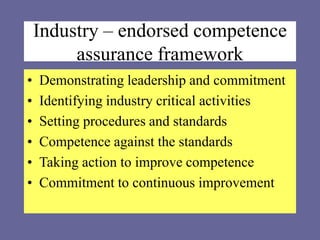
Industry – endorsed competence
assurance framework
• Demonstrating leadership and commitment
• Identifying industry critical activities
• Setting procedures and standards
• Competence against the standards
• Taking action to improve competence
• Commitment to continuous improvement
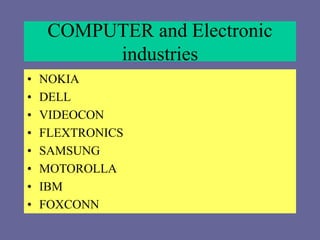
COMPUTER and Electronic
industries
• NOKIA
• DELL
• VIDEOCON
• FLEXTRONICS
• SAMSUNG
• MOTOROLLA
• IBM
• FOXCONN
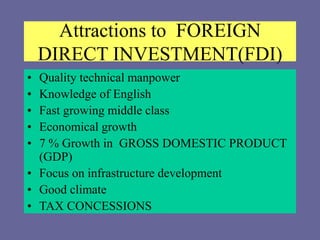
Attractions to FOREIGN
DIRECT INVESTMENT(FDI)
• Quality technical manpower
• Knowledge of English
• Fast growing middle class
• Economical growth
• 7 % Growth in GROSS DOMESTIC PRODUCT
(GDP)
• Focus on infrastructure development
• Good climate
• TAX CONCESSIONS
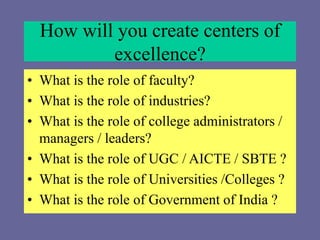
How will you create centers of
excellence?
• What is the role of faculty?
• What is the role of industries?
• What is the role of college administrators /
managers / leaders?
• What is the role of UGC / AICTE / SBTE ?
• What is the role of Universities /Colleges ?
• What is the role of Government of India ?
Human Resource Development
• Long-term programs
• Flexible programs
• Short-term MODULAR programs
• Distance education programs / online education
• Industrial training / internship
• Technical working group meetings
• Development workshops
• In-house programs
• Life-long education
Acute shortage of trained human
resources
• 6,50,0000 Multi Skilled Workers
• 6,00,0000 Competent IT enabled
technicians , applied scientists , engineers
and managers
• Research and development engineers
• Managers with exposure to international
business exposure
• Applied scientists
Industrial collaboration through
partnership
• Starting I T I s , Polytechnics , Engineering
Colleges,Technical Universities through industrial
cooperation
• Sponsoring research and development programs
• Funding for proto type equipment
• Joint evaluation of existing curricula
• Participation in preparing goals,objectives of
professional programs
• Cooperation in implementation
Need for Frontal Assault
• Institutional autonomy with accountability
• Accreditation of programs by Industry
• Programs for institutional development and
creation of centers of excellence
• Programs and projects to meet the growing
technology and economy
• P-P-P for expansion of well performing
institutions
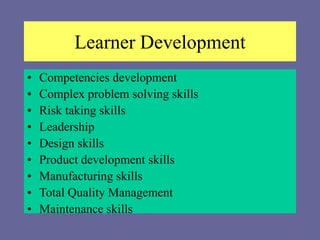
Learner Development
• Competencies development
• Complex problem solving skills
• Risk taking skills
• Leadership
• Design skills
• Product development skills
• Manufacturing skills
• Total Quality Management
• Maintenance skills
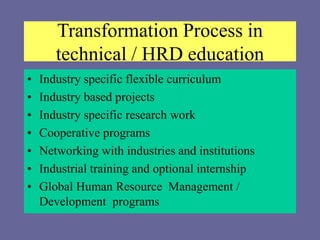
Transformation Process in
technical / HRD education
• Industry specific flexible curriculum
• Industry based projects
• Industry specific research work
• Cooperative programs
• Networking with industries and institutions
• Industrial training and optional internship
• Global Human Resource Management /
Development programs
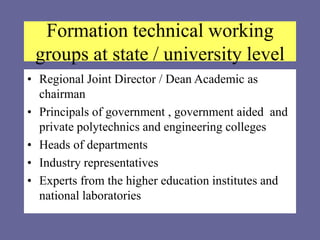
Formation technical working
groups at state / university level
• Regional Joint Director / Dean Academic as
chairman
• Principals of government , government aided and
private polytechnics and engineering colleges
• Heads of departments
• Industry representatives
• Experts from the higher education institutes and
national laboratories
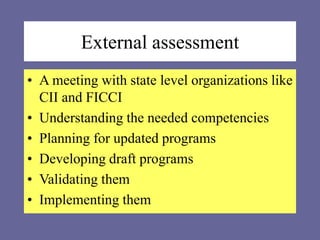
External assessment
• A meeting with state level organizations like
CII and FICCI
• Understanding the needed competencies
• Planning for updated programs
• Developing draft programs
• Validating them
• Implementing them
What are the current problems in
developing human resources?
• Institutional development ?
• Lack of I.I.C.P ?
• Heavy control of various councils?
• Corruption ?
• Vision ?
• Faculty shortages?
• Lack of development programs?
• Lack of funds?
CREATE CENTERS OF
EXCELLENCE
• DEVELOP TECHNICAL / HRD &M
EDUCATION PROGRAMMES TO MEET
GLOBAL STANDARDS
• PROVIDE ACADEMIC AUTONOMY
WITH BUILT IN ACCOUNTABILITY
• DEVELOP MARKET DRIVEN
FLEXIBLE PROGRAMMES
• NETWORK WITH EMPLOYERS
CREDIT BASED
PROGRAMMES
• COURSES
• Basic,Core, Applied, Advanced, Electives,
• Independent Studies
• Country specific courses
• Total credits are fixed
• Duration varies , maximum five years for
graduate programmes
• Two to five years for post graduate programs
FLEXIBILITY
• Learners plan their courses based on their
needs / vision /goal
• University provides the courses demanded
• Responds to the client needs
CREDIT TRANSFER
• Based on the objectives of the courses
• Built in Standards
• Limitation on the number of credits
REGION-WIDE INNOVATION CORRIDOR
WORKFORCE INITIATIVE
• Workforce development
• Formation of innovation corridor
• Consortium of industry and technical education
institutes
• Creation of the next generation of innovators
(engineers, managers and technicians)
• Capitalization of wealth of research and
development utilization of manufacturing assets
• Work force transformation through cooperative
engineering programmes
Innovation corridors
• Bangalore –Mysore corridor
• Bangalore-Hosur corridor
• Mangalore industrial hub
• Chennai-Vellore corridor
• Chennai hub
• Hosur hub
• Chennai –Ennore corridor
STRATEGIC GOALS
• Sustainable Entrepreneurship
• Manufacturing value chain and supplier
competitiveness
• Development of innovation-oriented
technical support
• INDUSTRY PARTICIPATION IN
TECHNICAL EDUCATION PLANNING
AND IMPLEMENTATION
GLOBAL COMPETITION
• National challenge
• Frontlines of the battle are regional
• COMPETITIVE ADVANTAGE
Companies, technicians, engineers,
technical institutions, researchers
government and entrepreneurs come
together to create competitive
advantage.
ABILITY TO TRANSFORM
• New ideas and new knowledge
into advanced, high quality
products and services.
ELEMENTS TO ACCELERATE
THE PROCESS
• Workforce skill-building
• Problem based learning
• Problem solving skills
• Creative design skills
• Lifelong learning strategies
• Investment and entrepreneurial
strategies
• Regional and economical development
strategies.
INNOVATION SUPPORT
• Meet the demands of the global
companies in the region
• Develop highly skilled technicians,
engineers and managers
• Develop 21st century job profiles to define
future workforce skills and needs
• Compilation of an innovation asset
inventory to foster innovation and
entrepreneurship.
IMPROVE THE INTERNATIONAL
COMPETITIVENESS OF THE
SOUTHERN REGION
• Develop and Execute a Smart
Supplier Strategy
• Support global manufacturers and
small and medium entrepreneurs
• Adapt to the global manufacturing
transformation.
INDUSTRIALIZATION
• Improve the international competitiveness
of the region’s supply chain by developing
and executing a smart supplier strategy
• Adapt to the global manufacturing
standards
• Identify the competencies needed
• Invite collaboration of the manufacturers
• Develop an industry driven manufacturing
technician training programme.
CAREER OPPORTUNITIES
• Strategic and integrative role in the effective
operation of business enterprises
• Manufacturing industries
• Service and commercial enterprises
• Management consulting firms
• Public / private sector industries
• Software industries
• Manufacturing consumer goods
• Ancillary products
• Maintenance engineering
• Energy management.
CAREER OPPORTUNITIES IN
CIVIL ENGINEERING
• Urban reconstruction
• Building technology and services
• Infrastructure development
• Construction technology / management
• Highways / Airports / Ports and Harbour construction
• Real Estate Management
• Industrial Parks
• Environmental Engineering
• Industrial Structures
• Pollution Control
• Private Builders
• Housing complexes.
CAREER OPPORTUNITIES IN
ELECTRICAL ENGINEERING
• Electricity Boards
• Power Generation
• Power Corporation
• Electrical machinery manufacturers
• Manufacturing industries
• Household appliance
• Electrical service industries
• Consultancy firms
• Maintenance firms
• Marketing
• Telecommunications service.
NATURE OF EMPLOYMENT
• Product Design
• Prototyping
• Manufacturing
• Testing
• Installation
• Operation
• Maintenance
• Planning
• Management.
CAREER OPPORTUNITIES IN
MECHANICAL ENGINEERING
• Manufacturing sector
• Automobiles
• Consumer goods
• Heavy machinery
• Precision components
• Electrical households appliances
• Electronics products
• Maintenance.
NATURE OF EMPLOYMENT
• Design
• Prototype development
• Installation
• Commissioning
• Maintenance.
ELECTRONIC ENGINEERING
• Manufacturing of computer
hardware and instruments
• Control systems, computers,
communication systems
• Maintenance
• Spare utility companies
• Service industries
• Electronic data systems.
NATURE OF EMPLOYMENT
• Research and development
• Installation
• Operation
• Maintenance
• Utility services planning
• Design
• Industrial products planning
• Consultancy works
• Manufacturing of electronic goods related to
TV’s, Satellites, radars, wireless equipment
• System analysis and planning.
INDUSTRIAL MANAGEMENT AND
MANUFACTURING SYSTEMS
ENGINEERING
• Strategic and integrative role in the
effective operation of
manufacturing industries
• Problem solving
• Innovations
• Coordination
• System integration.
JOBS IN MANUFACTURING
INDUSTRIES
• Manufacturing corporations
• Research and product development
• Service and commercial enterprises
• Management and consulting firms
• Management systems for business
enterprises
• Managing technical systems
• Energy management systems
• Building service systems
• Air Conditioning.
JOBS IN ENVIRONMENTAL
ENGINEERING
• Careers in water, air, and noise pollution
control
• Solid and hazardous waste treatment
• Clean technology
• Installation and maintenance of pollution
control equipment
• Environment planning and assessment
• Impact studies.
Human resource development
• Long-term programs in global HRM / HRD
• Executive development programs
• Online programs
• In-house programs
INDUSTRY SPEICIFIC COURSES
• Hands-on laboratory classes that
focus on current issues in the
application of engineering
principles
• Prepare students for practical
design and production work.
ACCREDITATION OF PROGRAMS
by INDUSTRIES
• Based on an PROFESSIONAL
competencies of students and their
achievements
• Programme objectives
• Faculty competencies
• Facilities / infrastructure
• Institutional commitment to total
quality and ethics.
TRENDS IN EMPLOYMENT OF
BIOMEDICAL ENGINEERS
• Greater focus on health issues will drive
demand for better medical devices
• Demand for more sophisticated medical
equipment and procedures
• An increased concern for cost-
effectiveness
• Rapid growth of pharmaceutical
manufacturing industries.
• GENERATES THE NEED FOR
BIOMEDICAL ENGINEERS
JOB OPPORTUNITIES FOR
CIVIL ENGINEERS
• Housing for middle class
• Urban reconstruction
• Infrastructure development
• SEZ (Special Economic Zones)
• Software industrial parks
• High capacity transportation
• Replacement of existing roads, bridges, and
public structures
• Real estate development
• Construction technology
• Service sector
• Maintenance.
COMPUTER HARDWARE ENGINEERS
• Computer & Semiconductor
manufacturing
• Computer systems design.
ELECTRICAL ENGINEERS
• Production of electrical machines,
generators, transformers, motors
• Replacement of engineers
• Power generation
• Transmission
• Maintenance.
ELECTRONICS ENGINEERS
• Rising demand for electronic goods
• Advanced communication equipment
• Defense-related electronic equipment
• Medical electronics
• Consumer products
• Service and maintenance
• Industrial electronics.
• Wireless technology
• Embedded system
ENVIRONMENTAL ENGINEERS
• Develop methods of cleaning up
existing hazards
• Pollution control devices
• Pollution free technology (clean
technology)
• Impact studies.
SAFETY ENGINEERS
• Safe production
• Health and safety within work
environments
• Product safety.
IMPACT ON THE TECHNICIAN
AND DEGREE PROGRAMMES
• Revision
• Improvement
• Innovation
• Industry specific programmes
• Multidisciplinary programmes
• Flexible programmes
• Multi skilled programmes
• Cooperative programmes.
INDUSTRY-INSTITUTE-
PARTNERSHIP
• M o U s with consortium of industries
• M o U s with Consortium of Institutes
• Networking
• Joint planning of needs assessment
• Needs analysis
• Resource sharing
• Knowledge sharing
Advisory Committees
• Members drawn from the consortium of
industries,institutes,and higher education
institutes,national institutes and national
laboratories
• Generating the program goals
• Stating the objectives of courses
• Selecting the instructional processes
• Providing industrial exposures and training
Joint Program Planning
• Program goals
• Program objectives
• Basic courses
• Applied courses
• Advanced courses
• Courses in technology , human resource
management and financial management
• Electives / Industry specific electives (Jointly
offered / out sourced / net worked )
Joint Formative Evaluation
• Check the course objectives against the
performance standards.
• Check the contents of the courses against
the current industrial / professional practices
• Check the adequacy of the courses
• Check the analytical ,design, estimation,
field work,practical,workshop / laboratory
works
Periodical Revision and
Improvement
• Revise and update the curriculum
periodically
• Assess the resources, infrastructure, funds,
faculty competencies ,and other relevant
requirements
• Check the instructional materials and aids
• Suggest improvements
• Carry out all accepted changes.
Mass production of resources
• Train the project faculty / staff
• Implement the program in all institutions
• Evaluate the outcome
• Obtain the feedback from the faculty,
participants,and industries.
• Analyze
• Revise and update
Periodical Evaluation
• Evaluate the curriculum and instruction
periodically
• Update the same
• Evaluate the policy of the government
(Freezing of non-plan expenditure from
2004)
BEST AND BRIGHTIST
• CREATE A CLIMATE FOR
EXCELLENCE
• UNDERTAKE INDUSTRY SPONSORED
RESEARCH AND DEVELOPMENT
WORKS
• RECRUIT, AND RETAIN BRIGHTEST
STUDENTS, FACULTYAND STAFF
• Eradicate corruption in recruitment
SUSTAIN THE
DEVELOPMENT
• Human capital
• Knowledge capital
• Support institutional development
• Network with industries for research and
development
• Create knowledge based society
• Decentralize educational administration
Bring continuous improvement
IN PROGRAMME PLANNING
AND IMPLEMENTATION
THROUGH NETWORKING and
GLOBALIZATION
Update National Policy on
Education
Journey always continues !
Never ends !!
Initiate globalization in
engineering education
THANK YOU ,
we hope that you will support all
International educational
Programme planners, and human
and knowledge capital developers

Human Resource Development in Engineering Education

  • 1.
    HUMAN RESOURCE REQUIREMENTS TO MEETTHE CHALLENGES OF 21st CENTURY - Dr. V. THANIKACHALAM
  • 2.
    Human Capital Development InEngineering and Technology Leads to faster industrialization of India
  • 3.
    Knowledge Capital Development •An outcome of human capital development • Creates intellectual property • Impacts on the GDP and Indian economy • Alleviates poverty • Improves the market share of Indian Industry in global market place • Creates global leaders in technology • Helps them acquire industries in other countries
  • 4.
    INDIA IS FASTbecoming as an EMERGING LEADER IN PRODUCTION AND SERVICES DUE TO GLOBALIZATION OF INDIAN ECONOMY * As human capital supplier to the WEST,EAST and the Pacific * As knowledge capital supplier to the world * As supplier of quality engineering / software products and technical services
  • 5.
    Problems of theWest • Shortage of human resources in engineering and technology to replace the retirees there • Shortage of highly qualified scientists , technicians, managers , technologists and engineers to do further research • Dependence on foreign students and research scholars from India and China • Decline in the output of graduates in the US Universities and research products
  • 6.
    Competitive strengths ofSouth India • Substantial private sector investment in technical education • Location advantage based on geographic presence in the Indian economy • Promising core industry clusters in high technology, manufacturing of automobiles , textile garments,leather goods , electrical goods and software development and B P O service .
  • 7.
    Investors • Successful public-privateinitiatives in key industry clusters at state / national level • Foreign direct investment in manufacturing industries and product design • Expansion of Indian Industry in the southern region • Establishment of new industries with foreign collaboration
  • 8.
    Technical Education • Renewedcommitment and leadership on improving technical education and training outcomes • Strong polytechnic colleges,engineering colleges and private technical universities / Deemed Universities , support of business associations, industry sectors ,workforce development • A set of national institutes to meet the quality needs of technical teachers
  • 9.
    Competitive challenges • Lackof integrated , region wide strategy for technical education, economic development,work force development • Low higher educational attainment • Low educational investments • Low research and development investments in engineering colleges and technical universities • Low training investments
  • 10.
    Urgent need • Keyto effective competition now are agility, fast response to market shifts, continuous innovation and focus on design and production • Dynamic curriculum development process • Partnership with industries, government industries , national laboratories and entrepreneurs
  • 11.
    Skills gap • Availableworkers and technicians lack I T enabled skills • Weak links between polytechnics and engineering colleges and industries • Shortage of trained faculty • Inflexible (rigid) curriculum • Shortage infrastructure and resources
  • 12.
    Demand • Business growth •Advancing technology • Demand for Innovative multi skilled workforce • Higher skills and competencies in design and manufacturing • Cooperative planning and implementing process
  • 13.
    Opportunities • Growth ofbusiness and industry clusters that have multiplier effects, pay high wage jobs and other benefits • Demand for highly skilled workers who can meet regional business needs and can compete in the national and global economy • Demand for seamless workforce system and stay marketable in the job world
  • 14.
    Scenario of India(11th and 12th Five year plans) {2007-2017} • GDP to Double to $2.5 trillion? • Global meltdown ? • Export US $155 to 200 billion ? • One more year of tax holiday for E o Us • Concessional export credit for high employment generating sectors • 6,50,00,000 more jobs in the formal job market • 6,00,00,000 more jobs are expected to be created by the country’s booming economy
  • 15.
    Issues that canpull down the growth • Global meltdown • Shortage of funds for investment • Retardation in global markets • Fall in market demands • Rapid growth in unemployment
  • 16.
    Shortage of … •Skilled workers • Shortage of technicians • Shortage of teachers • Shortage of vision for growth • Shortage resources • Shortage of dynamic policy too !
  • 17.
    Extrapolation … • Every$ 1 billion of incremental export would create 2.26 lakh new jobs • Export target US $ 200 billion for 2008-09 • Possible amount US $ 155 billion • S E Zs are emerging as engines of expert growth • E o Us can enjoy tax holiday till 2010
  • 18.
    Outsourcing for productionand services • Looking for countries with trained human resources in science , engineering , technology, management and human resource development • Participants of Global economy through WTO • Climate for developing the products and services • Local high purchasing power for goods and services and paying fees to colleges • Capability for undertaking the research and development works
  • 19.
    KEY FACTORS • EXCELLENCEIN TECHNICAL EDUCATION • ENGINEERS and TECHNICIANS WITH STRONG ANALYTICAL SKILLS • MANAGERS WITH MULTICULTUTRAL UNDERSTANDING WHO CAN OPERATE IN A GLOBAL CONTEXT • SCIENTISTS WITH INTELLECTUAL AGILITY
  • 20.
    GLOBAL COMPETITIVENESS IN AUTOMOBILEMANUFACTURING TECHNOLOGY • Ashok Leyland • Hyundai • Hero motors and Daimler partnership • BMW • FORD • Caterpillar • Mitsubishi • Nissan • Renault • TAFE • TVS- Delphi
  • 21.
    Industry – endorsedcompetence assurance framework • Demonstrating leadership and commitment • Identifying industry critical activities • Setting procedures and standards • Competence against the standards • Taking action to improve competence • Commitment to continuous improvement
  • 22.
    COMPUTER and Electronic industries •NOKIA • DELL • VIDEOCON • FLEXTRONICS • SAMSUNG • MOTOROLLA • IBM • FOXCONN
  • 23.
    Attractions to FOREIGN DIRECTINVESTMENT(FDI) • Quality technical manpower • Knowledge of English • Fast growing middle class • Economical growth • 7 % Growth in GROSS DOMESTIC PRODUCT (GDP) • Focus on infrastructure development • Good climate • TAX CONCESSIONS
  • 24.
    How will youcreate centers of excellence? • What is the role of faculty? • What is the role of industries? • What is the role of college administrators / managers / leaders? • What is the role of UGC / AICTE / SBTE ? • What is the role of Universities /Colleges ? • What is the role of Government of India ?
  • 25.
    Human Resource Development •Long-term programs • Flexible programs • Short-term MODULAR programs • Distance education programs / online education • Industrial training / internship • Technical working group meetings • Development workshops • In-house programs • Life-long education
  • 26.
    Acute shortage oftrained human resources • 6,50,0000 Multi Skilled Workers • 6,00,0000 Competent IT enabled technicians , applied scientists , engineers and managers • Research and development engineers • Managers with exposure to international business exposure • Applied scientists
  • 27.
    Industrial collaboration through partnership •Starting I T I s , Polytechnics , Engineering Colleges,Technical Universities through industrial cooperation • Sponsoring research and development programs • Funding for proto type equipment • Joint evaluation of existing curricula • Participation in preparing goals,objectives of professional programs • Cooperation in implementation
  • 28.
    Need for FrontalAssault • Institutional autonomy with accountability • Accreditation of programs by Industry • Programs for institutional development and creation of centers of excellence • Programs and projects to meet the growing technology and economy • P-P-P for expansion of well performing institutions
  • 29.
    Learner Development • Competenciesdevelopment • Complex problem solving skills • Risk taking skills • Leadership • Design skills • Product development skills • Manufacturing skills • Total Quality Management • Maintenance skills
  • 30.
    Transformation Process in technical/ HRD education • Industry specific flexible curriculum • Industry based projects • Industry specific research work • Cooperative programs • Networking with industries and institutions • Industrial training and optional internship • Global Human Resource Management / Development programs
  • 31.
    Formation technical working groupsat state / university level • Regional Joint Director / Dean Academic as chairman • Principals of government , government aided and private polytechnics and engineering colleges • Heads of departments • Industry representatives • Experts from the higher education institutes and national laboratories
  • 32.
    External assessment • Ameeting with state level organizations like CII and FICCI • Understanding the needed competencies • Planning for updated programs • Developing draft programs • Validating them • Implementing them
  • 33.
    What are thecurrent problems in developing human resources? • Institutional development ? • Lack of I.I.C.P ? • Heavy control of various councils? • Corruption ? • Vision ? • Faculty shortages? • Lack of development programs? • Lack of funds?
  • 34.
    CREATE CENTERS OF EXCELLENCE •DEVELOP TECHNICAL / HRD &M EDUCATION PROGRAMMES TO MEET GLOBAL STANDARDS • PROVIDE ACADEMIC AUTONOMY WITH BUILT IN ACCOUNTABILITY • DEVELOP MARKET DRIVEN FLEXIBLE PROGRAMMES • NETWORK WITH EMPLOYERS
  • 35.
    CREDIT BASED PROGRAMMES • COURSES •Basic,Core, Applied, Advanced, Electives, • Independent Studies • Country specific courses • Total credits are fixed • Duration varies , maximum five years for graduate programmes • Two to five years for post graduate programs
  • 36.
    FLEXIBILITY • Learners plantheir courses based on their needs / vision /goal • University provides the courses demanded • Responds to the client needs
  • 37.
    CREDIT TRANSFER • Basedon the objectives of the courses • Built in Standards • Limitation on the number of credits
  • 38.
    REGION-WIDE INNOVATION CORRIDOR WORKFORCEINITIATIVE • Workforce development • Formation of innovation corridor • Consortium of industry and technical education institutes • Creation of the next generation of innovators (engineers, managers and technicians) • Capitalization of wealth of research and development utilization of manufacturing assets • Work force transformation through cooperative engineering programmes
  • 39.
    Innovation corridors • Bangalore–Mysore corridor • Bangalore-Hosur corridor • Mangalore industrial hub • Chennai-Vellore corridor • Chennai hub • Hosur hub • Chennai –Ennore corridor
  • 40.
    STRATEGIC GOALS • SustainableEntrepreneurship • Manufacturing value chain and supplier competitiveness • Development of innovation-oriented technical support • INDUSTRY PARTICIPATION IN TECHNICAL EDUCATION PLANNING AND IMPLEMENTATION
  • 41.
    GLOBAL COMPETITION • Nationalchallenge • Frontlines of the battle are regional • COMPETITIVE ADVANTAGE Companies, technicians, engineers, technical institutions, researchers government and entrepreneurs come together to create competitive advantage.
  • 42.
    ABILITY TO TRANSFORM •New ideas and new knowledge into advanced, high quality products and services.
  • 43.
    ELEMENTS TO ACCELERATE THEPROCESS • Workforce skill-building • Problem based learning • Problem solving skills • Creative design skills • Lifelong learning strategies • Investment and entrepreneurial strategies • Regional and economical development strategies.
  • 44.
    INNOVATION SUPPORT • Meetthe demands of the global companies in the region • Develop highly skilled technicians, engineers and managers • Develop 21st century job profiles to define future workforce skills and needs • Compilation of an innovation asset inventory to foster innovation and entrepreneurship.
  • 45.
    IMPROVE THE INTERNATIONAL COMPETITIVENESSOF THE SOUTHERN REGION • Develop and Execute a Smart Supplier Strategy • Support global manufacturers and small and medium entrepreneurs • Adapt to the global manufacturing transformation.
  • 46.
    INDUSTRIALIZATION • Improve theinternational competitiveness of the region’s supply chain by developing and executing a smart supplier strategy • Adapt to the global manufacturing standards • Identify the competencies needed • Invite collaboration of the manufacturers • Develop an industry driven manufacturing technician training programme.
  • 47.
    CAREER OPPORTUNITIES • Strategicand integrative role in the effective operation of business enterprises • Manufacturing industries • Service and commercial enterprises • Management consulting firms • Public / private sector industries • Software industries • Manufacturing consumer goods • Ancillary products • Maintenance engineering • Energy management.
  • 48.
    CAREER OPPORTUNITIES IN CIVILENGINEERING • Urban reconstruction • Building technology and services • Infrastructure development • Construction technology / management • Highways / Airports / Ports and Harbour construction • Real Estate Management • Industrial Parks • Environmental Engineering • Industrial Structures • Pollution Control • Private Builders • Housing complexes.
  • 49.
    CAREER OPPORTUNITIES IN ELECTRICALENGINEERING • Electricity Boards • Power Generation • Power Corporation • Electrical machinery manufacturers • Manufacturing industries • Household appliance • Electrical service industries • Consultancy firms • Maintenance firms • Marketing • Telecommunications service.
  • 50.
    NATURE OF EMPLOYMENT •Product Design • Prototyping • Manufacturing • Testing • Installation • Operation • Maintenance • Planning • Management.
  • 51.
    CAREER OPPORTUNITIES IN MECHANICALENGINEERING • Manufacturing sector • Automobiles • Consumer goods • Heavy machinery • Precision components • Electrical households appliances • Electronics products • Maintenance.
  • 52.
    NATURE OF EMPLOYMENT •Design • Prototype development • Installation • Commissioning • Maintenance.
  • 53.
    ELECTRONIC ENGINEERING • Manufacturingof computer hardware and instruments • Control systems, computers, communication systems • Maintenance • Spare utility companies • Service industries • Electronic data systems.
  • 54.
    NATURE OF EMPLOYMENT •Research and development • Installation • Operation • Maintenance • Utility services planning • Design • Industrial products planning • Consultancy works • Manufacturing of electronic goods related to TV’s, Satellites, radars, wireless equipment • System analysis and planning.
  • 55.
    INDUSTRIAL MANAGEMENT AND MANUFACTURINGSYSTEMS ENGINEERING • Strategic and integrative role in the effective operation of manufacturing industries • Problem solving • Innovations • Coordination • System integration.
  • 56.
    JOBS IN MANUFACTURING INDUSTRIES •Manufacturing corporations • Research and product development • Service and commercial enterprises • Management and consulting firms • Management systems for business enterprises • Managing technical systems • Energy management systems • Building service systems • Air Conditioning.
  • 57.
    JOBS IN ENVIRONMENTAL ENGINEERING •Careers in water, air, and noise pollution control • Solid and hazardous waste treatment • Clean technology • Installation and maintenance of pollution control equipment • Environment planning and assessment • Impact studies.
  • 58.
    Human resource development •Long-term programs in global HRM / HRD • Executive development programs • Online programs • In-house programs
  • 59.
    INDUSTRY SPEICIFIC COURSES •Hands-on laboratory classes that focus on current issues in the application of engineering principles • Prepare students for practical design and production work.
  • 60.
    ACCREDITATION OF PROGRAMS byINDUSTRIES • Based on an PROFESSIONAL competencies of students and their achievements • Programme objectives • Faculty competencies • Facilities / infrastructure • Institutional commitment to total quality and ethics.
  • 61.
    TRENDS IN EMPLOYMENTOF BIOMEDICAL ENGINEERS • Greater focus on health issues will drive demand for better medical devices • Demand for more sophisticated medical equipment and procedures • An increased concern for cost- effectiveness • Rapid growth of pharmaceutical manufacturing industries. • GENERATES THE NEED FOR BIOMEDICAL ENGINEERS
  • 62.
    JOB OPPORTUNITIES FOR CIVILENGINEERS • Housing for middle class • Urban reconstruction • Infrastructure development • SEZ (Special Economic Zones) • Software industrial parks • High capacity transportation • Replacement of existing roads, bridges, and public structures • Real estate development • Construction technology • Service sector • Maintenance.
  • 63.
    COMPUTER HARDWARE ENGINEERS •Computer & Semiconductor manufacturing • Computer systems design.
  • 64.
    ELECTRICAL ENGINEERS • Productionof electrical machines, generators, transformers, motors • Replacement of engineers • Power generation • Transmission • Maintenance.
  • 65.
    ELECTRONICS ENGINEERS • Risingdemand for electronic goods • Advanced communication equipment • Defense-related electronic equipment • Medical electronics • Consumer products • Service and maintenance • Industrial electronics. • Wireless technology • Embedded system
  • 66.
    ENVIRONMENTAL ENGINEERS • Developmethods of cleaning up existing hazards • Pollution control devices • Pollution free technology (clean technology) • Impact studies.
  • 67.
    SAFETY ENGINEERS • Safeproduction • Health and safety within work environments • Product safety.
  • 68.
    IMPACT ON THETECHNICIAN AND DEGREE PROGRAMMES • Revision • Improvement • Innovation • Industry specific programmes • Multidisciplinary programmes • Flexible programmes • Multi skilled programmes • Cooperative programmes.
  • 69.
    INDUSTRY-INSTITUTE- PARTNERSHIP • M oU s with consortium of industries • M o U s with Consortium of Institutes • Networking • Joint planning of needs assessment • Needs analysis • Resource sharing • Knowledge sharing
  • 70.
    Advisory Committees • Membersdrawn from the consortium of industries,institutes,and higher education institutes,national institutes and national laboratories • Generating the program goals • Stating the objectives of courses • Selecting the instructional processes • Providing industrial exposures and training
  • 71.
    Joint Program Planning •Program goals • Program objectives • Basic courses • Applied courses • Advanced courses • Courses in technology , human resource management and financial management • Electives / Industry specific electives (Jointly offered / out sourced / net worked )
  • 72.
    Joint Formative Evaluation •Check the course objectives against the performance standards. • Check the contents of the courses against the current industrial / professional practices • Check the adequacy of the courses • Check the analytical ,design, estimation, field work,practical,workshop / laboratory works
  • 73.
    Periodical Revision and Improvement •Revise and update the curriculum periodically • Assess the resources, infrastructure, funds, faculty competencies ,and other relevant requirements • Check the instructional materials and aids • Suggest improvements • Carry out all accepted changes.
  • 74.
    Mass production ofresources • Train the project faculty / staff • Implement the program in all institutions • Evaluate the outcome • Obtain the feedback from the faculty, participants,and industries. • Analyze • Revise and update
  • 75.
    Periodical Evaluation • Evaluatethe curriculum and instruction periodically • Update the same • Evaluate the policy of the government (Freezing of non-plan expenditure from 2004)
  • 76.
    BEST AND BRIGHTIST •CREATE A CLIMATE FOR EXCELLENCE • UNDERTAKE INDUSTRY SPONSORED RESEARCH AND DEVELOPMENT WORKS • RECRUIT, AND RETAIN BRIGHTEST STUDENTS, FACULTYAND STAFF • Eradicate corruption in recruitment
  • 77.
    SUSTAIN THE DEVELOPMENT • Humancapital • Knowledge capital • Support institutional development • Network with industries for research and development • Create knowledge based society • Decentralize educational administration
  • 78.
    Bring continuous improvement INPROGRAMME PLANNING AND IMPLEMENTATION THROUGH NETWORKING and GLOBALIZATION
  • 79.
  • 80.
    Journey always continues! Never ends !!
  • 81.
  • 82.
    THANK YOU , wehope that you will support all International educational Programme planners, and human and knowledge capital developers