
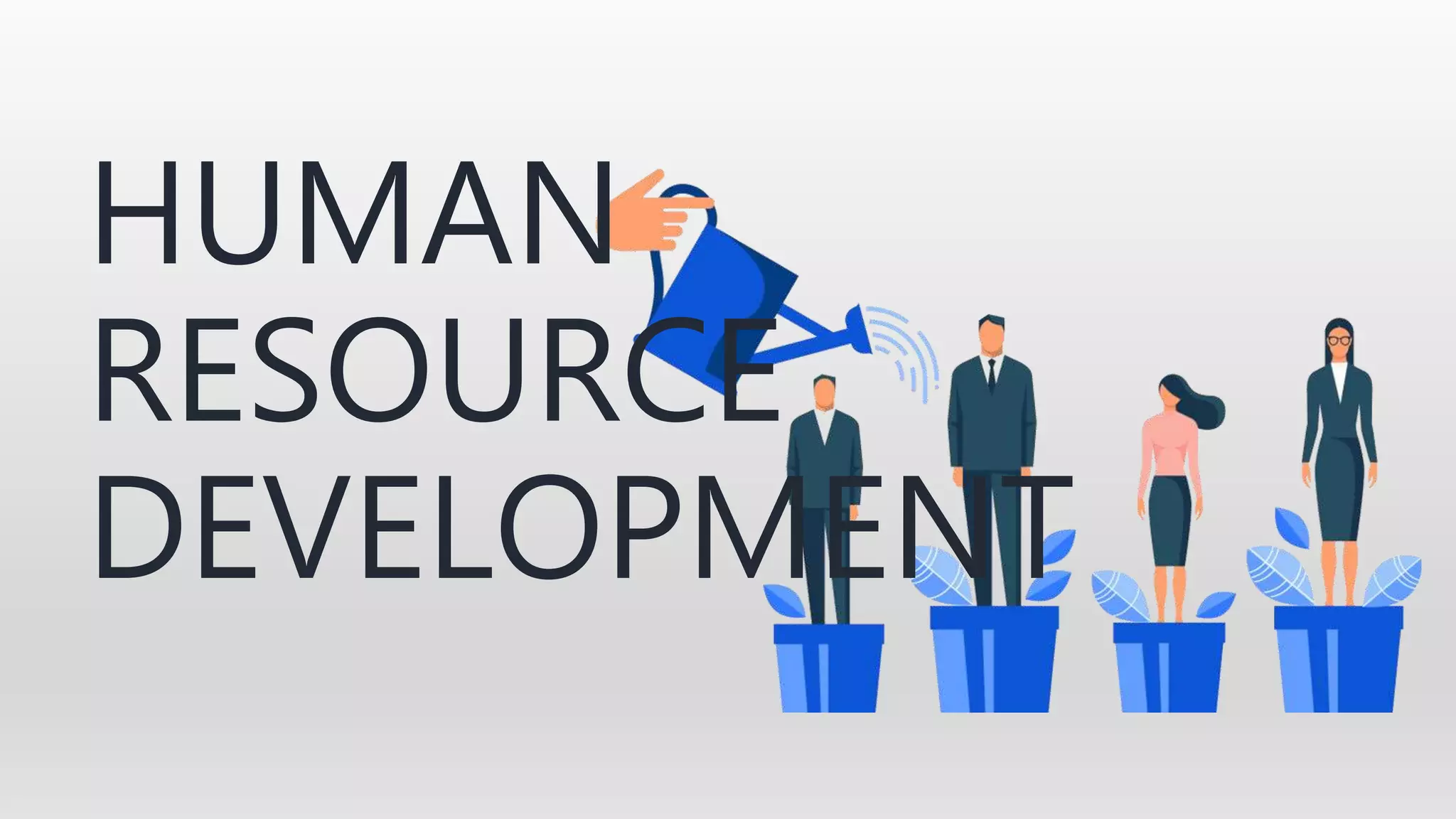






HUMAN
RESOURCE
DEVELOPMENT
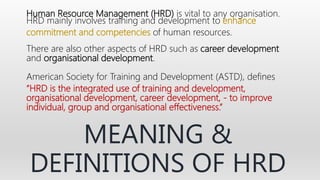
Human Resource Management (HRD) is vital to any organisation.
HRD mainly involves training and development to enhance
commitment and competencies of human resources.
There are also other aspects of HRD such as career development
and organisational development.
American Society for Training and Development (ASTD), defines
“HRD is the integrated use of training and development,
organisational development, career development, - to improve
individual, group and organisational effectiveness.”
MEANING &
DEFINITIONS OF HRD
FUNCTIONS
OF HRD
• Performance Appraisal
• Promotion of Employees
• Training and Development
• Career Development
• Organisation Development
• Motivation
• Employee Welfare
• Mentoring
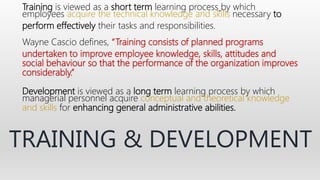
Training is viewed as a short term learning process by which
employees acquire the technical knowledge and skills necessary to
perform effectively their tasks and responsibilities.
Wayne Cascio defines, “Training consists of planned programs
undertaken to improve employee knowledge, skills, attitudes and
social behaviour so that the performance of the organization improves
considerably.”
Development is viewed as a long term learning process by which
managerial personnel acquire conceptual and theoretical knowledge
and skills for enhancing general administrative abilities.
TRAINING & DEVELOPMENT
IMPORTAN
CE• Innovation
• Corporate Image
• Team Work
• Optimum Use of Resources
• Motivation
• Customer Satisfaction
• Absenteeism Reduction
• Employee Turnover Reduction
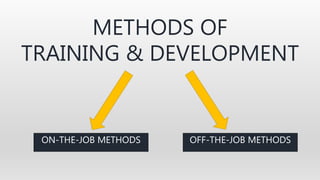
METHODS OF
TRAINING & DEVELOPMENT
ON-THE-JOB METHODS OFF-THE-JOB METHODS
ON-THE-JOB
METHODS
• Job Rotation
• Planned Progression
• Coaching
• Counselling
• Understudy Position
• Junior Boards
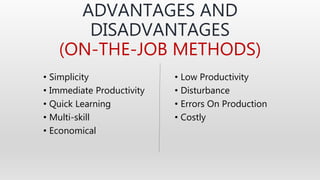
ADVANTAGES AND
DISADVANTAGES
(ON-THE-JOB METHODS)
• Simplicity
• Immediate Productivity
• Quick Learning
• Multi-skill
• Economical
• Low Productivity
• Disturbance
• Errors On Production
• Costly
OFF-THE-JOB
METHODS
• Assessment Centres
• Business Games
• Classroom Methods
• Simulation
• Committees
• Conferences
• Reading and References
• Seminars and Workshops
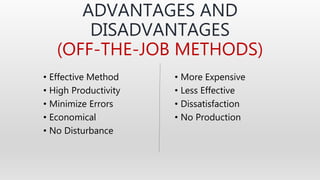
ADVANTAGES AND
DISADVANTAGES
(OFF-THE-JOB METHODS)
• Effective Method
• High Productivity
• Minimize Errors
• Economical
• No Disturbance
• More Expensive
• Less Effective
• Dissatisfaction
• No Production
TECHNIQUES OF
MANAGEMENT DEVELOPMENT
PROGRAMME
• Brainstorming Sessions
• Vestibule Training
• In Basket Training
• Programmed Instructions
• Sensitivity Training
• Case Study Method
• Role Playing
• Mentoring
Thank You

HUMAN RESOURCE DEVELOPMENT

  • 1.
  • 2.
    Human Resource Management(HRD) is vital to any organisation. HRD mainly involves training and development to enhance commitment and competencies of human resources. There are also other aspects of HRD such as career development and organisational development. American Society for Training and Development (ASTD), defines “HRD is the integrated use of training and development, organisational development, career development, - to improve individual, group and organisational effectiveness.” MEANING & DEFINITIONS OF HRD
  • 3.
    FUNCTIONS OF HRD • PerformanceAppraisal • Promotion of Employees • Training and Development • Career Development • Organisation Development • Motivation • Employee Welfare • Mentoring
  • 4.
    Training is viewedas a short term learning process by which employees acquire the technical knowledge and skills necessary to perform effectively their tasks and responsibilities. Wayne Cascio defines, “Training consists of planned programs undertaken to improve employee knowledge, skills, attitudes and social behaviour so that the performance of the organization improves considerably.” Development is viewed as a long term learning process by which managerial personnel acquire conceptual and theoretical knowledge and skills for enhancing general administrative abilities. TRAINING & DEVELOPMENT
  • 5.
    IMPORTAN CE• Innovation • CorporateImage • Team Work • Optimum Use of Resources • Motivation • Customer Satisfaction • Absenteeism Reduction • Employee Turnover Reduction
  • 6.
    METHODS OF TRAINING &DEVELOPMENT ON-THE-JOB METHODS OFF-THE-JOB METHODS
  • 7.
    ON-THE-JOB METHODS • Job Rotation •Planned Progression • Coaching • Counselling • Understudy Position • Junior Boards
  • 8.
    ADVANTAGES AND DISADVANTAGES (ON-THE-JOB METHODS) •Simplicity • Immediate Productivity • Quick Learning • Multi-skill • Economical • Low Productivity • Disturbance • Errors On Production • Costly
  • 9.
    OFF-THE-JOB METHODS • Assessment Centres •Business Games • Classroom Methods • Simulation • Committees • Conferences • Reading and References • Seminars and Workshops
  • 10.
    ADVANTAGES AND DISADVANTAGES (OFF-THE-JOB METHODS) •Effective Method • High Productivity • Minimize Errors • Economical • No Disturbance • More Expensive • Less Effective • Dissatisfaction • No Production
  • 11.
    TECHNIQUES OF MANAGEMENT DEVELOPMENT PROGRAMME •Brainstorming Sessions • Vestibule Training • In Basket Training • Programmed Instructions • Sensitivity Training • Case Study Method • Role Playing • Mentoring
  • 12.