A Presentation by:
ABHINAY ANAND
MBBS VIIIth Semester (2017 Batch)
Institute of Medical Sciences
Banaras Hindu University
What is a Human Milk Bank?
A human milk bank is a service which
 collects,
 screens,
 processes,
 stores, and
 dispenses by doctor’s prescription
human milk which has been donated by
nursing mothers who are not biologically
related to the recipient infant.
Baby is hospitalized at birth due to Prematurity or Very Low Birth Weight
Child is admitted in the hospital and mother is staying far away
Less milk production
Infectious diseases in the mother
Mother is on certain medications which get secreted in breast milk
Maternal complications, including death in immediate postpartum period
Adopted Baby, if inducing lactation in the mother is not possible
Mother has undergone bilateral mastectomy
When do we need Donated
Human Milk? (Indian Pediatrics 2014;51: 469-474)
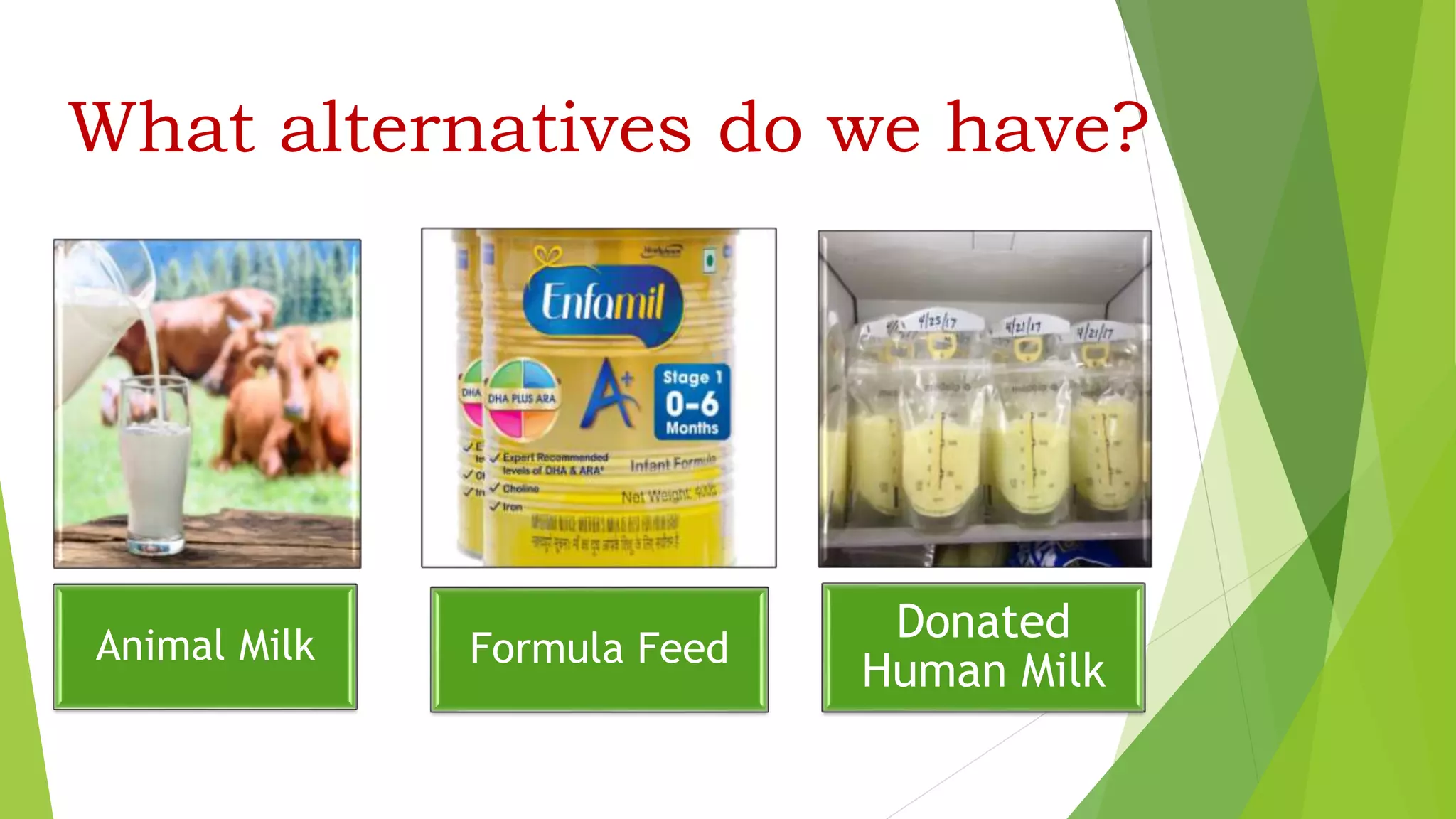
What alternatives do we have?
Formula Feed
Animal Milk
Donated
Human Milk
Why to prefer Human Milk over
Formula Feed/Animal Milk?
Primary and by far the largest group of consumers of human breast milk are
Premature and Very Low Birth Weight Babies, in whom we have found:
1. Decreased rates of Necrotising Enterocolitis (NEC) (J Perinatol. 2009; 29(1):57-62)
2. Decreased rates of late-onset Sepsis (Pediatrics. 1999; 103(6 Pt 1):1150-7)
3. Decreased rates of Retinopathy of Prematurity (Pediatr Int. 2007; 49(6):894-7)
4. Better weight gain (Pediatrics. 1999; 103(6 Pt 1):1150-7)
5. Fewer re-hospitalizations in the first year of life (Pediatrics. 2006; 118(1):e115-23)
6. Improved neurodevelopmental outcomes (Pediatrics. 2007; 120(4):e953-9)
As compared to premature infants receiving formula feeds or animal milk,
Premature infants who receive human milk, when they reach adolescence,
have:
Why to prefer Human Milk over
Formula Feed/Animal Milk?
1. Lower rates of Metabolic Syndrome (Lancet 2001 Feb 10; 357:413-9)
2. Lower Blood Pressure (Lancet 2001 Feb 10; 357:413-9)
3. Lower Low-density Lipoprotein (LDL) Levels (Lancet 2004 May 15; 363:1571-8)
4. Less Insulin and Leptin resistance (Am J Clin Nutr. 2002 Jun; 75:993-9)
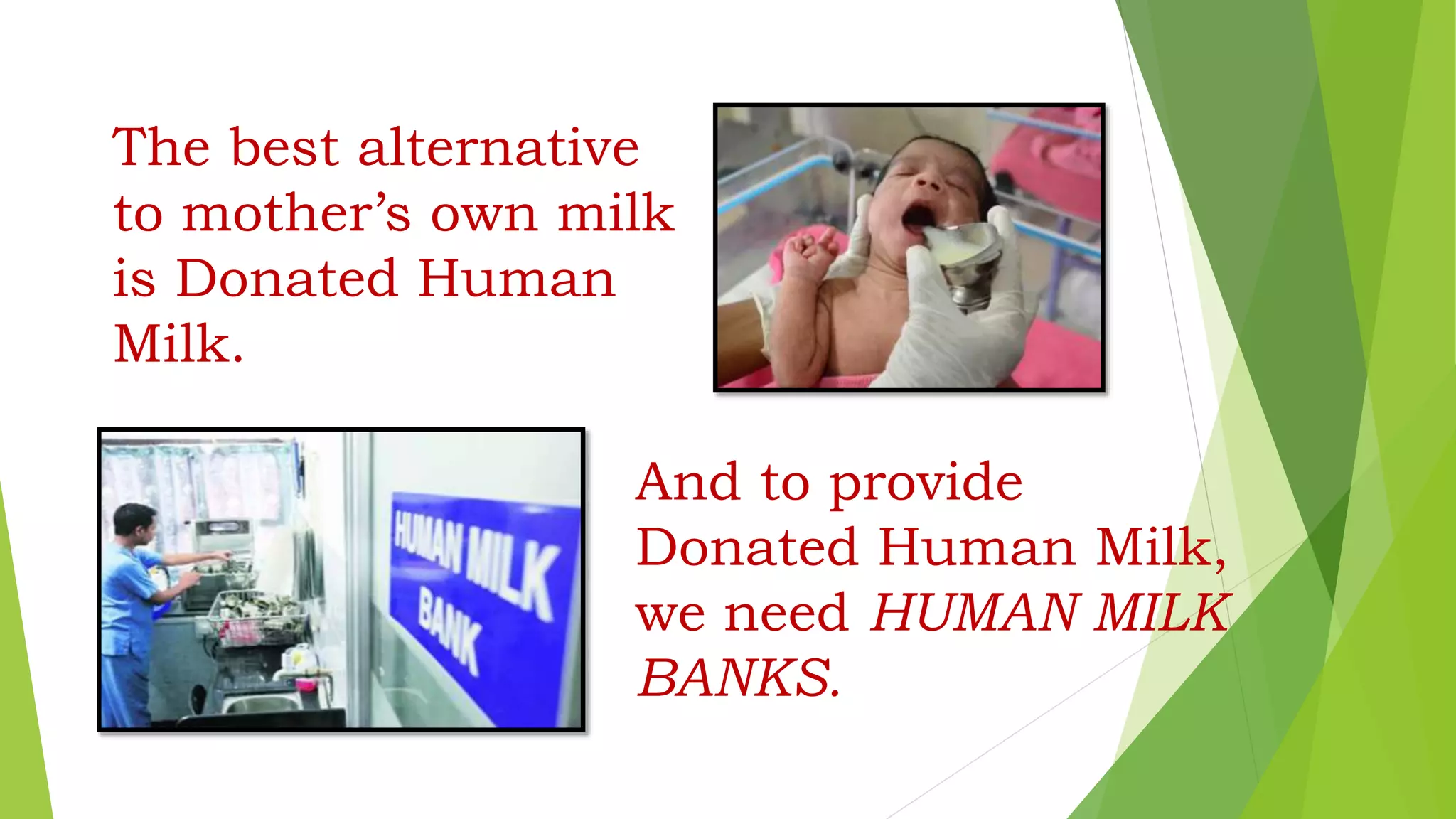
The best alternative
to mother’s own milk
is Donated Human
Milk.
And to provide
Donated Human Milk,
we need HUMAN MILK
BANKS.
From where did we begin?
 World's First Human Milk Bank was
opened in 1909 by Dr. Theodor
Escherich in Vienna, Austria.
 However, the 1960s saw a decline in
milk banking because of recent
advances in neonatal care and baby
formula.
Dr. Theodor Escherich
WHO and UNICEF in 1980
“Where it is not possible for the biological mother
to breastfeed, the first alternative, if available,
should be the use of Human Milk from other
sources. Human Milk Banks should be available
in appropriate situations.”
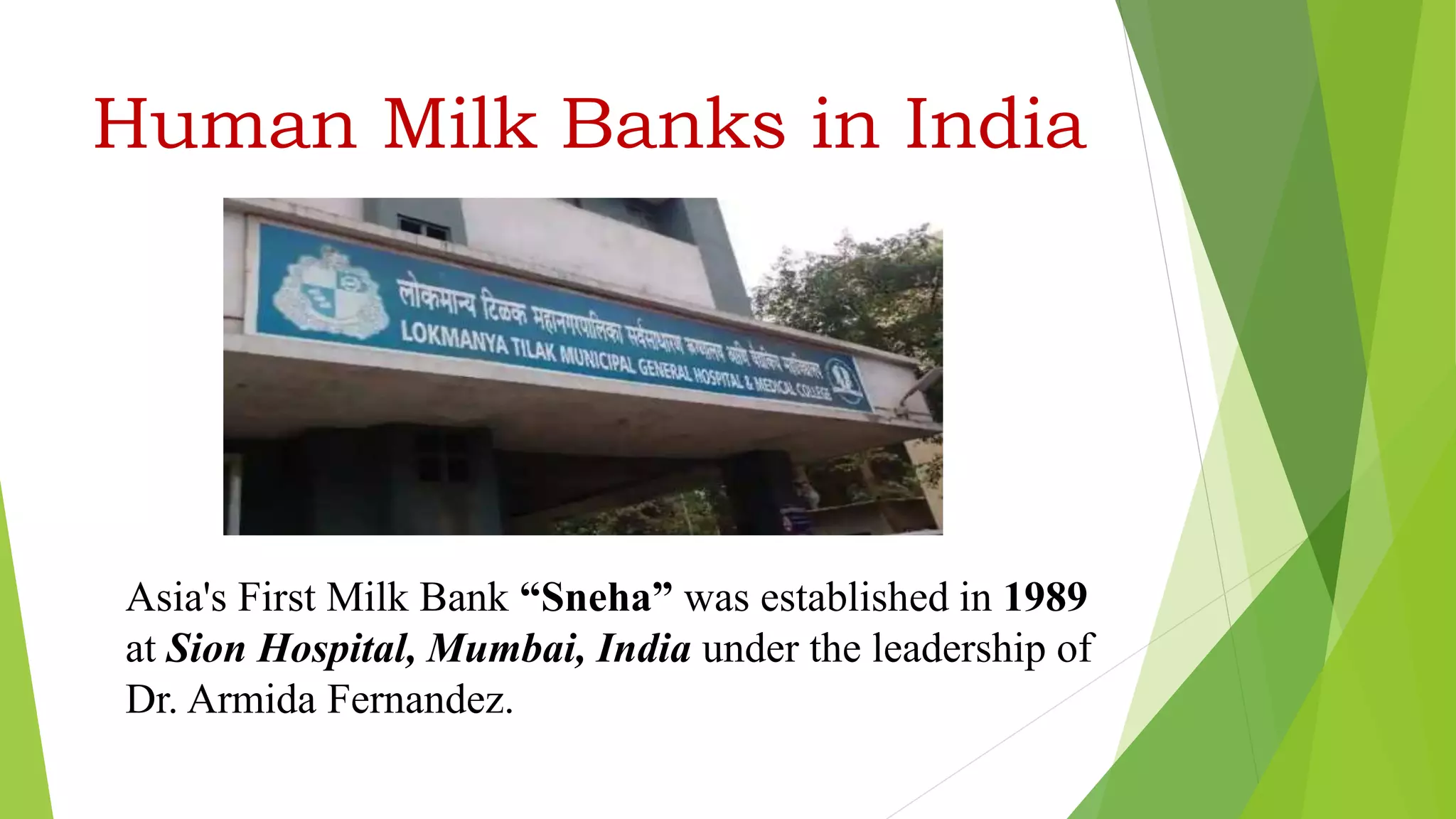
Human Milk Banks in India
Asia's First Milk Bank “Sneha” was established in 1989
at Sion Hospital, Mumbai, India under the leadership of
Dr. Armida Fernandez.
Technicalities of Setting Up
and Operating a Human
Milk Bank
Location of Human Milk Banks
 In close proximity or even inside the boundaries of neonatal unit
or Post Natal Wards
 Associated with elevated rates of exclusive breastfeeding in Very
Low Birth Weight babies (J Perinat Med. 2013;41:129-31)
 Donors are likely to be found in large numbers in Neonatal and
Post Natal wards.
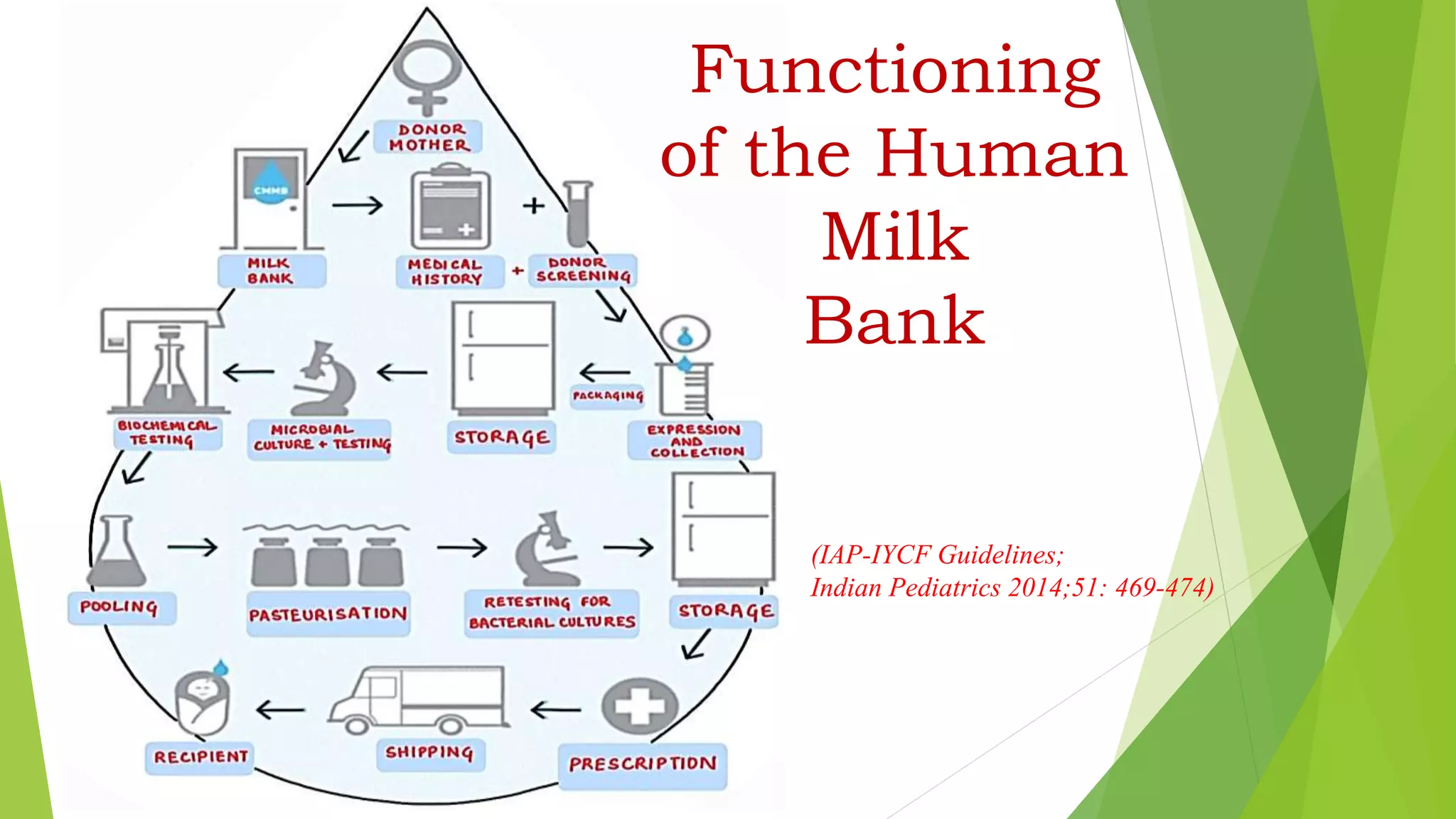
Functioning
of the Human
Milk
Bank
(IAP-IYCF Guidelines;
Indian Pediatrics 2014;51: 469-474)
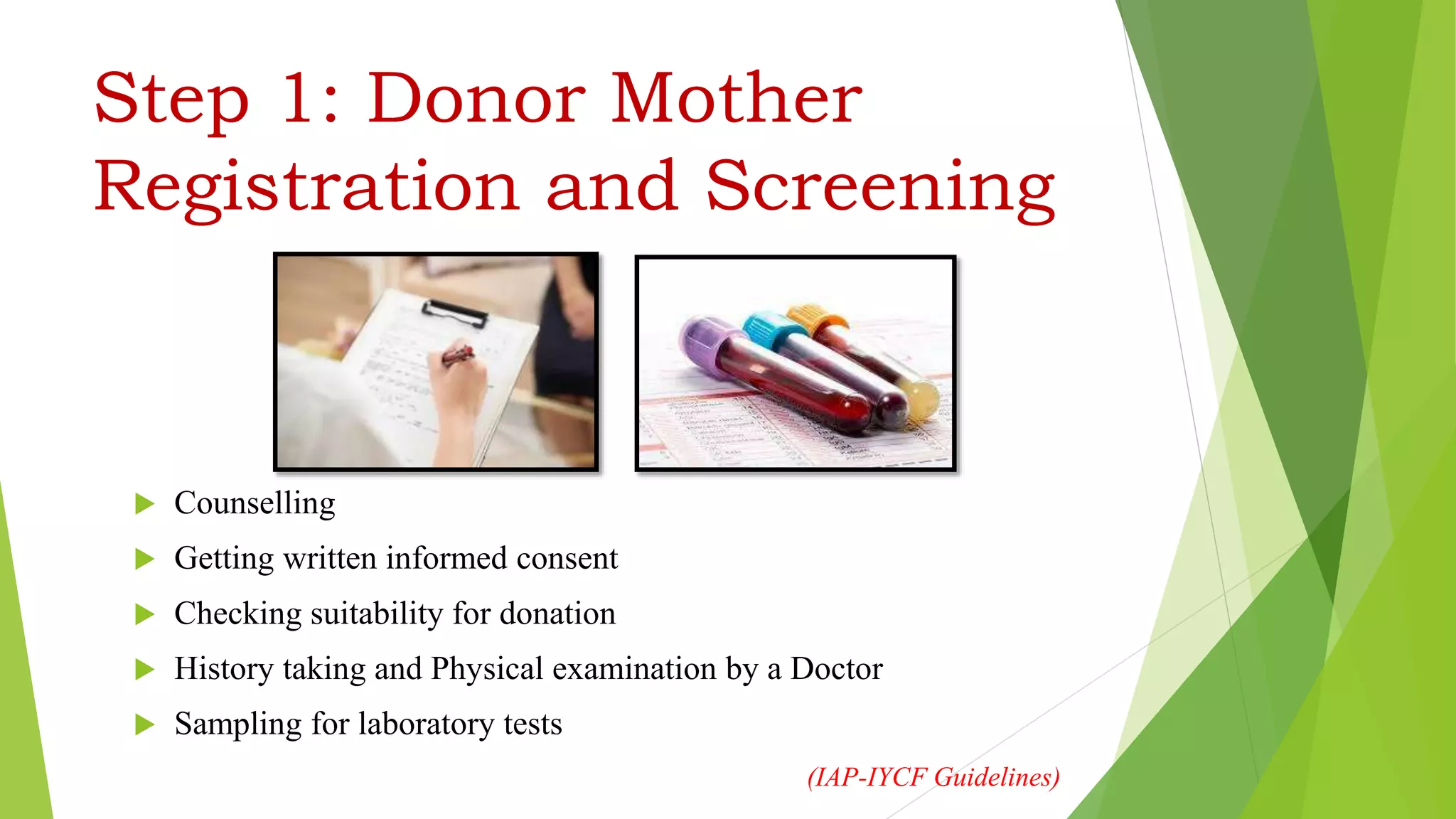
Step 1: Donor Mother
Registration and Screening
 Counselling
 Getting written informed consent
 Checking suitability for donation
 History taking and Physical examination by a Doctor
 Sampling for laboratory tests
(IAP-IYCF Guidelines)
When can a lactating mother
donate her milk?
Milk can be donated by a lactating mother who:
1. Is in good health
2. Has enough milk after feeding her baby satisfactorily and her
baby is thriving nicely
3. Is not regularly on medications which can get excreted in the milk
4. Has been tested negative for HIV, HTLV, Hepatitis B, Hepatitis
C and Syphilis
5. Does not have mastitis or fungal infection of the nipple or areola,
or active herpes simplex or varicella zoster infections in the
mammary or thoracic region.
(IAP-IYCF Guidelines)
Step 2: Milk Expression
 Manual Milk Expression
 Low cost
 Less chances of contamination
 Electric Breast Pump
 More volume of milk collected
 More chances of contamination and
hence the breast pump should be
washed thoroughly with detergent
and stored dry in between two uses.
(IAP-IYCF Guidelines)
Step 3: Collection,
Packaging and Storage
 Hard plastic containers
 Cylindrical, wide-mouthed stainless steel containers with tight
fitting/screwed caps are equally effective. They are easily available, and are
durable, easy to clean and autoclave.
 Collected raw breast milk should be refrigerated immediately.
(IAP-IYCF Guidelines)
Step 4: Pre-Pasteurization
Microbiological and
Biochemical Testing
 In developing countries like India, it is not possible because of cost
constraints.
 Wastage of milk to the tune of about 30% in some cases. (Early Hum Dev.
2009;85:701-4)
 In developed countries it is done and if there are more than 105 CFU/ml,
that milk is not used.
(IAP-IYCF Guidelines)
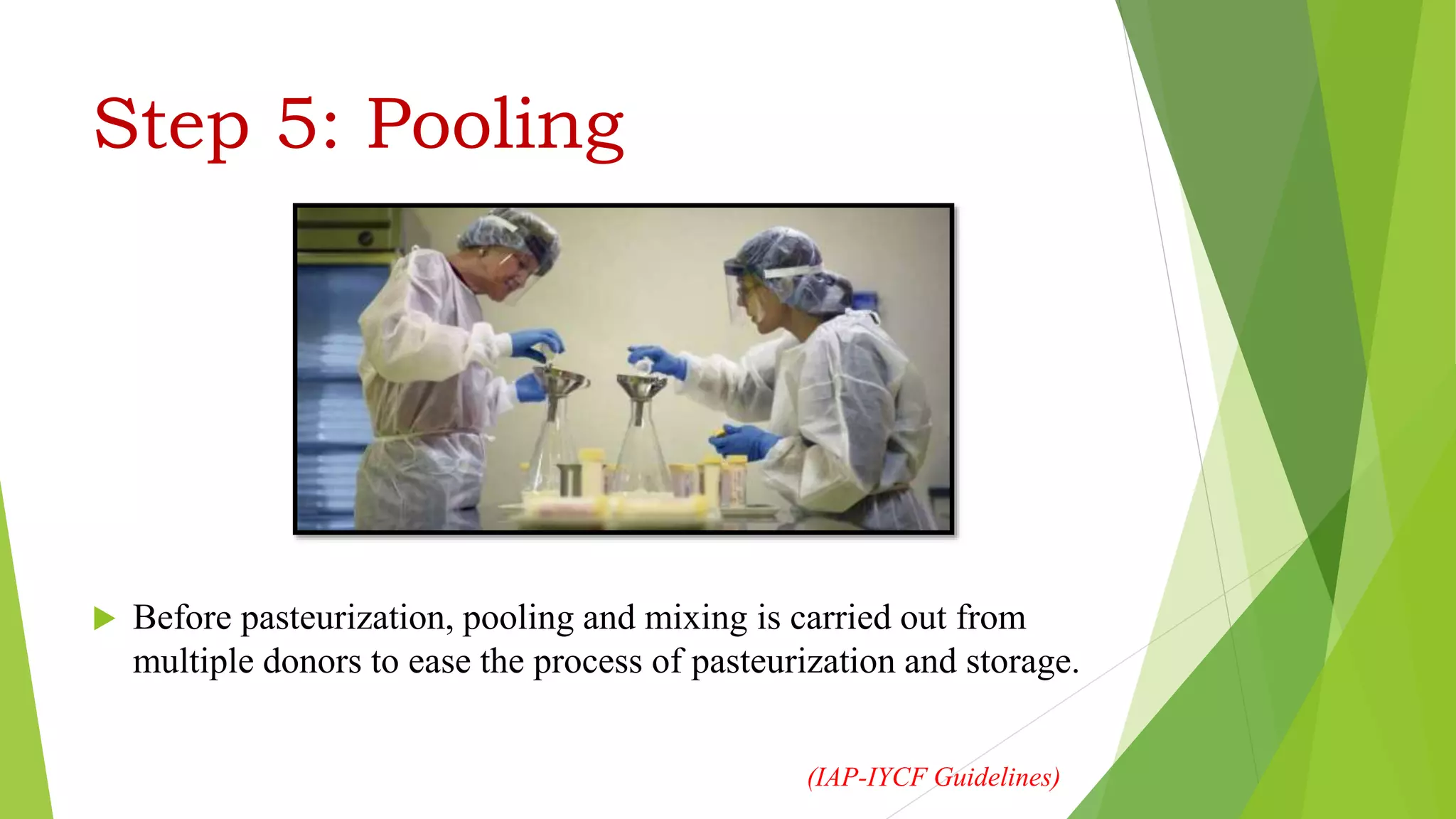
Step 5: Pooling
 Before pasteurization, pooling and mixing is carried out from
multiple donors to ease the process of pasteurization and storage.
(IAP-IYCF Guidelines)
Step 6: Pasteurization
 Holder method: 62.5ºC for a period of 30 minutes
 Done in a Shaker Water Bath to avoid coagulation of the milk and
to distribute heat evenly.
(IAP-IYCF Guidelines)
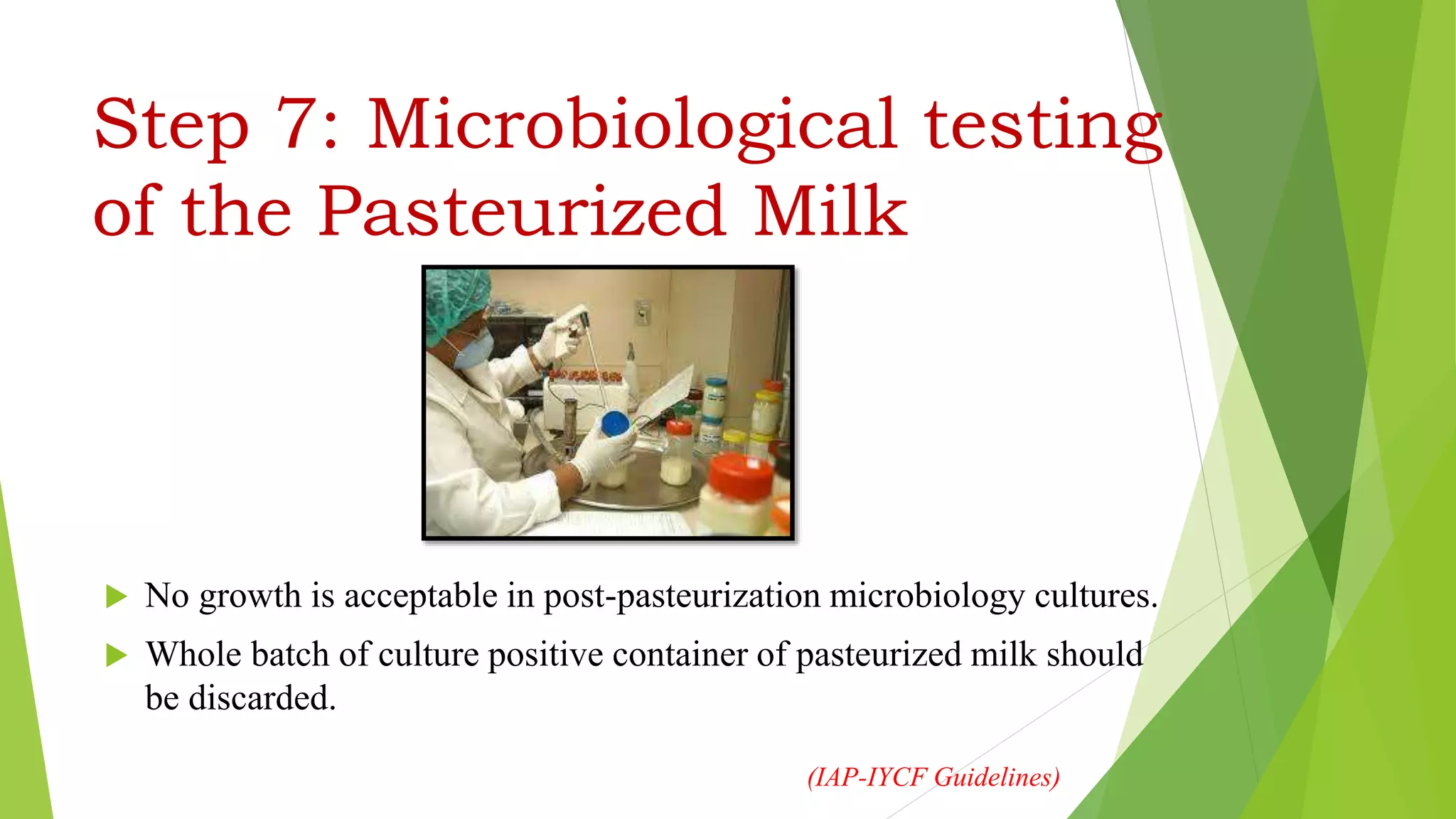
Step 7: Microbiological testing
of the Pasteurized Milk
 No growth is acceptable in post-pasteurization microbiology cultures.
 Whole batch of culture positive container of pasteurized milk should
be discarded.
(IAP-IYCF Guidelines)
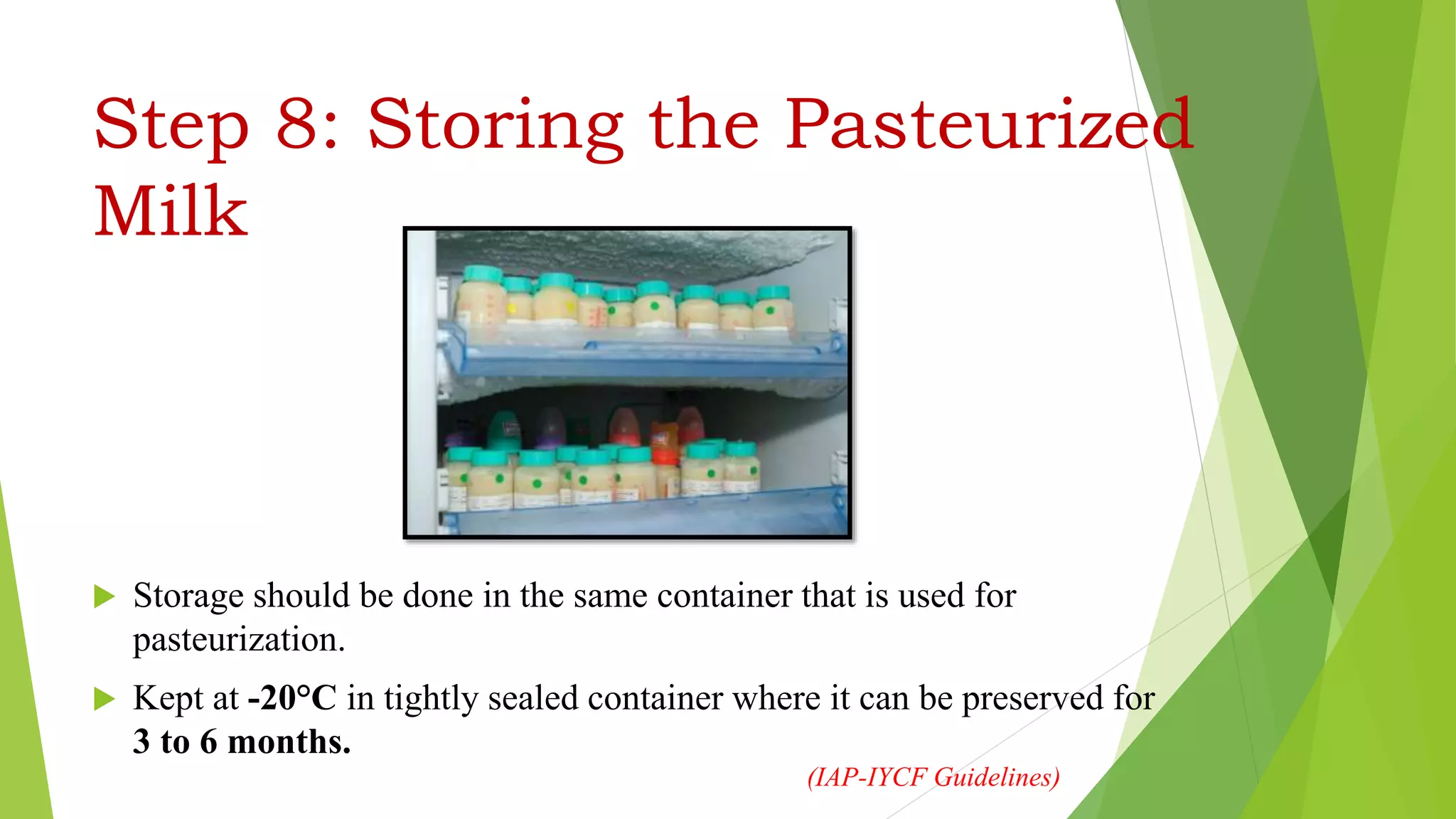
Step 8: Storing the Pasteurized
Milk
 Storage should be done in the same container that is used for
pasteurization.
 Kept at -20°C in tightly sealed container where it can be preserved for
3 to 6 months.
(IAP-IYCF Guidelines)
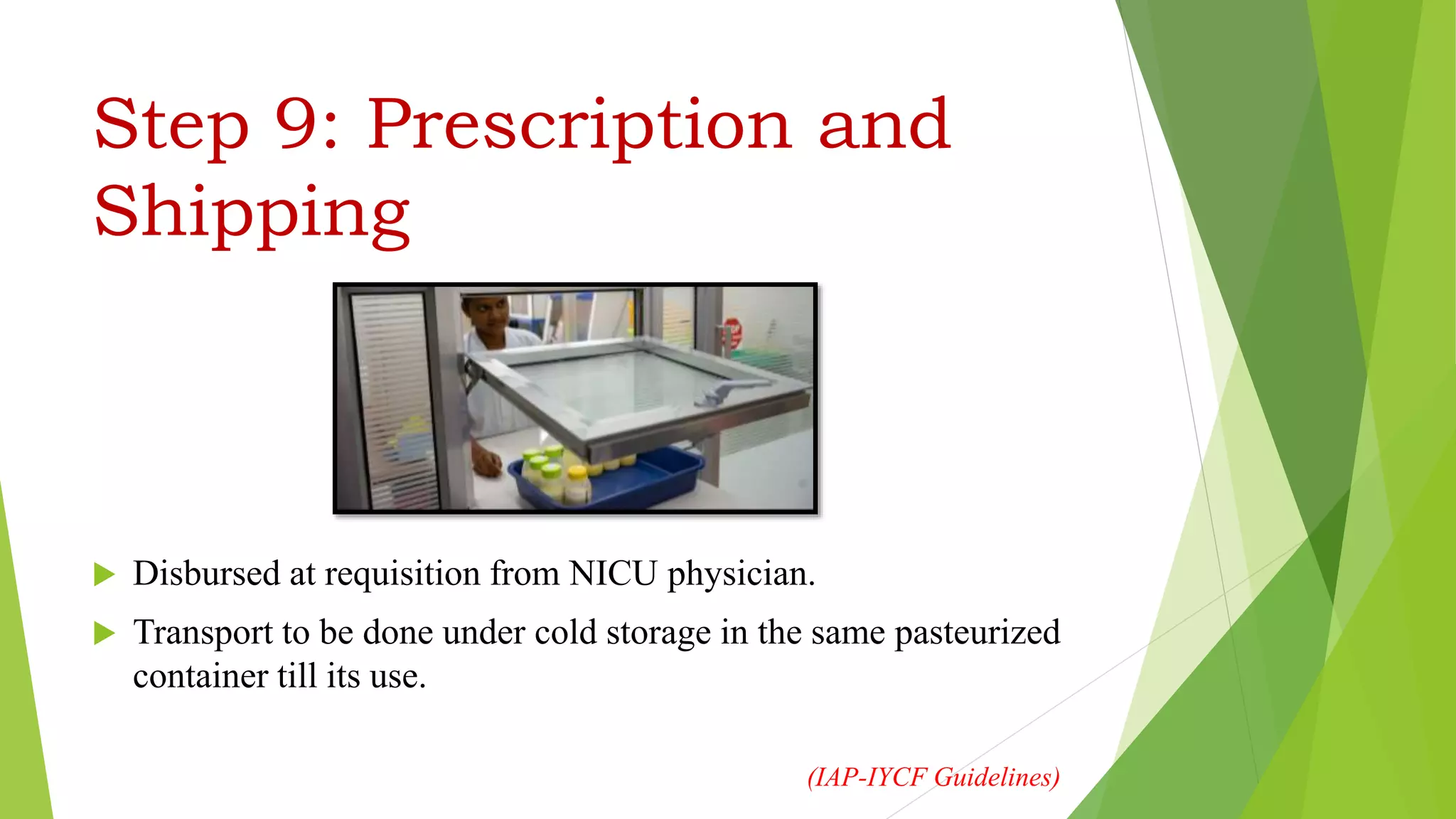
Step 9: Prescription and
Shipping
 Disbursed at requisition from NICU physician.
 Transport to be done under cold storage in the same pasteurized
container till its use.
(IAP-IYCF Guidelines)
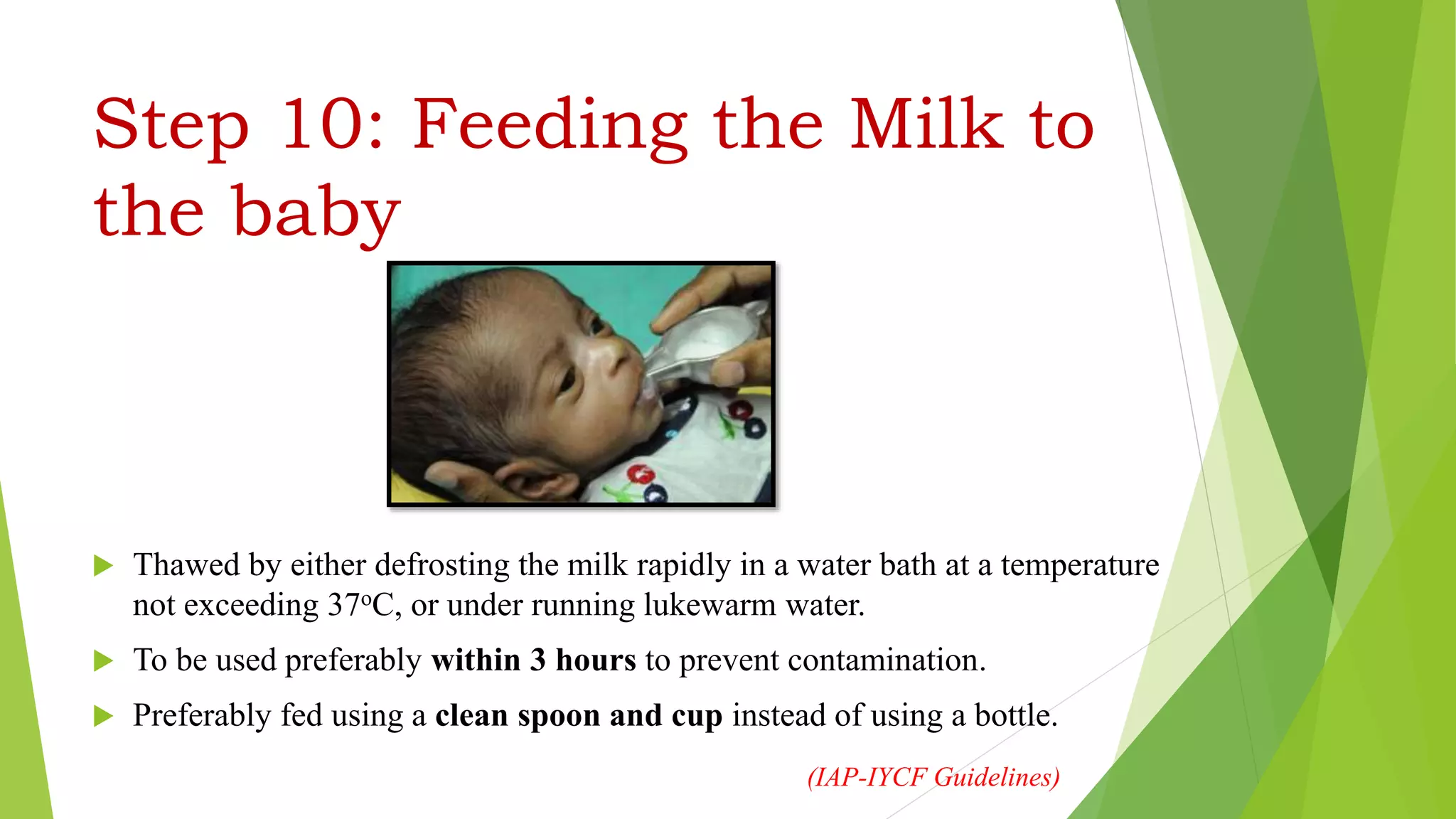
Step 10: Feeding the Milk to
the baby
 Thawed by either defrosting the milk rapidly in a water bath at a temperature
not exceeding 37oC, or under running lukewarm water.
 To be used preferably within 3 hours to prevent contamination.
 Preferably fed using a clean spoon and cup instead of using a bottle.
(IAP-IYCF Guidelines)
Challenges
1. High Cost of:
 Setting up and Operating the Milk Bank
 Donated Human Milk as compared to other alternatives
2. Less Availability of:
 Milk Banks
 Donor Mothers
3. Lack of health care personnel involved in Human Milk Banking
4. Concern about the type of women who might donate
What we can do!
 Encouraging lactating mothers to donate their milk wherever milk
banks are available
 Creating awareness about the benefits of using donated human
milk instead of animal milk or formula feed
 Making parents as well as authorities realize about the long term cost
effectiveness of setting up a Human Milk Bank and using donated
human milk instead of formula feed due to decreased rates of NEC,
sepsis and other neonatal complications. ( J Hum Lact. 2002;18:172-7)
 It is clear that artificial formula will never provide the broad range of
benefits of human milk.
 High rate of preterm births in the country and level of malnutrition
that ensues in such babies are indicators for the urgent need to establish
milk banks across the country, especially in the large neonatal units of
all hospitals.
Concluding Note
Human Milk Banking

Human Milk Banking

  • 1.
    A Presentation by: ABHINAYANAND MBBS VIIIth Semester (2017 Batch) Institute of Medical Sciences Banaras Hindu University
  • 2.
    What is aHuman Milk Bank? A human milk bank is a service which  collects,  screens,  processes,  stores, and  dispenses by doctor’s prescription human milk which has been donated by nursing mothers who are not biologically related to the recipient infant.
  • 3.
    Baby is hospitalizedat birth due to Prematurity or Very Low Birth Weight Child is admitted in the hospital and mother is staying far away Less milk production Infectious diseases in the mother Mother is on certain medications which get secreted in breast milk Maternal complications, including death in immediate postpartum period Adopted Baby, if inducing lactation in the mother is not possible Mother has undergone bilateral mastectomy When do we need Donated Human Milk? (Indian Pediatrics 2014;51: 469-474)
  • 4.
    What alternatives dowe have? Formula Feed Animal Milk Donated Human Milk
  • 5.
    Why to preferHuman Milk over Formula Feed/Animal Milk? Primary and by far the largest group of consumers of human breast milk are Premature and Very Low Birth Weight Babies, in whom we have found: 1. Decreased rates of Necrotising Enterocolitis (NEC) (J Perinatol. 2009; 29(1):57-62) 2. Decreased rates of late-onset Sepsis (Pediatrics. 1999; 103(6 Pt 1):1150-7) 3. Decreased rates of Retinopathy of Prematurity (Pediatr Int. 2007; 49(6):894-7) 4. Better weight gain (Pediatrics. 1999; 103(6 Pt 1):1150-7) 5. Fewer re-hospitalizations in the first year of life (Pediatrics. 2006; 118(1):e115-23) 6. Improved neurodevelopmental outcomes (Pediatrics. 2007; 120(4):e953-9)
  • 6.
    As compared topremature infants receiving formula feeds or animal milk, Premature infants who receive human milk, when they reach adolescence, have: Why to prefer Human Milk over Formula Feed/Animal Milk? 1. Lower rates of Metabolic Syndrome (Lancet 2001 Feb 10; 357:413-9) 2. Lower Blood Pressure (Lancet 2001 Feb 10; 357:413-9) 3. Lower Low-density Lipoprotein (LDL) Levels (Lancet 2004 May 15; 363:1571-8) 4. Less Insulin and Leptin resistance (Am J Clin Nutr. 2002 Jun; 75:993-9)
  • 7.
    The best alternative tomother’s own milk is Donated Human Milk. And to provide Donated Human Milk, we need HUMAN MILK BANKS.
  • 8.
    From where didwe begin?  World's First Human Milk Bank was opened in 1909 by Dr. Theodor Escherich in Vienna, Austria.  However, the 1960s saw a decline in milk banking because of recent advances in neonatal care and baby formula. Dr. Theodor Escherich
  • 9.
    WHO and UNICEFin 1980 “Where it is not possible for the biological mother to breastfeed, the first alternative, if available, should be the use of Human Milk from other sources. Human Milk Banks should be available in appropriate situations.”
  • 10.
    Human Milk Banksin India Asia's First Milk Bank “Sneha” was established in 1989 at Sion Hospital, Mumbai, India under the leadership of Dr. Armida Fernandez.
  • 11.
    Technicalities of SettingUp and Operating a Human Milk Bank
  • 12.
    Location of HumanMilk Banks  In close proximity or even inside the boundaries of neonatal unit or Post Natal Wards  Associated with elevated rates of exclusive breastfeeding in Very Low Birth Weight babies (J Perinat Med. 2013;41:129-31)  Donors are likely to be found in large numbers in Neonatal and Post Natal wards.
  • 13.
    Functioning of the Human Milk Bank (IAP-IYCFGuidelines; Indian Pediatrics 2014;51: 469-474)
  • 14.
    Step 1: DonorMother Registration and Screening  Counselling  Getting written informed consent  Checking suitability for donation  History taking and Physical examination by a Doctor  Sampling for laboratory tests (IAP-IYCF Guidelines)
  • 15.
    When can alactating mother donate her milk? Milk can be donated by a lactating mother who: 1. Is in good health 2. Has enough milk after feeding her baby satisfactorily and her baby is thriving nicely 3. Is not regularly on medications which can get excreted in the milk 4. Has been tested negative for HIV, HTLV, Hepatitis B, Hepatitis C and Syphilis 5. Does not have mastitis or fungal infection of the nipple or areola, or active herpes simplex or varicella zoster infections in the mammary or thoracic region. (IAP-IYCF Guidelines)
  • 16.
    Step 2: MilkExpression  Manual Milk Expression  Low cost  Less chances of contamination  Electric Breast Pump  More volume of milk collected  More chances of contamination and hence the breast pump should be washed thoroughly with detergent and stored dry in between two uses. (IAP-IYCF Guidelines)
  • 17.
    Step 3: Collection, Packagingand Storage  Hard plastic containers  Cylindrical, wide-mouthed stainless steel containers with tight fitting/screwed caps are equally effective. They are easily available, and are durable, easy to clean and autoclave.  Collected raw breast milk should be refrigerated immediately. (IAP-IYCF Guidelines)
  • 18.
    Step 4: Pre-Pasteurization Microbiologicaland Biochemical Testing  In developing countries like India, it is not possible because of cost constraints.  Wastage of milk to the tune of about 30% in some cases. (Early Hum Dev. 2009;85:701-4)  In developed countries it is done and if there are more than 105 CFU/ml, that milk is not used. (IAP-IYCF Guidelines)
  • 19.
    Step 5: Pooling Before pasteurization, pooling and mixing is carried out from multiple donors to ease the process of pasteurization and storage. (IAP-IYCF Guidelines)
  • 20.
    Step 6: Pasteurization Holder method: 62.5ºC for a period of 30 minutes  Done in a Shaker Water Bath to avoid coagulation of the milk and to distribute heat evenly. (IAP-IYCF Guidelines)
  • 21.
    Step 7: Microbiologicaltesting of the Pasteurized Milk  No growth is acceptable in post-pasteurization microbiology cultures.  Whole batch of culture positive container of pasteurized milk should be discarded. (IAP-IYCF Guidelines)
  • 22.
    Step 8: Storingthe Pasteurized Milk  Storage should be done in the same container that is used for pasteurization.  Kept at -20°C in tightly sealed container where it can be preserved for 3 to 6 months. (IAP-IYCF Guidelines)
  • 23.
    Step 9: Prescriptionand Shipping  Disbursed at requisition from NICU physician.  Transport to be done under cold storage in the same pasteurized container till its use. (IAP-IYCF Guidelines)
  • 24.
    Step 10: Feedingthe Milk to the baby  Thawed by either defrosting the milk rapidly in a water bath at a temperature not exceeding 37oC, or under running lukewarm water.  To be used preferably within 3 hours to prevent contamination.  Preferably fed using a clean spoon and cup instead of using a bottle. (IAP-IYCF Guidelines)
  • 25.
    Challenges 1. High Costof:  Setting up and Operating the Milk Bank  Donated Human Milk as compared to other alternatives 2. Less Availability of:  Milk Banks  Donor Mothers 3. Lack of health care personnel involved in Human Milk Banking 4. Concern about the type of women who might donate
  • 26.
    What we cando!  Encouraging lactating mothers to donate their milk wherever milk banks are available  Creating awareness about the benefits of using donated human milk instead of animal milk or formula feed  Making parents as well as authorities realize about the long term cost effectiveness of setting up a Human Milk Bank and using donated human milk instead of formula feed due to decreased rates of NEC, sepsis and other neonatal complications. ( J Hum Lact. 2002;18:172-7)
  • 27.
     It isclear that artificial formula will never provide the broad range of benefits of human milk.  High rate of preterm births in the country and level of malnutrition that ensues in such babies are indicators for the urgent need to establish milk banks across the country, especially in the large neonatal units of all hospitals. Concluding Note