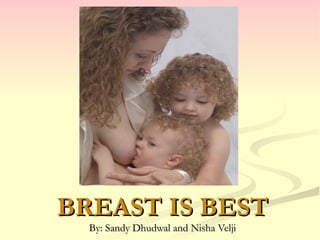
BREAST IS BEST
  By: Sandy Dhudwal and Nisha Velji
OUTLINE

     1. History
2. Recommendations
     3. Properties of Breast Milk
         4. Benefits of Breastfeeding
            5. Harmful Effects of Formula Milk
6. Why Some Mothers Choose Formula
  Vs. Breast Milk
     7. Other Options
                8. Additional Resources
OBJECTIVE
   To increase awareness about breast feeding.
   To educate about the benefits of breast feeding.
   To educate about the basics of breast feeding.
   To educate about the harms associated with
    formula feeding.
   To advocate for breast feeding and empower
    parents to make an informed choice.
HISTORY
   Artificial feeding becomes
    readily available at turn of
    century
   By 1940’s control of birth &
    feedings given to doctors
   By 1970, historical low in
    breastfeeding rates in western
    world
   Rates peak in 1980s
   Duration rates still generally low
RECOMMENDATIONS
      Exclusive breast feeding until 6 months
       of age

      Introduce complimentary foods with
       continued breastfeeding

      Optimum to breastfeed for 2 years or
       longer
PROPERTIES OF BREASTMILK
   Biologic specificity
    => Long-chain
    omega-3 Fatty
    Acids (DHA and
    AA)
    -Important for brain
    and retinal
    development
    -Higher IQs
IMMUNOLOGIC SPECIFICITY
   Protection against pathogens &
    allergens
   Kills pathogenic organisms or modifies
    their growth
   Stimulates epithelial maturation for
    future defence
   First immunization
   Protection against common respiratory
    and intestinal diseases
IMMUNOLOGIC SPECIFICITY
 Colostrum = Baby’s first vaccination
 Less risk of illness such as:

  Ear infections, pneumonia, crohn’s disease
  and other bowel illnesses, stomach flu and
  other intestinal illnesses, ear infections,
  childhood cancers, diabetes, arthritis,
  allergies, asthma and eczema
PERFECT FOOD FOR BABIES
 Just the right amount of nutrients in the right
  proportions
 Over 200 components in human milk

 Composition of breast milk:

  -Live cells, fat, carbohydrates, proteins, vitamins,
  minerals
  -Less fat than most other mammals
  -More lactose than other mammals
BREAST MILK COMPOSITION
   Fat (4% concentration provides up to 50%
    of caloric needs, cholesterol levels
    constant, lipolytic enzymes aid in fat
    digestion)
   Carbohydrates (lactose = milk sugar
    predominantly in human milk, 7%
    concentration provides up to 40% caloric
    needs, essential for development of CNS,
    enhances calcium & iron absorption)
BREAST MILK COMPOSITION
   Carbohydrates (Bifidus factor = growth
    factor present only in human milk
    required for establishing an acidic
    environment in the gut to inhibit growth
    of bacteria, fungi and parasites)

    Protein
    -Lactoferin => Isolates external iron
    -Secretory IGA => Most important
     immunoglobulin, breast milk = only
     source for first 6 weeks
BENEFITS OF BREASTFEEDING
   Ecological:
    -Saves resources
    -Less waste
    -No refrigeration
    -No manufacturing
    -No bottles, cans
    -No trucking
    -No handling
BENEFITS OF BREASTFEEDING

   For Society
    -Smarter
    -Healthier
    -Less cost to healthcare system
    -Stronger families
BENEFITS OF BREASTFEEDING
   To Families
    -Less trips to
    doctors, hospitals
    -Less prescriptions
    -Less stress
    -Less illness
    -More bonding
    -Inexpensive
BENEFITS OF BREASTFEEDING
   Benefits to baby:
    -Better dental health
    -Increased visual acuity
    -Decreased duration and
    intensity of illnesses
    -Less allergies
    -Better health & less risk
    of illnesses
BENEFITS OF BREASTFEEDING
    Benefits to mother:
    -Psychological (Attachment, bonding, security,
     skin to skin, fulfillment of basic needs,
     relationship)
    -Easier weight loss
    -Decreased risk of illness (breast cancer,
     osteoperosis, hemmorhage, ovarian cancer)
    -Birth control
    -Pride, empowerment, fulfillment
HARMFUL EFFECTS
OF FORMULA MILK
Why some mothers choose formula
            vs. breast milk
   Distressed by physical discomfort of early breastfeeding
    problems.

   Convenience issues

   Pressures of employment/school

   Worries that breast shape will change

   Formula manufacturers manipulate people through their
    ads
   Doctors and nurses need more lactation training
                                      www.hasslefreeclipart.com/. ../baby_crying.gif
Why some mothers choose formula
              vs. breast milk
   Moms given very little time to adjust to changes of
    postpartum

   Family demands

   Non-supportive family/health professionals

   Embarrassment

   Lack of confidence in self

   Feeling that one cannot produce enough milk
                                  www.dreamstime.com/ thumb_27/11304631444pJ47D.jpg
Mother’s milk vs. formula milk
   Formula milk for 3 days old
    babies is no different than
    formula milk for 3 months old
    infants.


                                        store.enfamil.com/ media/pr_prosobee_lipil.jpg


   Breast milk is ingeniously
    different every single day;
    adapted to the changing needs
    of the baby.


                                    breastfeeding.8k.com/ Resources/breastfeeding.jpeg
Mother’s milk vs. formula milk

   Human milk is designed to
    support the development of
    large brains, capable of
    processing and storing lots of
    information.
                                       www.babymall.com.au/ images/readingroomcartoon.gif


   Cows milk is designed to
    support functions, like constant
    grazing.


                                             myxo.css.msu.edu/danimal/ quiz/cow_picture.png
Illness Relative risk
   Allergies, eczema 2 to 7 times
   Urinary tract infections 2.6 to 5.5
    times
   Inflammatory bowel disease 1.5
    to 1.9 times
   Diabetes, type 1 2.4 times
   Gastroenteritis 3 times
   Hodgkin's lymphoma 1.8 to 6.7
    times
   Otitis media 2.4 times
   Haemophilus influenzae
    meningitis 3.8 times
   Necrotizing enterocolitis 6 to 10
    times
                                          www.geocities.com/.../ Canopy/4116/stalk.gif
Illness Relative risk

   Pneumonia/lower
    respiratory tract infection
    1.7 to 5 times
   Respiratory syncytial virus
    infection 3.9 times
   Sepsis 2.1 times
   Sudden infant death
    syndrome 2.0 times
   Industrialized-world
    hospitalization 3 times


                                             www.mamashealth.com/
                                  images/lungs1.gif
Barriers to Bonding
* A Bottle places a physical barrier
   between mom and baby

*Less skin to skin contact

*Less eye contact

* The hormonal connection
   between the breastfeeding
   mother and baby cannot be
   experienced by the bottle
   feeding mother


                                       www.photohome.com/.../ mom-and-baby-1a.jpg
Other Options If Breastfeeding is
             Not Possible
Mom can still use her milk, even if she decides not to
 breastfeed:

   Use a breast pump (electric/manual)
   Cup or bowl feeding
   Spoon feeding
   Eyedropper or feeding syringe
   Nursing supplementer
   Get milk from donation bank


                                    graphics.iparenting.com/. ../womanpumping.jpg
THE END
There is no freedom of choice for humans
  if it has been taken away from them
  at the beginning.

Breast-feeding is not a choice,
  but an obligation to the choice,


Give your child the freedom of choice.


              www.13.waisays.com/ image006.jpg
Additional Resources
   La Leche League
   World Health
    Organization
   Community Health
    Nurses
   Lactation
    Consultants
   Public Health
    Agency of Canada
References
   Mohrbacher, Nancy, and Stock, Julie. The Breastfeeding Answer Book, 3rd
    Edition. Illinois: La Leche Leage International, 2003.
   The Breastfeeding Committee for Canada. The Baby-Friendly Iniative in
    Community Health Services: a Canadian Implementation Guide. BCC, 2002.
   World Health Organization. Evidence for the Ten Steps to Successful
    Breastfeeding. Geneva: WHO, 1998.
   Class Notes
   Google Images
   http://www.fda.gov/FDAC/features/895_brstfeed.html
   http://medicalreporter.health.org/tmr0297/breastfeed0297.html
   http://www.mamadearest.ca/en/info/benefits_breastfeeding.htm
   http://www.lambtonhealth.on.ca/infant/benefits.asp
   http://www.babyfriendly.org.uk/health.asp
   http://www.phac-aspc.gc.ca/rhs-ssg/factshts/brstfd_e.html
   http://www.caaws.ca/mothersinmotion/baby/feeding_benefits_e.html

Breastisbest

  • 1.
    BREAST IS BEST By: Sandy Dhudwal and Nisha Velji
  • 2.
    OUTLINE 1. History 2. Recommendations 3. Properties of Breast Milk 4. Benefits of Breastfeeding 5. Harmful Effects of Formula Milk
  • 3.
    6. Why SomeMothers Choose Formula Vs. Breast Milk 7. Other Options 8. Additional Resources
  • 4.
    OBJECTIVE  To increase awareness about breast feeding.  To educate about the benefits of breast feeding.  To educate about the basics of breast feeding.  To educate about the harms associated with formula feeding.  To advocate for breast feeding and empower parents to make an informed choice.
  • 5.
    HISTORY  Artificial feeding becomes readily available at turn of century  By 1940’s control of birth & feedings given to doctors  By 1970, historical low in breastfeeding rates in western world  Rates peak in 1980s  Duration rates still generally low
  • 6.
    RECOMMENDATIONS  Exclusive breast feeding until 6 months of age  Introduce complimentary foods with continued breastfeeding  Optimum to breastfeed for 2 years or longer
  • 7.
    PROPERTIES OF BREASTMILK  Biologic specificity => Long-chain omega-3 Fatty Acids (DHA and AA) -Important for brain and retinal development -Higher IQs
  • 8.
    IMMUNOLOGIC SPECIFICITY  Protection against pathogens & allergens  Kills pathogenic organisms or modifies their growth  Stimulates epithelial maturation for future defence  First immunization  Protection against common respiratory and intestinal diseases
  • 9.
    IMMUNOLOGIC SPECIFICITY  Colostrum= Baby’s first vaccination  Less risk of illness such as: Ear infections, pneumonia, crohn’s disease and other bowel illnesses, stomach flu and other intestinal illnesses, ear infections, childhood cancers, diabetes, arthritis, allergies, asthma and eczema
  • 10.
    PERFECT FOOD FORBABIES  Just the right amount of nutrients in the right proportions  Over 200 components in human milk  Composition of breast milk: -Live cells, fat, carbohydrates, proteins, vitamins, minerals -Less fat than most other mammals -More lactose than other mammals
  • 11.
    BREAST MILK COMPOSITION  Fat (4% concentration provides up to 50% of caloric needs, cholesterol levels constant, lipolytic enzymes aid in fat digestion)  Carbohydrates (lactose = milk sugar predominantly in human milk, 7% concentration provides up to 40% caloric needs, essential for development of CNS, enhances calcium & iron absorption)
  • 12.
    BREAST MILK COMPOSITION  Carbohydrates (Bifidus factor = growth factor present only in human milk required for establishing an acidic environment in the gut to inhibit growth of bacteria, fungi and parasites)  Protein -Lactoferin => Isolates external iron -Secretory IGA => Most important immunoglobulin, breast milk = only source for first 6 weeks
  • 13.
    BENEFITS OF BREASTFEEDING  Ecological: -Saves resources -Less waste -No refrigeration -No manufacturing -No bottles, cans -No trucking -No handling
  • 14.
    BENEFITS OF BREASTFEEDING  For Society -Smarter -Healthier -Less cost to healthcare system -Stronger families
  • 15.
    BENEFITS OF BREASTFEEDING  To Families -Less trips to doctors, hospitals -Less prescriptions -Less stress -Less illness -More bonding -Inexpensive
  • 16.
    BENEFITS OF BREASTFEEDING  Benefits to baby: -Better dental health -Increased visual acuity -Decreased duration and intensity of illnesses -Less allergies -Better health & less risk of illnesses
  • 17.
    BENEFITS OF BREASTFEEDING  Benefits to mother: -Psychological (Attachment, bonding, security, skin to skin, fulfillment of basic needs, relationship) -Easier weight loss -Decreased risk of illness (breast cancer, osteoperosis, hemmorhage, ovarian cancer) -Birth control -Pride, empowerment, fulfillment
  • 18.
  • 19.
    Why some motherschoose formula vs. breast milk  Distressed by physical discomfort of early breastfeeding problems.  Convenience issues  Pressures of employment/school  Worries that breast shape will change  Formula manufacturers manipulate people through their ads  Doctors and nurses need more lactation training www.hasslefreeclipart.com/. ../baby_crying.gif
  • 20.
    Why some motherschoose formula vs. breast milk  Moms given very little time to adjust to changes of postpartum  Family demands  Non-supportive family/health professionals  Embarrassment  Lack of confidence in self  Feeling that one cannot produce enough milk www.dreamstime.com/ thumb_27/11304631444pJ47D.jpg
  • 21.
    Mother’s milk vs.formula milk  Formula milk for 3 days old babies is no different than formula milk for 3 months old infants. store.enfamil.com/ media/pr_prosobee_lipil.jpg  Breast milk is ingeniously different every single day; adapted to the changing needs of the baby. breastfeeding.8k.com/ Resources/breastfeeding.jpeg
  • 22.
    Mother’s milk vs.formula milk  Human milk is designed to support the development of large brains, capable of processing and storing lots of information. www.babymall.com.au/ images/readingroomcartoon.gif  Cows milk is designed to support functions, like constant grazing. myxo.css.msu.edu/danimal/ quiz/cow_picture.png
  • 23.
    Illness Relative risk  Allergies, eczema 2 to 7 times  Urinary tract infections 2.6 to 5.5 times  Inflammatory bowel disease 1.5 to 1.9 times  Diabetes, type 1 2.4 times  Gastroenteritis 3 times  Hodgkin's lymphoma 1.8 to 6.7 times  Otitis media 2.4 times  Haemophilus influenzae meningitis 3.8 times  Necrotizing enterocolitis 6 to 10 times www.geocities.com/.../ Canopy/4116/stalk.gif
  • 24.
    Illness Relative risk  Pneumonia/lower respiratory tract infection 1.7 to 5 times  Respiratory syncytial virus infection 3.9 times  Sepsis 2.1 times  Sudden infant death syndrome 2.0 times  Industrialized-world hospitalization 3 times www.mamashealth.com/ images/lungs1.gif
  • 25.
    Barriers to Bonding *A Bottle places a physical barrier between mom and baby *Less skin to skin contact *Less eye contact * The hormonal connection between the breastfeeding mother and baby cannot be experienced by the bottle feeding mother www.photohome.com/.../ mom-and-baby-1a.jpg
  • 26.
    Other Options IfBreastfeeding is Not Possible Mom can still use her milk, even if she decides not to breastfeed:  Use a breast pump (electric/manual)  Cup or bowl feeding  Spoon feeding  Eyedropper or feeding syringe  Nursing supplementer  Get milk from donation bank graphics.iparenting.com/. ../womanpumping.jpg
  • 27.
    THE END There isno freedom of choice for humans if it has been taken away from them at the beginning. Breast-feeding is not a choice, but an obligation to the choice, Give your child the freedom of choice. www.13.waisays.com/ image006.jpg
  • 28.
    Additional Resources  La Leche League  World Health Organization  Community Health Nurses  Lactation Consultants  Public Health Agency of Canada
  • 29.
    References  Mohrbacher, Nancy, and Stock, Julie. The Breastfeeding Answer Book, 3rd Edition. Illinois: La Leche Leage International, 2003.  The Breastfeeding Committee for Canada. The Baby-Friendly Iniative in Community Health Services: a Canadian Implementation Guide. BCC, 2002.  World Health Organization. Evidence for the Ten Steps to Successful Breastfeeding. Geneva: WHO, 1998.  Class Notes  Google Images  http://www.fda.gov/FDAC/features/895_brstfeed.html  http://medicalreporter.health.org/tmr0297/breastfeed0297.html  http://www.mamadearest.ca/en/info/benefits_breastfeeding.htm  http://www.lambtonhealth.on.ca/infant/benefits.asp  http://www.babyfriendly.org.uk/health.asp  http://www.phac-aspc.gc.ca/rhs-ssg/factshts/brstfd_e.html  http://www.caaws.ca/mothersinmotion/baby/feeding_benefits_e.html

Editor's Notes

  • #20 Most mothers know that breast milk is the more healthier choice then why do a large number chose to formula feed? Most mothers know that breast milk is the more healthier choice then why do a large number chose to formula feed.