Human-Machine Interfaces (HMI):
Understanding, types &
importance
Writer:- Aeliya Marine Tech Pvt. Ltd
What is HMI?
 A Human Machine Interface
(HMI) is a user interface or
dashboard that connects a
person to a machine, system,
or device.
Types of HMI
Graphical
User
Interfaces
Touch
screens
Physical
Control
Panels
Web-based
HMI
HMI Components
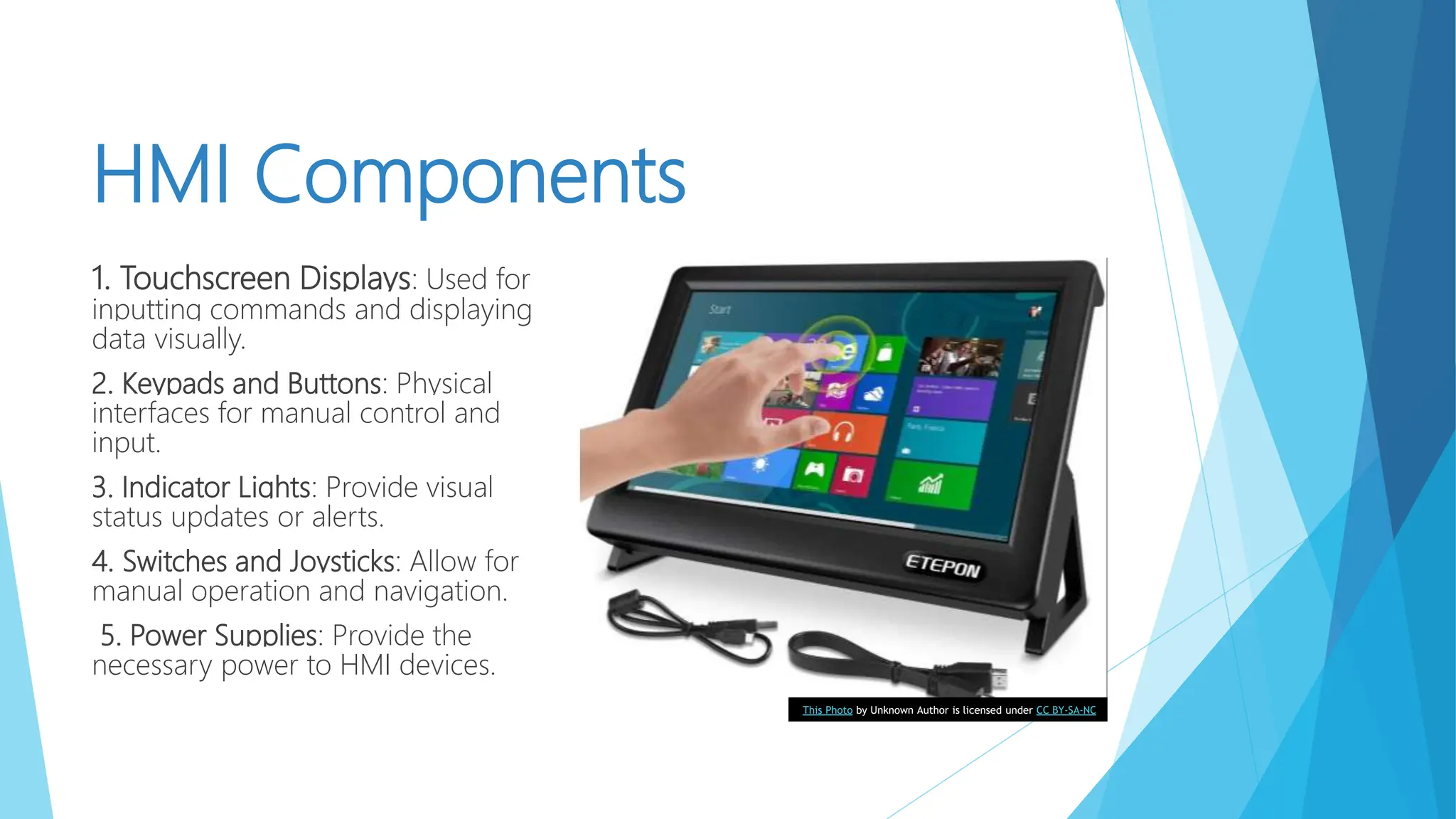
1. Touchscreen Displays: Used for
inputting commands and displaying
data visually.
2. Keypads and Buttons: Physical
interfaces for manual control and
input.
3. Indicator Lights: Provide visual
status updates or alerts.
4. Switches and Joysticks: Allow for
manual operation and navigation.
5. Power Supplies: Provide the
necessary power to HMI devices.
This Photo by Unknown Author is licensed under CC BY-SA-NC
Applications of HMI
 Commercial Aviation
 Industrial
 Medical
 Space
 Communication
Advantages of HMI
 Improved User Experience
 Enhanced Monitoring and Control
 Increased Safety
 Customization and Flexibility
Future Trends in HMI
 Touchless Interfaces
 Augmented Reality (AR) and Virtual Reality (VR)
Integration
 Artificial Intelligence (AI) and Machine Learning (ML)
 Natural Language Processing (NLP)
 Wearable Devices
 Internet of Things (IoT) Connectivity
Thank You
www.aeliyamarinetech.c
om
(+91) 9725218532

Human-Machine Interfaces (HMI): Understanding, types & importance