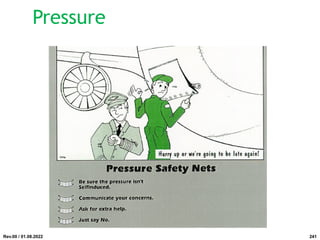
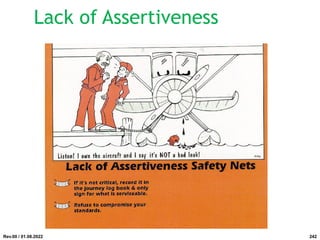
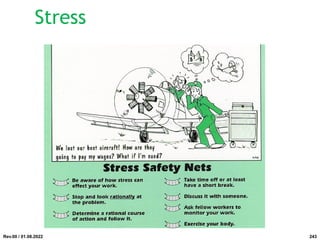
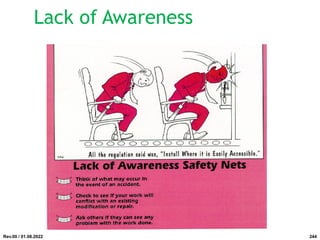
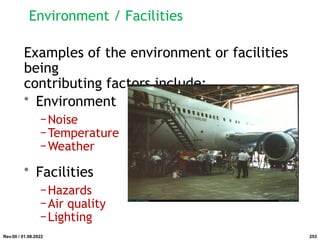
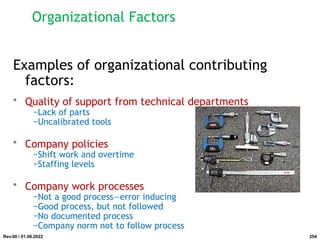
Maintenance Human Factors
EASA Part 66 Module 9
and GM 145.A.30 (e)
Rev.00 / 01.08.2022 BON-TEK145-001_HUMAN_FACTOR_INITIAL 1
Content
• 1. General
• GM1 145.A.30 (e) : 1.1-1.2-1.3-2-3
• Module 9 : 9.1-9.3.4-9.8
• 2. Human Performance and Limitations
• GM1 145.A.30 (e) : 4.1 to 4.15-5.4-5.5
• Module 9 : 9.2-9.3.2-9.4.1-9.4.4-9.4.5-9.4.6-9.6.1-9.6.2
• 3. Environment
• GM1 145.A.30 (e) : 5.1-5.2-5.3-5.6-5.7-5.8-5.9
• Module 9 : 9.4.2-9.4.3-9.5
• 4. Procedures, Information, Tools, and Practice
• GM1 145.A.30 (e) : 5.10-6
• Module 9 : 9.6.3-9.6.4-9.7.2
• 5. Communication
• GM1 145.A.30 (e) : 7
• Module 9 : 9.7.1-9.7.3-9.7.4
Rev.00 / 01.08.2022 2
• 6. Teamwork
• GM1 145.A.30 (e) : 8.1-8.2-9.3
• Module 9 : 9.3
• 7. Human Error
• GM1 145.A.30 (e) : 5.12-5.13
• Module 9 : 9.8.1-9.8.4
• 8. Hazards in the Workplace
• GM1 145.A.30 (e) : 5.11
• Module 9 : 9.9
• 9. Professionalism and Integrity
• GM1 145.A.30 (e) : 9-8.3
• Module 9 : N/A
• 10. Organisation Human Factor Program
• GM1 145.A.30 (e) : 10
• Module 9 : N/A
Rev.00 / 01.08.2022
Content
3
I. General
Rev.00 / 01.08.2022 BON-TEK145-001_HUMAN_FACTOR_INITIAL 4
General
• The Need to take Human Factors in to
account
• Statistics, Incidents
• Murphy’s law.
• Safety Culture
Rev.00 / 01.08.2022 5
Definition
Human Factors is a technical discipline aimed at optimizing
human performance within a system by contributing to the
planning, design, and evaluation of tasks, jobs, products,
organizations, environments and systems in order to make
them compatible with the needs, abilities, and limitations of
people.
Rev.00 / 01.08.2022 6
Where Can Human Factors
Be Applied in Maintenance?
 Manuals & Procedures
 Operational Controls & Displays
 Design for Maintainability
 Human/Computer Interaction
 Training
 Work Group Procedures
Rev.00 / 01.08.2022 7
Specialty Areas in Human
Factors
Cognitive Human Factors
Concerned with mental processes, such as perception,
memory, reasoning, and motor response
− Mental work load
− Decision making
− Human reliability
(skilled performance and errors)
− Training
− Human computer interaction
− Work stress
Rev.00 / 01.08.2022 8
Physical Human Factors
Concerned with human anatomical, anthropometric,
physiological and biomechanical characteristics as they
related to physical activity.
− Materials handling
− Repetitive movements
− Workplace layout
− Safety and health
Rev.00 / 01.08.2022
Specialty Areas in Human
Factors
9
Organizational Human Factors
Concerned with optimization of work organizations,
including their organizational structures, policies, and
processes.
− Crew resource management
− Work design
− Culture
Leadership Communication
Teamwork
Shift work/Overtime
Quality Management
Rev.00 / 01.08.2022
Specialty Areas in Human
Factors
10
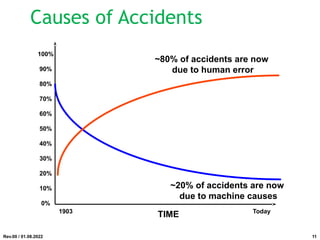
Causes of Accidents
100%
90%
80%
70%
60%
50%
40%
30%
20%
10%
0%
1903 Today
TIME
~80% of accidents are now
due to human error
~20% of accidents are now
due to machine causes
Rev.00 / 01.08.2022 11
American Airlines Flight 191
Year: 1979, 273 fatalities
Model: DC-10
Improper maintenance caused
loss of control after engine
detachment ruptured
hydraulic fluid lines
Rev.00 / 01.08.2022
Significant Maintenance
Human Factors Events
12
Aloha Airlines Flight 243
Year: 1988, 1 fatalities
Model: B737-200
Explosive
decompression caused
by fatigue failure
Rev.00 / 01.08.2022
Significant Maintenance
Human Factors Events
13
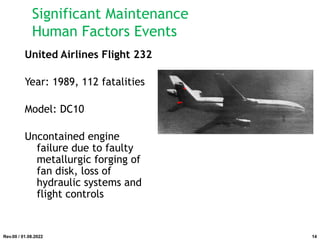
United Airlines Flight 232
Year: 1989, 112 fatalities
Model: DC10
Uncontained engine
failure due to faulty
metallurgic forging of
fan disk, loss of
hydraulic systems and
flight controls
Rev.00 / 01.08.2022
Significant Maintenance
Human Factors Events
14
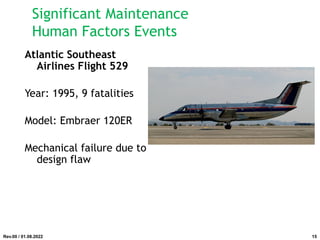
Atlantic Southeast
Airlines Flight 529
Year: 1995, 9 fatalities
Model: Embraer 120ER
Mechanical failure due to
design flaw
Rev.00 / 01.08.2022
Significant Maintenance
Human Factors Events
15
Aeroperú Flight 603
Year:1996, 70 fatalities
Type: B757-200
Maintenance error,
instrument failure
Rev.00 / 01.08.2022
Significant Maintenance
Human Factors Events
16
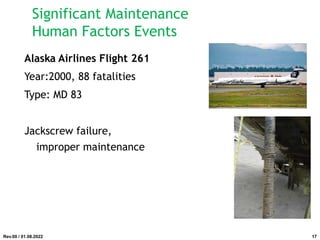
Alaska Airlines Flight 261
Year:2000, 88 fatalities
Type: MD 83
Jackscrew failure,
improper maintenance
Rev.00 / 01.08.2022
Significant Maintenance
Human Factors Events
17
Primary Causes of All Accidents
Worldwide Commercial Jet Fleet
Excludes::
• Sabotage
• Military action
.
Percentage of total accidents with known causes
Miscellaneous/other
Airport/ATC
Weather
Maintenance & Inspection
Airplane
Cockpit crew
10 20 30 40 50 60 70
27
11
36
14
50
166
Primary factor
1959--1992 1993--2002
Number of accidents
Total with known causes
59
43
36
31
133
540
842 304
Unknown or awaiting reports 110 97
Total 952 401
7.0%
5.1%
4.3%
3.7%
15.8%
8.9%
3.6%
11.8%
4.6%
16.4%
54.6%
Legend:
1959 through 1992
1993 through 2002
64.1%
Rev.00 / 01.08.2022 18
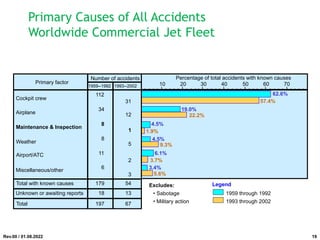
Excludes:
• Sabotage
• Military action
Percentage of total accidents with known causes
Miscellaneous/other
Airport/ATC
Weather
Maintenance & Inspection
Airplane
Cockpit crew
10 20 30 40 50 60 70
3
2
5
1
12
31
Primary factor
1959--1992 1993--2002
Number of accidents
Total with known causes
6
11
8
8
34
112
179 54
Unknown or awaiting reports 18 13
Total 197 67
3.4%
6.1%
4.5%
4.5%
19.0%
62.6%
5.6%
3.7%
9.3%
1.9%
22.2%
57.4%
Legend
1959 through 1992
1993 through 2002
Rev.00 / 01.08.2022
Primary Causes of All Accidents
Worldwide Commercial Jet Fleet
19
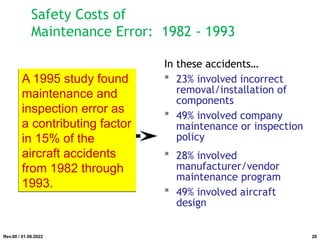
Safety Costs of
Maintenance Error: 1982 - 1993
In these accidents…
 23% involved incorrect
removal/installation of
components
 49% involved company
maintenance or inspection
policy
 28% involved
manufacturer/vendor
maintenance program
 49% involved aircraft
design
A 1995 study found
maintenance and
inspection error as
a contributing factor
in 15% of the
aircraft accidents
from 1982 through
1993.
Rev.00 / 01.08.2022 20
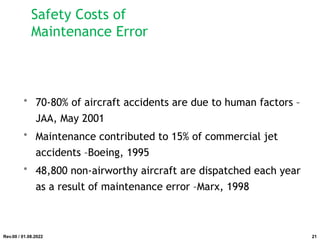
Safety Costs of
Maintenance Error
• 70-80% of aircraft accidents are due to human factors –
JAA, May 2001
• Maintenance contributed to 15% of commercial jet
accidents –Boeing, 1995
• 48,800 non-airworthy aircraft are dispatched each year
as a result of maintenance error –Marx, 1998
Rev.00 / 01.08.2022 21
Monetary Costs of Maintenance Error
Maintenance error caused
• 20% to 30% of in-flight shutdowns (IFSDs)
at a cost of US $500,000 per IFSD
• 50% of flight delays due to engine
problems at a cost of US $10,000 per
hour
• 50% of flight cancellations due to engine
problems at a cost of US $50,000 per
cancellation
Rev.00 / 01.08.2022 22
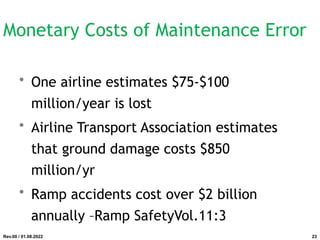
Monetary Costs of Maintenance Error
• One airline estimates $75-$100
million/year is lost
• Airline Transport Association estimates
that ground damage costs $850
million/yr
• Ramp accidents cost over $2 billion
annually –Ramp SafetyVol.11:3
Rev.00 / 01.08.2022 23
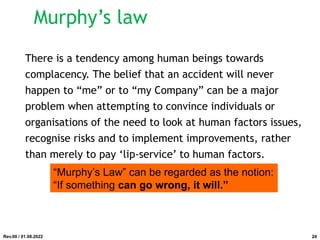
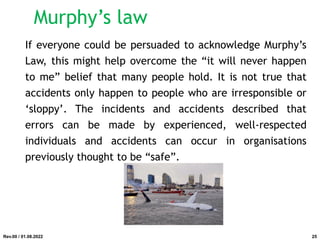
Murphy’s law
There is a tendency among human beings towards
complacency. The belief that an accident will never
happen to “me” or to “my Company” can be a major
problem when attempting to convince individuals or
organisations of the need to look at human factors issues,
recognise risks and to implement improvements, rather
than merely to pay ‘lip-service’ to human factors.
“Murphy’s Law” can be regarded as the notion:
“If something can go wrong, it will.”
Rev.00 / 01.08.2022 24
If everyone could be persuaded to acknowledge Murphy’s
Law, this might help overcome the “it will never happen
to me” belief that many people hold. It is not true that
accidents only happen to people who are irresponsible or
‘sloppy’. The incidents and accidents described that
errors can be made by experienced, well-respected
individuals and accidents can occur in organisations
previously thought to be “safe”.
Rev.00 / 01.08.2022
Murphy’s law
25
Safety Culture
Culture
Customary beliefs, behavior patterns, and material traits of
a racial, religious, or social group
Any organization has a culture of its own
− Management style
− Morale
− Acceptable behaviors
− Norms
Rev.00 / 01.08.2022 26
• What is a “safety culture” as it applies to an aircraft
maintenance organization?
• A “safety culture” is a (maintenance organization)
culture in which safety plays a major role.
Rev.00 / 01.08.2022
Safety Culture
27
Safety, as it applies to maintenance, has
three components
1. Maintenance actions (e.g., an installation
error) can lead to flight safety issues
2. Mechanic actions can lead to personal safety
issues (e.g., cuts, puncture wounds, and
broken bones)
3. Maintenance actions can lead to equipment
damage
A good safety culture will reduce the instances
of all three of these events, reducing the
accident rate and, thus, saving lives and money
Rev.00 / 01.08.2022
Safety Culture
28
Elements (James Reason)
• Informed Culture
• Reporting Culture
• Learning Culture
• Just Culture
• Flexible Culture
Rev.00 / 01.08.2022
Safety Culture
29
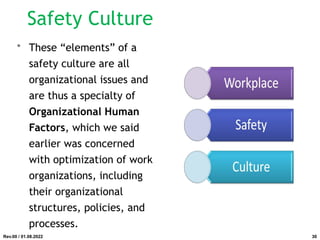
• These “elements” of a
safety culture are all
organizational issues and
are thus a specialty of
Organizational Human
Factors, which we said
earlier was concerned
with optimization of work
organizations, including
their organizational
structures, policies, and
processes.
Rev.00 / 01.08.2022
Safety Culture
30
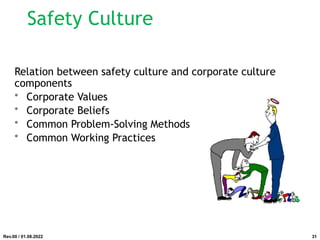
Relation between safety culture and corporate culture
components
• Corporate Values
• Corporate Beliefs
• Common Problem-Solving Methods
• Common Working Practices
Rev.00 / 01.08.2022
Safety Culture
31
2. Human Performance
& Limitations
Rev.00 / 01.08.2022 BON-TEK145-001_HUMAN_FACTOR_INITIAL 32
Human Performance &
Limitations
 Vision
 Hearing
 Attention and perception
 Decision Making
 Memory
 Information processing
 Stress (effects on
performance)
 Situation awareness
 Motivation
 Physical work
 Sleep Fatigue, Shiftwork
 Claustrophobia and
physical access
 Fitness/health
 Alcohol, medication, drugs
 Workload
 Repetitive tasks/
complacency
Rev.00 / 01.08.2022 33
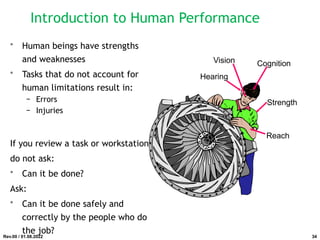
Introduction to Human Performance
• Human beings have strengths
and weaknesses
• Tasks that do not account for
human limitations result in:
− Errors
− Injuries
If you review a task or workstation,
do not ask:
• Can it be done?
Ask:
• Can it be done safely and
correctly by the people who do
the job?
Vision
Hearing
Cognition
Strength
Reach
Rev.00 / 01.08.2022 34
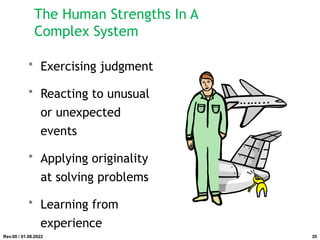
The Human Strengths In A
Complex System
• Exercising judgment
• Reacting to unusual
or unexpected
events
• Applying originality
at solving problems
• Learning from
experience
Rev.00 / 01.08.2022 35
Vision
Rev.00 / 01.08.2022 BON-TEK145-001_HUMAN_FACTOR_INITIAL 36
Vision Performance Issues
• Vision requirements are task
based
• Illumination requirements are
task based
• Technicians must recognize
their individual visual
limitations and capabilities
Being able to see clearly is vital in aircraft
maintenance and inspection.
Rev.00 / 01.08.2022 37
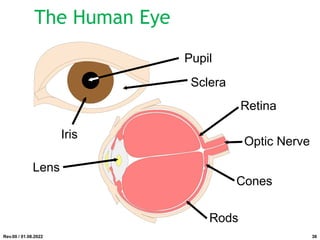
The Human Eye
Pupil
Iris
Sclera
Lens
Retina
Optic Nerve
Rods
Cones
Rev.00 / 01.08.2022 38
The Normal Visual Field
• Provide visual access to
work area...
− Without excessive bending
− For both short and tall people
• Visual access is critical
to...
− Doing the task
− Visual validation of task
• Examples of problems due
to poor visual access:
− Incorrect attachment
− Inspection errors
− Increased task time
Normal Line Of Sight
Rev.00 / 01.08.2022 39
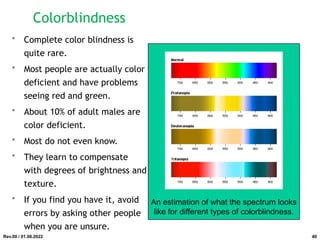
Colorblindness
• Complete color blindness is
quite rare.
• Most people are actually color
deficient and have problems
seeing red and green.
• About 10% of adult males are
color deficient.
• Most do not even know.
• They learn to compensate
with degrees of brightness and
texture.
• If you find you have it, avoid
errors by asking other people
when you are unsure.
An estimation of what the spectrum looks
like for different types of colorblindness.
Rev.00 / 01.08.2022 40
Although not directly affecting visual acuity, inability to see
particular colours can be a problem for the aircraft
maintenance engineer. Amongst other things, good colour vision
for maintenance engineers is important for:
 Recognising components;
 Distinguishing between wires;
 Using various diagnostic tools;
 Recognizing various lights on the airfield (e.g. warning
lights).
Rev.00 / 01.08.2022
Colorblindness
41
A Quick Colorblindness Test
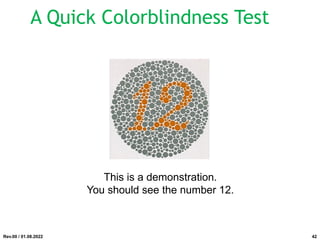
This is a demonstration.
You should see the number 12.
Rev.00 / 01.08.2022 42
What Numbers Do You See?
Rev.00 / 01.08.2022 43
Vision Problems
(Physical Factors)
Hypermetropia
Myopia
Astigmatism
Prespiyotia
Cataracts
Glaucoma
Migraine
Rev.00 / 01.08.2022 44
Foreign Substances
Vision can be adversely affected by the use of certain drugs and
medications, alcohol, and smoking cigarettes. With smoking, carbon
monoxide which builds up in the bloodstream allows less oxygen to be
carried in the blood to the eyes. This is known as hypoxia and can
impair rapidly the sensitivity of the rods. Alcohol can have similar
effects, even hours after the last drink.
Rev.00 / 01.08.2022 45
Environmental Factors
• Vision can be improved by increasing the lighting level, but only up
to a point, as the law of diminishing returns operates. Also,
increased illumination could result in increased glare. Older
people are more affected by the glare of reflected light than
younger people.
• Any airborne particles such as dust, rain or mist can interfere with
the transmission of light through the air, distorting what is seen.
Rev.00 / 01.08.2022 46
Hearing
Rev.00 / 01.08.2022 BON-TEK145-001_HUMAN_FACTOR_INITIAL 47
Hearing
• The ear performs two quite different functions. It is used to detect
sounds by receiving vibrations in the air, and secondly, it is
responsible for balance and sensing acceleration. Of these two,
the hearing aspect is more pertinent to the maintenance engineer,
and thus it is necessary to have a basic appreciation of how the
ear works.
• The performance of the ear is associated with the range of sounds
that can be heard - both in terms of the pitch (frequency) and the
volume of the sound.
Rev.00 / 01.08.2022 48
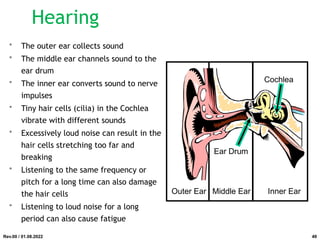
• The outer ear collects sound
• The middle ear channels sound to the
ear drum
• The inner ear converts sound to nerve
impulses
• Tiny hair cells (cilia) in the Cochlea
vibrate with different sounds
• Excessively loud noise can result in the
hair cells stretching too far and
breaking
• Listening to the same frequency or
pitch for a long time can also damage
the hair cells
• Listening to loud noise for a long
period can also cause fatigue
Outer Ear Middle Ear Inner Ear
Ear Drum
Cochlea
Rev.00 / 01.08.2022
Hearing
49
Hearing Protection
• Types of Hearing Protection
− Disposable plugs
− Reusable plugs
− Custom-fitted plugs
− Ear muffs
• Wearing Hearing Protection Properly
− Follow package directions when putting
protection on.
− Make sure the selected protection fits properly.
− Maintain hearing protective devices in a
sanitary condition.

− Make sure nothing interferes with the use of
hearing protectors (e.g., eyeglass frames).
Rev.00 / 01.08.2022 50
Symptoms of Hearing Loss
− Noise or ringing in the ears.
− Trouble hearing people when they speak.
− Trouble hearing certain high or soft sounds.
− Needing a higher volume on the TV or
radio--high enough that others complain.
Rev.00 / 01.08.2022
Hearing Protection
51
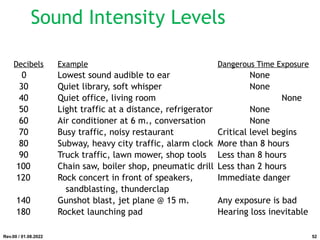
Sound Intensity Levels
Decibels Example Dangerous Time Exposure
0 Lowest sound audible to ear None
30 Quiet library, soft whisper None
40 Quiet office, living room None
50 Light traffic at a distance, refrigerator None
60 Air conditioner at 6 m., conversation None
70 Busy traffic, noisy restaurant Critical level begins
80 Subway, heavy city traffic, alarm clock More than 8 hours
90 Truck traffic, lawn mower, shop tools Less than 8 hours
100 Chain saw, boiler shop, pneumatic drill Less than 2 hours
120 Rock concert in front of speakers, Immediate danger
sandblasting, thunderclap
140 Gunshot blast, jet plane @ 15 m. Any exposure is bad
180 Rocket launching pad Hearing loss inevitable
Rev.00 / 01.08.2022 52
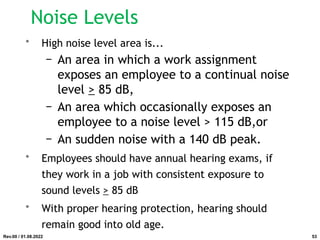
Noise Levels
• High noise level area is...
− An area in which a work assignment
exposes an employee to a continual noise
level > 85 dB,
− An area which occasionally exposes an
employee to a noise level > 115 dB,or
− An sudden noise with a 140 dB peak.
• Employees should have annual hearing exams, if
they work in a job with consistent exposure to
sound levels > 85 dB
• With proper hearing protection, hearing should
remain good into old age.
Rev.00 / 01.08.2022 53
Information Processing/
Attention and Perception/
Memory
Rev.00 / 01.08.2022 BON-TEK145-001_HUMAN_FACTOR_INITIAL 54
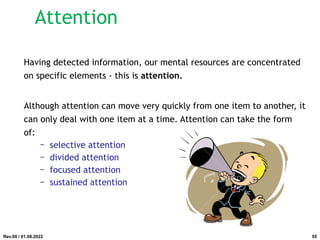
Attention
Having detected information, our mental resources are concentrated
on specific elements - this is attention.
Although attention can move very quickly from one item to another, it
can only deal with one item at a time. Attention can take the form
of:
− selective attention
− divided attention
− focused attention
− sustained attention
Rev.00 / 01.08.2022 55
Perception
Perception involves the organisation and interpretation of sensory
data in order to make it meaningful, discarding non-relevant data,
i.e. transforming data into information. Perception is a highly
sophisticated mechanism and requires existing knowledge and
experience to know what data to keep and what to discard, and how
to associate the data in a meaningful manner.
Examples of the perceptual process:
− the image formed on the retina is inverted and two dimensional, yet
we see the world the right way up and in three dimensions;
− if the head is turned, the eyes detect a constantly changing pattern of
images, yet we perceive things around us to have a set location,
rather than move chaotically.
Rev.00 / 01.08.2022 56
Decision Making
Decision making is the generation of alternative courses of action
based on available information, knowledge, prior experience,
expectation, context, goals, etc. and selecting one preferred option.
It is also described as thinking, problem solving and judgment.
This may range from deciding to do
nothing, to deciding to act immediately
in a very specific manner. A fire alarm
bell, for instance, may trigger a well-
trained sequence of actions without
further thought (i.e. evacuate);
alternatively, an unfamiliar siren may
require further information to be
gathered before an appropriate course
of action can be initiated.
Rev.00 / 01.08.2022 57
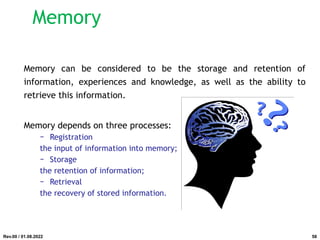
Memory
Memory can be considered to be the storage and retention of
information, experiences and knowledge, as well as the ability to
retrieve this information.
Memory depends on three processes:
− Registration
the input of information into memory;
− Storage
the retention of information;
− Retrieval
the recovery of stored information.
Rev.00 / 01.08.2022 58
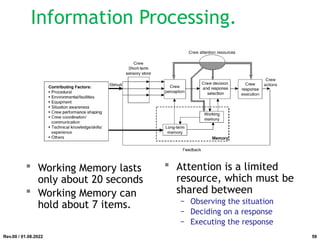
Information Processing.
 Working Memory lasts
only about 20 seconds
 Working Memory can
hold about 7 items.
 Attention is a limited
resource, which must be
shared between
− Observing the situation
− Deciding on a response
− Executing the response
Rev.00 / 01.08.2022 59
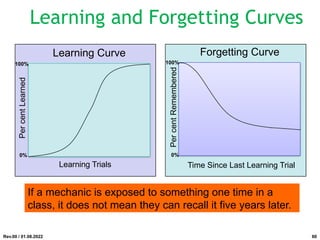
Learning and Forgetting Curves
Per
cent
Learned
Learning Trials
Learning Curve
Per
cent
Remembered
Time Since Last Learning Trial
Forgetting Curve
If a mechanic is exposed to something one time in a
class, it does not mean they can recall it five years later.
0%
0%
100%
100%
Rev.00 / 01.08.2022 60
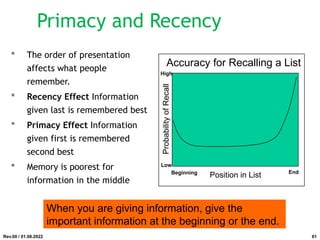
Primacy and Recency
 The order of presentation
affects what people
remember.
 Recency Effect Information
given last is remembered best
 Primacy Effect Information
given first is remembered
second best
 Memory is poorest for
information in the middle
Probability
of
Recall
Position in List
Accuracy for Recalling a List
Low
High
Beginning End
When you are giving information, give the
important information at the beginning or the end.
Rev.00 / 01.08.2022 61
Negative Transfer Of Training
• When you learn new things, previously learned material is still in
long-term memory.
• If the material is similar, sometimes you can become confused.
• Example: Mechanic knows how to replace a hydraulic pump on
airplane A. The airline acquires a newer model--airplane B.
− The bolts on airplane A must be torqued to 150 foot pounds
− The bolts on airplane B must be torqued to 200 foot pounds
Later, the mechanic makes an error by:
− Replacing a pump on plane A and tightening the bolts to 200
foot pounds, or
− Replacing a pump on plane B and tightening the bolts to 150
foot pounds.
Be sure to check details when things
are almost, but not quite the same.
Rev.00 / 01.08.2022 62
Situation Awareness
Motivation&De-motivation
Rev.00 / 01.08.2022 BON-TEK145-001_HUMAN_FACTOR_INITIAL 63
Situation Awareness
The ability to maintain
awareness of what is
happening on the ramp or
the hangar, as well as what
is happening on the task.
Rev.00 / 01.08.2022 64
• Situation awareness for the aircraft
maintenance engineer can be summarized as:
− the status of the system the engineer is working
on;
− the relationship between the reported defect and
the intended rectification;
− the possible effect on this work on other systems;
− the effect of this work on that being done by
others and the effect of their work on this work.
Rev.00 / 01.08.2022
Situation Awareness
65
• See elements (e.g., people and equipment)
in the work environment
− Where they are now
− Whether they are moving or stationary
• Understand the significance of what you see
• Project the status of the elements for the
near future (i.e., determine future
implications)
Rev.00 / 01.08.2022
Situation Awareness
66
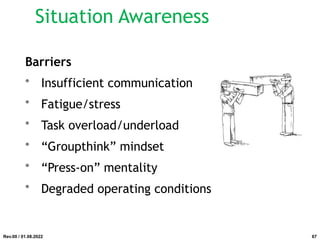
Barriers
• Insufficient communication
• Fatigue/stress
• Task overload/underload
• “Groupthink” mindset
• “Press-on” mentality
• Degraded operating conditions
Rev.00 / 01.08.2022
Situation Awareness
67
• Actively question/evaluate
• Use assertive behavior when necessary
• Analyze/monitor situation continuously
Rev.00 / 01.08.2022
Situation Awareness
68
B737 double engine oil loss
AAIB report stated:
“Once the Controller and fitter had got to T2 and found that this supportive material
[Task Cards and AMM extracts] was not available in the work pack, they would have had
to return to Base Engineering or to have gone over to the Line Maintenance office to
get it. It would be, in some measure, understandable for them to have a reluctance to
recross the exposed apron area on a winter’s night to obtain a description of what they
were fairly confident they knew anyway. However, during the course of the night, both
of them had occasion to return to the Base Maintenance hangar a number of times
before the task had been completed. Either could, therefore, have referred to or even
drawn the task descriptive papers before the job was signed off. The question that
should be addressed, therefore, is whether there might be any factors other than
overconfidence in their memories, bad judgments or idleness which would dispose them
to pass up these opportunities to refresh their memories on the proper and complete
procedures.”
Rev.00 / 01.08.2022 69
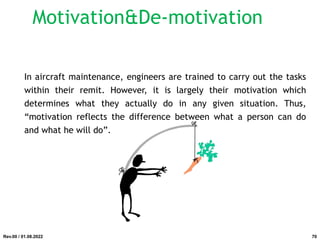
Motivation&De-motivation
In aircraft maintenance, engineers are trained to carry out the tasks
within their remit. However, it is largely their motivation which
determines what they actually do in any given situation. Thus,
“motivation reflects the difference between what a person can do
and what he will do”.
Rev.00 / 01.08.2022 70
With respect to aviation safety, being appropriately motivated is
vital. Ideally, aircraft maintenance engineers ought to be motivated
to work in a safe and efficient manner. However, many factors may
cause conflicting motivations to override this ideal. For instance, the
motivation of some financial bonus, or de-motivation of working
outdoors in extreme cold weather might lead to less consideration of
safety and increase the likelihood of risk taking, corner cutting,
violating procedures and so on.
Rev.00 / 01.08.2022
Motivation&De-motivation
71
Maslow’s Hierarchy of Needs
Possibly one of the most well known theories which attempts to
describe human motivation is Maslow’s hierarchy of needs.
Maslow considered that humans are driven by two different sets of
motivational forces:
− those that ensure survival by satisfying basic physical and
psychological needs;
− those that help us to realise our full potential in life known as self-
actualisation needs (fulfilling ambitions, etc.)..
Rev.00 / 01.08.2022
Motivation&De-motivation
72
Highly motivated people tend to show the following
characteristics:
− high performance and results being consistently achieved;
− the energy, enthusiasm and determination to succeed;
− unstinting co-operation in overcoming problems;
− willingness to accept responsibility;
− willingness to accommodate change.
Rev.00 / 01.08.2022
Motivation&De-motivation
73
De-motivated people tend to demonstrate the following
characteristics:
− apathy and indifference to the job, including reduced regard
for safety whilst working;
− a poor record of time keeping and high absenteeism;
− an exaggeration of the effects/difficulties encountered in
problems, disputes and grievances;
− a lack of co-operation in dealing with problems or difficulties;
− unjustified resistance to change.
Rev.00 / 01.08.2022
Motivation&De-motivation
74
Physical Work
Rev.00 / 01.08.2022 BON-TEK145-001_HUMAN_FACTOR_INITIAL 75
Physical Work
Aircraft maintenance engineering is a relatively active occupation.
Regardless of the job being done, most tasks tend to have elements
of fine motor control, requiring precision, as well as activities
requiring strength and gross manipulation.
As an engineer gets older, the musculoskeletal system stiffens and
muscles become weaker. Injuries become more likely and take
longer to heal. Staying in shape will minimise the effects of ageing,
but they still occur.
Missing a break in an effort to get a job done within a certain time
frame can be counterproductive, as fatigue diminishes motor skills,
perception, awareness and standards. As a consequence, work may
slow and mistakes may occur that need to be rectified.
Rev.00 / 01.08.2022 76
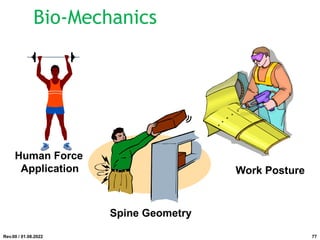
Bio-Mechanics
Human Force
Application
Spine Geometry
Work Posture
Rev.00 / 01.08.2022 77
Musculo Skeletal Injuries
• Bone Fractures
• Strains and Sprains
− Generally due to a single event
− Result of joint movement beyond
normal range
• Cumulative Trauma Disorders (CTDs)
− Result of multiple “micro injuries”
− Joint movements within normal
range
− Initial damage is undetectable
− Injuries may be permanent
Rev.00 / 01.08.2022 78
Types of CTDs
• Tendons
− Tendinitis
− Tenosynovitis
− Rotator cuff tendinitis
• Nerve Disorders
− Carpal tunnel syndrome
• Neurovascular Disorders
− Thoracic outlet syndrome
− Vibration syndrome
White finger
Rev.00 / 01.08.2022 79
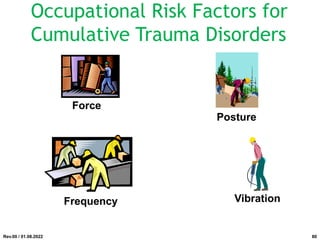
Occupational Risk Factors for
Cumulative Trauma Disorders
Force
Frequency Vibration
Posture
Rev.00 / 01.08.2022 80
Work Posture - Hand and Wrist
OK Avoid
Rev.00 / 01.08.2022 81
Sleep & Fatigue
Shift Work
Rev.00 / 01.08.2022 BON-TEK145-001_HUMAN_FACTOR_INITIAL 82
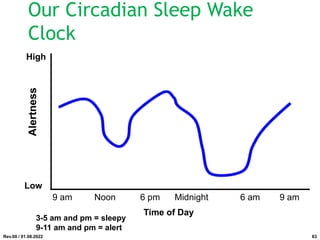
Our Circadian Sleep Wake
Clock
Alertness
Low
High
9 am Noon 6 pm Midnight 6 am 9 am
Time of Day
3-5 am and pm = sleepy
9-11 am and pm = alert
Rev.00 / 01.08.2022 83
Sleep
• Still no specific definition of sleep
− Lying down
− Little movement
− Do not respond as readily to disturbances
− Reversible—can wake up
Rev.00 / 01.08.2022 84
Sleep
• Still not totally sure why we need sleep, but there are two
theories
− Energy conservation—sleep to conserve energy
− Restoration
• Dream sleep thought to be important for learning,
reasoning, controlling emotions, and other mental
activity
• Non-dream sleep thought to be important because that
is when proteins are built and when the brain and
nervous system regain control over other body systems.
• Also know that bad things happen if we do not sleep
Rev.00 / 01.08.2022 85
How Much Sleep Do You Need?
 Depends
− Age
− Health
− Circadian rhythm
− Body metabolism
− Physical exercise level
− The quality of the sleep
− Amount of recent sleep
− Body temperature
− Personal differences
 Short sleepers
Need around 6 hrs of sleep
 Long sleepers
Need around 9 hrs of sleep
 1 in 25 people need
more than 10 or less
than 5 hrs of sleep
 “Magic number” of 8 hrs
of sleep is really just an
average
Rev.00 / 01.08.2022 86
Stages of Sleep
• Dream or Rapid Eye Movement (REM) sleep
− Experience dreams
− Characteristics of wakefulness—heartbeat is erratic,
muscles are active, and blood flow rises and falls
− Each time REM is repeated, it is a little longer
− Lightest sleep stage—easily awakened
− Process emotions and select information to store in
long-term memory
− Spend ~25% of our time in REM sleep
• Non-REM (or non-dreaming) sleep

− Four stages
Rev.00 / 01.08.2022 87
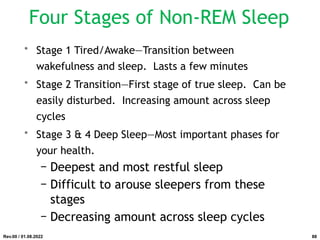
Four Stages of Non-REM Sleep
• Stage 1 Tired/Awake—Transition between
wakefulness and sleep. Lasts a few minutes
• Stage 2 Transition—First stage of true sleep. Can be
easily disturbed. Increasing amount across sleep
cycles
• Stage 3 & 4 Deep Sleep—Most important phases for
your health.
− Deepest and most restful sleep
− Difficult to arouse sleepers from these
stages
− Decreasing amount across sleep cycles
Rev.00 / 01.08.2022 88
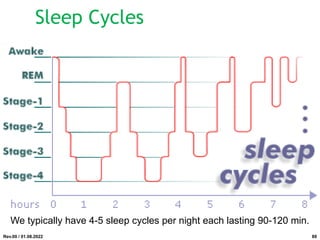
Sleep Cycles
We typically have 4-5 sleep cycles per night each lasting 90-120 min.
Rev.00 / 01.08.2022 89
Fatigue
Fatigue
A feeling of lack of energy, weariness or tiredness. Also
called tiredness, weariness, exhaustion, or lethargy.
Fatigue is a normal response to physical exertion,
emotional stress, and lack of sleep.
Alertness
Vigilantly attentive and watchful; mentally responsive
and perceptive.
Rev.00 / 01.08.2022 90
Types of Fatigue
• Acute fatigue
− Intense
− Short duration
− Cured by a good night’s sleep
• Chronic fatigue
− Frequently fatigued
− Long duration of the fatigue
− Slow recovery
− Often a physical sickness or mental stress that
causes chronic fatigue
− Not cured by one good night’s sleep
Rev.00 / 01.08.2022 91
Effects of Fatigue
 Overall performance gets
worse
 Exercise poor judgment
 Slowed reaction times
 Forgetful
 Poor cognitive
functioning
 Thinking
 Reasoning
 Problem solving
 Withdrawal from social
situations
 Mood changes
 Increase alcohol use
 Long term health can
degrade
 Quality of life degrades
Rev.00 / 01.08.2022 92
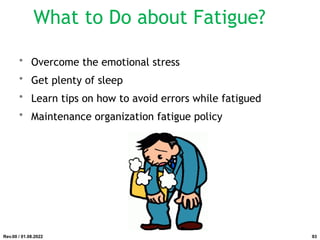
What to Do about Fatigue?
• Overcome the emotional stress
• Get plenty of sleep
• Learn tips on how to avoid errors while fatigued
• Maintenance organization fatigue policy
Rev.00 / 01.08.2022 93
Getting a Good Night’s Sleep
Avoiding Fatigue
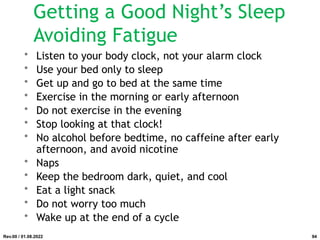
• Listen to your body clock, not your alarm clock
• Use your bed only to sleep
• Get up and go to bed at the same time
• Exercise in the morning or early afternoon
• Do not exercise in the evening
• Stop looking at that clock!
• No alcohol before bedtime, no caffeine after early
afternoon, and avoid nicotine
• Naps
• Keep the bedroom dark, quiet, and cool
• Eat a light snack
• Do not worry too much
• Wake up at the end of a cycle
Rev.00 / 01.08.2022 94
Avoiding Errors While Fatigued
• Admit you are tired!
• Remain physical to remain alert
• Exercise/stretch at frequent intervals
• Talk to people
• Drink plenty of liquids
• Take a nap
• Avoid tedious, boring work
• Work with somebody else so you can
catch each other’s errors
• Go back over and check your work
Rev.00 / 01.08.2022 95
Shift Work
• Aircraft are often available for more significant
maintenance during the night
• Aircraft maintenance engineers usually work shifts.
• The disadvantages of shift working are mainly associated
with:
− working ‘unsociable hours’, meaning that time available with
friends, family, etc. will be disrupted
− working when human performance is known to be poorer (i.e.
between 4 - 6 a.m.)
− problems associated with general desynchronisation and
disturbance of the body’s various rhythms (principally sleeping
patterns).
Rev.00 / 01.08.2022 96
• Many maintenance tasks often span more than one shift,
requiring tasks to be passed from one shift to the next.
The outgoing personnel are at the end of anything up to a
twelve hour shift and are consequently tired and eager to
go home. Therefore, shift handover is potentially an area
where human errors can occur.
In the B737 double engine oil loss incident, the error occurred during the night
shift. The accident investigation report commented that: “It is under these
circumstances that the fragility of the self monitoring system is most exposed
because the safety system can be jeopardised by poor judgement on the part of
one person and it is also the time at which people are most likely to suffer
impaired judgement”.
Rev.00 / 01.08.2022
Shift Work
97
It is always sensible to monitor ones performance, especially when working
additional hours. Performance decrements can be gradual, and first signs of
chronic fatigue may be moodiness, headaches or finding that familiar tasks (such
as programming the video recorder) seem more complicated than usual.
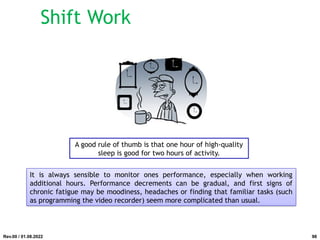
A good rule of thumb is that one hour of high-quality
sleep is good for two hours of activity.
Rev.00 / 01.08.2022
Shift Work
98
Claustrophobia
&
Physical Access
Rev.00 / 01.08.2022 BON-TEK145-001_HUMAN_FACTOR_INITIAL 99
Phobias
Phobia
A persistent, abnormal, and irrational
fear that compels avoidance, despite
the understanding by the phobic
person and reassurance by others that
there is no danger.
Claustrophobia
Fear of enclosed spaces. A more
accurate description is a fear of not
having an easy escape route.
Acrophobia
Fear of heights or high levels
Rev.00 / 01.08.2022 100
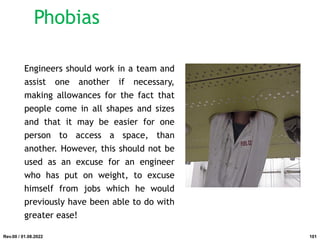
Engineers should work in a team and
assist one another if necessary,
making allowances for the fact that
people come in all shapes and sizes
and that it may be easier for one
person to access a space, than
another. However, this should not be
used as an excuse for an engineer
who has put on weight, to excuse
himself from jobs which he would
previously have been able to do with
greater ease!
Rev.00 / 01.08.2022
Phobias
101
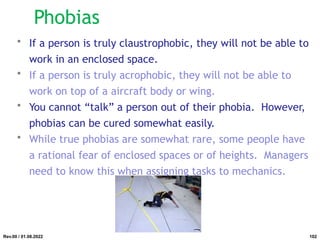
• If a person is truly claustrophobic, they will not be able to
work in an enclosed space.
• If a person is truly acrophobic, they will not be able to
work on top of a aircraft body or wing.
• You cannot “talk” a person out of their phobia. However,
phobias can be cured somewhat easily.
• While true phobias are somewhat rare, some people have
a rational fear of enclosed spaces or of heights. Managers
need to know this when assigning tasks to mechanics.
Rev.00 / 01.08.2022
Phobias
102
Fitness/Health
Rev.00 / 01.08.2022 BON-TEK145-001_HUMAN_FACTOR_INITIAL 103
Fitness and Health
• Ill health (sickness) and poor fitness can have a
negative impact on performance (work)
− Work may be of poor quality
− Errors are more likely
• The purpose of awareness training is to get mechanics
to realize when they are feeling ill or exhausted from
work, and to do something about it
− Stay home if really sick
− Ask to be put on a simple task
− Ask a friend to check your work
− Take their medications
Rev.00 / 01.08.2022 104
• The job of an aircraft maintenance engineer can be physically
demanding. In addition, his work may have to be carried out in
widely varying physical environments, including cramped spaces,
extremes of temperature, etc.
• Fitness and health can have a significant affect upon job
performance (both physical and cognitive). Day-to-day fitness and
health can be reduced through illness (physical or mental) or
injury.
Part-66 imposes a requirement that “certifying staff must not
exercise the privileges of their certification authorisation if they know
or suspect that their physical or mental condition renders them unfit.”
Rev.00 / 01.08.2022
Fitness and Health
105
• Aircraft maintenance engineers can take common sense
steps to maintain their fitness and health. These
include:
− Eating regular meals and a well-balanced diet;
− Taking regular exercise (exercise sufficient to double the
resting pulse rate for 20 minutes, three times a week is often
recommended);
− Stopping smoking;
− Sensible alcohol intake.
Rev.00 / 01.08.2022
Fitness and Health
106
Alcohol, Medication, and
Drugs
Rev.00 / 01.08.2022 BON-TEK145-001_HUMAN_FACTOR_INITIAL 107
Alcohol, Medication, and Drugs
• Alcohol, medication, and drugs can all have an effect on
performance
• Three main effects
− Central nervous system depressant (e.g., alcohol,
pain killers, and sleeping pills)—slows down your
reflexes and thinking ability
− Central nervous system stimulant (e.g.,
amphetamines and caffeine)—speeds up your
reflexes and thinking, but too much can have a
negative effect
− Hallucinogens (e.g., marijuana and LSD)—affects
your understanding of reality
Rev.00 / 01.08.2022 108
• Purpose of training is to get mechanics to realize that
using drugs of any kind can have an affect on their
performance.
− If they are on prescription drugs, they need
to know the side effects (e.g., drowsiness or
decreased mental capacity) so that they are
aware of the drug’s effect on their
performance and can do something about it
• Do not work with dangerous equipment
• Do not do complex tasks
• Stay at home
Rev.00 / 01.08.2022
Alcohol, Medication, and Drugs
109
As a general rule, aircraft maintenance engineers should not
work for at least eight hours after drinking even small quantities
of alcohol and increase this time if more has been drunk.
Medication is usually taken to relieve symptoms of an
illness. Even if the drugs taken do not affect the engineer’s
performance, he should still ask himself whether the illness
has made him temporarily unfit for work.
If the aircraft maintenance engineer has any
doubts about the suitability of working whilst
taking medication, he must seek appropriate
professional advice.
Rev.00 / 01.08.2022
Alcohol, Medication, and Drugs
110
Workload
Rev.00 / 01.08.2022 BON-TEK145-001_HUMAN_FACTOR_INITIAL 111
Workload
Workload is subjective (i.e. experienced differently by
different people) and is affected by:
• The nature of the task, such as the:
− physical demands it requires (e.g. strength required, etc.);
− mental demands it requires (e.g. complexity of decisions to be made,
etc.).
• The circumstances under which the task is performed, such as
the:
− standard of performance required (i.e. degree of accuracy);
− time available to accomplish the task (and thus the speed at which the task
must be carried out);
− requirement to carry out the task at the same time as doing something
else;
− perceived control of the task (i.e. is it imposed by others or under your
control, etc.);
− environmental factors existing at time (e.g. extremes of temperature,
etc.).
Rev.00 / 01.08.2022 112
• The person and his state, such as his:
• skills (both physical and mental);
• his experience (particularly familiarity with the
task in question);
• his current health and fitness levels;
• his emotional state (e.g. stress level, mood,
etc.)
Rev.00 / 01.08.2022
Workload
113
Overload and Underload
• Overload occurs at very high levels of workload (when the
engineer becomes over aroused). Performance deteriorates when
arousal becomes too high and we are forced to shed tasks and
focus on key information. Error rates may also increase.
• Underload occurs at low levels of workload (when the engineer
becomes under aroused). It can be just as problematic to an
engineer as overload, as it too causes a deterioration in
performance and an increase in errors, such as missed
information. Underload can result from a task an engineer finds
boring, very easy, or indeed a lack of tasks.
Rev.00 / 01.08.2022 114
Workload Management
• It is important to manage your work so that you do not
wait until the end of your work period to rush through
your task.
− Speed-accuracy trade-off increases the
likelihood that the work will be of low
quality or contain errors
• Discuss incidents/accidents that were caused by poor
workload management.
If you tell a mechanic to
“hurry up and finish the task,”
you are inviting an error.
Rev.00 / 01.08.2022 115
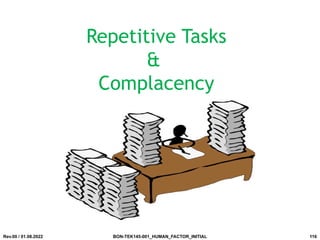
Repetitive Tasks
&
Complacency
Rev.00 / 01.08.2022 BON-TEK145-001_HUMAN_FACTOR_INITIAL 116
Repetitive Tasks
Repetitive tasks in aircraft maintenance engineering typically refer
to tasks that are performed several times during a shift, or a
number of times during a short time period, e.g. in the course of a
week. An example of this would be the checking life jackets on an
aircraft during daily inspections.
Some engineers may specialise in a certain aspect of maintenance,
such as engines. As a result, they may possibly carry out the same or
similar tasks several times a day.
Rev.00 / 01.08.2022 117
The main danger with repetitive tasks is that engineers may become
so practised at such tasks that they may cease to consult the
maintenance manual, or to use job cards. Thus, if something about
a task is changed, the engineer may not be aware of the change.
Complacency is also a danger, whereby an engineer may skip steps
or fail to give due attention to steps in a procedure, especially if it
is to check something which is rarely found to be wrong, damaged or
out of tolerance.
In the Aloha accident report, the NTSB raised the problem of repetitive tasks:
“The concern was expressed about what kinds of characteristics are appropriate to
consider when selecting persons to perform an obviously tedious, repetitive task such as a
protracted NDI inspection. Inspectors normally come up through the seniority ranks. If they
have the desire, knowledge and skills, they bid on the position and are selected for the
inspector job on that basis. However, to ask a technically knowledgeable person to
perform an obviously tedious and exceedingly boring task, rather than to have him
supervise the quality of the task, may not be an appropriate use of personnel…”
Rev.00 / 01.08.2022
Repetitive Tasks
118
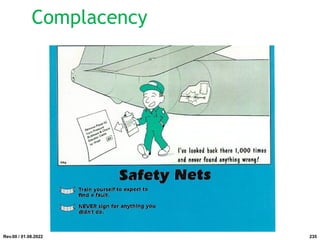
Complacency
• Complacency = Self-satisfaction accompanied by
unawareness of actual dangers or deficiencies
• Mechanics can become complacent when they have
done a task over and over again without making an
error
• Inspectors can become complacent when they have
done an inspection many times before without finding
a problem
• We must fight complacency!
Rev.00 / 01.08.2022 119
Complacency—One of the Dirty
Dozen
Rev.00 / 01.08.2022 120
3. Environment
Rev.00 / 01.08.2022 BON-TEK145-001_HUMAN_FACTOR_INITIAL 121
Environment
 Peer pressure
 Stress
 Physical Stressors
 Working Area
 Climate and temperature
 Motion and vibration
 Noise and fumes
 Illumination
 Psychological Stressors
 Time pressure and Deadlines
Rev.00 / 01.08.2022 122
Peer Pressure
Peer pressure is the actual or perceived pressure which an individual
may feel, to conform to what he believes that his peers or colleagues
expect.
For example, an individual engineer may feel that there is pressure to
cut corners in order to get an aircraft out by a certain time, in the
belief that this is what his colleagues would do under similar
circumstances.
Peer pressure thus falls within the area of conformity. Conformity is
the tendency to allow one’s opinions, attitudes, actions and even
perceptions to be affected by prevailing opinions, attitudes, actions
and perceptions.
Rev.00 / 01.08.2022 123
The degree to which an individual’s view is likely to be affected by
conformity or peer pressure, depends on many factors, including:
• culture (people from country x tend to conform more than those from
country y)
• gender (men tend to conform less than women)
• self-esteem (a person with low self-esteem is likely to conform more)
•familiarity of the individual with the subject matter (a person is more likely
to conform to the majority view if he feels that he knows less about the
subject matter than they do)
•the expertise of the group members (if the individual respects the group or
perceives them to be very knowledgeable he will be more likely to conform to
their views)
•the relationship between the individual and group members (conformity
increases if the individual knows the other members of the group, i.e. it is a
group of peers)
Rev.00 / 01.08.2022
Peer Pressure
124
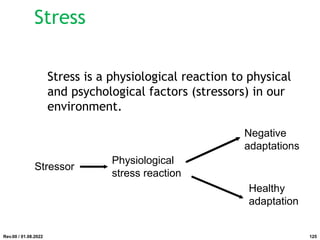
Stress
Stress is a physiological reaction to physical
and psychological factors (stressors) in our
environment.
Physiological
stress reaction
Stressor
Negative
adaptations
Healthy
adaptation
Rev.00 / 01.08.2022 125
Domestic Stress
When aircraft maintenance engineers go to work, they cannot leave
stresses associated with home behind. Pre-occupation with a source
of domestic stress can play on one’s mind during the working day,
distracting from the working task. Inability to concentrate fully may
impact on the engineer’s task performance and ability to pay due
attention to safety.
Domestic stress typically results from major life changes at home,
such as marriage, birth of a child, a son or daughter leaving home,
bereavement of a close family member or friend, marital problems,
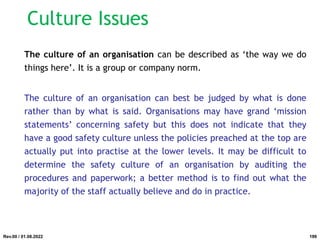
or divorce.
Rev.00 / 01.08.2022 126
Work Related Stress
Aircraft maintenance engineers can experience stress for two reasons
at work:
because of the task or job they are undertaking at that moment, or
because of the general organisational environment.
Stress can be felt when carrying out certain tasks that are particularly
challenging or difficult. This stress can be increased by lack of
guidance in this situation, or time pressures to complete the task or
job (covered later in this chapter). This type of stress can be reduced
by careful management, good training, etc.
Rev.00 / 01.08.2022 127
Stress Management
Once we become aware of stress, we generally respond to it by using
one of two strategies: defence or coping.
Defence strategies involve alleviation of the symptoms (taking
medication, alcohol, etc.) or reducing the anxiety (e.g. denying to
yourself that there is a problem (denial), or blaming someone else)
Coping strategies involve dealing with the source of the stress rather
than just the symptoms (e.g. delegating workload, prioritising tasks,
sorting out the problem, etc.).
Rev.00 / 01.08.2022 128
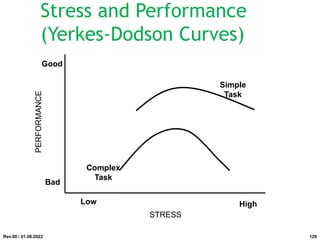
Stress and Performance
(Yerkes-Dodson Curves)
PERFORMANCE
STRESS
Low High
Good
Bad
Simple
Task
Complex
Task
Rev.00 / 01.08.2022 129
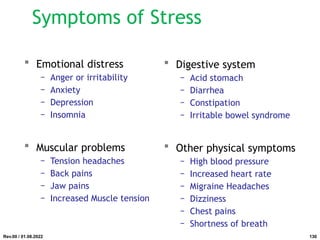
Symptoms of Stress
 Emotional distress
− Anger or irritability
− Anxiety
− Depression
− Insomnia
 Muscular problems
− Tension headaches
− Back pains
− Jaw pains
− Increased Muscle tension
 Digestive system
− Acid stomach
− Diarrhea
− Constipation
− Irritable bowel syndrome
 Other physical symptoms
− High blood pressure
− Increased heart rate
− Migraine Headaches
− Dizziness
− Chest pains
− Shortness of breath
Rev.00 / 01.08.2022 130
Stressors
• Physical stressors
− Illness
− Environment
− Fatigue
• Psychological stressors
− Bereavement and tragedy
− Daily annoyances
− Chronic stress
Rev.00 / 01.08.2022 131
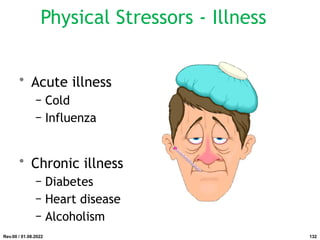
Physical Stressors - Illness
• Acute illness
− Cold
− Influenza
• Chronic illness
− Diabetes
− Heart disease
− Alcoholism
Rev.00 / 01.08.2022 132
Physical Stressors -
Environment
• Climate & temperature
− Effects on performance
− Effects on health
− Heat
− Cold
− Wind
− Humidity
• Motion & Vibration
− Effects on performance
− Effects on health
− Engine ground run
− Moving platforms
− Riveting
• Noise
− Effects on performance
• Hearing
• Cognitive performance
− Hearing damage
− Other effects on health
• Fumes
− Workplace distraction
− Health hazard
Rev.00 / 01.08.2022 133
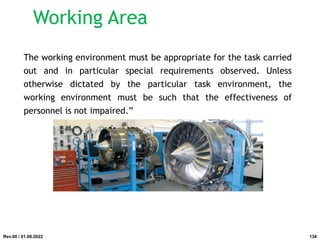
Working Area
The working environment must be appropriate for the task carried
out and in particular special requirements observed. Unless
otherwise dictated by the particular task environment, the
working environment must be such that the effectiveness of
personnel is not impaired.”
Rev.00 / 01.08.2022 134
• The working environment comprises the physical environment,
the social environment and the tasks that need to be carried
out . Each of these three components of the working
environment interact, for example:
− engineers are trained to perform various tasks
− successful task execution requires a suitable physical
environment
− an unsuitable or unpleasant physical environment is likely
to be de-motivating
Rev.00 / 01.08.2022
Working Area
135
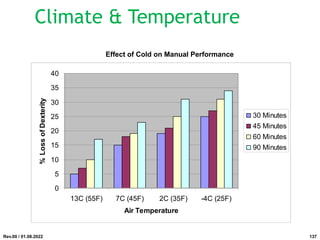
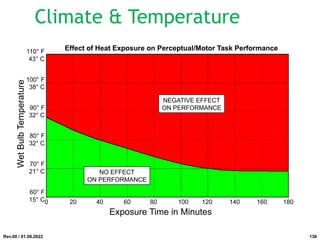
Climate & Temperature
Environmental conditions can affect physical performance. For example,
cold conditions make numb fingers, reducing the engineer’s ability to
carry out fiddly repairs, and working in strong winds can be distracting,
especially if having to work at height (e.g. on staging). Extreme
environmental conditions may also be fatiguing, both physically and
mentally.
There are no simple solutions to the effects of temperature and climate
on the engineer. For example, an aircraft being turned around on the
apron cannot usually be moved into the hangar so that the engineer
avoids the worst of the weather. In the cold, gloves can be worn, but
obviously the gloves themselves may interfere with fine motor skills. In
the direct heat of the sun or driving rain, it is usually impossible to set up
a temporary shelter when working outside.
Rev.00 / 01.08.2022 136
0
5
10
15
20
25
30
35
40
13C (55F) 7C (45F) 2C (35F) -4C (25F)
Air Temperature
%
Loss
of
Dexterity
30 Minutes
45 Minutes
60 Minutes
90 Minutes
Effect of Cold on Manual Performance
Rev.00 / 01.08.2022
Climate & Temperature
137
110° F
43° C
100° F
38° C
90° F
32° C
80° F
32° C
0 20 40 60 80 100 120 140 160 180
Exposure Time in Minutes
Wet
Bulb
Temperature
70° F
21° C
60° F
15° C
NEGATIVE EFFECT
ON PERFORMANCE
NO EFFECT
ON PERFORMANCE
Effect of Heat Exposure on Perceptual/Motor Task Performance
Rev.00 / 01.08.2022
Climate & Temperature
138
Motion & Vibration
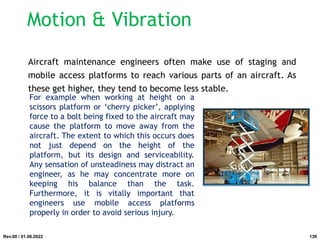
Aircraft maintenance engineers often make use of staging and
mobile access platforms to reach various parts of an aircraft. As
these get higher, they tend to become less stable.
For example when working at height on a
scissors platform or ‘cherry picker’, applying
force to a bolt being fixed to the aircraft may
cause the platform to move away from the
aircraft. The extent to which this occurs does
not just depend on the height of the
platform, but its design and serviceability.
Any sensation of unsteadiness may distract an
engineer, as he may concentrate more on
keeping his balance than the task.
Furthermore, it is vitally important that
engineers use mobile access platforms
properly in order to avoid serious injury.
Rev.00 / 01.08.2022 139
Vibration in aircraft maintenance engineering is usually associated
with the use of rotating or percussive tools and ancillary
equipment, such as generators. Low frequency noise, such as that
associated with aircraft engines, can also cause vibration.
Vibration between 0.5 Hz to 20 Hz is most
problematic, as the human body absorbs most
of the vibratory energy in this range. The
range between 50-150 Hz is most troublesome
for the hand and is associated with Vibratory-
induced White Finger Syndrome. Pneumatic
tools can produce troublesome vibrations in
this range and frequent use can lead to
reduced local blood flow and pain associated
with VWF. Vibration can be annoying, possibly
disrupting an engineer’s concentration.
Rev.00 / 01.08.2022
Motion & Vibration
140
Noise
The noise environment in which the aircraft maintenance engineer
works can vary considerably. For instance, the airport ramp or
apron area is clearly noisy, due to running aircraft engines or
auxiliary power units (APUs), moving vehicles and so on. It is not
unusual for this to exceed 85 dB - 90 dB which can cause hearing
damage if the time of exposure is prolonged.
The hangar area can also be noisy, usually
due to the use of various tools during
aircraft maintenance. Short periods of
intense noise are not uncommon here and
can cause temporary hearing loss.
Engineers may move to and from these
noisy areas into the relative quiet of rest
rooms, aircraft cabins, stores and offices.
Rev.00 / 01.08.2022 141
Fumes
By its nature, the maintenance of aircraft involves working with a
variety of fluids and chemical substances. For instance, engineers
may come across various lubricants (oils and greases), hydraulic
fluids, paints, cleaning compounds and solder. They will also be
exposed to aircraft fuel and exhaust. In fact, there is every
possibility that an engineer could be exposed to a number of these
at any one time in the workplace. Each substance gives off some
form of vapour or fumes which can be inhaled by the aircraft
maintenance engineer. Some fumes will be obvious as a result of
their odour, whereas others have no smell to indicate their
presence. Some substances will be benign most of the time, but
may, in certain circumstances, produce fumes (e.g. overheated
grease or oils, smouldering insulation).
Rev.00 / 01.08.2022 142
Illumination
In order that aircraft maintenance engineers are able to carry out
their work safely and efficiently, it is imperative that their work
be conducted under proper lighting conditions.
When working outside during daylight, the
engineer may have sufficient natural light
to see well by. It is possible however that
he may be in shadow (possibly caused by
the aircraft) or a building. Similarly,
cramped equipment compartments will not
be illuminated by ambient hangar lighting.
In these cases, additional local artificial
lighting is usually required (known as task
lighting)..
Rev.00 / 01.08.2022 143
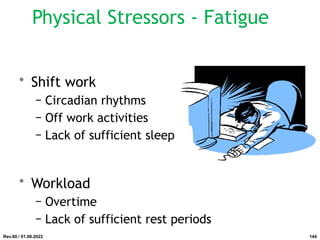
Physical Stressors - Fatigue
• Shift work
− Circadian rhythms
− Off work activities
− Lack of sufficient sleep
• Workload
− Overtime
− Lack of sufficient rest periods
Rev.00 / 01.08.2022 144
Psychological Stressors –
Bereavement & Tragedy
• Long term detrimental affects on health
• Abnormal sleep patterns
• Negative behavior
− Alcohol and drug use
− Inability to pay attention
− Poor attendance
Rev.00 / 01.08.2022 145
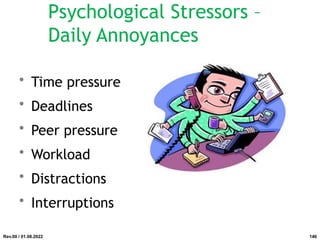
Psychological Stressors –
Daily Annoyances
• Time pressure
• Deadlines
• Peer pressure
• Workload
• Distractions
• Interruptions
Rev.00 / 01.08.2022 146
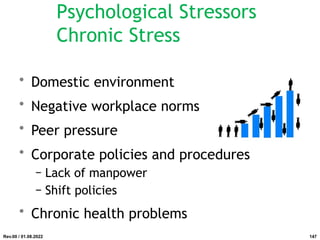
Psychological Stressors
Chronic Stress
• Domestic environment
• Negative workplace norms
• Peer pressure
• Corporate policies and procedures
− Lack of manpower
− Shift policies
• Chronic health problems
Rev.00 / 01.08.2022 147
Time Pressure and Deadlines
As with stress, it is generally thought that some time pressure is
stimulating and may actually improve task performance. However, it
is almost certainly true that excessive time pressure (either actual or
perceived, external or self-imposed), is likely to mean that due care
and attention when carrying out tasks diminishes and more errors will
be made. Ultimately, these errors can lead to aircraft incidents and
accidents.
Rev.00 / 01.08.2022 148
An extract from the NTSB report on the Aloha accident refers to time pressure as a
possible contributory factor in the accident: “The majority of Aloha's maintenance
was normally conducted only during the night. It was considered important that
the airplanes be available again for the next day's flying schedule. Such aircraft
utilization tends to drive the scheduling, and indeed, the completion of required
maintenance work. Mechanics and inspectors are forced to perform under time
pressure. Further, the intense effort to keep the airplanes flying may have been so
strong that the maintenance personnel were reluctant to keep airplanes in the
hangar any longer than absolutely necessary.”
It is possible that perceived time pressure would appear to have been a
contributory factor in the BAC 1-11 accident described in Chapter 1. Although the
aircraft was not required the following morning for operational use, it was booked
for a wash. The wash team had been booked the previous week and an aircraft had
not been ready. This would have happened again, due to short-staffing, so the Shift
Manager decided to carry out the windscreen replacement task himself so that the
aircraft would be ready in time.
Rev.00 / 01.08.2022
Time Pressure and Deadlines
149
4. Procedures, Information, Tools,
and Practice
Rev.00 / 01.08.2022 BON-TEK145-001_HUMAN_FACTOR_INITIAL 150
Procedures, Information,
Tools, and Practices
• Visual inspection
• Complex systems
• Work logging and recording
• Norms
• Technical documentation
Access and quality
Rev.00 / 01.08.2022 151
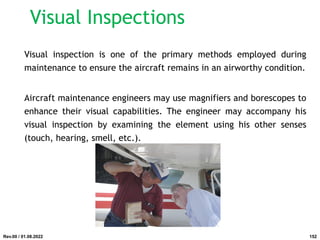
Visual Inspections
Visual inspection is one of the primary methods employed during
maintenance to ensure the aircraft remains in an airworthy condition.
Aircraft maintenance engineers may use magnifiers and borescopes to
enhance their visual capabilities. The engineer may accompany his
visual inspection by examining the element using his other senses
(touch, hearing, smell, etc.).
Rev.00 / 01.08.2022 152
There are various steps that an engineer can take to help him carry
out a reliable visual inspection. The engineer should:
− ensure that he understands the area, component or system he has
been asked to inspect (e.g. as specified on the work card)
− locate the corresponding area, component or system on the aircraft
itself
− make sure the environment is conducive to the visual inspection task
(considering factors described in Chapter 5 - “Physical Environment”,
such as lighting, access, etc.)
− conduct a systematic visual search, moving his eyes carefully in a set
pattern so that all parts are inspected
− examine thoroughly any potential degradation or defect that is seen
and decide whether it constitutes a problem
Rev.00 / 01.08.2022
Visual Inspections
153
Visual inspection requires a considerable amount of concentration.
Long spells of continuous inspection can be tedious and result in low
arousal. An engineer’s low arousal or lack of motivation can
contribute to a failure to spot a potential problem or a failure in
recognising a defect during visual inspection. The effects are
potentially worse when an inspector has a very low expectation of
finding a defect, e.g. on a new aircraft
The Aloha accident highlights what can happen when visual inspection is poor. The
accident report included two findings that suggest visual inspection was one of the
main contributors to the accident:
• “There are human factors issues associated with visual and non-destructive
inspection which can degrade inspector performance to the extent that theoretically
detectable damage is overlooked.”
• “Aloha Airlines management failed to recognise the human performance factors of
inspection and to fully motivate and focus their inspector force toward the critical
nature of lap joint inspection, corrosion control and crack detection…..”
Rev.00 / 01.08.2022
Visual Inspections
154
Factors Influencing Visual
Inspection
• Physical and Environmental Factors
Lighting, job aids, noise, workplace design
• Task Factors
Inspection time, defect types, defect mix,
repetitiveness/monotony, defect probability,
feed forward and feedback information
• Subject Factors
Visual acuity, age, experience, training
Rev.00 / 01.08.2022 155
Complex Systems
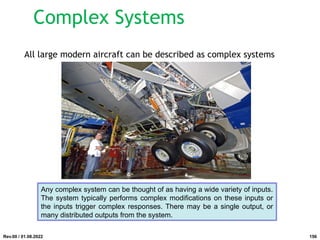
All large modern aircraft can be described as complex systems
Any complex system can be thought of as having a wide variety of inputs.
The system typically performs complex modifications on these inputs or
the inputs trigger complex responses. There may be a single output, or
many distributed outputs from the system.
Rev.00 / 01.08.2022 156
With complex systems within aircraft, written procedures and
reference material become an even more important source of
guidance than with simple systems. They may describe
comprehensively the method of performing maintenance tasks, such
as inspections, adjustments and tests. They may describe the
relationship of one system to other systems and often, most
importantly, provide cautions or bring attention to specific areas or
components. It is important to follow the procedures to the letter,
since deviations from procedures may have implication on other parts
of the system of which the engineer may be unaware
When working with complex systems, it is important that the aircraft
maintenance engineer makes reference to appropriate guidance material.
This typically breaks down the system conceptually or physically, making
it easier to understand and work onç
Rev.00 / 01.08.2022
Complex Systems
157
Work Logging and Recording
• Importance of proper work logging/recording
− All work on an aircraft should be documented
− Work sign-offs should occur soon after the sub-task
is completed. Do not wait until the end of the task
to sign off all “worked by” blocks.
− Any work done on the aircraft that is not covered in
the maintenance manual (e.g., loosening a clamp
on a tube in order to remove a pump) should be
recorded
Rev.00 / 01.08.2022 158
This is one of the most critical aspects of communication within
aviation maintenance, since inadequate logging or recording of work
has been cited as a contributor to several incidents.
In the B737 double engine oil loss incident in February 1995, for instance,
one of the conclusions was:
“…the Line Engineer…had not made a written statement or annotation on
a work stage sheet to show where he had got to in the inspections”.
The reason for this was because he had intended completing the job
himself and, therefore, did not consider that detailed work logging was
necessary. However, this contributed towards the incident in that:
“the Night Base Maintenance Controller accepted the tasks on a verbal
handover [and] he did not fully appreciate what had been done and what
remained to be done”.
Rev.00 / 01.08.2022
Work Logging and Recording
159
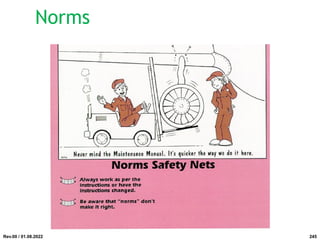
Norms
Typical behavior in a social group or organization.
− Norms are simply the state of actual
conditions
− They can be effective or ineffective in the
performance of quality work
Tagging connections Wearing appropriate
safety equipment
Following check lists
and procedures
Rev.00 / 01.08.2022 160
 Effective Norms:
 Are a by-product of
effective communication
within the airline
 Reinforce good practices
 Increase organizational
safety and efficiency
Should become company
policy!
 Ineffective Norms:
 Develop in part due to
ineffective communication
 Cause inexperienced
personnel to deviate from
best practices
 Reduce organizational
safety and efficiency
Must be eliminated!
Rev.00 / 01.08.2022
Norms
161
Some Ineffective Norms
• Memorizing tasks instead of using manuals/cards
• Not using torque wrenches
• Troubleshooting through experience, instead of using the
Fault Isolation Manual (FIM)
• Deviating from maintenance manual procedures based on
experience
• Failing to attach “Do Not Use” tags when pulling circuit
breakers and switches
• Skipping functional or operational tests
• Signing off for tasks not seen or checked
• Providing minimum information in shift handover log
Rev.00 / 01.08.2022
Norms
162
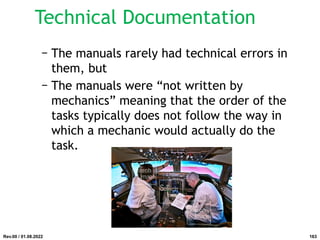
Technical Documentation
− The manuals rarely had technical errors in
them, but
− The manuals were “not written by
mechanics” meaning that the order of the
tasks typically does not follow the way in
which a mechanic would actually do the
task.
Rev.00 / 01.08.2022 163
• MEDA investigations have found that
documentation is the most frequent
contributing factor to maintenance error
• Problems include
− Not understandable
− Incorrect step
− Conflicting information
− No illustration
− Poor illustration
− Not used
Rev.00 / 01.08.2022
Technical Documentation
164
• Use one action verb per statement
• Coordinate ATA 100 caution and warning guidelines
with current ANSI/ISO standards
• Use Simplified English
• Avoid using acronyms and abbreviations
• Where arrow is pointing should be immediately
obvious
Rev.00 / 01.08.2022
Technical Documentation
165
5. Communication
Rev.00 / 01.08.2022 BON-TEK145-001_HUMAN_FACTOR_INITIAL 166
Communication
• Communication fundamentals
• Shift/task handover
• Keeping up to date, currency
• Dissemination of information
• Cultural differences
Rev.00 / 01.08.2022 167
Communication: The ability to clearly and accurately
send and acknowledge information and to provide useful
feedback.
Rev.00 / 01.08.2022
Communication Fundamentals
168
Communication Fundamentals
Where Communication Errors Can Occur
• Between mechanics and pilots
• Between mechanics and management
• Between teams of mechanics
• Between individual mechanics
Rev.00 / 01.08.2022 169
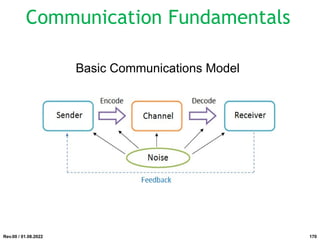
Basic Communications Model
Rev.00 / 01.08.2022
Communication Fundamentals
170
Sender’s Responsibility
1. Communicating information clearly
2. Covering timely information
accurately
3. Requesting verification of feedback
4. Verbalizing plans
Rev.00 / 01.08.2022
Communication Fundamentals
171
Receiver’s Responsibility
1. Acknowledge communications.
2. Repeat information.
3. Paraphrase information.
4. Clarify information.
5. Provide useful feedback.
Rev.00 / 01.08.2022
Communication Fundamentals
172
• Passive listening
− No feedback
− Poor feedback
• Not using the right words
• Inappropriate method
• Vague or late information
Barriers to Effective Communication
Rev.00 / 01.08.2022
Communication Fundamentals
173
Overcoming Barriers to Communication
• Use active listening
• Request feedback
• Use appropriate emphasis
(decibel level)
• Use common words
Rev.00 / 01.08.2022
Communication Fundamentals
174
DO NOT
 Argue about things
 Bring up things that are not
important
 Plan out your words while
the other person is talking
 Think about other things
while the other person is
talking
DO
 Ask good questions
 Make eye contact
 Use positive body language
 Repeat back using your own
words to make sure you
understand
Active Listening
Rev.00 / 01.08.2022
Communication Fundamentals
175
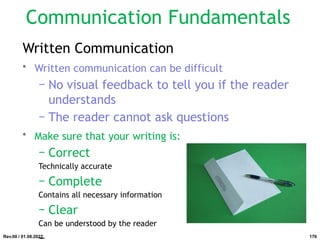
Written Communication
• Written communication can be difficult
− No visual feedback to tell you if the reader
understands
− The reader cannot ask questions
• Make sure that your writing is:
− Correct
Technically accurate
− Complete
Contains all necessary information
− Clear
Can be understood by the reader
Rev.00 / 01.08.2022
Communication Fundamentals
176
Communication Within Teams
A Individual aircraft maintenance engineers need to communicate:
• before starting a task - to find out what to do;
• during a task - to discuss work in progress, ask colleagues questions,
confirm actions or intentions, or to ensure that others are informed of
the maintenance state at any particular time;
• at the end of a task - to report its completion and highlight any problems
It is much less common for individuals within teams to use written
communication. They would however be expected to obtain pertinent
written information communicated by service bulletins and work cards and
to complete documentation associated with a task.
Rev.00 / 01.08.2022 177
Communication Between
Teams
Communication between teams is critical in aircraft maintenance
engineering. It is the means by which one team passes on tasks to
another team. This usually occurs at shift handover. The information
conveyed will include:
• tasks that have been completed
• tasks in progress, their status, any
problems encountered, etc
• tasks to be carried out;
• general company and technical
information.
Rev.00 / 01.08.2022 178
Shift/Task Handover
• Best shift handover would include…
− A written shift handover logbook entry about the task,
including
• What was completed
• Exactly where in the task the handover occurred/where the task
is to be started
• Any special requirements (e.g., waiting for an inspection)
• Any work done that was outside the task card (e.g., loosened a
clamp)
− A verbal handover with the mechanic taking over the
task
− A task card that was completely filled out (all “worked
by” and “checked by” signatures completed) up to
where the mechanic quit working on the task
Rev.00 / 01.08.2022 179
Keeping up to date, currency
Aircraft maintenance engineers undertake an approved
course to obtain the knowledge and basic skills to enter
the profession. This training is followed by instruction in
more specific areas, such as maintenance of individual
aircraft and specific systems. However, the aviation
industry is dynamic: operators change their aircraft, new
aircraft types and variants are introduced, new aircraft
maintenance practices are introduced. As a
consequence, the engineer needs to keep his knowledge
and skills.
Rev.00 / 01.08.2022 180
Responsibility for maintaining currency lies with both the individual
engineer and the maintenance organisation for which he works. The
engineer should make it his business to keep up-to-date with
changes in his profession (remembering that making assumptions
can be dangerous). The organisation should provide the appropriate
training and allow their staff time to undertake the training before
working on a new aircraft type or variant. It should also make
written information easily accessible to engineers and encourage
them to read it. It is, of course, vital that those producing the
information make it easy for engineers to understand (i.e. Avoid
ambiguity).
Rev.00 / 01.08.2022
Keeping up to date, currency
181
Dissemination of Information
An aircraft maintenance engineer or team of engineers
need to plan the way work will be performed. Part of
this process should be checking that all information
relating to the task has been gathered and understood.
This includes checking to see if there is any information
highlighting a change associated with the task (e.g. the
way something should be done, the tools to be used, the
components or parts involved)
It is imperative that engineers working remotely
from the engineering base (e.g. on the line)
familiarise themselves with new information (on
notice boards, in maintenance manuals, etc.) on a
regular basis.
Rev.00 / 01.08.2022 182
• It is important that…
− Information is up to date
− Accessible by those who need it
− Gets to those who need it in a timely
fashion
• Accidents/incidents
− Examples from the audience
Rev.00 / 01.08.2022
Dissemination of Information
183
Cultural Differences
• Culture = Customary beliefs, behavior patterns,
and material traits of a group (organization)
• Some of these beliefs deal with communication
issues
− Do not admit to mistakes
− Indirect (not straightforward) communications
− Pilots will not talk to maintenance staff, etc.
• Discuss how the participants’ national/
organizational cultures affect communication
Rev.00 / 01.08.2022 184
6. Teamwork
Rev.00 / 01.08.2022 BON-TEK145-001_HUMAN_FACTOR_INITIAL 185
Teamwork
• Behaviors (Group & Team)
• Responsibility (Individual & Group)
• Culture Issues
• Management, supervision, and leadership
Rev.00 / 01.08.2022 186
Overview
• Group Behavior
− Responsibility
− Motivation
− Norms
− Culture
• Effective Team Behaviors
− Communication
− Assertiveness
− Situation Awareness
− Leadership
Rev.00 / 01.08.2022 187
Group Behavior
Group Behavior
The way people behave when part of a group.
Rev.00 / 01.08.2022 188
What Effects Behavior In
Groups?
• Responsibility
• Motivation
• Norms
• Culture
Rev.00 / 01.08.2022 189
Responsibility
Individual & Group
Within aircraft maintenance, responsibility should be spread across all
those who play a part in the activity. This ranges from the
accountable manager who formulates policy, through management
that set procedures, to supervisors, teams of engineers and
individuals within those teams. Flight crew also play a part as they
are responsible for carrying out preflight checks and walk arounds and
highlighting aircraft faults to maintenance personnel.
Rev.00 / 01.08.2022 190
Traditionally, in the maintenance engineering environment,
responsibility has been considered in terms of the individual rather
than the group or team. This is historical, and has much to do with
the manner in which engineers are licensed and the way in which
work is certified. This has both advantages and disadvantages. The
main advantage to individual responsibility is that an engineer
understands clearly that one or more tasks have been assigned to him
and it is his job to do them (it can also be a strong incentive to an
engineer to do the work correctly knowing that he will be the one
held responsible if something goes wrong). The main disadvantage of
any emphasis upon personal responsibility, is that this may overlook
the importance of working together as a cohesive team or group to
achieve goals.
Rev.00 / 01.08.2022
Responsibility
Individual & Group
191
In practice, aircraft maintenance engineers are often assigned to
groups or teams in the workplace. These may be shift teams, or
smaller groups within a shift. A team may be made up of various
engineering trades, or be structured around aircraft types or place of
work (e.g. a particular hangar). Although distinct tasks may be
assigned to individuals within a team, the responsibility for fulfilling
overall goals would fall on the entire team.
Rev.00 / 01.08.2022
Responsibility
Individual & Group
192
• Responsibility is...
− Recognizing that you can affect the team’s
success
− Choosing to act to help that success
• In a Group, we tend to feel less responsible.
− “Someone else will do it.”
− “The whole team agreed.”
− “Nobody saw me, it could be anyone.”
Rev.00 / 01.08.2022
Responsibility
Individual & Group
193
Examples of Taking
Responsibility
• Admitting and fixing errors
• Saying something about a situation when you
know there is something wrong
• Addressing non-critical problems
− Picking up FOD
− Finding the safety wire you dropped
• Maintaining professional responsibility
• Maintaining technical currency
Rev.00 / 01.08.2022 194
Motivation = Desire X Belief
Motivation
A process within a person that causes the person to move
toward a goal.
• Motivation is determined both by…
− The desire to succeed, and
− The belief that effort will result in success
Someone who does not believe they can win will
not try no matter how badly they want the prize.
Rev.00 / 01.08.2022 195
Performance = Ability X
Motivation
Performance is determined by BOTH:
• Ability
&
• Motivation
Example: Someone with medium skills
and high motivation can out perform
someone of high skills and no
motivation
Rev.00 / 01.08.2022 196
Culture Issues
Culture
Customary beliefs, behavior patterns, and material traits of
a racial, religious, or social group
• National culture affects group activities
• Any organization has a culture of its own
− Management style
− Morale
− Acceptable behaviors
Rev.00 / 01.08.2022 197
Organisation’s
Culture
Technical
Culture
Culture of shifts
&
Work groups
Culture of
Company sites
Business
Culture Culture
Safety
Culture
Culture of the Aircraft
Maintenance Engineering
Industry as a Whole
The influences on an organisation’s culture
Rev.00 / 01.08.2022
Culture Issues
198
The culture of an organisation can be described as ‘the way we do
things here’. It is a group or company norm.
The culture of an organisation can best be judged by what is done
rather than by what is said. Organisations may have grand ‘mission
statements’ concerning safety but this does not indicate that they
have a good safety culture unless the policies preached at the top are
actually put into practise at the lower levels. It may be difficult to
determine the safety culture of an organisation by auditing the
procedures and paperwork; a better method is to find out what the
majority of the staff actually believe and do in practice.
Rev.00 / 01.08.2022
Culture Issues
199
Safety Culture
Safety Values The organization regards safety as being of prime
importance.
Safety Beliefs The organization believes that:
· Safety makes commercial sense
· Individuals are not the sole causes of incidents
· The next accident is waiting to happen.
Common Problem-Solving
Methods
· Risk assessment
· Cost-benefit analyses
· Accident investigation AND accident analysis
· Search for problems in advance of incidents.
Common Working Practices · Safety integral to design and operations practice
· Safety #1 on meeting agendas up to Board level
· Chronic unease about safety.
Safety Culture Component Definition
Rev.00 / 01.08.2022 200
The influence of social culture (an individual’s background or
heritage) can be important in determining how an individual
integrates into an organisational culture.
The way an individual behaves outside an organisation is likely to
have a bearing on how they behave within it. Internal pressures and
conflicts within groups at work can be driven by underlying social
cultural differences (e.g. different nationalities, different political
views, different religious beliefs, etc.). This is an extremely complex
subject, however, and in-depth discussion is beyond the scope of this
text.
Rev.00 / 01.08.2022
Culture Issues
201
Effective Team Behaviors
Communication
The ability to clearly and accurately send and acknowledge
information and provide useful feedback.
Assertiveness
The willingness to actively participate and the ability to state and
maintain individual position.
Situational Awareness
The ability to maintain awareness of what is happening on the ramp
as well as in the task.
Leadership
The ability to direct and coordinate the activities of crew members
and to stimulate them to work together as a team.
Rev.00 / 01.08.2022 202
Non-Effective Team Behavior Example
MEDA Report No : MEDA-2014-02 (Reg. EX-32004)
One week after A/C release, during another maintenance check, when back
cargo panels opened many components were found dirty and dusty. Operator
technical representor claimed that visual inspections were not performed well
enough.
After MEDA Report corrective and preventive actions have been taken. As total
maintenance duration was longer than predicted and occured with intervals
there were not enough coordination and communication between maintenance
and cleaning teams.
Following preventive actions, special trainings have been provided to all cleaning
teams emphasizing correct and better cleaning methods, coordination between
teams during cleaning and interdisciplinery work ability.
Rev.00 / 01.08.2022
Effective Team Behaviors
203
Photos related to MEDA-2014-02
Non-Effective Team Behavior Example
MEDA Report No : MEDA-2014-02 (Reg. EX-32004)
Rev.00 / 01.08.2022
Effective Team Behaviors
204
Assertiveness
Assertiveness The willingness to actively participate
and the ability to state and maintain individual position.
Rev.00 / 01.08.2022 205
What Is Assertiveness?
• Providing relevant information without being asked
• Making suggestions
• Asking questions as necessary
• Confronting ambiguities
• Willingness to make decisions
• Maintaining position when challenged until convinced
by the facts
• Clearly stating positions on decisions and procedures
• Refusing an unreasonable request
If a disagreement exists, take the most conservative action
until more information is available.
Rev.00 / 01.08.2022 206
Management/Supervision
Leadership
Leadership
The ability to direct and coordinate the activities of
crew members and to stimulate them to work
together as a team.
Rev.00 / 01.08.2022 207
Leadership Responsibilities
• Direct and coordinate crew activities
• Delegate tasks to crew members
• Ensure crew understands expectations
• Focus attention on critical aspects of situations
Rev.00 / 01.08.2022
Management/Supervision
Leadership
208
Leadership Responsibilities
• Keep crew informed of mission information
• Ask crew members for relevant mission information
• Provide feedback to crew on their performance
• Create and maintain a professional atmosphere
Rev.00 / 01.08.2022
Management/Supervision
Leadership
209
Types of Leadership
Designated
Leadership by authority,
position, rank, or title
- Formal/permanent
Functional
Leadership by knowledge
or experience
- Informal/temporary
Rev.00 / 01.08.2022
Management/Supervision
Leadership
210
Managers and supervisors have a key role to play in ensuring that
work is carried out safely. It is no good instilling the engineers and
technicians with ‘good safety practice’ concepts, if these are not
supported by their supervisors and managers.
Rev.00 / 01.08.2022
Management/Supervision
Leadership
211
The Management Role
Line Managers, particularly those working as an integral part of the
‘front line’ operation, may be placed in a situation where they may
have to compromise between commercial drivers and ‘ideal’ safety
practices (both of which are passed down from ‘top management’ in
the organisation). For example, if there is a temporary staff shortage,
he must decide whether maintenance tasks can be safely carried out
with reduced manpower, or he must decide whether an engineer
volunteering to work a “ghoster” to make up the numbers will be able
to perform adequately.
Rev.00 / 01.08.2022
Management/Supervision
Leadership
212
The Supervisory Role
Supervision may be a formal role or post (i.e. a Supervisor), or an
informal arrangement in which a more experienced engineer ‘keeps
an eye on’ less experienced staff. The Supervisor is in a position not
only to watch out for errors which might be made by engineers and
technicians, but will also have a good appreciation of individual
engineer’s strengths and weaknesses, together with an appreciation
of the norms and safety culture of the group which he supervises. It is
mainly his job to prevent unsafe norms from developing, and to
ensure that good safety practices are maintained. There can be a risk
however, that the Supervisor becomes drawn down the same cultural
path as his team without realising.
Rev.00 / 01.08.2022
Management/Supervision
Leadership
213
Barriers To Effective Leadership
• Micro-management - failure to delegate
• Poor interpersonal skills
• Inexperience
• Pressure
• New situations
• Rigidity
Rev.00 / 01.08.2022
Management/Supervision
Leadership
214
Effective Leadership
• Make suggestions; don’t dictate
• Encourage crew to participate
• Lead by inspiration
• Provide feedback to the crew
Rev.00 / 01.08.2022
Management/Supervision
Leadership
215
• Factors that affect the way that people behave when
part of a team include…
− Amount of responsibility
− Motivation to do a good job
− Work group norms
− Work group and national culture
• Effective team behaviors include…
− Good communication, including active listening
− Assertiveness
− Situational awareness
− Leadership
Rev.00 / 01.08.2022
Management/Supervision
Leadership
216
7. Human Error
Rev.00 / 01.08.2022 BON-TEK145-001_HUMAN_FACTOR_INITIAL 217
Human Error
• Error Models and Theories
• Types of Error in Maintenance Tasks
• Implications of errors (i.e. accidents)
• Avoiding and managing errors
Rev.00 / 01.08.2022 218
In the past, aircraft components and systems were relatively
unreliable. Modern aircraft by comparison are designed and
manufactured to be highly reliable. As a consequence, it is more
common nowadays to hear that an aviation incident or accident has
been caused by “human error”.
Rev.00 / 01.08.2022
Human Error
219
Error Models and Theories
Rev.00 / 01.08.2022 BON-TEK145-001_HUMAN_FACTOR_INITIAL 220
Error Models and Theories
− Design-Versus Operator-Induced Errors
− Variable Versus Constant Errors
− Reversible Versus Irreversible Errors
− Slips, Lapses and Mistakes
− Reason’s “Swiss Cheese” Model
− The Dirty Dozen
− MEDA contributing factors model
Rev.00 / 01.08.2022 221
Design-Versus Operator-Induced Errors
In aviation, emphasis is often placed upon the error(s) of the front
line operators, who may include flight crew, air traffic controllers and
aircraft maintenance engineers.
However, errors may have been made before an aircraft ever leaves
the ground by aircraft designers. This may mean that, even if an
aircraft is maintained and flown as it is designed to be, a flaw in its
original design may lead to operational safety being compromised.
Alternatively, flawed procedures put in place by airline, maintenance
organisation or air traffic control management may also lead to
operational problems.
Rev.00 / 01.08.2022
Error Models and Theories
222
Variable Versus Constant Errors
Variable errors are random in nature, whereas the constant errors
follow some kind of consistent, systematic (yet erroneous) pattern.
The implication is that constant errors may be predicted and
therefore controlled, whereas variable errors cannot be predicted
and are much harder to deal with. If we know enough about the
nature of the task, the environment it is performed in, the
mechanisms governing performance, and the nature of the individual,
we have a greater chance of predicting an error.
Rev.00 / 01.08.2022
Error Models and Theories
223
Variable errors constant errors
Rev.00 / 01.08.2022
Error Models and Theories
224
Reversible Versus Irreversible Errors
Another way of categorising errors is to determine whether they are
reversible or irreversible. The former can be recovered from, whereas
the latter typically cannot be. For example, if a pilot miscalculates
the fuel he should carry, he may have to divert to a closer airfield,
but if he accidentally dumps his fuel, he may not have many options
open to him.
A well designed system or procedure should mean that errors made by
aircraft maintenance engineers are reversible. Thus, if an engineer
installs a part incorrectly, it should be spotted and corrected before
the aircraft is released back to service by supervisory procedures in
place.
Rev.00 / 01.08.2022
Error Models and Theories
225
Slips, Lapses and Mistakes
Slip : An error in EXECUTING the steps of a task
Slips can be thought of as actions not carried out as intended or
planned. (an error of commission)
The mechanic knows how to install a pump, but turns
the wrench too hard and breaks a fitting.
Transposing digits when copying out
numbers, or misordering steps in a procedure.
Rev.00 / 01.08.2022
Error Models and Theories
226
Slips, Lapses and Mistakes
Lapse : An error in RETRIEVING information about a task
Lapses are missed actions and omissions, i.e. when somebody has
failed to do something due to lapses of memory and/or attention or
because they have forgotten something. (an error of omission)
Forgetting to replace an engine cowling.
A mechanic is called to help on a different task after torquing 3 of
5 bolts. When he comes back to his original job he forgets that
he had two bolts left to torque and moves on to the next task.
Rev.00 / 01.08.2022
Error Models and Theories
227
Slips, Lapses and Mistakes
Mistakes : An error in PLANNING a task
Mistakes are a specific type of error brought about by a faulty
plan/intention, i.e. Somebody did something believing it to be
correct when it was, in fact, wrong.
An error of judgement such as mis-selection
of bolts when fitting an aircraft windscreen.
“I do not need to do the fault isolation, because I have
seen this problem before! I will replace this box.”
Rev.00 / 01.08.2022
Error Models and Theories
228
Reason’s “Swiss Cheese” Model
Defenses
Functional Tests
Checklists
Productive Activities
Repairs, Servicing
Fault Isolation
Pre-Conditions
Off work activities
Physical size
Facilities
Schedule
Line Management
Delegation
Prioritization
Planning
Decision Makers
Policies, procedures,
corporate culture
Latent Failures
Latent Failures
Latent Failures
Active Failures
Active And
Latent Failures
Latent Failures
A maintenance organization has
many barriers to error.
Errors can happen at any
level.
Rev.00 / 01.08.2022 229
Defenses
Functional Tests
Checklists
Latent Failures
Active Failures
Active And
Latent Failures
In most cases, errors are caught
before an accident occurs.
Productive Activities
Repairs, Servicing
Fault Isolation
Latent Failures
Latent Failures
Pre-Conditions
Off work activities
Physical size
Facilities
Schedule
Line Management
Delegation
Prioritization
Planning
Decision Makers
Policies, procedures,
corporate culture
Latent Failures
Rev.00 / 01.08.2022
Reason’s “Swiss Cheese” Model
230
Defenses
Functional Tests
Checklists
Productive Activities
Repairs, Servicing
Fault Isolation
Pre-Conditions
Off work activities
Physical size
Facilities
Schedule
Line Management
Delegation
Prioritization
Planning
Decision Makers
Policies, procedures,
corporate culture
Accident
Latent Failures
Latent Failures
Latent Failures
Active Failures
Active And
Latent Failures
Latent Failures
An accident only occurs
when a failure occurs
in all of the barriers.
Rev.00 / 01.08.2022
Reason’s “Swiss Cheese” Model
231
The Dirty Dozen
Rev.00 / 01.08.2022 BON-TEK145-001_HUMAN_FACTOR_INITIAL 232
The “Dirty Dozen”
1. Lack of
communication
2. Complacency
3. Lack of knowledge
4. Distraction
5. Lack of teamwork
6. Fatigue
7. Lack of resources
8. Pressure
9. Lack of assertiveness
10.Stress
11.Lack of awareness
12.Norms
Rev.00 / 01.08.2022 233
Lack of Communication
Rev.00 / 01.08.2022 234
Complacency
Rev.00 / 01.08.2022 235
Lack of Knowledge
Rev.00 / 01.08.2022 236
Distraction
Rev.00 / 01.08.2022 237
Lack of Teamwork
Rev.00 / 01.08.2022 238
Fatigue
Rev.00 / 01.08.2022 239
Lack of Resources
Rev.00 / 01.08.2022 240
Pressure
Rev.00 / 01.08.2022 241
Lack of Assertiveness
Rev.00 / 01.08.2022 242
Stress
Rev.00 / 01.08.2022 243
Lack of Awareness
Rev.00 / 01.08.2022 244
Norms
Rev.00 / 01.08.2022 245
Contributing Factors
 Information
 Equipment/Tools
 Airplane Design/
Configuration/Parts
 Job/Task
 Technical Knowledge/
Skills
 Individual Factors
 Environment/Facilities
 Organizational Factors
 Leadership/Supervision
 Communication
Rev.00 / 01.08.2022 246
Information
• Hard to read or understand
• Incorrect
• Not used because it is
−Unavailable
−Inaccessible
−Simply not used
• Out of date
• Not modified to meet the
current configuration
BITE
Manual
Information is a contributing factor when it is...
Rev.00 / 01.08.2022 247
Equipment / Tools
 Unsafe
 Hard to use
 Not used
 Unavailable
 Mis-calibrated
 Inappropriate for the task
 Cannot be used in intended
environment
 No Instructions
Equipment or tools may be a contributing factor
when they are. . .
Rev.00 / 01.08.2022 248
Aircraft Design/Configuration/Parts
Aircraft design is a contributing
factor when. . .
 Design contributes to
access problems
 A part is difficult to
reach and remove
 Aircraft configuration
varies
 A part is easy to
replace incorrectly
 A part is unavailable
 A part is incorrectly labeled
Rev.00 / 01.08.2022 249
Job / Task
The job or task is a contributing
factor
when it is. . .
• Repetitive / monotonous
• Complex / confusing
• Different from other,
similar tasks
• New task or task changed
Rev.00 / 01.08.2022 250
Technical Knowledge/Skills
Technical knowledge or skills may be a
contributing factor when . . .
• Technical skills are inadequate
• Task planning is inadequate
• Technical knowledge is lacking in...
− Maintenance organization process
− Aircraft system
− Job / task
Rev.00 / 01.08.2022 251
Individual Factors
Examples of individual contributing factors
include:
• Physical health
− Senses (eyesight, hearing, etc.)
− Physical conditions / illnesses
• Fatigue
• Time pressure
• Peer pressure
• Body size and strength
Rev.00 / 01.08.2022 252
Environment / Facilities
Examples of the environment or facilities
being
contributing factors include:
• Environment
−Noise
−Temperature
−Weather
• Facilities
−Hazards
−Air quality
−Lighting
Rev.00 / 01.08.2022 253
Organizational Factors
Examples of organizational contributing
factors:
• Quality of support from technical departments
−Lack of parts
−Uncalibrated tools
• Company policies
−Shift work and overtime
−Staffing levels
• Company work processes
−Not a good process—error inducing
−Good process, but not followed
−No documented process
−Company norm not to follow process
Rev.00 / 01.08.2022 254
Leadership/Supervision
Leadership or supervision may be
a contributing factor when. . .
 There is poor planning or organizing of work
 Work is assigned to mechanics
who are poorly suited for the job
 Supervision has an inaccurate
belief about how long it takes to
do a task
 There is inadequate supervision
Rev.00 / 01.08.2022 255
Communication
Poor written and verbal communication
between . . .
• Mechanics
• Mechanics / lead
• Lead / management
• Flight crew / maintenance
• Shifts
• Departments
Rev.00 / 01.08.2022 256
Examples of Error
Management Ideas
Error Reduction / Elimination
Make it easier for the mechanic to do the task
correctly
• “Acceptable fill level” band on IDG oil level display
• Simplified English procedures
• Increased lighting for visual inspection
Error Capturing
Tasks added to find a mistake
• Inspection or functional check
Rev.00 / 01.08.2022 257
Error Tolerance
Doing maintenance tasks so that the
aircraft is functional after a
maintenance error
• Not doing the same maintenance tasks
on both engines on an aircraft
Error Audit
Quality surveys and special audit
programs
Rev.00 / 01.08.2022
Examples of Error
Management Ideas
258
Types of error in maintenance tasks
Rev.00 / 01.08.2022 BON-TEK145-001_HUMAN_FACTOR_INITIAL 259
Error & Violation
• An error is a human action (behavior)
that unintentionally departs from the
expected action (behavior).
• A violation is a human action (behavior)
that intentionally departs from the
expected action (behavior).
Rev.00 / 01.08.2022 260
Violation
• Violations are often made by well-
intentioned staff trying to finish a job,
not staff who are trying to increase
comfort/reduce work load.
• There are several types of violations
− Unintentional
− Routine
− Situational
− Exceptional
Rev.00 / 01.08.2022 261
• Unintentional
Occur for two main reasons
− Arise from procedures that are written in an attempt
to control behavior that is impossible to control (e.g.,
Remain in control of your vehicle at all times)
− Occur when staff do not know or understand the
rules.
• Routine
These are “common practice.”
Often occur with such regularity that they are automatic. Violating
this rule has become a group norm. Often occur when the existing
procedure does not lead to the intended outcome.
Rev.00 / 01.08.2022
Violation
262
• Situational
Occur as a result of factors dictated by the employee’s
immediate work area or environment. Due to such things
as…
• Time pressure
• Lack of supervision
• Unavailability of equipment,
tools, or parts
• Insufficient staff
Rev.00 / 01.08.2022
Violation
263
• Exceptional
Rare and tend to happen only
in very unusual circumstances,
like an emergency or
recovering from equipment
failure. E.g., enter a fuel cell
to rescue a fallen colleague,
despite rules that forbid such
a rescue attempt.
Rev.00 / 01.08.2022
Violation
264
Types of Maintenance Error
Error by a mechanic/engineer that leads to
problems on the aircraft.
−Installation errors
−Servicing errors
−Repair errors
−Fault isolation/inspection/testing errors
−Errors causing foreign object damage (FOD)
−Errors causing equipment damage
−Errors causing personal injury
Rev.00 / 01.08.2022 265
HumanError in Aircraft
Maintenance
1. Incorrect installation of components
2. Fitting of wrong parts
3. Electrical wiring discrepancies
4. Loose objects left in aircraft
5. Inadequate lubrication
6. Access panels/fairings/cowlings not
secured
7. Fuel/oil caps and fuel panels not secured
8. Gear pins not removed before departure
Rev.00 / 01.08.2022 266
Implications of errors (i.e. accidents)
Rev.00 / 01.08.2022 BON-TEK145-001_HUMAN_FACTOR_INITIAL 267
Implications of errors
In the worst cases, human errors in aviation maintenance can and do
cause aircraft accidents. However, accidents are the observable
manifestations of error. Like an iceberg which has most of its mass
beneath the water line, the majority of errors do not result in actual
accidents.
Some incidents are more high profile than others, such as errors
causing significant in-flight events that, fortuitously, or because of
the skills of the pilot, did not become accidents. Other incidents are
more mundane and do not become serious because of defences built
into the maintenance system. However, all incidents are significant to
the aircraft maintenance industry, as they may warn of a potential
future accident should the error occur in different circumstances.
Rev.00 / 01.08.2022 268
It is likely that the greatest proportion of errors made by aircraft
maintenance engineers are spotted almost immediately they are
made and corrected. The engineer may detect his own error, or it
may be picked up by colleagues, supervisors or quality control. In
these cases, the engineer involved should (it is hoped) learn from his
error and therefore (it is hoped) be less likely to make the same error
again.
It is vital that aircraft maintenance engineers learn from their own
errors and from the errors made by others in the industry. These
powerful and persuasive lessons are the positive aspects of human
error.
Rev.00 / 01.08.2022
Implications of errors
269
Avoiding and managing errors
Rev.00 / 01.08.2022 BON-TEK145-001_HUMAN_FACTOR_INITIAL 270
Avoiding and managing errors
Whilst the aircraft maintenance engineering industry should always
strive towards ensuring that errors do not occur in the first place, it
will never be possible to eradicate them totally. Therefore all
maintenance organisations should aim to ‘manage’ errors.
Error management seeks to:
• prevent errors from occurring
• eliminate or mitigate the bad effects of errors
Rev.00 / 01.08.2022 271
To prevent errors from occurring, it is necessary to predict where
they are most likely to occur and then to put in place preventative
measures. Incident reporting schemes do this for the industry as a
whole. Within a maintenance organisation, data on errors, incidents
and accidents should be captured with a Safety Management System
(SMS), which should provide mechanisms for identifying potential
weak spots and error-prone activities or situations. Output from this
should guide local training, company procedures, the introduction of
new defences, or the modification of existing defences.
Rev.00 / 01.08.2022
Avoiding and managing errors
272
8. Hazards in the Workplace
Rev.00 / 01.08.2022 BON-TEK145-001_HUMAN_FACTOR_INITIAL 273
Hazards in the Workplace
Hazards in the workplace tend to be a health and safety issue,
relating to the protection of individuals at work. All workplaces have
hazards and aircraft maintenance engineering is no exception. Health
and safety is somewhat separate from human factors and this chapter
therefore gives only a very brief overview of the issues relating the
aircraft maintenance engineering.
Rev.00 / 01.08.2022 274
Recognising and Avoiding
Hazards
There are may potential hazards in the aircraft
maintenance industry and it is impossible to list them all
here. However, a thorough health and safety appraisal will
reveal the hazards. Physical hazards may include:
• very bright lights (e.g. from welding)
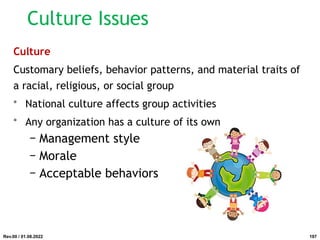
• very loud sounds (sudden or continuous)
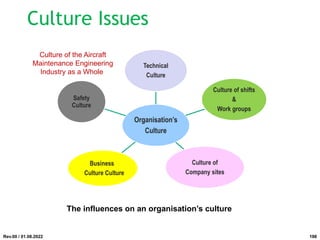
• confined or enclosed areas
• working at significant heights
• noxious substances (liquids, fumes, etc.)
• excessive temperature (i.e. too cold or too hot)
• moving equipment, moving vehicles and vibration
Rev.00 / 01.08.2022 275
Maintenance organisations should appoint someone with
health and safety responsibilities.
A maintenance organisation has a duty under health and
safety legislation to:
− identify hazards in the workplace
− remove them where possible
− mitigate the risks to employees
Identify
The
hazard
Assess
The
Risk
Control
The
Risk
Rev.00 / 01.08.2022
Recognising and Avoiding
Hazards
276
Engineer’s Individual
Responsibilities
In an aircraft maintenance organisation, the health and safety policy
might include statements applicable to engineers such as the need to:
− Take reasonable care of the health and safety of themselves and
others who may be affected by their acts or omissions at work
− Co-operate with the maintenance organisation to ensure that statutory
requirements concerning health and safety at work are met
− Work in accordance with any safety instruction and/or training
received
− Inform their supervisor or management of work situations that
represent an immediate or potential danger to health and safety at
work and any shortcomings in protection arrangements
− Not interfere intentionally or recklessly with, nor misuse, anything
provided in the interests of health and safety
Rev.00 / 01.08.2022 277
Safety In the Working
Environment
Engineers should ensure that they keep the working environment
safe. Clutter, rubbish, etc. is not only a nuisance to others, but can
constitute a danger (e.g. a trip hazard, fire hazard, etc.). In addition,
engineers should be careful when working on the line not to leave
objects when a job has been completed. Foreign Object Damage
(FOD) is a risk to aircraft operating at an airfield.
Rev.00 / 01.08.2022 278
Dealing With Emergencies
Careful handling of health and safety in the maintenance environment
should serve to minimise risks. However, should health and safety
problems occur, all personnel should know as far as reasonably
practical how to deal with emergency situations.
Emergencies may include:
• An injury to oneself or to a colleague
• A situation that is inherently dangerous, which has the potential to
cause injury (such as the escape of a noxious substance, or a fire).
Rev.00 / 01.08.2022 279
Careful handling of health and safety in the maintenance environment should
serve to minimise risks. However, should health and safety problems occur,
all personnel should know as far as reasonably practical how to deal with
emergency situations.
Emergencies may include:
• An injury to oneself or to a colleague
• A situation that is inherently dangerous, which has the potential to cause
injury (such as the escape of a noxious substance, or a fire).
Appropriate guidance and training should be provided by the maintenance
organisation. The organisation should also provide procedures and
facilities for dealing with emergency situations and these must be
adequately communicated to all personnel. Maintenance organisations
should appoint and train one or more first aiders.
Rev.00 / 01.08.2022
Dealing With Emergencies
280
9. Professionalism
&
Integrity
Rev.00 / 01.08.2022 BON-TEK145-001_HUMAN_FACTOR_INITIAL 281
Professionalism and Integrity
• Keeping up to date: currency
• Error provoking behaviour
• Assertiveness
Rev.00 / 01.08.2022 282
Examples of Taking
Responsibility
• Admitting and fixing errors
• Saying something about a situation when you
know there is something wrong
• Addressing non-critical problems
− Picking up foreign materials that can cause FOD
− Finding the safety wire you dropped
• Maintaining professional responsibility
• Maintaining technical currency
Rev.00 / 01.08.2022 283
A Mechanic’s Professional Responsibility
FOLLOW THE MAINTENANCE MANUAL:
1. I will perform maintenance in full compliance with published
maintenance data. No steps will be omitted.
FOLLOW THE MAINTENANCE PROGRAM:
2. I am responsible for verifying that all maintenance tasks that I
perform are called out in the FAA approved maintenance
program or are directly requested by the air carrier through
changes to the approved maintenance manual or task cards.
OBTAIN WRITTEN AUTHORIZATION:
3. I will not accept verbal authorization (from anyone) to proceed
with maintenance or repair procedures not included in
approved technical data.
Rev.00 / 01.08.2022 284
HAVE TECHNICAL DATA AVAILABLE:
4. I will review and have in my possession the current technical data
necessary to perform each maintenance task that I accomplish. I will
be able to produce this information at any time during the
performance of the maintenance task.
IDENTIFY DEVIAITIONS AND INFORM THE APPROPRIATE PEOPLE:
5. Inspection personnel are required to determine the conformity quality
of airworthiness of an aircraft or component undergoing a
maintenance task. This task will be done in accordance with the air
carriers approved maintenance program or the manufacturers
maintenance manual. If I become aware of any deviation, I will
immediately bring it to the attention of QC supervisory personnel. I
will also ensure that the deviation is documented.
Rev.00 / 01.08.2022
A Mechanic’s Professional Responsibility
285
DOCUMENT PARTS THAT HAVE BEEN DISTURBED:
6. I will fully document any part or subassembly that I remove,
disassemble, inspect, test, reassemble, or otherwise disturbed
as part of the maintenance task. Documentation will be done
in accordance with the manufacturers instructions.
PROVIDE CLEAR AND COMPLETE DOCUMENTATION:
7. I will include in the maintenance records a description of the
work performed. The description will be in sufficient detail to
permit a person unfamiliar with the work to understand
what was done, and the methods and procedures used in
doing it. If references to technical data are used, I will include
a detailed description of the section, page and paragraph of
the reference used.
Rev.00 / 01.08.2022
A Mechanic’s Professional Responsibility
286
ENSURE REPLACEMENT PART IS APPROVED:
8. I will ensure that any new replacement or modified parts have
been inspected for evidence of FAA or air carrier approval prior to
using the part.
MAKE SURE THAT SPECIAL TOOLS ARE APPROVED:
9. I will ensure that any special tools, test fixtures, shop aids, and
other maintenance support equipment that I use are called out in
the manufacturers maintenance instructions or determined to be
acceptable to the air carrier.
MAKE SURE THAT YOU HAVE THE APPROPRIATE TRAINING:
10. I will not perform any maintenance task unless I have
been found competent to perform those tasks in accordance with
the air carriers training program. I will not perform any
maintenance task for which I have not been properly trained. I
shall will ensure that any training that I receive is properly
documented and included in my training file.
Rev.00 / 01.08.2022
A Mechanic’s Professional Responsibility
287
Key Behaviors
• Key behaviors are specific maintenance
behaviors intended to minimize the frequency
and impact of maintenance errors that could
impact flight safety and reliability.
• Key behaviors specific to your organization
could be developed through MEDA
investigations and employee focus groups.
Rev.00 / 01.08.2022 288
Examples of Key Behaviors
1. When performing principle systems or
structures maintenance, we must review the
current maintenance instructions before
beginning a task.
2. We must document all additional
disassemblies not specified in the task
instructions.
3. We must document job status at end of shift
or when moving to a new task.
Rev.00 / 01.08.2022 289
4. We must flag all disassemblies that might be
inconspicuous to anyone closing the work area.
5. We must confirm the integrity of each adjacent
connection after installation of any LRU.
6. We must complete all required checks and
tests.
7. We must, when closing a panel, conduct a brief
visual scan for safety related errors.
Rev.00 / 01.08.2022
Examples of Key Behaviors
290
10. Organisation Human Factor
Program
Rev.00 / 01.08.2022 BON-TEK145-001_HUMAN_FACTOR_INITIAL 291
Error Models and Theories
− Reporting Errors
− Disciplinary Policy
− Error Investigation
− Action to Address Problems
− Feedback
Rev.00 / 01.08.2022 292
The Maintenance Error Decision Aid
(MEDA) Contributing Factors Model
Rev.00 / 01.08.2022 BON-TEK145-001_HUMAN_FACTOR_INITIAL 293
What Is MEDA?
• Errors result from contributing
factors in the work place.
• Most of the contributing
factors are under management
control.
• Therefore, improvements can
be made so that these factors
do not contribute to future
errors.
MEDA is a process that is used to investigate
the causes of maintenance error.
Rev.00 / 01.08.2022 294
MEDA Contributing Factors
• Things that affect human performance
are called contributing factors
• Best understood using a maintenance
system model
Mechanic Immediate Work
Environment
Supervision
Overall
Maintenance &
Engineering
Organization
Rev.00 / 01.08.2022 295
Organization
Philosophy
Other M & E
Organizations
Policies
Procedures
Processes
Selection
Training
Continuous
Quality
Improvement
Supervision
Planning
Organizing
Prioritizing
Delegating
Instructing
Feedback
Performance
Management
Team
Building
Immediate Environment
Facilities
Weather
Aircraft design/configuration
Component design
Equipment/tools/parts
Maintenance manuals
Tasks
Time pressure
Teamwork
On-the-Job training
Communication
Mechanic
Knowledge
Skills
Abilities
Other characteristics
Rev.00 / 01.08.2022
MEDA Contributing Factors
296
MEDA Error Model
• Poor lighting
• Missing step
• Poor hand over report
• Lack of skill
• Hard to reach
• Miscalibrated tool
• Wrong part from Spares
• Understaffed
• Poor supervision
• Incomplete installation
• Wrong part installed
• Incorrectly serviced
• Not repaired correctly
• Incorrect troubleshooting
• Missed during inspection
• Flight cancellation
• Gate return
• In-flight shut down
• Diversion
• Equipment damage
• Personal injury
Contributing
Factors
Error Event
Lead
to
Leads
to
Probability
Probability
Rev.00 / 01.08.2022 297
MEDA Philosophy
• Staff do not make errors on purpose
• Maintenance errors are made because
of a series of related contributing
factors
• Most of the contributing factors are part
of maintenance organization processes
and can be changed
• Maintenance program must be viewed
as a system, where the mechanic is one
part of the system
Rev.00 / 01.08.2022 298
MEDA Is Used to Investigate
the Following Kinds of Events
• Process Loss
− Flight delay
− Flight diversion
− Flight cancellation
− Gate return
− In-flight shut down
− Air turn-back
• Aircraft Damage
• Injury
• Rework
Rev.00 / 01.08.2022 299
The “Event Iceberg”
Where MEDA
should start
Present level of
investigation
Where MEDA
should go
Costly Events
In-flight shutdowns, turn backs,
delays/cancellations, equipment
damage, and personal injuries
Other Events
Serious
Events
Rework--Maintenance tasks done incorrectly
but caught by inspection or functional test
All events are due to the same contributing factors. Therefore,
responding to lower level events will prevent higher level events.
Rev.00 / 01.08.2022 300
THE END
Rev.00 / 01.08.2022 301

BON-TEK145-001_HUMAN_FACTOR_INITIAL.pptx

  • 1.
    Maintenance Human Factors EASAPart 66 Module 9 and GM 145.A.30 (e) Rev.00 / 01.08.2022 BON-TEK145-001_HUMAN_FACTOR_INITIAL 1
  • 2.
    Content • 1. General •GM1 145.A.30 (e) : 1.1-1.2-1.3-2-3 • Module 9 : 9.1-9.3.4-9.8 • 2. Human Performance and Limitations • GM1 145.A.30 (e) : 4.1 to 4.15-5.4-5.5 • Module 9 : 9.2-9.3.2-9.4.1-9.4.4-9.4.5-9.4.6-9.6.1-9.6.2 • 3. Environment • GM1 145.A.30 (e) : 5.1-5.2-5.3-5.6-5.7-5.8-5.9 • Module 9 : 9.4.2-9.4.3-9.5 • 4. Procedures, Information, Tools, and Practice • GM1 145.A.30 (e) : 5.10-6 • Module 9 : 9.6.3-9.6.4-9.7.2 • 5. Communication • GM1 145.A.30 (e) : 7 • Module 9 : 9.7.1-9.7.3-9.7.4 Rev.00 / 01.08.2022 2
  • 3.
    • 6. Teamwork •GM1 145.A.30 (e) : 8.1-8.2-9.3 • Module 9 : 9.3 • 7. Human Error • GM1 145.A.30 (e) : 5.12-5.13 • Module 9 : 9.8.1-9.8.4 • 8. Hazards in the Workplace • GM1 145.A.30 (e) : 5.11 • Module 9 : 9.9 • 9. Professionalism and Integrity • GM1 145.A.30 (e) : 9-8.3 • Module 9 : N/A • 10. Organisation Human Factor Program • GM1 145.A.30 (e) : 10 • Module 9 : N/A Rev.00 / 01.08.2022 Content 3
  • 4.
    I. General Rev.00 /01.08.2022 BON-TEK145-001_HUMAN_FACTOR_INITIAL 4
  • 5.
    General • The Needto take Human Factors in to account • Statistics, Incidents • Murphy’s law. • Safety Culture Rev.00 / 01.08.2022 5
  • 6.
    Definition Human Factors isa technical discipline aimed at optimizing human performance within a system by contributing to the planning, design, and evaluation of tasks, jobs, products, organizations, environments and systems in order to make them compatible with the needs, abilities, and limitations of people. Rev.00 / 01.08.2022 6
  • 7.
    Where Can HumanFactors Be Applied in Maintenance?  Manuals & Procedures  Operational Controls & Displays  Design for Maintainability  Human/Computer Interaction  Training  Work Group Procedures Rev.00 / 01.08.2022 7
  • 8.
    Specialty Areas inHuman Factors Cognitive Human Factors Concerned with mental processes, such as perception, memory, reasoning, and motor response − Mental work load − Decision making − Human reliability (skilled performance and errors) − Training − Human computer interaction − Work stress Rev.00 / 01.08.2022 8
  • 9.
    Physical Human Factors Concernedwith human anatomical, anthropometric, physiological and biomechanical characteristics as they related to physical activity. − Materials handling − Repetitive movements − Workplace layout − Safety and health Rev.00 / 01.08.2022 Specialty Areas in Human Factors 9
  • 10.
    Organizational Human Factors Concernedwith optimization of work organizations, including their organizational structures, policies, and processes. − Crew resource management − Work design − Culture Leadership Communication Teamwork Shift work/Overtime Quality Management Rev.00 / 01.08.2022 Specialty Areas in Human Factors 10
  • 11.
    Causes of Accidents 100% 90% 80% 70% 60% 50% 40% 30% 20% 10% 0% 1903Today TIME ~80% of accidents are now due to human error ~20% of accidents are now due to machine causes Rev.00 / 01.08.2022 11
  • 12.
    American Airlines Flight191 Year: 1979, 273 fatalities Model: DC-10 Improper maintenance caused loss of control after engine detachment ruptured hydraulic fluid lines Rev.00 / 01.08.2022 Significant Maintenance Human Factors Events 12
  • 13.
    Aloha Airlines Flight243 Year: 1988, 1 fatalities Model: B737-200 Explosive decompression caused by fatigue failure Rev.00 / 01.08.2022 Significant Maintenance Human Factors Events 13
  • 14.
    United Airlines Flight232 Year: 1989, 112 fatalities Model: DC10 Uncontained engine failure due to faulty metallurgic forging of fan disk, loss of hydraulic systems and flight controls Rev.00 / 01.08.2022 Significant Maintenance Human Factors Events 14
  • 15.
    Atlantic Southeast Airlines Flight529 Year: 1995, 9 fatalities Model: Embraer 120ER Mechanical failure due to design flaw Rev.00 / 01.08.2022 Significant Maintenance Human Factors Events 15
  • 16.
    Aeroperú Flight 603 Year:1996,70 fatalities Type: B757-200 Maintenance error, instrument failure Rev.00 / 01.08.2022 Significant Maintenance Human Factors Events 16
  • 17.
    Alaska Airlines Flight261 Year:2000, 88 fatalities Type: MD 83 Jackscrew failure, improper maintenance Rev.00 / 01.08.2022 Significant Maintenance Human Factors Events 17
  • 18.
    Primary Causes ofAll Accidents Worldwide Commercial Jet Fleet Excludes:: • Sabotage • Military action . Percentage of total accidents with known causes Miscellaneous/other Airport/ATC Weather Maintenance & Inspection Airplane Cockpit crew 10 20 30 40 50 60 70 27 11 36 14 50 166 Primary factor 1959--1992 1993--2002 Number of accidents Total with known causes 59 43 36 31 133 540 842 304 Unknown or awaiting reports 110 97 Total 952 401 7.0% 5.1% 4.3% 3.7% 15.8% 8.9% 3.6% 11.8% 4.6% 16.4% 54.6% Legend: 1959 through 1992 1993 through 2002 64.1% Rev.00 / 01.08.2022 18
  • 19.
    Excludes: • Sabotage • Militaryaction Percentage of total accidents with known causes Miscellaneous/other Airport/ATC Weather Maintenance & Inspection Airplane Cockpit crew 10 20 30 40 50 60 70 3 2 5 1 12 31 Primary factor 1959--1992 1993--2002 Number of accidents Total with known causes 6 11 8 8 34 112 179 54 Unknown or awaiting reports 18 13 Total 197 67 3.4% 6.1% 4.5% 4.5% 19.0% 62.6% 5.6% 3.7% 9.3% 1.9% 22.2% 57.4% Legend 1959 through 1992 1993 through 2002 Rev.00 / 01.08.2022 Primary Causes of All Accidents Worldwide Commercial Jet Fleet 19
  • 20.
    Safety Costs of MaintenanceError: 1982 - 1993 In these accidents…  23% involved incorrect removal/installation of components  49% involved company maintenance or inspection policy  28% involved manufacturer/vendor maintenance program  49% involved aircraft design A 1995 study found maintenance and inspection error as a contributing factor in 15% of the aircraft accidents from 1982 through 1993. Rev.00 / 01.08.2022 20
  • 21.
    Safety Costs of MaintenanceError • 70-80% of aircraft accidents are due to human factors – JAA, May 2001 • Maintenance contributed to 15% of commercial jet accidents –Boeing, 1995 • 48,800 non-airworthy aircraft are dispatched each year as a result of maintenance error –Marx, 1998 Rev.00 / 01.08.2022 21
  • 22.
    Monetary Costs ofMaintenance Error Maintenance error caused • 20% to 30% of in-flight shutdowns (IFSDs) at a cost of US $500,000 per IFSD • 50% of flight delays due to engine problems at a cost of US $10,000 per hour • 50% of flight cancellations due to engine problems at a cost of US $50,000 per cancellation Rev.00 / 01.08.2022 22
  • 23.
    Monetary Costs ofMaintenance Error • One airline estimates $75-$100 million/year is lost • Airline Transport Association estimates that ground damage costs $850 million/yr • Ramp accidents cost over $2 billion annually –Ramp SafetyVol.11:3 Rev.00 / 01.08.2022 23
  • 24.
    Murphy’s law There isa tendency among human beings towards complacency. The belief that an accident will never happen to “me” or to “my Company” can be a major problem when attempting to convince individuals or organisations of the need to look at human factors issues, recognise risks and to implement improvements, rather than merely to pay ‘lip-service’ to human factors. “Murphy’s Law” can be regarded as the notion: “If something can go wrong, it will.” Rev.00 / 01.08.2022 24
  • 25.
    If everyone couldbe persuaded to acknowledge Murphy’s Law, this might help overcome the “it will never happen to me” belief that many people hold. It is not true that accidents only happen to people who are irresponsible or ‘sloppy’. The incidents and accidents described that errors can be made by experienced, well-respected individuals and accidents can occur in organisations previously thought to be “safe”. Rev.00 / 01.08.2022 Murphy’s law 25
  • 26.
    Safety Culture Culture Customary beliefs,behavior patterns, and material traits of a racial, religious, or social group Any organization has a culture of its own − Management style − Morale − Acceptable behaviors − Norms Rev.00 / 01.08.2022 26
  • 27.
    • What isa “safety culture” as it applies to an aircraft maintenance organization? • A “safety culture” is a (maintenance organization) culture in which safety plays a major role. Rev.00 / 01.08.2022 Safety Culture 27
  • 28.
    Safety, as itapplies to maintenance, has three components 1. Maintenance actions (e.g., an installation error) can lead to flight safety issues 2. Mechanic actions can lead to personal safety issues (e.g., cuts, puncture wounds, and broken bones) 3. Maintenance actions can lead to equipment damage A good safety culture will reduce the instances of all three of these events, reducing the accident rate and, thus, saving lives and money Rev.00 / 01.08.2022 Safety Culture 28
  • 29.
    Elements (James Reason) •Informed Culture • Reporting Culture • Learning Culture • Just Culture • Flexible Culture Rev.00 / 01.08.2022 Safety Culture 29
  • 30.
    • These “elements”of a safety culture are all organizational issues and are thus a specialty of Organizational Human Factors, which we said earlier was concerned with optimization of work organizations, including their organizational structures, policies, and processes. Rev.00 / 01.08.2022 Safety Culture 30
  • 31.
    Relation between safetyculture and corporate culture components • Corporate Values • Corporate Beliefs • Common Problem-Solving Methods • Common Working Practices Rev.00 / 01.08.2022 Safety Culture 31
  • 32.
    2. Human Performance &Limitations Rev.00 / 01.08.2022 BON-TEK145-001_HUMAN_FACTOR_INITIAL 32
  • 33.
    Human Performance & Limitations Vision  Hearing  Attention and perception  Decision Making  Memory  Information processing  Stress (effects on performance)  Situation awareness  Motivation  Physical work  Sleep Fatigue, Shiftwork  Claustrophobia and physical access  Fitness/health  Alcohol, medication, drugs  Workload  Repetitive tasks/ complacency Rev.00 / 01.08.2022 33
  • 34.
    Introduction to HumanPerformance • Human beings have strengths and weaknesses • Tasks that do not account for human limitations result in: − Errors − Injuries If you review a task or workstation, do not ask: • Can it be done? Ask: • Can it be done safely and correctly by the people who do the job? Vision Hearing Cognition Strength Reach Rev.00 / 01.08.2022 34
  • 35.
    The Human StrengthsIn A Complex System • Exercising judgment • Reacting to unusual or unexpected events • Applying originality at solving problems • Learning from experience Rev.00 / 01.08.2022 35
  • 36.
    Vision Rev.00 / 01.08.2022BON-TEK145-001_HUMAN_FACTOR_INITIAL 36
  • 37.
    Vision Performance Issues •Vision requirements are task based • Illumination requirements are task based • Technicians must recognize their individual visual limitations and capabilities Being able to see clearly is vital in aircraft maintenance and inspection. Rev.00 / 01.08.2022 37
  • 38.
    The Human Eye Pupil Iris Sclera Lens Retina OpticNerve Rods Cones Rev.00 / 01.08.2022 38
  • 39.
    The Normal VisualField • Provide visual access to work area... − Without excessive bending − For both short and tall people • Visual access is critical to... − Doing the task − Visual validation of task • Examples of problems due to poor visual access: − Incorrect attachment − Inspection errors − Increased task time Normal Line Of Sight Rev.00 / 01.08.2022 39
  • 40.
    Colorblindness • Complete colorblindness is quite rare. • Most people are actually color deficient and have problems seeing red and green. • About 10% of adult males are color deficient. • Most do not even know. • They learn to compensate with degrees of brightness and texture. • If you find you have it, avoid errors by asking other people when you are unsure. An estimation of what the spectrum looks like for different types of colorblindness. Rev.00 / 01.08.2022 40
  • 41.
    Although not directlyaffecting visual acuity, inability to see particular colours can be a problem for the aircraft maintenance engineer. Amongst other things, good colour vision for maintenance engineers is important for:  Recognising components;  Distinguishing between wires;  Using various diagnostic tools;  Recognizing various lights on the airfield (e.g. warning lights). Rev.00 / 01.08.2022 Colorblindness 41
  • 42.
    A Quick ColorblindnessTest This is a demonstration. You should see the number 12. Rev.00 / 01.08.2022 42
  • 43.
    What Numbers DoYou See? Rev.00 / 01.08.2022 43
  • 44.
  • 45.
    Foreign Substances Vision canbe adversely affected by the use of certain drugs and medications, alcohol, and smoking cigarettes. With smoking, carbon monoxide which builds up in the bloodstream allows less oxygen to be carried in the blood to the eyes. This is known as hypoxia and can impair rapidly the sensitivity of the rods. Alcohol can have similar effects, even hours after the last drink. Rev.00 / 01.08.2022 45
  • 46.
    Environmental Factors • Visioncan be improved by increasing the lighting level, but only up to a point, as the law of diminishing returns operates. Also, increased illumination could result in increased glare. Older people are more affected by the glare of reflected light than younger people. • Any airborne particles such as dust, rain or mist can interfere with the transmission of light through the air, distorting what is seen. Rev.00 / 01.08.2022 46
  • 47.
    Hearing Rev.00 / 01.08.2022BON-TEK145-001_HUMAN_FACTOR_INITIAL 47
  • 48.
    Hearing • The earperforms two quite different functions. It is used to detect sounds by receiving vibrations in the air, and secondly, it is responsible for balance and sensing acceleration. Of these two, the hearing aspect is more pertinent to the maintenance engineer, and thus it is necessary to have a basic appreciation of how the ear works. • The performance of the ear is associated with the range of sounds that can be heard - both in terms of the pitch (frequency) and the volume of the sound. Rev.00 / 01.08.2022 48
  • 49.
    • The outerear collects sound • The middle ear channels sound to the ear drum • The inner ear converts sound to nerve impulses • Tiny hair cells (cilia) in the Cochlea vibrate with different sounds • Excessively loud noise can result in the hair cells stretching too far and breaking • Listening to the same frequency or pitch for a long time can also damage the hair cells • Listening to loud noise for a long period can also cause fatigue Outer Ear Middle Ear Inner Ear Ear Drum Cochlea Rev.00 / 01.08.2022 Hearing 49
  • 50.
    Hearing Protection • Typesof Hearing Protection − Disposable plugs − Reusable plugs − Custom-fitted plugs − Ear muffs • Wearing Hearing Protection Properly − Follow package directions when putting protection on. − Make sure the selected protection fits properly. − Maintain hearing protective devices in a sanitary condition. − Make sure nothing interferes with the use of hearing protectors (e.g., eyeglass frames). Rev.00 / 01.08.2022 50
  • 51.
    Symptoms of HearingLoss − Noise or ringing in the ears. − Trouble hearing people when they speak. − Trouble hearing certain high or soft sounds. − Needing a higher volume on the TV or radio--high enough that others complain. Rev.00 / 01.08.2022 Hearing Protection 51
  • 52.
    Sound Intensity Levels DecibelsExample Dangerous Time Exposure 0 Lowest sound audible to ear None 30 Quiet library, soft whisper None 40 Quiet office, living room None 50 Light traffic at a distance, refrigerator None 60 Air conditioner at 6 m., conversation None 70 Busy traffic, noisy restaurant Critical level begins 80 Subway, heavy city traffic, alarm clock More than 8 hours 90 Truck traffic, lawn mower, shop tools Less than 8 hours 100 Chain saw, boiler shop, pneumatic drill Less than 2 hours 120 Rock concert in front of speakers, Immediate danger sandblasting, thunderclap 140 Gunshot blast, jet plane @ 15 m. Any exposure is bad 180 Rocket launching pad Hearing loss inevitable Rev.00 / 01.08.2022 52
  • 53.
    Noise Levels • Highnoise level area is... − An area in which a work assignment exposes an employee to a continual noise level > 85 dB, − An area which occasionally exposes an employee to a noise level > 115 dB,or − An sudden noise with a 140 dB peak. • Employees should have annual hearing exams, if they work in a job with consistent exposure to sound levels > 85 dB • With proper hearing protection, hearing should remain good into old age. Rev.00 / 01.08.2022 53
  • 54.
    Information Processing/ Attention andPerception/ Memory Rev.00 / 01.08.2022 BON-TEK145-001_HUMAN_FACTOR_INITIAL 54
  • 55.
    Attention Having detected information,our mental resources are concentrated on specific elements - this is attention. Although attention can move very quickly from one item to another, it can only deal with one item at a time. Attention can take the form of: − selective attention − divided attention − focused attention − sustained attention Rev.00 / 01.08.2022 55
  • 56.
    Perception Perception involves theorganisation and interpretation of sensory data in order to make it meaningful, discarding non-relevant data, i.e. transforming data into information. Perception is a highly sophisticated mechanism and requires existing knowledge and experience to know what data to keep and what to discard, and how to associate the data in a meaningful manner. Examples of the perceptual process: − the image formed on the retina is inverted and two dimensional, yet we see the world the right way up and in three dimensions; − if the head is turned, the eyes detect a constantly changing pattern of images, yet we perceive things around us to have a set location, rather than move chaotically. Rev.00 / 01.08.2022 56
  • 57.
    Decision Making Decision makingis the generation of alternative courses of action based on available information, knowledge, prior experience, expectation, context, goals, etc. and selecting one preferred option. It is also described as thinking, problem solving and judgment. This may range from deciding to do nothing, to deciding to act immediately in a very specific manner. A fire alarm bell, for instance, may trigger a well- trained sequence of actions without further thought (i.e. evacuate); alternatively, an unfamiliar siren may require further information to be gathered before an appropriate course of action can be initiated. Rev.00 / 01.08.2022 57
  • 58.
    Memory Memory can beconsidered to be the storage and retention of information, experiences and knowledge, as well as the ability to retrieve this information. Memory depends on three processes: − Registration the input of information into memory; − Storage the retention of information; − Retrieval the recovery of stored information. Rev.00 / 01.08.2022 58
  • 59.
    Information Processing.  WorkingMemory lasts only about 20 seconds  Working Memory can hold about 7 items.  Attention is a limited resource, which must be shared between − Observing the situation − Deciding on a response − Executing the response Rev.00 / 01.08.2022 59
  • 60.
    Learning and ForgettingCurves Per cent Learned Learning Trials Learning Curve Per cent Remembered Time Since Last Learning Trial Forgetting Curve If a mechanic is exposed to something one time in a class, it does not mean they can recall it five years later. 0% 0% 100% 100% Rev.00 / 01.08.2022 60
  • 61.
    Primacy and Recency The order of presentation affects what people remember.  Recency Effect Information given last is remembered best  Primacy Effect Information given first is remembered second best  Memory is poorest for information in the middle Probability of Recall Position in List Accuracy for Recalling a List Low High Beginning End When you are giving information, give the important information at the beginning or the end. Rev.00 / 01.08.2022 61
  • 62.
    Negative Transfer OfTraining • When you learn new things, previously learned material is still in long-term memory. • If the material is similar, sometimes you can become confused. • Example: Mechanic knows how to replace a hydraulic pump on airplane A. The airline acquires a newer model--airplane B. − The bolts on airplane A must be torqued to 150 foot pounds − The bolts on airplane B must be torqued to 200 foot pounds Later, the mechanic makes an error by: − Replacing a pump on plane A and tightening the bolts to 200 foot pounds, or − Replacing a pump on plane B and tightening the bolts to 150 foot pounds. Be sure to check details when things are almost, but not quite the same. Rev.00 / 01.08.2022 62
  • 63.
    Situation Awareness Motivation&De-motivation Rev.00 /01.08.2022 BON-TEK145-001_HUMAN_FACTOR_INITIAL 63
  • 64.
    Situation Awareness The abilityto maintain awareness of what is happening on the ramp or the hangar, as well as what is happening on the task. Rev.00 / 01.08.2022 64
  • 65.
    • Situation awarenessfor the aircraft maintenance engineer can be summarized as: − the status of the system the engineer is working on; − the relationship between the reported defect and the intended rectification; − the possible effect on this work on other systems; − the effect of this work on that being done by others and the effect of their work on this work. Rev.00 / 01.08.2022 Situation Awareness 65
  • 66.
    • See elements(e.g., people and equipment) in the work environment − Where they are now − Whether they are moving or stationary • Understand the significance of what you see • Project the status of the elements for the near future (i.e., determine future implications) Rev.00 / 01.08.2022 Situation Awareness 66
  • 67.
    Barriers • Insufficient communication •Fatigue/stress • Task overload/underload • “Groupthink” mindset • “Press-on” mentality • Degraded operating conditions Rev.00 / 01.08.2022 Situation Awareness 67
  • 68.
    • Actively question/evaluate •Use assertive behavior when necessary • Analyze/monitor situation continuously Rev.00 / 01.08.2022 Situation Awareness 68
  • 69.
    B737 double engineoil loss AAIB report stated: “Once the Controller and fitter had got to T2 and found that this supportive material [Task Cards and AMM extracts] was not available in the work pack, they would have had to return to Base Engineering or to have gone over to the Line Maintenance office to get it. It would be, in some measure, understandable for them to have a reluctance to recross the exposed apron area on a winter’s night to obtain a description of what they were fairly confident they knew anyway. However, during the course of the night, both of them had occasion to return to the Base Maintenance hangar a number of times before the task had been completed. Either could, therefore, have referred to or even drawn the task descriptive papers before the job was signed off. The question that should be addressed, therefore, is whether there might be any factors other than overconfidence in their memories, bad judgments or idleness which would dispose them to pass up these opportunities to refresh their memories on the proper and complete procedures.” Rev.00 / 01.08.2022 69
  • 70.
    Motivation&De-motivation In aircraft maintenance,engineers are trained to carry out the tasks within their remit. However, it is largely their motivation which determines what they actually do in any given situation. Thus, “motivation reflects the difference between what a person can do and what he will do”. Rev.00 / 01.08.2022 70
  • 71.
    With respect toaviation safety, being appropriately motivated is vital. Ideally, aircraft maintenance engineers ought to be motivated to work in a safe and efficient manner. However, many factors may cause conflicting motivations to override this ideal. For instance, the motivation of some financial bonus, or de-motivation of working outdoors in extreme cold weather might lead to less consideration of safety and increase the likelihood of risk taking, corner cutting, violating procedures and so on. Rev.00 / 01.08.2022 Motivation&De-motivation 71
  • 72.
    Maslow’s Hierarchy ofNeeds Possibly one of the most well known theories which attempts to describe human motivation is Maslow’s hierarchy of needs. Maslow considered that humans are driven by two different sets of motivational forces: − those that ensure survival by satisfying basic physical and psychological needs; − those that help us to realise our full potential in life known as self- actualisation needs (fulfilling ambitions, etc.).. Rev.00 / 01.08.2022 Motivation&De-motivation 72
  • 73.
    Highly motivated peopletend to show the following characteristics: − high performance and results being consistently achieved; − the energy, enthusiasm and determination to succeed; − unstinting co-operation in overcoming problems; − willingness to accept responsibility; − willingness to accommodate change. Rev.00 / 01.08.2022 Motivation&De-motivation 73
  • 74.
    De-motivated people tendto demonstrate the following characteristics: − apathy and indifference to the job, including reduced regard for safety whilst working; − a poor record of time keeping and high absenteeism; − an exaggeration of the effects/difficulties encountered in problems, disputes and grievances; − a lack of co-operation in dealing with problems or difficulties; − unjustified resistance to change. Rev.00 / 01.08.2022 Motivation&De-motivation 74
  • 75.
    Physical Work Rev.00 /01.08.2022 BON-TEK145-001_HUMAN_FACTOR_INITIAL 75
  • 76.
    Physical Work Aircraft maintenanceengineering is a relatively active occupation. Regardless of the job being done, most tasks tend to have elements of fine motor control, requiring precision, as well as activities requiring strength and gross manipulation. As an engineer gets older, the musculoskeletal system stiffens and muscles become weaker. Injuries become more likely and take longer to heal. Staying in shape will minimise the effects of ageing, but they still occur. Missing a break in an effort to get a job done within a certain time frame can be counterproductive, as fatigue diminishes motor skills, perception, awareness and standards. As a consequence, work may slow and mistakes may occur that need to be rectified. Rev.00 / 01.08.2022 76
  • 77.
  • 78.
    Musculo Skeletal Injuries •Bone Fractures • Strains and Sprains − Generally due to a single event − Result of joint movement beyond normal range • Cumulative Trauma Disorders (CTDs) − Result of multiple “micro injuries” − Joint movements within normal range − Initial damage is undetectable − Injuries may be permanent Rev.00 / 01.08.2022 78
  • 79.
    Types of CTDs •Tendons − Tendinitis − Tenosynovitis − Rotator cuff tendinitis • Nerve Disorders − Carpal tunnel syndrome • Neurovascular Disorders − Thoracic outlet syndrome − Vibration syndrome White finger Rev.00 / 01.08.2022 79
  • 80.
    Occupational Risk Factorsfor Cumulative Trauma Disorders Force Frequency Vibration Posture Rev.00 / 01.08.2022 80
  • 81.
    Work Posture -Hand and Wrist OK Avoid Rev.00 / 01.08.2022 81
  • 82.
    Sleep & Fatigue ShiftWork Rev.00 / 01.08.2022 BON-TEK145-001_HUMAN_FACTOR_INITIAL 82
  • 83.
    Our Circadian SleepWake Clock Alertness Low High 9 am Noon 6 pm Midnight 6 am 9 am Time of Day 3-5 am and pm = sleepy 9-11 am and pm = alert Rev.00 / 01.08.2022 83
  • 84.
    Sleep • Still nospecific definition of sleep − Lying down − Little movement − Do not respond as readily to disturbances − Reversible—can wake up Rev.00 / 01.08.2022 84
  • 85.
    Sleep • Still nottotally sure why we need sleep, but there are two theories − Energy conservation—sleep to conserve energy − Restoration • Dream sleep thought to be important for learning, reasoning, controlling emotions, and other mental activity • Non-dream sleep thought to be important because that is when proteins are built and when the brain and nervous system regain control over other body systems. • Also know that bad things happen if we do not sleep Rev.00 / 01.08.2022 85
  • 86.
    How Much SleepDo You Need?  Depends − Age − Health − Circadian rhythm − Body metabolism − Physical exercise level − The quality of the sleep − Amount of recent sleep − Body temperature − Personal differences  Short sleepers Need around 6 hrs of sleep  Long sleepers Need around 9 hrs of sleep  1 in 25 people need more than 10 or less than 5 hrs of sleep  “Magic number” of 8 hrs of sleep is really just an average Rev.00 / 01.08.2022 86
  • 87.
    Stages of Sleep •Dream or Rapid Eye Movement (REM) sleep − Experience dreams − Characteristics of wakefulness—heartbeat is erratic, muscles are active, and blood flow rises and falls − Each time REM is repeated, it is a little longer − Lightest sleep stage—easily awakened − Process emotions and select information to store in long-term memory − Spend ~25% of our time in REM sleep • Non-REM (or non-dreaming) sleep − Four stages Rev.00 / 01.08.2022 87
  • 88.
    Four Stages ofNon-REM Sleep • Stage 1 Tired/Awake—Transition between wakefulness and sleep. Lasts a few minutes • Stage 2 Transition—First stage of true sleep. Can be easily disturbed. Increasing amount across sleep cycles • Stage 3 & 4 Deep Sleep—Most important phases for your health. − Deepest and most restful sleep − Difficult to arouse sleepers from these stages − Decreasing amount across sleep cycles Rev.00 / 01.08.2022 88
  • 89.
    Sleep Cycles We typicallyhave 4-5 sleep cycles per night each lasting 90-120 min. Rev.00 / 01.08.2022 89
  • 90.
    Fatigue Fatigue A feeling oflack of energy, weariness or tiredness. Also called tiredness, weariness, exhaustion, or lethargy. Fatigue is a normal response to physical exertion, emotional stress, and lack of sleep. Alertness Vigilantly attentive and watchful; mentally responsive and perceptive. Rev.00 / 01.08.2022 90
  • 91.
    Types of Fatigue •Acute fatigue − Intense − Short duration − Cured by a good night’s sleep • Chronic fatigue − Frequently fatigued − Long duration of the fatigue − Slow recovery − Often a physical sickness or mental stress that causes chronic fatigue − Not cured by one good night’s sleep Rev.00 / 01.08.2022 91
  • 92.
    Effects of Fatigue Overall performance gets worse  Exercise poor judgment  Slowed reaction times  Forgetful  Poor cognitive functioning  Thinking  Reasoning  Problem solving  Withdrawal from social situations  Mood changes  Increase alcohol use  Long term health can degrade  Quality of life degrades Rev.00 / 01.08.2022 92
  • 93.
    What to Doabout Fatigue? • Overcome the emotional stress • Get plenty of sleep • Learn tips on how to avoid errors while fatigued • Maintenance organization fatigue policy Rev.00 / 01.08.2022 93
  • 94.
    Getting a GoodNight’s Sleep Avoiding Fatigue • Listen to your body clock, not your alarm clock • Use your bed only to sleep • Get up and go to bed at the same time • Exercise in the morning or early afternoon • Do not exercise in the evening • Stop looking at that clock! • No alcohol before bedtime, no caffeine after early afternoon, and avoid nicotine • Naps • Keep the bedroom dark, quiet, and cool • Eat a light snack • Do not worry too much • Wake up at the end of a cycle Rev.00 / 01.08.2022 94
  • 95.
    Avoiding Errors WhileFatigued • Admit you are tired! • Remain physical to remain alert • Exercise/stretch at frequent intervals • Talk to people • Drink plenty of liquids • Take a nap • Avoid tedious, boring work • Work with somebody else so you can catch each other’s errors • Go back over and check your work Rev.00 / 01.08.2022 95
  • 96.
    Shift Work • Aircraftare often available for more significant maintenance during the night • Aircraft maintenance engineers usually work shifts. • The disadvantages of shift working are mainly associated with: − working ‘unsociable hours’, meaning that time available with friends, family, etc. will be disrupted − working when human performance is known to be poorer (i.e. between 4 - 6 a.m.) − problems associated with general desynchronisation and disturbance of the body’s various rhythms (principally sleeping patterns). Rev.00 / 01.08.2022 96
  • 97.
    • Many maintenancetasks often span more than one shift, requiring tasks to be passed from one shift to the next. The outgoing personnel are at the end of anything up to a twelve hour shift and are consequently tired and eager to go home. Therefore, shift handover is potentially an area where human errors can occur. In the B737 double engine oil loss incident, the error occurred during the night shift. The accident investigation report commented that: “It is under these circumstances that the fragility of the self monitoring system is most exposed because the safety system can be jeopardised by poor judgement on the part of one person and it is also the time at which people are most likely to suffer impaired judgement”. Rev.00 / 01.08.2022 Shift Work 97
  • 98.
    It is alwayssensible to monitor ones performance, especially when working additional hours. Performance decrements can be gradual, and first signs of chronic fatigue may be moodiness, headaches or finding that familiar tasks (such as programming the video recorder) seem more complicated than usual. A good rule of thumb is that one hour of high-quality sleep is good for two hours of activity. Rev.00 / 01.08.2022 Shift Work 98
  • 99.
    Claustrophobia & Physical Access Rev.00 /01.08.2022 BON-TEK145-001_HUMAN_FACTOR_INITIAL 99
  • 100.
    Phobias Phobia A persistent, abnormal,and irrational fear that compels avoidance, despite the understanding by the phobic person and reassurance by others that there is no danger. Claustrophobia Fear of enclosed spaces. A more accurate description is a fear of not having an easy escape route. Acrophobia Fear of heights or high levels Rev.00 / 01.08.2022 100
  • 101.
    Engineers should workin a team and assist one another if necessary, making allowances for the fact that people come in all shapes and sizes and that it may be easier for one person to access a space, than another. However, this should not be used as an excuse for an engineer who has put on weight, to excuse himself from jobs which he would previously have been able to do with greater ease! Rev.00 / 01.08.2022 Phobias 101
  • 102.
    • If aperson is truly claustrophobic, they will not be able to work in an enclosed space. • If a person is truly acrophobic, they will not be able to work on top of a aircraft body or wing. • You cannot “talk” a person out of their phobia. However, phobias can be cured somewhat easily. • While true phobias are somewhat rare, some people have a rational fear of enclosed spaces or of heights. Managers need to know this when assigning tasks to mechanics. Rev.00 / 01.08.2022 Phobias 102
  • 103.
    Fitness/Health Rev.00 / 01.08.2022BON-TEK145-001_HUMAN_FACTOR_INITIAL 103
  • 104.
    Fitness and Health •Ill health (sickness) and poor fitness can have a negative impact on performance (work) − Work may be of poor quality − Errors are more likely • The purpose of awareness training is to get mechanics to realize when they are feeling ill or exhausted from work, and to do something about it − Stay home if really sick − Ask to be put on a simple task − Ask a friend to check your work − Take their medications Rev.00 / 01.08.2022 104
  • 105.
    • The jobof an aircraft maintenance engineer can be physically demanding. In addition, his work may have to be carried out in widely varying physical environments, including cramped spaces, extremes of temperature, etc. • Fitness and health can have a significant affect upon job performance (both physical and cognitive). Day-to-day fitness and health can be reduced through illness (physical or mental) or injury. Part-66 imposes a requirement that “certifying staff must not exercise the privileges of their certification authorisation if they know or suspect that their physical or mental condition renders them unfit.” Rev.00 / 01.08.2022 Fitness and Health 105
  • 106.
    • Aircraft maintenanceengineers can take common sense steps to maintain their fitness and health. These include: − Eating regular meals and a well-balanced diet; − Taking regular exercise (exercise sufficient to double the resting pulse rate for 20 minutes, three times a week is often recommended); − Stopping smoking; − Sensible alcohol intake. Rev.00 / 01.08.2022 Fitness and Health 106
  • 107.
    Alcohol, Medication, and Drugs Rev.00/ 01.08.2022 BON-TEK145-001_HUMAN_FACTOR_INITIAL 107
  • 108.
    Alcohol, Medication, andDrugs • Alcohol, medication, and drugs can all have an effect on performance • Three main effects − Central nervous system depressant (e.g., alcohol, pain killers, and sleeping pills)—slows down your reflexes and thinking ability − Central nervous system stimulant (e.g., amphetamines and caffeine)—speeds up your reflexes and thinking, but too much can have a negative effect − Hallucinogens (e.g., marijuana and LSD)—affects your understanding of reality Rev.00 / 01.08.2022 108
  • 109.
    • Purpose oftraining is to get mechanics to realize that using drugs of any kind can have an affect on their performance. − If they are on prescription drugs, they need to know the side effects (e.g., drowsiness or decreased mental capacity) so that they are aware of the drug’s effect on their performance and can do something about it • Do not work with dangerous equipment • Do not do complex tasks • Stay at home Rev.00 / 01.08.2022 Alcohol, Medication, and Drugs 109
  • 110.
    As a generalrule, aircraft maintenance engineers should not work for at least eight hours after drinking even small quantities of alcohol and increase this time if more has been drunk. Medication is usually taken to relieve symptoms of an illness. Even if the drugs taken do not affect the engineer’s performance, he should still ask himself whether the illness has made him temporarily unfit for work. If the aircraft maintenance engineer has any doubts about the suitability of working whilst taking medication, he must seek appropriate professional advice. Rev.00 / 01.08.2022 Alcohol, Medication, and Drugs 110
  • 111.
    Workload Rev.00 / 01.08.2022BON-TEK145-001_HUMAN_FACTOR_INITIAL 111
  • 112.
    Workload Workload is subjective(i.e. experienced differently by different people) and is affected by: • The nature of the task, such as the: − physical demands it requires (e.g. strength required, etc.); − mental demands it requires (e.g. complexity of decisions to be made, etc.). • The circumstances under which the task is performed, such as the: − standard of performance required (i.e. degree of accuracy); − time available to accomplish the task (and thus the speed at which the task must be carried out); − requirement to carry out the task at the same time as doing something else; − perceived control of the task (i.e. is it imposed by others or under your control, etc.); − environmental factors existing at time (e.g. extremes of temperature, etc.). Rev.00 / 01.08.2022 112
  • 113.
    • The personand his state, such as his: • skills (both physical and mental); • his experience (particularly familiarity with the task in question); • his current health and fitness levels; • his emotional state (e.g. stress level, mood, etc.) Rev.00 / 01.08.2022 Workload 113
  • 114.
    Overload and Underload •Overload occurs at very high levels of workload (when the engineer becomes over aroused). Performance deteriorates when arousal becomes too high and we are forced to shed tasks and focus on key information. Error rates may also increase. • Underload occurs at low levels of workload (when the engineer becomes under aroused). It can be just as problematic to an engineer as overload, as it too causes a deterioration in performance and an increase in errors, such as missed information. Underload can result from a task an engineer finds boring, very easy, or indeed a lack of tasks. Rev.00 / 01.08.2022 114
  • 115.
    Workload Management • Itis important to manage your work so that you do not wait until the end of your work period to rush through your task. − Speed-accuracy trade-off increases the likelihood that the work will be of low quality or contain errors • Discuss incidents/accidents that were caused by poor workload management. If you tell a mechanic to “hurry up and finish the task,” you are inviting an error. Rev.00 / 01.08.2022 115
  • 116.
    Repetitive Tasks & Complacency Rev.00 /01.08.2022 BON-TEK145-001_HUMAN_FACTOR_INITIAL 116
  • 117.
    Repetitive Tasks Repetitive tasksin aircraft maintenance engineering typically refer to tasks that are performed several times during a shift, or a number of times during a short time period, e.g. in the course of a week. An example of this would be the checking life jackets on an aircraft during daily inspections. Some engineers may specialise in a certain aspect of maintenance, such as engines. As a result, they may possibly carry out the same or similar tasks several times a day. Rev.00 / 01.08.2022 117
  • 118.
    The main dangerwith repetitive tasks is that engineers may become so practised at such tasks that they may cease to consult the maintenance manual, or to use job cards. Thus, if something about a task is changed, the engineer may not be aware of the change. Complacency is also a danger, whereby an engineer may skip steps or fail to give due attention to steps in a procedure, especially if it is to check something which is rarely found to be wrong, damaged or out of tolerance. In the Aloha accident report, the NTSB raised the problem of repetitive tasks: “The concern was expressed about what kinds of characteristics are appropriate to consider when selecting persons to perform an obviously tedious, repetitive task such as a protracted NDI inspection. Inspectors normally come up through the seniority ranks. If they have the desire, knowledge and skills, they bid on the position and are selected for the inspector job on that basis. However, to ask a technically knowledgeable person to perform an obviously tedious and exceedingly boring task, rather than to have him supervise the quality of the task, may not be an appropriate use of personnel…” Rev.00 / 01.08.2022 Repetitive Tasks 118
  • 119.
    Complacency • Complacency =Self-satisfaction accompanied by unawareness of actual dangers or deficiencies • Mechanics can become complacent when they have done a task over and over again without making an error • Inspectors can become complacent when they have done an inspection many times before without finding a problem • We must fight complacency! Rev.00 / 01.08.2022 119
  • 120.
    Complacency—One of theDirty Dozen Rev.00 / 01.08.2022 120
  • 121.
    3. Environment Rev.00 /01.08.2022 BON-TEK145-001_HUMAN_FACTOR_INITIAL 121
  • 122.
    Environment  Peer pressure Stress  Physical Stressors  Working Area  Climate and temperature  Motion and vibration  Noise and fumes  Illumination  Psychological Stressors  Time pressure and Deadlines Rev.00 / 01.08.2022 122
  • 123.
    Peer Pressure Peer pressureis the actual or perceived pressure which an individual may feel, to conform to what he believes that his peers or colleagues expect. For example, an individual engineer may feel that there is pressure to cut corners in order to get an aircraft out by a certain time, in the belief that this is what his colleagues would do under similar circumstances. Peer pressure thus falls within the area of conformity. Conformity is the tendency to allow one’s opinions, attitudes, actions and even perceptions to be affected by prevailing opinions, attitudes, actions and perceptions. Rev.00 / 01.08.2022 123
  • 124.
    The degree towhich an individual’s view is likely to be affected by conformity or peer pressure, depends on many factors, including: • culture (people from country x tend to conform more than those from country y) • gender (men tend to conform less than women) • self-esteem (a person with low self-esteem is likely to conform more) •familiarity of the individual with the subject matter (a person is more likely to conform to the majority view if he feels that he knows less about the subject matter than they do) •the expertise of the group members (if the individual respects the group or perceives them to be very knowledgeable he will be more likely to conform to their views) •the relationship between the individual and group members (conformity increases if the individual knows the other members of the group, i.e. it is a group of peers) Rev.00 / 01.08.2022 Peer Pressure 124
  • 125.
    Stress Stress is aphysiological reaction to physical and psychological factors (stressors) in our environment. Physiological stress reaction Stressor Negative adaptations Healthy adaptation Rev.00 / 01.08.2022 125
  • 126.
    Domestic Stress When aircraftmaintenance engineers go to work, they cannot leave stresses associated with home behind. Pre-occupation with a source of domestic stress can play on one’s mind during the working day, distracting from the working task. Inability to concentrate fully may impact on the engineer’s task performance and ability to pay due attention to safety. Domestic stress typically results from major life changes at home, such as marriage, birth of a child, a son or daughter leaving home, bereavement of a close family member or friend, marital problems, or divorce. Rev.00 / 01.08.2022 126
  • 127.
    Work Related Stress Aircraftmaintenance engineers can experience stress for two reasons at work: because of the task or job they are undertaking at that moment, or because of the general organisational environment. Stress can be felt when carrying out certain tasks that are particularly challenging or difficult. This stress can be increased by lack of guidance in this situation, or time pressures to complete the task or job (covered later in this chapter). This type of stress can be reduced by careful management, good training, etc. Rev.00 / 01.08.2022 127
  • 128.
    Stress Management Once webecome aware of stress, we generally respond to it by using one of two strategies: defence or coping. Defence strategies involve alleviation of the symptoms (taking medication, alcohol, etc.) or reducing the anxiety (e.g. denying to yourself that there is a problem (denial), or blaming someone else) Coping strategies involve dealing with the source of the stress rather than just the symptoms (e.g. delegating workload, prioritising tasks, sorting out the problem, etc.). Rev.00 / 01.08.2022 128
  • 129.
    Stress and Performance (Yerkes-DodsonCurves) PERFORMANCE STRESS Low High Good Bad Simple Task Complex Task Rev.00 / 01.08.2022 129
  • 130.
    Symptoms of Stress Emotional distress − Anger or irritability − Anxiety − Depression − Insomnia  Muscular problems − Tension headaches − Back pains − Jaw pains − Increased Muscle tension  Digestive system − Acid stomach − Diarrhea − Constipation − Irritable bowel syndrome  Other physical symptoms − High blood pressure − Increased heart rate − Migraine Headaches − Dizziness − Chest pains − Shortness of breath Rev.00 / 01.08.2022 130
  • 131.
    Stressors • Physical stressors −Illness − Environment − Fatigue • Psychological stressors − Bereavement and tragedy − Daily annoyances − Chronic stress Rev.00 / 01.08.2022 131
  • 132.
    Physical Stressors -Illness • Acute illness − Cold − Influenza • Chronic illness − Diabetes − Heart disease − Alcoholism Rev.00 / 01.08.2022 132
  • 133.
    Physical Stressors - Environment •Climate & temperature − Effects on performance − Effects on health − Heat − Cold − Wind − Humidity • Motion & Vibration − Effects on performance − Effects on health − Engine ground run − Moving platforms − Riveting • Noise − Effects on performance • Hearing • Cognitive performance − Hearing damage − Other effects on health • Fumes − Workplace distraction − Health hazard Rev.00 / 01.08.2022 133
  • 134.
    Working Area The workingenvironment must be appropriate for the task carried out and in particular special requirements observed. Unless otherwise dictated by the particular task environment, the working environment must be such that the effectiveness of personnel is not impaired.” Rev.00 / 01.08.2022 134
  • 135.
    • The workingenvironment comprises the physical environment, the social environment and the tasks that need to be carried out . Each of these three components of the working environment interact, for example: − engineers are trained to perform various tasks − successful task execution requires a suitable physical environment − an unsuitable or unpleasant physical environment is likely to be de-motivating Rev.00 / 01.08.2022 Working Area 135
  • 136.
    Climate & Temperature Environmentalconditions can affect physical performance. For example, cold conditions make numb fingers, reducing the engineer’s ability to carry out fiddly repairs, and working in strong winds can be distracting, especially if having to work at height (e.g. on staging). Extreme environmental conditions may also be fatiguing, both physically and mentally. There are no simple solutions to the effects of temperature and climate on the engineer. For example, an aircraft being turned around on the apron cannot usually be moved into the hangar so that the engineer avoids the worst of the weather. In the cold, gloves can be worn, but obviously the gloves themselves may interfere with fine motor skills. In the direct heat of the sun or driving rain, it is usually impossible to set up a temporary shelter when working outside. Rev.00 / 01.08.2022 136
  • 137.
    0 5 10 15 20 25 30 35 40 13C (55F) 7C(45F) 2C (35F) -4C (25F) Air Temperature % Loss of Dexterity 30 Minutes 45 Minutes 60 Minutes 90 Minutes Effect of Cold on Manual Performance Rev.00 / 01.08.2022 Climate & Temperature 137
  • 138.
    110° F 43° C 100°F 38° C 90° F 32° C 80° F 32° C 0 20 40 60 80 100 120 140 160 180 Exposure Time in Minutes Wet Bulb Temperature 70° F 21° C 60° F 15° C NEGATIVE EFFECT ON PERFORMANCE NO EFFECT ON PERFORMANCE Effect of Heat Exposure on Perceptual/Motor Task Performance Rev.00 / 01.08.2022 Climate & Temperature 138
  • 139.
    Motion & Vibration Aircraftmaintenance engineers often make use of staging and mobile access platforms to reach various parts of an aircraft. As these get higher, they tend to become less stable. For example when working at height on a scissors platform or ‘cherry picker’, applying force to a bolt being fixed to the aircraft may cause the platform to move away from the aircraft. The extent to which this occurs does not just depend on the height of the platform, but its design and serviceability. Any sensation of unsteadiness may distract an engineer, as he may concentrate more on keeping his balance than the task. Furthermore, it is vitally important that engineers use mobile access platforms properly in order to avoid serious injury. Rev.00 / 01.08.2022 139
  • 140.
    Vibration in aircraftmaintenance engineering is usually associated with the use of rotating or percussive tools and ancillary equipment, such as generators. Low frequency noise, such as that associated with aircraft engines, can also cause vibration. Vibration between 0.5 Hz to 20 Hz is most problematic, as the human body absorbs most of the vibratory energy in this range. The range between 50-150 Hz is most troublesome for the hand and is associated with Vibratory- induced White Finger Syndrome. Pneumatic tools can produce troublesome vibrations in this range and frequent use can lead to reduced local blood flow and pain associated with VWF. Vibration can be annoying, possibly disrupting an engineer’s concentration. Rev.00 / 01.08.2022 Motion & Vibration 140
  • 141.
    Noise The noise environmentin which the aircraft maintenance engineer works can vary considerably. For instance, the airport ramp or apron area is clearly noisy, due to running aircraft engines or auxiliary power units (APUs), moving vehicles and so on. It is not unusual for this to exceed 85 dB - 90 dB which can cause hearing damage if the time of exposure is prolonged. The hangar area can also be noisy, usually due to the use of various tools during aircraft maintenance. Short periods of intense noise are not uncommon here and can cause temporary hearing loss. Engineers may move to and from these noisy areas into the relative quiet of rest rooms, aircraft cabins, stores and offices. Rev.00 / 01.08.2022 141
  • 142.
    Fumes By its nature,the maintenance of aircraft involves working with a variety of fluids and chemical substances. For instance, engineers may come across various lubricants (oils and greases), hydraulic fluids, paints, cleaning compounds and solder. They will also be exposed to aircraft fuel and exhaust. In fact, there is every possibility that an engineer could be exposed to a number of these at any one time in the workplace. Each substance gives off some form of vapour or fumes which can be inhaled by the aircraft maintenance engineer. Some fumes will be obvious as a result of their odour, whereas others have no smell to indicate their presence. Some substances will be benign most of the time, but may, in certain circumstances, produce fumes (e.g. overheated grease or oils, smouldering insulation). Rev.00 / 01.08.2022 142
  • 143.
    Illumination In order thataircraft maintenance engineers are able to carry out their work safely and efficiently, it is imperative that their work be conducted under proper lighting conditions. When working outside during daylight, the engineer may have sufficient natural light to see well by. It is possible however that he may be in shadow (possibly caused by the aircraft) or a building. Similarly, cramped equipment compartments will not be illuminated by ambient hangar lighting. In these cases, additional local artificial lighting is usually required (known as task lighting).. Rev.00 / 01.08.2022 143
  • 144.
    Physical Stressors -Fatigue • Shift work − Circadian rhythms − Off work activities − Lack of sufficient sleep • Workload − Overtime − Lack of sufficient rest periods Rev.00 / 01.08.2022 144
  • 145.
    Psychological Stressors – Bereavement& Tragedy • Long term detrimental affects on health • Abnormal sleep patterns • Negative behavior − Alcohol and drug use − Inability to pay attention − Poor attendance Rev.00 / 01.08.2022 145
  • 146.
    Psychological Stressors – DailyAnnoyances • Time pressure • Deadlines • Peer pressure • Workload • Distractions • Interruptions Rev.00 / 01.08.2022 146
  • 147.
    Psychological Stressors Chronic Stress •Domestic environment • Negative workplace norms • Peer pressure • Corporate policies and procedures − Lack of manpower − Shift policies • Chronic health problems Rev.00 / 01.08.2022 147
  • 148.
    Time Pressure andDeadlines As with stress, it is generally thought that some time pressure is stimulating and may actually improve task performance. However, it is almost certainly true that excessive time pressure (either actual or perceived, external or self-imposed), is likely to mean that due care and attention when carrying out tasks diminishes and more errors will be made. Ultimately, these errors can lead to aircraft incidents and accidents. Rev.00 / 01.08.2022 148
  • 149.
    An extract fromthe NTSB report on the Aloha accident refers to time pressure as a possible contributory factor in the accident: “The majority of Aloha's maintenance was normally conducted only during the night. It was considered important that the airplanes be available again for the next day's flying schedule. Such aircraft utilization tends to drive the scheduling, and indeed, the completion of required maintenance work. Mechanics and inspectors are forced to perform under time pressure. Further, the intense effort to keep the airplanes flying may have been so strong that the maintenance personnel were reluctant to keep airplanes in the hangar any longer than absolutely necessary.” It is possible that perceived time pressure would appear to have been a contributory factor in the BAC 1-11 accident described in Chapter 1. Although the aircraft was not required the following morning for operational use, it was booked for a wash. The wash team had been booked the previous week and an aircraft had not been ready. This would have happened again, due to short-staffing, so the Shift Manager decided to carry out the windscreen replacement task himself so that the aircraft would be ready in time. Rev.00 / 01.08.2022 Time Pressure and Deadlines 149
  • 150.
    4. Procedures, Information,Tools, and Practice Rev.00 / 01.08.2022 BON-TEK145-001_HUMAN_FACTOR_INITIAL 150
  • 151.
    Procedures, Information, Tools, andPractices • Visual inspection • Complex systems • Work logging and recording • Norms • Technical documentation Access and quality Rev.00 / 01.08.2022 151
  • 152.
    Visual Inspections Visual inspectionis one of the primary methods employed during maintenance to ensure the aircraft remains in an airworthy condition. Aircraft maintenance engineers may use magnifiers and borescopes to enhance their visual capabilities. The engineer may accompany his visual inspection by examining the element using his other senses (touch, hearing, smell, etc.). Rev.00 / 01.08.2022 152
  • 153.
    There are varioussteps that an engineer can take to help him carry out a reliable visual inspection. The engineer should: − ensure that he understands the area, component or system he has been asked to inspect (e.g. as specified on the work card) − locate the corresponding area, component or system on the aircraft itself − make sure the environment is conducive to the visual inspection task (considering factors described in Chapter 5 - “Physical Environment”, such as lighting, access, etc.) − conduct a systematic visual search, moving his eyes carefully in a set pattern so that all parts are inspected − examine thoroughly any potential degradation or defect that is seen and decide whether it constitutes a problem Rev.00 / 01.08.2022 Visual Inspections 153
  • 154.
    Visual inspection requiresa considerable amount of concentration. Long spells of continuous inspection can be tedious and result in low arousal. An engineer’s low arousal or lack of motivation can contribute to a failure to spot a potential problem or a failure in recognising a defect during visual inspection. The effects are potentially worse when an inspector has a very low expectation of finding a defect, e.g. on a new aircraft The Aloha accident highlights what can happen when visual inspection is poor. The accident report included two findings that suggest visual inspection was one of the main contributors to the accident: • “There are human factors issues associated with visual and non-destructive inspection which can degrade inspector performance to the extent that theoretically detectable damage is overlooked.” • “Aloha Airlines management failed to recognise the human performance factors of inspection and to fully motivate and focus their inspector force toward the critical nature of lap joint inspection, corrosion control and crack detection…..” Rev.00 / 01.08.2022 Visual Inspections 154
  • 155.
    Factors Influencing Visual Inspection •Physical and Environmental Factors Lighting, job aids, noise, workplace design • Task Factors Inspection time, defect types, defect mix, repetitiveness/monotony, defect probability, feed forward and feedback information • Subject Factors Visual acuity, age, experience, training Rev.00 / 01.08.2022 155
  • 156.
    Complex Systems All largemodern aircraft can be described as complex systems Any complex system can be thought of as having a wide variety of inputs. The system typically performs complex modifications on these inputs or the inputs trigger complex responses. There may be a single output, or many distributed outputs from the system. Rev.00 / 01.08.2022 156
  • 157.
    With complex systemswithin aircraft, written procedures and reference material become an even more important source of guidance than with simple systems. They may describe comprehensively the method of performing maintenance tasks, such as inspections, adjustments and tests. They may describe the relationship of one system to other systems and often, most importantly, provide cautions or bring attention to specific areas or components. It is important to follow the procedures to the letter, since deviations from procedures may have implication on other parts of the system of which the engineer may be unaware When working with complex systems, it is important that the aircraft maintenance engineer makes reference to appropriate guidance material. This typically breaks down the system conceptually or physically, making it easier to understand and work onç Rev.00 / 01.08.2022 Complex Systems 157
  • 158.
    Work Logging andRecording • Importance of proper work logging/recording − All work on an aircraft should be documented − Work sign-offs should occur soon after the sub-task is completed. Do not wait until the end of the task to sign off all “worked by” blocks. − Any work done on the aircraft that is not covered in the maintenance manual (e.g., loosening a clamp on a tube in order to remove a pump) should be recorded Rev.00 / 01.08.2022 158
  • 159.
    This is oneof the most critical aspects of communication within aviation maintenance, since inadequate logging or recording of work has been cited as a contributor to several incidents. In the B737 double engine oil loss incident in February 1995, for instance, one of the conclusions was: “…the Line Engineer…had not made a written statement or annotation on a work stage sheet to show where he had got to in the inspections”. The reason for this was because he had intended completing the job himself and, therefore, did not consider that detailed work logging was necessary. However, this contributed towards the incident in that: “the Night Base Maintenance Controller accepted the tasks on a verbal handover [and] he did not fully appreciate what had been done and what remained to be done”. Rev.00 / 01.08.2022 Work Logging and Recording 159
  • 160.
    Norms Typical behavior ina social group or organization. − Norms are simply the state of actual conditions − They can be effective or ineffective in the performance of quality work Tagging connections Wearing appropriate safety equipment Following check lists and procedures Rev.00 / 01.08.2022 160
  • 161.
     Effective Norms: Are a by-product of effective communication within the airline  Reinforce good practices  Increase organizational safety and efficiency Should become company policy!  Ineffective Norms:  Develop in part due to ineffective communication  Cause inexperienced personnel to deviate from best practices  Reduce organizational safety and efficiency Must be eliminated! Rev.00 / 01.08.2022 Norms 161
  • 162.
    Some Ineffective Norms •Memorizing tasks instead of using manuals/cards • Not using torque wrenches • Troubleshooting through experience, instead of using the Fault Isolation Manual (FIM) • Deviating from maintenance manual procedures based on experience • Failing to attach “Do Not Use” tags when pulling circuit breakers and switches • Skipping functional or operational tests • Signing off for tasks not seen or checked • Providing minimum information in shift handover log Rev.00 / 01.08.2022 Norms 162
  • 163.
    Technical Documentation − Themanuals rarely had technical errors in them, but − The manuals were “not written by mechanics” meaning that the order of the tasks typically does not follow the way in which a mechanic would actually do the task. Rev.00 / 01.08.2022 163
  • 164.
    • MEDA investigationshave found that documentation is the most frequent contributing factor to maintenance error • Problems include − Not understandable − Incorrect step − Conflicting information − No illustration − Poor illustration − Not used Rev.00 / 01.08.2022 Technical Documentation 164
  • 165.
    • Use oneaction verb per statement • Coordinate ATA 100 caution and warning guidelines with current ANSI/ISO standards • Use Simplified English • Avoid using acronyms and abbreviations • Where arrow is pointing should be immediately obvious Rev.00 / 01.08.2022 Technical Documentation 165
  • 166.
    5. Communication Rev.00 /01.08.2022 BON-TEK145-001_HUMAN_FACTOR_INITIAL 166
  • 167.
    Communication • Communication fundamentals •Shift/task handover • Keeping up to date, currency • Dissemination of information • Cultural differences Rev.00 / 01.08.2022 167
  • 168.
    Communication: The abilityto clearly and accurately send and acknowledge information and to provide useful feedback. Rev.00 / 01.08.2022 Communication Fundamentals 168
  • 169.
    Communication Fundamentals Where CommunicationErrors Can Occur • Between mechanics and pilots • Between mechanics and management • Between teams of mechanics • Between individual mechanics Rev.00 / 01.08.2022 169
  • 170.
    Basic Communications Model Rev.00/ 01.08.2022 Communication Fundamentals 170
  • 171.
    Sender’s Responsibility 1. Communicatinginformation clearly 2. Covering timely information accurately 3. Requesting verification of feedback 4. Verbalizing plans Rev.00 / 01.08.2022 Communication Fundamentals 171
  • 172.
    Receiver’s Responsibility 1. Acknowledgecommunications. 2. Repeat information. 3. Paraphrase information. 4. Clarify information. 5. Provide useful feedback. Rev.00 / 01.08.2022 Communication Fundamentals 172
  • 173.
    • Passive listening −No feedback − Poor feedback • Not using the right words • Inappropriate method • Vague or late information Barriers to Effective Communication Rev.00 / 01.08.2022 Communication Fundamentals 173
  • 174.
    Overcoming Barriers toCommunication • Use active listening • Request feedback • Use appropriate emphasis (decibel level) • Use common words Rev.00 / 01.08.2022 Communication Fundamentals 174
  • 175.
    DO NOT  Argueabout things  Bring up things that are not important  Plan out your words while the other person is talking  Think about other things while the other person is talking DO  Ask good questions  Make eye contact  Use positive body language  Repeat back using your own words to make sure you understand Active Listening Rev.00 / 01.08.2022 Communication Fundamentals 175
  • 176.
    Written Communication • Writtencommunication can be difficult − No visual feedback to tell you if the reader understands − The reader cannot ask questions • Make sure that your writing is: − Correct Technically accurate − Complete Contains all necessary information − Clear Can be understood by the reader Rev.00 / 01.08.2022 Communication Fundamentals 176
  • 177.
    Communication Within Teams AIndividual aircraft maintenance engineers need to communicate: • before starting a task - to find out what to do; • during a task - to discuss work in progress, ask colleagues questions, confirm actions or intentions, or to ensure that others are informed of the maintenance state at any particular time; • at the end of a task - to report its completion and highlight any problems It is much less common for individuals within teams to use written communication. They would however be expected to obtain pertinent written information communicated by service bulletins and work cards and to complete documentation associated with a task. Rev.00 / 01.08.2022 177
  • 178.
    Communication Between Teams Communication betweenteams is critical in aircraft maintenance engineering. It is the means by which one team passes on tasks to another team. This usually occurs at shift handover. The information conveyed will include: • tasks that have been completed • tasks in progress, their status, any problems encountered, etc • tasks to be carried out; • general company and technical information. Rev.00 / 01.08.2022 178
  • 179.
    Shift/Task Handover • Bestshift handover would include… − A written shift handover logbook entry about the task, including • What was completed • Exactly where in the task the handover occurred/where the task is to be started • Any special requirements (e.g., waiting for an inspection) • Any work done that was outside the task card (e.g., loosened a clamp) − A verbal handover with the mechanic taking over the task − A task card that was completely filled out (all “worked by” and “checked by” signatures completed) up to where the mechanic quit working on the task Rev.00 / 01.08.2022 179
  • 180.
    Keeping up todate, currency Aircraft maintenance engineers undertake an approved course to obtain the knowledge and basic skills to enter the profession. This training is followed by instruction in more specific areas, such as maintenance of individual aircraft and specific systems. However, the aviation industry is dynamic: operators change their aircraft, new aircraft types and variants are introduced, new aircraft maintenance practices are introduced. As a consequence, the engineer needs to keep his knowledge and skills. Rev.00 / 01.08.2022 180
  • 181.
    Responsibility for maintainingcurrency lies with both the individual engineer and the maintenance organisation for which he works. The engineer should make it his business to keep up-to-date with changes in his profession (remembering that making assumptions can be dangerous). The organisation should provide the appropriate training and allow their staff time to undertake the training before working on a new aircraft type or variant. It should also make written information easily accessible to engineers and encourage them to read it. It is, of course, vital that those producing the information make it easy for engineers to understand (i.e. Avoid ambiguity). Rev.00 / 01.08.2022 Keeping up to date, currency 181
  • 182.
    Dissemination of Information Anaircraft maintenance engineer or team of engineers need to plan the way work will be performed. Part of this process should be checking that all information relating to the task has been gathered and understood. This includes checking to see if there is any information highlighting a change associated with the task (e.g. the way something should be done, the tools to be used, the components or parts involved) It is imperative that engineers working remotely from the engineering base (e.g. on the line) familiarise themselves with new information (on notice boards, in maintenance manuals, etc.) on a regular basis. Rev.00 / 01.08.2022 182
  • 183.
    • It isimportant that… − Information is up to date − Accessible by those who need it − Gets to those who need it in a timely fashion • Accidents/incidents − Examples from the audience Rev.00 / 01.08.2022 Dissemination of Information 183
  • 184.
    Cultural Differences • Culture= Customary beliefs, behavior patterns, and material traits of a group (organization) • Some of these beliefs deal with communication issues − Do not admit to mistakes − Indirect (not straightforward) communications − Pilots will not talk to maintenance staff, etc. • Discuss how the participants’ national/ organizational cultures affect communication Rev.00 / 01.08.2022 184
  • 185.
    6. Teamwork Rev.00 /01.08.2022 BON-TEK145-001_HUMAN_FACTOR_INITIAL 185
  • 186.
    Teamwork • Behaviors (Group& Team) • Responsibility (Individual & Group) • Culture Issues • Management, supervision, and leadership Rev.00 / 01.08.2022 186
  • 187.
    Overview • Group Behavior −Responsibility − Motivation − Norms − Culture • Effective Team Behaviors − Communication − Assertiveness − Situation Awareness − Leadership Rev.00 / 01.08.2022 187
  • 188.
    Group Behavior Group Behavior Theway people behave when part of a group. Rev.00 / 01.08.2022 188
  • 189.
    What Effects BehaviorIn Groups? • Responsibility • Motivation • Norms • Culture Rev.00 / 01.08.2022 189
  • 190.
    Responsibility Individual & Group Withinaircraft maintenance, responsibility should be spread across all those who play a part in the activity. This ranges from the accountable manager who formulates policy, through management that set procedures, to supervisors, teams of engineers and individuals within those teams. Flight crew also play a part as they are responsible for carrying out preflight checks and walk arounds and highlighting aircraft faults to maintenance personnel. Rev.00 / 01.08.2022 190
  • 191.
    Traditionally, in themaintenance engineering environment, responsibility has been considered in terms of the individual rather than the group or team. This is historical, and has much to do with the manner in which engineers are licensed and the way in which work is certified. This has both advantages and disadvantages. The main advantage to individual responsibility is that an engineer understands clearly that one or more tasks have been assigned to him and it is his job to do them (it can also be a strong incentive to an engineer to do the work correctly knowing that he will be the one held responsible if something goes wrong). The main disadvantage of any emphasis upon personal responsibility, is that this may overlook the importance of working together as a cohesive team or group to achieve goals. Rev.00 / 01.08.2022 Responsibility Individual & Group 191
  • 192.
    In practice, aircraftmaintenance engineers are often assigned to groups or teams in the workplace. These may be shift teams, or smaller groups within a shift. A team may be made up of various engineering trades, or be structured around aircraft types or place of work (e.g. a particular hangar). Although distinct tasks may be assigned to individuals within a team, the responsibility for fulfilling overall goals would fall on the entire team. Rev.00 / 01.08.2022 Responsibility Individual & Group 192
  • 193.
    • Responsibility is... −Recognizing that you can affect the team’s success − Choosing to act to help that success • In a Group, we tend to feel less responsible. − “Someone else will do it.” − “The whole team agreed.” − “Nobody saw me, it could be anyone.” Rev.00 / 01.08.2022 Responsibility Individual & Group 193
  • 194.
    Examples of Taking Responsibility •Admitting and fixing errors • Saying something about a situation when you know there is something wrong • Addressing non-critical problems − Picking up FOD − Finding the safety wire you dropped • Maintaining professional responsibility • Maintaining technical currency Rev.00 / 01.08.2022 194
  • 195.
    Motivation = DesireX Belief Motivation A process within a person that causes the person to move toward a goal. • Motivation is determined both by… − The desire to succeed, and − The belief that effort will result in success Someone who does not believe they can win will not try no matter how badly they want the prize. Rev.00 / 01.08.2022 195
  • 196.
    Performance = AbilityX Motivation Performance is determined by BOTH: • Ability & • Motivation Example: Someone with medium skills and high motivation can out perform someone of high skills and no motivation Rev.00 / 01.08.2022 196
  • 197.
    Culture Issues Culture Customary beliefs,behavior patterns, and material traits of a racial, religious, or social group • National culture affects group activities • Any organization has a culture of its own − Management style − Morale − Acceptable behaviors Rev.00 / 01.08.2022 197
  • 198.
    Organisation’s Culture Technical Culture Culture of shifts & Workgroups Culture of Company sites Business Culture Culture Safety Culture Culture of the Aircraft Maintenance Engineering Industry as a Whole The influences on an organisation’s culture Rev.00 / 01.08.2022 Culture Issues 198
  • 199.
    The culture ofan organisation can be described as ‘the way we do things here’. It is a group or company norm. The culture of an organisation can best be judged by what is done rather than by what is said. Organisations may have grand ‘mission statements’ concerning safety but this does not indicate that they have a good safety culture unless the policies preached at the top are actually put into practise at the lower levels. It may be difficult to determine the safety culture of an organisation by auditing the procedures and paperwork; a better method is to find out what the majority of the staff actually believe and do in practice. Rev.00 / 01.08.2022 Culture Issues 199
  • 200.
    Safety Culture Safety ValuesThe organization regards safety as being of prime importance. Safety Beliefs The organization believes that: · Safety makes commercial sense · Individuals are not the sole causes of incidents · The next accident is waiting to happen. Common Problem-Solving Methods · Risk assessment · Cost-benefit analyses · Accident investigation AND accident analysis · Search for problems in advance of incidents. Common Working Practices · Safety integral to design and operations practice · Safety #1 on meeting agendas up to Board level · Chronic unease about safety. Safety Culture Component Definition Rev.00 / 01.08.2022 200
  • 201.
    The influence ofsocial culture (an individual’s background or heritage) can be important in determining how an individual integrates into an organisational culture. The way an individual behaves outside an organisation is likely to have a bearing on how they behave within it. Internal pressures and conflicts within groups at work can be driven by underlying social cultural differences (e.g. different nationalities, different political views, different religious beliefs, etc.). This is an extremely complex subject, however, and in-depth discussion is beyond the scope of this text. Rev.00 / 01.08.2022 Culture Issues 201
  • 202.
    Effective Team Behaviors Communication Theability to clearly and accurately send and acknowledge information and provide useful feedback. Assertiveness The willingness to actively participate and the ability to state and maintain individual position. Situational Awareness The ability to maintain awareness of what is happening on the ramp as well as in the task. Leadership The ability to direct and coordinate the activities of crew members and to stimulate them to work together as a team. Rev.00 / 01.08.2022 202
  • 203.
    Non-Effective Team BehaviorExample MEDA Report No : MEDA-2014-02 (Reg. EX-32004) One week after A/C release, during another maintenance check, when back cargo panels opened many components were found dirty and dusty. Operator technical representor claimed that visual inspections were not performed well enough. After MEDA Report corrective and preventive actions have been taken. As total maintenance duration was longer than predicted and occured with intervals there were not enough coordination and communication between maintenance and cleaning teams. Following preventive actions, special trainings have been provided to all cleaning teams emphasizing correct and better cleaning methods, coordination between teams during cleaning and interdisciplinery work ability. Rev.00 / 01.08.2022 Effective Team Behaviors 203
  • 204.
    Photos related toMEDA-2014-02 Non-Effective Team Behavior Example MEDA Report No : MEDA-2014-02 (Reg. EX-32004) Rev.00 / 01.08.2022 Effective Team Behaviors 204
  • 205.
    Assertiveness Assertiveness The willingnessto actively participate and the ability to state and maintain individual position. Rev.00 / 01.08.2022 205
  • 206.
    What Is Assertiveness? •Providing relevant information without being asked • Making suggestions • Asking questions as necessary • Confronting ambiguities • Willingness to make decisions • Maintaining position when challenged until convinced by the facts • Clearly stating positions on decisions and procedures • Refusing an unreasonable request If a disagreement exists, take the most conservative action until more information is available. Rev.00 / 01.08.2022 206
  • 207.
    Management/Supervision Leadership Leadership The ability todirect and coordinate the activities of crew members and to stimulate them to work together as a team. Rev.00 / 01.08.2022 207
  • 208.
    Leadership Responsibilities • Directand coordinate crew activities • Delegate tasks to crew members • Ensure crew understands expectations • Focus attention on critical aspects of situations Rev.00 / 01.08.2022 Management/Supervision Leadership 208
  • 209.
    Leadership Responsibilities • Keepcrew informed of mission information • Ask crew members for relevant mission information • Provide feedback to crew on their performance • Create and maintain a professional atmosphere Rev.00 / 01.08.2022 Management/Supervision Leadership 209
  • 210.
    Types of Leadership Designated Leadershipby authority, position, rank, or title - Formal/permanent Functional Leadership by knowledge or experience - Informal/temporary Rev.00 / 01.08.2022 Management/Supervision Leadership 210
  • 211.
    Managers and supervisorshave a key role to play in ensuring that work is carried out safely. It is no good instilling the engineers and technicians with ‘good safety practice’ concepts, if these are not supported by their supervisors and managers. Rev.00 / 01.08.2022 Management/Supervision Leadership 211
  • 212.
    The Management Role LineManagers, particularly those working as an integral part of the ‘front line’ operation, may be placed in a situation where they may have to compromise between commercial drivers and ‘ideal’ safety practices (both of which are passed down from ‘top management’ in the organisation). For example, if there is a temporary staff shortage, he must decide whether maintenance tasks can be safely carried out with reduced manpower, or he must decide whether an engineer volunteering to work a “ghoster” to make up the numbers will be able to perform adequately. Rev.00 / 01.08.2022 Management/Supervision Leadership 212
  • 213.
    The Supervisory Role Supervisionmay be a formal role or post (i.e. a Supervisor), or an informal arrangement in which a more experienced engineer ‘keeps an eye on’ less experienced staff. The Supervisor is in a position not only to watch out for errors which might be made by engineers and technicians, but will also have a good appreciation of individual engineer’s strengths and weaknesses, together with an appreciation of the norms and safety culture of the group which he supervises. It is mainly his job to prevent unsafe norms from developing, and to ensure that good safety practices are maintained. There can be a risk however, that the Supervisor becomes drawn down the same cultural path as his team without realising. Rev.00 / 01.08.2022 Management/Supervision Leadership 213
  • 214.
    Barriers To EffectiveLeadership • Micro-management - failure to delegate • Poor interpersonal skills • Inexperience • Pressure • New situations • Rigidity Rev.00 / 01.08.2022 Management/Supervision Leadership 214
  • 215.
    Effective Leadership • Makesuggestions; don’t dictate • Encourage crew to participate • Lead by inspiration • Provide feedback to the crew Rev.00 / 01.08.2022 Management/Supervision Leadership 215
  • 216.
    • Factors thataffect the way that people behave when part of a team include… − Amount of responsibility − Motivation to do a good job − Work group norms − Work group and national culture • Effective team behaviors include… − Good communication, including active listening − Assertiveness − Situational awareness − Leadership Rev.00 / 01.08.2022 Management/Supervision Leadership 216
  • 217.
    7. Human Error Rev.00/ 01.08.2022 BON-TEK145-001_HUMAN_FACTOR_INITIAL 217
  • 218.
    Human Error • ErrorModels and Theories • Types of Error in Maintenance Tasks • Implications of errors (i.e. accidents) • Avoiding and managing errors Rev.00 / 01.08.2022 218
  • 219.
    In the past,aircraft components and systems were relatively unreliable. Modern aircraft by comparison are designed and manufactured to be highly reliable. As a consequence, it is more common nowadays to hear that an aviation incident or accident has been caused by “human error”. Rev.00 / 01.08.2022 Human Error 219
  • 220.
    Error Models andTheories Rev.00 / 01.08.2022 BON-TEK145-001_HUMAN_FACTOR_INITIAL 220
  • 221.
    Error Models andTheories − Design-Versus Operator-Induced Errors − Variable Versus Constant Errors − Reversible Versus Irreversible Errors − Slips, Lapses and Mistakes − Reason’s “Swiss Cheese” Model − The Dirty Dozen − MEDA contributing factors model Rev.00 / 01.08.2022 221
  • 222.
    Design-Versus Operator-Induced Errors Inaviation, emphasis is often placed upon the error(s) of the front line operators, who may include flight crew, air traffic controllers and aircraft maintenance engineers. However, errors may have been made before an aircraft ever leaves the ground by aircraft designers. This may mean that, even if an aircraft is maintained and flown as it is designed to be, a flaw in its original design may lead to operational safety being compromised. Alternatively, flawed procedures put in place by airline, maintenance organisation or air traffic control management may also lead to operational problems. Rev.00 / 01.08.2022 Error Models and Theories 222
  • 223.
    Variable Versus ConstantErrors Variable errors are random in nature, whereas the constant errors follow some kind of consistent, systematic (yet erroneous) pattern. The implication is that constant errors may be predicted and therefore controlled, whereas variable errors cannot be predicted and are much harder to deal with. If we know enough about the nature of the task, the environment it is performed in, the mechanisms governing performance, and the nature of the individual, we have a greater chance of predicting an error. Rev.00 / 01.08.2022 Error Models and Theories 223
  • 224.
    Variable errors constanterrors Rev.00 / 01.08.2022 Error Models and Theories 224
  • 225.
    Reversible Versus IrreversibleErrors Another way of categorising errors is to determine whether they are reversible or irreversible. The former can be recovered from, whereas the latter typically cannot be. For example, if a pilot miscalculates the fuel he should carry, he may have to divert to a closer airfield, but if he accidentally dumps his fuel, he may not have many options open to him. A well designed system or procedure should mean that errors made by aircraft maintenance engineers are reversible. Thus, if an engineer installs a part incorrectly, it should be spotted and corrected before the aircraft is released back to service by supervisory procedures in place. Rev.00 / 01.08.2022 Error Models and Theories 225
  • 226.
    Slips, Lapses andMistakes Slip : An error in EXECUTING the steps of a task Slips can be thought of as actions not carried out as intended or planned. (an error of commission) The mechanic knows how to install a pump, but turns the wrench too hard and breaks a fitting. Transposing digits when copying out numbers, or misordering steps in a procedure. Rev.00 / 01.08.2022 Error Models and Theories 226
  • 227.
    Slips, Lapses andMistakes Lapse : An error in RETRIEVING information about a task Lapses are missed actions and omissions, i.e. when somebody has failed to do something due to lapses of memory and/or attention or because they have forgotten something. (an error of omission) Forgetting to replace an engine cowling. A mechanic is called to help on a different task after torquing 3 of 5 bolts. When he comes back to his original job he forgets that he had two bolts left to torque and moves on to the next task. Rev.00 / 01.08.2022 Error Models and Theories 227
  • 228.
    Slips, Lapses andMistakes Mistakes : An error in PLANNING a task Mistakes are a specific type of error brought about by a faulty plan/intention, i.e. Somebody did something believing it to be correct when it was, in fact, wrong. An error of judgement such as mis-selection of bolts when fitting an aircraft windscreen. “I do not need to do the fault isolation, because I have seen this problem before! I will replace this box.” Rev.00 / 01.08.2022 Error Models and Theories 228
  • 229.
    Reason’s “Swiss Cheese”Model Defenses Functional Tests Checklists Productive Activities Repairs, Servicing Fault Isolation Pre-Conditions Off work activities Physical size Facilities Schedule Line Management Delegation Prioritization Planning Decision Makers Policies, procedures, corporate culture Latent Failures Latent Failures Latent Failures Active Failures Active And Latent Failures Latent Failures A maintenance organization has many barriers to error. Errors can happen at any level. Rev.00 / 01.08.2022 229
  • 230.
    Defenses Functional Tests Checklists Latent Failures ActiveFailures Active And Latent Failures In most cases, errors are caught before an accident occurs. Productive Activities Repairs, Servicing Fault Isolation Latent Failures Latent Failures Pre-Conditions Off work activities Physical size Facilities Schedule Line Management Delegation Prioritization Planning Decision Makers Policies, procedures, corporate culture Latent Failures Rev.00 / 01.08.2022 Reason’s “Swiss Cheese” Model 230
  • 231.
    Defenses Functional Tests Checklists Productive Activities Repairs,Servicing Fault Isolation Pre-Conditions Off work activities Physical size Facilities Schedule Line Management Delegation Prioritization Planning Decision Makers Policies, procedures, corporate culture Accident Latent Failures Latent Failures Latent Failures Active Failures Active And Latent Failures Latent Failures An accident only occurs when a failure occurs in all of the barriers. Rev.00 / 01.08.2022 Reason’s “Swiss Cheese” Model 231
  • 232.
    The Dirty Dozen Rev.00/ 01.08.2022 BON-TEK145-001_HUMAN_FACTOR_INITIAL 232
  • 233.
    The “Dirty Dozen” 1.Lack of communication 2. Complacency 3. Lack of knowledge 4. Distraction 5. Lack of teamwork 6. Fatigue 7. Lack of resources 8. Pressure 9. Lack of assertiveness 10.Stress 11.Lack of awareness 12.Norms Rev.00 / 01.08.2022 233
  • 234.
  • 235.
  • 236.
    Lack of Knowledge Rev.00/ 01.08.2022 236
  • 237.
  • 238.
    Lack of Teamwork Rev.00/ 01.08.2022 238
  • 239.
  • 240.
    Lack of Resources Rev.00/ 01.08.2022 240
  • 241.
  • 242.
  • 243.
  • 244.
    Lack of Awareness Rev.00/ 01.08.2022 244
  • 245.
  • 246.
    Contributing Factors  Information Equipment/Tools  Airplane Design/ Configuration/Parts  Job/Task  Technical Knowledge/ Skills  Individual Factors  Environment/Facilities  Organizational Factors  Leadership/Supervision  Communication Rev.00 / 01.08.2022 246
  • 247.
    Information • Hard toread or understand • Incorrect • Not used because it is −Unavailable −Inaccessible −Simply not used • Out of date • Not modified to meet the current configuration BITE Manual Information is a contributing factor when it is... Rev.00 / 01.08.2022 247
  • 248.
    Equipment / Tools Unsafe  Hard to use  Not used  Unavailable  Mis-calibrated  Inappropriate for the task  Cannot be used in intended environment  No Instructions Equipment or tools may be a contributing factor when they are. . . Rev.00 / 01.08.2022 248
  • 249.
    Aircraft Design/Configuration/Parts Aircraft designis a contributing factor when. . .  Design contributes to access problems  A part is difficult to reach and remove  Aircraft configuration varies  A part is easy to replace incorrectly  A part is unavailable  A part is incorrectly labeled Rev.00 / 01.08.2022 249
  • 250.
    Job / Task Thejob or task is a contributing factor when it is. . . • Repetitive / monotonous • Complex / confusing • Different from other, similar tasks • New task or task changed Rev.00 / 01.08.2022 250
  • 251.
    Technical Knowledge/Skills Technical knowledgeor skills may be a contributing factor when . . . • Technical skills are inadequate • Task planning is inadequate • Technical knowledge is lacking in... − Maintenance organization process − Aircraft system − Job / task Rev.00 / 01.08.2022 251
  • 252.
    Individual Factors Examples ofindividual contributing factors include: • Physical health − Senses (eyesight, hearing, etc.) − Physical conditions / illnesses • Fatigue • Time pressure • Peer pressure • Body size and strength Rev.00 / 01.08.2022 252
  • 253.
    Environment / Facilities Examplesof the environment or facilities being contributing factors include: • Environment −Noise −Temperature −Weather • Facilities −Hazards −Air quality −Lighting Rev.00 / 01.08.2022 253
  • 254.
    Organizational Factors Examples oforganizational contributing factors: • Quality of support from technical departments −Lack of parts −Uncalibrated tools • Company policies −Shift work and overtime −Staffing levels • Company work processes −Not a good process—error inducing −Good process, but not followed −No documented process −Company norm not to follow process Rev.00 / 01.08.2022 254
  • 255.
    Leadership/Supervision Leadership or supervisionmay be a contributing factor when. . .  There is poor planning or organizing of work  Work is assigned to mechanics who are poorly suited for the job  Supervision has an inaccurate belief about how long it takes to do a task  There is inadequate supervision Rev.00 / 01.08.2022 255
  • 256.
    Communication Poor written andverbal communication between . . . • Mechanics • Mechanics / lead • Lead / management • Flight crew / maintenance • Shifts • Departments Rev.00 / 01.08.2022 256
  • 257.
    Examples of Error ManagementIdeas Error Reduction / Elimination Make it easier for the mechanic to do the task correctly • “Acceptable fill level” band on IDG oil level display • Simplified English procedures • Increased lighting for visual inspection Error Capturing Tasks added to find a mistake • Inspection or functional check Rev.00 / 01.08.2022 257
  • 258.
    Error Tolerance Doing maintenancetasks so that the aircraft is functional after a maintenance error • Not doing the same maintenance tasks on both engines on an aircraft Error Audit Quality surveys and special audit programs Rev.00 / 01.08.2022 Examples of Error Management Ideas 258
  • 259.
    Types of errorin maintenance tasks Rev.00 / 01.08.2022 BON-TEK145-001_HUMAN_FACTOR_INITIAL 259
  • 260.
    Error & Violation •An error is a human action (behavior) that unintentionally departs from the expected action (behavior). • A violation is a human action (behavior) that intentionally departs from the expected action (behavior). Rev.00 / 01.08.2022 260
  • 261.
    Violation • Violations areoften made by well- intentioned staff trying to finish a job, not staff who are trying to increase comfort/reduce work load. • There are several types of violations − Unintentional − Routine − Situational − Exceptional Rev.00 / 01.08.2022 261
  • 262.
    • Unintentional Occur fortwo main reasons − Arise from procedures that are written in an attempt to control behavior that is impossible to control (e.g., Remain in control of your vehicle at all times) − Occur when staff do not know or understand the rules. • Routine These are “common practice.” Often occur with such regularity that they are automatic. Violating this rule has become a group norm. Often occur when the existing procedure does not lead to the intended outcome. Rev.00 / 01.08.2022 Violation 262
  • 263.
    • Situational Occur asa result of factors dictated by the employee’s immediate work area or environment. Due to such things as… • Time pressure • Lack of supervision • Unavailability of equipment, tools, or parts • Insufficient staff Rev.00 / 01.08.2022 Violation 263
  • 264.
    • Exceptional Rare andtend to happen only in very unusual circumstances, like an emergency or recovering from equipment failure. E.g., enter a fuel cell to rescue a fallen colleague, despite rules that forbid such a rescue attempt. Rev.00 / 01.08.2022 Violation 264
  • 265.
    Types of MaintenanceError Error by a mechanic/engineer that leads to problems on the aircraft. −Installation errors −Servicing errors −Repair errors −Fault isolation/inspection/testing errors −Errors causing foreign object damage (FOD) −Errors causing equipment damage −Errors causing personal injury Rev.00 / 01.08.2022 265
  • 266.
    HumanError in Aircraft Maintenance 1.Incorrect installation of components 2. Fitting of wrong parts 3. Electrical wiring discrepancies 4. Loose objects left in aircraft 5. Inadequate lubrication 6. Access panels/fairings/cowlings not secured 7. Fuel/oil caps and fuel panels not secured 8. Gear pins not removed before departure Rev.00 / 01.08.2022 266
  • 267.
    Implications of errors(i.e. accidents) Rev.00 / 01.08.2022 BON-TEK145-001_HUMAN_FACTOR_INITIAL 267
  • 268.
    Implications of errors Inthe worst cases, human errors in aviation maintenance can and do cause aircraft accidents. However, accidents are the observable manifestations of error. Like an iceberg which has most of its mass beneath the water line, the majority of errors do not result in actual accidents. Some incidents are more high profile than others, such as errors causing significant in-flight events that, fortuitously, or because of the skills of the pilot, did not become accidents. Other incidents are more mundane and do not become serious because of defences built into the maintenance system. However, all incidents are significant to the aircraft maintenance industry, as they may warn of a potential future accident should the error occur in different circumstances. Rev.00 / 01.08.2022 268
  • 269.
    It is likelythat the greatest proportion of errors made by aircraft maintenance engineers are spotted almost immediately they are made and corrected. The engineer may detect his own error, or it may be picked up by colleagues, supervisors or quality control. In these cases, the engineer involved should (it is hoped) learn from his error and therefore (it is hoped) be less likely to make the same error again. It is vital that aircraft maintenance engineers learn from their own errors and from the errors made by others in the industry. These powerful and persuasive lessons are the positive aspects of human error. Rev.00 / 01.08.2022 Implications of errors 269
  • 270.
    Avoiding and managingerrors Rev.00 / 01.08.2022 BON-TEK145-001_HUMAN_FACTOR_INITIAL 270
  • 271.
    Avoiding and managingerrors Whilst the aircraft maintenance engineering industry should always strive towards ensuring that errors do not occur in the first place, it will never be possible to eradicate them totally. Therefore all maintenance organisations should aim to ‘manage’ errors. Error management seeks to: • prevent errors from occurring • eliminate or mitigate the bad effects of errors Rev.00 / 01.08.2022 271
  • 272.
    To prevent errorsfrom occurring, it is necessary to predict where they are most likely to occur and then to put in place preventative measures. Incident reporting schemes do this for the industry as a whole. Within a maintenance organisation, data on errors, incidents and accidents should be captured with a Safety Management System (SMS), which should provide mechanisms for identifying potential weak spots and error-prone activities or situations. Output from this should guide local training, company procedures, the introduction of new defences, or the modification of existing defences. Rev.00 / 01.08.2022 Avoiding and managing errors 272
  • 273.
    8. Hazards inthe Workplace Rev.00 / 01.08.2022 BON-TEK145-001_HUMAN_FACTOR_INITIAL 273
  • 274.
    Hazards in theWorkplace Hazards in the workplace tend to be a health and safety issue, relating to the protection of individuals at work. All workplaces have hazards and aircraft maintenance engineering is no exception. Health and safety is somewhat separate from human factors and this chapter therefore gives only a very brief overview of the issues relating the aircraft maintenance engineering. Rev.00 / 01.08.2022 274
  • 275.
    Recognising and Avoiding Hazards Thereare may potential hazards in the aircraft maintenance industry and it is impossible to list them all here. However, a thorough health and safety appraisal will reveal the hazards. Physical hazards may include: • very bright lights (e.g. from welding) • very loud sounds (sudden or continuous) • confined or enclosed areas • working at significant heights • noxious substances (liquids, fumes, etc.) • excessive temperature (i.e. too cold or too hot) • moving equipment, moving vehicles and vibration Rev.00 / 01.08.2022 275
  • 276.
    Maintenance organisations shouldappoint someone with health and safety responsibilities. A maintenance organisation has a duty under health and safety legislation to: − identify hazards in the workplace − remove them where possible − mitigate the risks to employees Identify The hazard Assess The Risk Control The Risk Rev.00 / 01.08.2022 Recognising and Avoiding Hazards 276
  • 277.
    Engineer’s Individual Responsibilities In anaircraft maintenance organisation, the health and safety policy might include statements applicable to engineers such as the need to: − Take reasonable care of the health and safety of themselves and others who may be affected by their acts or omissions at work − Co-operate with the maintenance organisation to ensure that statutory requirements concerning health and safety at work are met − Work in accordance with any safety instruction and/or training received − Inform their supervisor or management of work situations that represent an immediate or potential danger to health and safety at work and any shortcomings in protection arrangements − Not interfere intentionally or recklessly with, nor misuse, anything provided in the interests of health and safety Rev.00 / 01.08.2022 277
  • 278.
    Safety In theWorking Environment Engineers should ensure that they keep the working environment safe. Clutter, rubbish, etc. is not only a nuisance to others, but can constitute a danger (e.g. a trip hazard, fire hazard, etc.). In addition, engineers should be careful when working on the line not to leave objects when a job has been completed. Foreign Object Damage (FOD) is a risk to aircraft operating at an airfield. Rev.00 / 01.08.2022 278
  • 279.
    Dealing With Emergencies Carefulhandling of health and safety in the maintenance environment should serve to minimise risks. However, should health and safety problems occur, all personnel should know as far as reasonably practical how to deal with emergency situations. Emergencies may include: • An injury to oneself or to a colleague • A situation that is inherently dangerous, which has the potential to cause injury (such as the escape of a noxious substance, or a fire). Rev.00 / 01.08.2022 279
  • 280.
    Careful handling ofhealth and safety in the maintenance environment should serve to minimise risks. However, should health and safety problems occur, all personnel should know as far as reasonably practical how to deal with emergency situations. Emergencies may include: • An injury to oneself or to a colleague • A situation that is inherently dangerous, which has the potential to cause injury (such as the escape of a noxious substance, or a fire). Appropriate guidance and training should be provided by the maintenance organisation. The organisation should also provide procedures and facilities for dealing with emergency situations and these must be adequately communicated to all personnel. Maintenance organisations should appoint and train one or more first aiders. Rev.00 / 01.08.2022 Dealing With Emergencies 280
  • 281.
    9. Professionalism & Integrity Rev.00 /01.08.2022 BON-TEK145-001_HUMAN_FACTOR_INITIAL 281
  • 282.
    Professionalism and Integrity •Keeping up to date: currency • Error provoking behaviour • Assertiveness Rev.00 / 01.08.2022 282
  • 283.
    Examples of Taking Responsibility •Admitting and fixing errors • Saying something about a situation when you know there is something wrong • Addressing non-critical problems − Picking up foreign materials that can cause FOD − Finding the safety wire you dropped • Maintaining professional responsibility • Maintaining technical currency Rev.00 / 01.08.2022 283
  • 284.
    A Mechanic’s ProfessionalResponsibility FOLLOW THE MAINTENANCE MANUAL: 1. I will perform maintenance in full compliance with published maintenance data. No steps will be omitted. FOLLOW THE MAINTENANCE PROGRAM: 2. I am responsible for verifying that all maintenance tasks that I perform are called out in the FAA approved maintenance program or are directly requested by the air carrier through changes to the approved maintenance manual or task cards. OBTAIN WRITTEN AUTHORIZATION: 3. I will not accept verbal authorization (from anyone) to proceed with maintenance or repair procedures not included in approved technical data. Rev.00 / 01.08.2022 284
  • 285.
    HAVE TECHNICAL DATAAVAILABLE: 4. I will review and have in my possession the current technical data necessary to perform each maintenance task that I accomplish. I will be able to produce this information at any time during the performance of the maintenance task. IDENTIFY DEVIAITIONS AND INFORM THE APPROPRIATE PEOPLE: 5. Inspection personnel are required to determine the conformity quality of airworthiness of an aircraft or component undergoing a maintenance task. This task will be done in accordance with the air carriers approved maintenance program or the manufacturers maintenance manual. If I become aware of any deviation, I will immediately bring it to the attention of QC supervisory personnel. I will also ensure that the deviation is documented. Rev.00 / 01.08.2022 A Mechanic’s Professional Responsibility 285
  • 286.
    DOCUMENT PARTS THATHAVE BEEN DISTURBED: 6. I will fully document any part or subassembly that I remove, disassemble, inspect, test, reassemble, or otherwise disturbed as part of the maintenance task. Documentation will be done in accordance with the manufacturers instructions. PROVIDE CLEAR AND COMPLETE DOCUMENTATION: 7. I will include in the maintenance records a description of the work performed. The description will be in sufficient detail to permit a person unfamiliar with the work to understand what was done, and the methods and procedures used in doing it. If references to technical data are used, I will include a detailed description of the section, page and paragraph of the reference used. Rev.00 / 01.08.2022 A Mechanic’s Professional Responsibility 286
  • 287.
    ENSURE REPLACEMENT PARTIS APPROVED: 8. I will ensure that any new replacement or modified parts have been inspected for evidence of FAA or air carrier approval prior to using the part. MAKE SURE THAT SPECIAL TOOLS ARE APPROVED: 9. I will ensure that any special tools, test fixtures, shop aids, and other maintenance support equipment that I use are called out in the manufacturers maintenance instructions or determined to be acceptable to the air carrier. MAKE SURE THAT YOU HAVE THE APPROPRIATE TRAINING: 10. I will not perform any maintenance task unless I have been found competent to perform those tasks in accordance with the air carriers training program. I will not perform any maintenance task for which I have not been properly trained. I shall will ensure that any training that I receive is properly documented and included in my training file. Rev.00 / 01.08.2022 A Mechanic’s Professional Responsibility 287
  • 288.
    Key Behaviors • Keybehaviors are specific maintenance behaviors intended to minimize the frequency and impact of maintenance errors that could impact flight safety and reliability. • Key behaviors specific to your organization could be developed through MEDA investigations and employee focus groups. Rev.00 / 01.08.2022 288
  • 289.
    Examples of KeyBehaviors 1. When performing principle systems or structures maintenance, we must review the current maintenance instructions before beginning a task. 2. We must document all additional disassemblies not specified in the task instructions. 3. We must document job status at end of shift or when moving to a new task. Rev.00 / 01.08.2022 289
  • 290.
    4. We mustflag all disassemblies that might be inconspicuous to anyone closing the work area. 5. We must confirm the integrity of each adjacent connection after installation of any LRU. 6. We must complete all required checks and tests. 7. We must, when closing a panel, conduct a brief visual scan for safety related errors. Rev.00 / 01.08.2022 Examples of Key Behaviors 290
  • 291.
    10. Organisation HumanFactor Program Rev.00 / 01.08.2022 BON-TEK145-001_HUMAN_FACTOR_INITIAL 291
  • 292.
    Error Models andTheories − Reporting Errors − Disciplinary Policy − Error Investigation − Action to Address Problems − Feedback Rev.00 / 01.08.2022 292
  • 293.
    The Maintenance ErrorDecision Aid (MEDA) Contributing Factors Model Rev.00 / 01.08.2022 BON-TEK145-001_HUMAN_FACTOR_INITIAL 293
  • 294.
    What Is MEDA? •Errors result from contributing factors in the work place. • Most of the contributing factors are under management control. • Therefore, improvements can be made so that these factors do not contribute to future errors. MEDA is a process that is used to investigate the causes of maintenance error. Rev.00 / 01.08.2022 294
  • 295.
    MEDA Contributing Factors •Things that affect human performance are called contributing factors • Best understood using a maintenance system model Mechanic Immediate Work Environment Supervision Overall Maintenance & Engineering Organization Rev.00 / 01.08.2022 295
  • 296.
    Organization Philosophy Other M &E Organizations Policies Procedures Processes Selection Training Continuous Quality Improvement Supervision Planning Organizing Prioritizing Delegating Instructing Feedback Performance Management Team Building Immediate Environment Facilities Weather Aircraft design/configuration Component design Equipment/tools/parts Maintenance manuals Tasks Time pressure Teamwork On-the-Job training Communication Mechanic Knowledge Skills Abilities Other characteristics Rev.00 / 01.08.2022 MEDA Contributing Factors 296
  • 297.
    MEDA Error Model •Poor lighting • Missing step • Poor hand over report • Lack of skill • Hard to reach • Miscalibrated tool • Wrong part from Spares • Understaffed • Poor supervision • Incomplete installation • Wrong part installed • Incorrectly serviced • Not repaired correctly • Incorrect troubleshooting • Missed during inspection • Flight cancellation • Gate return • In-flight shut down • Diversion • Equipment damage • Personal injury Contributing Factors Error Event Lead to Leads to Probability Probability Rev.00 / 01.08.2022 297
  • 298.
    MEDA Philosophy • Staffdo not make errors on purpose • Maintenance errors are made because of a series of related contributing factors • Most of the contributing factors are part of maintenance organization processes and can be changed • Maintenance program must be viewed as a system, where the mechanic is one part of the system Rev.00 / 01.08.2022 298
  • 299.
    MEDA Is Usedto Investigate the Following Kinds of Events • Process Loss − Flight delay − Flight diversion − Flight cancellation − Gate return − In-flight shut down − Air turn-back • Aircraft Damage • Injury • Rework Rev.00 / 01.08.2022 299
  • 300.
    The “Event Iceberg” WhereMEDA should start Present level of investigation Where MEDA should go Costly Events In-flight shutdowns, turn backs, delays/cancellations, equipment damage, and personal injuries Other Events Serious Events Rework--Maintenance tasks done incorrectly but caught by inspection or functional test All events are due to the same contributing factors. Therefore, responding to lower level events will prevent higher level events. Rev.00 / 01.08.2022 300
  • 301.
    THE END Rev.00 /01.08.2022 301

Editor's Notes

  • #12 The National Transportation Safety Board determines that the probable cause of this accident was the asymmetrical stall and the ensuing roll of the aircraft because of the uncommanded retraction of the left wing outboard leading edge slats and the loss of stall warning and slat disagreement indication systems resulting from maintenance-induced damage leading to the separation of the No. 1 engine and pylon assembly at a critical point during takeoff. The separation resulted from damage by improper maintenance procedures which led to failure of the pylon structure.
  • #13 The B-737 involved in this accident had been examined as required by AD 87-21-08 by two airline inspectors. One inspector had 22 years experience and the other, the chief inspector, had 33 years experience. Neither found any cracks during inspection. Post-accident analysis determined there were over 240 cracks in the skin of this aircraft. The ensuing investigation identified many human-factors-related problems leading to the failed inspections. Findings showed that although the airlines maintenance management group were technically knowledgeable and possessed the requisite expertise, organizational factors reduced the effectiveness of their maintenance programs. These findings focused attention onto maintenance and aviation maintenance technicians(AMTs) as potential accident causal factors and led to the development of MRM and human factors training.
  • #14 The B-737 involved in this accident had been examined as required by AD 87-21-08 by two airline inspectors. One inspector had 22 years experience and the other, the chief inspector, had 33 years experience. Neither found any cracks during inspection. Post-accident analysis determined there were over 240 cracks in the skin of this aircraft. The ensuing investigation identified many human-factors-related problems leading to the failed inspections. Findings showed that although the airlines maintenance management group were technically knowledgeable and possessed the requisite expertise, organizational factors reduced the effectiveness of their maintenance programs. These findings focused attention onto maintenance and aviation maintenance technicians(AMTs) as potential accident causal factors and led to the development of MRM and human factors training.
  • #15 The probable cause of the accident was determined to be the failure of the propeller due to undiscovered metal fatigue in one blade resulting from corrosion from chlorine. The failed propeller blade had undergone scheduled ultrasonic testing , which resulted in its rejection and removal from the propeller. The blade was sent to a Hamilton Standard facility, where it was subject to refurbishing work that was incorrectly performed. The propeller blade was then installed on the propeller fitted to the aircraft. The National Transportation Safety Board (NTSB) criticized Hamilton Standard, who had maintained the propellers, for "inadequate and ineffective corporate inspection and repair techniques, training, documentation and communication", and both Hamilton and the Federal Aviation Administration for "failure to require recurrent on-wing ultrasonic inspections for the affected propellers".
  • #16 Duct tape was accidentally left over some or all of the static ports (on the underside of the fuselage) after the aircraft was cleaned, eventually leading to the crash. Employee Eleuterio Chacaliaza left the tape on by mistake.
  • #17 Examination of the jackscrew and acme nut revealed that no effective lubrication was present on these components at the time of the accident. Ultimately, the lack of lubrication and resultant excessive wear of the acme nut threads were determined to be the direct causes of the accident. Recovered jackscrew - the spiral "wire" wound around the threaded portion is the remains of the acme nut internal screw thread that has been stripped from the nut, which, freeing the jackscrew, then allowed the adjustable tailplane to go to full nose-down trim initially, and later beyond when the sole retaining fixture at the top of the jackscrew finally failed due to the aerodynamic loads placed upon it.
  • #18 The “Primary factor” column of this chart indicates the primary cause as determined by the investigating agency (ex. NTSB) The “Number of Accidents” is broken up into two columns. One is from the beginning of the jet age to 1989. The second is from 1990 to 1999. The bar chart indicates the percentage of total accidents attributed to each of the primary causes. The blue bar relates to number of accidents from 1959 to 1990 and the orange bar relates to accidents from 1990 to 1999. Note that maintenance and inspection errors were the primary cause of 2.6% of the accidents from 1959 through 1989, and that this has more than doubled to 5.9% from 1990 through 1999.
  • #19 This chart provides the same analysis for the U.S. commercial fleet. Note that maintenance and inspection errors were the primary cause of 3.7% of the accidents from 1959 through 1989, and this has more than doubled to 8.3% from 1990 through 1999.
  • #80 force Higher force higher risk posture body position assumed while working - farther from neutral higher risk vibration exposure to hand/arm and whole body vibration time waited frequency more times you do it the more it hurts fatigue higher fatigue = higher risk rest between exertions change of muscle groups general fatigue
  • #86 Depends on many factors, including: Age – Younger people need more sleep than older people Health - General health can also affect the amount of sleep one needs. Sick people usually need more rest so their immune system can work better. Circadian Rhythm - Each person has his or her own biological clock that may respond differently to external stimuli than others. Body metabolism - Usually, the faster the metabolism, the more sleep needed. Physical exercise level - The quality of your sleep improves with exercise well before bedtime, often requiring less total sleep time. Gender - Women have the tendency to sleep longer than men. This may be related to need or it may be related to preference. The quality of your sleep - Although the average duration of sleep act as a good guideline, it does not tell us about the quality of sleep and the amount spent in various stages. This means that a person may feel very tired after nine hours of sleep, due to lack of REM and stage-4 sleep, and that another person may feel fresher after only six hours of sleep, thanks to a proportionally large amount of time which was spent in REM and Stage-4. The quality of sleep often depends on your health and your exercise patterns. Amount of sleep you've gotten recently - Sleep debt can lead to all sorts of problems if you don't stop to get the rest you need. Body temperature - Researchers have also found out that there is a strong relationship between the amount we sleep and our body temperature: Our tendency to fall asleep rises as our body temperature reaches its minimum and vice versa. Therefore, if we go to bed long before our body temperature reaches its minimum, our time asleep could result longer as we are further away from the time when our body temperature starts to rise again.
  • #94 Listen to your body clock, not your alarm clock. We all need certain hours of rest; some need people need more, some less. The fact that on weekdays many of us are woken up by an alarm clock means that we are interrupting our bodies efforts to get the amount of rest needed. Although it is quite impossible to change the time we need to get up in the morning, we can try to go to bed early enough so that we can get up in the morning without the help of an alarm clock. Use your bed only to sleep. The bed has become our society's second couch! We sleep, read, listen to music, watch TV, cry, daydream, rest and sometimes even eat in it. By doing so, we make our mind forget what a bed is actually for. If we get in the habit to use the bed exclusively for sleep, our mind will automatically say, "Hey, it's time to sleep" the moment we lay ourselves to bed. Get up and go to bed at the same time. To make your body get used to a certain rhythm, you should condition it by going to bed and getting up at the same time every day (also on weekends). Once your body has adapted to the rhythm, you will get tired at the same time every day and get up automatically every morning. Chances that you will have problems sleeping will be reduced. Exercise in the morning and in the early afternoon- Apart from contributing to our health, exercise during daytime also improves the quality and quantity of our stage-4 sleep. A greater amount of stage-4 makes us feel fresh and relaxed the next morning. So get your sport shoes, because you now have another reason to exercise! Don’t exercise in the evening- Although exercise is good for your health, it is not advisable to do strenuous physical efforts near bedtime. It would be as though your metabolism were still in fourth gear and programmed to "daytime activity", while you would want to be in a "Parking" gear. Stop looking at that clock! Stop looking at that clock! It is a well known, bad habit: for some reason you have problems falling asleep and instead of doing something good, you do the worst thing possible: you look at the clock on your bedside table -just to realize that another 30 minutes have passed! The worries created by knowing what time it is will just contribute to your sleeplessness. So next time when the clock is stealing your sleep, simply turn it around so that you cannot see the time. No alcohol prior to bedtime. Alcohol is known as a calming drug and many people use it as a sleep promoter. In fact, many English physicians used to prescribe older patients with sleep problems some alcohol. (3) It may help you fall asleep more easily, but more than just about one gram of alcohol per kilogram of body weight, will negatively interfere with your sleep rhythm: Important Stage-4 sleep is decreased. The REM-Phases become shorter; our sleep seems more unstable and superficial. (4) Getting up the next day is usually accompanied by the feeling of not having rested enough, better known as a "hangover". No caffeine after early afternoon. Naps- When tiredness sets in between noon and 4 p.m. , an occasional nap may be the right quick fix solution. Please note that a nap does not substitute a good night's sleep and therefore should not become a habit or be longer than an hour to avoid slipping into a REM sleep. However, instead of beating your tiredness by napping, try to find out if anything is interfering with the quality of your night sleep or if you lack quantity. Experts generally advice to avoid naps when possible but, if necessary, to do a 30-40 minute, so-called, "power nap." (1) Avoid Nicotine. Keep the bedroom dark, quiet, and cool. As the only way for our body to adapt to the ambient temperature while we enter deeper sleep stages is to perspire or activate our metabolism, we should be sure that our room is neither too warm nor too cold when we go to bed. Not doing so might strain our body, instead of giving it a possibility to rest. Although our hearing senses are less sensitive during deep sleep phases, noise could disturb our sleep while we are trying to fall asleep or even might interrupt it during one of the few Stage-1-REM Phases we have every night, in which our senses are more sensitive to external stimuli. Eat a light snack - not too much. Food with tryptophan, an amino acid, is thought to produce sleepiness. Some foods with tryptophan include milk, bananas, fish, and turkey. Don’t worry too much. If you can't fall asleep for quite a while, don't let it eat itself into your mind. Instead, stop trying and do some simple activity, like reading (but nothing too emotional or stimulating!) or listening to the radio.
  • #171 INSTRUCTOR ACTIVITY SHOW SLIDE #18 b. Sender’s Responsibility (1) communicating information clearly (2) conveying timely information accurately and concisely (3) requesting verification or feedback (4) verbalizing plans NEXT
  • #172 INSTRUCTOR ACTIVITY SHOW SLIDE #20 d. Receiver’s responsibilities (1) Acknowledge communications. (2) Repeat information. (3) Paraphrase information. (4) Clarify information. (5) Provide useful feedback. Remember to have students read and “remember” each section and come up with examples of their own. NEXT
  • #173 INSTRUCTOR ACTIVITY SHOW SLIDE #22 f. Barriers to good communication (1) Passive listening (2) No/poor feedback (3) Non-standard terms (4) Inappropriate method (5) vague/ambiguous information (6) esoteric/late information Remember to have students read and “remember” each section and come up with examples of their own. NEXT
  • #174 INSTRUCTOR ACTIVITY SHOW SLIDE #23 g. Overcoming barriers to communication (1) Use active listening. (2) Require feedback. (3) Use appropriate communication mode. (4) Use appropriate emphasis (decibel level). (5) Use standard terminology. Remember to have students read and “remember” each section and come up with examples of their own. NEXT
  • #175 INSTRUCTOR ACTIVITY Show Slide #24 “In Active Listening: Don’t Do Debate Ask Questions Detour Paraphrase Preplan Make Eye Contact Tune Out Use Positive Body Language” “People who communicate do not assume what the other person is thinking. They ask for clarifications.” Remember to have students read and “remember” each section and come up with examples of their own. NEXT
  • #202 INSTRUCTOR ACTIVITY SHOW SLIDE Definitions of behavioral skills 1. Communication - the ability to clearly and accurately send and acknowledge information or commands and provides useful feedback. 2. Assertiveness - the willingness to actively participate and the ability to state and maintain individual position. 3. Situational Awareness - the ability to maintain awareness of what is happening on the ramp as well as in the task 4. Leadership - the ability to direct and coordinate the activities of crew members and to stimulate them to work together as a team. Have students read AND remember each definition. NEXT
  • #235 􀁍“I don’t need to go get the tech data; I’ve done this a hundred times...” 􀁍“No need to pull that panel. Last time I checked that linkage had plenty of grease...” 􀁍I’ve been an aircraft mechanic for over 25 years; I know what I’m doing...” Safety Nets 􀁍Always follow checklist(s) &/or squawk cards 􀁍Never work from memory 􀁍Be sure to vary your routine periodically 􀁍Be aware of the dangers of complacency
  • #237 􀁍Phone calls 􀁍Personal Issues 􀁍Water Cooler Talk Safety Nets 􀁍Use a detailed checklist 􀁍Always finish the task 􀁍Double-inspect the work 􀁍Use torque seal &/or safety wire 􀁍Record or tag uncompleted work 􀁍When you return to the task, always go back three (3) steps
  • #238 Safety Nets 􀁍Always discuss and plan the Who, What, When, Where, and How of the task to be done 􀁍Insure that everyone understands and agrees
  • #241 Safety Nets 􀁍Stop! Assess the situation 􀁍Look at the situation rationally 􀁍Can I safely do the job on time? 􀁍Have I voiced my concerns clearly? 􀁍What is the worst thing that can happen to me? 􀁍Listen to your rational mind 􀁍Has this happened before? 􀁍Act 􀁍Speak up –ask for help or more time
  • #242 Safety Nets 􀁍Record all the work you do in the logbook, but only sign for that which is serviceable 􀁍Refuse to compromise your standards
  • #244 Safety Nets 􀁍THINK 􀁍What could occur in the event of an accident? 􀁍CHECK 􀁍Will your work conflict with a previous or existing repair &/or modification? 􀁍ASK 􀁍See if anyone else can spot a problem you overlooked
  • #245 􀁍“I don’t care how you did it there, we’ve done it thisway for years!” 􀁍Outdated/inadequate company policies
  • #247 Information refers to the written or computerized data used by a maintenance technician to carry out a job task. Information is mostly written material such as the maintenance manual, service bulletins, illustrated parts catalog, task cards, etc. In order for information to be a contributing factor, it must be problematic in some form: it has to be hard to read or understand; the information must contain mistakes; have steps left out of the procedure; or for some reason was not used by the technician because the information was not available, poor illustrations, or was not located near the worksite. It’s very important to find out whether or not the information was used or if the technician worked from memory. If the information was memorized, then this should be noted in the knowledge and skills section. As a side note, from our earlier study involving the field test operators, information was the most common reoccurring contributing factor to maintenance errors.
  • #248 The next contributing factor is equipment and tools. Equipment and tools refer to those tools and materials needed to perform a maintenance task such as non-destructive test equipment, calibrated torque wrenches, ground support equipment and special tools called out in the maintenance procedures. Some examples are worn brakes on tugs, an over sized piece of equipment, a complex piece of test equipment or the lack of available tools.
  • #249 An aircraft design should be user friendly to the maintenance personnel. A technician should be able to reach a part, remove it, and replace it in the correct orientation. When considering accessibility issues to maintenance error, it must be seen as a contributor to the error and not just an inconvenience to the maintenance technician. Variability in aircraft configurations, or even similarities between models can contribute to errors when a similiar task is to be carried out, or a slightly different part is to be replaced. For example, a mechanic that normally is assigned to the 747-200 model, does a similiar job on the 747-400, may experience some differences and consequentially errors without recognizing the criticality of the task. Parts refer to those aircraft parts that are to be replaced. Parts that are easy to replace incorrectly or in the wrong orientation, can also contribute to errors. The CAA has reported that over a ten year period, there have been nearly 100 reports of cross-connected systems from UK operators - roughly ten a year covering all systems. The common response is that if the functional checks were done properly, the problems would be found. Good part design also incorporates feedback that helps the maintenance technician know that something has been performed incorrectly. For example, an electrical connector that has a ratchet effect provides feedback to the maintenance technician when the installation is correct. If this ratchet effect is included in some connectors and not others, this could contribute to error. If a maintenance technician goes from a ratchet connector to a non-ratchet connector, the technician may overtighten the non-ratchet connector looking for the ratchet. An incorrectly labled part could cause inventory to display that the part is unavailable, resulting in a delayed or canceled flight.
  • #250 An investigator should determine the information used to do a job, task or subtask, and the technical knowledge and skills were possessed by the technician. Once these are identified, the task itself could contribute to an error by being: repetitive, monotonous, complex or confusing, different from other similar tasks, a new task or task changed. Boredom can result from repetitious and routine tasks and work underload can lead to a lack of detailed attention to the task. A lack of attention to the work being performed can lead to errors, especially inspection tasks. This was the case in the accident in which the 737 experienced explosive decompression and part of the upper fuselage departed the aircraft. The investigations found that there were over 100 cracks in the fuselage that were missed during inspection.
  • #252 Factors that affect individual performance vary from person t o person. Ones physical well being, personal events like the loss of loved ones, marital issues or changes in the homelife can effect individual performance at work. Physical health and the acuteness of your senses can contribute to errors. Any deficiency in your vision while doing inspecition can impinge upon the quality of inspection performed. A prime example is the 737 accident, there were approximately 100 tiny cracks missed during an inspection. Physical conditions also have been shown to relate to errors. Alcohol/drugs can significantly impair judgement, and over the counter medications can negatively affect your senses and the ability to effectively perform a task. Fatigue is also a serious issue especially in aviation maintenance since most of the work is done on the third shift, also known as the graveyard shift. The Federal Aviation Adminstration has defined fatigue as a depletion of key body energy reserves. There are two types of fatigue: chronic and acute. Chronic fatigue may be emotional or physical and occurs over a long period of time. Acute fatigue is more short term, and results from laborius physcial stress, lack of sleep, or poor nutrition. Fatigue within the maintenance environment is influenced by a number of factors: rotating work shifts, number of hours on shift, amount of time on a a specific task, sleep disruptions and illness. Time pressures are inevitable in maintenance operations. Peer pressure (or local norms) often influences the technician's behavior. For example, some experienced technicians may not refer to the maintenance manual to perform a complicated task because of the belief that other technicians would see that as a sign of lack of knowledge or weakness. Depending of the work environment, local norms may have a very powerful effect. Characteristic signs are evident in individuals more susceptible to peer pressure: a lack of confidence, indecisiveness, doing whatever one is told without questioning, and always trying to please others.
  • #253 The work environment and facilities can contribute to error. For example the high noise levels can impact the communication necessary to perform a task, it can cover up system feedback during a system functional test, and also over time can reduce ones ability to concentrate. One normally would consider working outside in -20 F degrees (C) to be a human factor issue. Extremely cold conditions can result in the task being rushed to get done thereby causing steps to be combined or omitted in order to get the job done, long exposure to low temperatures can decrease in the sense of touch, and the ability of a technician to do detailed work requiring finger dexterity. Facilities contribute to errors in the amount of lighting available in a work area, clutter as a result of tools and materials not being stored in proper locations, and exposure to hazardous materials without using personal protective equipment can lead to personal injury as well as a maintenance error. The investigator should be cautioned however to not make ‘snap judgement” about environment factors. The mere presence of low temperature does not necessarily mean that a person was negatively affected by it. One would want to check on such things as length of exposure, protective gear worn, etc. to gauge the true effect.
  • #254 Evidence of a poor organizational environment shows signs of high absenteeism, high turnover rates, low productivity, low morale, high incident rates, unnecessary risk-taking behavior, job dissatisfaction and burnout. Company work processes were cited as a contributing factor in the L-1011 incident in Miami in that a policy change resulted in the o-rings being packaged separately from the chip detector, thereby resulting in the missing o-rings on all three engines. The organizational environment can have an impact on maintenance error through the creation and fostering of practices, processes, and policies that may be less reliable or more error prone. Factors such as internal communication and support between departments, the level of trust between management and technicians, management goals and technician awareness and buy-in of those goals, union activities, attitudes and morale, all greatly affect productivity and quality of work. The amount of ownership the technician has of his/her work environment and the ability to change and improve processes and systems is of key importance to technician morale and self esteem, which in turn affects quality of task performance.
  • #255 An effective supervisor takes the time to get to know their team members, their skill levels, expertise, their personality and individual goals. Even though supervisors do not actually perform the tasks, they impact the work flow of the operation in their effectiveness to plan, prioritize and organize the work to be performed. Work tasks should be assigned based on the level of experience and expertise within the work group. Assigning a technician a new or difficult task, under pressure can contribute to errors. For example, assigning a mechanic to dispatch a large aircraft from the hangar without any previous towing or radio experience with wing-walkers could possibly lead to disasterous results. Similiar incident have occurred in which new mechanics assigned to a new work group agree to do the maintenance task in order to gain acceptance and “help” out the crew.
  • #256 The next contributing factor is communication. Communication issues refer to the break down in the information exchanged, and the fact that a message can be changed due to ones priorities and expectations regarding the task and how it should be performed. Studies have shown that most verbal communication is about 30% efficient. This applies to written and verbal communication between mechanics, mechancis and their lead, leads and management, flight crews and maintenance crews, between shifts and departments.
  • #257 Here are some examples of error management techniques. Error reduction/elimination is most often used because it directly attempts to reduce the frequency of the error and allows the mechanic to do his or her work easier. Examples are using simplified english so that written procedures are more clearly understood, simplified work cards, increased lighting, and simplified door opening instructions to prevent inadvertent slide deployment. Error capturing techniques are designed to capture the error before the undesirable outcome occurs. They do not dircectly serve to reduce a specific error, but it does reduce the proability that an aircraft would be dispatched with a potential failure. Examples include inspection and functional checks.
  • #258 The theory behind error tolerant techniques is to modify or change the system or processes to reduce or eliminate the undersirable consequences. An example is prohibiting the same maintenance task performed on all engines before a single flight. Error audits choose not to directly address error, instead they do high level investigations of the organziation and use the results as quick fixes in response to their maintenance errors.