Background and Justification
Importance of Safety
Civil Aviation Safety Record
Causes of Accidents
What is Human Factor?
Benefits of Human Factor Training
Human Factors inAviation
P S Ganapathy
Consultant (Flight Ops.)
Jet Airways (India) Ltd.
2.
Human Factors inAviation
Background and Justification
Importance of Safety
Civil Aviation Safety Record
Causes of Accidents
What is Human Factor?
Benefits of Human Factor Training
3.
AVIATION INDUSTRY
• Technologybased
• Employs 2 million people
• Generates US$2,40,000
million revenue
• Continuously growing
• Success and Survival
solely depends on
SAFETY
4.
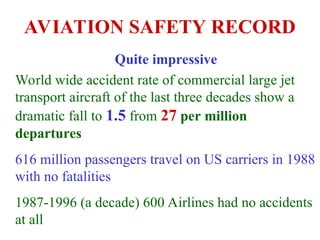
AVIATION SAFETY RECORD
Quiteimpressive
World wide accident rate of commercial large jet
transport aircraft of the last three decades show a
dramatic fall to 1.5 from 27 per million
departures
616 million passengers travel on US carriers in 1988
with no fatalities
1987-1996 (a decade) 600 Airlines had no accidents
at all
5.
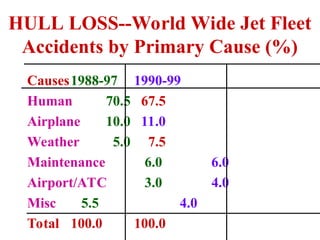
HULL LOSS--World WideJet Fleet
Accidents by Primary Cause (%)
Causes1988-97 1990-99
Human 70.5 67.5
Airplane 10.0 11.0
Weather 5.0 7.5
Maintenance 6.0 6.0
Airport/ATC 3.0 4.0
Misc 5.5 4.0
Total 100.0 100.0
6.
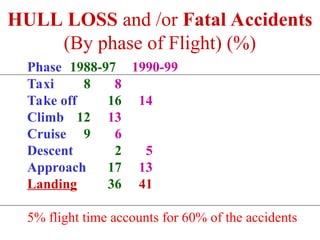
HULL LOSS and/or Fatal Accidents
(By phase of Flight) (%)
Phase 1988-97 1990-99
Taxi 8 8
Take off 16 14
Climb 12 13
Cruise 9 6
Descent 2 5
Approach 17 13
Landing 36 41
5% flight time accounts for 60% of the accidents
7.
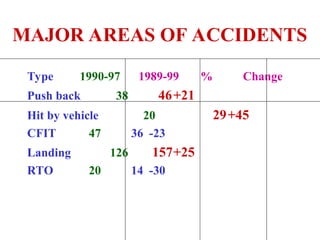
MAJOR AREAS OFACCIDENTS
Type 1990-97 1989-99 % Change
Push back 38 46+21
Hit by vehicle 20 29+45
CFIT 47 36 -23
Landing 126 157+25
RTO 20 14 -30
8.
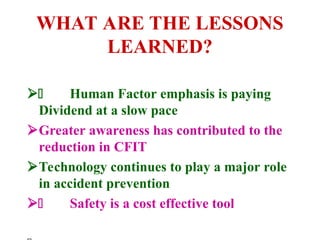
WHAT ARE THELESSONS
LEARNED?
Human Factor emphasis is paying
Dividend at a slow pace
Greater awareness has contributed to the
reduction in CFIT
Technology continues to play a major role
in accident prevention
Safety is a cost effective tool
9.
NEED FOR SAFETY
ENHANCEMENT
•Human error continues to dominate as the cause of
aviation accidents (65 to 70 %)
• Since 1970 the accident rate is relatively constant
• As the number of flight departures increase, we can
anticipate an increase in the absolute number of
accidents.
• Society does not understand the accident rates and
is only concerned with the number of accidents
irrespective of any decline in the global rates
10.
Accident investigation reports
The crew reacted prematurely and in a
way deviated from the laid down procedure
Series of distractions and aggravations
in the cockpit
The failure of the pilots to monitor
flight instruments
Flight crews’ failure to use check list
Lack of team work amongst crew
members
11.
Human factors &Flight safety
How can we prevent accidents?
Examination of Industry’s accident investigation
reports clearly establishes that different
management of available resources could have
prevented the accidents in majority of the cases
12.
What are theavailable resources?
Aircraft systems
Procedure
Manuals and check lists
Cockpit crew
Flight Despatchers
Cabin crew
Maintenance personnel
ATC
13.
What is Management?
Itis the coordinated use of the available
resources to reach a goal
Set the goal
Evaluate risk
Set the priorities
Allocate resources
Evaluate results
14.
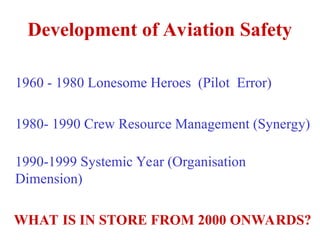
Development of AviationSafety
1960 - 1980 Lonesome Heroes (Pilot Error)
1980- 1990 Crew Resource Management (Synergy)
1990-1999 Systemic Year (Organisation
Dimension)
WHAT IS IN STORE FROM 2000 ONWARDS?
15.
What is CRM?
Theeffective utilization of all available
resources to achieve safe and efficient operation of
a flight
Focus of CRM training is on the functioning of
the crew as an intact team, not simply as a
collection of technically competent individuals
CRM aims at improving crew performance
16.
Human Factors
HF isthe Social Movement of learning the
limit of human ability and movement and
performance, to analyse and apply the
knowledge gained to the daily operations to
in prevent Human Failure which is the
major source of accidents Aviation
17.
What is HumanFactor ?
• Concerns with Optimizing the Relationship
between People and their Activities by
Systematic Application of Human Sciences
Integrated with System Engineering.
• It is about PEOPLE ; It is about PEOPLE in
their Working Environment and it is about
their Relationship with Machines and
Procedures.
18.
PROGRESS ON THEHUMAN
FACTORS FRONT
ICAO
Since 1990, holding regular global flight safety and
human factors symposium to bring in awareness.
Incorporation of the requirement of human factors
/ CRM training and in accident / incident
investigation in applicable annexes
Regulatory authorities
Inclusion of human factors training as mandatory in
the training curriculum
19.
PROGRESS ON THE
HUMANFACTORS FRONT
Airlines
Imparting CRM Training to Operation personnel
emphasizing the significance of human factors for
enhanced performance
Aircraft manufacturers
Human limitations are taken into consideration in
the design of the system / layout
20.
What is HumanFactor Training ?
• Not a substitute for Technical Training
• Training directed to bring in CHANGE in
Mindset
Attitude
Culture
of Individual for enhancement of
Safety and Efficiency
21.
Focus of HumanFactors
Training
• Aviation Physiology
• Aviation Psychology
• Relationship- SHEL Model
22.
Human Factors Training
Developsthe INDIVIDUAL for
Decision Making
Effective Communication
Leadership
Interpersonal Skills
Good Resource Management
Handling of Stress
Teamwork
23.
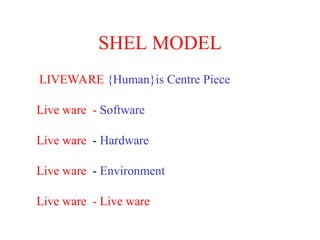
SHEL MODEL
LIVEWARE {Human}isCentre Piece
Live ware - Software
Live ware - Hardware
Live ware - Environment
Live ware - Live ware
24.
SHEL MODEL
• Liveware – Hardware Interface
• Relationship between Human & Machine
Work station Configuration
Display and Control Design
Seats
25.
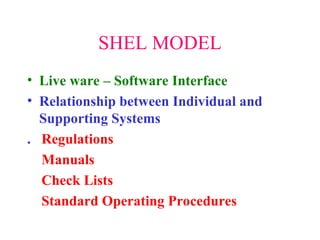
SHEL MODEL
• Liveware – Software Interface
• Relationship between Individual and
Supporting Systems
. Regulations
Manuals
Check Lists
Standard Operating Procedures
26.
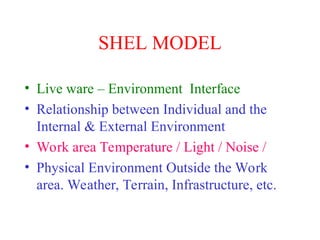
SHEL MODEL
• Liveware – Environment Interface
• Relationship between Individual and the
Internal & External Environment
• Work area Temperature / Light / Noise /
• Physical Environment Outside the Work
area. Weather, Terrain, Infrastructure, etc.
27.
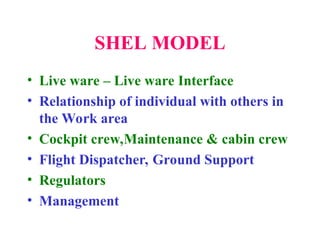
SHEL MODEL
• Liveware – Live ware Interface
• Relationship of individual with others in
the Work area
• Cockpit crew,Maintenance & cabin crew
• Flight Dispatcher, Ground Support
• Regulators
• Management
28.
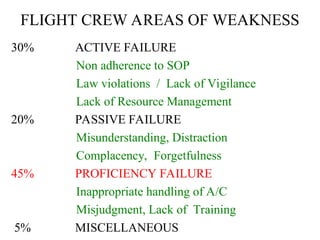
FLIGHT CREW AREASOF WEAKNESS
30% ACTIVE FAILURE
Non adherence to SOP
Law violations / Lack of Vigilance
Lack of Resource Management
20% PASSIVE FAILURE
Misunderstanding, Distraction
Complacency, Forgetfulness
45% PROFICIENCY FAILURE
Inappropriate handling of A/C
Misjudgment, Lack of Training
5% MISCELLANEOUS
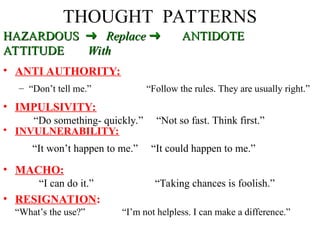
THOUGHT PATTERNS
HAZARDOUS
HAZARDOUS
Replace
Replace
ANTIDOTE
ANTIDOTE
ATTITUDE
ATTITUDE With
With
• ANTI AUTHORITY:
– “Don’t tell me.” “Follow the rules. They are usually right.”
• IMPULSIVITY:
“Do something- quickly.” “Not so fast. Think first.”
• INVULNERABILITY:
“It won’t happen to me.” “It could happen to me.”
• MACHO:
“I can do it.” “Taking chances is foolish.”
• RESIGNATION:
“What’s the use?” “I’m not helpless. I can make a difference.”
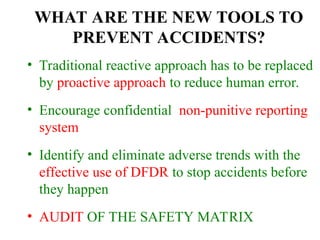
31.
WHAT ARE THENEW TOOLS TO
PREVENT ACCIDENTS?
• Traditional reactive approach has to be replaced
by proactive approach to reduce human error.
• Encourage confidential non-punitive reporting
system
• Identify and eliminate adverse trends with the
effective use of DFDR to stop accidents before
they happen
• AUDIT OF THE SAFETY MATRIX
32.
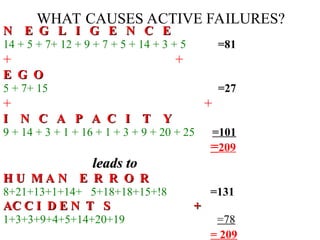
WHAT CAUSES ACTIVEFAILURES?
N E G L I G E N C E
N E G L I G E N C E
14 + 5 + 7+ 12 + 9 + 7 + 5 + 14 + 3 + 5 =81
+ +
E G O
E G O
5 + 7+ 15 =27
+ +
I N C A P A C I T Y
I N C A P A C I T Y
9 + 14 + 3 + 1 + 16 + 1 + 3 + 9 + 20 + 25 =101
=209
leads to
leads to
H U M A N E R R O R
H U M A N E R R O R
8+21+13+1+14+ 5+18+18+15+!8 =131
AC C I D E N T S +
AC C I D E N T S +
1+3+3+9+4+5+14+20+19 =78
= 209
33.
WHAT IS THESOLUTION?
• INDIVIDUAL ATTITUDINAL CHANGE TO DO
THINGS IN THE CORRECT MANNER AT THE
FIRST INSTANT AS LAID DOWN IN THE
MANUAL
• SENSE OF PRIDE
• TRUE MOTIVATION AND COMMITMENT
34.
REACTIVE APPROACH
to
PROACTIVE APPROACH
•Flight Operation Quality Assurance
• Voluntary Incident Reporting System
• Regular Safety Audit
• Creating Safety Data Base and Trend Analysis
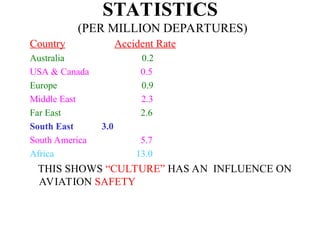
STATISTICS
(PER MILLION DEPARTURES)
CountryAccident Rate
Australia 0.2
USA & Canada 0.5
Europe 0.9
Middle East 2.3
Far East 2.6
South East 3.0
South America 5.7
Africa 13.0
THIS SHOWS “CULTURE” HAS AN INFLUENCE ON
AVIATION SAFETY
37.
CULTURAL INFLUENCES ON
AVIATI0NSAFETY
• Attitude towards errors
• Willingness to admit mistakes
• Reporting if things are wrong
• Keeping head down and not saying anything
• Independent thinking and questioning
38.
Error, Performance andSafety
Errors cause aircraft accidents
Distinguish between errors and violation
Error: Results when action deviates from
intention; it is not intentional
Violation: Results due intentional deviation
from regulation or SOP;
Initially intentional but can become
routine
39.
Consequences of errors
Consequencesof an error may be very different.
Therefore we must clearly differentiate between
an error and its consequences
Best example: Difference between an error
made in the simulator and the exact same error
made in the air.
Errors can be detected in a tolerant system and
corrected; behaviour is re-adopted.
40.
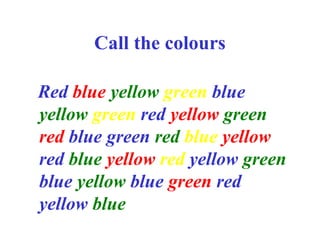
Call the colours
Redblue yellow green blue
yellow green red yellow green
red blue green red blue yellow
red blue yellow red yellow green
blue yellow blue green red
yellow blue
41.
Error chain reaction
Withtime,errors
produce more and more negative
effects
create conditions for new errors
contribute to accidents.
Surrounding environment can turn a simple
error into disaster.
42.
Error Management Prevention
Do not exceed your skills
Set your priorities, manage your time and
workload
Learn from your errors; keep to the facts; do
not listen to your ego.
Work as a team
Use checklists, callouts, cross checks
Adherence to SOP
43.
Update of situationalawareness
Anticipate the future
Refer to past experience
Attend to one subject at a time
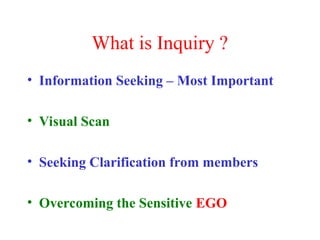
What is Inquiry?
• Information Seeking – Most Important
• Visual Scan
• Seeking Clarification from members
• Overcoming the Sensitive EGO
46.
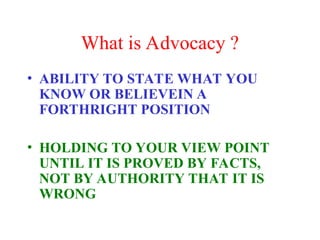
What is Advocacy?
• ABILITY TO STATE WHAT YOU
KNOW OR BELIEVEIN A
FORTHRIGHT POSITION
• HOLDING TO YOUR VIEW POINT
UNTIL IT IS PROVED BY FACTS,
NOT BY AUTHORITY THAT IT IS
WRONG
47.
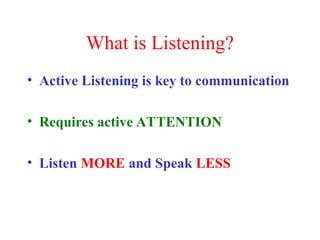
What is Listening?
•Active Listening is key to communication
• Requires active ATTENTION
• Listen MORE and Speak LESS
48.
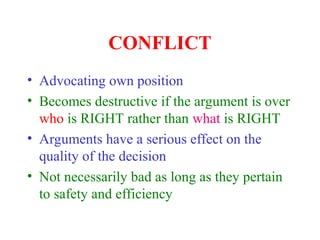
CONFLICT
• Advocating ownposition
• Becomes destructive if the argument is over
who is RIGHT rather than what is RIGHT
• Arguments have a serious effect on the
quality of the decision
• Not necessarily bad as long as they pertain
to safety and efficiency
49.
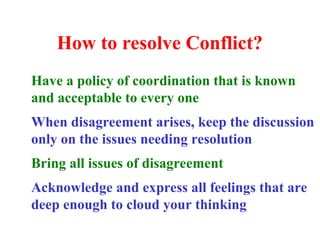
How to resolveConflict?
Have a policy of coordination that is known
and acceptable to every one
When disagreement arises, keep the discussion
only on the issues needing resolution
Bring all issues of disagreement
Acknowledge and express all feelings that are
deep enough to cloud your thinking
50.
Conflict Resolution
• Keyto the highest level of problem solving
• Leads to deeper thinking, creative to new
ideas
• Promotes mutual respect
• Provides an opportunity to seek better
solutions
51.
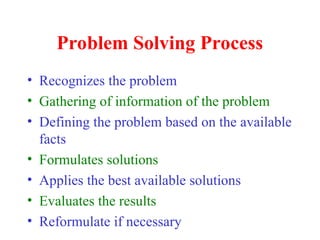
Problem Solving Process
•Recognizes the problem
• Gathering of information of the problem
• Defining the problem based on the available
facts
• Formulates solutions
• Applies the best available solutions
• Evaluates the results
• Reformulate if necessary
52.
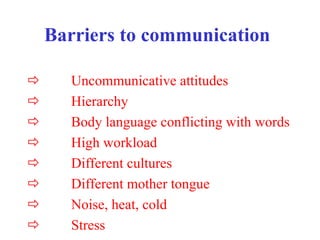
Barriers to communication
Uncommunicative attitudes
Hierarchy
Body language conflicting with words
High workload
Different cultures
Different mother tongue
Noise, heat, cold
Stress
53.
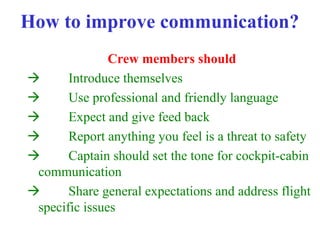
How to improvecommunication?
Crew members should
Introduce themselves
Use professional and friendly language
Expect and give feed back
Report anything you feel is a threat to safety
Captain should set the tone for cockpit-cabin
communication
Share general expectations and address flight
specific issues
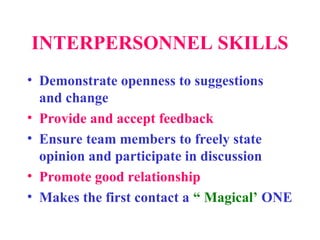
INTERPERSONNEL SKILLS
• Demonstrateopenness to suggestions
and change
• Provide and accept feedback
• Ensure team members to freely state
opinion and participate in discussion
• Promote good relationship
• Makes the first contact a “ Magical’ ONE
56.
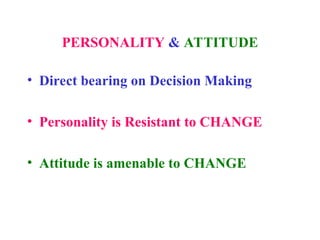
PERSONALITY & ATTITUDE
•Direct bearing on Decision Making
• Personality is Resistant to CHANGE
• Attitude is amenable to CHANGE
57.
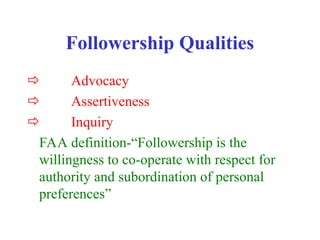
Followership Qualities
Advocacy
Assertiveness
Inquiry
FAA definition-“Followership is the
willingness to co-operate with respect for
authority and subordination of personal
preferences”
58.
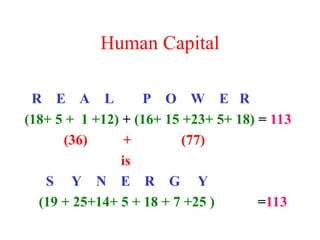
Human Capital
R EA L P O W E R
(18+ 5 + 1 +12) + (16+ 15 +23+ 5+ 18) = 113
(36) + (77)
is
S Y N E R G Y
(19 + 25+14+ 5 + 18 + 7 +25 ) =113
59.
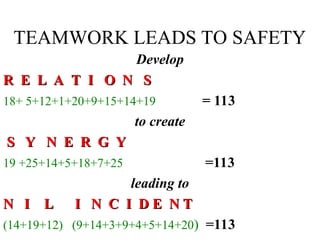
TEAMWORK LEADS TOSAFETY
Develop
R E L A T I O N S
R E L A T I O N S
18+ 5+12+1+20+9+15+14+19 = 113
to create
S Y N E R G Y
S Y N E R G Y
19 +25+14+5+18+7+25 =113
leading to
N I L I N C I D E N T
N I L I N C I D E N T
(14+19+12) (9+14+3+9+4+5+14+20) =113
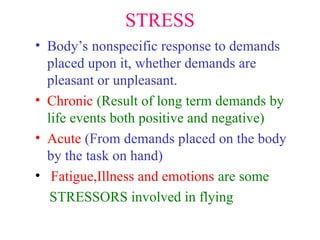
STRESS
• Body’s nonspecificresponse to demands
placed upon it, whether demands are
pleasant or unpleasant.
• Chronic (Result of long term demands by
life events both positive and negative)
• Acute (From demands placed on the body
by the task on hand)
• Fatigue,Illness and emotions are some
STRESSORS involved in flying
62.
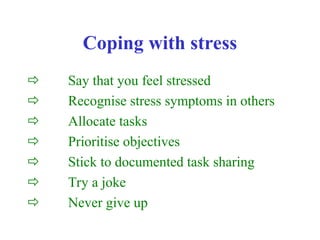
Coping with stress
Say that you feel stressed
Recognise stress symptoms in others
Allocate tasks
Prioritise objectives
Stick to documented task sharing
Try a joke
Never give up
63.
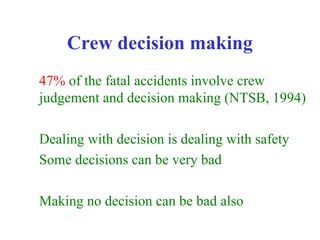
Crew decision making
47%of the fatal accidents involve crew
judgement and decision making (NTSB, 1994)
Dealing with decision is dealing with safety
Some decisions can be very bad
Making no decision can be bad also
64.
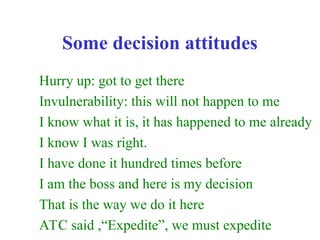
Some decision attitudes
Hurryup: got to get there
Invulnerability: this will not happen to me
I know what it is, it has happened to me already
I know I was right.
I have done it hundred times before
I am the boss and here is my decision
That is the way we do it here
ATC said ,“Expedite”, we must expedite
65.
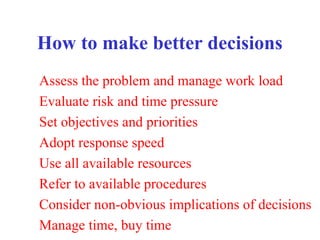
How to makebetter decisions
Assess the problem and manage work load
Evaluate risk and time pressure
Set objectives and priorities
Adopt response speed
Use all available resources
Refer to available procedures
Consider non-obvious implications of decisions
Manage time, buy time
66.
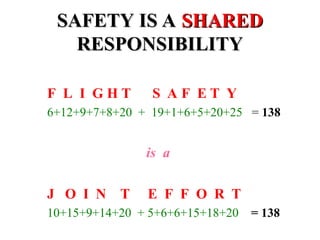
SAFETY IS A
SAFETYIS A SHARED
SHARED
RESPONSIBILITY
RESPONSIBILITY
F L I G H T S A F E T Y
6+12+9+7+8+20 + 19+1+6+5+20+25 = 138
is a
J O I N T E F F O R T
10+15+9+14+20 + 5+6+6+15+18+20 = 138
67.
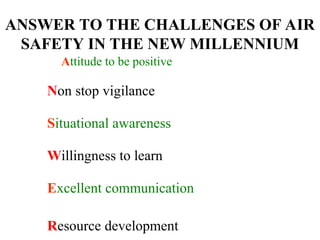
ANSWER TO THECHALLENGES OF AIR
SAFETY IN THE NEW MILLENNIUM
Attitude to be positive
Non stop vigilance
Situational awareness
Willingness to learn
Excellent communication
Resource development