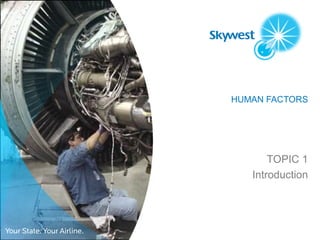
HUMAN FACTORS


       TOPIC 1
   Introduction
The need to take Human Factors into account


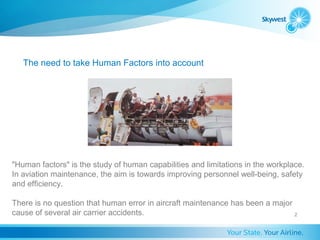
"Human factors" is the study of human capabilities and limitations in the workplace.
In aviation maintenance, the aim is towards improving personnel well-being, safety
and efficiency.

There is no question that human error in aircraft maintenance has been a major
cause of several air carrier accidents.                                        2
The need to take Human Factors into account


Human Factors researchers study system performance. That is, they study the
interaction of maintenance personnel, the equipment they use, the written and verbal
procedures and rules they follow, and the environmental conditions of any system.


The aim of human factors is to optimise the relationship between maintenance
personnel and systems with a view to improving safety, efficiency and well-being.


It is also beyond question that unless the aviation industry learns from these
occurrences, maintenance-related safety breakdowns will continue to occur.
                                                                                       3
The need to take Human Factors into account

Human factors include such attributes as:

      Physiology - the mechanical, physical, and biochemical functions of living
       organisms
      Psychology - including perception, cognition, memory, social interaction, error
      Work place design
      Environmental conditions
      Human - machine interface
      Anthropometrics - the scientific study of measurements of the human body


                                                                                         4
Issues associated with Human Factors

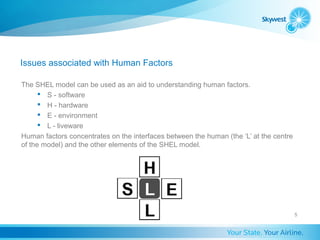
The SHEL model can be used as an aid to understanding human factors.
       S - software
       H - hardware
       E - environment
       L - liveware
Human factors concentrates on the interfaces between the human (the ‘L’ at the centre
of the model) and the other elements of the SHEL model.


                                                                                        5
Issues associated with Human Factors

“Liveware” (human being) , can perform a wide range of activities.


Even though modern aircraft are now designed with the latest self-test and diagnostic
routines that modern computing power can provide, one aspect of aviation
maintenance has not changed: maintenance tasks are still being done by human
beings.


                                                                                        6
Issues associated with Human Factors

With modern technology, aircraft are becoming more and more reliable.


However, it is not possible to re-design the human being.


To overcome humans being unreliable it is important to provide:
        Good Training;
        Procedures;
        Tools and;
        Duplicate Inspections.
And we can improve aircraft design. For example, making it impossible to reconnect
something the wrong way.
                                                                                     7
Human Error

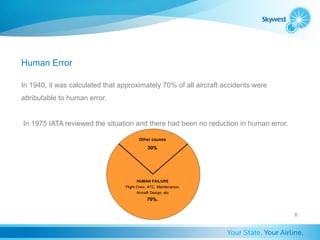
In 1940, it was calculated that approximately 70% of all aircraft accidents were
attributable to human error.


In 1975 IATA reviewed the situation and there had been no reduction in human error.


                                                                                      8
Human Error

In 1986 a study was carried looking at significant accident causes in 93 aircraft
accidents. These causes were as follows:
       Pilot deviated from basic operational procedures - 33%

       Inadequate cross-check by second crew member - 26%

       Design faults -13%

       Maintenance and inspection deficiencies - 12%

       Absence of approach guidance - 10%

As can be seen from the list, maintenance and inspection deficiencies are a major
contributing factor to accidents.

                                                                                    9
Human Error

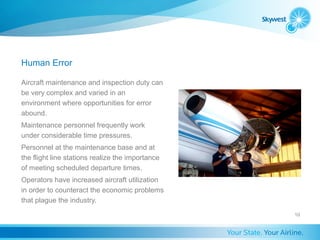
Aircraft maintenance and inspection duty can
be very complex and varied in an
environment where opportunities for error
abound.
Maintenance personnel frequently work
under considerable time pressures.
Personnel at the maintenance base and at
the flight line stations realize the importance
of meeting scheduled departure times.
Operators have increased aircraft utilization
in order to counteract the economic problems
that plague the industry.
                                                  10
Human Error contributing factors
Aircraft maintenance related incidents are characterised by:
        Staff shortages
        Time pressures
        Shift or Task handovers
        An element of a “can do” attitude
        Errors occurred at night
        Interruptions occurred
        Some failure to use approved data or company procedures
        Confusion using technical manuals
        Inadequate pre-planning, equipment or spares


                                                                   11
A breakdown in Human Factors


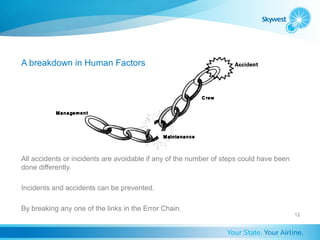
All accidents or incidents are avoidable if any of the number of steps could have been
done differently.

Incidents and accidents can be prevented.

By breaking any one of the links in the Error Chain.
                                                                                         12
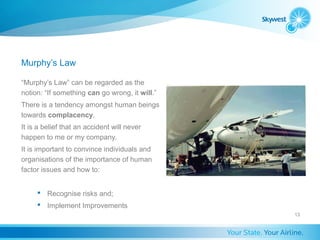
Murphy’s Law

“Murphy’s Law” can be regarded as the
notion: “If something can go wrong, it will.”
There is a tendency amongst human beings
towards complacency.
It is a belief that an accident will never
happen to me or my company.
It is important to convince individuals and
organisations of the importance of human
factor issues and how to:


      Recognise risks and;
      Implement Improvements
                                                13
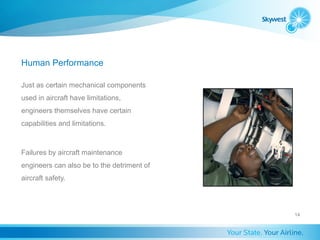
Human Performance

Just as certain mechanical components
used in aircraft have limitations,
engineers themselves have certain
capabilities and limitations.


Failures by aircraft maintenance
engineers can also be to the detriment of
aircraft safety.


                                            14

Human factors topic 1 introduction

  • 1.
    HUMAN FACTORS TOPIC 1 Introduction
  • 2.
    The need totake Human Factors into account "Human factors" is the study of human capabilities and limitations in the workplace. In aviation maintenance, the aim is towards improving personnel well-being, safety and efficiency. There is no question that human error in aircraft maintenance has been a major cause of several air carrier accidents. 2
  • 3.
    The need totake Human Factors into account Human Factors researchers study system performance. That is, they study the interaction of maintenance personnel, the equipment they use, the written and verbal procedures and rules they follow, and the environmental conditions of any system. The aim of human factors is to optimise the relationship between maintenance personnel and systems with a view to improving safety, efficiency and well-being. It is also beyond question that unless the aviation industry learns from these occurrences, maintenance-related safety breakdowns will continue to occur. 3
  • 4.
    The need totake Human Factors into account Human factors include such attributes as:  Physiology - the mechanical, physical, and biochemical functions of living organisms  Psychology - including perception, cognition, memory, social interaction, error  Work place design  Environmental conditions  Human - machine interface  Anthropometrics - the scientific study of measurements of the human body 4
  • 5.
    Issues associated withHuman Factors The SHEL model can be used as an aid to understanding human factors.  S - software  H - hardware  E - environment  L - liveware Human factors concentrates on the interfaces between the human (the ‘L’ at the centre of the model) and the other elements of the SHEL model. 5
  • 6.
    Issues associated withHuman Factors “Liveware” (human being) , can perform a wide range of activities. Even though modern aircraft are now designed with the latest self-test and diagnostic routines that modern computing power can provide, one aspect of aviation maintenance has not changed: maintenance tasks are still being done by human beings. 6
  • 7.
    Issues associated withHuman Factors With modern technology, aircraft are becoming more and more reliable. However, it is not possible to re-design the human being. To overcome humans being unreliable it is important to provide:  Good Training;  Procedures;  Tools and;  Duplicate Inspections. And we can improve aircraft design. For example, making it impossible to reconnect something the wrong way. 7
  • 8.
    Human Error In 1940,it was calculated that approximately 70% of all aircraft accidents were attributable to human error. In 1975 IATA reviewed the situation and there had been no reduction in human error. 8
  • 9.
    Human Error In 1986a study was carried looking at significant accident causes in 93 aircraft accidents. These causes were as follows:  Pilot deviated from basic operational procedures - 33%  Inadequate cross-check by second crew member - 26%  Design faults -13%  Maintenance and inspection deficiencies - 12%  Absence of approach guidance - 10% As can be seen from the list, maintenance and inspection deficiencies are a major contributing factor to accidents. 9
  • 10.
    Human Error Aircraft maintenanceand inspection duty can be very complex and varied in an environment where opportunities for error abound. Maintenance personnel frequently work under considerable time pressures. Personnel at the maintenance base and at the flight line stations realize the importance of meeting scheduled departure times. Operators have increased aircraft utilization in order to counteract the economic problems that plague the industry. 10
  • 11.
    Human Error contributingfactors Aircraft maintenance related incidents are characterised by:  Staff shortages  Time pressures  Shift or Task handovers  An element of a “can do” attitude  Errors occurred at night  Interruptions occurred  Some failure to use approved data or company procedures  Confusion using technical manuals  Inadequate pre-planning, equipment or spares 11
  • 12.
    A breakdown inHuman Factors All accidents or incidents are avoidable if any of the number of steps could have been done differently. Incidents and accidents can be prevented. By breaking any one of the links in the Error Chain. 12
  • 13.
    Murphy’s Law “Murphy’s Law”can be regarded as the notion: “If something can go wrong, it will.” There is a tendency amongst human beings towards complacency. It is a belief that an accident will never happen to me or my company. It is important to convince individuals and organisations of the importance of human factor issues and how to:  Recognise risks and;  Implement Improvements 13
  • 14.
    Human Performance Just ascertain mechanical components used in aircraft have limitations, engineers themselves have certain capabilities and limitations. Failures by aircraft maintenance engineers can also be to the detriment of aircraft safety. 14

Editor's Notes

  • #3 "Human factors" refers to the study of human capabilities and limitations in the workplace. Human factors researchers study system performance. That is, they study the interaction of maintenance personnel, the equipment they use, the written and verbal procedures and rules they follow, and the environmental conditions of any system. The aim of human factors is to optimise the relationship between maintenance personnel and systems with a view to improving safety, efficiency and well-being”. It is also beyond question that unless the aviation industry learns from these occurrences, maintenance-related safety breakdowns will continue to occur.
  • #6 S - software (e.g. maintenance procedures, maintenance manuals, checklist layout etc.); H - hardware (e.g. tools, test equipment, the physical structure of aircraft, design of flight decks, the positioning and operating sense of controls and instruments etc.); E - environment (e.g. physical environment such as conditions in the hangar, conditions on the line etc. and work environment such as work patterns, management structures, public perception of the industry etc.) L - liveware (i.e. the people or person at the centre of the model, including maintenance engineers, supervisors, planners, managers etc.)
  • #7 Since Liveware is at the centre of the model, all other aspects (Software, Hardware and Environment) must be designed or adapted to assist his performance and respect his limitations . If these two aspects are ignored, the human - in this case the maintenance engineer - will not perform to the best of his abilities, may make errors, and may jeopardise safety.
  • #9 In 1940, it was calculated that approximately 70% of all aircraft accidents were attributable to man’s performance (human error), not machine malfunction. When IATA reviewed the situation in 1975, there had been no reduction in human error component of maintenance statistics. A simple definition of human factors is ‘fitting the job to the man and the man to the job’. Read and work through the case studies in CAP 715 Chapter 1 pages 5 and 6.
  • #11 Aircraft maintenance and inspection duty can be very complex and varied in an environment where opportunities for error abound. Maintenance personnel frequently work under considerable time pressures. Personnel at the maintenance base and at the flight line stations realize the importance of meeting scheduled departure times. Operators have increased aircraft utilization in order to counteract the economic problems that plague the industry. Aircraft maintenance technicians are also maintaining a fleet that is increasing in age. It is not uncommon to find 20 to 25 year old aircraft in many airline fleets,
  • #12 The UK Civil Aviation Authority has stressed in Airworthiness Notice No. 71 (Issue 1, 20 March 2000) that it “seeks to provide an environment in which errors may be openly investigated in order that the contributing factors and root causes of maintenance errors can be addressed” .
  • #13 Discuss the various links in the chain and how they can be broken. An accident or incident are preventable and can be avoided if any one of a number of things is done differently. In some cases a number of individuals are involved and the outcome can be modified if any one of them reacts or queries a particular action.
  • #14 Picture above: The MD11 was doing an engine run. The only people in the cockpit of the MD11 were maintenance engineers. About five of them. They had the wheels chocked and the brakes on. They ran all three engines at full power as part of their engine run!!! None of them noticed the aircraft, with brakes on and wheels chocked, sliding across the tarmac - leaving heavy skid marks were visible for months after!! The wing of the Airbus rode over the top of the MD11 cockpit, where it split and spilt several tonnes of fuel into the interior of the MD11.