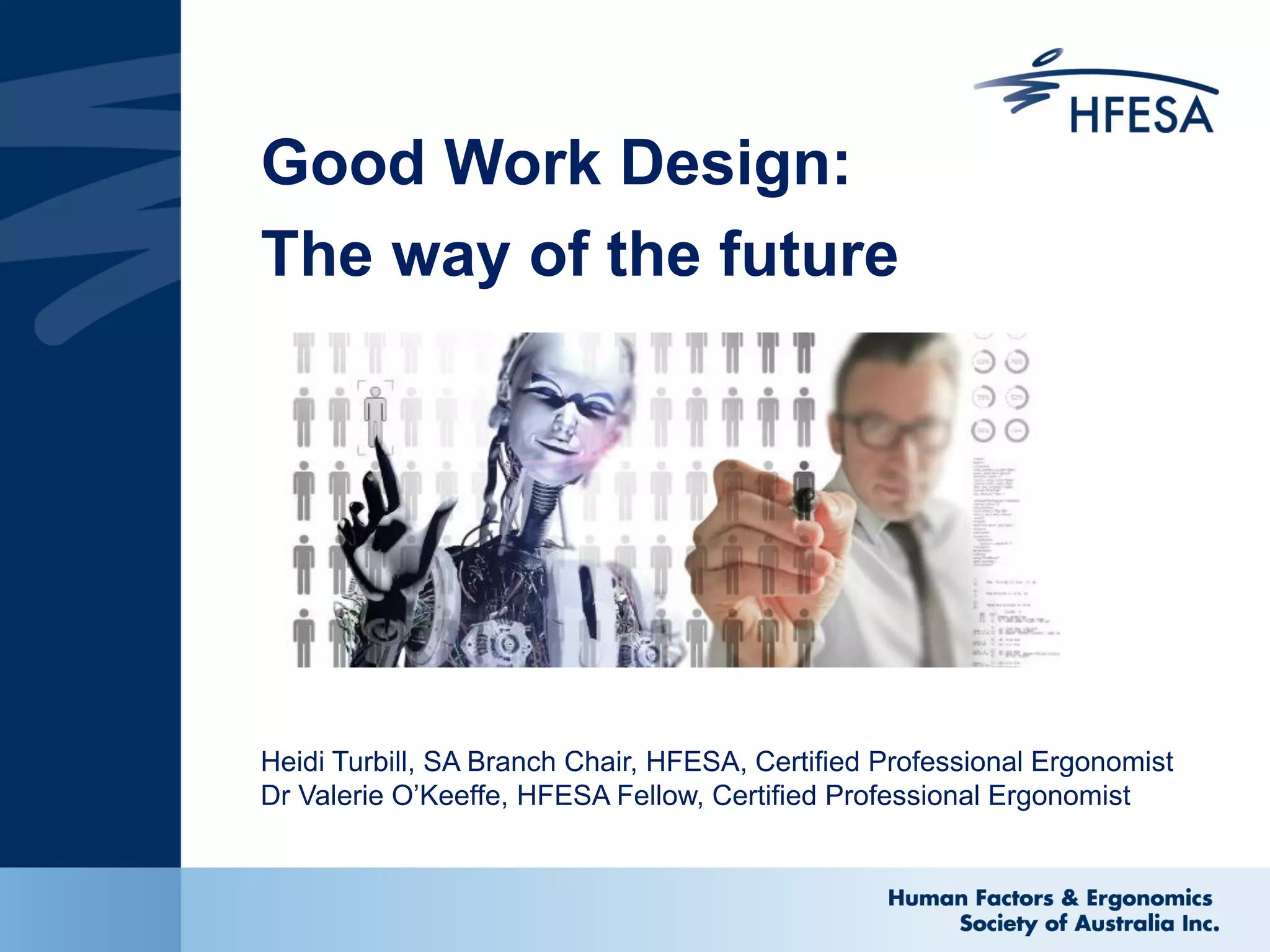
Good Work Design:
The way of the future
Heidi Turbill, SA Branch Chair, HFESA, Certified Professional Ergonomist
Dr Valerie O’Keeffe, HFESA Fellow, Certified Professional Ergonomist
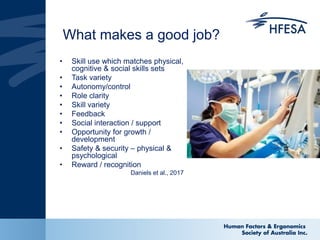
What makes a good job?
• Skill use which matches physical,
cognitive & social skills sets
• Task variety
• Autonomy/control
• Role clarity
• Skill variety
• Feedback
• Social interaction / support
• Opportunity for growth /
development
• Safety & security – physical &
psychological
• Reward / recognition
Daniels et al., 2017
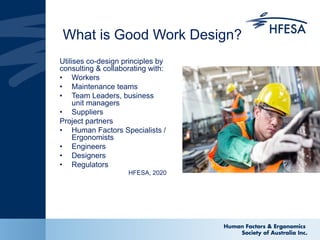
What is Good Work Design?
Utilises co-design principles by
consulting & collaborating with:
• Workers
• Maintenance teams
• Team Leaders, business
unit managers
• Suppliers
Project partners
• Human Factors Specialists /
Ergonomists
• Engineers
• Designers
• Regulators
HFESA, 2020
Prevention of WMSD
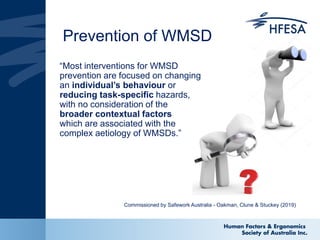
“Most interventions for WMSD
prevention are focused on changing
an individual’s behaviour or
reducing task-specific hazards,
with no consideration of the
broader contextual factors
which are associated with the
complex aetiology of WMSDs.”
Commissioned by Safework Australia - Oakman, Clune & Stuckey (2019)
Prevention of WMSD
Barriers to the effective implementation of interventions to
prevent WMSDs:
• a failure to adopt a ‘systems’ approach to risk
management
• an inadequate adherence to the hierarchy of risk
control
• a lack of management commitment, organisation
culture and climate
• a lack of understanding of the importance of worker
participation
• the role of legislation, codes of practice and related
documents
• the role of competencies in WMSD risk management.
Commissioned by Safework Australia - Oakman, Clune & Stuckey (2019)
WHS Act – Section 22
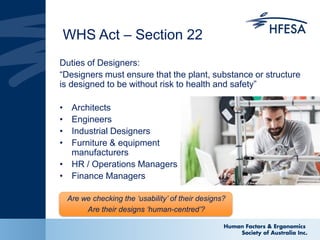
Duties of Designers:
“Designers must ensure that the plant, substance or structure
is designed to be without risk to health and safety”
• Architects
• Engineers
• Industrial Designers
• Furniture & equipment
manufacturers
• HR / Operations Managers
• Finance Managers
Are we checking the ‘usability’ of their designs?
Are their designs ‘human-centred’?
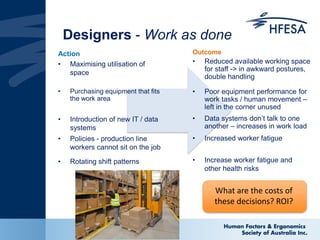
Designers - Work as done
Action
• Maximising utilisation of
space
Outcome
• Reduced available working space
for staff -> in awkward postures,
double handling
• Introduction of new IT / data
systems
• Purchasing equipment that fits
the work area
• Policies - production line
workers cannot sit on the job
• Rotating shift patterns
• Poor equipment performance for
work tasks / human movement –
left in the corner unused
• Data systems don’t talk to one
another – increases in work load
• Increase worker fatigue and
other health risks
• Increased worker fatigue
What are the costs of
these decisions? ROI?
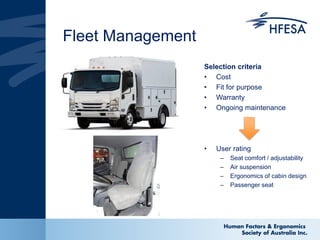
Fleet Management
Selection criteria
• Cost
• Fit for purpose
• Warranty
• Ongoing maintenance
• User rating
– Seat comfort / adjustability
– Air suspension
– Ergonomics of cabin design
– Passenger seat
GWD - Promoting Human Performance
Integrate GWD practices into daily business decision
Use ‘Design & Systems thinking’ approaches
• Safety in Design
• User-centred design
Understand human capability & limitation
Your workforce has the answers
Certified Professionals - Human Factors & Ergonomics
are experts in this field
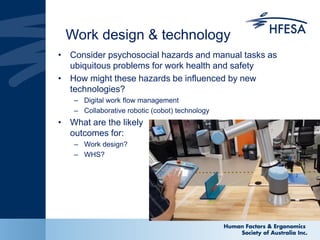
Work design & technology
• Consider psychosocial hazards and manual tasks as
ubiquitous problems for work health and safety
• How might these hazards be influenced by new
technologies?
– Digital work flow management
– Collaborative robotic (cobot) technology
• What are the likely
outcomes for:
– Work design?
– WHS?
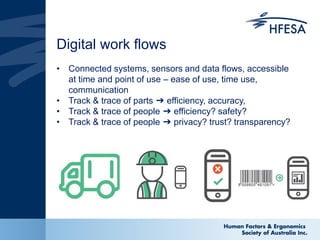
Digital work flows
• Connected systems, sensors and data flows, accessible
at time and point of use – ease of use, time use,
communication
• Track & trace of parts ➔ efficiency, accuracy,
• Track & trace of people ➔ efficiency? safety?
• Track & trace of people ➔ privacy? trust? transparency?
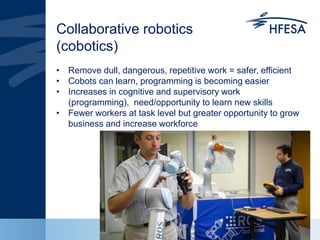
Collaborative robotics
(cobotics)
• Remove dull, dangerous, repetitive work = safer, efficient
• Cobots can learn, programming is becoming easier
• Increases in cognitive and supervisory work
(programming), need/opportunity to learn new skills
• Fewer workers at task level but greater opportunity to grow
business and increase workforce
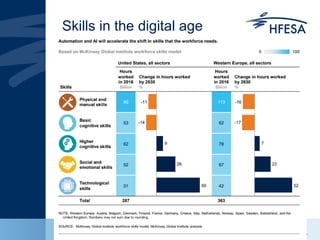
Skills in the digital age
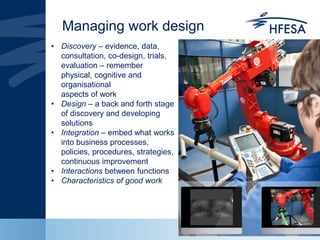
Managing work design
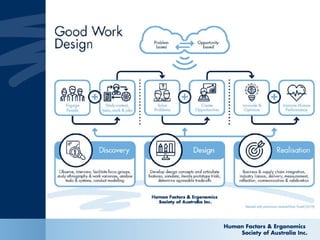
• Discovery – evidence, data,
consultation, co-design, trials,
evaluation – remember
physical, cognitive and
organisational
aspects of work
• Design – a back and forth stage
of discovery and developing
solutions
• Integration – embed what works
into business processes,
policies, procedures, strategies,
continuous improvement
• Interactions between functions
• Characteristics of good work
Thank you!
Contact us:
Heidi Turbill: sachair@ergonomics.org.au
Valerie O’Keeffe: valerie.okeeffe@flinders.edu.au
HFESA Position paper on ‘Good Work Design’ is available from:
https://www.ergonomics.org.au/resources/position-statements
References
Badri, A., Boudreau-Trudel, B., & Souissi, A. S. (2018). Occupational health
and safety in the industry 4.0 era: A cause for major concern? Safety
Science, 109, 403-411.
DOI: 10.1016/j.ssci.2018.06.012
Daniels, K., Gedikli, C., Watson, D., Semkina, A., & Vaughn, O. (2017). Job
design, employment practices and well-being: A systematic review of
intervention studies. Ergonomics, 60(9), 1177-1196.
El Zaatari, S., Marei, M., Li, W., & Usman, Z. (2019). Cobot programming for
collaborative industrial tasks: An overview. Robotics and Autonomous
Systems, 116, 162-180.
Safework Australia (2019). Work-related musculoskeletal disorders in
Australia. https://www.safeworkaustralia.gov.au/doc/work-related-
musculoskeletal-disorders-australia
Van den Broeck, A., & Parker, S. K. (2017). Job and work design. Accessed
from https://lirias.kuleuven.be/1678614?limo=0
Waschull, S., Bokhorst, J. A., Molleman, E., & Wortmann, J. C. (2020). Work
design in future industrial production: Transforming towards cyber-physical
systems. Computers & Industrial Engineering, 139, 105679.

Human factors and ergonomics update

  • 1.
    Good Work Design: Theway of the future Heidi Turbill, SA Branch Chair, HFESA, Certified Professional Ergonomist Dr Valerie O’Keeffe, HFESA Fellow, Certified Professional Ergonomist
  • 3.
    What makes agood job? • Skill use which matches physical, cognitive & social skills sets • Task variety • Autonomy/control • Role clarity • Skill variety • Feedback • Social interaction / support • Opportunity for growth / development • Safety & security – physical & psychological • Reward / recognition Daniels et al., 2017
  • 4.
    What is GoodWork Design? Utilises co-design principles by consulting & collaborating with: • Workers • Maintenance teams • Team Leaders, business unit managers • Suppliers Project partners • Human Factors Specialists / Ergonomists • Engineers • Designers • Regulators HFESA, 2020
  • 6.
    Prevention of WMSD “Mostinterventions for WMSD prevention are focused on changing an individual’s behaviour or reducing task-specific hazards, with no consideration of the broader contextual factors which are associated with the complex aetiology of WMSDs.” Commissioned by Safework Australia - Oakman, Clune & Stuckey (2019)
  • 7.
    Prevention of WMSD Barriersto the effective implementation of interventions to prevent WMSDs: • a failure to adopt a ‘systems’ approach to risk management • an inadequate adherence to the hierarchy of risk control • a lack of management commitment, organisation culture and climate • a lack of understanding of the importance of worker participation • the role of legislation, codes of practice and related documents • the role of competencies in WMSD risk management. Commissioned by Safework Australia - Oakman, Clune & Stuckey (2019)
  • 8.
    WHS Act –Section 22 Duties of Designers: “Designers must ensure that the plant, substance or structure is designed to be without risk to health and safety” • Architects • Engineers • Industrial Designers • Furniture & equipment manufacturers • HR / Operations Managers • Finance Managers Are we checking the ‘usability’ of their designs? Are their designs ‘human-centred’?
  • 9.
    Designers - Workas done Action • Maximising utilisation of space Outcome • Reduced available working space for staff -> in awkward postures, double handling • Introduction of new IT / data systems • Purchasing equipment that fits the work area • Policies - production line workers cannot sit on the job • Rotating shift patterns • Poor equipment performance for work tasks / human movement – left in the corner unused • Data systems don’t talk to one another – increases in work load • Increase worker fatigue and other health risks • Increased worker fatigue What are the costs of these decisions? ROI?
  • 10.
    Fleet Management Selection criteria •Cost • Fit for purpose • Warranty • Ongoing maintenance • User rating – Seat comfort / adjustability – Air suspension – Ergonomics of cabin design – Passenger seat
  • 11.
    GWD - PromotingHuman Performance Integrate GWD practices into daily business decision Use ‘Design & Systems thinking’ approaches • Safety in Design • User-centred design Understand human capability & limitation Your workforce has the answers Certified Professionals - Human Factors & Ergonomics are experts in this field
  • 12.
    Work design &technology • Consider psychosocial hazards and manual tasks as ubiquitous problems for work health and safety • How might these hazards be influenced by new technologies? – Digital work flow management – Collaborative robotic (cobot) technology • What are the likely outcomes for: – Work design? – WHS?
  • 13.
    Digital work flows •Connected systems, sensors and data flows, accessible at time and point of use – ease of use, time use, communication • Track & trace of parts ➔ efficiency, accuracy, • Track & trace of people ➔ efficiency? safety? • Track & trace of people ➔ privacy? trust? transparency?
  • 14.
    Collaborative robotics (cobotics) • Removedull, dangerous, repetitive work = safer, efficient • Cobots can learn, programming is becoming easier • Increases in cognitive and supervisory work (programming), need/opportunity to learn new skills • Fewer workers at task level but greater opportunity to grow business and increase workforce
  • 15.
    Skills in thedigital age
  • 16.
    Managing work design •Discovery – evidence, data, consultation, co-design, trials, evaluation – remember physical, cognitive and organisational aspects of work • Design – a back and forth stage of discovery and developing solutions • Integration – embed what works into business processes, policies, procedures, strategies, continuous improvement • Interactions between functions • Characteristics of good work
  • 17.
    Thank you! Contact us: HeidiTurbill: sachair@ergonomics.org.au Valerie O’Keeffe: valerie.okeeffe@flinders.edu.au HFESA Position paper on ‘Good Work Design’ is available from: https://www.ergonomics.org.au/resources/position-statements
  • 18.
    References Badri, A., Boudreau-Trudel,B., & Souissi, A. S. (2018). Occupational health and safety in the industry 4.0 era: A cause for major concern? Safety Science, 109, 403-411. DOI: 10.1016/j.ssci.2018.06.012 Daniels, K., Gedikli, C., Watson, D., Semkina, A., & Vaughn, O. (2017). Job design, employment practices and well-being: A systematic review of intervention studies. Ergonomics, 60(9), 1177-1196. El Zaatari, S., Marei, M., Li, W., & Usman, Z. (2019). Cobot programming for collaborative industrial tasks: An overview. Robotics and Autonomous Systems, 116, 162-180. Safework Australia (2019). Work-related musculoskeletal disorders in Australia. https://www.safeworkaustralia.gov.au/doc/work-related- musculoskeletal-disorders-australia Van den Broeck, A., & Parker, S. K. (2017). Job and work design. Accessed from https://lirias.kuleuven.be/1678614?limo=0 Waschull, S., Bokhorst, J. A., Molleman, E., & Wortmann, J. C. (2020). Work design in future industrial production: Transforming towards cyber-physical systems. Computers & Industrial Engineering, 139, 105679.