“”” Understanding the significance of
exposure science in WHS issues
Dr Len Turczynowicz
Senior Research Fellow, University of Adelaide
SA Safety Symposium 20 October 2023
Presentation Outline
 What is exposure science?
 Exposome and epigenetics
 Exposure science in workplace health and safety
 Exposure science tools
 The application of exposure science logic
 Retrospective pesticide exposure assessments
 Impacts of latency and growing epidemiological evidence
 Emerging contaminants (silica; PFAS/PFOA)
 Time-dependent exposures – where to?
 Key issues and concluding comments
What is exposure science?
Definition
 Exposure science addresses the intensity and
duration of contact of humans or other organisms
with those agents (defined as chemical, physical, or
biologic stressors) and their fate in living systems.”
(National Academy of Sciences, 2012, p33)
What is exposure
science?
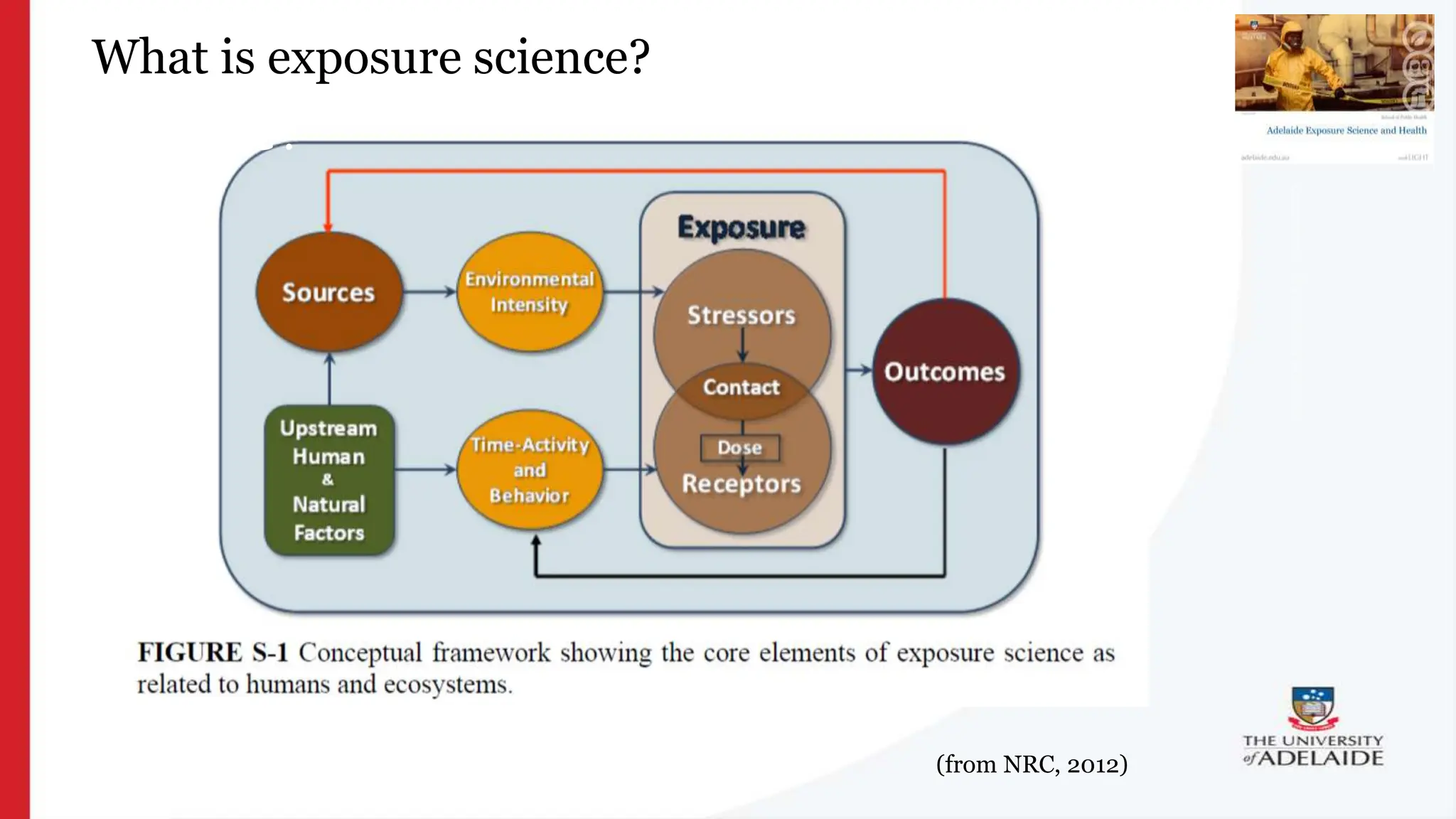
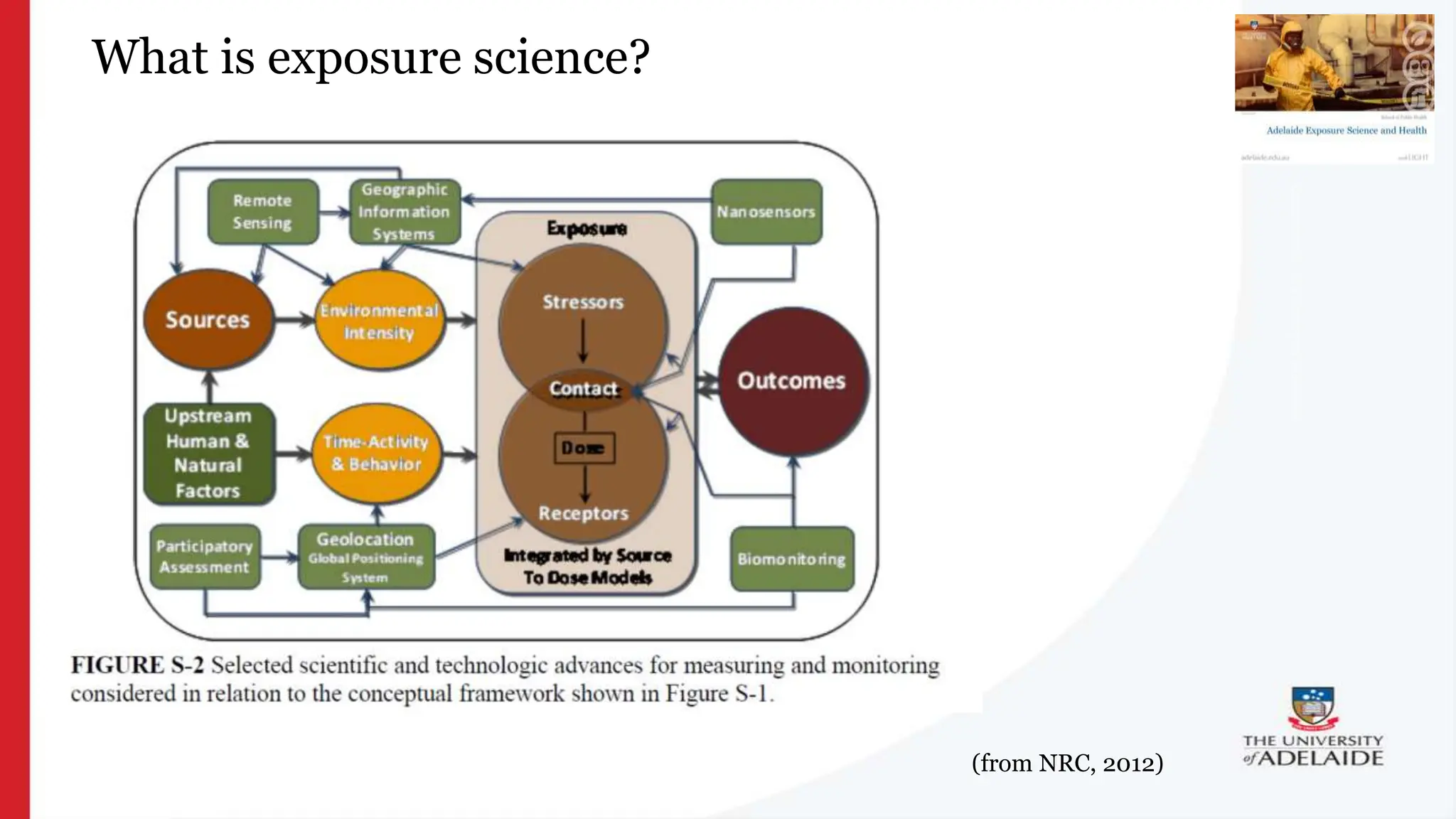
What is exposure science?
(from NRC, 2012)
What is exposure
science?
What is exposure science?
 The study of stressors, populations (receptors), and their
contacts in the context of space and time
 The science linking human and ecologic behaviour to
environmental processes in such a way that the information
generated can be used to mitigate or prevent future adverse
exposures
 Predominantly observational performed in the field within
normal living and working situations
 Exposure science is a multidisciplinary field, both an art and a
science.
What is exposure
science?
What is exposure science?
(from NRC, 2012)
What is exposure
science?
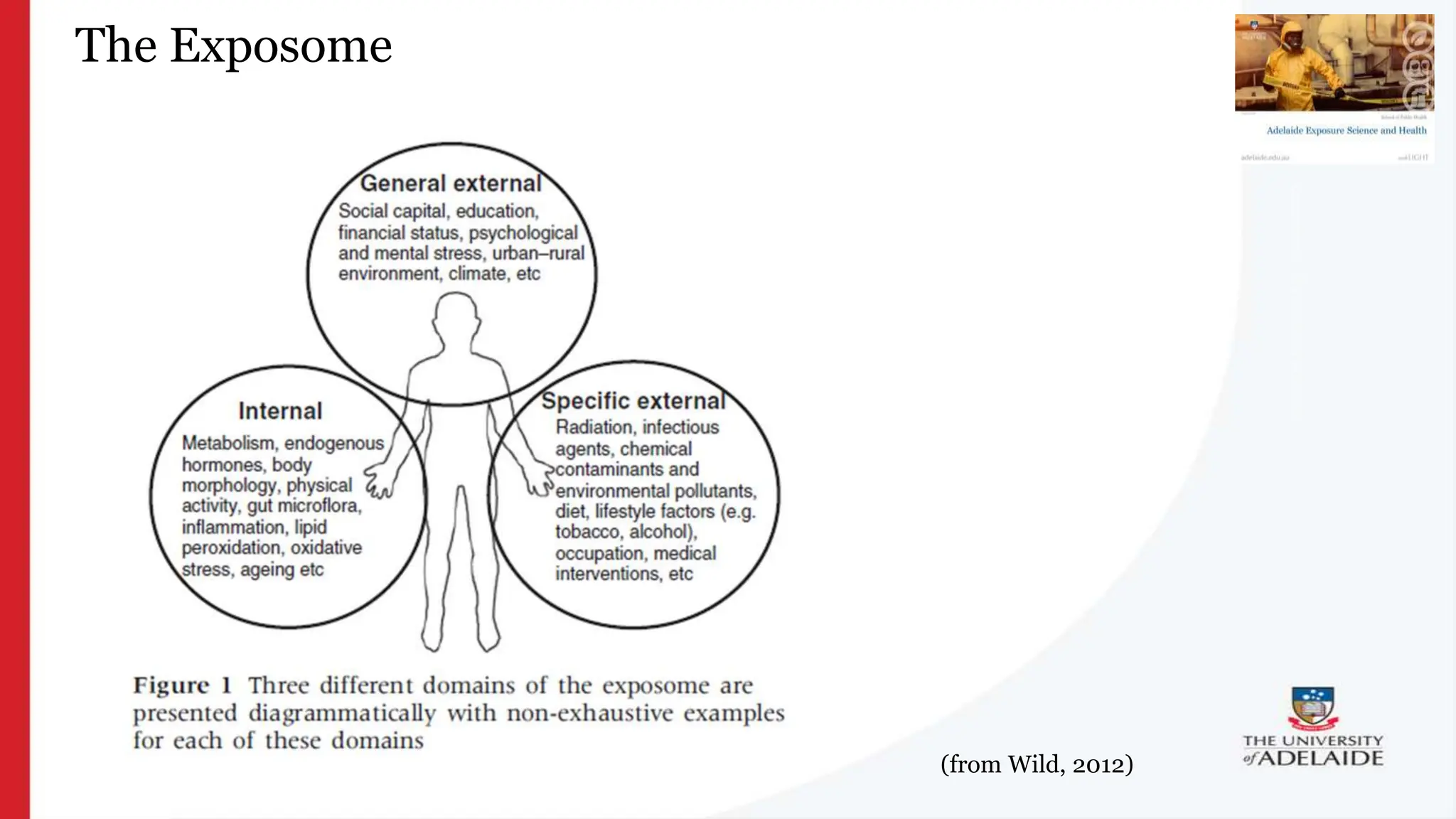
The Exposome
 It comprises the totality of exposures to which an individual is
subjected from conception to death, including those resulting from
environmental agents, socioeconomic conditions, lifestyle, diet, and
endogenous processes.
 The exposome is a concept with limited application at present (e.g.,
cohorts)
 Often generated from consecutive cross-sectional studies
 Exposomics – technologies for characterizing the exposome
What is exposure
science?
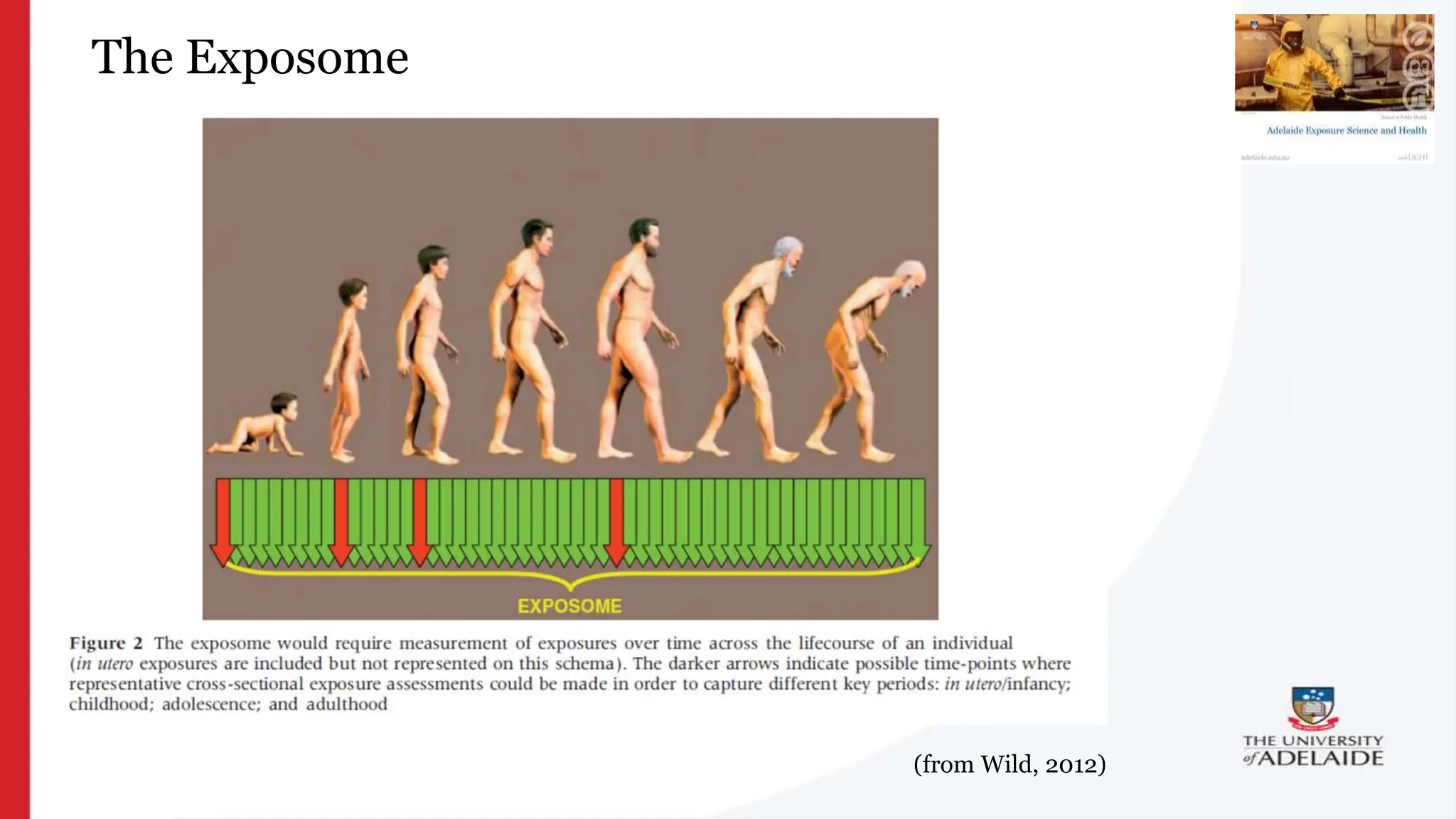
The Exposome
(from Wild, 2012)
What is exposure
science?
The Exposome
(from Wild, 2012)
What is exposure
science?
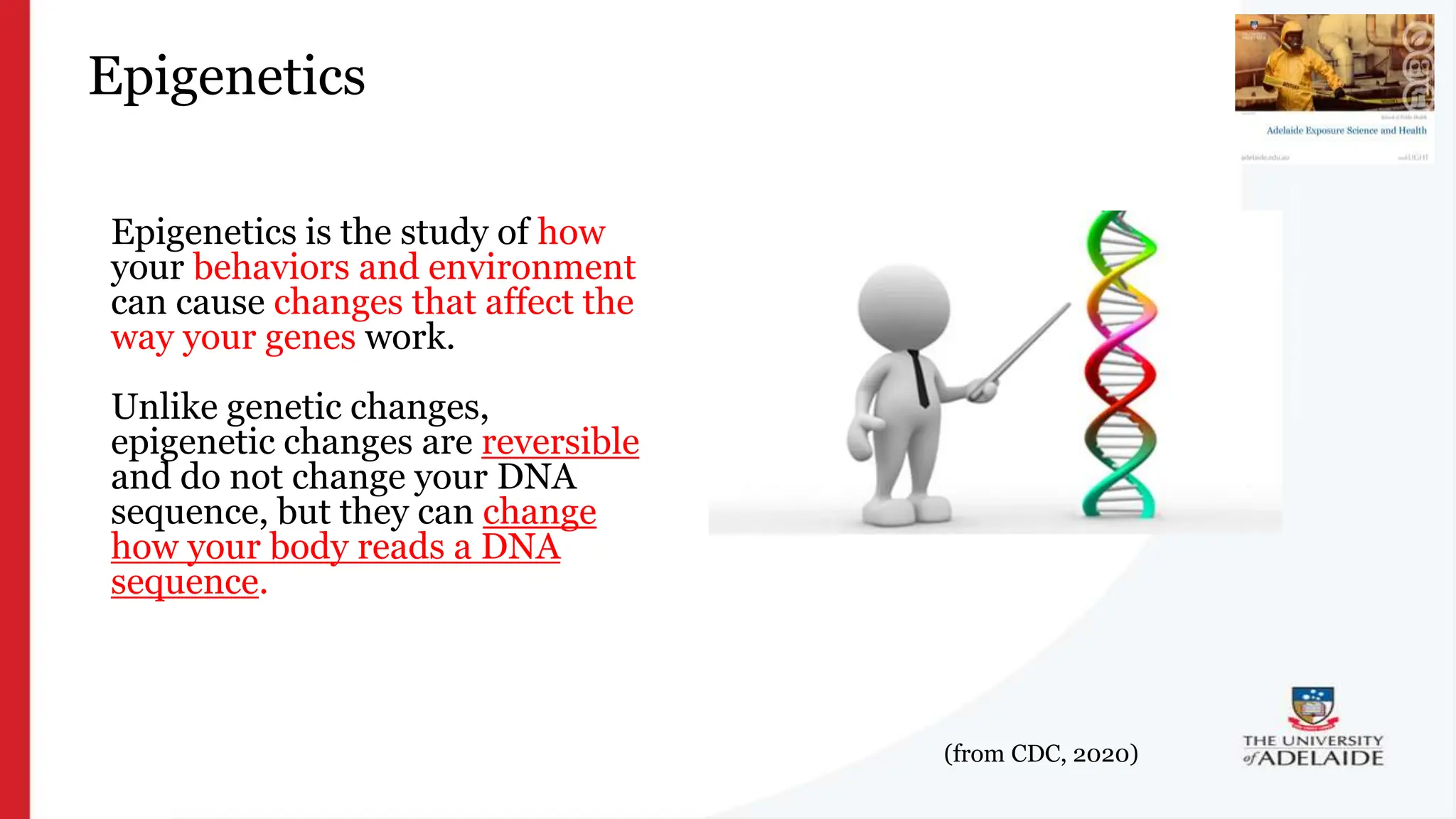
Epigenetics
Epigenetics is the study of how
your behaviors and environment
can cause changes that affect the
way your genes work.
Unlike genetic changes,
epigenetic changes are reversible
and do not change your DNA
sequence, but they can change
how your body reads a DNA
sequence.
(from CDC, 2020)
What is exposure
science?
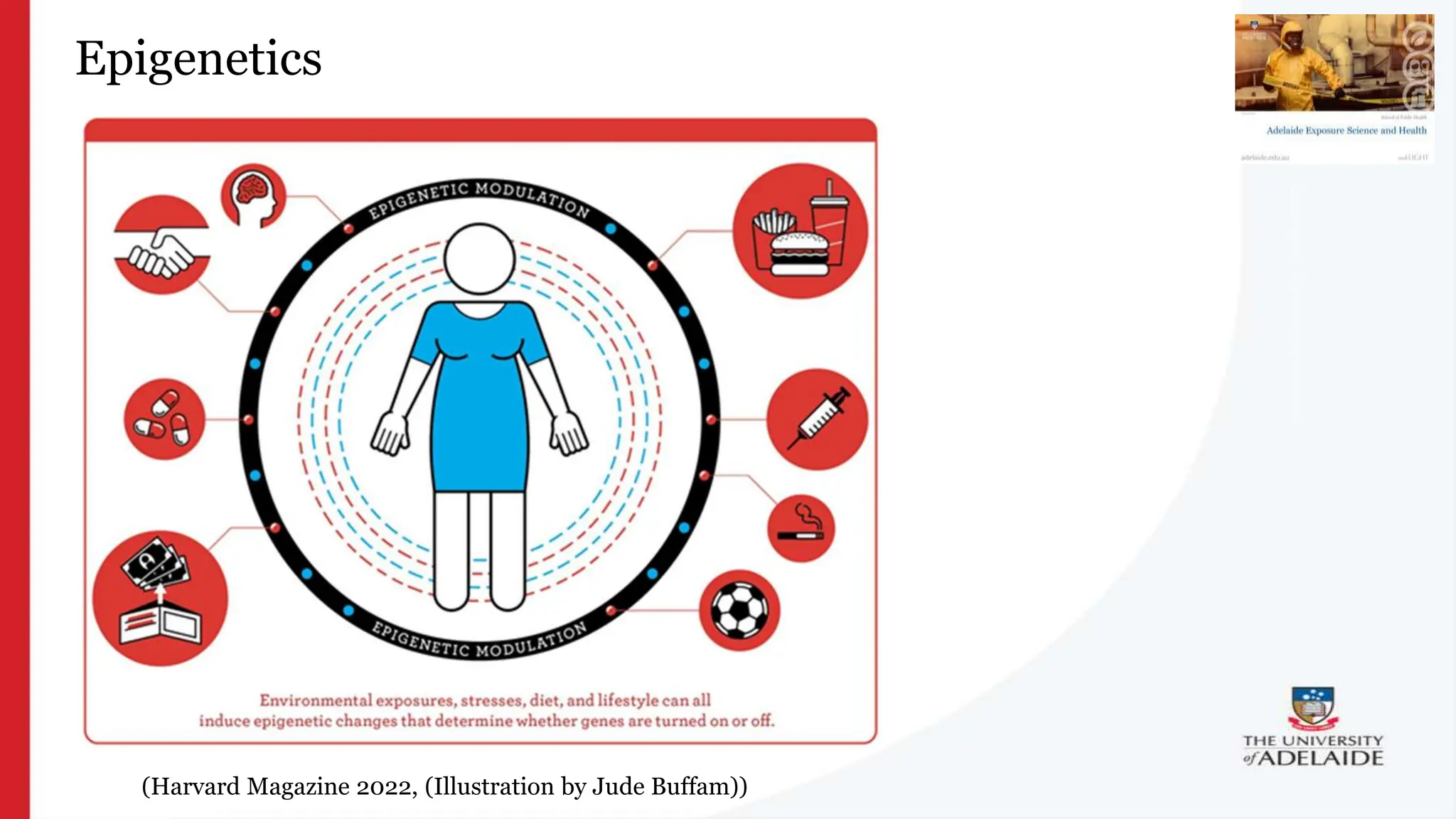
Epigenetics
(Harvard Magazine 2022, (Illustration by Jude Buffam))
What is exposure
science?
Epigenetics
(from Obri et al., (2020)
[Consider early life exposures = Carcinogens,
asthmagens, nutrition, exercise]
What is exposure
science?
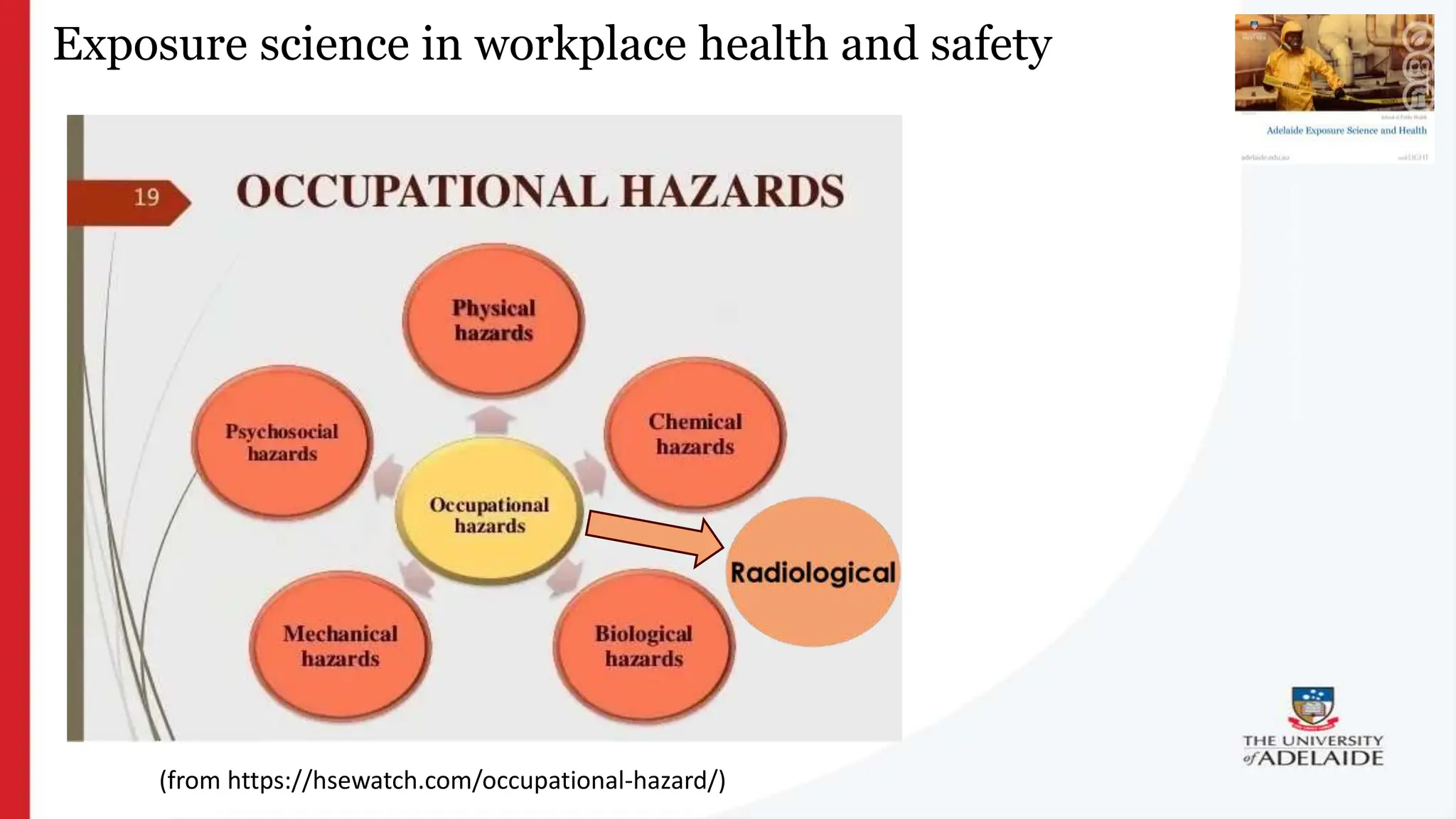
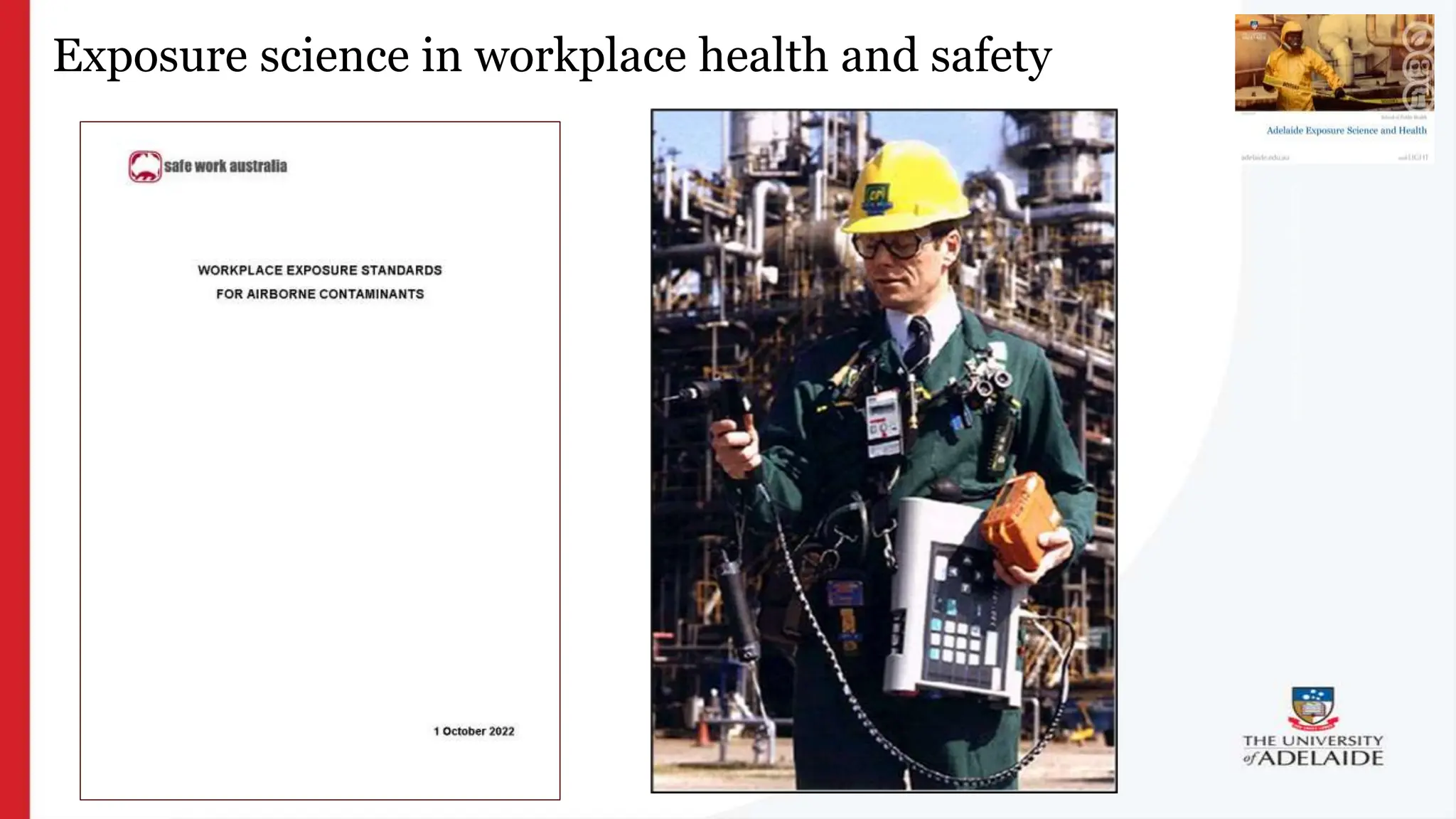
Exposure science in workplace health and safety
(from https://hsewatch.com/occupational-hazard/)
What is exposure
science?
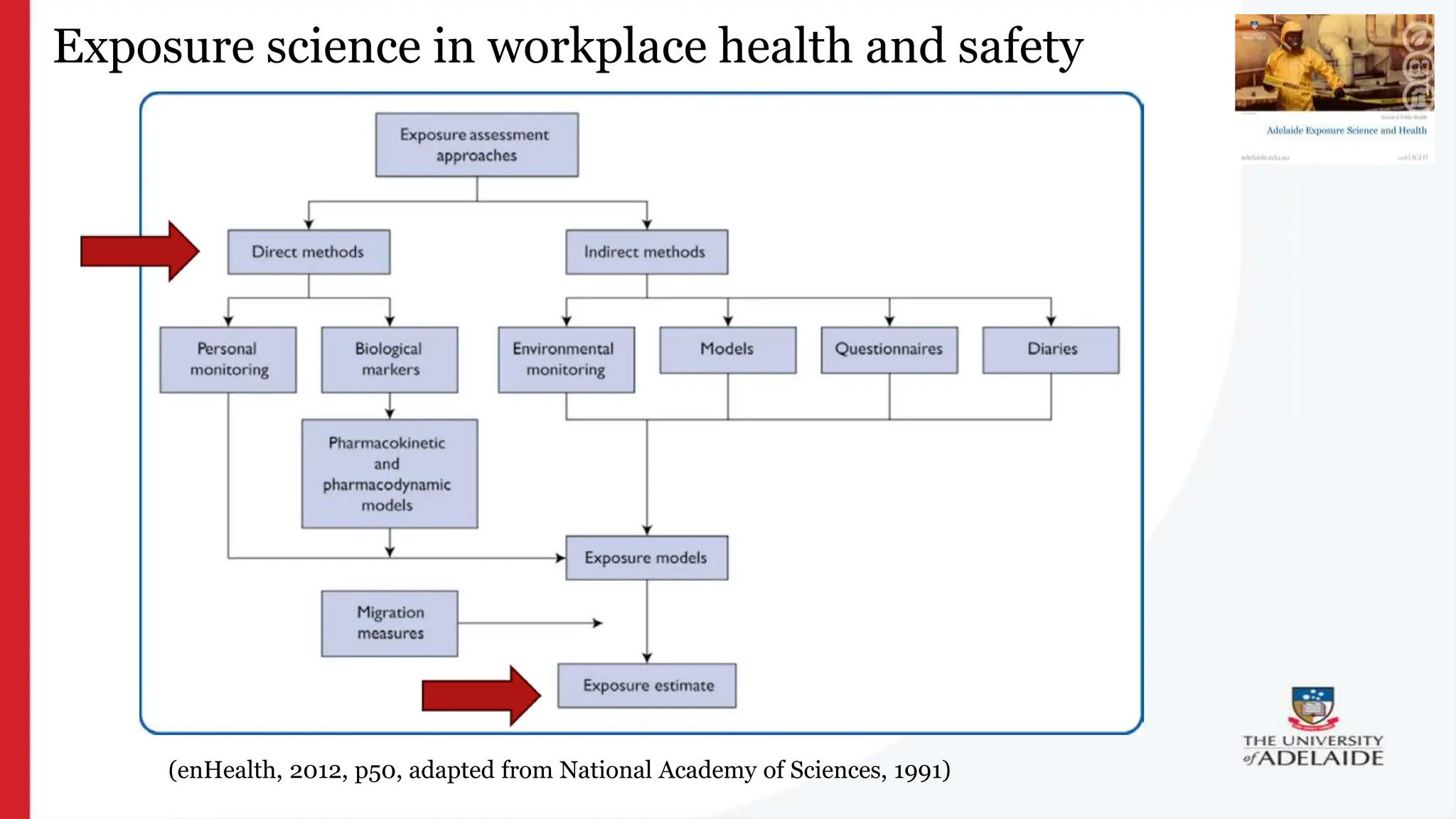
Exposure science in workplace health and safety
(enHealth, 2012, p50, adapted from National Academy of Sciences, 1991)
What is exposure
science?
Exposure science in workplace health and safety
What is exposure
science?
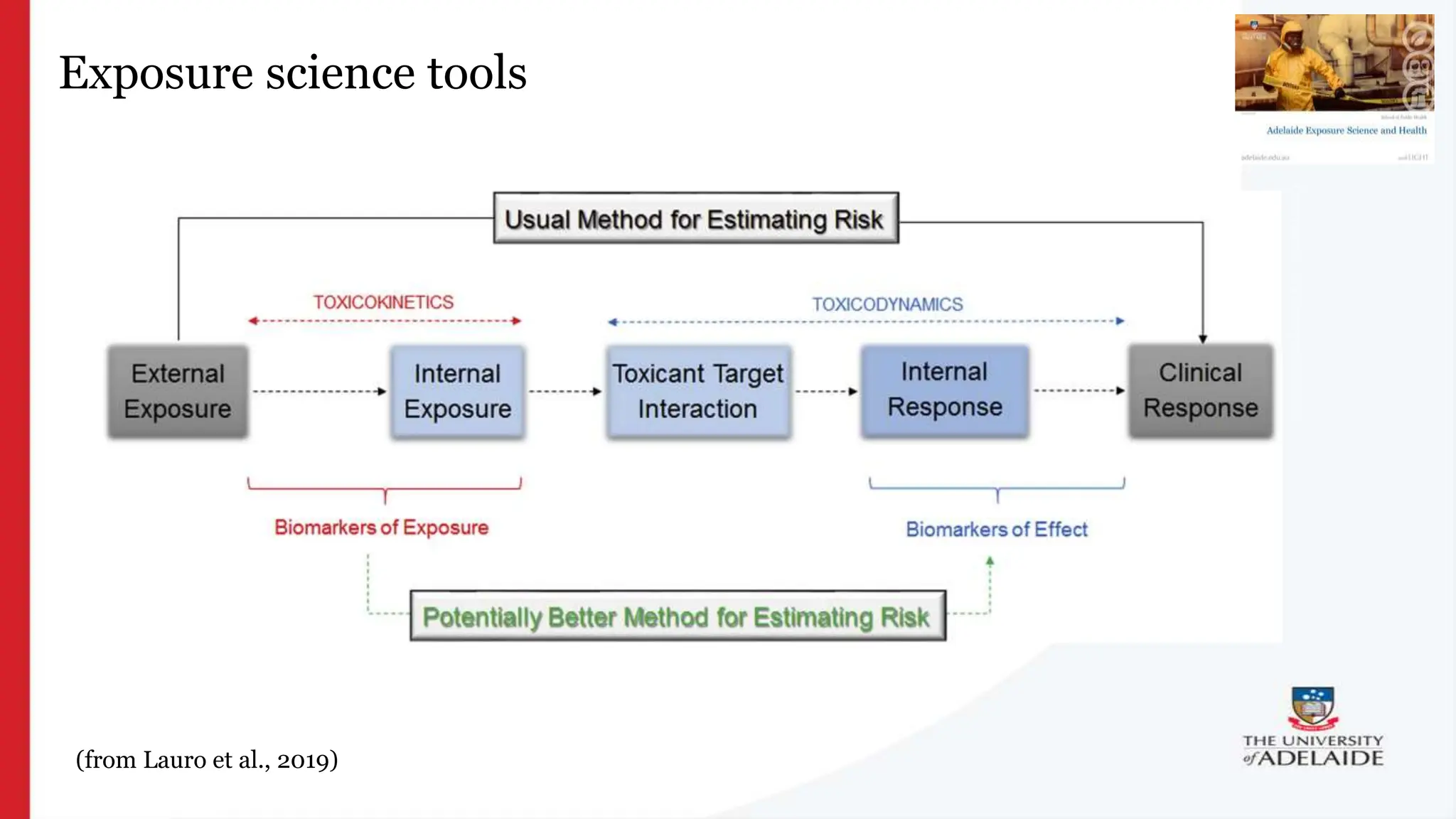
Exposure science tools
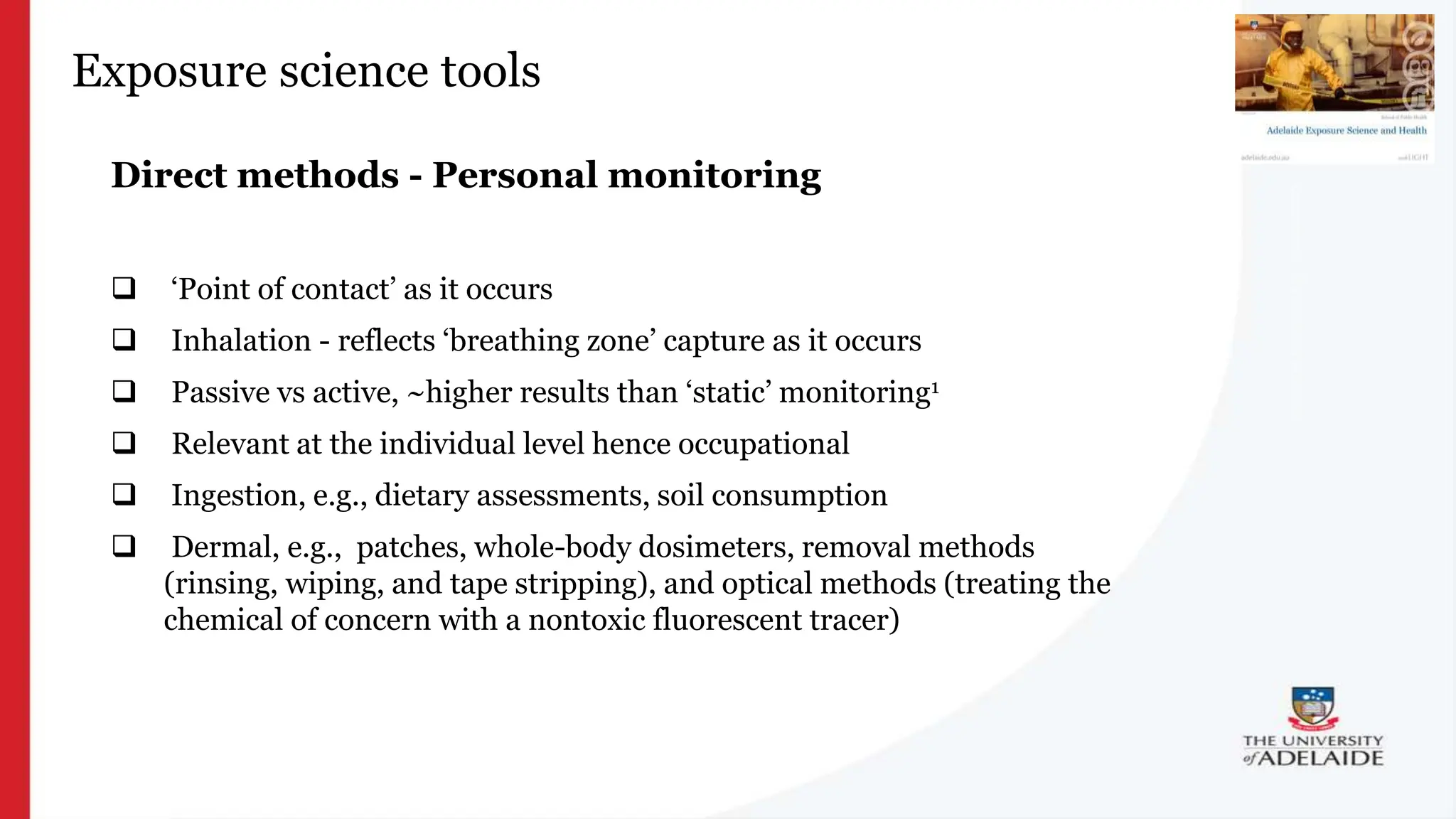
Direct methods - Personal monitoring
 ‘Point of contact’ as it occurs
 Inhalation - reflects ‘breathing zone’ capture as it occurs
 Passive vs active, ~higher results than ‘static’ monitoring1
 Relevant at the individual level hence occupational
 Ingestion, e.g., dietary assessments, soil consumption
 Dermal, e.g., patches, whole-body dosimeters, removal methods
(rinsing, wiping, and tape stripping), and optical methods (treating the
chemical of concern with a nontoxic fluorescent tracer)
What is exposure
science?
Exposure science tools
Direct methods - Biological monitoring
 Assessing chemical exposures by measuring the chemical or its
breakdown products in a biological sample (usually urine, blood or
breath).
 Common in occupational hygiene (phthalates, PAHs)
 Not as common in environmental assessment (lead)
 Need to understand a range of characteristics of your contaminant of
interest (MOA, ADME).
 Reverse dosimetry tools
What is exposure
science?
Exposure science tools
(from Lauro et al., 2019)
What is exposure
science?
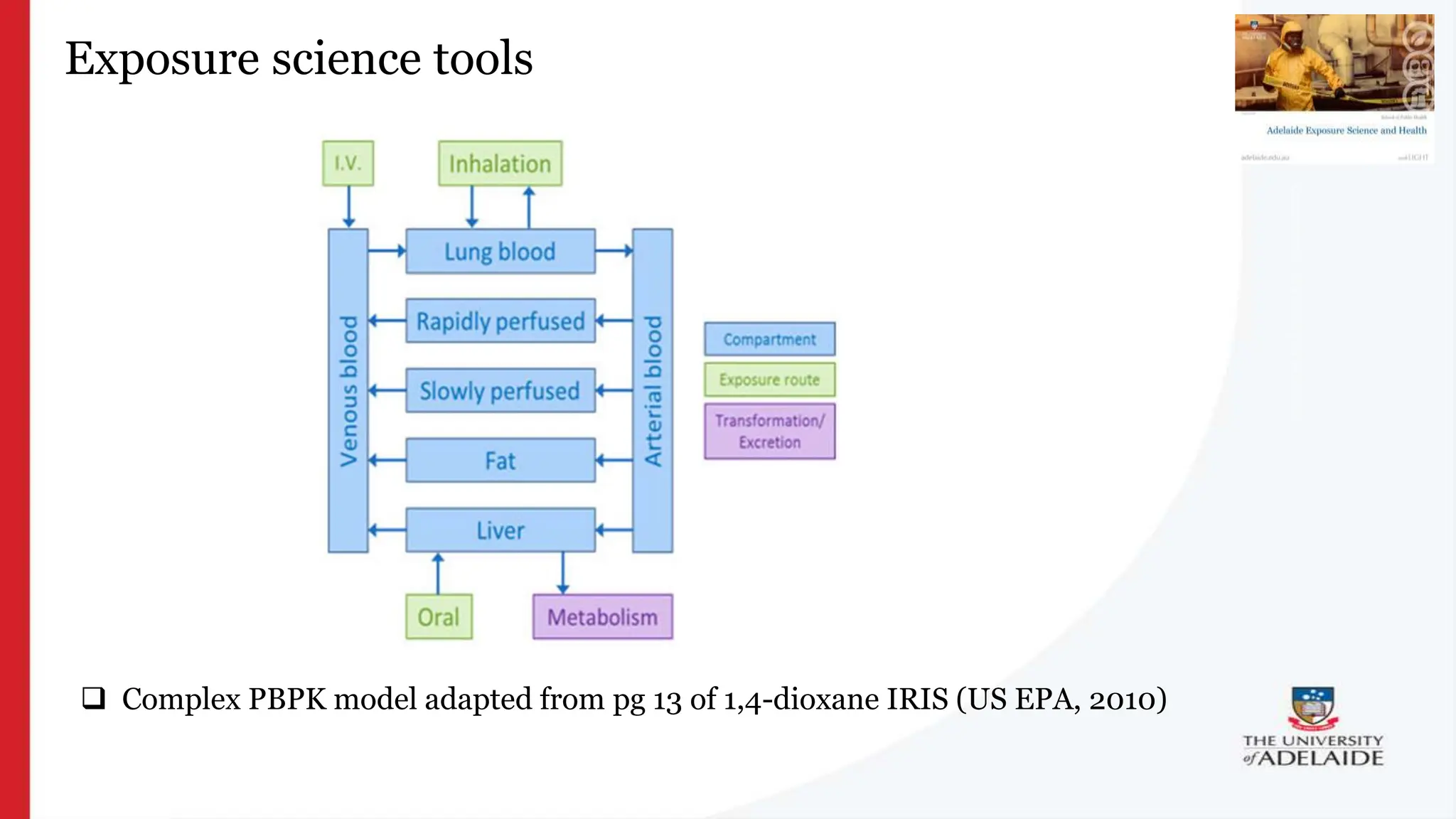
Exposure science tools
 Complex PBPK model adapted from pg 13 of 1,4-dioxane IRIS (US EPA, 2010)
What is exposure
science?
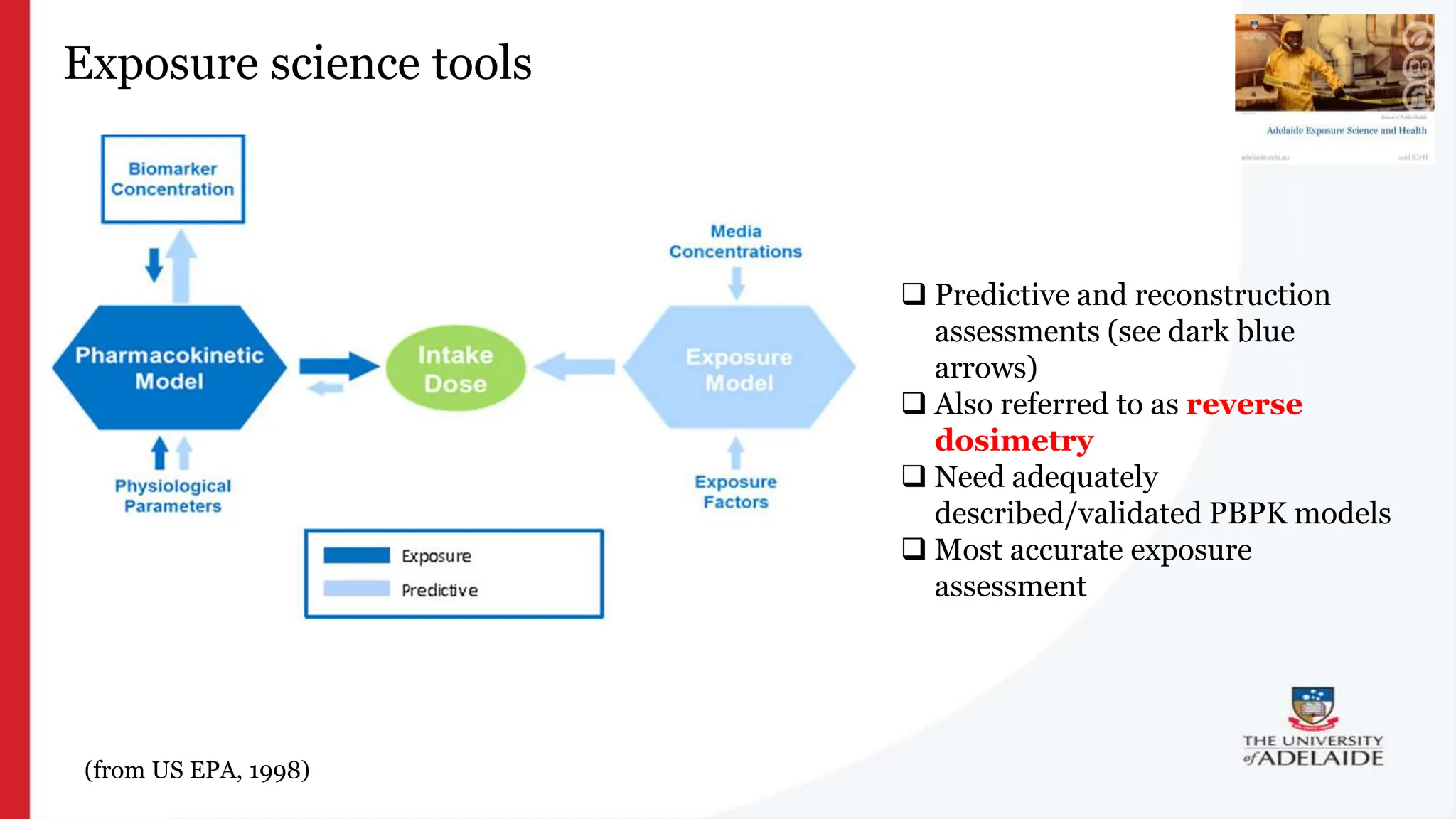
Exposure science tools
(from US EPA, 1998)
 Predictive and reconstruction
assessments (see dark blue
arrows)
 Also referred to as reverse
dosimetry
 Need adequately
described/validated PBPK models
 Most accurate exposure
assessment
What is exposure
science?
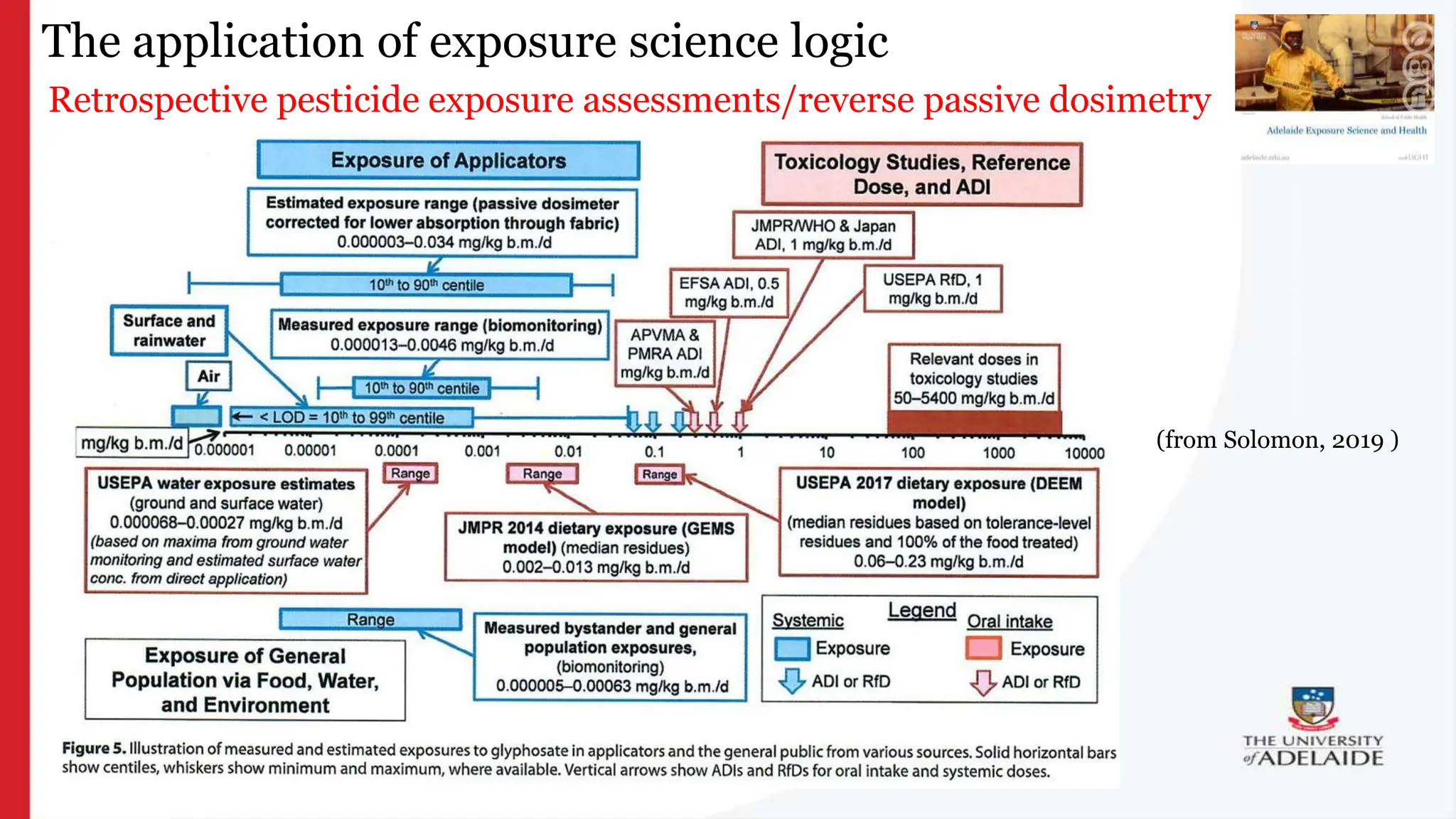
The application of exposure science logic
Retrospective pesticide exposure assessments/reverse passive dosimetry
(from Solomon, 2019 )
The application of exposure science logic
Retrospective pesticide exposure assessments/reverse passive dosimetry
(RISK21 plots, Pastoor et al 2014)
[exposure measurement] [biological marker
exposure measurement]
What is exposure
science?
The application of exposure science logic
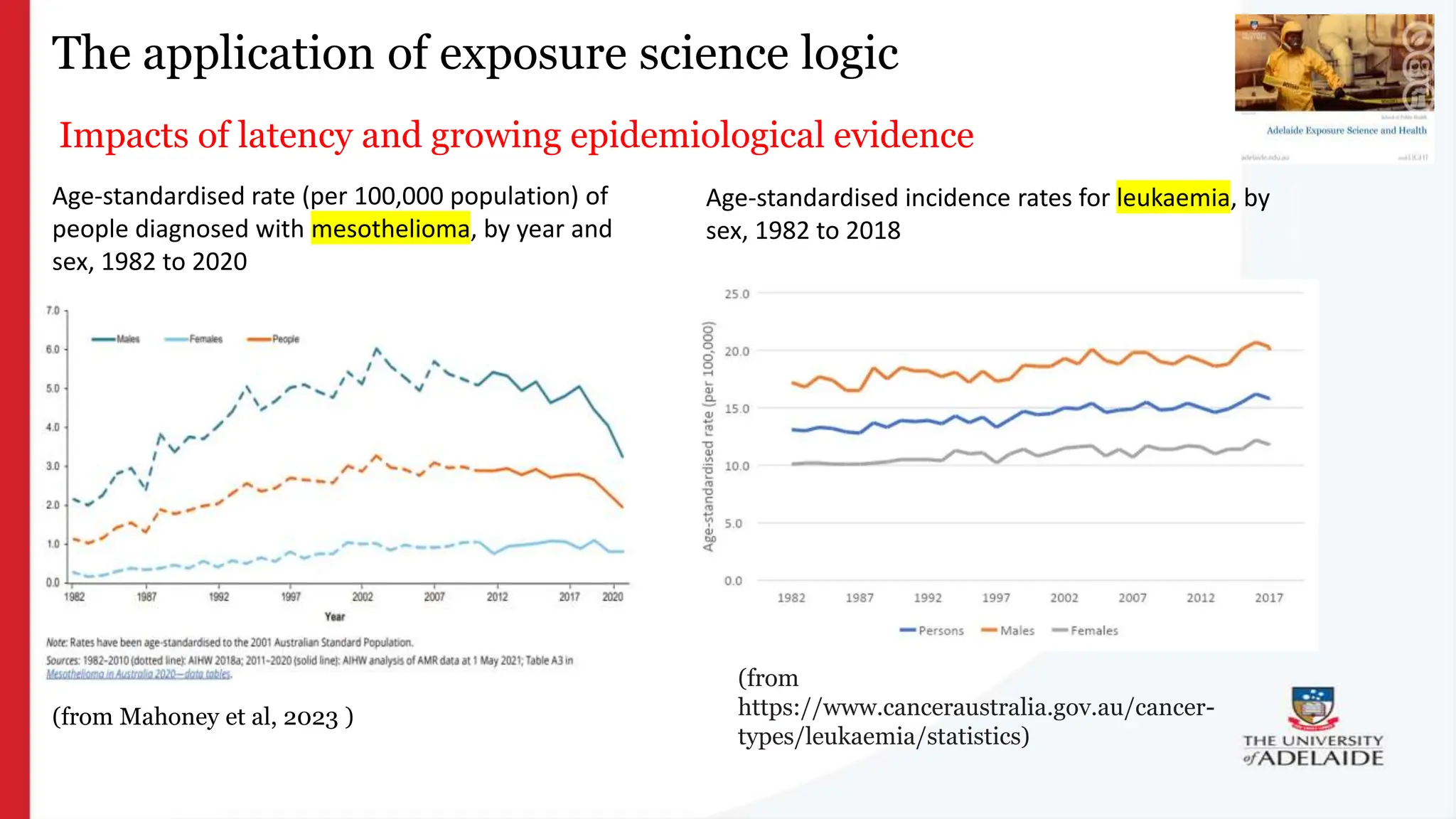
Impacts of latency and growing epidemiological evidence
(from Mahoney et al, 2023 )
Age-standardised rate (per 100,000 population) of
people diagnosed with mesothelioma, by year and
sex, 1982 to 2020
Age-standardised incidence rates for leukaemia, by
sex, 1982 to 2018
(from
https://www.canceraustralia.gov.au/cancer-
types/leukaemia/statistics)
What is exposure
science?
The application of exposure science logic
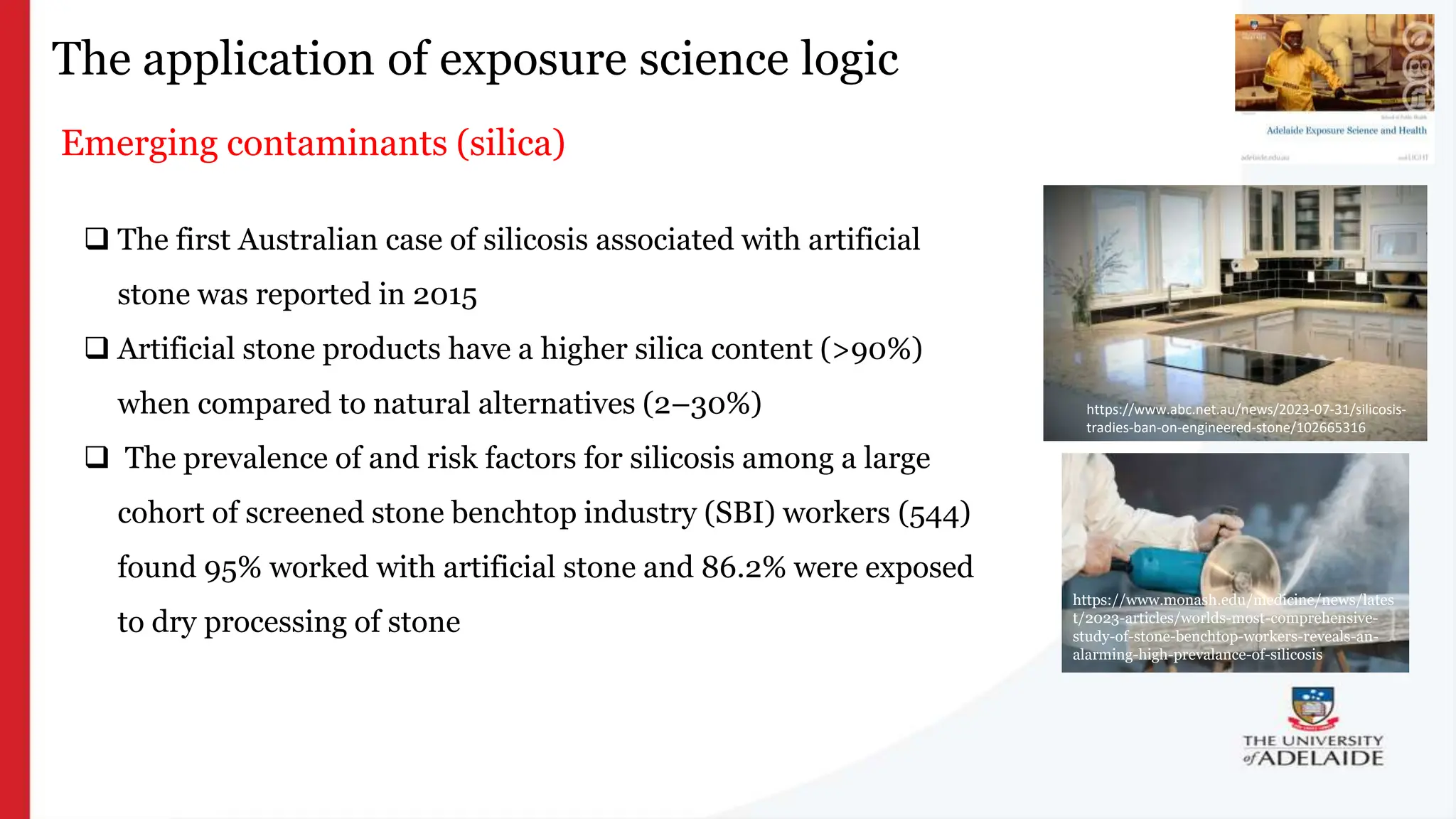
Emerging contaminants (silica)
https://www.monash.edu/medicine/news/lates
t/2023-articles/worlds-most-comprehensive-
study-of-stone-benchtop-workers-reveals-an-
alarming-high-prevalance-of-silicosis
https://www.abc.net.au/news/2023-07-31/silicosis-
tradies-ban-on-engineered-stone/102665316
 The first Australian case of silicosis associated with artificial
stone was reported in 2015
 Artificial stone products have a higher silica content (>90%)
when compared to natural alternatives (2–30%)
 The prevalence of and risk factors for silicosis among a large
cohort of screened stone benchtop industry (SBI) workers (544)
found 95% worked with artificial stone and 86.2% were exposed
to dry processing of stone
What is exposure
science?
The application of exposure science logic
Emerging contaminants (silica)

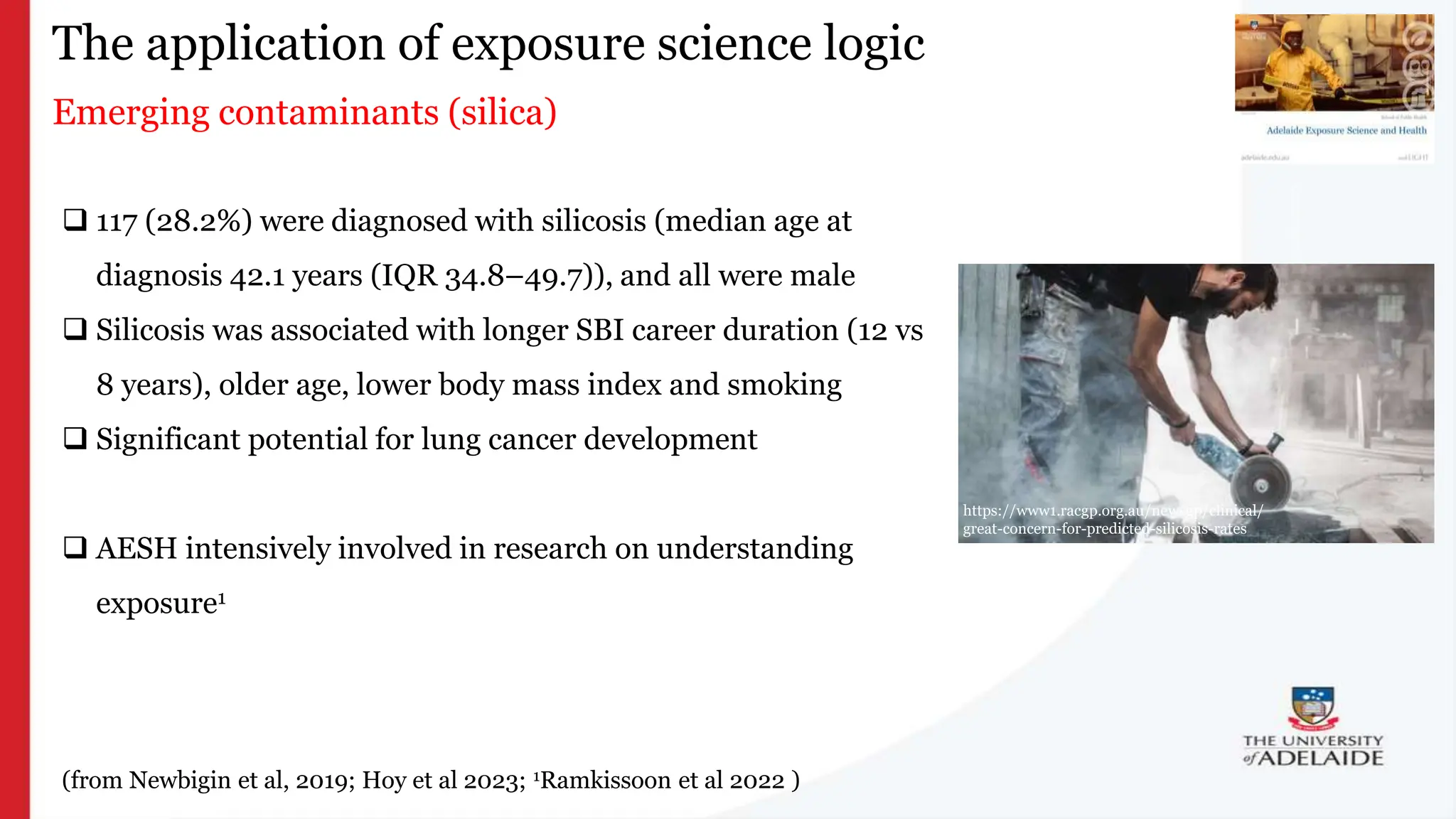
 117 (28.2%) were diagnosed with silicosis (median age at
diagnosis 42.1 years (IQR 34.8–49.7)), and all were male
 Silicosis was associated with longer SBI career duration (12 vs
8 years), older age, lower body mass index and smoking
 Significant potential for lung cancer development
 AESH intensively involved in research on understanding
exposure1
(from Newbigin et al, 2019; Hoy et al 2023; 1Ramkissoon et al 2022 )
https://www1.racgp.org.au/newsgp/clinical/
great-concern-for-predicted-silicosis-rates
What is exposure
science?
The application of exposure science logic
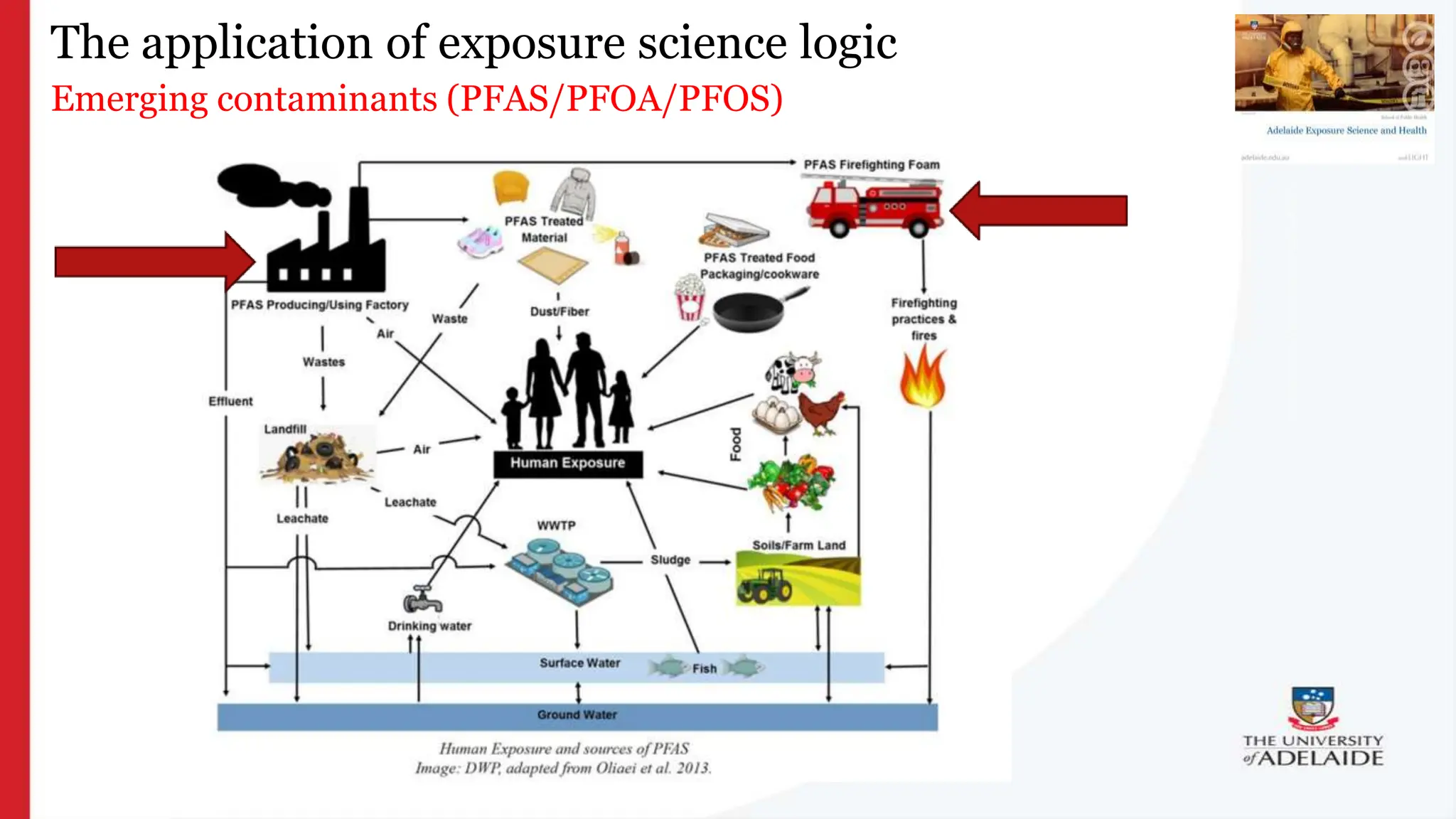
Emerging contaminants
(Per-and polyfluoroalkyl substances (PFAS)/ Perfluorooctanoic Acid
(PFOA), Perfluorooctane Sulfonate (PFOS)
 Toxicology equivocal so what is important?
 Understanding physicochemical and toxico-kinetic characteristics – important for
exposure science
 Incalcitrant and highly water soluble but albumin bound = ↑ body burden/retention
(Biological t1/2 range = 1.0 to 4.7 years (Li et al., 2019)
 This means minute exposures are important and understanding environmental
distribution pathways and exposures critical for risk assessment
What is exposure
science?
The application of exposure science logic
Emerging contaminants (PFAS/PFOA/PFOS)
Time-dependent exposures – where to?
?
The application of exposure science logic
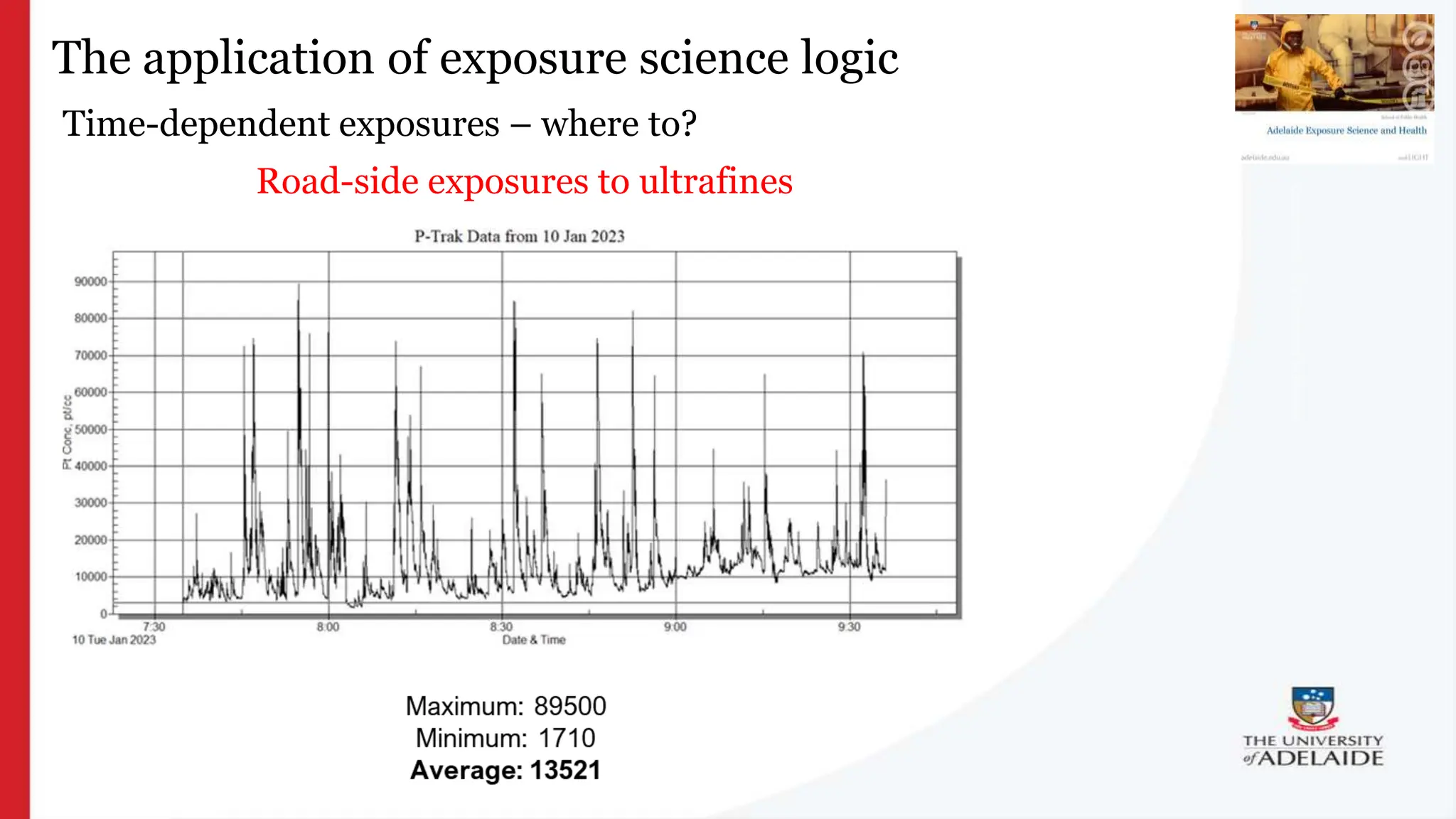
Road-side exposures to ultrafines
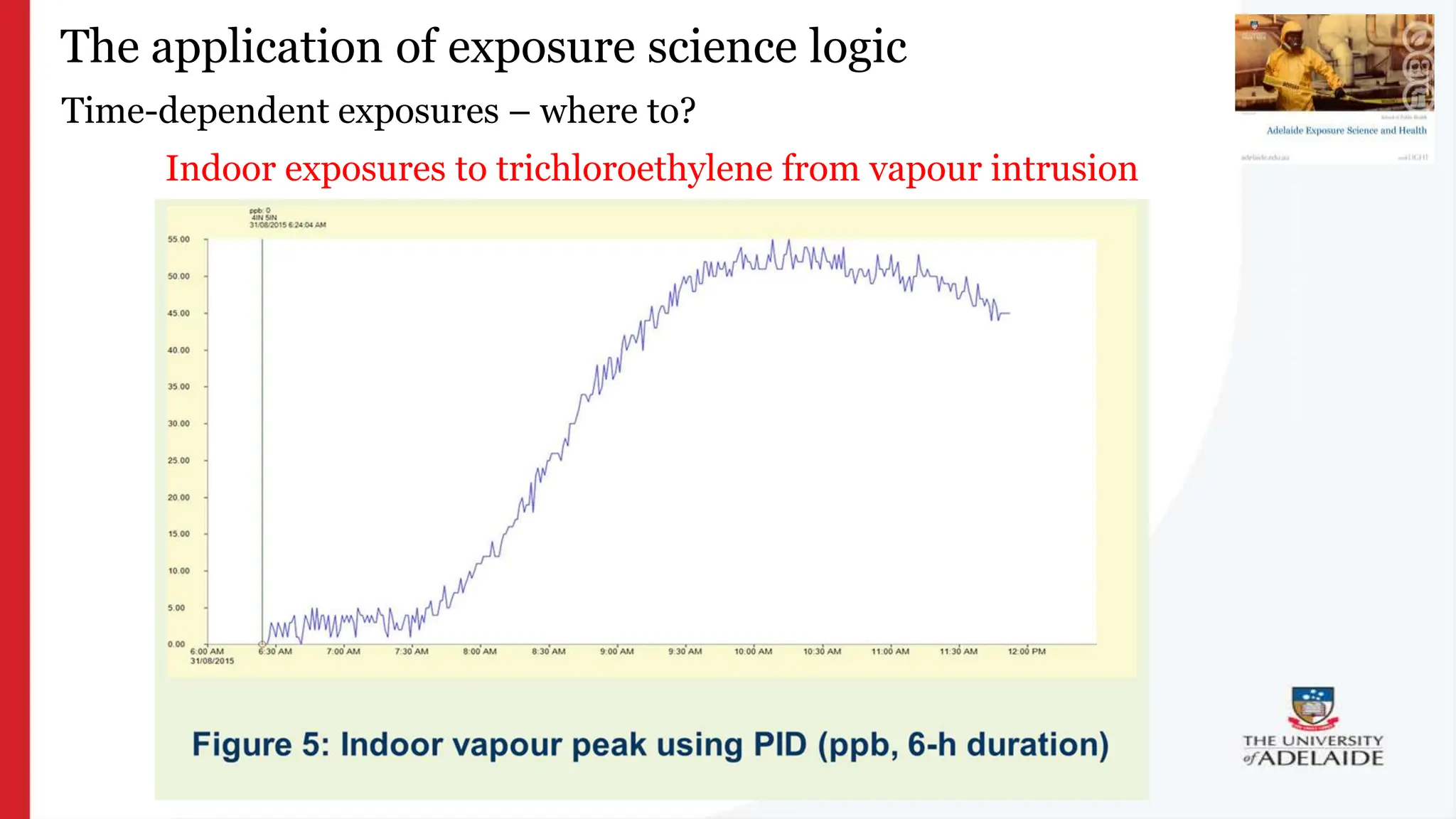
Time-dependent exposures – where to?
?
The application of exposure science logic
Indoor exposures to trichloroethylene from vapour intrusion
What is exposure
science?
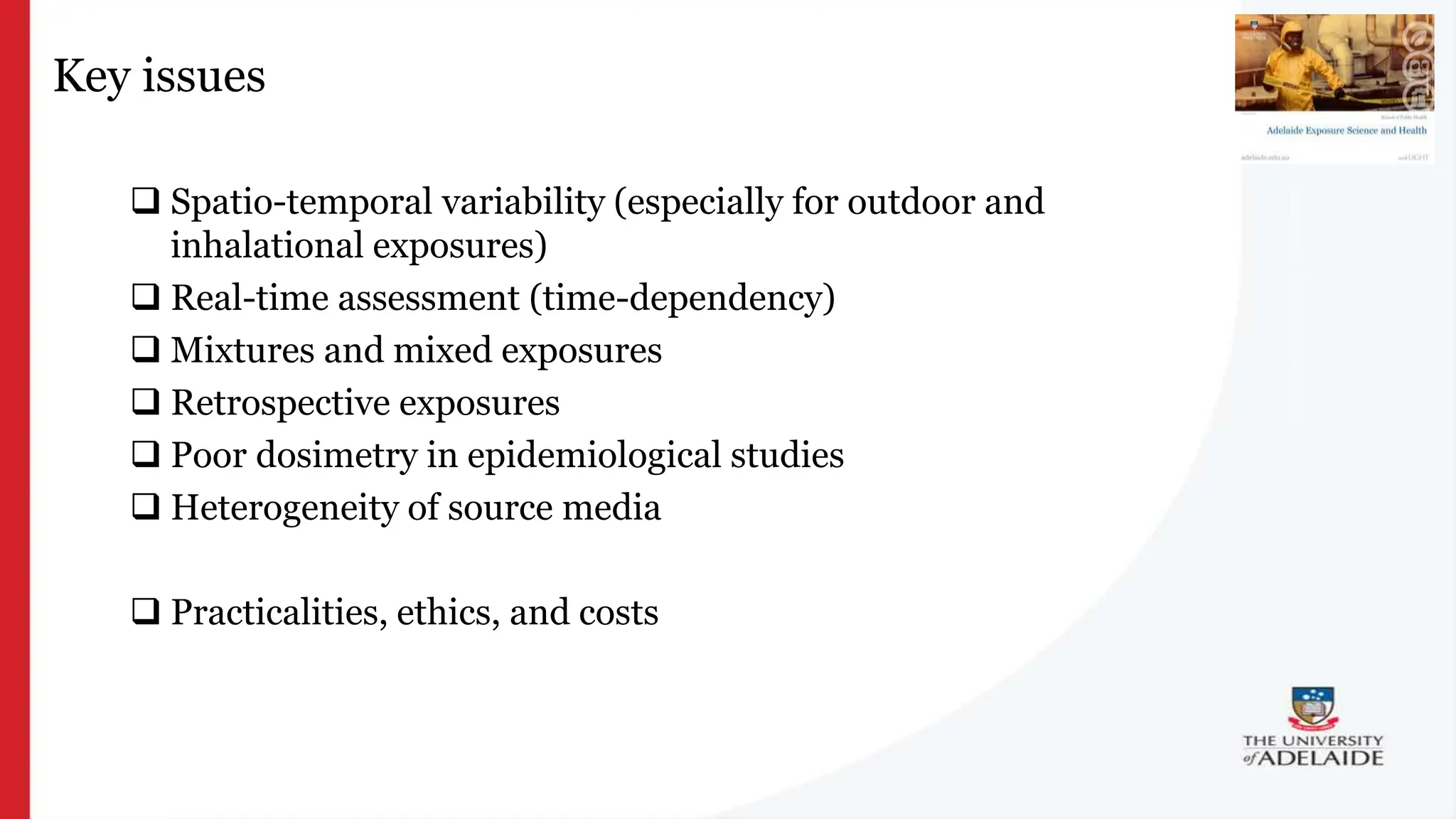
Key issues
 Spatio-temporal variability (especially for outdoor and
inhalational exposures)
 Real-time assessment (time-dependency)
 Mixtures and mixed exposures
 Retrospective exposures
 Poor dosimetry in epidemiological studies
 Heterogeneity of source media
 Practicalities, ethics, and costs
What is exposure
science?
Concluding comments
 Exposure science is complex and evolving
 It is important that exposure monitoring and surveillance
are sustained
 A need to facilitate Australian research studies in the field
to understand exposures and their significance
 Relevance of research objectives should match
community and industry needs
Thank you
SA Safety Symposium 20 October 2023

Understanding the significance of exposure science in WHS issues

  • 1.
    “”” Understanding thesignificance of exposure science in WHS issues Dr Len Turczynowicz Senior Research Fellow, University of Adelaide SA Safety Symposium 20 October 2023
  • 2.
    Presentation Outline  Whatis exposure science?  Exposome and epigenetics  Exposure science in workplace health and safety  Exposure science tools  The application of exposure science logic  Retrospective pesticide exposure assessments  Impacts of latency and growing epidemiological evidence  Emerging contaminants (silica; PFAS/PFOA)  Time-dependent exposures – where to?  Key issues and concluding comments
  • 3.
    What is exposurescience? Definition  Exposure science addresses the intensity and duration of contact of humans or other organisms with those agents (defined as chemical, physical, or biologic stressors) and their fate in living systems.” (National Academy of Sciences, 2012, p33)
  • 4.
    What is exposure science? Whatis exposure science? (from NRC, 2012)
  • 5.
    What is exposure science? Whatis exposure science?  The study of stressors, populations (receptors), and their contacts in the context of space and time  The science linking human and ecologic behaviour to environmental processes in such a way that the information generated can be used to mitigate or prevent future adverse exposures  Predominantly observational performed in the field within normal living and working situations  Exposure science is a multidisciplinary field, both an art and a science.
  • 6.
    What is exposure science? Whatis exposure science? (from NRC, 2012)
  • 7.
    What is exposure science? TheExposome  It comprises the totality of exposures to which an individual is subjected from conception to death, including those resulting from environmental agents, socioeconomic conditions, lifestyle, diet, and endogenous processes.  The exposome is a concept with limited application at present (e.g., cohorts)  Often generated from consecutive cross-sectional studies  Exposomics – technologies for characterizing the exposome
  • 8.
    What is exposure science? TheExposome (from Wild, 2012)
  • 9.
    What is exposure science? TheExposome (from Wild, 2012)
  • 10.
    What is exposure science? Epigenetics Epigeneticsis the study of how your behaviors and environment can cause changes that affect the way your genes work. Unlike genetic changes, epigenetic changes are reversible and do not change your DNA sequence, but they can change how your body reads a DNA sequence. (from CDC, 2020)
  • 11.
    What is exposure science? Epigenetics (HarvardMagazine 2022, (Illustration by Jude Buffam))
  • 12.
    What is exposure science? Epigenetics (fromObri et al., (2020) [Consider early life exposures = Carcinogens, asthmagens, nutrition, exercise]
  • 13.
    What is exposure science? Exposurescience in workplace health and safety (from https://hsewatch.com/occupational-hazard/)
  • 14.
    What is exposure science? Exposurescience in workplace health and safety (enHealth, 2012, p50, adapted from National Academy of Sciences, 1991)
  • 15.
    What is exposure science? Exposurescience in workplace health and safety
  • 16.
    What is exposure science? Exposurescience tools Direct methods - Personal monitoring  ‘Point of contact’ as it occurs  Inhalation - reflects ‘breathing zone’ capture as it occurs  Passive vs active, ~higher results than ‘static’ monitoring1  Relevant at the individual level hence occupational  Ingestion, e.g., dietary assessments, soil consumption  Dermal, e.g., patches, whole-body dosimeters, removal methods (rinsing, wiping, and tape stripping), and optical methods (treating the chemical of concern with a nontoxic fluorescent tracer)
  • 17.
    What is exposure science? Exposurescience tools Direct methods - Biological monitoring  Assessing chemical exposures by measuring the chemical or its breakdown products in a biological sample (usually urine, blood or breath).  Common in occupational hygiene (phthalates, PAHs)  Not as common in environmental assessment (lead)  Need to understand a range of characteristics of your contaminant of interest (MOA, ADME).  Reverse dosimetry tools
  • 18.
    What is exposure science? Exposurescience tools (from Lauro et al., 2019)
  • 19.
    What is exposure science? Exposurescience tools  Complex PBPK model adapted from pg 13 of 1,4-dioxane IRIS (US EPA, 2010)
  • 20.
    What is exposure science? Exposurescience tools (from US EPA, 1998)  Predictive and reconstruction assessments (see dark blue arrows)  Also referred to as reverse dosimetry  Need adequately described/validated PBPK models  Most accurate exposure assessment
  • 21.
    What is exposure science? Theapplication of exposure science logic Retrospective pesticide exposure assessments/reverse passive dosimetry (from Solomon, 2019 )
  • 22.
    The application ofexposure science logic Retrospective pesticide exposure assessments/reverse passive dosimetry (RISK21 plots, Pastoor et al 2014) [exposure measurement] [biological marker exposure measurement]
  • 23.
    What is exposure science? Theapplication of exposure science logic Impacts of latency and growing epidemiological evidence (from Mahoney et al, 2023 ) Age-standardised rate (per 100,000 population) of people diagnosed with mesothelioma, by year and sex, 1982 to 2020 Age-standardised incidence rates for leukaemia, by sex, 1982 to 2018 (from https://www.canceraustralia.gov.au/cancer- types/leukaemia/statistics)
  • 24.
    What is exposure science? Theapplication of exposure science logic Emerging contaminants (silica) https://www.monash.edu/medicine/news/lates t/2023-articles/worlds-most-comprehensive- study-of-stone-benchtop-workers-reveals-an- alarming-high-prevalance-of-silicosis https://www.abc.net.au/news/2023-07-31/silicosis- tradies-ban-on-engineered-stone/102665316  The first Australian case of silicosis associated with artificial stone was reported in 2015  Artificial stone products have a higher silica content (>90%) when compared to natural alternatives (2–30%)  The prevalence of and risk factors for silicosis among a large cohort of screened stone benchtop industry (SBI) workers (544) found 95% worked with artificial stone and 86.2% were exposed to dry processing of stone
  • 25.
    What is exposure science? Theapplication of exposure science logic Emerging contaminants (silica)   117 (28.2%) were diagnosed with silicosis (median age at diagnosis 42.1 years (IQR 34.8–49.7)), and all were male  Silicosis was associated with longer SBI career duration (12 vs 8 years), older age, lower body mass index and smoking  Significant potential for lung cancer development  AESH intensively involved in research on understanding exposure1 (from Newbigin et al, 2019; Hoy et al 2023; 1Ramkissoon et al 2022 ) https://www1.racgp.org.au/newsgp/clinical/ great-concern-for-predicted-silicosis-rates
  • 26.
    What is exposure science? Theapplication of exposure science logic Emerging contaminants (Per-and polyfluoroalkyl substances (PFAS)/ Perfluorooctanoic Acid (PFOA), Perfluorooctane Sulfonate (PFOS)  Toxicology equivocal so what is important?  Understanding physicochemical and toxico-kinetic characteristics – important for exposure science  Incalcitrant and highly water soluble but albumin bound = ↑ body burden/retention (Biological t1/2 range = 1.0 to 4.7 years (Li et al., 2019)  This means minute exposures are important and understanding environmental distribution pathways and exposures critical for risk assessment
  • 27.
    What is exposure science? Theapplication of exposure science logic Emerging contaminants (PFAS/PFOA/PFOS)
  • 28.
    Time-dependent exposures –where to? ? The application of exposure science logic Road-side exposures to ultrafines
  • 29.
    Time-dependent exposures –where to? ? The application of exposure science logic Indoor exposures to trichloroethylene from vapour intrusion
  • 30.
    What is exposure science? Keyissues  Spatio-temporal variability (especially for outdoor and inhalational exposures)  Real-time assessment (time-dependency)  Mixtures and mixed exposures  Retrospective exposures  Poor dosimetry in epidemiological studies  Heterogeneity of source media  Practicalities, ethics, and costs
  • 31.
    What is exposure science? Concludingcomments  Exposure science is complex and evolving  It is important that exposure monitoring and surveillance are sustained  A need to facilitate Australian research studies in the field to understand exposures and their significance  Relevance of research objectives should match community and industry needs
  • 32.
    Thank you SA SafetySymposium 20 October 2023