1
The Way We Work Has Changed Looking Toward 2030
2
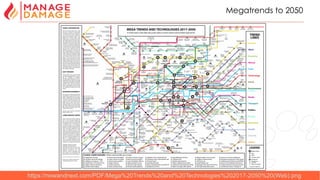
Megatrends to 2050
https://nowandnext.com/PDF/Mega%20Trends%20and%20Technologies%202017-2050%20(Web).png
3
Megatrends to 2050
The extending reach of automated systems and robotics. The costs of advanced automated technologies are likely to
continue falling and the capabilities and widespread deployment are likely to continue rising.
Rising workplace stress and mental health issues. Australia's workforce is registering increasing levels of stress and mental
health issues. New and intensifying uses of digital technologies in the workplace may exacerbate problems with mental
health and stress, but technology also presents opportunities to manage these issues.
Rising screen time, sedentary behaviour and chronic illness. The amount of daily screen time has grown for both adults
and children and there is a continued drift away from manual jobs towards sedentary jobs. Rates of obesity,
cardiovascular disease, type 2 diabetes, and other chronic illnesses continue to rise.
Blurring the boundaries between work and home. An increasingly large share of Australian workers are entering into work
arrangements that enable them to work from home or other locations, blurring the boundaries between work and home
life.
The gig and entrepreneurial economy. The gig economy refers to freelance task-based work organised through online
platforms or 'apps'. It changes the way we work away from traditional employment models. Although the Australian gig
economy is still relatively small, at least some growth is anticipated.
An ageing workforce. The average age of Australia's workforce is increasing along with the ageing of the population as
a whole and older Australians are having to stay in the workforce longer.
https://www.csiro.au/en/News/News-releases/2018/Six-megatrends-workplace-health-safety
4
Megatrends to 2050
5
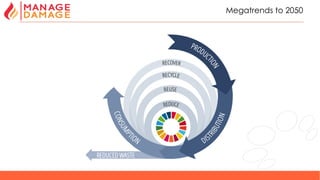
Megatrends to 2050
https://ec.europa.eu/info/sites/info/files/commission-white-paper-artificial-intelligence-feb2020_en.pdf
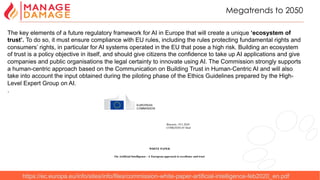
The key elements of a future regulatory framework for AI in Europe that will create a unique ‘ecosystem of
trust’. To do so, it must ensure compliance with EU rules, including the rules protecting fundamental rights and
consumers’ rights, in particular for AI systems operated in the EU that pose a high risk. Building an ecosystem
of trust is a policy objective in itself, and should give citizens the confidence to take up AI applications and give
companies and public organisations the legal certainty to innovate using AI. The Commission strongly supports
a human-centric approach based on the Communication on Building Trust in Human-Centric AI and will also
take into account the input obtained during the piloting phase of the Ethics Guidelines prepared by the High-
Level Expert Group on AI.
.
6
Megatrends to 2050
https://ec.europa.eu/info/sites/info/files/commission-white-paper-artificial-intelligence-feb2020_en.pdf
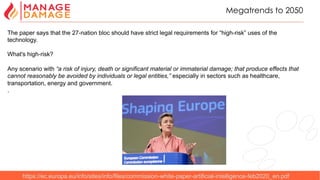
The paper says that the 27-nation bloc should have strict legal requirements for “high-risk” uses of the
technology.
What's high-risk?
Any scenario with “a risk of injury, death or significant material or immaterial damage; that produce effects that
cannot reasonably be avoided by individuals or legal entities,” especially in sectors such as healthcare,
transportation, energy and government.
.
7
Megatrends to 2050
https://www.iecetech.org/issue/2020-01/Looking-to-the-future
8
Megatrends to 2050
https://www.iecetech.org/issue/2020-01/A-holistic-ecosystem-approach-to-AI/(gallery)/show
9
Overview
What does the future / today look like?
• Globalisation
• Employment or Engagement
• New Types of Engagement
• Subcontractor Management
• Inspections and Regulator Management
• Robotics in the Workplace
• Legislation and Documentation/ Codes
not yet caught up to todays “future”
• Corporate Social Duties
10
Change for Yesterday or at least - Now
We need to install systems, standards and
set guidelines now to catch up to these
changing factors that we suggest are
future issues – in every workplace we are
already here in some fashion – time to
identify these risks at your workplace and
then start to close the gap of risks we face
daily.
11
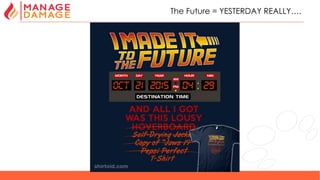
The Future = YESTERDAY REALLY….
12
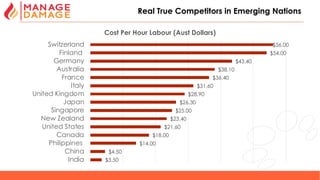
Globalisation is Real = True Competitors in All Nations
13
Real True Competitors in Emerging Nations
$3.50
$4.50
$14.00
$18.00
$21.60
$23.40
$25.00
$26.30
$28.90
$31.60
$36.40
$38.10
$43.40
$54.00
$56.00
India
China
Philippines
Canada
United States
New Zealand
Singapore
Japan
United Kingdom
Italy
France
Australia
Germany
Finland
Switzerland
Cost Per Hour Labour (Aust Dollars)
14
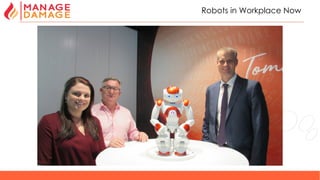
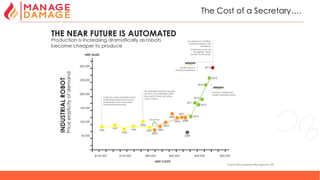
Robots in Workplace Now
15
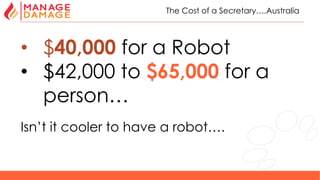
The Cost of a Secretary….
16
The Cost of a Secretary….Australia
• $40,000 for a Robot
• $42,000 to $65,000 for a
person…
Isn’t it cooler to have a robot….
17
They are not entirely ready….. In some places
18
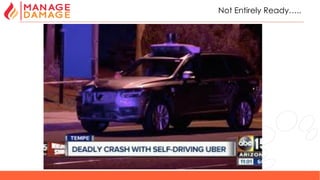
Not Entirely Ready…..
19
Not Entirely Ready…..
https://www.technologyreview.com/s/615244/hackers-can-trick-a-tesla-into-accelerating-by-50-miles-per-hour/
Hackers can trick a Tesla into accelerating by 50 miles per hour
A two inch piece of tape fooled the Tesla’s cameras and made the car quickly and mistakenly speed up.
20
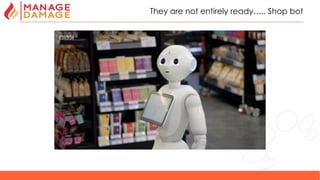
They are not entirely ready….. Shop bot
21
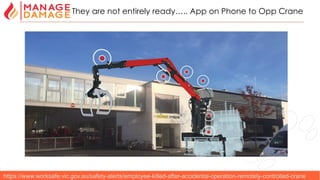
They are not entirely ready….. App on Phone to Opp Crane
https://www.worksafe.vic.gov.au/safety-alerts/employee-killed-after-accidental-operation-remotely-controlled-crane
22
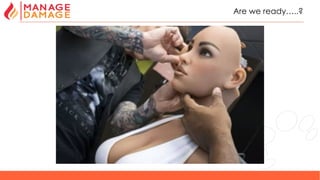
Are we ready…..?
23
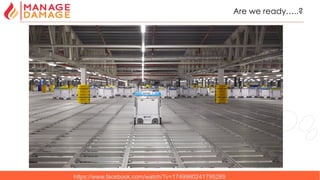
Are we ready…..?
https://www.facebook.com/watch/?v=1749960241795289
24
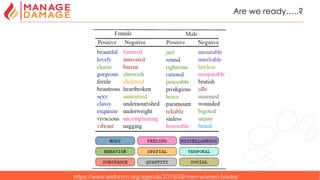
Are we ready…..?
https://www.weforum.org/agenda/2019/09/men-women-books/
25
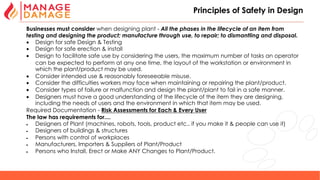
Principles of Safety in Design
Businesses must consider when designing plant - All the phases in the lifecycle of an item from
testing and designing the product; manufacture through use, to repair; to dismantling and disposal.
• Design for safe Design & Testing
• Design for safe erection & install
• Design to facilitate safe use by considering the users, the maximum number of tasks an operator
can be expected to perform at any one time, the layout of the workstation or environment in
which the plant/product may be used.
• Consider intended use & reasonably foreseeable misuse.
• Consider the difficulties workers may face when maintaining or repairing the plant/product.
• Consider types of failure or malfunction and design the plant/plant to fail in a safe manner.
• Designers must have a good understanding of the lifecycle of the item they are designing,
including the needs of users and the environment in which that item may be used.
Required Documentation - Risk Assessments for Each & Every User
The law has requirements for....
• Designers of Plant (machines, robots, tools, product etc.. if you make it & people can use it)
• Designers of buildings & structures
• Persons with control of workplaces
• Manufacturers, Importers & Suppliers of Plant/Product
• Persons who Install, Erect or Make ANY Changes to Plant/Product.
26
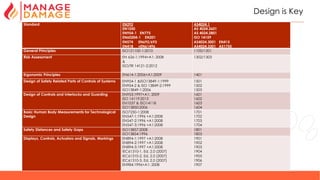
Design is Key
Standard EN292
EN1050
EN954-1 EN775
EN60204-1 EN201
EN574 EN692/693
EN418 vEN61496
AS4024.1
AS 4024.2601
AS 4024.2801
ISO 14159
AS4024.3001 EN415
AS4024.3301 AS1755
General Principles ISO121100-1:2010 1100/1201
Risk Assessment EN 626-1:1994+A1: 2008
&
ISO/TR 14121-2:2012
1302/1303
Ergonomic Principles EN614-1:2006+A1:2009 1401
Design of Safety Related Parts of Controls of Systems EN954-1 &ISO13849-1:1999
EN954-2 & ISO 13849-2:1999
ISO13849-1:2006
1501
1502
1503
Design of Controls and Interlocks and Guarding EN953:1997+A1: 2009
ISO 14119:2013
EN1037 & ISO14118
ISO13850:2006
1601
1602
1603
1604
Basic Human Body Measurements for Technological
Design
ISO7250-1:2008
EN547-1:1996 +A1:2008
EN547-2:1996 +A1:2008
EN547-3:1996 +A1:2008
1701
1702
1703
1704
Safety Distances and Safety Gaps ISO13857:2008
ISO13854:1996
1801
1803
Displays, Controls, Actuators and Signals, Markings EN894-1:1997 +A1:2008
EN894-2:1997 +A1:2008
EN894-3:1997 +A1:2008
IEC61310-1, Ed, 2.0 (2007)
IEC61310-2, Ed, 2.0 (2007)
IEC61310-3, Ed, 2.0 (2007)
EN984:1996+A1: 2008
1901
1902
1903
1904
1905
1906
1907
27
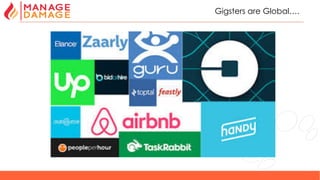
Gigsters are Global….
28
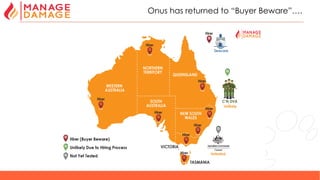
Onus has returned to “Buyer Beware”….
29
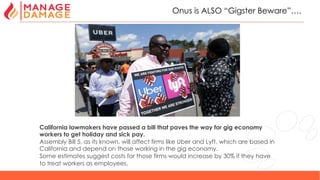
Onus is ALSO “Gigster Beware”….
California lawmakers have passed a bill that paves the way for gig economy
workers to get holiday and sick pay.
Assembly Bill 5, as its known, will affect firms like Uber and Lyft, which are based in
California and depend on those working in the gig economy.
Some estimates suggest costs for those firms would increase by 30% if they have
to treat workers as employees.
30
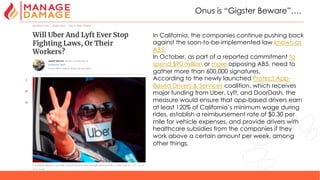
Onus is “Gigster Beware”….
In California, the companies continue pushing back
against the soon-to-be-implemented law known as
AB5.
In October, as part of a reported commitment to
spend $90 million or more opposing AB5, need to
gather more than 600,000 signatures.
According to the newly launched Protect App-
Based Drivers & Services coalition, which receives
major funding from Uber, Lyft, and DoorDash, the
measure would ensure that app-based drivers earn
at least 120% of California’s minimum wage during
rides, establish a reimbursement rate of $0.30 per
mile for vehicle expenses, and provide drivers with
healthcare subsidies from the companies if they
work above a certain amount per week, among
other things.
31
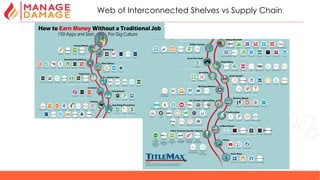
Web of Interconnected Shelves vs Supply Chain
32
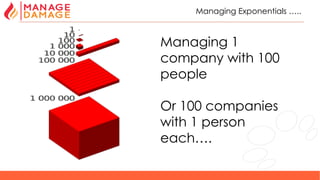
Managing Exponentials …..
Managing 1
company with 100
people
Or 100 companies
with 1 person
each….
33
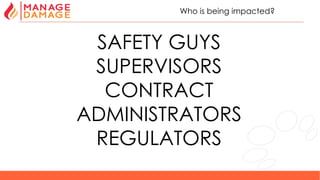
Who is being impacted?
SAFETY GUYS
SUPERVISORS
CONTRACT
ADMINISTRATORS
REGULATORS
34
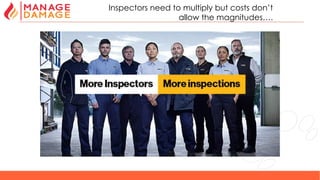
Inspectors need to multiply but costs don’t
allow the magnitudes….
35
Blood from Stones….
36
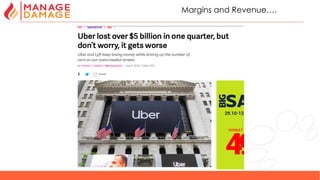
Margins and Revenue….
37
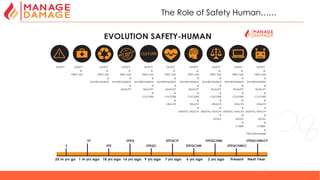
The Role of Safety Human……
38
The Speed of Change…..
39
The Compliance Errors – Do we Cost them In?...
40
Who Pays – Not the Customer They Want to Pay Less…..
41
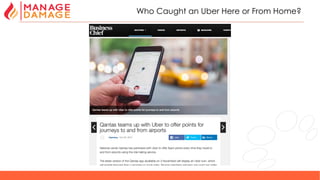
Who Caught an Uber Here or From Home?
42
The Way We Work Has Changed - Now Let’s
Catch Up for WHS
43
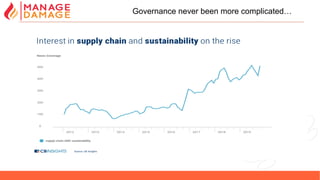
Governance never been more complicated…
44
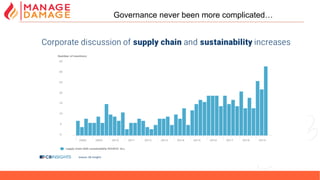
Governance never been more complicated…
45
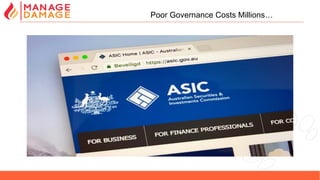
Poor Governance Costs Millions…
46
Support our Boards and Leaders

The Way We Work Has Changed - Now Looking Toward 2030

  • 1.
    1 The Way WeWork Has Changed Looking Toward 2030
  • 2.
  • 3.
    3 Megatrends to 2050 Theextending reach of automated systems and robotics. The costs of advanced automated technologies are likely to continue falling and the capabilities and widespread deployment are likely to continue rising. Rising workplace stress and mental health issues. Australia's workforce is registering increasing levels of stress and mental health issues. New and intensifying uses of digital technologies in the workplace may exacerbate problems with mental health and stress, but technology also presents opportunities to manage these issues. Rising screen time, sedentary behaviour and chronic illness. The amount of daily screen time has grown for both adults and children and there is a continued drift away from manual jobs towards sedentary jobs. Rates of obesity, cardiovascular disease, type 2 diabetes, and other chronic illnesses continue to rise. Blurring the boundaries between work and home. An increasingly large share of Australian workers are entering into work arrangements that enable them to work from home or other locations, blurring the boundaries between work and home life. The gig and entrepreneurial economy. The gig economy refers to freelance task-based work organised through online platforms or 'apps'. It changes the way we work away from traditional employment models. Although the Australian gig economy is still relatively small, at least some growth is anticipated. An ageing workforce. The average age of Australia's workforce is increasing along with the ageing of the population as a whole and older Australians are having to stay in the workforce longer. https://www.csiro.au/en/News/News-releases/2018/Six-megatrends-workplace-health-safety
  • 4.
  • 5.
    5 Megatrends to 2050 https://ec.europa.eu/info/sites/info/files/commission-white-paper-artificial-intelligence-feb2020_en.pdf Thekey elements of a future regulatory framework for AI in Europe that will create a unique ‘ecosystem of trust’. To do so, it must ensure compliance with EU rules, including the rules protecting fundamental rights and consumers’ rights, in particular for AI systems operated in the EU that pose a high risk. Building an ecosystem of trust is a policy objective in itself, and should give citizens the confidence to take up AI applications and give companies and public organisations the legal certainty to innovate using AI. The Commission strongly supports a human-centric approach based on the Communication on Building Trust in Human-Centric AI and will also take into account the input obtained during the piloting phase of the Ethics Guidelines prepared by the High- Level Expert Group on AI. .
  • 6.
    6 Megatrends to 2050 https://ec.europa.eu/info/sites/info/files/commission-white-paper-artificial-intelligence-feb2020_en.pdf Thepaper says that the 27-nation bloc should have strict legal requirements for “high-risk” uses of the technology. What's high-risk? Any scenario with “a risk of injury, death or significant material or immaterial damage; that produce effects that cannot reasonably be avoided by individuals or legal entities,” especially in sectors such as healthcare, transportation, energy and government. .
  • 7.
  • 8.
  • 9.
    9 Overview What does thefuture / today look like? • Globalisation • Employment or Engagement • New Types of Engagement • Subcontractor Management • Inspections and Regulator Management • Robotics in the Workplace • Legislation and Documentation/ Codes not yet caught up to todays “future” • Corporate Social Duties
  • 10.
    10 Change for Yesterdayor at least - Now We need to install systems, standards and set guidelines now to catch up to these changing factors that we suggest are future issues – in every workplace we are already here in some fashion – time to identify these risks at your workplace and then start to close the gap of risks we face daily.
  • 11.
    11 The Future =YESTERDAY REALLY….
  • 12.
    12 Globalisation is Real= True Competitors in All Nations
  • 13.
    13 Real True Competitorsin Emerging Nations $3.50 $4.50 $14.00 $18.00 $21.60 $23.40 $25.00 $26.30 $28.90 $31.60 $36.40 $38.10 $43.40 $54.00 $56.00 India China Philippines Canada United States New Zealand Singapore Japan United Kingdom Italy France Australia Germany Finland Switzerland Cost Per Hour Labour (Aust Dollars)
  • 14.
  • 15.
    15 The Cost ofa Secretary….
  • 16.
    16 The Cost ofa Secretary….Australia • $40,000 for a Robot • $42,000 to $65,000 for a person… Isn’t it cooler to have a robot….
  • 17.
    17 They are notentirely ready….. In some places
  • 18.
  • 19.
    19 Not Entirely Ready….. https://www.technologyreview.com/s/615244/hackers-can-trick-a-tesla-into-accelerating-by-50-miles-per-hour/ Hackerscan trick a Tesla into accelerating by 50 miles per hour A two inch piece of tape fooled the Tesla’s cameras and made the car quickly and mistakenly speed up.
  • 20.
    20 They are notentirely ready….. Shop bot
  • 21.
    21 They are notentirely ready….. App on Phone to Opp Crane https://www.worksafe.vic.gov.au/safety-alerts/employee-killed-after-accidental-operation-remotely-controlled-crane
  • 22.
  • 23.
  • 24.
  • 25.
    25 Principles of Safetyin Design Businesses must consider when designing plant - All the phases in the lifecycle of an item from testing and designing the product; manufacture through use, to repair; to dismantling and disposal. • Design for safe Design & Testing • Design for safe erection & install • Design to facilitate safe use by considering the users, the maximum number of tasks an operator can be expected to perform at any one time, the layout of the workstation or environment in which the plant/product may be used. • Consider intended use & reasonably foreseeable misuse. • Consider the difficulties workers may face when maintaining or repairing the plant/product. • Consider types of failure or malfunction and design the plant/plant to fail in a safe manner. • Designers must have a good understanding of the lifecycle of the item they are designing, including the needs of users and the environment in which that item may be used. Required Documentation - Risk Assessments for Each & Every User The law has requirements for.... • Designers of Plant (machines, robots, tools, product etc.. if you make it & people can use it) • Designers of buildings & structures • Persons with control of workplaces • Manufacturers, Importers & Suppliers of Plant/Product • Persons who Install, Erect or Make ANY Changes to Plant/Product.
  • 26.
    26 Design is Key StandardEN292 EN1050 EN954-1 EN775 EN60204-1 EN201 EN574 EN692/693 EN418 vEN61496 AS4024.1 AS 4024.2601 AS 4024.2801 ISO 14159 AS4024.3001 EN415 AS4024.3301 AS1755 General Principles ISO121100-1:2010 1100/1201 Risk Assessment EN 626-1:1994+A1: 2008 & ISO/TR 14121-2:2012 1302/1303 Ergonomic Principles EN614-1:2006+A1:2009 1401 Design of Safety Related Parts of Controls of Systems EN954-1 &ISO13849-1:1999 EN954-2 & ISO 13849-2:1999 ISO13849-1:2006 1501 1502 1503 Design of Controls and Interlocks and Guarding EN953:1997+A1: 2009 ISO 14119:2013 EN1037 & ISO14118 ISO13850:2006 1601 1602 1603 1604 Basic Human Body Measurements for Technological Design ISO7250-1:2008 EN547-1:1996 +A1:2008 EN547-2:1996 +A1:2008 EN547-3:1996 +A1:2008 1701 1702 1703 1704 Safety Distances and Safety Gaps ISO13857:2008 ISO13854:1996 1801 1803 Displays, Controls, Actuators and Signals, Markings EN894-1:1997 +A1:2008 EN894-2:1997 +A1:2008 EN894-3:1997 +A1:2008 IEC61310-1, Ed, 2.0 (2007) IEC61310-2, Ed, 2.0 (2007) IEC61310-3, Ed, 2.0 (2007) EN984:1996+A1: 2008 1901 1902 1903 1904 1905 1906 1907
  • 27.
  • 28.
    28 Onus has returnedto “Buyer Beware”….
  • 29.
    29 Onus is ALSO“Gigster Beware”…. California lawmakers have passed a bill that paves the way for gig economy workers to get holiday and sick pay. Assembly Bill 5, as its known, will affect firms like Uber and Lyft, which are based in California and depend on those working in the gig economy. Some estimates suggest costs for those firms would increase by 30% if they have to treat workers as employees.
  • 30.
    30 Onus is “GigsterBeware”…. In California, the companies continue pushing back against the soon-to-be-implemented law known as AB5. In October, as part of a reported commitment to spend $90 million or more opposing AB5, need to gather more than 600,000 signatures. According to the newly launched Protect App- Based Drivers & Services coalition, which receives major funding from Uber, Lyft, and DoorDash, the measure would ensure that app-based drivers earn at least 120% of California’s minimum wage during rides, establish a reimbursement rate of $0.30 per mile for vehicle expenses, and provide drivers with healthcare subsidies from the companies if they work above a certain amount per week, among other things.
  • 31.
    31 Web of InterconnectedShelves vs Supply Chain
  • 32.
    32 Managing Exponentials ….. Managing1 company with 100 people Or 100 companies with 1 person each….
  • 33.
    33 Who is beingimpacted? SAFETY GUYS SUPERVISORS CONTRACT ADMINISTRATORS REGULATORS
  • 34.
    34 Inspectors need tomultiply but costs don’t allow the magnitudes….
  • 35.
  • 36.
  • 37.
    37 The Role ofSafety Human……
  • 38.
    38 The Speed ofChange…..
  • 39.
    39 The Compliance Errors– Do we Cost them In?...
  • 40.
    40 Who Pays –Not the Customer They Want to Pay Less…..
  • 41.
    41 Who Caught anUber Here or From Home?
  • 42.
    42 The Way WeWork Has Changed - Now Let’s Catch Up for WHS
  • 43.
    43 Governance never beenmore complicated…
  • 44.
    44 Governance never beenmore complicated…
  • 45.
  • 46.