

1/6/23
The Centre for WHS:
Developing evidence-based and practical solutions
for preventing harm in the workplace.
Gregory Zelic, Centre for WHS
2023 AIHS National Conference
• About us: what we do – how we do it
• Our approach to the Future World of Work.
Outline
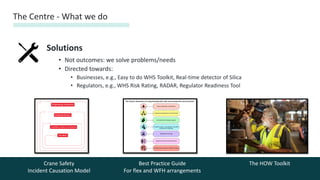
Solutions
• Not outcomes: we solve problems/needs
• Directed towards:
• Businesses, e.g., Easy to do WHS Toolkit, Real-time detector of Silica
• Regulators, e.g., WHS Risk Rating, RADAR, Regulator Readiness Tool
The Centre - What we do
Crane Safety
Incident Causation Model
Best Practice Guide
For flex and WFH arrangements
The HOW Toolkit
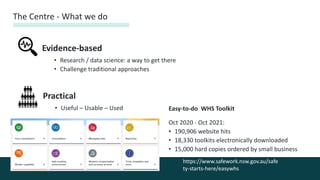
Evidence-based
• Research / data science: a way to get there
• Challenge traditional approaches
The Centre - What we do
Practical
• Useful – Usable – Used
https://www.safework.nsw.gov.au/safe
ty-starts-here/easywhs
Oct 2020 - Oct 2021:
• 190,906 website hits
• 18,330 toolkits electronically downloaded
• 15,000 hard copies ordered by small business
Easy-to-do WHS Toolkit
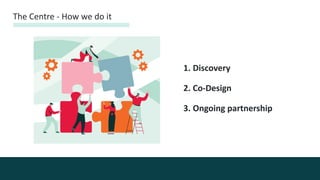
The Centre - How we do it
1. Discovery
2. Co-Design
3. Ongoing partnership
Our approach to the Future World of Work
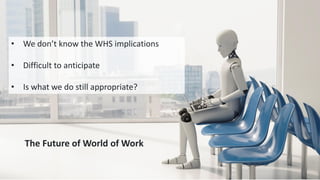
The Future of World of Work
• We don’t know the WHS implications
• Difficult to anticipate
• Is what we do still appropriate?
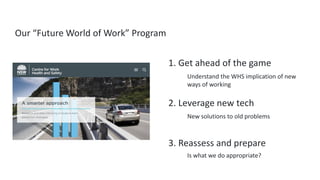
1. Get ahead of the game
2. Leverage new tech
3. Reassess and prepare
Our “Future World of Work” Program
Understand the WHS implication of new
ways of working
New solutions to old problems
Is what we do appropriate?
The Centre’s Future World of Work program
WHS impacts of AI in the workplace
• Two projects; one with Uni Adelaide, one with Charles Sturt
• Developing a risk matrix which businesses can use to help consider WHS issues
related to AI in the workplace
Working safely with collaborative robots
• Partnered with University of Technology Sydney
• Developing Guidelines and strategies for cobots in the workplace
#1 - Get ahead of the game
#2 - Leverage new Tech
#3 - Reassess and Prepare
1
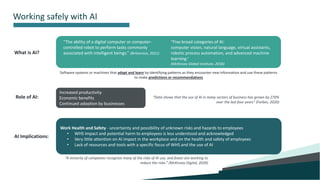
Working safely with AI
“The ability of a digital computer or computer-
controlled robot to perform tasks commonly
associated with intelligent beings.” (Britannica, 2021)
“Five broad categories of AI:
computer vision, natural language, virtual assistants,
robotic process automation, and advanced machine
learning.”
(McKinsey Global Institute, 2018)
Work Health and Safety - uncertainty and possibility of unknown risks and hazards to employees
• WHS impact and potential harm to employees is less understood and acknowledged
• Very little attention on AI impact in the workplace and on the health and safety of employees
• Lack of resources and tools with a specific focus of WHS and the use of AI
“A minority of companies recognize many of the risks of AI use, and fewer are working to
reduce the risks.” (McKinsey Digital, 2020)
Increased productivity
Economic benefits
Continued adoption by businesses
“Data shows that the use of AI in many sectors of business has grown by 270%
over the last four years” (Forbes, 2020)
What is AI?
Role of AI:
AI Implications:
Software systems or machines that adapt and learn by identifying patterns as they encounter new information and use these patterns
to make predictions or recommendations
Source: Safe Work Australia
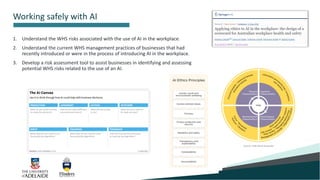
1. Understand the WHS risks associated with the use of AI in the workplace.
2. Understand the current WHS management practices of businesses that had
recently introduced or were in the process of introducing AI in the workplace.
3. Develop a risk assessment tool to assist businesses in identifying and assessing
potential WHS risks related to the use of an AI.
2
Working safely with AI
3
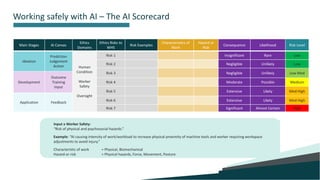
Working safely with AI – The AI Scorecard
Main Stages AI Canvas
Ethics
Domains
Ethics Risks to
WHS
Risk Examples
Characteristics of
Work
Hazard or
Risk
Consequence Likelihood Risk Level
Ideation
Prediction
Judgement
Action Human
Condition
Worker
Safety
Oversight
Risk 1 Insignificant Rare Low
Risk 2 Negligible Unlikely Low
Risk 3 Negligible Unlikely Low Med
Development
Outcome
Training
Input
Risk 4 Moderate Possible Medium
Risk 5 Extensive Likely Med High
Application Feedback
Risk 6 Extensive Likely Med High
Risk 7 Significant Almost Certain High
Input x Worker Safety:
“Risk of physical and psychosocial hazards.”
Example: “AI causing intensity of work/workload to increase physical proximity of machine tools and worker requiring workspace
adjustments to avoid injury.”
Characteristic of work = Physical, Biomechanical
Hazard or risk = Physical hazards, Force, Movement, Posture
4
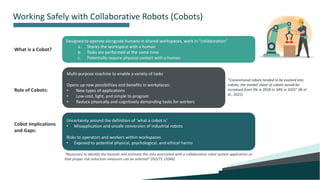
Working Safely with Collaborative Robots (Cobots)
Designed to operate alongside humans in shared workspaces, work in “collaboration”
a. Shares the workspace with a human
b. Tasks are performed at the same time
c. Potentially require physical contact with a human
Uncertainty around the definition of ‘what a cobot is’
• Misapplication and unsafe conversion of industrial robots
Risks to operators and workers within workspaces
• Exposed to potential physical, psychological, and ethical harms
“Necessary to identify the hazards and estimate the risks associated with a collaborative robot system application so
that proper risk reduction measures can be selected” (ISO/TS 15066)
Multi-purpose machine to enable a variety of tasks
Opens up new possibilities and benefits in workplaces:
• New types of applications
• Low-cost, light, and simple to program
• Reduce physically and cognitively demanding tasks for workers
“Conventional robots tended to be evolved into
cobots; the market share of cobots would be
increased from 3% in 2018 to 34% in 2025” (Bi et
al., 2021)
What is a Cobot?
Role of Cobots:
Cobot Implications
and Gaps:
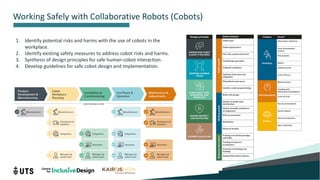
1. Identify potential risks and harms with the use of cobots in the
workplace.
2. Identify existing safety measures to address cobot risks and harms.
3. Synthesis of design principles for safe human-cobot interaction.
4. Develop guidelines for safe cobot design and implementation.
5
Working Safely with Collaborative Robots (Cobots)
6
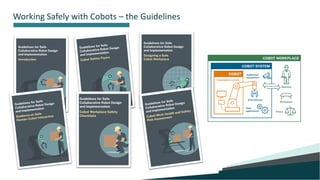
Working Safely with Cobots – the Guidelines
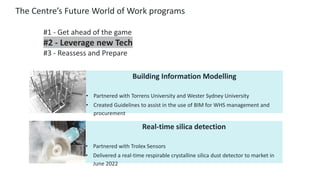
Building Information Modelling
• Partnered with Torrens University and Wester Sydney University
• Created Guidelines to assist in the use of BIM for WHS management and
procurement
Real-time silica detection
• Partnered with Trolex Sensors
• Delivered a real-time respirable crystalline silica dust detector to market in
June 2022
The Centre’s Future World of Work programs
#1 - Get ahead of the game
#2 - Leverage new Tech
#3 - Reassess and Prepare
8
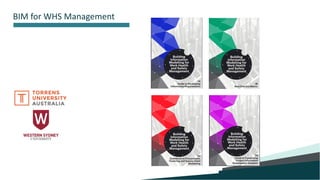
BIM for WHS Management
9
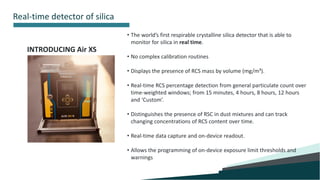
Real-time detector of silica
INTRODUCING Air XS
• The world’s first respirable crystalline silica detector that is able to
monitor for silica in real time.
• No complex calibration routines
• Displays the presence of RCS mass by volume (mg/m³).
• Real-time RCS percentage detection from general particulate count over
time-weighted windows; from 15 minutes, 4 hours, 8 hours, 12 hours
and ‘Custom’.
• Distinguishes the presence of RSC in dust mixtures and can track
changing concentrations of RCS content over time.
• Real-time data capture and on-device readout.
• Allows the programming of on-device exposure limit thresholds and
warnings
Regulator Readiness Tool
• Examined regulatory gaps created by new ways or working
• Created Gap Assessment Tool to be used by organisations
RADAR
• Anticipating new, emerging and future ways of working
• Local, current and relevant WHS insights
• Bi-annual download
The Centre’s Future World of Work program
#1 - Get ahead of the game
#2 - Leverage new Tech
#3 - Reassess and Prepare
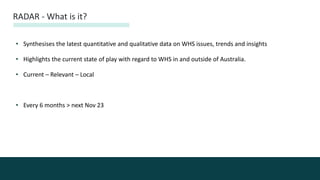
• Synthesises the latest quantitative and qualitative data on WHS issues, trends and insights
• Highlights the current state of play with regard to WHS in and outside of Australia.
• Current – Relevant – Local
• Every 6 months > next Nov 23
RADAR - What is it?
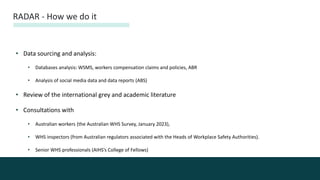
• Data sourcing and analysis:
• Databases analysis: WSMS, workers compensation claims and policies, ABR
• Analysis of social media data and data reports (ABS)
• Review of the international grey and academic literature
• Consultations with
• Australian workers (the Australian WHS Survey, January 2023),
• WHS inspectors (from Australian regulators associated with the Heads of Workplace Safety Authorities).
• Senior WHS professionals (AIHS’s College of Fellows)
RADAR - How we do it
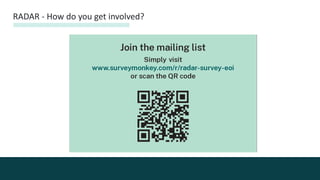
RADAR - How do you get involved?
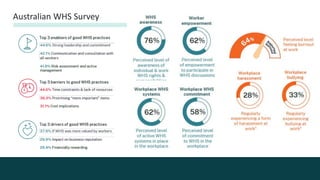
Australian WHS Survey
• Continued financial pressures are influencing attitudes towards safety
• Geopolitical and economic pressures continue, e.g., inflation, labour shortage and supply chain disruption - the priority
placed on health, safety and worker wellbeing will be challenged
• Emergence of complacency and acceptance of unsafe practices, particularly in the face of increasing work demands and
financial pressure
• Inspectors expressed lack of commitment of businesses around WHS, with some suggesting the cost is a dealbreaker – “More affordable to be fined”
• Senior WHS prof: examples where executives deliberately try to avoid their obligations.
• Workers continue to experience psychosocial harm, including burnout and harassment
• Australian employee engagement and job satisfaction is at an all-time low
• WHS Survey:
• nearly two-thirds of respondents are feeling burnt out
• Main drivers cited were increasing normalisation of chronic understaffing across organisations, along with the limited acknowledgement and limited action
taken against bullying and/or harassment in the workplace.
• Inspectors report an increase in bullying, harassment, violence, and aggression within workplaces, highlighting that these
behaviours are quickly escalating due to increased fatigue and stress.
Key RADAR insights Apr 23
25
WHS Radar report – Apr 23
• Australian regulators are strengthening action to address WHS concerns
• Recent legislative changes show a strengthened approach to WHS commitment:
• industrial manslaughter laws spread further across Australian jurisdictions
• recent prosecutions highlight the seriousness of recklessness, the breach of right-of-entry laws and the chain of
responsibility.
• NSW laws making assault of frontline health or emergency services a harsher criminal act, attracting a sentence of
up to 14 years in jail
• New areas of regulatory disruption: AI, electric vehicles and professional athletes
• Increased awareness of the limited WHS consideration when introducing new techs, AI, in the workplace: poor change
management, poor risk assessment and training.
• Concern as expected growth of Australian Industries
• Increased interest in electric vehicles (GTA) contrast with 1. current poor regulation on storage and use of electric
batteries, and 2. increase in incidents involving lithium battery fires.
• Submissions to the current senate inquiry into concussions and repeated head trauma in contact sport support further
review of WHS frameworks and of the exemption of paid professional athletes from current workers compensation
schemes.
26
Key RADAR insights Apr 23
WHS Radar report – Apr 23
• Being on top of the future of work is challenging
• The Centre has a dedicated focus on this topic with:
• Regularly published evidences in regard to WHS implications of new ways of working
• Regularly published solutions that can be directly used to prevent harm
• Ongoing program of work on future of work and implications for the OHS prof and regulator
• Follow us on all social media
TAKEAWAYS
27-30 November 2023
Subscribe to the newsletter
Check the website
centreforwhs.nsw.gov.au
29

Developing practical evidence-based solutions to prevent harm in the workplace

  • 1.
    1/6/23 The Centre forWHS: Developing evidence-based and practical solutions for preventing harm in the workplace. Gregory Zelic, Centre for WHS 2023 AIHS National Conference
  • 2.
    • About us:what we do – how we do it • Our approach to the Future World of Work. Outline
  • 4.
    Solutions • Not outcomes:we solve problems/needs • Directed towards: • Businesses, e.g., Easy to do WHS Toolkit, Real-time detector of Silica • Regulators, e.g., WHS Risk Rating, RADAR, Regulator Readiness Tool The Centre - What we do Crane Safety Incident Causation Model Best Practice Guide For flex and WFH arrangements The HOW Toolkit
  • 5.
    Evidence-based • Research /data science: a way to get there • Challenge traditional approaches The Centre - What we do Practical • Useful – Usable – Used https://www.safework.nsw.gov.au/safe ty-starts-here/easywhs Oct 2020 - Oct 2021: • 190,906 website hits • 18,330 toolkits electronically downloaded • 15,000 hard copies ordered by small business Easy-to-do WHS Toolkit
  • 6.
    The Centre -How we do it 1. Discovery 2. Co-Design 3. Ongoing partnership
  • 7.
    Our approach tothe Future World of Work
  • 8.
    The Future ofWorld of Work • We don’t know the WHS implications • Difficult to anticipate • Is what we do still appropriate?
  • 9.
    1. Get aheadof the game 2. Leverage new tech 3. Reassess and prepare Our “Future World of Work” Program Understand the WHS implication of new ways of working New solutions to old problems Is what we do appropriate?
  • 10.
    The Centre’s FutureWorld of Work program WHS impacts of AI in the workplace • Two projects; one with Uni Adelaide, one with Charles Sturt • Developing a risk matrix which businesses can use to help consider WHS issues related to AI in the workplace Working safely with collaborative robots • Partnered with University of Technology Sydney • Developing Guidelines and strategies for cobots in the workplace #1 - Get ahead of the game #2 - Leverage new Tech #3 - Reassess and Prepare
  • 11.
    1 Working safely withAI “The ability of a digital computer or computer- controlled robot to perform tasks commonly associated with intelligent beings.” (Britannica, 2021) “Five broad categories of AI: computer vision, natural language, virtual assistants, robotic process automation, and advanced machine learning.” (McKinsey Global Institute, 2018) Work Health and Safety - uncertainty and possibility of unknown risks and hazards to employees • WHS impact and potential harm to employees is less understood and acknowledged • Very little attention on AI impact in the workplace and on the health and safety of employees • Lack of resources and tools with a specific focus of WHS and the use of AI “A minority of companies recognize many of the risks of AI use, and fewer are working to reduce the risks.” (McKinsey Digital, 2020) Increased productivity Economic benefits Continued adoption by businesses “Data shows that the use of AI in many sectors of business has grown by 270% over the last four years” (Forbes, 2020) What is AI? Role of AI: AI Implications: Software systems or machines that adapt and learn by identifying patterns as they encounter new information and use these patterns to make predictions or recommendations
  • 12.
    Source: Safe WorkAustralia 1. Understand the WHS risks associated with the use of AI in the workplace. 2. Understand the current WHS management practices of businesses that had recently introduced or were in the process of introducing AI in the workplace. 3. Develop a risk assessment tool to assist businesses in identifying and assessing potential WHS risks related to the use of an AI. 2 Working safely with AI
  • 13.
    3 Working safely withAI – The AI Scorecard Main Stages AI Canvas Ethics Domains Ethics Risks to WHS Risk Examples Characteristics of Work Hazard or Risk Consequence Likelihood Risk Level Ideation Prediction Judgement Action Human Condition Worker Safety Oversight Risk 1 Insignificant Rare Low Risk 2 Negligible Unlikely Low Risk 3 Negligible Unlikely Low Med Development Outcome Training Input Risk 4 Moderate Possible Medium Risk 5 Extensive Likely Med High Application Feedback Risk 6 Extensive Likely Med High Risk 7 Significant Almost Certain High Input x Worker Safety: “Risk of physical and psychosocial hazards.” Example: “AI causing intensity of work/workload to increase physical proximity of machine tools and worker requiring workspace adjustments to avoid injury.” Characteristic of work = Physical, Biomechanical Hazard or risk = Physical hazards, Force, Movement, Posture
  • 14.
    4 Working Safely withCollaborative Robots (Cobots) Designed to operate alongside humans in shared workspaces, work in “collaboration” a. Shares the workspace with a human b. Tasks are performed at the same time c. Potentially require physical contact with a human Uncertainty around the definition of ‘what a cobot is’ • Misapplication and unsafe conversion of industrial robots Risks to operators and workers within workspaces • Exposed to potential physical, psychological, and ethical harms “Necessary to identify the hazards and estimate the risks associated with a collaborative robot system application so that proper risk reduction measures can be selected” (ISO/TS 15066) Multi-purpose machine to enable a variety of tasks Opens up new possibilities and benefits in workplaces: • New types of applications • Low-cost, light, and simple to program • Reduce physically and cognitively demanding tasks for workers “Conventional robots tended to be evolved into cobots; the market share of cobots would be increased from 3% in 2018 to 34% in 2025” (Bi et al., 2021) What is a Cobot? Role of Cobots: Cobot Implications and Gaps:
  • 15.
    1. Identify potentialrisks and harms with the use of cobots in the workplace. 2. Identify existing safety measures to address cobot risks and harms. 3. Synthesis of design principles for safe human-cobot interaction. 4. Develop guidelines for safe cobot design and implementation. 5 Working Safely with Collaborative Robots (Cobots)
  • 16.
    6 Working Safely withCobots – the Guidelines
  • 17.
    Building Information Modelling •Partnered with Torrens University and Wester Sydney University • Created Guidelines to assist in the use of BIM for WHS management and procurement Real-time silica detection • Partnered with Trolex Sensors • Delivered a real-time respirable crystalline silica dust detector to market in June 2022 The Centre’s Future World of Work programs #1 - Get ahead of the game #2 - Leverage new Tech #3 - Reassess and Prepare
  • 18.
    8 BIM for WHSManagement
  • 19.
    9 Real-time detector ofsilica INTRODUCING Air XS • The world’s first respirable crystalline silica detector that is able to monitor for silica in real time. • No complex calibration routines • Displays the presence of RCS mass by volume (mg/m³). • Real-time RCS percentage detection from general particulate count over time-weighted windows; from 15 minutes, 4 hours, 8 hours, 12 hours and ‘Custom’. • Distinguishes the presence of RSC in dust mixtures and can track changing concentrations of RCS content over time. • Real-time data capture and on-device readout. • Allows the programming of on-device exposure limit thresholds and warnings
  • 20.
    Regulator Readiness Tool •Examined regulatory gaps created by new ways or working • Created Gap Assessment Tool to be used by organisations RADAR • Anticipating new, emerging and future ways of working • Local, current and relevant WHS insights • Bi-annual download The Centre’s Future World of Work program #1 - Get ahead of the game #2 - Leverage new Tech #3 - Reassess and Prepare
  • 21.
    • Synthesises thelatest quantitative and qualitative data on WHS issues, trends and insights • Highlights the current state of play with regard to WHS in and outside of Australia. • Current – Relevant – Local • Every 6 months > next Nov 23 RADAR - What is it?
  • 22.
    • Data sourcingand analysis: • Databases analysis: WSMS, workers compensation claims and policies, ABR • Analysis of social media data and data reports (ABS) • Review of the international grey and academic literature • Consultations with • Australian workers (the Australian WHS Survey, January 2023), • WHS inspectors (from Australian regulators associated with the Heads of Workplace Safety Authorities). • Senior WHS professionals (AIHS’s College of Fellows) RADAR - How we do it
  • 23.
    RADAR - Howdo you get involved?
  • 24.
  • 25.
    • Continued financialpressures are influencing attitudes towards safety • Geopolitical and economic pressures continue, e.g., inflation, labour shortage and supply chain disruption - the priority placed on health, safety and worker wellbeing will be challenged • Emergence of complacency and acceptance of unsafe practices, particularly in the face of increasing work demands and financial pressure • Inspectors expressed lack of commitment of businesses around WHS, with some suggesting the cost is a dealbreaker – “More affordable to be fined” • Senior WHS prof: examples where executives deliberately try to avoid their obligations. • Workers continue to experience psychosocial harm, including burnout and harassment • Australian employee engagement and job satisfaction is at an all-time low • WHS Survey: • nearly two-thirds of respondents are feeling burnt out • Main drivers cited were increasing normalisation of chronic understaffing across organisations, along with the limited acknowledgement and limited action taken against bullying and/or harassment in the workplace. • Inspectors report an increase in bullying, harassment, violence, and aggression within workplaces, highlighting that these behaviours are quickly escalating due to increased fatigue and stress. Key RADAR insights Apr 23 25 WHS Radar report – Apr 23
  • 26.
    • Australian regulatorsare strengthening action to address WHS concerns • Recent legislative changes show a strengthened approach to WHS commitment: • industrial manslaughter laws spread further across Australian jurisdictions • recent prosecutions highlight the seriousness of recklessness, the breach of right-of-entry laws and the chain of responsibility. • NSW laws making assault of frontline health or emergency services a harsher criminal act, attracting a sentence of up to 14 years in jail • New areas of regulatory disruption: AI, electric vehicles and professional athletes • Increased awareness of the limited WHS consideration when introducing new techs, AI, in the workplace: poor change management, poor risk assessment and training. • Concern as expected growth of Australian Industries • Increased interest in electric vehicles (GTA) contrast with 1. current poor regulation on storage and use of electric batteries, and 2. increase in incidents involving lithium battery fires. • Submissions to the current senate inquiry into concussions and repeated head trauma in contact sport support further review of WHS frameworks and of the exemption of paid professional athletes from current workers compensation schemes. 26 Key RADAR insights Apr 23 WHS Radar report – Apr 23
  • 27.
    • Being ontop of the future of work is challenging • The Centre has a dedicated focus on this topic with: • Regularly published evidences in regard to WHS implications of new ways of working • Regularly published solutions that can be directly used to prevent harm • Ongoing program of work on future of work and implications for the OHS prof and regulator • Follow us on all social media TAKEAWAYS
  • 28.
    27-30 November 2023 Subscribeto the newsletter Check the website
  • 29.