Whenever you go to work, you have a number of tasks, activities and responsibilities that you need to carry out, usually in
collaboration with others. Work design is basically how these tasks, activities, responsibilities and interactions with other
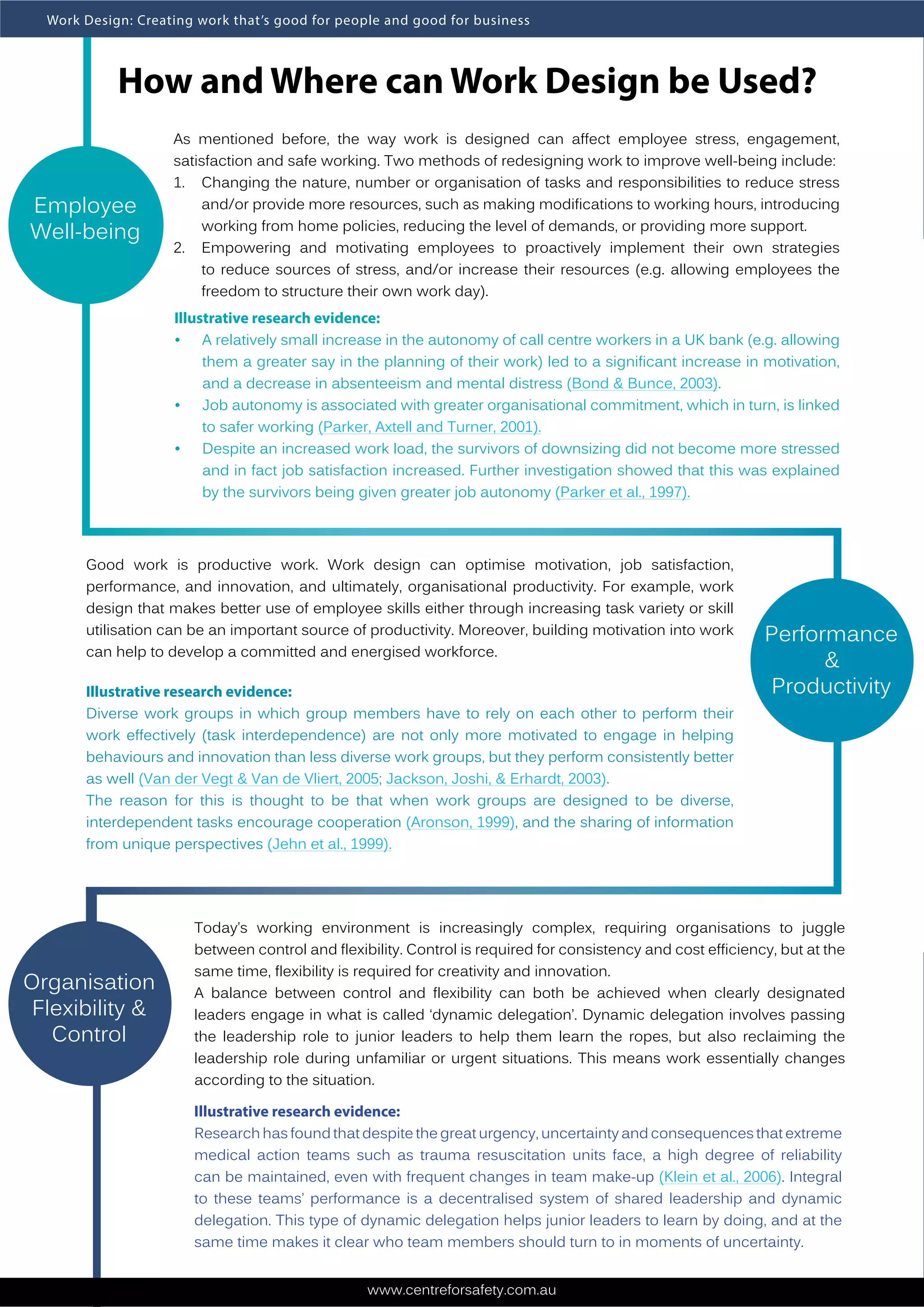
people are organised and structured. Good work design is crucial, as it affects both individual employees and organisational
outcomes. For employees, work design can affect their motivation, their well-being and their development. Increased
employee motivation, well-being and accelerated development can in turn improve organisational outcomes such as
safety, performance, and innovation.
There are seven core elements to think about when creating a motivating job.
The seven elements of work design can be combined in different ways to create work that is ideal not only for productivity,
but also employee well-being. Keep in mind though that there is no ‘one fits all’ formula of work design. Good work design is
often tailored to fit the organisation, individuals and situation.
GOOD WORK DESIGN
“I love my job...I’ve learned so much... I can talk the talk
with biochemists, software engineers, all these interesting
people... And I love being independent, relying on myself...
It’s exciting”
(Corporate headhunter, Bowe et al, 2009. P12)
BAD WORK DESIGN
“We see about a hundred injuries a year and I’m amazed
there aren’t more. The main causes are inexperience and
repetition… People work the same job all the time and
they stop thinking. Workers in a plant like this need to be
moved around…”
(Slaughterhouse human resources director, Bowe et al, 2009. P52)
Are you required to do lots of
repetitive tasks, or do you have
lots of variety in your work?
Do you have a clear
understanding of your
role, responsibilities and
accountabilities?
How much clear feedback do you
receive about your effectiveness
in performing your work?
Does your workplace provide
appropriate opportunity and
support for you to use your skills
effectively?
How much discretion does your job
provide over daily work decisions such
as when and how to perform your work?
How much sustained or high levels
of physical, mental or emotional effort
does your work require?
JOB VARIETYROLE CLARITY JOB FEEDBACK SKILL UTILISATION
JOB AUTONOMY JOB DEMANDS
Work
Design
Creating work
that’s good for
PEOPLE and good
for BUSINESS
7Motivational Aspects of WORK DESIGN
WHAT DOES GOOD OR BAD WORK DESIGN LOOK LIKE?
Are you provided with emotional and
social support from your peers and/or
your supervisor?
SOCIAL SUPPORT
www.centreforsafety.com.au
As mentioned before, the way work is designed can affect employee stress, engagement,
satisfaction and safe working. Two methods of redesigning work to improve well-being include:
1.	 Changing the nature, number or organisation of tasks and responsibilities to reduce stress
and/or provide more resources, such as making modifications to working hours, introducing
working from home policies, reducing the level of demands, or providing more support.
2.	 Empowering and motivating employees to proactively implement their own strategies
to reduce sources of stress, and/or increase their resources (e.g. allowing employees the
freedom to structure their own work day).
Good work is productive work. Work design can optimise motivation, job satisfaction,
performance, and innovation, and ultimately, organisational productivity. For example, work
design that makes better use of employee skills either through increasing task variety or skill
utilisation can be an important source of productivity. Moreover, building motivation into work
can help to develop a committed and energised workforce.
Today’s working environment is increasingly complex, requiring organisations to juggle
between control and flexibility. Control is required for consistency and cost efficiency, but at the
same time, flexibility is required for creativity and innovation.
A balance between control and flexibility can both be achieved when clearly designated
leaders engage in what is called ‘dynamic delegation’. Dynamic delegation involves passing
the leadership role to junior leaders to help them learn the ropes, but also reclaiming the
leadership role during unfamiliar or urgent situations. This means work essentially changes
according to the situation.
How and Where can Work Design be Used?
Employee
Well-being
Performance
&
Productivity
Organisation
Flexibility &
Control
Illustrative research evidence:
•	 A relatively small increase in the autonomy of call centre workers in a UK bank (e.g. allowing
them a greater say in the planning of their work) led to a significant increase in motivation,
and a decrease in absenteeism and mental distress (Bond & Bunce, 2003).
•	 Job autonomy is associated with greater organisational commitment, which in turn, is linked
to safer working (Parker, Axtell and Turner, 2001).
•	 Despite an increased work load, the survivors of downsizing did not become more stressed
and in fact job satisfaction increased. Further investigation showed that this was explained
by the survivors being given greater job autonomy (Parker et al., 1997).
Illustrative research evidence:
Research has found that despite the great urgency, uncertainty and consequences that extreme
medical action teams such as trauma resuscitation units face, a high degree of reliability
can be maintained, even with frequent changes in team make-up (Klein et al., 2006). Integral
to these teams’ performance is a decentralised system of shared leadership and dynamic
delegation. This type of dynamic delegation helps junior leaders to learn by doing, and at the
same time makes it clear who team members should turn to in moments of uncertainty.
Illustrative research evidence:
Diverse work groups in which group members have to rely on each other to perform their
work effectively (task interdependence) are not only more motivated to engage in helping
behaviours and innovation than less diverse work groups, but they perform consistently better
as well (Van der Vegt & Van de Vliert, 2005; Jackson, Joshi, & Erhardt, 2003).
The reason for this is thought to be that when work groups are designed to be diverse,
interdependent tasks encourage cooperation (Aronson, 1999), and the sharing of information
from unique perspectives (Jehn et al., 1999).
Work Design: Creating work that’s good for people and good for business
www.centreforsafety.com.au
Work design is of increasing relevance, and it is essential to keep the understanding of how to
best design work for well-being and performance, up to date. Globalisation, competition and new
technology will push industries towards unchartered territory and necessarily give rise to radical
changes in the ways organisations operate and people work. Some work conditions are becoming
more extreme, for example, the activity of deep sea mining. The Centre for Safety is placing itself
at the forefront of these changes, in order to generate new knowledge on how extreme working
conditions can be designed so they have a positive effect on well-being and performance.
Organisations that are making radical changes in the way work is carried out (e.g. remote control
centres), and who are interested in understanding the effects of these changes, are encouraged to
contact the UWA Centre for Safety.
Other potential collaborations of interest to the Centre for Safety include:
•	 Evaluating the effects of work redesigns (or other changes with effects on work design).
•	 Leadership development interventions to train leaders in work design and mental health.
•	 Company-wide audits of work design, mental health, and engagement.
Work Design @ The University of Western Australia
Looking toward the Future: Extreme working conditions
Building Safer & More Productive Operating Theatres
There is increasing evidence that surgical errors are
not due to a lack of technical skills (e.g., training or
knowledge), but are due to non-technical skills such as
communication and team failures, e.g. unclear team
goals. Using work design theories, this study examines
how changes to surgical team briefings and debriefings
can improve surgical outcomes.
Project page link
Sleep Deprivation and Fatigue in Surgical Practice
The nature of health care frequently entails shift-work,
prolonged work hours, and overnight emergency calls.
These environments can be particularly detrimental for
sleep quality and lead to episodes of serious physical
and mental fatigue. Using work design theories, this study
provide strategies to address fatigue issues and improve
performance in surgical settings.
Project page link
2010 European Working Conditions Survey (44,000 workers)
29%
20%
14%
37%
High-paid
good jobs
Well-balanced
good jobs
Poorly
balanced jobs
Poor quality jobs
Excess job intensity
(time pressure,
working hours)Poorest mental health
Low on intrinsic job
quality, earnings and
prospects
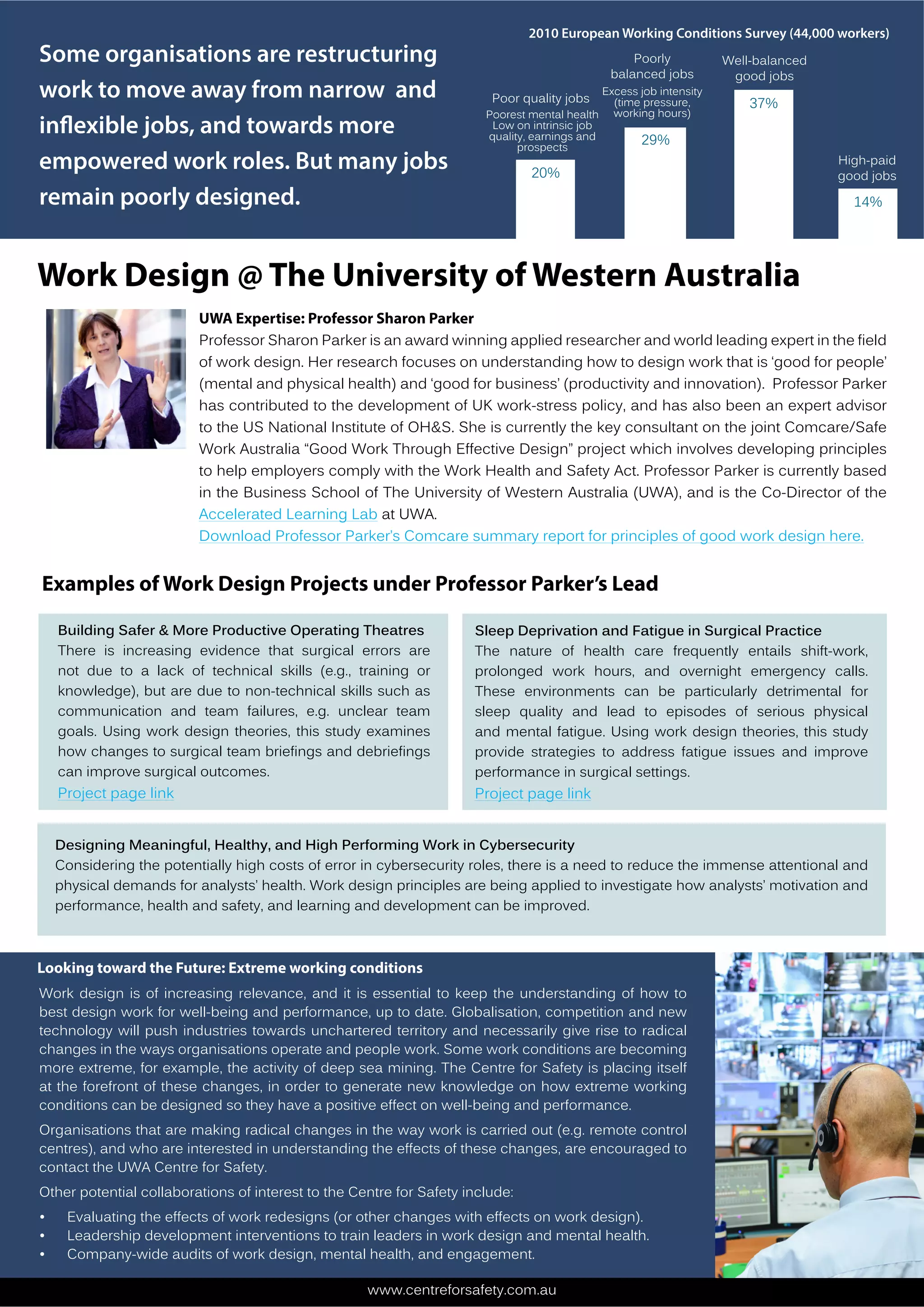
Some organisations are restructuring
work to move away from narrow and
inflexible jobs, and towards more
empowered work roles. But many jobs
remain poorly designed.
Examples of Work Design Projects under Professor Parker’s Lead
UWA Expertise: Professor Sharon Parker
Professor Sharon Parker is an award winning applied researcher and world leading expert in the field
of work design. Her research focuses on understanding how to design work that is ‘good for people’
(mental and physical health) and ‘good for business’ (productivity and innovation). Professor Parker
has contributed to the development of UK work-stress policy, and has also been an expert advisor
to the US National Institute of OH&S. She is currently the key consultant on the joint Comcare/Safe
Work Australia “Good Work Through Effective Design” project which involves developing principles
to help employers comply with the Work Health and Safety Act. Professor Parker is currently based
in the Business School of The University of Western Australia (UWA), and is the Co-Director of the
Accelerated Learning Lab at UWA.
Download Professor Parker’s Comcare summary report for principles of good work design here.
www.centreforsafety.com.au
Designing Meaningful, Healthy, and High Performing Work in Cybersecurity
Considering the potentially high costs of error in cybersecurity roles, there is a need to reduce the immense attentional and
physical demands for analysts’ health. Work design principles are being applied to investigate how analysts’ motivation and
performance, health and safety, and learning and development can be improved.
About the UWA Centre for Safety:
The UWA Centre for Safety is a hub for cutting edge research, innovative ideas, and practical solutions across the field
of work safety.
Formed out of a partnership between Rio Tinto and The University of Western Australia, the Centre is dedicated to
solving important safety challenges, and creating sustainable organisational change.
The Centre for Safety brings together world renowned experts across disciplines including Psychology, Engineering,
Medicine, Business, Law and Health Science. This unique multidisciplinary approach towards safety provides critical
insights into current industry concerns.
By encouraging collaborations between research, industry and government, the Centre for Safety is leading the way
for safety innovation.
References:
Aronson, E. (1999). The power of self-persuasion. American Psychologist, 54(11), 875.
Bond, F. W., & Bunce, D. (2003). The role of acceptance and job control in mental health, job satisfaction, and work performance. Journal of applied psychology, 88(6), 1057.
Bowe, J., & Bowe, M. (Eds.). (2009). Gig: Americans talk about their jobs. Broadway Books.
Clinton, M., Totterdell, P., & Wood, S. (2006). A grounded theory of portfolio working experiencing the smallest of small businesses. International Small Business Journal, 24(2), 179-
203.
Jackson, S. E., Joshi, A., & Erhardt, N. L. (2003). Recent research on team and organizational diversity: SWOT analysis and implications. Journal of management, 29(6), 801-830.
Jehn, K. A., Northcraft, G. B., & Neale, M. A. (1999). Why differences make a difference: A field study of diversity, conflict and performance in workgroups. Administrative science
quarterly, 44(4), 741-763.
Klein, K. J., Ziegert, J. C., Knight, A. P., & Xiao, Y. (2006). Dynamic delegation: Shared, hierarchical, and deindividualized leadership in extreme action teams. Administrative Science
Quarterly, 51(4), 590-621.
Parker, S. K., & Wall, T. D. (1998). Job and work design: Organizing work to promote well-being and effectiveness (Vol. 4). Sage.
Parker, S. K., Chmiel, N., & Wall, T. D. (1997). Work characteristics and employee well-being within a context of strategic downsizing. Journal of occupational health psychology,
2(4), 289.
Parker, S. K., Axtell, C. M., & Turner, N. (2001). Designing a safer workplace: Importance of job autonomy, communication quality, and supportive supervisors. Journal of
Occupational Health Psychology, 6(3), 211.
Van der Vegt, G. S., & Van de Vliert, E. (2005). Effects of perceived skill dissimilarity and task interdependence on helping in work teams. Journal of management, 31(1), 73-89.
© The University of Western Australia, 2015. This document remains the intellectual property of The University of Western Australia and
is protected by copyright and registered trademarks. No material from this document is to be reproduced or used in any format without
express written permission
www.centreforsafety.com.au
Email: centreforsafety-psy@uwa.edu.au
About the Accelerated Learning Lab
The University of Western Australia’s Accelerated Learning Lab (ALL@UWA) is a world-class centre developing leaders
at all levels, in all types of organisations.
Drawing on a wealth of experience from both the School of Psychology and the Business School at UWA, the ALL@
UWA specialises in experiential learning, and seeks to enhance a range of knowledge and skills key to leadership
such as problem-solving, communication, and proactivity.
The ALL@UWA works together with multiple disciplines across the University of Western Australia (e.g., Psychology,
Business, Engineering and Computer Science, Medicine, Law, Sleep Science), leading scholars from other
universities, as well as government bodies, advisory groups, and industry partners to develop specialised leadership
programs.
The Centre for Safety collaborates with the ALL@UWA on a number of safety related projects and educational
programs.
Accelerated Learning Lab
Email: allatuwa-psy@uwa.edu.au
Work Design: Creating work that’s good for people and good for business

Work Design: Creating work that's good for people and good for business

  • 1.
    Whenever you goto work, you have a number of tasks, activities and responsibilities that you need to carry out, usually in collaboration with others. Work design is basically how these tasks, activities, responsibilities and interactions with other people are organised and structured. Good work design is crucial, as it affects both individual employees and organisational outcomes. For employees, work design can affect their motivation, their well-being and their development. Increased employee motivation, well-being and accelerated development can in turn improve organisational outcomes such as safety, performance, and innovation. There are seven core elements to think about when creating a motivating job. The seven elements of work design can be combined in different ways to create work that is ideal not only for productivity, but also employee well-being. Keep in mind though that there is no ‘one fits all’ formula of work design. Good work design is often tailored to fit the organisation, individuals and situation. GOOD WORK DESIGN “I love my job...I’ve learned so much... I can talk the talk with biochemists, software engineers, all these interesting people... And I love being independent, relying on myself... It’s exciting” (Corporate headhunter, Bowe et al, 2009. P12) BAD WORK DESIGN “We see about a hundred injuries a year and I’m amazed there aren’t more. The main causes are inexperience and repetition… People work the same job all the time and they stop thinking. Workers in a plant like this need to be moved around…” (Slaughterhouse human resources director, Bowe et al, 2009. P52) Are you required to do lots of repetitive tasks, or do you have lots of variety in your work? Do you have a clear understanding of your role, responsibilities and accountabilities? How much clear feedback do you receive about your effectiveness in performing your work? Does your workplace provide appropriate opportunity and support for you to use your skills effectively? How much discretion does your job provide over daily work decisions such as when and how to perform your work? How much sustained or high levels of physical, mental or emotional effort does your work require? JOB VARIETYROLE CLARITY JOB FEEDBACK SKILL UTILISATION JOB AUTONOMY JOB DEMANDS Work Design Creating work that’s good for PEOPLE and good for BUSINESS 7Motivational Aspects of WORK DESIGN WHAT DOES GOOD OR BAD WORK DESIGN LOOK LIKE? Are you provided with emotional and social support from your peers and/or your supervisor? SOCIAL SUPPORT www.centreforsafety.com.au
  • 2.
    As mentioned before,the way work is designed can affect employee stress, engagement, satisfaction and safe working. Two methods of redesigning work to improve well-being include: 1. Changing the nature, number or organisation of tasks and responsibilities to reduce stress and/or provide more resources, such as making modifications to working hours, introducing working from home policies, reducing the level of demands, or providing more support. 2. Empowering and motivating employees to proactively implement their own strategies to reduce sources of stress, and/or increase their resources (e.g. allowing employees the freedom to structure their own work day). Good work is productive work. Work design can optimise motivation, job satisfaction, performance, and innovation, and ultimately, organisational productivity. For example, work design that makes better use of employee skills either through increasing task variety or skill utilisation can be an important source of productivity. Moreover, building motivation into work can help to develop a committed and energised workforce. Today’s working environment is increasingly complex, requiring organisations to juggle between control and flexibility. Control is required for consistency and cost efficiency, but at the same time, flexibility is required for creativity and innovation. A balance between control and flexibility can both be achieved when clearly designated leaders engage in what is called ‘dynamic delegation’. Dynamic delegation involves passing the leadership role to junior leaders to help them learn the ropes, but also reclaiming the leadership role during unfamiliar or urgent situations. This means work essentially changes according to the situation. How and Where can Work Design be Used? Employee Well-being Performance & Productivity Organisation Flexibility & Control Illustrative research evidence: • A relatively small increase in the autonomy of call centre workers in a UK bank (e.g. allowing them a greater say in the planning of their work) led to a significant increase in motivation, and a decrease in absenteeism and mental distress (Bond & Bunce, 2003). • Job autonomy is associated with greater organisational commitment, which in turn, is linked to safer working (Parker, Axtell and Turner, 2001). • Despite an increased work load, the survivors of downsizing did not become more stressed and in fact job satisfaction increased. Further investigation showed that this was explained by the survivors being given greater job autonomy (Parker et al., 1997). Illustrative research evidence: Research has found that despite the great urgency, uncertainty and consequences that extreme medical action teams such as trauma resuscitation units face, a high degree of reliability can be maintained, even with frequent changes in team make-up (Klein et al., 2006). Integral to these teams’ performance is a decentralised system of shared leadership and dynamic delegation. This type of dynamic delegation helps junior leaders to learn by doing, and at the same time makes it clear who team members should turn to in moments of uncertainty. Illustrative research evidence: Diverse work groups in which group members have to rely on each other to perform their work effectively (task interdependence) are not only more motivated to engage in helping behaviours and innovation than less diverse work groups, but they perform consistently better as well (Van der Vegt & Van de Vliert, 2005; Jackson, Joshi, & Erhardt, 2003). The reason for this is thought to be that when work groups are designed to be diverse, interdependent tasks encourage cooperation (Aronson, 1999), and the sharing of information from unique perspectives (Jehn et al., 1999). Work Design: Creating work that’s good for people and good for business www.centreforsafety.com.au
  • 3.
    Work design isof increasing relevance, and it is essential to keep the understanding of how to best design work for well-being and performance, up to date. Globalisation, competition and new technology will push industries towards unchartered territory and necessarily give rise to radical changes in the ways organisations operate and people work. Some work conditions are becoming more extreme, for example, the activity of deep sea mining. The Centre for Safety is placing itself at the forefront of these changes, in order to generate new knowledge on how extreme working conditions can be designed so they have a positive effect on well-being and performance. Organisations that are making radical changes in the way work is carried out (e.g. remote control centres), and who are interested in understanding the effects of these changes, are encouraged to contact the UWA Centre for Safety. Other potential collaborations of interest to the Centre for Safety include: • Evaluating the effects of work redesigns (or other changes with effects on work design). • Leadership development interventions to train leaders in work design and mental health. • Company-wide audits of work design, mental health, and engagement. Work Design @ The University of Western Australia Looking toward the Future: Extreme working conditions Building Safer & More Productive Operating Theatres There is increasing evidence that surgical errors are not due to a lack of technical skills (e.g., training or knowledge), but are due to non-technical skills such as communication and team failures, e.g. unclear team goals. Using work design theories, this study examines how changes to surgical team briefings and debriefings can improve surgical outcomes. Project page link Sleep Deprivation and Fatigue in Surgical Practice The nature of health care frequently entails shift-work, prolonged work hours, and overnight emergency calls. These environments can be particularly detrimental for sleep quality and lead to episodes of serious physical and mental fatigue. Using work design theories, this study provide strategies to address fatigue issues and improve performance in surgical settings. Project page link 2010 European Working Conditions Survey (44,000 workers) 29% 20% 14% 37% High-paid good jobs Well-balanced good jobs Poorly balanced jobs Poor quality jobs Excess job intensity (time pressure, working hours)Poorest mental health Low on intrinsic job quality, earnings and prospects Some organisations are restructuring work to move away from narrow and inflexible jobs, and towards more empowered work roles. But many jobs remain poorly designed. Examples of Work Design Projects under Professor Parker’s Lead UWA Expertise: Professor Sharon Parker Professor Sharon Parker is an award winning applied researcher and world leading expert in the field of work design. Her research focuses on understanding how to design work that is ‘good for people’ (mental and physical health) and ‘good for business’ (productivity and innovation). Professor Parker has contributed to the development of UK work-stress policy, and has also been an expert advisor to the US National Institute of OH&S. She is currently the key consultant on the joint Comcare/Safe Work Australia “Good Work Through Effective Design” project which involves developing principles to help employers comply with the Work Health and Safety Act. Professor Parker is currently based in the Business School of The University of Western Australia (UWA), and is the Co-Director of the Accelerated Learning Lab at UWA. Download Professor Parker’s Comcare summary report for principles of good work design here. www.centreforsafety.com.au Designing Meaningful, Healthy, and High Performing Work in Cybersecurity Considering the potentially high costs of error in cybersecurity roles, there is a need to reduce the immense attentional and physical demands for analysts’ health. Work design principles are being applied to investigate how analysts’ motivation and performance, health and safety, and learning and development can be improved.
  • 4.
    About the UWACentre for Safety: The UWA Centre for Safety is a hub for cutting edge research, innovative ideas, and practical solutions across the field of work safety. Formed out of a partnership between Rio Tinto and The University of Western Australia, the Centre is dedicated to solving important safety challenges, and creating sustainable organisational change. The Centre for Safety brings together world renowned experts across disciplines including Psychology, Engineering, Medicine, Business, Law and Health Science. This unique multidisciplinary approach towards safety provides critical insights into current industry concerns. By encouraging collaborations between research, industry and government, the Centre for Safety is leading the way for safety innovation. References: Aronson, E. (1999). The power of self-persuasion. American Psychologist, 54(11), 875. Bond, F. W., & Bunce, D. (2003). The role of acceptance and job control in mental health, job satisfaction, and work performance. Journal of applied psychology, 88(6), 1057. Bowe, J., & Bowe, M. (Eds.). (2009). Gig: Americans talk about their jobs. Broadway Books. Clinton, M., Totterdell, P., & Wood, S. (2006). A grounded theory of portfolio working experiencing the smallest of small businesses. International Small Business Journal, 24(2), 179- 203. Jackson, S. E., Joshi, A., & Erhardt, N. L. (2003). Recent research on team and organizational diversity: SWOT analysis and implications. Journal of management, 29(6), 801-830. Jehn, K. A., Northcraft, G. B., & Neale, M. A. (1999). Why differences make a difference: A field study of diversity, conflict and performance in workgroups. Administrative science quarterly, 44(4), 741-763. Klein, K. J., Ziegert, J. C., Knight, A. P., & Xiao, Y. (2006). Dynamic delegation: Shared, hierarchical, and deindividualized leadership in extreme action teams. Administrative Science Quarterly, 51(4), 590-621. Parker, S. K., & Wall, T. D. (1998). Job and work design: Organizing work to promote well-being and effectiveness (Vol. 4). Sage. Parker, S. K., Chmiel, N., & Wall, T. D. (1997). Work characteristics and employee well-being within a context of strategic downsizing. Journal of occupational health psychology, 2(4), 289. Parker, S. K., Axtell, C. M., & Turner, N. (2001). Designing a safer workplace: Importance of job autonomy, communication quality, and supportive supervisors. Journal of Occupational Health Psychology, 6(3), 211. Van der Vegt, G. S., & Van de Vliert, E. (2005). Effects of perceived skill dissimilarity and task interdependence on helping in work teams. Journal of management, 31(1), 73-89. © The University of Western Australia, 2015. This document remains the intellectual property of The University of Western Australia and is protected by copyright and registered trademarks. No material from this document is to be reproduced or used in any format without express written permission www.centreforsafety.com.au Email: centreforsafety-psy@uwa.edu.au About the Accelerated Learning Lab The University of Western Australia’s Accelerated Learning Lab (ALL@UWA) is a world-class centre developing leaders at all levels, in all types of organisations. Drawing on a wealth of experience from both the School of Psychology and the Business School at UWA, the ALL@ UWA specialises in experiential learning, and seeks to enhance a range of knowledge and skills key to leadership such as problem-solving, communication, and proactivity. The ALL@UWA works together with multiple disciplines across the University of Western Australia (e.g., Psychology, Business, Engineering and Computer Science, Medicine, Law, Sleep Science), leading scholars from other universities, as well as government bodies, advisory groups, and industry partners to develop specialised leadership programs. The Centre for Safety collaborates with the ALL@UWA on a number of safety related projects and educational programs. Accelerated Learning Lab Email: allatuwa-psy@uwa.edu.au Work Design: Creating work that’s good for people and good for business