Human Cell Types
Introduction
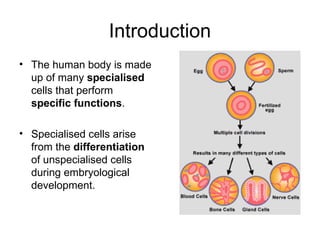
• The human body is made
up of many specialised
cells that perform
specific functions.
• Specialised cells arise
from the differentiation
of unspecialised cells
during embryological
development.
Stem cells…what do you know
already?
Use the questions below to help you complete a KWL chart to show the following
information:
K what you know already
W what you want to learn about stem cells during this unit
L complete this at the end of the unit to summarise what you have learned
Some questions to think about…
•What is a cell?
•What varieties of cell exist?
•What is a tissue? Give some examples.
•What is an organ? Give some examples.
•What is a system? Give some examples.
•What is a stem cell?
•What are some different types of stem cells?
•What is the purpose of stem cell research?
•What are some ways that stem cells have been successfully used in medicine?
•What are some of the issues in stem cell research?
•What are some of the misconceptions that people have about stem cell research?
What are stem cells?
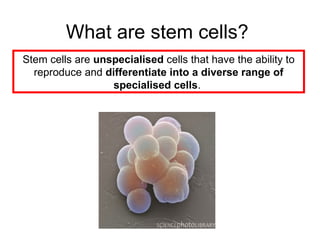
Stem cells are unspecialised cells that have the ability to
reproduce and differentiate into a diverse range of
specialised cells.
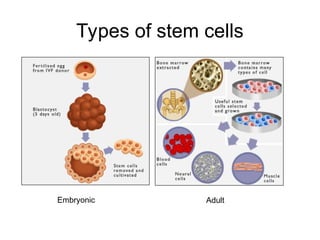
Types of stem cells
Embryonic Adult
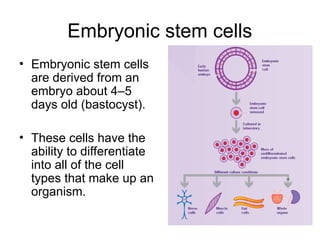
Embryonic stem cells
• Embryonic stem cells
are derived from an
embryo about 4–5
days old (bastocyst).
• These cells have the
ability to differentiate
into all of the cell
types that make up an
organism.
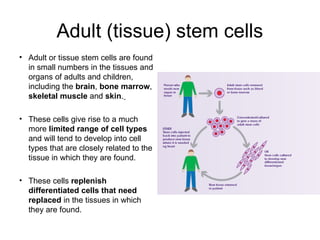
Adult (tissue) stem cells
• Adult or tissue stem cells are found
in small numbers in the tissues and
organs of adults and children,
including the brain, bone marrow,
skeletal muscle and skin.
• These cells give rise to a much
more limited range of cell types
and will tend to develop into cell
types that are closely related to the
tissue in which they are found.
• These cells replenish
differentiated cells that need
replaced in the tissues in which
they are found.
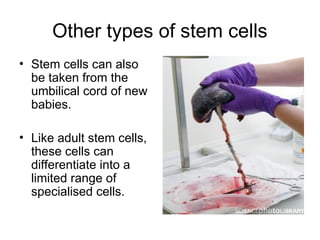
Other types of stem cells
• Stem cells can also
be taken from the
umbilical cord of new
babies.
• Like adult stem cells,
these cells can
differentiate into a
limited range of
specialised cells.
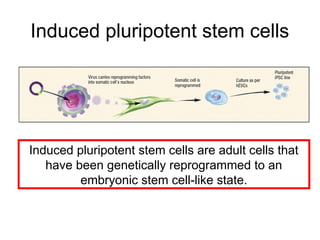
Induced pluripotent stem cells
Induced pluripotent stem cells are adult cells that
have been genetically reprogrammed to an
embryonic stem cell-like state.
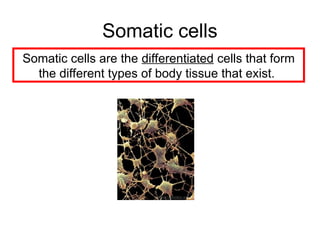
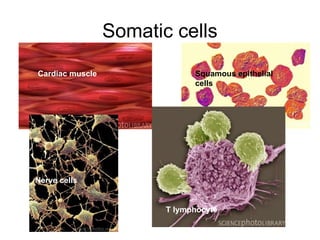
Somatic cells
Somatic cells are the differentiated cells that form
the different types of body tissue that exist.
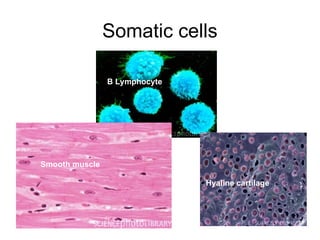
Somatic cells
B Lymphocyte
Hyaline cartilage
Smooth muscle
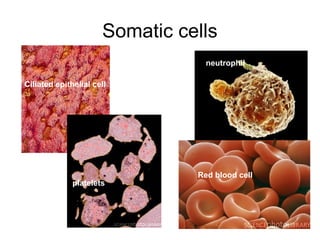
Somatic cells
Ciliated epithelial cell
Red blood cell
platelets
neutrophil
Somatic cells
Cardiac muscle
Nerve cells
Squamous epithelial
cells
T lymphocyte
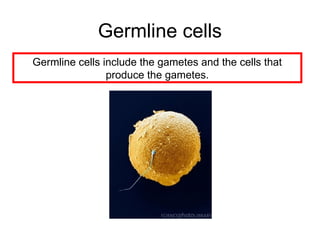
Germline cells
Germline cells include the gametes and the cells that
produce the gametes.
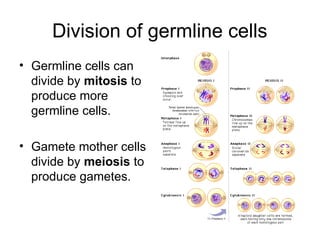
Division of germline cells
• Germline cells can
divide by mitosis to
produce more
germline cells.
• Gamete mother cells
divide by meiosis to
produce gametes.
Stem cell research
Stem cell research provides us with a
wealth of information and can be studied in
a variety of ways, including:
•how cell processes such as growth,
differentiation and gene regulation work
•the study of diseases and their
development
•drug testing
•therapeutic uses in the treatment of
diseases such as leukaemia (bone marrow
transplant), Hunter’s disease and heart
disease
•therapeutic uses in medicine, including skin
grafts for burns and stem cell grafts for
cornea repair.
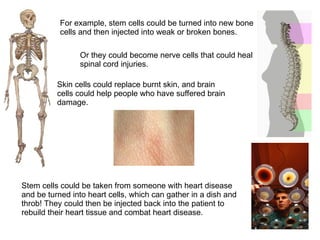
For example, stem cells could be turned into new bone
cells and then injected into weak or broken bones.
Skin cells could replace burnt skin, and brain
cells could help people who have suffered brain
damage.
Or they could become nerve cells that could heal
spinal cord injuries.
Stem cells could be taken from someone with heart disease
and be turned into heart cells, which can gather in a dish and
throb! They could then be injected back into the patient to
rebuild their heart tissue and combat heart disease.
Parkinson's is a very common disease starting with mild symptoms, a mask-
like face, stiffness and tremors until sufferers eventually become immobile.
It is caused by a slow deterioration of certain brain cells (neurons) and
there's no cure.
Replacing the affected brain cells seems more hopeful than finding better
drugs. Many people think that stem cells could be grown into new brain cells
that could help to treat or even cure Parkinson's.
Parkinson's disease
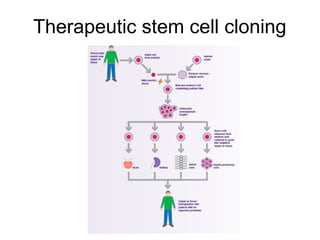
Therapeutic stem cell cloning
Presentation task
Using what you have learned already and adding further research,
create a presentation that covers the following aspects of stem cells:
•the biology of stem cells – what is a stem cell, types of stem cells
•the potential of stem cells – details of one or two research projects
involving stem cells that you have found particularly interesting, details
of potential therapies
•stem cell dilemmas – explore the moral and ethical issues surrounding
stem cell research (personal points of view can be expressed if
desired).
You will be assessed using all three of the above criteria as well as on
the overall quality of your presentation.
Not in our back yard!
Should a business license be issued to ESC lifeworks Inc. by the city of
Glasgow?
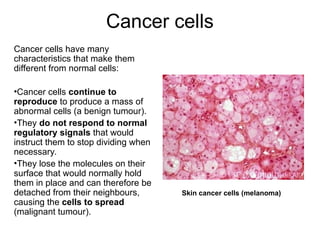
Cancer cells
Cancer cells have many
characteristics that make them
different from normal cells:
•Cancer cells continue to
reproduce to produce a mass of
abnormal cells (a benign tumour).
•They do not respond to normal
regulatory signals that would
instruct them to stop dividing when
necessary.
•They lose the molecules on their
surface that would normally hold
them in place and can therefore be
detached from their neighbours,
causing the cells to spread
(malignant tumour).
Skin cancer cells (melanoma)
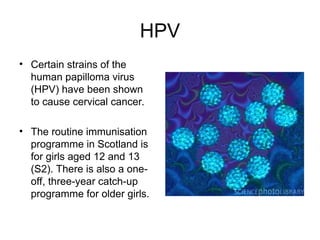
HPV
• Certain strains of the
human papilloma virus
(HPV) have been shown
to cause cervical cancer.
• The routine immunisation
programme in Scotland is
for girls aged 12 and 13
(S2). There is also a one-
off, three-year catch-up
programme for older girls.
Your task
Produce an information leaflet designed to answer
the questions of a patient recently diagnosed with
cancer. Points to consider:
•How are cancer cells different from other cells?
•What is a tumour?
•How will I know if my cancer has spread?
•What is the difference between a malignant
tumour and a benign tumour?
•How will my cancer be treated?
THANK YOU

Human Cell Types . Human Cell Types 2024

  • 1.
  • 2.
    Introduction • The humanbody is made up of many specialised cells that perform specific functions. • Specialised cells arise from the differentiation of unspecialised cells during embryological development.
  • 3.
    Stem cells…what doyou know already? Use the questions below to help you complete a KWL chart to show the following information: K what you know already W what you want to learn about stem cells during this unit L complete this at the end of the unit to summarise what you have learned Some questions to think about… •What is a cell? •What varieties of cell exist? •What is a tissue? Give some examples. •What is an organ? Give some examples. •What is a system? Give some examples. •What is a stem cell? •What are some different types of stem cells? •What is the purpose of stem cell research? •What are some ways that stem cells have been successfully used in medicine? •What are some of the issues in stem cell research? •What are some of the misconceptions that people have about stem cell research?
  • 4.
    What are stemcells? Stem cells are unspecialised cells that have the ability to reproduce and differentiate into a diverse range of specialised cells.
  • 5.
    Types of stemcells Embryonic Adult
  • 6.
    Embryonic stem cells •Embryonic stem cells are derived from an embryo about 4–5 days old (bastocyst). • These cells have the ability to differentiate into all of the cell types that make up an organism.
  • 7.
    Adult (tissue) stemcells • Adult or tissue stem cells are found in small numbers in the tissues and organs of adults and children, including the brain, bone marrow, skeletal muscle and skin. • These cells give rise to a much more limited range of cell types and will tend to develop into cell types that are closely related to the tissue in which they are found. • These cells replenish differentiated cells that need replaced in the tissues in which they are found.
  • 8.
    Other types ofstem cells • Stem cells can also be taken from the umbilical cord of new babies. • Like adult stem cells, these cells can differentiate into a limited range of specialised cells.
  • 9.
    Induced pluripotent stemcells Induced pluripotent stem cells are adult cells that have been genetically reprogrammed to an embryonic stem cell-like state.
  • 10.
    Somatic cells Somatic cellsare the differentiated cells that form the different types of body tissue that exist.
  • 11.
    Somatic cells B Lymphocyte Hyalinecartilage Smooth muscle
  • 12.
    Somatic cells Ciliated epithelialcell Red blood cell platelets neutrophil
  • 13.
    Somatic cells Cardiac muscle Nervecells Squamous epithelial cells T lymphocyte
  • 14.
    Germline cells Germline cellsinclude the gametes and the cells that produce the gametes.
  • 15.
    Division of germlinecells • Germline cells can divide by mitosis to produce more germline cells. • Gamete mother cells divide by meiosis to produce gametes.
  • 16.
    Stem cell research Stemcell research provides us with a wealth of information and can be studied in a variety of ways, including: •how cell processes such as growth, differentiation and gene regulation work •the study of diseases and their development •drug testing •therapeutic uses in the treatment of diseases such as leukaemia (bone marrow transplant), Hunter’s disease and heart disease •therapeutic uses in medicine, including skin grafts for burns and stem cell grafts for cornea repair.
  • 17.
    For example, stemcells could be turned into new bone cells and then injected into weak or broken bones. Skin cells could replace burnt skin, and brain cells could help people who have suffered brain damage. Or they could become nerve cells that could heal spinal cord injuries. Stem cells could be taken from someone with heart disease and be turned into heart cells, which can gather in a dish and throb! They could then be injected back into the patient to rebuild their heart tissue and combat heart disease.
  • 18.
    Parkinson's is avery common disease starting with mild symptoms, a mask- like face, stiffness and tremors until sufferers eventually become immobile. It is caused by a slow deterioration of certain brain cells (neurons) and there's no cure. Replacing the affected brain cells seems more hopeful than finding better drugs. Many people think that stem cells could be grown into new brain cells that could help to treat or even cure Parkinson's. Parkinson's disease
  • 20.
  • 21.
    Presentation task Using whatyou have learned already and adding further research, create a presentation that covers the following aspects of stem cells: •the biology of stem cells – what is a stem cell, types of stem cells •the potential of stem cells – details of one or two research projects involving stem cells that you have found particularly interesting, details of potential therapies •stem cell dilemmas – explore the moral and ethical issues surrounding stem cell research (personal points of view can be expressed if desired). You will be assessed using all three of the above criteria as well as on the overall quality of your presentation.
  • 22.
    Not in ourback yard! Should a business license be issued to ESC lifeworks Inc. by the city of Glasgow?
  • 23.
    Cancer cells Cancer cellshave many characteristics that make them different from normal cells: •Cancer cells continue to reproduce to produce a mass of abnormal cells (a benign tumour). •They do not respond to normal regulatory signals that would instruct them to stop dividing when necessary. •They lose the molecules on their surface that would normally hold them in place and can therefore be detached from their neighbours, causing the cells to spread (malignant tumour). Skin cancer cells (melanoma)
  • 24.
    HPV • Certain strainsof the human papilloma virus (HPV) have been shown to cause cervical cancer. • The routine immunisation programme in Scotland is for girls aged 12 and 13 (S2). There is also a one- off, three-year catch-up programme for older girls.
  • 25.
    Your task Produce aninformation leaflet designed to answer the questions of a patient recently diagnosed with cancer. Points to consider: •How are cancer cells different from other cells? •What is a tumour? •How will I know if my cancer has spread? •What is the difference between a malignant tumour and a benign tumour? •How will my cancer be treated?
  • 26.

Editor's Notes

  • #2 Differentiation also occurs in later developmental stages tissue repair etc in mature adults
  • #4 Why relatively? It is either unspecialised or not
  • #10 Please see comments in Teacher notes regarding protein expression
  • #17 A cool video showing heart cells beating in a dish…. http://www.youtube.com/watch?v=RO4pAc21M24