International Journal of Trend in Scientific Research and Development (IJTSRD)
Volume 3 Issue 6, October 2019 Available Online: www.ijtsrd.com e-ISSN: 2456 – 6470
@ IJTSRD | Unique Paper ID – IJTSRD28073 | Volume – 3 | Issue – 6 | September - October 2019 Page 205
Daily Human Activity Recognition using
Adaboost Classifiers on Wisdm Dataset
Khin Khin Oo
Lecturer, University of Computer Studies, Lashio, Myanmar
ABSTRACT
Human activity recognition is an important area of machine learningresearch
as it has much utilization in different areas such as sports training, security,
entertainment, ambient-assisted living, and health monitoring and
management. Studying human activity recognitionshowsthatresearchersare
interested mostly in the daily activities of the human.Nowadaysmobilephone
is well equipped with advanced processor, more memory, powerful battery
and built-in sensors. This provides an opportunity to open up new areas of
data mining for activity recognition of human’s daily living. In the paper, the
benchmark dataset is considered for this work is acquired from the WISDM
laboratory, which is available in public domain. We tested experiment using
AdaBoost.M1 algorithm with Decision Stump, Hoeffding Tree, Random Tree,
J48, Random Forest and REP Tree to classify six activities of daily life by using
Weka tool. Then we also see the test output from weka experimenterforthese
six classifiers. We found the using Adaboost,M1 with Random Forest, J.48 and
REP Tree improves overall accuracy. We showed that the difference in
accuracy for Random Forest, REP Tree and J48 algorithms compared to
Decision Stump, and Hoeffding Tree is statistically significant. We also show
that the accuracy of these algorithms compared to Decision Stump, and
Hoeffding Tree is high, so we can say that these two algorithms achieved a
statistically significantly better result than the Decision Stump, and Hoeffding
Tree and Random Tree baseline.
KEYWORDS: Human activity recognition, machine learning, data mining,
classifier, accuracy
How to cite this paper: Khin Khin Oo
"Daily Human Activity Recognition using
Adaboost Classifiers on Wisdm Dataset"
Published in
International Journal
of Trend in Scientific
Research and
Development
(ijtsrd), ISSN: 2456-
6470, Volume-3 |
Issue-6, October
2019, pp.205-209, URL:
https://www.ijtsrd.com/papers/ijtsrd28
073.pdf
Copyright © 2019 by author(s) and
International Journal ofTrendinScientific
Research and Development Journal. This
is an Open Access article distributed
under the terms of
the Creative
CommonsAttribution
License (CC BY 4.0)
(http://creativecommons.org/licenses/by
/4.0)
1. INTRODUCTION
Human Activity recognition (HAR) is the root of many
applications, such as those which deal with personal
biometric signature, advanced computing,healthandfitness
monitoring, and elder-care, etc. The input of HAR models is
the reading of the raw sensor data and the output is the
prediction of the user's motion activities. The HAR system
becomes an emerging discipline in the area of pervasive
computing in the intelligent computing applications.
According to the World Health Organization (WHO), the
number of diabetic patients among the world population
drastically increases from time to time (WHO, 2016). In the
world, the first time it is happening that the proportion of
older persons (60 years or older)increasesintheproportion
of young (below 15). For the first timeinhistory,thenumber
of older persons in the world will exceed the number of
young by year 2050. Such ageing population need care.
Activity recognition isa significantresearchareacanprovide
a solution to such problem. This area has many applications
in healthcare, elder care, user interfaces, smart
environments, and security. Image and video based human
activity recognition has been studied since a long time but
they have limitation of mostly require infrastructure
support, for example, the installation of videocamerasin the
monitoring areas. There are alternative approaches are
available such as a body worn sensors or a smart phone
which have built-in sensors to recognize the human activity
of daily living. But a normal human can't wear so many
sensors on the body excludinga patient.Today'ssmartphone
is well equipped with powerful sensors and long lasting
battery with small in size provides an opportunity for data
mining research and applications in human activity
recognition using mobile phones. Some existing works have
explored human activity recognition using data from
accelerometer sensors. Many researches receivedverygood
accuracy by using tri-axial accelerometer for activity
recognition the daily.
2. Sensor approaches
There are two types of sensors to recognize the human
activities; using external or wearablesensors.Inthepast,the
sensors were settled in predetermined points of interest,
therefore the detecting of activities is essentially based on
the interaction of the users with the sensors. One of the
examples of external sensors applications is the intelligent
home, which has a capability to identify the complicated
activities, eating, taking a shower, washing dishes, etc.,
because they depend on data that is collected from various
sensors which are placed in specific objects. Those objects
are supported by peoples’ interaction with them (e.g., stove,
faucet, washing machine, etc.). However, there is no useful
response if the user is out of the sensor area or the activities
of the user do not need to interact with those objects.
Moreover, the composition and servicing of sensors require
high costs.
Also, some of the extensive researches have been focused on
the recognition of activities and gestures from video
sequences. This is most appropriate for security and
IJTSRD28073
International Journal of Trend in Scientific Research and Development (IJTSRD) @ www.ijtsrd.com eISSN: 2456-6470
@ IJTSRD | Unique Paper ID – IJTSRD28073 | Volume – 3 | Issue – 6 | September - October 2019 Page 206
interactive applications. Microsoft developed the Kinect
game console that let the user interact with the game using
the gestures without any controller devices. However, there
are some issues in video sequences of HAR such as:
The privacy, as no one wants to be always monitored
and recorded by cameras.
The pervasiveness, it is difficult to attach the video
recording devices to the target of individuals in orderto
collect the images of their entire bodyduringdailyliving
activities.
Video processing techniques are comparatively costly
and consuming time.
The above-mentioned limitationsmotivatetousea wearable
sensor in HAR. Where the measured attributes almost
depend on the following: environmental variables (such as
temperature and humidity), movement of the user (such as
using GPS or accelerometers), or physiological signals (such
as heart rate or electrocardiogram). These data are indexed
over the time dimension.
Accelerometer sensors sense the acceleration event from
mobile phone, WII remoteorwearablesensors.Therawdata
stream from the accelerometer is the acceleration of each
axis in the units of g-force. The raw data is represented in a
set of 3D space vectors of acceleration. Atimestampcanalso
be returned together with the three axes readings. Most of
the existing accelerometers provide a user interface to
configure the sampling frequency so that the user have to
choose the best sampling rate which match his needs. There
are many causes that encourage developing new techniques
for enhancing the accuracy under more factual conditions.
However, the first works on HAR date back to the late 90’s.
3. Challenges face HAR system designers
Any HAR system design relies on the activities to be
recognized. The activities kinds and complexity are able to
affect the quality of the recognition. Some of challenges
which face researches are (1) how to select the attributes to
be measured, (2) how constructingthesystemwithportable,
unobtrusive, and inexpensive data acquisition, (3) how
extracting the features and designingtheinferencemethods,
(4) how collecting the data in the real environment, (5) how
recognizing activities of the new users without the need of
re-training the system, and (6) how can be implemented in
the mobile devices which meeting energy and processing
limitations.
4. Offline versus online HAR systems
The recognition of human activity could be done using
offline or online techniques. Whenever online processing is
not necessary for the application, the offline processing can
always be used. For example, if the tracking of person’sdaily
routine is the goal such as in, the data was collected during
the day by using the sensors and then it couldbeuploadedto
a server at the end of the day. The data can be processed
offline for classification purposes only.
However, some of the applications such as fitness coach
where the user applies the given program whichcontainson
a set of activities with sequence and duration. It is widely
required to identify what the user is currently doing;
therefore it requires using online technique.
Another application can be the recruitmentforparticipatory
sensing applications. For instance, the application aimed to
collect the information from users during walking in a
specific location in the city. Thus, online recognition of
activities becomes significant. Some researches on human
activities, which work on offline recognition, are using
machine learning tools such as WEKA. Nowadays, some of
clouding systems are being used for online recognition.
5. Data collection
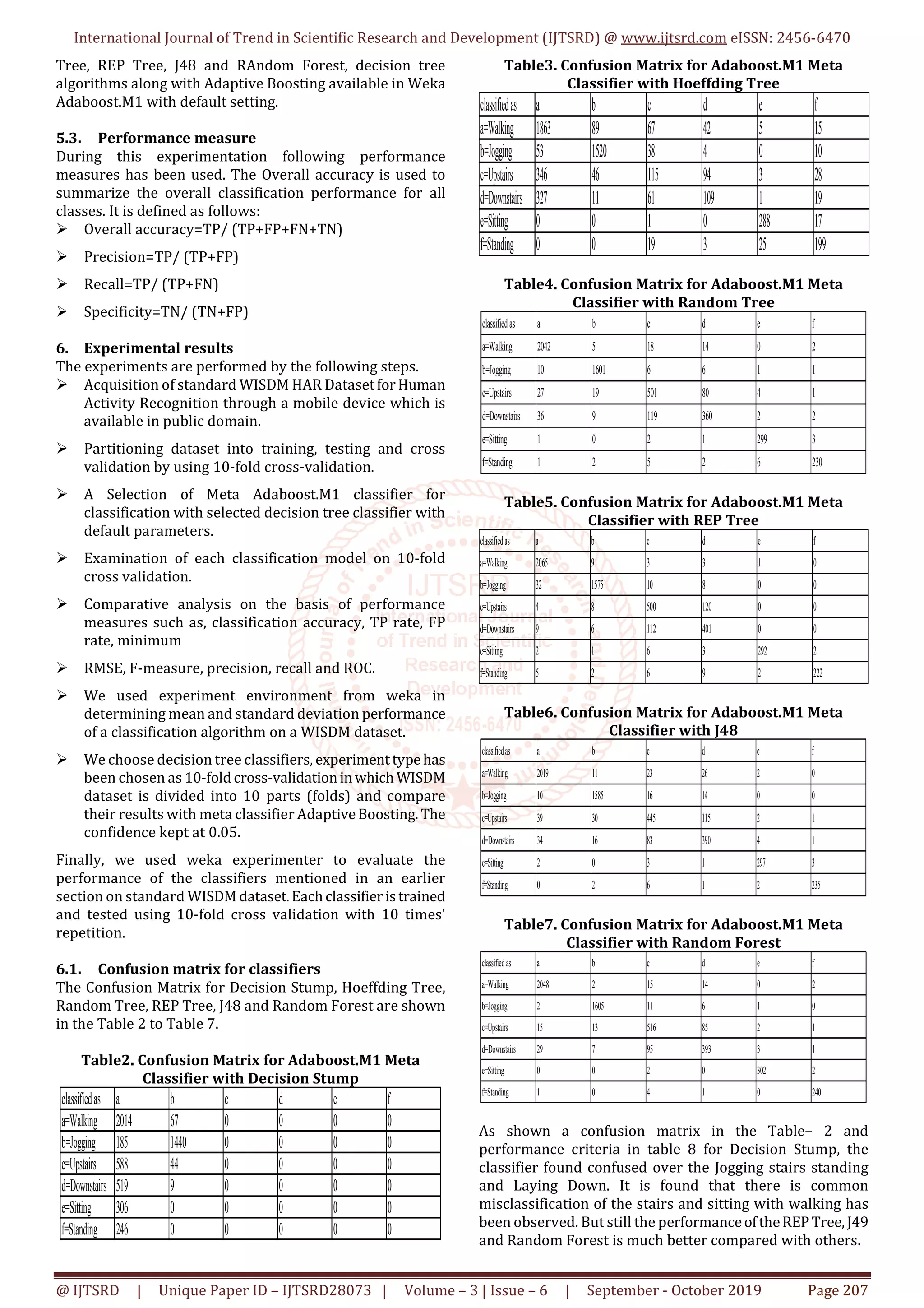
In this paper, we have uses a standard HAR dataset which is
publicly available from the WISDM group. Android smart
phone based application was used to collect data. Each user
was asked to take the smart phone in a front leg pocket and
performed five different activities in supervised condition
which were walking, jogging, walking upstairs, walking
downstairs, sitting, and standing. While performing these
activities, the sampling rate for accelerometer sensor was
kept of 20Hz. WISDM HAR dataset consists the
accelerometer's raw time series data and detail descriptions
are shown in the Table 1.
5.1. Feature generation
Before applying the classifier algorithm, it is necessary to
transform the raw sensor's data. The raw accelerometer's
signal consists of a value related each of the three axes. To
accomplish this J. R. Kwapisz et al has segmented into 10-
second data without overlapping. This is because he
considered that 10seconds data consist of sufficient
recreations that consist of 200 readings. Then they have
generated features that were based each segment data of
200 raw accelerometer readings. A total 43 features are
generated. All these are variants are based on six extraction
methods. Average, Standard Deviation, Average Absolute
Difference and Time between Peaks for each axis are
extracted. Apart from these Average Resultant Acceleration
and Binned Distribution is also extracted.
5.2. Classification
In this paper for classification of human activity of daily
living, we have used the classifiers available in the Weka
tool. In this paper, we have presented selected classifier
algorithms like Decision Stump, Hoeffding Tree, Random
International Journal of Trend in Scientific Research and Development (IJTSRD) @ www.ijtsrd.com eISSN: 2456-6470
@ IJTSRD | Unique Paper ID – IJTSRD28073 | Volume – 3 | Issue – 6 | September - October 2019 Page 207
Tree, REP Tree, J48 and RAndom Forest, decision tree
algorithms along with Adaptive Boosting available in Weka
Adaboost.M1 with default setting.
5.3. Performance measure
During this experimentation following performance
measures has been used. The Overall accuracy is used to
summarize the overall classification performance for all
classes. It is defined as follows:
Overall accuracy=TP/ (TP+FP+FN+TN)
Precision=TP/ (TP+FP)
Recall=TP/ (TP+FN)
Specificity=TN/ (TN+FP)
6. Experimental results
The experiments are performed by the following steps.
Acquisition of standard WISDM HAR DatasetforHuman
Activity Recognition through a mobile device which is
available in public domain.
Partitioning dataset into training, testing and cross
validation by using 10-fold cross-validation.
A Selection of Meta Adaboost.M1 classifier for
classification with selected decision tree classifier with
default parameters.
Examination of each classification model on 10-fold
cross validation.
Comparative analysis on the basis of performance
measures such as, classification accuracy, TP rate, FP
rate, minimum
RMSE, F-measure, precision, recall and ROC.
We used experiment environment from weka in
determining mean and standard deviation performance
of a classification algorithm on a WISDM dataset.
We choose decision tree classifiers, experimenttypehas
been chosen as 10-foldcross-validationinwhichWISDM
dataset is divided into 10 parts (folds) and compare
their results with meta classifier AdaptiveBoosting.The
confidence kept at 0.05.
Finally, we used weka experimenter to evaluate the
performance of the classifiers mentioned in an earlier
section on standard WISDM dataset.Eachclassifieristrained
and tested using 10-fold cross validation with 10 times'
repetition.
6.1. Confusion matrix for classifiers
The Confusion Matrix for Decision Stump, Hoeffding Tree,
Random Tree, REP Tree, J48 and Random Forest are shown
in the Table 2 to Table 7.
Table2. Confusion Matrix for Adaboost.M1 Meta
Classifier with Decision Stump
classifiedas a b c d e f
a=Walking 2014 67 0 0 0 0
b=Jogging 185 1440 0 0 0 0
c=Upstairs 588 44 0 0 0 0
d=Downstairs 519 9 0 0 0 0
e=Sitting 306 0 0 0 0 0
f=Standing 246 0 0 0 0 0
Table3. Confusion Matrix for Adaboost.M1 Meta
Classifier with Hoeffding Tree
classifiedas a b c d e f
a=Walking 1863 89 67 42 5 15
b=Jogging 53 1520 38 4 0 10
c=Upstairs 346 46 115 94 3 28
d=Downstairs 327 11 61 109 1 19
e=Sitting 0 0 1 0 288 17
f=Standing 0 0 19 3 25 199
Table4. Confusion Matrix for Adaboost.M1 Meta
Classifier with Random Tree
classifiedas a b c d e f
a=Walking 2042 5 18 14 0 2
b=Jogging 10 1601 6 6 1 1
c=Upstairs 27 19 501 80 4 1
d=Downstairs 36 9 119 360 2 2
e=Sitting 1 0 2 1 299 3
f=Standing 1 2 5 2 6 230
Table5. Confusion Matrix for Adaboost.M1 Meta
Classifier with REP Tree
classifiedas a b c d e f
a=Walking 2065 9 3 3 1 0
b=Jogging 32 1575 10 8 0 0
c=Upstairs 4 8 500 120 0 0
d=Downstairs 9 6 112 401 0 0
e=Sitting 2 1 6 3 292 2
f=Standing 5 2 6 9 2 222
Table6. Confusion Matrix for Adaboost.M1 Meta
Classifier with J48
classifiedas a b c d e f
a=Walking 2019 11 23 26 2 0
b=Jogging 10 1585 16 14 0 0
c=Upstairs 39 30 445 115 2 1
d=Downstairs 34 16 83 390 4 1
e=Sitting 2 0 3 1 297 3
f=Standing 0 2 6 1 2 235
Table7. Confusion Matrix for Adaboost.M1 Meta
Classifier with Random Forest
classifiedas a b c d e f
a=Walking 2048 2 15 14 0 2
b=Jogging 2 1605 11 6 1 0
c=Upstairs 15 13 516 85 2 1
d=Downstairs 29 7 95 393 3 1
e=Sitting 0 0 2 0 302 2
f=Standing 1 0 4 1 0 240
As shown a confusion matrix in the Table– 2 and
performance criteria in table 8 for Decision Stump, the
classifier found confused over the Jogging stairs standing
and Laying Down. It is found that there is common
misclassification of the stairs and sitting with walking has
been observed. But still the performanceoftheREPTree,J49
and Random Forest is much better compared with others.
International Journal of Trend in Scientific Research and Development (IJTSRD) @ www.ijtsrd.com eISSN: 2456-6470
@ IJTSRD | Unique Paper ID – IJTSRD28073 | Volume – 3 | Issue – 6 | September - October 2019 Page 208
6.2. Performance criteria for classifiers
The performance criteria for classifiers are as shown in
Table 8 to Table 13.
Table8. Performance Criteria for Adaboost.M1 Meta
Classifier with Decision Stump
Class TPRate FPRate Precision Recall F-Measure MCC ROCArea PRCArea
Walking 0.968 0.553 0.522 0.968 0.678 0.446 0.708 0.519
Jogging 0.886 0.032 0.923 0.886 0.904 0.865 0.93 0.876
Upstairs 0 0 ? 0 ? ? 0.624 0.152
Downstairs 0 0 ? 0 ? ? 0.651 0.135
Sitting 0 0 ? 0 ? ? 0.654 0.08
Standing 0 0 ? 0 ? ? 0.651 0.064
WeightedAvg. 0.638 0.222 ? 0.638 ? ? 0.753 0.5
Table9. Performance Criteria for Adaboost.M1 Meta
Classifier with Hoeffding Tree
Class TPRate FPRate Precision Recall F-Measure MCC ROCArea PRCArea
Walking 0.895 0.218 0.72 0.895 0.798 0.66 0.91 0.851
Jogging 0.935 0.038 0.912 0.935 0.924 0.891 0.979 0.971
Upstairs 0.182 0.039 0.382 0.182 0.247 0.201 0.832 0.327
Downstairs 0.206 0.029 0.433 0.206 0.279 0.25 0.81 0.316
Sitting 0.941 0.007 0.894 0.941 0.917 0.912 0.998 0.979
Standing 0.809 0.017 0.691 0.809 0.745 0.735 0.991 0.783
WeightedAvg. 0.756 0.104 0.719 0.756 0.725 0.653 0.92 0.778
Table10. Performance Criteria for Adaboost.M1 Meta
Classifier with Random Tree
Class TPRate FPRate Precision Recall F-Measure MCC ROCArea PRCArea
Walking 0.981 0.022 0.965 0.981 0.973 0.956 0.997 0.996
Jogging 0.985 0.009 0.979 0.985 0.982 0.974 0.999 0.998
Upstairs 0.793 0.031 0.77 0.793 0.781 0.752 0.976 0.857
Downstairs 0.682 0.021 0.778 0.682 0.727 0.701 0.975 0.813
Sitting 0.977 0.003 0.958 0.977 0.968 0.966 1 0.995
Standing 0.935 0.002 0.962 0.935 0.948 0.946 0.997 0.981
WeightedAvg. 0.929 0.017 0.927 0.929 0.928 0.913 0.993 0.962
Table11. Performance Criteria for Adaboost.M1 Meta
Classifier with REP Tree
Class TPRate FPRate Precision Recall F-Measure MCC ROCArea PRCArea
Walking 0.992 0.016 0.975 0.992 0.984 0.974 0.997 0.992
Jogging 0.969 0.007 0.984 0.969 0.976 0.967 0.989 0.988
Upstairs 0.791 0.029 0.785 0.791 0.788 0.76 0.982 0.872
Downstairs 0.759 0.029 0.737 0.759 0.748 0.721 0.978 0.801
Sitting 0.954 0.001 0.99 0.954 0.972 0.97 0.991 0.981
Standing 0.902 0 0.991 0.902 0.945 0.943 0.946 0.915
WeightedAvg. 0.933 0.014 0.934 0.933 0.933 0.92 0.988 0.954
Table12. Performance Criteria for Adaboost.M1 Meta
Classifier with J48
Class TPRate FPRate Precision Recall F-Measure MCC ROCArea PRCArea
Walking 0.97 0.025 0.96 0.97 0.965 0.943 0.995 0.993
Jogging 0.975 0.016 0.964 0.975 0.97 0.957 0.998 0.994
Upstairs 0.704 0.027 0.773 0.704 0.737 0.705 0.964 0.829
Downstairs 0.739 0.032 0.713 0.739 0.726 0.696 0.967 0.794
Sitting 0.971 0.002 0.967 0.971 0.969 0.967 0.994 0.972
Standing 0.955 0.001 0.979 0.955 0.967 0.966 0.996 0.988
WeightedAvg. 0.917 0.021 0.916 0.917 0.917 0.898 0.989 0.953
Table13. Performance Criteria for Adaboost.M1 Meta
Classifier with Random Forest
Class TPRate FPRate Precision Recall F-Measure MCC ROCArea PRCArea
Walking 0.984 0.014 0.978 0.984 0.981 0.969 0.998 0.997
Jogging 0.988 0.006 0.986 0.988 0.987 0.982 1 0.999
Upstairs 0.816 0.027 0.802 0.816 0.809 0.784 0.986 0.908
Downstairs 0.744 0.022 0.788 0.744 0.765 0.741 0.984 0.883
Sitting 0.987 0.001 0.981 0.987 0.984 0.983 1 0.999
Standing 0.976 0.001 0.976 0.976 0.976 0.974 1 0.995
WeightedAvg. 0.942 0.012 0.941 0.942 0.942 0.93 0.996 0.976
7. Conclusion
This paper surveys the state-of-the-art in human activity
recognition based on measured acceleration components.
It can be concluded that the Random Forest, REP Tree and
J48 algorithms which have a little “v” next to their results
means that the difference in the accuracyofthesealgorithms
compared to Decision Stump, and Hoeffding Tree is
statistically significant. This paper also shows the accuracy
of these algorithms compared to Decision Stump, and
Hoeffding Tree is high, so it can be said that these two
algorithms achieved a statistically significantly better result
than the Decision Stump, and Hoeffding Tree and Random
Tree baseline.
8. References
[1] Khan, Adil Mehmood and Lee, Young-Koo and Lee,
Sungyoung Y and Kim, Tae-Seong [2010] A triaxial
accelerometer-based physical-activity recognition via
augmented-signal features and a hierarchical
recognizer,
Information Technology in Biomedicine, IEEE
Transactions;14:5–1166.
[2] Casale, Pierluigi, Pujol Oriol, Radeva Petia. [2011]
Human activity recognition from accelerometer data
using a wearable device, Pattern Recognition and
Image Analysis, 289, Springer.
[3] A. G. Renehan, M. Tyson, M. Egger, R. F. Heller, M.
Zwahlen, Bodymass index and incidence of cancer: a
systematic review and metaanalysis of prospective
observational studies, TheLancet371(2008)569-578.
[4] A. P. C. S. Collaboration, et al., Body mass index and
cardiovascular disease in the asia-pacific region: an
overview of 33 cohorts involving 310 000participants,
International journal of epidemiology 33 (2004) 751-
758.
[5] M. Javan Roshtkhari and M. D. Levine, “Human activity
recognition in videos using a single example,” Image
Vis. Comput., vol. 31, no. 11, pp. 864–876, Nov. 2013.
[6] Redmon, J., Farhadi, A.: Yolo9000: Better, faster,
stronger. In: Computer Vision and Pattern Recognition
(CVPR), 2017 IEEE Conference on, IEEE (2017) 6517–
6525.
[7] Slim S. O., Atia A., Mostafa MS.M. (2016) An
Experimental Comparison Between Seven
Classification Algorithms for Activity Recognition. In
The 1st International Conference on Advanced
Intelligent System and Informatics (AISI2015),
November 28-30, 2015, Beni Suef, Egypt. Advances in
International Journal of Trend in Scientific Research and Development (IJTSRD) @ www.ijtsrd.com eISSN: 2456-6470
@ IJTSRD | Unique Paper ID – IJTSRD28073 | Volume – 3 | Issue – 6 | September - October 2019 Page 209
Intelligent Systems and Computing, vol 407. Springer,
Cham.
[8] T. HAYASHI, M. NISHIDA, N. KITAOKA, T. TODA and K.
TAKEDA, "Daily ActivityRecognitionwithLarge-Scaled
Real-Life Recording Datasets Based on Deep Neural
Network Using Multi-Modal Signals", IEICE
Transactions on Fundamentals of Electronics,
Communications and Computer Sciences, vol. 101, no.
1, pp. 199-210, 2018.
[9] T. Hayashi, M. Nishida, N. Kitaoka,andK.Takeda,“Daily
activity recognition based on dnn using environmental
sound and acceleration signals,” European Signal
Processing Conference, pp.2306–2310, IEEE, 2015.
[10] M. Saeed, J. Pietilä, and I. Korhonen. “An Activity
Recognition Framework Deploying theRandomForest
Classifier and A Single Optical Heart Rate Monitoring
and Triaxial Accelerometer WristBand.”Sensors(Basel,
Switzerland), 18(2), 2018.
[11] Shirahama, K.; Grzegorzek, M. On the Generality of
Codebook Approach for Sensor-based Human Activity
Recognition. Electronics 2017, 6, 44.
[12] Kose, Mustafa.; Incel, O.D.; Ersoy, C. Online Human
Activity Recognition on Smart Phones.InProceeedings
of the Workshop on Mobile Sensing: From
Smartphones and Wearables toBigData,Beijing,China,
16 April 2012; pp. 11–15.
[13] Dean M. Karantonis, Michael R. Narayanan, Merryn
Mathie, Nigel H. Lovell, Branko G. Celler [2006]
Implementation of a real-time human movement
classifier using a triaxial accelerometerforambulatory
monitoring, IEEE Transactions on Information
Technology in Biomedicine, 10(1): 156–167
[14] N Ravi, N Dandekar, P Mysore, and ML Littman. [2005]
Activity recognition from accelerometer data.IAAI-05:
American Association for Artificial Intelligence.

Daily Human Activity Recognition using Adaboost Classifiers on Wisdm Dataset

  • 1.
    International Journal ofTrend in Scientific Research and Development (IJTSRD) Volume 3 Issue 6, October 2019 Available Online: www.ijtsrd.com e-ISSN: 2456 – 6470 @ IJTSRD | Unique Paper ID – IJTSRD28073 | Volume – 3 | Issue – 6 | September - October 2019 Page 205 Daily Human Activity Recognition using Adaboost Classifiers on Wisdm Dataset Khin Khin Oo Lecturer, University of Computer Studies, Lashio, Myanmar ABSTRACT Human activity recognition is an important area of machine learningresearch as it has much utilization in different areas such as sports training, security, entertainment, ambient-assisted living, and health monitoring and management. Studying human activity recognitionshowsthatresearchersare interested mostly in the daily activities of the human.Nowadaysmobilephone is well equipped with advanced processor, more memory, powerful battery and built-in sensors. This provides an opportunity to open up new areas of data mining for activity recognition of human’s daily living. In the paper, the benchmark dataset is considered for this work is acquired from the WISDM laboratory, which is available in public domain. We tested experiment using AdaBoost.M1 algorithm with Decision Stump, Hoeffding Tree, Random Tree, J48, Random Forest and REP Tree to classify six activities of daily life by using Weka tool. Then we also see the test output from weka experimenterforthese six classifiers. We found the using Adaboost,M1 with Random Forest, J.48 and REP Tree improves overall accuracy. We showed that the difference in accuracy for Random Forest, REP Tree and J48 algorithms compared to Decision Stump, and Hoeffding Tree is statistically significant. We also show that the accuracy of these algorithms compared to Decision Stump, and Hoeffding Tree is high, so we can say that these two algorithms achieved a statistically significantly better result than the Decision Stump, and Hoeffding Tree and Random Tree baseline. KEYWORDS: Human activity recognition, machine learning, data mining, classifier, accuracy How to cite this paper: Khin Khin Oo "Daily Human Activity Recognition using Adaboost Classifiers on Wisdm Dataset" Published in International Journal of Trend in Scientific Research and Development (ijtsrd), ISSN: 2456- 6470, Volume-3 | Issue-6, October 2019, pp.205-209, URL: https://www.ijtsrd.com/papers/ijtsrd28 073.pdf Copyright © 2019 by author(s) and International Journal ofTrendinScientific Research and Development Journal. This is an Open Access article distributed under the terms of the Creative CommonsAttribution License (CC BY 4.0) (http://creativecommons.org/licenses/by /4.0) 1. INTRODUCTION Human Activity recognition (HAR) is the root of many applications, such as those which deal with personal biometric signature, advanced computing,healthandfitness monitoring, and elder-care, etc. The input of HAR models is the reading of the raw sensor data and the output is the prediction of the user's motion activities. The HAR system becomes an emerging discipline in the area of pervasive computing in the intelligent computing applications. According to the World Health Organization (WHO), the number of diabetic patients among the world population drastically increases from time to time (WHO, 2016). In the world, the first time it is happening that the proportion of older persons (60 years or older)increasesintheproportion of young (below 15). For the first timeinhistory,thenumber of older persons in the world will exceed the number of young by year 2050. Such ageing population need care. Activity recognition isa significantresearchareacanprovide a solution to such problem. This area has many applications in healthcare, elder care, user interfaces, smart environments, and security. Image and video based human activity recognition has been studied since a long time but they have limitation of mostly require infrastructure support, for example, the installation of videocamerasin the monitoring areas. There are alternative approaches are available such as a body worn sensors or a smart phone which have built-in sensors to recognize the human activity of daily living. But a normal human can't wear so many sensors on the body excludinga patient.Today'ssmartphone is well equipped with powerful sensors and long lasting battery with small in size provides an opportunity for data mining research and applications in human activity recognition using mobile phones. Some existing works have explored human activity recognition using data from accelerometer sensors. Many researches receivedverygood accuracy by using tri-axial accelerometer for activity recognition the daily. 2. Sensor approaches There are two types of sensors to recognize the human activities; using external or wearablesensors.Inthepast,the sensors were settled in predetermined points of interest, therefore the detecting of activities is essentially based on the interaction of the users with the sensors. One of the examples of external sensors applications is the intelligent home, which has a capability to identify the complicated activities, eating, taking a shower, washing dishes, etc., because they depend on data that is collected from various sensors which are placed in specific objects. Those objects are supported by peoples’ interaction with them (e.g., stove, faucet, washing machine, etc.). However, there is no useful response if the user is out of the sensor area or the activities of the user do not need to interact with those objects. Moreover, the composition and servicing of sensors require high costs. Also, some of the extensive researches have been focused on the recognition of activities and gestures from video sequences. This is most appropriate for security and IJTSRD28073
  • 2.
    International Journal ofTrend in Scientific Research and Development (IJTSRD) @ www.ijtsrd.com eISSN: 2456-6470 @ IJTSRD | Unique Paper ID – IJTSRD28073 | Volume – 3 | Issue – 6 | September - October 2019 Page 206 interactive applications. Microsoft developed the Kinect game console that let the user interact with the game using the gestures without any controller devices. However, there are some issues in video sequences of HAR such as: The privacy, as no one wants to be always monitored and recorded by cameras. The pervasiveness, it is difficult to attach the video recording devices to the target of individuals in orderto collect the images of their entire bodyduringdailyliving activities. Video processing techniques are comparatively costly and consuming time. The above-mentioned limitationsmotivatetousea wearable sensor in HAR. Where the measured attributes almost depend on the following: environmental variables (such as temperature and humidity), movement of the user (such as using GPS or accelerometers), or physiological signals (such as heart rate or electrocardiogram). These data are indexed over the time dimension. Accelerometer sensors sense the acceleration event from mobile phone, WII remoteorwearablesensors.Therawdata stream from the accelerometer is the acceleration of each axis in the units of g-force. The raw data is represented in a set of 3D space vectors of acceleration. Atimestampcanalso be returned together with the three axes readings. Most of the existing accelerometers provide a user interface to configure the sampling frequency so that the user have to choose the best sampling rate which match his needs. There are many causes that encourage developing new techniques for enhancing the accuracy under more factual conditions. However, the first works on HAR date back to the late 90’s. 3. Challenges face HAR system designers Any HAR system design relies on the activities to be recognized. The activities kinds and complexity are able to affect the quality of the recognition. Some of challenges which face researches are (1) how to select the attributes to be measured, (2) how constructingthesystemwithportable, unobtrusive, and inexpensive data acquisition, (3) how extracting the features and designingtheinferencemethods, (4) how collecting the data in the real environment, (5) how recognizing activities of the new users without the need of re-training the system, and (6) how can be implemented in the mobile devices which meeting energy and processing limitations. 4. Offline versus online HAR systems The recognition of human activity could be done using offline or online techniques. Whenever online processing is not necessary for the application, the offline processing can always be used. For example, if the tracking of person’sdaily routine is the goal such as in, the data was collected during the day by using the sensors and then it couldbeuploadedto a server at the end of the day. The data can be processed offline for classification purposes only. However, some of the applications such as fitness coach where the user applies the given program whichcontainson a set of activities with sequence and duration. It is widely required to identify what the user is currently doing; therefore it requires using online technique. Another application can be the recruitmentforparticipatory sensing applications. For instance, the application aimed to collect the information from users during walking in a specific location in the city. Thus, online recognition of activities becomes significant. Some researches on human activities, which work on offline recognition, are using machine learning tools such as WEKA. Nowadays, some of clouding systems are being used for online recognition. 5. Data collection In this paper, we have uses a standard HAR dataset which is publicly available from the WISDM group. Android smart phone based application was used to collect data. Each user was asked to take the smart phone in a front leg pocket and performed five different activities in supervised condition which were walking, jogging, walking upstairs, walking downstairs, sitting, and standing. While performing these activities, the sampling rate for accelerometer sensor was kept of 20Hz. WISDM HAR dataset consists the accelerometer's raw time series data and detail descriptions are shown in the Table 1. 5.1. Feature generation Before applying the classifier algorithm, it is necessary to transform the raw sensor's data. The raw accelerometer's signal consists of a value related each of the three axes. To accomplish this J. R. Kwapisz et al has segmented into 10- second data without overlapping. This is because he considered that 10seconds data consist of sufficient recreations that consist of 200 readings. Then they have generated features that were based each segment data of 200 raw accelerometer readings. A total 43 features are generated. All these are variants are based on six extraction methods. Average, Standard Deviation, Average Absolute Difference and Time between Peaks for each axis are extracted. Apart from these Average Resultant Acceleration and Binned Distribution is also extracted. 5.2. Classification In this paper for classification of human activity of daily living, we have used the classifiers available in the Weka tool. In this paper, we have presented selected classifier algorithms like Decision Stump, Hoeffding Tree, Random
  • 3.
    International Journal ofTrend in Scientific Research and Development (IJTSRD) @ www.ijtsrd.com eISSN: 2456-6470 @ IJTSRD | Unique Paper ID – IJTSRD28073 | Volume – 3 | Issue – 6 | September - October 2019 Page 207 Tree, REP Tree, J48 and RAndom Forest, decision tree algorithms along with Adaptive Boosting available in Weka Adaboost.M1 with default setting. 5.3. Performance measure During this experimentation following performance measures has been used. The Overall accuracy is used to summarize the overall classification performance for all classes. It is defined as follows: Overall accuracy=TP/ (TP+FP+FN+TN) Precision=TP/ (TP+FP) Recall=TP/ (TP+FN) Specificity=TN/ (TN+FP) 6. Experimental results The experiments are performed by the following steps. Acquisition of standard WISDM HAR DatasetforHuman Activity Recognition through a mobile device which is available in public domain. Partitioning dataset into training, testing and cross validation by using 10-fold cross-validation. A Selection of Meta Adaboost.M1 classifier for classification with selected decision tree classifier with default parameters. Examination of each classification model on 10-fold cross validation. Comparative analysis on the basis of performance measures such as, classification accuracy, TP rate, FP rate, minimum RMSE, F-measure, precision, recall and ROC. We used experiment environment from weka in determining mean and standard deviation performance of a classification algorithm on a WISDM dataset. We choose decision tree classifiers, experimenttypehas been chosen as 10-foldcross-validationinwhichWISDM dataset is divided into 10 parts (folds) and compare their results with meta classifier AdaptiveBoosting.The confidence kept at 0.05. Finally, we used weka experimenter to evaluate the performance of the classifiers mentioned in an earlier section on standard WISDM dataset.Eachclassifieristrained and tested using 10-fold cross validation with 10 times' repetition. 6.1. Confusion matrix for classifiers The Confusion Matrix for Decision Stump, Hoeffding Tree, Random Tree, REP Tree, J48 and Random Forest are shown in the Table 2 to Table 7. Table2. Confusion Matrix for Adaboost.M1 Meta Classifier with Decision Stump classifiedas a b c d e f a=Walking 2014 67 0 0 0 0 b=Jogging 185 1440 0 0 0 0 c=Upstairs 588 44 0 0 0 0 d=Downstairs 519 9 0 0 0 0 e=Sitting 306 0 0 0 0 0 f=Standing 246 0 0 0 0 0 Table3. Confusion Matrix for Adaboost.M1 Meta Classifier with Hoeffding Tree classifiedas a b c d e f a=Walking 1863 89 67 42 5 15 b=Jogging 53 1520 38 4 0 10 c=Upstairs 346 46 115 94 3 28 d=Downstairs 327 11 61 109 1 19 e=Sitting 0 0 1 0 288 17 f=Standing 0 0 19 3 25 199 Table4. Confusion Matrix for Adaboost.M1 Meta Classifier with Random Tree classifiedas a b c d e f a=Walking 2042 5 18 14 0 2 b=Jogging 10 1601 6 6 1 1 c=Upstairs 27 19 501 80 4 1 d=Downstairs 36 9 119 360 2 2 e=Sitting 1 0 2 1 299 3 f=Standing 1 2 5 2 6 230 Table5. Confusion Matrix for Adaboost.M1 Meta Classifier with REP Tree classifiedas a b c d e f a=Walking 2065 9 3 3 1 0 b=Jogging 32 1575 10 8 0 0 c=Upstairs 4 8 500 120 0 0 d=Downstairs 9 6 112 401 0 0 e=Sitting 2 1 6 3 292 2 f=Standing 5 2 6 9 2 222 Table6. Confusion Matrix for Adaboost.M1 Meta Classifier with J48 classifiedas a b c d e f a=Walking 2019 11 23 26 2 0 b=Jogging 10 1585 16 14 0 0 c=Upstairs 39 30 445 115 2 1 d=Downstairs 34 16 83 390 4 1 e=Sitting 2 0 3 1 297 3 f=Standing 0 2 6 1 2 235 Table7. Confusion Matrix for Adaboost.M1 Meta Classifier with Random Forest classifiedas a b c d e f a=Walking 2048 2 15 14 0 2 b=Jogging 2 1605 11 6 1 0 c=Upstairs 15 13 516 85 2 1 d=Downstairs 29 7 95 393 3 1 e=Sitting 0 0 2 0 302 2 f=Standing 1 0 4 1 0 240 As shown a confusion matrix in the Table– 2 and performance criteria in table 8 for Decision Stump, the classifier found confused over the Jogging stairs standing and Laying Down. It is found that there is common misclassification of the stairs and sitting with walking has been observed. But still the performanceoftheREPTree,J49 and Random Forest is much better compared with others.
  • 4.
    International Journal ofTrend in Scientific Research and Development (IJTSRD) @ www.ijtsrd.com eISSN: 2456-6470 @ IJTSRD | Unique Paper ID – IJTSRD28073 | Volume – 3 | Issue – 6 | September - October 2019 Page 208 6.2. Performance criteria for classifiers The performance criteria for classifiers are as shown in Table 8 to Table 13. Table8. Performance Criteria for Adaboost.M1 Meta Classifier with Decision Stump Class TPRate FPRate Precision Recall F-Measure MCC ROCArea PRCArea Walking 0.968 0.553 0.522 0.968 0.678 0.446 0.708 0.519 Jogging 0.886 0.032 0.923 0.886 0.904 0.865 0.93 0.876 Upstairs 0 0 ? 0 ? ? 0.624 0.152 Downstairs 0 0 ? 0 ? ? 0.651 0.135 Sitting 0 0 ? 0 ? ? 0.654 0.08 Standing 0 0 ? 0 ? ? 0.651 0.064 WeightedAvg. 0.638 0.222 ? 0.638 ? ? 0.753 0.5 Table9. Performance Criteria for Adaboost.M1 Meta Classifier with Hoeffding Tree Class TPRate FPRate Precision Recall F-Measure MCC ROCArea PRCArea Walking 0.895 0.218 0.72 0.895 0.798 0.66 0.91 0.851 Jogging 0.935 0.038 0.912 0.935 0.924 0.891 0.979 0.971 Upstairs 0.182 0.039 0.382 0.182 0.247 0.201 0.832 0.327 Downstairs 0.206 0.029 0.433 0.206 0.279 0.25 0.81 0.316 Sitting 0.941 0.007 0.894 0.941 0.917 0.912 0.998 0.979 Standing 0.809 0.017 0.691 0.809 0.745 0.735 0.991 0.783 WeightedAvg. 0.756 0.104 0.719 0.756 0.725 0.653 0.92 0.778 Table10. Performance Criteria for Adaboost.M1 Meta Classifier with Random Tree Class TPRate FPRate Precision Recall F-Measure MCC ROCArea PRCArea Walking 0.981 0.022 0.965 0.981 0.973 0.956 0.997 0.996 Jogging 0.985 0.009 0.979 0.985 0.982 0.974 0.999 0.998 Upstairs 0.793 0.031 0.77 0.793 0.781 0.752 0.976 0.857 Downstairs 0.682 0.021 0.778 0.682 0.727 0.701 0.975 0.813 Sitting 0.977 0.003 0.958 0.977 0.968 0.966 1 0.995 Standing 0.935 0.002 0.962 0.935 0.948 0.946 0.997 0.981 WeightedAvg. 0.929 0.017 0.927 0.929 0.928 0.913 0.993 0.962 Table11. Performance Criteria for Adaboost.M1 Meta Classifier with REP Tree Class TPRate FPRate Precision Recall F-Measure MCC ROCArea PRCArea Walking 0.992 0.016 0.975 0.992 0.984 0.974 0.997 0.992 Jogging 0.969 0.007 0.984 0.969 0.976 0.967 0.989 0.988 Upstairs 0.791 0.029 0.785 0.791 0.788 0.76 0.982 0.872 Downstairs 0.759 0.029 0.737 0.759 0.748 0.721 0.978 0.801 Sitting 0.954 0.001 0.99 0.954 0.972 0.97 0.991 0.981 Standing 0.902 0 0.991 0.902 0.945 0.943 0.946 0.915 WeightedAvg. 0.933 0.014 0.934 0.933 0.933 0.92 0.988 0.954 Table12. Performance Criteria for Adaboost.M1 Meta Classifier with J48 Class TPRate FPRate Precision Recall F-Measure MCC ROCArea PRCArea Walking 0.97 0.025 0.96 0.97 0.965 0.943 0.995 0.993 Jogging 0.975 0.016 0.964 0.975 0.97 0.957 0.998 0.994 Upstairs 0.704 0.027 0.773 0.704 0.737 0.705 0.964 0.829 Downstairs 0.739 0.032 0.713 0.739 0.726 0.696 0.967 0.794 Sitting 0.971 0.002 0.967 0.971 0.969 0.967 0.994 0.972 Standing 0.955 0.001 0.979 0.955 0.967 0.966 0.996 0.988 WeightedAvg. 0.917 0.021 0.916 0.917 0.917 0.898 0.989 0.953 Table13. Performance Criteria for Adaboost.M1 Meta Classifier with Random Forest Class TPRate FPRate Precision Recall F-Measure MCC ROCArea PRCArea Walking 0.984 0.014 0.978 0.984 0.981 0.969 0.998 0.997 Jogging 0.988 0.006 0.986 0.988 0.987 0.982 1 0.999 Upstairs 0.816 0.027 0.802 0.816 0.809 0.784 0.986 0.908 Downstairs 0.744 0.022 0.788 0.744 0.765 0.741 0.984 0.883 Sitting 0.987 0.001 0.981 0.987 0.984 0.983 1 0.999 Standing 0.976 0.001 0.976 0.976 0.976 0.974 1 0.995 WeightedAvg. 0.942 0.012 0.941 0.942 0.942 0.93 0.996 0.976 7. Conclusion This paper surveys the state-of-the-art in human activity recognition based on measured acceleration components. It can be concluded that the Random Forest, REP Tree and J48 algorithms which have a little “v” next to their results means that the difference in the accuracyofthesealgorithms compared to Decision Stump, and Hoeffding Tree is statistically significant. This paper also shows the accuracy of these algorithms compared to Decision Stump, and Hoeffding Tree is high, so it can be said that these two algorithms achieved a statistically significantly better result than the Decision Stump, and Hoeffding Tree and Random Tree baseline. 8. References [1] Khan, Adil Mehmood and Lee, Young-Koo and Lee, Sungyoung Y and Kim, Tae-Seong [2010] A triaxial accelerometer-based physical-activity recognition via augmented-signal features and a hierarchical recognizer, Information Technology in Biomedicine, IEEE Transactions;14:5–1166. [2] Casale, Pierluigi, Pujol Oriol, Radeva Petia. [2011] Human activity recognition from accelerometer data using a wearable device, Pattern Recognition and Image Analysis, 289, Springer. [3] A. G. Renehan, M. Tyson, M. Egger, R. F. Heller, M. Zwahlen, Bodymass index and incidence of cancer: a systematic review and metaanalysis of prospective observational studies, TheLancet371(2008)569-578. [4] A. P. C. S. Collaboration, et al., Body mass index and cardiovascular disease in the asia-pacific region: an overview of 33 cohorts involving 310 000participants, International journal of epidemiology 33 (2004) 751- 758. [5] M. Javan Roshtkhari and M. D. Levine, “Human activity recognition in videos using a single example,” Image Vis. Comput., vol. 31, no. 11, pp. 864–876, Nov. 2013. [6] Redmon, J., Farhadi, A.: Yolo9000: Better, faster, stronger. In: Computer Vision and Pattern Recognition (CVPR), 2017 IEEE Conference on, IEEE (2017) 6517– 6525. [7] Slim S. O., Atia A., Mostafa MS.M. (2016) An Experimental Comparison Between Seven Classification Algorithms for Activity Recognition. In The 1st International Conference on Advanced Intelligent System and Informatics (AISI2015), November 28-30, 2015, Beni Suef, Egypt. Advances in
  • 5.
    International Journal ofTrend in Scientific Research and Development (IJTSRD) @ www.ijtsrd.com eISSN: 2456-6470 @ IJTSRD | Unique Paper ID – IJTSRD28073 | Volume – 3 | Issue – 6 | September - October 2019 Page 209 Intelligent Systems and Computing, vol 407. Springer, Cham. [8] T. HAYASHI, M. NISHIDA, N. KITAOKA, T. TODA and K. TAKEDA, "Daily ActivityRecognitionwithLarge-Scaled Real-Life Recording Datasets Based on Deep Neural Network Using Multi-Modal Signals", IEICE Transactions on Fundamentals of Electronics, Communications and Computer Sciences, vol. 101, no. 1, pp. 199-210, 2018. [9] T. Hayashi, M. Nishida, N. Kitaoka,andK.Takeda,“Daily activity recognition based on dnn using environmental sound and acceleration signals,” European Signal Processing Conference, pp.2306–2310, IEEE, 2015. [10] M. Saeed, J. Pietilä, and I. Korhonen. “An Activity Recognition Framework Deploying theRandomForest Classifier and A Single Optical Heart Rate Monitoring and Triaxial Accelerometer WristBand.”Sensors(Basel, Switzerland), 18(2), 2018. [11] Shirahama, K.; Grzegorzek, M. On the Generality of Codebook Approach for Sensor-based Human Activity Recognition. Electronics 2017, 6, 44. [12] Kose, Mustafa.; Incel, O.D.; Ersoy, C. Online Human Activity Recognition on Smart Phones.InProceeedings of the Workshop on Mobile Sensing: From Smartphones and Wearables toBigData,Beijing,China, 16 April 2012; pp. 11–15. [13] Dean M. Karantonis, Michael R. Narayanan, Merryn Mathie, Nigel H. Lovell, Branko G. Celler [2006] Implementation of a real-time human movement classifier using a triaxial accelerometerforambulatory monitoring, IEEE Transactions on Information Technology in Biomedicine, 10(1): 156–167 [14] N Ravi, N Dandekar, P Mysore, and ML Littman. [2005] Activity recognition from accelerometer data.IAAI-05: American Association for Artificial Intelligence.