THE
DEVASTATING
HUDHUD
INTRODUCTION
The Hudhud cyclone will go down as the most
devastating cyclone ever in the history of
Vizag. This cyclone was not expected to have
such a devastating and long lasting effect on
the people of vizag. In a split second, Vizag
was turned from the City of Destiny to the
City of Doom. At the same time it taught the
younger generation how their forefathers
used to live. A life without fans , lights,
electricity and most importantly- computer
and TV. It was also a wake up call for the
elder generation as well, it taught them an
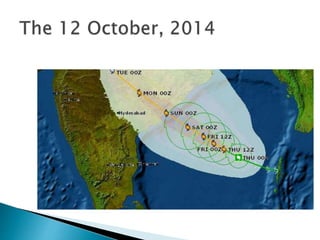
Hudhud originated from a low pressure
system that formed under the influence
of an upper-air cyclonic circulation in the
Andaman Sea on October 6.
 The name of this relentless force has its name
originated from Oman.
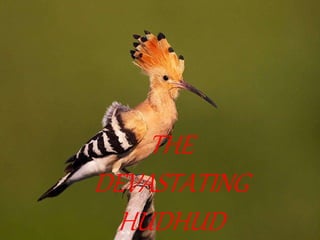
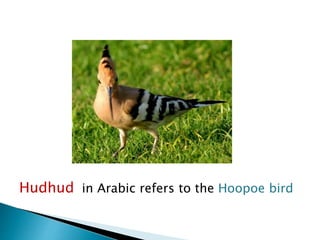
 The Hudhud, or hoopoe bird, is an exotic creature
noticed for its distinctive crown of feathers and is
widespread in Europe, Asia and North Africa.
 An international panel on tropical cyclones led by
the World Meteorological Organization (WMO), a
Geneva-based agency of the UN, sat down in 2004
and decided to name their cyclones as a committee
in the spirit of co-operation and consensus.
Origin of the name
Hudhud in Arabic refers to the Hoopoe bird
 Eight countries - India, Pakistan,
Bangladesh, Maldives, Myanmar, Oman, Sri
Lanka and Thailand - took part. They came
up with a list of 64 names- eight names
from each country - for upcoming cyclones.
 The list goes alphabetically, according to
each country. The last cyclone in the region
was Nanauk in June, a name contributed by
Myanmar.
Visakhapatnam (nicknamed as Vizag
and sometimes known by its historical
name Waltair) is the largest city in the
Indian state of Andhra Pradesh and the
third largest city on the east coast of
India (after Chennai and Kolkata). It is a
port city on the southeast coast of Bay
of Bengal and often called as "The Jewel
of the East Coast" and the "City of
Destiny".
Visakhapatnam
Visakhapatnam bore the brunt of
Hudhud, which hit its coast with a
speed of 185 km/h (115 mph).
Hudhud crossed the coast of Andhra
Pradesh at the noon of October 12
over Visakhapatnam, with winds
exceeding 185 km/h (115 mph). As
per initial reports, 3 people were killed
due to heavy rainfall accompanied by
strong winds in coastal areas. Within
hours of hitting the coast, the cyclone
severed the radar link of
Visakhapatnam Cyclone Warning
Centre.
The high tides
 Hudhud caused at least 46 deaths
within Andhra Pradesh. Total damage
costs are estimated to be at least
70000 crore (US$11 billion). This
makes Hudhud the most destructive
cyclone to ever hit India and the
second most destructive in the basin
after Cyclone Nargis in 2008.
A broken down bridge
With Hudhud slamming into the Vizag coast on Sunday
morning, people faced anxious moments as their
phones (both mobile and landline) went phut, cutting
them off from their near and dear ones. By afternoon,
when Hudhud made a landfall, most of the phone lines
in the city either went dead or had only enough signal
to send only SOS SMSes.
Problemsfacedby the people
The Home Ministry and State authorities of Odisha and
Andhra Pradesh closely coordinated preparedness
measures at this stage. On October 11, Around 400,000
people in 397 villages in 5 districts along the coast were
ordered to evacuate. The evacuees were shifted to 370
relief camps.
State and central government’s
action
Reportedly, thousands of members of the
National Disaster Response Force (NDRF) and
State Disaster Response Force (SDRF), and the
fire services, were sent to coastal areas to
prepare for search and rescue operations and
assist with evacuations. NDRF teams also
organized drinking water supplies, food
distribution and provision of other basic
amenities.
 Navy chief Admiral RK Dhowan reviewed the
effect of cyclone Hudhud at the naval base in
Visakhapatnam and said all efforts were made to
restore its lost glory.
 Laudable efforts of INS Dega in resuming air
operations in less than 24 hours of the calamity
and ensuring availability of runway to facilitate
airlifting of relief material to Visakhapatnam from
various parts of the country as also the early
resumption of civil flight operations.
RESCUE OPERATIONS
POSITIVE EFFECTS OF HUDHUD
Though Hudhud had a devastating effect on the districts of
Visakhapatnam, Srikakulam and Vizianagaram, it has
brought family members and friends closer on the positive
side.These are some of the extracts from a newspaper
which clearly suggest that Hudhud reminded the people of
vizag, the need to be united:
For 80-year-old Sitadevi of Muralinagar, the
memory of having dinner with her family members
has almost erased. She had been having her night
meal all alone, as her son and working daughter-in-
law would return home late in the night.
“Today, after many years, we are once again having
our meal together. Most importantly, my 15-year-
old granddaughter, who never joined me as she
Ch. Srinivas Rao has a similar story to narrate. They didn’t
share that good a relationship with their neighbour for
quite sometime. “But as the building started to shake due
Hudhud, my neighbours were the first to alert us and even
carry our two-year-old child to safety at the cellar. We
are friends once again,” he said.
Sangita, a software professional, had mixed feelings when
her estranged husband called up from Bangalore to
enquire her well-being. “It was a ‘feel good moment’ at the
time of crisis,” she said.
 Mangroves and casuarinas plantations along the
coast and the thick tree cover on the hills used to
protect the city in the past from the vagaries of
cyclones
 Cyclone shelters need to be maintained in a state of
readiness.
 Gram sabhas in villages can play a crucial role in
facing calamities. If fallen trees could be cleared
along many lanes in the city within five days after the
cyclone, the credit should go to self-help groups
and some NGOs. The government should, therefore,
involve civil society as a part of any disaster
management effort in the future.
CONCLUSION
Hudhud-This was nothing but the name of a bird
before the 12th of October 2014 but after the
12th ,this term became a symbol of destruction.
Many people lost their lives, they died fighting
the brute force of the raging wind, they died
the death of a martyr. People were in a state of
despair, they lost all their hope and then there
was a ray of hope in the form of unity. People in
the Hudhud struck areas fought as one for their
survival which helped them overcome their state
of distress. Hudhud has been experienced by
many but desired by none. This situation though
was handled carefully by the Government of
India ,help was provided to people who needed it
OUR TEAM
B.Srihith 23
P.Sai Saugandh 9
Achyut 2
Himanshu 5
K.Sai Mohan 28
G.Hemchand 34
A. Nishant 40
THANK
YOU

Hud hud cyclone

  • 1.
  • 2.
    INTRODUCTION The Hudhud cyclonewill go down as the most devastating cyclone ever in the history of Vizag. This cyclone was not expected to have such a devastating and long lasting effect on the people of vizag. In a split second, Vizag was turned from the City of Destiny to the City of Doom. At the same time it taught the younger generation how their forefathers used to live. A life without fans , lights, electricity and most importantly- computer and TV. It was also a wake up call for the elder generation as well, it taught them an
  • 3.
    Hudhud originated froma low pressure system that formed under the influence of an upper-air cyclonic circulation in the Andaman Sea on October 6.
  • 4.
     The nameof this relentless force has its name originated from Oman.  The Hudhud, or hoopoe bird, is an exotic creature noticed for its distinctive crown of feathers and is widespread in Europe, Asia and North Africa.  An international panel on tropical cyclones led by the World Meteorological Organization (WMO), a Geneva-based agency of the UN, sat down in 2004 and decided to name their cyclones as a committee in the spirit of co-operation and consensus. Origin of the name
  • 5.
    Hudhud in Arabicrefers to the Hoopoe bird
  • 6.
     Eight countries- India, Pakistan, Bangladesh, Maldives, Myanmar, Oman, Sri Lanka and Thailand - took part. They came up with a list of 64 names- eight names from each country - for upcoming cyclones.  The list goes alphabetically, according to each country. The last cyclone in the region was Nanauk in June, a name contributed by Myanmar.
  • 8.
    Visakhapatnam (nicknamed asVizag and sometimes known by its historical name Waltair) is the largest city in the Indian state of Andhra Pradesh and the third largest city on the east coast of India (after Chennai and Kolkata). It is a port city on the southeast coast of Bay of Bengal and often called as "The Jewel of the East Coast" and the "City of Destiny". Visakhapatnam
  • 9.
    Visakhapatnam bore thebrunt of Hudhud, which hit its coast with a speed of 185 km/h (115 mph).
  • 10.
    Hudhud crossed thecoast of Andhra Pradesh at the noon of October 12 over Visakhapatnam, with winds exceeding 185 km/h (115 mph). As per initial reports, 3 people were killed due to heavy rainfall accompanied by strong winds in coastal areas. Within hours of hitting the coast, the cyclone severed the radar link of Visakhapatnam Cyclone Warning Centre.
  • 11.
  • 12.
     Hudhud causedat least 46 deaths within Andhra Pradesh. Total damage costs are estimated to be at least 70000 crore (US$11 billion). This makes Hudhud the most destructive cyclone to ever hit India and the second most destructive in the basin after Cyclone Nargis in 2008.
  • 13.
  • 14.
    With Hudhud slamminginto the Vizag coast on Sunday morning, people faced anxious moments as their phones (both mobile and landline) went phut, cutting them off from their near and dear ones. By afternoon, when Hudhud made a landfall, most of the phone lines in the city either went dead or had only enough signal to send only SOS SMSes. Problemsfacedby the people
  • 15.
    The Home Ministryand State authorities of Odisha and Andhra Pradesh closely coordinated preparedness measures at this stage. On October 11, Around 400,000 people in 397 villages in 5 districts along the coast were ordered to evacuate. The evacuees were shifted to 370 relief camps. State and central government’s action
  • 16.
    Reportedly, thousands ofmembers of the National Disaster Response Force (NDRF) and State Disaster Response Force (SDRF), and the fire services, were sent to coastal areas to prepare for search and rescue operations and assist with evacuations. NDRF teams also organized drinking water supplies, food distribution and provision of other basic amenities.
  • 17.
     Navy chiefAdmiral RK Dhowan reviewed the effect of cyclone Hudhud at the naval base in Visakhapatnam and said all efforts were made to restore its lost glory.  Laudable efforts of INS Dega in resuming air operations in less than 24 hours of the calamity and ensuring availability of runway to facilitate airlifting of relief material to Visakhapatnam from various parts of the country as also the early resumption of civil flight operations. RESCUE OPERATIONS
  • 19.
    POSITIVE EFFECTS OFHUDHUD Though Hudhud had a devastating effect on the districts of Visakhapatnam, Srikakulam and Vizianagaram, it has brought family members and friends closer on the positive side.These are some of the extracts from a newspaper which clearly suggest that Hudhud reminded the people of vizag, the need to be united: For 80-year-old Sitadevi of Muralinagar, the memory of having dinner with her family members has almost erased. She had been having her night meal all alone, as her son and working daughter-in- law would return home late in the night. “Today, after many years, we are once again having our meal together. Most importantly, my 15-year- old granddaughter, who never joined me as she
  • 20.
    Ch. Srinivas Raohas a similar story to narrate. They didn’t share that good a relationship with their neighbour for quite sometime. “But as the building started to shake due Hudhud, my neighbours were the first to alert us and even carry our two-year-old child to safety at the cellar. We are friends once again,” he said. Sangita, a software professional, had mixed feelings when her estranged husband called up from Bangalore to enquire her well-being. “It was a ‘feel good moment’ at the time of crisis,” she said.
  • 21.
     Mangroves andcasuarinas plantations along the coast and the thick tree cover on the hills used to protect the city in the past from the vagaries of cyclones  Cyclone shelters need to be maintained in a state of readiness.  Gram sabhas in villages can play a crucial role in facing calamities. If fallen trees could be cleared along many lanes in the city within five days after the cyclone, the credit should go to self-help groups and some NGOs. The government should, therefore, involve civil society as a part of any disaster management effort in the future.
  • 22.
    CONCLUSION Hudhud-This was nothingbut the name of a bird before the 12th of October 2014 but after the 12th ,this term became a symbol of destruction. Many people lost their lives, they died fighting the brute force of the raging wind, they died the death of a martyr. People were in a state of despair, they lost all their hope and then there was a ray of hope in the form of unity. People in the Hudhud struck areas fought as one for their survival which helped them overcome their state of distress. Hudhud has been experienced by many but desired by none. This situation though was handled carefully by the Government of India ,help was provided to people who needed it
  • 23.
    OUR TEAM B.Srihith 23 P.SaiSaugandh 9 Achyut 2 Himanshu 5 K.Sai Mohan 28 G.Hemchand 34 A. Nishant 40
  • 24.