











School of Water Resources, IIT Kharagpur
By:
Manas Ranjan Panda
16WM60R04
M Tech(Water Engineering and
Management)
1 2/1/2017
Manas Ranjan Panda,School of Water Resources
Topic: Cyclone Phailin
CONTENTS
1. Phailin; An Introduction
2. Genesis & Pathway
3. Salient features
4. Devastation
5. Mitigation and Relief
6. Consequences: by photos & videos
2/1/20172 Manas Ranjan Panda,School of Water Resources
Phailin; An Introduction
 Very Severe Cyclonic Storm
 (Thai: meaning "sapphire")
 On October 4, 2013 the Japan Meteorological Agency started to monitor
a tropical depression that had developed in the Gulf of Thailand
 The second-strongest tropical cyclone ever to make landfall in India.
 It caused substantial damage to Odisha and AP.
 Biggest evacuation ever in last 23 years in India.
2/1/20173 Manas Ranjan Panda,School of Water Resources
Genesis & Pathway
 6 th October - Tenasserim coast
 7 th October – Andaman sea
 8 th October – Andaman sea
 It concentrated into a depression at12.00N and
longitude 96.00E
2/1/20174 Manas Ranjan Panda,School of Water Resources
Genesis & Pathway
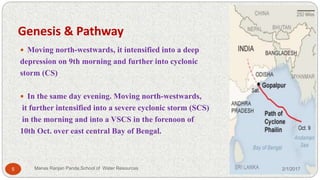
 Moving north-westwards, it intensified into a deep
depression on 9th morning and further into cyclonic
storm (CS)
 In the same day evening. Moving north-westwards,
it further intensified into a severe cyclonic storm (SCS)
in the morning and into a VSCS in the forenoon of
10th Oct. over east central Bay of Bengal.
2/1/20175 Manas Ranjan Panda,School of Water Resources
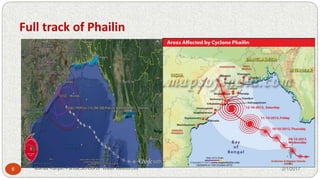
Full track of Phailin
2/1/20176 Manas Ranjan Panda,School of Water Resources
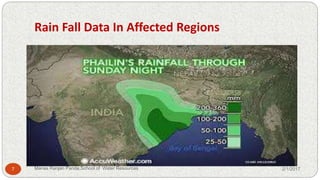
Rain Fall Data In Affected Regions
2/1/20177 Manas Ranjan Panda,School of Water Resources
Salient features
 VSCS PHAILIN is the most intense cyclone that crossed India coast
after Odisha Super Cyclone of 29th October 1999.
 There was rapid intensification of the system from 10th Oct. morning
to 11th October morning leading to an increase in wind speed from 45
knots to 115 knots.
.
2/1/20178 Manas Ranjan Panda,School of Water Resources
Salient features
 At the time of landfall on 12th Oct, maximum sustained surface wind speed
in association with the cyclone was about 115 knots (215 kmph) and
estimated central pressure was 940 hPa with pressure drop of 66 hPa at the
centre compared to surroundings.
 It caused very heavy to extremely heavy rainfall over Odisha leading to
floods, and strong gale wind leading to large scale structural damage and
storm surge leading to coastal inundation over Odisha.
2/1/20179 Manas Ranjan Panda,School of Water Resources
Salient features
 The numerical weather prediction (NWP) and dynamical statistical models
provided good guidance with respect to its genesis, track and intensity.
Though there was divergence in model guidance with respect to landfall
point in the initial stage, the consensus among the models emerged as the
cyclone moved closer to the coast.
 IMD accurately predicted the genesis, intensity, track and point & time of
landfall and also the adverse weather like heavy rainfall, gale wind and
storm surge 4 to 5 days in advance.
2/1/201710 Manas Ranjan Panda,School of Water Resources
DEVASTATION
2/1/201711 Manas Ranjan Panda,School of Water Resources
Odisha
 Districts Affected: Angul Balasore, Bhadrak, Bolangir, Cuttak,
Ganjapati, Ganjam, Jagatsinghpur, Jajpur, Kamdhamal,
Kendrapara, Keonjhar, Khurda,Koraput, Mayurbhanj, Nayagarh,
Puri
 Block Affected (Nos.) : 151
 Village Affected(Nos.) : 18,117
 Population Affected (Nos.) due to flood & cyclone : 1,23,96,065
2/1/201712 Manas Ranjan Panda,School of Water Resources
Odisha
 Human Casualty due to cyclone : 21
 Human Casualty due to flood : 17
 Crop area affected (hect) : 6,68,268
 Person evacuated due to cyclone : 9,83,642
 Person evacuated due to flood : 1,71,083
 Cattle evacuated : 31,062
 House damaged : 41,9052
 In the state, the normal power consumption is around 2,800MW but due to
the power cut, it had come down to 1,300MW
 Losses across Odisha amounted to 42.4 billion rupees
2/1/201713 Manas Ranjan Panda,School of Water Resources
Coastal Andhra Pradesh
 Districts affected : Srikakulam, Vizainagaram, Visakhapatnam
 Village affected : 294
 Human death : 01
 Persons evacuated : 134,426
 Paddy crop inundated : 6,192 Ha
2/1/201714 Manas Ranjan Panda,School of Water Resources
Jharkhand
 A rainfall total of 74.6 mm (2.94 in) was recorded at Ranchi, while
Jamshedpur recorded 52.4 mm (2.06 in), and Bokaro recorded 58.4 mm
(2.30 in).
 Most of the small rivers of Ranchi like Harmu River, Jumar River, Potpoto
River, River flowing under the Over bridge etc. were overflowing due to
heavy rain in the city. Even many of the local ponds were overflowing. Trees
were uprooted and low land area faced water logging.
 Barring an early morning lightning strike at Simdradhao village in Giridih
district in which a person was killed,
 according to police, there were no reports of rain-related casualty anywhere
in the state.
 At least 400 huts were destroyed .
2/1/201715 Manas Ranjan Panda,School of Water Resources
Andaman and Nicobar Islands
 On October 8th IMD warned that heavy to very heavy rainfall would occur
over the islands while some damage to thatched huts, power and
communication lines was expected.
 These warnings were continued until October 11, when the IMD noted that
no further adverse weather, would occur over the Andaman and Nicobar
Islands.
 Within the islands the Directorate of Health Services opened a Medical
Camp in Rangat while the Deputy Commissioner, Police and Fire Services
all ensured there were no casualties between October 8–10th .
2/1/201716 Manas Ranjan Panda,School of Water Resources
Other Indian states
 The areas of West Bengal, Chhattisgarh, Bihar and eastern parts of Uttar
Pradesh are likely to experience heavy rainfall and strong winds.
 There is risk of trees falling and disruption of light or electricity poles.
However, the effect here will not be as severe as that in Odisha and Andhra
Pradesh.
 A Merchant Ship MV Bingo was feared to have sunk in rough seas off the
coast of West Bengal due to Cyclone Phailin. The crew of 20 were spotted in
lifeboats by the Coast Guard and were rescued.
2/1/201717 Manas Ranjan Panda,School of Water Resources
Nepal
 The eastern region of Nepal experienced heavy rainfall and winds
while it was lighter in the central and western part of the country.
 Rainfall began in the eastern and mid-western region since early
morning on 13 October and began in the central regional too in the
afternoon . The impact of the cyclone continued until 15 October.
 Nepalese great festival Dashain was affected by the October rain.
 It caused flood in Kosi and Gandaki rivers in Nepal
2/1/201718 Manas Ranjan Panda,School of Water Resources
Mitigation and Relief
2/1/201719 Manas Ranjan Panda,School of Water Resources
Odisha
 Government had made arrangements for over 10,00,560 food packets for
relief.
 Indian Air Force helicopters were kept on standby in West Bengal to
move in for help at short notice.
 A total of 11,54,725 people were evacuated in the wake of the storm and
the following floods in the state
 International Medical Corps was among the first responders after
Phailin, with field workers in the affected areas within 24 hours. In
partnership with the Chief District Medical Officers and local health
authorities, International Medical Corps’ Emergency Response Team
deployed .
2/1/201720 Manas Ranjan Panda,School of Water Resources
Odisha
 The creation of the National Disaster Response Force (NDRF) in 2006
ensured that there were around 2,300 personnel, especially trained in
disaster mitigation and response, available for deployment, along with
equipment like inflatable boads, lifebuoys and power saws.
 Incidentally, Odisha had set up its own Odisha State Disaster
Management Authority and Odisha Disaster Rapid Action Force
(ODRAF) soon the 1999 disaster, much before the NDMA and NDRF
came into being.
 Apart from 2,000 personnel from the Army, the National Disaster
Response Force (NDRF) has deployed 2,300 personnel in the three States
– 29 teams in Odisha, 19 teams in Andhra Pradesh and 7 teams in West
Bengal.
2/1/201721 Manas Ranjan Panda,School of Water Resources
Odisha
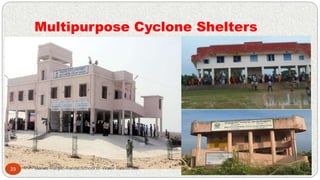
 The locations were identified through a scientific survey conducted by Indian
Institute of Technology (IIT), Kharagpur with two major postulates i.e. No
person will have to travel more than 2.25 km to get a safe shelter and without
crossing a natural Barrier. The building is designed to withstand wind speed up
to 300 kmph and moderate earthquakes. Its plinth is above High Flood line
(HFL) and standing on a stilted floor, it can remain unaffected in storm surge up
to the 1st floor level.
 So far, 203 multipurpose cyclone shelters, including 65 by Indian Red Cross
Society have been constructed in coastal districts of Orissa and have been
handed over to the community based Cyclone Shelter Management and
Maintenance Committees (CSMMC). 52 flood shelters of similar design are
being constructed in 9 flood prone districts out of Chief Minister’s Relief Fund.
2/1/201722 Manas Ranjan Panda,School of Water Resources
Multipurpose Cyclone Shelters
2/1/201723 Manas Ranjan Panda,School of Water Resources
CM of Odisha Mr. Naveen Pattanaik was honored by
UNO
Biggest evacuation ever in india since last 23
years.
Announcement of 100 new multipurpose
cyclone shelter on the occasion of 80th year
completion of independent Odisha state by
CM.
2/1/201724 Manas Ranjan Panda,School of Water Resources
ANDHRA PRADESH
 The Andhra Pradesh government and the Chief Minister met
representatives of the Army and Navy seeking their assistance if
required.
 Utility workers striking against the division of Andhra Pradesh
called off their strike partly in view of the cyclone threat to the
coastal districts.
 The state government ordered the evacuation of 64,000 people
living in low-lying areas.
 The coastal districts of the state escaped the force of the cyclone.
2/1/201725 Manas Ranjan Panda,School of Water Resources
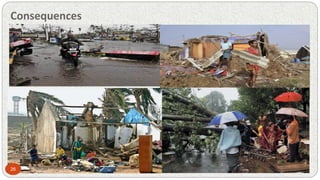
Consequences
2/1/201726 Manas Ranjan Panda,School of Water Resources
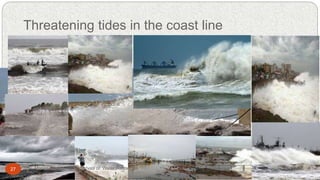
Threatening tides in the coast line
2/1/201727 Manas Ranjan Panda,School of Water Resources
Ship about to sunk
2/1/201728 Manas Ranjan Panda,School of Water Resources
Heavy rains
2/1/201729 Manas Ranjan Panda,School of Water Resources
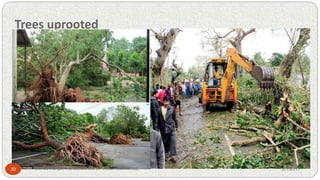
Trees uprooted
2/1/201730 Manas Ranjan Panda,School of Water Resources
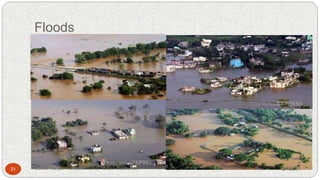
Floods
2/1/201731 Manas Ranjan Panda,School of Water Resources
Blocked transport
2/1/201732 Manas Ranjan Panda,School of Water Resources
Damage to paddy crop
2/1/201733 Manas Ranjan Panda,School of Water Resources
Media during phailin
2/1/201734 Manas Ranjan Panda,School of Water Resources
2/1/201735 Manas Ranjan Panda,School of Water Resources
2/1/2017Manas Ranjan Panda,School of Water Resources36

Phailin cyclone

  • 1.
    School of WaterResources, IIT Kharagpur By: Manas Ranjan Panda 16WM60R04 M Tech(Water Engineering and Management) 1 2/1/2017 Manas Ranjan Panda,School of Water Resources Topic: Cyclone Phailin
  • 2.
    CONTENTS 1. Phailin; AnIntroduction 2. Genesis & Pathway 3. Salient features 4. Devastation 5. Mitigation and Relief 6. Consequences: by photos & videos 2/1/20172 Manas Ranjan Panda,School of Water Resources
  • 3.
    Phailin; An Introduction Very Severe Cyclonic Storm  (Thai: meaning "sapphire")  On October 4, 2013 the Japan Meteorological Agency started to monitor a tropical depression that had developed in the Gulf of Thailand  The second-strongest tropical cyclone ever to make landfall in India.  It caused substantial damage to Odisha and AP.  Biggest evacuation ever in last 23 years in India. 2/1/20173 Manas Ranjan Panda,School of Water Resources
  • 4.
    Genesis & Pathway 6 th October - Tenasserim coast  7 th October – Andaman sea  8 th October – Andaman sea  It concentrated into a depression at12.00N and longitude 96.00E 2/1/20174 Manas Ranjan Panda,School of Water Resources
  • 5.
    Genesis & Pathway Moving north-westwards, it intensified into a deep depression on 9th morning and further into cyclonic storm (CS)  In the same day evening. Moving north-westwards, it further intensified into a severe cyclonic storm (SCS) in the morning and into a VSCS in the forenoon of 10th Oct. over east central Bay of Bengal. 2/1/20175 Manas Ranjan Panda,School of Water Resources
  • 6.
    Full track ofPhailin 2/1/20176 Manas Ranjan Panda,School of Water Resources
  • 7.
    Rain Fall DataIn Affected Regions 2/1/20177 Manas Ranjan Panda,School of Water Resources
  • 8.
    Salient features  VSCSPHAILIN is the most intense cyclone that crossed India coast after Odisha Super Cyclone of 29th October 1999.  There was rapid intensification of the system from 10th Oct. morning to 11th October morning leading to an increase in wind speed from 45 knots to 115 knots. . 2/1/20178 Manas Ranjan Panda,School of Water Resources
  • 9.
    Salient features  Atthe time of landfall on 12th Oct, maximum sustained surface wind speed in association with the cyclone was about 115 knots (215 kmph) and estimated central pressure was 940 hPa with pressure drop of 66 hPa at the centre compared to surroundings.  It caused very heavy to extremely heavy rainfall over Odisha leading to floods, and strong gale wind leading to large scale structural damage and storm surge leading to coastal inundation over Odisha. 2/1/20179 Manas Ranjan Panda,School of Water Resources
  • 10.
    Salient features  Thenumerical weather prediction (NWP) and dynamical statistical models provided good guidance with respect to its genesis, track and intensity. Though there was divergence in model guidance with respect to landfall point in the initial stage, the consensus among the models emerged as the cyclone moved closer to the coast.  IMD accurately predicted the genesis, intensity, track and point & time of landfall and also the adverse weather like heavy rainfall, gale wind and storm surge 4 to 5 days in advance. 2/1/201710 Manas Ranjan Panda,School of Water Resources
  • 11.
    DEVASTATION 2/1/201711 Manas RanjanPanda,School of Water Resources
  • 12.
    Odisha  Districts Affected:Angul Balasore, Bhadrak, Bolangir, Cuttak, Ganjapati, Ganjam, Jagatsinghpur, Jajpur, Kamdhamal, Kendrapara, Keonjhar, Khurda,Koraput, Mayurbhanj, Nayagarh, Puri  Block Affected (Nos.) : 151  Village Affected(Nos.) : 18,117  Population Affected (Nos.) due to flood & cyclone : 1,23,96,065 2/1/201712 Manas Ranjan Panda,School of Water Resources
  • 13.
    Odisha  Human Casualtydue to cyclone : 21  Human Casualty due to flood : 17  Crop area affected (hect) : 6,68,268  Person evacuated due to cyclone : 9,83,642  Person evacuated due to flood : 1,71,083  Cattle evacuated : 31,062  House damaged : 41,9052  In the state, the normal power consumption is around 2,800MW but due to the power cut, it had come down to 1,300MW  Losses across Odisha amounted to 42.4 billion rupees 2/1/201713 Manas Ranjan Panda,School of Water Resources
  • 14.
    Coastal Andhra Pradesh Districts affected : Srikakulam, Vizainagaram, Visakhapatnam  Village affected : 294  Human death : 01  Persons evacuated : 134,426  Paddy crop inundated : 6,192 Ha 2/1/201714 Manas Ranjan Panda,School of Water Resources
  • 15.
    Jharkhand  A rainfalltotal of 74.6 mm (2.94 in) was recorded at Ranchi, while Jamshedpur recorded 52.4 mm (2.06 in), and Bokaro recorded 58.4 mm (2.30 in).  Most of the small rivers of Ranchi like Harmu River, Jumar River, Potpoto River, River flowing under the Over bridge etc. were overflowing due to heavy rain in the city. Even many of the local ponds were overflowing. Trees were uprooted and low land area faced water logging.  Barring an early morning lightning strike at Simdradhao village in Giridih district in which a person was killed,  according to police, there were no reports of rain-related casualty anywhere in the state.  At least 400 huts were destroyed . 2/1/201715 Manas Ranjan Panda,School of Water Resources
  • 16.
    Andaman and NicobarIslands  On October 8th IMD warned that heavy to very heavy rainfall would occur over the islands while some damage to thatched huts, power and communication lines was expected.  These warnings were continued until October 11, when the IMD noted that no further adverse weather, would occur over the Andaman and Nicobar Islands.  Within the islands the Directorate of Health Services opened a Medical Camp in Rangat while the Deputy Commissioner, Police and Fire Services all ensured there were no casualties between October 8–10th . 2/1/201716 Manas Ranjan Panda,School of Water Resources
  • 17.
    Other Indian states The areas of West Bengal, Chhattisgarh, Bihar and eastern parts of Uttar Pradesh are likely to experience heavy rainfall and strong winds.  There is risk of trees falling and disruption of light or electricity poles. However, the effect here will not be as severe as that in Odisha and Andhra Pradesh.  A Merchant Ship MV Bingo was feared to have sunk in rough seas off the coast of West Bengal due to Cyclone Phailin. The crew of 20 were spotted in lifeboats by the Coast Guard and were rescued. 2/1/201717 Manas Ranjan Panda,School of Water Resources
  • 18.
    Nepal  The easternregion of Nepal experienced heavy rainfall and winds while it was lighter in the central and western part of the country.  Rainfall began in the eastern and mid-western region since early morning on 13 October and began in the central regional too in the afternoon . The impact of the cyclone continued until 15 October.  Nepalese great festival Dashain was affected by the October rain.  It caused flood in Kosi and Gandaki rivers in Nepal 2/1/201718 Manas Ranjan Panda,School of Water Resources
  • 19.
    Mitigation and Relief 2/1/201719Manas Ranjan Panda,School of Water Resources
  • 20.
    Odisha  Government hadmade arrangements for over 10,00,560 food packets for relief.  Indian Air Force helicopters were kept on standby in West Bengal to move in for help at short notice.  A total of 11,54,725 people were evacuated in the wake of the storm and the following floods in the state  International Medical Corps was among the first responders after Phailin, with field workers in the affected areas within 24 hours. In partnership with the Chief District Medical Officers and local health authorities, International Medical Corps’ Emergency Response Team deployed . 2/1/201720 Manas Ranjan Panda,School of Water Resources
  • 21.
    Odisha  The creationof the National Disaster Response Force (NDRF) in 2006 ensured that there were around 2,300 personnel, especially trained in disaster mitigation and response, available for deployment, along with equipment like inflatable boads, lifebuoys and power saws.  Incidentally, Odisha had set up its own Odisha State Disaster Management Authority and Odisha Disaster Rapid Action Force (ODRAF) soon the 1999 disaster, much before the NDMA and NDRF came into being.  Apart from 2,000 personnel from the Army, the National Disaster Response Force (NDRF) has deployed 2,300 personnel in the three States – 29 teams in Odisha, 19 teams in Andhra Pradesh and 7 teams in West Bengal. 2/1/201721 Manas Ranjan Panda,School of Water Resources
  • 22.
    Odisha  The locationswere identified through a scientific survey conducted by Indian Institute of Technology (IIT), Kharagpur with two major postulates i.e. No person will have to travel more than 2.25 km to get a safe shelter and without crossing a natural Barrier. The building is designed to withstand wind speed up to 300 kmph and moderate earthquakes. Its plinth is above High Flood line (HFL) and standing on a stilted floor, it can remain unaffected in storm surge up to the 1st floor level.  So far, 203 multipurpose cyclone shelters, including 65 by Indian Red Cross Society have been constructed in coastal districts of Orissa and have been handed over to the community based Cyclone Shelter Management and Maintenance Committees (CSMMC). 52 flood shelters of similar design are being constructed in 9 flood prone districts out of Chief Minister’s Relief Fund. 2/1/201722 Manas Ranjan Panda,School of Water Resources
  • 23.
    Multipurpose Cyclone Shelters 2/1/201723Manas Ranjan Panda,School of Water Resources
  • 24.
    CM of OdishaMr. Naveen Pattanaik was honored by UNO Biggest evacuation ever in india since last 23 years. Announcement of 100 new multipurpose cyclone shelter on the occasion of 80th year completion of independent Odisha state by CM. 2/1/201724 Manas Ranjan Panda,School of Water Resources
  • 25.
    ANDHRA PRADESH  TheAndhra Pradesh government and the Chief Minister met representatives of the Army and Navy seeking their assistance if required.  Utility workers striking against the division of Andhra Pradesh called off their strike partly in view of the cyclone threat to the coastal districts.  The state government ordered the evacuation of 64,000 people living in low-lying areas.  The coastal districts of the state escaped the force of the cyclone. 2/1/201725 Manas Ranjan Panda,School of Water Resources
  • 26.
    Consequences 2/1/201726 Manas RanjanPanda,School of Water Resources
  • 27.
    Threatening tides inthe coast line 2/1/201727 Manas Ranjan Panda,School of Water Resources
  • 28.
    Ship about tosunk 2/1/201728 Manas Ranjan Panda,School of Water Resources
  • 29.
    Heavy rains 2/1/201729 ManasRanjan Panda,School of Water Resources
  • 30.
    Trees uprooted 2/1/201730 ManasRanjan Panda,School of Water Resources
  • 31.
    Floods 2/1/201731 Manas RanjanPanda,School of Water Resources
  • 32.
    Blocked transport 2/1/201732 ManasRanjan Panda,School of Water Resources
  • 33.
    Damage to paddycrop 2/1/201733 Manas Ranjan Panda,School of Water Resources
  • 34.
    Media during phailin 2/1/201734Manas Ranjan Panda,School of Water Resources
  • 35.
    2/1/201735 Manas RanjanPanda,School of Water Resources
  • 36.