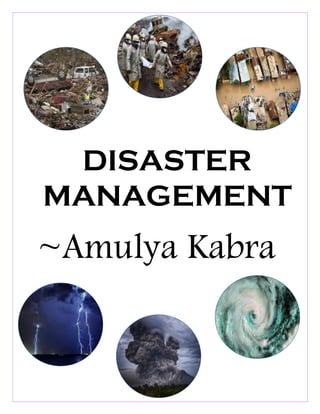
DISASTER
MANAGEMENT
~Amulya Kabra
STUDENT’S INFORMATION
This is a Social Studies Project on
the topic
“Disaster Management”
Name: Amulya Kabra
Class: 9th
Section: Olympiad
School: Narayana E-Techno
Branch: BLR-MH
Submitted to:
Sagarika Ma’am/SST Teacher
ACKNOWLEDGEMENT
I sincerely want to express my special
thanks of gratitude to my Mother,
Father for their guidance and support in
completing my project and my Social
Studies Teacher Sagarika Ma’am for
giving me a golden opportunity to make
a wonderful project on Disaster
Management.
I have learnt a lot while making the
project about disaster management.
I AM REALLY THANKFUL TO THEM.
I am not only making this project for
marks but also to increase my
knowledge.
INDEX
INTRODUCTION.........................................................................................................................................6
WHAT IS A DISASTER.............................................................................................................................. 6
TYPES OF DISASTERS.............................................................................................................................. 7
Disaster Risk Reduction............................................................................................................................ 10
Preparedness:...................................................................................................................................... 10
Mitigation:.......................................................................................................................................... 11
Disaster Management Cycle..................................................................................................................... 12
Pre-disaster......................................................................................................................................... 13
Disaster occurrence ............................................................................................................................. 13
Post-disaster........................................................................................................................................ 14
Possible risk reduction measures for EARTHQUAKES.................................................................................. 15
Community preparedness: ................................................................................................................... 15
Planning:............................................................................................................................................. 15
Public education:................................................................................................................................. 16
Engineered structures:......................................................................................................................... 16
Possible risk reduction measures for TSUNAMI:......................................................................................... 18
Site Planning and Land Management: ................................................................................................... 19
Engineering structures: ........................................................................................................................ 20
Flood management:............................................................................................................................. 21
Possible Risk Reduction Measures for CYCLONES:...................................................................................... 22
Coastal belt plantation:........................................................................................................................ 22
Hazard mapping:.................................................................................................................................. 23
Engineered structures:......................................................................................................................... 24
Improving vegetation cover:................................................................................................................. 25
Possible Risk Reduction Measures for EPIDEMICS:..................................................................................... 27
Possible Risk Reduction Measures for FLOODS: ......................................................................................... 28
Warning:............................................................................................................................................. 28
Mapping of the flood prone areas:........................................................................................................ 29
Land use control:................................................................................................................................. 29
Construction of engineered structures.................................................................................................. 30
Flood Control:...................................................................................................................................... 30
Flood Management:............................................................................................................................. 31
Possible Risk Reduction Measures for DROUGHT:...................................................................................... 33
Public Awareness and education:.......................................................................................................... 33
Drought Monitoring:............................................................................................................................ 33
Water supply augmentation and conservation:...................................................................................... 34
Expansion of irrigation facilities: ........................................................................................................... 34
Land use:............................................................................................................................................. 34
Livelihood planning:............................................................................................................................. 34
Drought planning:................................................................................................................................ 35
Possible risk reduction measures for Landslides: ....................................................................................... 36
Hazard mapping:.................................................................................................................................. 36
Land use practices: .............................................................................................................................. 36
Retaining Walls:................................................................................................................................... 37
Surface Drainage Control Works:.......................................................................................................... 37
Engineered structures:......................................................................................................................... 38
Increasing vegetation cover:................................................................................................................. 38
Insurance:........................................................................................................................................... 38
Types of Industrial hazards:...................................................................................................................... 39
Preventions of Mechanical Hazards: ......................................................................................................... 39
Prevent contact:.................................................................................................................................. 39
Security Devices:.................................................................................................................................. 39
Protect from falling objects: ................................................................................................................. 40
Create no interference:........................................................................................................................ 40
Allow safe lubrication:.......................................................................................................................... 40
Preventions of Electrical Hazards:............................................................................................................. 41
Preventions of Chemical Hazards:............................................................................................................. 42
Preventions of Fire Hazards:..................................................................................................................... 44
Fire Extinguishers:................................................................................................................................ 44
Water based fire extinguishers: ............................................................................................................ 44
Water based foams:............................................................................................................................. 44
Dry chemicals:..................................................................................................................................... 45
INTRODUCTION
WHAT IS A DISASTER
A disaster can be defined as “A serious
disruption in the functioning of the community
or a society causing wide spread material,
economic, social or environmental losses which
exceed the ability of the affected society to cope
using its own resources”.
A disaster is a result from the combination of
hazard, vulnerability and insufficient capacity or
measures to reduce the potential chances of
risk. A disaster happens when a hazard impacts
on the vulnerable population and causes
damage, casualties and disruption.
Any hazard – flood, earthquake or cyclone which
is a triggering event along with greater
vulnerability (inadequate access to resources,
sick and old people, lack of awareness etc.)
would lead to disaster causing greater loss to life
and property.
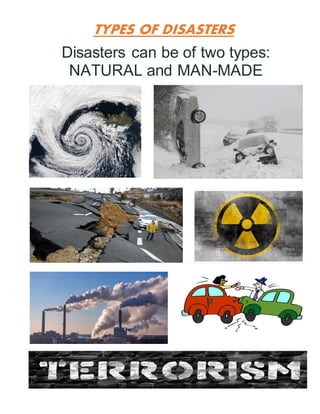
TYPES OF DISASTERS
Disasters can be of two types:
NATURAL and MAN-MADE
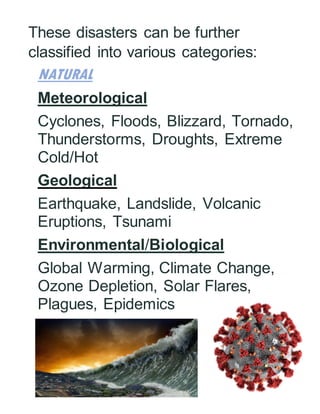
These disasters can be further
classified into various categories:
NATURAL
Meteorological
Cyclones, Floods, Blizzard, Tornado,
Thunderstorms, Droughts, Extreme
Cold/Hot
Geological
Earthquake, Landslide, Volcanic
Eruptions, Tsunami
Environmental/Biological
Global Warming, Climate Change,
Ozone Depletion, Solar Flares,
Plagues, Epidemics
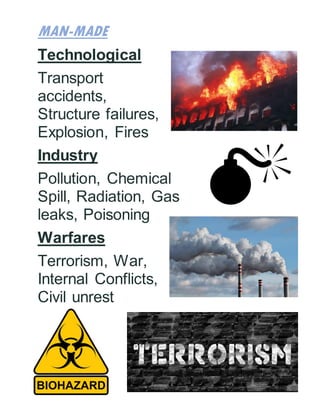
MAN-MADE
Technological
Transport
accidents,
Structure failures,
Explosion, Fires
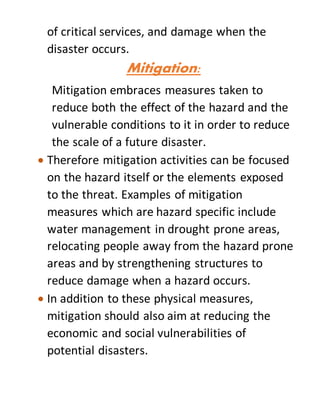
Industry
Pollution, Chemical
Spill, Radiation, Gas
leaks, Poisoning
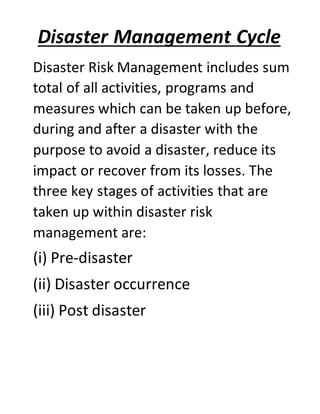
Warfares
Terrorism, War,
Internal Conflicts,
Civil unrest
Disaster Risk Reduction
Disaster Risk Reduction can take place in the
following ways:
Preparedness:
This protective process embraces measures
which enable governments, communities and
individuals to respond rapidly to disaster
situations to cope with them effectively.
 Preparedness includes the formulation of
viable emergency plans, the development of
warning systems, the maintenance of
inventories and the training of personnel.
 It may also embrace search and rescue
measures as well as evacuation plans for
areas that may be at risk from a recurring
disaster.
 Preparedness therefore encompasses those
measures taken before a disaster event which
are aimed at minimizing loss of life, disruption
of critical services, and damage when the
disaster occurs.
Mitigation:
Mitigation embraces measures taken to
reduce both the effect of the hazard and the
vulnerable conditions to it in order to reduce
the scale of a future disaster.
 Therefore mitigation activities can be focused
on the hazard itself or the elements exposed
to the threat. Examples of mitigation
measures which are hazard specific include
water management in drought prone areas,
relocating people away from the hazard prone
areas and by strengthening structures to
reduce damage when a hazard occurs.
 In addition to these physical measures,
mitigation should also aim at reducing the
economic and social vulnerabilities of
potential disasters.
Disaster Management Cycle
Disaster Risk Management includes sum
total of all activities, programs and
measures which can be taken up before,
during and after a disaster with the
purpose to avoid a disaster, reduce its
impact or recover from its losses. The
three key stages of activities that are
taken up within disaster risk
management are:
(i) Pre-disaster
(ii) Disaster occurrence
(iii) Post disaster
Pre-disaster
(Before a disaster)
It includes the activities taken to reduce human
and property losses caused by a potential
hazard. For example carrying out awareness
campaigns, strengthening the existing weak
structures, preparation of the disaster
management plans at household and
community level etc. Such risk reduction
measures taken under this stage are termed as
mitigation and preparedness activities.
Disaster occurrence
(During a disaster)
It includes the initiatives taken to ensure that
the needs and provisions of victims are met and
suffering is minimized. Activities taken under this
stage are called emergency response activities.
Post-disaster
(After a disaster)
It includes the initiatives taken in response to a
disaster with a purpose to achieve early recovery
and rehabilitation of affected communities,
immediately after a disaster strikes. These are
called as response and recovery activities.
Possible risk reduction
measures for EARTHQUAKES
Community preparedness:
Community preparedness is vital for mitigating
earthquake impact. The most effective way to
save you even in a slightest shaking is 'DROP,
COVER and HOLD'.
Planning:
The Bureau of Indian Standards has published
building codes and guidelines for safe
construction of buildings against earthquakes.
Before the buildings are constructed the
building plans have to be checked by the
Municipality, according to the laid down bylaws.
Many existing lifeline buildings such as
hospitals, schools and fire stations may not be
built with earthquake safety measures.
Their earthquake safety needs to be upgraded
by retrofitting techniques.
Public education:
Public education is educating the public on
causes and characteristics of an earthquake and
preparedness measures.
It can be created through sensitization and
training program for community, architects,
engineers, builders, masons, teachers,
government functionaries’ teachers and
students.
Engineered structures:
Buildings need to be designed and constructed
as per the building laws to withstand ground
shaking.
Architectural and engineering inputs need to be
put together to improve building design and
construction practices.
The soil type needs to be analyzed before
construction. Building structures on soft soil
should be avoided.
Buildings on soft soil are more likely to get
damaged even if the magnitude of the
earthquake is not strong.
Similar problems persist in the buildings
constructed on the river banks which have
alluvial soil.
Possible risk reduction
measures for TSUNAMI:
In certain tsunami prone countries some
measures have been taken to reduce the
damage caused on shore. Japan has
implemented an extensive program of building
tsunami walls of up to 4.5m (13.5 ft) high in
front of populated coastal areas. Other
localities have built flood gates and channels to
redirect the water from incoming tsunamis.
However, framed structures in the area. The
wall may have succeeded in slowing down and
moderating the height of the tsunami but it did
not prevent major destruction and loss of life
Site Planning and Land Management:
Site planning determines the location,
configuration, and density of development on
particular sites and is, therefore, an important
tool in reducing tsunami risk.
The designation and zoning of tsunami hazard
areas for such open-space uses as agriculture,
parks and recreation, or natural hazard areas is
recommended as the first land use planning
strategy.
This strategy is designed to keep development
at a minimum in hazard areas.
In areas where it is not feasible to restrict land
to open-space uses, other land use planning
measures can be used.
These include strategically controlling the type
of development and uses allowed in hazard
areas, and avoiding high-value and high
occupancy uses to the greatest degree possible.
Engineering structures:
Most of the habitation of the fishing community
is seen in the coastal areas. The houses
constructed by them are mainly of lightweight
materials without any engineering inputs.
Therefore there is an urgent need to educate
the community about the good construction
practices that they should adopt such as:
 Site selection – Avoid building or living in
buildings within several hundred feet of the
coastline as these areas are more likely to
experience damage from tsunamis.
Construct the structure on a higher ground
level with respect to mean sea level.
 Elevate coastal homes – Most tsunami
waves are less than 3 meters in height.
Elevating house will help reduce damage to
property from most tsunamis.
Construction of water breakers to reduce the
velocity of waves.
Use of water and corrosion resistant materials
for construction.
Construction of community halls at higher
locations, which can act as shelters at the
time of a disaster.
Flood management:
Flooding will result from a tsunami. Tsunami
waves will flood the coastal areas. Flood
mitigation measures could be incorporated.
Torrential rains, strong wind and storm range
leads to flooding in the cyclone affected areas.
There are possibilities of landslides too. Flood
mitigation measures could be incorporated
Possible Risk Reduction
Measures for CYCLONES:
Coastal belt plantation:
Green belt plantation along the coastal line in a
scientific interweaving pattern can reduce the
effect of the hazard.
Providing a cover through green belt sustains
less damage.
Forests act as a wide buffer zone against strong
winds and flash floods.
Without the forest the cyclone travel freely
inland.
The lack of protective forest cover allows water
to inundate large areas and cause destruction.
With the loss of the forest cover each
consecutive cyclone can penetrate further
inland.
Hazard mapping:
Meteorological records of the wind speed and
the directions give the probability of the winds
in the region.
Cyclones can be predicted several days in
advance.
The onset is extensive and often very
destructive.
Past records and paths can give the pattern of
occurrence for particular wind speeds.
A hazard map will illustrate the areas vulnerable
to cyclone in any given year.
It will be useful to estimate the severity of the
cyclone and various damage intensities in the
region.
The map is prepared with data inputs of past
climatological records, history of wind speed,
frequency of flooding etc.
Land use control designed so that least critical
activities are placed in vulnerable areas.
Location of settlements in the floodplains is at
utmost risk.
Sitting of key facilities must be marked in the
land use.
Policies should be in place to regulate land use
and building codes should be enforced.
Engineered structures:
Structures need to be built to withstand wind
forces. Good site selection is also important.
Majority of the buildings in coastal areas are
built with locally available materials and have
no engineering inputs.
Good construction practice should be adopted
such as: -
 Cyclonic wind storms inundate the coastal
areas. It is advised to construct on stilts or on
earth mound.
 Houses can be strengthened to resist wind
and flood damage.
 All elements holding the structures need to
be properly anchored to resist the uplift or
flying off of the objects. For example, avoid
large overhangs of roofs, and the projections
should be tied down.
 A row of planted trees will act as a shield. It
reduces the energy.
 Buildings should be wind and water
resistant.
 Buildings storing food supplies must be
protected against the winds and water.
 Protect river embankments.
 Communication lines should be installed
underground.
 Provide strong halls for community shelter
in vulnerable locations.
Improving vegetation cover:
The roots of the plants and trees keep the soil
intact and prevent erosion and slow runoff to
prevent or lessen flooding.
The use of tree planted in rows will act as a
windbreak.
Coastal shelterbelt plantations can be
developed to break severe wind speeds. It
minimizes devastating effects.
The Orissa calamity has also highlighted the
need for urgent measures like shelterbelt
plantation along cyclone-prone coastal areas.
Species chosen for this purpose should not only
be able to withstand the impact of strong
cyclonic winds, but also check soil erosion.
Possible Risk Reduction
Measures for EPIDEMICS:
 Investment in improved sanitation, provision
of clean water and better urban infrastructure
can reduce the frequency of human contact
with pathogenic agents.
 Building strong health systems and supporting
proper nutrition will help ensure good
baseline levels of health, making people less
susceptible to infectious diseases.
 Investment in reliable disease surveillance in
both human and animal populations will help
in reducing epidemics.
 Technological solutions can help minimize the
burden of sizable outbreaks and epidemics.
 Better and less costly treatments including
novel antibiotics and antiviral to counter
resistant diseases, are sorely needed. New
and improved vaccines are even more
important.
Possible Risk Reduction
Measures for FLOODS:
Warning:
With the advancement of technology such as
satellite and remote-sensing equipment, flood
waves can be tracked as the water level rises.
 Heavy precipitation will give sufficient
warning of the coming river flood.
 High tides with high winds may indicate
flooding in the coastal areas.
 Evacuation is possible with suitable
monitoring and warning. Warning is issued by
the Central Water Commission (CWC),
Irrigation & Flood Control Department, and
Water Resources Department. CWC
maintains close liaison with the administrative
and state engineering agencies, local civil
authorities to communicate advance warning
for appropriate mitigation and preparedness
measures.
Mapping of the flood prone areas:
It is a primary step involved in reducing the risk
of the region. Historical records give the
indication of the flood inundation areas and the
period of occurrence and the extent of the
coverage. Warning can be issued looking into
the earlier marked heights of the water levels in
case of potential threat.
In the coastal areas the tide levels and the land
characteristics will determine the submergence
areas.
Flood hazard mapping will give the proper
indication of water flow during floods.
Land use control:
This will reduce danger of life and property
when waters inundate the flood plains and the
coastal areas.
The number of casualties is related to the
population in the area at risk.
In areas where people already have built their
settlements, measures should be taken to
relocate to better sites so as to reduce
vulnerability.
No major development should be permitted in
the areas which are subjected to high flooding.
Important facilities like hospitals, schools
should be built in safe areas. In urban areas,
water holding areas can be created like ponds,
lakes or low-lying areas.
Construction of engineered structures
Provide strengthening of structures to
withstand flood forces and seepage. The
buildings should be constructed on an elevated
area. If necessary build on stilts or platform.
Flood Control:
This aims to reduce flood damage. This can be
done by decreasing the amount of runoff with
the help of reforestation, protection of
vegetation, clearing of debris from streams and
other water holding areas, conservation of
ponds and lakes etc. Flood Diversion include
levees, embankments, dams and channel
improvement. Dams can store water and can
release water at a manageable rate. Flood
Proofing reduces the risk of damage. Measures
include use of sand bags to keep flood water
away, blocking or sealing of doors and windows
of houses etc. Houses may be elevated by
building on raised land. Buildings should be
constructed away from water bodies.
Flood Management:
In India, systematic planning for flood
management commenced with the Five Year
Plans, particularly with the launching of
National Programme of Flood Management in
1954.
Structural measures include, storage reservoirs
flood embankments, drainage channels, anti-
erosion works, channel improvement works,
detention basins etc.
Non-structural measures include flood
forecasting, flood plain zoning, flood proofing,
disaster preparedness etc.
The flood management measures undertaken
so far have provided reasonable degree of
protection to an area of 15.81 million hectares
throughout the country.
Possible Risk Reduction
Measures for DROUGHT:
Public Awareness and education:
If the community is aware of the dos and
don’ts, then half of the problem is solved.
This includes awareness on the availability of
safe drinking water, water conservation
techniques, agricultural drought management
strategies like crop contingency plans,
construction of rain water harvesting structure.
Awareness can be generated by the print,
electronic and folk media.
Drought Monitoring:
It is continuous observation of the rainfall
situation, availability of water in the reservoirs,
lakes, rivers etc. and comparing with the
existing water needs in various sectors of the
society.
Water supply augmentation and
conservation:
Rainwater harvesting in houses and farmers’
fields increases the content of water available.
Water harvesting by either allowing the runoff
water from all the fields to a common point
(e.g. Farm ponds) or allowing it to infiltrate into
the soil where it has fallen (in situ) (e.g. contour
bunds, contour cultivation, raised bed planting
etc.) helps increase water availability for
sustained agricultural production.
Expansion of irrigation facilities:
This facility reduces the drought vulnerability.
Land use:
Land use based on its capability helps in
optimum use of land and water and can avoid
the undue demand created due to their misuse.
Livelihood planning:
Identifies those livelihoods which are least
affected by the drought.
Some of such livelihoods include increased off-
farm employment opportunities, collection of
non-timber forest produce from the community
forests, raising goats, carpentry etc.
Drought planning:
The basic goal of drought planning is to improve
the effectiveness of preparedness and response
efforts by enhancing monitoring, mitigation and
response measures.
Planning would help in effective coordination
among state and national agencies in dealing
with the drought. Components of drought plan
include establishing drought taskforce which is
a team of specialists who can advise the
government in taking decision to deal with
drought situation, establishing coordination
mechanism among various agencies which deal
with the droughts, providing crop insurance
schemes to the farmers to cope with the
drought related crop losses, and public
awareness.
Possible risk reduction
measures for Landslides:
Hazard mapping:
Locates areas prone to slope failures. This will
help to avoid building settlements in such areas.
These maps will also serve as a tool for
mitigation planning.
Land use practices:
 Areas covered by degraded natural vegetation
in upper slopes are to be afforested with
suitable species. Existing patches of natural
vegetation (forest and natural grass land) in
good condition, should be preserved
 Any developmental activity initiated in the
area should be taken up only after a detailed
study of the region has been carried out.
 In construction of roads, irrigation canals etc.
proper care is to be taken to avoid blockage of
natural drainage.
 Total avoidance of settlement in the risk zone
should be made mandatory.
 Relocate settlements and infrastructure that
fall in the possible path of the landslide.
 No construction of buildings in areas beyond a
certain degree of slope.
Retaining Walls:
Retaining walls can be built to stop land from
slipping (these walls are commonly seen along
roads in hill stations).
These are constructed to prevent smaller sized
and secondary landslides that often occur along
the toe portion of the larger landslides.
Surface Drainage Control Works:
The surface drainage control works are
implemented to control the movement of
landslides accompanied by infiltration of rain
water and spring flows.
Engineered structures:
Engineered structures with strong foundations
can withstand or take the ground movement
forces. Underground installations (pipes, cables,
etc.) should be made flexible to move in order
to withstand forces caused by the landslide
Increasing vegetation cover:
It’s the cheapest and most effective way of
arresting landslides. This helps to bind the top
layer of the soil with layers below, while
preventing excessive run-off and soil erosion.
Insurance:
It will assist individuals whose homes are likely
to be damaged by landslides or by any other
natural hazards.
Types of Industrial hazards:
1. Mechanical hazards
2. Electrical hazards
3. Chemical hazards
4. Fire hazards
Preventions of Mechanical
Hazards:
Prevent contact:
The safeguard must prevent hands, arms, or
any part of a worker's body from making
contact with dangerous moving parts.
Security Devices:
Workers should not be able to easily remove
with the safeguard. Guards and safety devices
should be made of durable material that will
withstand the conditions of normal use.
Protect from falling objects:
The safeguard should ensure that no objects
can fall into moving parts. A small tool which is
dropped into a cycling machine could easily
become a projectile that could strike and injure
someone.
Create no interference:
Proper safeguarding can actually enhance
efficiency, since workers will not be afraid of
injuries then.
Allow safe lubrication:
If possible, one should be able to lubricate the
machine without removing the safeguards.
Locating oil reservoirs outside of the guard,
with a line leading to the lubrication point, will
reduce the need for the operator or
maintenance worker to enter the hazardous
area.
Preventions of Electrical
Hazards:
 Power equipment should be plugged into wall
receptacles with power switches in the off
position.
 Electrical equipment should be unplugged by
grasping the plug and pulling. Never pull or
jerk the cord to unplug the equipment.
 Frayed, cracked or exposed wiring on
equipment cords must be corrected. Also
check for defective cord clamps at locations
where the power cord enters the equipment
or the attachment plug.
 Temporary or permanent storage of materials
must not be allowed within 3 feet of electrical
equipment.
 Any electrical equipment causing shocks or
which has high leakage potential must be
tagged with a DANGER—DO NOT USE label or
equivalent.
Preventions of Chemical
Hazards:
 Before starting work with a chemical a
“chemical hazard pocket guide” should be
consulted for necessary information about the
chemical. It will give the type of reaction the
chemical may produce, its inflammability,
carcinogenicity, prevention and treatment
procedures etc.
 No eating, drinking, or smoking where
chemicals are used.
 Skin should be covered with protective
clothing.
 Clothing should be removed immediately it
gets wet or contaminated with a chemical.
 Eyes or skins should be washed with plenty of
water after an accident.
 Face mask may be used in toxic dust or gases.
 Workers working in antibiotic related
products must be changed routinely so that
an individual is not exposed to a certain
antibiotic for a long period of time.
 Whenever a dust allergy or respiratory
problem precipitates the worker should
immediately be removed from the work place
and put under proper healthcare.
 In case of inflammable gas or solvent leakage
the exhaust fans should be started and all the
source of fire should be extinguished.
Preventions of Fire Hazards:
Fire Extinguishers:
 Removal of fuel e.g. blanketing with foam or
interposing a layer of gas between the fuel
and the flames.
 By removal of oxygen e.g. by dilution with
inert gases or vapours.
 By removal of heat by cooling with water or
other extinguishing agents.
Water based fire extinguishers:
 They produce CO2 by reaction with acid and
carbonates, or CO2 is kept under pressure.
E.g. Portable fire extinguisher, Soda-Ash
Extinguisher, Antifreeze Extinguisher.
Water based foams:
 Two types of foams are available.
Chemical foams and Mechanical foams.
 Chemical foams are bubbles filled with CO2
produced by chemical reaction in an aqueous
solution mixed with a foaming agent. The
reacting chemicals are usually of sodium
carbonate and Ammonium Sulphate.
 Mechanical foams are bubbles filled with air.
Foams forms barrier and prevents contact
between fuel and air.
Dry chemicals:
These are finely divided solid particles sodium
bicarbonate, potassium bicarbonate and
Ammonium Sulphate discharged from a hose
pipe.
SUGGESTIONS
But, Disaster Managers and Policy Makers
must lay down effective plan for resource
planning, land use zoning and disaster
reduction building byelaws etc.
Various science and technological
innovations should be used to reduce
disaster risk. One of them is establishing
early warning systems.
Projects planned for future in the high
disaster prone areas must follow the rules
and guidelines issued by the government
for disaster management and protecting
development gains.
Government must ensure the designs and
implementation of the plans and policies
laid by them for disaster management,
especially in the private sector
Mock drills at local and national level are
conducted which help to know about do's
and don'ts when any disaster happens
National disaster response force (NDRF)
has played a pivotal role in quick disaster
response.
They carry out operations during a disaster
to rescue stuck people, provide medical aid
to victims, extricate victims and carry out
various relief measures and rehabilitation
programmes.
For a quick and active disaster response,
these forces needs to be strengthened and
trained.
Government should also integrate with
stakeholders to come up with a more
effective plan
Also, Nowadays, Focus has shifted from
disaster management to disaster risk
management (DRR) since it helps in the
reduction of number of deaths from
disaster, number of people affected,
economic and infrastructure losses. A 15
year action plan “Sendai framework” has
been adopted by the UN for DRR
CONCLUSION
A disaster is a destructive event that
occurs suddenly and involves loss of life
and property.
It is a sudden accident or a natural
catastrophe that causes great damage
or loss of life.
Disaster Management isn’t only the duty
of the government, it is our
responsibility too to know how to
minimize the risk of disaster, escaping it,
helping others, What To Do and What
Not To.
Community awareness programmes are
essential among youth.
Training and capacity building is crucial
for managing disasters effectively.
BIBLIOGRAPHY
I HAVE TAKEN REFERENCES, PICTURES
AND SOME SOURCES FROM THE
FOLLOWING PLACES:
PICTURES: google.com & bing.com
RESEARCH:
http://www.govtpolytechnicbargarh.in/i
ticollege/college/iti/SM/6th-civ-
DISASTER%20MANAGEMENT.pdf
& NCERT Disaster Management
Textbook
Thank You
For giving me an opportunity to
make a project on
Disaster Management

545602005-Sst-Class9-Disaster-Management-Project.pdf

  • 1.
  • 2.
    STUDENT’S INFORMATION This isa Social Studies Project on the topic “Disaster Management” Name: Amulya Kabra Class: 9th Section: Olympiad School: Narayana E-Techno Branch: BLR-MH Submitted to: Sagarika Ma’am/SST Teacher
  • 3.
    ACKNOWLEDGEMENT I sincerely wantto express my special thanks of gratitude to my Mother, Father for their guidance and support in completing my project and my Social Studies Teacher Sagarika Ma’am for giving me a golden opportunity to make a wonderful project on Disaster Management. I have learnt a lot while making the project about disaster management. I AM REALLY THANKFUL TO THEM. I am not only making this project for marks but also to increase my knowledge.
  • 4.
    INDEX INTRODUCTION.........................................................................................................................................6 WHAT IS ADISASTER.............................................................................................................................. 6 TYPES OF DISASTERS.............................................................................................................................. 7 Disaster Risk Reduction............................................................................................................................ 10 Preparedness:...................................................................................................................................... 10 Mitigation:.......................................................................................................................................... 11 Disaster Management Cycle..................................................................................................................... 12 Pre-disaster......................................................................................................................................... 13 Disaster occurrence ............................................................................................................................. 13 Post-disaster........................................................................................................................................ 14 Possible risk reduction measures for EARTHQUAKES.................................................................................. 15 Community preparedness: ................................................................................................................... 15 Planning:............................................................................................................................................. 15 Public education:................................................................................................................................. 16 Engineered structures:......................................................................................................................... 16 Possible risk reduction measures for TSUNAMI:......................................................................................... 18 Site Planning and Land Management: ................................................................................................... 19 Engineering structures: ........................................................................................................................ 20 Flood management:............................................................................................................................. 21 Possible Risk Reduction Measures for CYCLONES:...................................................................................... 22 Coastal belt plantation:........................................................................................................................ 22 Hazard mapping:.................................................................................................................................. 23 Engineered structures:......................................................................................................................... 24 Improving vegetation cover:................................................................................................................. 25 Possible Risk Reduction Measures for EPIDEMICS:..................................................................................... 27 Possible Risk Reduction Measures for FLOODS: ......................................................................................... 28 Warning:............................................................................................................................................. 28 Mapping of the flood prone areas:........................................................................................................ 29 Land use control:................................................................................................................................. 29 Construction of engineered structures.................................................................................................. 30 Flood Control:...................................................................................................................................... 30 Flood Management:............................................................................................................................. 31 Possible Risk Reduction Measures for DROUGHT:...................................................................................... 33 Public Awareness and education:.......................................................................................................... 33
  • 5.
    Drought Monitoring:............................................................................................................................ 33 Watersupply augmentation and conservation:...................................................................................... 34 Expansion of irrigation facilities: ........................................................................................................... 34 Land use:............................................................................................................................................. 34 Livelihood planning:............................................................................................................................. 34 Drought planning:................................................................................................................................ 35 Possible risk reduction measures for Landslides: ....................................................................................... 36 Hazard mapping:.................................................................................................................................. 36 Land use practices: .............................................................................................................................. 36 Retaining Walls:................................................................................................................................... 37 Surface Drainage Control Works:.......................................................................................................... 37 Engineered structures:......................................................................................................................... 38 Increasing vegetation cover:................................................................................................................. 38 Insurance:........................................................................................................................................... 38 Types of Industrial hazards:...................................................................................................................... 39 Preventions of Mechanical Hazards: ......................................................................................................... 39 Prevent contact:.................................................................................................................................. 39 Security Devices:.................................................................................................................................. 39 Protect from falling objects: ................................................................................................................. 40 Create no interference:........................................................................................................................ 40 Allow safe lubrication:.......................................................................................................................... 40 Preventions of Electrical Hazards:............................................................................................................. 41 Preventions of Chemical Hazards:............................................................................................................. 42 Preventions of Fire Hazards:..................................................................................................................... 44 Fire Extinguishers:................................................................................................................................ 44 Water based fire extinguishers: ............................................................................................................ 44 Water based foams:............................................................................................................................. 44 Dry chemicals:..................................................................................................................................... 45
  • 6.
    INTRODUCTION WHAT IS ADISASTER A disaster can be defined as “A serious disruption in the functioning of the community or a society causing wide spread material, economic, social or environmental losses which exceed the ability of the affected society to cope using its own resources”. A disaster is a result from the combination of hazard, vulnerability and insufficient capacity or measures to reduce the potential chances of risk. A disaster happens when a hazard impacts on the vulnerable population and causes damage, casualties and disruption. Any hazard – flood, earthquake or cyclone which is a triggering event along with greater vulnerability (inadequate access to resources, sick and old people, lack of awareness etc.) would lead to disaster causing greater loss to life and property.
  • 7.
    TYPES OF DISASTERS Disasterscan be of two types: NATURAL and MAN-MADE
  • 8.
    These disasters canbe further classified into various categories: NATURAL Meteorological Cyclones, Floods, Blizzard, Tornado, Thunderstorms, Droughts, Extreme Cold/Hot Geological Earthquake, Landslide, Volcanic Eruptions, Tsunami Environmental/Biological Global Warming, Climate Change, Ozone Depletion, Solar Flares, Plagues, Epidemics
  • 9.
    MAN-MADE Technological Transport accidents, Structure failures, Explosion, Fires Industry Pollution,Chemical Spill, Radiation, Gas leaks, Poisoning Warfares Terrorism, War, Internal Conflicts, Civil unrest
  • 10.
    Disaster Risk Reduction DisasterRisk Reduction can take place in the following ways: Preparedness: This protective process embraces measures which enable governments, communities and individuals to respond rapidly to disaster situations to cope with them effectively.  Preparedness includes the formulation of viable emergency plans, the development of warning systems, the maintenance of inventories and the training of personnel.  It may also embrace search and rescue measures as well as evacuation plans for areas that may be at risk from a recurring disaster.  Preparedness therefore encompasses those measures taken before a disaster event which are aimed at minimizing loss of life, disruption
  • 11.
    of critical services,and damage when the disaster occurs. Mitigation: Mitigation embraces measures taken to reduce both the effect of the hazard and the vulnerable conditions to it in order to reduce the scale of a future disaster.  Therefore mitigation activities can be focused on the hazard itself or the elements exposed to the threat. Examples of mitigation measures which are hazard specific include water management in drought prone areas, relocating people away from the hazard prone areas and by strengthening structures to reduce damage when a hazard occurs.  In addition to these physical measures, mitigation should also aim at reducing the economic and social vulnerabilities of potential disasters.
  • 12.
    Disaster Management Cycle DisasterRisk Management includes sum total of all activities, programs and measures which can be taken up before, during and after a disaster with the purpose to avoid a disaster, reduce its impact or recover from its losses. The three key stages of activities that are taken up within disaster risk management are: (i) Pre-disaster (ii) Disaster occurrence (iii) Post disaster
  • 13.
    Pre-disaster (Before a disaster) Itincludes the activities taken to reduce human and property losses caused by a potential hazard. For example carrying out awareness campaigns, strengthening the existing weak structures, preparation of the disaster management plans at household and community level etc. Such risk reduction measures taken under this stage are termed as mitigation and preparedness activities. Disaster occurrence (During a disaster) It includes the initiatives taken to ensure that the needs and provisions of victims are met and suffering is minimized. Activities taken under this stage are called emergency response activities.
  • 14.
    Post-disaster (After a disaster) Itincludes the initiatives taken in response to a disaster with a purpose to achieve early recovery and rehabilitation of affected communities, immediately after a disaster strikes. These are called as response and recovery activities.
  • 15.
    Possible risk reduction measuresfor EARTHQUAKES Community preparedness: Community preparedness is vital for mitigating earthquake impact. The most effective way to save you even in a slightest shaking is 'DROP, COVER and HOLD'. Planning: The Bureau of Indian Standards has published building codes and guidelines for safe construction of buildings against earthquakes. Before the buildings are constructed the building plans have to be checked by the Municipality, according to the laid down bylaws. Many existing lifeline buildings such as hospitals, schools and fire stations may not be built with earthquake safety measures. Their earthquake safety needs to be upgraded by retrofitting techniques.
  • 16.
    Public education: Public educationis educating the public on causes and characteristics of an earthquake and preparedness measures. It can be created through sensitization and training program for community, architects, engineers, builders, masons, teachers, government functionaries’ teachers and students. Engineered structures: Buildings need to be designed and constructed as per the building laws to withstand ground shaking. Architectural and engineering inputs need to be put together to improve building design and construction practices. The soil type needs to be analyzed before construction. Building structures on soft soil should be avoided.
  • 17.
    Buildings on softsoil are more likely to get damaged even if the magnitude of the earthquake is not strong. Similar problems persist in the buildings constructed on the river banks which have alluvial soil.
  • 18.
    Possible risk reduction measuresfor TSUNAMI: In certain tsunami prone countries some measures have been taken to reduce the damage caused on shore. Japan has implemented an extensive program of building tsunami walls of up to 4.5m (13.5 ft) high in front of populated coastal areas. Other localities have built flood gates and channels to redirect the water from incoming tsunamis. However, framed structures in the area. The wall may have succeeded in slowing down and moderating the height of the tsunami but it did not prevent major destruction and loss of life
  • 19.
    Site Planning andLand Management: Site planning determines the location, configuration, and density of development on particular sites and is, therefore, an important tool in reducing tsunami risk. The designation and zoning of tsunami hazard areas for such open-space uses as agriculture, parks and recreation, or natural hazard areas is recommended as the first land use planning strategy. This strategy is designed to keep development at a minimum in hazard areas. In areas where it is not feasible to restrict land to open-space uses, other land use planning measures can be used. These include strategically controlling the type of development and uses allowed in hazard areas, and avoiding high-value and high occupancy uses to the greatest degree possible.
  • 20.
    Engineering structures: Most ofthe habitation of the fishing community is seen in the coastal areas. The houses constructed by them are mainly of lightweight materials without any engineering inputs. Therefore there is an urgent need to educate the community about the good construction practices that they should adopt such as:  Site selection – Avoid building or living in buildings within several hundred feet of the coastline as these areas are more likely to experience damage from tsunamis. Construct the structure on a higher ground level with respect to mean sea level.  Elevate coastal homes – Most tsunami waves are less than 3 meters in height. Elevating house will help reduce damage to property from most tsunamis. Construction of water breakers to reduce the velocity of waves.
  • 21.
    Use of waterand corrosion resistant materials for construction. Construction of community halls at higher locations, which can act as shelters at the time of a disaster. Flood management: Flooding will result from a tsunami. Tsunami waves will flood the coastal areas. Flood mitigation measures could be incorporated. Torrential rains, strong wind and storm range leads to flooding in the cyclone affected areas. There are possibilities of landslides too. Flood mitigation measures could be incorporated
  • 22.
    Possible Risk Reduction Measuresfor CYCLONES: Coastal belt plantation: Green belt plantation along the coastal line in a scientific interweaving pattern can reduce the effect of the hazard. Providing a cover through green belt sustains less damage. Forests act as a wide buffer zone against strong winds and flash floods. Without the forest the cyclone travel freely inland. The lack of protective forest cover allows water to inundate large areas and cause destruction. With the loss of the forest cover each consecutive cyclone can penetrate further inland.
  • 23.
    Hazard mapping: Meteorological recordsof the wind speed and the directions give the probability of the winds in the region. Cyclones can be predicted several days in advance. The onset is extensive and often very destructive. Past records and paths can give the pattern of occurrence for particular wind speeds. A hazard map will illustrate the areas vulnerable to cyclone in any given year. It will be useful to estimate the severity of the cyclone and various damage intensities in the region. The map is prepared with data inputs of past climatological records, history of wind speed, frequency of flooding etc. Land use control designed so that least critical activities are placed in vulnerable areas.
  • 24.
    Location of settlementsin the floodplains is at utmost risk. Sitting of key facilities must be marked in the land use. Policies should be in place to regulate land use and building codes should be enforced. Engineered structures: Structures need to be built to withstand wind forces. Good site selection is also important. Majority of the buildings in coastal areas are built with locally available materials and have no engineering inputs. Good construction practice should be adopted such as: -  Cyclonic wind storms inundate the coastal areas. It is advised to construct on stilts or on earth mound.  Houses can be strengthened to resist wind and flood damage.
  • 25.
     All elementsholding the structures need to be properly anchored to resist the uplift or flying off of the objects. For example, avoid large overhangs of roofs, and the projections should be tied down.  A row of planted trees will act as a shield. It reduces the energy.  Buildings should be wind and water resistant.  Buildings storing food supplies must be protected against the winds and water.  Protect river embankments.  Communication lines should be installed underground.  Provide strong halls for community shelter in vulnerable locations. Improving vegetation cover: The roots of the plants and trees keep the soil intact and prevent erosion and slow runoff to prevent or lessen flooding.
  • 26.
    The use oftree planted in rows will act as a windbreak. Coastal shelterbelt plantations can be developed to break severe wind speeds. It minimizes devastating effects. The Orissa calamity has also highlighted the need for urgent measures like shelterbelt plantation along cyclone-prone coastal areas. Species chosen for this purpose should not only be able to withstand the impact of strong cyclonic winds, but also check soil erosion.
  • 27.
    Possible Risk Reduction Measuresfor EPIDEMICS:  Investment in improved sanitation, provision of clean water and better urban infrastructure can reduce the frequency of human contact with pathogenic agents.  Building strong health systems and supporting proper nutrition will help ensure good baseline levels of health, making people less susceptible to infectious diseases.  Investment in reliable disease surveillance in both human and animal populations will help in reducing epidemics.  Technological solutions can help minimize the burden of sizable outbreaks and epidemics.  Better and less costly treatments including novel antibiotics and antiviral to counter resistant diseases, are sorely needed. New and improved vaccines are even more important.
  • 28.
    Possible Risk Reduction Measuresfor FLOODS: Warning: With the advancement of technology such as satellite and remote-sensing equipment, flood waves can be tracked as the water level rises.  Heavy precipitation will give sufficient warning of the coming river flood.  High tides with high winds may indicate flooding in the coastal areas.  Evacuation is possible with suitable monitoring and warning. Warning is issued by the Central Water Commission (CWC), Irrigation & Flood Control Department, and Water Resources Department. CWC maintains close liaison with the administrative and state engineering agencies, local civil authorities to communicate advance warning for appropriate mitigation and preparedness measures.
  • 29.
    Mapping of theflood prone areas: It is a primary step involved in reducing the risk of the region. Historical records give the indication of the flood inundation areas and the period of occurrence and the extent of the coverage. Warning can be issued looking into the earlier marked heights of the water levels in case of potential threat. In the coastal areas the tide levels and the land characteristics will determine the submergence areas. Flood hazard mapping will give the proper indication of water flow during floods. Land use control: This will reduce danger of life and property when waters inundate the flood plains and the coastal areas. The number of casualties is related to the population in the area at risk.
  • 30.
    In areas wherepeople already have built their settlements, measures should be taken to relocate to better sites so as to reduce vulnerability. No major development should be permitted in the areas which are subjected to high flooding. Important facilities like hospitals, schools should be built in safe areas. In urban areas, water holding areas can be created like ponds, lakes or low-lying areas. Construction of engineered structures Provide strengthening of structures to withstand flood forces and seepage. The buildings should be constructed on an elevated area. If necessary build on stilts or platform. Flood Control: This aims to reduce flood damage. This can be done by decreasing the amount of runoff with the help of reforestation, protection of vegetation, clearing of debris from streams and
  • 31.
    other water holdingareas, conservation of ponds and lakes etc. Flood Diversion include levees, embankments, dams and channel improvement. Dams can store water and can release water at a manageable rate. Flood Proofing reduces the risk of damage. Measures include use of sand bags to keep flood water away, blocking or sealing of doors and windows of houses etc. Houses may be elevated by building on raised land. Buildings should be constructed away from water bodies. Flood Management: In India, systematic planning for flood management commenced with the Five Year Plans, particularly with the launching of National Programme of Flood Management in 1954. Structural measures include, storage reservoirs flood embankments, drainage channels, anti- erosion works, channel improvement works, detention basins etc.
  • 32.
    Non-structural measures includeflood forecasting, flood plain zoning, flood proofing, disaster preparedness etc. The flood management measures undertaken so far have provided reasonable degree of protection to an area of 15.81 million hectares throughout the country.
  • 33.
    Possible Risk Reduction Measuresfor DROUGHT: Public Awareness and education: If the community is aware of the dos and don’ts, then half of the problem is solved. This includes awareness on the availability of safe drinking water, water conservation techniques, agricultural drought management strategies like crop contingency plans, construction of rain water harvesting structure. Awareness can be generated by the print, electronic and folk media. Drought Monitoring: It is continuous observation of the rainfall situation, availability of water in the reservoirs, lakes, rivers etc. and comparing with the existing water needs in various sectors of the society.
  • 34.
    Water supply augmentationand conservation: Rainwater harvesting in houses and farmers’ fields increases the content of water available. Water harvesting by either allowing the runoff water from all the fields to a common point (e.g. Farm ponds) or allowing it to infiltrate into the soil where it has fallen (in situ) (e.g. contour bunds, contour cultivation, raised bed planting etc.) helps increase water availability for sustained agricultural production. Expansion of irrigation facilities: This facility reduces the drought vulnerability. Land use: Land use based on its capability helps in optimum use of land and water and can avoid the undue demand created due to their misuse. Livelihood planning: Identifies those livelihoods which are least affected by the drought.
  • 35.
    Some of suchlivelihoods include increased off- farm employment opportunities, collection of non-timber forest produce from the community forests, raising goats, carpentry etc. Drought planning: The basic goal of drought planning is to improve the effectiveness of preparedness and response efforts by enhancing monitoring, mitigation and response measures. Planning would help in effective coordination among state and national agencies in dealing with the drought. Components of drought plan include establishing drought taskforce which is a team of specialists who can advise the government in taking decision to deal with drought situation, establishing coordination mechanism among various agencies which deal with the droughts, providing crop insurance schemes to the farmers to cope with the drought related crop losses, and public awareness.
  • 36.
    Possible risk reduction measuresfor Landslides: Hazard mapping: Locates areas prone to slope failures. This will help to avoid building settlements in such areas. These maps will also serve as a tool for mitigation planning. Land use practices:  Areas covered by degraded natural vegetation in upper slopes are to be afforested with suitable species. Existing patches of natural vegetation (forest and natural grass land) in good condition, should be preserved  Any developmental activity initiated in the area should be taken up only after a detailed study of the region has been carried out.  In construction of roads, irrigation canals etc. proper care is to be taken to avoid blockage of natural drainage.
  • 37.
     Total avoidanceof settlement in the risk zone should be made mandatory.  Relocate settlements and infrastructure that fall in the possible path of the landslide.  No construction of buildings in areas beyond a certain degree of slope. Retaining Walls: Retaining walls can be built to stop land from slipping (these walls are commonly seen along roads in hill stations). These are constructed to prevent smaller sized and secondary landslides that often occur along the toe portion of the larger landslides. Surface Drainage Control Works: The surface drainage control works are implemented to control the movement of landslides accompanied by infiltration of rain water and spring flows.
  • 38.
    Engineered structures: Engineered structureswith strong foundations can withstand or take the ground movement forces. Underground installations (pipes, cables, etc.) should be made flexible to move in order to withstand forces caused by the landslide Increasing vegetation cover: It’s the cheapest and most effective way of arresting landslides. This helps to bind the top layer of the soil with layers below, while preventing excessive run-off and soil erosion. Insurance: It will assist individuals whose homes are likely to be damaged by landslides or by any other natural hazards.
  • 39.
    Types of Industrialhazards: 1. Mechanical hazards 2. Electrical hazards 3. Chemical hazards 4. Fire hazards Preventions of Mechanical Hazards: Prevent contact: The safeguard must prevent hands, arms, or any part of a worker's body from making contact with dangerous moving parts. Security Devices: Workers should not be able to easily remove with the safeguard. Guards and safety devices should be made of durable material that will withstand the conditions of normal use.
  • 40.
    Protect from fallingobjects: The safeguard should ensure that no objects can fall into moving parts. A small tool which is dropped into a cycling machine could easily become a projectile that could strike and injure someone. Create no interference: Proper safeguarding can actually enhance efficiency, since workers will not be afraid of injuries then. Allow safe lubrication: If possible, one should be able to lubricate the machine without removing the safeguards. Locating oil reservoirs outside of the guard, with a line leading to the lubrication point, will reduce the need for the operator or maintenance worker to enter the hazardous area.
  • 41.
    Preventions of Electrical Hazards: Power equipment should be plugged into wall receptacles with power switches in the off position.  Electrical equipment should be unplugged by grasping the plug and pulling. Never pull or jerk the cord to unplug the equipment.  Frayed, cracked or exposed wiring on equipment cords must be corrected. Also check for defective cord clamps at locations where the power cord enters the equipment or the attachment plug.  Temporary or permanent storage of materials must not be allowed within 3 feet of electrical equipment.  Any electrical equipment causing shocks or which has high leakage potential must be tagged with a DANGER—DO NOT USE label or equivalent.
  • 42.
    Preventions of Chemical Hazards: Before starting work with a chemical a “chemical hazard pocket guide” should be consulted for necessary information about the chemical. It will give the type of reaction the chemical may produce, its inflammability, carcinogenicity, prevention and treatment procedures etc.  No eating, drinking, or smoking where chemicals are used.  Skin should be covered with protective clothing.  Clothing should be removed immediately it gets wet or contaminated with a chemical.  Eyes or skins should be washed with plenty of water after an accident.  Face mask may be used in toxic dust or gases.
  • 43.
     Workers workingin antibiotic related products must be changed routinely so that an individual is not exposed to a certain antibiotic for a long period of time.  Whenever a dust allergy or respiratory problem precipitates the worker should immediately be removed from the work place and put under proper healthcare.  In case of inflammable gas or solvent leakage the exhaust fans should be started and all the source of fire should be extinguished.
  • 44.
    Preventions of FireHazards: Fire Extinguishers:  Removal of fuel e.g. blanketing with foam or interposing a layer of gas between the fuel and the flames.  By removal of oxygen e.g. by dilution with inert gases or vapours.  By removal of heat by cooling with water or other extinguishing agents. Water based fire extinguishers:  They produce CO2 by reaction with acid and carbonates, or CO2 is kept under pressure. E.g. Portable fire extinguisher, Soda-Ash Extinguisher, Antifreeze Extinguisher. Water based foams:  Two types of foams are available. Chemical foams and Mechanical foams.
  • 45.
     Chemical foamsare bubbles filled with CO2 produced by chemical reaction in an aqueous solution mixed with a foaming agent. The reacting chemicals are usually of sodium carbonate and Ammonium Sulphate.  Mechanical foams are bubbles filled with air. Foams forms barrier and prevents contact between fuel and air. Dry chemicals: These are finely divided solid particles sodium bicarbonate, potassium bicarbonate and Ammonium Sulphate discharged from a hose pipe.
  • 46.
    SUGGESTIONS But, Disaster Managersand Policy Makers must lay down effective plan for resource planning, land use zoning and disaster reduction building byelaws etc. Various science and technological innovations should be used to reduce disaster risk. One of them is establishing early warning systems. Projects planned for future in the high disaster prone areas must follow the rules and guidelines issued by the government for disaster management and protecting development gains. Government must ensure the designs and implementation of the plans and policies laid by them for disaster management, especially in the private sector Mock drills at local and national level are conducted which help to know about do's and don'ts when any disaster happens
  • 47.
    National disaster responseforce (NDRF) has played a pivotal role in quick disaster response. They carry out operations during a disaster to rescue stuck people, provide medical aid to victims, extricate victims and carry out various relief measures and rehabilitation programmes. For a quick and active disaster response, these forces needs to be strengthened and trained. Government should also integrate with stakeholders to come up with a more effective plan Also, Nowadays, Focus has shifted from disaster management to disaster risk management (DRR) since it helps in the reduction of number of deaths from disaster, number of people affected, economic and infrastructure losses. A 15 year action plan “Sendai framework” has been adopted by the UN for DRR
  • 48.
    CONCLUSION A disaster isa destructive event that occurs suddenly and involves loss of life and property. It is a sudden accident or a natural catastrophe that causes great damage or loss of life. Disaster Management isn’t only the duty of the government, it is our responsibility too to know how to minimize the risk of disaster, escaping it, helping others, What To Do and What Not To. Community awareness programmes are essential among youth. Training and capacity building is crucial for managing disasters effectively.
  • 49.
    BIBLIOGRAPHY I HAVE TAKENREFERENCES, PICTURES AND SOME SOURCES FROM THE FOLLOWING PLACES: PICTURES: google.com & bing.com RESEARCH: http://www.govtpolytechnicbargarh.in/i ticollege/college/iti/SM/6th-civ- DISASTER%20MANAGEMENT.pdf & NCERT Disaster Management Textbook
  • 50.
    Thank You For givingme an opportunity to make a project on Disaster Management