Lesson 4
Data Structure
Arrays
• Built-in in most programming languages
• Two kinds (programmer responsibility):
• Unordered: attendance tracking
• Ordered: high scorers
• Operations:
• Insertion
• Deletion
• Search
List
• The List models a sequence of positions
storing arbitrary objects
• It establishes a before/after relation
between positions
• Generic methods:
• size(), isEmpty()
• Accessor methods:
• first(), last()
• prev(p), next(p)
• Update methods:
• replace(p, e)
• insertBefore(p, e),
• insertAfter(p, e),
• insertFirst(e),
• insertLast(e)
• remove(p)
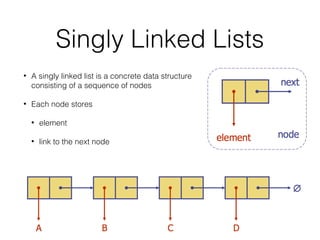
Singly Linked Lists
• A singly linked list is a concrete data structure
consisting of a sequence of nodes
• Each node stores
• element
• link to the next node
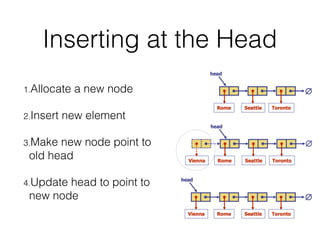
Inserting at the Head
1.Allocate a new node
2.Insert new element
3.Make new node point to
old head
4.Update head to point to
new node
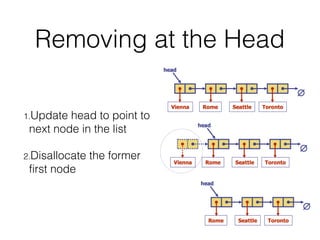
Removing at the Head
1.Update head to point to
next node in the list
2.Disallocate the former
first node
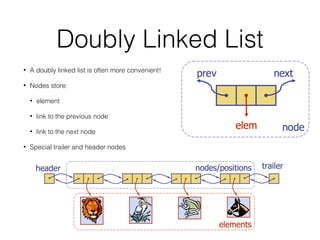
Doubly Linked List
• A doubly linked list is often more convenient!
• Nodes store:
• element
• link to the previous node
• link to the next node
• Special trailer and header nodes
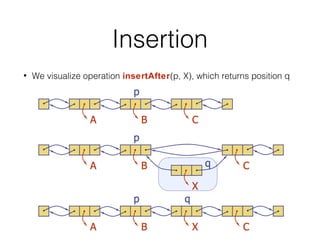
Insertion
• We visualize operation insertAfter(p, X), which returns position q
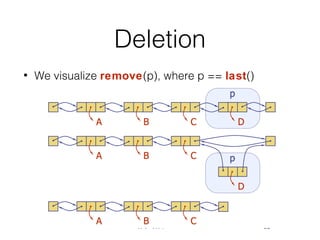
Deletion
• We visualize remove(p), where p == last()
Stack
• The stack is a very common data structure used in
programs which has lot of potential
• Hold object, usually all of the same type
• Follows the concept of LIFO
Stack
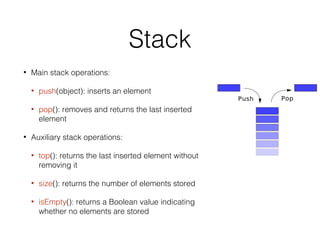
• Main stack operations:
• push(object): inserts an element
• pop(): removes and returns the last inserted
element
• Auxiliary stack operations:
• top(): returns the last inserted element without
removing it
• size(): returns the number of elements stored
• isEmpty(): returns a Boolean value indicating
whether no elements are stored
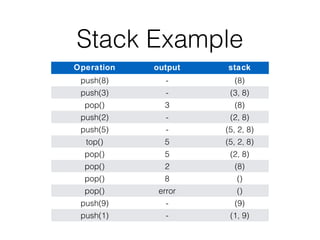
Stack Example
Operation output stack
push(8) - (8)
push(3) - (3, 8)
pop() 3 (8)
push(2) - (2, 8)
push(5) - (5, 2, 8)
top() 5 (5, 2, 8)
pop() 5 (2, 8)
pop() 2 (8)
pop() 8 ()
pop() error ()
push(9) - (9)
push(1) - (1, 9)
Application of Stack
• Direct applications
★ Page-visited history in a Web browser
★ Undo sequence in a text editor
• Indirect applications
★ Auxiliary data structure for algorithms
★ Component of other data structures
Queue
• The stack is a very common data structure used in
programs which has lot of potential
• Hold object, usually all of the same type
• Follows the concept of FIFO
• Insertions are at the rear of the queue and removals
are at the front of the queue
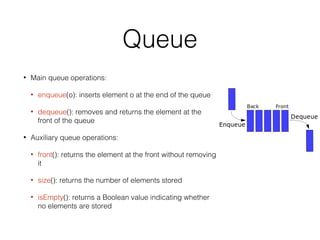
Queue
• Main queue operations:
• enqueue(o): inserts element o at the end of the queue
• dequeue(): removes and returns the element at the
front of the queue
• Auxiliary queue operations:
• front(): returns the element at the front without removing
it
• size(): returns the number of elements stored
• isEmpty(): returns a Boolean value indicating whether
no elements are stored
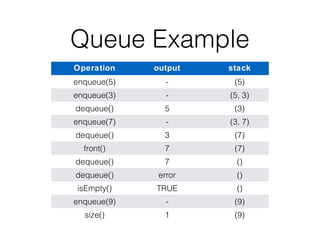
Queue Example
Operation output stack
enqueue(5) - (5)
enqueue(3) - (5, 3)
dequeue() 5 (3)
enqueue(7) - (3, 7)
dequeue() 3 (7)
front() 7 (7)
dequeue() 7 ()
dequeue() error ()
isEmpty() TRUE ()
enqueue(9) - (9)
size() 1 (9)
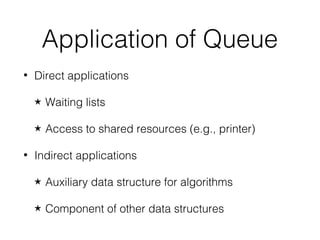
Application of Queue
• Direct applications
★ Waiting lists
★ Access to shared resources (e.g., printer)
• Indirect applications
★ Auxiliary data structure for algorithms
★ Component of other data structures
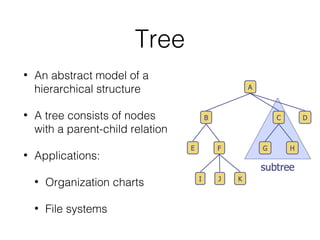
Tree
• An abstract model of a
hierarchical structure
• A tree consists of nodes
with a parent-child relation
• Applications:
• Organization charts
• File systems
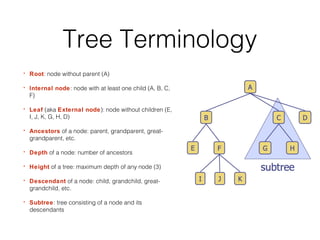
Tree Terminology
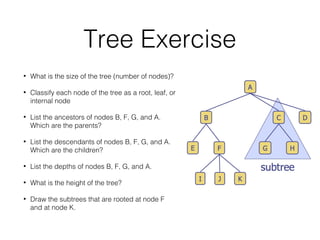
• Root: node without parent (A)
• Internal node: node with at least one child (A, B, C,
F)
• Leaf (aka External node): node without children (E,
I, J, K, G, H, D)
• Ancestors of a node: parent, grandparent, great-
grandparent, etc.
• Depth of a node: number of ancestors
• Height of a tree: maximum depth of any node (3)
• Descendant of a node: child, grandchild, great-
grandchild, etc.
• Subtree: tree consisting of a node and its
descendants
Tree Exercise
• What is the size of the tree (number of nodes)?
• Classify each node of the tree as a root, leaf, or
internal node
• List the ancestors of nodes B, F, G, and A.
Which are the parents?
• List the descendants of nodes B, F, G, and A.
Which are the children?
• List the depths of nodes B, F, G, and A.
• What is the height of the tree?
• Draw the subtrees that are rooted at node F
and at node K.
Tree
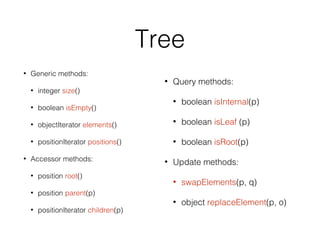
• Generic methods:
• integer size()
• boolean isEmpty()
• objectIterator elements()
• positionIterator positions()
• Accessor methods:
• position root()
• position parent(p)
• positionIterator children(p)
• Query methods:
• boolean isInternal(p)
• boolean isLeaf (p)
• boolean isRoot(p)
• Update methods:
• swapElements(p, q)
• object replaceElement(p, o)
Depth and Height
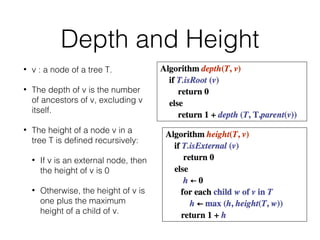
• v : a node of a tree T.
• The depth of v is the number
of ancestors of v, excluding v
itself.
• The height of a node v in a
tree T is defined recursively:
• If v is an external node, then
the height of v is 0
• Otherwise, the height of v is
one plus the maximum
height of a child of v.
Preorder Traversal
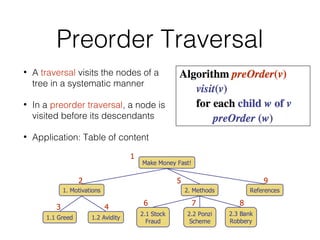
• A traversal visits the nodes of a
tree in a systematic manner
• In a preorder traversal, a node is
visited before its descendants
• Application: Table of content
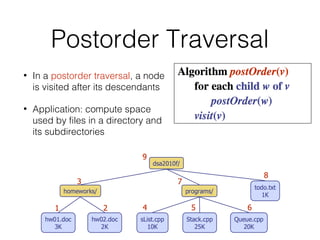
Postorder Traversal
• In a postorder traversal, a node
is visited after its descendants
• Application: compute space
used by files in a directory and
its subdirectories
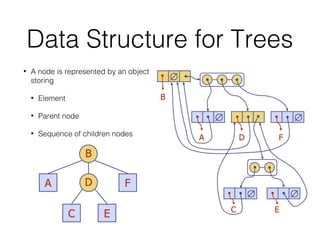
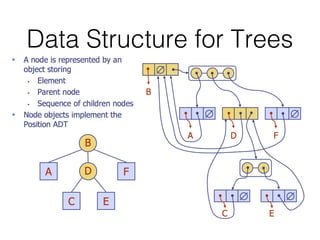
Data Structure for Trees
• A node is represented by an object
storing
• Element
• Parent node
• Sequence of children nodes
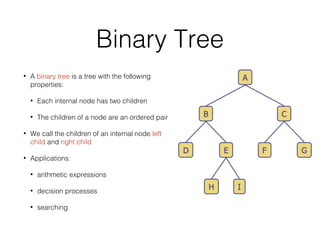
Binary Tree
• A binary tree is a tree with the following
properties:
• Each internal node has two children
• The children of a node are an ordered pair
• We call the children of an internal node left
child and right child
• Applications:
• arithmetic expressions
• decision processes
• searching
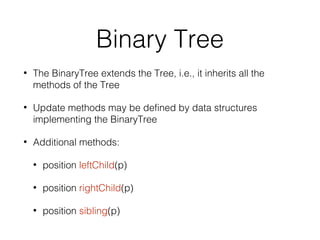
Binary Tree
• The BinaryTree extends the Tree, i.e., it inherits all the
methods of the Tree
• Update methods may be defined by data structures
implementing the BinaryTree
• Additional methods:
• position leftChild(p)
• position rightChild(p)
• position sibling(p)
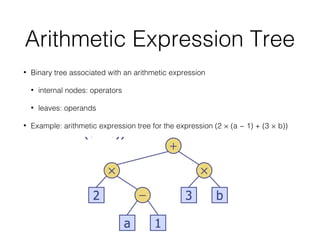
Arithmetic Expression Tree
• Binary tree associated with an arithmetic expression
• internal nodes: operators
• leaves: operands
• Example: arithmetic expression tree for the expression (2 × (a − 1) + (3 × b))
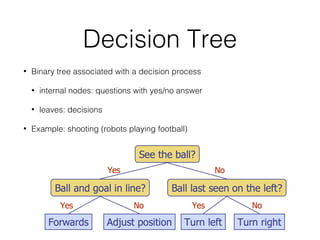
Decision Tree
• Binary tree associated with a decision process
• internal nodes: questions with yes/no answer
• leaves: decisions
• Example: shooting (robots playing football)
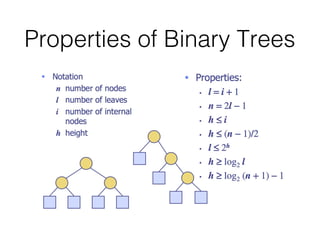
Properties of Binary Trees
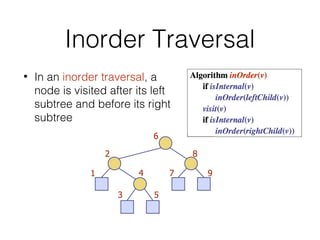
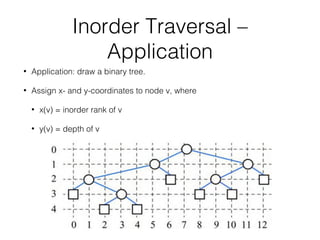
Inorder Traversal
• In an inorder traversal, a
node is visited after its left
subtree and before its right
subtree
Inorder Traversal –
Application
• Application: draw a binary tree.
• Assign x- and y-coordinates to node v, where
• x(v) = inorder rank of v
• y(v) = depth of v
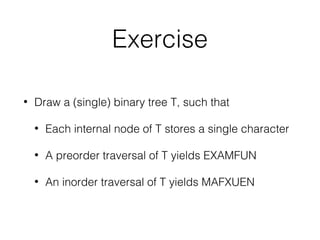
Exercise
• Draw a (single) binary tree T, such that
• Each internal node of T stores a single character
• A preorder traversal of T yields EXAMFUN
• An inorder traversal of T yields MAFXUEN
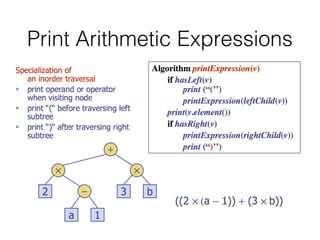
Print Arithmetic Expressions
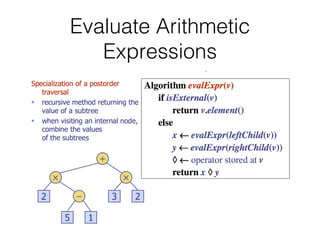
Evaluate Arithmetic
Expressions
Exercise
1.Draw an expression tree that has
• Four leaves, storing the values 1, 5, 6, and 7
• 3 internal nodes, storing operations +, -, *, /(operators can be used more
than once, but each internal node stores only one)
• The value of the root is 21
2. Draw a tree that represents the expression (3*45 + 10*(6-2))-(5/6 + 7*2)
• list all the internal nodes, leaf nodes. What are the height and the size of
the tree?
• list all nodes in the order visited using preorder/postorder/inorder
traversal.
Data Structure for Trees
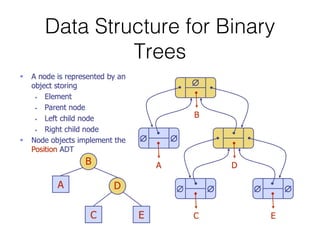
Data Structure for Binary
Trees

Hub102 - Lesson4 - Data Structure

  • 1.
  • 2.
    Arrays • Built-in inmost programming languages • Two kinds (programmer responsibility): • Unordered: attendance tracking • Ordered: high scorers • Operations: • Insertion • Deletion • Search
  • 3.
    List • The Listmodels a sequence of positions storing arbitrary objects • It establishes a before/after relation between positions • Generic methods: • size(), isEmpty() • Accessor methods: • first(), last() • prev(p), next(p) • Update methods: • replace(p, e) • insertBefore(p, e), • insertAfter(p, e), • insertFirst(e), • insertLast(e) • remove(p)
  • 4.
    Singly Linked Lists •A singly linked list is a concrete data structure consisting of a sequence of nodes • Each node stores • element • link to the next node
  • 5.
    Inserting at theHead 1.Allocate a new node 2.Insert new element 3.Make new node point to old head 4.Update head to point to new node
  • 6.
    Removing at theHead 1.Update head to point to next node in the list 2.Disallocate the former first node
  • 7.
    Doubly Linked List •A doubly linked list is often more convenient! • Nodes store: • element • link to the previous node • link to the next node • Special trailer and header nodes
  • 8.
    Insertion • We visualizeoperation insertAfter(p, X), which returns position q
  • 9.
    Deletion • We visualizeremove(p), where p == last()
  • 10.
    Stack • The stackis a very common data structure used in programs which has lot of potential • Hold object, usually all of the same type • Follows the concept of LIFO
  • 11.
    Stack • Main stackoperations: • push(object): inserts an element • pop(): removes and returns the last inserted element • Auxiliary stack operations: • top(): returns the last inserted element without removing it • size(): returns the number of elements stored • isEmpty(): returns a Boolean value indicating whether no elements are stored
  • 12.
    Stack Example Operation outputstack push(8) - (8) push(3) - (3, 8) pop() 3 (8) push(2) - (2, 8) push(5) - (5, 2, 8) top() 5 (5, 2, 8) pop() 5 (2, 8) pop() 2 (8) pop() 8 () pop() error () push(9) - (9) push(1) - (1, 9)
  • 13.
    Application of Stack •Direct applications ★ Page-visited history in a Web browser ★ Undo sequence in a text editor • Indirect applications ★ Auxiliary data structure for algorithms ★ Component of other data structures
  • 14.
    Queue • The stackis a very common data structure used in programs which has lot of potential • Hold object, usually all of the same type • Follows the concept of FIFO • Insertions are at the rear of the queue and removals are at the front of the queue
  • 15.
    Queue • Main queueoperations: • enqueue(o): inserts element o at the end of the queue • dequeue(): removes and returns the element at the front of the queue • Auxiliary queue operations: • front(): returns the element at the front without removing it • size(): returns the number of elements stored • isEmpty(): returns a Boolean value indicating whether no elements are stored
  • 16.
    Queue Example Operation outputstack enqueue(5) - (5) enqueue(3) - (5, 3) dequeue() 5 (3) enqueue(7) - (3, 7) dequeue() 3 (7) front() 7 (7) dequeue() 7 () dequeue() error () isEmpty() TRUE () enqueue(9) - (9) size() 1 (9)
  • 17.
    Application of Queue •Direct applications ★ Waiting lists ★ Access to shared resources (e.g., printer) • Indirect applications ★ Auxiliary data structure for algorithms ★ Component of other data structures
  • 18.
    Tree • An abstractmodel of a hierarchical structure • A tree consists of nodes with a parent-child relation • Applications: • Organization charts • File systems
  • 19.
    Tree Terminology • Root:node without parent (A) • Internal node: node with at least one child (A, B, C, F) • Leaf (aka External node): node without children (E, I, J, K, G, H, D) • Ancestors of a node: parent, grandparent, great- grandparent, etc. • Depth of a node: number of ancestors • Height of a tree: maximum depth of any node (3) • Descendant of a node: child, grandchild, great- grandchild, etc. • Subtree: tree consisting of a node and its descendants
  • 20.
    Tree Exercise • Whatis the size of the tree (number of nodes)? • Classify each node of the tree as a root, leaf, or internal node • List the ancestors of nodes B, F, G, and A. Which are the parents? • List the descendants of nodes B, F, G, and A. Which are the children? • List the depths of nodes B, F, G, and A. • What is the height of the tree? • Draw the subtrees that are rooted at node F and at node K.
  • 21.
    Tree • Generic methods: •integer size() • boolean isEmpty() • objectIterator elements() • positionIterator positions() • Accessor methods: • position root() • position parent(p) • positionIterator children(p) • Query methods: • boolean isInternal(p) • boolean isLeaf (p) • boolean isRoot(p) • Update methods: • swapElements(p, q) • object replaceElement(p, o)
  • 22.
    Depth and Height •v : a node of a tree T. • The depth of v is the number of ancestors of v, excluding v itself. • The height of a node v in a tree T is defined recursively: • If v is an external node, then the height of v is 0 • Otherwise, the height of v is one plus the maximum height of a child of v.
  • 23.
    Preorder Traversal • Atraversal visits the nodes of a tree in a systematic manner • In a preorder traversal, a node is visited before its descendants • Application: Table of content
  • 24.
    Postorder Traversal • Ina postorder traversal, a node is visited after its descendants • Application: compute space used by files in a directory and its subdirectories
  • 25.
    Data Structure forTrees • A node is represented by an object storing • Element • Parent node • Sequence of children nodes
  • 26.
    Binary Tree • Abinary tree is a tree with the following properties: • Each internal node has two children • The children of a node are an ordered pair • We call the children of an internal node left child and right child • Applications: • arithmetic expressions • decision processes • searching
  • 27.
    Binary Tree • TheBinaryTree extends the Tree, i.e., it inherits all the methods of the Tree • Update methods may be defined by data structures implementing the BinaryTree • Additional methods: • position leftChild(p) • position rightChild(p) • position sibling(p)
  • 28.
    Arithmetic Expression Tree •Binary tree associated with an arithmetic expression • internal nodes: operators • leaves: operands • Example: arithmetic expression tree for the expression (2 × (a − 1) + (3 × b))
  • 29.
    Decision Tree • Binarytree associated with a decision process • internal nodes: questions with yes/no answer • leaves: decisions • Example: shooting (robots playing football)
  • 30.
  • 31.
    Inorder Traversal • Inan inorder traversal, a node is visited after its left subtree and before its right subtree
  • 32.
    Inorder Traversal – Application •Application: draw a binary tree. • Assign x- and y-coordinates to node v, where • x(v) = inorder rank of v • y(v) = depth of v
  • 33.
    Exercise • Draw a(single) binary tree T, such that • Each internal node of T stores a single character • A preorder traversal of T yields EXAMFUN • An inorder traversal of T yields MAFXUEN
  • 34.
  • 35.
  • 36.
    Exercise 1.Draw an expressiontree that has • Four leaves, storing the values 1, 5, 6, and 7 • 3 internal nodes, storing operations +, -, *, /(operators can be used more than once, but each internal node stores only one) • The value of the root is 21 2. Draw a tree that represents the expression (3*45 + 10*(6-2))-(5/6 + 7*2) • list all the internal nodes, leaf nodes. What are the height and the size of the tree? • list all nodes in the order visited using preorder/postorder/inorder traversal.
  • 37.
  • 38.
    Data Structure forBinary Trees