I
An
Assignment on
Human Resource Management
Of
Marks and Spencer
Submitted by:
Name:
Id:
Submitted to:
Date of Submission:
II
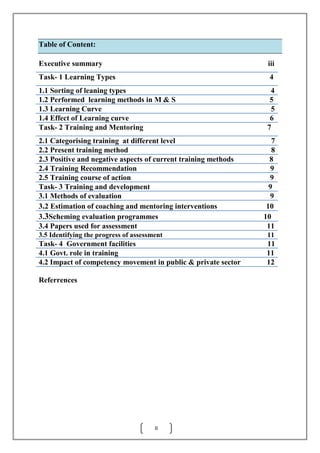
Table of Content:
Executive summary iii
Task- 1 Learning Types 4
1.1 Sorting of leaning types 4
1.2 Performed learning methods in M & S 5
1.3 Learning Curve 5
1.4 Effect of Learning curve 6
Task- 2 Training and Mentoring 7
2.1 Categorising training at different level 7
2.2 Present training method 8
2.3 Positive and negative aspects of current training methods 8
2.4 Training Recommendation 9
2.5 Training course of action 9
Task- 3 Training and development 9
3.1 Methods of evaluation 9
3.2 Estimation of coaching and mentoring interventions 10
3.3Scheming evaluation programmes 10
3.4 Papers used for assessment 11
3.5 Identifying the progress of assessment 11
Task- 4 Government facilities 11
4.1 Govt. role in training 11
4.2 Impact of competency movement in public & private sector 12
Referrences
III
Marks and Spencer is a famous and renowned company in UK. They have been performing
and fulfilling customer needs with their 361 retail stores since 1884. They have around 65000
employees around all the retail stores. Because of competition and surviving in market they
had to face undesirable circumstances. To get rid of this problem they impart training and
coaching among their employees so that the employees can adapt with different work needed
in crisis. They provide various kinds of training such as on-the-job and off-the job training.
This helps the employee to enhance their ability and skills. An idea has been created here
which is going to mention an idle of training process as well as the initiatives of the
government to help and enhance facilities of training and learning.Government led initiatives
in human resource development can play a vital part in training the M&S employees
contributing more in the economy as a result. The organization construction of Marks &
Spencer is not a tree but rather trodden so as to give the employees more room to work and
have direct communication with the decision making legislatures of the organization so the
employees can burgeon in their respective fields of work.
Executive Summary
4
Task-1
Learning Types
1. Leaning Types:Due to excessive competition, M & S had to develop new business
strategies and ideas for the competitive era. This changing environment brought immense
challenge to the employees. People learn in their individual ways. According to individual’s
taste they can be classified in different categories so that the training process can be highly
effective.
1.1 Sorting of learning types:Honey & Mumford (1986) has identified 4 different learning
types- theorist, activist, reflector and pragmatist.
Activists:Activists are likely to be without biasness in new experiences.Their
philosophy is: "I'll try anything once". They tend to act first and consider the consequences
afterwards. Their days are filled with activity. They tackle problems by brainstorming. As
soon as the excitement from one activity has died down, they are busy looking for the next.
They are gregarious people constantly involving them-selves with others but, in so doing,
they seek to centre all activity on themselves.
Pragmatists:Pragmatists tends to try out new ideas, theories and techniques to see if
they work in practice. They view problems and difficulties as a "challenge". Their philosophy
is: "As long as it works, that's fine." - although they may also be keen to experiment to find
better ways to do things.They positively search out new ideas and take the first opportunity to
experiment with applications. They tend to be impatient with ruminating and open-ended
discussion. They are essentially practical, down-to-earth people who like solving problems
(often through trial and error).
Theorists:Theorists think through problems in a logical, step-by-step fashion. They
assimilate disparate facts into coherent, holistic theories. ". They tend to be detached,
analytical and dedicated to rational objectivity rather than anything subjective or ambiguous.
They may rigidly reject anything that does not fit in with their own particular mind-set.They
tend to be perfectionists who do not rest easy until things are tidy and fit into a rational
scheme. They like to analyse and synthesise. They are keen on asking questions and
challenging assumptions. Their philosophy is: "If it's logical then it's good."
5
Reflectors:Reflectors collect data, both first-hand and from others, and prefer to
think about it thoroughly before coming to any conclusion.They tend to adopt a low profile
and have a slightly distant, tolerant unruffled air about them. Their philosophy is to be
cautious. They are thoughtful people who like to consider all possible angles and
implications before making a move. . They tend to postpone reaching definite conclusions
for as long as possible. They enjoy observing other people and prefer to take a back seat in
meetings and discussions. They listen to others before making their own points
1.2 Performed learning methods in M&S:M & S always try to identify the abilities
to be developed in employees. They provide performance coaching to impart practical
knowledge among employees. They conducted various kinds of learning methods such as on-
the-job and off-the job training methods. In on-the-job training managers are employed in
different posts to increase their potentiality. Employees are to also take part in off-the-job
training which enhance their knowledge and experience. Both help the employees to be
confident and courageous and perform well. The efficient and effective training can only
ensure the ultimate success of the organization as M&S is also following. The learning style
followed by M&S is a part of their training scheme for the employees to adjust their business
strategy. The pragmatist style is a challenging and strenuous style providing the employees
with much room for improvement and development of confidence.
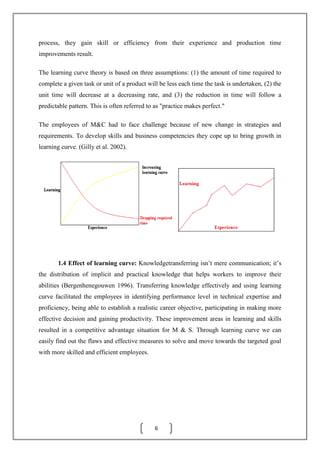
1.3 Learning curve:The learning curve, also referred to as the productivity
experience curve, represents the improvement in an employee's production or work output as
he learns the steps involved in each task(Huang 2001). As the learning curve takes effect in
your retail employees, you can expect to see a nicer-looking, more organized display of
merchandise, fewer mistakes made due to lack of experience and an increase in sales. All of
these things add up to a more productive business with employees who feel confident in the
job they're doing.
Learning curves are important in a variety of business applications, especially manufacturing.
The learning curve theory is a relationship between unit production time and the cumulative
number of units produced. As individuals or organizations collectively repeat a particular
6
process, they gain skill or efficiency from their experience and production time
improvements result.
The learning curve theory is based on three assumptions: (1) the amount of time required to
complete a given task or unit of a product will be less each time the task is undertaken, (2) the
unit time will decrease at a decreasing rate, and (3) the reduction in time will follow a
predictable pattern. This is often referred to as "practice makes perfect."
The employees of M&C had to face challenge because of new change in strategies and
requirements. To develop skills and business competencies they cope up to bring growth in
learning curve. (Gilly et al. 2002).
1.4 Effect of learning curve: Knowledgetransferring isn’t mere communication; it’s
the distribution of implicit and practical knowledge that helps workers to improve their
abilities (Bergenhenegouwen 1996). Transferring knowledge effectively and using learning
curve facilitated the employees in identifying performance level in technical expertise and
proficiency, being able to establish a realistic career objective, participating in making more
effective decision and gaining productivity. These improvement areas in learning and skills
resulted in a competitive advantage situation for M & S. Through learning curve we can
easily find out the flaws and effective measures to solve and move towards the targeted goal
with more skilled and efficient employees.
7
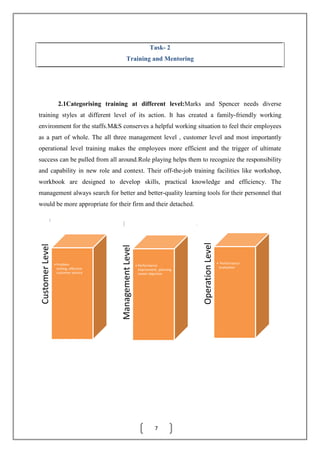
2.1Categorising training at different level:Marks and Spencer needs diverse
training styles at different level of its action. It has created a family-friendly working
environment for the staffs.M&S conserves a helpful working situation to feel their employees
as a part of whole. The all three management level , customer level and most importantly
operational level training makes the employees more efficient and the trigger of ultimate
success can be pulled from all around.Role playing helps them to recognize the responsibility
and capability in new role and context. Their off-the-job training facilities like workshop,
workbook are designed to develop skills, practical knowledge and efficiency. The
management always search for better and better-quality learning tools for their personnel that
would be more appropriate for their firm and their detached.
CustomerLevel
• Problem
solving, effective
customer service
ManagementLevel
• Performance
improvment, planning
career objective
OperationLevel
• Performance
evaluation
Task- 2
Training and Mentoring
8
2.2 Present training method:The management of M and S always search for better and
upgraded learning tools for their employees that would be more appropriate for their firm and
their objective. Marks &Spencer stimulatethe employees to build effective career objective
(Liao 2005). Theyevaluate their actual performance level and suggested how much
development is required. Role playing benefits them to recognize the responsibility and skill
in new position and context (Gilly et al. 2002). Off-the-job training events like workshop,
workbook facility are planned to improve efficiency and skills.This training event will
energize the employees to take part in decision making and increase the ability to provide
more realistic analysis and solution.
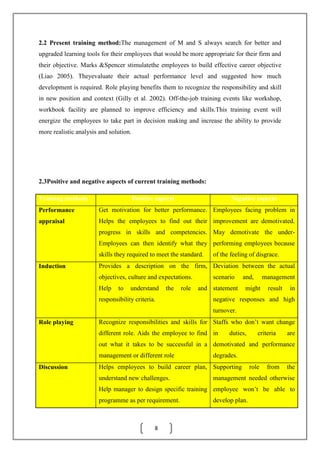
2.3Positive and negative aspects of current training methods:
Training methods Positive aspects Negative aspects
Performance
appraisal
Get motivation for better performance.
Helps the employees to find out their
progress in skills and competencies.
Employees can then identify what they
skills they required to meet the standard.
Employees facing problem in
improvement are demotivated.
May demotivate the under-
performing employees because
of the feeling of disgrace.
Induction Provides a description on the firm,
objectives, culture and expectations.
Help to understand the role and
responsibility criteria.
Deviation between the actual
scenario and, management
statement might result in
negative responses and high
turnover.
Role playing Recognize responsibilities and skills for
different role. Aids the employee to find
out what it takes to be successful in a
management or different role
Staffs who don’t want change
in duties, criteria are
demotivated and performance
degrades.
Discussion Helps employees to build career plan,
understand new challenges.
Help manager to design specific training
programme as per requirement.
Supporting role from the
management needed otherwise
employee won’t be able to
develop plan.
9
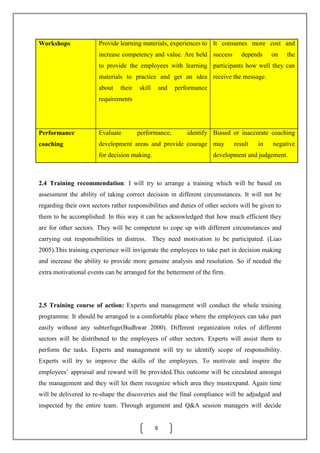
Workshops Provide learning materials, experiences to
increase competency and value. Are held
to provide the employees with learning
materials to practice and get an idea
about their skill and performance
requirements
It consumes more cost and
success depends on the
participants how well they can
receive the message.
Performance
coaching
Evaluate performance, identify
development areas and provide courage
for decision making.
Biased or inaccurate coaching
may result in negative
development and judgement.
2.4 Training recommendation: I will try to arrange a training which will be based on
assessment the ability of taking correct decision in different circumstances. It will not be
regarding their own sectors rather responsibilities and duties of other sectors will be given to
them to be accomplished. In this way it can be acknowledged that how much efficient they
are for other sectors. They will be competent to cope up with different circumstances and
carrying out responsibilities in distress. They need motivation to be participated. (Liao
2005).This training experience will invigorate the employees to take part in decision making
and increase the ability to provide more genuine analysis and resolution. So if needed the
extra motivational events can be arranged for the betterment of the firm.
2.5 Training course of action: Experts and management will conduct the whole training
programme. It should be arranged in a comfortable place where the employees can take part
easily without any subterfuge(Budhwar 2000). Different organization roles of different
sectors will be distributed to the employees of other sectors. Experts will assist them to
perform the tasks. Experts and management will try to identify scope of responsibility.
Experts will try to improve the skills of the employees. To motivate and inspire the
employees’ appraisal and reward will be provided.This outcome will be circulated amongst
the management and they will let them recognize which area they mustexpand. Again time
will be delivered to re-shape the discoveries and the final compliance will be adjudged and
inspected by the entire team. Through argument and Q&A session managers will decide
10
which resolution was most appropriate and will be commenced. These every steps really
bears the ultimate importance and the successful execution of the all these steps can make the
goal fulfil and can make an effective human resource for the future.
Task- 3
Training and development
3.1 Methods of evaluations: For the evaluation of the result of the training event I used
different methodology (Gilly et al. 2002). To find out the efficiency and effectiveness of the
event and how successful the training program was I will assess various factors, costs and
benefits ratio to decide the continuity and changes of the program. I used a framework to
evaluate the program in five steps which provide analysis on the program. The program is
judged at 5 different criteria to find out whether it has met the need or not.This ‘Five tiered
approach’ defined by Jacobs. F. (1988). The agendaappraises a program in five stages and
equates the actual output with the projected outcome of the program.
1. Need evaluation:It helps to define the problem. It ensures the necessity of the
training.
2. Monitoring the participation:It helps to select the targeted participants and what
facility should be provided and how much they are participating can be known.
3. Program interpretation:It’s the review at different level to know how the program
can be more effective.
4. Improvement:Identifies the development of the participant- how much the
participants are improving?
5. Program effect:The consequences of the training event in the long-termcan be
identified through this process.
3.2Estimationof coaching and mentoring interventions: Coaching and mentoring are been
used as tools of learning and development (Bloch, 1995, and Leedham, 2005) however they
are also some of the interventions that are the least likely to be evaluated (Industrial Society,
11
1998 and Leedham, 2005). This position does not appear to have changed as in the CIPD
(2008) survey only 8% of L&D respondents evaluate the effectiveness of coaching through a
formal evaluation process. Whilst some exceptions exist such as Paige (2002) it remains
evident that there is little empirical evidence in this area. Response from the instructor and
trainers will be taken after each training event ends to know what they think about the plug-
in. Carefully observe the happenings and partaking of the employees and effects of internal
and external factors on the training event. How excellently employees apply their learning in
customer service. Through the training event employees get to learn different factors in the
organization environment including customer service through problem cracking and
argument.
3.3 Scheming evaluation programmes:The assessment method used to measure the
program is a combination of quantitative and qualitative methods. I applied three approaches
to detect the gap at various levels of the event.
i. Trainer criticism: Criticism from the trainer through direct conversation
willbevery helpful to evaluate the pros and cons of the program designing to make
necessary corrections.
ii. Observation: Cautiously observe the accomplishments and involvement of the
participants and influence of other factors on their activities and the training event.
iii. Customer feedback: How workers were able to use the learning from the training
in customer service is evaluated. By participating in the training session
employees learned various elements in the structural atmosphere including
customer service. Customer feedback through questioner, complaint box service,
appraisal facility will show if there was any progressive change in the customer
service.
3.4 Papers used for assessment: To assess the training session different factors are analysed
and considered. Results of these factors justified how the training event was assessed and the
effectiveness of the event.
i. Quality: Whether the service and product quality is standardized or not is
evaluated.
ii. Customer service: Toknow how customer service is developed and attains
thecustomer valuation of the company.
12
iii. Production effectiveness: The event aims at bringing effectiveness and
enthusiasm in performance. The productivity is assessed in the evaluation
procedure.
iv. Increment in sales: Positive or negative impact on the productivity of the training
event is analysed to detect the success of the event.
3.5 Identifying the progress of assessment: Through the five steps derivation can be
detected. The Five tiered assessment technique was very beneficial to assess the achievement
of the event in real life work setting. The system appraised the expected advantage and actual
profit to sort out the alteration and probability of the training event. Throughout the
assessment procedure employees, managers provided their problems and life-threatening
activities of the training event that affected unpleasantly in their development process. Thus it
was easy to figure it out the cost-benefit ratio to decide on whether it will continue or not or
improvement need to be made. The management found it a successful assessment system
which critically analysed all the steps and policies taken by HR managers. More logical and
analytical improvement was made in order to receive a better output and result in
performance.
Finally it can be identified whether the assessment was successive or not. Additional
requirements also can be guessed through this way.
Task- 4
Government Facilities
4.1 Govt. role in training: As business firms play a vital role in the economy of the country
The UK government contributes in training and developing the staffs of private
companies(Farquharson&Baum 2002). Training programs are run to improve the abilities of
employees and reach the performance standard. M&S is also a most popular brand so Gov.
provides all kinds of facilities to impart training. Lifelong learning system is encouraged by
the Govt. and firms to encourage the employees to learn through self-motivation.The UK
13
government own a noteworthy role in the training and improvement of the employees of
private companies. Govt. position training programs through skilled trainer to make sure the
employees can develop and reach at least a smallest standard of performance. M and S is a
giant vendor firm in UK; so UK govt. should concern about the internal development of the
firm’s performance. To do so they need to take the accountability to take the presentation to a
standard level. Enduring learning is the self-motivated learning by the employees. Govt.
participation in training can aid the staffs to detection knowledge from the working
environment.
4.2 Impact of competency movement in public & private sector: Movement skill and
competency has forced other private and public firms to take performance gap into account
for improvement. Private companies are concentrating and developing this sector to enhance
the competencies which will ultimately bring competitive advantage. The firms are working
on improving incompetency and inefficiency in performance like poor service quality,
inefficient production, low motivation etc. which is a competitive disadvantage. A private
consulting organization named Deloittegives a huge effort in training and development of
their employees. They maintain a faster learning curve to develop and match their skill and
ability quickly. The learning is a continuous process and recognition is given to grow the
confidence. The overall employees’ skill and performance possess a greater influence on
industry and the economy; the public firms are also improving their manpower to gear up
their performance. For example ‘East Coast Trains ‘and many others are continuously
working on improving the skills, service quality and performances.
4.3 Assessment of contemporary training launched by UK government that influenced
the HRD such an organization like M&S:
Assessment of training: The training is occupational and designed at quick learning on
different areas of a business. Consuming an empathetic on the contemporary situation
and forthcoming panorama UK govt. strategies different qualitative training programs
for different firms. This fashionable training facility is quicker process of expansion
in the defenceless working troposphere. As the economy is pretentious by the
performances of the employees in all firms, the Govt. has been putting further
14
possible effort in conniving the best learning options to the firms as per the type of
learning needs.
Role of contemporary learning:For Marks and Spencer training initiatives are very
necessary for further development and in advance reasonable advantage. M&S has
industrialized and different their core values and to make it successful they need
definite training facilities for their workforces. This cotemporary training will aid the
employees to quickly adapt to the changing environment. The training is appraised
concentrating the expectation of customers, competitive position, market condition,
and future viewpoint and adaptability factors. Sooner adaptableness is possible with
the active involvement and effective employment of contemporary knowledge events
as per the firm’s structure and employees require.
Conclusion:M&Sreally strives hard for the excellence by making effective and efficient
workforce through some needed and beneficial training program.It is one of the companies
whose training program of the employees includes both on-job and off-job training thus
allowing the employees to adapt easily to the working conditions and to be able to show them
their whole potential they have in store and not mess everything up due to pressure and
nervousnessMarks and Spencer is a foremost vendor firm holding a high effect on the UK
economy. The management bring different services for a faster performance adjustment of
workers. These helped the firm to stay and fight in the highly competitive market gaining
more customer contentment and loyalty. The friendly environment helps the personnel to feel
more importance and find out organizational flaws. For different learning requirements and
development necessities, the firm need to identify more critical areas and organizational
difficulties for effective application of theories and ideologies. The workforces can be at their
best recital level if management provide full support to them and to their organizational
structure and work environment. Thus the ultimate goal can be achieved by the execution of
all these plans and uphold the image of the company M&S more brightly.
15
References:
Farquharson L. and Baum T. (2002) Enacting organisational change programmes: a centre
stage role for HRM?, International Journal of Contemporary Hospitality Management,
Vol. 14 Issue 5, pp.243-250
Liao Y. (2005) Business strategy and performance: the role of human resource management
control, Personnel Review, Vol. 34 Issue 3, pp.294-309
Gilly, J., Eggland, S.&Gilly, A. (2002). Principles of Human resource management New
York: Basic books [online] collected from-
http://nhokanson.wordpress.com/2007/02/01/definitions-of-human-resources-human-
resource-management-and-their-relation-to-human-resource-development/
Budhwar P. (2000) Evaluating levels of strategic integration and devolvement of human
resource management in the UK, Personnel Review, Vol. 29 Issue 2, pp.141-157
Huang T. (2001) the effects of linkage between business and human resource management
strategies, Personnel Review, Vol. 30 Issue 2, pp.132-151

Hrd 9

  • 1.
    I An Assignment on Human ResourceManagement Of Marks and Spencer Submitted by: Name: Id: Submitted to: Date of Submission:
  • 2.
    II Table of Content: Executivesummary iii Task- 1 Learning Types 4 1.1 Sorting of leaning types 4 1.2 Performed learning methods in M & S 5 1.3 Learning Curve 5 1.4 Effect of Learning curve 6 Task- 2 Training and Mentoring 7 2.1 Categorising training at different level 7 2.2 Present training method 8 2.3 Positive and negative aspects of current training methods 8 2.4 Training Recommendation 9 2.5 Training course of action 9 Task- 3 Training and development 9 3.1 Methods of evaluation 9 3.2 Estimation of coaching and mentoring interventions 10 3.3Scheming evaluation programmes 10 3.4 Papers used for assessment 11 3.5 Identifying the progress of assessment 11 Task- 4 Government facilities 11 4.1 Govt. role in training 11 4.2 Impact of competency movement in public & private sector 12 Referrences
  • 3.
    III Marks and Spenceris a famous and renowned company in UK. They have been performing and fulfilling customer needs with their 361 retail stores since 1884. They have around 65000 employees around all the retail stores. Because of competition and surviving in market they had to face undesirable circumstances. To get rid of this problem they impart training and coaching among their employees so that the employees can adapt with different work needed in crisis. They provide various kinds of training such as on-the-job and off-the job training. This helps the employee to enhance their ability and skills. An idea has been created here which is going to mention an idle of training process as well as the initiatives of the government to help and enhance facilities of training and learning.Government led initiatives in human resource development can play a vital part in training the M&S employees contributing more in the economy as a result. The organization construction of Marks & Spencer is not a tree but rather trodden so as to give the employees more room to work and have direct communication with the decision making legislatures of the organization so the employees can burgeon in their respective fields of work. Executive Summary
  • 4.
    4 Task-1 Learning Types 1. LeaningTypes:Due to excessive competition, M & S had to develop new business strategies and ideas for the competitive era. This changing environment brought immense challenge to the employees. People learn in their individual ways. According to individual’s taste they can be classified in different categories so that the training process can be highly effective. 1.1 Sorting of learning types:Honey & Mumford (1986) has identified 4 different learning types- theorist, activist, reflector and pragmatist. Activists:Activists are likely to be without biasness in new experiences.Their philosophy is: "I'll try anything once". They tend to act first and consider the consequences afterwards. Their days are filled with activity. They tackle problems by brainstorming. As soon as the excitement from one activity has died down, they are busy looking for the next. They are gregarious people constantly involving them-selves with others but, in so doing, they seek to centre all activity on themselves. Pragmatists:Pragmatists tends to try out new ideas, theories and techniques to see if they work in practice. They view problems and difficulties as a "challenge". Their philosophy is: "As long as it works, that's fine." - although they may also be keen to experiment to find better ways to do things.They positively search out new ideas and take the first opportunity to experiment with applications. They tend to be impatient with ruminating and open-ended discussion. They are essentially practical, down-to-earth people who like solving problems (often through trial and error). Theorists:Theorists think through problems in a logical, step-by-step fashion. They assimilate disparate facts into coherent, holistic theories. ". They tend to be detached, analytical and dedicated to rational objectivity rather than anything subjective or ambiguous. They may rigidly reject anything that does not fit in with their own particular mind-set.They tend to be perfectionists who do not rest easy until things are tidy and fit into a rational scheme. They like to analyse and synthesise. They are keen on asking questions and challenging assumptions. Their philosophy is: "If it's logical then it's good."
  • 5.
    5 Reflectors:Reflectors collect data,both first-hand and from others, and prefer to think about it thoroughly before coming to any conclusion.They tend to adopt a low profile and have a slightly distant, tolerant unruffled air about them. Their philosophy is to be cautious. They are thoughtful people who like to consider all possible angles and implications before making a move. . They tend to postpone reaching definite conclusions for as long as possible. They enjoy observing other people and prefer to take a back seat in meetings and discussions. They listen to others before making their own points 1.2 Performed learning methods in M&S:M & S always try to identify the abilities to be developed in employees. They provide performance coaching to impart practical knowledge among employees. They conducted various kinds of learning methods such as on- the-job and off-the job training methods. In on-the-job training managers are employed in different posts to increase their potentiality. Employees are to also take part in off-the-job training which enhance their knowledge and experience. Both help the employees to be confident and courageous and perform well. The efficient and effective training can only ensure the ultimate success of the organization as M&S is also following. The learning style followed by M&S is a part of their training scheme for the employees to adjust their business strategy. The pragmatist style is a challenging and strenuous style providing the employees with much room for improvement and development of confidence. 1.3 Learning curve:The learning curve, also referred to as the productivity experience curve, represents the improvement in an employee's production or work output as he learns the steps involved in each task(Huang 2001). As the learning curve takes effect in your retail employees, you can expect to see a nicer-looking, more organized display of merchandise, fewer mistakes made due to lack of experience and an increase in sales. All of these things add up to a more productive business with employees who feel confident in the job they're doing. Learning curves are important in a variety of business applications, especially manufacturing. The learning curve theory is a relationship between unit production time and the cumulative number of units produced. As individuals or organizations collectively repeat a particular
  • 6.
    6 process, they gainskill or efficiency from their experience and production time improvements result. The learning curve theory is based on three assumptions: (1) the amount of time required to complete a given task or unit of a product will be less each time the task is undertaken, (2) the unit time will decrease at a decreasing rate, and (3) the reduction in time will follow a predictable pattern. This is often referred to as "practice makes perfect." The employees of M&C had to face challenge because of new change in strategies and requirements. To develop skills and business competencies they cope up to bring growth in learning curve. (Gilly et al. 2002). 1.4 Effect of learning curve: Knowledgetransferring isn’t mere communication; it’s the distribution of implicit and practical knowledge that helps workers to improve their abilities (Bergenhenegouwen 1996). Transferring knowledge effectively and using learning curve facilitated the employees in identifying performance level in technical expertise and proficiency, being able to establish a realistic career objective, participating in making more effective decision and gaining productivity. These improvement areas in learning and skills resulted in a competitive advantage situation for M & S. Through learning curve we can easily find out the flaws and effective measures to solve and move towards the targeted goal with more skilled and efficient employees.
  • 7.
    7 2.1Categorising training atdifferent level:Marks and Spencer needs diverse training styles at different level of its action. It has created a family-friendly working environment for the staffs.M&S conserves a helpful working situation to feel their employees as a part of whole. The all three management level , customer level and most importantly operational level training makes the employees more efficient and the trigger of ultimate success can be pulled from all around.Role playing helps them to recognize the responsibility and capability in new role and context. Their off-the-job training facilities like workshop, workbook are designed to develop skills, practical knowledge and efficiency. The management always search for better and better-quality learning tools for their personnel that would be more appropriate for their firm and their detached. CustomerLevel • Problem solving, effective customer service ManagementLevel • Performance improvment, planning career objective OperationLevel • Performance evaluation Task- 2 Training and Mentoring
  • 8.
    8 2.2 Present trainingmethod:The management of M and S always search for better and upgraded learning tools for their employees that would be more appropriate for their firm and their objective. Marks &Spencer stimulatethe employees to build effective career objective (Liao 2005). Theyevaluate their actual performance level and suggested how much development is required. Role playing benefits them to recognize the responsibility and skill in new position and context (Gilly et al. 2002). Off-the-job training events like workshop, workbook facility are planned to improve efficiency and skills.This training event will energize the employees to take part in decision making and increase the ability to provide more realistic analysis and solution. 2.3Positive and negative aspects of current training methods: Training methods Positive aspects Negative aspects Performance appraisal Get motivation for better performance. Helps the employees to find out their progress in skills and competencies. Employees can then identify what they skills they required to meet the standard. Employees facing problem in improvement are demotivated. May demotivate the under- performing employees because of the feeling of disgrace. Induction Provides a description on the firm, objectives, culture and expectations. Help to understand the role and responsibility criteria. Deviation between the actual scenario and, management statement might result in negative responses and high turnover. Role playing Recognize responsibilities and skills for different role. Aids the employee to find out what it takes to be successful in a management or different role Staffs who don’t want change in duties, criteria are demotivated and performance degrades. Discussion Helps employees to build career plan, understand new challenges. Help manager to design specific training programme as per requirement. Supporting role from the management needed otherwise employee won’t be able to develop plan.
  • 9.
    9 Workshops Provide learningmaterials, experiences to increase competency and value. Are held to provide the employees with learning materials to practice and get an idea about their skill and performance requirements It consumes more cost and success depends on the participants how well they can receive the message. Performance coaching Evaluate performance, identify development areas and provide courage for decision making. Biased or inaccurate coaching may result in negative development and judgement. 2.4 Training recommendation: I will try to arrange a training which will be based on assessment the ability of taking correct decision in different circumstances. It will not be regarding their own sectors rather responsibilities and duties of other sectors will be given to them to be accomplished. In this way it can be acknowledged that how much efficient they are for other sectors. They will be competent to cope up with different circumstances and carrying out responsibilities in distress. They need motivation to be participated. (Liao 2005).This training experience will invigorate the employees to take part in decision making and increase the ability to provide more genuine analysis and resolution. So if needed the extra motivational events can be arranged for the betterment of the firm. 2.5 Training course of action: Experts and management will conduct the whole training programme. It should be arranged in a comfortable place where the employees can take part easily without any subterfuge(Budhwar 2000). Different organization roles of different sectors will be distributed to the employees of other sectors. Experts will assist them to perform the tasks. Experts and management will try to identify scope of responsibility. Experts will try to improve the skills of the employees. To motivate and inspire the employees’ appraisal and reward will be provided.This outcome will be circulated amongst the management and they will let them recognize which area they mustexpand. Again time will be delivered to re-shape the discoveries and the final compliance will be adjudged and inspected by the entire team. Through argument and Q&A session managers will decide
  • 10.
    10 which resolution wasmost appropriate and will be commenced. These every steps really bears the ultimate importance and the successful execution of the all these steps can make the goal fulfil and can make an effective human resource for the future. Task- 3 Training and development 3.1 Methods of evaluations: For the evaluation of the result of the training event I used different methodology (Gilly et al. 2002). To find out the efficiency and effectiveness of the event and how successful the training program was I will assess various factors, costs and benefits ratio to decide the continuity and changes of the program. I used a framework to evaluate the program in five steps which provide analysis on the program. The program is judged at 5 different criteria to find out whether it has met the need or not.This ‘Five tiered approach’ defined by Jacobs. F. (1988). The agendaappraises a program in five stages and equates the actual output with the projected outcome of the program. 1. Need evaluation:It helps to define the problem. It ensures the necessity of the training. 2. Monitoring the participation:It helps to select the targeted participants and what facility should be provided and how much they are participating can be known. 3. Program interpretation:It’s the review at different level to know how the program can be more effective. 4. Improvement:Identifies the development of the participant- how much the participants are improving? 5. Program effect:The consequences of the training event in the long-termcan be identified through this process. 3.2Estimationof coaching and mentoring interventions: Coaching and mentoring are been used as tools of learning and development (Bloch, 1995, and Leedham, 2005) however they are also some of the interventions that are the least likely to be evaluated (Industrial Society,
  • 11.
    11 1998 and Leedham,2005). This position does not appear to have changed as in the CIPD (2008) survey only 8% of L&D respondents evaluate the effectiveness of coaching through a formal evaluation process. Whilst some exceptions exist such as Paige (2002) it remains evident that there is little empirical evidence in this area. Response from the instructor and trainers will be taken after each training event ends to know what they think about the plug- in. Carefully observe the happenings and partaking of the employees and effects of internal and external factors on the training event. How excellently employees apply their learning in customer service. Through the training event employees get to learn different factors in the organization environment including customer service through problem cracking and argument. 3.3 Scheming evaluation programmes:The assessment method used to measure the program is a combination of quantitative and qualitative methods. I applied three approaches to detect the gap at various levels of the event. i. Trainer criticism: Criticism from the trainer through direct conversation willbevery helpful to evaluate the pros and cons of the program designing to make necessary corrections. ii. Observation: Cautiously observe the accomplishments and involvement of the participants and influence of other factors on their activities and the training event. iii. Customer feedback: How workers were able to use the learning from the training in customer service is evaluated. By participating in the training session employees learned various elements in the structural atmosphere including customer service. Customer feedback through questioner, complaint box service, appraisal facility will show if there was any progressive change in the customer service. 3.4 Papers used for assessment: To assess the training session different factors are analysed and considered. Results of these factors justified how the training event was assessed and the effectiveness of the event. i. Quality: Whether the service and product quality is standardized or not is evaluated. ii. Customer service: Toknow how customer service is developed and attains thecustomer valuation of the company.
  • 12.
    12 iii. Production effectiveness:The event aims at bringing effectiveness and enthusiasm in performance. The productivity is assessed in the evaluation procedure. iv. Increment in sales: Positive or negative impact on the productivity of the training event is analysed to detect the success of the event. 3.5 Identifying the progress of assessment: Through the five steps derivation can be detected. The Five tiered assessment technique was very beneficial to assess the achievement of the event in real life work setting. The system appraised the expected advantage and actual profit to sort out the alteration and probability of the training event. Throughout the assessment procedure employees, managers provided their problems and life-threatening activities of the training event that affected unpleasantly in their development process. Thus it was easy to figure it out the cost-benefit ratio to decide on whether it will continue or not or improvement need to be made. The management found it a successful assessment system which critically analysed all the steps and policies taken by HR managers. More logical and analytical improvement was made in order to receive a better output and result in performance. Finally it can be identified whether the assessment was successive or not. Additional requirements also can be guessed through this way. Task- 4 Government Facilities 4.1 Govt. role in training: As business firms play a vital role in the economy of the country The UK government contributes in training and developing the staffs of private companies(Farquharson&Baum 2002). Training programs are run to improve the abilities of employees and reach the performance standard. M&S is also a most popular brand so Gov. provides all kinds of facilities to impart training. Lifelong learning system is encouraged by the Govt. and firms to encourage the employees to learn through self-motivation.The UK
  • 13.
    13 government own anoteworthy role in the training and improvement of the employees of private companies. Govt. position training programs through skilled trainer to make sure the employees can develop and reach at least a smallest standard of performance. M and S is a giant vendor firm in UK; so UK govt. should concern about the internal development of the firm’s performance. To do so they need to take the accountability to take the presentation to a standard level. Enduring learning is the self-motivated learning by the employees. Govt. participation in training can aid the staffs to detection knowledge from the working environment. 4.2 Impact of competency movement in public & private sector: Movement skill and competency has forced other private and public firms to take performance gap into account for improvement. Private companies are concentrating and developing this sector to enhance the competencies which will ultimately bring competitive advantage. The firms are working on improving incompetency and inefficiency in performance like poor service quality, inefficient production, low motivation etc. which is a competitive disadvantage. A private consulting organization named Deloittegives a huge effort in training and development of their employees. They maintain a faster learning curve to develop and match their skill and ability quickly. The learning is a continuous process and recognition is given to grow the confidence. The overall employees’ skill and performance possess a greater influence on industry and the economy; the public firms are also improving their manpower to gear up their performance. For example ‘East Coast Trains ‘and many others are continuously working on improving the skills, service quality and performances. 4.3 Assessment of contemporary training launched by UK government that influenced the HRD such an organization like M&S: Assessment of training: The training is occupational and designed at quick learning on different areas of a business. Consuming an empathetic on the contemporary situation and forthcoming panorama UK govt. strategies different qualitative training programs for different firms. This fashionable training facility is quicker process of expansion in the defenceless working troposphere. As the economy is pretentious by the performances of the employees in all firms, the Govt. has been putting further
  • 14.
    14 possible effort inconniving the best learning options to the firms as per the type of learning needs. Role of contemporary learning:For Marks and Spencer training initiatives are very necessary for further development and in advance reasonable advantage. M&S has industrialized and different their core values and to make it successful they need definite training facilities for their workforces. This cotemporary training will aid the employees to quickly adapt to the changing environment. The training is appraised concentrating the expectation of customers, competitive position, market condition, and future viewpoint and adaptability factors. Sooner adaptableness is possible with the active involvement and effective employment of contemporary knowledge events as per the firm’s structure and employees require. Conclusion:M&Sreally strives hard for the excellence by making effective and efficient workforce through some needed and beneficial training program.It is one of the companies whose training program of the employees includes both on-job and off-job training thus allowing the employees to adapt easily to the working conditions and to be able to show them their whole potential they have in store and not mess everything up due to pressure and nervousnessMarks and Spencer is a foremost vendor firm holding a high effect on the UK economy. The management bring different services for a faster performance adjustment of workers. These helped the firm to stay and fight in the highly competitive market gaining more customer contentment and loyalty. The friendly environment helps the personnel to feel more importance and find out organizational flaws. For different learning requirements and development necessities, the firm need to identify more critical areas and organizational difficulties for effective application of theories and ideologies. The workforces can be at their best recital level if management provide full support to them and to their organizational structure and work environment. Thus the ultimate goal can be achieved by the execution of all these plans and uphold the image of the company M&S more brightly.
  • 15.
    15 References: Farquharson L. andBaum T. (2002) Enacting organisational change programmes: a centre stage role for HRM?, International Journal of Contemporary Hospitality Management, Vol. 14 Issue 5, pp.243-250 Liao Y. (2005) Business strategy and performance: the role of human resource management control, Personnel Review, Vol. 34 Issue 3, pp.294-309 Gilly, J., Eggland, S.&Gilly, A. (2002). Principles of Human resource management New York: Basic books [online] collected from- http://nhokanson.wordpress.com/2007/02/01/definitions-of-human-resources-human- resource-management-and-their-relation-to-human-resource-development/ Budhwar P. (2000) Evaluating levels of strategic integration and devolvement of human resource management in the UK, Personnel Review, Vol. 29 Issue 2, pp.141-157 Huang T. (2001) the effects of linkage between business and human resource management strategies, Personnel Review, Vol. 30 Issue 2, pp.132-151