Establish your
knowledge strategyIknowiT
.by
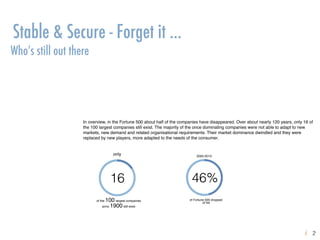
16
of the 100 largest companies
anno 1900 still exist
2000-2010:
46%
of Fortune 500 dropped
of list
only
Stable & Secure - Forget it …
Who’s still out there
In overview, in the Fortune 500 about half of the companies have disappeared. Over about nearly 120 years, only 16 of
the 100 largest companies still exist. The majority of the once dominating companies were not able to adapt to new
markets, new demand and related organisational requirements. Their market dominance dwindled and they were
replaced by new players, more adapted to the needs of the consumer.
2ki
.
Changing professions require chances in education
Jobs

in-demand
TOP

10
2004 2010
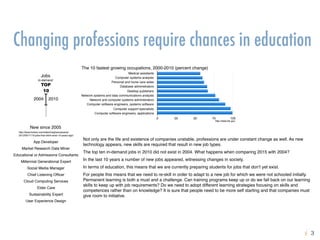
Not only are the life and existence of companies unstable, professions are under constant change as well. As new
technology appears, new skills are required that result in new job types.
The top ten in-demand jobs in 2010 did not exist in 2004. What happens when comparing 2015 with 2004?
In the last 10 years a number of new jobs appeared, witnessing changes in society.
In terms of education, this means that we are currently preparing students for jobs that don’t yet exist.
For people this means that we need to re-skill in order to adapt to a new job for which we were not schooled initially.
Permanent learning is both a must and a challenge. Can training programs keep up or do we fall back on our learning
skills to keep up with job requirements? Do we need to adopt different learning strategies focusing on skills and
competences rather than on knowledge? It is sure that people need to be more self starting and that companies must
give room to initiative.
The 10 fastest growing occupations, 2000-2010 (percent change)
http://data.bls.gov
New since 2005
http://www.forbes.com/sites/meghancasserly/
2012/05/11/10-jobs-that-didnt-exist-10-years-ago/
App Developer
Market Research Data Miner
Educational or Admissions Consultants
Millennial Generational Expert
Social Media Manager
Chief Listening Officer
Cloud Computing Services
Elder Care
Sustainability Expert
User Experience Design
3ki
.
Medical assistants
Computer systems analysts
Personal and home care aides
Database administrators
Desktop publishers
Network systems and data communications analysts
Network and computer systems administrators
Computer software engineers, systems software
Computer support specialists
Computer software engineers, applications
0 25 50 75 100
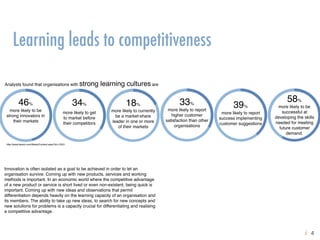
Analysts found that organisations with strong learning cultures are
46%

more likely to be
strong innovators in
their markets
34%
more likely to get
to market before
their competitors
18%

more likely to currently
be a market-share
leader in one or more
of their markets
33%

more likely to report
higher customer
satisfaction than other
organisations
39%

more likely to report
success implementing
customer suggestions
58%

more likely to be
successful at
developing the skills
needed for meeting
future customer
demand.
http://www.bersin.com/News/Content.aspx?id=12521
Innovation is often isolated as a goal to be achieved in order to let an
organisation survive. Coming up with new products, services and working
methods is important. In an economic world where the competitive advantage
of a new product or service is short lived or even non-existent, being quick is
important. Coming up with new ideas and observations that permit
differentiation depends heavily on the learning capacity of an organisation and
its members. The ability to take up new ideas, to search for new concepts and
new solutions for problems is a capacity crucial for differentiating and realising
a competitive advantage.
Learning leads to competitiveness
4ki
.
Your company focus
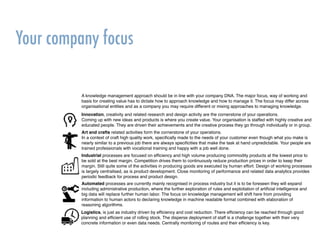
A knowledge management approach should be in line with your company DNA. The major focus, way of working and
basis for creating value has to dictate how to approach knowledge and how to manage it. The focus may differ across
organisational entities and as a company you may require different or mixing approaches to managing knowledge.
Innovation, creativity and related research and design activity are the cornerstone of your operations.
Coming up with new ideas and products is where you create value. Your organisation is staffed with highly creative and
educated people. They are driven their achievements and the creative process they go through individually or in group.
Art and crafts related activities form the cornerstone of your operations.
In a context of craft high quality work, specifically made to the needs of your customer even though what you make is
nearly similar to a previous job there are always specificities that make the task at hand unpredictable. Your people are
trained professionals with vocational training and happy with a job well done.
Industrial processes are focused on efficiency and high volume producing commodity products at the lowest price to
be sold at the best margin. Competition drives them to continuously reduce production prices in order to keep their
margin. Still quite some of the activities in producing goods are executed by human effort. Design of working processes
is largely centralised, as is product development. Close monitoring of performance and related data analytics provides
periodic feedback for process and product design.
Logistics, is just as industry driven by efficiency and cost reduction. There efficiency can be reached through good
planning and efficient use of rolling stock. The disperse deployment of staff is a challenge together with their very
concrete information or even data needs. Centrally monitoring of routes and their efficiency is key.
Automated processes are currently mainly recognised in process industry but it is to be foreseen they will expand
including administrative production, where the further exploration of rules and exploitation of artificial intelligence and
big data will replace further human labor. The focus on knowledge management will shift here from providing
information to human actors to declaring knowledge in machine readable format combined with elaboration of
reasoning algorithms.
Establish function and role needs
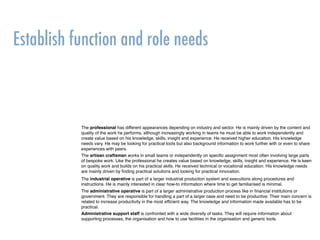
The professional has different appearances depending on industry and sector. He is mainly driven by the content and
quality of the work he performs, although increasingly working in teams he must be able to work independently and
create value based on his knowledge, skills, insight and experience. He received higher education. His knowledge
needs vary. He may be looking for practical tools but also background information to work further with or even to share
experiences with peers.
The industrial operative is part of a larger industrial production system and executions along procedures and
instructions. He is mainly interested in clear how-to information where time to get familiarised is minimal.
Administrative support staff is confronted with a wide diversity of tasks. They will require information about
supporting processes, the organisation and how to use facilities in the organisation and generic tools.
The administrative operative is part of a larger administrative production process like in financial institutions or
government. They are responsible for handling a part of a larger case and need to be productive. Their main concern is
related to increase productivity in the most efficient way. The knowledge and information made available has to be
practical.
The artisan craftsman works in small teams or independently on specific assignment most often involving large parts
of bespoke work. Like the professional he creates value based on knowledge, skills, insight and experience. He is keen
on quality work and builds on his practical skills. He received technical or vocational education. His knowledge needs
are mainly driven by finding practical solutions and looking for practical innovation.
Establish a knowledge/information mix &
transmission modi
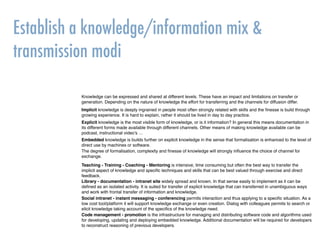
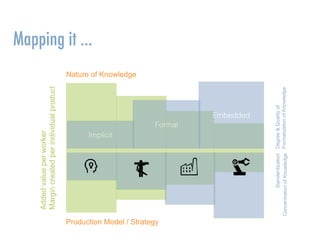
Knowledge can be expressed and shared at different levels. These have an impact and limitations on transfer or
generation. Depending on the nature of knowledge the effort for transferring and the channels for diffusion differ.
Implicit knowledge is deeply ingrained in people most often strongly related with skills and the finesse is build through
growing experience. It is hard to explain, rather it should be lived in day to day practice.
Explicit knowledge is the most visible form of knowledge, or is it information? In general this means documentation in
its different forms made available through different channels. Other means of making knowledge available can be
podcast, instructional video’s …
Embedded knowledge is builds further on explicit knowledge in the sense that formalisation is enhanced to the level of
direct use by machines or software.
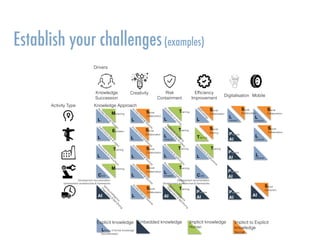
Teaching - Training - Coaching - Mentoring is intensive, time consuming but often the best way to transfer the
implicit aspect of knowledge and specific techniques and skills that can be best valued through exercise and direct
feedback.
Library - documentation - intranet site widely spread and known. In that sense easily to implement as it can be
defined as an isolated activity. It is suited for transfer of explicit knowledge that can transferred in unambiguous ways
and work with frontal transfer of information and knowledge.
Code management - promotion is the infrastructure for managing and distributing software code and algorithms used
for developing, updating and deploying embedded knowledge. Additional documentation will be required for developers
to reconstruct reasoning of previous developers.
Social intranet - instant messaging - conferencing permits interaction and thus applying to a specific situation. As a
low cost tool/platform it will support knowledge exchange or even creation. Dialog with colleagues permits to search or
elicit knowledge taking account of the specifics of the knowledge need.
The degree of formalisation, complexity and finesse of knowledge will strongly influence the choice of channel for
exchange.
Addedvalueperworker
Margincreatedperindividualproduct
Nature of Knowledge
Production Model / Strategy
Degree&Qualityof

FormalizationofKnowledge
Standardization
ConcentrationofKnowledge
Embedded
Formal
Implicit
Mapping it …
00" 10" 20" 30" 40" 50" 60" 70" 80" 90" 100"
United"States"
Australia"
EU"27"
Belgium"
Germany"
United"Kingdom"
Sweden"
Denmark"
Norway"
France"
55G64" 25G54" 15G24"
15#24 25#54 55#64
United States 45,5 75,1 60,0
Australia 60,7 79,8 61,1
EU 27 .. .. ..
Belgium 26,0 79,3 38,7
Germany 48,2 82,8 59,9
United Kingdom 50,1 80,1 56,8
Sweden 40,4 86,0 72,5
Denmark 57,5 82,3 59,5
Norway 51,4 84,7 69,6
France 29,9 81,3 41,4
Employment rates by age group
As a percentage of population in that age group
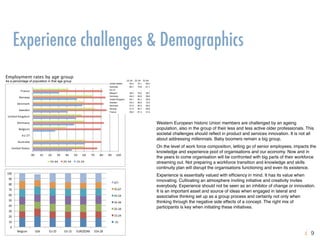
Western European historic Union members are challenged by an ageing
population, also in the group of their less and less active older professionals. This
societal challenges should reflect in product and services innovation. It is not all
about addressing millennials. Baby boomers remain a big group.
On the level of work force composition, letting go of senior employees, impacts the
knowledge and experience pool of organisations and our economy. Now and in
the years to come organisation will be confronted with big parts of their workforce
streaming out. Not preparing a workforce transition and knowledge and skills
continuity plan will disrupt the organisations functioning and even its existence.
Experience is essentially valued with efficiency in mind. It has its value when
innovating. Cultivating an atmosphere inviting initiative and creativity invites
everybody. Experience should not be seen as an inhibitor of change or innovation.
It is an important asset and source of ideas when engaged in lateral and
associative thinking set up as a group process and certainly not only when
thinking through the negative side effects of a concept. The right mix of
participants is key when initiating these initiatives.
0"
10"
20"
30"
40"
50"
60"
70"
80"
90"
100"
Belgium" USA" EU725" EU715" EUROZONE" EEA728"
67+"
55767"
45754"
35744"
25734"
15724"
715"
Experience challenges & Demographics
9ki
.
What is your company’s age pyramid
All companies follow the age pyramid of the society they function in. At least in
Western society the baby boomer generation is being replaced by younger
generations in our workforce due to retirement. Its impact may be sudden and
abrupt when reinforced by specific, contextually introduced retirement plans
triggered by sector’s economic needs.
Making up your company age pyramid, in occurrence specified by functional role,
will give you insight in the succession strategy to set up. Knowledge transition
should be part of your succession planning. Depending on your activity domain
and focus this will be more ore less intensive.
Establish your challenges(examples)
Knowledge Approach
Drivers
Activity Type
Knowledge

Succession
Risk

Containment
Efficiency

Improvement
Creativity
MobileDigitalisation
Social
Interaction
L
Intranet
L
Intranet
L
Procedures
&
Instructions
L
Intranet
Procedures
&
Instructions
Social
Collaboration
L
G
uidelines
on
tooling
Development documentation
Development workbenches & frameworks
L
Elicitation
Social
CollaborationMentoring
AI AI
L
Procedures
&
Instructions
Code
Training
Instructions
(live
&
video)
Mentoring
Training
Training
Training
Training
G
uidelines
on
tooling
Instructions
(live
&
video)
Training
Vehicle
Intelligence
D
iagnostics
&
SelfD
riving
L
Access
ExternalSources
L
Access
ExternalSources
Social
Collaboration
L
Access
ExternalSourcesSocial
Collaboration
L
Access
ExternalSources
Social
Collaboration
L
Access
ExternalSources
Social
Collaboration
L
Access
ExternalSources
Development documentation
Development workbenches & frameworks
L
Social
Sharing
Training
Social
Collaboration
M
ethodology
Library of formal knowledge
Documentation
AI
Vehicle
Intelligence
D
iagnostics
&
SelfD
riving
L
Intranet
Social
Collaboration
Process
AI
Process
AI
Process
AI
L
Intranet
Social
Collaboration
Process
AI
L
Procedures
&
Instructions
Training
Process
AI
Explicit knowledge Embedded knowledge Implicit knowledge
Human
Implicit to Explicit 

knowledge
Social
L
Intranet
Code
IknowiT
.
koenraad.seys@iknowit.eu
http://iknowit.eu

Knowledge Management Strategy Choices

  • 1.
  • 2.
    16 of the 100largest companies anno 1900 still exist 2000-2010: 46% of Fortune 500 dropped of list only Stable & Secure - Forget it … Who’s still out there In overview, in the Fortune 500 about half of the companies have disappeared. Over about nearly 120 years, only 16 of the 100 largest companies still exist. The majority of the once dominating companies were not able to adapt to new markets, new demand and related organisational requirements. Their market dominance dwindled and they were replaced by new players, more adapted to the needs of the consumer. 2ki .
  • 3.
    Changing professions requirechances in education Jobs
 in-demand TOP
 10 2004 2010 Not only are the life and existence of companies unstable, professions are under constant change as well. As new technology appears, new skills are required that result in new job types. The top ten in-demand jobs in 2010 did not exist in 2004. What happens when comparing 2015 with 2004? In the last 10 years a number of new jobs appeared, witnessing changes in society. In terms of education, this means that we are currently preparing students for jobs that don’t yet exist. For people this means that we need to re-skill in order to adapt to a new job for which we were not schooled initially. Permanent learning is both a must and a challenge. Can training programs keep up or do we fall back on our learning skills to keep up with job requirements? Do we need to adopt different learning strategies focusing on skills and competences rather than on knowledge? It is sure that people need to be more self starting and that companies must give room to initiative. The 10 fastest growing occupations, 2000-2010 (percent change) http://data.bls.gov New since 2005 http://www.forbes.com/sites/meghancasserly/ 2012/05/11/10-jobs-that-didnt-exist-10-years-ago/ App Developer Market Research Data Miner Educational or Admissions Consultants Millennial Generational Expert Social Media Manager Chief Listening Officer Cloud Computing Services Elder Care Sustainability Expert User Experience Design 3ki . Medical assistants Computer systems analysts Personal and home care aides Database administrators Desktop publishers Network systems and data communications analysts Network and computer systems administrators Computer software engineers, systems software Computer support specialists Computer software engineers, applications 0 25 50 75 100
  • 4.
    Analysts found thatorganisations with strong learning cultures are 46%
 more likely to be strong innovators in their markets 34% more likely to get to market before their competitors 18%
 more likely to currently be a market-share leader in one or more of their markets 33%
 more likely to report higher customer satisfaction than other organisations 39%
 more likely to report success implementing customer suggestions 58%
 more likely to be successful at developing the skills needed for meeting future customer demand. http://www.bersin.com/News/Content.aspx?id=12521 Innovation is often isolated as a goal to be achieved in order to let an organisation survive. Coming up with new products, services and working methods is important. In an economic world where the competitive advantage of a new product or service is short lived or even non-existent, being quick is important. Coming up with new ideas and observations that permit differentiation depends heavily on the learning capacity of an organisation and its members. The ability to take up new ideas, to search for new concepts and new solutions for problems is a capacity crucial for differentiating and realising a competitive advantage. Learning leads to competitiveness 4ki .
  • 5.
    Your company focus Aknowledge management approach should be in line with your company DNA. The major focus, way of working and basis for creating value has to dictate how to approach knowledge and how to manage it. The focus may differ across organisational entities and as a company you may require different or mixing approaches to managing knowledge. Innovation, creativity and related research and design activity are the cornerstone of your operations. Coming up with new ideas and products is where you create value. Your organisation is staffed with highly creative and educated people. They are driven their achievements and the creative process they go through individually or in group. Art and crafts related activities form the cornerstone of your operations. In a context of craft high quality work, specifically made to the needs of your customer even though what you make is nearly similar to a previous job there are always specificities that make the task at hand unpredictable. Your people are trained professionals with vocational training and happy with a job well done. Industrial processes are focused on efficiency and high volume producing commodity products at the lowest price to be sold at the best margin. Competition drives them to continuously reduce production prices in order to keep their margin. Still quite some of the activities in producing goods are executed by human effort. Design of working processes is largely centralised, as is product development. Close monitoring of performance and related data analytics provides periodic feedback for process and product design. Logistics, is just as industry driven by efficiency and cost reduction. There efficiency can be reached through good planning and efficient use of rolling stock. The disperse deployment of staff is a challenge together with their very concrete information or even data needs. Centrally monitoring of routes and their efficiency is key. Automated processes are currently mainly recognised in process industry but it is to be foreseen they will expand including administrative production, where the further exploration of rules and exploitation of artificial intelligence and big data will replace further human labor. The focus on knowledge management will shift here from providing information to human actors to declaring knowledge in machine readable format combined with elaboration of reasoning algorithms.
  • 6.
    Establish function androle needs The professional has different appearances depending on industry and sector. He is mainly driven by the content and quality of the work he performs, although increasingly working in teams he must be able to work independently and create value based on his knowledge, skills, insight and experience. He received higher education. His knowledge needs vary. He may be looking for practical tools but also background information to work further with or even to share experiences with peers. The industrial operative is part of a larger industrial production system and executions along procedures and instructions. He is mainly interested in clear how-to information where time to get familiarised is minimal. Administrative support staff is confronted with a wide diversity of tasks. They will require information about supporting processes, the organisation and how to use facilities in the organisation and generic tools. The administrative operative is part of a larger administrative production process like in financial institutions or government. They are responsible for handling a part of a larger case and need to be productive. Their main concern is related to increase productivity in the most efficient way. The knowledge and information made available has to be practical. The artisan craftsman works in small teams or independently on specific assignment most often involving large parts of bespoke work. Like the professional he creates value based on knowledge, skills, insight and experience. He is keen on quality work and builds on his practical skills. He received technical or vocational education. His knowledge needs are mainly driven by finding practical solutions and looking for practical innovation.
  • 7.
    Establish a knowledge/informationmix & transmission modi Knowledge can be expressed and shared at different levels. These have an impact and limitations on transfer or generation. Depending on the nature of knowledge the effort for transferring and the channels for diffusion differ. Implicit knowledge is deeply ingrained in people most often strongly related with skills and the finesse is build through growing experience. It is hard to explain, rather it should be lived in day to day practice. Explicit knowledge is the most visible form of knowledge, or is it information? In general this means documentation in its different forms made available through different channels. Other means of making knowledge available can be podcast, instructional video’s … Embedded knowledge is builds further on explicit knowledge in the sense that formalisation is enhanced to the level of direct use by machines or software. Teaching - Training - Coaching - Mentoring is intensive, time consuming but often the best way to transfer the implicit aspect of knowledge and specific techniques and skills that can be best valued through exercise and direct feedback. Library - documentation - intranet site widely spread and known. In that sense easily to implement as it can be defined as an isolated activity. It is suited for transfer of explicit knowledge that can transferred in unambiguous ways and work with frontal transfer of information and knowledge. Code management - promotion is the infrastructure for managing and distributing software code and algorithms used for developing, updating and deploying embedded knowledge. Additional documentation will be required for developers to reconstruct reasoning of previous developers. Social intranet - instant messaging - conferencing permits interaction and thus applying to a specific situation. As a low cost tool/platform it will support knowledge exchange or even creation. Dialog with colleagues permits to search or elicit knowledge taking account of the specifics of the knowledge need. The degree of formalisation, complexity and finesse of knowledge will strongly influence the choice of channel for exchange.
  • 8.
    Addedvalueperworker Margincreatedperindividualproduct Nature of Knowledge ProductionModel / Strategy Degree&Qualityof
 FormalizationofKnowledge Standardization ConcentrationofKnowledge Embedded Formal Implicit Mapping it …
  • 9.
    00" 10" 20"30" 40" 50" 60" 70" 80" 90" 100" United"States" Australia" EU"27" Belgium" Germany" United"Kingdom" Sweden" Denmark" Norway" France" 55G64" 25G54" 15G24" 15#24 25#54 55#64 United States 45,5 75,1 60,0 Australia 60,7 79,8 61,1 EU 27 .. .. .. Belgium 26,0 79,3 38,7 Germany 48,2 82,8 59,9 United Kingdom 50,1 80,1 56,8 Sweden 40,4 86,0 72,5 Denmark 57,5 82,3 59,5 Norway 51,4 84,7 69,6 France 29,9 81,3 41,4 Employment rates by age group As a percentage of population in that age group Western European historic Union members are challenged by an ageing population, also in the group of their less and less active older professionals. This societal challenges should reflect in product and services innovation. It is not all about addressing millennials. Baby boomers remain a big group. On the level of work force composition, letting go of senior employees, impacts the knowledge and experience pool of organisations and our economy. Now and in the years to come organisation will be confronted with big parts of their workforce streaming out. Not preparing a workforce transition and knowledge and skills continuity plan will disrupt the organisations functioning and even its existence. Experience is essentially valued with efficiency in mind. It has its value when innovating. Cultivating an atmosphere inviting initiative and creativity invites everybody. Experience should not be seen as an inhibitor of change or innovation. It is an important asset and source of ideas when engaged in lateral and associative thinking set up as a group process and certainly not only when thinking through the negative side effects of a concept. The right mix of participants is key when initiating these initiatives. 0" 10" 20" 30" 40" 50" 60" 70" 80" 90" 100" Belgium" USA" EU725" EU715" EUROZONE" EEA728" 67+" 55767" 45754" 35744" 25734" 15724" 715" Experience challenges & Demographics 9ki .
  • 10.
    What is yourcompany’s age pyramid All companies follow the age pyramid of the society they function in. At least in Western society the baby boomer generation is being replaced by younger generations in our workforce due to retirement. Its impact may be sudden and abrupt when reinforced by specific, contextually introduced retirement plans triggered by sector’s economic needs. Making up your company age pyramid, in occurrence specified by functional role, will give you insight in the succession strategy to set up. Knowledge transition should be part of your succession planning. Depending on your activity domain and focus this will be more ore less intensive.
  • 11.
    Establish your challenges(examples) KnowledgeApproach Drivers Activity Type Knowledge
 Succession Risk
 Containment Efficiency
 Improvement Creativity MobileDigitalisation Social Interaction L Intranet L Intranet L Procedures & Instructions L Intranet Procedures & Instructions Social Collaboration L G uidelines on tooling Development documentation Development workbenches & frameworks L Elicitation Social CollaborationMentoring AI AI L Procedures & Instructions Code Training Instructions (live & video) Mentoring Training Training Training Training G uidelines on tooling Instructions (live & video) Training Vehicle Intelligence D iagnostics & SelfD riving L Access ExternalSources L Access ExternalSources Social Collaboration L Access ExternalSourcesSocial Collaboration L Access ExternalSources Social Collaboration L Access ExternalSources Social Collaboration L Access ExternalSources Development documentation Development workbenches & frameworks L Social Sharing Training Social Collaboration M ethodology Library of formal knowledge Documentation AI Vehicle Intelligence D iagnostics & SelfD riving L Intranet Social Collaboration Process AI Process AI Process AI L Intranet Social Collaboration Process AI L Procedures & Instructions Training Process AI Explicit knowledge Embedded knowledge Implicit knowledge Human Implicit to Explicit 
 knowledge Social L Intranet Code
  • 12.