UNIT: 23 HUMAN RESOURCE
AND DEVELOPMENT
Assignment Title:- Learning Styles and
Government- led skills initiative
by Shraddha Sharma
CONTENTS
 INTRODUCTION
 HONEY and MUMUFORD LEARNING STYLE
 KOLB’S THEORY
 MYER BRIGGS INVENTORY
 INFORMAL LEARNING
 SELF MANAGED LEARNING
 LEARNING CURVE
 TRANSFER OF LEARNING
 IMPACT OF LEARNING THEORY
 CONTRIBUTION OF LEARNING STYLE AND THEORIES
 ROLE OF UK GOVERNMENT
 QCDA AND OFQUAL
 SECTOR SKILL COUNCIL
 APPRENTICESHIP SCHEMES
 REFERENCES
INTRODUCTION
 Learning is the process through which an individual
gain knowledge or by practicing and further
enhancing their skills.
As mentioned by Wenger, Nancy White and John
Smith - By learning, we do not mean just book
learning, or classroom learning, or even e-learning.
We see learning as an integral part of life.
Sometimes it demands an effort; sometimes it is not
even our goal. But it always involves who we are,
what we do, who we seek to connect with, and what
we aspire to become.
LO.1
HONEY AND MUMFORD(1982)
1.1
KOLB’S THEORY
1.1
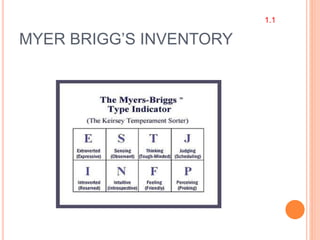
MYER BRIGG’S INVENTORY
1.1
INFORMAL LEARNING
Informal learning is learning which happens without a
tutorial. It happens outside the working area
generally.
BENEFITS:
• Leads to increased proficiency.
CHARACTERISTICS:
• Just in time
• Experimental
1.1
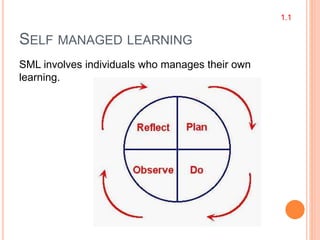
SELF MANAGED LEARNING
SML involves individuals who manages their own
learning.
1.1
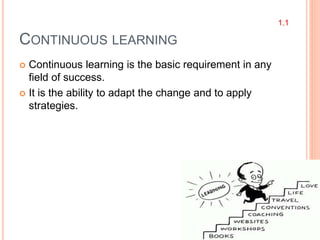
CONTINUOUS LEARNING
 Continuous learning is the basic requirement in any
field of success.
 It is the ability to adapt the change and to apply
strategies.
1.1
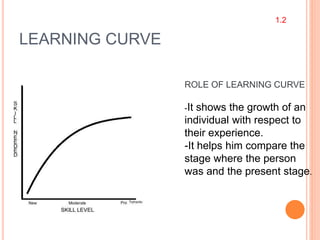
LEARNING CURVE
ROLE OF LEARNING CURVE
-It shows the growth of an
individual with respect to
their experience.
-It helps him compare the
stage where the person
was and the present stage.
1.2
TRANSFER OF LEARNING TO THE
WORKPLACE
 It is applying the skills and knowledge learnt during
one context to the other .
1.2
IMPACT OF LEARNING THEORIES
 The result after applying the learning theories will
always be positive.
 The work will be more efficient and less time
consuming.
 It will be easy to manage for a team while planning
for any event.
1.2
CONTRIBUTION OF LEARNING STYLES AND
THEORIES WHEN PLANNING AND
DESIGNING A LEARNING EVENT
 Different learning theories and learning styles are
available for various activities.
 Different styles are effective for different individuals
according to their capability and the job required.
 Learning theory, style and the learning event are
co-related with each other and success depends on
careful selection and acquisition.
 For planning and designing a learning event in an
organization it is important to use an appropriate
learning style to be able to achieve the objective of
the organization.
1.3
ROLE OF U.K. GOVERNMENT
 In recent years government has promoted the idea
of lifelong learning. The individual is encouraged to
carry on learning even after leaving the formal
education.
 They promote lifelong learning which is further
helpful for any person.
4.1
LO.4
QCDA
 QCDA stands for qualification and curriculum
development agency.
 It is an exempt charity.
 It is an executive non-departmental public body
(NDPB)
OFQUAL
• Office of qualification and examinations results
• It’s a non-ministerial government department
4.1
SECTOR SKILL COUNCIL
o It covers specific industries in the UK.
o They are the employer led organization
o They follow their goals like:
1.to understand the skills needed by their
industry
2.To support employers in enhancing the
apprenticeship standards.
4.1
APPRENTICESHIP SCHEMES AND IMPACT OF THE
COMPETENCY MOVEMENT ON THE PUBLIC AND
PRIVATE SECTORS
 Apprenticeship is a for training new candidates of
any profession with on-the-job training
accompanied by studies.
 It also enable them to have a license for practicing
their regulated profession.
 The impact results in the sectors paying more
attention to the their core competencies.
4.2
CONTEMPORARY TRAINING INITIATIVE
TAKEN BY UK GOVERNMENT
 TRAIN TO GAIN (T2G) it is the initiative funded and
promoted by UK by government to provide the
vocational training to employed individuals.
 It mainly focuses on the age group of 25+ who do
not have a full level 2 qualification via Learning and
Skill Council.
4.3
REFERENCES
 What are Learning Styles. 2015. What are Learning Styles. [ONLINE] Available
at: http://web.cortland.edu/andersmd/learning/Introduction.htm. [Accessed 16 February
2015]
 home - from workSMART.org.uk. 2015. home - from workSMART.org.uk. [ONLINE]
Available at: http://www.worksmart.org.uk/. [Accessed 16 February 2015].
 Personality Assessment Inventory & Professional Development | CPP . 2015. Personality
Assessment Inventory & Professional Development | CPP. [ONLINE] Available
at: https://www.cpp.com/en/index.aspx. [Accessed 16 February 2015].
 Pat Burke Guild and Stephen Garger, . (2001). Diversity, Learning Style and
Culture. Diversity, Learning Style and Culture. 2nd (1), 2-10
 Atherton J S (2013) Learning and Teaching; Experiential Learning [On-line: UK]
retrieved 16 February 2015
from http://www.learningandteaching.info/learning/experience.htm
Read more: Experiential
Learning http://www.learningandteaching.info/learning/experience.htm#ixzz3RsyoiUXw
Under Creative Commons License: Attribution Non-Commercial No Derivatives
 By Scott, Catherine (2010). The Enduring Appeal of 'Learning Styles'. australia: Australian
Council for Educational Research. COPYRIGHT 2010 Gale Group.. 5+.

Different Learning Style (HND) UK

  • 1.
    UNIT: 23 HUMANRESOURCE AND DEVELOPMENT Assignment Title:- Learning Styles and Government- led skills initiative by Shraddha Sharma
  • 2.
    CONTENTS  INTRODUCTION  HONEYand MUMUFORD LEARNING STYLE  KOLB’S THEORY  MYER BRIGGS INVENTORY  INFORMAL LEARNING  SELF MANAGED LEARNING  LEARNING CURVE  TRANSFER OF LEARNING  IMPACT OF LEARNING THEORY  CONTRIBUTION OF LEARNING STYLE AND THEORIES  ROLE OF UK GOVERNMENT  QCDA AND OFQUAL  SECTOR SKILL COUNCIL  APPRENTICESHIP SCHEMES  REFERENCES
  • 3.
    INTRODUCTION  Learning isthe process through which an individual gain knowledge or by practicing and further enhancing their skills. As mentioned by Wenger, Nancy White and John Smith - By learning, we do not mean just book learning, or classroom learning, or even e-learning. We see learning as an integral part of life. Sometimes it demands an effort; sometimes it is not even our goal. But it always involves who we are, what we do, who we seek to connect with, and what we aspire to become. LO.1
  • 4.
  • 5.
  • 6.
  • 7.
    INFORMAL LEARNING Informal learningis learning which happens without a tutorial. It happens outside the working area generally. BENEFITS: • Leads to increased proficiency. CHARACTERISTICS: • Just in time • Experimental 1.1
  • 8.
    SELF MANAGED LEARNING SMLinvolves individuals who manages their own learning. 1.1
  • 9.
    CONTINUOUS LEARNING  Continuouslearning is the basic requirement in any field of success.  It is the ability to adapt the change and to apply strategies. 1.1
  • 10.
    LEARNING CURVE ROLE OFLEARNING CURVE -It shows the growth of an individual with respect to their experience. -It helps him compare the stage where the person was and the present stage. 1.2
  • 11.
    TRANSFER OF LEARNINGTO THE WORKPLACE  It is applying the skills and knowledge learnt during one context to the other . 1.2
  • 12.
    IMPACT OF LEARNINGTHEORIES  The result after applying the learning theories will always be positive.  The work will be more efficient and less time consuming.  It will be easy to manage for a team while planning for any event. 1.2
  • 13.
    CONTRIBUTION OF LEARNINGSTYLES AND THEORIES WHEN PLANNING AND DESIGNING A LEARNING EVENT  Different learning theories and learning styles are available for various activities.  Different styles are effective for different individuals according to their capability and the job required.  Learning theory, style and the learning event are co-related with each other and success depends on careful selection and acquisition.  For planning and designing a learning event in an organization it is important to use an appropriate learning style to be able to achieve the objective of the organization. 1.3
  • 14.
    ROLE OF U.K.GOVERNMENT  In recent years government has promoted the idea of lifelong learning. The individual is encouraged to carry on learning even after leaving the formal education.  They promote lifelong learning which is further helpful for any person. 4.1 LO.4
  • 15.
    QCDA  QCDA standsfor qualification and curriculum development agency.  It is an exempt charity.  It is an executive non-departmental public body (NDPB) OFQUAL • Office of qualification and examinations results • It’s a non-ministerial government department 4.1
  • 16.
    SECTOR SKILL COUNCIL oIt covers specific industries in the UK. o They are the employer led organization o They follow their goals like: 1.to understand the skills needed by their industry 2.To support employers in enhancing the apprenticeship standards. 4.1
  • 17.
    APPRENTICESHIP SCHEMES ANDIMPACT OF THE COMPETENCY MOVEMENT ON THE PUBLIC AND PRIVATE SECTORS  Apprenticeship is a for training new candidates of any profession with on-the-job training accompanied by studies.  It also enable them to have a license for practicing their regulated profession.  The impact results in the sectors paying more attention to the their core competencies. 4.2
  • 18.
    CONTEMPORARY TRAINING INITIATIVE TAKENBY UK GOVERNMENT  TRAIN TO GAIN (T2G) it is the initiative funded and promoted by UK by government to provide the vocational training to employed individuals.  It mainly focuses on the age group of 25+ who do not have a full level 2 qualification via Learning and Skill Council. 4.3
  • 19.
    REFERENCES  What areLearning Styles. 2015. What are Learning Styles. [ONLINE] Available at: http://web.cortland.edu/andersmd/learning/Introduction.htm. [Accessed 16 February 2015]  home - from workSMART.org.uk. 2015. home - from workSMART.org.uk. [ONLINE] Available at: http://www.worksmart.org.uk/. [Accessed 16 February 2015].  Personality Assessment Inventory & Professional Development | CPP . 2015. Personality Assessment Inventory & Professional Development | CPP. [ONLINE] Available at: https://www.cpp.com/en/index.aspx. [Accessed 16 February 2015].  Pat Burke Guild and Stephen Garger, . (2001). Diversity, Learning Style and Culture. Diversity, Learning Style and Culture. 2nd (1), 2-10  Atherton J S (2013) Learning and Teaching; Experiential Learning [On-line: UK] retrieved 16 February 2015 from http://www.learningandteaching.info/learning/experience.htm Read more: Experiential Learning http://www.learningandteaching.info/learning/experience.htm#ixzz3RsyoiUXw Under Creative Commons License: Attribution Non-Commercial No Derivatives  By Scott, Catherine (2010). The Enduring Appeal of 'Learning Styles'. australia: Australian Council for Educational Research. COPYRIGHT 2010 Gale Group.. 5+.

Editor's Notes

  • #5 1.Activist – the people who believe in spontaneous actions. They do not give a second thought to their working and pops up with results before anyone else could. 2.Theorist- understand the logic and synthesis before coming to a conclusion. 3.Pragmatist- they prefer experimenting and do things differently. They believe in practicality of everything. 4.Reflectors- they are the observers . They like to be sure about everything they do. They take time before concluding something.
  • #6 1.Concrete experience- it is gained by performing a task as a team or individually. It is all about active involvement. Here things cannot be learned by reading or simply watching it has to be performed practically. 2.The second one is reflective observation which is simply taking a step back and have a review about the work which has been performed and how it has been performed. 3. Abstract conceptualization- at this stage the learner compares with his past and present. It is basically what he did and what he already knew. 4. Active experimentation- it is all about show casing what they have learnt all the while.
  • #7  Extrovert and introvert- extrovert are more action oriented and learn from outside energy more and are more social as compared to the introverts whereas introverts are more thought oriented, they learn from within. People who are observant believes in sensing and the reality of the things happening around them. The introspective ones enjoy imaging the future and abstract theories. 3.The tough minded one believes in the fact and are mostly rigid with their decision. The one who are friendly prefer taking decisions via emotional aspects. 4.The people who judge have a firm decision and are generally not satisfied by others opinion. The one who perceives are more open minded and flexible with their thinking.
  • #8 Informal learning generally happens without a tutorial. It happens to an individual on its own. Benefits Research results shows that manager have learnt a majority of core task through it.
  • #9 A plan is made then the task is worked upon. Further the things are observed and the task done is reviewed.
  • #10 Continuous Learning is the ability to apply strategies which support learning and the ability to adapt to change. We use this skill when we learn as part of regular work or from co-workers and when we access training in the workplace or off-site
  • #11 Learning curve is the measure to check an individual’s growth with time.
  • #12 Example: the skills an intern learn during a sales period and he applies it to the job later while dealing with customers.
  • #15  Employees in sufficiently large organizations are eligible to make a request if they have worked for the employer continuously for six months and are over 18 (16-18 year olds have a separate right to time off for study or training)
  • #17 (SSCs) are employer-led organizations that cover specific industries in the United Kingdom. They have five key goals: to understand the future skills needs of their industry. to support Employers in developing and managing Apprenticeship Standards
  • #18 Apprenticeship is a system of training a new generation of practitioners of a trade or profession with on-the-job training and often some accompanying study (classroom work Touches also on the organizational competencies that denote success. Goes on to outline the development of the competency movement in the UK, drawing comparisons with the US movement and demonstrating how the competency movement has now become an international movement. Ends with an overview of the remaining articles in the journal which relate to competency in the public sector.and reading).
  • #19 Train to Gain (T2G), is a UK government funded initiative to deliver vocational training to employed individuals in the UK, primarily those in the 25+ age band who do not already have a Full Level 2 Qualification, via the Skills Funding Agency, formerly the Learning and Skills Counci