ASSIGNMENT
PHARMACOGNOSY
High-performance
Liquidchromatography(HPLC)
CREDIT
M HABIB UR REHMAN BPD02181285
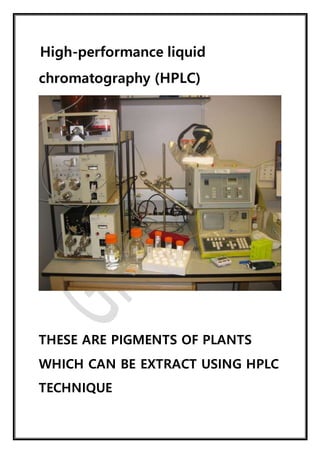
High-performance liquid
chromatography (HPLC)
THESE ARE PIGMENTS OF PLANTS
WHICH CAN BE EXTRACT USING HPLC
TECHNIQUE
 Carotene an orange pigment
 Xanthophyll a yellow pigment
 Phaeophytin a gray-brown pigment
 Chlorophyll a; a blue-green pigment
 Chlorophyll b; a yellow-green pigment etc.
Separation of Photosynthetic Pigments by High-
Performance Liquid Chromatography
INTRODUCTION
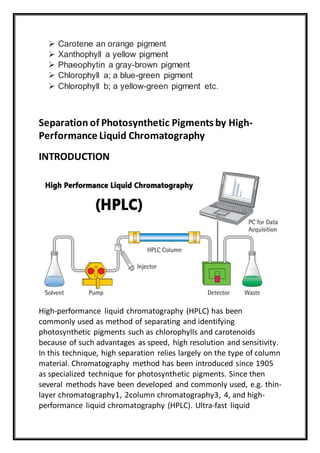
High-performance liquid chromatography (HPLC) has been
commonly used as method of separating and identifying
photosynthetic pigments such as chlorophylls and carotenoids
because of such advantages as speed, high resolution and sensitivity.
In this technique, high separation relies largely on the type of column
material. Chromatography method has been introduced since 1905
as specialized technique for photosynthetic pigments. Since then
several methods have been developed and commonly used, e.g. thin-
layer chromatography1, 2column chromatography3, 4, and high-
performance liquid chromatography (HPLC). Ultra-fast liquid
chromatography (UFLC) was one of the newest generations of HPLC
which provide special advantages in conducting researches with low
time consuming and high resolution data8, 9. These advantages gave
an opportunity in the development of a low cost and rapid analysis
method.
I. Plant Material
Pleomele angustifolia
Collected leaves were cleaned by rinsing with distilled water and
were then frozen and stored at -20 °C for further analyses.
II. Pigments extraction
P. angustifolia leaves were ground using a mortar with a few
amounts of sodium ascorbate and calcium carbonate to avoid
pigments oxidation and acidification. Liquid nitrogen was added to
prevent enzymatic reaction which can affect to the pigment stability.
The homogenate (0.2 g wet weight) of P. angustifolia was extracted
with 3 mL of 100 % methanol in a conical bottom tube, by shaking
with vortex for 10 s. In order to minimize photo-degradation and
oxidation of the pigments, the extractions and measurements were
carried out under green dimmed light at room temperature under
ultra-high purity (99 %) nitrogen atmosphere. This rapid extraction
method was conducted less than 1 min. prior to injection, sample
pigment was filtrated through a membrane filter 0.2 μm, nylon,
Whatman, Maidstone.
III. HPLC analysis
Pigments separation was carried out by UFLC using equipped with
photodiode array detector. In briefly, HPLC analysis was performed
isocratic method using a mobile phase consisted of acetonitrile and
methanol. The solvent ratios (v/v) were varies for analysis in the
following: 20: 80 (System 1); 35: 65 (System 2), 50: 50 (System 3), 65:
35 (System 4) and 80: 20 (System 5). Column temperature used was
either 30 °C or 40 °C. Pigments were detected in the range of 190 nm
to 800 nm. Pigment solution was subjected to analysis.
IV. Pigment identification
All targeted peaks were isolated for identification. Visible absorption
spectra were obtained by UV-Visible Spectrophotometer 1800 from
350 nm to 800 nm. Isolated pigments were measured in different
solvents. Chlorophylls group was measured in acetone, diethyl ether,
and ethanol, while carotenoids group in acetone, n-hexane, and
ethanol. Spectral properties were then compared with those of
reference spectra from the standard phytoplankton pigments.
V. Results and discussion
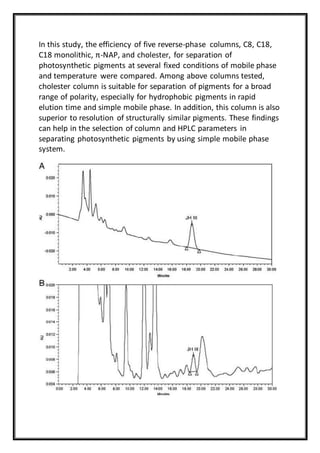
Six photosynthetic pigments were separated with the columns used.
In here, therefore, the properties of four columns were mainly
compared. The pigments were identified with comparison of
absorption spectra of isolated pigments in different solvents as
follows: violaxanthin (1st peak), zeaxanthin (2nd peak), chlorophyll b
(3rd peak), chlorophyll a (4th peak), α-carotene (5th peak), and β-
carotene (6th peak). Rapid separation was observed in C18 than C8
column. Moreover, particulate packing column needed longer time
analysis than monolithic column at both temperatures. Despite the
large column volume. High column temperature enhanced time
analysis in both column types. This is probably due to decrease in
solvent density with increasing temperature. In both columns at 40
°C, retention time is able to reduce about 0.7 times of 30 °C to
accomplish all peak separation. Similar results were also obtained by
C8 column.
VI. Conclusion
In this study, the efficiency of five reverse-phase columns, C8, C18,
C18 monolithic, π-NAP, and cholester, for separation of
photosynthetic pigments at several fixed conditions of mobile phase
and temperature were compared. Among above columns tested,
cholester column is suitable for separation of pigments for a broad
range of polarity, especially for hydrophobic pigments in rapid
elution time and simple mobile phase. In addition, this column is also
superior to resolution of structurally similar pigments. These findings
can help in the selection of column and HPLC parameters in
separating photosynthetic pigments by using simple mobile phase
system.
References
1.JeffreyS.Quantitativethinlayerchromatographyof chlorophyllsandcarotenoidsfrom
marine algae
2.Quach HT, SteeperRL,GriffinGW.An improvedmethodforthe extractionandthin-layer
chromatographyof chlorophyll aandb
3.Shioi Y,Fukae R, Sasa T. Chlorophyll analysisbyhigh-performance liquid
chromatography
4.Hart DJ,Scott KJ.Developmentandevaluationof anHPLC methodforthe analysisof
carotenoidsinfoodsandthe measurementof the carotenoidcontentof vegetablesand
fruitscommonlyconsumedinthe UK.FoodChemistry.
THANK YOU…

HPLC Technique In Pharmacognosy

  • 1.
  • 2.
    High-performance liquid chromatography (HPLC) THESEARE PIGMENTS OF PLANTS WHICH CAN BE EXTRACT USING HPLC TECHNIQUE
  • 3.
     Carotene anorange pigment  Xanthophyll a yellow pigment  Phaeophytin a gray-brown pigment  Chlorophyll a; a blue-green pigment  Chlorophyll b; a yellow-green pigment etc. Separation of Photosynthetic Pigments by High- Performance Liquid Chromatography INTRODUCTION High-performance liquid chromatography (HPLC) has been commonly used as method of separating and identifying photosynthetic pigments such as chlorophylls and carotenoids because of such advantages as speed, high resolution and sensitivity. In this technique, high separation relies largely on the type of column material. Chromatography method has been introduced since 1905 as specialized technique for photosynthetic pigments. Since then several methods have been developed and commonly used, e.g. thin- layer chromatography1, 2column chromatography3, 4, and high- performance liquid chromatography (HPLC). Ultra-fast liquid
  • 4.
    chromatography (UFLC) wasone of the newest generations of HPLC which provide special advantages in conducting researches with low time consuming and high resolution data8, 9. These advantages gave an opportunity in the development of a low cost and rapid analysis method. I. Plant Material Pleomele angustifolia Collected leaves were cleaned by rinsing with distilled water and were then frozen and stored at -20 °C for further analyses. II. Pigments extraction P. angustifolia leaves were ground using a mortar with a few amounts of sodium ascorbate and calcium carbonate to avoid pigments oxidation and acidification. Liquid nitrogen was added to prevent enzymatic reaction which can affect to the pigment stability. The homogenate (0.2 g wet weight) of P. angustifolia was extracted with 3 mL of 100 % methanol in a conical bottom tube, by shaking with vortex for 10 s. In order to minimize photo-degradation and oxidation of the pigments, the extractions and measurements were carried out under green dimmed light at room temperature under ultra-high purity (99 %) nitrogen atmosphere. This rapid extraction method was conducted less than 1 min. prior to injection, sample pigment was filtrated through a membrane filter 0.2 μm, nylon, Whatman, Maidstone. III. HPLC analysis Pigments separation was carried out by UFLC using equipped with photodiode array detector. In briefly, HPLC analysis was performed isocratic method using a mobile phase consisted of acetonitrile and methanol. The solvent ratios (v/v) were varies for analysis in the
  • 5.
    following: 20: 80(System 1); 35: 65 (System 2), 50: 50 (System 3), 65: 35 (System 4) and 80: 20 (System 5). Column temperature used was either 30 °C or 40 °C. Pigments were detected in the range of 190 nm to 800 nm. Pigment solution was subjected to analysis. IV. Pigment identification All targeted peaks were isolated for identification. Visible absorption spectra were obtained by UV-Visible Spectrophotometer 1800 from 350 nm to 800 nm. Isolated pigments were measured in different solvents. Chlorophylls group was measured in acetone, diethyl ether, and ethanol, while carotenoids group in acetone, n-hexane, and ethanol. Spectral properties were then compared with those of reference spectra from the standard phytoplankton pigments. V. Results and discussion Six photosynthetic pigments were separated with the columns used. In here, therefore, the properties of four columns were mainly compared. The pigments were identified with comparison of absorption spectra of isolated pigments in different solvents as follows: violaxanthin (1st peak), zeaxanthin (2nd peak), chlorophyll b (3rd peak), chlorophyll a (4th peak), α-carotene (5th peak), and β- carotene (6th peak). Rapid separation was observed in C18 than C8 column. Moreover, particulate packing column needed longer time analysis than monolithic column at both temperatures. Despite the large column volume. High column temperature enhanced time analysis in both column types. This is probably due to decrease in solvent density with increasing temperature. In both columns at 40 °C, retention time is able to reduce about 0.7 times of 30 °C to accomplish all peak separation. Similar results were also obtained by C8 column. VI. Conclusion
  • 6.
    In this study,the efficiency of five reverse-phase columns, C8, C18, C18 monolithic, π-NAP, and cholester, for separation of photosynthetic pigments at several fixed conditions of mobile phase and temperature were compared. Among above columns tested, cholester column is suitable for separation of pigments for a broad range of polarity, especially for hydrophobic pigments in rapid elution time and simple mobile phase. In addition, this column is also superior to resolution of structurally similar pigments. These findings can help in the selection of column and HPLC parameters in separating photosynthetic pigments by using simple mobile phase system.
  • 7.
    References 1.JeffreyS.Quantitativethinlayerchromatographyof chlorophyllsandcarotenoidsfrom marine algae 2.QuachHT, SteeperRL,GriffinGW.An improvedmethodforthe extractionandthin-layer chromatographyof chlorophyll aandb 3.Shioi Y,Fukae R, Sasa T. Chlorophyll analysisbyhigh-performance liquid chromatography 4.Hart DJ,Scott KJ.Developmentandevaluationof anHPLC methodforthe analysisof carotenoidsinfoodsandthe measurementof the carotenoidcontentof vegetablesand fruitscommonlyconsumedinthe UK.FoodChemistry. THANK YOU…