The OptIPuter as  a Prototype for CalREN-XD Briefing to the CalREN-XD Subcommittee CENIC Board July 29, 2005 Dr. Larry Smarr Director, California Institute for Telecommunications and Information Technologies Harry E. Gruber Professor,  Dept. of Computer Science and Engineering Jacobs School of Engineering, UCSD
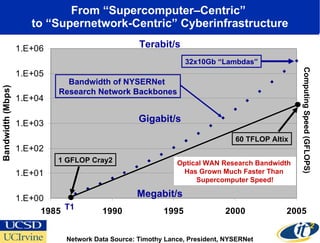
From “Supercomputer–Centric”  to “Supernetwork-Centric” Cyberinfrastructure Megabit/s Gigabit/s Terabit/s Network Data Source: Timothy Lance, President, NYSERNet 32x10Gb “Lambdas” 1 GFLOP Cray2 60 TFLOP Altix Bandwidth of NYSERNet  Research Network Backbones T1 Optical WAN Research Bandwidth  Has Grown Much Faster Than  Supercomputer Speed! Computing Speed (GFLOPS)
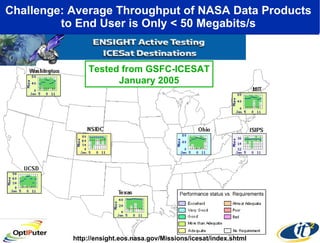
Challenge: Average Throughput of NASA Data Products  to End User is Only < 50 Megabits/s  Tested from GSFC-ICESAT January 2005 http://ensight.eos.nasa.gov/Missions/icesat/index.shtml
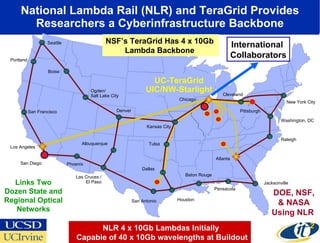
National Lambda Rail (NLR) and TeraGrid Provides Researchers a Cyberinfrastructure Backbone San Francisco Pittsburgh Cleveland San Diego Los Angeles Portland Seattle Pensacola Baton Rouge Houston San Antonio Las Cruces / El Paso Phoenix New York City Washington, DC Raleigh Jacksonville Dallas Tulsa Atlanta Kansas City Denver Ogden/ Salt Lake City Boise Albuquerque UC-TeraGrid UIC/NW-Starlight Chicago International  Collaborators NLR 4 x 10Gb Lambdas Initially Capable of 40 x 10Gb wavelengths at Buildout NSF’s TeraGrid Has 4 x 10Gb  Lambda Backbone  Links Two Dozen State and Regional Optical Networks DOE, NSF, & NASA Using NLR
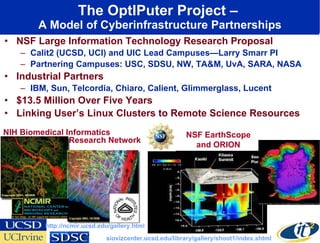
The OptIPuter Project –  A Model of Cyberinfrastructure Partnerships NSF Large Information Technology Research Proposal Calit2 (UCSD, UCI) and UIC Lead Campuses—Larry Smarr PI Partnering Campuses: USC, SDSU, NW, TA&M, UvA, SARA, NASA Industrial Partners IBM, Sun, Telcordia, Chiaro, Calient, Glimmerglass, Lucent $13.5 Million Over Five Years Linking User’s Linux Clusters to Remote Science Resources NIH Biomedical Informatics NSF EarthScope and ORION http://ncmir.ucsd.edu/gallery.html siovizcenter.ucsd.edu/library/gallery/shoot1/index.shtml Research Network
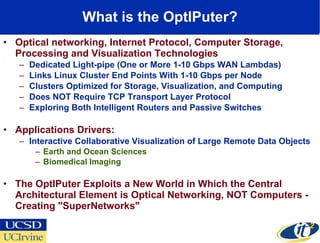
What is the OptIPuter? Opt ical networking,  I nternet  P rotocol, Comp uter  Storage, Processing and Visualization Technologies Dedicated Light-pipe (One or More 1-10 Gbps WAN Lambdas) Links Linux Cluster End Points With 1-10 Gbps per Node Clusters Optimized for Storage, Visualization, and Computing Does NOT Require TCP Transport Layer Protocol  Exploring Both Intelligent Routers and Passive Switches Applications Drivers:  Interactive Collaborative Visualization of Large Remote Data Objects Earth and Ocean Sciences Biomedical Imaging The OptIPuter Exploits a New World in Which the Central Architectural Element is Optical Networking, NOT Computers - Creating &quot;SuperNetworks&quot;
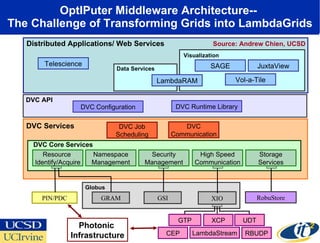
OptIPuter Middleware Architecture--  The Challenge of Transforming Grids into LambdaGrids Distributed Applications/ Web Services Telescience Vol-a-Tile SAGE JuxtaView Visualization  Data Services LambdaRAM PIN/PDC Photonic  Infrastructure Source: Andrew Chien, UCSD GTP XCP UDT LambdaStream CEP RBUDP DVC Configuration DVC API DVC Runtime Library Globus XIO DVC Services DVC Core Services DVC Job Scheduling DVC Communication Resource  Identify/Acquire Namespace Management Security Management High Speed Communication Storage Services GRAM GSI RobuStore
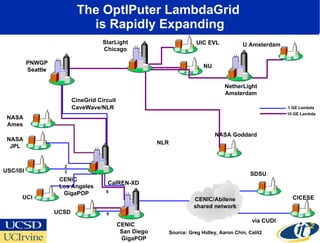
The OptIPuter LambdaGrid  is Rapidly Expanding 1 GE Lambda 10 GE Lambda Source: Greg Hidley, Aaron Chin, Calit2 UCSD StarLight Chicago UIC EVL NU CENIC  San Diego GigaPOP CalREN-XD 6 6 NetherLight Amsterdam U Amsterdam SDSU CICESE via CUDI CENIC/Abilene shared network PNWGP Seattle CaveWave/NLR NASA Goddard NASA Ames NLR NASA JPL UCI CENIC  Los Angeles GigaPOP 2 2 USC/ISI CineGrid Circuit
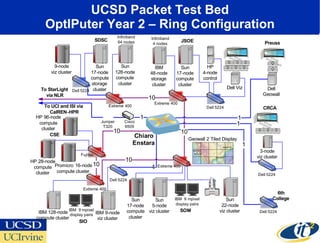
UCSD Packet Test Bed OptIPuter Year 2 – Ring Configuration
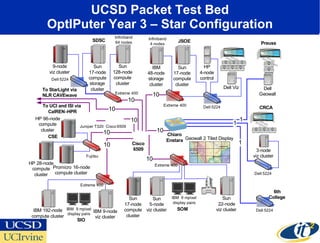
UCSD Packet Test Bed OptIPuter Year 3 – Star Configuration
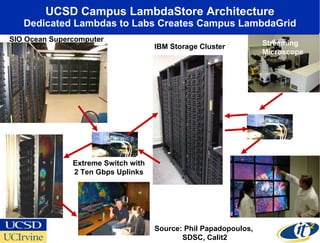
UCSD Campus LambdaStore Architecture Dedicated Lambdas to Labs Creates Campus LambdaGrid SIO Ocean Supercomputer IBM Storage Cluster Extreme Switch with 2 Ten Gbps Uplinks Streaming Microscope Source: Phil Papadopoulos,  SDSC, Calit2
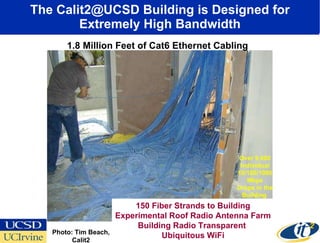
The Calit2@UCSD Building is Designed for Extremely High Bandwidth 1.8 Million Feet of Cat6 Ethernet Cabling 150 Fiber Strands to Building Experimental Roof Radio Antenna Farm Building Radio Transparent   Ubiquitous WiFi Photo: Tim Beach, Calit2 Over 9,000 Individual 10/100/1000 Mbps Drops in the Building
Calit2 Partnering with CENIC and Campuses OptIPuter Campus Donated Multiple Single Mode Fiber Pairs Between Major OptIPuter Labs For Research Campus Provided Routable IP Space for OptIPuter, Allowing for Easier Network Expansion Campus Agreed to House and Monitor the Core Networking Gear While the New Calit2 Building is Being Built CalREN-HPR Campus Provided Connectivity to the CalREN-HPR Calit2 Provided Funding to Upgrade CalREN-HPR Access to 10GE Other UC Campuses are Now Following Suit with UCLA Expected to Upgrade this Summer CalREN-XD Campus Funded About 50% of the Dedicated 1GE Connections to UC Irvine and the University of Southern California (ISI) It was the First XD Deployment for CENIC  Planning Underway for XD to be Extended UC Wide
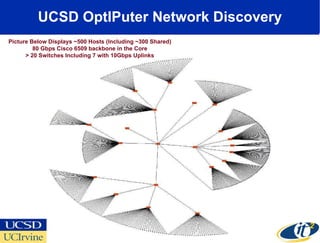
UCSD OptIPuter Network Discovery Picture Below Displays ~500 Hosts (Including ~300 Shared) 80 Gbps Cisco 6509 backbone in the Core > 20 Switches Including 7 with 10Gbps Uplinks
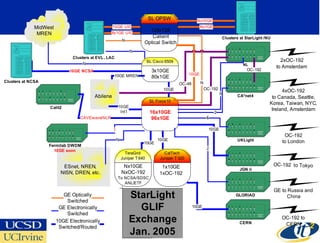
Year 3 Plans: Enhance Campus OptIPuter  A Substantial Portion of the Physical Build Completes in Year 2 Endpoints, Cross-campus Fiber, Commodity Endpoints Increase Campus Bandwidth Work Towards More Extensive 10GigE Integration Optiputer HW Budget Limited In Year 3, Focus is on Network Extension Connect Two Campus Sites with 32-node Clusters At 10GigE 3:1 Campus Bisection Ratio Add/Expand a Moderate Number of new  Campus Endpoints Add New Endpoints Into The Chiaro Network UCSD Sixth College  JSOE (Engineering) Collaborative Visualization Center New Calit2 Research Facility  Add 3 General-purpose Sun Opteron Clusters at Key Campus Sites (Compute and Storage); Clusters Will All Have PCI-X (100 Mhz, 1Gbps)  Deploy Infiniband on Our IBM Storage Cluster and on a Previously-Donated Sun 128-node Compute Cluster Complete Financial Acquisition of the Chiaro Router
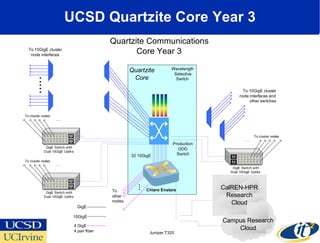
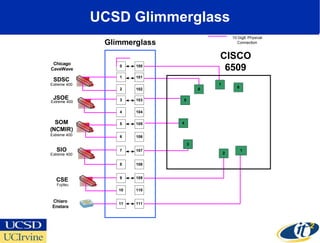
Year Three Goals Integrate New NSF Quartzite MRI Goal -- integration of Packet-based (SoCal) and Circuit-based (Illinois) Approaches a Hybrid System Add Additional O-O-O Switching Capabilities Through a Commercial (Glimmerglass) All-optical Switch and the Lucent (Pre-commercial) Wavelength Selective Switch Begin CWDM or DWDM Deployment to Extend Optical Paths Around UCSD and Provide Additional Bandwidth Add Additional 10GigE in Switches and Cluster Node NICs MRI Proposal (Quartzite, Recommended for Funding) Allows Us to Match the Network to the Number of Existing Endpoints This is a New Kind of Distributed Instrument  300+ Components Distributed Over the Campus Simple and Centralized Control for Other Optiputer Users
UCSD Quartzite Core Year 3
UCSD Glimmerglass
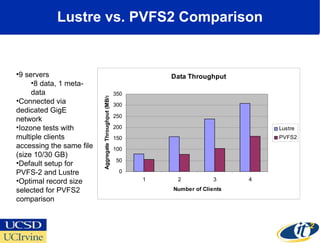
Lustre vs. PVFS2 Comparison 9 servers 8 data, 1 meta-data Connected via dedicated GigE network Iozone tests with multiple clients accessing the same file (size 10/30 GB) Default setup for PVFS-2 and Lustre Optimal record size selected for PVFS2 comparison
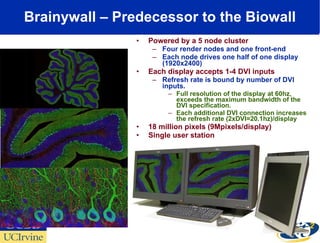
Brainywall – Predecessor to the Biowall Powered by a 5 node cluster Four render nodes and one front-end Each node drives one half of one display (1920x2400) Each display accepts 1-4 DVI inputs Refresh rate is bound by number of DVI inputs.  Full resolution of the display at 60hz, exceeds the maximum bandwidth of the DVI specification. Each additional DVI connection increases the refresh rate (2xDVI=20.1hz)/display 18 million pixels (9Mpixels/display) Single user station
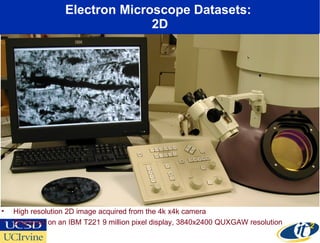
Electron Microscope Datasets:  2D High resolution 2D image acquired from the 4k x4k camera Displayed on an IBM T221 9 million pixel display, 3840x2400 QUXGAW resolution
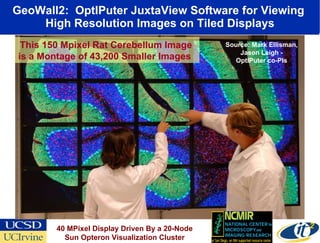
GeoWall2:  OptIPuter JuxtaView Software for Viewing  High Resolution Images on Tiled Displays This 150 Mpixel Rat Cerebellum Image  is a Montage of 43,200 Smaller Images  Source: Mark Ellisman, Jason Leigh - OptIPuter co-PIs 40 MPixel Display Driven By a 20-Node Sun Opteron Visualization Cluster
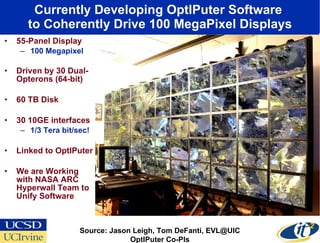
Currently Developing OptIPuter Software  to Coherently Drive 100 MegaPixel Displays 55-Panel Display  100 Megapixel  Driven by 30 Dual-Opterons (64-bit) 60 TB Disk 30 10GE interfaces 1/3 Tera bit/sec! Linked to OptIPuter We are Working with NASA ARC Hyperwall Team to Unify Software Source: Jason Leigh, Tom DeFanti, EVL@UIC OptIPuter Co-PIs
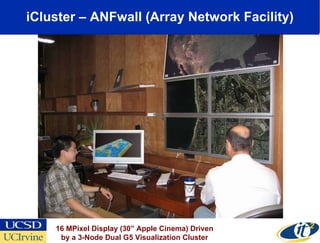
iCluster – ANFwall (Array Network Facility) Source: Mark Ellisman, Jason Leigh - OptIPuter co-PIs 16 MPixel Display (30” Apple Cinema) Driven by a 3-Node Dual G5 Visualization Cluster
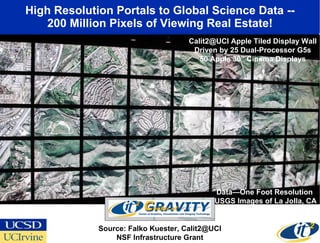
High Resolution Portals to Global Science Data -- 200 Million Pixels of Viewing Real Estate! Calit2@UCI Apple Tiled Display Wall Driven by 25 Dual-Processor G5s 50 Apple 30” Cinema Displays Source: Falko Kuester, Calit2@UCI NSF Infrastructure Grant Data—One Foot Resolution  USGS Images of La Jolla, CA
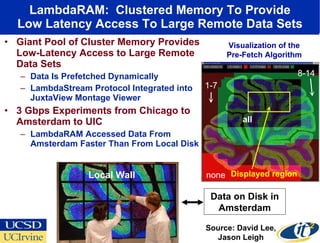
LambdaRAM:  Clustered Memory To Provide Low Latency Access To Large Remote Data Sets Giant Pool of Cluster Memory Provides Low-Latency Access to Large Remote Data Sets  Data Is Prefetched Dynamically LambdaStream Protocol Integrated into JuxtaView Montage Viewer 3 Gbps Experiments from Chicago to Amsterdam to UIC  LambdaRAM Accessed Data From Amsterdam Faster Than From Local Disk all 8-14 none all 8-14 1-7 Displayed region Visualization of the Pre-Fetch Algorithm none Data on Disk in Amsterdam Local Wall Source: David Lee, Jason Leigh
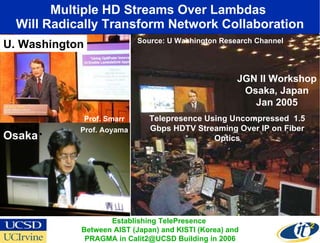
Multiple HD Streams Over Lambdas  Will Radically Transform Network Collaboration U. Washington JGN II Workshop Osaka, Japan Jan 2005 Prof.  Osaka Prof. Aoyama Prof. Smarr Source: U Washington Research Channel Telepresence Using Uncompressed  1.5 Gbps HDTV Streaming Over IP on Fiber Optics Establishing TelePresence  Between AIST (Japan) and KISTI (Korea) and PRAGMA in Calit2@UCSD Building in 2006
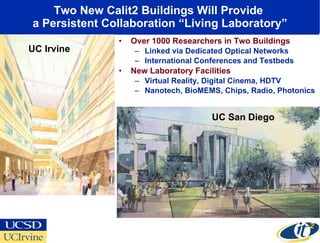
Two New Calit2 Buildings Will Provide  a Persistent Collaboration “Living Laboratory” Over 1000 Researchers in Two Buildings Linked via Dedicated Optical Networks International Conferences and Testbeds New Laboratory Facilities Virtual Reality, Digital Cinema, HDTV Nanotech, BioMEMS, Chips, Radio, Photonics Bioengineering UC San Diego UC Irvine
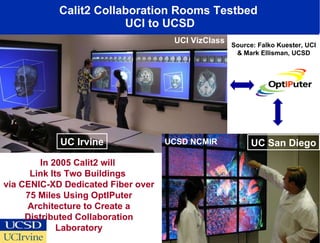
Calit2 Collaboration Rooms Testbed  UCI to UCSD In 2005 Calit2 will  Link Its Two Buildings  via CENIC-XD Dedicated Fiber over 75 Miles Using OptIPuter Architecture to Create a Distributed Collaboration Laboratory UC Irvine UC San Diego UCI VizClass  UCSD NCMIR Source: Falko Kuester, UCI & Mark Ellisman, UCSD
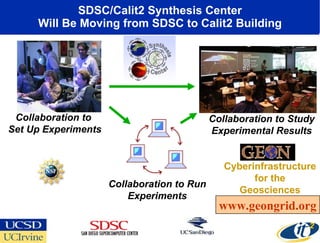
SDSC/Calit2 Synthesis Center Will Be Moving from SDSC to Calit2 Building Collaboration to  Set Up Experiments Collaboration to Study Experimental Results Cyberinfrastructure for the Geosciences www.geongrid.org Collaboration to Run Experiments
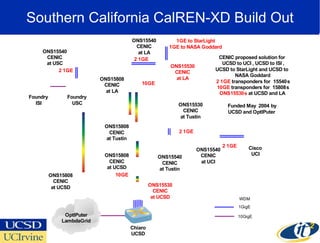
Southern California CalREN-XD Build Out
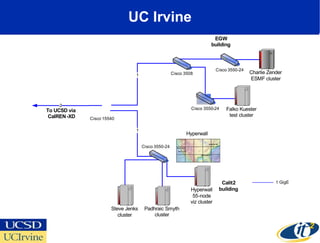
UC Irvine
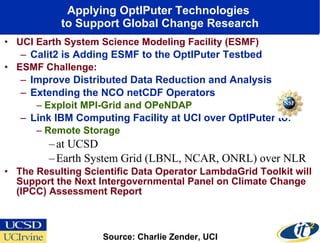
Applying OptIPuter Technologies  to Support Global Change Research UCI Earth System Science Modeling Facility (ESMF) Calit2 is Adding ESMF to the OptIPuter Testbed ESMF Challenge: Improve Distributed Data Reduction and Analysis Extending the NCO netCDF Operators Exploit MPI-Grid and OPeNDAP Link IBM Computing Facility at UCI over OptIPuter to: Remote Storage  at UCSD Earth System Grid (LBNL, NCAR, ONRL) over NLR The Resulting Scientific Data Operator LambdaGrid Toolkit will Support the Next Intergovernmental Panel on Climate Change (IPCC) Assessment Report Source: Charlie Zender, UCI
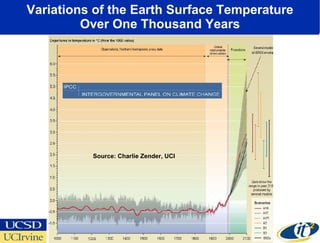
Variations of the Earth Surface Temperature Over One Thousand Years Source: Charlie Zender, UCI
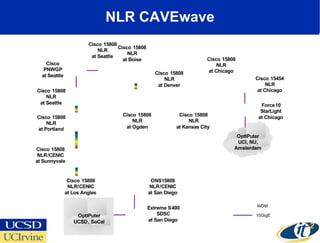
NLR CAVEwave
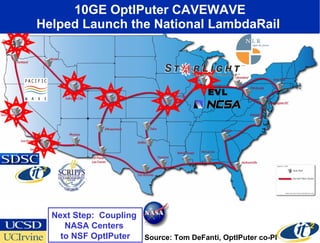
10GE OptIPuter CAVEWAVE Helped Launch the National LambdaRail  EVL Source: Tom DeFanti, OptIPuter co-PI Next Step:  Coupling  NASA Centers  to NSF OptIPuter
 
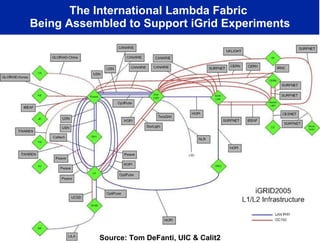
The International Lambda Fabric  Being Assembled to Support iGrid Experiments Source: Tom DeFanti, UIC & Calit2
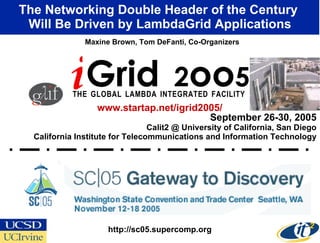
September 26-30, 2005 Calit2 @ University of California, San Diego California Institute for Telecommunications and Information Technology The Networking Double Header of the Century  Will Be Driven by LambdaGrid Applications i Grid  2 oo 5 T   H   E  G   L   O   B   A   L  L   A   M   B   D   A  I   N   T   E   G   R   A   T   E   D  F   A   C   I   L   I   T   Y   Maxine Brown, Tom DeFanti, Co-Organizers www.startap.net/igrid2005/ http://sc05.supercomp.org
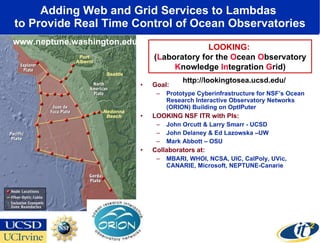
Adding Web and Grid Services to Lambdas  to Provide Real Time Control of Ocean Observatories Goal:  Prototype Cyberinfrastructure for NSF’s Ocean Research Interactive Observatory Networks (ORION) Building on OptIPuter LOOKING NSF ITR with PIs: John Orcutt & Larry Smarr - UCSD John Delaney & Ed Lazowska –UW Mark Abbott – OSU Collaborators at: MBARI, WHOI, NCSA, UIC, CalPoly, UVic, CANARIE, Microsoft, NEPTUNE-Canarie LOOKING:  ( L aboratory for the  O cean  O bservatory  K nowledge  In tegration  G rid) www.neptune.washington.edu http://lookingtosea.ucsd.edu/
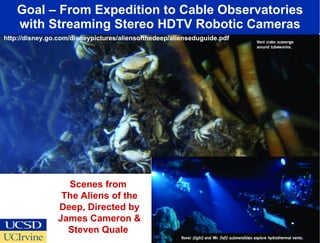
Goal – From Expedition to Cable Observatories with Streaming Stereo HDTV Robotic Cameras Scenes from  The Aliens of the Deep, Directed by James Cameron & Steven Quale  http://disney.go.com/disneypictures/aliensofthedeep/alienseduguide.pdf
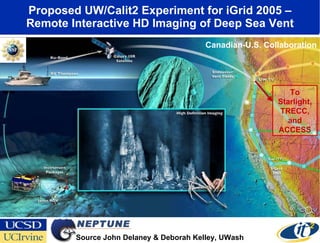
Proposed UW/Calit2 Experiment for iGrid 2005 – Remote Interactive HD Imaging of Deep Sea Vent Source John Delaney & Deborah Kelley, UWash To Starlight, TRECC, and ACCESS Canadian-U.S. Collaboration
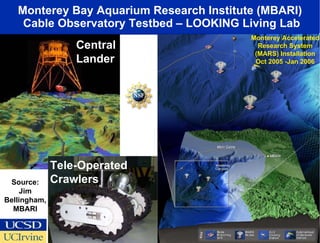
Monterey Bay Aquarium Research Institute (MBARI)  Cable Observatory Testbed – LOOKING Living Lab Tele-Operated Crawlers Central Lander Monterey Accelerated Research System (MARS) Installation Oct 2005 -Jan 2006 Source: Jim Bellingham, MBARI

The OptIPuter as a Prototype for CalREN-XD

  • 1.
    The OptIPuter as a Prototype for CalREN-XD Briefing to the CalREN-XD Subcommittee CENIC Board July 29, 2005 Dr. Larry Smarr Director, California Institute for Telecommunications and Information Technologies Harry E. Gruber Professor, Dept. of Computer Science and Engineering Jacobs School of Engineering, UCSD
  • 2.
    From “Supercomputer–Centric” to “Supernetwork-Centric” Cyberinfrastructure Megabit/s Gigabit/s Terabit/s Network Data Source: Timothy Lance, President, NYSERNet 32x10Gb “Lambdas” 1 GFLOP Cray2 60 TFLOP Altix Bandwidth of NYSERNet Research Network Backbones T1 Optical WAN Research Bandwidth Has Grown Much Faster Than Supercomputer Speed! Computing Speed (GFLOPS)
  • 3.
    Challenge: Average Throughputof NASA Data Products to End User is Only < 50 Megabits/s Tested from GSFC-ICESAT January 2005 http://ensight.eos.nasa.gov/Missions/icesat/index.shtml
  • 4.
    National Lambda Rail(NLR) and TeraGrid Provides Researchers a Cyberinfrastructure Backbone San Francisco Pittsburgh Cleveland San Diego Los Angeles Portland Seattle Pensacola Baton Rouge Houston San Antonio Las Cruces / El Paso Phoenix New York City Washington, DC Raleigh Jacksonville Dallas Tulsa Atlanta Kansas City Denver Ogden/ Salt Lake City Boise Albuquerque UC-TeraGrid UIC/NW-Starlight Chicago International Collaborators NLR 4 x 10Gb Lambdas Initially Capable of 40 x 10Gb wavelengths at Buildout NSF’s TeraGrid Has 4 x 10Gb Lambda Backbone Links Two Dozen State and Regional Optical Networks DOE, NSF, & NASA Using NLR
  • 5.
    The OptIPuter Project– A Model of Cyberinfrastructure Partnerships NSF Large Information Technology Research Proposal Calit2 (UCSD, UCI) and UIC Lead Campuses—Larry Smarr PI Partnering Campuses: USC, SDSU, NW, TA&M, UvA, SARA, NASA Industrial Partners IBM, Sun, Telcordia, Chiaro, Calient, Glimmerglass, Lucent $13.5 Million Over Five Years Linking User’s Linux Clusters to Remote Science Resources NIH Biomedical Informatics NSF EarthScope and ORION http://ncmir.ucsd.edu/gallery.html siovizcenter.ucsd.edu/library/gallery/shoot1/index.shtml Research Network
  • 6.
    What is theOptIPuter? Opt ical networking, I nternet P rotocol, Comp uter Storage, Processing and Visualization Technologies Dedicated Light-pipe (One or More 1-10 Gbps WAN Lambdas) Links Linux Cluster End Points With 1-10 Gbps per Node Clusters Optimized for Storage, Visualization, and Computing Does NOT Require TCP Transport Layer Protocol Exploring Both Intelligent Routers and Passive Switches Applications Drivers: Interactive Collaborative Visualization of Large Remote Data Objects Earth and Ocean Sciences Biomedical Imaging The OptIPuter Exploits a New World in Which the Central Architectural Element is Optical Networking, NOT Computers - Creating &quot;SuperNetworks&quot;
  • 7.
    OptIPuter Middleware Architecture-- The Challenge of Transforming Grids into LambdaGrids Distributed Applications/ Web Services Telescience Vol-a-Tile SAGE JuxtaView Visualization Data Services LambdaRAM PIN/PDC Photonic Infrastructure Source: Andrew Chien, UCSD GTP XCP UDT LambdaStream CEP RBUDP DVC Configuration DVC API DVC Runtime Library Globus XIO DVC Services DVC Core Services DVC Job Scheduling DVC Communication Resource Identify/Acquire Namespace Management Security Management High Speed Communication Storage Services GRAM GSI RobuStore
  • 8.
    The OptIPuter LambdaGrid is Rapidly Expanding 1 GE Lambda 10 GE Lambda Source: Greg Hidley, Aaron Chin, Calit2 UCSD StarLight Chicago UIC EVL NU CENIC San Diego GigaPOP CalREN-XD 6 6 NetherLight Amsterdam U Amsterdam SDSU CICESE via CUDI CENIC/Abilene shared network PNWGP Seattle CaveWave/NLR NASA Goddard NASA Ames NLR NASA JPL UCI CENIC Los Angeles GigaPOP 2 2 USC/ISI CineGrid Circuit
  • 9.
    UCSD Packet TestBed OptIPuter Year 2 – Ring Configuration
  • 10.
    UCSD Packet TestBed OptIPuter Year 3 – Star Configuration
  • 11.
    UCSD Campus LambdaStoreArchitecture Dedicated Lambdas to Labs Creates Campus LambdaGrid SIO Ocean Supercomputer IBM Storage Cluster Extreme Switch with 2 Ten Gbps Uplinks Streaming Microscope Source: Phil Papadopoulos, SDSC, Calit2
  • 12.
    The Calit2@UCSD Buildingis Designed for Extremely High Bandwidth 1.8 Million Feet of Cat6 Ethernet Cabling 150 Fiber Strands to Building Experimental Roof Radio Antenna Farm Building Radio Transparent Ubiquitous WiFi Photo: Tim Beach, Calit2 Over 9,000 Individual 10/100/1000 Mbps Drops in the Building
  • 13.
    Calit2 Partnering withCENIC and Campuses OptIPuter Campus Donated Multiple Single Mode Fiber Pairs Between Major OptIPuter Labs For Research Campus Provided Routable IP Space for OptIPuter, Allowing for Easier Network Expansion Campus Agreed to House and Monitor the Core Networking Gear While the New Calit2 Building is Being Built CalREN-HPR Campus Provided Connectivity to the CalREN-HPR Calit2 Provided Funding to Upgrade CalREN-HPR Access to 10GE Other UC Campuses are Now Following Suit with UCLA Expected to Upgrade this Summer CalREN-XD Campus Funded About 50% of the Dedicated 1GE Connections to UC Irvine and the University of Southern California (ISI) It was the First XD Deployment for CENIC Planning Underway for XD to be Extended UC Wide
  • 14.
    UCSD OptIPuter NetworkDiscovery Picture Below Displays ~500 Hosts (Including ~300 Shared) 80 Gbps Cisco 6509 backbone in the Core > 20 Switches Including 7 with 10Gbps Uplinks
  • 15.
    Year 3 Plans:Enhance Campus OptIPuter A Substantial Portion of the Physical Build Completes in Year 2 Endpoints, Cross-campus Fiber, Commodity Endpoints Increase Campus Bandwidth Work Towards More Extensive 10GigE Integration Optiputer HW Budget Limited In Year 3, Focus is on Network Extension Connect Two Campus Sites with 32-node Clusters At 10GigE 3:1 Campus Bisection Ratio Add/Expand a Moderate Number of new Campus Endpoints Add New Endpoints Into The Chiaro Network UCSD Sixth College JSOE (Engineering) Collaborative Visualization Center New Calit2 Research Facility Add 3 General-purpose Sun Opteron Clusters at Key Campus Sites (Compute and Storage); Clusters Will All Have PCI-X (100 Mhz, 1Gbps) Deploy Infiniband on Our IBM Storage Cluster and on a Previously-Donated Sun 128-node Compute Cluster Complete Financial Acquisition of the Chiaro Router
  • 16.
    Year Three GoalsIntegrate New NSF Quartzite MRI Goal -- integration of Packet-based (SoCal) and Circuit-based (Illinois) Approaches a Hybrid System Add Additional O-O-O Switching Capabilities Through a Commercial (Glimmerglass) All-optical Switch and the Lucent (Pre-commercial) Wavelength Selective Switch Begin CWDM or DWDM Deployment to Extend Optical Paths Around UCSD and Provide Additional Bandwidth Add Additional 10GigE in Switches and Cluster Node NICs MRI Proposal (Quartzite, Recommended for Funding) Allows Us to Match the Network to the Number of Existing Endpoints This is a New Kind of Distributed Instrument 300+ Components Distributed Over the Campus Simple and Centralized Control for Other Optiputer Users
  • 17.
  • 18.
  • 19.
    Lustre vs. PVFS2Comparison 9 servers 8 data, 1 meta-data Connected via dedicated GigE network Iozone tests with multiple clients accessing the same file (size 10/30 GB) Default setup for PVFS-2 and Lustre Optimal record size selected for PVFS2 comparison
  • 20.
    Brainywall – Predecessorto the Biowall Powered by a 5 node cluster Four render nodes and one front-end Each node drives one half of one display (1920x2400) Each display accepts 1-4 DVI inputs Refresh rate is bound by number of DVI inputs. Full resolution of the display at 60hz, exceeds the maximum bandwidth of the DVI specification. Each additional DVI connection increases the refresh rate (2xDVI=20.1hz)/display 18 million pixels (9Mpixels/display) Single user station
  • 21.
    Electron Microscope Datasets: 2D High resolution 2D image acquired from the 4k x4k camera Displayed on an IBM T221 9 million pixel display, 3840x2400 QUXGAW resolution
  • 22.
    GeoWall2: OptIPuterJuxtaView Software for Viewing High Resolution Images on Tiled Displays This 150 Mpixel Rat Cerebellum Image is a Montage of 43,200 Smaller Images Source: Mark Ellisman, Jason Leigh - OptIPuter co-PIs 40 MPixel Display Driven By a 20-Node Sun Opteron Visualization Cluster
  • 23.
    Currently Developing OptIPuterSoftware to Coherently Drive 100 MegaPixel Displays 55-Panel Display 100 Megapixel Driven by 30 Dual-Opterons (64-bit) 60 TB Disk 30 10GE interfaces 1/3 Tera bit/sec! Linked to OptIPuter We are Working with NASA ARC Hyperwall Team to Unify Software Source: Jason Leigh, Tom DeFanti, EVL@UIC OptIPuter Co-PIs
  • 24.
    iCluster – ANFwall(Array Network Facility) Source: Mark Ellisman, Jason Leigh - OptIPuter co-PIs 16 MPixel Display (30” Apple Cinema) Driven by a 3-Node Dual G5 Visualization Cluster
  • 25.
    High Resolution Portalsto Global Science Data -- 200 Million Pixels of Viewing Real Estate! Calit2@UCI Apple Tiled Display Wall Driven by 25 Dual-Processor G5s 50 Apple 30” Cinema Displays Source: Falko Kuester, Calit2@UCI NSF Infrastructure Grant Data—One Foot Resolution USGS Images of La Jolla, CA
  • 26.
    LambdaRAM: ClusteredMemory To Provide Low Latency Access To Large Remote Data Sets Giant Pool of Cluster Memory Provides Low-Latency Access to Large Remote Data Sets Data Is Prefetched Dynamically LambdaStream Protocol Integrated into JuxtaView Montage Viewer 3 Gbps Experiments from Chicago to Amsterdam to UIC LambdaRAM Accessed Data From Amsterdam Faster Than From Local Disk all 8-14 none all 8-14 1-7 Displayed region Visualization of the Pre-Fetch Algorithm none Data on Disk in Amsterdam Local Wall Source: David Lee, Jason Leigh
  • 27.
    Multiple HD StreamsOver Lambdas Will Radically Transform Network Collaboration U. Washington JGN II Workshop Osaka, Japan Jan 2005 Prof. Osaka Prof. Aoyama Prof. Smarr Source: U Washington Research Channel Telepresence Using Uncompressed 1.5 Gbps HDTV Streaming Over IP on Fiber Optics Establishing TelePresence Between AIST (Japan) and KISTI (Korea) and PRAGMA in Calit2@UCSD Building in 2006
  • 28.
    Two New Calit2Buildings Will Provide a Persistent Collaboration “Living Laboratory” Over 1000 Researchers in Two Buildings Linked via Dedicated Optical Networks International Conferences and Testbeds New Laboratory Facilities Virtual Reality, Digital Cinema, HDTV Nanotech, BioMEMS, Chips, Radio, Photonics Bioengineering UC San Diego UC Irvine
  • 29.
    Calit2 Collaboration RoomsTestbed UCI to UCSD In 2005 Calit2 will Link Its Two Buildings via CENIC-XD Dedicated Fiber over 75 Miles Using OptIPuter Architecture to Create a Distributed Collaboration Laboratory UC Irvine UC San Diego UCI VizClass UCSD NCMIR Source: Falko Kuester, UCI & Mark Ellisman, UCSD
  • 30.
    SDSC/Calit2 Synthesis CenterWill Be Moving from SDSC to Calit2 Building Collaboration to Set Up Experiments Collaboration to Study Experimental Results Cyberinfrastructure for the Geosciences www.geongrid.org Collaboration to Run Experiments
  • 31.
  • 32.
  • 33.
    Applying OptIPuter Technologies to Support Global Change Research UCI Earth System Science Modeling Facility (ESMF) Calit2 is Adding ESMF to the OptIPuter Testbed ESMF Challenge: Improve Distributed Data Reduction and Analysis Extending the NCO netCDF Operators Exploit MPI-Grid and OPeNDAP Link IBM Computing Facility at UCI over OptIPuter to: Remote Storage at UCSD Earth System Grid (LBNL, NCAR, ONRL) over NLR The Resulting Scientific Data Operator LambdaGrid Toolkit will Support the Next Intergovernmental Panel on Climate Change (IPCC) Assessment Report Source: Charlie Zender, UCI
  • 34.
    Variations of theEarth Surface Temperature Over One Thousand Years Source: Charlie Zender, UCI
  • 35.
  • 36.
    10GE OptIPuter CAVEWAVEHelped Launch the National LambdaRail EVL Source: Tom DeFanti, OptIPuter co-PI Next Step: Coupling NASA Centers to NSF OptIPuter
  • 37.
  • 38.
    The International LambdaFabric Being Assembled to Support iGrid Experiments Source: Tom DeFanti, UIC & Calit2
  • 39.
    September 26-30, 2005Calit2 @ University of California, San Diego California Institute for Telecommunications and Information Technology The Networking Double Header of the Century Will Be Driven by LambdaGrid Applications i Grid 2 oo 5 T H E G L O B A L L A M B D A I N T E G R A T E D F A C I L I T Y Maxine Brown, Tom DeFanti, Co-Organizers www.startap.net/igrid2005/ http://sc05.supercomp.org
  • 40.
    Adding Web andGrid Services to Lambdas to Provide Real Time Control of Ocean Observatories Goal: Prototype Cyberinfrastructure for NSF’s Ocean Research Interactive Observatory Networks (ORION) Building on OptIPuter LOOKING NSF ITR with PIs: John Orcutt & Larry Smarr - UCSD John Delaney & Ed Lazowska –UW Mark Abbott – OSU Collaborators at: MBARI, WHOI, NCSA, UIC, CalPoly, UVic, CANARIE, Microsoft, NEPTUNE-Canarie LOOKING: ( L aboratory for the O cean O bservatory K nowledge In tegration G rid) www.neptune.washington.edu http://lookingtosea.ucsd.edu/
  • 41.
    Goal – FromExpedition to Cable Observatories with Streaming Stereo HDTV Robotic Cameras Scenes from The Aliens of the Deep, Directed by James Cameron & Steven Quale http://disney.go.com/disneypictures/aliensofthedeep/alienseduguide.pdf
  • 42.
    Proposed UW/Calit2 Experimentfor iGrid 2005 – Remote Interactive HD Imaging of Deep Sea Vent Source John Delaney & Deborah Kelley, UWash To Starlight, TRECC, and ACCESS Canadian-U.S. Collaboration
  • 43.
    Monterey Bay AquariumResearch Institute (MBARI) Cable Observatory Testbed – LOOKING Living Lab Tele-Operated Crawlers Central Lander Monterey Accelerated Research System (MARS) Installation Oct 2005 -Jan 2006 Source: Jim Bellingham, MBARI

Editor's Notes

  • #21 One of the cornerstones of Telescience is to enable the users to visualize and interact with their data. Telescience will integrate OptIPuter to visualize big stuff.