HPC Trends for 2017 –
HPCAC Stanford
Addison Snell
@addisonsnell, addison@intersect360.com
Intersect360 Research in 2017
10 year history of HPC analyst business
Covering “high performance data center” markets, including
traditional HPC and supercomputing, high-performance enterprise,
cloud, big data, and hyperscale
New hyperscale advisory service
Weekly podcast, “This Week in HPC”
Contributing editors to The Next Platform, market research partners
of TOP500.org, media partnerships with HPCwire, insideHPC
Sponsors of HPC Advisory Council
Key Topics from Yesterday
• Architecture specialization
• HPC in the Cloud
• HPC vs. Hyperscale
• Machine learning and AI
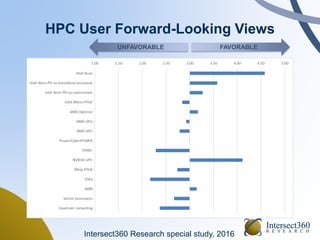
HPC User Forward-Looking Views
FAVORABLEUNFAVORABLE
Intersect360 Research special study, 2016
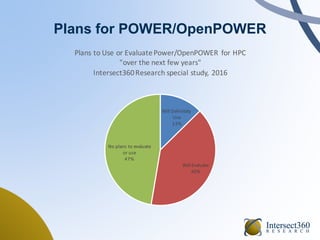
Plans for POWER/OpenPOWER
Will Definitely
Use
13%
Will Evaluate
40%
No plans to evaluate
or use
47%
Plans to Use or EvaluatePower/OpenPOWER for HPC
"over the next few years"
Intersect360Research special study, 2016
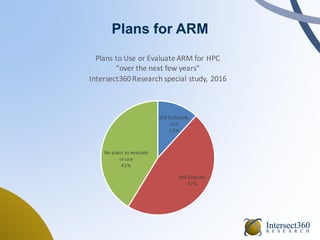
Plans for ARM
Will Definitely
Use
12%
Will Evaluate
47%
No plans to evaluate
or use
41%
Plans to Use or EvaluateARM for HPC
"over the next few years"
Intersect360Research special study, 2016
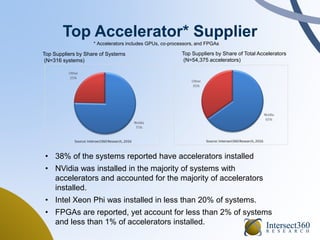
Top Accelerator* Supplier
• 38% of the systems reported have accelerators installed
• NVidia was installed in the majority of systems with
accelerators and accounted for the majority of accelerators
installed.
• Intel Xeon Phi was installed in less than 20% of systems.
• FPGAs are reported, yet account for less than 2% of systems
and less than 1% of accelerators installed.
Top Suppliers by Share of Systems
(N=316 systems)
Top Suppliers by Share of Total Accelerators
(N=54,375 accelerators)
* Accelerators includes GPUs, co-processors, and FPGAs
Top Interconnects/Network Suppliers
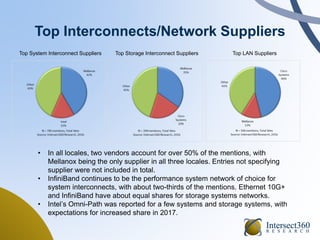
• In all locales, two vendors account for over 50% of the mentions, with
Mellanox being the only supplier in all three locales. Entries not specifying
supplier were not included in total.
• InfiniBand continues to be the performance system network of choice for
system interconnects, with about two-thirds of the mentions. Ethernet 10G+
and InfiniBand have about equal shares for storage systems networks.
• Intel’s Omni-Path was reported for a few systems and storage systems, with
expectations for increased share in 2017.
Top System Interconnect Suppliers Top Storage Interconnect Suppliers Top LAN Suppliers
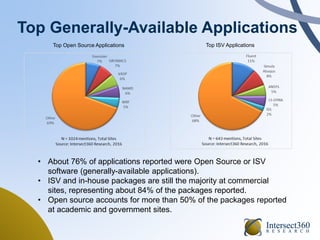
• About 76% of applications reported were Open Source or ISV
software (generally-available applications).
• ISV and in-house packages are still the majority at commercial
sites, representing about 84% of the packages reported.
• Open source accounts for more than 50% of the packages reported
at academic and government sites.
Top Generally-Available Applications
Top Open Source Applications Top ISV Applications
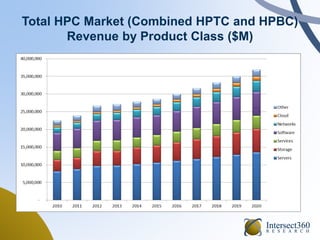
Total HPC Market (Combined HPTC and HPBC)
Revenue by Product Class ($M)
The Hyperscale Market
• Included since our 2007 HPC methodology as
“ultrascale internet”
• In 2015, recognized “Hyperscale” as distinct
market in proximity to HPC; began process of
separating it from HPC
• Defined hyperscale methodology with market
research and feedback from interested clients
• Published definitions and methodology report in
April 2016
Hyperscale Market Definition
The hyperscale market
consists of arbitrarily
scalable, web-facing
application infrastructure
that is distinct from general
IT investment
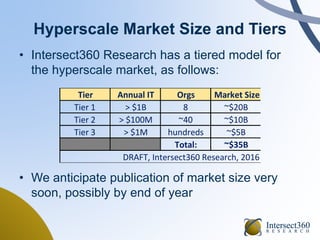
Hyperscale Market Size and Tiers
• Intersect360 Research has a tiered model for
the hyperscale market, as follows:
Tier Annual IT Orgs Market Size
Tier 1 > $1B 8 ~$20B
Tier 2 > $100M ~40 ~$10B
Tier 3 > $1M hundreds ~$5B
Total: ~$35B
DRAFT, Intersect360 Research, 2016
• We anticipate publication of market size very
soon, possibly by end of year
Deep Learning
• Intersect360 Research tracks AI (including deep
learning, machine learning, cognitive computing,
etc.) as part of the hyperscale market
– Similar to but distinct from HPC
– Low precision, intensely parallel, strong affinity to
public cloud
• DL is not a vertical market. It is more akin to an
algorithm or method of computation, like an FFT
• Cloud providers and end users are in early
stages of investment for their applications
Sizing Deep Learning
• We have looked at the size of the deep learning
market opportunity from several angles:
– Supplier-side information on market expansion
– Demand-side market analysis on acquisitions
– Top-down analysis of the hyperscale market
– Analyst opinion
• Our independent methods have produced
consistent views of the current opportunity in
deep learning
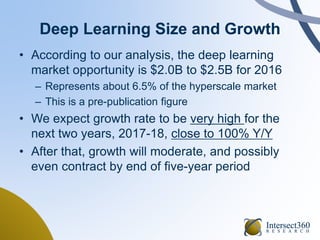
Deep Learning Size and Growth
• According to our analysis, the deep learning
market opportunity is $2.0B to $2.5B for 2016
– Represents about 6.5% of the hyperscale market
– This is a pre-publication figure
• We expect growth rate to be very high for the
next two years, 2017-18, close to 100% Y/Y
• After that, growth will moderate, and possibly
even contract by end of five-year period
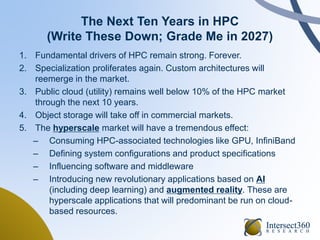
The Next Ten Years in HPC
(Write These Down; Grade Me in 2027)
1. Fundamental drivers of HPC remain strong. Forever.
2. Specialization proliferates again. Custom architectures will
reemerge in the market.
3. Public cloud (utility) remains well below 10% of the HPC market
through the next 10 years.
4. Object storage will take off in commercial markets.
5. The hyperscale market will have a tremendous effect:
– Consuming HPC-associated technologies like GPU, InfiniBand
– Defining system configurations and product specifications
– Influencing software and middleware
– Introducing new revolutionary applications based on AI
(including deep learning) and augmented reality. These are
hyperscale applications that will predominant be run on cloud-
based resources.

HPC Computing Trends

  • 1.
    HPC Trends for2017 – HPCAC Stanford Addison Snell @addisonsnell, addison@intersect360.com
  • 2.
    Intersect360 Research in2017 10 year history of HPC analyst business Covering “high performance data center” markets, including traditional HPC and supercomputing, high-performance enterprise, cloud, big data, and hyperscale New hyperscale advisory service Weekly podcast, “This Week in HPC” Contributing editors to The Next Platform, market research partners of TOP500.org, media partnerships with HPCwire, insideHPC Sponsors of HPC Advisory Council
  • 3.
    Key Topics fromYesterday • Architecture specialization • HPC in the Cloud • HPC vs. Hyperscale • Machine learning and AI
  • 4.
    HPC User Forward-LookingViews FAVORABLEUNFAVORABLE Intersect360 Research special study, 2016
  • 5.
    Plans for POWER/OpenPOWER WillDefinitely Use 13% Will Evaluate 40% No plans to evaluate or use 47% Plans to Use or EvaluatePower/OpenPOWER for HPC "over the next few years" Intersect360Research special study, 2016
  • 6.
    Plans for ARM WillDefinitely Use 12% Will Evaluate 47% No plans to evaluate or use 41% Plans to Use or EvaluateARM for HPC "over the next few years" Intersect360Research special study, 2016
  • 7.
    Top Accelerator* Supplier •38% of the systems reported have accelerators installed • NVidia was installed in the majority of systems with accelerators and accounted for the majority of accelerators installed. • Intel Xeon Phi was installed in less than 20% of systems. • FPGAs are reported, yet account for less than 2% of systems and less than 1% of accelerators installed. Top Suppliers by Share of Systems (N=316 systems) Top Suppliers by Share of Total Accelerators (N=54,375 accelerators) * Accelerators includes GPUs, co-processors, and FPGAs
  • 8.
    Top Interconnects/Network Suppliers •In all locales, two vendors account for over 50% of the mentions, with Mellanox being the only supplier in all three locales. Entries not specifying supplier were not included in total. • InfiniBand continues to be the performance system network of choice for system interconnects, with about two-thirds of the mentions. Ethernet 10G+ and InfiniBand have about equal shares for storage systems networks. • Intel’s Omni-Path was reported for a few systems and storage systems, with expectations for increased share in 2017. Top System Interconnect Suppliers Top Storage Interconnect Suppliers Top LAN Suppliers
  • 9.
    • About 76%of applications reported were Open Source or ISV software (generally-available applications). • ISV and in-house packages are still the majority at commercial sites, representing about 84% of the packages reported. • Open source accounts for more than 50% of the packages reported at academic and government sites. Top Generally-Available Applications Top Open Source Applications Top ISV Applications
  • 10.
    Total HPC Market(Combined HPTC and HPBC) Revenue by Product Class ($M)
  • 11.
    The Hyperscale Market •Included since our 2007 HPC methodology as “ultrascale internet” • In 2015, recognized “Hyperscale” as distinct market in proximity to HPC; began process of separating it from HPC • Defined hyperscale methodology with market research and feedback from interested clients • Published definitions and methodology report in April 2016
  • 12.
    Hyperscale Market Definition Thehyperscale market consists of arbitrarily scalable, web-facing application infrastructure that is distinct from general IT investment
  • 13.
    Hyperscale Market Sizeand Tiers • Intersect360 Research has a tiered model for the hyperscale market, as follows: Tier Annual IT Orgs Market Size Tier 1 > $1B 8 ~$20B Tier 2 > $100M ~40 ~$10B Tier 3 > $1M hundreds ~$5B Total: ~$35B DRAFT, Intersect360 Research, 2016 • We anticipate publication of market size very soon, possibly by end of year
  • 14.
    Deep Learning • Intersect360Research tracks AI (including deep learning, machine learning, cognitive computing, etc.) as part of the hyperscale market – Similar to but distinct from HPC – Low precision, intensely parallel, strong affinity to public cloud • DL is not a vertical market. It is more akin to an algorithm or method of computation, like an FFT • Cloud providers and end users are in early stages of investment for their applications
  • 15.
    Sizing Deep Learning •We have looked at the size of the deep learning market opportunity from several angles: – Supplier-side information on market expansion – Demand-side market analysis on acquisitions – Top-down analysis of the hyperscale market – Analyst opinion • Our independent methods have produced consistent views of the current opportunity in deep learning
  • 16.
    Deep Learning Sizeand Growth • According to our analysis, the deep learning market opportunity is $2.0B to $2.5B for 2016 – Represents about 6.5% of the hyperscale market – This is a pre-publication figure • We expect growth rate to be very high for the next two years, 2017-18, close to 100% Y/Y • After that, growth will moderate, and possibly even contract by end of five-year period
  • 17.
    The Next TenYears in HPC (Write These Down; Grade Me in 2027) 1. Fundamental drivers of HPC remain strong. Forever. 2. Specialization proliferates again. Custom architectures will reemerge in the market. 3. Public cloud (utility) remains well below 10% of the HPC market through the next 10 years. 4. Object storage will take off in commercial markets. 5. The hyperscale market will have a tremendous effect: – Consuming HPC-associated technologies like GPU, InfiniBand – Defining system configurations and product specifications – Influencing software and middleware – Introducing new revolutionary applications based on AI (including deep learning) and augmented reality. These are hyperscale applications that will predominant be run on cloud- based resources.