How Unethical
Practices
Almost
Destroyed
WorldCom
Group Members
•   Amit Yadav
•   Samarpal Singh
•   Ravindra Kumar
•   Apporva Verma
•   Saurabh Tripathi
•   Udit Varshney
•   Vimal Verma
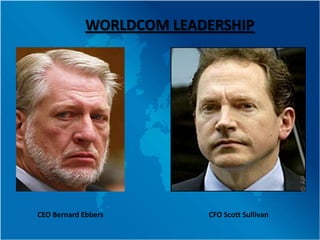
WORLDCOM LEADERSHIP


CEO Bernard Ebbers        CFO Scott Sullivan
COMPANY BACKGROUND
•   Worldcom founded in 1983 in hattiesburg ,
    mississippi
•   Initially called LDDS- Long Distance Discount
    Service
•   Bernard Ebber as CEO in 1985
                    Growth=survival
                    $650000=$1.5 m
•    Worldcom went public in 1989
•   1993-metromedia co. & resergens communication
•   1995- william technology
•   1998-Biggest acquisition($40 billion revenues)
• 1999 sprint merger worth $129 billion crashed
• Stock declined by 2000
• Heavy loans unstabilized his position as he left he
  said
• New CEO-John Sidgmore & CFO Scott Sullivan
• investigation launched by :-

            SEC (Security exchange commission)

          Internal auditor
• Purchased by Verizon communication on 2001
  known as Verizon business.
Truth Behind the Scandal

• Unrealistic financial targets and inability to meet them
• Recording of a/c entries without any evidences
• Company was capitalizing its line costs. Line costs were
  operating expenses but classified as capital expenditure
• False figures 3.055 Bn $ in 2001 & 797 Mn $ in 2002
• In 2000 and 2001, WC claimed pre tax revenue of 7.6 and
  2.4 Bn $ respectively. Later discovered as loss of 49.9
  and14.5 Bn $ for the respective years
• Reserve accounts were manipulated to increase figures
• Two versions of accounts the actual version and the Final
  version for investors
Nemesis catches up with world com

Attempt to acquire sprint in oct 1999 but failed.
Ebbers lacked strategic sense of direction and company
started drifting.
A company suffered financial crunch because of decline in
revenue,over capacity       and huge debts.
Fear amongst CEO and the top brass of the company.
Stock price dropped to 0.5 $ in jan 2002.
In june 2002,co. announced inflation of profits and improper
accounting of 3.9 Bn$.
In august 2002,another 3 Bn$ was improperly accounted.
Why WorldCom
 failed????
Reasons for the fiasco
Corporate culture
Variety of people
Acquisition of various
 business entities
Department were distant
 from each other
Hierarchical nature of the
 organization
Inorganic growth
Acquisition of business
 units
Financed by companies
 high value stock
Industrial slow growth rate
 and recession
Failing leadership
No technical qualification ,
 no experience
Priority to personal interest
 over organization's interest.
No backup plan
Unconcerned and Malfunctioning
       Board of directors
Unalert top management
Whimsical CEO
Large pay packages of top
 executives
Unreasonable long tenures of
 board members
Unreasonable loans and
 benefits given to Ebbers
Other reasons
Recession of the economy
Vast oversupply of capacity
Unhealthy focus on profits
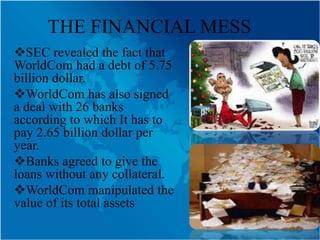
THE FINANCIAL MESS
SEC revealed the fact that
WorldCom had a debt of 5.75
billion dollar.
WorldCom has also signed
a deal with 26 banks
according to which It has to
pay 2.65 billion dollar per
year.
Banks agreed to give the
loans without any collateral.
WorldCom manipulated the
value of its total assets
WorldCom also defaulted
 to give 0.60 dollar on its
 MCI group tracking
 stock.
This step was taken by
 WorldCom stating the
 fact that by this it can
 save upto 284 million
 dollar a year.
How the stakeholders
  were affected?
Decline the value of stock

Workforce cut down drastically

Customer

Financial institutions

The Indian connection
The Blame Game
• Arthur Anderson was external auditor of
  WorldCom since 1989.
• They denied any involvement in the
  Fiasco.
• Arthur Anderson missed opportunities
  where they could have disclosed the
  fraud. They have been criticized for their
  way of handling WorldCom accounts
  books and policies.
• Arthur Anderson had series of audit
  fraud including Enron and
  WorldCom.
• Observers commented that Arthur
  Anderson could have paid more
  attention towards aggressive
  practices when it was aware of such
  practices before.
Summary
• WorldCom is not only about “greed”
• Corporate fraud is the result of how a corporation is
  led, how employees are motivated, the nature of the
  work, and the degree of individual autonomy
• Ethics training and compliance programs don’t work
  in a culture that is exclusively materialistic and that
  devalues the dignity of work and workers
• The basic assumptions about how corporations are
  organized and run need to be rethought
• Corporate executives must re-learn how to lead
• Leadership training must be holistic, emphasizing free
  will, personal responsibility and transparency i.e.:
  continuous, open, information-sharing
Why ‘good’ managers make bad ethical
                       choices (
Four Rationalizations To Justify Questionable
   Conduct
1) Believe that the activity is not “really” illegal
2) Believe that it is in the individual’s or
   corporation’s best interest
3) Believe that it will never be found out
4) Believe that the company will condone
   actions that are taken in its interest and will
   even protect the managers responsible
                                                       21
Conclusion

 A good way to avoid management oversights is to
  subject the control mechanisms themselves to
  periodic surprise audits…
 The point is to make sure that internal audits and
  controls are functioning as planned
 It is a case of inspecting the inspectors and taking
  the necessary steps to keep the controls working
  efficiently
 It is up to Top Management to send a clear &
  pragmatic message to all employees that good
  ethics is still the foundation of good business

                                                         22
Key Take Aways
• No job is worth breaking the law or committing
  unethical acts for
• Your personal integrity is your most important
  asset – you own it and control it


   What will it profit a man if he gains the
       world but loose his own soul?
                      (Mark 8:36)Jesus
Christ
How Unethical Practices Almost Destroyed WorldCom

How Unethical Practices Almost Destroyed WorldCom

  • 1.
  • 2.
    Group Members • Amit Yadav • Samarpal Singh • Ravindra Kumar • Apporva Verma • Saurabh Tripathi • Udit Varshney • Vimal Verma
  • 3.
    WORLDCOM LEADERSHIP CEO BernardEbbers CFO Scott Sullivan
  • 4.
    COMPANY BACKGROUND • Worldcom founded in 1983 in hattiesburg , mississippi • Initially called LDDS- Long Distance Discount Service • Bernard Ebber as CEO in 1985 Growth=survival $650000=$1.5 m • Worldcom went public in 1989 • 1993-metromedia co. & resergens communication • 1995- william technology • 1998-Biggest acquisition($40 billion revenues)
  • 5.
    • 1999 sprintmerger worth $129 billion crashed • Stock declined by 2000 • Heavy loans unstabilized his position as he left he said • New CEO-John Sidgmore & CFO Scott Sullivan • investigation launched by :- SEC (Security exchange commission) Internal auditor • Purchased by Verizon communication on 2001 known as Verizon business.
  • 6.
    Truth Behind theScandal • Unrealistic financial targets and inability to meet them • Recording of a/c entries without any evidences • Company was capitalizing its line costs. Line costs were operating expenses but classified as capital expenditure • False figures 3.055 Bn $ in 2001 & 797 Mn $ in 2002 • In 2000 and 2001, WC claimed pre tax revenue of 7.6 and 2.4 Bn $ respectively. Later discovered as loss of 49.9 and14.5 Bn $ for the respective years • Reserve accounts were manipulated to increase figures • Two versions of accounts the actual version and the Final version for investors
  • 7.
    Nemesis catches upwith world com Attempt to acquire sprint in oct 1999 but failed. Ebbers lacked strategic sense of direction and company started drifting. A company suffered financial crunch because of decline in revenue,over capacity and huge debts. Fear amongst CEO and the top brass of the company. Stock price dropped to 0.5 $ in jan 2002. In june 2002,co. announced inflation of profits and improper accounting of 3.9 Bn$. In august 2002,another 3 Bn$ was improperly accounted.
  • 8.
  • 9.
    Reasons for thefiasco Corporate culture Variety of people Acquisition of various business entities Department were distant from each other Hierarchical nature of the organization
  • 10.
    Inorganic growth Acquisition ofbusiness units Financed by companies high value stock Industrial slow growth rate and recession
  • 11.
    Failing leadership No technicalqualification , no experience Priority to personal interest over organization's interest. No backup plan
  • 12.
    Unconcerned and Malfunctioning Board of directors Unalert top management Whimsical CEO Large pay packages of top executives Unreasonable long tenures of board members Unreasonable loans and benefits given to Ebbers
  • 13.
    Other reasons Recession ofthe economy Vast oversupply of capacity Unhealthy focus on profits
  • 14.
    THE FINANCIAL MESS SECrevealed the fact that WorldCom had a debt of 5.75 billion dollar. WorldCom has also signed a deal with 26 banks according to which It has to pay 2.65 billion dollar per year. Banks agreed to give the loans without any collateral. WorldCom manipulated the value of its total assets
  • 15.
    WorldCom also defaulted to give 0.60 dollar on its MCI group tracking stock. This step was taken by WorldCom stating the fact that by this it can save upto 284 million dollar a year.
  • 16.
    How the stakeholders were affected?
  • 17.
    Decline the valueof stock Workforce cut down drastically Customer Financial institutions The Indian connection
  • 18.
    The Blame Game •Arthur Anderson was external auditor of WorldCom since 1989. • They denied any involvement in the Fiasco. • Arthur Anderson missed opportunities where they could have disclosed the fraud. They have been criticized for their way of handling WorldCom accounts books and policies.
  • 19.
    • Arthur Andersonhad series of audit fraud including Enron and WorldCom. • Observers commented that Arthur Anderson could have paid more attention towards aggressive practices when it was aware of such practices before.
  • 20.
    Summary • WorldCom isnot only about “greed” • Corporate fraud is the result of how a corporation is led, how employees are motivated, the nature of the work, and the degree of individual autonomy • Ethics training and compliance programs don’t work in a culture that is exclusively materialistic and that devalues the dignity of work and workers • The basic assumptions about how corporations are organized and run need to be rethought • Corporate executives must re-learn how to lead • Leadership training must be holistic, emphasizing free will, personal responsibility and transparency i.e.: continuous, open, information-sharing
  • 21.
    Why ‘good’ managersmake bad ethical choices ( Four Rationalizations To Justify Questionable Conduct 1) Believe that the activity is not “really” illegal 2) Believe that it is in the individual’s or corporation’s best interest 3) Believe that it will never be found out 4) Believe that the company will condone actions that are taken in its interest and will even protect the managers responsible 21
  • 22.
    Conclusion  A goodway to avoid management oversights is to subject the control mechanisms themselves to periodic surprise audits…  The point is to make sure that internal audits and controls are functioning as planned  It is a case of inspecting the inspectors and taking the necessary steps to keep the controls working efficiently  It is up to Top Management to send a clear & pragmatic message to all employees that good ethics is still the foundation of good business 22
  • 23.
    Key Take Aways •No job is worth breaking the law or committing unethical acts for • Your personal integrity is your most important asset – you own it and control it What will it profit a man if he gains the world but loose his own soul? (Mark 8:36)Jesus Christ