Lessons From WorldCom
How Leadership FailuresCaused theBiggest
Bankruptcy in History
John J. Sarno, President
EmployersAssociation of New Jersey
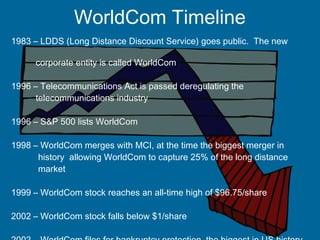
WorldCom Timeline
1983 – LDDS (Long Distance Discount Service) goes public. The new
corporate entity is called WorldCom
1996 – Telecommunications Act is passed deregulating the
telecommunications industry
1996 – S&P 500 lists WorldCom
1998 – WorldCom merges with MCI, at the time the biggest merger in
history allowing WorldCom to capture 25% of the long distance
market
1999 – WorldCom stock reaches an all-time high of $96.75/share
2002 – WorldCom stock falls below $1/share
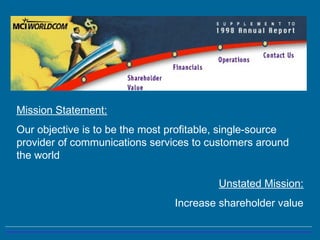
Mission Statement:
Our objective is to be the most profitable, single-source
provider of communications services to customers around
the world
Unstated Mission:
Increase shareholder value
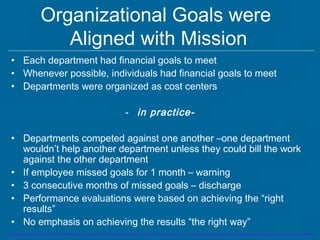
Organizational Goals were
Aligned with Mission
• Each department had financial goals to meet
• Whenever possible, individuals had financial goals to meet
• Departments were organized as cost centers
- in practice-
• Departments competed against one another –one department
wouldn’t help another department unless they could bill the work
against the other department
• If employee missed goals for 1 month – warning
• 3 consecutive months of missed goals – discharge
• Performance evaluations were based on achieving the “right
results”
• No emphasis on achieving the results “the right way”
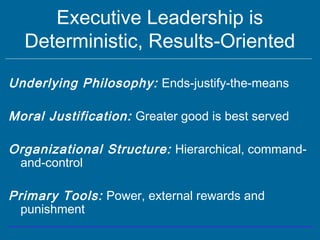
Executive Leadership is
Deterministic, Results-Oriented
Underlying Philosophy: Ends-justify-the-means
Moral Justification: Greater good is best served
Organizational Structure: Hierarchical, command-
and-control
Primary Tools: Power, external rewards and
punishment
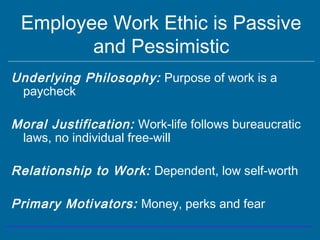
Employee Work Ethic is Passive
and Pessimistic
Underlying Philosophy: Purpose of work is a
paycheck
Moral Justification: Work-life follows bureaucratic
laws, no individual free-will
Relationship to Work: Dependent, low self-worth
Primary Motivators: Money, perks and fear
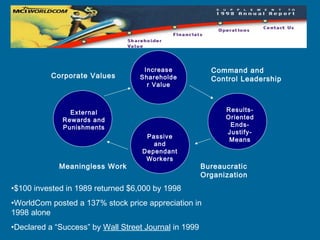
External
Rewards and
Punishments
Increase
Shareholde
r Value
Results-
Oriented
Ends-
Justify-
Means
Passive
and
Dependant
Workers
Corporate Values
Command and
Control Leadership
Bureaucratic
Organization
Meaningless Work
•$100 invested in 1989 returned $6,000 by 1998
•WorldCom posted a 137% stock price appreciation in
1998 alone
•Declared a “Success” by Wall Street Journal in 1999
In 2003, court-appointed Bankruptcy
Examiner described WorldCom as having a
“culture of greed.”
Special investigation committee report
asked why no one disclosed or complained
about management misconduct. The report
avers that “the answer seems to lie partly in
the culture.”
Betty Vinson was hired in 1996 as a mid-level accountant and was promoted to
senior manager in WorldCom’s corporate accounting division. The division
compiled the company’s quarterly reports. Ten accountants reported to Ms.
Vinson. Vinson reported to Buford Yates.
In mid-2000 it was clear that WorldCom would not make its financial expectations,
which were scrutinized by Wall Street analysts. A scramble ensued to try and
reduce expenses on the company’s statements enough to meet Wall Street’s
expectations for the quarter. Yates convened a meeting, explaining that Scott
Sullivan, WorldCom’s CFO, suggested that a reserve account be used to, in part,
boost earnings. According to Sullivan, the transaction was the only way out of the
company’s troubles. The transactions would violate accounting rules.
Vinson and Yates faced the same dilemma in the second, third and fourth quarters of
2001. Both contemplated resigning, but followed orders. They withdrew from co-
workers, afraid that they might let something slip. When an accountant
questioned the discrepancy, Yates sent an e-mail stating: “Show those numbers
to the damn auditors and I’ll throw you out the f____ window.” In withholding the
information from the General Tax Counsel, Yates stated that “I’ll need to kill him if
I tell him.” In 2003, Sullivan, Yates and Vinson are indicted for securities fraud.
Vinson and Yates’ position was described as “untenable,” “victims of unscrupulous
higher managers.”
Tentative Conclusion: The WorldCom disaster is not only about
“greed.” Instead, its about a corporate culture that fostered
dependent workers with low self-esteem, who could not exercise
free-will, and who performed for external rewards.
Tentative Conclusion: WorldCom’s code of conduct, ethics
training and compliance programs were ineffective because the
organization’s values were deterministic and material.
Tentative Conclusion: WorldCom’s executive leaders used power,
fear and intimidation to lead and, therefore, autonomous
individuals, with high self-esteem were viewed as a threat to the
organization’s mission.
In making a decision to seek an indictment against a corporation,
the US Department of Justice, will consider the corporate culture,
as measured by:
 The company’s history of wrongdoing,
 Its response to regulatory action,
 Its reaction to the criminal conduct committed by its
employees, including the cooperation with the
Government’s investigation
 The level within the corporation at which the crimes
were committed or conducted,
 The pervasiveness of the criminal behavior within the
organization
According to the Department, the culture “is a web of attitudes and
practices that tends to replicate and perpetuate itself…[It] may
instill respect for the law or breed contempt and malfeasance.”
• New criminal and civil penalties, as well as mandated
corporate reforms make it critical that a corporate culture
instill respect for the law and ethical standards.
• However, MBA-ethics course and corporate training
programs do not address individual autonomy, free-will,
self worth and the intrinsic reward of performing
meaningful work
• The real lesson of WorldCom is that employees believed
that they had “no choice,” that they “were victims,” that
they were merely “following orders.”
• The real lesson of WorldCom is that the company was
perfectly aligned to increase shareholder value at any
costs.
Reflections on Executive
Leadership
• Executive leadership must foster an ethical, law-abiding climate
• Persons who view themselves as “agents,” “victims,” or as merely
“following orders” will engage in unethical acts and criminal activity
• Persons who are autonomous and who exercise free-will tend to feel
personally responsible for their actions
• Persons who are autonomous are not easily controlled and are
motivated intrinsically
• Autonomous people can be lead by empowerment and persuasion,
with an emphasis on sharing information and non-economic rewards
• To the extent possible, autonomous people must be allowed to
organize and control their own work and to make decisions.
• Training cannot change culture, only leaders can
Reflections on
Leadership/Ethics Training
• Classroom instruction is insufficient
• Open communication, including respectful dissent,
has to be encouraged
• Whistleblowing must be dealt with not only as a legal
issue, but as an opportunity for understanding,
information sharing and, if necessary, change
• Coaching and mentoring are indispensable
• All work must have dignity and self-worth
• To the extent possible, leadership must be
“transparent,” capable of being understood and
evaluated at any point, open to feedback and
continuous information-sharing.
Summary
• WorldCom is not only about “greed”
• Corporate fraud is the result of how a corporation is led,
how employees are motivated, the nature of the work,
and the degree of individual autonomy
• Ethics training and compliance programs don’t work in a
culture that is exclusively materialistic and that devalues
the dignity of work and workers
• The basic assumptions about how corporations are
organized and run need to be rethought
• Corporate executives must re-learn how to lead
• Leadership training must be holistic, emphasizing free
will, personal responsibility and transparency i.e.:
continuous, open, information-sharing
Employers Association of New Jersey
www.eanj.org
John J. Sarno
John@eanj.org
973-758-6800

Lessons from-worldcom-1231784975071368-3

  • 1.
    Lessons From WorldCom HowLeadership FailuresCaused theBiggest Bankruptcy in History John J. Sarno, President EmployersAssociation of New Jersey
  • 2.
    WorldCom Timeline 1983 –LDDS (Long Distance Discount Service) goes public. The new corporate entity is called WorldCom 1996 – Telecommunications Act is passed deregulating the telecommunications industry 1996 – S&P 500 lists WorldCom 1998 – WorldCom merges with MCI, at the time the biggest merger in history allowing WorldCom to capture 25% of the long distance market 1999 – WorldCom stock reaches an all-time high of $96.75/share 2002 – WorldCom stock falls below $1/share
  • 3.
    Mission Statement: Our objectiveis to be the most profitable, single-source provider of communications services to customers around the world Unstated Mission: Increase shareholder value
  • 4.
    Organizational Goals were Alignedwith Mission • Each department had financial goals to meet • Whenever possible, individuals had financial goals to meet • Departments were organized as cost centers - in practice- • Departments competed against one another –one department wouldn’t help another department unless they could bill the work against the other department • If employee missed goals for 1 month – warning • 3 consecutive months of missed goals – discharge • Performance evaluations were based on achieving the “right results” • No emphasis on achieving the results “the right way”
  • 5.
    Executive Leadership is Deterministic,Results-Oriented Underlying Philosophy: Ends-justify-the-means Moral Justification: Greater good is best served Organizational Structure: Hierarchical, command- and-control Primary Tools: Power, external rewards and punishment
  • 6.
    Employee Work Ethicis Passive and Pessimistic Underlying Philosophy: Purpose of work is a paycheck Moral Justification: Work-life follows bureaucratic laws, no individual free-will Relationship to Work: Dependent, low self-worth Primary Motivators: Money, perks and fear
  • 7.
    External Rewards and Punishments Increase Shareholde r Value Results- Oriented Ends- Justify- Means Passive and Dependant Workers CorporateValues Command and Control Leadership Bureaucratic Organization Meaningless Work •$100 invested in 1989 returned $6,000 by 1998 •WorldCom posted a 137% stock price appreciation in 1998 alone •Declared a “Success” by Wall Street Journal in 1999
  • 8.
    In 2003, court-appointedBankruptcy Examiner described WorldCom as having a “culture of greed.” Special investigation committee report asked why no one disclosed or complained about management misconduct. The report avers that “the answer seems to lie partly in the culture.”
  • 9.
    Betty Vinson washired in 1996 as a mid-level accountant and was promoted to senior manager in WorldCom’s corporate accounting division. The division compiled the company’s quarterly reports. Ten accountants reported to Ms. Vinson. Vinson reported to Buford Yates. In mid-2000 it was clear that WorldCom would not make its financial expectations, which were scrutinized by Wall Street analysts. A scramble ensued to try and reduce expenses on the company’s statements enough to meet Wall Street’s expectations for the quarter. Yates convened a meeting, explaining that Scott Sullivan, WorldCom’s CFO, suggested that a reserve account be used to, in part, boost earnings. According to Sullivan, the transaction was the only way out of the company’s troubles. The transactions would violate accounting rules. Vinson and Yates faced the same dilemma in the second, third and fourth quarters of 2001. Both contemplated resigning, but followed orders. They withdrew from co- workers, afraid that they might let something slip. When an accountant questioned the discrepancy, Yates sent an e-mail stating: “Show those numbers to the damn auditors and I’ll throw you out the f____ window.” In withholding the information from the General Tax Counsel, Yates stated that “I’ll need to kill him if I tell him.” In 2003, Sullivan, Yates and Vinson are indicted for securities fraud. Vinson and Yates’ position was described as “untenable,” “victims of unscrupulous higher managers.”
  • 10.
    Tentative Conclusion: TheWorldCom disaster is not only about “greed.” Instead, its about a corporate culture that fostered dependent workers with low self-esteem, who could not exercise free-will, and who performed for external rewards. Tentative Conclusion: WorldCom’s code of conduct, ethics training and compliance programs were ineffective because the organization’s values were deterministic and material. Tentative Conclusion: WorldCom’s executive leaders used power, fear and intimidation to lead and, therefore, autonomous individuals, with high self-esteem were viewed as a threat to the organization’s mission.
  • 11.
    In making adecision to seek an indictment against a corporation, the US Department of Justice, will consider the corporate culture, as measured by:  The company’s history of wrongdoing,  Its response to regulatory action,  Its reaction to the criminal conduct committed by its employees, including the cooperation with the Government’s investigation  The level within the corporation at which the crimes were committed or conducted,  The pervasiveness of the criminal behavior within the organization According to the Department, the culture “is a web of attitudes and practices that tends to replicate and perpetuate itself…[It] may instill respect for the law or breed contempt and malfeasance.”
  • 12.
    • New criminaland civil penalties, as well as mandated corporate reforms make it critical that a corporate culture instill respect for the law and ethical standards. • However, MBA-ethics course and corporate training programs do not address individual autonomy, free-will, self worth and the intrinsic reward of performing meaningful work • The real lesson of WorldCom is that employees believed that they had “no choice,” that they “were victims,” that they were merely “following orders.” • The real lesson of WorldCom is that the company was perfectly aligned to increase shareholder value at any costs.
  • 13.
    Reflections on Executive Leadership •Executive leadership must foster an ethical, law-abiding climate • Persons who view themselves as “agents,” “victims,” or as merely “following orders” will engage in unethical acts and criminal activity • Persons who are autonomous and who exercise free-will tend to feel personally responsible for their actions • Persons who are autonomous are not easily controlled and are motivated intrinsically • Autonomous people can be lead by empowerment and persuasion, with an emphasis on sharing information and non-economic rewards • To the extent possible, autonomous people must be allowed to organize and control their own work and to make decisions. • Training cannot change culture, only leaders can
  • 14.
    Reflections on Leadership/Ethics Training •Classroom instruction is insufficient • Open communication, including respectful dissent, has to be encouraged • Whistleblowing must be dealt with not only as a legal issue, but as an opportunity for understanding, information sharing and, if necessary, change • Coaching and mentoring are indispensable • All work must have dignity and self-worth • To the extent possible, leadership must be “transparent,” capable of being understood and evaluated at any point, open to feedback and continuous information-sharing.
  • 15.
    Summary • WorldCom isnot only about “greed” • Corporate fraud is the result of how a corporation is led, how employees are motivated, the nature of the work, and the degree of individual autonomy • Ethics training and compliance programs don’t work in a culture that is exclusively materialistic and that devalues the dignity of work and workers • The basic assumptions about how corporations are organized and run need to be rethought • Corporate executives must re-learn how to lead • Leadership training must be holistic, emphasizing free will, personal responsibility and transparency i.e.: continuous, open, information-sharing
  • 16.
    Employers Association ofNew Jersey www.eanj.org John J. Sarno John@eanj.org 973-758-6800