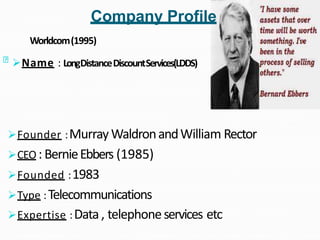
Name : LongDistanceDiscountServices(LDDS)
Worldcom(1995)
Founder :Murray WaldronandWilliam Rector
CEO : BernieEbbers (1985)
Founded :1983
Type :Telecommunications
Expertise :Data, telephoneservices etc
Company Profile
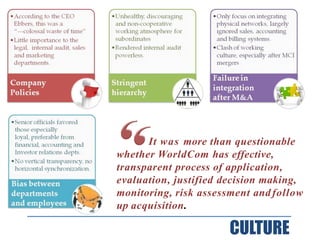
CULTURE
It was more than questionable
whether WorldCom has effective,
transparent process of application,
evaluation, justified decision making,
monitoring, risk assessment andfollow
up acquisition.
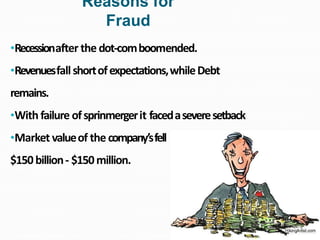
•Recessionafter the dot-comboomended.
•Revenuesfallshortofexpectations,whileDebt
remains.
•With failure ofsprinmergerit facedaseveresetback
•Market valueof the company’sfell
$150billion- $150million.
Reasons for
Fraud
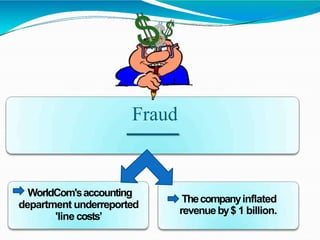
Fraud
WorldCom'saccounting
department underreported
'line costs’
Thecompanyinflated
revenueby$ 1 billion.
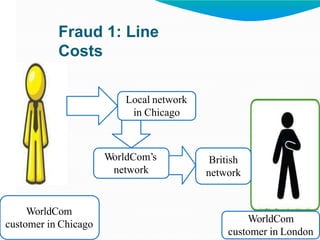
WorldCom
customer in Chicago WorldCom
customer in London
Local network
in Chicago
WorldCom’s
network
British
network
Fraud 1: Line
Costs
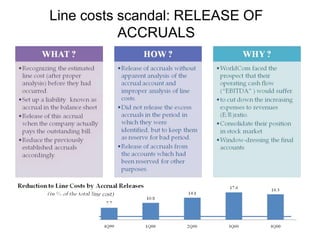
Line costs scandal: RELEASE OF
ACCRUALS
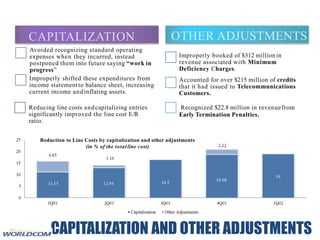
Reducing line costs andcapitalizing entries
significantly improved the line cost E/R
ratio.
OTHER ADJUSTMENTS
Improperly booked of $312 millionin
revenue associated with Minimum
Deficiency Charges.
Accounted for over $215 million of credits
that it had issued to Telecommunications
Customers.
Recognized $22.8 million in revenuefrom
Early Termination Penalties.
CAPITALIZATION AND OTHER ADJUSTMENTS
CAPITALIZATION
Avoided recognizing standard operating
expenses when they incurred, instead
postponed them into future saying “work in
progress”
Improperly shifted these expenditures from
income statementto balance sheet, increasing
current income and inflating assets.
Reduction to Line Costs by capitalization and other adjustments
(in % of the totalline cost)
Fraud 2: Inflating Revenue
 The company inflated its revenues with bogus accounting entries
from ‘corporate unallocated revenue accounts’.
 WorldCom reduced the reserve accounts held to cover the liabilities
of acquired companies thereby adding $2.8 billion to the revenue
line from these reserves. As a result, the profit margin increased
considerably between 1998-2000.
• A company spends $500 to perform annual maintenance on
a cutting machine. This expenditure is an operating
expenditure and, as such, it should be treated as business
expense .Current net income would decrease as a result.
• However, if the company spends $500 to replace the motor
in the machine, this expenditure would be posted to the
asset
account ―Property,Plant, and Equipment‖. Such an
expenditure is a capital expenditure because the life of the
equipment has been extended and/or its operating
efficiency increased.
EXPENSE VS CAPITAL
EXPENDITURE
Fraud 2: Inflating Revenue
What WorldComdid?
Reduced the amount of money held in
reserve by $2.8 billion and moved this
money into the revenue line of its
financial statements.
In 2000, classified operating
expenses as long-term capital
investments ( $3.85 billion).
These changes turned WorldCom's losses
into profits to the tune of $1.38 billion in
2001. It also made WorldCom's assets
appear more valuable.
Fraud 2: Inflating Revenue
• They also added a journal entry for $500 million in computer
expenses, but supporting documents for the expenses were
never found.
• Ebber also takes out a separate $43 million loan to
finance the purchase of a 500,000-acre ranch- backed
by Ebbers' WorldCom stock.
• Scott Sullivan misallocated capital expenditure as normal
expenses, thus turning profits into losses ( $9 billion) - not
discovered by internal auditor Cynthia Cooper until June 2002.
Fraud 2: Inflating Revenue
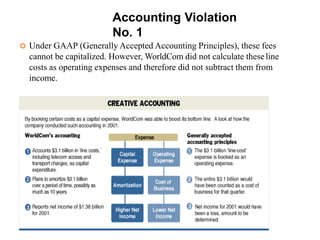
 Under GAAP (Generally Accepted Accounting Principles), these fees
cannot be capitalized. However, WorldCom did not calculate theseline
costs as operating expenses and therefore did not subtract them from
income.
Accounting Violation
No. 1
WorldCom violated the revenue recognition principle because they recorded
revenue entries (with top-side adjusting journal entries) that had no valid
economic activity underlying the entries.
Rather, the entries were merely a tool to close the gap between the revenue
forecast and the actual revenue earned. The principal tool used to generate the
entries was the monthly revenue report (“MonRev”) prepared and distributed
by the revenue reporting and accounting group. The MonRev included dozens of
spreadsheets detailing actual revenue data from all of the company’s channels
and segments.
Accounting
Violation No 2.
( Revenue
Recognition)
WorldCom maintained a fairly automated process for closing and consolidating
operational revenue numbers on the MonRev. By the tenth day after the end of the
month, the revenue accounting group prepared a draft, referred to as the
“Preliminary” MonRev. In general, this preliminary report was compared to the
targeted revenue numbers and the difference was used as the basis for a top-side
adjusting journal entry to close the gap. In essence, by booking revenue
entries with no underlying business activity, WorldCom
violated the revenue recognition principle.
Accounting
Violation No. 2
( Revenue
Recognition)
Violation Of Auditing
Standards No.1
Paragraph 56 of PCAOB Auditing Standards Number 12 or Sarbanes–Oxley Act
According to Sarbox Sextion 13, “The Audit Committee of each issuer, in its
capacity as a committee of the board of directors, shall be directly
responsible for the appointment, compensation and oversight of the work
of any registered public accounting firm employed by that issuer”
How did WorldCom violated the rule :
The Audit committee didn’t support the internal audit staff’s budget. Denial of
access to company records and allowing management to dictate the internal
control staff world.
Violation Of Auditing
Standards No 2.
According to PCAOB Ethics and Independence Rule 3520, auditor
independence means that an auditor must not have a financial interest in the client, is not a
trustee of an estate that has a financial interest, has a joint closely held investment, or has
received/given a loan from the company/director/officer of the company. The auditor must
not be a director/officer/employee, promoter/underwriter/voting trustee, or trustee for the
client. The significance to the auditing profession is that only if an auditor is independent
can he give a true and fair view of the financial statements. If the auditor is influenced the
purpose of the audit will be lost.
Auditor independence is the bedrock of the auditing profession. This rule was
violated by Andersen. The reason is that from 1999 through 2001 WorldCom paid
Andersen $7.8 million in audit fees and during the same period Andersen received
$50 million for consulting, litigation support, and tax services. This means Andersen
had a financial interest in the audit procedure. So clearly he has violated the law.
Violation Of Auditing
Standards No.2
WorldCom had not established an effective system of internal control over financial statements.
Control policies and procedures that would have monitored and prevented management
override and the release of line costs, which resulted in overstated financial statements. When
linking internal controls to financial statement assertions for expense accounts, it is evident that
several management assertions were incorrect and not identified by the controls.
According to PCAOB Auditing Standards No.5 and Paragraph 68,
Worldcom had an Ineffective Financial Reporting
Violation Of Auditing
Standards No 3.
False management assertions fell into the categories of accuracy, valuation presentation
and disclosure. The management assertions of accuracy and valuation, which states that
the transactions and events have been recorded accurately and that account balances
have been valued correctly was false because WorldCom’s management did not correctly
disclose the expense. Management’s assertions of presentation and disclosure, which
state that all transactions and events have been presented correctly and that all relevant
information has been disclosed to financial statement users was also violated. WorldCom
failed to disclose the release of line costs the lowered its expense account and increased
its revenues.
Violation Of Auditing
Standards No. 3
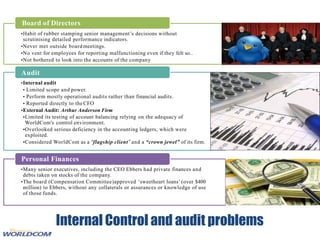
Internal Control and audit problems
Board of Directors
•Habit of rubber stamping senior management’s decisions without
scrutinising detailed performance indicators.
•Never met outside boardmeetings.
•No vent for employees for reporting malfunctioning even if they felt so..
•Not bothered to look into the accounts of the company
Audit
•Internal audit
• Limited scope and power.
• Perform mostly operational audits rather than financial audits.
• Reported directly to the CFO
•External Audit: Arthur Anderson Firm
•Limited its testing of account balancing relying on the adequacy of
WorldCom's control environment.
•Overlooked serious deficiency in the accounting ledgers, which were
exploited.
•Considered WorldCom as a “flagship client” and a “crown jewel” of its firm.
Personal Finances
•Many senior executives, including the CEO Ebbers had private finances and
debts taken on stocks of the company.
•The board (Compensation Committee)approved ‘sweetheart loans’ (over $400
million) to Ebbers, without any collaterals or assurances or knowledge of use
of those funds.
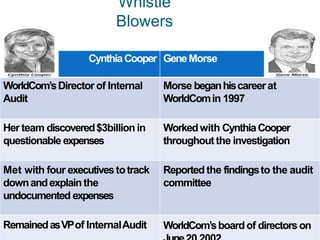
Whistle
Blowers
CynthiaCooper
WorldCom’sDirector of Internal
Audit
Her team discovered$3billion in
questionable expenses
Met with four executivestotrack
downandexplainthe
undocumented expenses
RemainedasVPof InternalAudit
GeneMorse
Morse beganhiscareerat
WorldComin 1997
Workedwith CynthiaCooper
throughoutthe investigation
Reported the findingsto the audit
committee
WorldCom’sboardof directorson
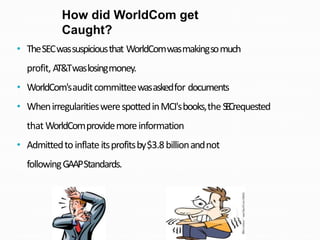
• TheSECwassuspiciousthat WorldComwasmakingsomuch
profit, AT&Twaslosingmoney.
• WorldCom'sauditcommitteewasaskedfor documents
• WhenirregularitieswerespottedinMCI'sbooks,theSECrequested
that WorldComprovidemoreinformation
• Admittedtoinflateitsprofitsby$3.8billionandnot
followingGAAPStandards.
How did WorldCom get
Caught?
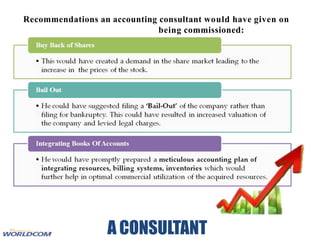
A CONSULTANT
Recommendations an accounting consultant would have given on
being commissioned:
 EnsuringAuditisdoneindependentlyand regularly.
 ThereshouldbeNon-Executiveboardmembersfor
controlling.
 Ensuringinternalauditsandrestaccountingpractices are
heldinaunbiasedmanner.
 CreatingEthicalpoliciesthroughoutthe company.
 Passinglawslike SarbanesOxleyAct, sothat suchScams
andScandalsdonothappen again.
Recomendations

WorldCom Scandal

  • 2.
    Name : LongDistanceDiscountServices(LDDS) Worldcom(1995) Founder:Murray WaldronandWilliam Rector CEO : BernieEbbers (1985) Founded :1983 Type :Telecommunications Expertise :Data, telephoneservices etc Company Profile
  • 3.
    CULTURE It was morethan questionable whether WorldCom has effective, transparent process of application, evaluation, justified decision making, monitoring, risk assessment andfollow up acquisition.
  • 4.
    •Recessionafter the dot-comboomended. •Revenuesfallshortofexpectations,whileDebt remains. •Withfailure ofsprinmergerit facedaseveresetback •Market valueof the company’sfell $150billion- $150million. Reasons for Fraud
  • 5.
  • 6.
    WorldCom customer in ChicagoWorldCom customer in London Local network in Chicago WorldCom’s network British network Fraud 1: Line Costs
  • 7.
    Line costs scandal:RELEASE OF ACCRUALS
  • 8.
    Reducing line costsandcapitalizing entries significantly improved the line cost E/R ratio. OTHER ADJUSTMENTS Improperly booked of $312 millionin revenue associated with Minimum Deficiency Charges. Accounted for over $215 million of credits that it had issued to Telecommunications Customers. Recognized $22.8 million in revenuefrom Early Termination Penalties. CAPITALIZATION AND OTHER ADJUSTMENTS CAPITALIZATION Avoided recognizing standard operating expenses when they incurred, instead postponed them into future saying “work in progress” Improperly shifted these expenditures from income statementto balance sheet, increasing current income and inflating assets. Reduction to Line Costs by capitalization and other adjustments (in % of the totalline cost)
  • 9.
    Fraud 2: InflatingRevenue  The company inflated its revenues with bogus accounting entries from ‘corporate unallocated revenue accounts’.  WorldCom reduced the reserve accounts held to cover the liabilities of acquired companies thereby adding $2.8 billion to the revenue line from these reserves. As a result, the profit margin increased considerably between 1998-2000.
  • 10.
    • A companyspends $500 to perform annual maintenance on a cutting machine. This expenditure is an operating expenditure and, as such, it should be treated as business expense .Current net income would decrease as a result. • However, if the company spends $500 to replace the motor in the machine, this expenditure would be posted to the asset account ―Property,Plant, and Equipment‖. Such an expenditure is a capital expenditure because the life of the equipment has been extended and/or its operating efficiency increased. EXPENSE VS CAPITAL EXPENDITURE Fraud 2: Inflating Revenue
  • 11.
    What WorldComdid? Reduced theamount of money held in reserve by $2.8 billion and moved this money into the revenue line of its financial statements. In 2000, classified operating expenses as long-term capital investments ( $3.85 billion). These changes turned WorldCom's losses into profits to the tune of $1.38 billion in 2001. It also made WorldCom's assets appear more valuable. Fraud 2: Inflating Revenue
  • 12.
    • They alsoadded a journal entry for $500 million in computer expenses, but supporting documents for the expenses were never found. • Ebber also takes out a separate $43 million loan to finance the purchase of a 500,000-acre ranch- backed by Ebbers' WorldCom stock. • Scott Sullivan misallocated capital expenditure as normal expenses, thus turning profits into losses ( $9 billion) - not discovered by internal auditor Cynthia Cooper until June 2002. Fraud 2: Inflating Revenue
  • 13.
     Under GAAP(Generally Accepted Accounting Principles), these fees cannot be capitalized. However, WorldCom did not calculate theseline costs as operating expenses and therefore did not subtract them from income. Accounting Violation No. 1
  • 14.
    WorldCom violated therevenue recognition principle because they recorded revenue entries (with top-side adjusting journal entries) that had no valid economic activity underlying the entries. Rather, the entries were merely a tool to close the gap between the revenue forecast and the actual revenue earned. The principal tool used to generate the entries was the monthly revenue report (“MonRev”) prepared and distributed by the revenue reporting and accounting group. The MonRev included dozens of spreadsheets detailing actual revenue data from all of the company’s channels and segments. Accounting Violation No 2. ( Revenue Recognition)
  • 15.
    WorldCom maintained afairly automated process for closing and consolidating operational revenue numbers on the MonRev. By the tenth day after the end of the month, the revenue accounting group prepared a draft, referred to as the “Preliminary” MonRev. In general, this preliminary report was compared to the targeted revenue numbers and the difference was used as the basis for a top-side adjusting journal entry to close the gap. In essence, by booking revenue entries with no underlying business activity, WorldCom violated the revenue recognition principle. Accounting Violation No. 2 ( Revenue Recognition)
  • 16.
    Violation Of Auditing StandardsNo.1 Paragraph 56 of PCAOB Auditing Standards Number 12 or Sarbanes–Oxley Act According to Sarbox Sextion 13, “The Audit Committee of each issuer, in its capacity as a committee of the board of directors, shall be directly responsible for the appointment, compensation and oversight of the work of any registered public accounting firm employed by that issuer” How did WorldCom violated the rule : The Audit committee didn’t support the internal audit staff’s budget. Denial of access to company records and allowing management to dictate the internal control staff world.
  • 17.
    Violation Of Auditing StandardsNo 2. According to PCAOB Ethics and Independence Rule 3520, auditor independence means that an auditor must not have a financial interest in the client, is not a trustee of an estate that has a financial interest, has a joint closely held investment, or has received/given a loan from the company/director/officer of the company. The auditor must not be a director/officer/employee, promoter/underwriter/voting trustee, or trustee for the client. The significance to the auditing profession is that only if an auditor is independent can he give a true and fair view of the financial statements. If the auditor is influenced the purpose of the audit will be lost.
  • 18.
    Auditor independence isthe bedrock of the auditing profession. This rule was violated by Andersen. The reason is that from 1999 through 2001 WorldCom paid Andersen $7.8 million in audit fees and during the same period Andersen received $50 million for consulting, litigation support, and tax services. This means Andersen had a financial interest in the audit procedure. So clearly he has violated the law. Violation Of Auditing Standards No.2
  • 19.
    WorldCom had notestablished an effective system of internal control over financial statements. Control policies and procedures that would have monitored and prevented management override and the release of line costs, which resulted in overstated financial statements. When linking internal controls to financial statement assertions for expense accounts, it is evident that several management assertions were incorrect and not identified by the controls. According to PCAOB Auditing Standards No.5 and Paragraph 68, Worldcom had an Ineffective Financial Reporting Violation Of Auditing Standards No 3.
  • 20.
    False management assertionsfell into the categories of accuracy, valuation presentation and disclosure. The management assertions of accuracy and valuation, which states that the transactions and events have been recorded accurately and that account balances have been valued correctly was false because WorldCom’s management did not correctly disclose the expense. Management’s assertions of presentation and disclosure, which state that all transactions and events have been presented correctly and that all relevant information has been disclosed to financial statement users was also violated. WorldCom failed to disclose the release of line costs the lowered its expense account and increased its revenues. Violation Of Auditing Standards No. 3
  • 21.
    Internal Control andaudit problems Board of Directors •Habit of rubber stamping senior management’s decisions without scrutinising detailed performance indicators. •Never met outside boardmeetings. •No vent for employees for reporting malfunctioning even if they felt so.. •Not bothered to look into the accounts of the company Audit •Internal audit • Limited scope and power. • Perform mostly operational audits rather than financial audits. • Reported directly to the CFO •External Audit: Arthur Anderson Firm •Limited its testing of account balancing relying on the adequacy of WorldCom's control environment. •Overlooked serious deficiency in the accounting ledgers, which were exploited. •Considered WorldCom as a “flagship client” and a “crown jewel” of its firm. Personal Finances •Many senior executives, including the CEO Ebbers had private finances and debts taken on stocks of the company. •The board (Compensation Committee)approved ‘sweetheart loans’ (over $400 million) to Ebbers, without any collaterals or assurances or knowledge of use of those funds.
  • 22.
    Whistle Blowers CynthiaCooper WorldCom’sDirector of Internal Audit Herteam discovered$3billion in questionable expenses Met with four executivestotrack downandexplainthe undocumented expenses RemainedasVPof InternalAudit GeneMorse Morse beganhiscareerat WorldComin 1997 Workedwith CynthiaCooper throughoutthe investigation Reported the findingsto the audit committee WorldCom’sboardof directorson
  • 23.
    • TheSECwassuspiciousthat WorldComwasmakingsomuch profit,AT&Twaslosingmoney. • WorldCom'sauditcommitteewasaskedfor documents • WhenirregularitieswerespottedinMCI'sbooks,theSECrequested that WorldComprovidemoreinformation • Admittedtoinflateitsprofitsby$3.8billionandnot followingGAAPStandards. How did WorldCom get Caught?
  • 24.
    A CONSULTANT Recommendations anaccounting consultant would have given on being commissioned:
  • 25.
     EnsuringAuditisdoneindependentlyand regularly. ThereshouldbeNon-Executiveboardmembersfor controlling.  Ensuringinternalauditsandrestaccountingpractices are heldinaunbiasedmanner.  CreatingEthicalpoliciesthroughoutthe company.  Passinglawslike SarbanesOxleyAct, sothat suchScams andScandalsdonothappen again. Recomendations