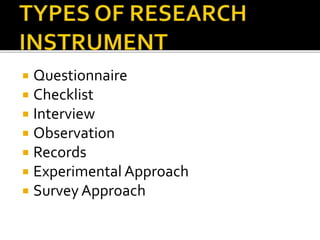
 Questionnaire
 Checklist
 Interview
 Observation
 Records
 Experimental Approach
 Survey Approach
 A series of question designed to elicit
information, which is filled in by all
participant in the sample.
 This can be gathered either by oral
interview or by written questionnaire.
 This is the most common type of
research instrument.
 These are items that comprise
several question on a topic and
require the same response
format.
 This involves either structure or
unstructured verbal communication
between the researcher and the
subject, during which information is
obtained for a study.
 Most commonly used in qualitative
research.
TYPES OF OBSERVATION
1. Unstructured observation
 A method of collecting research
data that has both opponent and
proponent
 Preparation of record keeping
forms such as category systems,
checklists and ratings scales.
 Researcher typically has some
prior knowledge about the
behavior or event of interest.
 A record refers to all the number
and statistic that institutions,
organization and people keep as a
record of their activities.
 A powerful design for testing
hypothesis of casual relationships
among variables.
 Researcher controls the
independent variable and watches
the effect on the dependent
variable.
 Non-experimental type in which
the researcher investigate a
community or a group of people.
 Another name is FORMULATIVE
or EXPLORATORY research.

How to-collect-data-research

  • 2.
     Questionnaire  Checklist Interview  Observation  Records  Experimental Approach  Survey Approach
  • 3.
     A seriesof question designed to elicit information, which is filled in by all participant in the sample.  This can be gathered either by oral interview or by written questionnaire.  This is the most common type of research instrument.
  • 4.
     These areitems that comprise several question on a topic and require the same response format.
  • 5.
     This involveseither structure or unstructured verbal communication between the researcher and the subject, during which information is obtained for a study.
  • 6.
     Most commonlyused in qualitative research. TYPES OF OBSERVATION 1. Unstructured observation  A method of collecting research data that has both opponent and proponent
  • 7.
     Preparation ofrecord keeping forms such as category systems, checklists and ratings scales.  Researcher typically has some prior knowledge about the behavior or event of interest.
  • 8.
     A recordrefers to all the number and statistic that institutions, organization and people keep as a record of their activities.
  • 9.
     A powerfuldesign for testing hypothesis of casual relationships among variables.  Researcher controls the independent variable and watches the effect on the dependent variable.
  • 10.
     Non-experimental typein which the researcher investigate a community or a group of people.  Another name is FORMULATIVE or EXPLORATORY research.