RESEARCH
METHODOLOGY: TOOLS
AND TECHNIQUES
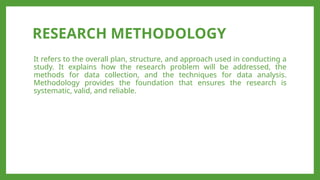
RESEARCH METHODOLOGY
It refers to the overall plan, structure, and approach used in conducting a
study. It explains how the research problem will be addressed, the
methods for data collection, and the techniques for data analysis.
Methodology provides the foundation that ensures the research is
systematic, valid, and reliable.
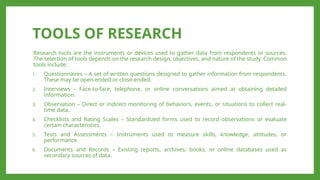
TOOLS OF RESEARCH
Research tools are the instruments or devices used to gather data from respondents or sources.
The selection of tools depends on the research design, objectives, and nature of the study. Common
tools include:
1. Questionnaires – A set of written questions designed to gather information from respondents.
These may be open-ended or close-ended.
2. Interviews – Face-to-face, telephone, or online conversations aimed at obtaining detailed
information.
3. Observation – Direct or indirect monitoring of behaviors, events, or situations to collect real-
time data.
4. Checklists and Rating Scales – Standardized forms used to record observations or evaluate
certain characteristics.
5. Tests and Assessments – Instruments used to measure skills, knowledge, attitudes, or
performance.
6. Documents and Records – Existing reports, archives, books, or online databases used as
secondary sources of data.
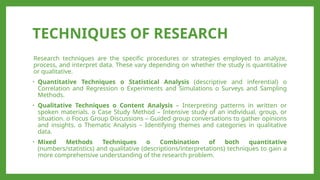
TECHNIQUES OF RESEARCH
Research techniques are the specific procedures or strategies employed to analyze,
process, and interpret data. These vary depending on whether the study is quantitative
or qualitative.
• Quantitative Techniques o Statistical Analysis (descriptive and inferential) o
Correlation and Regression o Experiments and Simulations o Surveys and Sampling
Methods.
• Qualitative Techniques o Content Analysis – Interpreting patterns in written or
spoken materials. o Case Study Method – Intensive study of an individual, group, or
situation. o Focus Group Discussions – Guided group conversations to gather opinions
and insights. o Thematic Analysis – Identifying themes and categories in qualitative
data.
• Mixed Methods Techniques o Combination of both quantitative
(numbers/statistics) and qualitative (descriptions/interpretations) techniques to gain a
more comprehensive understanding of the research problem.

Research Methodology: Tools and Techniqies.pptx

  • 1.
  • 2.
    RESEARCH METHODOLOGY It refersto the overall plan, structure, and approach used in conducting a study. It explains how the research problem will be addressed, the methods for data collection, and the techniques for data analysis. Methodology provides the foundation that ensures the research is systematic, valid, and reliable.
  • 3.
    TOOLS OF RESEARCH Researchtools are the instruments or devices used to gather data from respondents or sources. The selection of tools depends on the research design, objectives, and nature of the study. Common tools include: 1. Questionnaires – A set of written questions designed to gather information from respondents. These may be open-ended or close-ended. 2. Interviews – Face-to-face, telephone, or online conversations aimed at obtaining detailed information. 3. Observation – Direct or indirect monitoring of behaviors, events, or situations to collect real- time data. 4. Checklists and Rating Scales – Standardized forms used to record observations or evaluate certain characteristics. 5. Tests and Assessments – Instruments used to measure skills, knowledge, attitudes, or performance. 6. Documents and Records – Existing reports, archives, books, or online databases used as secondary sources of data.
  • 4.
    TECHNIQUES OF RESEARCH Researchtechniques are the specific procedures or strategies employed to analyze, process, and interpret data. These vary depending on whether the study is quantitative or qualitative. • Quantitative Techniques o Statistical Analysis (descriptive and inferential) o Correlation and Regression o Experiments and Simulations o Surveys and Sampling Methods. • Qualitative Techniques o Content Analysis – Interpreting patterns in written or spoken materials. o Case Study Method – Intensive study of an individual, group, or situation. o Focus Group Discussions – Guided group conversations to gather opinions and insights. o Thematic Analysis – Identifying themes and categories in qualitative data. • Mixed Methods Techniques o Combination of both quantitative (numbers/statistics) and qualitative (descriptions/interpretations) techniques to gain a more comprehensive understanding of the research problem.