1/25
How to Write an Effective
Press Release?
How to write useful and effective press
releases? What mistakes to avoid? Do the
traditional forms of contacting the media
still work? What irritates the media the most
in the releases they get?
2/25
What should you do
for your communique to hit the mark?
Check out what journalists say!
3/25
#1Most common mistakes
in writing press releases
4/25
Avoid is forgetting to include key details.
Names, dates, anything that answers the who/
what/when/where. You’d be surprised, but those
things can be easy to forget, and journalists or
other influencers don’t want to have to dig to fill
the holes.danielle capriato
PRNewswire
5/25
When I receive a press release from
someone who has no idea what is covered in
the publication I work for, it often ends up in
the trash bin.
Do your homework before you write and
send the press release. In this case, know
something about the target you are pitching,
presumably a publication or a media outlet.
seth arenstein
PR News
6/25
Don’t assume everyone will read every word,
stick to the facts, and don’t exaggerate with
false claims. Always credit your source, and
don’t ever trash your competitors.
sara ghazaii
PR Council
7/25
I have a feeling that 80% of the PR people
who contact us don’t do any research
beforehand. They don’t read anything by
the given journalist, and what’s still hard
to believe, they often have no clue what
publication they’re calling.marta bellon
Business Insider Polska:
8/25
The passive voice is sometimes appropriate,
but I get pretty annoyed when writers use it
unnecessarily. If you want your company to
appear active, write in the active voice!
Another mistake can be to use business
jargon. Again, there are times when industry
terms may be appropriate, but it’s easy to
forget that your target audience (journalists
and readers) may not be familiar with the
terms you take for granted.
james kotecki
AutomatedInsights
9/25
#2
How to write an effective
press release?
10/25
get these 6 tips
for writing a great press release

11/25
And use wisely this free
feedback from media
people:
12/25
Write for people, not for search engines
(search engines try to think like people,
so they like natural language too!)
and avoid keyword stuffing.

13/25
Be brief and to the point.
Tell the writer WHY the news in the release is important
to his/her readers and do so as soon as you can.
Don’t make the journalist search through your whole
press release to find the answer to this vital question.
Make things as simple as possible.

14/25
Stick to the core of
“who, what, when, where, and why”
— it seems simple, but you typically have a good 30
seconds to capture your reader’s attention.

15/25
Understand that journalists
have a well developed
BS detector!

16/25
Include the contact info
of the person who can provide
a detailed explanation of the project.

17/25
Use proper visuals.
It often turns out that the pictures sent
are legally unpublishable because they lack
the legal rights to be put out for example in print and
online. That automatically disqualifies the agency.

18/25

#How to contact the media nowadays?
19/25
Way 1:
The basic approach is “information follow up”,
which works if the sender knows to whom and
why they’re sending the release and can justify
it a bit better than “because my client really
wanted to be seen in a prestigious magazine.”
20/25
Way 2:
Reach your contacts directly via email or social
media, or simply go through the PR department.
Very often both ways at once. It’s quicker and
more effective.
21/25
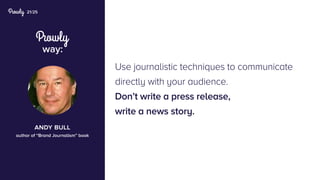
way:
Use journalistic techniques to communicate
directly with your audience.
Don’t write a press release,
write a news story.
andy bull
author of “Brand Journalism” book
22/25
Don’t know how to start?
23/25
“Don’t talk about products and services at all. Instead, tell stories.
Be interesting, create something that’s going to be valuable. My
suggestion is always: don’t start with what your company does, in-
stead start with the problems that your buyers have” advises
David Meerman Scott in our interview. Read it and start jour
journey with brand journalism right now!

24/25
PRO tip:
The press release is important, but as part of an overall launch
strategy. You’ll probably have a lower success rate if you just
push a press release out into the world without doing
additional outreach.

25/25
Wait.
Prefer to download this SlideShare as a PDF and view that Way?
click here


How to Write an Effective Press Release

  • 1.
    1/25 How to Writean Effective Press Release? How to write useful and effective press releases? What mistakes to avoid? Do the traditional forms of contacting the media still work? What irritates the media the most in the releases they get?
  • 2.
    2/25 What should youdo for your communique to hit the mark? Check out what journalists say!
  • 3.
    3/25 #1Most common mistakes inwriting press releases
  • 4.
    4/25 Avoid is forgettingto include key details. Names, dates, anything that answers the who/ what/when/where. You’d be surprised, but those things can be easy to forget, and journalists or other influencers don’t want to have to dig to fill the holes.danielle capriato PRNewswire
  • 5.
    5/25 When I receivea press release from someone who has no idea what is covered in the publication I work for, it often ends up in the trash bin. Do your homework before you write and send the press release. In this case, know something about the target you are pitching, presumably a publication or a media outlet. seth arenstein PR News
  • 6.
    6/25 Don’t assume everyonewill read every word, stick to the facts, and don’t exaggerate with false claims. Always credit your source, and don’t ever trash your competitors. sara ghazaii PR Council
  • 7.
    7/25 I have afeeling that 80% of the PR people who contact us don’t do any research beforehand. They don’t read anything by the given journalist, and what’s still hard to believe, they often have no clue what publication they’re calling.marta bellon Business Insider Polska:
  • 8.
    8/25 The passive voiceis sometimes appropriate, but I get pretty annoyed when writers use it unnecessarily. If you want your company to appear active, write in the active voice! Another mistake can be to use business jargon. Again, there are times when industry terms may be appropriate, but it’s easy to forget that your target audience (journalists and readers) may not be familiar with the terms you take for granted. james kotecki AutomatedInsights
  • 9.
    9/25 #2 How to writean effective press release?
  • 10.
    10/25 get these 6tips for writing a great press release 
  • 11.
    11/25 And use wiselythis free feedback from media people:
  • 12.
    12/25 Write for people,not for search engines (search engines try to think like people, so they like natural language too!) and avoid keyword stuffing. 
  • 13.
    13/25 Be brief andto the point. Tell the writer WHY the news in the release is important to his/her readers and do so as soon as you can. Don’t make the journalist search through your whole press release to find the answer to this vital question. Make things as simple as possible. 
  • 14.
    14/25 Stick to thecore of “who, what, when, where, and why” — it seems simple, but you typically have a good 30 seconds to capture your reader’s attention. 
  • 15.
    15/25 Understand that journalists havea well developed BS detector! 
  • 16.
    16/25 Include the contactinfo of the person who can provide a detailed explanation of the project. 
  • 17.
    17/25 Use proper visuals. Itoften turns out that the pictures sent are legally unpublishable because they lack the legal rights to be put out for example in print and online. That automatically disqualifies the agency. 
  • 18.
    18/25  #How to contactthe media nowadays?
  • 19.
    19/25 Way 1: The basicapproach is “information follow up”, which works if the sender knows to whom and why they’re sending the release and can justify it a bit better than “because my client really wanted to be seen in a prestigious magazine.”
  • 20.
    20/25 Way 2: Reach yourcontacts directly via email or social media, or simply go through the PR department. Very often both ways at once. It’s quicker and more effective.
  • 21.
    21/25 way: Use journalistic techniquesto communicate directly with your audience. Don’t write a press release, write a news story. andy bull author of “Brand Journalism” book
  • 22.
  • 23.
    23/25 “Don’t talk aboutproducts and services at all. Instead, tell stories. Be interesting, create something that’s going to be valuable. My suggestion is always: don’t start with what your company does, in- stead start with the problems that your buyers have” advises David Meerman Scott in our interview. Read it and start jour journey with brand journalism right now! 
  • 24.
    24/25 PRO tip: The pressrelease is important, but as part of an overall launch strategy. You’ll probably have a lower success rate if you just push a press release out into the world without doing additional outreach. 
  • 25.
    25/25 Wait. Prefer to downloadthis SlideShare as a PDF and view that Way? click here 