Building a Healthy Support GroupKarla Steingraber, Psy.D. & Ann Harriman, MAAprioris Psychological Health Services666 Dundee Rd., Suite 502, Northbrook IL
Who are you? Current Support Group LeadersFuture Support Group LeadersTherapistsLay People
Issues Faced / FearsWhat are you interested in hearing today?
Question 1:What is the #1 Most Important Attribute of a Healthy Support Group
Question 1:What is the #1 Most Important Attribute of a Healthy Support GroupNo Trigger TalkSupportListeningLeaving judgments at the doorTime limits/the frameNo monopolizingConfidentialitySafety
Why a Support Group
What makes a support group effective? Relationship Skills
 Increase Motivation
 Connection
 Cost & Time Efficiency...more and more, Bill discovered that new adherents could get sober by believing in each other and in the strength of this group. Men who had proven over and over again, by extremely painful experience, that they could not get sober on their own had somehow become more powerful when two or three of them worked on their common problem. This, then—whatever it was that occurred among them—was what they could accept as a power greater than themselves.				--AA Historian, Ernest Kurtz
What is a support group?
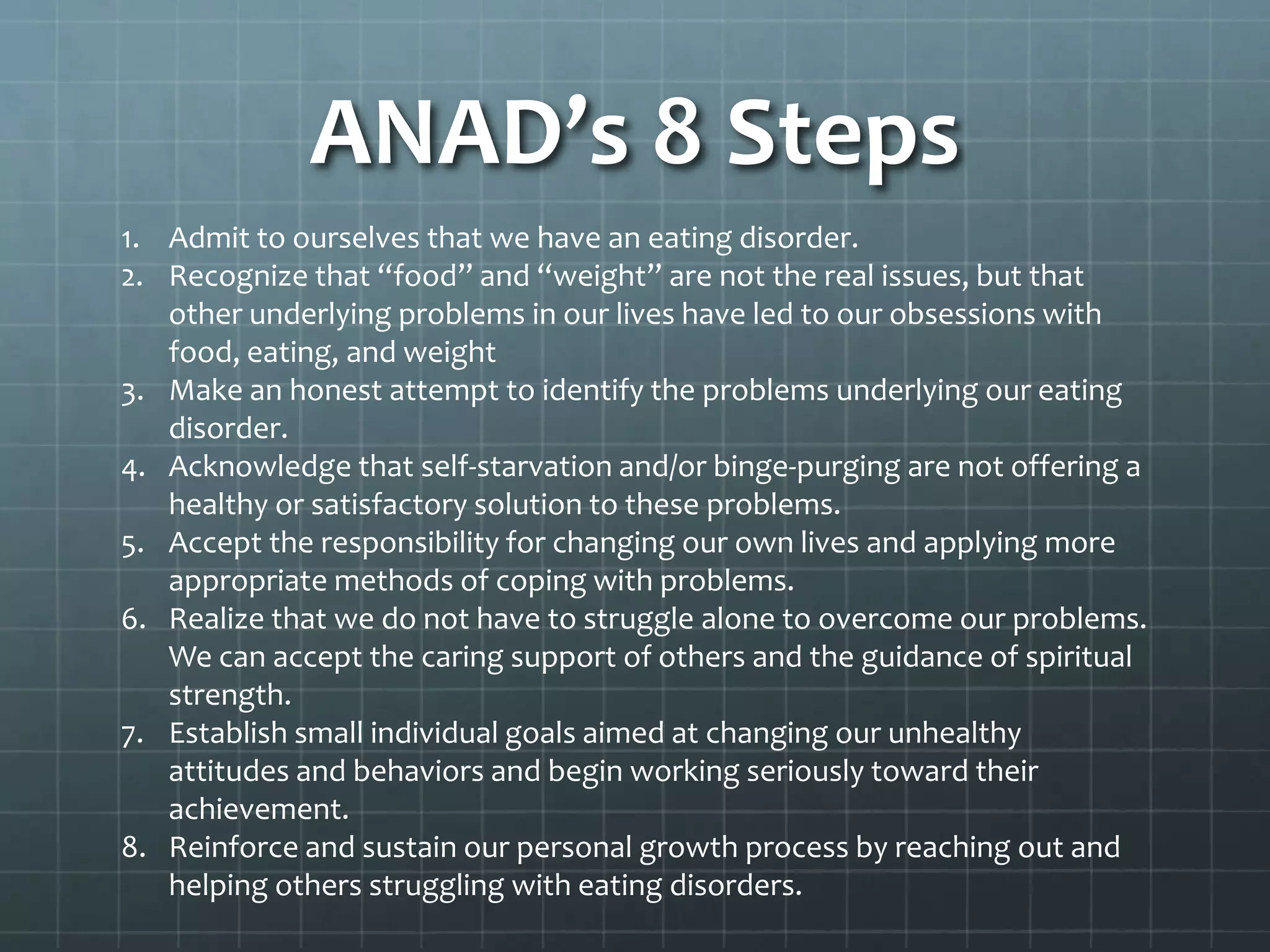
ANAD’s 8 StepsAdmit to ourselves that we have an eating disorder.  Recognize that “food” and “weight” are not the real issues, but that other underlying problems in our lives have led to our obsessions with food, eating, and weightMake an honest attempt to identify the problems underlying our eating disorder.  Acknowledge that self-starvation and/or binge-purging are not offering a healthy or satisfactory solution to these problems.  Accept the responsibility for changing our own lives and applying more appropriate methods of coping with problems.  Realize that we do not have to struggle alone to overcome our problems.  We can accept the caring support of others and the guidance of spiritual strength.  Establish small individual goals aimed at changing our unhealthy attitudes and behaviors and begin working seriously toward their achievement. Reinforce and sustain our personal growth process by reaching out and helping others struggling with eating disorders.
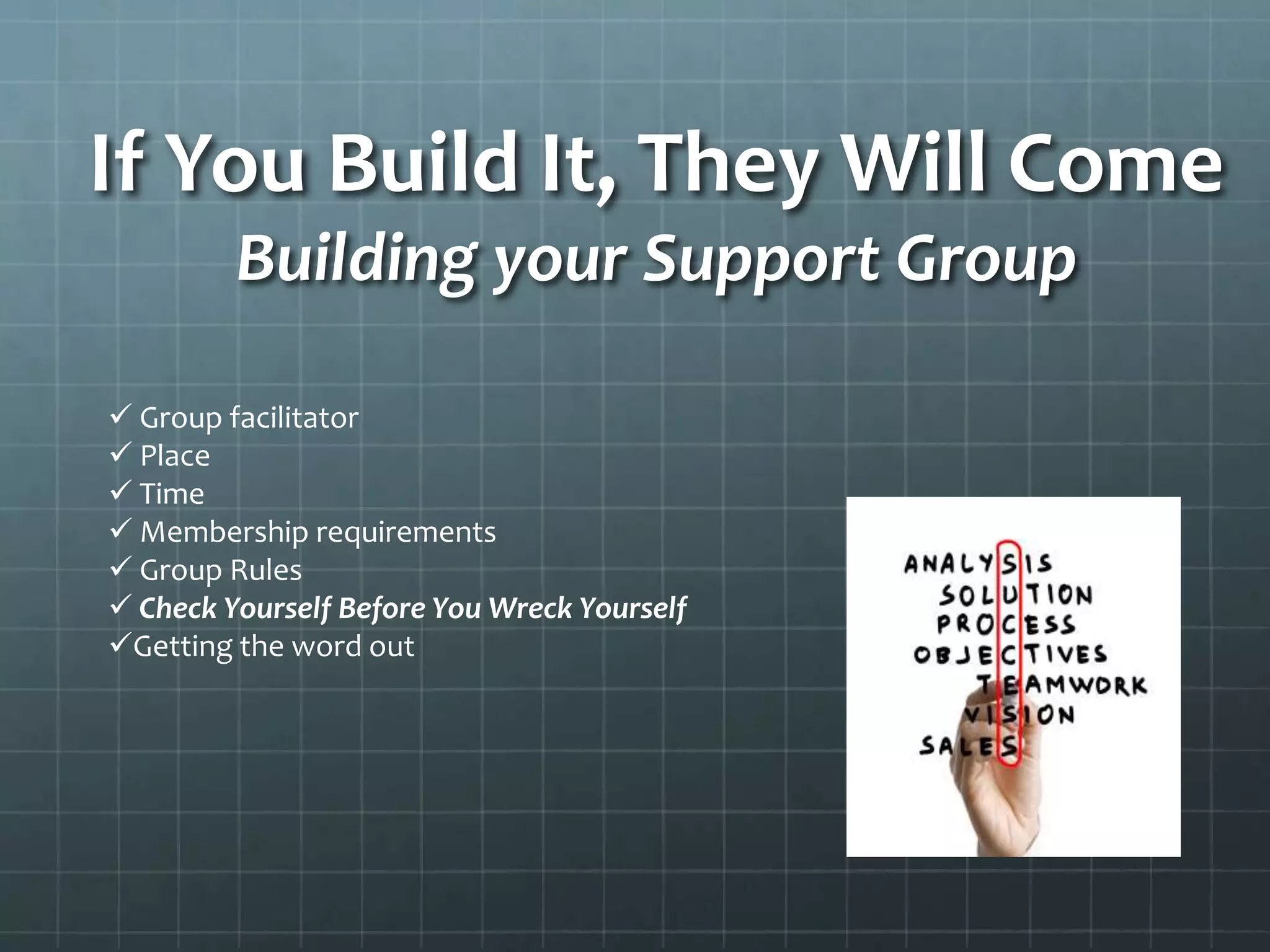
If You Build It, They Will ComeBuilding your Support Group Group facilitator
 Place
 Time
 Membership requirements
 Group Rules
 Check Yourself Before You Wreck Yourself
Getting the word outBreakout Session #1Sketches 1, 2, 51. Split into groups2. Read over sketches together and 3. Fill in your thoughts and interventions
Question 2:What leads to facilitator burnout ?
We have a group!Leader vs. Facilitator“Peer” Facilitator vs. “Professionally Trained” Facilitator
BoundariesBehaviorMeeting outside groupFriendliness vs. FriendsInvolvement in Personal LivesSelf AwarenessMotivationsOwn IssuesSelf-Disclosure
Facilitator or Co-FacilitatorSharing the LoadNew Dynamic
Group RoutineHow do you feel right nowWhat is something positive about your recoveryDid you reach your goalWill you be speaking in depth laterRandom Question for funMeaningful goalsChecking in with Co-leaderNotes, logLong-Term Goals/Strategies

How to Start, Enhance, and Maintain a Support Group

  • 1.
    Building a HealthySupport GroupKarla Steingraber, Psy.D. & Ann Harriman, MAAprioris Psychological Health Services666 Dundee Rd., Suite 502, Northbrook IL
  • 2.
    Who are you?Current Support Group LeadersFuture Support Group LeadersTherapistsLay People
  • 3.
    Issues Faced /FearsWhat are you interested in hearing today?
  • 4.
    Question 1:What isthe #1 Most Important Attribute of a Healthy Support Group
  • 5.
    Question 1:What isthe #1 Most Important Attribute of a Healthy Support GroupNo Trigger TalkSupportListeningLeaving judgments at the doorTime limits/the frameNo monopolizingConfidentialitySafety
  • 6.
  • 7.
    What makes asupport group effective? Relationship Skills
  • 8.
  • 9.
  • 10.
    Cost &Time Efficiency...more and more, Bill discovered that new adherents could get sober by believing in each other and in the strength of this group. Men who had proven over and over again, by extremely painful experience, that they could not get sober on their own had somehow become more powerful when two or three of them worked on their common problem. This, then—whatever it was that occurred among them—was what they could accept as a power greater than themselves. --AA Historian, Ernest Kurtz
  • 11.
    What is asupport group?
  • 12.
    ANAD’s 8 StepsAdmitto ourselves that we have an eating disorder. Recognize that “food” and “weight” are not the real issues, but that other underlying problems in our lives have led to our obsessions with food, eating, and weightMake an honest attempt to identify the problems underlying our eating disorder. Acknowledge that self-starvation and/or binge-purging are not offering a healthy or satisfactory solution to these problems. Accept the responsibility for changing our own lives and applying more appropriate methods of coping with problems. Realize that we do not have to struggle alone to overcome our problems. We can accept the caring support of others and the guidance of spiritual strength. Establish small individual goals aimed at changing our unhealthy attitudes and behaviors and begin working seriously toward their achievement. Reinforce and sustain our personal growth process by reaching out and helping others struggling with eating disorders.
  • 13.
    If You BuildIt, They Will ComeBuilding your Support Group Group facilitator
  • 14.
  • 15.
  • 16.
  • 17.
  • 18.
    Check YourselfBefore You Wreck Yourself
  • 19.
    Getting the wordoutBreakout Session #1Sketches 1, 2, 51. Split into groups2. Read over sketches together and 3. Fill in your thoughts and interventions
  • 20.
    Question 2:What leadsto facilitator burnout ?
  • 21.
    We have agroup!Leader vs. Facilitator“Peer” Facilitator vs. “Professionally Trained” Facilitator
  • 22.
    BoundariesBehaviorMeeting outside groupFriendlinessvs. FriendsInvolvement in Personal LivesSelf AwarenessMotivationsOwn IssuesSelf-Disclosure
  • 23.
  • 24.
    Group RoutineHow doyou feel right nowWhat is something positive about your recoveryDid you reach your goalWill you be speaking in depth laterRandom Question for funMeaningful goalsChecking in with Co-leaderNotes, logLong-Term Goals/Strategies
  • 25.
  • 26.
  • 27.
    Maintaining a HealthyDynamicOpen MindedHumble/ModestSmall GoalsWhen to Change DirectionFeedbackSurveysStay Positive
  • 28.
  • 29.
    Breakout Session 2 Sketches3 & 4Identify mistakes group leaders may have made, improve upon itIdentify where the group leader did something right
  • 30.
    Recognizing the Dynamic Withall 5 sketches, match the sketch to the issue___ Boundaries___ Safety___ Aggression___ Scape-goating___ Trigger Talk
  • 31.
    Contact Information Dr. Karla Steingraber Ann Harriman, MA666 Dundee Rd., Ste 502 Northbrook IL 60062 847-778-3997keas@aprioris.netaharriman@aprioris.netDr. Karla SteingraberAnn Harriman, MA