
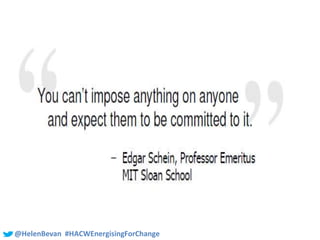
@HelenBevan #HACWEnergisingForChange
Helen Bevan
Chief Transformation Officer
@HelenBevan
#HACWEnergisingForChange
Source of image: ivysea.com
Building
energy for
change
@HelenBevan #HACWEnergisingForChange Source of image: Whatsthebigideascwartzy.blogspot.com
@HelenBevan #HACWEnergisingForChange
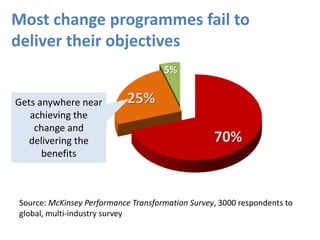
Most change programmes fail to
deliver their objectives
Source: McKinsey Performance Transformation Survey, 3000 respondents to
global, multi-industry survey
70%
25%
5%
Gets anywhere near
achieving the
change and
delivering the
benefits
@HelenBevan #HACWEnergisingForChange
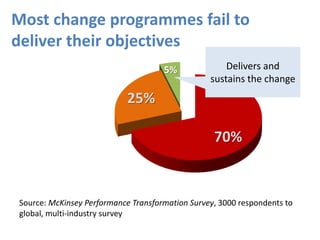
Source: McKinsey Performance Transformation Survey, 3000 respondents to
global, multi-industry survey
70%
25%
5% Delivers and
sustains the change
Most change programmes fail to
deliver their objectives
@HelenBevan #HACWEnergisingForChange
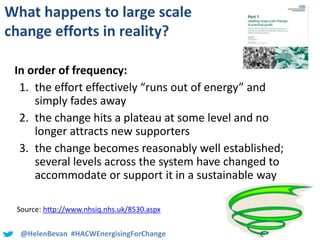
What happens to large scale
change efforts in reality?
In order of frequency:
1. the effort effectively “runs out of energy” and
simply fades away
2. the change hits a plateau at some level and no
longer attracts new supporters
3. the change becomes reasonably well established;
several levels across the system have changed to
accommodate or support it in a sustainable way
Source: http://www.nhsiq.nhs.uk/8530.aspx
@HelenBevan #HACWEnergisingForChange
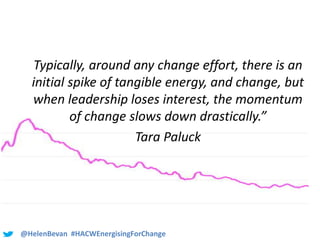
Typically, around any change effort, there is an
initial spike of tangible energy, and change, but
when leadership loses interest, the momentum
of change slows down drastically.”
Tara Paluck
@HelenBevan #HACWEnergisingForChange
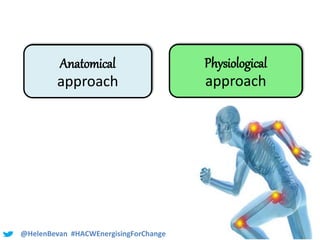
Anatomical
approach
Physiological
approach
@HelenBevan #HACWEnergisingForChange
Anatomical
approach
 Improving clinical
systems
 Seeking to reduce
harm and reduce risk
 Redesigning pathways
 Standardising
 Measuring
@HelenBevan #HACWEnergisingForChange
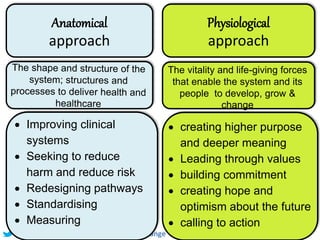
Anatomical
approach
 Improving clinical
systems
 Seeking to reduce
harm and reduce risk
 Redesigning pathways
 Standardising
 Measuring
Physiological
approach
The vitality and life-giving forces
that enable the system and its
people to develop, grow &
change
 creating higher purpose
and deeper meaning
 Leading through values
 building commitment
 creating hope and
optimism about the future
 calling to action
@HelenBevan #HACWEnergisingForChange
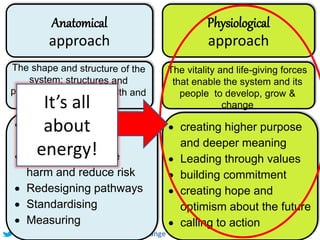
Anatomical
approach
 Improving clinical
systems
 Seeking to reduce
harm and reduce risk
 Redesigning pathways
 Standardising
 Measuring
Physiological
approach
The vitality and life-giving forces
that enable the system and its
people to develop, grow &
change
 creating higher purpose
and deeper meaning
 Leading through values
 building commitment
 creating hope and
optimism about the future
 calling to action
It’s all
about
energy!
@HelenBevan #HACWEnergisingForChange
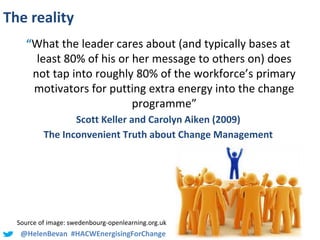
The reality
“What the leader cares about (and typically bases at
least 80% of his or her message to others on) does
not tap into roughly 80% of the workforce’s primary
motivators for putting extra energy into the change
programme”
Scott Keller and Carolyn Aiken (2009)
The Inconvenient Truth about Change Management
Source of image: swedenbourg-openlearning.org.uk
@HelenBevan #HACWEnergisingForChange
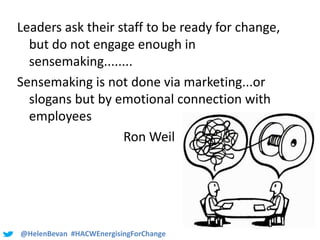
Leaders ask their staff to be ready for change,
but do not engage enough in
sensemaking........
Sensemaking is not done via marketing...or
slogans but by emotional connection with
employees
Ron Weil
@HelenBevan #HACWEnergisingForChange
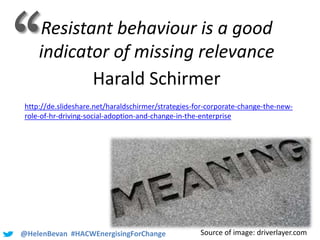
Resistant behaviour is a good
indicator of missing relevance
Harald Schirmer
http://de.slideshare.net/haraldschirmer/strategies-for-corporate-change-the-new-
role-of-hr-driving-social-adoption-and-change-in-the-enterprise
Source of image: driverlayer.com
‘‘
@HelenBevan #HACWEnergisingForChange
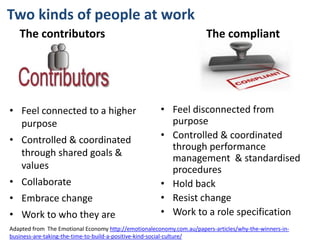
Two kinds of people at work
• Feel connected to a higher
purpose
• Controlled & coordinated
through shared goals &
values
• Collaborate
• Embrace change
• Work to who they are
The contributors The compliant
• Feel disconnected from
purpose
• Controlled & coordinated
through performance
management & standardised
procedures
• Hold back
• Resist change
• Work to a role specification
Adapted from The Emotional Economy http://emotionaleconomy.com.au/papers-articles/why-the-winners-in-
business-are-taking-the-time-to-build-a-positive-kind-social-culture/
@HelenBevan #HACWEnergisingForChange
Two kinds of people at work
• Feel connected to a higher
purpose
• Controlled & coordinated
through shared goals &
values
• Collaborate
• Embrace change
• Work to who they are
The contributors The compliant
• Feel disconnected from
purpose
• Controlled & coordinated
through performance
management & standardised
procedures
• Hold back
• Resist change
• Work to a role specification
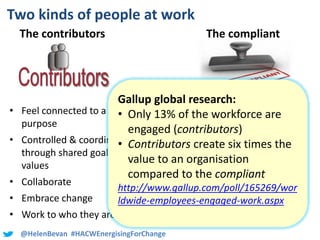
Gallup global research:
• Only 13% of the workforce are
engaged (contributors)
• Contributors create six times the
value to an organisation
compared to the compliant
http://www.gallup.com/poll/165269/wor
ldwide-employees-engaged-work.aspx
@HelenBevan #HACWEnergisingForChange
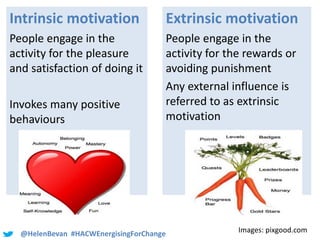
Intrinsic motivation
People engage in the
activity for the pleasure
and satisfaction of doing it
Invokes many positive
behaviours
Extrinsic motivation
People engage in the
activity for the rewards or
avoiding punishment
Any external influence is
referred to as extrinsic
motivation
Images: pixgood.com
@HelenBevan #HACWEnergisingForChange
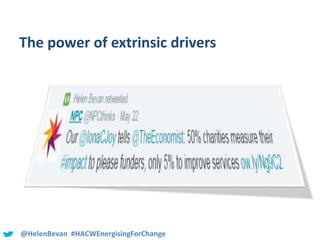
The power of extrinsic drivers
@HelenBevan #HACWEnergisingForChange
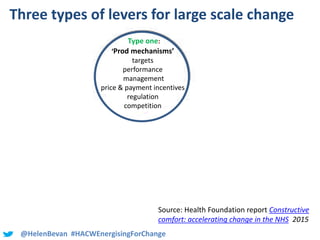
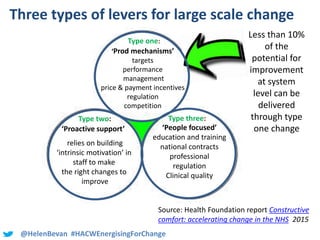
Three types of levers for large scale change
‘Prod mechanisms’
targets
performance
management
price & payment incentives
regulation
competition
‘Proactive support’
relies on building
‘intrinsic motivation’ in
staff to make
the right changes to
improve
‘People focused’
education and training
national contracts
professional
regulation
clinical
quality standards
Type one:
Type two: Type three:
Source: Health Foundation report Constructive
comfort: accelerating change in the NHS 2015
@HelenBevan #HACWEnergisingForChange
Three types of levers for large scale change
‘Prod mechanisms’
targets
performance
management
price & payment incentives
regulation
competition
‘Proactive support’
relies on building
‘intrinsic motivation’ in
staff to make
the right changes to
improve
‘People focused’
education and training
national contracts
professional
regulation
clinical
quality standards
Type one:
Type two: Type three:
Source: Health Foundation report Constructive
comfort: accelerating change in the NHS 2015
@HelenBevan #HACWEnergisingForChange
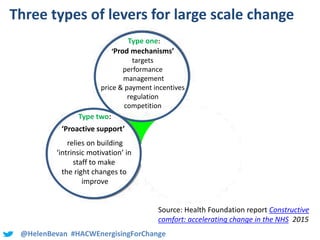
Three types of levers for large scale change
‘Prod mechanisms’
targets
performance
management
price & payment incentives
regulation
competition
‘Proactive support’
relies on building
‘intrinsic motivation’ in
staff to make
the right changes to
improve
‘People focused’
education and training
national contracts
professional
regulation
Clinical quality
Type one:
Type two: Type three:
Source: Health Foundation report Constructive
comfort: accelerating change in the NHS 2015
@HelenBevan #HACWEnergisingForChange
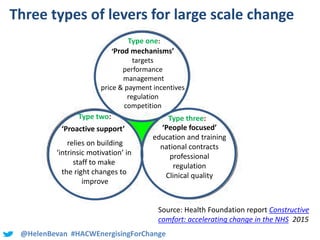
Three types of levers for large scale change
‘Prod mechanisms’
targets
performance
management
price & payment incentives
regulation
competition
‘Proactive support’
relies on building
‘intrinsic motivation’ in
staff to make
the right changes to
improve
‘People focused’
education and training
national contracts
professional
regulation
Clinical quality
Type one:
Type two: Type three:
Source: Health Foundation report Constructive
comfort: accelerating change in the NHS 2015
Less than 10%
of the
potential for
improvement
at system
level can be
delivered
through type
one change
#SHCR @School4Radicals@HelenBevan #HACWEnergisingForChange
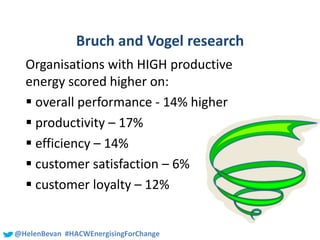
Bruch and Vogel research
Organisations with HIGH productive
energy scored higher on:
 overall performance - 14% higher
 productivity – 17%
 efficiency – 14%
 customer satisfaction – 6%
 customer loyalty – 12%
#SHCR @School4Radicals
#SHCR @School4Radicals@HelenBevan #HACWEnergisingForChange
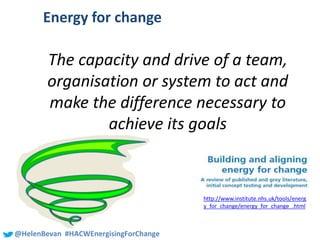
Energy for change
The capacity and drive of a team,
organisation or system to act and
make the difference necessary to
achieve its goals
http://www.institute.nhs.uk/tools/energ
y_for_change/energy_for_change_.html
#SHCR @School4Radicals@HelenBevan #HACWEnergisingForChange
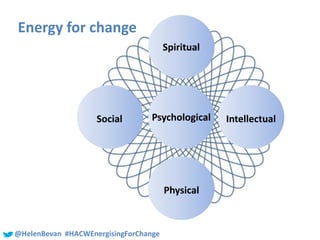
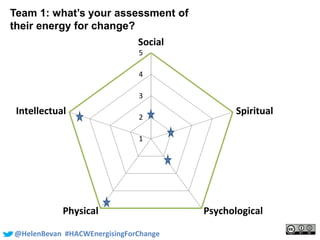
Psychological
Physical
Spiritual
Social Intellectual
Energy for change
#SHCR @School4Radicals@HelenBevan #HACWEnergisingForChange
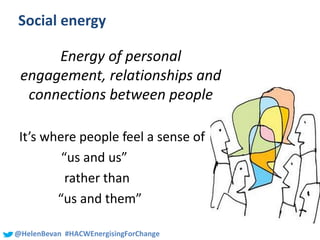
Social energy
Energy of personal
engagement, relationships and
connections between people
It’s where people feel a sense of
“us and us”
rather than
“us and them”
#SHCR @School4Radicals@HelenBevan #HACWEnergisingForChange
Spiritual energy
Energy of commitment to a common
vision for the future, driven by shared
values and a higher purpose
Gives people the confidence to move towards a
different future that is more compelling than
the status quo
#SHCR @School4Radicals@HelenBevan #HACWEnergisingForChange
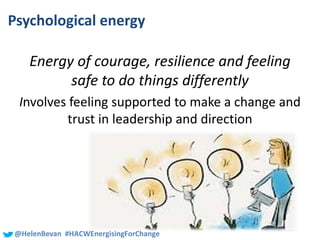
Psychological energy
Energy of courage, resilience and feeling
safe to do things differently
Involves feeling supported to make a change and
trust in leadership and direction
#SHCR @School4Radicals@HelenBevan #HACWEnergisingForChange
Physical energy
Energy of action, getting things done and
making progress
The flexible, responsive drive to make things
happen
#SHCR @School4Radicals@HelenBevan #HACWEnergisingForChange
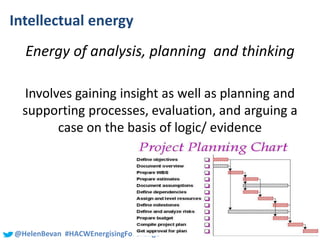
Intellectual energy
Energy of analysis, planning and thinking
Involves gaining insight as well as planning and
supporting processes, evaluation, and arguing a
case on the basis of logic/ evidence
#SHCR @School4Radicals@HelenBevan #HACWEnergisingForChange
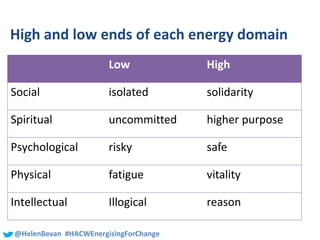
High and low ends of each energy domain
Low High
Social isolated solidarity
Spiritual uncommitted higher purpose
Psychological risky safe
Physical fatigue vitality
Intellectual Illogical reason
#SHCR @School4Radicals@HelenBevan #HACWEnergisingForChange
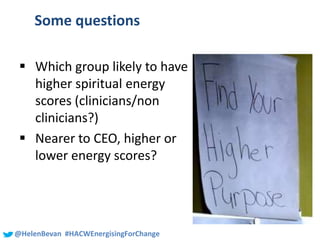
Some questions
 Which group likely to have
higher spiritual energy
scores (clinicians/non
clinicians?)
 Nearer to CEO, higher or
lower energy scores?
@helenbevan@helenbevan #Quality2013
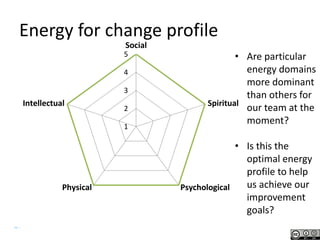
• Are particular
energy domains
more dominant
than others for
our team at the
moment?
• Is this the
optimal energy
profile to help
us achieve our
improvement
goals?
Energy for change profile
1
2
3
4
5
Social
Spiritual
PsychologicalPhysical
Intellectual
#SHCR @School4Radicals@HelenBevan #HACWEnergisingForChange
1
2
3
4
5
Social
Spiritual
PsychologicalPhysical
Intellectual
Team 1: what’s your assessment of
their energy for change?
#SHCR @School4Radicals@HelenBevan #HACWEnergisingForChange
1
2
3
4
5
Social
Spiritual
PsychologicalPhysical
Intellectual
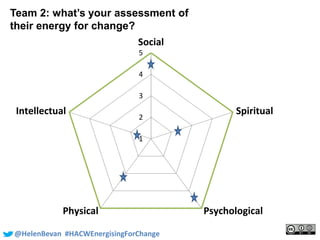
Team 2: what’s your assessment of
their energy for change?
#SHCR @School4Radicals@HelenBevan
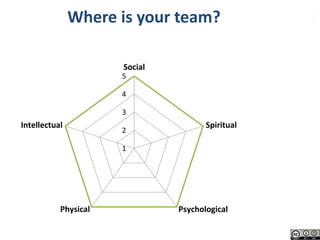
Where is your team?
1
2
3
4
5
Social
Spiritual
PsychologicalPhysical
Intellectual
#SHCR @School4Radicals
There has never been a time in the history
of healthcare when this advice has been
more pertinent
“Leadership is not about making clever
decisions and doing bigger deals. It is about
helping release the positive energy that
exists naturally within people”
Henry Mintzberg
#SHCR @School4Radicals@HelenBevan #HACWEnergisingForChange
#SHCR @School4Radicals@HelenBevan #HACWEnergisingForChange Source: Helen Bevan
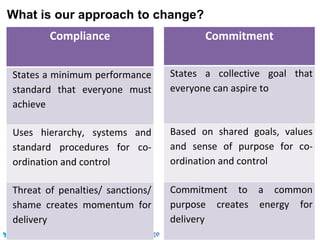
Compliance
States a minimum performance
standard that everyone must
achieve
Uses hierarchy, systems and
standard procedures for co-
ordination and control
Threat of penalties/ sanctions/
shame creates momentum for
delivery
What is our approach to change?
Commitment
States a collective goal that
everyone can aspire to
Based on shared goals, values
and sense of purpose for co-
ordination and control
Commitment to a common
purpose creates energy for
delivery
#SHCR @School4Radicals@HelenBevan #HACWEnergisingForChange
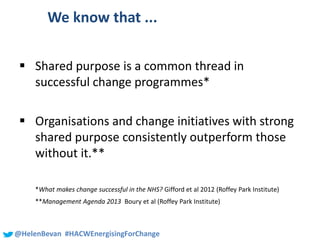
We know that ...
 Shared purpose is a common thread in
successful change programmes*
 Organisations and change initiatives with strong
shared purpose consistently outperform those
without it.**
*What makes change successful in the NHS? Gifford et al 2012 (Roffey Park Institute)
**Management Agenda 2013 Boury et al (Roffey Park Institute)
#SHCR @School4Radicals@HelenBevan #HACWEnergisingForChange
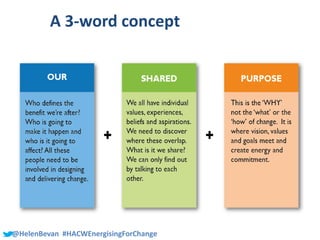
A 3-word concept
#SHCR @School4Radicals@HelenBevan #HACWEnergisingForChange
[Shared] purpose goes way deeper than
vision and mission; it goes right into your gut
and taps some part of your primal self. I
believe that if you can bring people with
similar primal-purposes together and get
them all marching in the same direction,
amazing things can be achieved.
Seth Carguilo
#SHCR @School4Radicals@HelenBevan #HACWEnergisingForChange
The power of shared purpose:
Perhaps the single most important influence on program
response by individual units—either in promoting or
resisting change—was the extent of consensus and
coalition among the senior medical and nursing staff on
individual Intensive Care Units….
[Consultant says] ‘I think it’s been successful because it’s
a unifying program, it’s one of the few things that we’ve
done that hasn’t been just a doctor thing, or just a nurse
thing, it’s involved the doctors and the nurses together.’
http://www.ncbi.nlm.nih.gov/pmc/articles/PMC3704826/
#SHCR @School4Radicals@HelenBevan #HACWEnergisingForChange
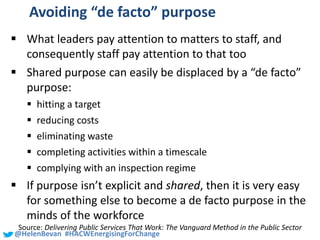
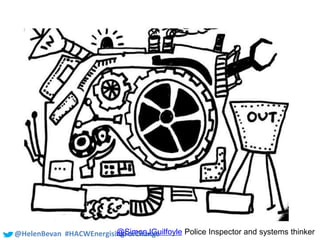
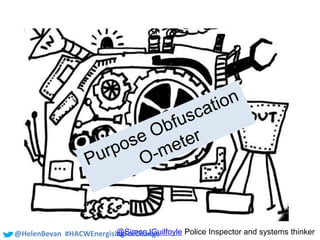
Avoiding “de facto” purpose
 What leaders pay attention to matters to staff, and
consequently staff pay attention to that too
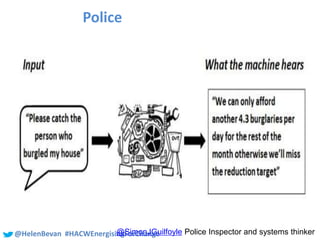
 Shared purpose can easily be displaced by a “de facto”
purpose:
 hitting a target
 reducing costs
 eliminating waste
 completing activities within a timescale
 complying with an inspection regime
 If purpose isn’t explicit and shared, then it is very easy
for something else to become a de facto purpose in the
minds of the workforce
Source: Delivering Public Services That Work: The Vanguard Method in the Public Sector
#SHCR @School4Radicals@HelenBevan #HACWEnergisingForChange@SimonJGuilfoyle Police Inspector and systems thinker
#SHCR @School4Radicals@HelenBevan #HACWEnergisingForChange
Police
@SimonJGuilfoyle Police Inspector and systems thinker
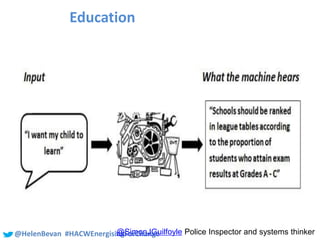
#SHCR @School4Radicals@HelenBevan #HACWEnergisingForChange
Education
@SimonJGuilfoyle Police Inspector and systems thinker
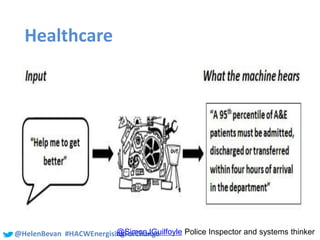
#SHCR @School4Radicals@HelenBevan #HACWEnergisingForChange
Healthcare
@SimonJGuilfoyle Police Inspector and systems thinker
@helenbevan@HelenBevan
1. Follow on Twitter
@HelenBevan
@NHSIQ
2. Subscribe to
3. Get materials from The School for Health and Care
Radicals: www.theedge.nhsiq.nhs.uk/school
Learn more about the Horizons team:
http://theedge.nhsiq.nhs.uk/cic/
TheEdge.nhsiq.nhs.uk
Three ways to connect!
@School4Radicals
@TheEdgeNHS

Building energy for change