IEA DSM TASK XXIV
               Closing the Loop -

Behaviour Change in DSM: From Theory to
               Practice


         ExCo meeting Norway April 19, 2012

Dr Sea Rotmann & Dr Ruth Mourik (Co-Operating Agents)
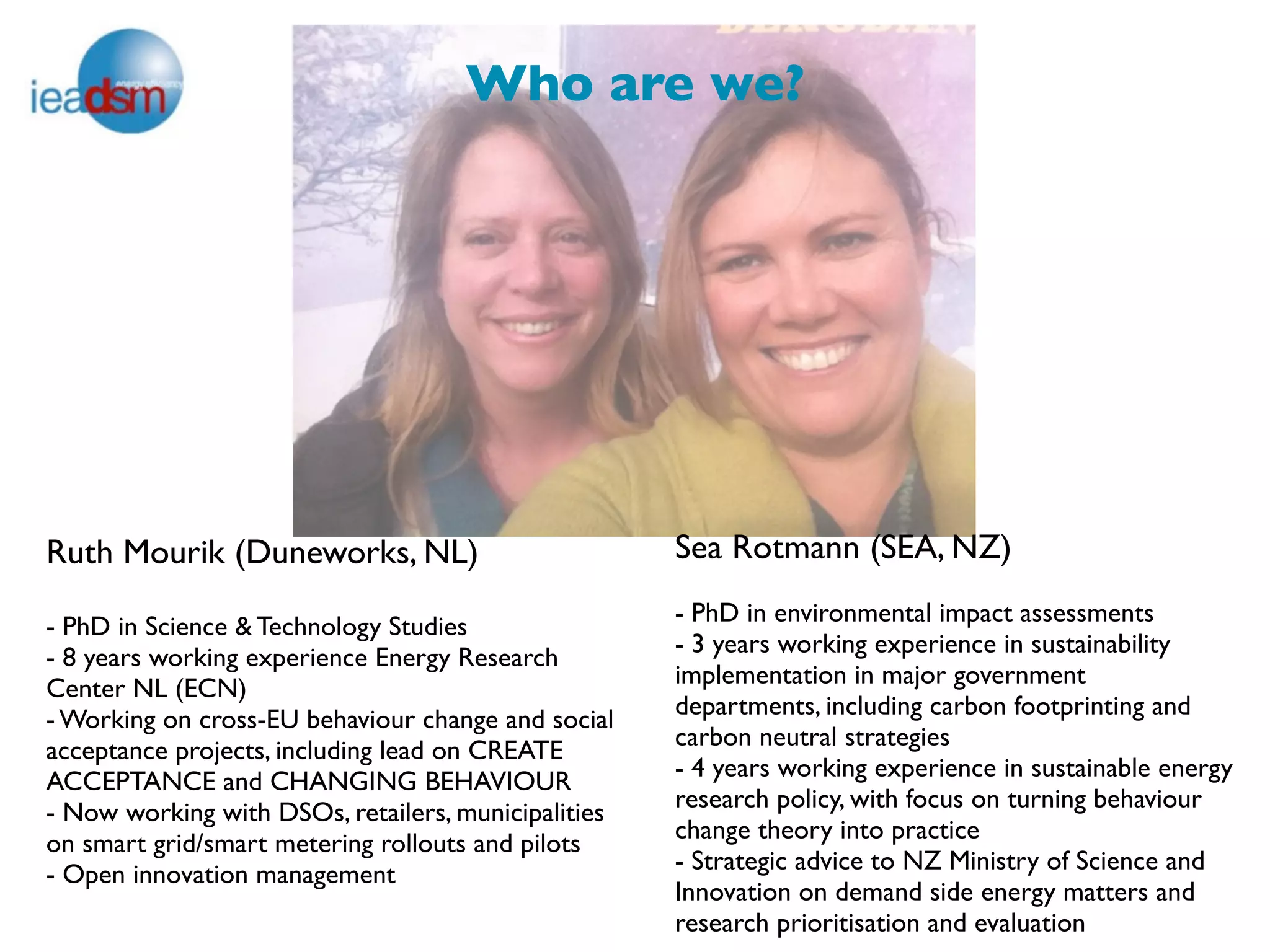
Who are we?


Ruth Mourik (Duneworks, NL)                          Sea Rotmann (SEA, NZ)

- PhD in Science & Technology Studies                - PhD in environmental impact assessments
                                                     - 3 years working experience in sustainability
- 8 years working experience Energy Research
                                                     implementation in major government
Center NL (ECN)
                                                     departments, including carbon footprinting and
- Working on cross-EU behaviour change and social
                                                     carbon neutral strategies
acceptance projects, including lead on CREATE
                                                     - 4 years working experience in sustainable energy
ACCEPTANCE and CHANGING BEHAVIOUR
                                                     research policy, with focus on turning behaviour
- Now working with DSOs, retailers, municipalities
                                                     change theory into practice
on smart grid/smart metering rollouts and pilots
                                                     - Strategic advice to NZ Ministry of Science and
- Open innovation management
                                                     Innovation on demand side energy matters and
                                                     research prioritisation and evaluation
The last 6 months since Jeju
·
    - Draft task definition plan completed and widely disseminated
·
    - Publicising task via flyer, Spotlight, mailing lists, twitter, facebook, linked in,
    Behaviour Change & Energy News, SCORAI newsletter, websites
·
    - Secured UKERC meeting place funding for October Oxford workshop on
    Subtask 2
·
    - Held kick-off workshops in Austria, NL and webinar with remaining experts
    including US, UK, Sweden
·
    - Lots of work went into securing the necessary country participation, with
    CH and NL finalised
·
    - Presented task to several DSOs, retailers and technology developers to
    secure commercial participation
·
    - Expert interest of participation is 150+ and counting! Experts from non-
    participating or sponsoring countries will get access only to Subtask 1 & 3
    (Helicopter view) and country-specific needs and recommendations will be
    developed only for participating/sponsoring countries
·
    - Another 10 countries are interested in the task and considering joining or
    perhaps sponsoring it (pending on ExCo decision on sponsorship)
·
    - ISGAN participated in our workshop and IEA has expressed interest
Premise for Task XXIV

The underlying proposition is that the energy efficiency gap results from:

·
    Complexities of human behaviour
·
    Insufficient sharing of results
·
    Limited transfer to the policy domain to inform real-life interventions;
·
    Failure to use monitoring and evaluation tools that show ongoing behaviour
    change outcomes;
·
    Absence of clear recommendations and guidelines

·
    ==> Although there is a lot of general knowledge and small case studies for
    these issues, there is limited information tailored specifically to countries’
    needs. Evaluation of long-term behavioural change is also extremely limited.
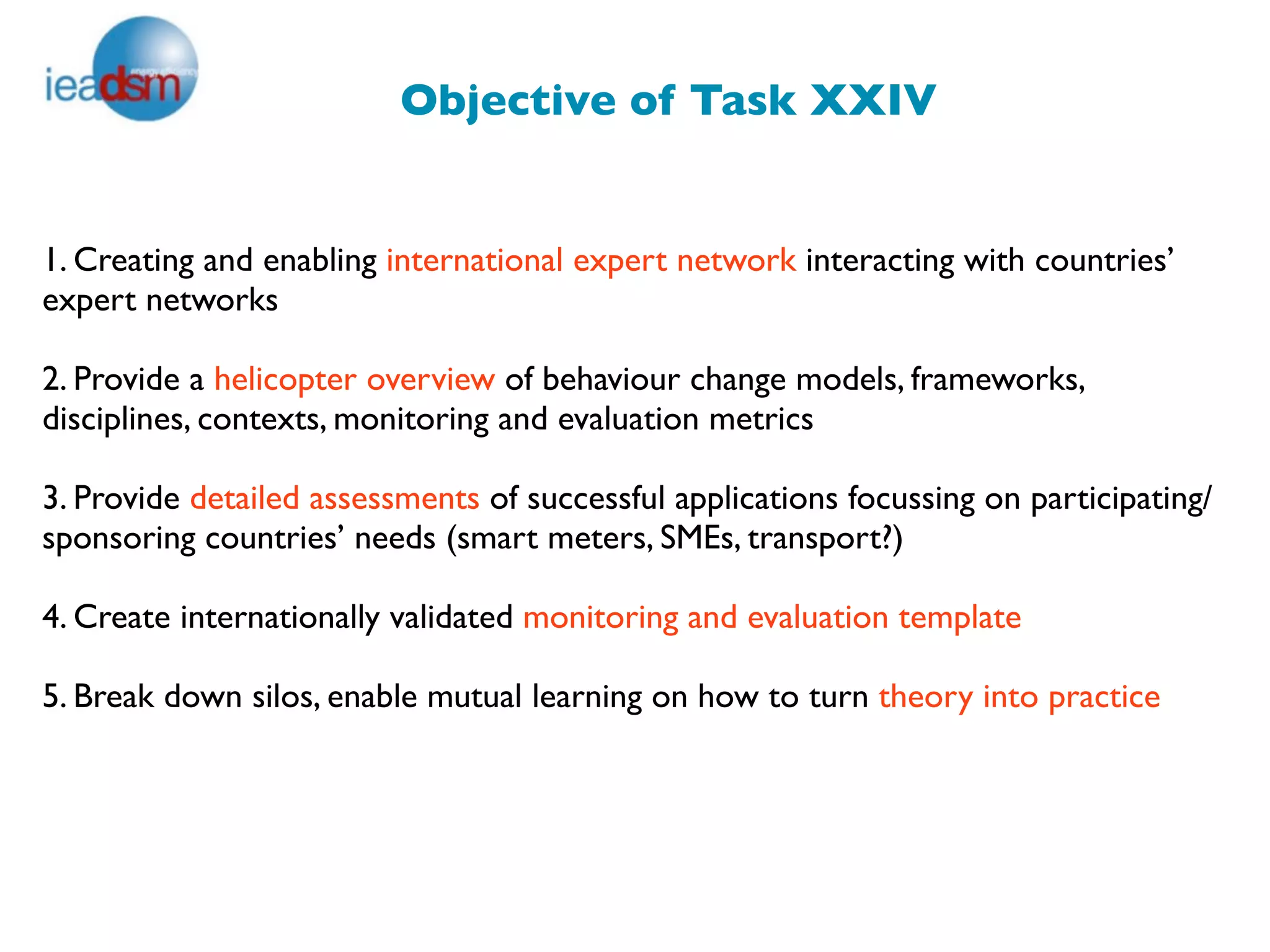
Objective of Task XXIV


1. Creating and enabling international expert network interacting with countries’
expert networks

2. Provide a helicopter overview of behaviour change models, frameworks,
disciplines, contexts, monitoring and evaluation metrics

3. Provide detailed assessments of successful applications focussing on participating/
sponsoring countries’ needs (smart meters, SMEs, transport?)

4. Create internationally validated monitoring and evaluation template

5. Break down silos, enable mutual learning on how to turn theory into practice
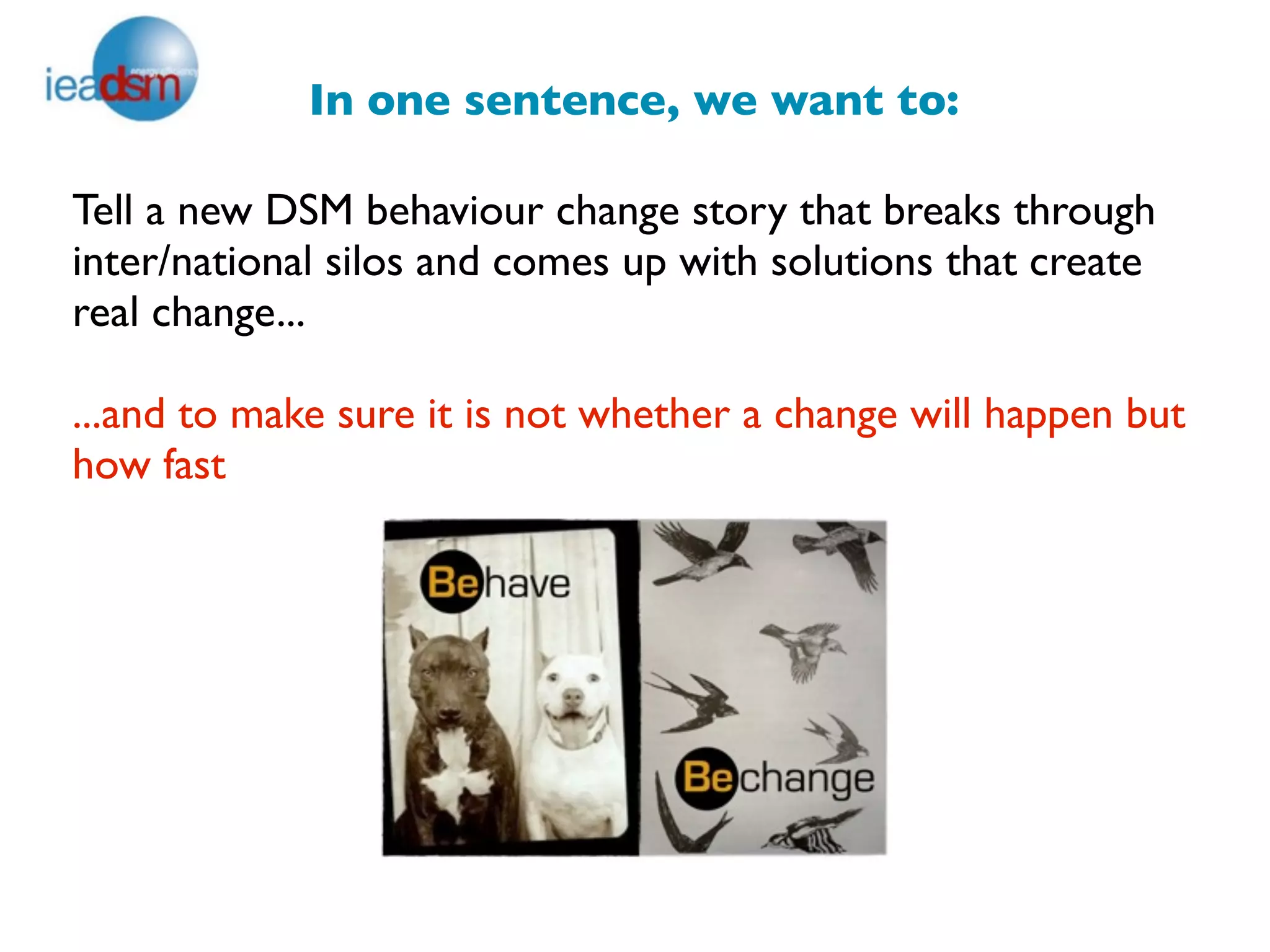
In one sentence, we want to:

Tell a new DSM behaviour change story that breaks through
inter/national silos and comes up with solutions that create
real change...

...and to make sure it is not whether a change will happen but
how fast
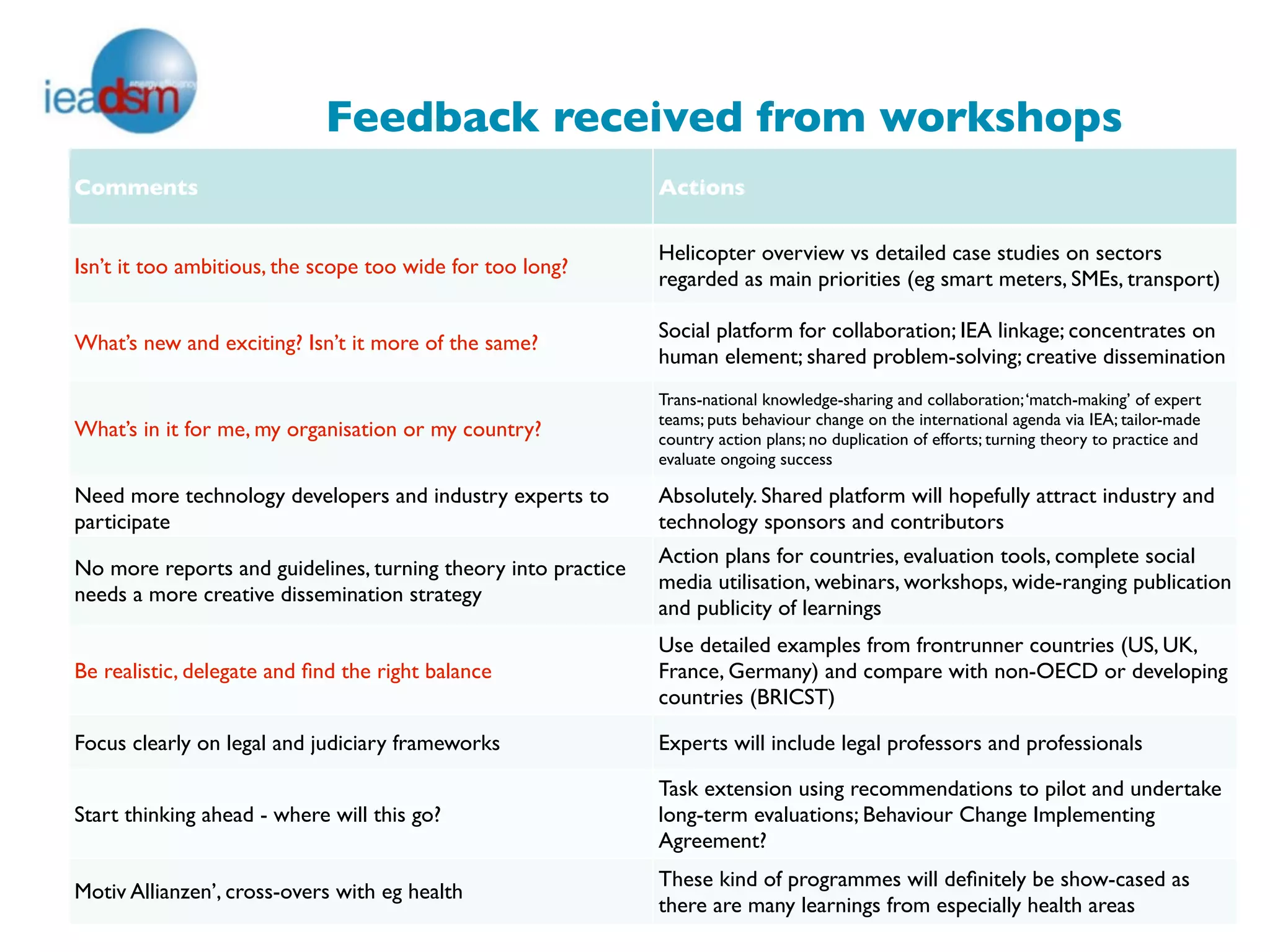
Feedback received from workshops
Comments                                                       Actions

                                                               Helicopter overview vs detailed case studies on sectors
Isn’t it too ambitious, the scope too wide for too long?
                                                               regarded as main priorities (eg smart meters, SMEs, transport)

                                                               Social platform for collaboration; IEA linkage; concentrates on
What’s new and exciting? Isn’t it more of the same?
                                                               human element; shared problem-solving; creative dissemination
                                                               Trans-national knowledge-sharing and collaboration; ‘match-making’ of expert
                                                               teams; puts behaviour change on the international agenda via IEA; tailor-made
What’s in it for me, my organisation or my country?            country action plans; no duplication of efforts; turning theory to practice and
                                                               evaluate ongoing success

Need more technology developers and industry experts to        Absolutely. Shared platform will hopefully attract industry and
participate                                                    technology sponsors and contributors
                                                               Action plans for countries, evaluation tools, complete social
No more reports and guidelines, turning theory into practice
                                                               media utilisation, webinars, workshops, wide-ranging publication
needs a more creative dissemination strategy
                                                               and publicity of learnings
                                                               Use detailed examples from frontrunner countries (US, UK,
Be realistic, delegate and find the right balance               France, Germany) and compare with non-OECD or developing
                                                               countries (BRICST)

Focus clearly on legal and judiciary frameworks                Experts will include legal professors and professionals

                                                               Task extension using recommendations to pilot and undertake
Start thinking ahead - where will this go?                     long-term evaluations; Behaviour Change Implementing
                                                               Agreement?
                                                               These kind of programmes will definitely be show-cased as
Motiv Allianzen’, cross-overs with eg health
                                                               there are many learnings from especially health areas
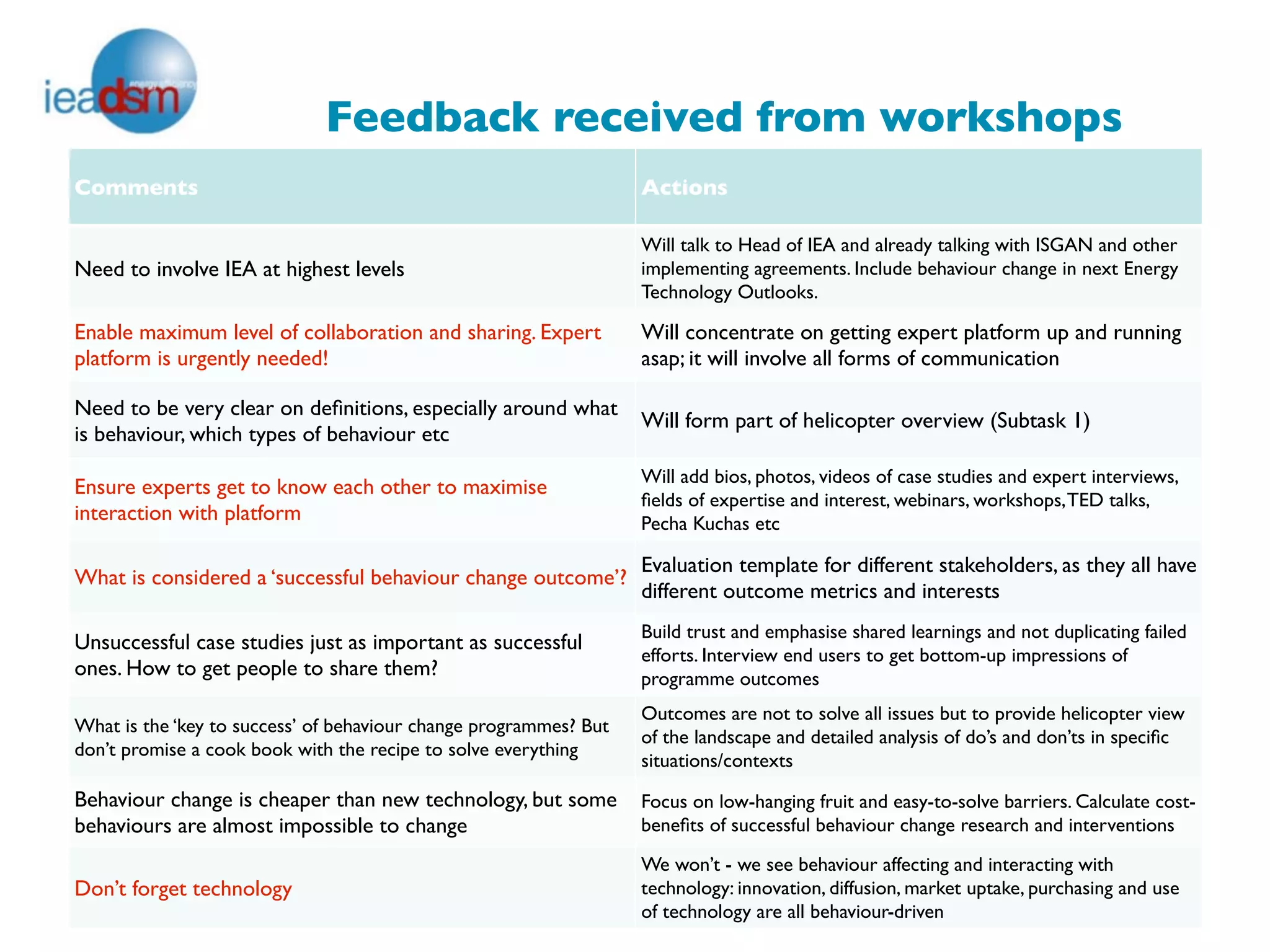
Feedback received from workshops
Comments                                                           Actions

                                                                   Will talk to Head of IEA and already talking with ISGAN and other
Need to involve IEA at highest levels                              implementing agreements. Include behaviour change in next Energy
                                                                   Technology Outlooks.

Enable maximum level of collaboration and sharing. Expert          Will concentrate on getting expert platform up and running
platform is urgently needed!                                       asap; it will involve all forms of communication

Need to be very clear on definitions, especially around what
                                                                   Will form part of helicopter overview (Subtask 1)
is behaviour, which types of behaviour etc
                                                                   Will add bios, photos, videos of case studies and expert interviews,
Ensure experts get to know each other to maximise
                                                                   fields of expertise and interest, webinars, workshops, TED talks,
interaction with platform                                          Pecha Kuchas etc

                                                                   Evaluation template for different stakeholders, as they all have
What is considered a ‘successful behaviour change outcome’?
                                                                   different outcome metrics and interests
                                                                   Build trust and emphasise shared learnings and not duplicating failed
Unsuccessful case studies just as important as successful
                                                                   efforts. Interview end users to get bottom-up impressions of
ones. How to get people to share them?                             programme outcomes
                                                                   Outcomes are not to solve all issues but to provide helicopter view
What is the ‘key to success’ of behaviour change programmes? But
                                                                   of the landscape and detailed analysis of do’s and don’ts in specific
don’t promise a cook book with the recipe to solve everything
                                                                   situations/contexts

Behaviour change is cheaper than new technology, but some          Focus on low-hanging fruit and easy-to-solve barriers. Calculate cost-
behaviours are almost impossible to change                         benefits of successful behaviour change research and interventions
                                                                   We won’t - we see behaviour affecting and interacting with
Don’t forget technology                                            technology: innovation, diffusion, market uptake, purchasing and use
                                                                   of technology are all behaviour-driven
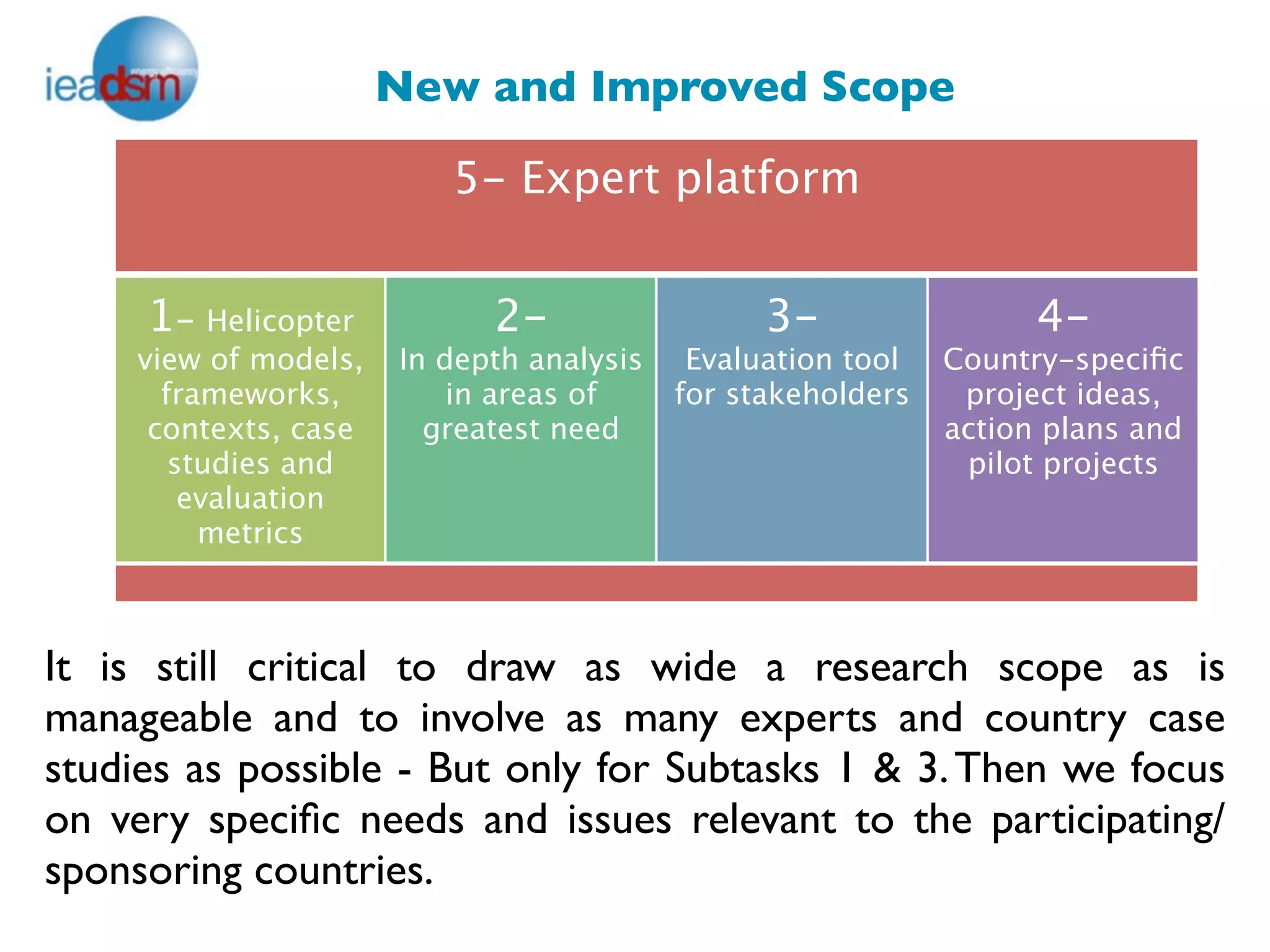
Previous scope
                       5- Guidelines and Expert platform


    1- Inventory of         2-                 3-          4-  Developing
        models,       In depth analysis   Data analysis    monitoring and
    frameworks and        of context      and synthesis      evaluation
       disciplines       sensitivities    subtasks 1+2       indicators


Was widely thought too ambitious to keep the scope this wide
throughout the task in light of the resources and time available.
Also was not thought to focus quickly and clearly enough on the
most important areas.
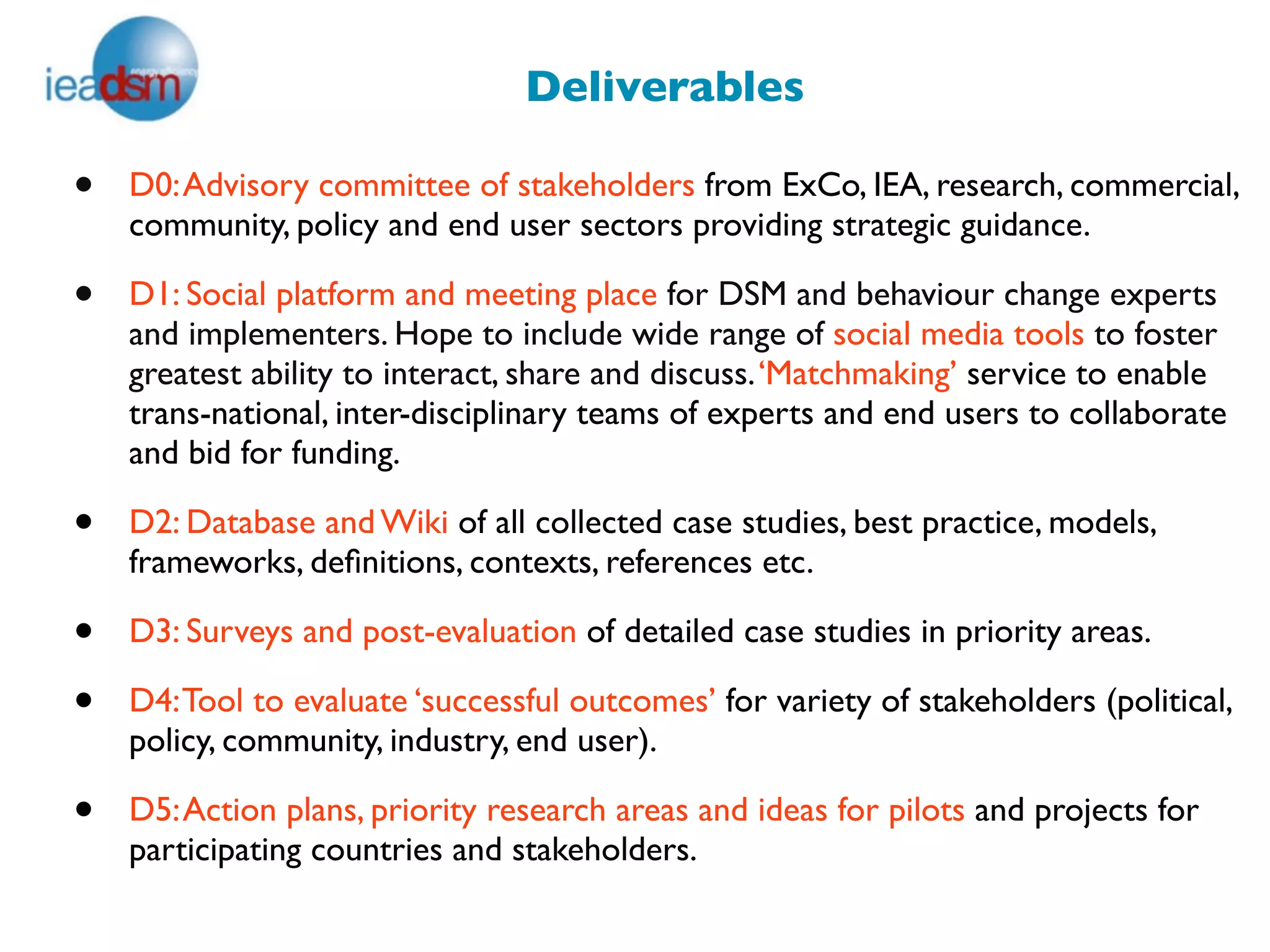
New and Improved Scope

                          5- Expert platform


     1- Helicopter           2-                  3-                 4-
     view of models,   In depth analysis    Evaluation tool   Country-specific
       frameworks,         in areas of     for stakeholders    project ideas,
      contexts, case     greatest need                        action plans and
        studies and                                            pilot projects
         evaluation
          metrics


It is still critical to draw as wide a research scope as is
manageable and to involve as many experts and country case
studies as possible - But only for Subtasks 1 & 3. Then we focus
on very specific needs and issues relevant to the participating/
sponsoring countries.
Deliverables

•   D0: Advisory committee of stakeholders from ExCo, IEA, research, commercial,
    community, policy and end user sectors providing strategic guidance.

•   D1: Social platform and meeting place for DSM and behaviour change experts
    and implementers. Hope to include wide range of social media tools to foster
    greatest ability to interact, share and discuss. ‘Matchmaking’ service to enable
    trans-national, inter-disciplinary teams of experts and end users to collaborate
    and bid for funding.

•   D2: Database and Wiki of all collected case studies, best practice, models,
    frameworks, definitions, contexts, references etc.

•   D3: Surveys and post-evaluation of detailed case studies in priority areas.

•   D4: Tool to evaluate ‘successful outcomes’ for variety of stakeholders (political,
    policy, community, industry, end user).

•   D5: Action plans, priority research areas and ideas for pilots and projects for
    participating countries and stakeholders.
General Comments

• Know your audience and stakeholders and meet their needs
• Regular publications and publicity
• Seminars for policymakers
• Keep it clear, use visual aids, try to keep it as short and
modular as possible and work with key-words and sub-sections
• A set of definitions, information, experiences,
recommendations and contacts that can be accessed easily and
quickly on a website
• Make it attractive and fun but be careful to align
communication and tone to the stakeholder
• Re-work work definition plan to be less dry and theoretical,
make benefits to stakeholders and distinguishing features clear
at the outset
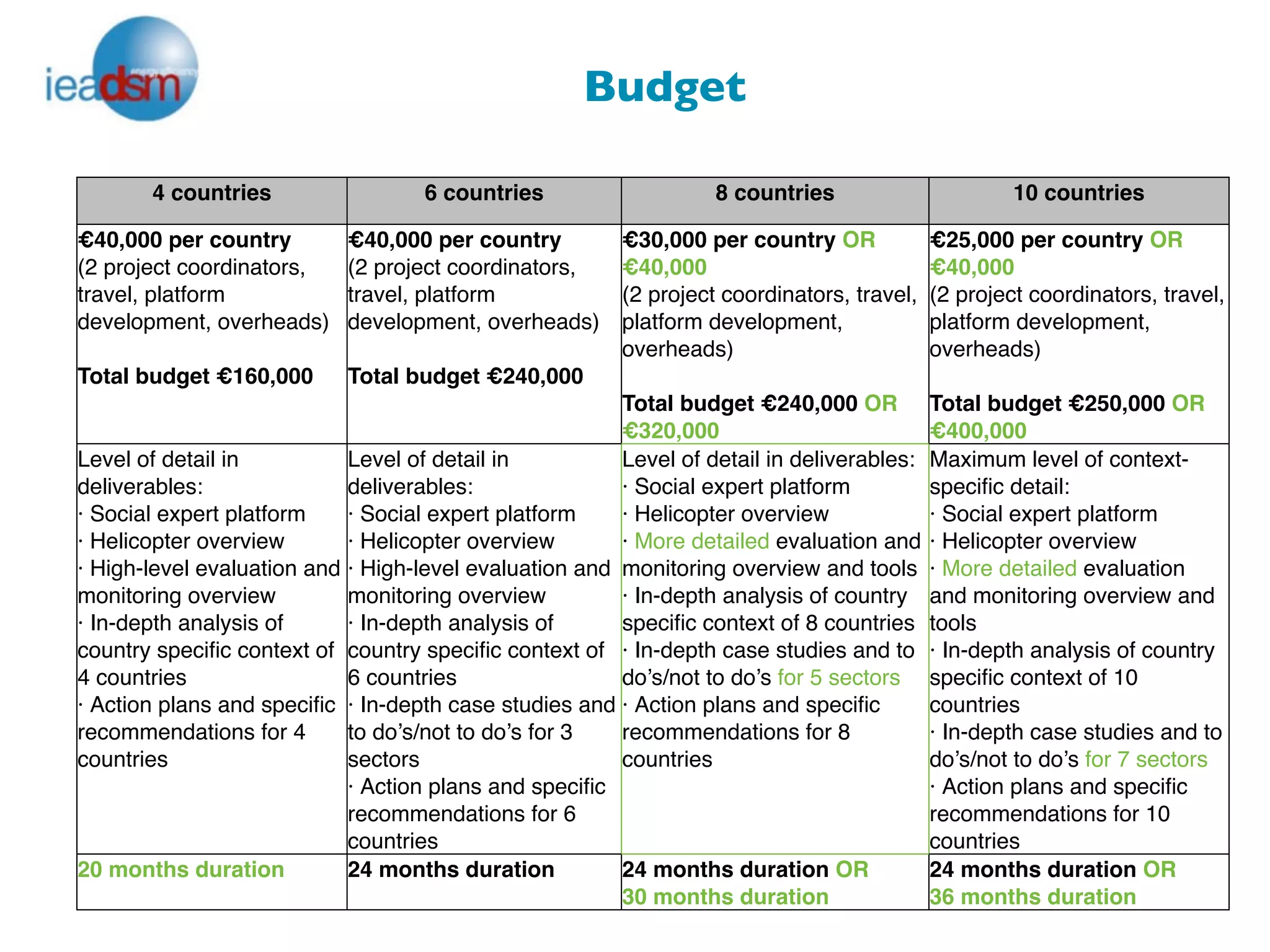
Budget

       4 countries                  6 countries                   8 countries                       10 countries

€40,000 per country         €40,000 per country         €30,000 per country OR             €25,000 per country OR
(2 project coordinators,    (2 project coordinators,    €40,000                            €40,000
travel, platform            travel, platform            (2 project coordinators, travel,   (2 project coordinators, travel,
development, overheads)     development, overheads)     platform development,              platform development,
                                                        overheads)                         overheads)
Total budget €160,000       Total budget €240,000
                                                        Total budget €240,000 OR           Total budget €250,000 OR
                                                        €320,000                           €400,000
Level of detail in          Level of detail in          Level of detail in deliverables:   Maximum level of context-
deliverables:               deliverables:               · Social expert platform           specific detail:
· Social expert platform    · Social expert platform    · Helicopter overview              · Social expert platform
· Helicopter overview       · Helicopter overview       · More detailed evaluation and     · Helicopter overview
· High-level evaluation and · High-level evaluation and monitoring overview and tools      · More detailed evaluation
monitoring overview         monitoring overview         · In-depth analysis of country     and monitoring overview and
· In-depth analysis of      · In-depth analysis of      specific context of 8 countries     tools
country specific context of country specific context of · In-depth case studies and to       · In-depth analysis of country
4 countries                 6 countries                 do’s/not to do’s for 5 sectors     specific context of 10
· Action plans and specific · In-depth case studies and · Action plans and specific          countries
recommendations for 4       to do’s/not to do’s for 3   recommendations for 8              · In-depth case studies and to
countries                   sectors                     countries                          do’s/not to do’s for 7 sectors
                            · Action plans and specific                                     · Action plans and specific
                            recommendations for 6                                          recommendations for 10
                            countries                                                      countries
20 months duration          24 months duration          24 months duration OR              24 months duration OR
                                                        30 months duration                 36 months duration
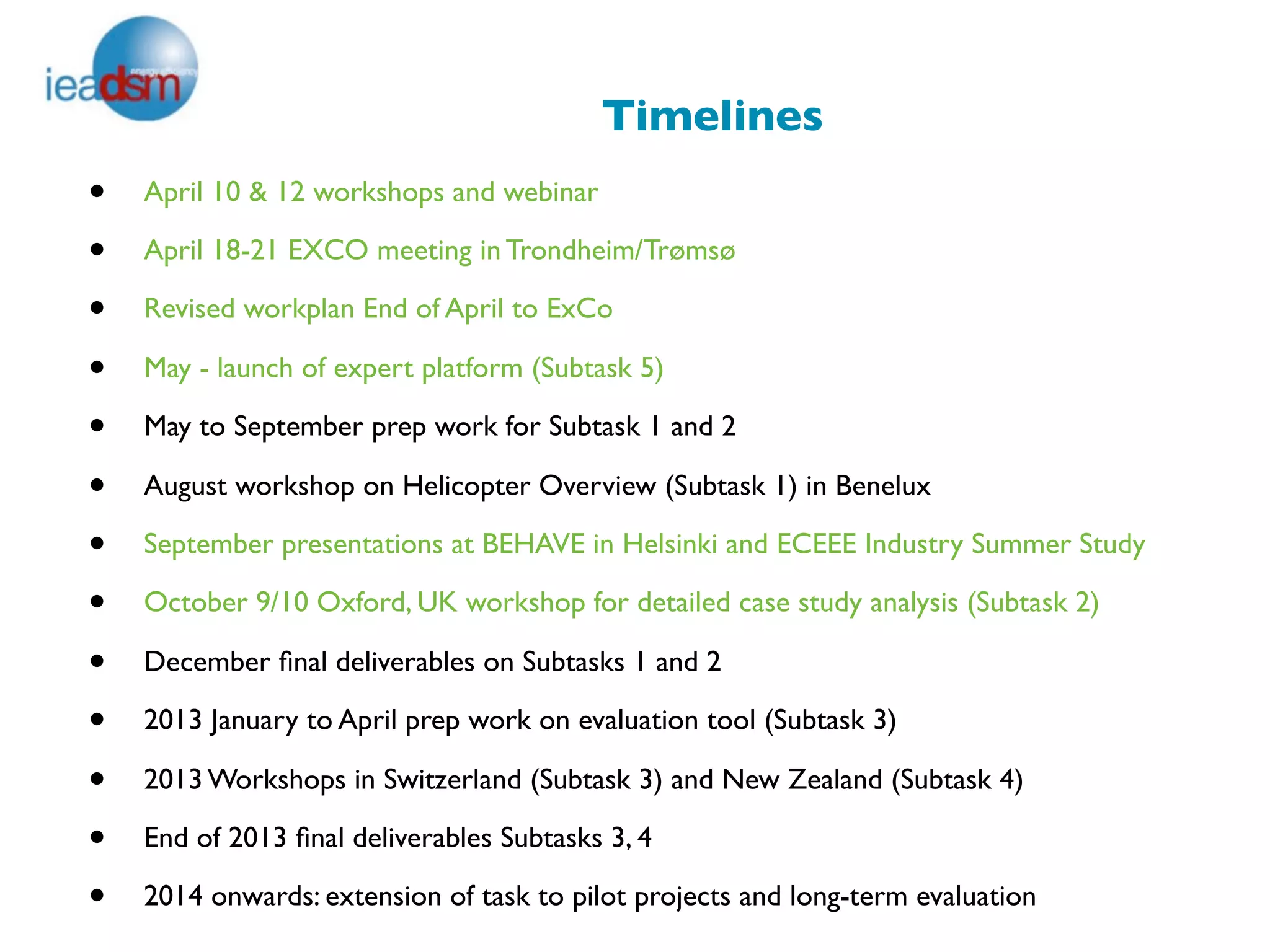
Timelines
•   April 10 & 12 workshops and webinar

•   April 18-21 EXCO meeting in Trondheim/Trømsø

•   Revised workplan End of April to ExCo

•   May - launch of expert platform (Subtask 5)

•   May to September prep work for Subtask 1 and 2

•   August workshop on Helicopter Overview (Subtask 1) in Benelux

•   September presentations at BEHAVE in Helsinki and ECEEE Industry Summer Study

•   October 9/10 Oxford, UK workshop for detailed case study analysis (Subtask 2)

•   December final deliverables on Subtasks 1 and 2

•   2013 January to April prep work on evaluation tool (Subtask 3)

•   2013 Workshops in Switzerland (Subtask 3) and New Zealand (Subtask 4)

•   End of 2013 final deliverables Subtasks 3, 4

•   2014 onwards: extension of task to pilot projects and long-term evaluation
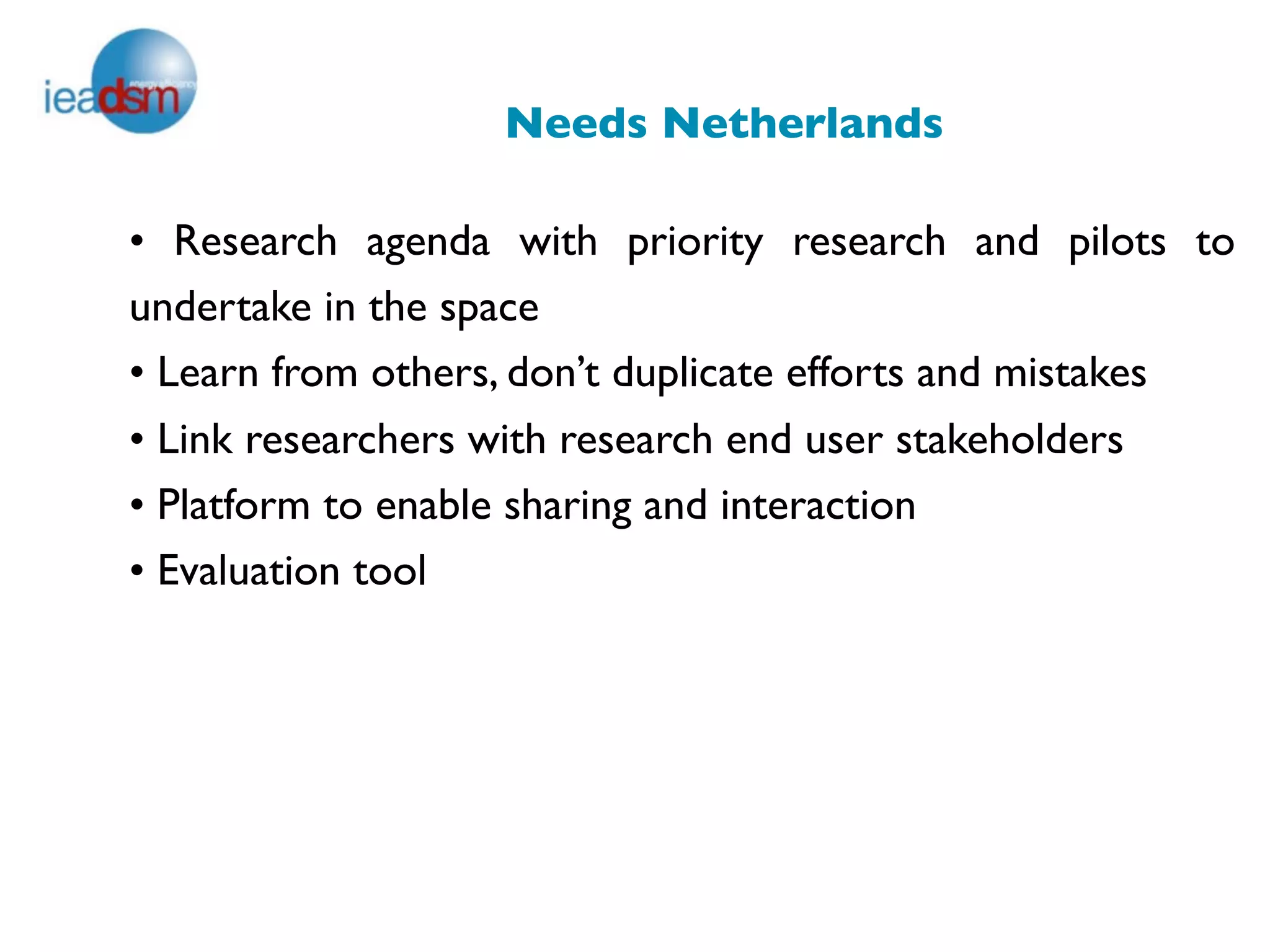
Needs Netherlands

• Research agenda with priority research and pilots to
undertake in the space
• Learn from others, don’t duplicate efforts and mistakes
• Link researchers with research end user stakeholders
• Platform to enable sharing and interaction
• Evaluation tool
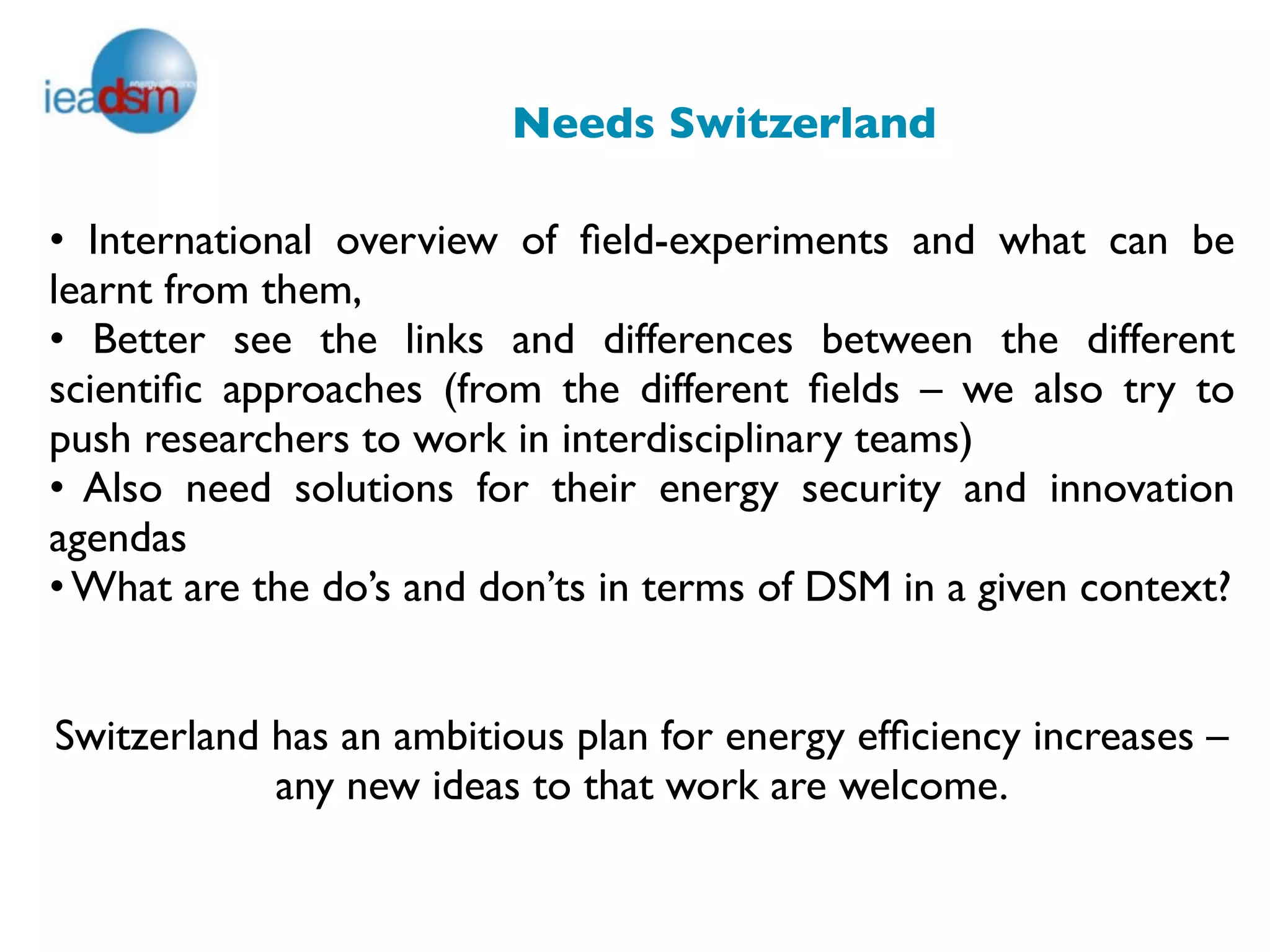
Needs Switzerland

• International overview of field-experiments and what can be
learnt from them,
• Better see the links and differences between the different
scientific approaches (from the different fields – we also try to
push researchers to work in interdisciplinary teams)
• Also need solutions for their energy security and innovation
agendas
• What are the do’s and don’ts in terms of DSM in a given context?


Switzerland has an ambitious plan for energy efficiency increases –
            any new ideas to that work are welcome.
                                  
Needs Belgium

• Learning about effectiveness of DSM and building
renovation programmes
• Learn about impact of economical instruments and legal
frameworks targeting the use of smart meters by the
final consumer in other countries
• Learn about effectiveness of DSM accompanying smart
metering implementation (savings achieved, evaluation)
• Find out what basic functionalities are necessary for smart
meters to allow for DSM
• Need solutions that help their energy security and
innovation agendas
Needs New Zealand

• International overview of policies, programmes and field-
experiments and what can be learnt from them
• To see the link between good research theory and practical
outcomes for policymakers and DSM implementers
• Tailor-made recommendations for the NZ context and end user
needs
• Monitoring and evaluation metrics, how to show ongoing
behaviour change outcomes from Government-driven energy
efficiency or DSM policies


IEA DSM ExCo presentation Task XXIV

IEA DSM ExCo presentation Task XXIV

  • 1.
    IEA DSM TASKXXIV Closing the Loop - Behaviour Change in DSM: From Theory to Practice ExCo meeting Norway April 19, 2012 Dr Sea Rotmann & Dr Ruth Mourik (Co-Operating Agents)
  • 2.
    Who are we? RuthMourik (Duneworks, NL) Sea Rotmann (SEA, NZ) - PhD in Science & Technology Studies - PhD in environmental impact assessments - 3 years working experience in sustainability - 8 years working experience Energy Research implementation in major government Center NL (ECN) departments, including carbon footprinting and - Working on cross-EU behaviour change and social carbon neutral strategies acceptance projects, including lead on CREATE - 4 years working experience in sustainable energy ACCEPTANCE and CHANGING BEHAVIOUR research policy, with focus on turning behaviour - Now working with DSOs, retailers, municipalities change theory into practice on smart grid/smart metering rollouts and pilots - Strategic advice to NZ Ministry of Science and - Open innovation management Innovation on demand side energy matters and research prioritisation and evaluation
  • 3.
    The last 6months since Jeju · - Draft task definition plan completed and widely disseminated · - Publicising task via flyer, Spotlight, mailing lists, twitter, facebook, linked in, Behaviour Change & Energy News, SCORAI newsletter, websites · - Secured UKERC meeting place funding for October Oxford workshop on Subtask 2 · - Held kick-off workshops in Austria, NL and webinar with remaining experts including US, UK, Sweden · - Lots of work went into securing the necessary country participation, with CH and NL finalised · - Presented task to several DSOs, retailers and technology developers to secure commercial participation · - Expert interest of participation is 150+ and counting! Experts from non- participating or sponsoring countries will get access only to Subtask 1 & 3 (Helicopter view) and country-specific needs and recommendations will be developed only for participating/sponsoring countries · - Another 10 countries are interested in the task and considering joining or perhaps sponsoring it (pending on ExCo decision on sponsorship) · - ISGAN participated in our workshop and IEA has expressed interest
  • 4.
    Premise for TaskXXIV The underlying proposition is that the energy efficiency gap results from: · Complexities of human behaviour · Insufficient sharing of results · Limited transfer to the policy domain to inform real-life interventions; · Failure to use monitoring and evaluation tools that show ongoing behaviour change outcomes; · Absence of clear recommendations and guidelines · ==> Although there is a lot of general knowledge and small case studies for these issues, there is limited information tailored specifically to countries’ needs. Evaluation of long-term behavioural change is also extremely limited.
  • 5.
    Objective of TaskXXIV 1. Creating and enabling international expert network interacting with countries’ expert networks 2. Provide a helicopter overview of behaviour change models, frameworks, disciplines, contexts, monitoring and evaluation metrics 3. Provide detailed assessments of successful applications focussing on participating/ sponsoring countries’ needs (smart meters, SMEs, transport?) 4. Create internationally validated monitoring and evaluation template 5. Break down silos, enable mutual learning on how to turn theory into practice
  • 6.
    In one sentence,we want to: Tell a new DSM behaviour change story that breaks through inter/national silos and comes up with solutions that create real change... ...and to make sure it is not whether a change will happen but how fast
  • 7.
    Feedback received fromworkshops Comments Actions Helicopter overview vs detailed case studies on sectors Isn’t it too ambitious, the scope too wide for too long? regarded as main priorities (eg smart meters, SMEs, transport) Social platform for collaboration; IEA linkage; concentrates on What’s new and exciting? Isn’t it more of the same? human element; shared problem-solving; creative dissemination Trans-national knowledge-sharing and collaboration; ‘match-making’ of expert teams; puts behaviour change on the international agenda via IEA; tailor-made What’s in it for me, my organisation or my country? country action plans; no duplication of efforts; turning theory to practice and evaluate ongoing success Need more technology developers and industry experts to Absolutely. Shared platform will hopefully attract industry and participate technology sponsors and contributors Action plans for countries, evaluation tools, complete social No more reports and guidelines, turning theory into practice media utilisation, webinars, workshops, wide-ranging publication needs a more creative dissemination strategy and publicity of learnings Use detailed examples from frontrunner countries (US, UK, Be realistic, delegate and find the right balance France, Germany) and compare with non-OECD or developing countries (BRICST) Focus clearly on legal and judiciary frameworks Experts will include legal professors and professionals Task extension using recommendations to pilot and undertake Start thinking ahead - where will this go? long-term evaluations; Behaviour Change Implementing Agreement? These kind of programmes will definitely be show-cased as Motiv Allianzen’, cross-overs with eg health there are many learnings from especially health areas
  • 8.
    Feedback received fromworkshops Comments Actions Will talk to Head of IEA and already talking with ISGAN and other Need to involve IEA at highest levels implementing agreements. Include behaviour change in next Energy Technology Outlooks. Enable maximum level of collaboration and sharing. Expert Will concentrate on getting expert platform up and running platform is urgently needed! asap; it will involve all forms of communication Need to be very clear on definitions, especially around what Will form part of helicopter overview (Subtask 1) is behaviour, which types of behaviour etc Will add bios, photos, videos of case studies and expert interviews, Ensure experts get to know each other to maximise fields of expertise and interest, webinars, workshops, TED talks, interaction with platform Pecha Kuchas etc Evaluation template for different stakeholders, as they all have What is considered a ‘successful behaviour change outcome’? different outcome metrics and interests Build trust and emphasise shared learnings and not duplicating failed Unsuccessful case studies just as important as successful efforts. Interview end users to get bottom-up impressions of ones. How to get people to share them? programme outcomes Outcomes are not to solve all issues but to provide helicopter view What is the ‘key to success’ of behaviour change programmes? But of the landscape and detailed analysis of do’s and don’ts in specific don’t promise a cook book with the recipe to solve everything situations/contexts Behaviour change is cheaper than new technology, but some Focus on low-hanging fruit and easy-to-solve barriers. Calculate cost- behaviours are almost impossible to change benefits of successful behaviour change research and interventions We won’t - we see behaviour affecting and interacting with Don’t forget technology technology: innovation, diffusion, market uptake, purchasing and use of technology are all behaviour-driven
  • 9.
    Previous scope 5- Guidelines and Expert platform 1- Inventory of 2- 3- 4- Developing models, In depth analysis Data analysis monitoring and frameworks and of context and synthesis evaluation disciplines sensitivities subtasks 1+2 indicators Was widely thought too ambitious to keep the scope this wide throughout the task in light of the resources and time available. Also was not thought to focus quickly and clearly enough on the most important areas.
  • 10.
    New and ImprovedScope 5- Expert platform 1- Helicopter 2- 3- 4- view of models, In depth analysis Evaluation tool Country-specific frameworks, in areas of for stakeholders project ideas, contexts, case greatest need action plans and studies and pilot projects evaluation metrics It is still critical to draw as wide a research scope as is manageable and to involve as many experts and country case studies as possible - But only for Subtasks 1 & 3. Then we focus on very specific needs and issues relevant to the participating/ sponsoring countries.
  • 11.
    Deliverables • D0: Advisory committee of stakeholders from ExCo, IEA, research, commercial, community, policy and end user sectors providing strategic guidance. • D1: Social platform and meeting place for DSM and behaviour change experts and implementers. Hope to include wide range of social media tools to foster greatest ability to interact, share and discuss. ‘Matchmaking’ service to enable trans-national, inter-disciplinary teams of experts and end users to collaborate and bid for funding. • D2: Database and Wiki of all collected case studies, best practice, models, frameworks, definitions, contexts, references etc. • D3: Surveys and post-evaluation of detailed case studies in priority areas. • D4: Tool to evaluate ‘successful outcomes’ for variety of stakeholders (political, policy, community, industry, end user). • D5: Action plans, priority research areas and ideas for pilots and projects for participating countries and stakeholders.
  • 12.
    General Comments • Knowyour audience and stakeholders and meet their needs • Regular publications and publicity • Seminars for policymakers • Keep it clear, use visual aids, try to keep it as short and modular as possible and work with key-words and sub-sections • A set of definitions, information, experiences, recommendations and contacts that can be accessed easily and quickly on a website • Make it attractive and fun but be careful to align communication and tone to the stakeholder • Re-work work definition plan to be less dry and theoretical, make benefits to stakeholders and distinguishing features clear at the outset
  • 13.
    Budget 4 countries 6 countries 8 countries 10 countries €40,000 per country €40,000 per country €30,000 per country OR €25,000 per country OR (2 project coordinators, (2 project coordinators, €40,000 €40,000 travel, platform travel, platform (2 project coordinators, travel, (2 project coordinators, travel, development, overheads) development, overheads) platform development, platform development, overheads) overheads) Total budget €160,000 Total budget €240,000 Total budget €240,000 OR Total budget €250,000 OR €320,000 €400,000 Level of detail in Level of detail in Level of detail in deliverables: Maximum level of context- deliverables: deliverables: · Social expert platform specific detail: · Social expert platform · Social expert platform · Helicopter overview · Social expert platform · Helicopter overview · Helicopter overview · More detailed evaluation and · Helicopter overview · High-level evaluation and · High-level evaluation and monitoring overview and tools · More detailed evaluation monitoring overview monitoring overview · In-depth analysis of country and monitoring overview and · In-depth analysis of · In-depth analysis of specific context of 8 countries tools country specific context of country specific context of · In-depth case studies and to · In-depth analysis of country 4 countries 6 countries do’s/not to do’s for 5 sectors specific context of 10 · Action plans and specific · In-depth case studies and · Action plans and specific countries recommendations for 4 to do’s/not to do’s for 3 recommendations for 8 · In-depth case studies and to countries sectors countries do’s/not to do’s for 7 sectors · Action plans and specific · Action plans and specific recommendations for 6 recommendations for 10 countries countries 20 months duration 24 months duration 24 months duration OR 24 months duration OR 30 months duration 36 months duration
  • 14.
    Timelines • April 10 & 12 workshops and webinar • April 18-21 EXCO meeting in Trondheim/Trømsø • Revised workplan End of April to ExCo • May - launch of expert platform (Subtask 5) • May to September prep work for Subtask 1 and 2 • August workshop on Helicopter Overview (Subtask 1) in Benelux • September presentations at BEHAVE in Helsinki and ECEEE Industry Summer Study • October 9/10 Oxford, UK workshop for detailed case study analysis (Subtask 2) • December final deliverables on Subtasks 1 and 2 • 2013 January to April prep work on evaluation tool (Subtask 3) • 2013 Workshops in Switzerland (Subtask 3) and New Zealand (Subtask 4) • End of 2013 final deliverables Subtasks 3, 4 • 2014 onwards: extension of task to pilot projects and long-term evaluation
  • 15.
    Needs Netherlands • Researchagenda with priority research and pilots to undertake in the space • Learn from others, don’t duplicate efforts and mistakes • Link researchers with research end user stakeholders • Platform to enable sharing and interaction • Evaluation tool
  • 16.
    Needs Switzerland • Internationaloverview of field-experiments and what can be learnt from them, • Better see the links and differences between the different scientific approaches (from the different fields – we also try to push researchers to work in interdisciplinary teams) • Also need solutions for their energy security and innovation agendas • What are the do’s and don’ts in terms of DSM in a given context? Switzerland has an ambitious plan for energy efficiency increases – any new ideas to that work are welcome.  
  • 17.
    Needs Belgium • Learningabout effectiveness of DSM and building renovation programmes • Learn about impact of economical instruments and legal frameworks targeting the use of smart meters by the final consumer in other countries • Learn about effectiveness of DSM accompanying smart metering implementation (savings achieved, evaluation) • Find out what basic functionalities are necessary for smart meters to allow for DSM • Need solutions that help their energy security and innovation agendas
  • 18.
    Needs New Zealand •International overview of policies, programmes and field- experiments and what can be learnt from them • To see the link between good research theory and practical outcomes for policymakers and DSM implementers • Tailor-made recommendations for the NZ context and end user needs • Monitoring and evaluation metrics, how to show ongoing behaviour change outcomes from Government-driven energy efficiency or DSM policies