How to Prevent Your Kubernetes Cluster
From Being Hacked
ContainerDays Meetup 2022
Who we are
© white duck GmbH 2022
Nico Meisenzahl (Head of DevOps Consulting and Operations,
Cloud Solution Architect, Azure & Developer Technologies MVP, GitLab Hero)
Email: nico.meisenzahl@whiteduck.de
Twitter: @nmeisenzahl
LinkedIn: https://www.linkedin.com/in/nicomeisenzahl/
Philip Welz (Senior Kubernetes & DevOps Engineer,
GitLab Hero, CKA, CKAD & CKS)
Twitter: @philip_welz
LinkedIn: https://www.linkedin.com/in/philip-welz
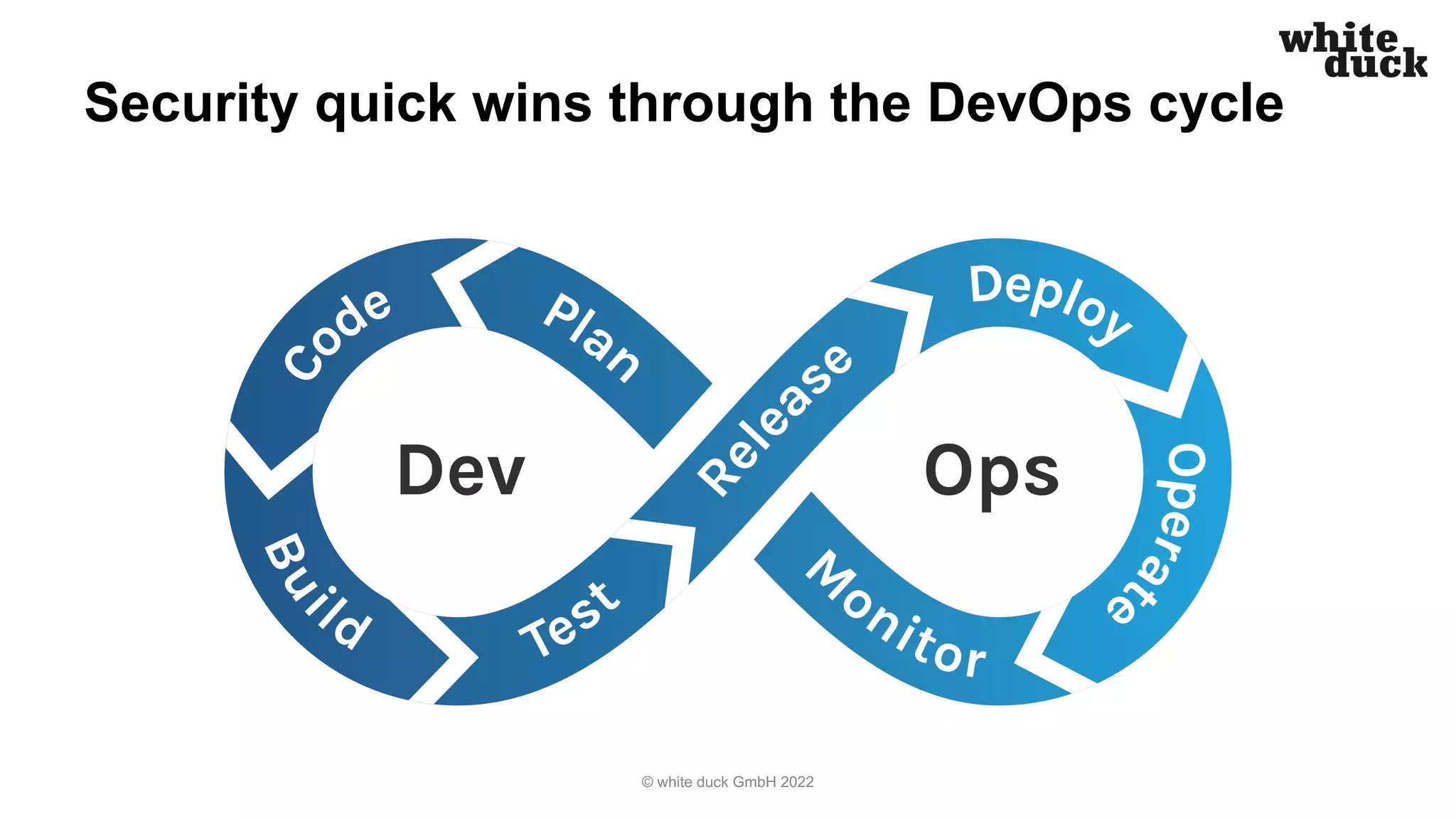
Security quick wins through the DevOps cycle
© white duck GmbH 2022
You should think about
• ensure secure application / deployment code
• build secure container images
• implement Kubernetes policies
• introduce Kubernetes network policies
• rely on Container Runtime Security
• many more…
© white duck GmbH 2022
Ensure secure application / deployment code
• your cluster is a shared resource
• a single compromised application can be enough
• automate and enforce code checks (shift left!)
• scan your code as well as your dependencies
• application code
• Dockerfiles
• deployment manifests
© white duck GmbH 2022
Examples
• vulnerable code and dependencies
• missing Dockerfile best practices
• unsecure Kubernetes manifests
They all can lead to someone gaining access to your
cluster!
© white duck GmbH 2022
SAST in general
• Static Application Security Testing (SAST) can help
validate you with
• application code
• Dockerfiles
• Kubernetes Manifests
• and more
• use your existing tooling (GitHub, GitLab) for easy start
• there is also a big ecosystem available
© white duck GmbH 2022
Software Bill of Materials (SBOM)
• “list of ingredients” for all your software and dependencies
• supports hierarchy and therefore multi-level dependencies
• without you don’t have the full visibility
• in an ideal world you would only need to care about your
own stuff
• SBOMs can be the baseline for your vulnerability
scanning
© white duck GmbH 2022
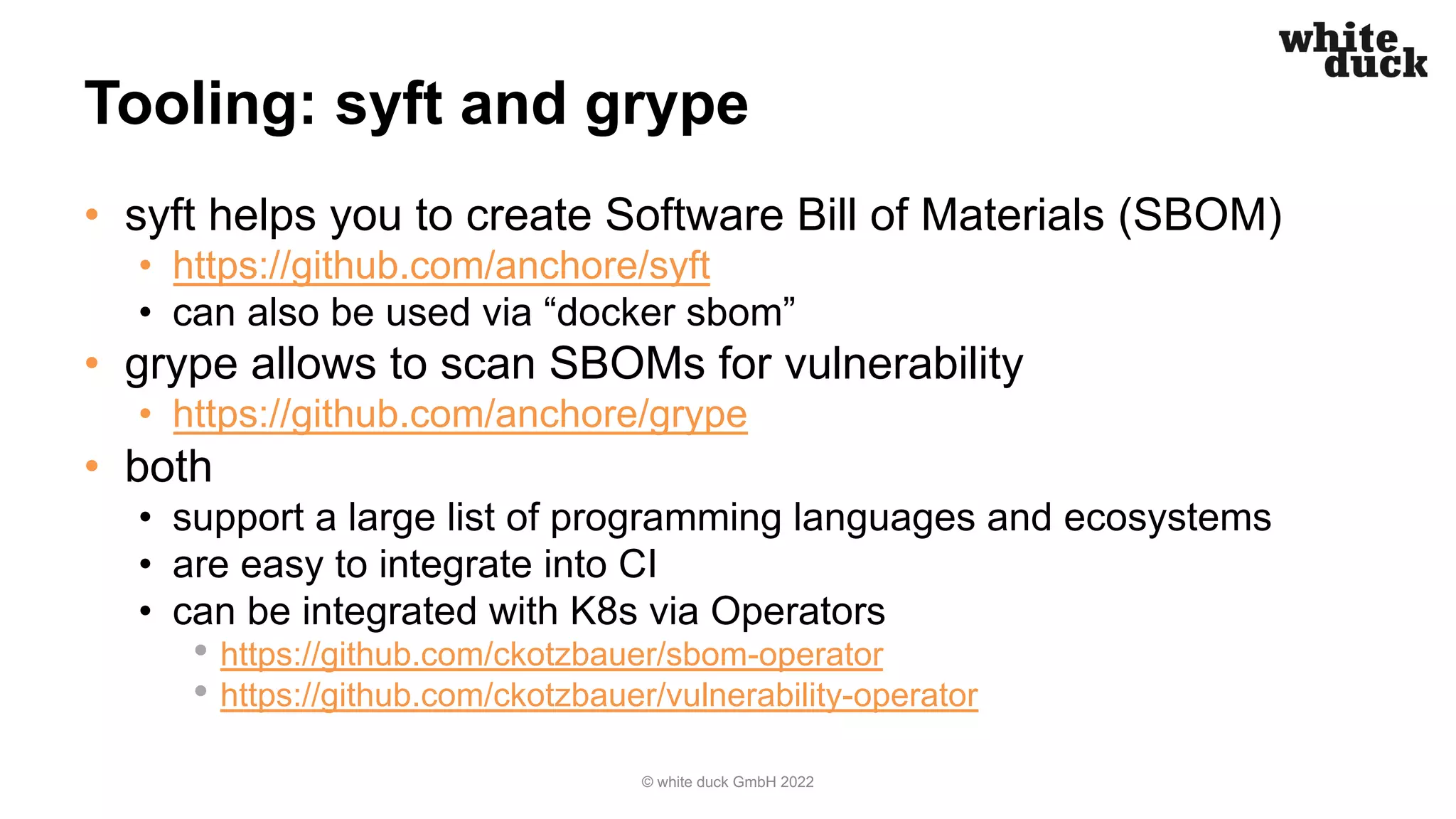
Tooling: syft and grype
• syft helps you to create Software Bill of Materials (SBOM)
• https://github.com/anchore/syft
• can also be used via “docker sbom”
• grype allows to scan SBOMs for vulnerability
• https://github.com/anchore/grype
• both
• support a large list of programming languages and ecosystems
• are easy to integrate into CI
• can be integrated with K8s via Operators
• https://github.com/ckotzbauer/sbom-operator
• https://github.com/ckotzbauer/vulnerability-operator
© white duck GmbH 2022
Demo: Vulnerability scanning with SBOM
• we will create an SBOM for an existing container image
using syft
• then analyzing the exported SBOM with grype to detect
possible vulnerabilities
© white duck GmbH 2022
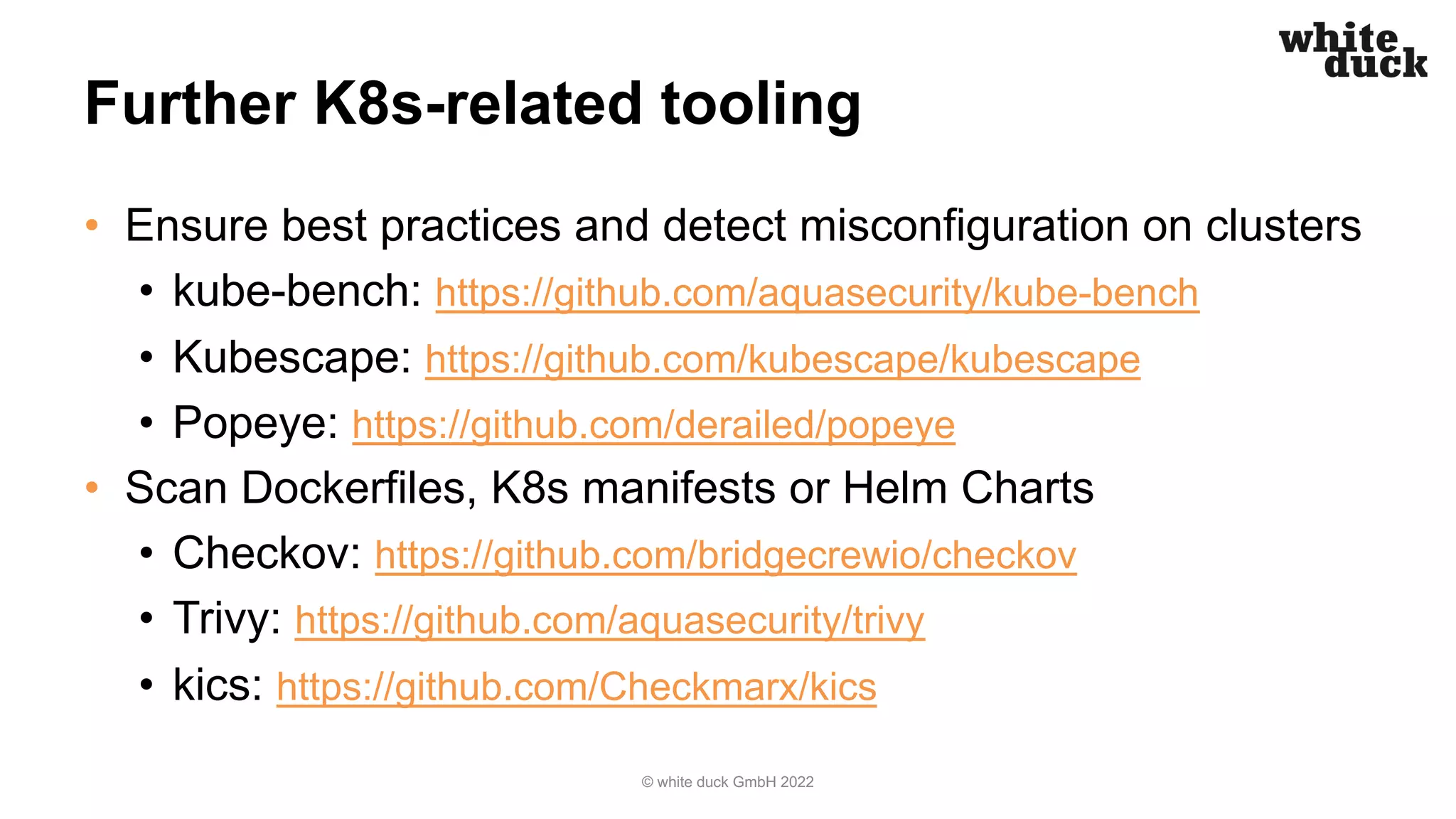
Further K8s-related tooling
• Ensure best practices and detect misconfiguration on clusters
• kube-bench: https://github.com/aquasecurity/kube-bench
• Kubescape: https://github.com/kubescape/kubescape
• Popeye: https://github.com/derailed/popeye
• Scan Dockerfiles, K8s manifests or Helm Charts
• Checkov: https://github.com/bridgecrewio/checkov
• Trivy: https://github.com/aquasecurity/trivy
• kics: https://github.com/Checkmarx/kics
© white duck GmbH 2022
Implement Kubernetes policies
• allows you to enforce what is allowed and what is not
• enables you to define guardrails for your user
• can limit attackers from gaining further access
© white duck GmbH 2022
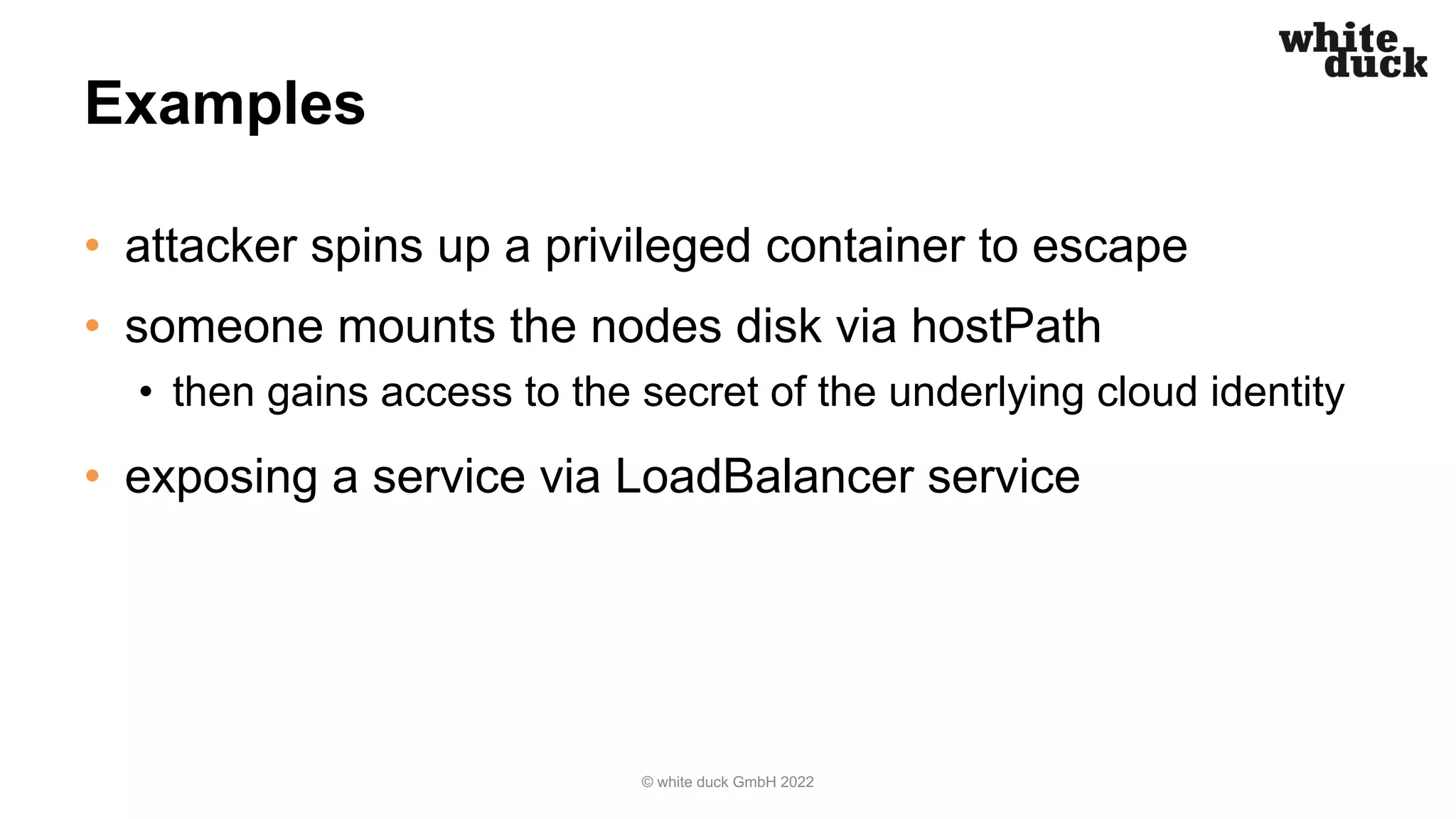
Examples
• attacker spins up a privileged container to escape
• someone mounts the nodes disk via hostPath
• then gains access to the secret of the underlying cloud identity
• exposing a service via LoadBalancer service
© white duck GmbH 2022
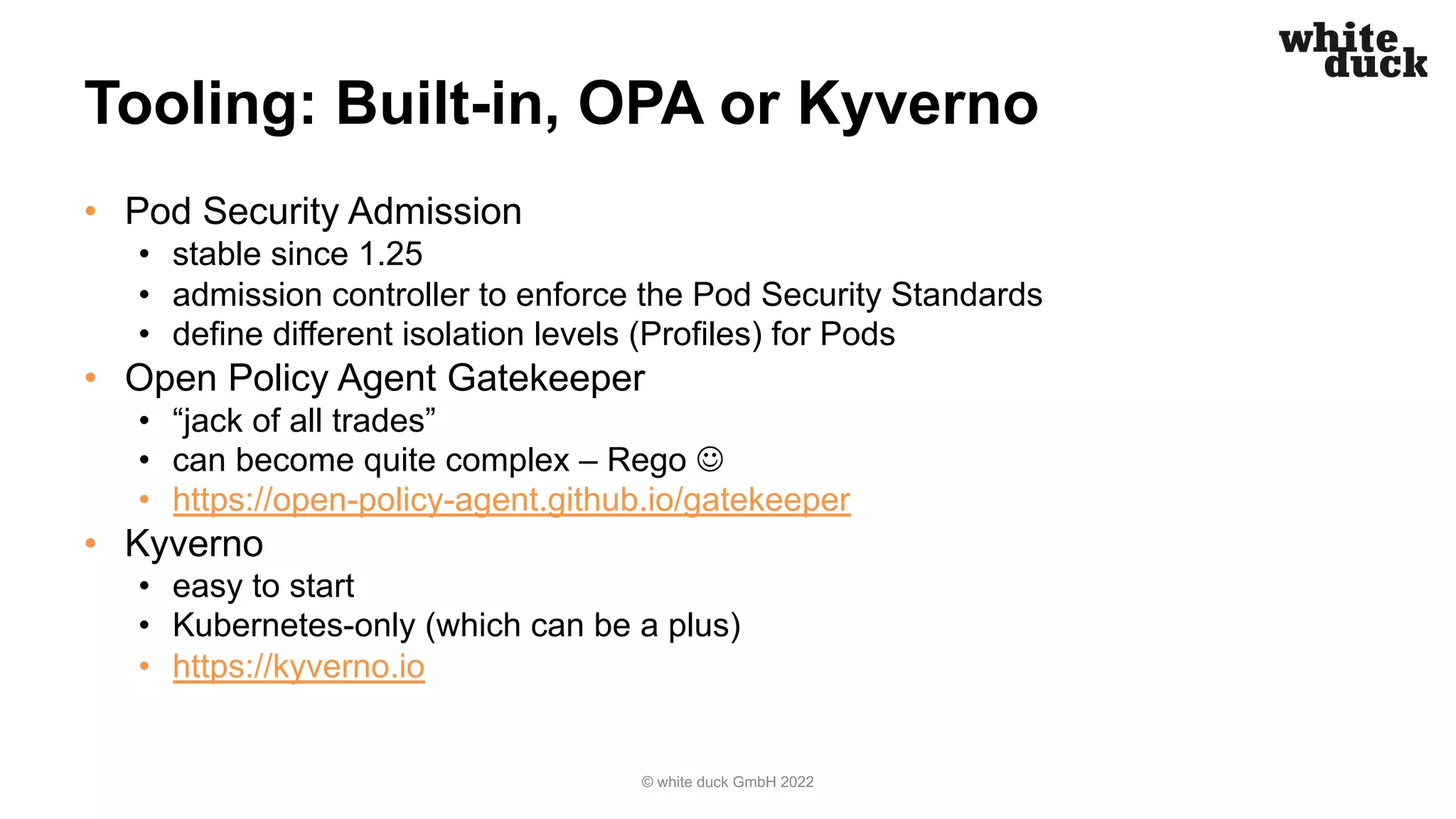
Tooling: Built-in, OPA or Kyverno
• Pod Security Admission
• stable since 1.25
• admission controller to enforce the Pod Security Standards
• define different isolation levels (Profiles) for Pods
• Open Policy Agent Gatekeeper
• “jack of all trades”
• can become quite complex – Rego J
• https://open-policy-agent.github.io/gatekeeper
• Kyverno
• easy to start
• Kubernetes-only (which can be a plus)
• https://kyverno.io
© white duck GmbH 2022
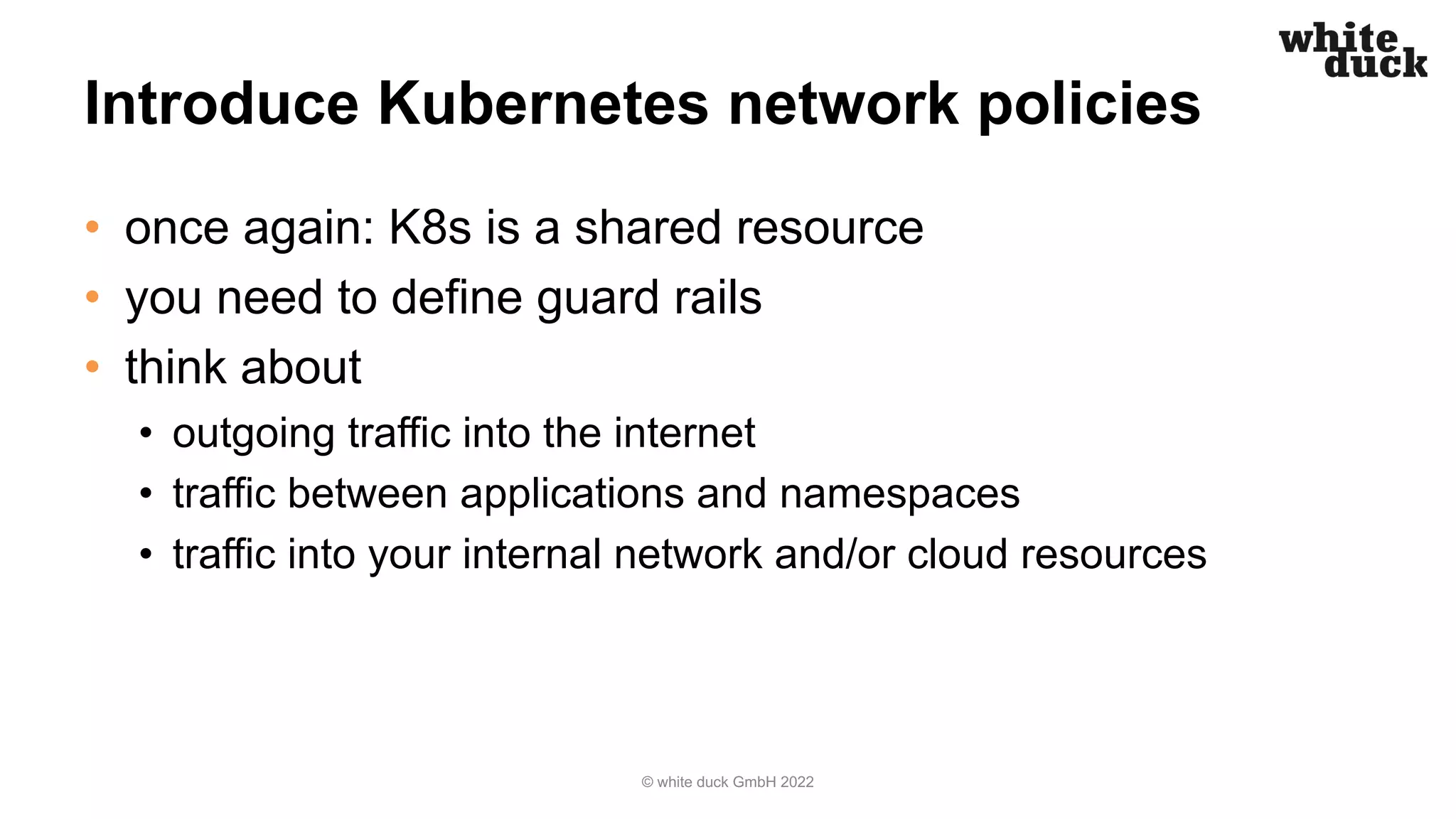
Introduce Kubernetes network policies
• once again: K8s is a shared resource
• you need to define guard rails
• think about
• outgoing traffic into the internet
• traffic between applications and namespaces
• traffic into your internal network and/or cloud resources
© white duck GmbH 2022
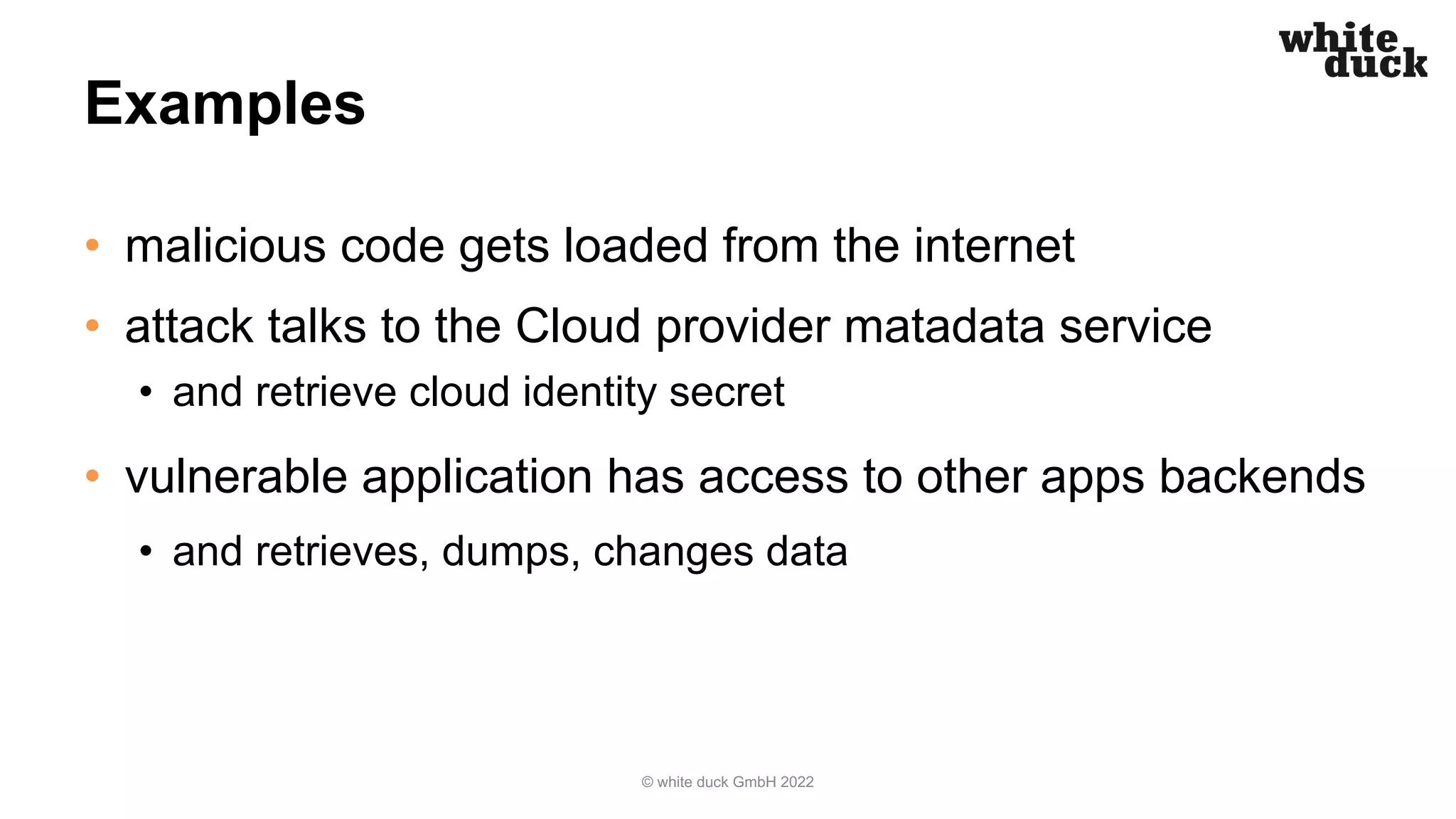
Examples
• malicious code gets loaded from the internet
• attack talks to the Cloud provider matadata service
• and retrieve cloud identity secret
• vulnerable application has access to other apps backends
• and retrieves, dumps, changes data
© white duck GmbH 2022
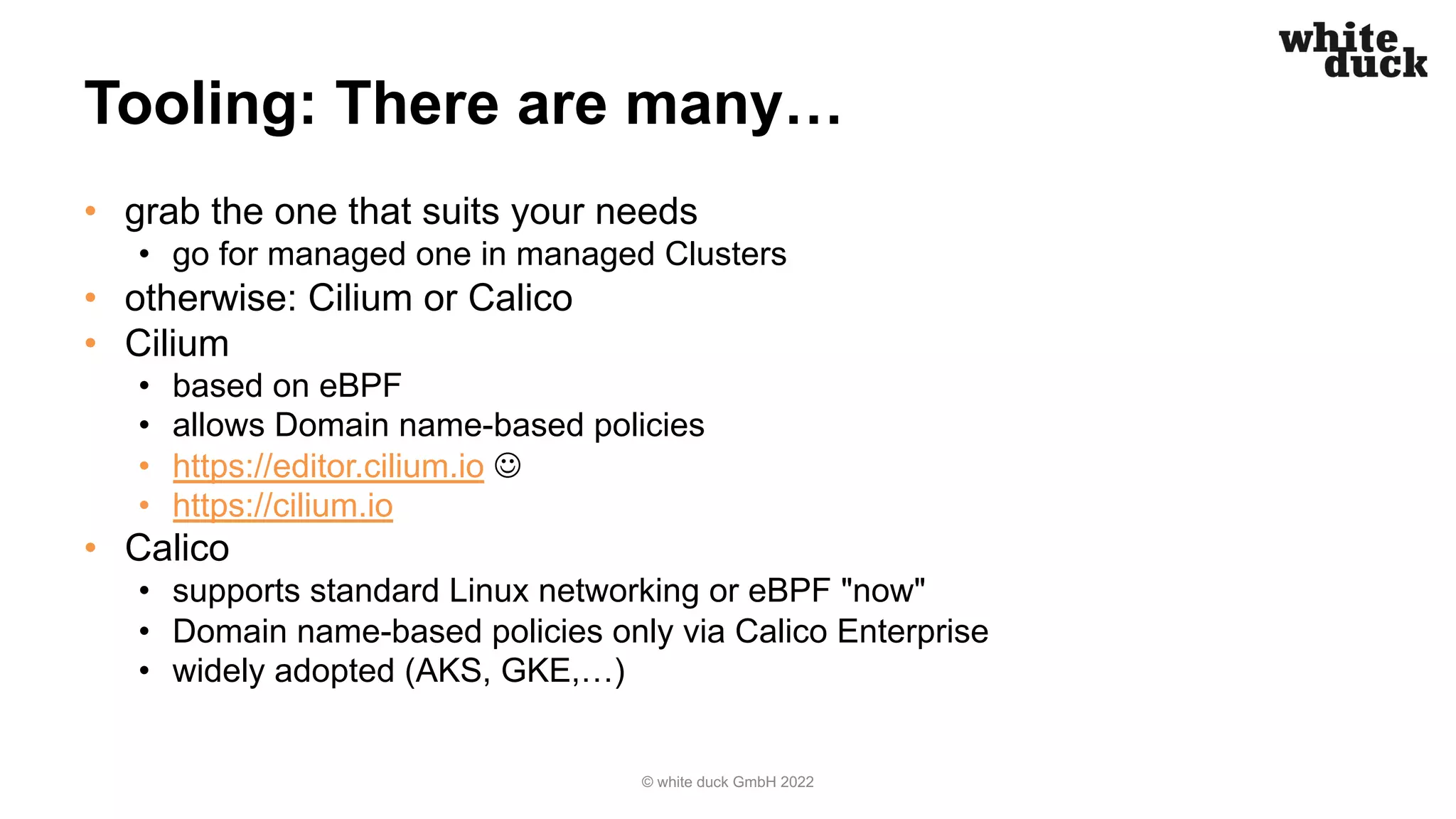
Tooling: There are many…
• grab the one that suits your needs
• go for managed one in managed Clusters
• otherwise: Cilium or Calico
• Cilium
• based on eBPF
• allows Domain name-based policies
• https://editor.cilium.io J
• https://cilium.io
• Calico
• supports standard Linux networking or eBPF "now"
• Domain name-based policies only via Calico Enterprise
• widely adopted (AKS, GKE,…)
© white duck GmbH 2022
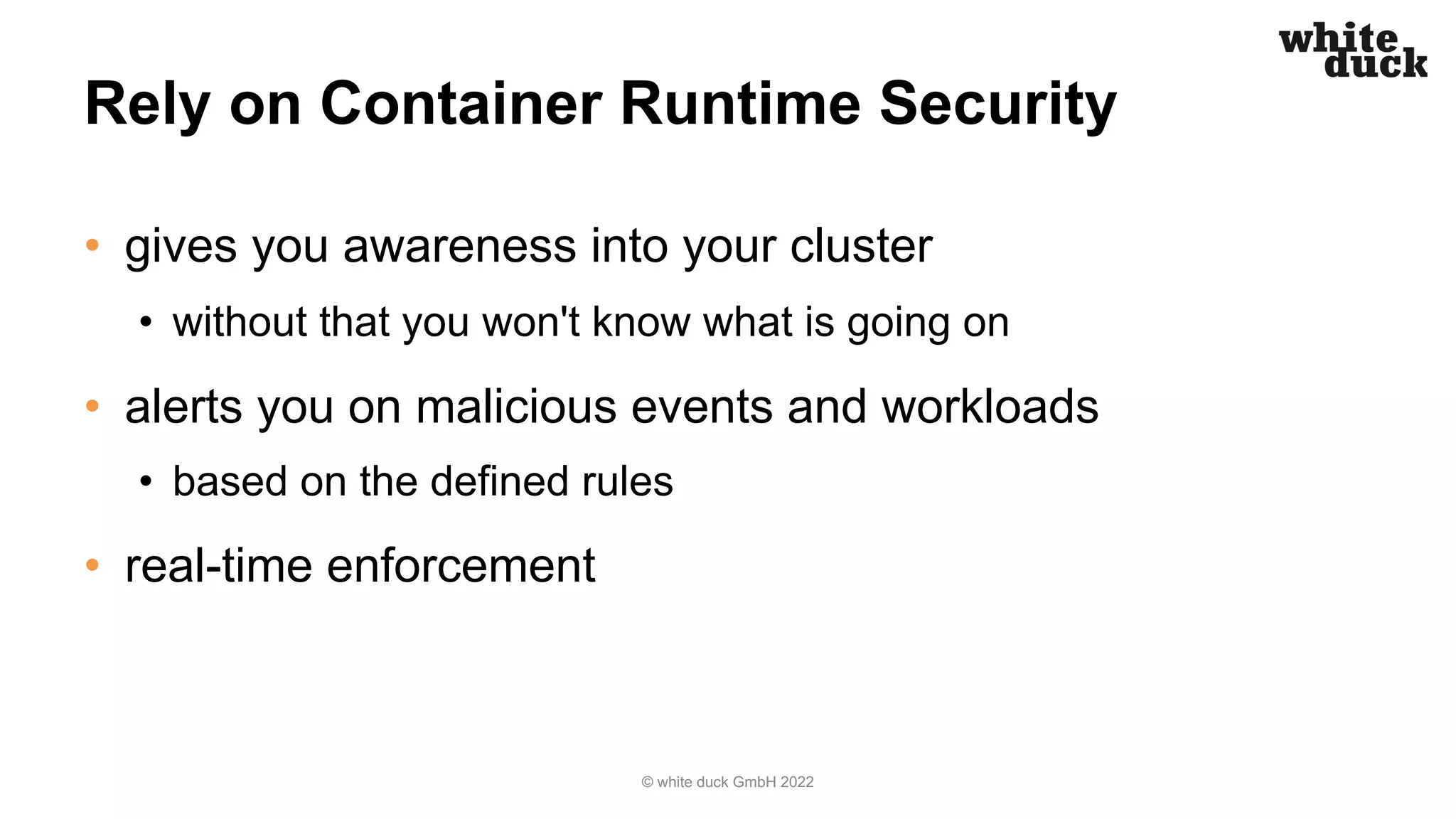
Rely on Container Runtime Security
• gives you awareness into your cluster
• without that you won't know what is going on
• alerts you on malicious events and workloads
• based on the defined rules
• real-time enforcement
© white duck GmbH 2022
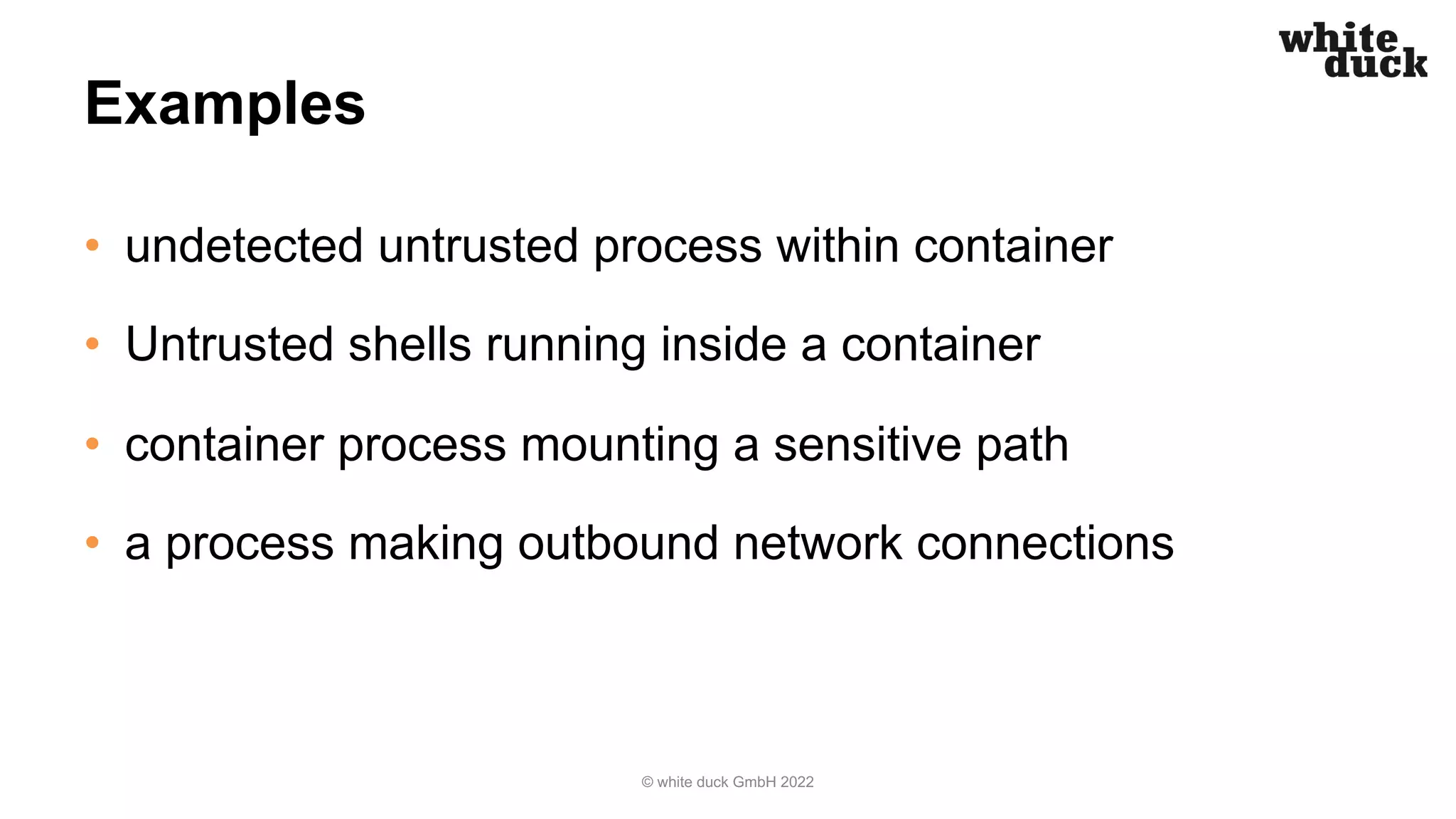
Examples
• undetected untrusted process within container
• Untrusted shells running inside a container
• container process mounting a sensitive path
• a process making outbound network connections
© white duck GmbH 2022
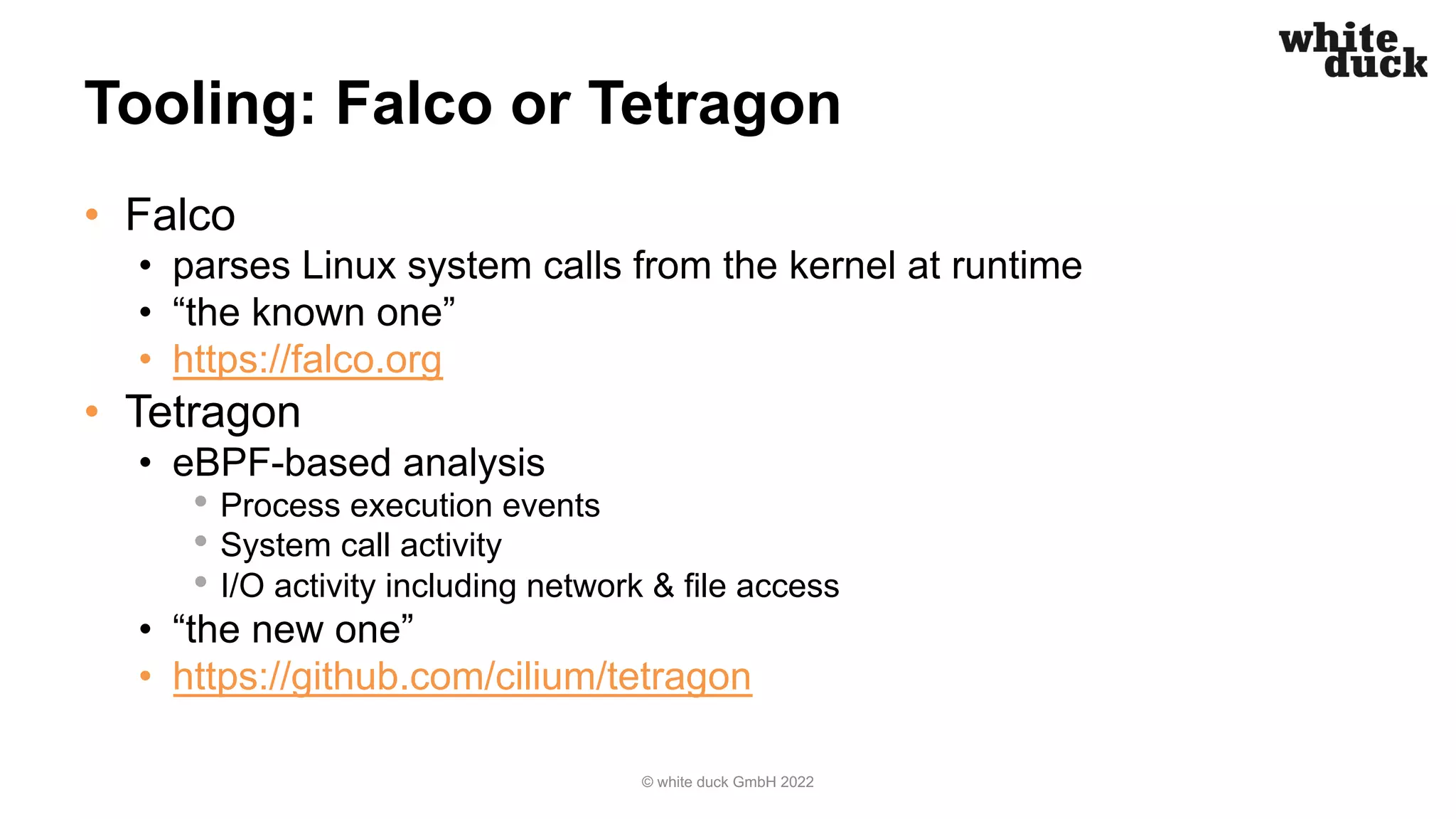
Tooling: Falco or Tetragon
• Falco
• parses Linux system calls from the kernel at runtime
• “the known one”
• https://falco.org
• Tetragon
• eBPF-based analysis
• Process execution events
• System call activity
• I/O activity including network & file access
• “the new one”
• https://github.com/cilium/tetragon
© white duck GmbH 2022
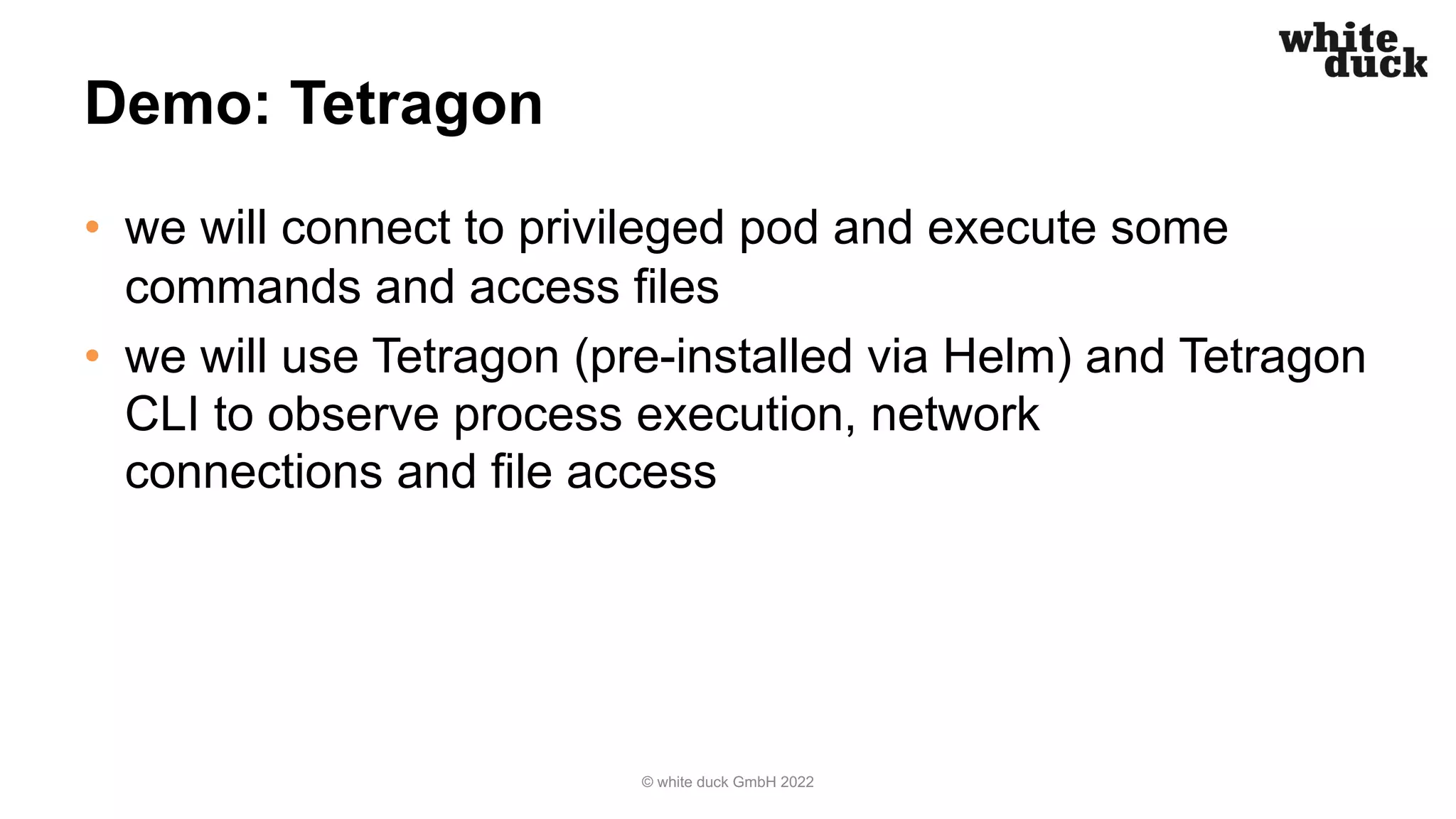
Demo: Tetragon
• we will connect to privileged pod and execute some
commands and access files
• we will use Tetragon (pre-installed via Helm) and Tetragon
CLI to observe process execution, network
connections and file access
© white duck GmbH 2022
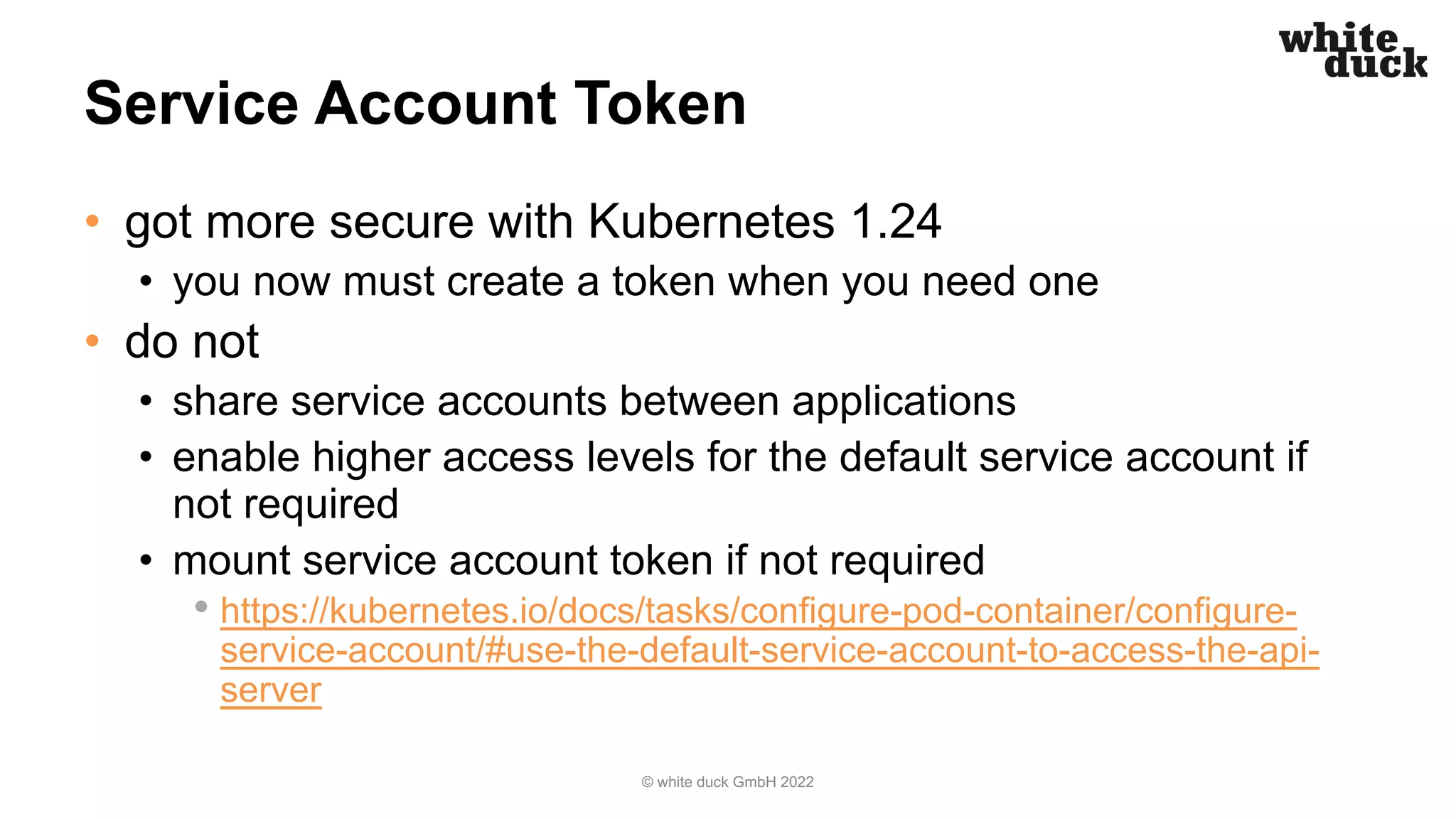
Service Account Token
• got more secure with Kubernetes 1.24
• you now must create a token when you need one
• do not
• share service accounts between applications
• enable higher access levels for the default service account if
not required
• mount service account token if not required
• https://kubernetes.io/docs/tasks/configure-pod-container/configure-
service-account/#use-the-default-service-account-to-access-the-api-
server
© white duck GmbH 2022
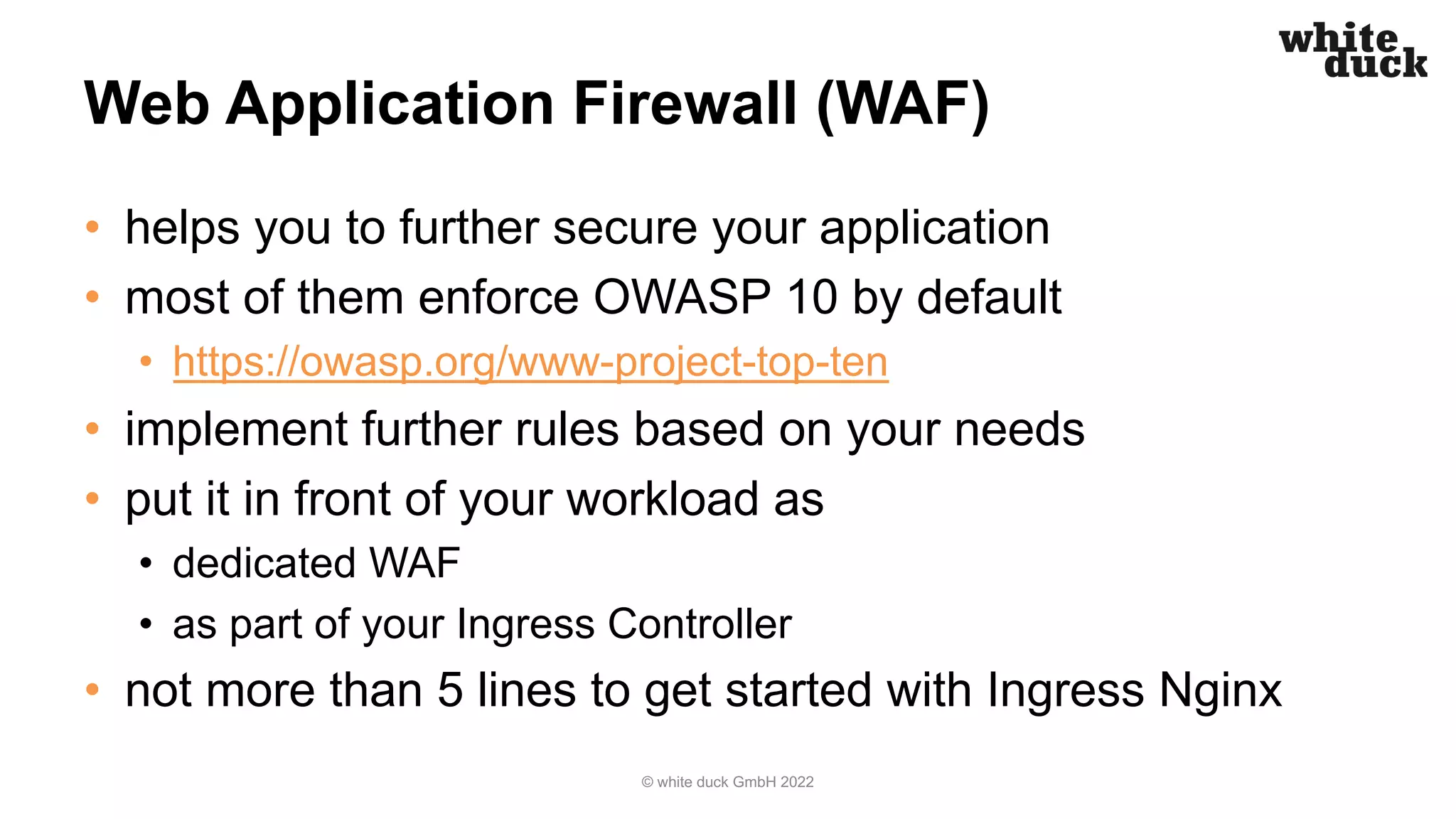
Web Application Firewall (WAF)
• helps you to further secure your application
• most of them enforce OWASP 10 by default
• https://owasp.org/www-project-top-ten
• implement further rules based on your needs
• put it in front of your workload as
• dedicated WAF
• as part of your Ingress Controller
• not more than 5 lines to get started with Ingress Nginx
© white duck GmbH 2022
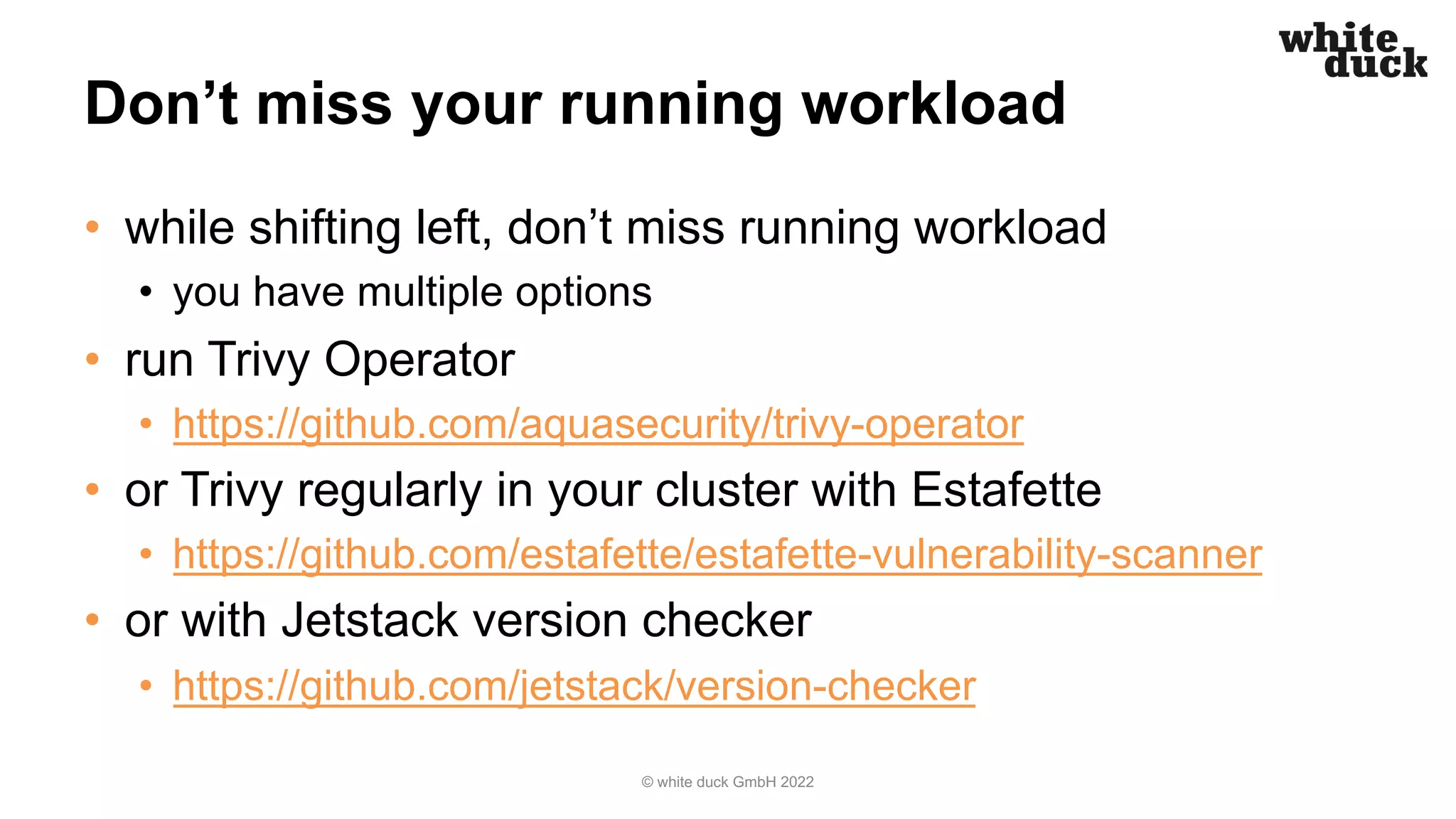
Don’t miss your running workload
• while shifting left, don’t miss running workload
• you have multiple options
• run Trivy Operator
• https://github.com/aquasecurity/trivy-operator
• or Trivy regularly in your cluster with Estafette
• https://github.com/estafette/estafette-vulnerability-scanner
• or with Jetstack version checker
• https://github.com/jetstack/version-checker
© white duck GmbH 2022
Links & further details
• there are many more projects
• we have shown only a very small portion
• “Hijack Kubernetes” demo
• https://github.com/nmeisenzahl/hijack-kubernetes
© white duck GmbH 2022
Questions?
© white duck GmbH 2022
Nico Meisenzahl (Head of DevOps Consulting and Operations,
Cloud Solution Architect, Azure & Developer Technologies MVP, GitLab Hero)
Email: nico.meisenzahl@whiteduck.de
Twitter: @nmeisenzahl
LinkedIn: https://www.linkedin.com/in/nicomeisenzahl/
Philip Welz (Senior Kubernetes & DevOps Engineer,
GitLab Hero, CKA, CKAD & CKS)
Twitter: @philip_welz
LinkedIn: https://www.linkedin.com/in/philip-welz

How to Prevent Your Kubernetes Cluster From Being Hacked

  • 1.
    How to PreventYour Kubernetes Cluster From Being Hacked ContainerDays Meetup 2022
  • 2.
    Who we are ©white duck GmbH 2022 Nico Meisenzahl (Head of DevOps Consulting and Operations, Cloud Solution Architect, Azure & Developer Technologies MVP, GitLab Hero) Email: nico.meisenzahl@whiteduck.de Twitter: @nmeisenzahl LinkedIn: https://www.linkedin.com/in/nicomeisenzahl/ Philip Welz (Senior Kubernetes & DevOps Engineer, GitLab Hero, CKA, CKAD & CKS) Twitter: @philip_welz LinkedIn: https://www.linkedin.com/in/philip-welz
  • 3.
    Security quick winsthrough the DevOps cycle © white duck GmbH 2022
  • 4.
    You should thinkabout • ensure secure application / deployment code • build secure container images • implement Kubernetes policies • introduce Kubernetes network policies • rely on Container Runtime Security • many more… © white duck GmbH 2022
  • 5.
    Ensure secure application/ deployment code • your cluster is a shared resource • a single compromised application can be enough • automate and enforce code checks (shift left!) • scan your code as well as your dependencies • application code • Dockerfiles • deployment manifests © white duck GmbH 2022
  • 6.
    Examples • vulnerable codeand dependencies • missing Dockerfile best practices • unsecure Kubernetes manifests They all can lead to someone gaining access to your cluster! © white duck GmbH 2022
  • 7.
    SAST in general •Static Application Security Testing (SAST) can help validate you with • application code • Dockerfiles • Kubernetes Manifests • and more • use your existing tooling (GitHub, GitLab) for easy start • there is also a big ecosystem available © white duck GmbH 2022
  • 8.
    Software Bill ofMaterials (SBOM) • “list of ingredients” for all your software and dependencies • supports hierarchy and therefore multi-level dependencies • without you don’t have the full visibility • in an ideal world you would only need to care about your own stuff • SBOMs can be the baseline for your vulnerability scanning © white duck GmbH 2022
  • 9.
    Tooling: syft andgrype • syft helps you to create Software Bill of Materials (SBOM) • https://github.com/anchore/syft • can also be used via “docker sbom” • grype allows to scan SBOMs for vulnerability • https://github.com/anchore/grype • both • support a large list of programming languages and ecosystems • are easy to integrate into CI • can be integrated with K8s via Operators • https://github.com/ckotzbauer/sbom-operator • https://github.com/ckotzbauer/vulnerability-operator © white duck GmbH 2022
  • 10.
    Demo: Vulnerability scanningwith SBOM • we will create an SBOM for an existing container image using syft • then analyzing the exported SBOM with grype to detect possible vulnerabilities © white duck GmbH 2022
  • 11.
    Further K8s-related tooling •Ensure best practices and detect misconfiguration on clusters • kube-bench: https://github.com/aquasecurity/kube-bench • Kubescape: https://github.com/kubescape/kubescape • Popeye: https://github.com/derailed/popeye • Scan Dockerfiles, K8s manifests or Helm Charts • Checkov: https://github.com/bridgecrewio/checkov • Trivy: https://github.com/aquasecurity/trivy • kics: https://github.com/Checkmarx/kics © white duck GmbH 2022
  • 12.
    Implement Kubernetes policies •allows you to enforce what is allowed and what is not • enables you to define guardrails for your user • can limit attackers from gaining further access © white duck GmbH 2022
  • 13.
    Examples • attacker spinsup a privileged container to escape • someone mounts the nodes disk via hostPath • then gains access to the secret of the underlying cloud identity • exposing a service via LoadBalancer service © white duck GmbH 2022
  • 14.
    Tooling: Built-in, OPAor Kyverno • Pod Security Admission • stable since 1.25 • admission controller to enforce the Pod Security Standards • define different isolation levels (Profiles) for Pods • Open Policy Agent Gatekeeper • “jack of all trades” • can become quite complex – Rego J • https://open-policy-agent.github.io/gatekeeper • Kyverno • easy to start • Kubernetes-only (which can be a plus) • https://kyverno.io © white duck GmbH 2022
  • 15.
    Introduce Kubernetes networkpolicies • once again: K8s is a shared resource • you need to define guard rails • think about • outgoing traffic into the internet • traffic between applications and namespaces • traffic into your internal network and/or cloud resources © white duck GmbH 2022
  • 16.
    Examples • malicious codegets loaded from the internet • attack talks to the Cloud provider matadata service • and retrieve cloud identity secret • vulnerable application has access to other apps backends • and retrieves, dumps, changes data © white duck GmbH 2022
  • 17.
    Tooling: There aremany… • grab the one that suits your needs • go for managed one in managed Clusters • otherwise: Cilium or Calico • Cilium • based on eBPF • allows Domain name-based policies • https://editor.cilium.io J • https://cilium.io • Calico • supports standard Linux networking or eBPF "now" • Domain name-based policies only via Calico Enterprise • widely adopted (AKS, GKE,…) © white duck GmbH 2022
  • 18.
    Rely on ContainerRuntime Security • gives you awareness into your cluster • without that you won't know what is going on • alerts you on malicious events and workloads • based on the defined rules • real-time enforcement © white duck GmbH 2022
  • 19.
    Examples • undetected untrustedprocess within container • Untrusted shells running inside a container • container process mounting a sensitive path • a process making outbound network connections © white duck GmbH 2022
  • 20.
    Tooling: Falco orTetragon • Falco • parses Linux system calls from the kernel at runtime • “the known one” • https://falco.org • Tetragon • eBPF-based analysis • Process execution events • System call activity • I/O activity including network & file access • “the new one” • https://github.com/cilium/tetragon © white duck GmbH 2022
  • 21.
    Demo: Tetragon • wewill connect to privileged pod and execute some commands and access files • we will use Tetragon (pre-installed via Helm) and Tetragon CLI to observe process execution, network connections and file access © white duck GmbH 2022
  • 22.
    Service Account Token •got more secure with Kubernetes 1.24 • you now must create a token when you need one • do not • share service accounts between applications • enable higher access levels for the default service account if not required • mount service account token if not required • https://kubernetes.io/docs/tasks/configure-pod-container/configure- service-account/#use-the-default-service-account-to-access-the-api- server © white duck GmbH 2022
  • 23.
    Web Application Firewall(WAF) • helps you to further secure your application • most of them enforce OWASP 10 by default • https://owasp.org/www-project-top-ten • implement further rules based on your needs • put it in front of your workload as • dedicated WAF • as part of your Ingress Controller • not more than 5 lines to get started with Ingress Nginx © white duck GmbH 2022
  • 24.
    Don’t miss yourrunning workload • while shifting left, don’t miss running workload • you have multiple options • run Trivy Operator • https://github.com/aquasecurity/trivy-operator • or Trivy regularly in your cluster with Estafette • https://github.com/estafette/estafette-vulnerability-scanner • or with Jetstack version checker • https://github.com/jetstack/version-checker © white duck GmbH 2022
  • 25.
    Links & furtherdetails • there are many more projects • we have shown only a very small portion • “Hijack Kubernetes” demo • https://github.com/nmeisenzahl/hijack-kubernetes © white duck GmbH 2022
  • 26.
    Questions? © white duckGmbH 2022 Nico Meisenzahl (Head of DevOps Consulting and Operations, Cloud Solution Architect, Azure & Developer Technologies MVP, GitLab Hero) Email: nico.meisenzahl@whiteduck.de Twitter: @nmeisenzahl LinkedIn: https://www.linkedin.com/in/nicomeisenzahl/ Philip Welz (Senior Kubernetes & DevOps Engineer, GitLab Hero, CKA, CKAD & CKS) Twitter: @philip_welz LinkedIn: https://www.linkedin.com/in/philip-welz