Hijack a Kubernetes Cluster – a Walkthrough
Nico Meisenzahl
• Senior Cloud & DevOps Consultant at white duck
• Microsoft MVP, GitLab Hero
• Cloud Native, Kubernetes & Azure
© white duck GmbH 2022
Phone: +49 8031 230159 0
Email: nico.meisenzahl@whiteduck.de
Twitter: @nmeisenzahl
LinkedIn: https://www.linkedin.com/in/nicomeisenzahl
Blog: https://meisenzahl.org
About this talk
• this is not an in-depth security talk
• it should make you aware of common attack vectors and
how to prevent them
• you will see demos on how to hijack a cluster
• you will learn how to prevent those with common best practices
• one more slide, then we will start hijacking
• https://github.com/nmeisenzahl/hijack-kubernetes
© white duck GmbH 2022
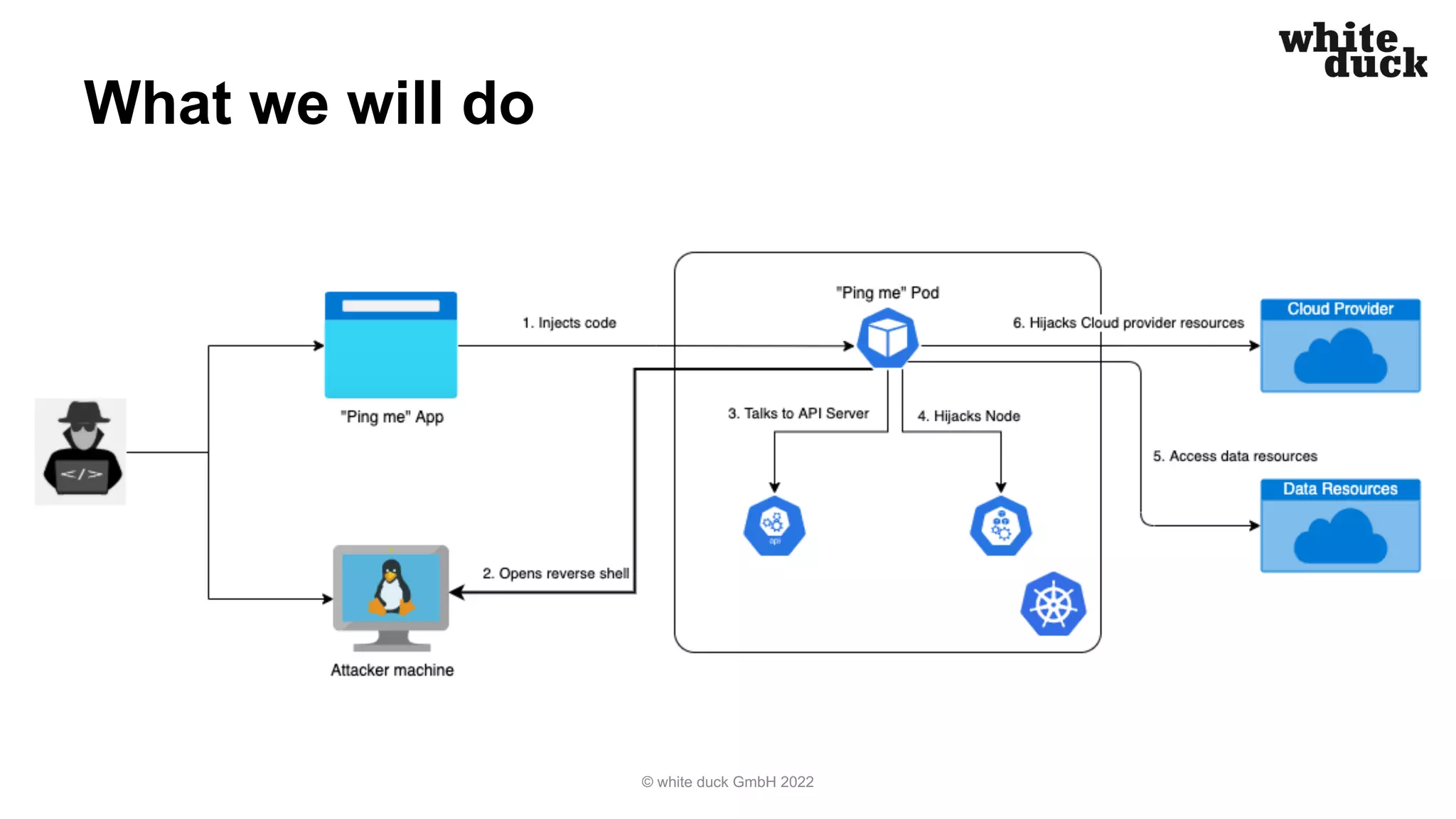
What we will do
© white duck GmbH 2022
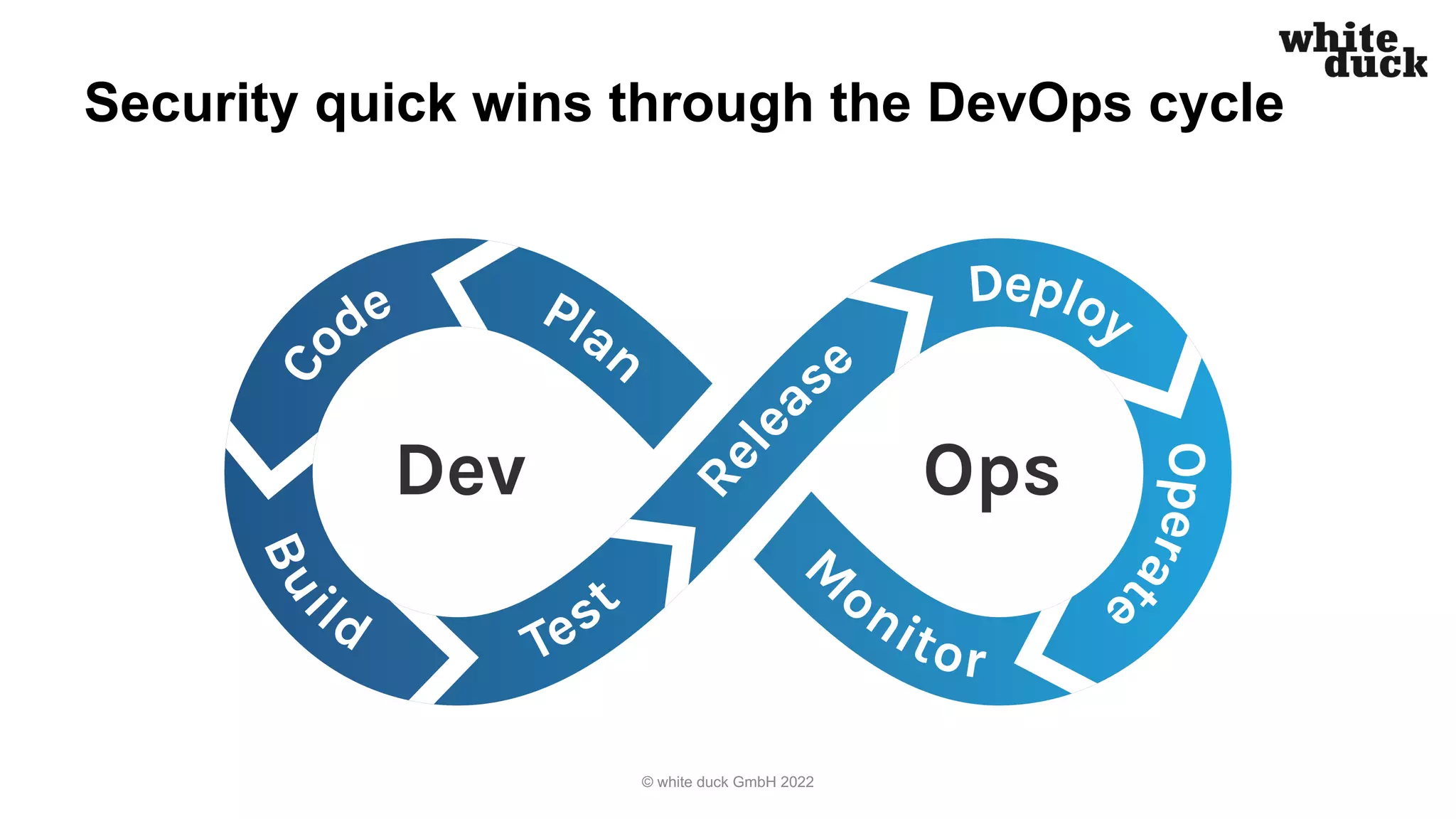
Security quick wins through the DevOps cycle
© white duck GmbH 2022
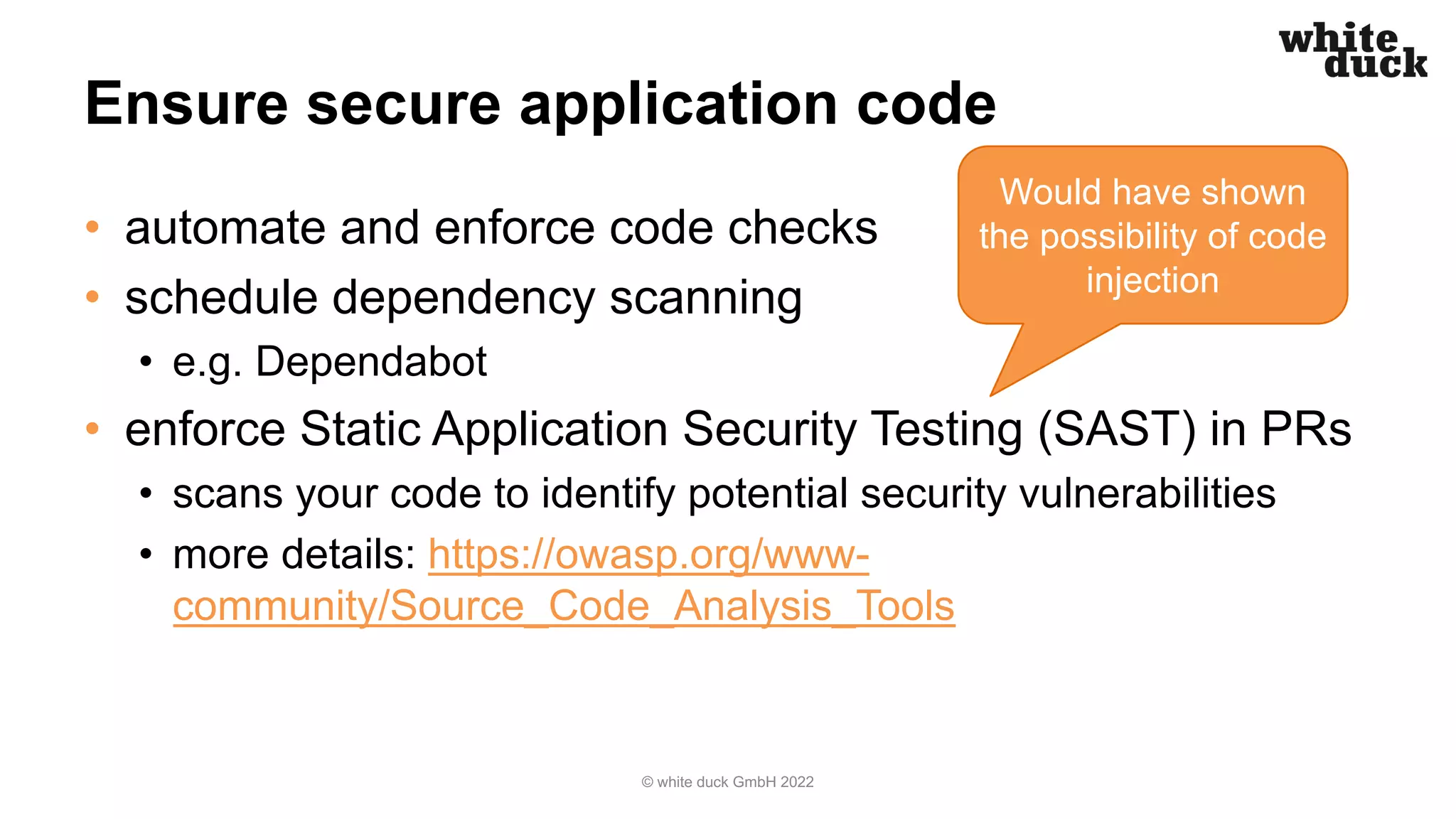
Ensure secure application code
• automate and enforce code checks
• schedule dependency scanning
• e.g. Dependabot
• enforce Static Application Security Testing (SAST) in PRs
• scans your code to identify potential security vulnerabilities
• more details: https://owasp.org/www-
community/Source_Code_Analysis_Tools
© white duck GmbH 2022
Ensure secure application code
• automate and enforce code checks
• schedule dependency scanning
• e.g. Dependabot
• enforce Static Application Security Testing (SAST) in PRs
• scans your code to identify potential security vulnerabilities
• more details: https://owasp.org/www-
community/Source_Code_Analysis_Tools
© white duck GmbH 2022
Would have shown
the possibility of code
injection
Build secure container images
• build secure/small container images – less is more
• do only include required dependencies (no debugging tools!)
• use self-contained binaries or “distroless” if possible
• https://github.com/GoogleContainerTools/distroless
• otherwise, use a small and secure Linux distro
• use and enforce SAST for validating your Dockerfiles
• scan your container images (on build and regularly)
© white duck GmbH 2022
Build secure container images
• build secure/small container images – less is more
• do only include required dependencies (no debugging tools!)
• use self-contained binaries or “distroless” if possible
• https://github.com/GoogleContainerTools/distroless
• otherwise, use a small and secure Linux distro
• use and enforce SAST for validating your Dockerfiles
• scan your container images (on build and regularly)
© white duck GmbH 2022
Would have made it
much harder to
hijack the container
and further expend
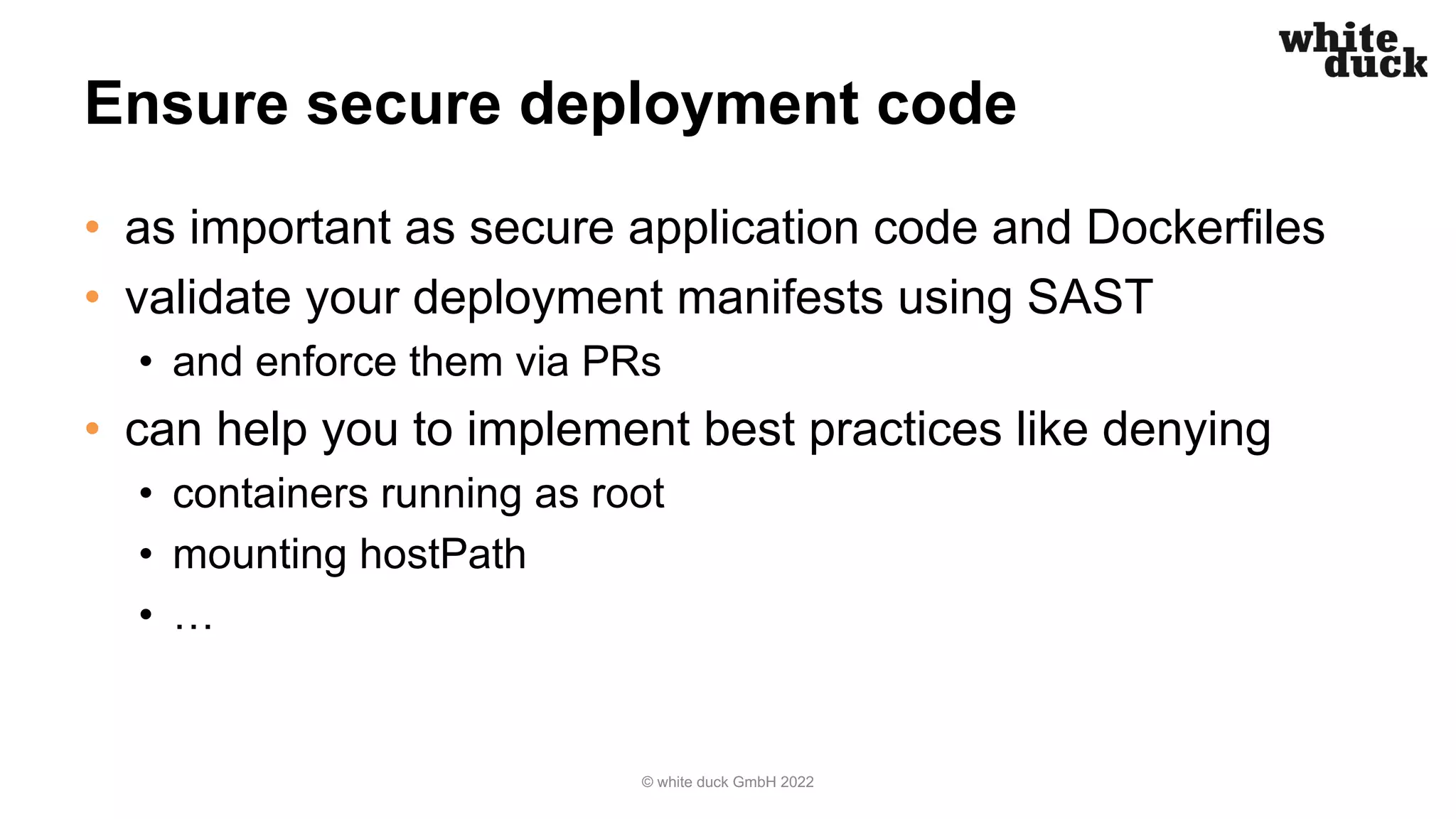
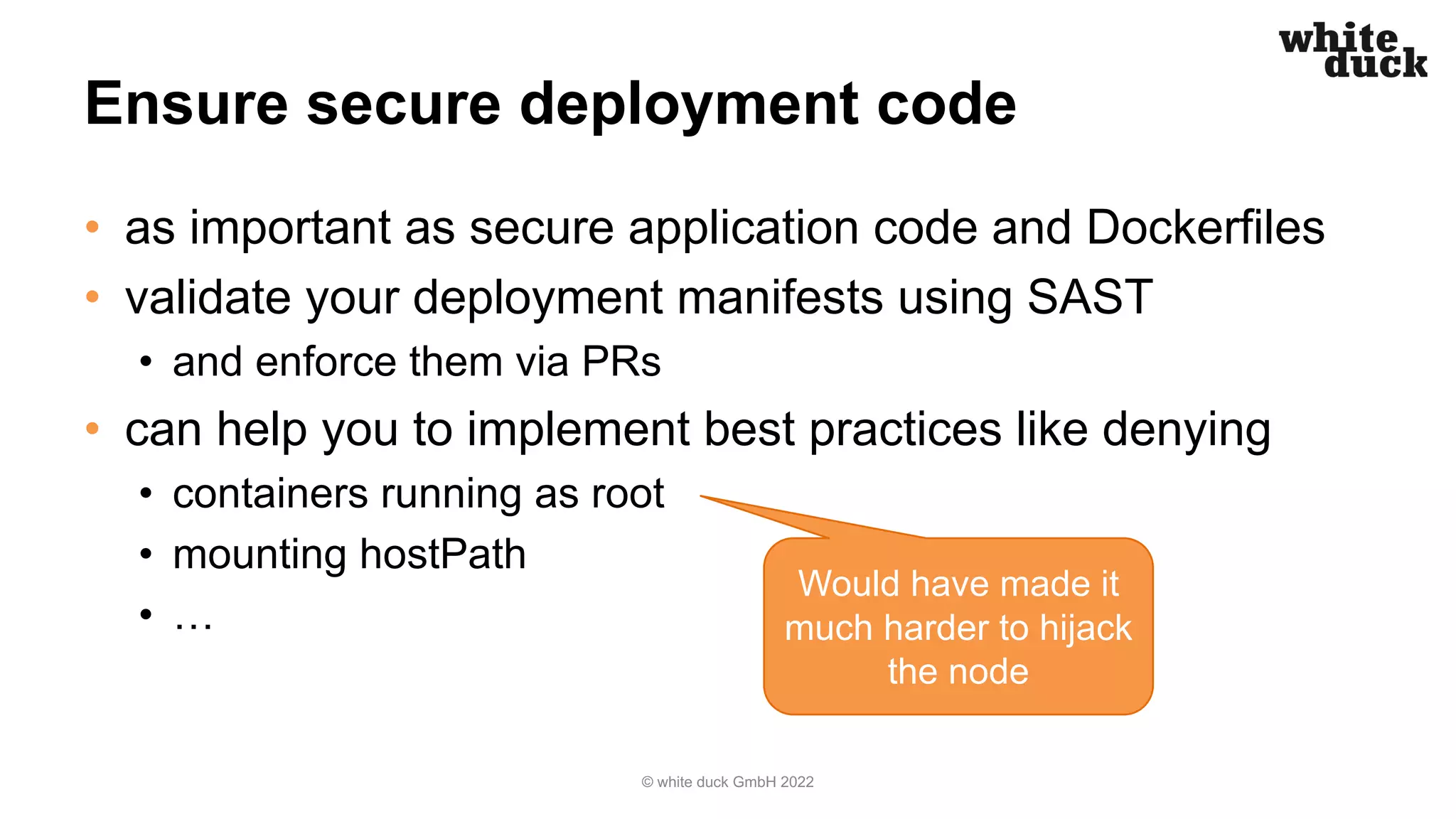
Ensure secure deployment code
• as important as secure application code and Dockerfiles
• validate your deployment manifests using SAST
• and enforce them via PRs
• can help you to implement best practices like denying
• containers running as root
• mounting hostPath
• …
© white duck GmbH 2022
Ensure secure deployment code
• as important as secure application code and Dockerfiles
• validate your deployment manifests using SAST
• and enforce them via PRs
• can help you to implement best practices like denying
• containers running as root
• mounting hostPath
• …
© white duck GmbH 2022
Would have made it
much harder to hijack
the node
SAST Tooling
• Source code
• https://codeql.github.com
• https://security-code-scan.github.io
• https://securego.io
• Kubernetes manifests
• https://kubesec.io
• https://github.com/aquasecurity/trivy
• Dockerfiles
• https://github.com/aquasecurity/trivy
• Terraform
• https://github.com/tfsec/tfsec
• https://github.com/aquasecurity/trivy
© white duck GmbH 2022
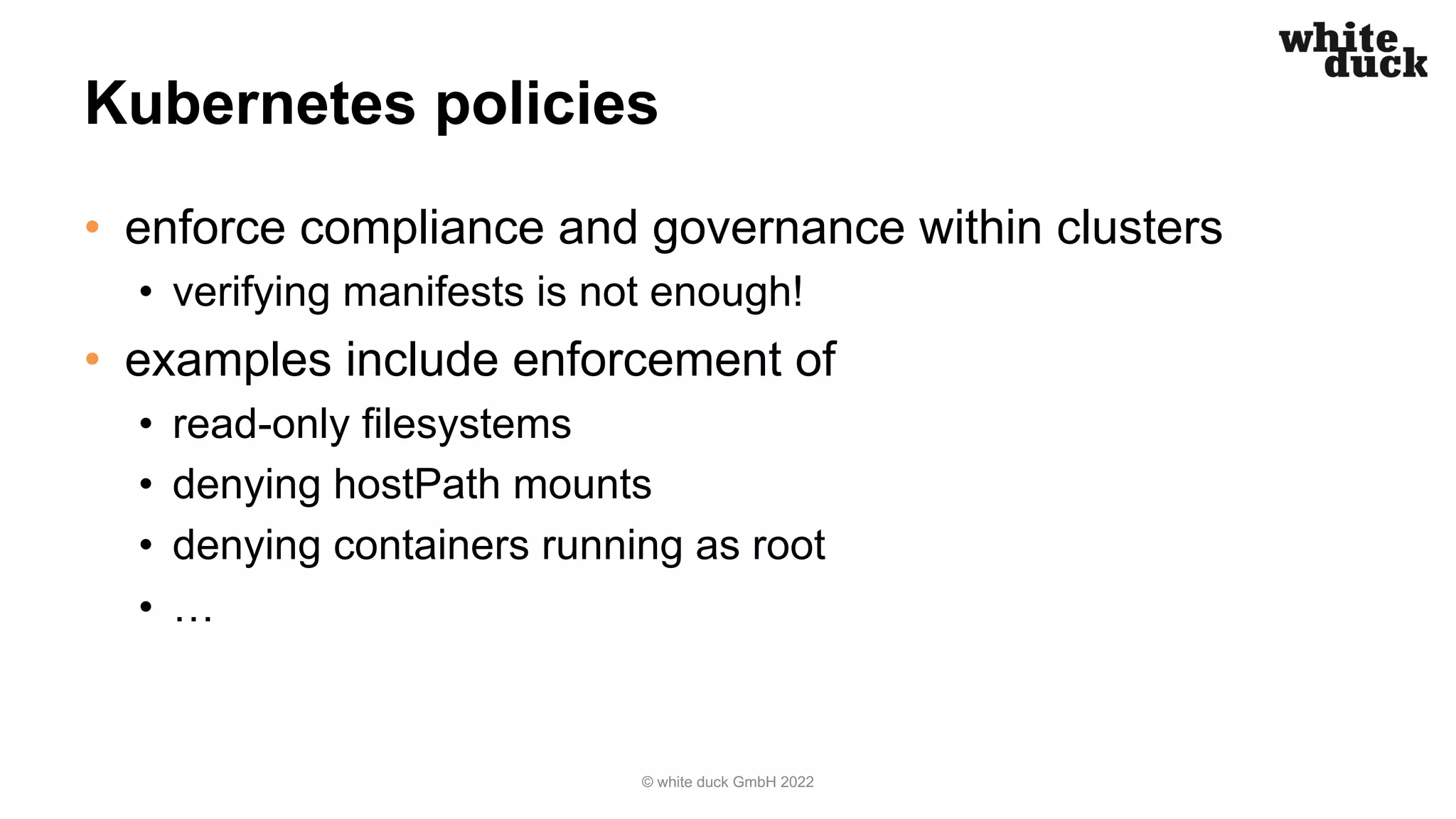
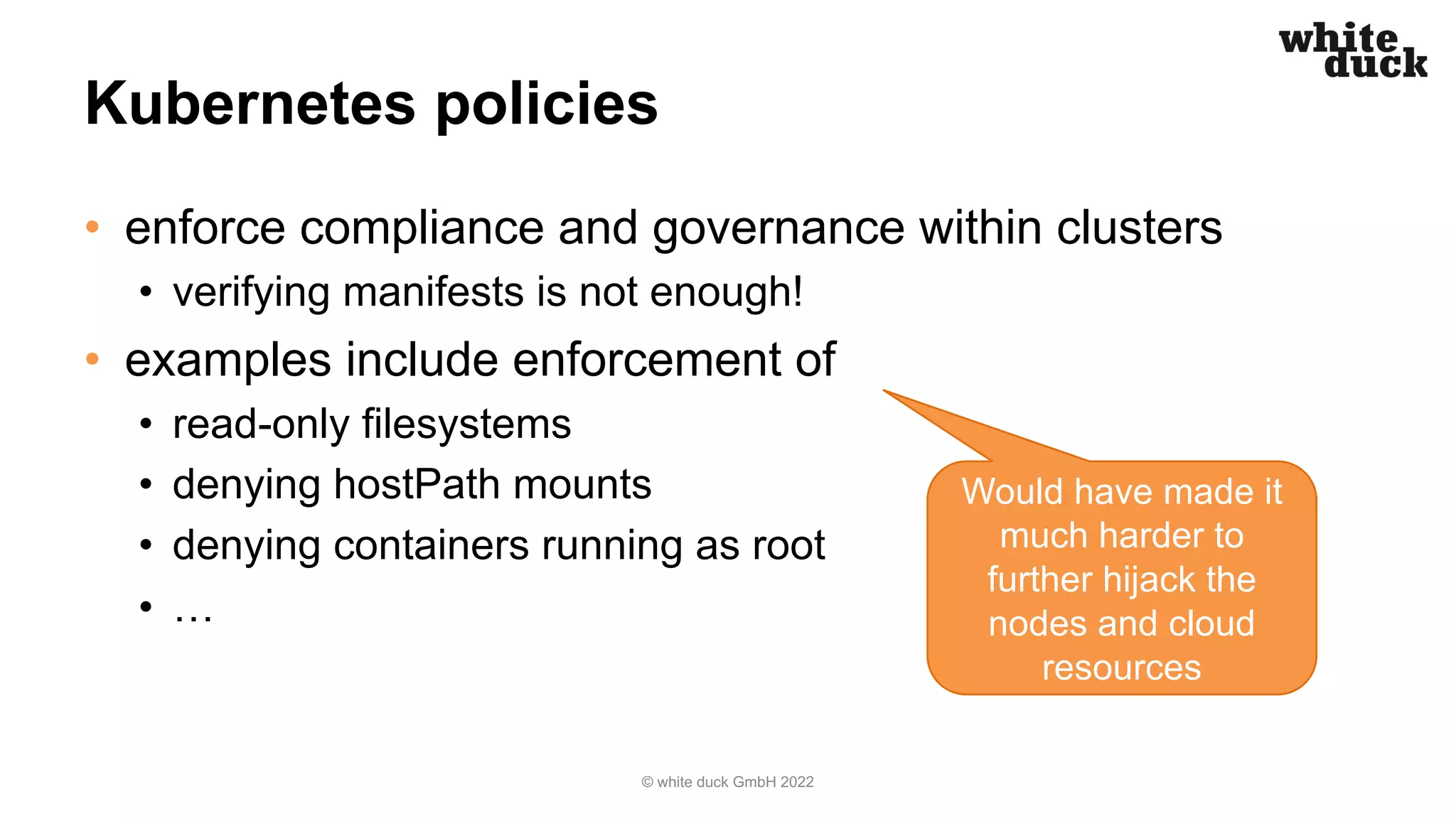
Kubernetes policies
• enforce compliance and governance within clusters
• verifying manifests is not enough!
• examples include enforcement of
• read-only filesystems
• denying hostPath mounts
• denying containers running as root
• …
© white duck GmbH 2022
Kubernetes policies
• enforce compliance and governance within clusters
• verifying manifests is not enough!
• examples include enforcement of
• read-only filesystems
• denying hostPath mounts
• denying containers running as root
• …
© white duck GmbH 2022
Would have made it
much harder to
further hijack the
nodes and cloud
resources
Kubernetes policy Tooling
• Open Policy Agent Gatekeeper
• https://github.com/open-policy-agent/gatekeeper
• Kyverno
• https://kyverno.io
• Azure Policies
• based on Open Policy Agent Gatekeeper
• https://docs.microsoft.com/azure/aks/use-azure-policy
© white duck GmbH 2022
Network Policies
• granular deny or explicitly allow between containers and
ingress/egress of the cluster
• limit egress access to the internet
• limit access between applications/namespaces
• deny access to the Cloud provider metadata service
• https://kubernetes.io/docs/concepts/services-
networking/network-policies
© white duck GmbH 2022
Network Policies
• granular deny or explicitly allow between containers and
ingress/egress of the cluster
• limit egress access to the internet
• limit access between applications/namespaces
• deny access to the Cloud provider metadata service
• https://kubernetes.io/docs/concepts/services-
networking/network-policies
© white duck GmbH 2022
Would have denied
network connections
(reverse shell, Redis,
Internet, metadata
service)
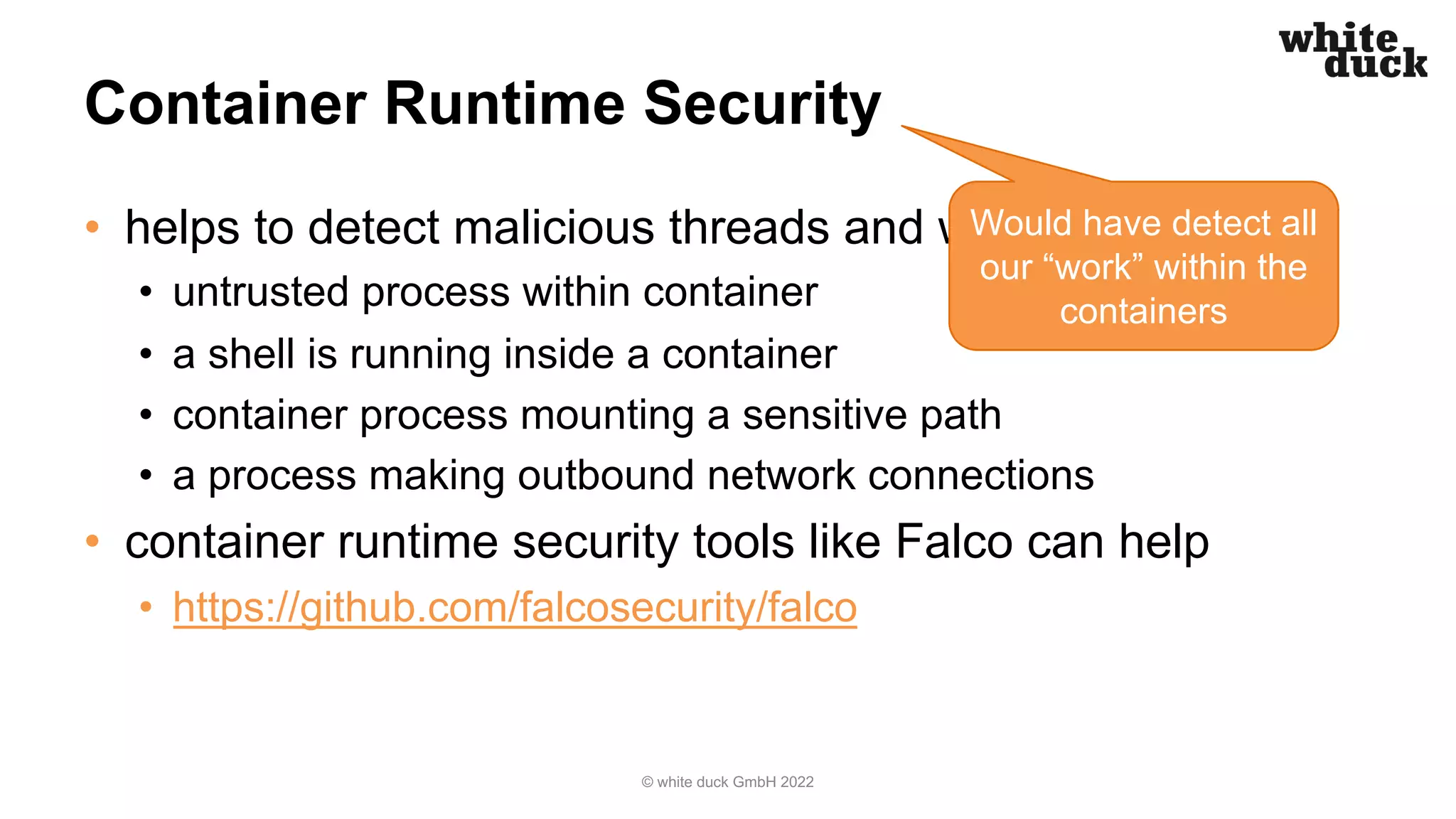
Container Runtime Security
• helps to detect malicious threads and workloads
• untrusted process within container
• a shell is running inside a container
• container process mounting a sensitive path
• a process making outbound network connections
• container runtime security tools like Falco can help
• https://github.com/falcosecurity/falco
© white duck GmbH 2022
Container Runtime Security
• helps to detect malicious threads and workloads
• untrusted process within container
• a shell is running inside a container
• container process mounting a sensitive path
• a process making outbound network connections
• container runtime security tools like Falco can help
• https://github.com/falcosecurity/falco
© white duck GmbH 2022
Would have detect all
our “work” within the
containers
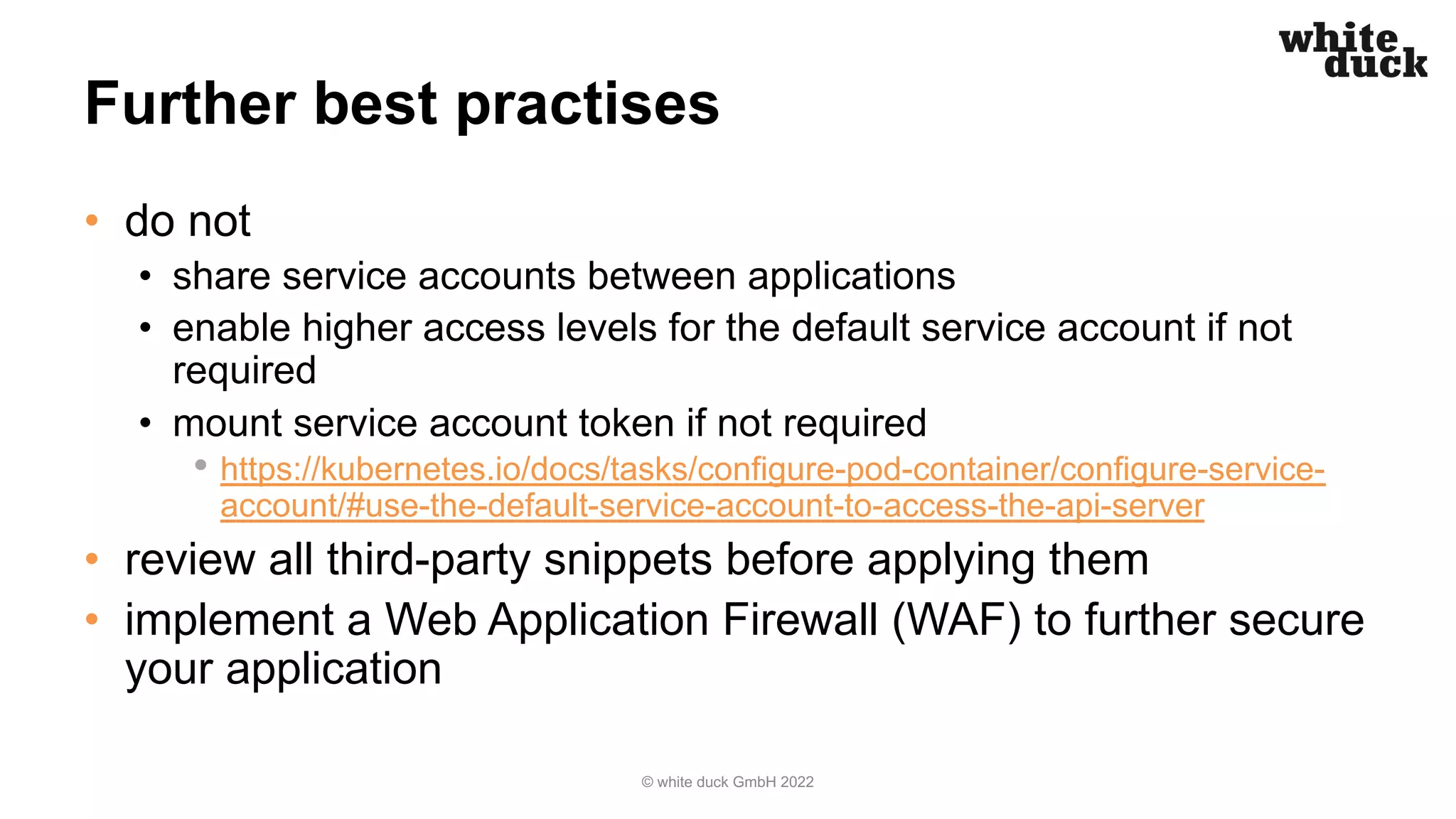
Further best practises
• do not
• share service accounts between applications
• enable higher access levels for the default service account if not
required
• mount service account token if not required
• https://kubernetes.io/docs/tasks/configure-pod-container/configure-service-
account/#use-the-default-service-account-to-access-the-api-server
• review all third-party snippets before applying them
• implement a Web Application Firewall (WAF) to further secure
your application
© white duck GmbH 2022
Further best practises
• do not
• share service accounts between applications
• enable higher access levels for the default service account if not
required
• mount service account token if not required
• https://kubernetes.io/docs/tasks/configure-pod-container/configure-service-
account/#use-the-default-service-account-to-access-the-api-server
• review all third-party snippets before applying them
• implement a Web Application Firewall (WAF) to further secure
your application
© white duck GmbH 2022
Wouldn’t have
allowed us to talk to
the API server
Would have denied
our code injection
Questions?
• Slides: https://www.slideshare.net/nmeisenzahl
• Demo: https://github.com/nmeisenzahl/hijack-kubernetes
© white duck GmbH 2022
Phone: +49 8031 230159 0
Email: nico.meisenzahl@whiteduck.de
Twitter: @nmeisenzahl
LinkedIn: https://www.linkedin.com/in/nicomeisenzahl
Blog: https://meisenzahl.org

Hijack a Kubernetes Cluster - a Walkthrough

  • 1.
    Hijack a KubernetesCluster – a Walkthrough
  • 2.
    Nico Meisenzahl • SeniorCloud & DevOps Consultant at white duck • Microsoft MVP, GitLab Hero • Cloud Native, Kubernetes & Azure © white duck GmbH 2022 Phone: +49 8031 230159 0 Email: nico.meisenzahl@whiteduck.de Twitter: @nmeisenzahl LinkedIn: https://www.linkedin.com/in/nicomeisenzahl Blog: https://meisenzahl.org
  • 3.
    About this talk •this is not an in-depth security talk • it should make you aware of common attack vectors and how to prevent them • you will see demos on how to hijack a cluster • you will learn how to prevent those with common best practices • one more slide, then we will start hijacking • https://github.com/nmeisenzahl/hijack-kubernetes © white duck GmbH 2022
  • 4.
    What we willdo © white duck GmbH 2022
  • 5.
    Security quick winsthrough the DevOps cycle © white duck GmbH 2022
  • 6.
    Ensure secure applicationcode • automate and enforce code checks • schedule dependency scanning • e.g. Dependabot • enforce Static Application Security Testing (SAST) in PRs • scans your code to identify potential security vulnerabilities • more details: https://owasp.org/www- community/Source_Code_Analysis_Tools © white duck GmbH 2022
  • 7.
    Ensure secure applicationcode • automate and enforce code checks • schedule dependency scanning • e.g. Dependabot • enforce Static Application Security Testing (SAST) in PRs • scans your code to identify potential security vulnerabilities • more details: https://owasp.org/www- community/Source_Code_Analysis_Tools © white duck GmbH 2022 Would have shown the possibility of code injection
  • 8.
    Build secure containerimages • build secure/small container images – less is more • do only include required dependencies (no debugging tools!) • use self-contained binaries or “distroless” if possible • https://github.com/GoogleContainerTools/distroless • otherwise, use a small and secure Linux distro • use and enforce SAST for validating your Dockerfiles • scan your container images (on build and regularly) © white duck GmbH 2022
  • 9.
    Build secure containerimages • build secure/small container images – less is more • do only include required dependencies (no debugging tools!) • use self-contained binaries or “distroless” if possible • https://github.com/GoogleContainerTools/distroless • otherwise, use a small and secure Linux distro • use and enforce SAST for validating your Dockerfiles • scan your container images (on build and regularly) © white duck GmbH 2022 Would have made it much harder to hijack the container and further expend
  • 10.
    Ensure secure deploymentcode • as important as secure application code and Dockerfiles • validate your deployment manifests using SAST • and enforce them via PRs • can help you to implement best practices like denying • containers running as root • mounting hostPath • … © white duck GmbH 2022
  • 11.
    Ensure secure deploymentcode • as important as secure application code and Dockerfiles • validate your deployment manifests using SAST • and enforce them via PRs • can help you to implement best practices like denying • containers running as root • mounting hostPath • … © white duck GmbH 2022 Would have made it much harder to hijack the node
  • 12.
    SAST Tooling • Sourcecode • https://codeql.github.com • https://security-code-scan.github.io • https://securego.io • Kubernetes manifests • https://kubesec.io • https://github.com/aquasecurity/trivy • Dockerfiles • https://github.com/aquasecurity/trivy • Terraform • https://github.com/tfsec/tfsec • https://github.com/aquasecurity/trivy © white duck GmbH 2022
  • 13.
    Kubernetes policies • enforcecompliance and governance within clusters • verifying manifests is not enough! • examples include enforcement of • read-only filesystems • denying hostPath mounts • denying containers running as root • … © white duck GmbH 2022
  • 14.
    Kubernetes policies • enforcecompliance and governance within clusters • verifying manifests is not enough! • examples include enforcement of • read-only filesystems • denying hostPath mounts • denying containers running as root • … © white duck GmbH 2022 Would have made it much harder to further hijack the nodes and cloud resources
  • 15.
    Kubernetes policy Tooling •Open Policy Agent Gatekeeper • https://github.com/open-policy-agent/gatekeeper • Kyverno • https://kyverno.io • Azure Policies • based on Open Policy Agent Gatekeeper • https://docs.microsoft.com/azure/aks/use-azure-policy © white duck GmbH 2022
  • 16.
    Network Policies • granulardeny or explicitly allow between containers and ingress/egress of the cluster • limit egress access to the internet • limit access between applications/namespaces • deny access to the Cloud provider metadata service • https://kubernetes.io/docs/concepts/services- networking/network-policies © white duck GmbH 2022
  • 17.
    Network Policies • granulardeny or explicitly allow between containers and ingress/egress of the cluster • limit egress access to the internet • limit access between applications/namespaces • deny access to the Cloud provider metadata service • https://kubernetes.io/docs/concepts/services- networking/network-policies © white duck GmbH 2022 Would have denied network connections (reverse shell, Redis, Internet, metadata service)
  • 18.
    Container Runtime Security •helps to detect malicious threads and workloads • untrusted process within container • a shell is running inside a container • container process mounting a sensitive path • a process making outbound network connections • container runtime security tools like Falco can help • https://github.com/falcosecurity/falco © white duck GmbH 2022
  • 19.
    Container Runtime Security •helps to detect malicious threads and workloads • untrusted process within container • a shell is running inside a container • container process mounting a sensitive path • a process making outbound network connections • container runtime security tools like Falco can help • https://github.com/falcosecurity/falco © white duck GmbH 2022 Would have detect all our “work” within the containers
  • 20.
    Further best practises •do not • share service accounts between applications • enable higher access levels for the default service account if not required • mount service account token if not required • https://kubernetes.io/docs/tasks/configure-pod-container/configure-service- account/#use-the-default-service-account-to-access-the-api-server • review all third-party snippets before applying them • implement a Web Application Firewall (WAF) to further secure your application © white duck GmbH 2022
  • 21.
    Further best practises •do not • share service accounts between applications • enable higher access levels for the default service account if not required • mount service account token if not required • https://kubernetes.io/docs/tasks/configure-pod-container/configure-service- account/#use-the-default-service-account-to-access-the-api-server • review all third-party snippets before applying them • implement a Web Application Firewall (WAF) to further secure your application © white duck GmbH 2022 Wouldn’t have allowed us to talk to the API server Would have denied our code injection
  • 22.
    Questions? • Slides: https://www.slideshare.net/nmeisenzahl •Demo: https://github.com/nmeisenzahl/hijack-kubernetes © white duck GmbH 2022 Phone: +49 8031 230159 0 Email: nico.meisenzahl@whiteduck.de Twitter: @nmeisenzahl LinkedIn: https://www.linkedin.com/in/nicomeisenzahl Blog: https://meisenzahl.org