Competitive Intelligence
Architecture
Dr. Elijah Ezendu
FIMC, FCCM, FIIAN, FBDI, FAAFM, FSSM, MIMIS, MIAP, MITD, ACIArb, ACIPM,
PhD, DocM, MBA, CWM, CBDA, CMA, MPM, PME, CSOL, CCIP, CMC, CMgr
Competitive Intelligence Architecture
focuses on designing, structuring and
deploying fitting intelligence
strategy, infrastructures and
frameworks that are necessary for
course-plotting an entity unto
superiority.
“Without a comprehensive description of
strategy, executives cannot easily
communicate it among themselves or to
their employees. Without a shared
understanding of the strategy, executives
cannot create alignment around it. And,
without alignment, executives cannot
implement their new strategies for the
changed environment of global
competition, deregulation, customer
sovereignty , advanced technology, and
competitive advantage.”
-Robert Kaplan and David Norton
“Strategy refers to the ideas, plans
and support that firms employ to
compete successfully against rivals.
Strategy is designed to help firms
achieve competitive advantage.”
-Robert Pitts and David Lei
Intelligence Strategy
“This refers to plan, philosophy or
scheme adoptable for resolving
business survival, competitiveness
and profitability through segmental
or holistic intelligence.”
-Elijah Ezendu
“A winning strategy must fit the
enterprise’s external and internal
situation, build sustainable
competitive advantage, and
improve company performance.”
-Thompson, Strickland and Gamble
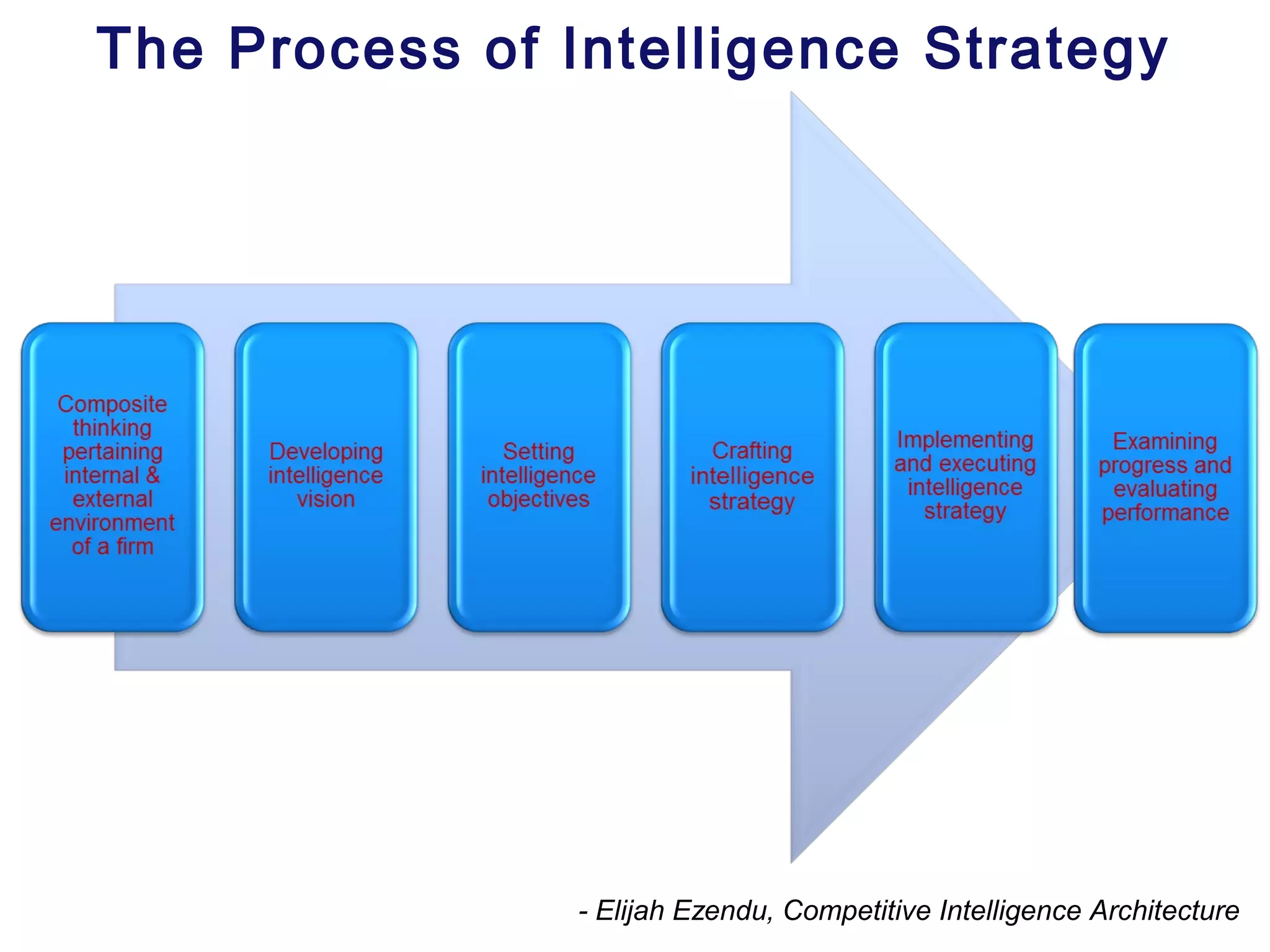
The Process of Intelligence Strategy
- Elijah Ezendu, Competitive Intelligence Architecture
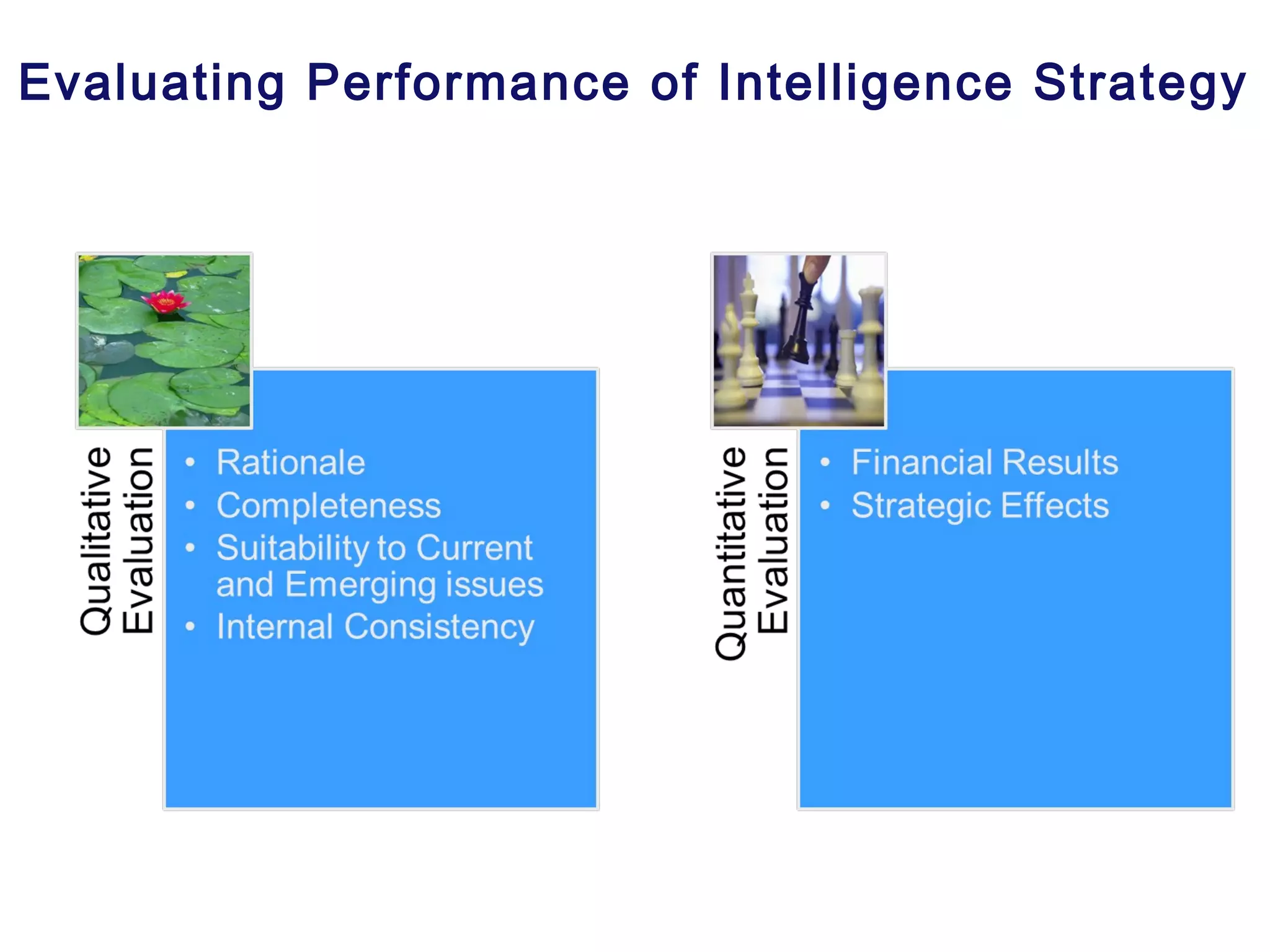
Evaluating Performance of Intelligence Strategy
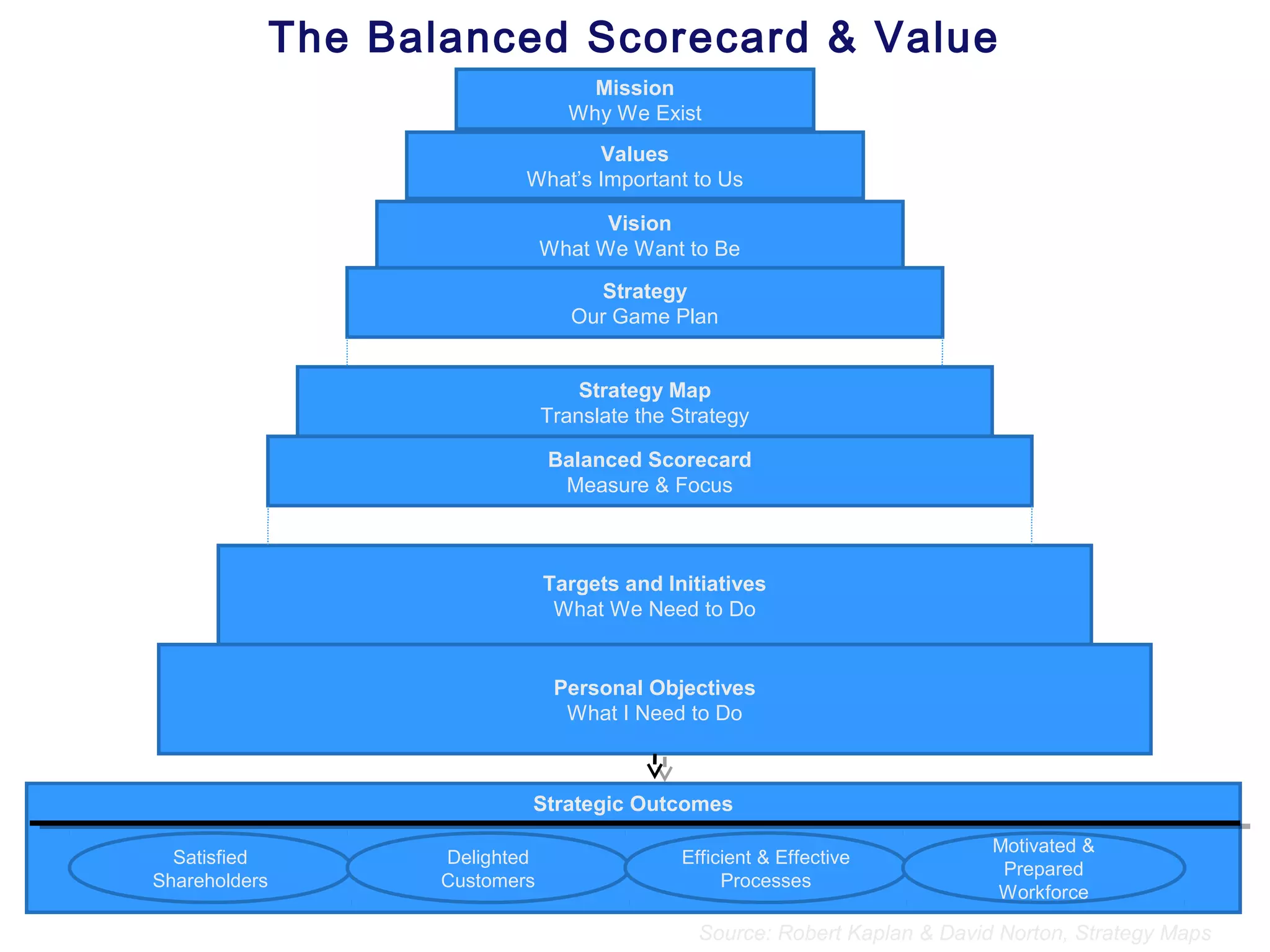
The Balanced Scorecard & Value
Vision
What We Want to Be
Strategy
Our Game Plan
Values
What’s Important to Us
Mission
Why We Exist
Strategy Map
Translate the Strategy
Balanced Scorecard
Measure & Focus
Targets and Initiatives
What We Need to Do
Personal Objectives
What I Need to Do
Strategic Outcomes
Satisfied
Shareholders
Delighted
Customers
Efficient & Effective
Processes
Motivated &
Prepared
Workforce
Source: Robert Kaplan & David Norton, Strategy Maps
Intelligence Values
Intelligence values of a firm comprise
the established principles, practices
and beliefs that serve as the root of
its intelligence culture.
High performing intelligence driven
organizations promote apposite
intelligence values that maximize
bottomline and stimulate
progressive development.
Mindset is a collection of assumptions
and notations held by one or more
people, thereby inducing them to
adopt prior behaviours and choices.
It’s a frame of mind that initiates from
cognitive bias.
“We cannot expect to solve a
complex problem using the same
mindset that we used to create it
in the first place”
-Einstein
Mindset is Causative
Mindset is the make or break factor
in all change processes.
As change becomes more complex
(transcending more boundaries
toward organisation-wide
change), mindset turn out to be
more influential.
Intelligence Mindset Determines
Intelligence Action
Intelligence Action is deep-rooted in
Intelligence Mindset.
Workers’ perception of reality
influences their decisions and
ultimately determines acceptable
course of action.
Mindset as Determinant of
Intelligence Strategy
Mindset influences development of
intelligence strategy in firms
because industry, customer and
organizational data are usually
interpreted through assumptions
and beliefs in one’s mindset.
Mindset Determines Leadership
Focus
Mindset influences leadership focus
because the pattern of leadership
adopted by a set of people in an
organisation is a reflection of their
beliefs about power, people,
performance and roles.
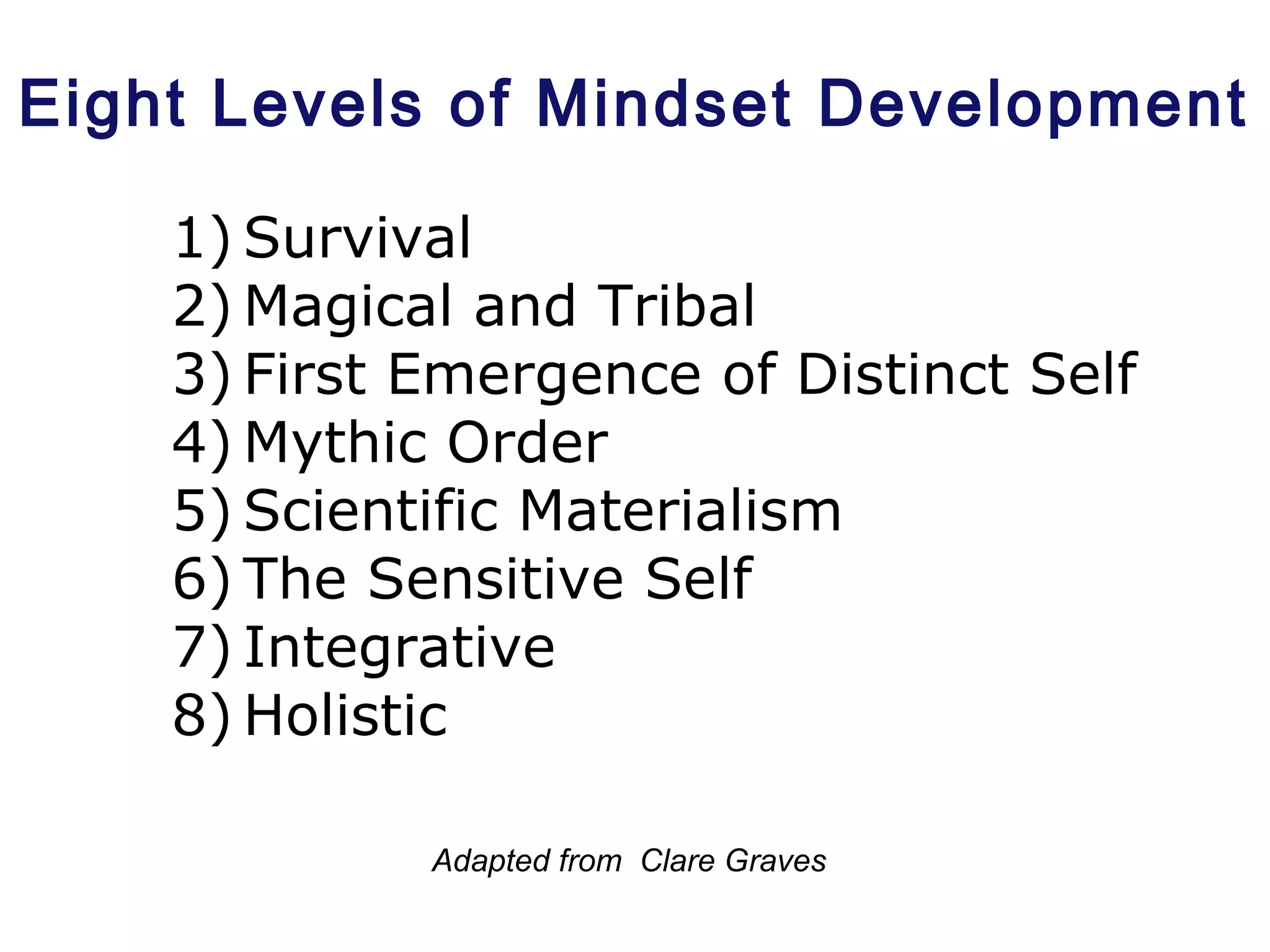
Eight Levels of Mindset Development
1) Survival
2) Magical and Tribal
3) First Emergence of Distinct Self
4) Mythic Order
5) Scientific Materialism
6) The Sensitive Self
7) Integrative
8) Holistic
Adapted from Clare Graves
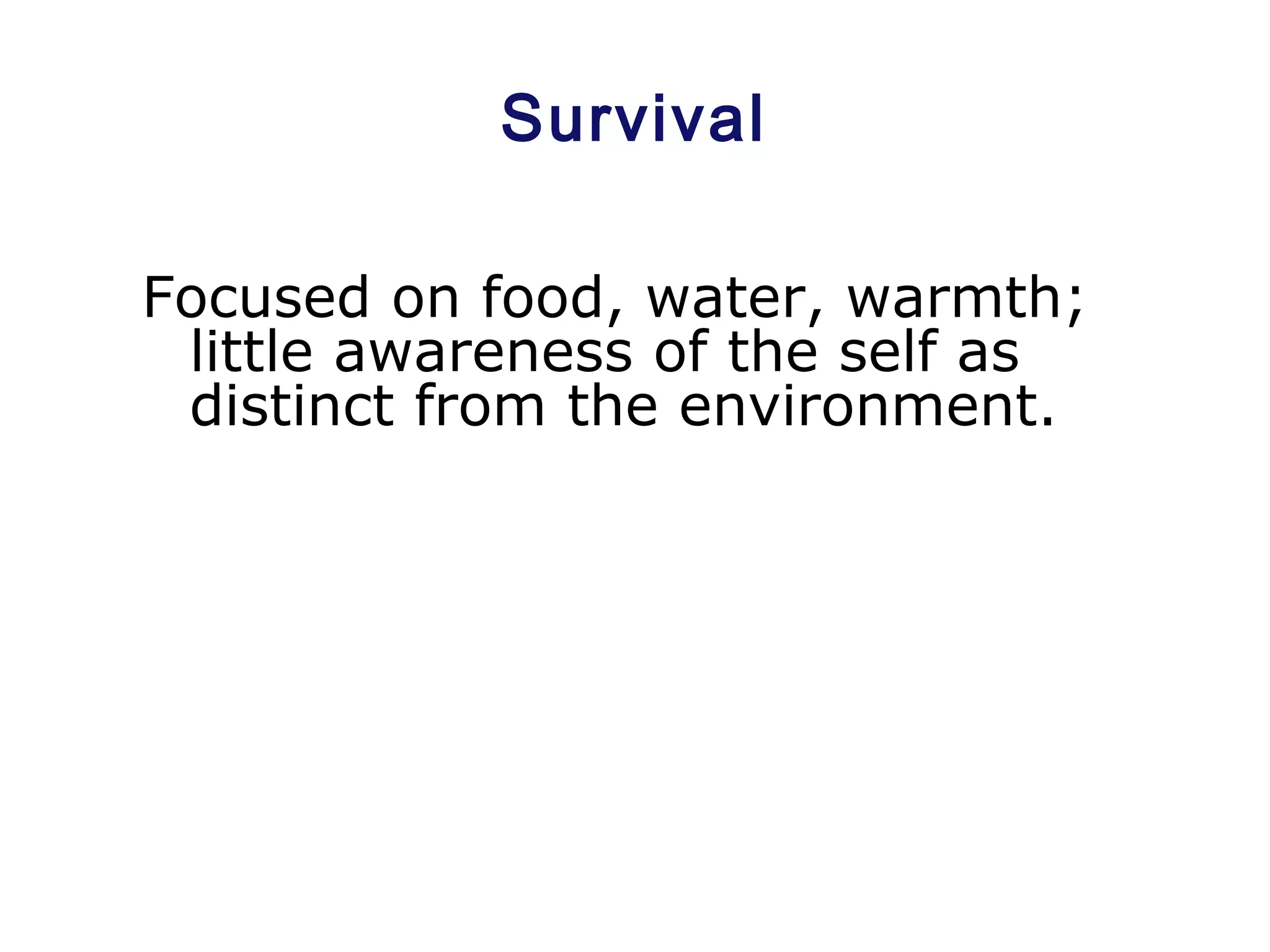
Survival
Focused on food, water, warmth;
little awareness of the self as
distinct from the environment.
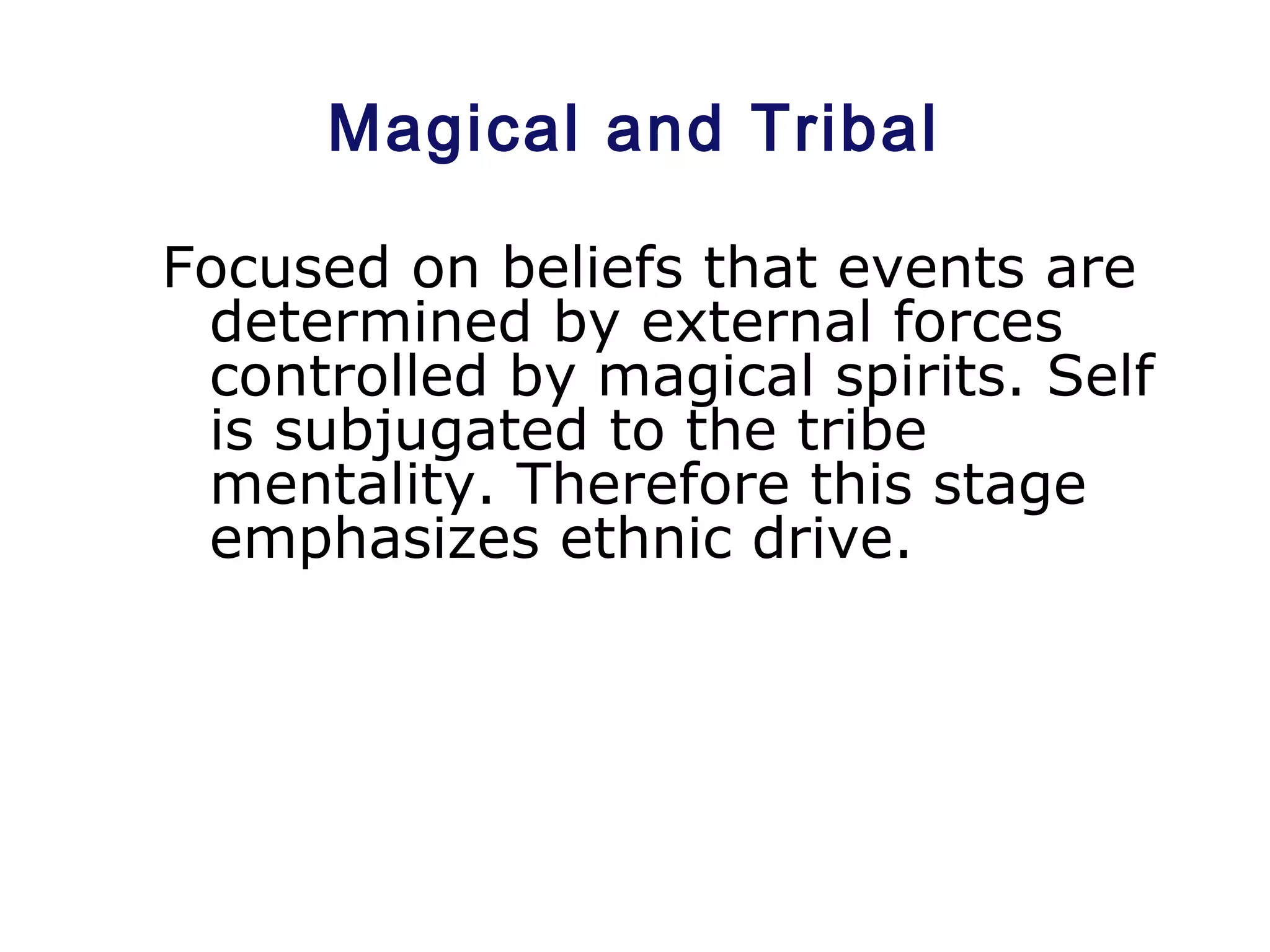
Magical and Tribal
Focused on beliefs that events are
determined by external forces
controlled by magical spirits. Self
is subjugated to the tribe
mentality. Therefore this stage
emphasizes ethnic drive.
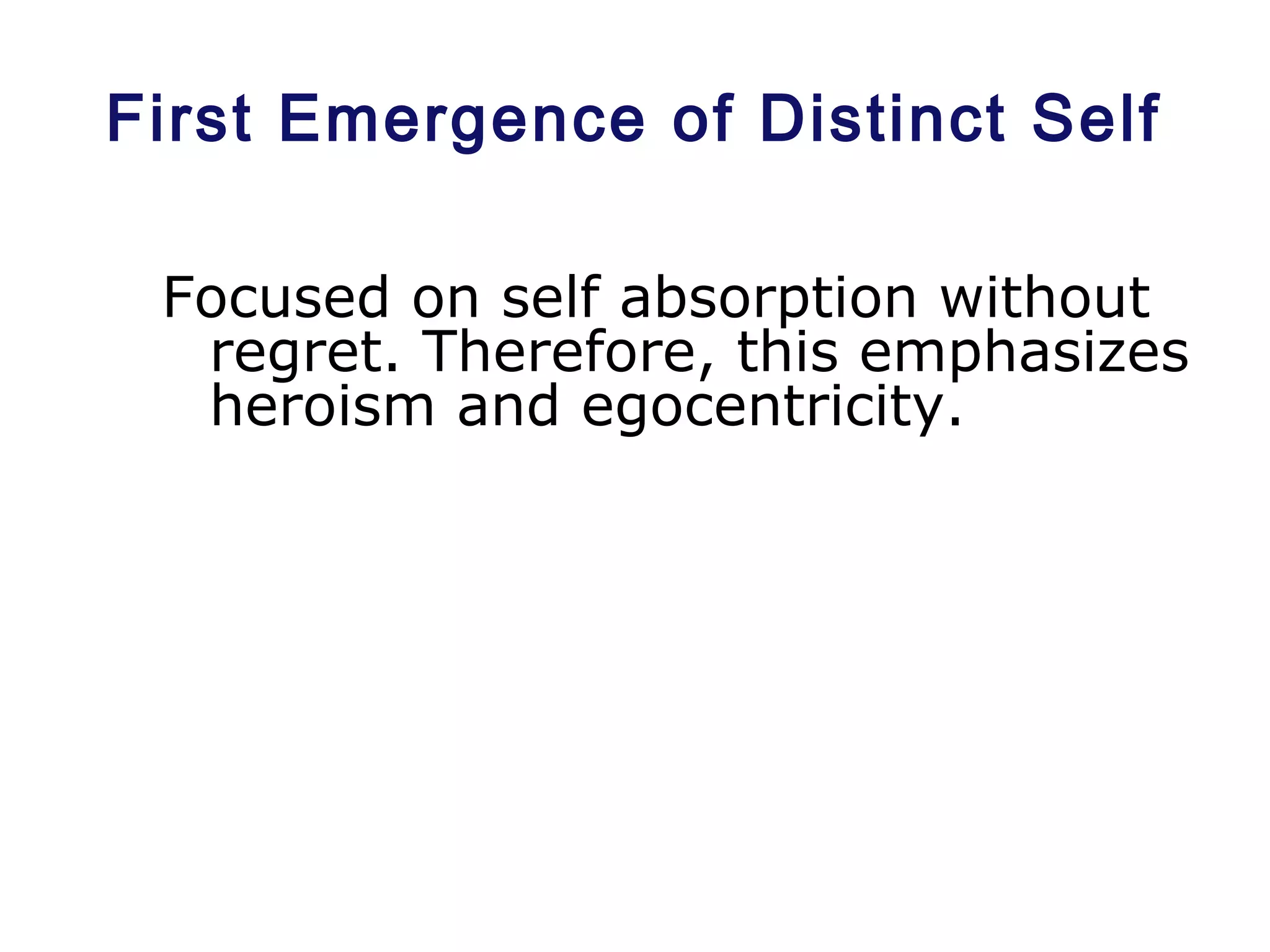
First Emergence of Distinct Self
Focused on self absorption without
regret. Therefore, this emphasizes
heroism and egocentricity.
Mythic Order
Focused on beliefs that life has
meaning and purpose ,
notwithstanding outcomes are
determined by an All-Powerful Other.
Therefore, this emphasizes right and
wrong, law and order, rigidity,
paternalistic orders and unyielding
standards.
Scientific Materialism
In this case, self escapes the group
mentality, and takes an individualistic
and scientific quest for truth and
achievement. Therefore, this
emphasizes objectivity and
rationalism.
The Sensitive Self
Focused on moving away from
greed and self-centeredness to
concern for others. Therefore, this
emphasizes pluralistic and
egalitarian life.
Integrative
Focused on moving beyond
pluralism to integrating
interdependent forces. Therefore,
this emphasizes that knowledge
and competency are more
important than power and status.
Holistic
Focused on advocating collective view
about how the whole system works.
Therefore, this emphasizes integration
of internal and external reality,
feelings and knowledge, thereby
consciously seeing the multitude of
interwoven systems within systems
without experiencing conflict.
Intelligence Mindset
This is a frame of mind that upholds
intelligence consciousness as a way
of life, believing in its importance
to value creation, sustainable
development, competitiveness,
environmental gearing and
profitability.
“If we continue to believe as we
have always believed, we will
continue to act as we have always
acted; and that if we continue to
act as we have always acted, we
will continue to get what we have
always gotten”
-Marilyn Ferguson
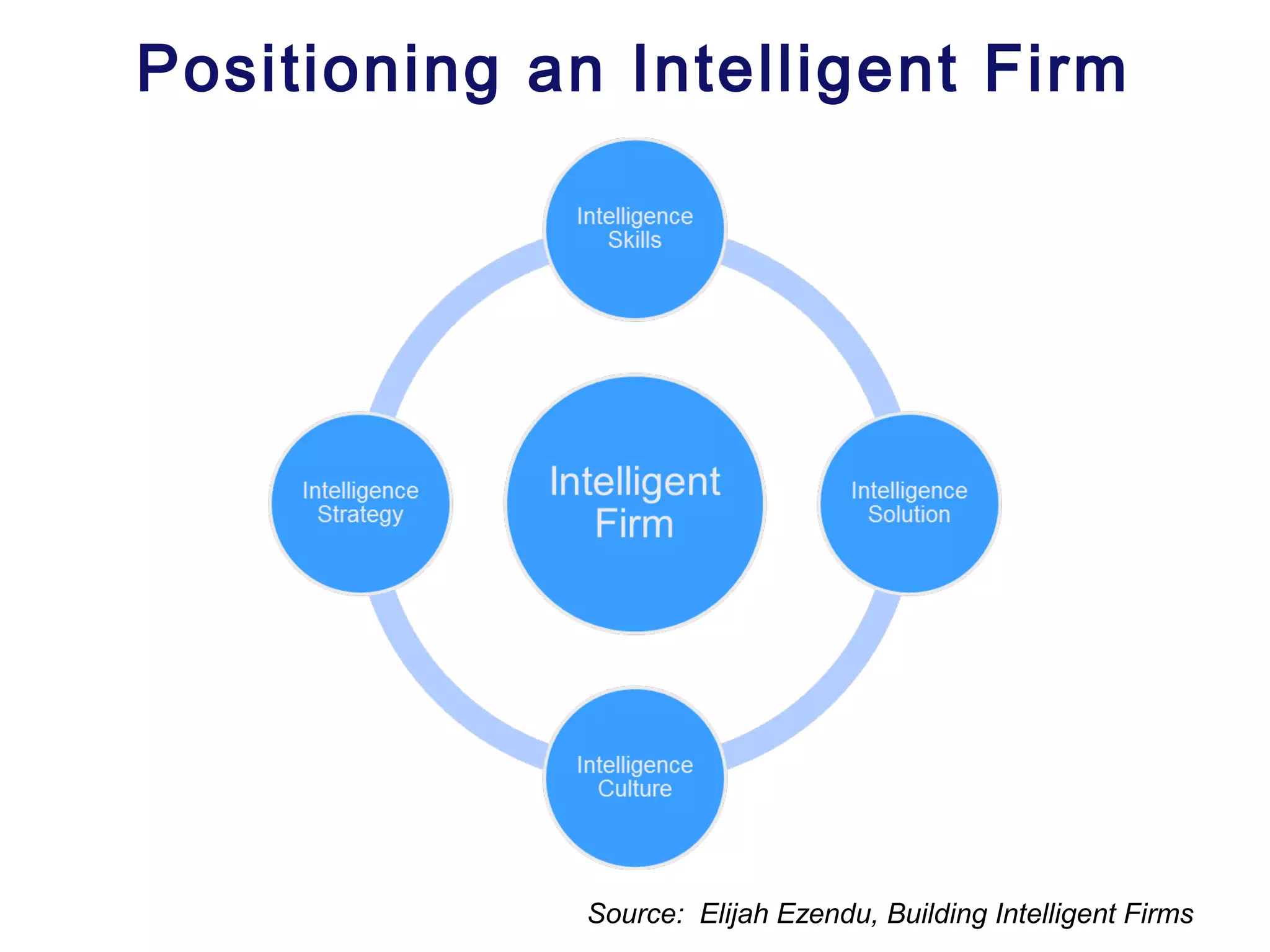
Positioning an Intelligent Firm
Source: Elijah Ezendu, Building Intelligent Firms
Common Problems of Building
Intelligence in Firms
i. Managers don’t value intelligence
ii. Managers consider intelligence a luxury
iii.Inability to incorporate it into strategy
iv.Managers believe “I know my industry”.
v. Unskilled people try to perform intelligence.
vi.Managers hoard information.
vii.The function doesn’t meet the real needs and
concerns of decision-makers.
viii.Intelligence is seldom used by decision-
makers.
Source: Jerry Miller, Competitive Intelligence
Requirements for Starting
Competitive Intelligence Programme
Well-trained and empowered staff.
Access to resources.
Effective alignment of intelligence
report to decision-making processes.
Properly structured unit or department.
Promotion of Intelligence Mindset.
Sensitivity to Change.
Technology driven processes.
Roles in the Intelligence Process
Core Roles
i. Primary Researchers
ii. Secondary Researchers
iii.Integrators
iv.Analysts
Supporting Roles
i. Protectors
ii. Knowledge Builders
iii.System Builders
iv.Data Builders
v. Decision Makers
The Place of CI in a Firm
CI as a Unit
 The Unit Head of
Competitive
Intelligence functions
within the Office of
C.E.O.
 The Competitive
Intelligence Unit
stands as a flat
structure.
 The term of reference
is usually narrow.
CI as a Department
 The Head of Competitive
Intelligence may be
positioned as Director,
General Manager or
Senior Manager.
 The Competitive
Intelligence Department
stands as a broad and tall
team based structure.
 The term of reference is
normally broad.
CI & Decision-Making
A clear-cut policy must be established
linking decision-making to competitive
intelligence report that must be
developed within the firm’s CI unit or
department.
Without competitive intelligence report
pertaining to an issue, there should be
no decision-making.
Every arbitrary decision that stems from
non-factual sentiment should be
disallowed.
Dr Elijah Ezendu is Award-Winning Business Expert & Certified Management Consultant with
expertise in Interim Management, Strategy, Competitive Intelligence, Transformation,
Restructuring, Turnaround Management, Business Development, Marketing, Project & Cost
Management, Leadership, HR, CSR, e-Business & Software Architecture. He had functioned
as Founder, Initiative for Sustainable Business Equity; Chairman of Board, Charisma Broadcast
Film Academy; Group Chief Operating Officer, Idova Group; CEO, Rubiini (UAE); Special
Advisor, RTEAN; Director, MMNA Investments; Chair, Int’l Board of GCC Business Council
(UAE); Senior Partner, Shevach Consulting; Chairman (Certification & Training), Coordinator
(Board of Fellows), Lead Assessor & Governing Council Member, Institute of Management
Consultants, Nigeria; Lead Resource, Centre for Competitive Intelligence Development; Lead
Consultant/ Partner, JK Michaels; Turnaround Project Director, Consolidated Business
Holdings Limited; Technical Director, Gestalt; Chief Operating Officer, Rohan Group; Executive
Director (Various Roles), Fortuna, Gambia & Malta; Chief Advisor/ Partner, D & E; Vice
Chairman of Board, Refined Shipping; Director of Programmes & Governing Council Member,
Institute of Business Development, Nigeria; Member of TDD Committee, International
Association of Software Architects, USA; Member of Strategic Planning and Implementation
Committee, Chartered Institute of Personnel Management of Nigeria; Country Manager
(Nigeria) & Adjunct Faculty (MBA Programme), Regent Business School, South Africa; Adjunct
Faculty (MBA Programme), Ladoke Akintola University of Technology; Editor-in-Chief, Cost
Management Journal; Council Member, Institute of Internal Auditors of Nigeria; Member, Board
of Directors (Several Organizations). He holds Doctoral Degree in Management, Master of
Business Administration and Fellow of Professional Institutes in North America, UK & Nigeria.
He is Innovator of Corporate Investment Structure Based on Financials and Intangibles, for
valuation highlighting intangible contributions of host communities and ecological environment:
A model celebrated globally as remedy for unmitigated depreciation of ecological capital and
developmental deprivation of host communities. He had served as Examiner to Professional
Thank You

Competitive Intelligence Architecture

  • 1.
    Competitive Intelligence Architecture Dr. ElijahEzendu FIMC, FCCM, FIIAN, FBDI, FAAFM, FSSM, MIMIS, MIAP, MITD, ACIArb, ACIPM, PhD, DocM, MBA, CWM, CBDA, CMA, MPM, PME, CSOL, CCIP, CMC, CMgr
  • 2.
    Competitive Intelligence Architecture focuseson designing, structuring and deploying fitting intelligence strategy, infrastructures and frameworks that are necessary for course-plotting an entity unto superiority.
  • 3.
    “Without a comprehensivedescription of strategy, executives cannot easily communicate it among themselves or to their employees. Without a shared understanding of the strategy, executives cannot create alignment around it. And, without alignment, executives cannot implement their new strategies for the changed environment of global competition, deregulation, customer sovereignty , advanced technology, and competitive advantage.” -Robert Kaplan and David Norton
  • 4.
    “Strategy refers tothe ideas, plans and support that firms employ to compete successfully against rivals. Strategy is designed to help firms achieve competitive advantage.” -Robert Pitts and David Lei
  • 5.
    Intelligence Strategy “This refersto plan, philosophy or scheme adoptable for resolving business survival, competitiveness and profitability through segmental or holistic intelligence.” -Elijah Ezendu
  • 6.
    “A winning strategymust fit the enterprise’s external and internal situation, build sustainable competitive advantage, and improve company performance.” -Thompson, Strickland and Gamble
  • 7.
    The Process ofIntelligence Strategy - Elijah Ezendu, Competitive Intelligence Architecture
  • 8.
    Evaluating Performance ofIntelligence Strategy
  • 9.
    The Balanced Scorecard& Value Vision What We Want to Be Strategy Our Game Plan Values What’s Important to Us Mission Why We Exist Strategy Map Translate the Strategy Balanced Scorecard Measure & Focus Targets and Initiatives What We Need to Do Personal Objectives What I Need to Do Strategic Outcomes Satisfied Shareholders Delighted Customers Efficient & Effective Processes Motivated & Prepared Workforce Source: Robert Kaplan & David Norton, Strategy Maps
  • 10.
    Intelligence Values Intelligence valuesof a firm comprise the established principles, practices and beliefs that serve as the root of its intelligence culture. High performing intelligence driven organizations promote apposite intelligence values that maximize bottomline and stimulate progressive development.
  • 11.
    Mindset is acollection of assumptions and notations held by one or more people, thereby inducing them to adopt prior behaviours and choices. It’s a frame of mind that initiates from cognitive bias.
  • 12.
    “We cannot expectto solve a complex problem using the same mindset that we used to create it in the first place” -Einstein
  • 13.
    Mindset is Causative Mindsetis the make or break factor in all change processes. As change becomes more complex (transcending more boundaries toward organisation-wide change), mindset turn out to be more influential.
  • 14.
    Intelligence Mindset Determines IntelligenceAction Intelligence Action is deep-rooted in Intelligence Mindset. Workers’ perception of reality influences their decisions and ultimately determines acceptable course of action.
  • 15.
    Mindset as Determinantof Intelligence Strategy Mindset influences development of intelligence strategy in firms because industry, customer and organizational data are usually interpreted through assumptions and beliefs in one’s mindset.
  • 16.
    Mindset Determines Leadership Focus Mindsetinfluences leadership focus because the pattern of leadership adopted by a set of people in an organisation is a reflection of their beliefs about power, people, performance and roles.
  • 17.
    Eight Levels ofMindset Development 1) Survival 2) Magical and Tribal 3) First Emergence of Distinct Self 4) Mythic Order 5) Scientific Materialism 6) The Sensitive Self 7) Integrative 8) Holistic Adapted from Clare Graves
  • 18.
    Survival Focused on food,water, warmth; little awareness of the self as distinct from the environment.
  • 19.
    Magical and Tribal Focusedon beliefs that events are determined by external forces controlled by magical spirits. Self is subjugated to the tribe mentality. Therefore this stage emphasizes ethnic drive.
  • 20.
    First Emergence ofDistinct Self Focused on self absorption without regret. Therefore, this emphasizes heroism and egocentricity.
  • 21.
    Mythic Order Focused onbeliefs that life has meaning and purpose , notwithstanding outcomes are determined by an All-Powerful Other. Therefore, this emphasizes right and wrong, law and order, rigidity, paternalistic orders and unyielding standards.
  • 22.
    Scientific Materialism In thiscase, self escapes the group mentality, and takes an individualistic and scientific quest for truth and achievement. Therefore, this emphasizes objectivity and rationalism.
  • 23.
    The Sensitive Self Focusedon moving away from greed and self-centeredness to concern for others. Therefore, this emphasizes pluralistic and egalitarian life.
  • 24.
    Integrative Focused on movingbeyond pluralism to integrating interdependent forces. Therefore, this emphasizes that knowledge and competency are more important than power and status.
  • 25.
    Holistic Focused on advocatingcollective view about how the whole system works. Therefore, this emphasizes integration of internal and external reality, feelings and knowledge, thereby consciously seeing the multitude of interwoven systems within systems without experiencing conflict.
  • 26.
    Intelligence Mindset This isa frame of mind that upholds intelligence consciousness as a way of life, believing in its importance to value creation, sustainable development, competitiveness, environmental gearing and profitability.
  • 27.
    “If we continueto believe as we have always believed, we will continue to act as we have always acted; and that if we continue to act as we have always acted, we will continue to get what we have always gotten” -Marilyn Ferguson
  • 28.
    Positioning an IntelligentFirm Source: Elijah Ezendu, Building Intelligent Firms
  • 29.
    Common Problems ofBuilding Intelligence in Firms i. Managers don’t value intelligence ii. Managers consider intelligence a luxury iii.Inability to incorporate it into strategy iv.Managers believe “I know my industry”. v. Unskilled people try to perform intelligence. vi.Managers hoard information. vii.The function doesn’t meet the real needs and concerns of decision-makers. viii.Intelligence is seldom used by decision- makers. Source: Jerry Miller, Competitive Intelligence
  • 30.
    Requirements for Starting CompetitiveIntelligence Programme Well-trained and empowered staff. Access to resources. Effective alignment of intelligence report to decision-making processes. Properly structured unit or department. Promotion of Intelligence Mindset. Sensitivity to Change. Technology driven processes.
  • 31.
    Roles in theIntelligence Process Core Roles i. Primary Researchers ii. Secondary Researchers iii.Integrators iv.Analysts Supporting Roles i. Protectors ii. Knowledge Builders iii.System Builders iv.Data Builders v. Decision Makers
  • 32.
    The Place ofCI in a Firm CI as a Unit  The Unit Head of Competitive Intelligence functions within the Office of C.E.O.  The Competitive Intelligence Unit stands as a flat structure.  The term of reference is usually narrow. CI as a Department  The Head of Competitive Intelligence may be positioned as Director, General Manager or Senior Manager.  The Competitive Intelligence Department stands as a broad and tall team based structure.  The term of reference is normally broad.
  • 33.
    CI & Decision-Making Aclear-cut policy must be established linking decision-making to competitive intelligence report that must be developed within the firm’s CI unit or department. Without competitive intelligence report pertaining to an issue, there should be no decision-making. Every arbitrary decision that stems from non-factual sentiment should be disallowed.
  • 34.
    Dr Elijah Ezenduis Award-Winning Business Expert & Certified Management Consultant with expertise in Interim Management, Strategy, Competitive Intelligence, Transformation, Restructuring, Turnaround Management, Business Development, Marketing, Project & Cost Management, Leadership, HR, CSR, e-Business & Software Architecture. He had functioned as Founder, Initiative for Sustainable Business Equity; Chairman of Board, Charisma Broadcast Film Academy; Group Chief Operating Officer, Idova Group; CEO, Rubiini (UAE); Special Advisor, RTEAN; Director, MMNA Investments; Chair, Int’l Board of GCC Business Council (UAE); Senior Partner, Shevach Consulting; Chairman (Certification & Training), Coordinator (Board of Fellows), Lead Assessor & Governing Council Member, Institute of Management Consultants, Nigeria; Lead Resource, Centre for Competitive Intelligence Development; Lead Consultant/ Partner, JK Michaels; Turnaround Project Director, Consolidated Business Holdings Limited; Technical Director, Gestalt; Chief Operating Officer, Rohan Group; Executive Director (Various Roles), Fortuna, Gambia & Malta; Chief Advisor/ Partner, D & E; Vice Chairman of Board, Refined Shipping; Director of Programmes & Governing Council Member, Institute of Business Development, Nigeria; Member of TDD Committee, International Association of Software Architects, USA; Member of Strategic Planning and Implementation Committee, Chartered Institute of Personnel Management of Nigeria; Country Manager (Nigeria) & Adjunct Faculty (MBA Programme), Regent Business School, South Africa; Adjunct Faculty (MBA Programme), Ladoke Akintola University of Technology; Editor-in-Chief, Cost Management Journal; Council Member, Institute of Internal Auditors of Nigeria; Member, Board of Directors (Several Organizations). He holds Doctoral Degree in Management, Master of Business Administration and Fellow of Professional Institutes in North America, UK & Nigeria. He is Innovator of Corporate Investment Structure Based on Financials and Intangibles, for valuation highlighting intangible contributions of host communities and ecological environment: A model celebrated globally as remedy for unmitigated depreciation of ecological capital and developmental deprivation of host communities. He had served as Examiner to Professional
  • 35.