

How Can I Learn Better?
    A college readiness skill
We All Learn Differently!
• We all have different styles of
  learning.
• There are some strategies you can use
  to make the learning process easier.
• In this presentation, you will learn:
   • Three Learning Styles
   • Memorization Techniques
• As a result of this presentation, you
  will be able to learn better!
Learning Styles
VAK
• We all have different styles of
  learning.
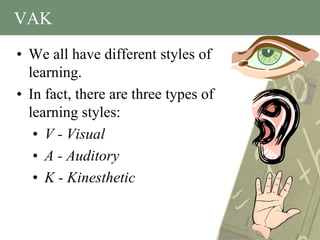
• In fact, there are three types of
  learning styles:
   • V - Visual
   • A - Auditory
   • K - Kinesthetic
Which is your learning style?
• You are a visual learner, if you learn best by seeing
  information. Strategies usually used: power points,
  whiteboard visuals, videos, highlighters, notes, color-
  coding, diagrams, charts, maps, timelines, etc.

• You are an auditory learner, if you learn best by hearing
  information. Strategies usually used: listening to lectures,
  engaging in discussions, music, read aloud, orally
  summarizing information, retell, etc.

• You are kinesthetic (aka tactile) learner, if you learn best by
  incorporating physical movement into learning. Strategies
  usually used: getting up to move periodically when
  studying, wiggling foot, tapping fingers, manipulating
  objects, building, assembling, labs, etc.
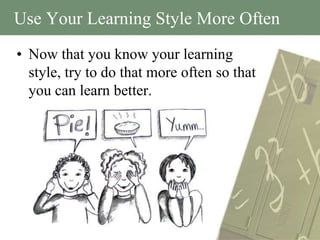
Use Your Learning Style More Often
• Now that you know your learning
  style, try to do that more often so that
  you can learn better.
Memorization Techniques
Memorization Methods
• One excellent way we can learn better
  is by using memorization strategies.
• The following memorization tools will
  help jog your memory and help you
  study:
   • Lists
   • Flashcards
   • M.N.E.M.O.N.I.C.S.
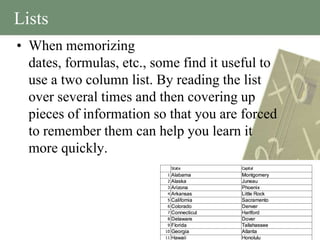
Lists
• When memorizing
  dates, formulas, etc., some find it useful to
  use a two column list. By reading the list
  over several times and then covering up
  pieces of information so that you are forced
  to remember them can help you learn it
  more quickly.
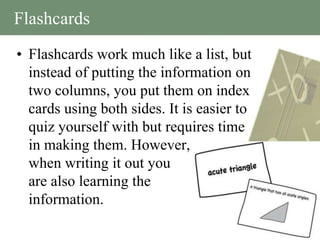
Flashcards
• Flashcards work much like a list, but
  instead of putting the information on
  two columns, you put them on index
  cards using both sides. It is easier to
  quiz yourself with but requires time
  in making them. However,
  when writing it out you
  are also learning the
  information.
M.N.E.M.O.N.I.C.S.
• Mnemonics are techniques that help
  you memorize information more
  quickly.
• Types of mnemonic devices:
   • Acronyms
   • Acrostics
   • Rhyme/Song
Acronyms
• Acronyms is where you use the first
  letter of the word to create a different
  word.
• Ex.) HOMES – name of the Great Lakes
   • Huron
   • Ontario
   • Michigan
   • Erie
   • Superior
Acrostics
• Acrostics are similar to an acronym except that
  instead of creating a word one can create a
  sentence.
• Ex. PEMDAS – Order of Operations
• Please Excuse My Dear Aunt Sally
   • Parenthesis
   • Exponents
   • Multiplication
   • Division
   • Addition
   • Subtraction
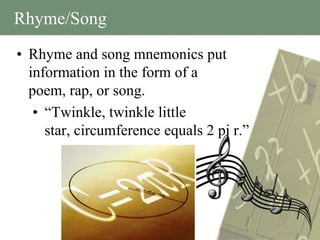
Rhyme/Song
• Rhyme and song mnemonics put
  information in the form of a
  poem, rap, or song.
   • “Twinkle, twinkle little
     star, circumference equals 2 pi r.”
Do It On Your Own

• Now that you know the different
  memorization strategies that you
  can use, try using them while
  studying for your next test. You
  will see that they will help you
  learn and memorize information
  more quickly so you can pass
  your tests!

How to Learn Better

  • 1.
    How Can ILearn Better? A college readiness skill
  • 2.
    We All LearnDifferently! • We all have different styles of learning. • There are some strategies you can use to make the learning process easier. • In this presentation, you will learn: • Three Learning Styles • Memorization Techniques • As a result of this presentation, you will be able to learn better!
  • 3.
  • 4.
    VAK • We allhave different styles of learning. • In fact, there are three types of learning styles: • V - Visual • A - Auditory • K - Kinesthetic
  • 5.
    Which is yourlearning style? • You are a visual learner, if you learn best by seeing information. Strategies usually used: power points, whiteboard visuals, videos, highlighters, notes, color- coding, diagrams, charts, maps, timelines, etc. • You are an auditory learner, if you learn best by hearing information. Strategies usually used: listening to lectures, engaging in discussions, music, read aloud, orally summarizing information, retell, etc. • You are kinesthetic (aka tactile) learner, if you learn best by incorporating physical movement into learning. Strategies usually used: getting up to move periodically when studying, wiggling foot, tapping fingers, manipulating objects, building, assembling, labs, etc.
  • 6.
    Use Your LearningStyle More Often • Now that you know your learning style, try to do that more often so that you can learn better.
  • 7.
  • 8.
    Memorization Methods • Oneexcellent way we can learn better is by using memorization strategies. • The following memorization tools will help jog your memory and help you study: • Lists • Flashcards • M.N.E.M.O.N.I.C.S.
  • 9.
    Lists • When memorizing dates, formulas, etc., some find it useful to use a two column list. By reading the list over several times and then covering up pieces of information so that you are forced to remember them can help you learn it more quickly.
  • 10.
    Flashcards • Flashcards workmuch like a list, but instead of putting the information on two columns, you put them on index cards using both sides. It is easier to quiz yourself with but requires time in making them. However, when writing it out you are also learning the information.
  • 11.
    M.N.E.M.O.N.I.C.S. • Mnemonics aretechniques that help you memorize information more quickly. • Types of mnemonic devices: • Acronyms • Acrostics • Rhyme/Song
  • 12.
    Acronyms • Acronyms iswhere you use the first letter of the word to create a different word. • Ex.) HOMES – name of the Great Lakes • Huron • Ontario • Michigan • Erie • Superior
  • 13.
    Acrostics • Acrostics aresimilar to an acronym except that instead of creating a word one can create a sentence. • Ex. PEMDAS – Order of Operations • Please Excuse My Dear Aunt Sally • Parenthesis • Exponents • Multiplication • Division • Addition • Subtraction
  • 14.
    Rhyme/Song • Rhyme andsong mnemonics put information in the form of a poem, rap, or song. • “Twinkle, twinkle little star, circumference equals 2 pi r.”
  • 15.
    Do It OnYour Own • Now that you know the different memorization strategies that you can use, try using them while studying for your next test. You will see that they will help you learn and memorize information more quickly so you can pass your tests!