



THE PAST CONTINUOUS
Vs
SIMPLE PAST
THE PAST CONTINUOUS
THE PAST CONTINUOUS Vs SIMPLE PAST
Remember:
Use the past continuous to describe
an activity that continued during a period
of time in the past.
THE PAST CONTINUOUS Vs SIMPLE PAST
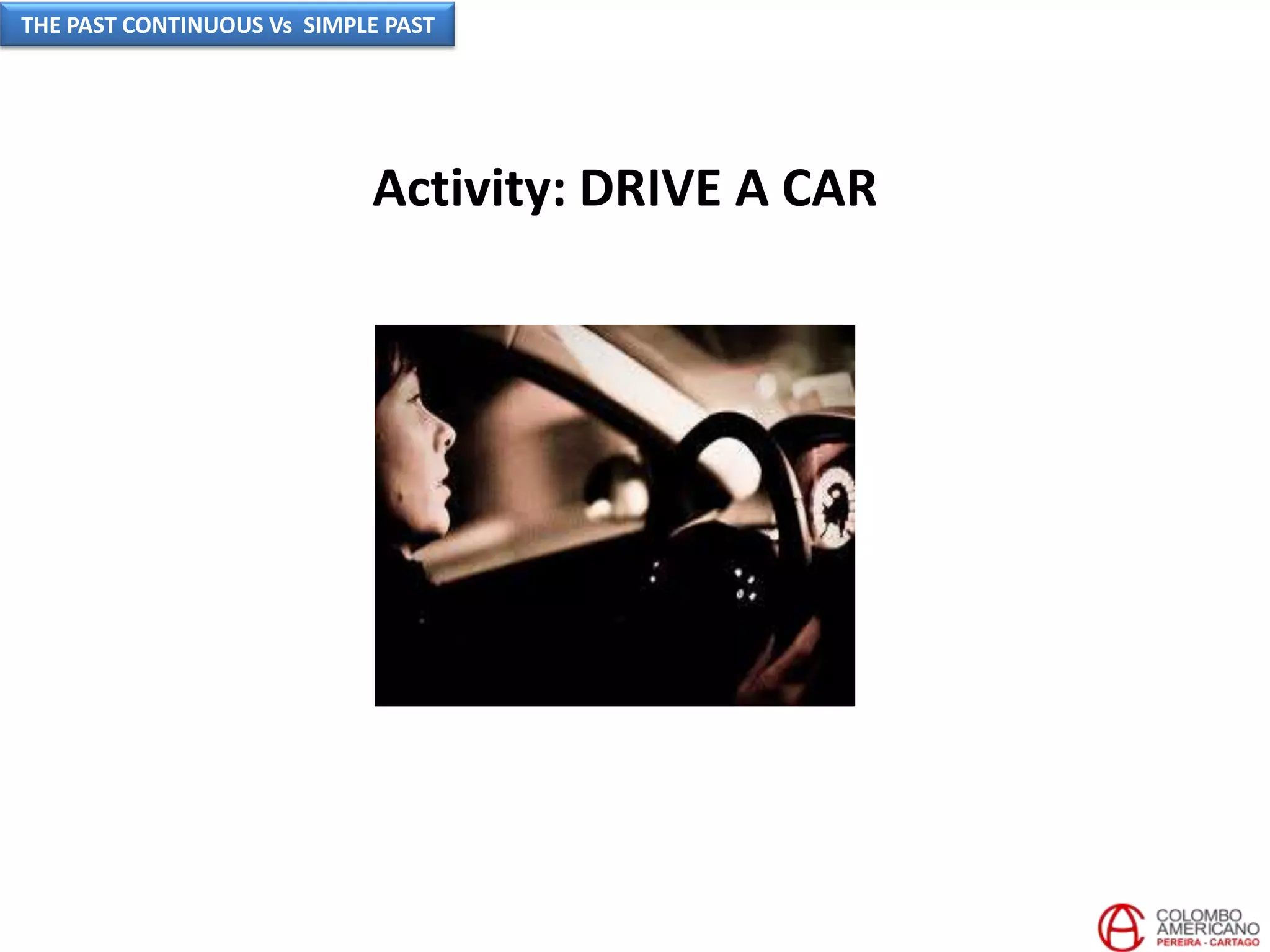
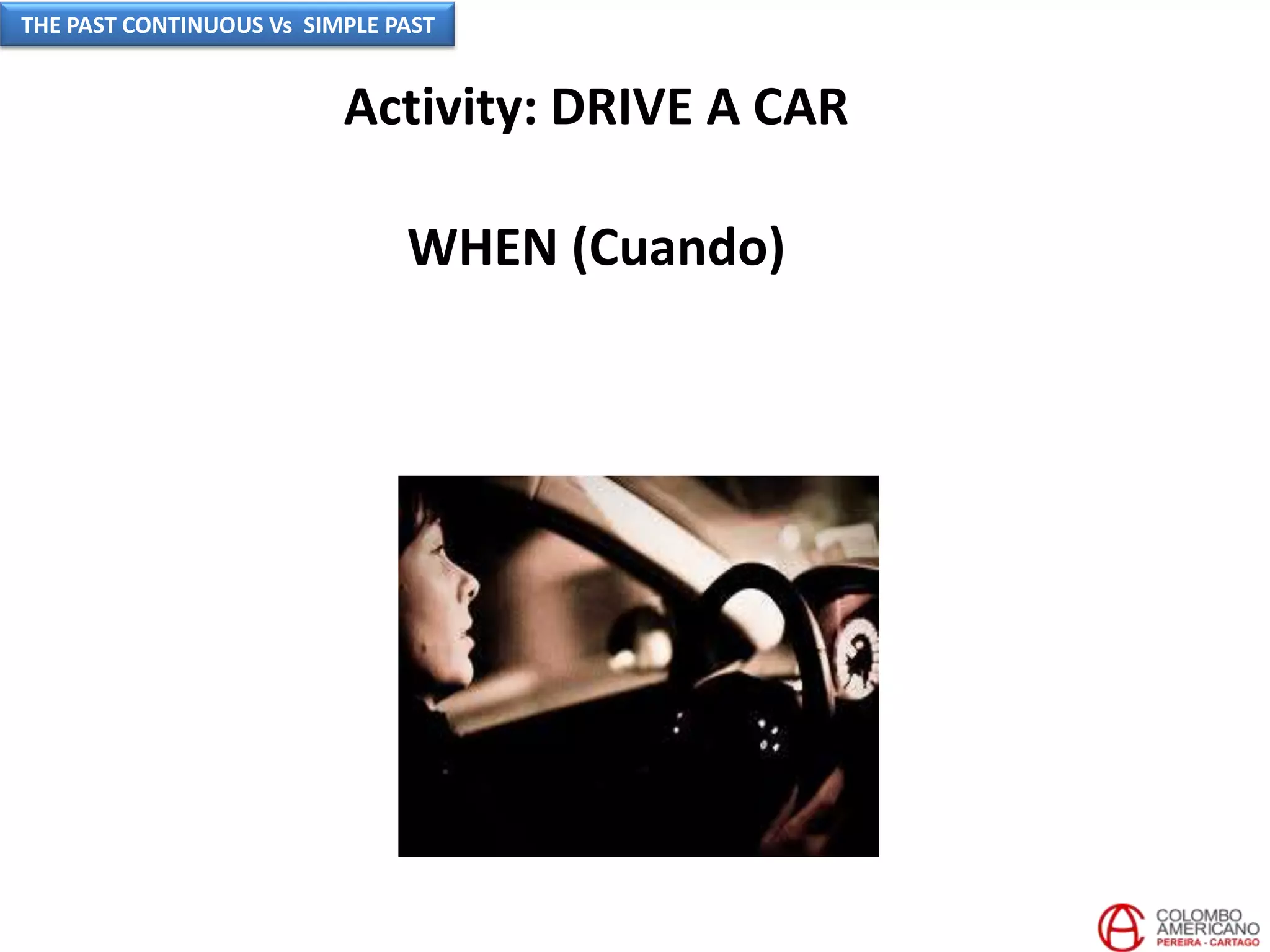
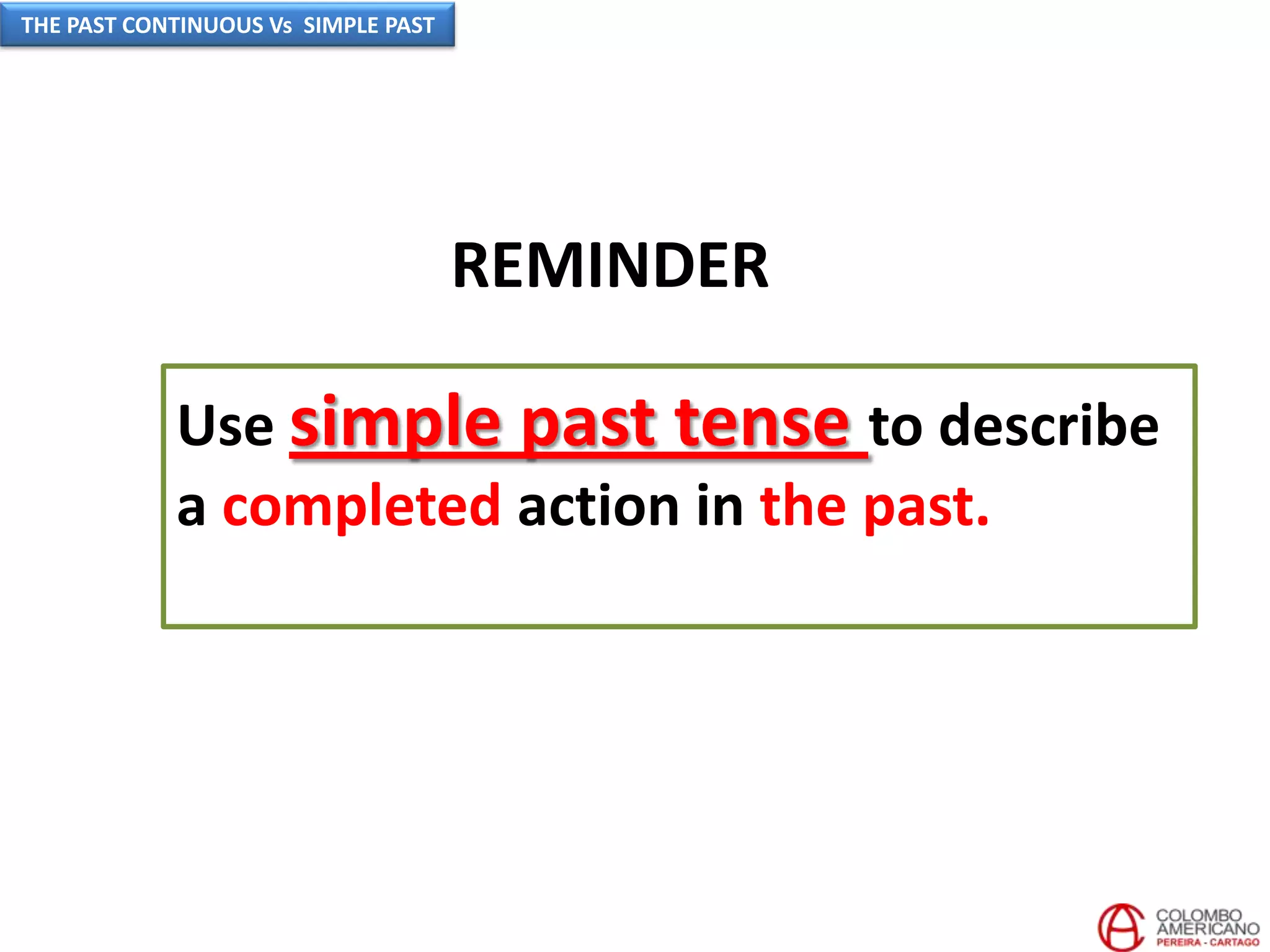
Activity: DRIVE A CAR
THE PAST CONTINUOUS Vs SIMPLE PAST
Activity: DRIVE A CAR
WHEN (Cuando)
THE PAST CONTINUOUS Vs SIMPLE PAST
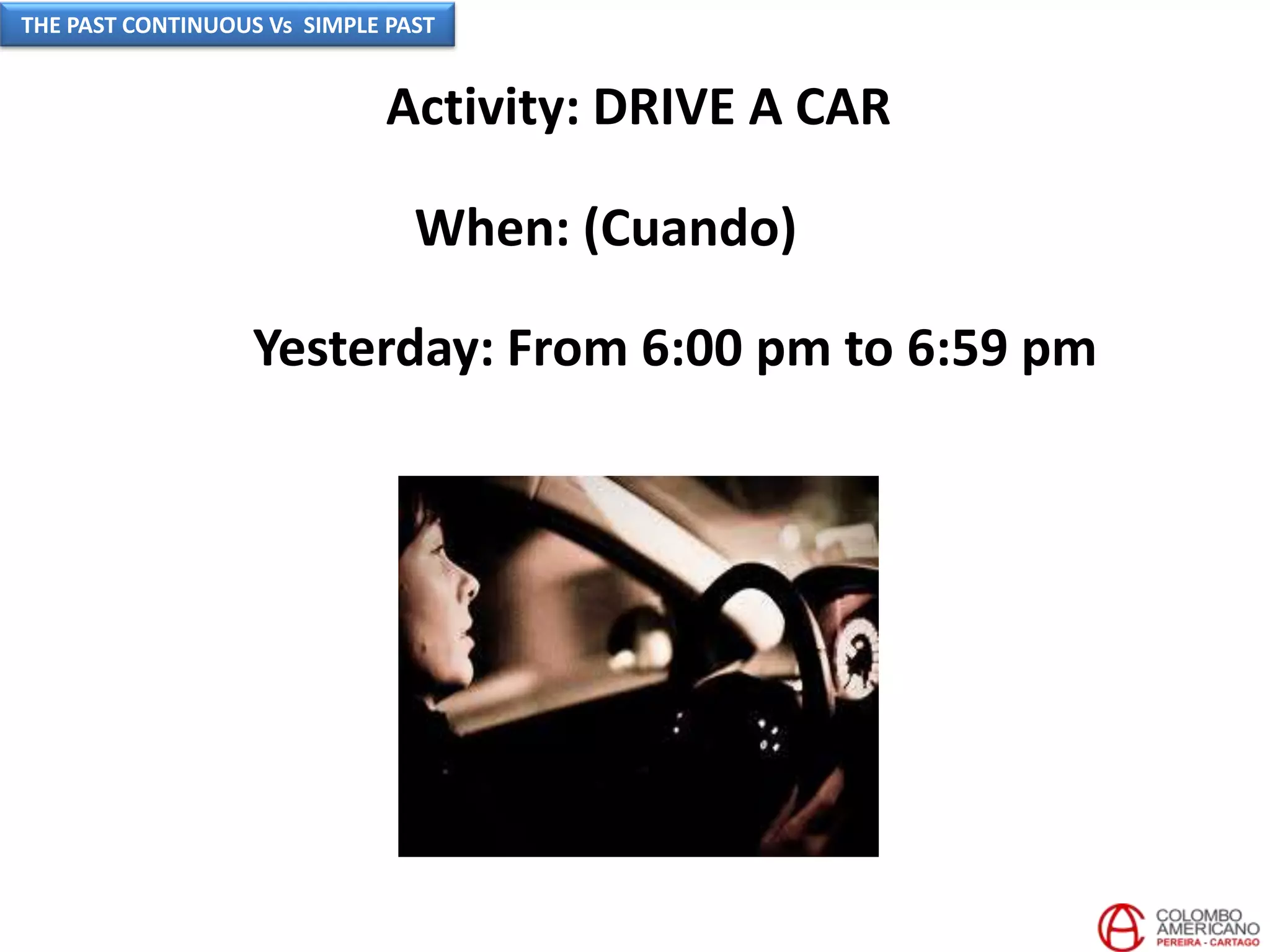
Activity: DRIVE A CAR
When: (Cuando)
Yesterday: From 6:00 pm to 6:59 pm
THE PAST CONTINUOUS Vs SIMPLE PAST
Time: From 6:00 am to 6:59 pm
(La acción se realiza de 6:00 a 6:59 pm,
esta dura una hora aproximadamente)
THE PAST CONTINUOUS Vs SIMPLE PAST
Time: From 6:00 am to 6:59 pm
(La acción se realiza de 6:00 a 6:59 pm,
esta dura una hora aproximadamente)
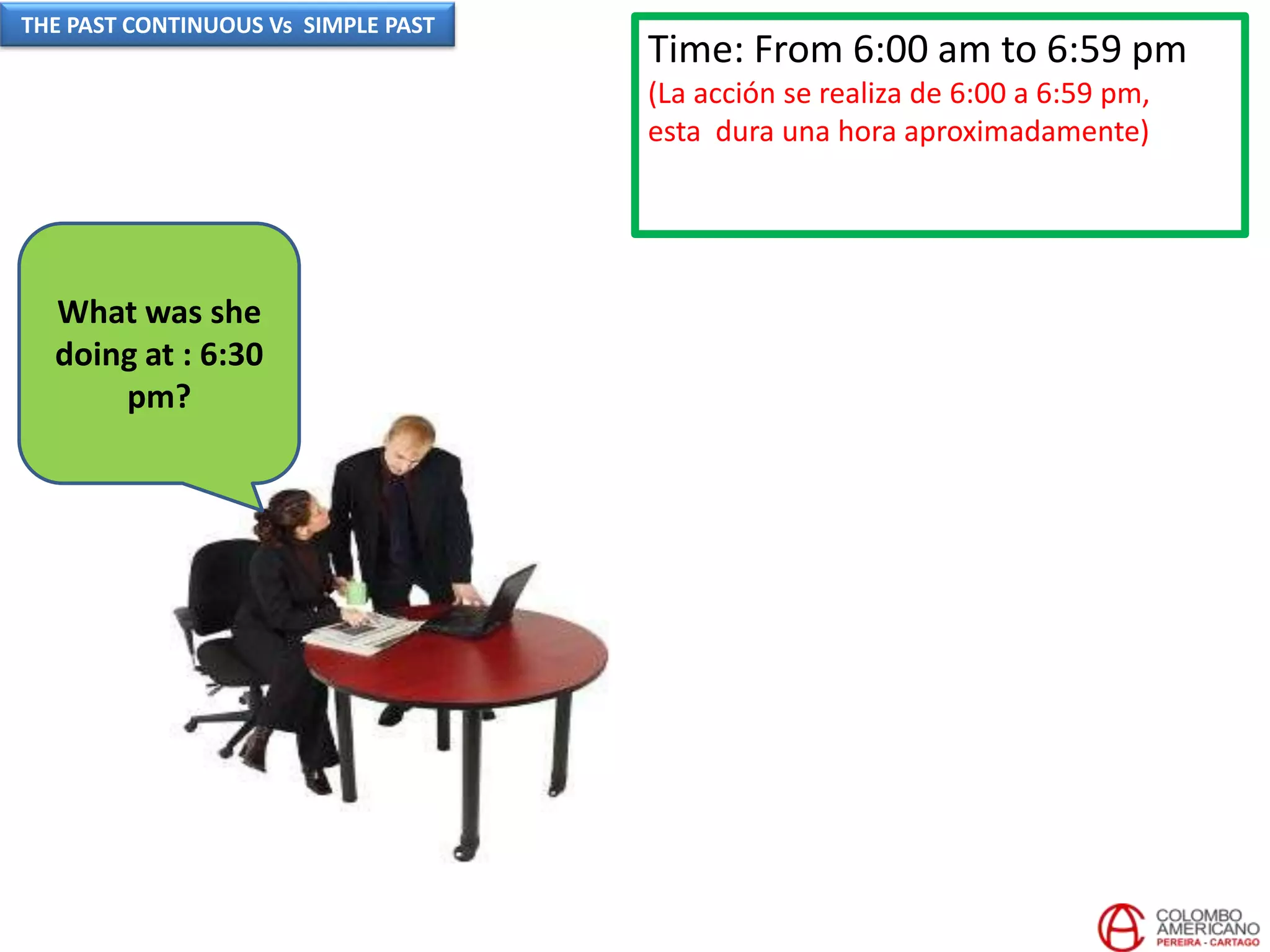
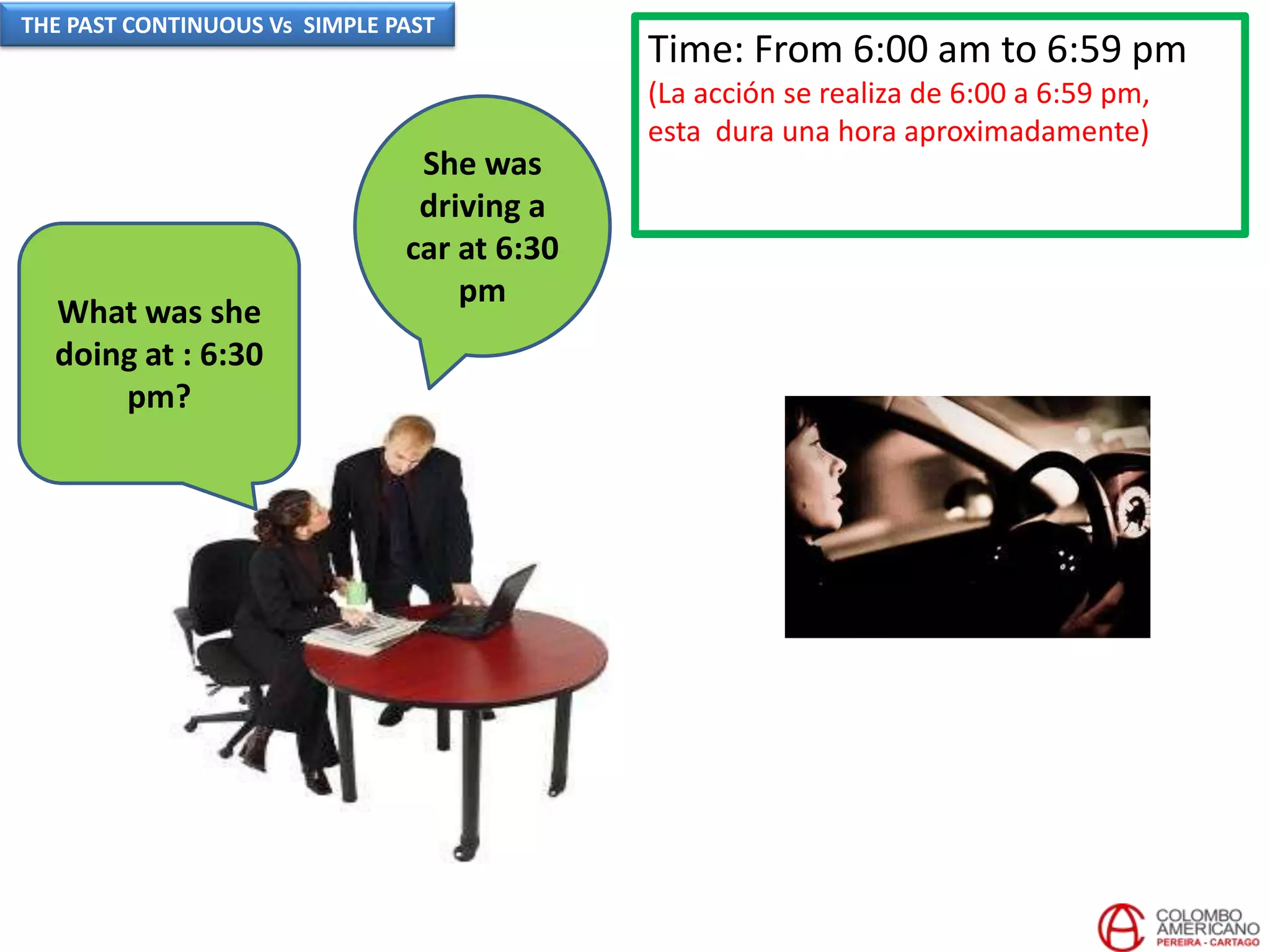
What was she
doing at : 6:30
pm?
THE PAST CONTINUOUS Vs SIMPLE PAST
Time: From 6:00 am to 6:59 pm
(La acción se realiza de 6:00 a 6:59 pm,
esta dura una hora aproximadamente)
She was
driving a
car at 6:30
pm
What was she
doing at : 6:30
pm?
THE PAST CONTINUOUS Vs SIMPLE PAST
THE SIMPLE PAST
THE PAST CONTINUOUS Vs SIMPLE PAST
Use simple past tense to describe
a completed action in the past.
REMINDER
THE PAST CONTINUOUS Vs SIMPLE PAST
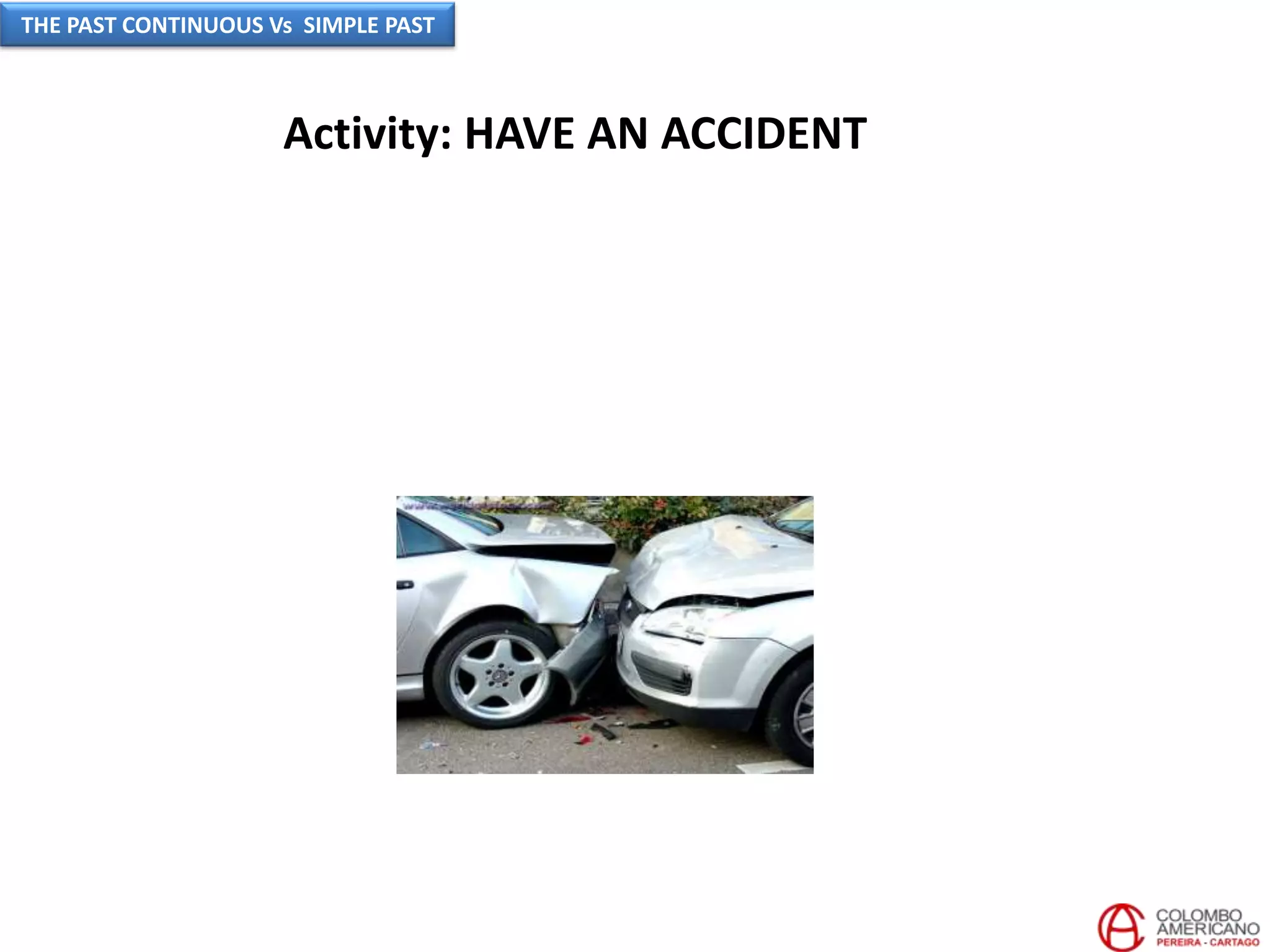
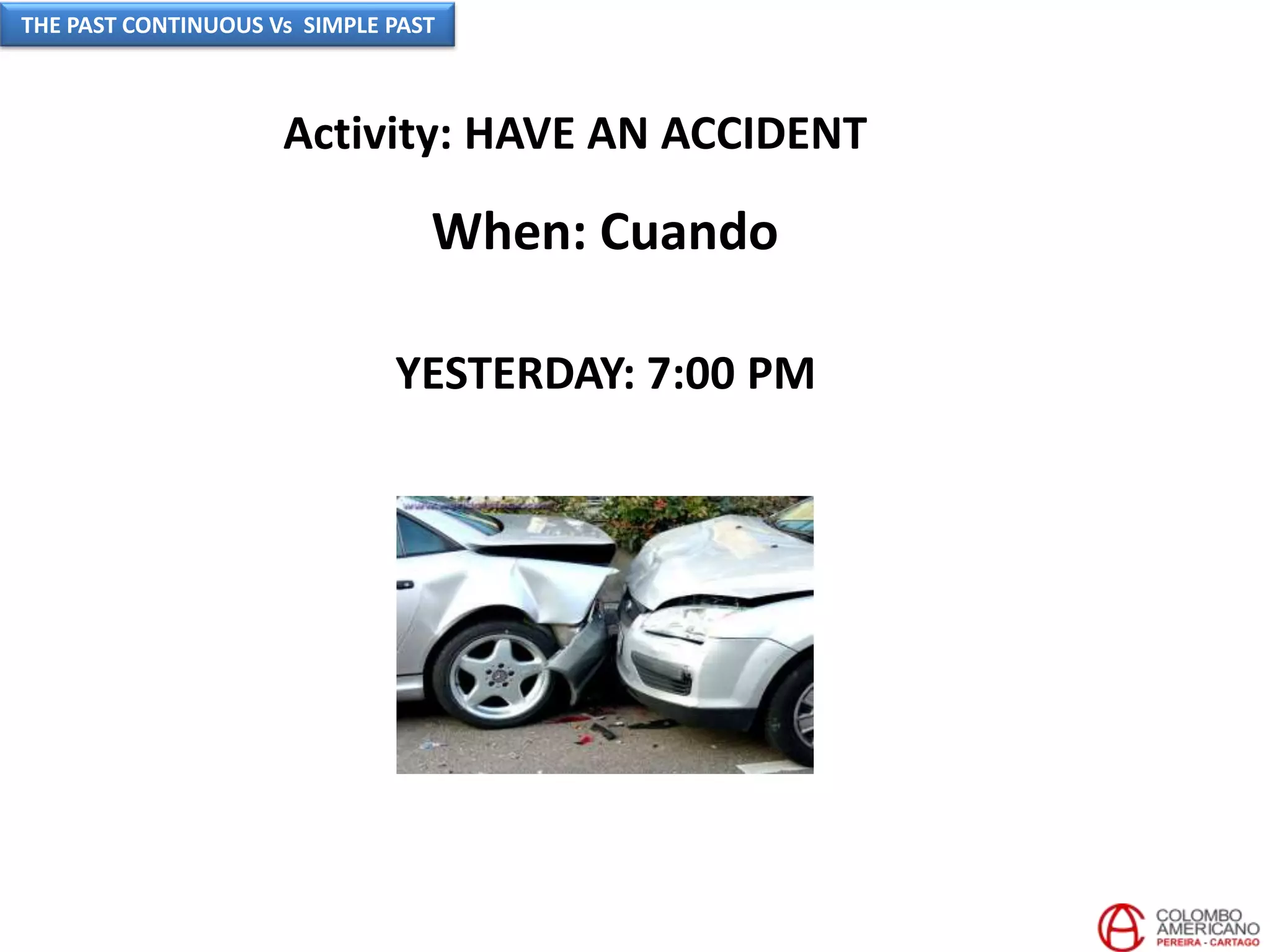
Activity: HAVE AN ACCIDENT
THE PAST CONTINUOUS Vs SIMPLE PAST
Activity: HAVE AN ACCIDENT
When: Cuando
THE PAST CONTINUOUS Vs SIMPLE PAST
Activity: HAVE AN ACCIDENT
YESTERDAY: 7:00 PM
When: Cuando
THE PAST CONTINUOUS Vs SIMPLE PAST
Time: 7:00 pm
(La acción pasó en un sólo momento
a las 7:00 pm)
THE PAST CONTINUOUS Vs SIMPLE PAST
Time: 7:00 pm
(La acción pasó en un sólo momento
a las 7:00 pm)
What
happend at
7:00 pm last
night?
THE PAST CONTINUOUS Vs SIMPLE PAST
Time: 7:00 pm
(La acción pasó en un sólo momento
a las 7:00 pm)
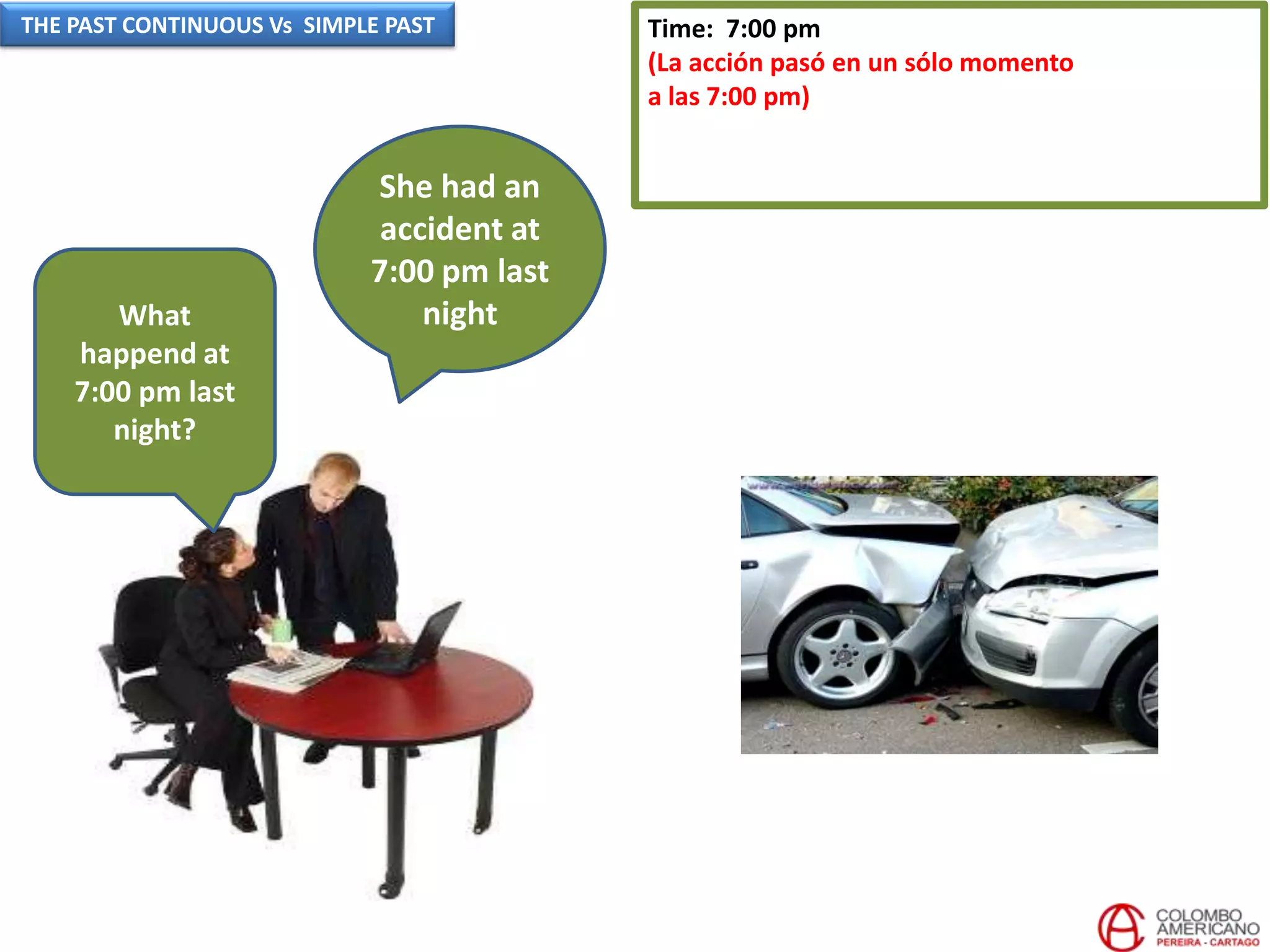
She had an
accident at
7:00 pm last
nightWhat
happend at
7:00 pm last
night?
THE PAST CONTINUOUS Vs SIMPLE PAST
HOW DO WE FORM THE PAST
CONTINUOUS:
THE PAST CONTINUOUS Vs SIMPLE PAST
HOW DO WE FORM THE PAST
CONTINUOUS :
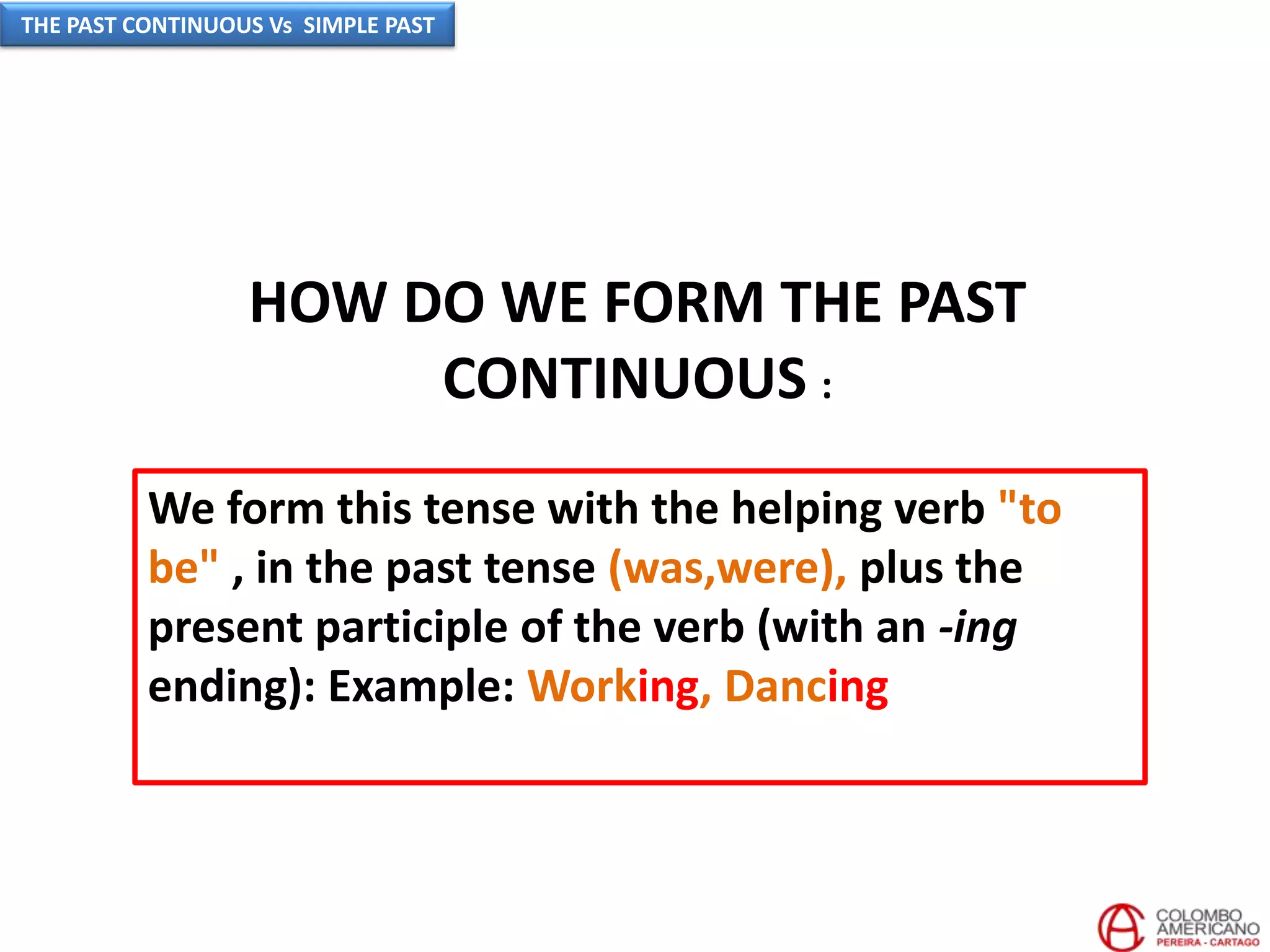
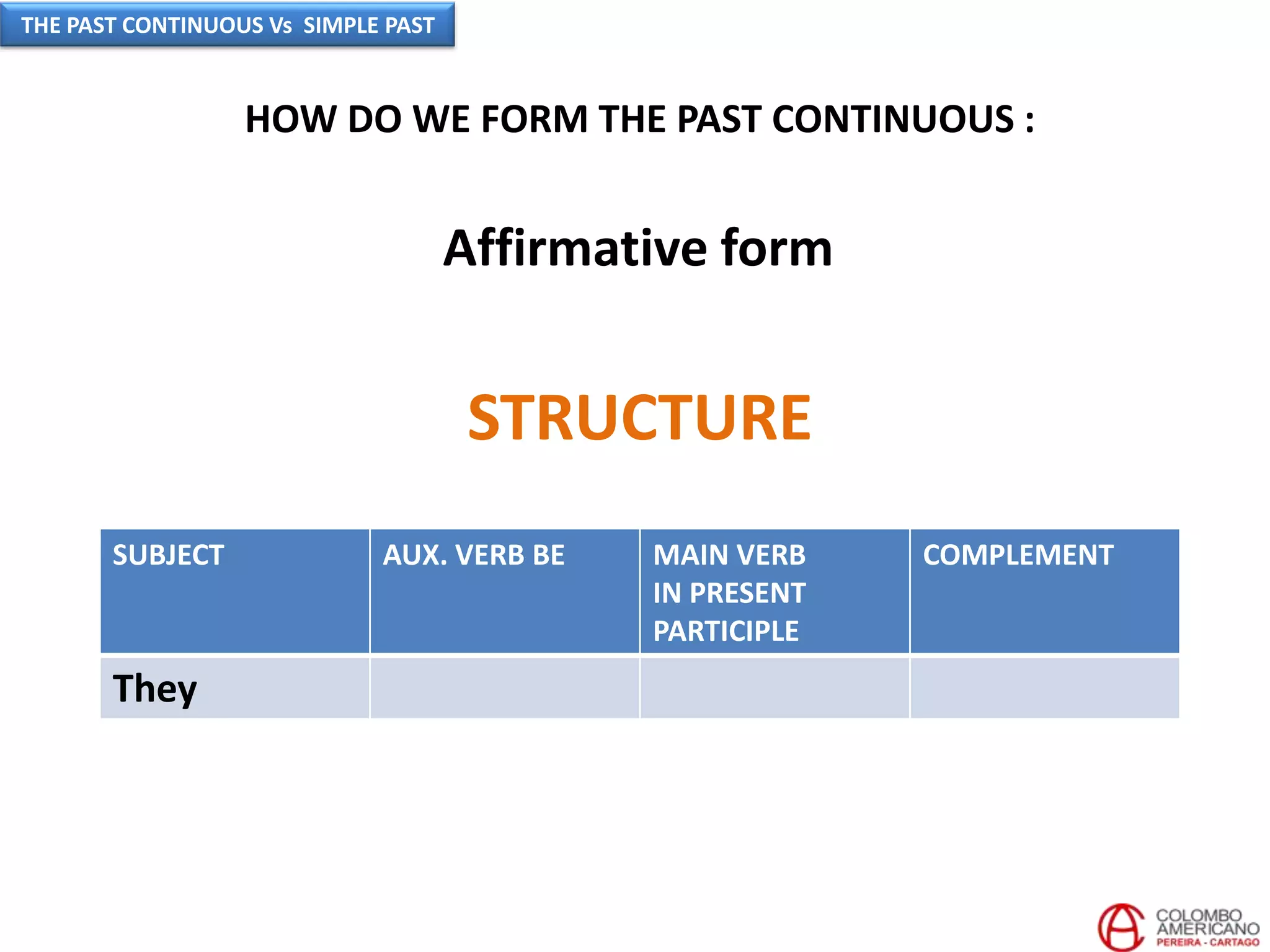
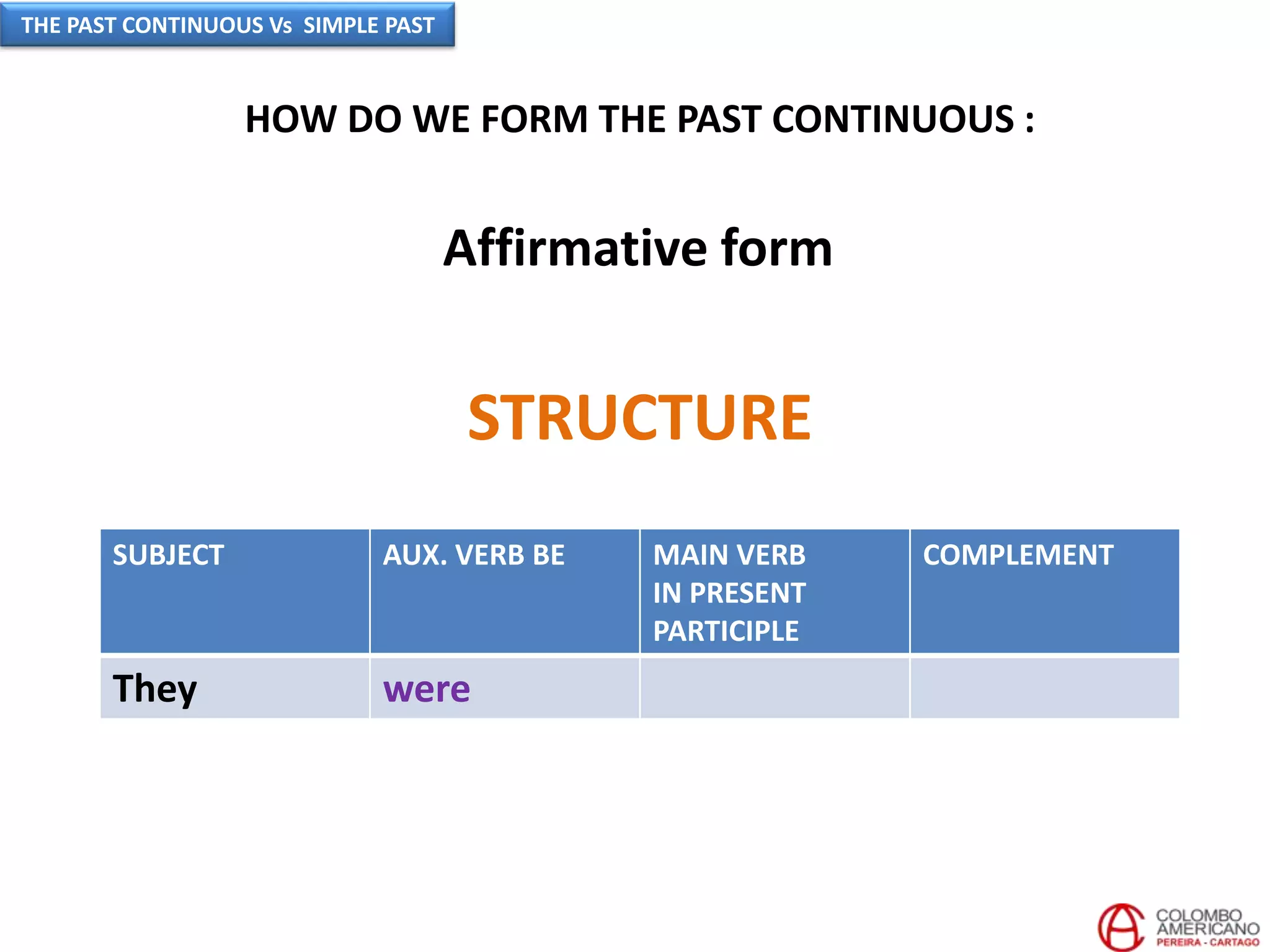
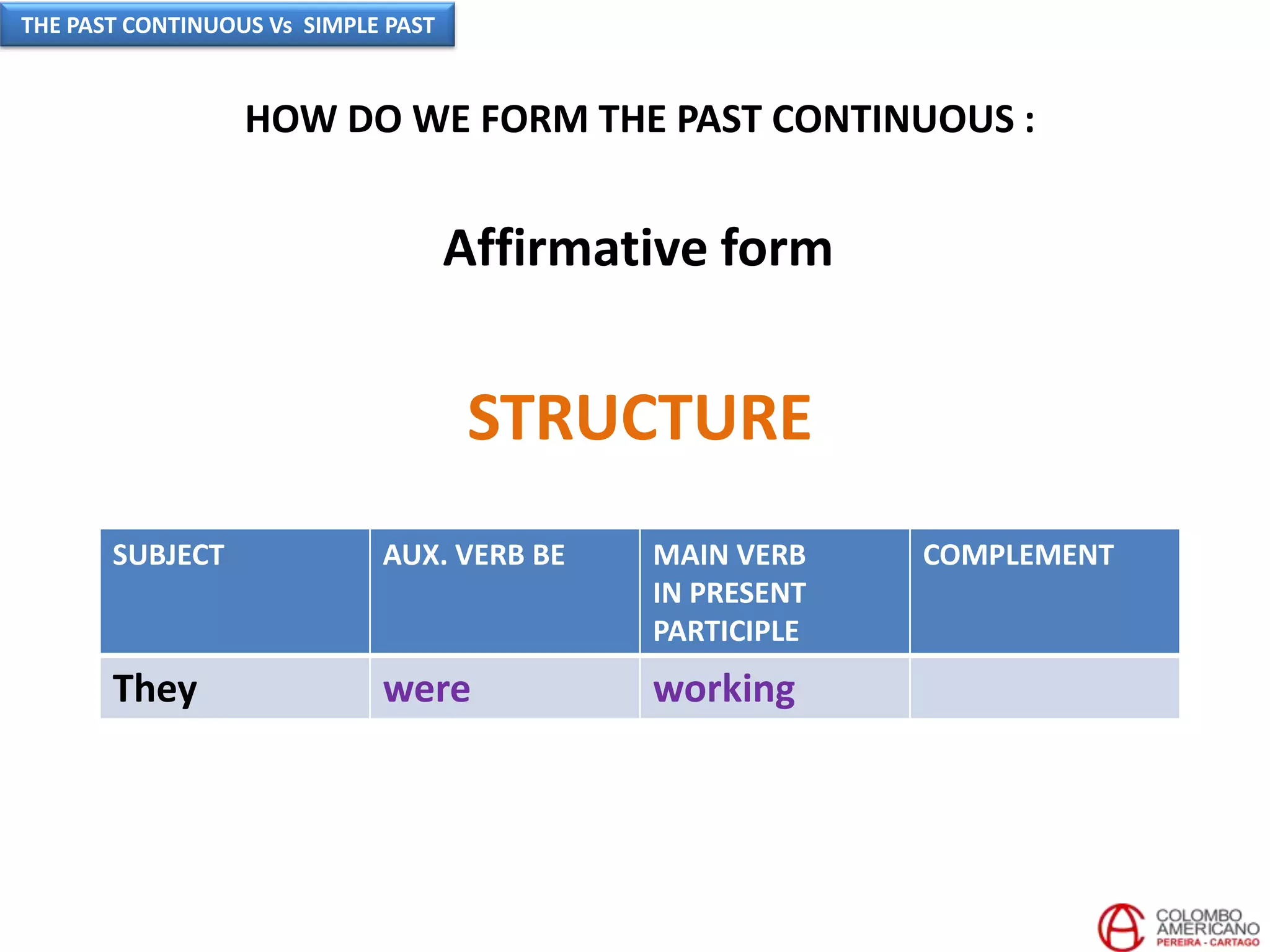
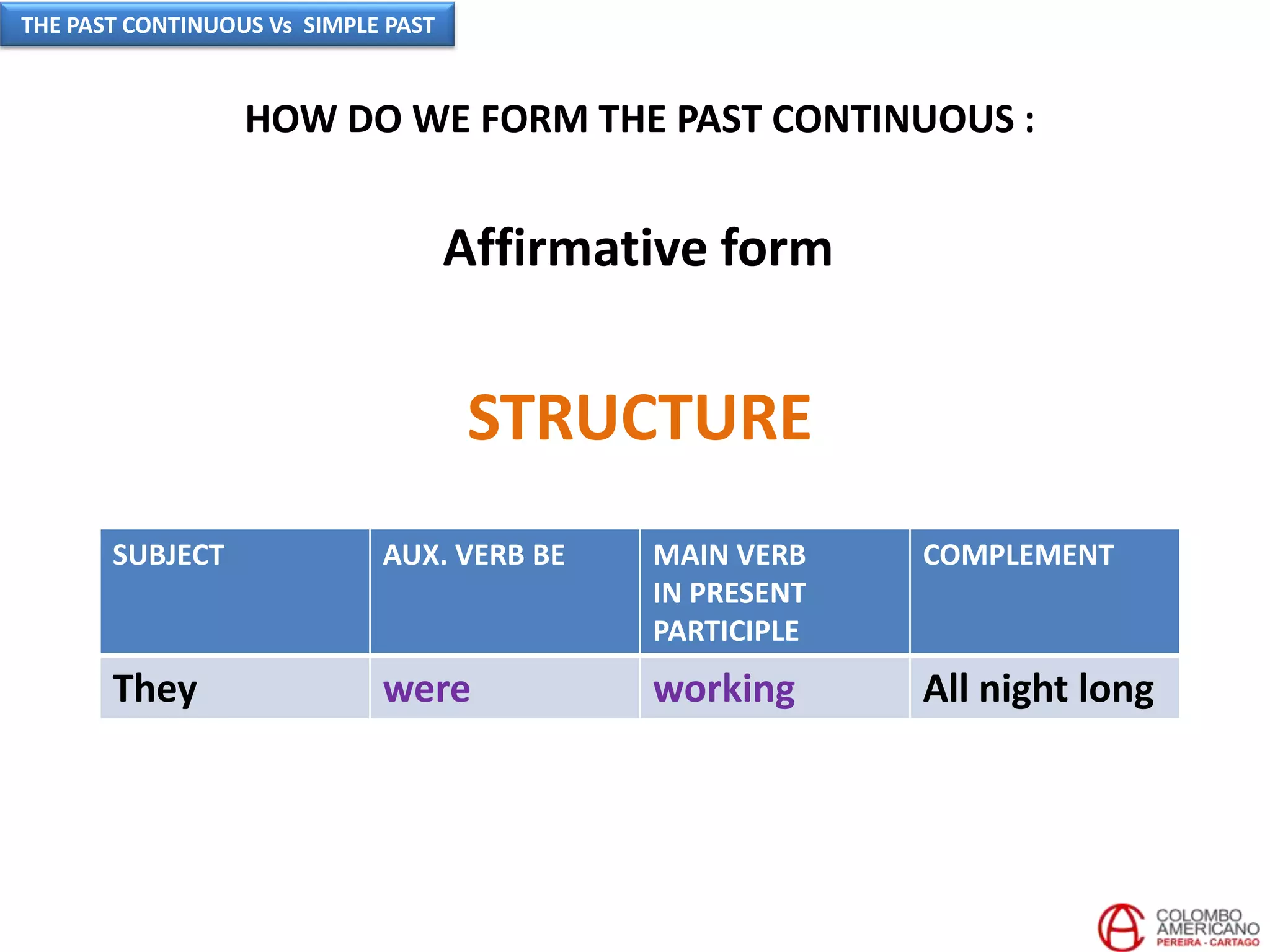
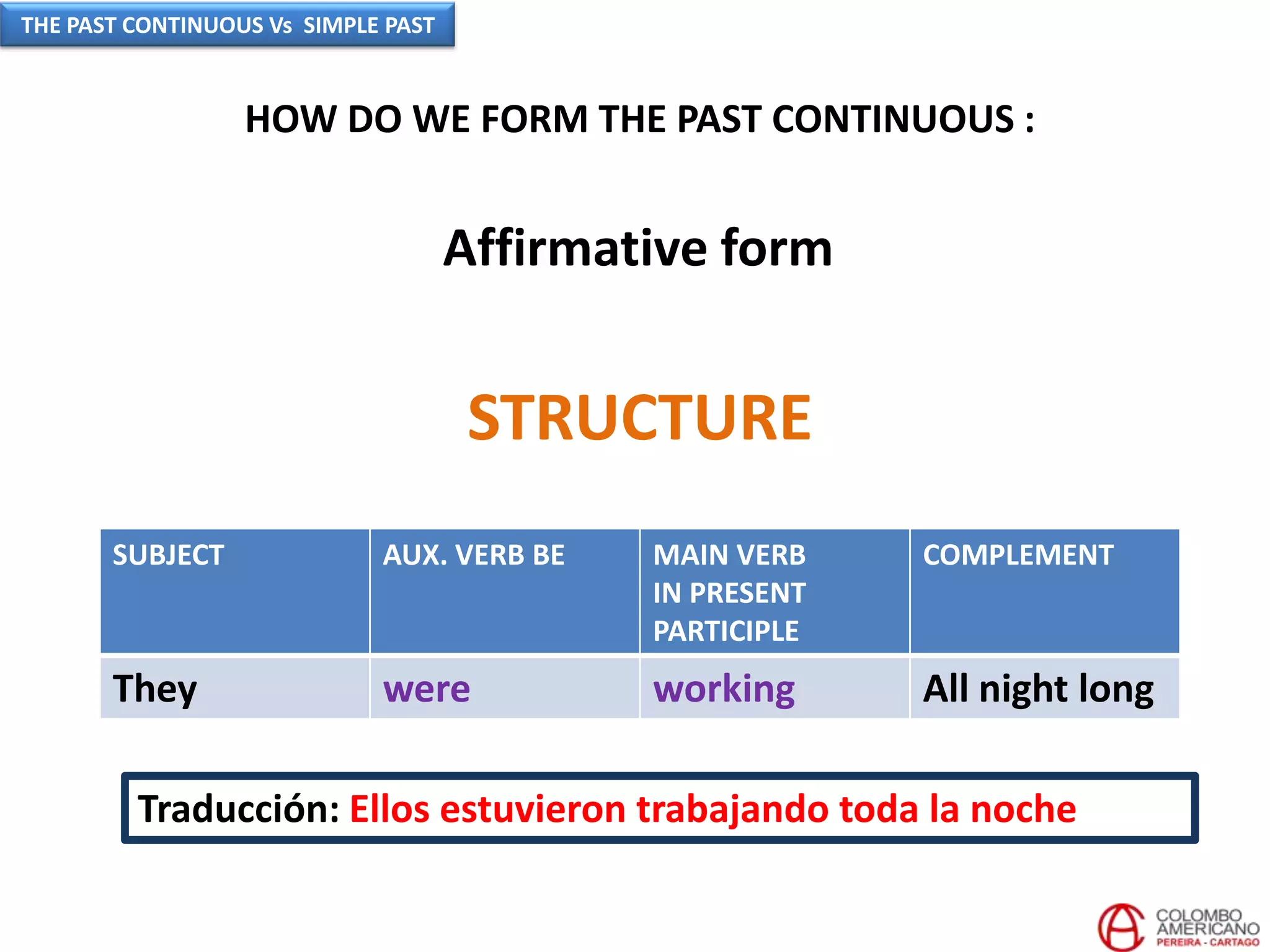
We form this tense with the helping verb "to
be" , in the past tense (was,were), plus the
present participle of the verb (with an -ing
ending): Example: Working, Dancing
THE PAST CONTINUOUS Vs SIMPLE PAST
HOW DO WE FORM THE PAST CONTINUOUS :
Affirmative form
THE PAST CONTINUOUS Vs SIMPLE PAST
HOW DO WE FORM THE PAST CONTINUOUS :
STRUCTURE
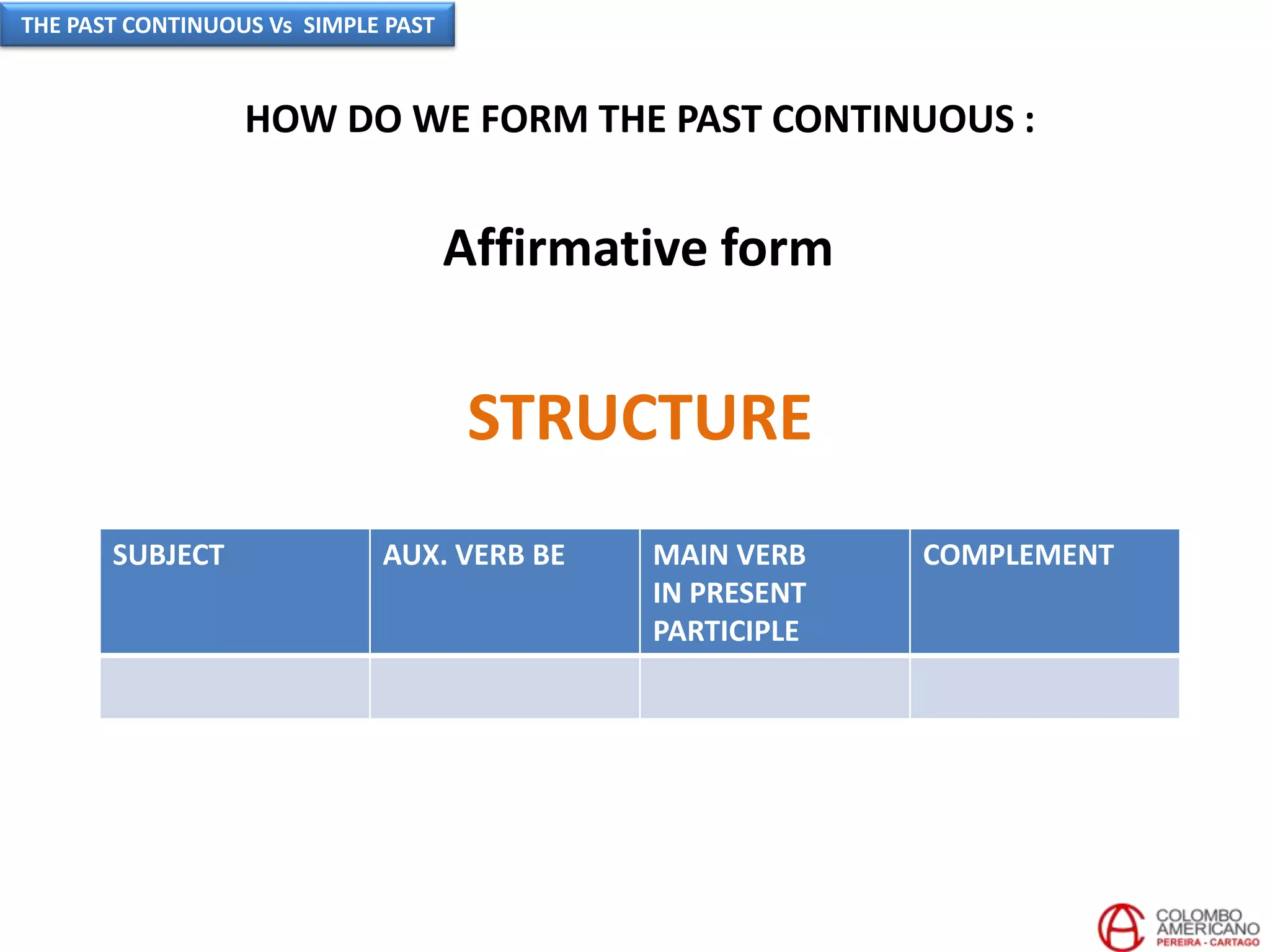
SUBJECT AUX. VERB BE MAIN VERB
IN PRESENT
PARTICIPLE
COMPLEMENT
Affirmative form
THE PAST CONTINUOUS Vs SIMPLE PAST
HOW DO WE FORM THE PAST CONTINUOUS :
STRUCTURE
SUBJECT AUX. VERB BE MAIN VERB
IN PRESENT
PARTICIPLE
COMPLEMENT
They
Affirmative form
THE PAST CONTINUOUS Vs SIMPLE PAST
HOW DO WE FORM THE PAST CONTINUOUS :
STRUCTURE
SUBJECT AUX. VERB BE MAIN VERB
IN PRESENT
PARTICIPLE
COMPLEMENT
They were
Affirmative form
THE PAST CONTINUOUS Vs SIMPLE PAST
HOW DO WE FORM THE PAST CONTINUOUS :
STRUCTURE
SUBJECT AUX. VERB BE MAIN VERB
IN PRESENT
PARTICIPLE
COMPLEMENT
They were working
Affirmative form
THE PAST CONTINUOUS Vs SIMPLE PAST
HOW DO WE FORM THE PAST CONTINUOUS :
STRUCTURE
SUBJECT AUX. VERB BE MAIN VERB
IN PRESENT
PARTICIPLE
COMPLEMENT
They were working All night long
Affirmative form
THE PAST CONTINUOUS Vs SIMPLE PAST
HOW DO WE FORM THE PAST CONTINUOUS :
STRUCTURE
SUBJECT AUX. VERB BE MAIN VERB
IN PRESENT
PARTICIPLE
COMPLEMENT
They were working All night long
Traducción: Ellos estuvieron trabajando toda la noche
Affirmative form
THE PAST CONTINUOUS Vs SIMPLE PAST
HOW DO WE FORM THE PAST CONTINUOUS :
Negative form:
THE PAST CONTINUOUS Vs SIMPLE PAST
HOW DO WE FORM THE PAST CONTINUOUS :
STRUCTURE
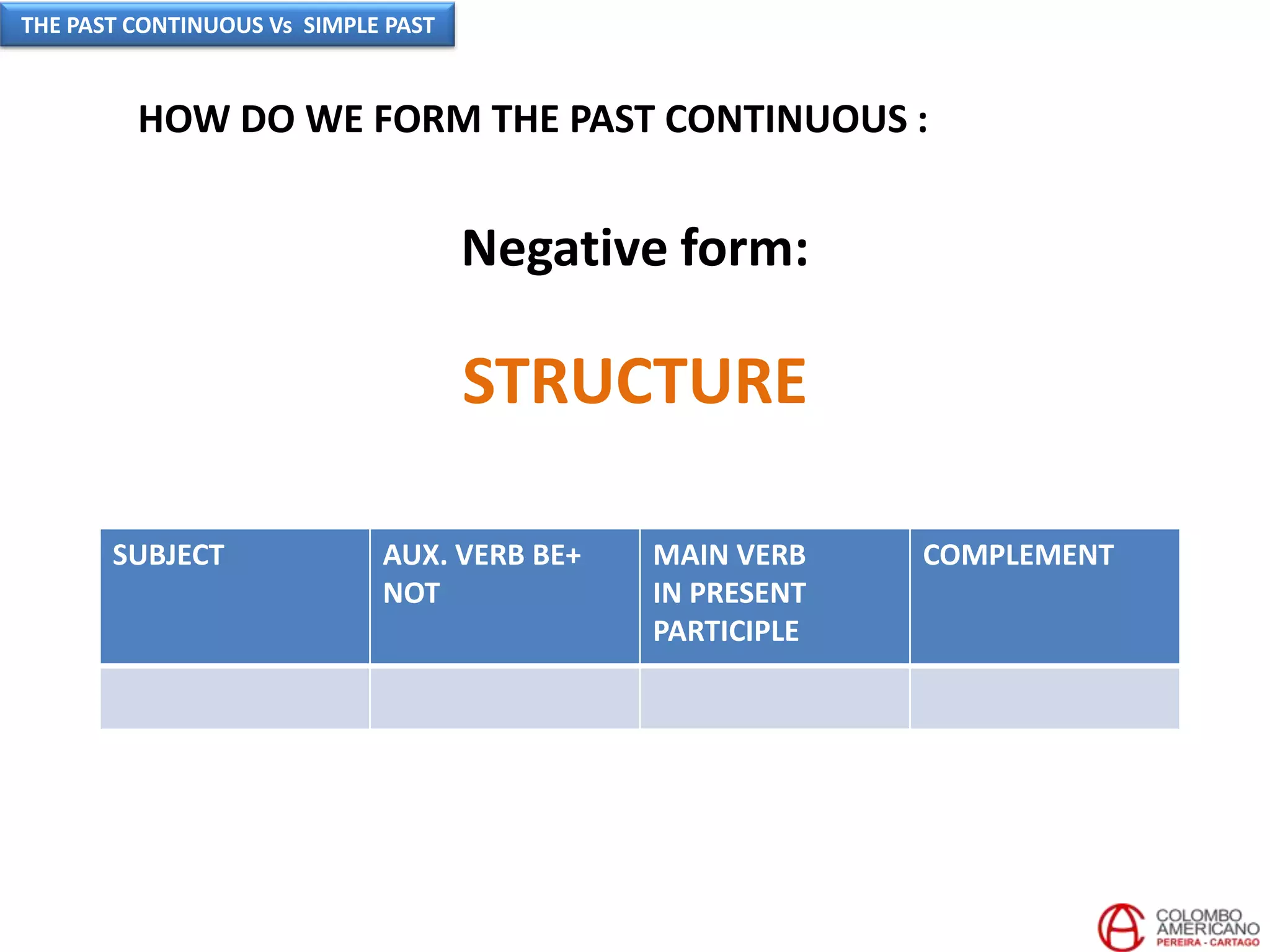
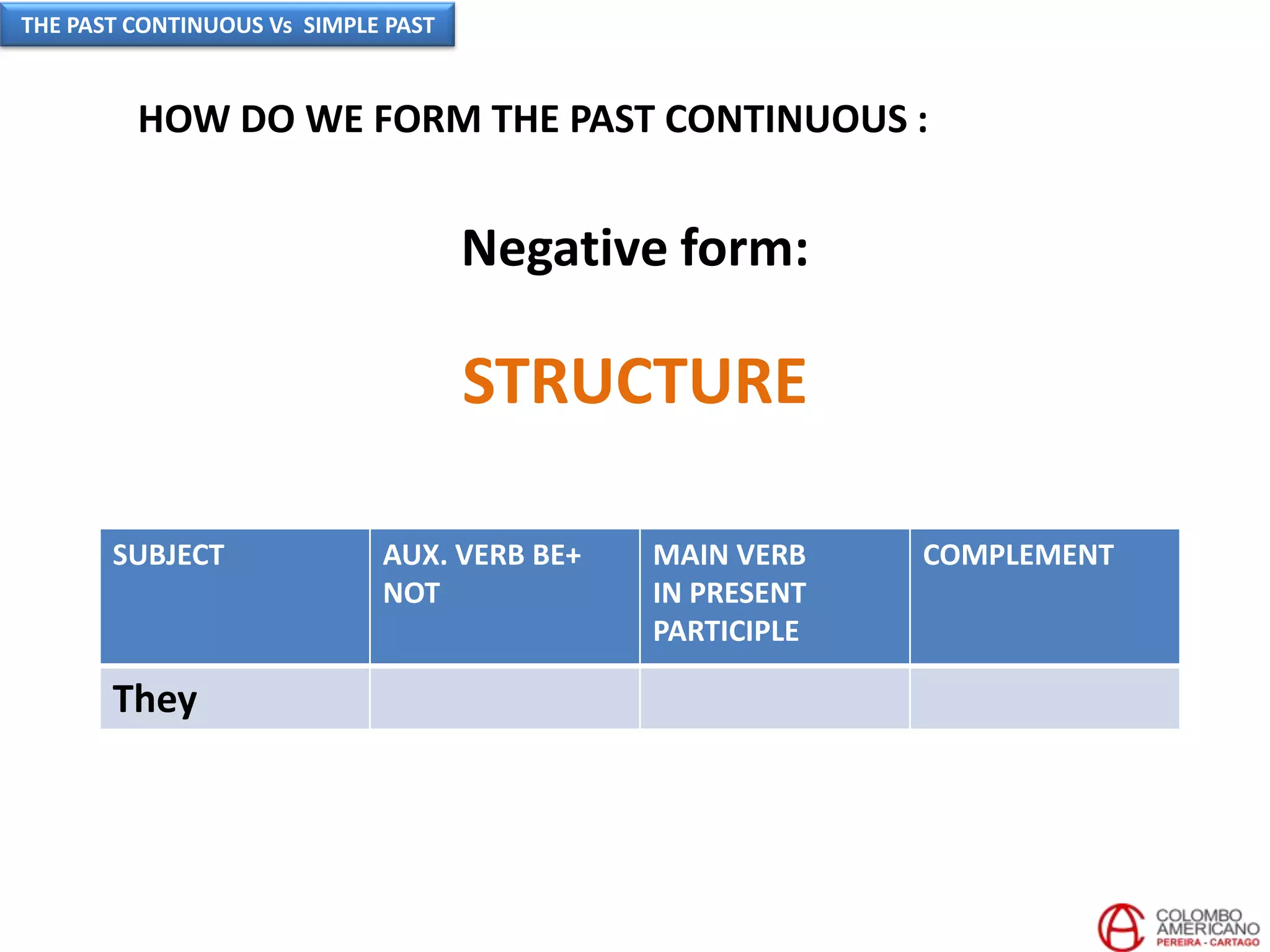
SUBJECT AUX. VERB BE+
NOT
MAIN VERB
IN PRESENT
PARTICIPLE
COMPLEMENT
Negative form:
THE PAST CONTINUOUS Vs SIMPLE PAST
HOW DO WE FORM THE PAST CONTINUOUS :
STRUCTURE
SUBJECT AUX. VERB BE+
NOT
MAIN VERB
IN PRESENT
PARTICIPLE
COMPLEMENT
They
Negative form:
THE PAST CONTINUOUS Vs SIMPLE PAST
HOW DO WE FORM THE PAST CONTINUOUS :
STRUCTURE
SUBJECT AUX. VERB BE+
NOT
MAIN VERB
IN PRESENT
PARTICIPLE
COMPLEMENT
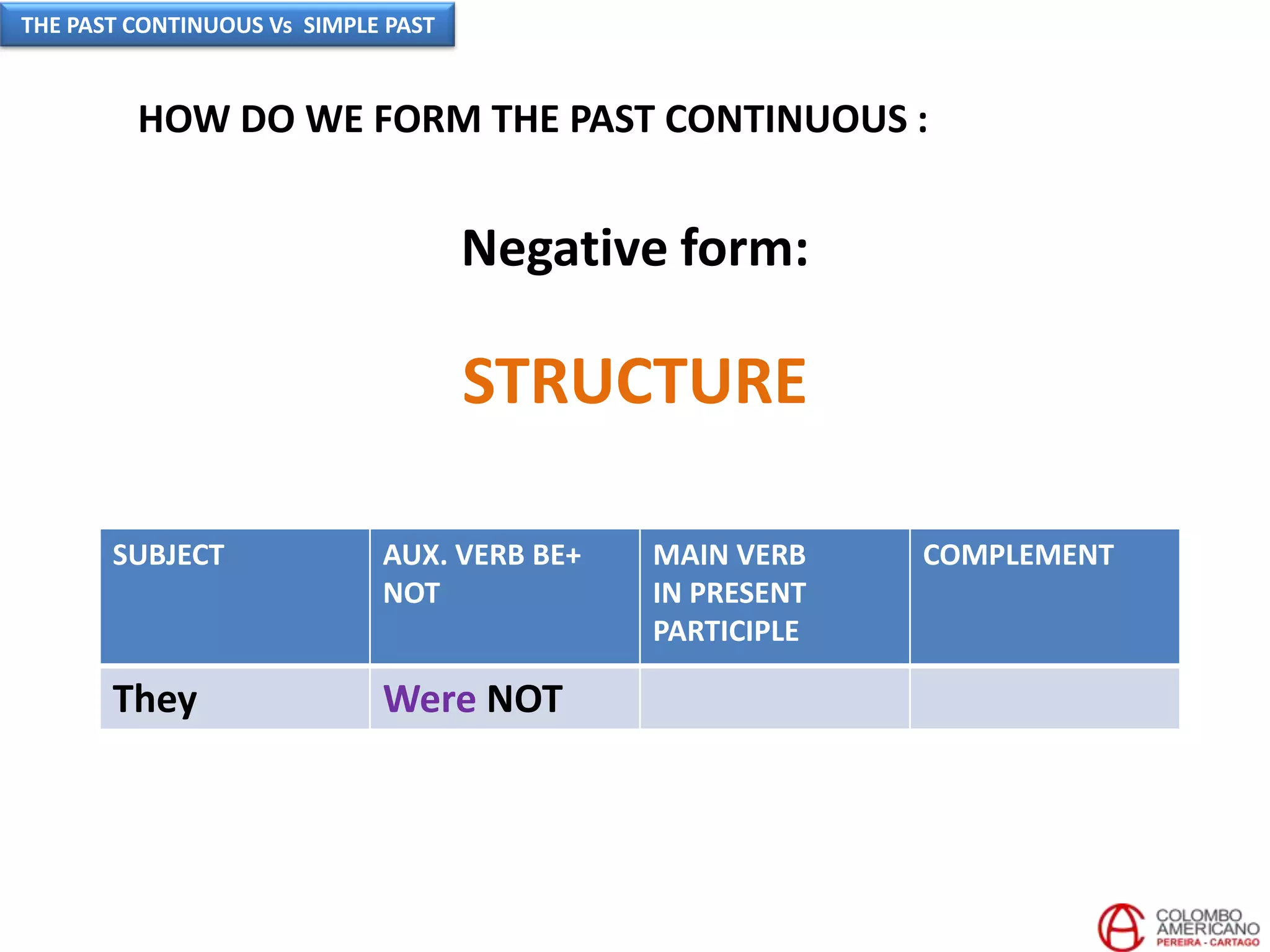
They Were NOT
Negative form:
THE PAST CONTINUOUS Vs SIMPLE PAST
HOW DO WE FORM THE PAST CONTINUOUS :
STRUCTURE
SUBJECT AUX. VERB BE+
NOT
MAIN VERB
IN PRESENT
PARTICIPLE
COMPLEMENT
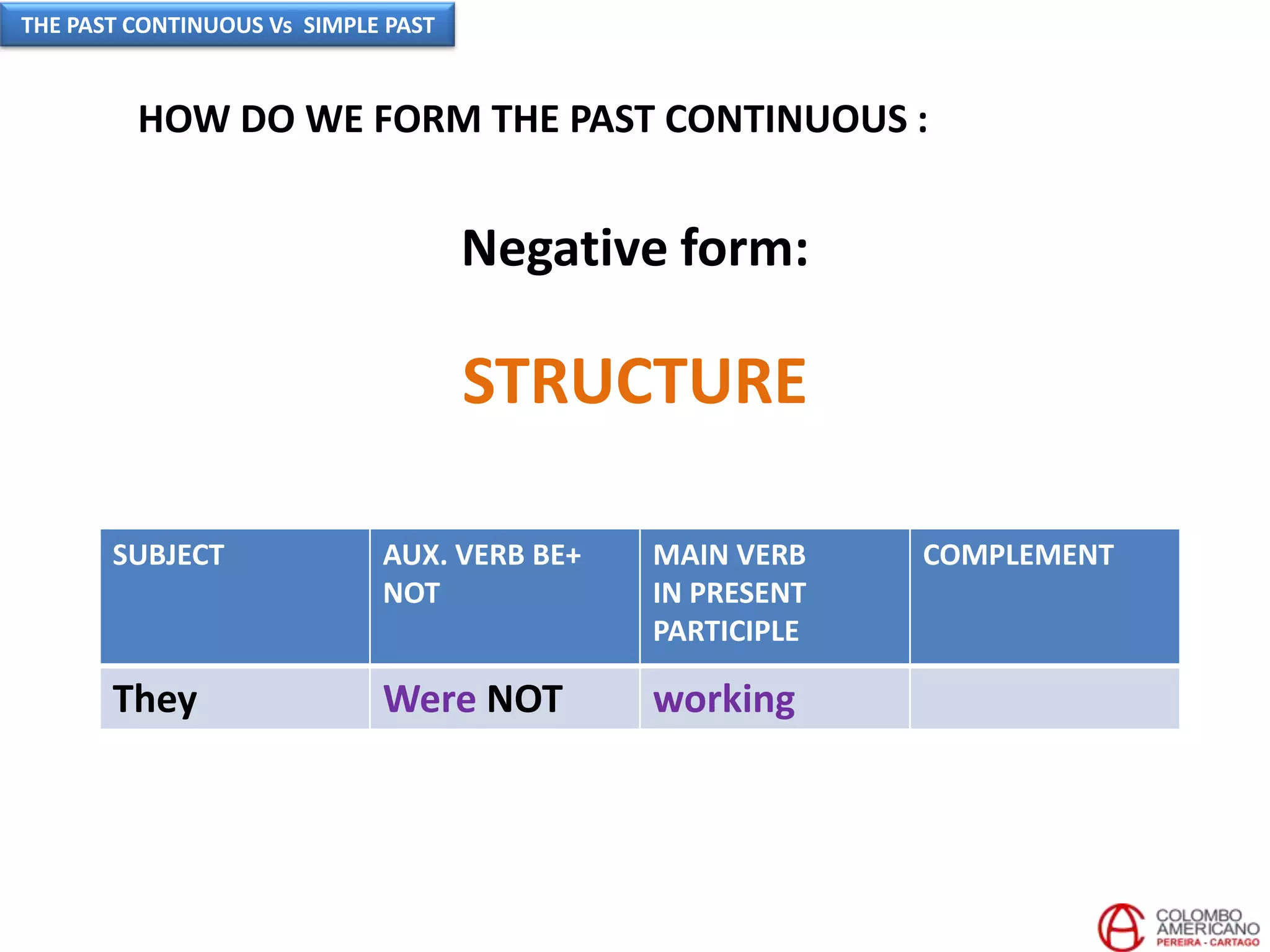
They Were NOT working
Negative form:
THE PAST CONTINUOUS Vs SIMPLE PAST
HOW DO WE FORM THE PAST CONTINUOUS :
STRUCTURE
SUBJECT AUX. VERB BE+
NOT
MAIN VERB
IN PRESENT
PARTICIPLE
COMPLEMENT
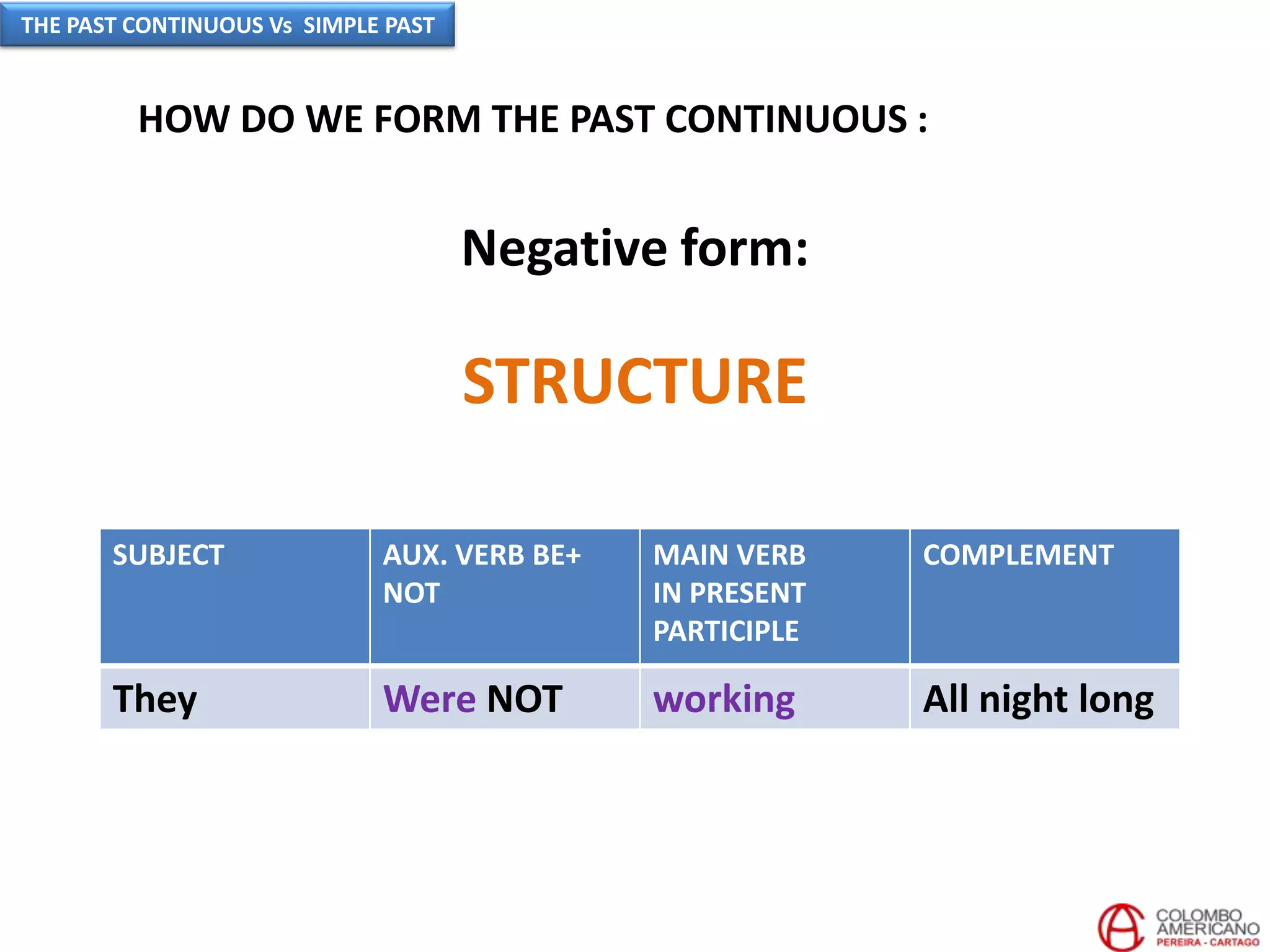
They Were NOT working All night long
Negative form:
THE PAST CONTINUOUS Vs SIMPLE PAST
HOW DO WE FORM THE PAST CONTINUOUS :
STRUCTURE
SUBJECT AUX. VERB BE+
NOT
MAIN VERB
IN PRESENT
PARTICIPLE
COMPLEMENT
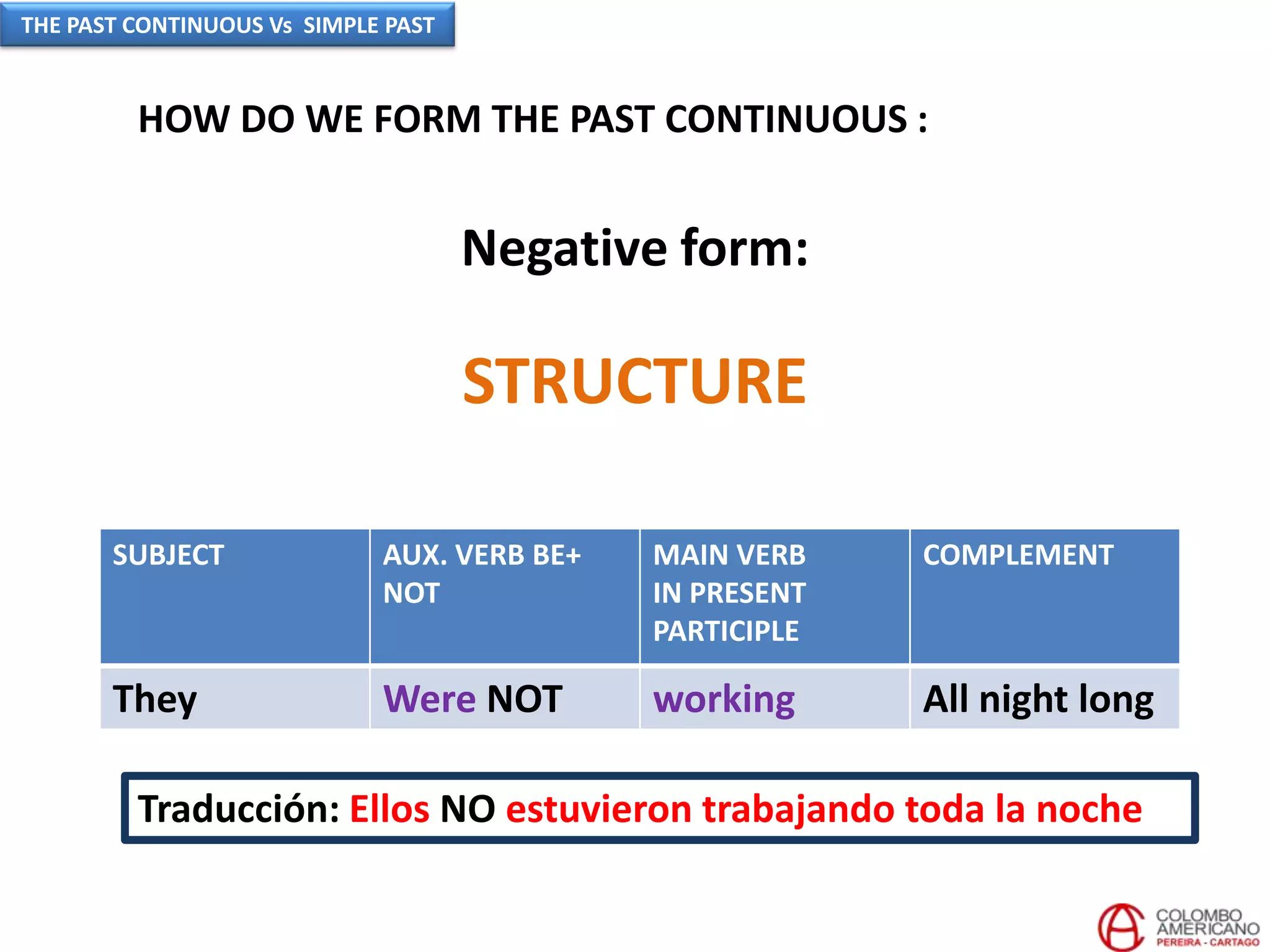
They Were NOT working All night long
Traducción: Ellos NO estuvieron trabajando toda la noche
Negative form:
THE PAST CONTINUOUS Vs SIMPLE PAST
HOW DO WE FORM THE PAST CONTINUOUS :
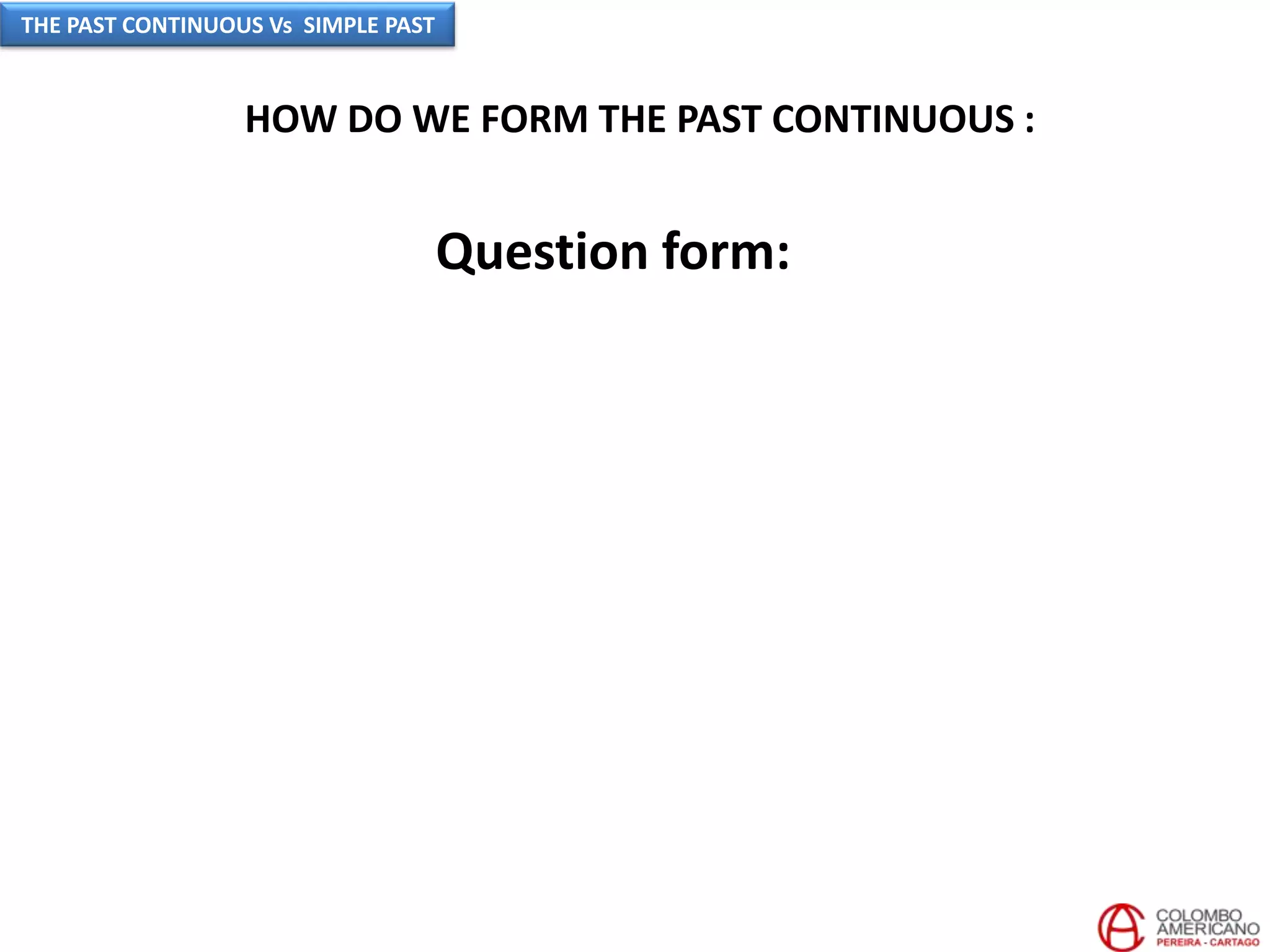
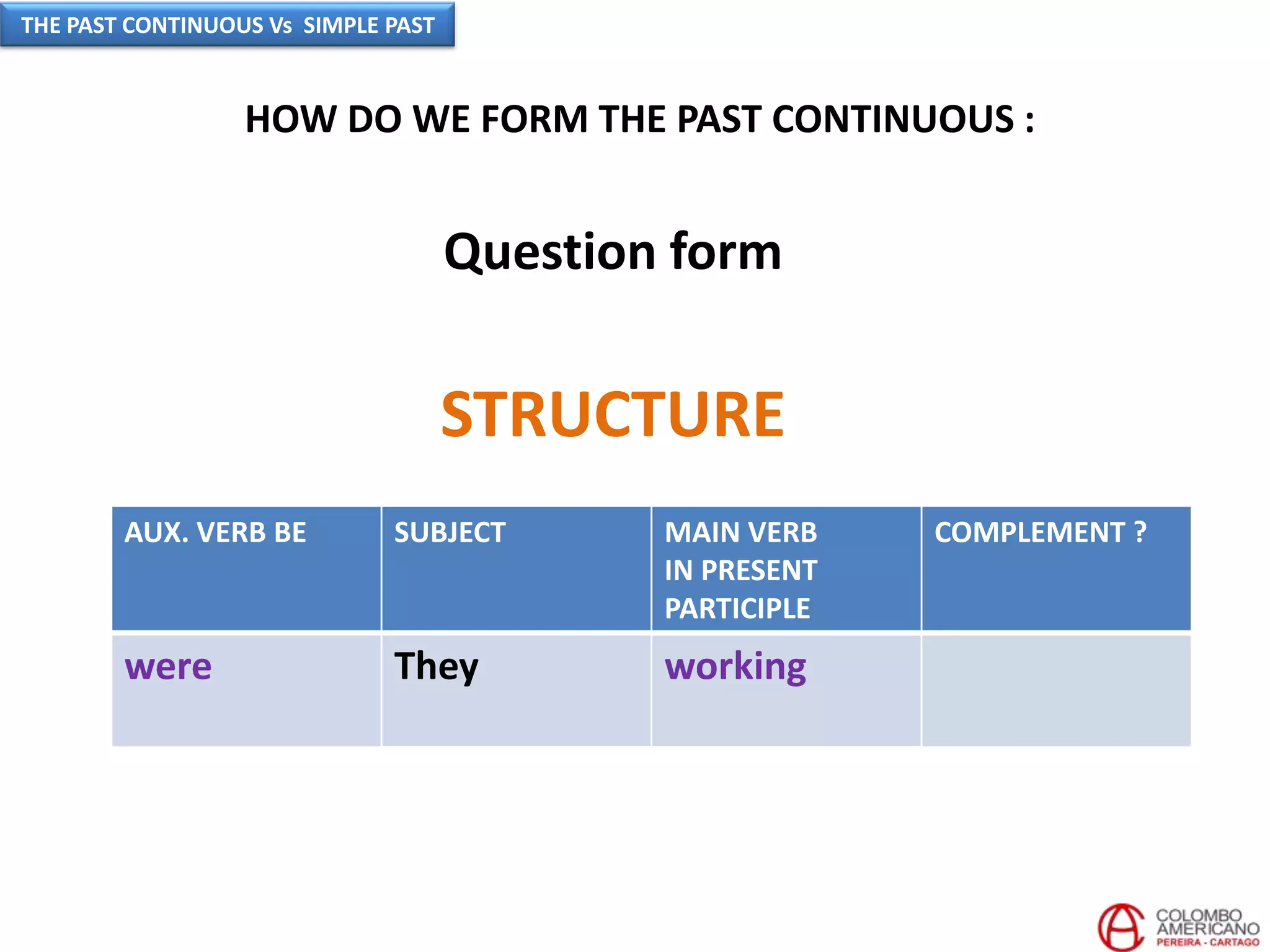
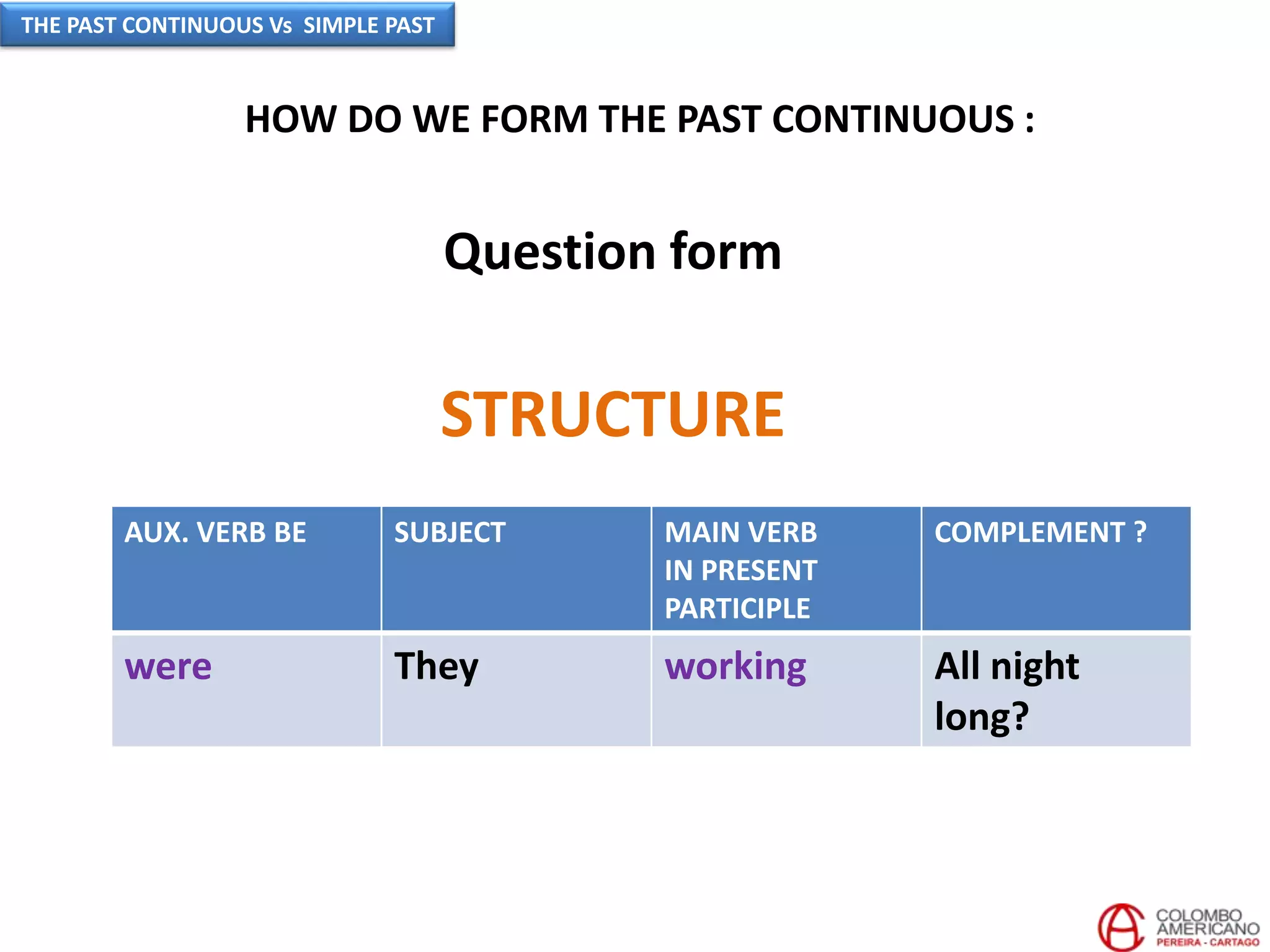
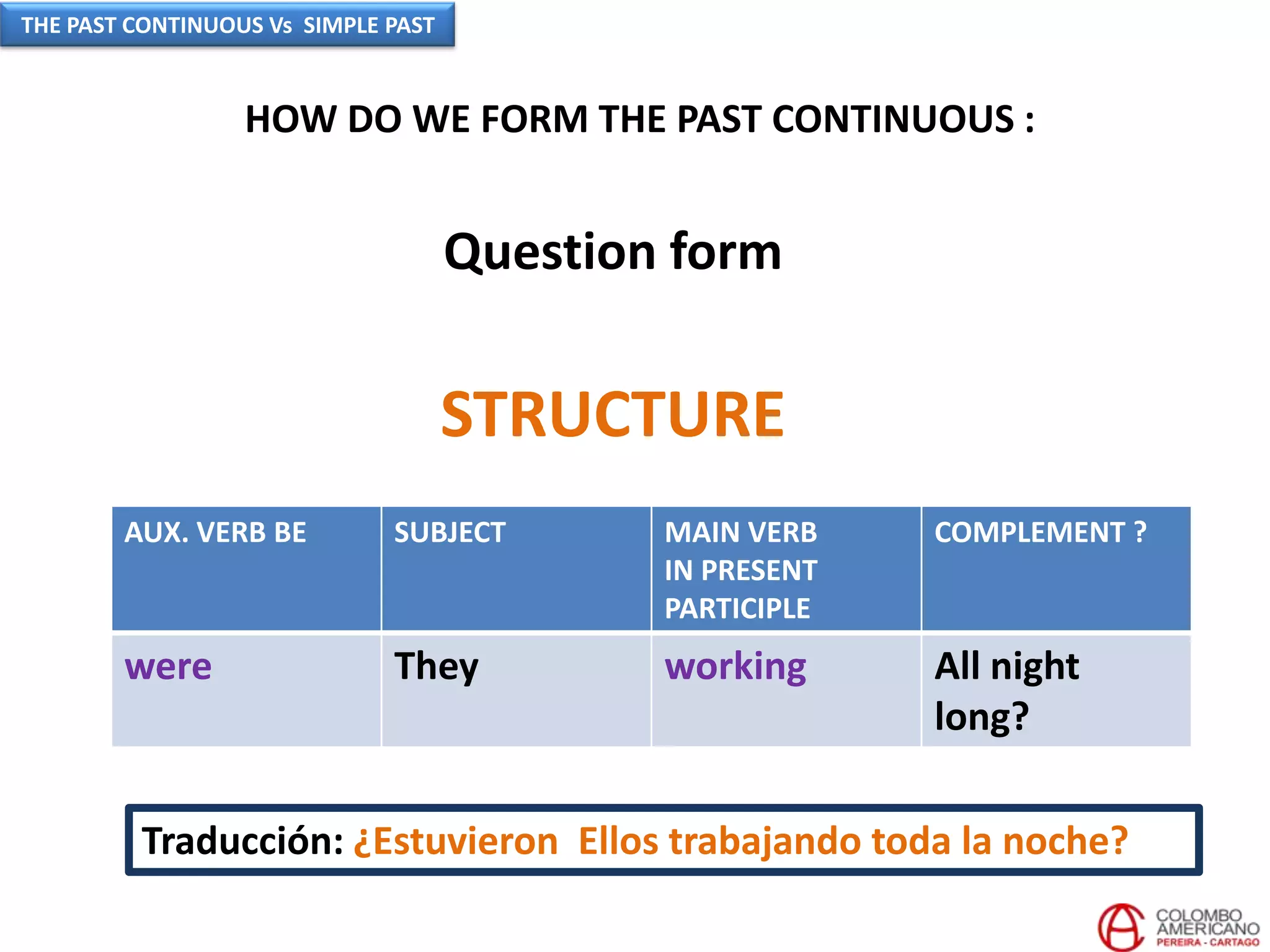
Question form:
THE PAST CONTINUOUS Vs SIMPLE PAST
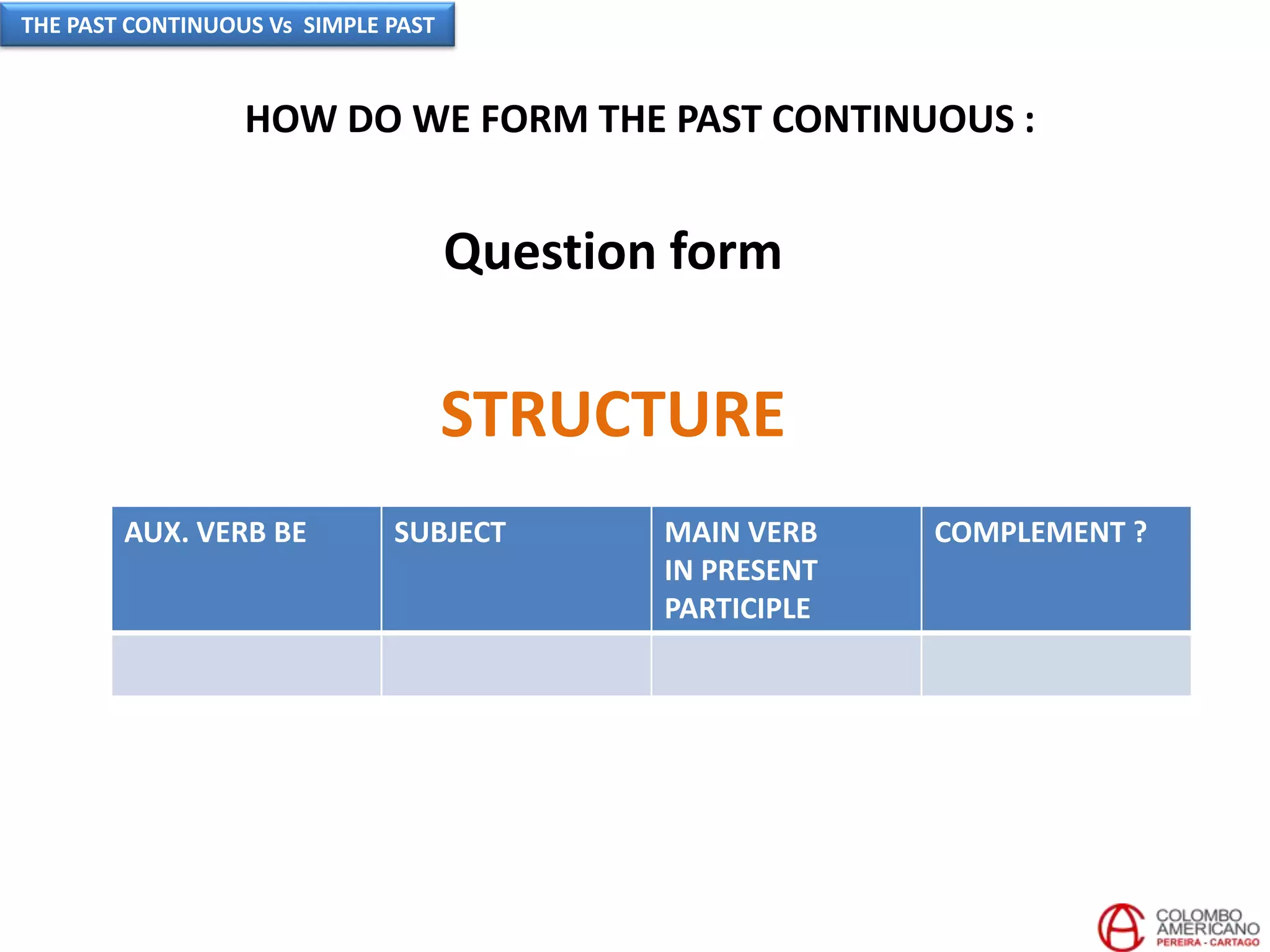
HOW DO WE FORM THE PAST CONTINUOUS :
STRUCTURE
AUX. VERB BE SUBJECT MAIN VERB
IN PRESENT
PARTICIPLE
COMPLEMENT ?
Question form
THE PAST CONTINUOUS Vs SIMPLE PAST
HOW DO WE FORM THE PAST CONTINUOUS :
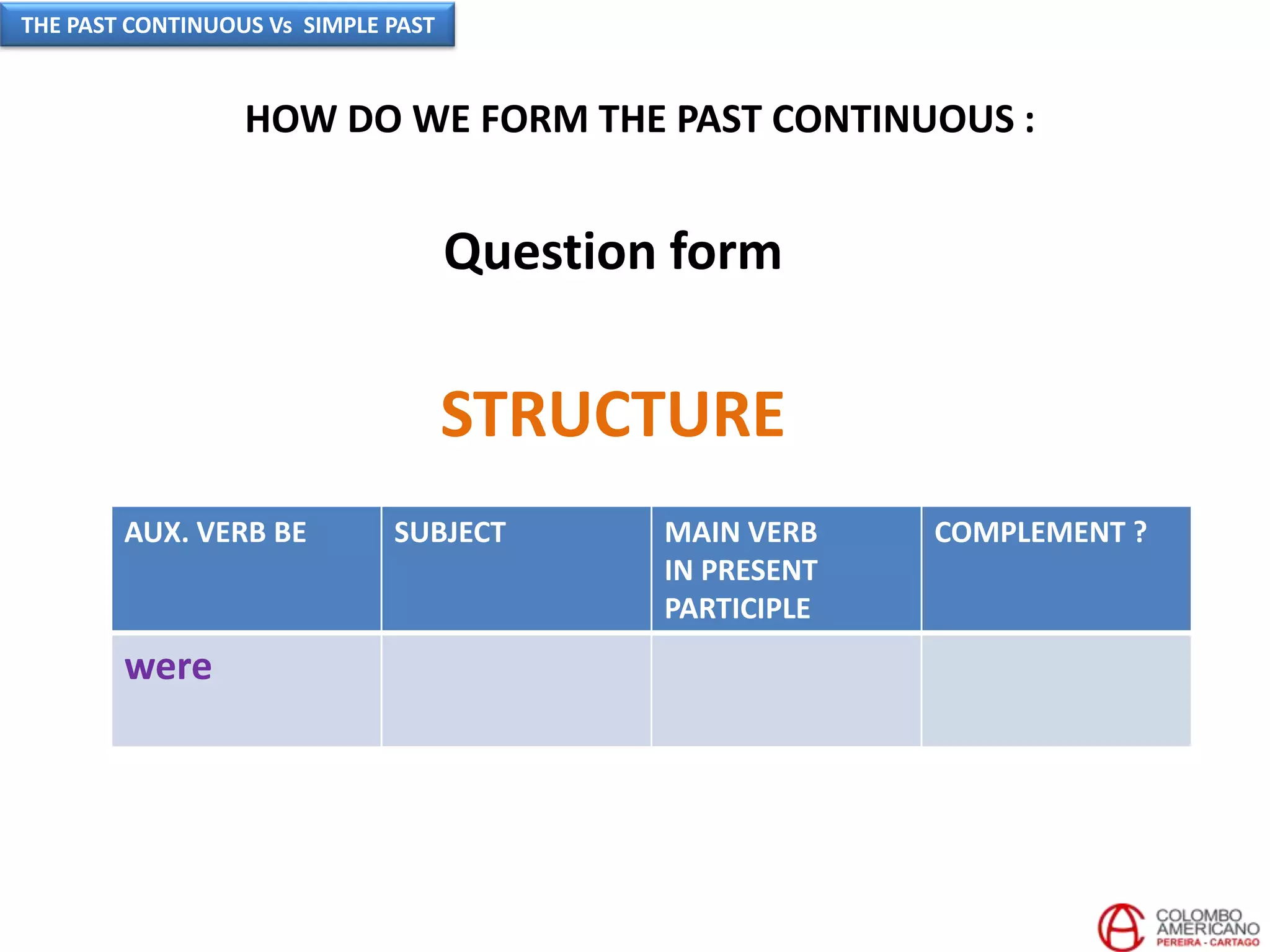
STRUCTURE
AUX. VERB BE SUBJECT MAIN VERB
IN PRESENT
PARTICIPLE
COMPLEMENT ?
were
Question form
THE PAST CONTINUOUS Vs SIMPLE PAST
HOW DO WE FORM THE PAST CONTINUOUS :
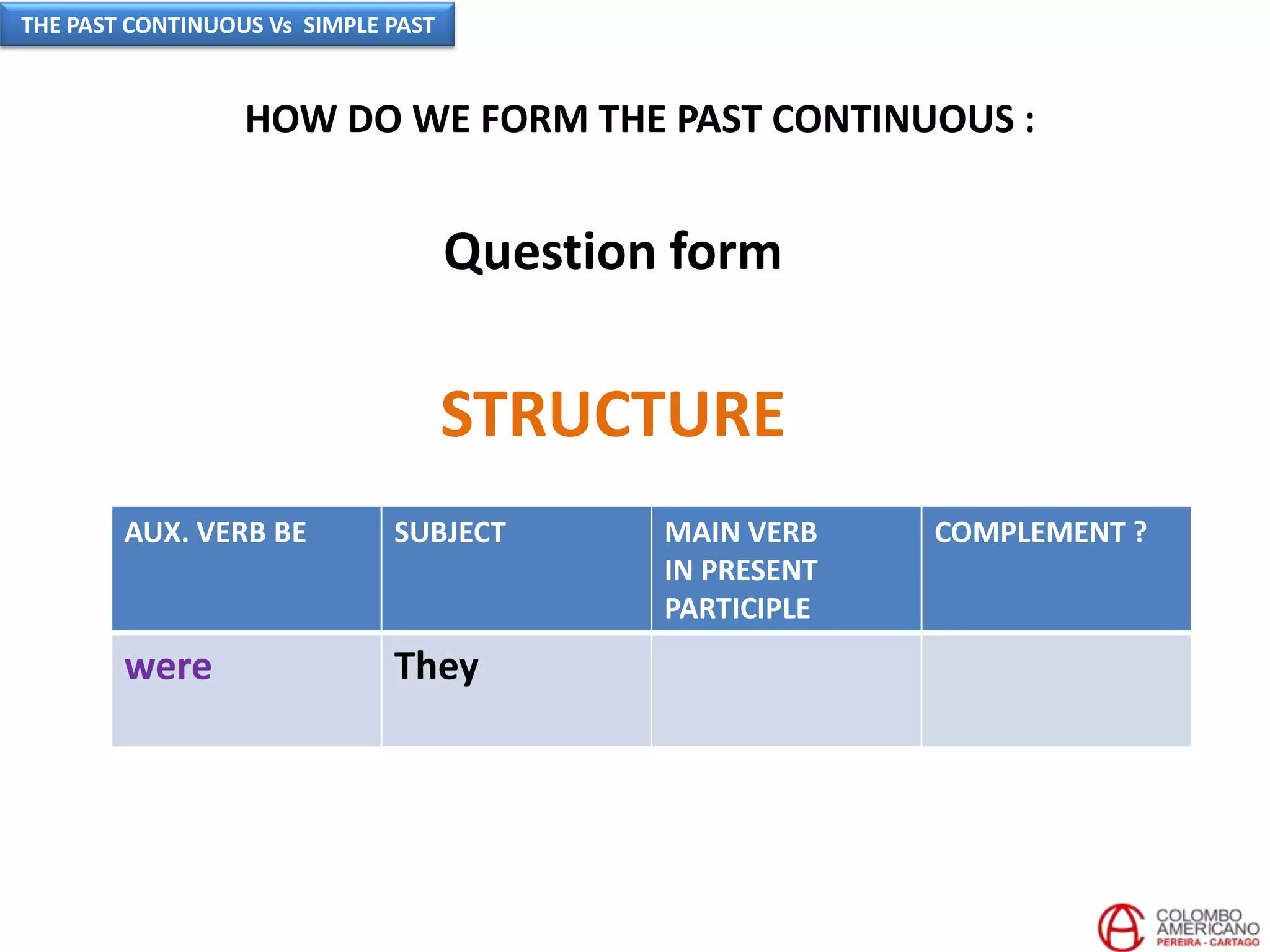
STRUCTURE
AUX. VERB BE SUBJECT MAIN VERB
IN PRESENT
PARTICIPLE
COMPLEMENT ?
were They
Question form
THE PAST CONTINUOUS Vs SIMPLE PAST
HOW DO WE FORM THE PAST CONTINUOUS :
STRUCTURE
AUX. VERB BE SUBJECT MAIN VERB
IN PRESENT
PARTICIPLE
COMPLEMENT ?
were They working
Question form
THE PAST CONTINUOUS Vs SIMPLE PAST
HOW DO WE FORM THE PAST CONTINUOUS :
STRUCTURE
AUX. VERB BE SUBJECT MAIN VERB
IN PRESENT
PARTICIPLE
COMPLEMENT ?
were They working All night
long?
Question form
THE PAST CONTINUOUS Vs SIMPLE PAST
HOW DO WE FORM THE PAST CONTINUOUS :
STRUCTURE
AUX. VERB BE SUBJECT MAIN VERB
IN PRESENT
PARTICIPLE
COMPLEMENT ?
were They working All night
long?
Traducción: ¿Estuvieron Ellos trabajando toda la noche?
Question form
THE PAST CONTINUOUS Vs SIMPLE PAST
Como se puede observar, existen dos
componentes muy importantes en: the past
continuous.
THE PAST CONTINUOUS Vs SIMPLE PAST
Como se puede observar, existen dos
componentes muy importantes en: the past
continuous.
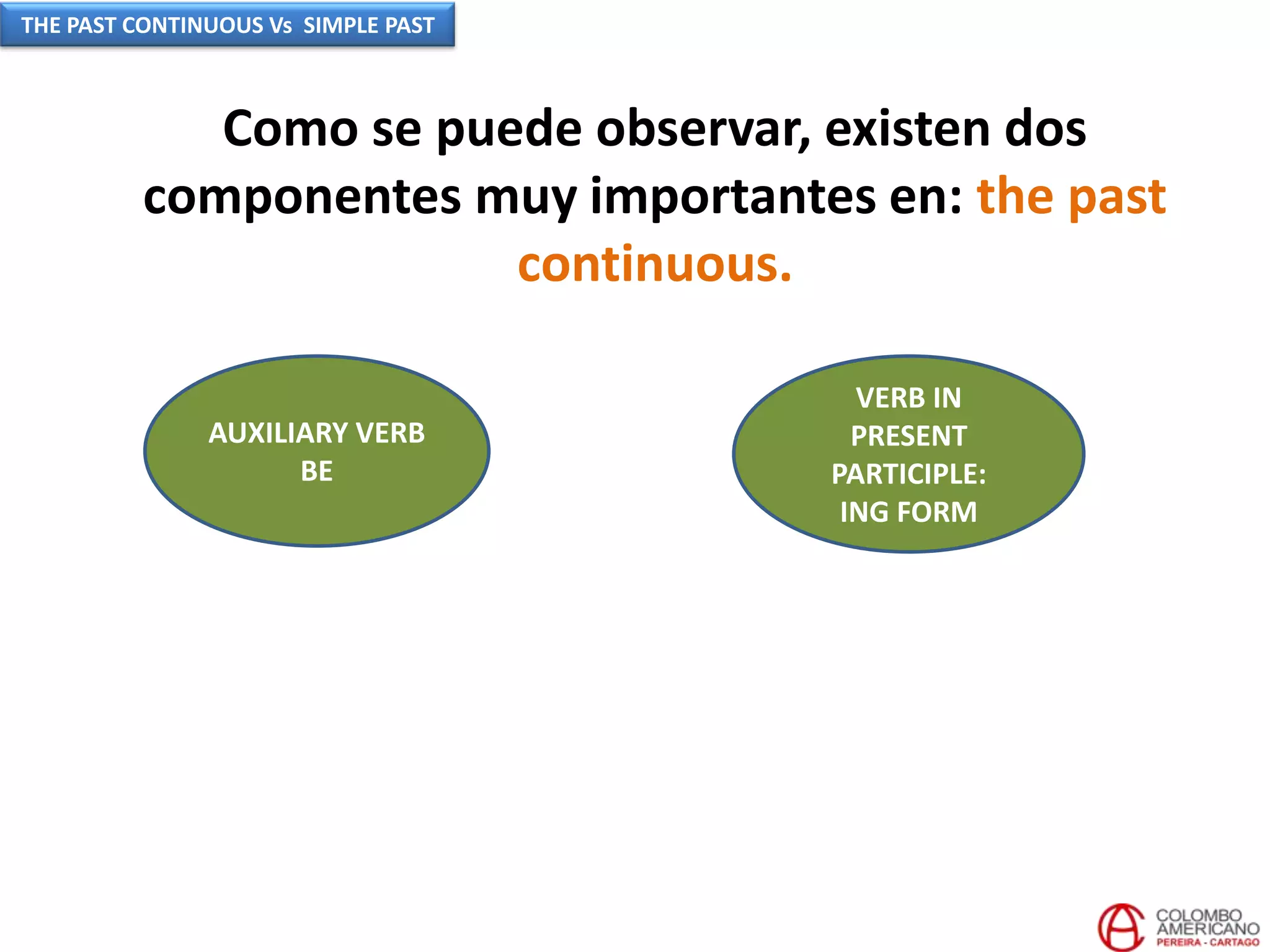
AUXILIARY VERB
BE
VERB IN
PRESENT
PARTICIPLE:
ING FORM
THE PAST CONTINUOUS Vs SIMPLE PAST
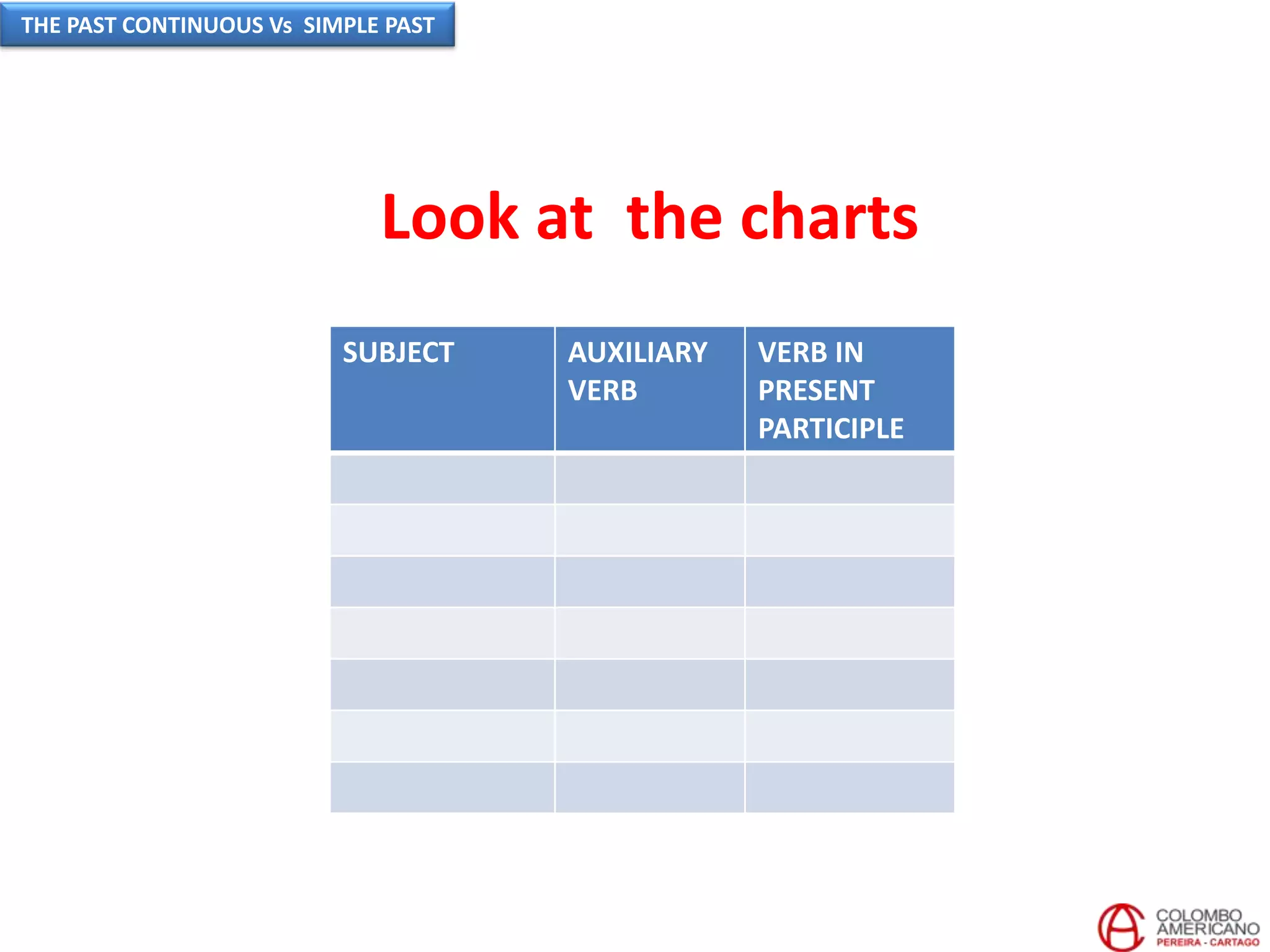
Look at the charts
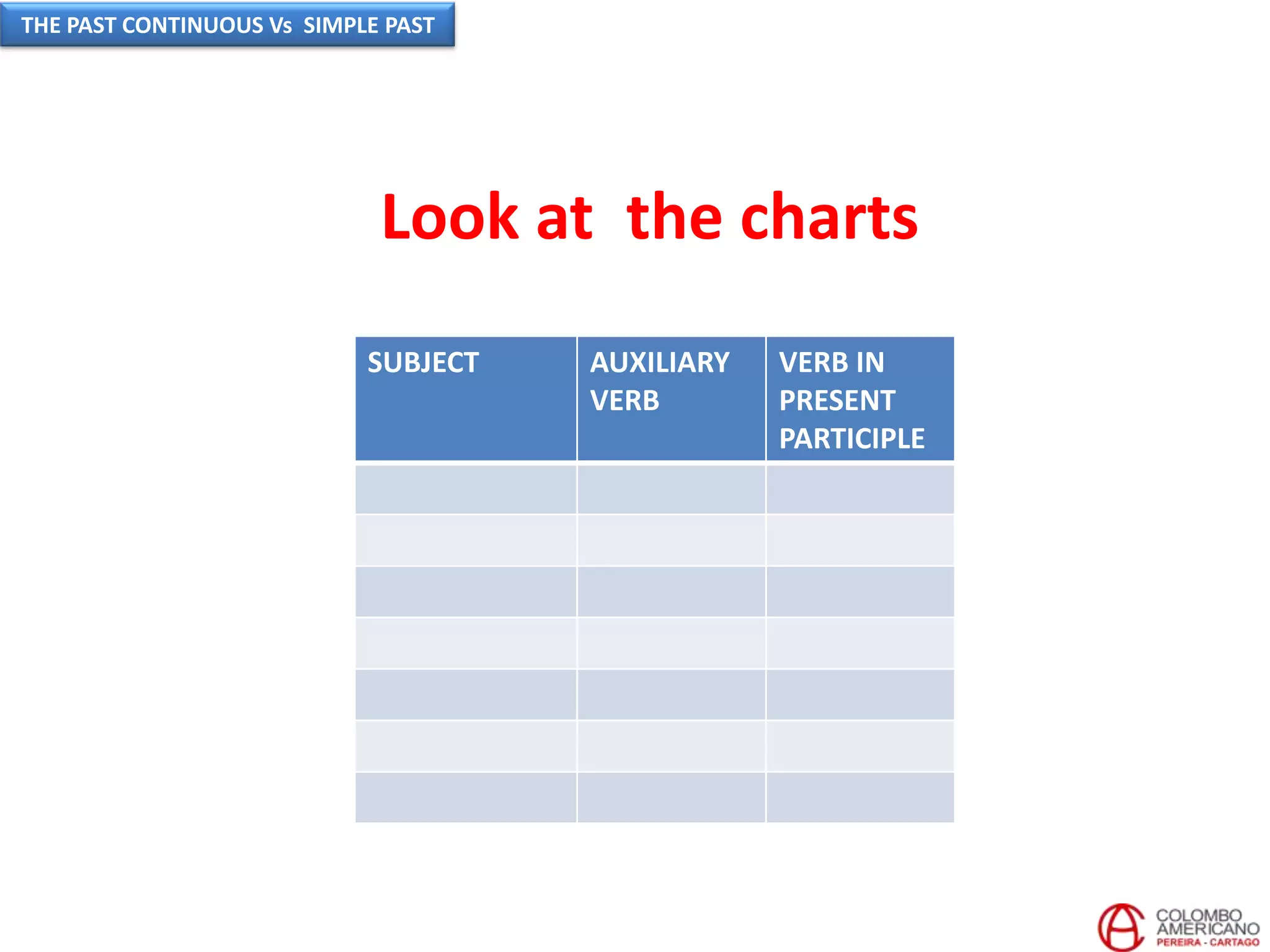
SUBJECT AUXILIARY
VERB
VERB IN
PRESENT
PARTICIPLE
THE PAST CONTINUOUS Vs SIMPLE PAST
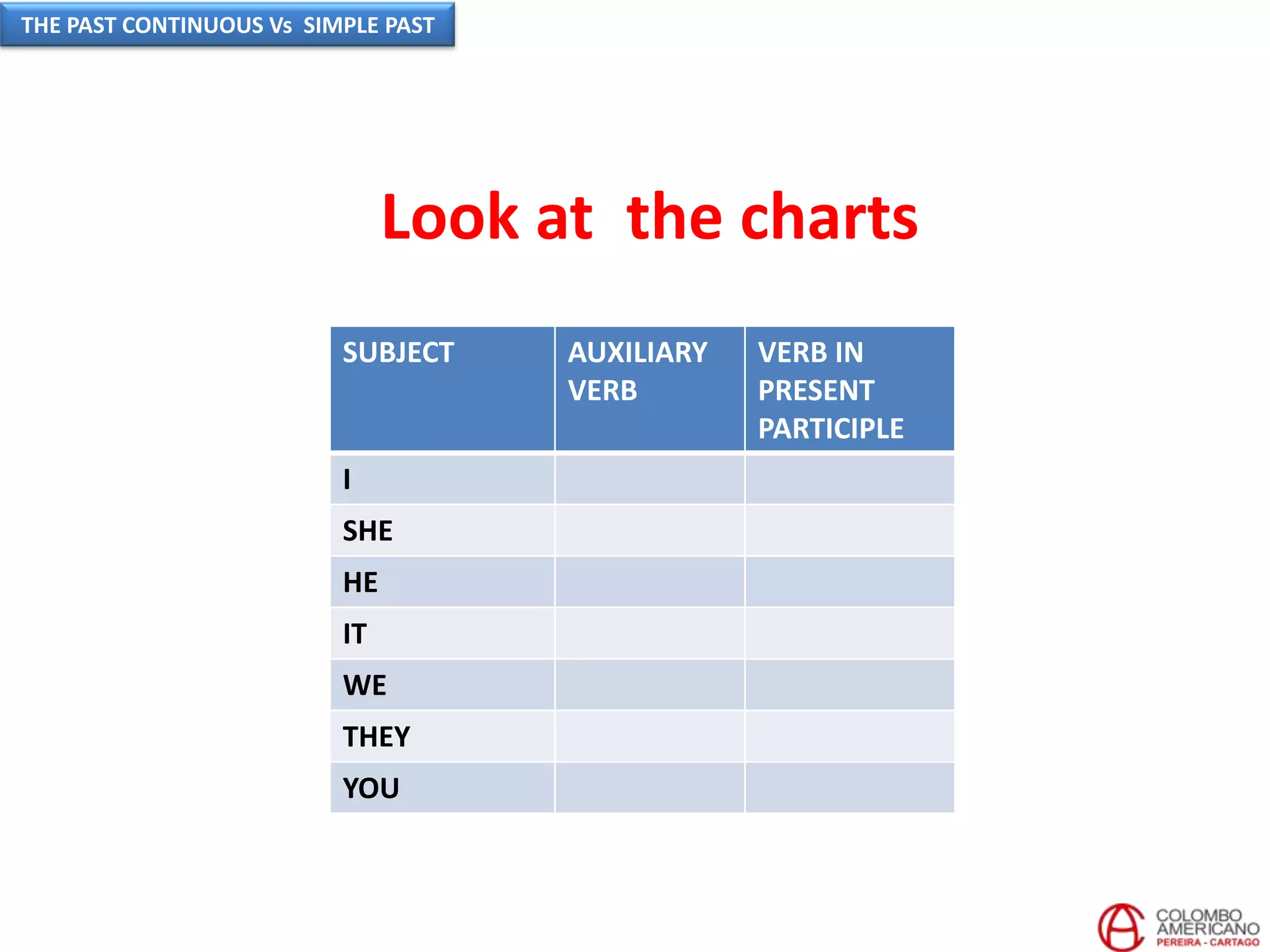
Look at the charts
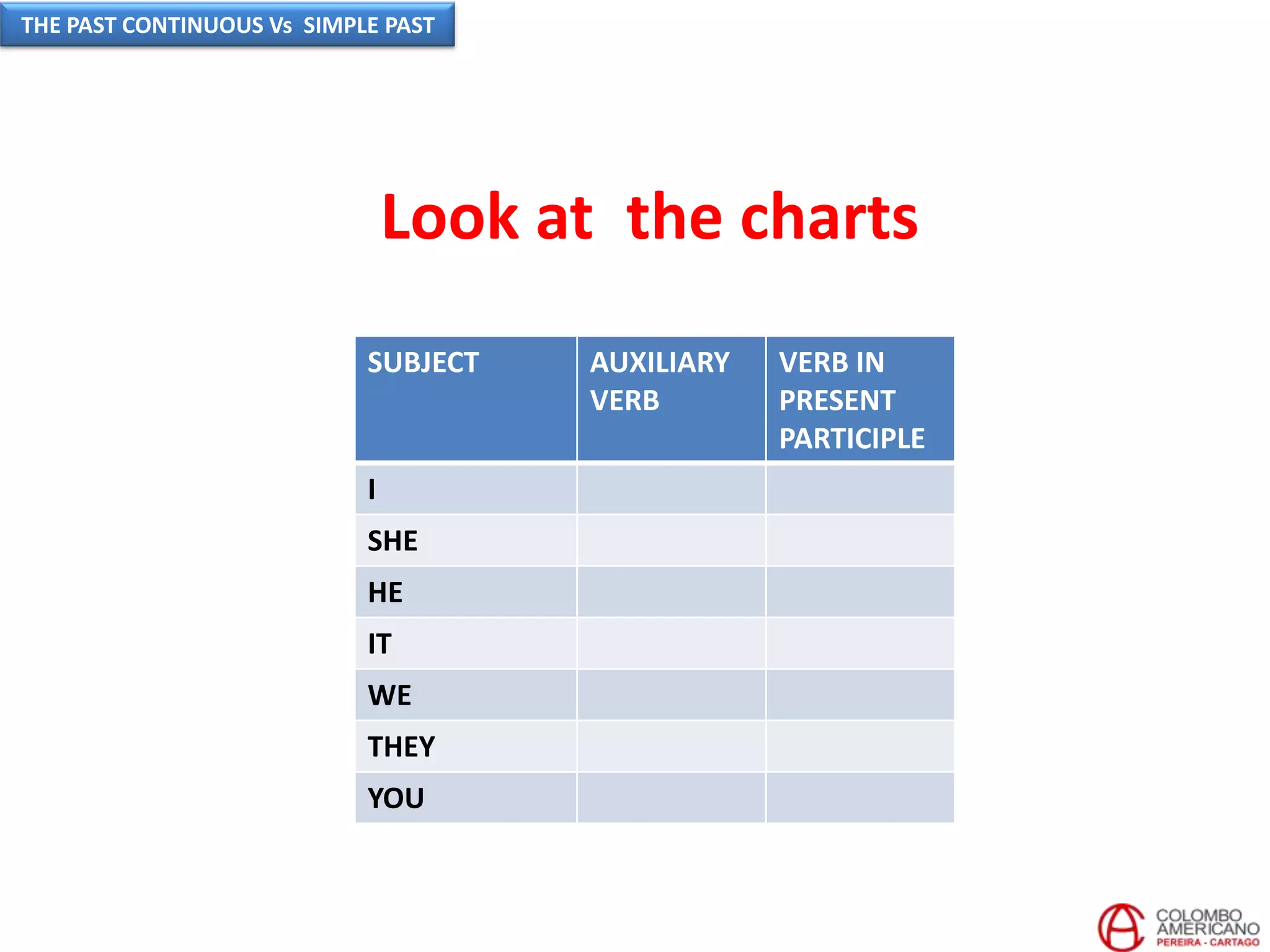
SUBJECT AUXILIARY
VERB
VERB IN
PRESENT
PARTICIPLE
I
SHE
HE
IT
WE
THEY
YOU
THE PAST CONTINUOUS Vs SIMPLE PAST
Look at the charts
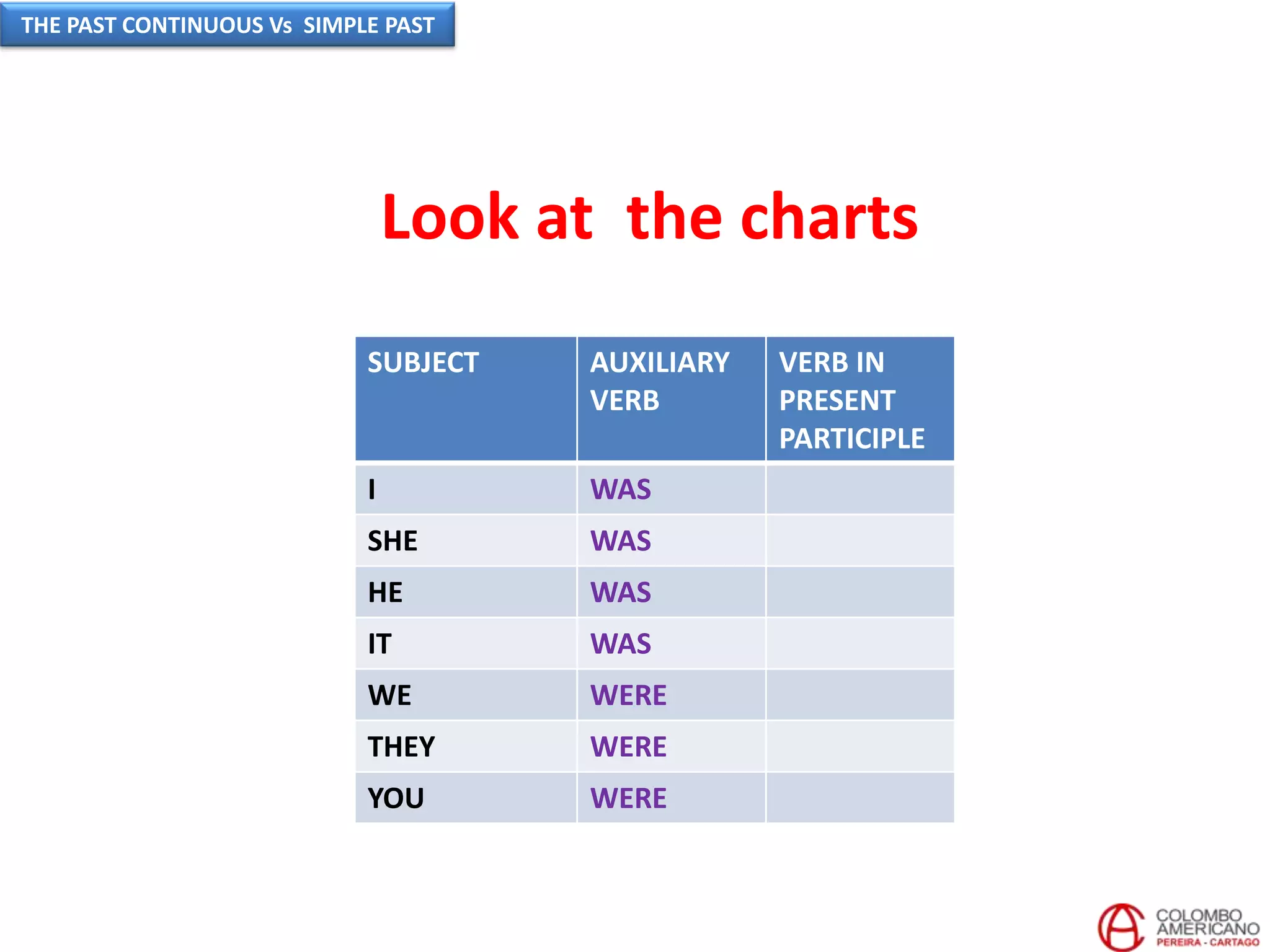
SUBJECT AUXILIARY
VERB
VERB IN
PRESENT
PARTICIPLE
I WAS
SHE WAS
HE WAS
IT WAS
WE WERE
THEY WERE
YOU WERE
THE PAST CONTINUOUS Vs SIMPLE PAST
Look at the charts
SUBJECT AUXILIARY
VERB
VERB IN
PRESENT
PARTICIPLE
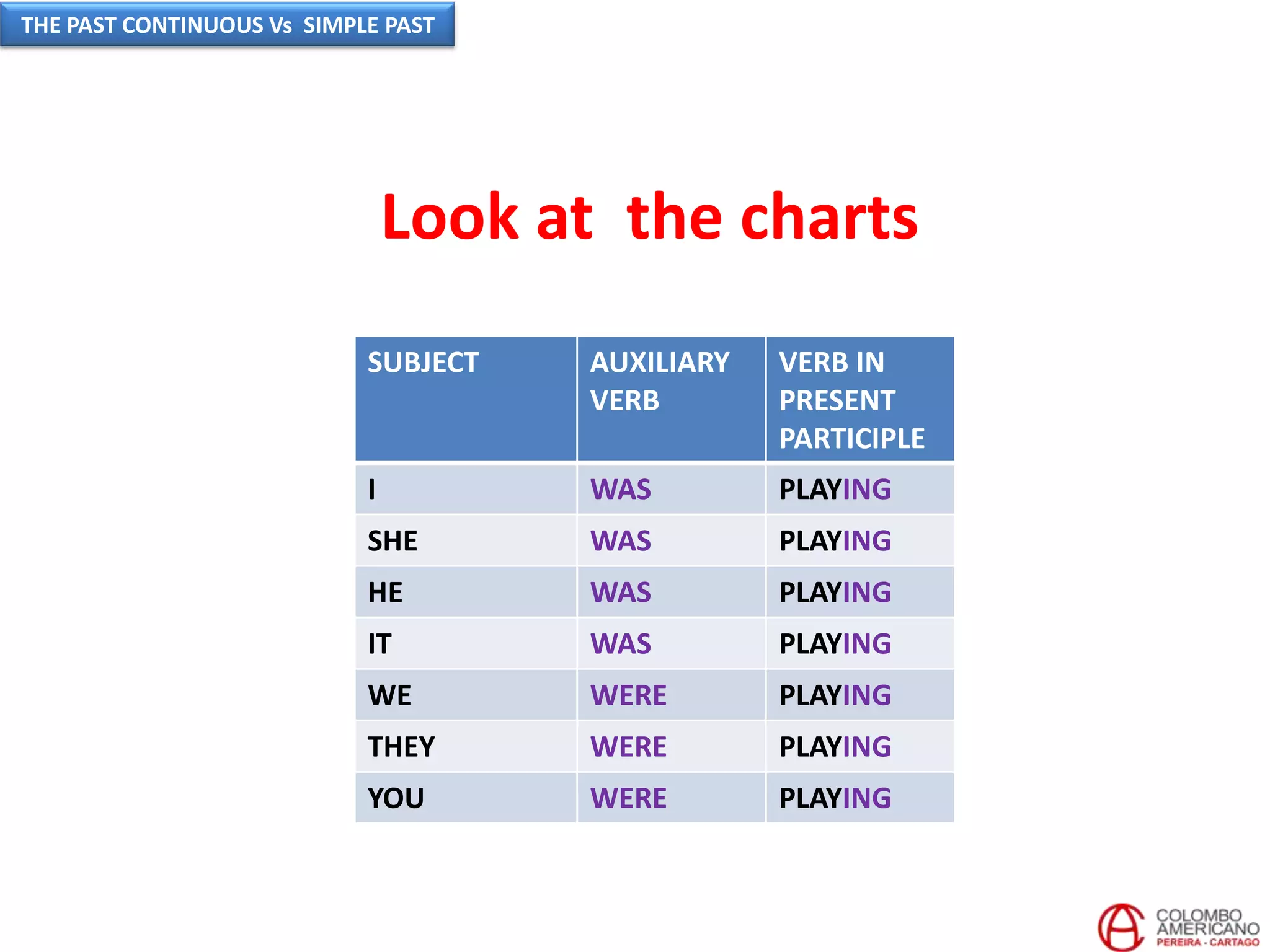
I WAS PLAYING
SHE WAS PLAYING
HE WAS PLAYING
IT WAS PLAYING
WE WERE PLAYING
THEY WERE PLAYING
YOU WERE PLAYING
THE PAST CONTINUOUS Vs SIMPLE PAST
Look at the charts
SUBJECT AUXILIARY
VERB
VERB IN
PRESENT
PARTICIPLE
THE PAST CONTINUOUS Vs SIMPLE PAST
Look at the charts
SUBJECT AUXILIARY
VERB
VERB IN
PRESENT
PARTICIPLE
I
SHE
HE
IT
WE
THEY
YOU
THE PAST CONTINUOUS Vs SIMPLE PAST
Look at the charts
SUBJECT AUXILIARY
VERB
VERB IN
PRESENT
PARTICIPLE
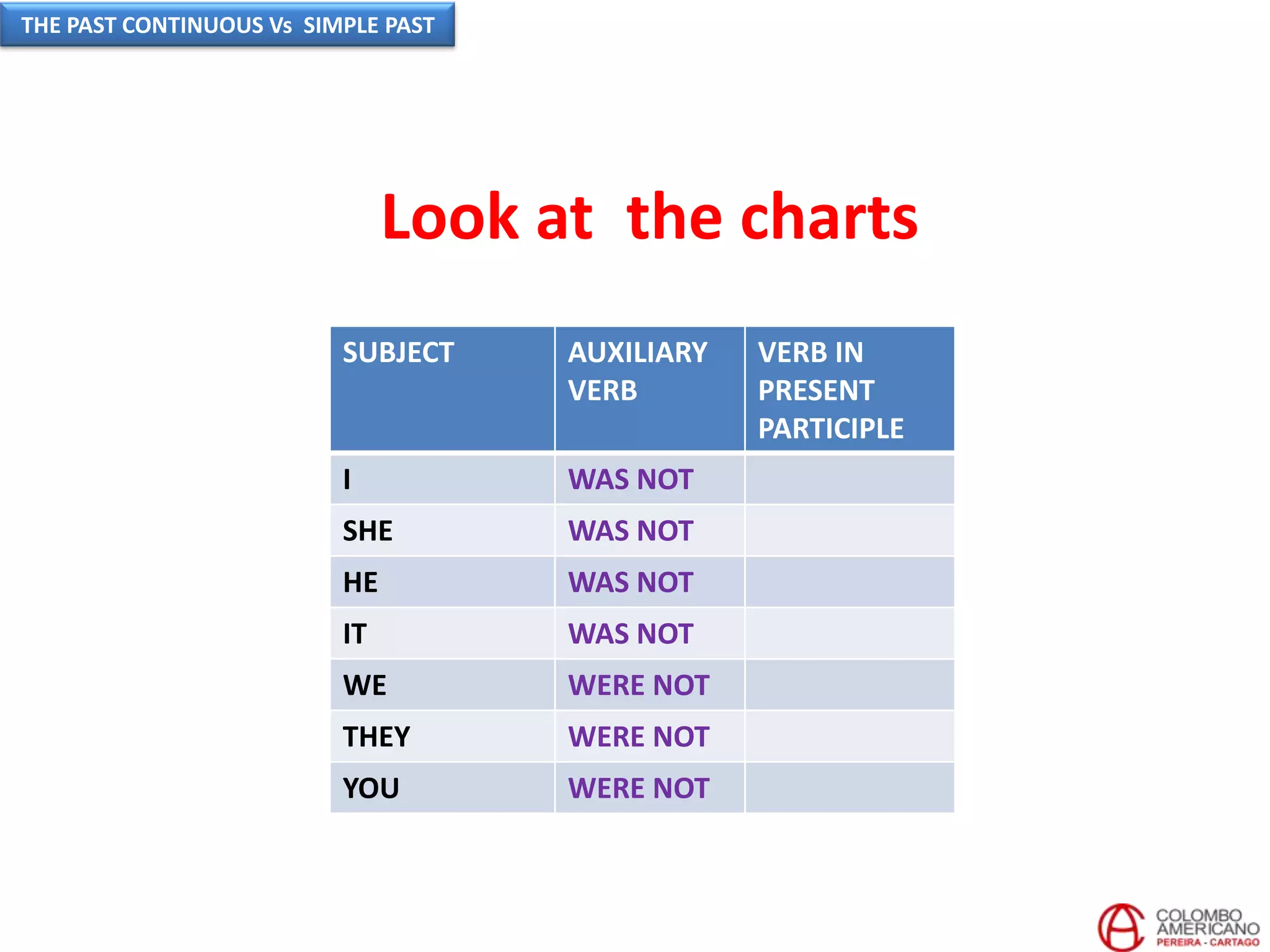
I WAS NOT
SHE WAS NOT
HE WAS NOT
IT WAS NOT
WE WERE NOT
THEY WERE NOT
YOU WERE NOT
THE PAST CONTINUOUS Vs SIMPLE PAST
Look at the charts
SUBJECT AUXILIARY
VERB
VERB IN
PRESENT
PARTICIPLE
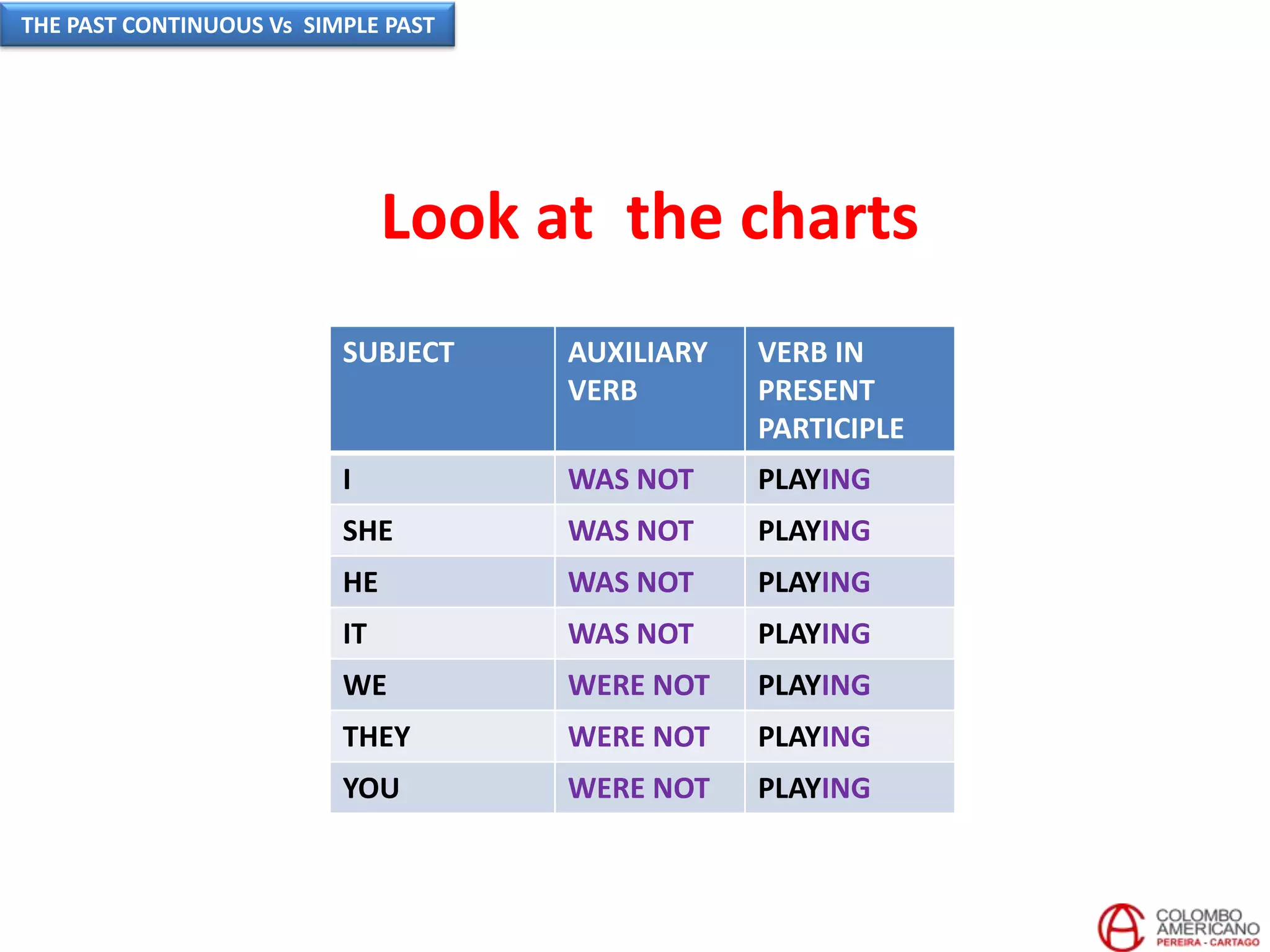
I WAS NOT PLAYING
SHE WAS NOT PLAYING
HE WAS NOT PLAYING
IT WAS NOT PLAYING
WE WERE NOT PLAYING
THEY WERE NOT PLAYING
YOU WERE NOT PLAYING
THE PAST CONTINUOUS Vs SIMPLE PAST
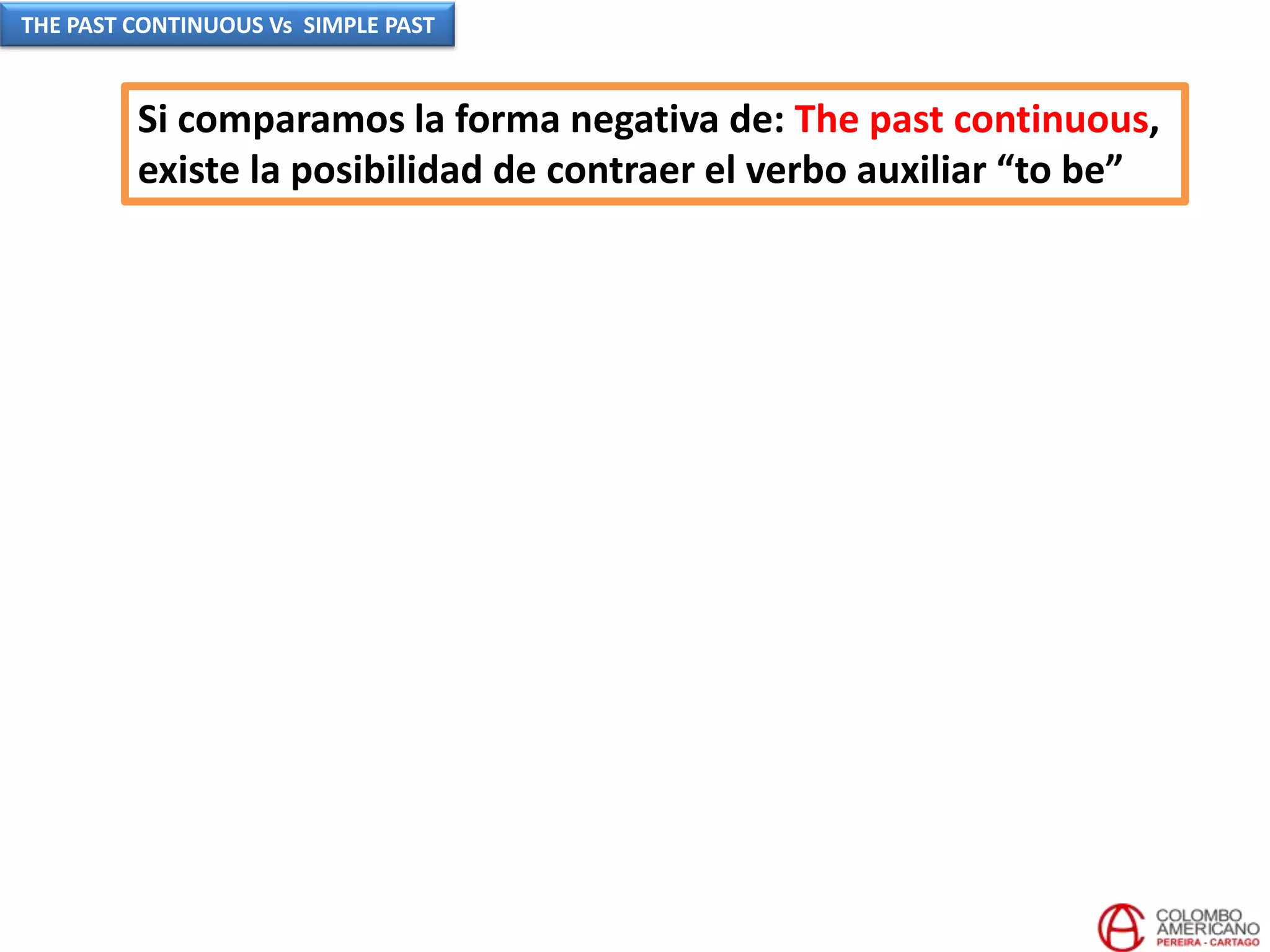
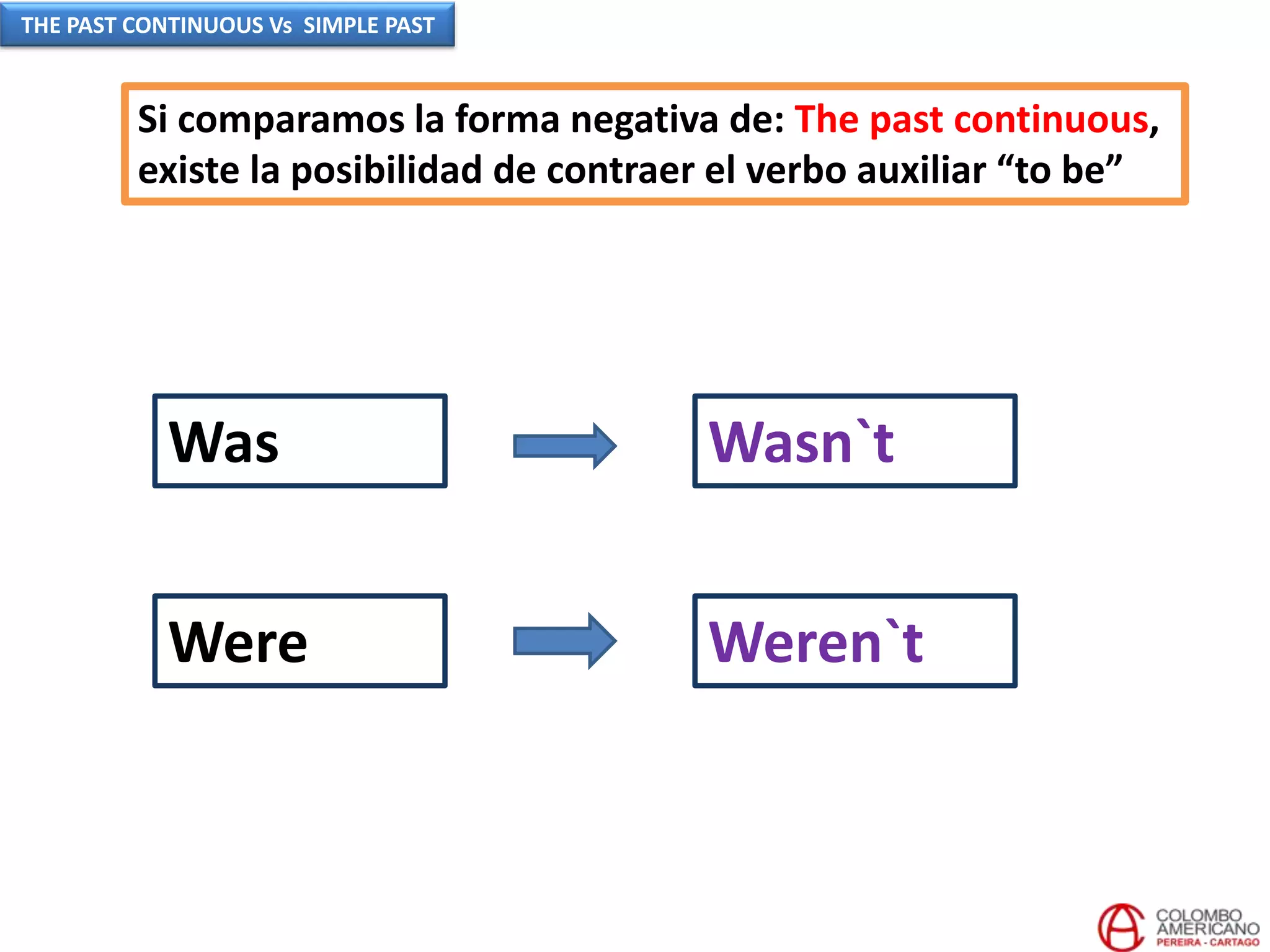
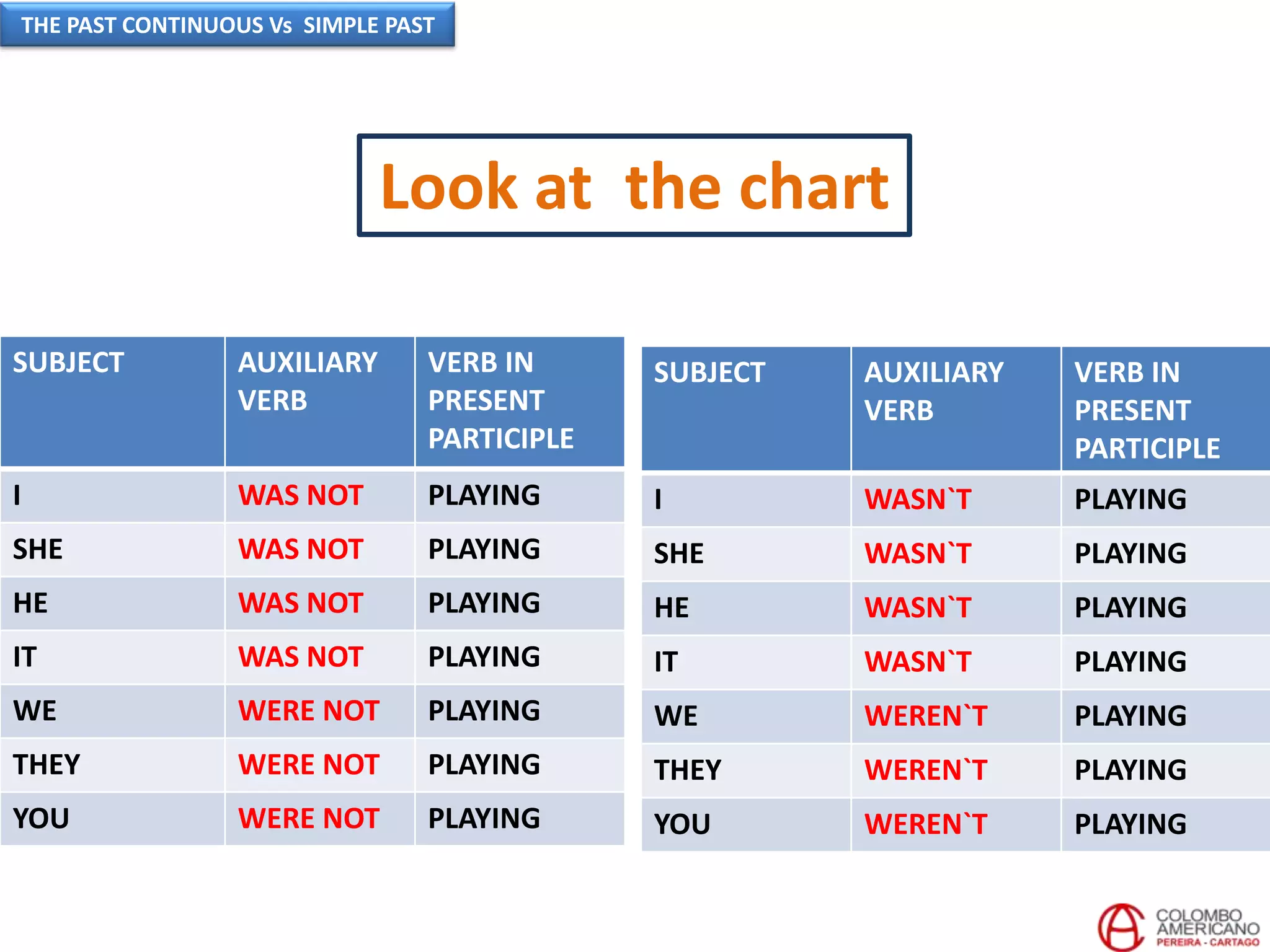
Si comparamos la forma negativa de: The past continuous,
existe la posibilidad de contraer el verbo auxiliar “to be”
THE PAST CONTINUOUS Vs SIMPLE PAST
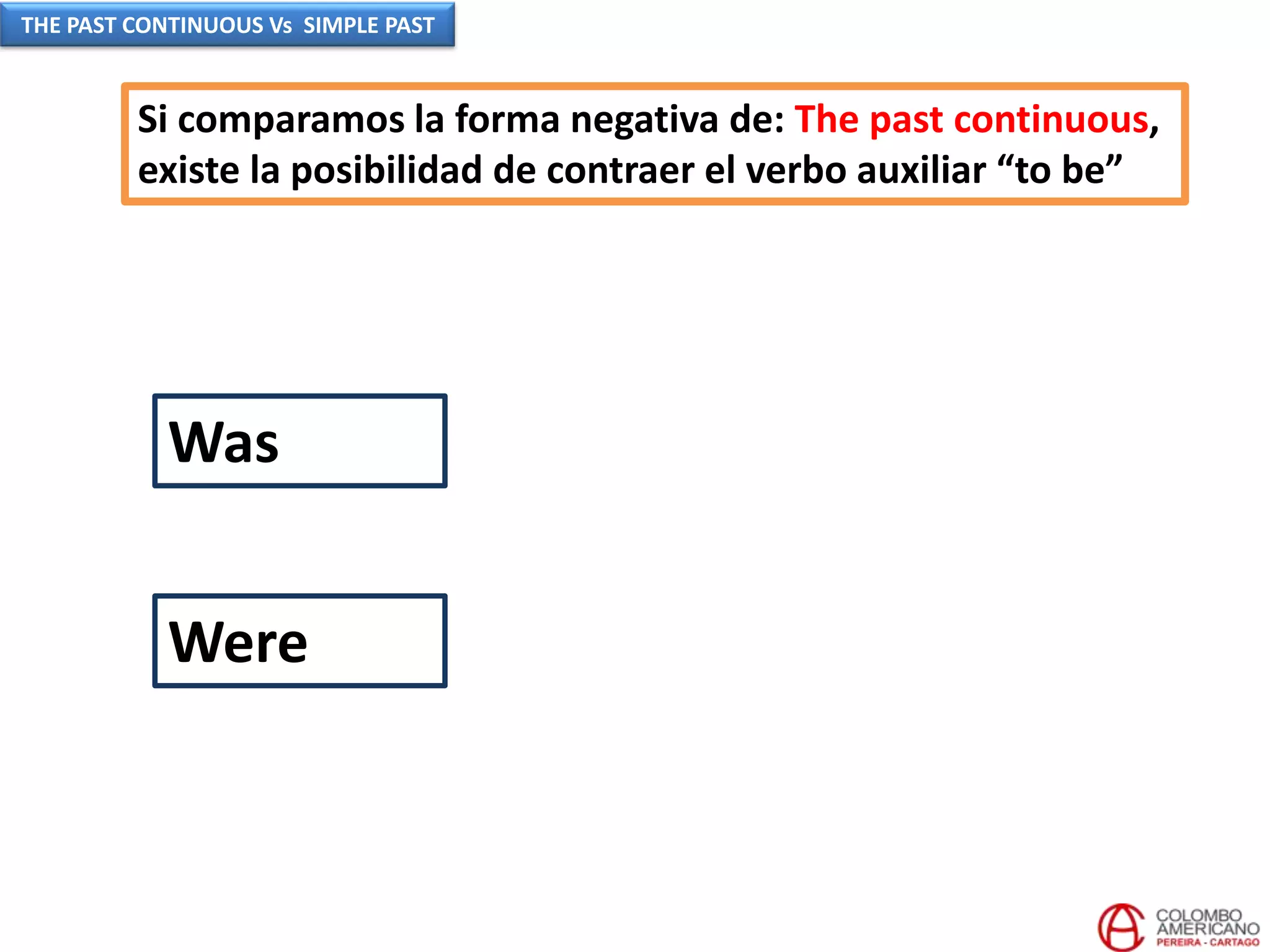
Was
Were
Si comparamos la forma negativa de: The past continuous,
existe la posibilidad de contraer el verbo auxiliar “to be”
THE PAST CONTINUOUS Vs SIMPLE PAST
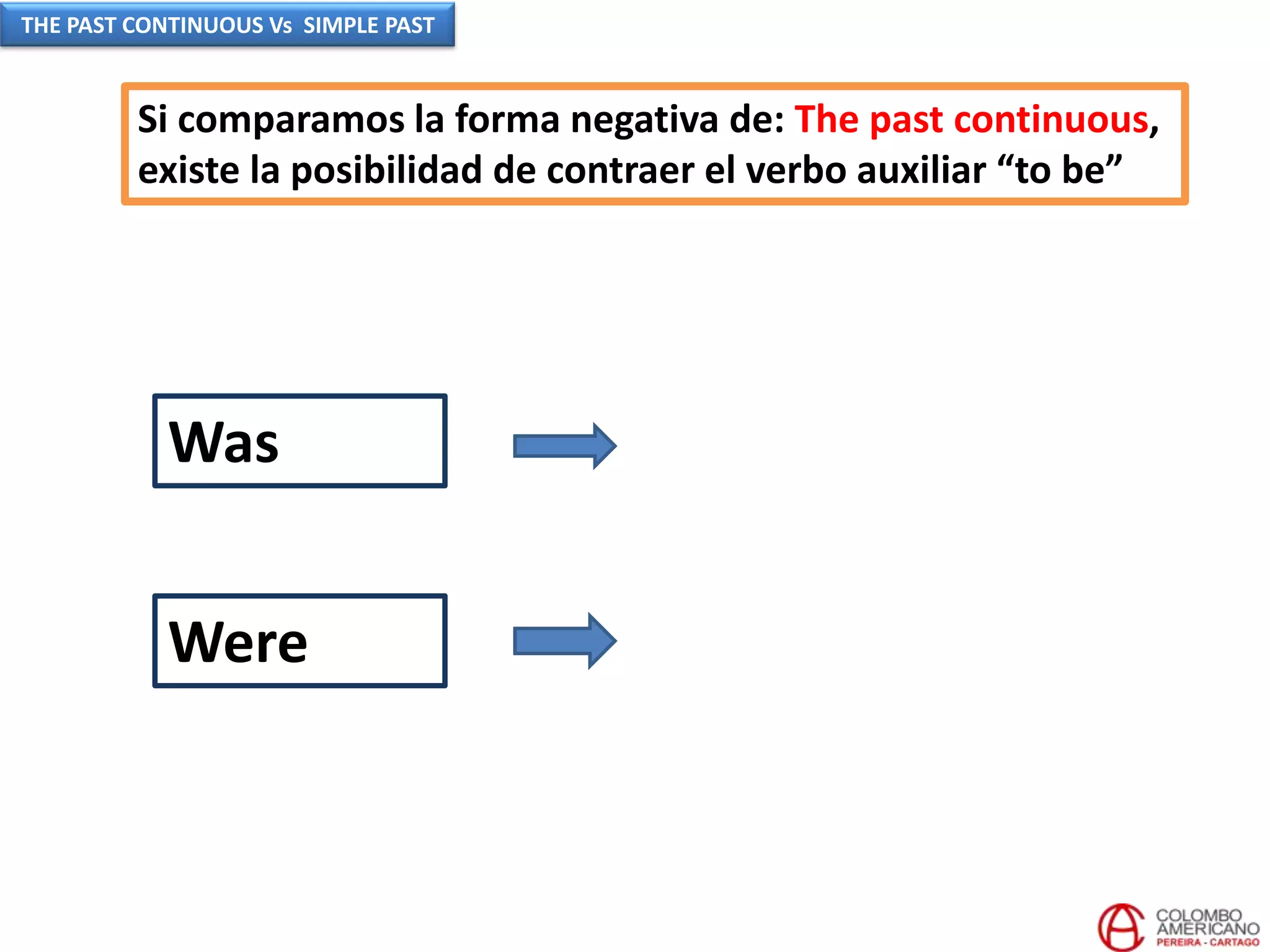
Was
Were
Si comparamos la forma negativa de: The past continuous,
existe la posibilidad de contraer el verbo auxiliar “to be”
THE PAST CONTINUOUS Vs SIMPLE PAST
Was Wasn`t
Were Weren`t
Si comparamos la forma negativa de: The past continuous,
existe la posibilidad de contraer el verbo auxiliar “to be”
THE PAST CONTINUOUS Vs SIMPLE PAST
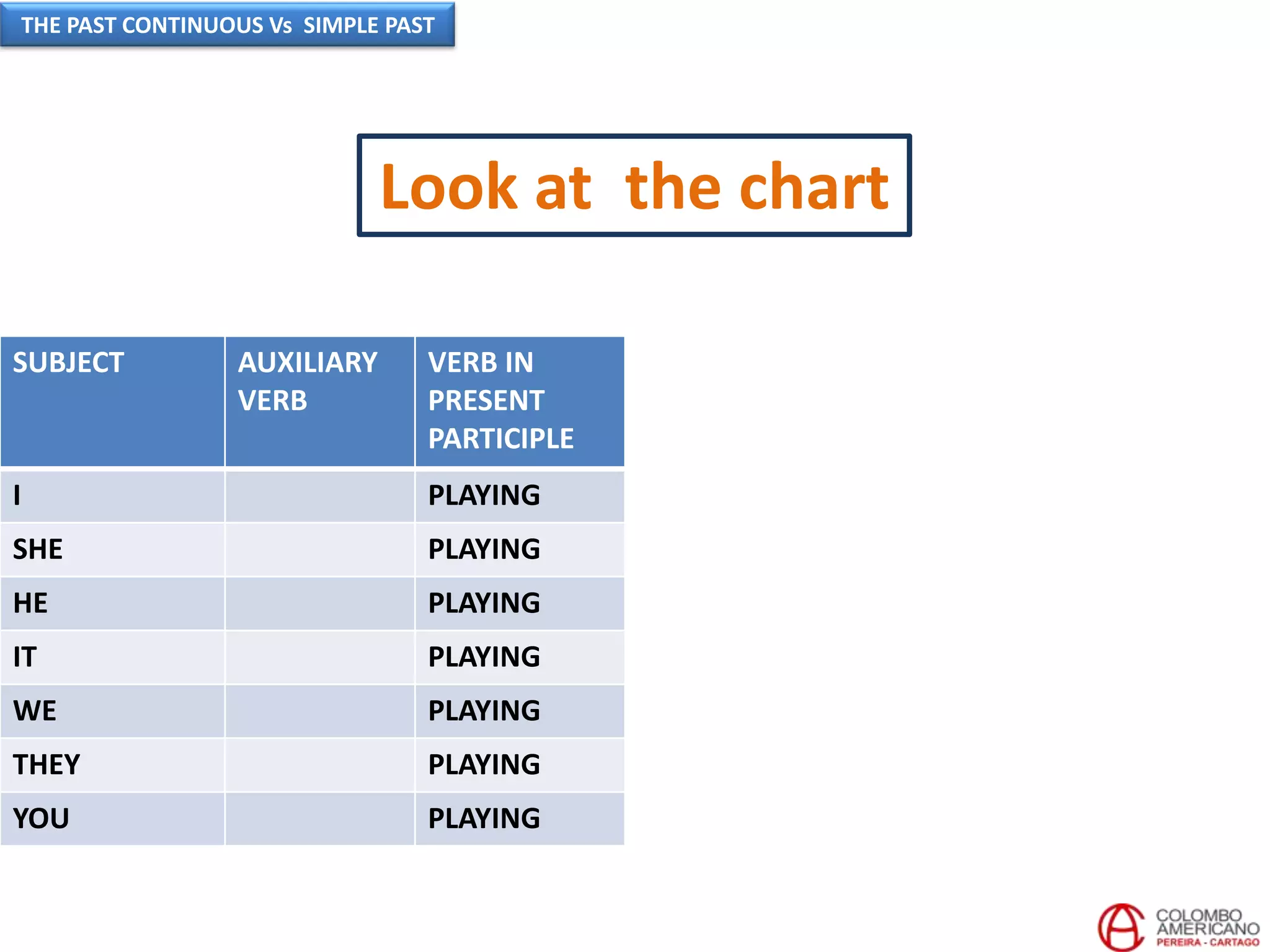
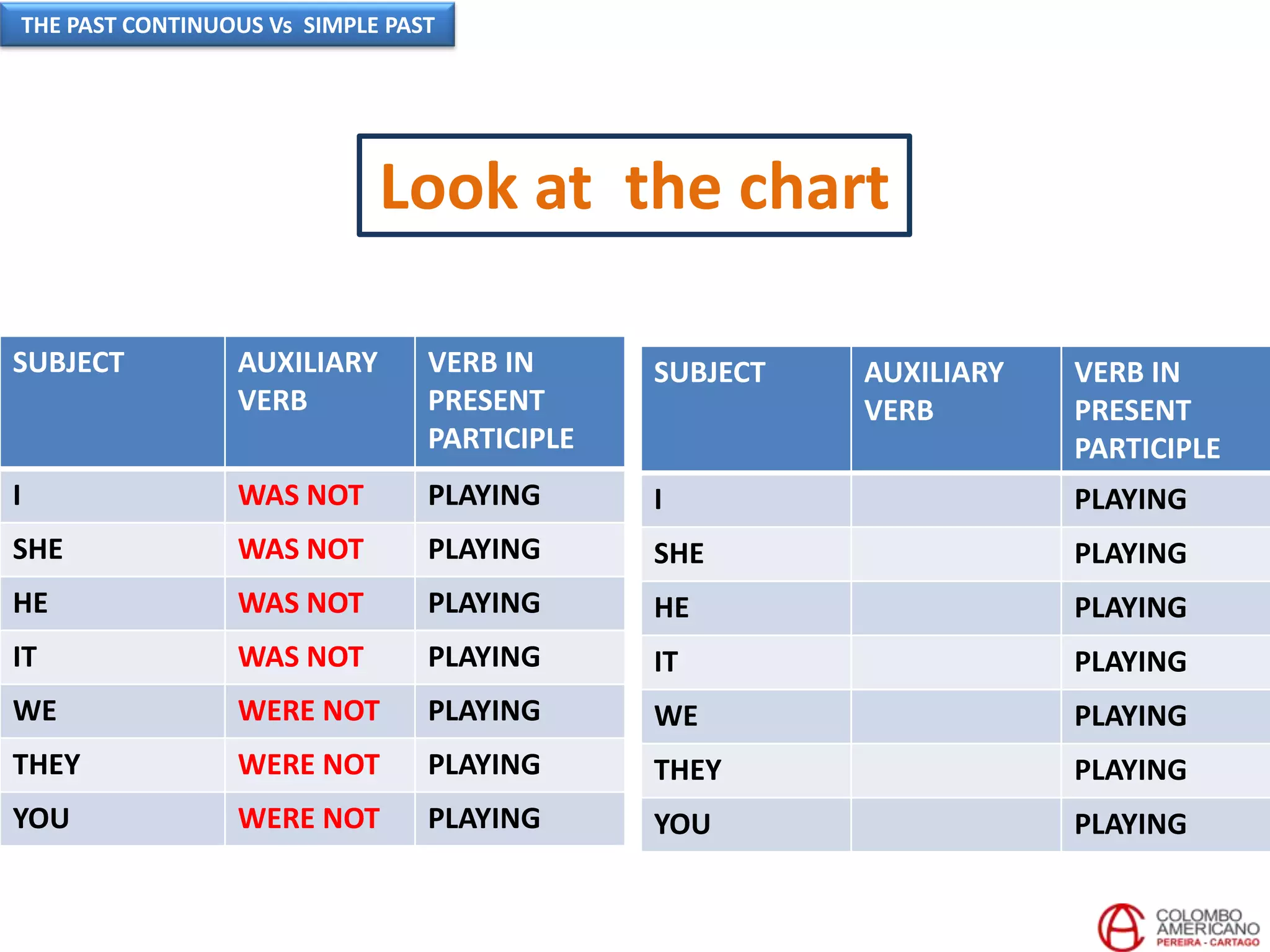
Look at the chart
SUBJECT AUXILIARY
VERB
VERB IN
PRESENT
PARTICIPLE
I PLAYING
SHE PLAYING
HE PLAYING
IT PLAYING
WE PLAYING
THEY PLAYING
YOU PLAYING
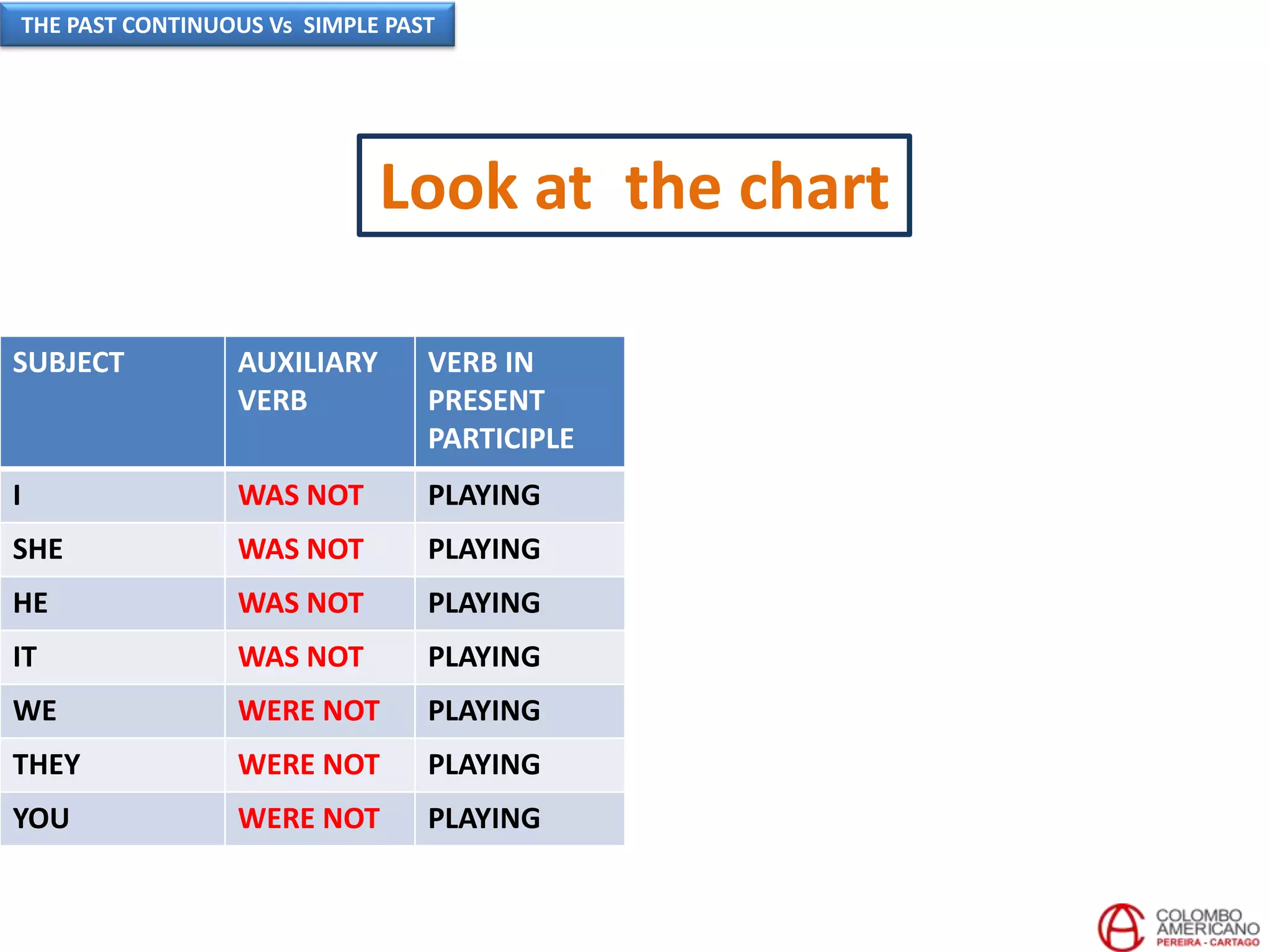
THE PAST CONTINUOUS Vs SIMPLE PAST
Look at the chart
SUBJECT AUXILIARY
VERB
VERB IN
PRESENT
PARTICIPLE
I WAS NOT PLAYING
SHE WAS NOT PLAYING
HE WAS NOT PLAYING
IT WAS NOT PLAYING
WE WERE NOT PLAYING
THEY WERE NOT PLAYING
YOU WERE NOT PLAYING
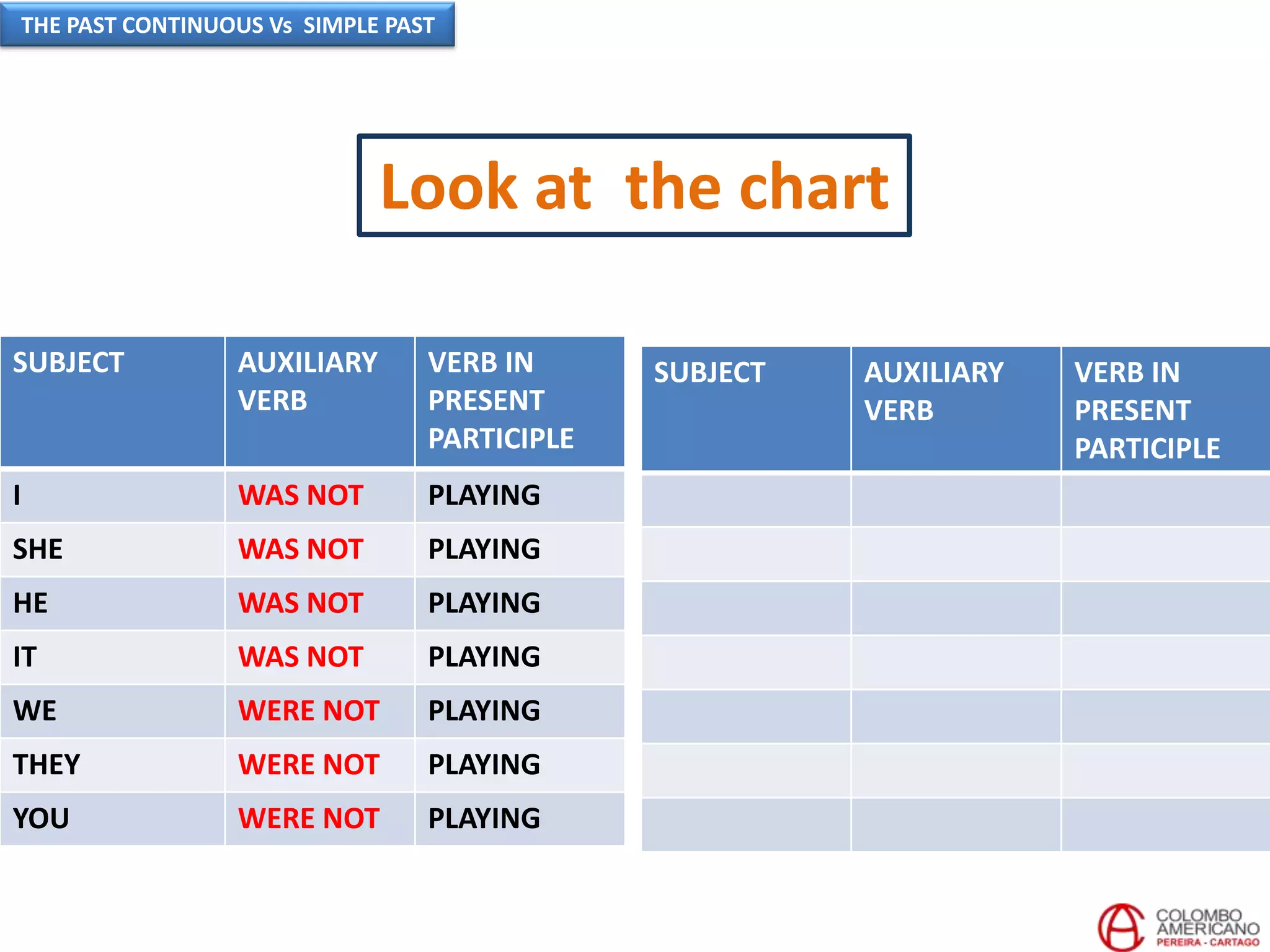
THE PAST CONTINUOUS Vs SIMPLE PAST
Look at the chart
SUBJECT AUXILIARY
VERB
VERB IN
PRESENT
PARTICIPLE
I WAS NOT PLAYING
SHE WAS NOT PLAYING
HE WAS NOT PLAYING
IT WAS NOT PLAYING
WE WERE NOT PLAYING
THEY WERE NOT PLAYING
YOU WERE NOT PLAYING
SUBJECT AUXILIARY
VERB
VERB IN
PRESENT
PARTICIPLE
THE PAST CONTINUOUS Vs SIMPLE PAST
Look at the chart
SUBJECT AUXILIARY
VERB
VERB IN
PRESENT
PARTICIPLE
I WAS NOT PLAYING
SHE WAS NOT PLAYING
HE WAS NOT PLAYING
IT WAS NOT PLAYING
WE WERE NOT PLAYING
THEY WERE NOT PLAYING
YOU WERE NOT PLAYING
SUBJECT AUXILIARY
VERB
VERB IN
PRESENT
PARTICIPLE
I PLAYING
SHE PLAYING
HE PLAYING
IT PLAYING
WE PLAYING
THEY PLAYING
YOU PLAYING
THE PAST CONTINUOUS Vs SIMPLE PAST
Look at the chart
SUBJECT AUXILIARY
VERB
VERB IN
PRESENT
PARTICIPLE
I WAS NOT PLAYING
SHE WAS NOT PLAYING
HE WAS NOT PLAYING
IT WAS NOT PLAYING
WE WERE NOT PLAYING
THEY WERE NOT PLAYING
YOU WERE NOT PLAYING
SUBJECT AUXILIARY
VERB
VERB IN
PRESENT
PARTICIPLE
I WASN`T PLAYING
SHE WASN`T PLAYING
HE WASN`T PLAYING
IT WASN`T PLAYING
WE WEREN`T PLAYING
THEY WEREN`T PLAYING
YOU WEREN`T PLAYING
THE PAST CONTINUOUS Vs SIMPLE PAST
Let`s combine the simple past tense and
the past continuous
THE PAST CONTINUOUS Vs SIMPLE PAST
Let`s combine the simple past tense and
the past continuous
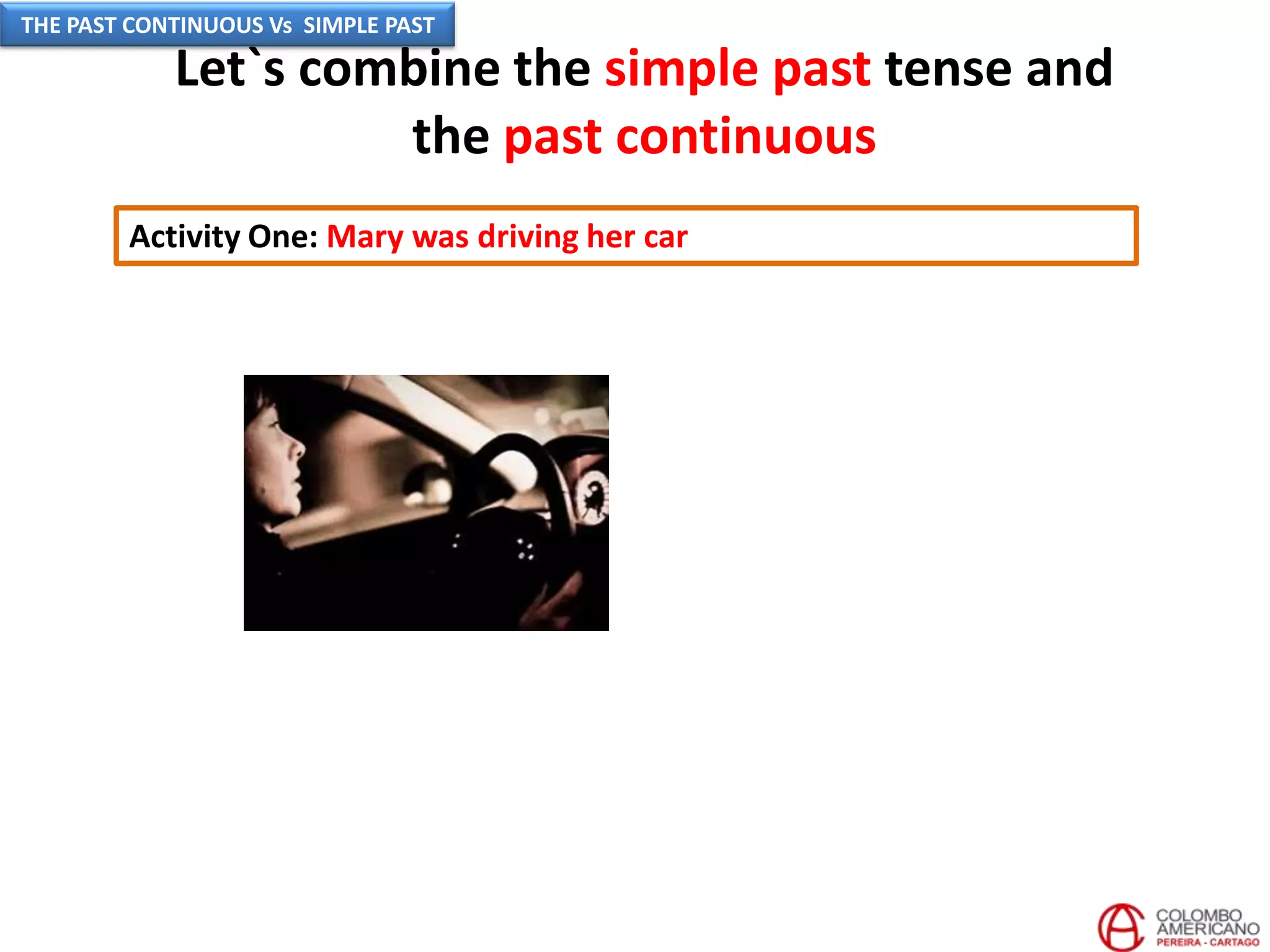
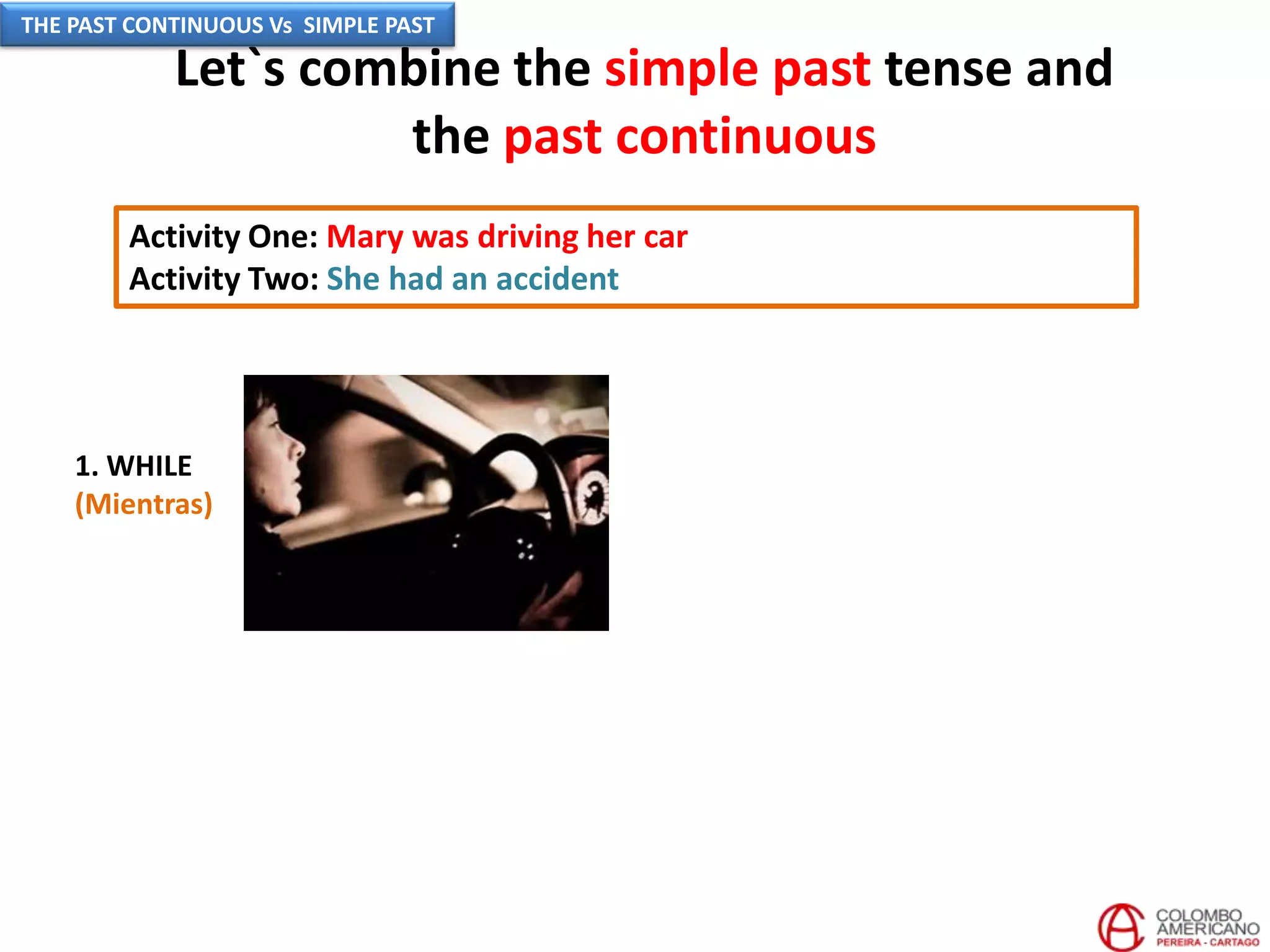
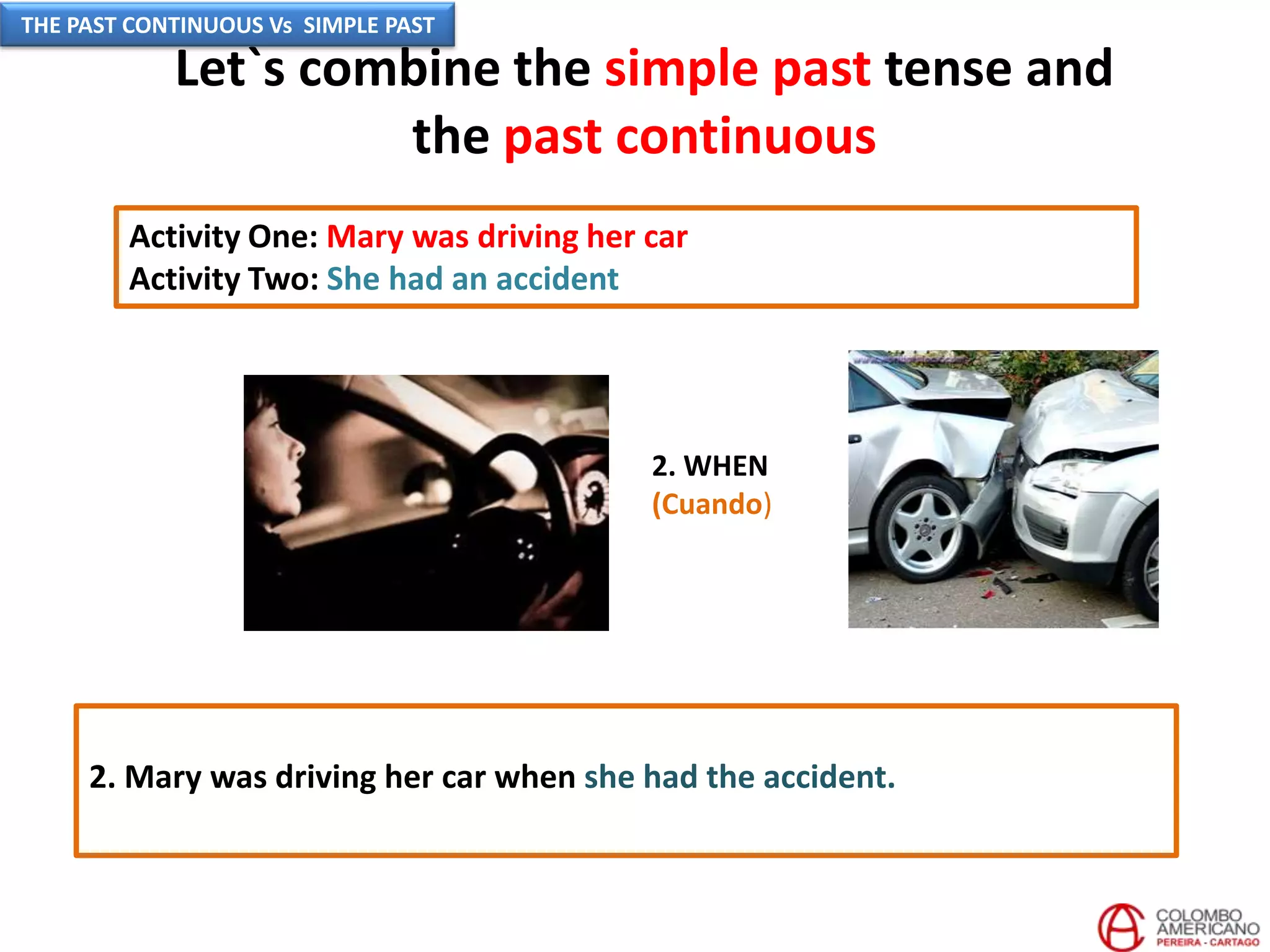
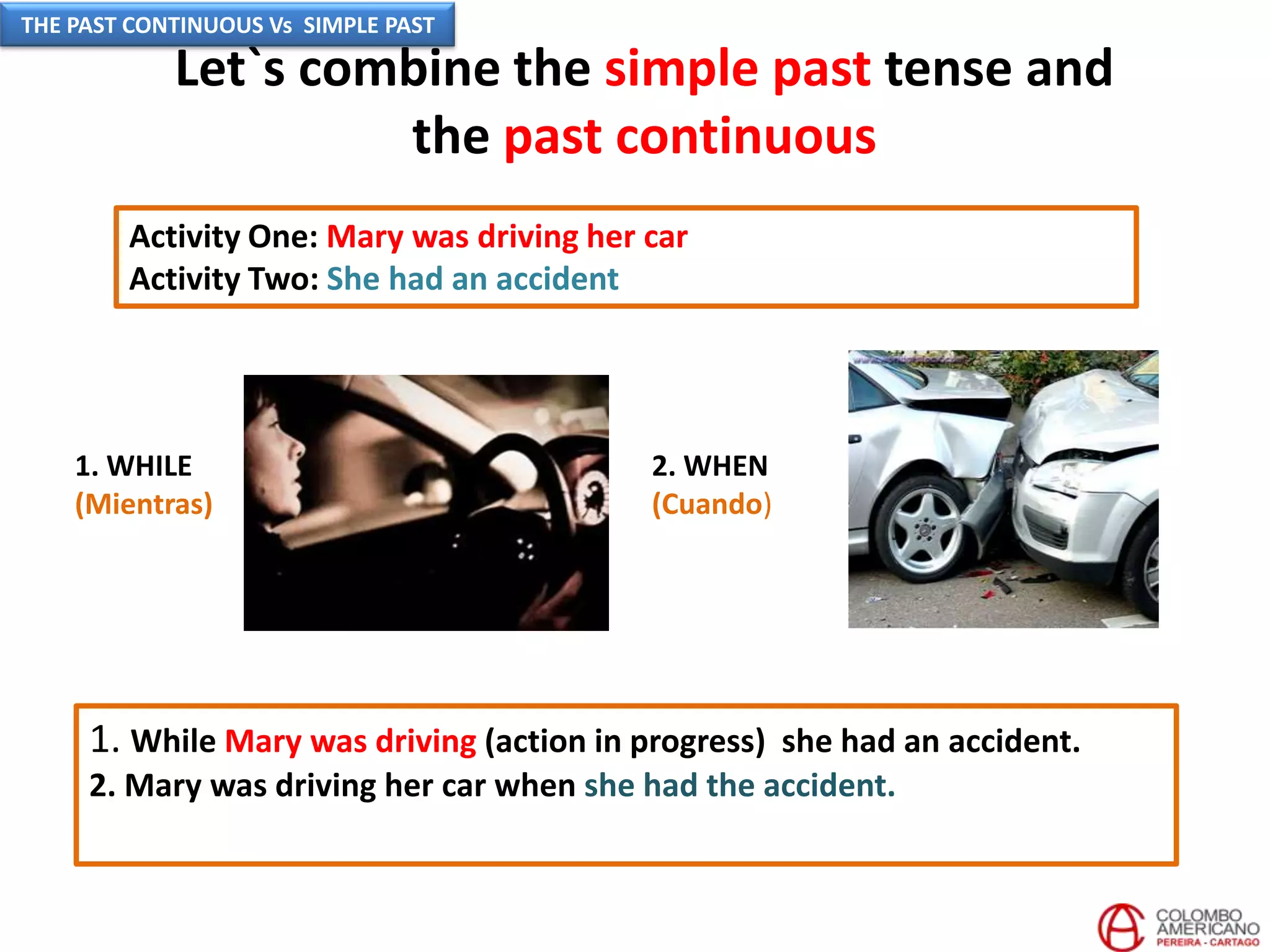
Activity One: Mary was driving her car
THE PAST CONTINUOUS Vs SIMPLE PAST
Let`s combine the simple past tense and
the past continuous
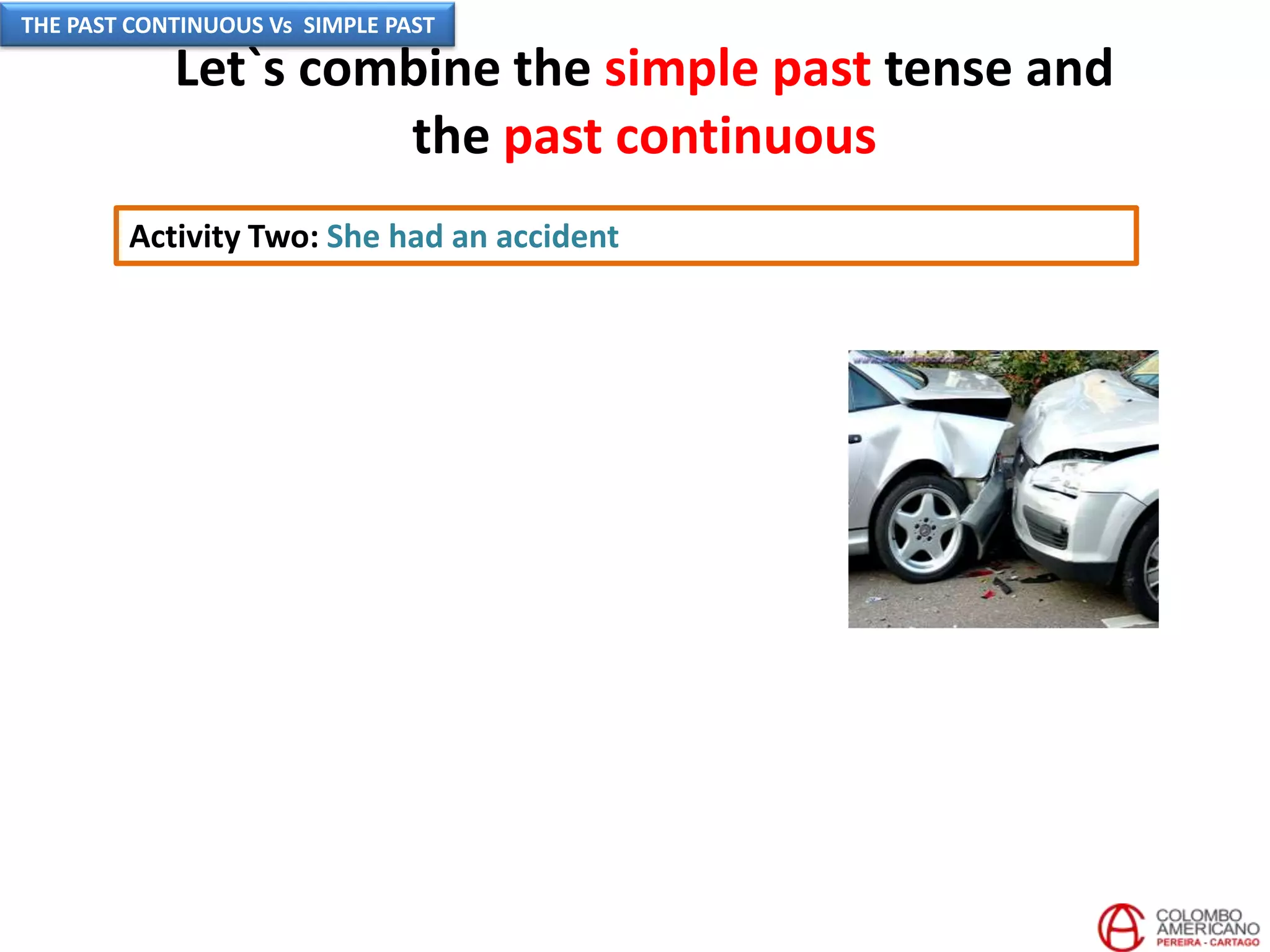
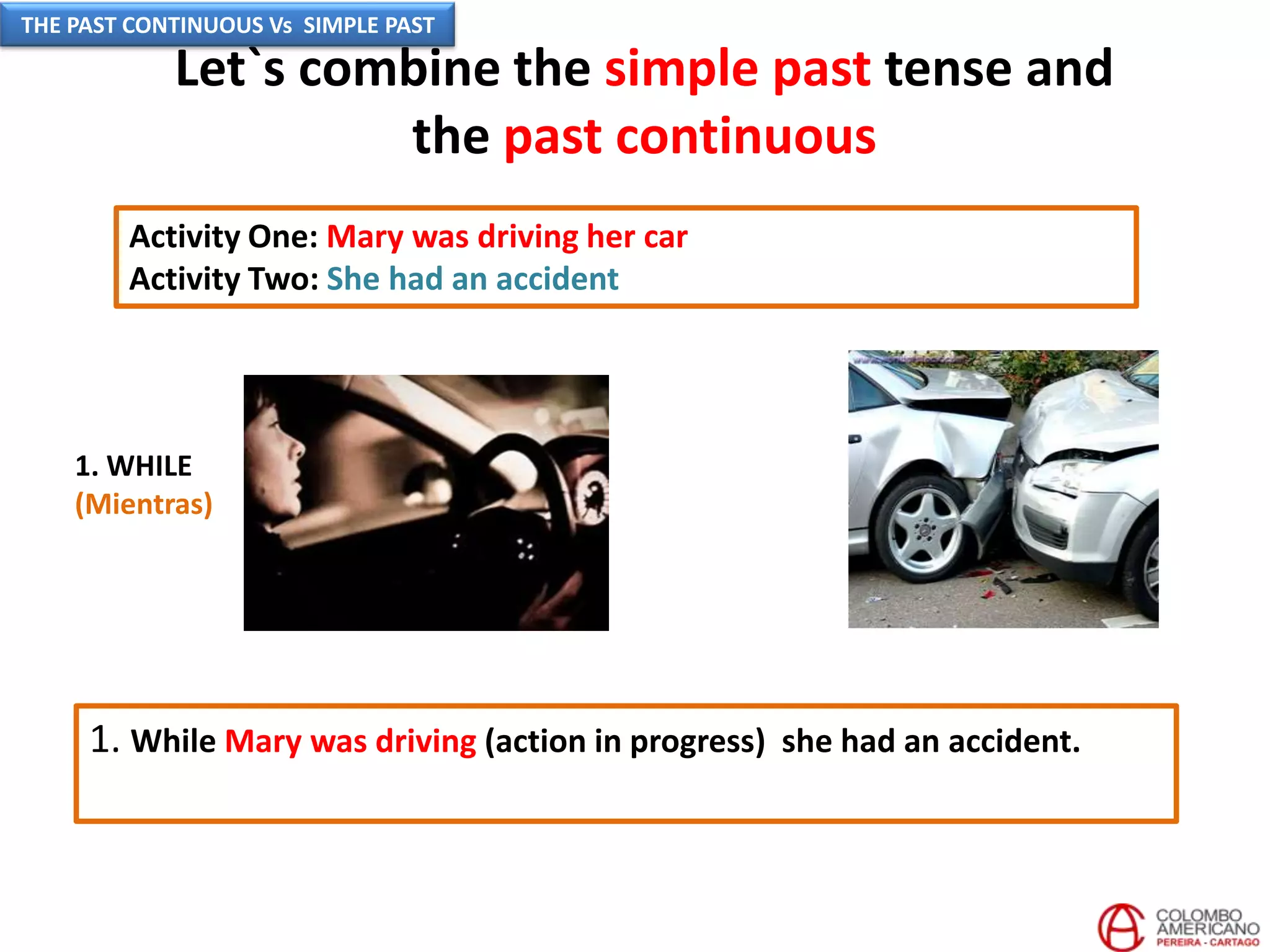
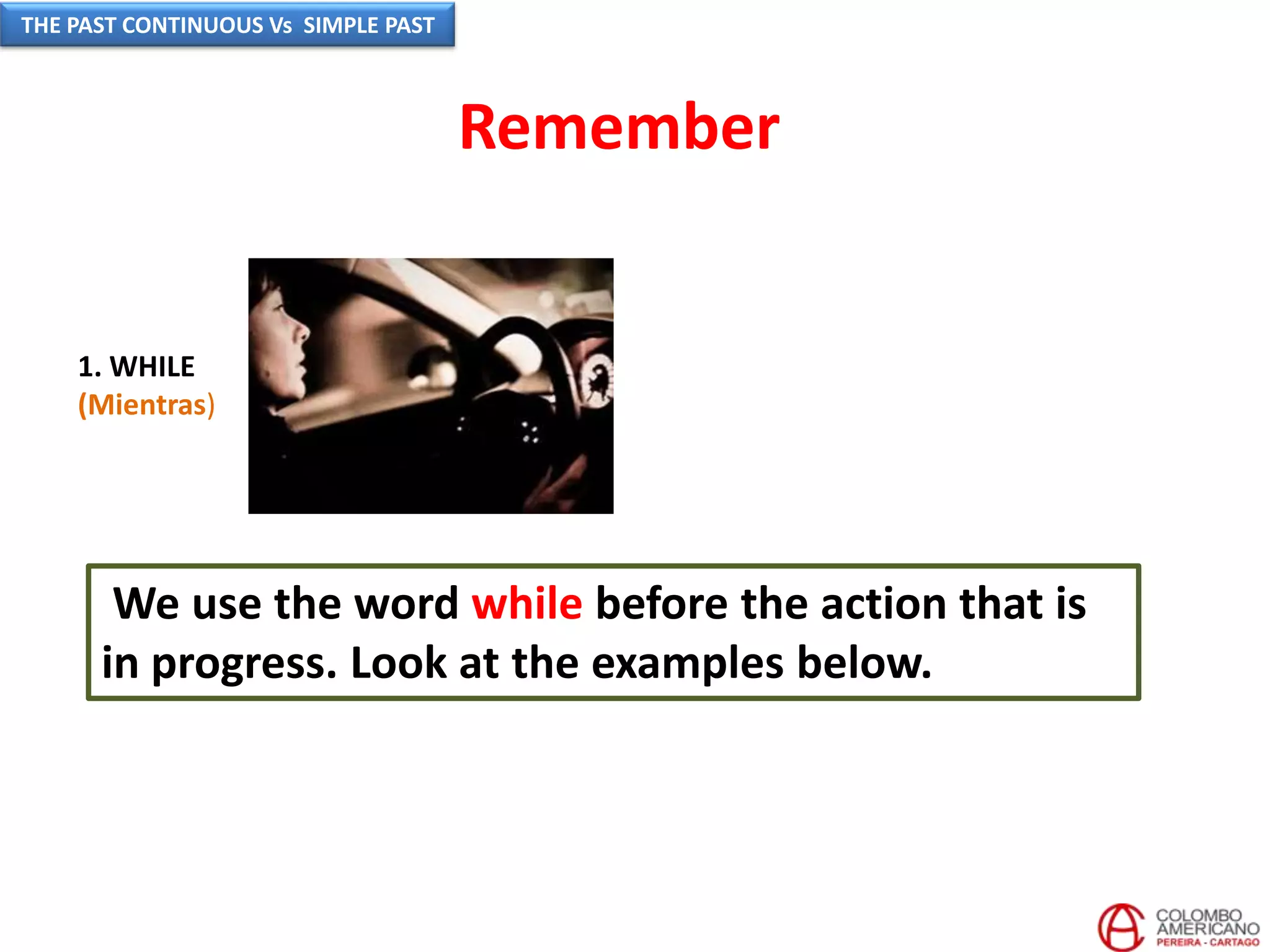
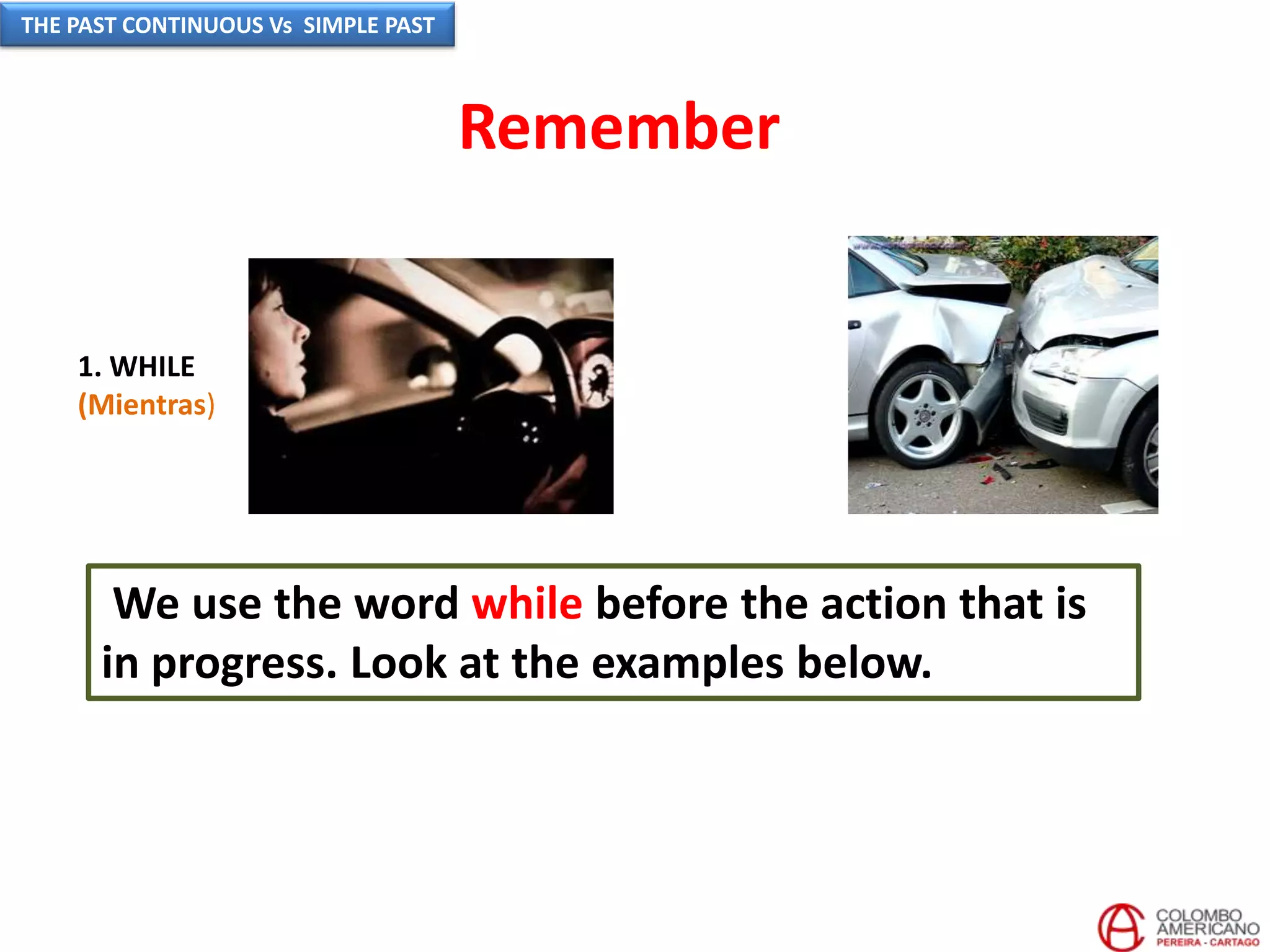
Activity Two: She had an accident
THE PAST CONTINUOUS Vs SIMPLE PAST
Let`s combine the simple past tense and
the past continuous
Activity One: Mary was driving her car
Activity Two: She had an accident
1. WHILE
(Mientras)
THE PAST CONTINUOUS Vs SIMPLE PAST
Let`s combine the simple past tense and
the past continuous
Activity One: Mary was driving her car
Activity Two: She had an accident
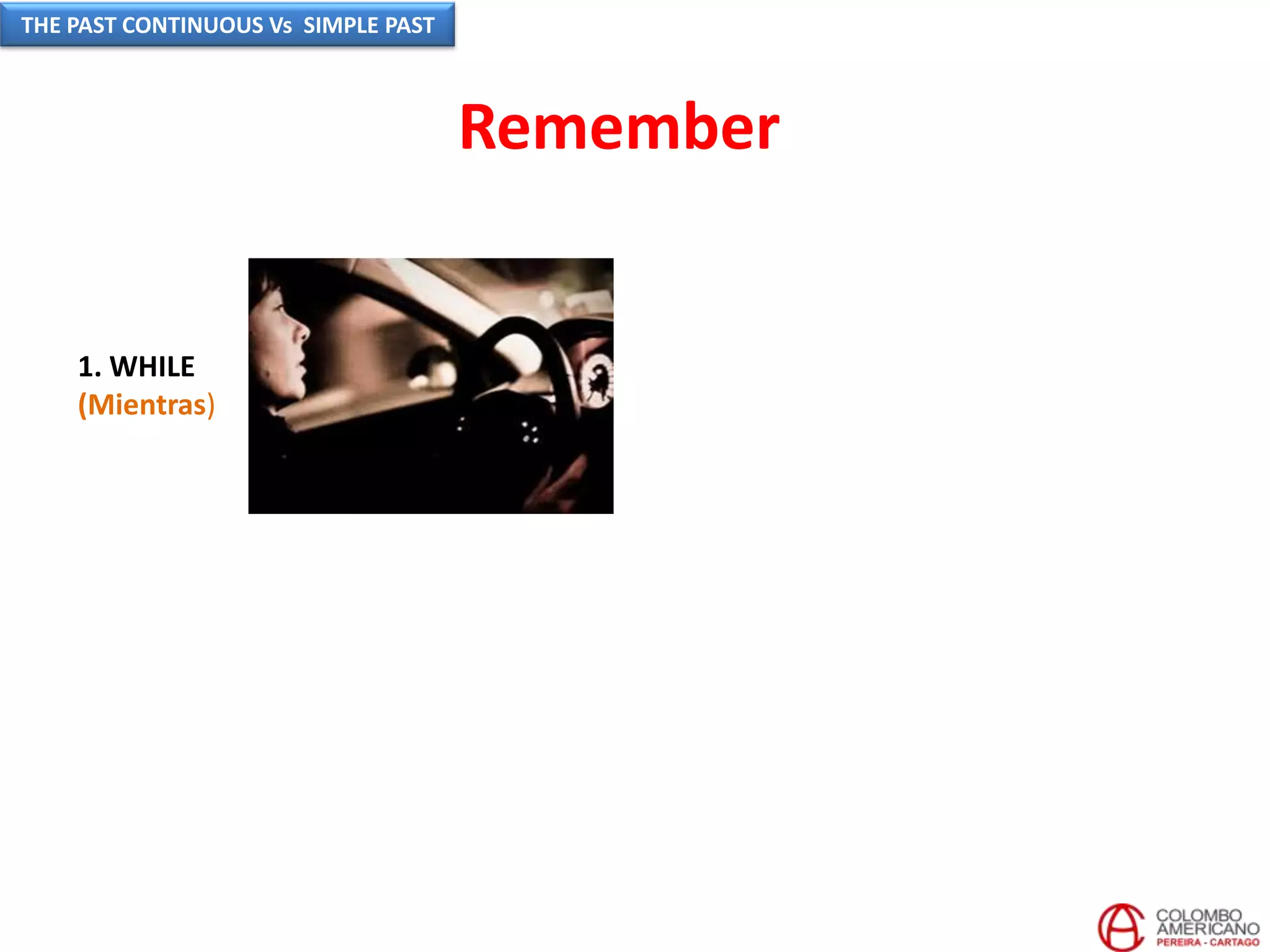
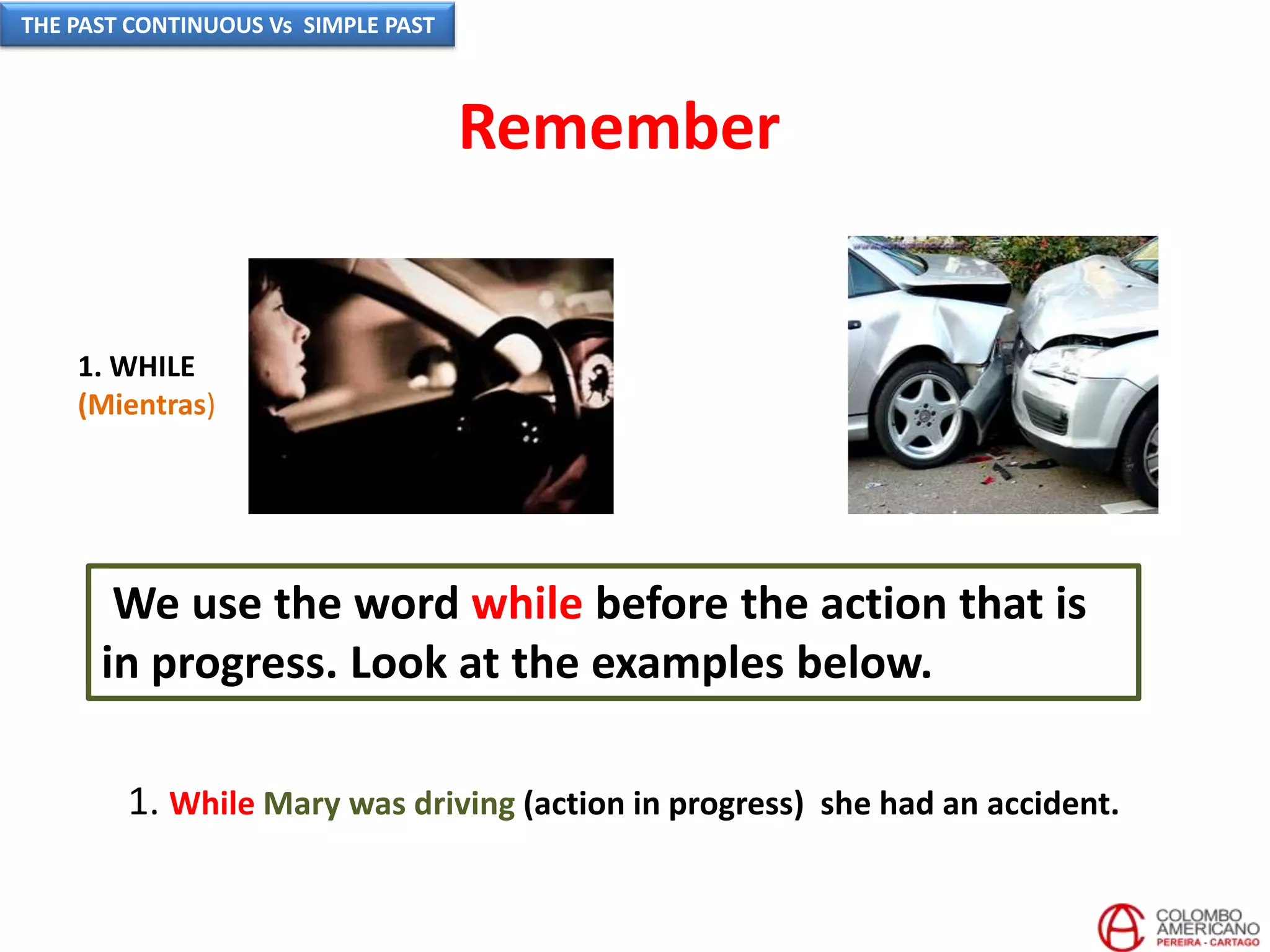
1. While Mary was driving (action in progress) she had an accident.
1. WHILE
(Mientras)
THE PAST CONTINUOUS Vs SIMPLE PAST
Let`s combine the simple past tense and
the past continuous
Activity One: Mary was driving her car
Activity Two: She had an accident
2. WHEN
(Cuando)
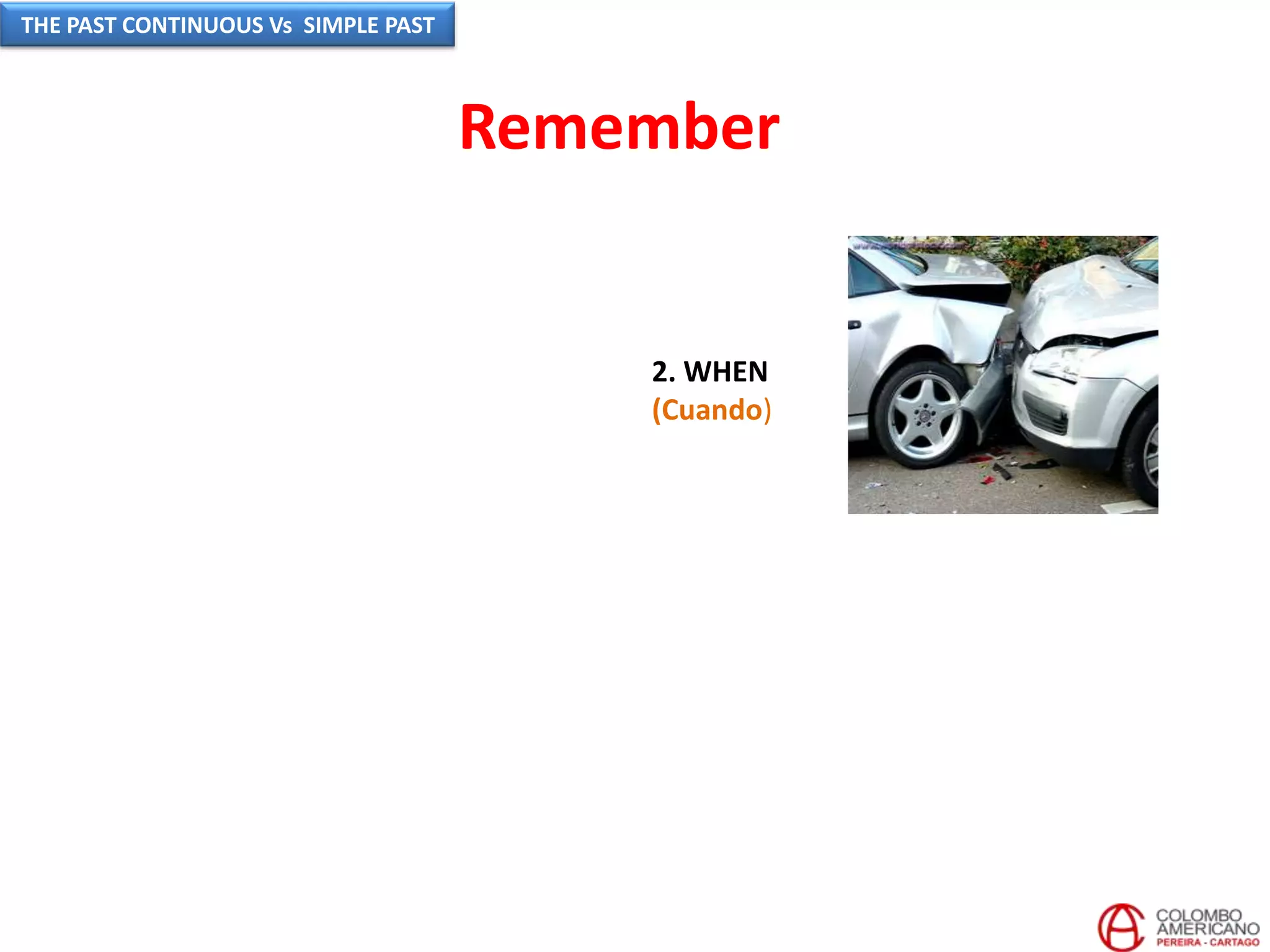
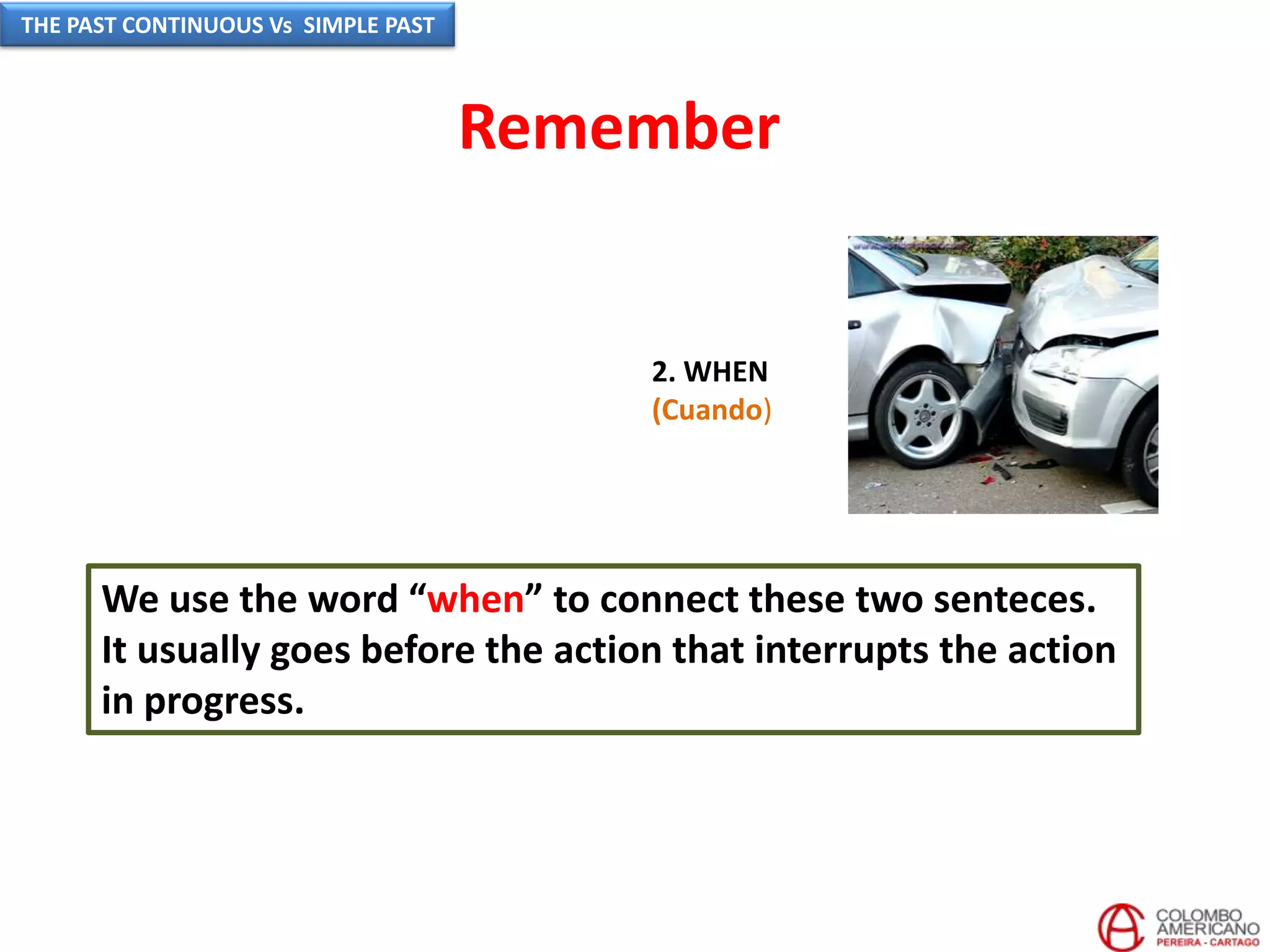
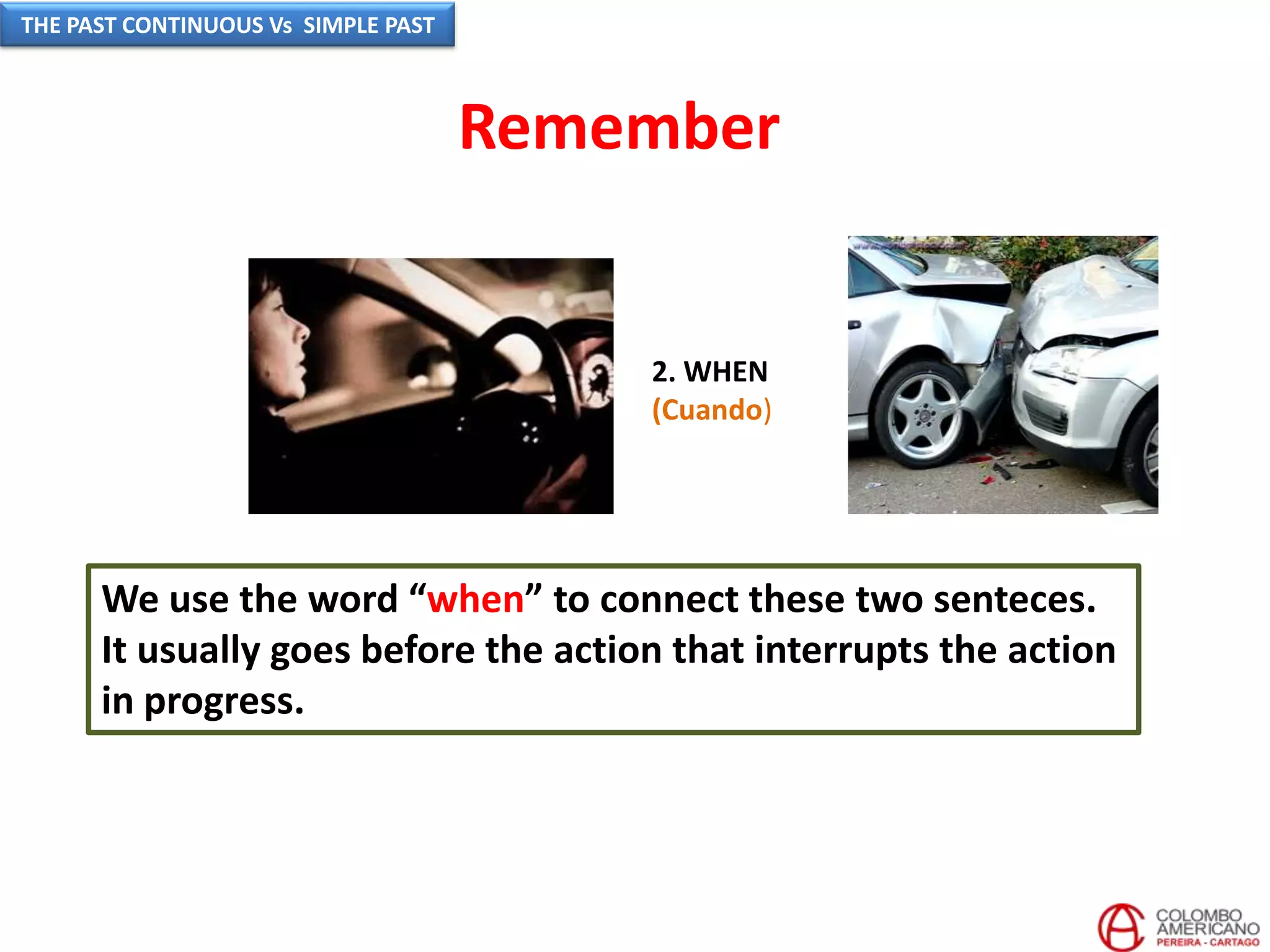
2. Mary was driving her car when she had the accident.
THE PAST CONTINUOUS Vs SIMPLE PAST
Let`s combine the simple past tense and
the past continuous
Activity One: Mary was driving her car
Activity Two: She had an accident
2. WHEN
(Cuando)
1. While Mary was driving (action in progress) she had an accident.
2. Mary was driving her car when she had the accident.
1. WHILE
(Mientras)
THE PAST CONTINUOUS Vs SIMPLE PAST
1. WHILE
(Mientras)
Remember
THE PAST CONTINUOUS Vs SIMPLE PAST
We use the word while before the action that is
in progress. Look at the examples below.
1. WHILE
(Mientras)
Remember
THE PAST CONTINUOUS Vs SIMPLE PAST
We use the word while before the action that is
in progress. Look at the examples below.
1. WHILE
(Mientras)
Remember
THE PAST CONTINUOUS Vs SIMPLE PAST
We use the word while before the action that is
in progress. Look at the examples below.
1. While Mary was driving (action in progress) she had an accident.
1. WHILE
(Mientras)
Remember
THE PAST CONTINUOUS Vs SIMPLE PAST
2. WHEN
(Cuando)
Remember
THE PAST CONTINUOUS Vs SIMPLE PAST
2. WHEN
(Cuando)
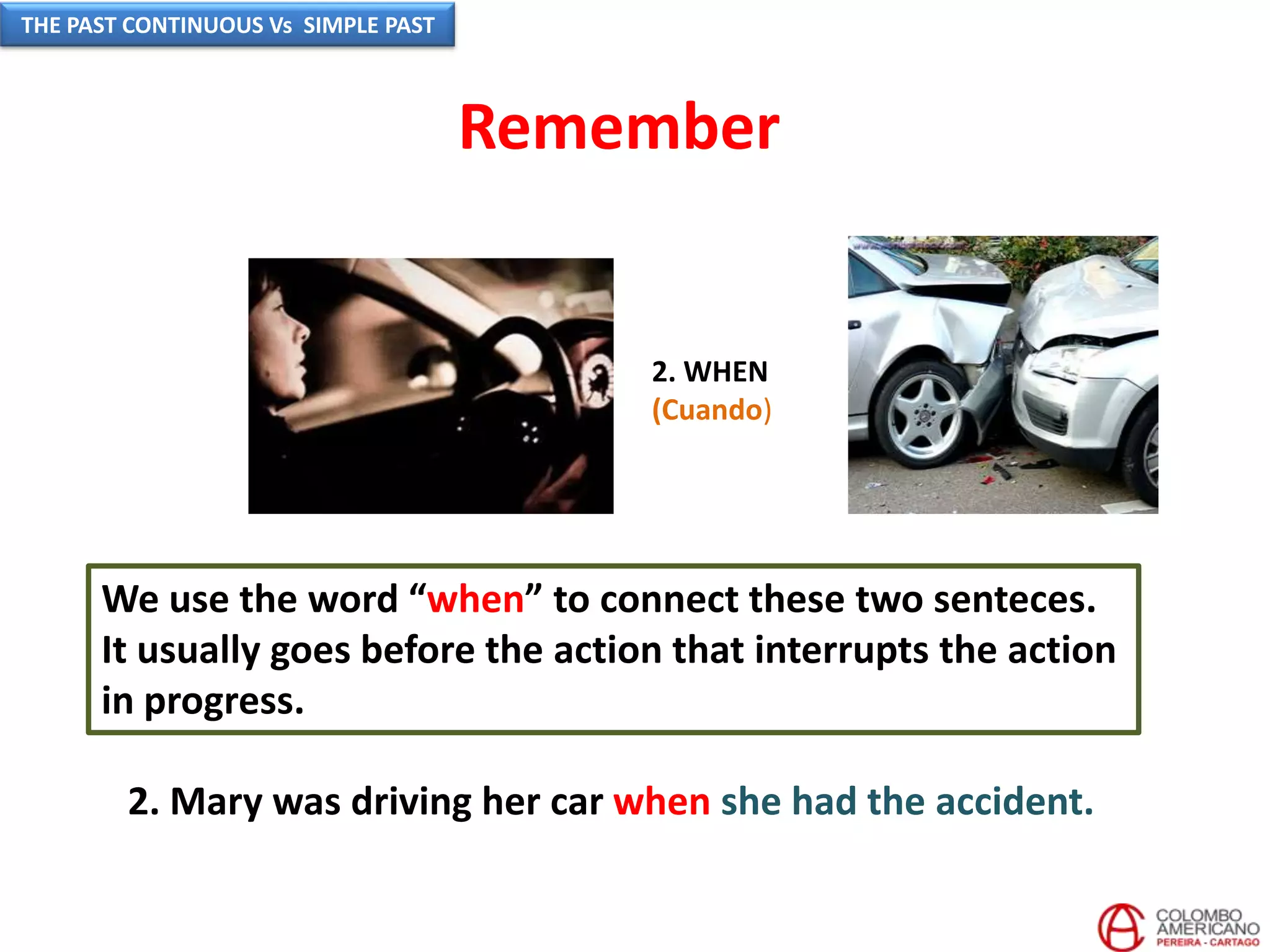
We use the word “when” to connect these two senteces.
It usually goes before the action that interrupts the action
in progress.
Remember
THE PAST CONTINUOUS Vs SIMPLE PAST
2. WHEN
(Cuando)
We use the word “when” to connect these two senteces.
It usually goes before the action that interrupts the action
in progress.
Remember
THE PAST CONTINUOUS Vs SIMPLE PAST
2. WHEN
(Cuando)
We use the word “when” to connect these two senteces.
It usually goes before the action that interrupts the action
in progress.
2. Mary was driving her car when she had the accident.
Remember
THE PAST CONTINUOUS Vs SIMPLE PAST
LET´S HAVE ANOTHER EXAMPLE
Activity One: I was eating some salad.
THE PAST CONTINUOUS Vs SIMPLE PAST
LET´S HAVE ANOTHER EXAMPLE
Activity Two: The telephone rang
THE PAST CONTINUOUS Vs SIMPLE PAST
LET´S HAVE ANOTHER EXAMPLE
Example:
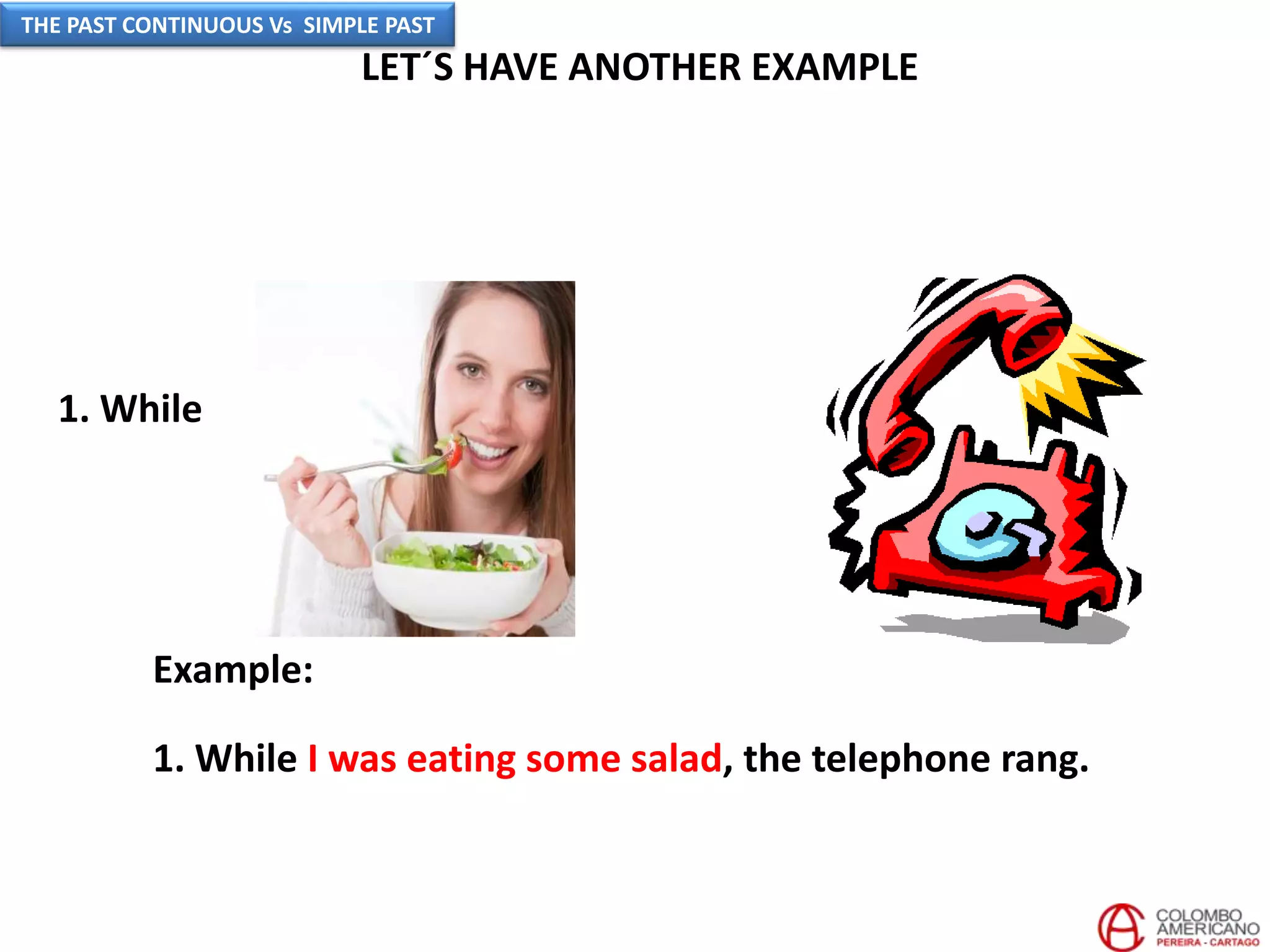
1. While I was eating some salad, the telephone rang.
1. While
THE PAST CONTINUOUS Vs SIMPLE PAST
LET´S HAVE ANOTHER EXAMPLE
Example:
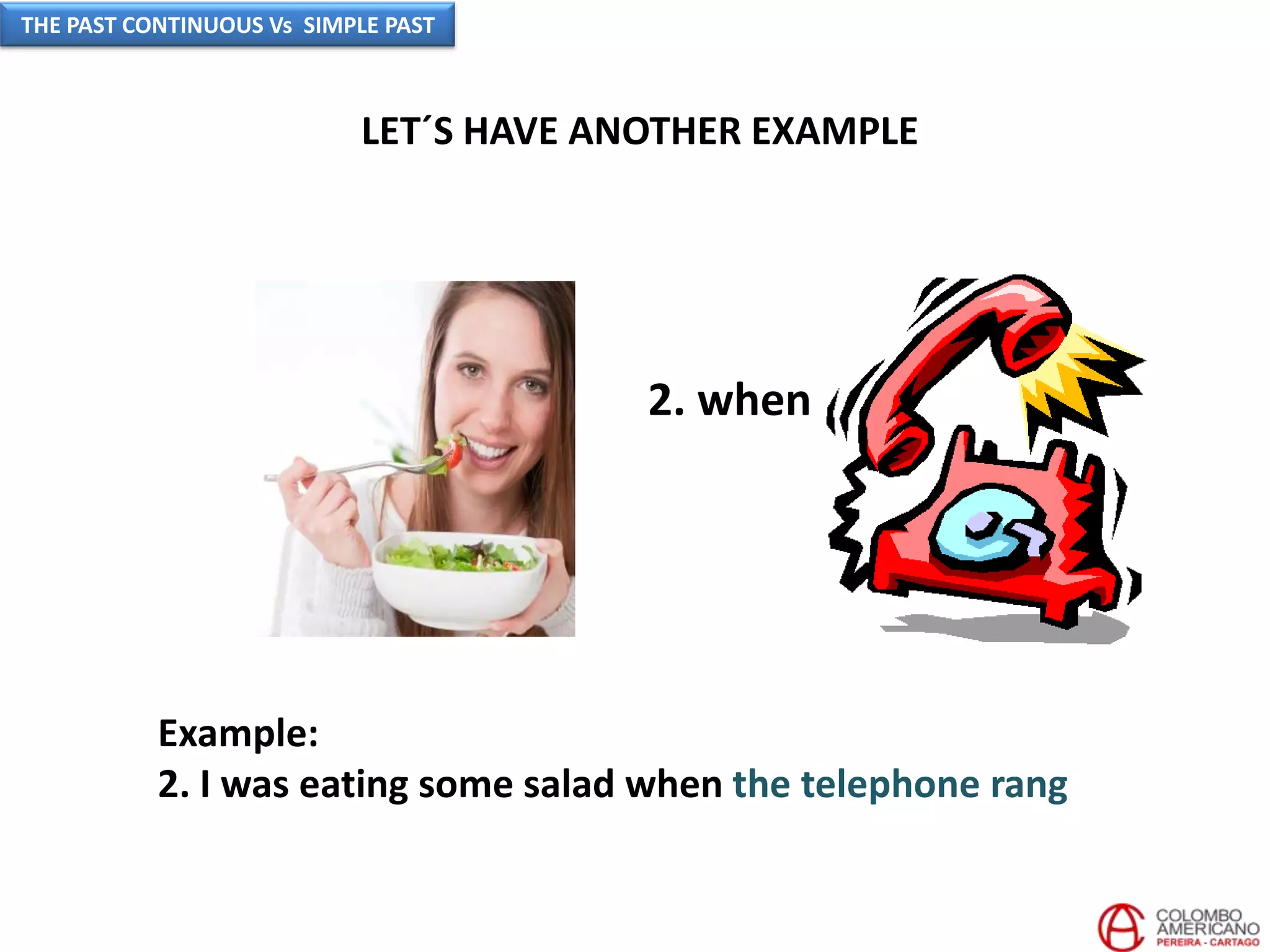
2. I was eating some salad when the telephone rang
2. when
THE PAST CONTINUOUS Vs SIMPLE PAST
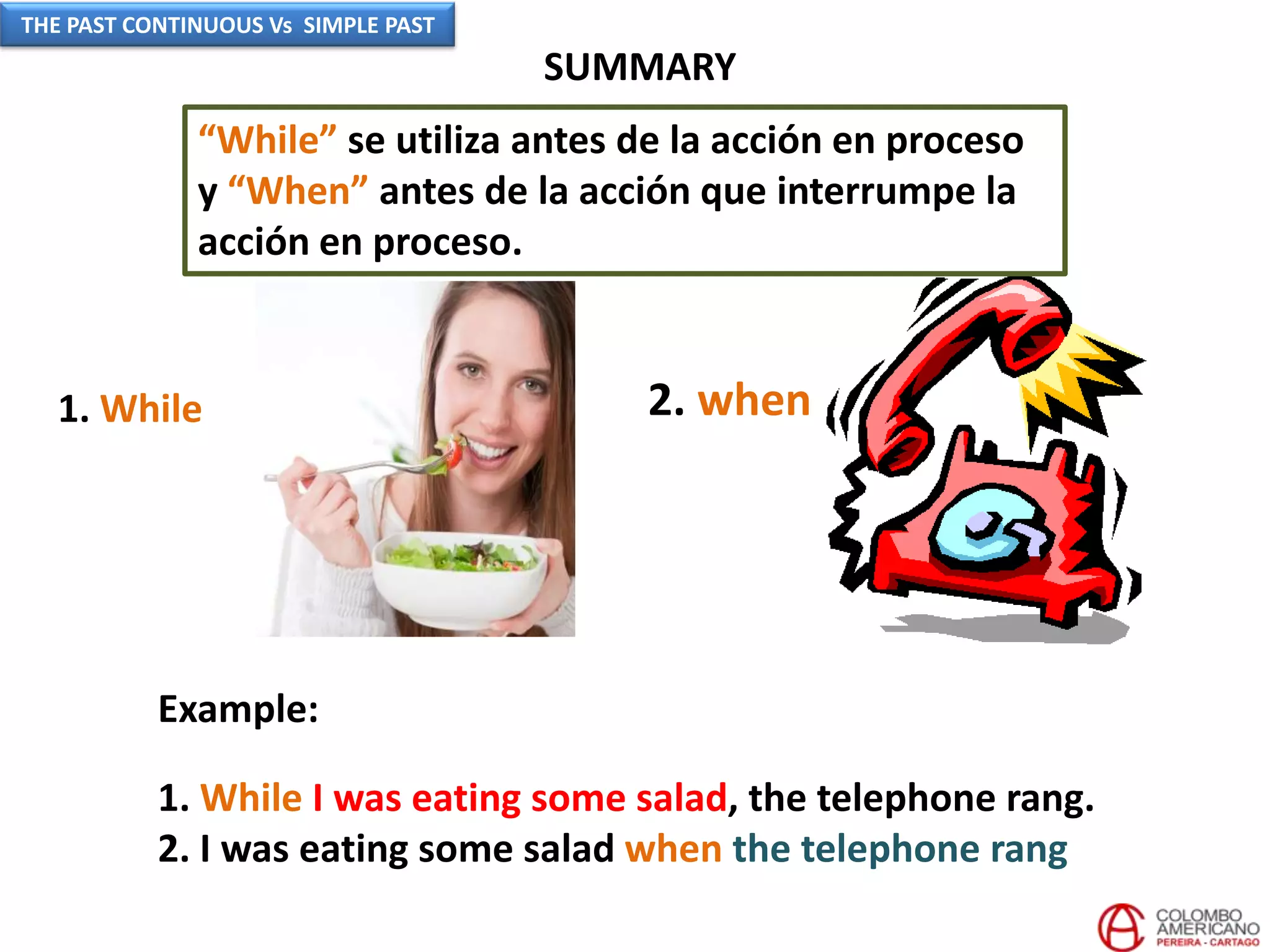
SUMMARY
Example:
1. While I was eating some salad, the telephone rang.
2. I was eating some salad when the telephone rang
1. While 2. when
“While” se utiliza antes de la acción en proceso
y “When” antes de la acción que interrumpe la
acción en proceso.
THE PAST CONTINUOUS Vs SIMPLE PAST
Let`s practice.
I invite you to visit the web page below and
test youself on the topic presented.
Good Luck.
http://www.englisch-hilfen.de/en/exercises/tenses/simple_past_progressive.htm
THE PAST CONTINUOUS Vs SIMPLE PAST

Course 9-Unit 4: Past continuous vs. simple past.

  • 1.
  • 2.
    THE PAST CONTINUOUS THEPAST CONTINUOUS Vs SIMPLE PAST
  • 3.
    Remember: Use the pastcontinuous to describe an activity that continued during a period of time in the past. THE PAST CONTINUOUS Vs SIMPLE PAST
  • 4.
    Activity: DRIVE ACAR THE PAST CONTINUOUS Vs SIMPLE PAST
  • 5.
    Activity: DRIVE ACAR WHEN (Cuando) THE PAST CONTINUOUS Vs SIMPLE PAST
  • 6.
    Activity: DRIVE ACAR When: (Cuando) Yesterday: From 6:00 pm to 6:59 pm THE PAST CONTINUOUS Vs SIMPLE PAST
  • 7.
    Time: From 6:00am to 6:59 pm (La acción se realiza de 6:00 a 6:59 pm, esta dura una hora aproximadamente) THE PAST CONTINUOUS Vs SIMPLE PAST
  • 8.
    Time: From 6:00am to 6:59 pm (La acción se realiza de 6:00 a 6:59 pm, esta dura una hora aproximadamente) What was she doing at : 6:30 pm? THE PAST CONTINUOUS Vs SIMPLE PAST
  • 9.
    Time: From 6:00am to 6:59 pm (La acción se realiza de 6:00 a 6:59 pm, esta dura una hora aproximadamente) She was driving a car at 6:30 pm What was she doing at : 6:30 pm? THE PAST CONTINUOUS Vs SIMPLE PAST
  • 10.
    THE SIMPLE PAST THEPAST CONTINUOUS Vs SIMPLE PAST
  • 11.
    Use simple pasttense to describe a completed action in the past. REMINDER THE PAST CONTINUOUS Vs SIMPLE PAST
  • 12.
    Activity: HAVE ANACCIDENT THE PAST CONTINUOUS Vs SIMPLE PAST
  • 13.
    Activity: HAVE ANACCIDENT When: Cuando THE PAST CONTINUOUS Vs SIMPLE PAST
  • 14.
    Activity: HAVE ANACCIDENT YESTERDAY: 7:00 PM When: Cuando THE PAST CONTINUOUS Vs SIMPLE PAST
  • 15.
    Time: 7:00 pm (Laacción pasó en un sólo momento a las 7:00 pm) THE PAST CONTINUOUS Vs SIMPLE PAST
  • 16.
    Time: 7:00 pm (Laacción pasó en un sólo momento a las 7:00 pm) What happend at 7:00 pm last night? THE PAST CONTINUOUS Vs SIMPLE PAST
  • 17.
    Time: 7:00 pm (Laacción pasó en un sólo momento a las 7:00 pm) She had an accident at 7:00 pm last nightWhat happend at 7:00 pm last night? THE PAST CONTINUOUS Vs SIMPLE PAST
  • 18.
    HOW DO WEFORM THE PAST CONTINUOUS: THE PAST CONTINUOUS Vs SIMPLE PAST
  • 19.
    HOW DO WEFORM THE PAST CONTINUOUS : We form this tense with the helping verb "to be" , in the past tense (was,were), plus the present participle of the verb (with an -ing ending): Example: Working, Dancing THE PAST CONTINUOUS Vs SIMPLE PAST
  • 20.
    HOW DO WEFORM THE PAST CONTINUOUS : Affirmative form THE PAST CONTINUOUS Vs SIMPLE PAST
  • 21.
    HOW DO WEFORM THE PAST CONTINUOUS : STRUCTURE SUBJECT AUX. VERB BE MAIN VERB IN PRESENT PARTICIPLE COMPLEMENT Affirmative form THE PAST CONTINUOUS Vs SIMPLE PAST
  • 22.
    HOW DO WEFORM THE PAST CONTINUOUS : STRUCTURE SUBJECT AUX. VERB BE MAIN VERB IN PRESENT PARTICIPLE COMPLEMENT They Affirmative form THE PAST CONTINUOUS Vs SIMPLE PAST
  • 23.
    HOW DO WEFORM THE PAST CONTINUOUS : STRUCTURE SUBJECT AUX. VERB BE MAIN VERB IN PRESENT PARTICIPLE COMPLEMENT They were Affirmative form THE PAST CONTINUOUS Vs SIMPLE PAST
  • 24.
    HOW DO WEFORM THE PAST CONTINUOUS : STRUCTURE SUBJECT AUX. VERB BE MAIN VERB IN PRESENT PARTICIPLE COMPLEMENT They were working Affirmative form THE PAST CONTINUOUS Vs SIMPLE PAST
  • 25.
    HOW DO WEFORM THE PAST CONTINUOUS : STRUCTURE SUBJECT AUX. VERB BE MAIN VERB IN PRESENT PARTICIPLE COMPLEMENT They were working All night long Affirmative form THE PAST CONTINUOUS Vs SIMPLE PAST
  • 26.
    HOW DO WEFORM THE PAST CONTINUOUS : STRUCTURE SUBJECT AUX. VERB BE MAIN VERB IN PRESENT PARTICIPLE COMPLEMENT They were working All night long Traducción: Ellos estuvieron trabajando toda la noche Affirmative form THE PAST CONTINUOUS Vs SIMPLE PAST
  • 27.
    HOW DO WEFORM THE PAST CONTINUOUS : Negative form: THE PAST CONTINUOUS Vs SIMPLE PAST
  • 28.
    HOW DO WEFORM THE PAST CONTINUOUS : STRUCTURE SUBJECT AUX. VERB BE+ NOT MAIN VERB IN PRESENT PARTICIPLE COMPLEMENT Negative form: THE PAST CONTINUOUS Vs SIMPLE PAST
  • 29.
    HOW DO WEFORM THE PAST CONTINUOUS : STRUCTURE SUBJECT AUX. VERB BE+ NOT MAIN VERB IN PRESENT PARTICIPLE COMPLEMENT They Negative form: THE PAST CONTINUOUS Vs SIMPLE PAST
  • 30.
    HOW DO WEFORM THE PAST CONTINUOUS : STRUCTURE SUBJECT AUX. VERB BE+ NOT MAIN VERB IN PRESENT PARTICIPLE COMPLEMENT They Were NOT Negative form: THE PAST CONTINUOUS Vs SIMPLE PAST
  • 31.
    HOW DO WEFORM THE PAST CONTINUOUS : STRUCTURE SUBJECT AUX. VERB BE+ NOT MAIN VERB IN PRESENT PARTICIPLE COMPLEMENT They Were NOT working Negative form: THE PAST CONTINUOUS Vs SIMPLE PAST
  • 32.
    HOW DO WEFORM THE PAST CONTINUOUS : STRUCTURE SUBJECT AUX. VERB BE+ NOT MAIN VERB IN PRESENT PARTICIPLE COMPLEMENT They Were NOT working All night long Negative form: THE PAST CONTINUOUS Vs SIMPLE PAST
  • 33.
    HOW DO WEFORM THE PAST CONTINUOUS : STRUCTURE SUBJECT AUX. VERB BE+ NOT MAIN VERB IN PRESENT PARTICIPLE COMPLEMENT They Were NOT working All night long Traducción: Ellos NO estuvieron trabajando toda la noche Negative form: THE PAST CONTINUOUS Vs SIMPLE PAST
  • 34.
    HOW DO WEFORM THE PAST CONTINUOUS : Question form: THE PAST CONTINUOUS Vs SIMPLE PAST
  • 35.
    HOW DO WEFORM THE PAST CONTINUOUS : STRUCTURE AUX. VERB BE SUBJECT MAIN VERB IN PRESENT PARTICIPLE COMPLEMENT ? Question form THE PAST CONTINUOUS Vs SIMPLE PAST
  • 36.
    HOW DO WEFORM THE PAST CONTINUOUS : STRUCTURE AUX. VERB BE SUBJECT MAIN VERB IN PRESENT PARTICIPLE COMPLEMENT ? were Question form THE PAST CONTINUOUS Vs SIMPLE PAST
  • 37.
    HOW DO WEFORM THE PAST CONTINUOUS : STRUCTURE AUX. VERB BE SUBJECT MAIN VERB IN PRESENT PARTICIPLE COMPLEMENT ? were They Question form THE PAST CONTINUOUS Vs SIMPLE PAST
  • 38.
    HOW DO WEFORM THE PAST CONTINUOUS : STRUCTURE AUX. VERB BE SUBJECT MAIN VERB IN PRESENT PARTICIPLE COMPLEMENT ? were They working Question form THE PAST CONTINUOUS Vs SIMPLE PAST
  • 39.
    HOW DO WEFORM THE PAST CONTINUOUS : STRUCTURE AUX. VERB BE SUBJECT MAIN VERB IN PRESENT PARTICIPLE COMPLEMENT ? were They working All night long? Question form THE PAST CONTINUOUS Vs SIMPLE PAST
  • 40.
    HOW DO WEFORM THE PAST CONTINUOUS : STRUCTURE AUX. VERB BE SUBJECT MAIN VERB IN PRESENT PARTICIPLE COMPLEMENT ? were They working All night long? Traducción: ¿Estuvieron Ellos trabajando toda la noche? Question form THE PAST CONTINUOUS Vs SIMPLE PAST
  • 41.
    Como se puedeobservar, existen dos componentes muy importantes en: the past continuous. THE PAST CONTINUOUS Vs SIMPLE PAST
  • 42.
    Como se puedeobservar, existen dos componentes muy importantes en: the past continuous. AUXILIARY VERB BE VERB IN PRESENT PARTICIPLE: ING FORM THE PAST CONTINUOUS Vs SIMPLE PAST
  • 43.
    Look at thecharts SUBJECT AUXILIARY VERB VERB IN PRESENT PARTICIPLE THE PAST CONTINUOUS Vs SIMPLE PAST
  • 44.
    Look at thecharts SUBJECT AUXILIARY VERB VERB IN PRESENT PARTICIPLE I SHE HE IT WE THEY YOU THE PAST CONTINUOUS Vs SIMPLE PAST
  • 45.
    Look at thecharts SUBJECT AUXILIARY VERB VERB IN PRESENT PARTICIPLE I WAS SHE WAS HE WAS IT WAS WE WERE THEY WERE YOU WERE THE PAST CONTINUOUS Vs SIMPLE PAST
  • 46.
    Look at thecharts SUBJECT AUXILIARY VERB VERB IN PRESENT PARTICIPLE I WAS PLAYING SHE WAS PLAYING HE WAS PLAYING IT WAS PLAYING WE WERE PLAYING THEY WERE PLAYING YOU WERE PLAYING THE PAST CONTINUOUS Vs SIMPLE PAST
  • 47.
    Look at thecharts SUBJECT AUXILIARY VERB VERB IN PRESENT PARTICIPLE THE PAST CONTINUOUS Vs SIMPLE PAST
  • 48.
    Look at thecharts SUBJECT AUXILIARY VERB VERB IN PRESENT PARTICIPLE I SHE HE IT WE THEY YOU THE PAST CONTINUOUS Vs SIMPLE PAST
  • 49.
    Look at thecharts SUBJECT AUXILIARY VERB VERB IN PRESENT PARTICIPLE I WAS NOT SHE WAS NOT HE WAS NOT IT WAS NOT WE WERE NOT THEY WERE NOT YOU WERE NOT THE PAST CONTINUOUS Vs SIMPLE PAST
  • 50.
    Look at thecharts SUBJECT AUXILIARY VERB VERB IN PRESENT PARTICIPLE I WAS NOT PLAYING SHE WAS NOT PLAYING HE WAS NOT PLAYING IT WAS NOT PLAYING WE WERE NOT PLAYING THEY WERE NOT PLAYING YOU WERE NOT PLAYING THE PAST CONTINUOUS Vs SIMPLE PAST
  • 51.
    Si comparamos laforma negativa de: The past continuous, existe la posibilidad de contraer el verbo auxiliar “to be” THE PAST CONTINUOUS Vs SIMPLE PAST
  • 52.
    Was Were Si comparamos laforma negativa de: The past continuous, existe la posibilidad de contraer el verbo auxiliar “to be” THE PAST CONTINUOUS Vs SIMPLE PAST
  • 53.
    Was Were Si comparamos laforma negativa de: The past continuous, existe la posibilidad de contraer el verbo auxiliar “to be” THE PAST CONTINUOUS Vs SIMPLE PAST
  • 54.
    Was Wasn`t Were Weren`t Sicomparamos la forma negativa de: The past continuous, existe la posibilidad de contraer el verbo auxiliar “to be” THE PAST CONTINUOUS Vs SIMPLE PAST
  • 55.
    Look at thechart SUBJECT AUXILIARY VERB VERB IN PRESENT PARTICIPLE I PLAYING SHE PLAYING HE PLAYING IT PLAYING WE PLAYING THEY PLAYING YOU PLAYING THE PAST CONTINUOUS Vs SIMPLE PAST
  • 56.
    Look at thechart SUBJECT AUXILIARY VERB VERB IN PRESENT PARTICIPLE I WAS NOT PLAYING SHE WAS NOT PLAYING HE WAS NOT PLAYING IT WAS NOT PLAYING WE WERE NOT PLAYING THEY WERE NOT PLAYING YOU WERE NOT PLAYING THE PAST CONTINUOUS Vs SIMPLE PAST
  • 57.
    Look at thechart SUBJECT AUXILIARY VERB VERB IN PRESENT PARTICIPLE I WAS NOT PLAYING SHE WAS NOT PLAYING HE WAS NOT PLAYING IT WAS NOT PLAYING WE WERE NOT PLAYING THEY WERE NOT PLAYING YOU WERE NOT PLAYING SUBJECT AUXILIARY VERB VERB IN PRESENT PARTICIPLE THE PAST CONTINUOUS Vs SIMPLE PAST
  • 58.
    Look at thechart SUBJECT AUXILIARY VERB VERB IN PRESENT PARTICIPLE I WAS NOT PLAYING SHE WAS NOT PLAYING HE WAS NOT PLAYING IT WAS NOT PLAYING WE WERE NOT PLAYING THEY WERE NOT PLAYING YOU WERE NOT PLAYING SUBJECT AUXILIARY VERB VERB IN PRESENT PARTICIPLE I PLAYING SHE PLAYING HE PLAYING IT PLAYING WE PLAYING THEY PLAYING YOU PLAYING THE PAST CONTINUOUS Vs SIMPLE PAST
  • 59.
    Look at thechart SUBJECT AUXILIARY VERB VERB IN PRESENT PARTICIPLE I WAS NOT PLAYING SHE WAS NOT PLAYING HE WAS NOT PLAYING IT WAS NOT PLAYING WE WERE NOT PLAYING THEY WERE NOT PLAYING YOU WERE NOT PLAYING SUBJECT AUXILIARY VERB VERB IN PRESENT PARTICIPLE I WASN`T PLAYING SHE WASN`T PLAYING HE WASN`T PLAYING IT WASN`T PLAYING WE WEREN`T PLAYING THEY WEREN`T PLAYING YOU WEREN`T PLAYING THE PAST CONTINUOUS Vs SIMPLE PAST
  • 60.
    Let`s combine thesimple past tense and the past continuous THE PAST CONTINUOUS Vs SIMPLE PAST
  • 61.
    Let`s combine thesimple past tense and the past continuous Activity One: Mary was driving her car THE PAST CONTINUOUS Vs SIMPLE PAST
  • 62.
    Let`s combine thesimple past tense and the past continuous Activity Two: She had an accident THE PAST CONTINUOUS Vs SIMPLE PAST
  • 63.
    Let`s combine thesimple past tense and the past continuous Activity One: Mary was driving her car Activity Two: She had an accident 1. WHILE (Mientras) THE PAST CONTINUOUS Vs SIMPLE PAST
  • 64.
    Let`s combine thesimple past tense and the past continuous Activity One: Mary was driving her car Activity Two: She had an accident 1. While Mary was driving (action in progress) she had an accident. 1. WHILE (Mientras) THE PAST CONTINUOUS Vs SIMPLE PAST
  • 65.
    Let`s combine thesimple past tense and the past continuous Activity One: Mary was driving her car Activity Two: She had an accident 2. WHEN (Cuando) 2. Mary was driving her car when she had the accident. THE PAST CONTINUOUS Vs SIMPLE PAST
  • 66.
    Let`s combine thesimple past tense and the past continuous Activity One: Mary was driving her car Activity Two: She had an accident 2. WHEN (Cuando) 1. While Mary was driving (action in progress) she had an accident. 2. Mary was driving her car when she had the accident. 1. WHILE (Mientras) THE PAST CONTINUOUS Vs SIMPLE PAST
  • 67.
    1. WHILE (Mientras) Remember THE PASTCONTINUOUS Vs SIMPLE PAST
  • 68.
    We use theword while before the action that is in progress. Look at the examples below. 1. WHILE (Mientras) Remember THE PAST CONTINUOUS Vs SIMPLE PAST
  • 69.
    We use theword while before the action that is in progress. Look at the examples below. 1. WHILE (Mientras) Remember THE PAST CONTINUOUS Vs SIMPLE PAST
  • 70.
    We use theword while before the action that is in progress. Look at the examples below. 1. While Mary was driving (action in progress) she had an accident. 1. WHILE (Mientras) Remember THE PAST CONTINUOUS Vs SIMPLE PAST
  • 71.
    2. WHEN (Cuando) Remember THE PASTCONTINUOUS Vs SIMPLE PAST
  • 72.
    2. WHEN (Cuando) We usethe word “when” to connect these two senteces. It usually goes before the action that interrupts the action in progress. Remember THE PAST CONTINUOUS Vs SIMPLE PAST
  • 73.
    2. WHEN (Cuando) We usethe word “when” to connect these two senteces. It usually goes before the action that interrupts the action in progress. Remember THE PAST CONTINUOUS Vs SIMPLE PAST
  • 74.
    2. WHEN (Cuando) We usethe word “when” to connect these two senteces. It usually goes before the action that interrupts the action in progress. 2. Mary was driving her car when she had the accident. Remember THE PAST CONTINUOUS Vs SIMPLE PAST
  • 75.
    LET´S HAVE ANOTHEREXAMPLE Activity One: I was eating some salad. THE PAST CONTINUOUS Vs SIMPLE PAST
  • 76.
    LET´S HAVE ANOTHEREXAMPLE Activity Two: The telephone rang THE PAST CONTINUOUS Vs SIMPLE PAST
  • 77.
    LET´S HAVE ANOTHEREXAMPLE Example: 1. While I was eating some salad, the telephone rang. 1. While THE PAST CONTINUOUS Vs SIMPLE PAST
  • 78.
    LET´S HAVE ANOTHEREXAMPLE Example: 2. I was eating some salad when the telephone rang 2. when THE PAST CONTINUOUS Vs SIMPLE PAST
  • 79.
    SUMMARY Example: 1. While Iwas eating some salad, the telephone rang. 2. I was eating some salad when the telephone rang 1. While 2. when “While” se utiliza antes de la acción en proceso y “When” antes de la acción que interrumpe la acción en proceso. THE PAST CONTINUOUS Vs SIMPLE PAST
  • 80.
    Let`s practice. I inviteyou to visit the web page below and test youself on the topic presented. Good Luck. http://www.englisch-hilfen.de/en/exercises/tenses/simple_past_progressive.htm THE PAST CONTINUOUS Vs SIMPLE PAST
  • 81.
    THE PAST CONTINUOUSVs SIMPLE PAST