HOW TO
INTERVIEW
Learn How to Carry Out an
Interview of a Prospective
Employee
Interview Tips - for
Interviewers
 Read prospective employees CV thoroughly











and make relevant notes.
You must makes notes of the questions you
intend to ask - otherwise you'll forget.
Decide the essential things you need to learn
and prepare questions to probe them.
Plan the environment - privacy, no interruptions,
ensure the interviewee is looked after while they
wait.
Arrange the seating in an informal relaxed way.
Don't sit behind a desk directly facing the
interviewee - sit around a coffee table or meeting
room table.
Clear your desk, apart from what you need for the
interview, so it shows you've prepared and are
organized, which shows you respect the situation
and the interviewee.
Put the interviewee at ease - it's stressful for
them, so don't make it any worse.
 Begin by explaining clearly and concisely the









general details of the organization and the role.
Ask open-ended questions - how, why, tell me,
what, (and to a lesser extent where, when, which)
to get the interviewee talking.
Make sure the interviewee does 90% of the
talking.
Use 'How?' and 'What?' questions to prompt
examples and get to the real motives and feelings.
'Why?' questions place more pressure on people
because they suggest that justification or defence
is required. 'Why?' questions asked in succession
will probe and drill down to root causes and
feelings, but use with care as this is a highpressure form of questioning and will not allow
sensitive or nervous people to show you how good
they are. Think about how your questions will
make the interviewee feel. Your aim and
responsibility as an interviewer is to understand
the other person - not to intimidate, which does not
facilitate understanding.
High pressure causes people to clam up and
rarely exposes hidden issues - calm, relaxed,
gentle, clever questions are far more revealing.
Probe the CV/resume/application form to clarify
any unclear points.
 If possible, and particularly for any position

above first-line jobs, use some form of
psychometric test, or graphology, and have the
results available for the interview, so you can
discuss them with the interviewee. Always give
people the results of their tests. Position the test
as a helpful discussion point, not the deciding
factor. Take care when giving the test to explain
and reassure. Ensure the test is done on your
premises - not sent in the post.
 Give interviewees opportunities to ask their
own questions. Questions asked by interviewees
are usually very revealing. They also help good
candidates to demonstrate their worth, especially if
the interviewer has not asked great questions or
there is a feeling that a person has for any reason
not had the chance to show their real capability
and potential.
Interview Tips - for
Interviewees

How to Carry Out an Interview
as an Interviewee
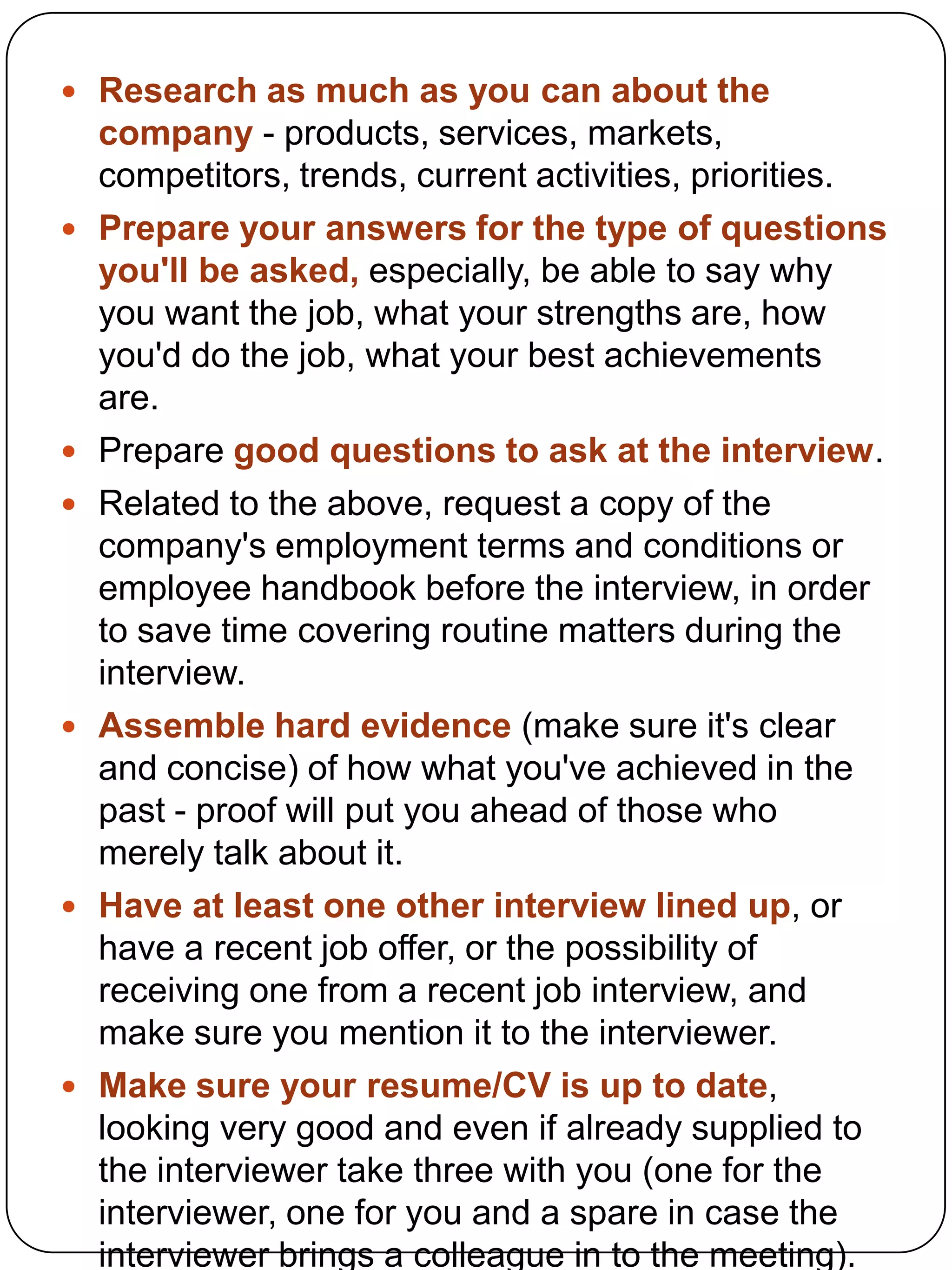
 Research as much as you can about the












company - products, services, markets,
competitors, trends, current activities, priorities.
Prepare your answers for the type of questions
you'll be asked, especially, be able to say why
you want the job, what your strengths are, how
you'd do the job, what your best achievements
are.
Prepare good questions to ask at the interview.
Related to the above, request a copy of the
company's employment terms and conditions or
employee handbook before the interview, in order
to save time covering routine matters during the
interview.
Assemble hard evidence (make sure it's clear
and concise) of how what you've achieved in the
past - proof will put you ahead of those who
merely talk about it.
Have at least one other interview lined up, or
have a recent job offer, or the possibility of
receiving one from a recent job interview, and
make sure you mention it to the interviewer.
Make sure your resume/CV is up to date,
looking very good and even if already supplied to
the interviewer take three with you (one for the
interviewer, one for you and a spare in case the
interviewer brings a colleague in to the meeting).
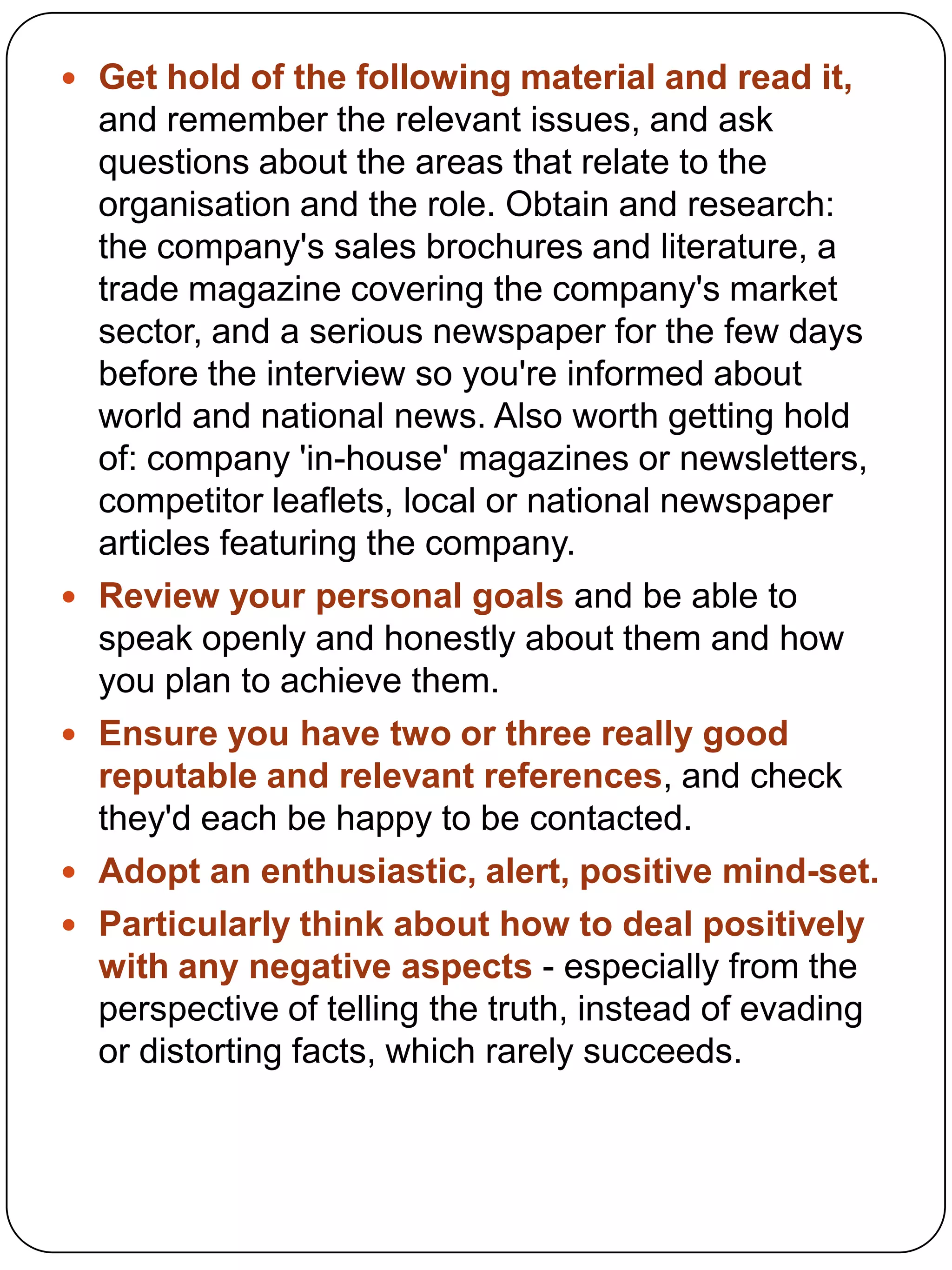
 Get hold of the following material and read it,








and remember the relevant issues, and ask
questions about the areas that relate to the
organisation and the role. Obtain and research:
the company's sales brochures and literature, a
trade magazine covering the company's market
sector, and a serious newspaper for the few days
before the interview so you're informed about
world and national news. Also worth getting hold
of: company 'in-house' magazines or newsletters,
competitor leaflets, local or national newspaper
articles featuring the company.
Review your personal goals and be able to
speak openly and honestly about them and how
you plan to achieve them.
Ensure you have two or three really good
reputable and relevant references, and check
they'd each be happy to be contacted.
Adopt an enthusiastic, alert, positive mind-set.
Particularly think about how to deal positively
with any negative aspects - especially from the
perspective of telling the truth, instead of evading
or distorting facts, which rarely succeeds.
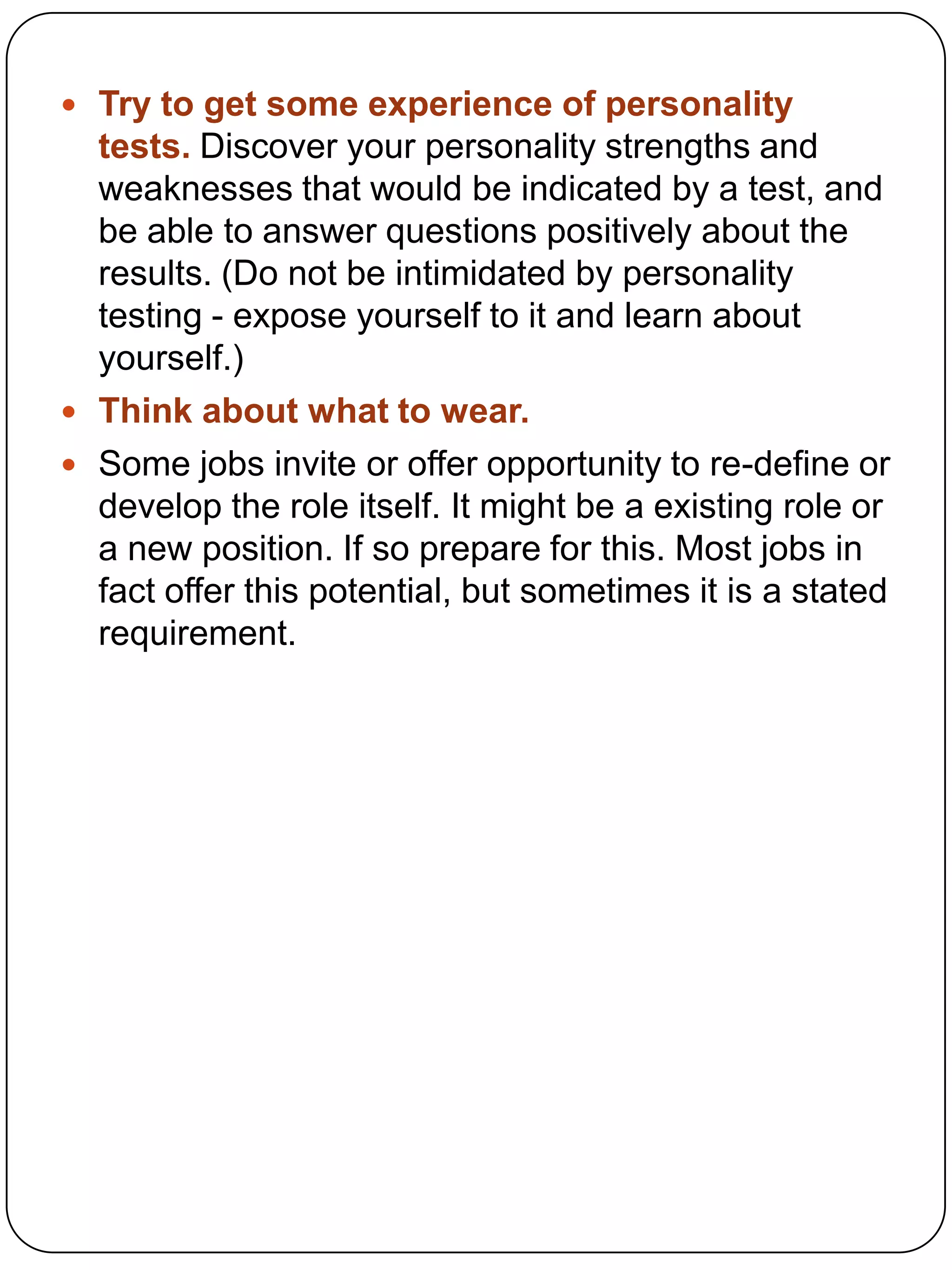
 Try to get some experience of personality

tests. Discover your personality strengths and
weaknesses that would be indicated by a test, and
be able to answer questions positively about the
results. (Do not be intimidated by personality
testing - expose yourself to it and learn about
yourself.)
 Think about what to wear.
 Some jobs invite or offer opportunity to re-define or
develop the role itself. It might be a existing role or
a new position. If so prepare for this. Most jobs in
fact offer this potential, but sometimes it is a stated
requirement.
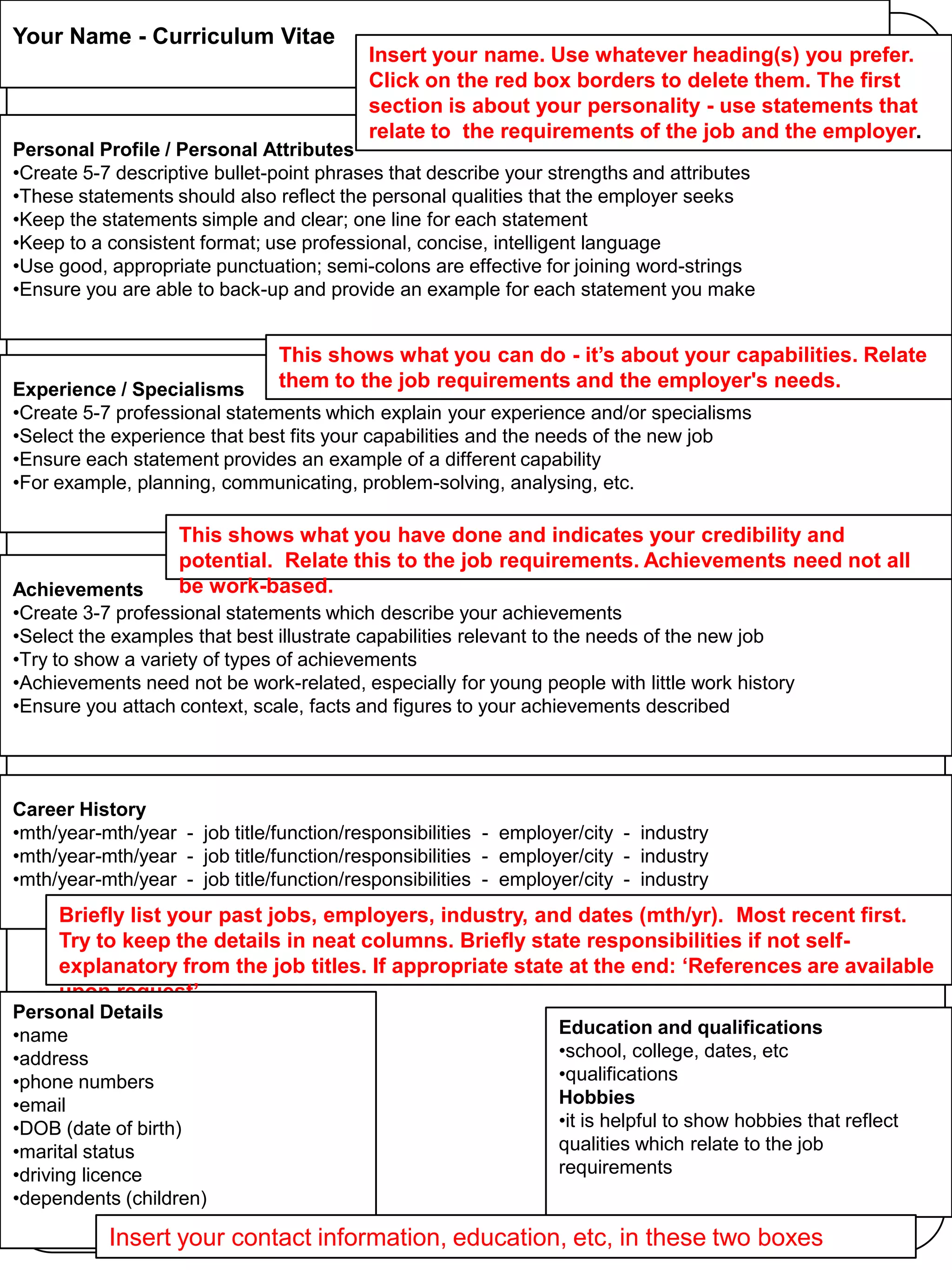
Your Name - Curriculum Vitae

Insert your name. Use whatever heading(s) you prefer.
Click on the red box borders to delete them. The first
section is about your personality - use statements that
relate to the requirements of the job and the employer.

Personal Profile / Personal Attributes
•Create 5-7 descriptive bullet-point phrases that describe your strengths and attributes
•These statements should also reflect the personal qualities that the employer seeks
•Keep the statements simple and clear; one line for each statement
•Keep to a consistent format; use professional, concise, intelligent language
•Use good, appropriate punctuation; semi-colons are effective for joining word-strings
•Ensure you are able to back-up and provide an example for each statement you make

This shows what you can do - it’s about your capabilities. Relate
them to the job requirements and the employer's needs.

Experience / Specialisms
•Create 5-7 professional statements which explain your experience and/or specialisms
•Select the experience that best fits your capabilities and the needs of the new job
•Ensure each statement provides an example of a different capability
•For example, planning, communicating, problem-solving, analysing, etc.

This shows what you have done and indicates your credibility and
potential. Relate this to the job requirements. Achievements need not all
be work-based.

Achievements
•Create 3-7 professional statements which describe your achievements
•Select the examples that best illustrate capabilities relevant to the needs of the new job
•Try to show a variety of types of achievements
•Achievements need not be work-related, especially for young people with little work history
•Ensure you attach context, scale, facts and figures to your achievements described

Career History
•mth/year-mth/year - job title/function/responsibilities - employer/city - industry

Briefly list your past jobs, employers, industry, and dates (mth/yr). Most recent first.
Try to keep the details in neat columns. Briefly state responsibilities if not selfexplanatory from the job titles. If appropriate state at the end: ‘References are available
upon request’.
Personal Details
•name
•address
•phone numbers
•email
•DOB (date of birth)
•marital status
•driving licence
•dependents (children)

Education and qualifications
•school, college, dates, etc
•qualifications
Hobbies
•it is helpful to show hobbies that reflect
qualities which relate to the job
requirements

Insert your contact information, education, etc, in these two boxes

How to interview presentation

  • 1.
    HOW TO INTERVIEW Learn Howto Carry Out an Interview of a Prospective Employee
  • 2.
    Interview Tips -for Interviewers  Read prospective employees CV thoroughly       and make relevant notes. You must makes notes of the questions you intend to ask - otherwise you'll forget. Decide the essential things you need to learn and prepare questions to probe them. Plan the environment - privacy, no interruptions, ensure the interviewee is looked after while they wait. Arrange the seating in an informal relaxed way. Don't sit behind a desk directly facing the interviewee - sit around a coffee table or meeting room table. Clear your desk, apart from what you need for the interview, so it shows you've prepared and are organized, which shows you respect the situation and the interviewee. Put the interviewee at ease - it's stressful for them, so don't make it any worse.
  • 3.
     Begin byexplaining clearly and concisely the      general details of the organization and the role. Ask open-ended questions - how, why, tell me, what, (and to a lesser extent where, when, which) to get the interviewee talking. Make sure the interviewee does 90% of the talking. Use 'How?' and 'What?' questions to prompt examples and get to the real motives and feelings. 'Why?' questions place more pressure on people because they suggest that justification or defence is required. 'Why?' questions asked in succession will probe and drill down to root causes and feelings, but use with care as this is a highpressure form of questioning and will not allow sensitive or nervous people to show you how good they are. Think about how your questions will make the interviewee feel. Your aim and responsibility as an interviewer is to understand the other person - not to intimidate, which does not facilitate understanding. High pressure causes people to clam up and rarely exposes hidden issues - calm, relaxed, gentle, clever questions are far more revealing. Probe the CV/resume/application form to clarify any unclear points.
  • 4.
     If possible,and particularly for any position above first-line jobs, use some form of psychometric test, or graphology, and have the results available for the interview, so you can discuss them with the interviewee. Always give people the results of their tests. Position the test as a helpful discussion point, not the deciding factor. Take care when giving the test to explain and reassure. Ensure the test is done on your premises - not sent in the post.  Give interviewees opportunities to ask their own questions. Questions asked by interviewees are usually very revealing. They also help good candidates to demonstrate their worth, especially if the interviewer has not asked great questions or there is a feeling that a person has for any reason not had the chance to show their real capability and potential.
  • 5.
    Interview Tips -for Interviewees How to Carry Out an Interview as an Interviewee
  • 6.
     Research asmuch as you can about the       company - products, services, markets, competitors, trends, current activities, priorities. Prepare your answers for the type of questions you'll be asked, especially, be able to say why you want the job, what your strengths are, how you'd do the job, what your best achievements are. Prepare good questions to ask at the interview. Related to the above, request a copy of the company's employment terms and conditions or employee handbook before the interview, in order to save time covering routine matters during the interview. Assemble hard evidence (make sure it's clear and concise) of how what you've achieved in the past - proof will put you ahead of those who merely talk about it. Have at least one other interview lined up, or have a recent job offer, or the possibility of receiving one from a recent job interview, and make sure you mention it to the interviewer. Make sure your resume/CV is up to date, looking very good and even if already supplied to the interviewer take three with you (one for the interviewer, one for you and a spare in case the interviewer brings a colleague in to the meeting).
  • 7.
     Get holdof the following material and read it,     and remember the relevant issues, and ask questions about the areas that relate to the organisation and the role. Obtain and research: the company's sales brochures and literature, a trade magazine covering the company's market sector, and a serious newspaper for the few days before the interview so you're informed about world and national news. Also worth getting hold of: company 'in-house' magazines or newsletters, competitor leaflets, local or national newspaper articles featuring the company. Review your personal goals and be able to speak openly and honestly about them and how you plan to achieve them. Ensure you have two or three really good reputable and relevant references, and check they'd each be happy to be contacted. Adopt an enthusiastic, alert, positive mind-set. Particularly think about how to deal positively with any negative aspects - especially from the perspective of telling the truth, instead of evading or distorting facts, which rarely succeeds.
  • 8.
     Try toget some experience of personality tests. Discover your personality strengths and weaknesses that would be indicated by a test, and be able to answer questions positively about the results. (Do not be intimidated by personality testing - expose yourself to it and learn about yourself.)  Think about what to wear.  Some jobs invite or offer opportunity to re-define or develop the role itself. It might be a existing role or a new position. If so prepare for this. Most jobs in fact offer this potential, but sometimes it is a stated requirement.
  • 9.
    Your Name -Curriculum Vitae Insert your name. Use whatever heading(s) you prefer. Click on the red box borders to delete them. The first section is about your personality - use statements that relate to the requirements of the job and the employer. Personal Profile / Personal Attributes •Create 5-7 descriptive bullet-point phrases that describe your strengths and attributes •These statements should also reflect the personal qualities that the employer seeks •Keep the statements simple and clear; one line for each statement •Keep to a consistent format; use professional, concise, intelligent language •Use good, appropriate punctuation; semi-colons are effective for joining word-strings •Ensure you are able to back-up and provide an example for each statement you make This shows what you can do - it’s about your capabilities. Relate them to the job requirements and the employer's needs. Experience / Specialisms •Create 5-7 professional statements which explain your experience and/or specialisms •Select the experience that best fits your capabilities and the needs of the new job •Ensure each statement provides an example of a different capability •For example, planning, communicating, problem-solving, analysing, etc. This shows what you have done and indicates your credibility and potential. Relate this to the job requirements. Achievements need not all be work-based. Achievements •Create 3-7 professional statements which describe your achievements •Select the examples that best illustrate capabilities relevant to the needs of the new job •Try to show a variety of types of achievements •Achievements need not be work-related, especially for young people with little work history •Ensure you attach context, scale, facts and figures to your achievements described Career History •mth/year-mth/year - job title/function/responsibilities - employer/city - industry •mth/year-mth/year - job title/function/responsibilities - employer/city - industry •mth/year-mth/year - job title/function/responsibilities - employer/city - industry Briefly list your past jobs, employers, industry, and dates (mth/yr). Most recent first. Try to keep the details in neat columns. Briefly state responsibilities if not selfexplanatory from the job titles. If appropriate state at the end: ‘References are available upon request’. Personal Details •name •address •phone numbers •email •DOB (date of birth) •marital status •driving licence •dependents (children) Education and qualifications •school, college, dates, etc •qualifications Hobbies •it is helpful to show hobbies that reflect qualities which relate to the job requirements Insert your contact information, education, etc, in these two boxes