How to identify an adjective in a sentence
For class VI State
Syllabus Students.
CHAPTER – I
PEACE &
HARMONY.
Read the following sentences from the story:
1. They heard a soft voice.
2. The pythons have long bodies.
3. The jackal told the elephant, “You are the
biggest animal in the forest.”
4. He said to the peacock, “You are the loveliest
bird in the forest.”
The underlined words are called ADJECTIVES.
Now let us learn how to identify an adjective in a
sentence:
Adjectives usually go before the nouns they
modify.
1. Once upon a time, in a very thick forest lived
many animals, birds, snakes and insects.
2. The peacocks were very proud of their dances
but admired the melodious songs of the
cuckoos.
3. They often held musical evenings in a large
open field.
Some adjectives like “available”, “imaginable”,
“possible”, “suitable” can be used just before a
noun but we use these adjectives just after the
nouns only when the noun follows words such as
first, last, next, only and superlative adjectives.
1. Self quarantine is the only treatment suitable
to control the spread of coronavirus.
2. It is an offer available only to the club
members.
3. Hard working is the only solution imaginable to
overcome this problem.
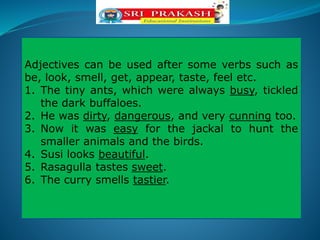
Adjectives can be used after some verbs such as
be, look, smell, get, appear, taste, feel etc.
1. The tiny ants, which were always busy, tickled
the dark buffaloes.
2. He was dirty, dangerous, and very cunning too.
3. Now it was easy for the jackal to hunt the
smaller animals and the birds.
4. Susi looks beautiful.
5. Rasagulla tastes sweet.
6. The curry smells tastier.
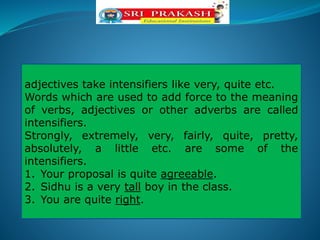
adjectives take intensifiers like very, quite etc.
Words which are used to add force to the meaning
of verbs, adjectives or other adverbs are called
intensifiers.
Strongly, extremely, very, fairly, quite, pretty,
absolutely, a little etc. are some of the
intensifiers.
1. Your proposal is quite agreeable.
2. Sidhu is a very tall boy in the class.
3. You are quite right.
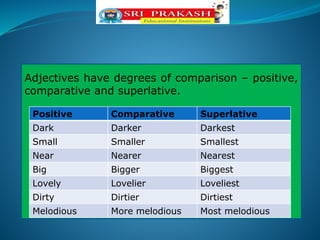
Adjectives have degrees of comparison – positive,
comparative and superlative.
Positive Comparative Superlative
Dark Darker Darkest
Small Smaller Smallest
Near Nearer Nearest
Big Bigger Biggest
Lovely Lovelier Loveliest
Dirty Dirtier Dirtiest
Melodious More melodious Most melodious
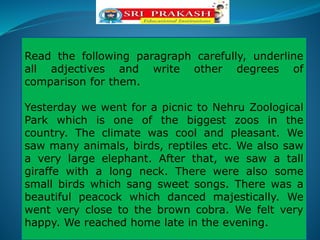
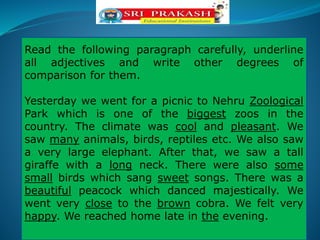
Read the following paragraph carefully, underline
all adjectives and write other degrees of
comparison for them.
Yesterday we went for a picnic to Nehru Zoological
Park which is one of the biggest zoos in the
country. The climate was cool and pleasant. We
saw many animals, birds, reptiles etc. We also saw
a very large elephant. After that, we saw a tall
giraffe with a long neck. There were also some
small birds which sang sweet songs. There was a
beautiful peacock which danced majestically. We
went very close to the brown cobra. We felt very
happy. We reached home late in the evening.
Read the following paragraph carefully, underline
all adjectives and write other degrees of
comparison for them.
Yesterday we went for a picnic to Nehru Zoological
Park which is one of the biggest zoos in the
country. The climate was cool and pleasant. We
saw many animals, birds, reptiles etc. We also saw
a very large elephant. After that, we saw a tall
giraffe with a long neck. There were also some
small birds which sang sweet songs. There was a
beautiful peacock which danced majestically. We
went very close to the brown cobra. We felt very
happy. We reached home late in the evening.
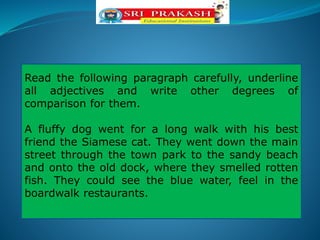
Read the following paragraph carefully, underline
all adjectives and write other degrees of
comparison for them.
A fluffy dog went for a long walk with his best
friend the Siamese cat. They went down the main
street through the town park to the sandy beach
and onto the old dock, where they smelled rotten
fish. They could see the blue water, feel in the
boardwalk restaurants.
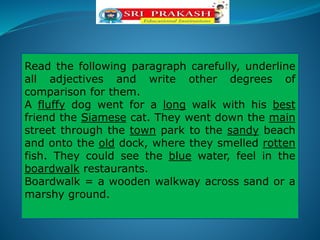
Read the following paragraph carefully, underline
all adjectives and write other degrees of
comparison for them.
A fluffy dog went for a long walk with his best
friend the Siamese cat. They went down the main
street through the town park to the sandy beach
and onto the old dock, where they smelled rotten
fish. They could see the blue water, feel in the
boardwalk restaurants.
Boardwalk = a wooden walkway across sand or a
marshy ground.
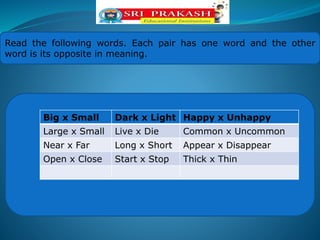
Read the following words. Each pair has one word and the other
word is its opposite in meaning.
Big x Small Dark x Light Happy x Unhappy
Large x Small Live x Die Common x Uncommon
Near x Far Long x Short Appear x Disappear
Open x Close Start x Stop Thick x Thin
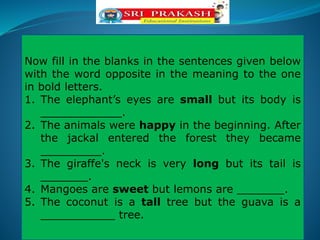
Now fill in the blanks in the sentences given below
with the word opposite in the meaning to the one
in bold letters.
1. The elephant’s eyes are small but its body is
____________.
2. The animals were happy in the beginning. After
the jackal entered the forest they became
_________.
3. The giraffe's neck is very long but its tail is
_______.
4. Mangoes are sweet but lemons are _______.
5. The coconut is a tall tree but the guava is a
___________ tree.
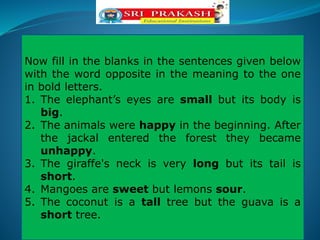
Now fill in the blanks in the sentences given below
with the word opposite in the meaning to the one
in bold letters.
1. The elephant’s eyes are small but its body is
big.
2. The animals were happy in the beginning. After
the jackal entered the forest they became
unhappy.
3. The giraffe's neck is very long but its tail is
short.
4. Mangoes are sweet but lemons sour.
5. The coconut is a tall tree but the guava is a
short tree.
THANK YOU FOR WATCHING THE VIDEO.

How to identify an adjective

  • 1.
    How to identifyan adjective in a sentence For class VI State Syllabus Students. CHAPTER – I PEACE & HARMONY.
  • 2.
    Read the followingsentences from the story: 1. They heard a soft voice. 2. The pythons have long bodies. 3. The jackal told the elephant, “You are the biggest animal in the forest.” 4. He said to the peacock, “You are the loveliest bird in the forest.” The underlined words are called ADJECTIVES.
  • 3.
    Now let uslearn how to identify an adjective in a sentence: Adjectives usually go before the nouns they modify. 1. Once upon a time, in a very thick forest lived many animals, birds, snakes and insects. 2. The peacocks were very proud of their dances but admired the melodious songs of the cuckoos. 3. They often held musical evenings in a large open field.
  • 4.
    Some adjectives like“available”, “imaginable”, “possible”, “suitable” can be used just before a noun but we use these adjectives just after the nouns only when the noun follows words such as first, last, next, only and superlative adjectives. 1. Self quarantine is the only treatment suitable to control the spread of coronavirus. 2. It is an offer available only to the club members. 3. Hard working is the only solution imaginable to overcome this problem.
  • 5.
    Adjectives can beused after some verbs such as be, look, smell, get, appear, taste, feel etc. 1. The tiny ants, which were always busy, tickled the dark buffaloes. 2. He was dirty, dangerous, and very cunning too. 3. Now it was easy for the jackal to hunt the smaller animals and the birds. 4. Susi looks beautiful. 5. Rasagulla tastes sweet. 6. The curry smells tastier.
  • 6.
    adjectives take intensifierslike very, quite etc. Words which are used to add force to the meaning of verbs, adjectives or other adverbs are called intensifiers. Strongly, extremely, very, fairly, quite, pretty, absolutely, a little etc. are some of the intensifiers. 1. Your proposal is quite agreeable. 2. Sidhu is a very tall boy in the class. 3. You are quite right.
  • 7.
    Adjectives have degreesof comparison – positive, comparative and superlative. Positive Comparative Superlative Dark Darker Darkest Small Smaller Smallest Near Nearer Nearest Big Bigger Biggest Lovely Lovelier Loveliest Dirty Dirtier Dirtiest Melodious More melodious Most melodious
  • 8.
    Read the followingparagraph carefully, underline all adjectives and write other degrees of comparison for them. Yesterday we went for a picnic to Nehru Zoological Park which is one of the biggest zoos in the country. The climate was cool and pleasant. We saw many animals, birds, reptiles etc. We also saw a very large elephant. After that, we saw a tall giraffe with a long neck. There were also some small birds which sang sweet songs. There was a beautiful peacock which danced majestically. We went very close to the brown cobra. We felt very happy. We reached home late in the evening.
  • 9.
    Read the followingparagraph carefully, underline all adjectives and write other degrees of comparison for them. Yesterday we went for a picnic to Nehru Zoological Park which is one of the biggest zoos in the country. The climate was cool and pleasant. We saw many animals, birds, reptiles etc. We also saw a very large elephant. After that, we saw a tall giraffe with a long neck. There were also some small birds which sang sweet songs. There was a beautiful peacock which danced majestically. We went very close to the brown cobra. We felt very happy. We reached home late in the evening.
  • 10.
    Read the followingparagraph carefully, underline all adjectives and write other degrees of comparison for them. A fluffy dog went for a long walk with his best friend the Siamese cat. They went down the main street through the town park to the sandy beach and onto the old dock, where they smelled rotten fish. They could see the blue water, feel in the boardwalk restaurants.
  • 11.
    Read the followingparagraph carefully, underline all adjectives and write other degrees of comparison for them. A fluffy dog went for a long walk with his best friend the Siamese cat. They went down the main street through the town park to the sandy beach and onto the old dock, where they smelled rotten fish. They could see the blue water, feel in the boardwalk restaurants. Boardwalk = a wooden walkway across sand or a marshy ground.
  • 12.
    Read the followingwords. Each pair has one word and the other word is its opposite in meaning. Big x Small Dark x Light Happy x Unhappy Large x Small Live x Die Common x Uncommon Near x Far Long x Short Appear x Disappear Open x Close Start x Stop Thick x Thin
  • 13.
    Now fill inthe blanks in the sentences given below with the word opposite in the meaning to the one in bold letters. 1. The elephant’s eyes are small but its body is ____________. 2. The animals were happy in the beginning. After the jackal entered the forest they became _________. 3. The giraffe's neck is very long but its tail is _______. 4. Mangoes are sweet but lemons are _______. 5. The coconut is a tall tree but the guava is a ___________ tree.
  • 14.
    Now fill inthe blanks in the sentences given below with the word opposite in the meaning to the one in bold letters. 1. The elephant’s eyes are small but its body is big. 2. The animals were happy in the beginning. After the jackal entered the forest they became unhappy. 3. The giraffe's neck is very long but its tail is short. 4. Mangoes are sweet but lemons sour. 5. The coconut is a tall tree but the guava is a short tree.
  • 15.
    THANK YOU FORWATCHING THE VIDEO.