How to Write Discussion
sections
Rules about doing research
 Choose the right research question
 Use the most appropriate study design
 Apply sound statistics
 Consider external validity
Writing papers
 Good writers are good artists!
 Be creative
 Express your personal style - be persuasive
 No place for political views
Structure of a research paper
 Title page
 Abstract
 Background (+objectives)
 Methods
 Results
 Discussion
 References
 Acknowledgment
 Figures and Tables
 Covering letter – sell your product!
Discussion
 Summarise main study findings
 Interpret findings in light of research question
 Point out strengths and weaknesses of study
 Comparison with previous studies (be concise)
 Implications for intended readers (be humble)
 Make recommendations regarding future research
Principal findings
 State the main findings in one sentence in
words.
 “Our study shows that … .”
 “Drinking coke causes cancer”.
 “rates of pregnancy are falling”
 Do not repeat data
Interpret study findings
 Make sense of results in light of
suggested hypothesis
 Use references that support your
interpretation
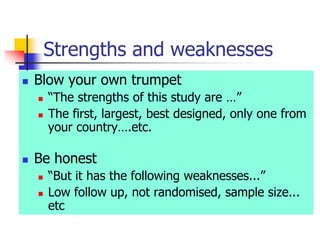
Strengths and weaknesses
 Blow your own trumpet
 “The strengths of this study are …”
 The first, largest, best designed, only one from
your country….etc.
 Be honest
 “But it has the following weaknesses...”
 Low follow up, not randomised, sample size...
etc
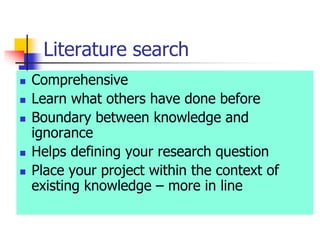
Literature search
 Comprehensive
 Learn what others have done before
 Boundary between knowledge and
ignorance
 Helps defining your research question
 Place your project within the context of
existing knowledge – more in line
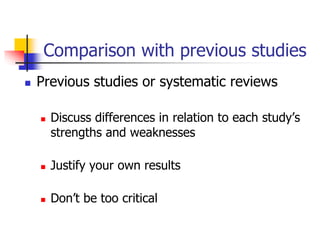
Comparison with previous studies
 Previous studies or systematic reviews
 Discuss differences in relation to each study’s
strengths and weaknesses
 Justify your own results
 Don’t be too critical
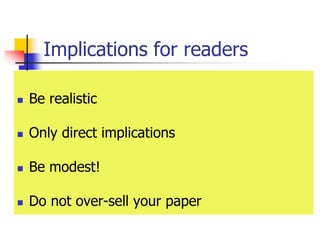
Implications for readers
 Be realistic
 Only direct implications
 Be modest!
 Do not over-sell your paper
Future research questions
 Unanswered questions
 Only those directly related to the study
 Future research
 Specific recommendations
 If you have none, say nothing
 DO NOT say “further research is needed”
Figures and tables
 Do numbers add up?
 Should stand alone:
 Descriptive legends
 Foot-notes if necessary
 Explain all abbreviation
Objectives
 Some rules about doing research
 Some rules about writing up research
 Submitting papers
 Editorial process
 Responding to editor’s decision
Submitting your paper
 Choose the right journal
 Read “Instructions for Authors”
 Write paper according to instructions
 Ask 2 colleagues to provide feedback
 Proof read the manuscript
 Submit the paper according to rules
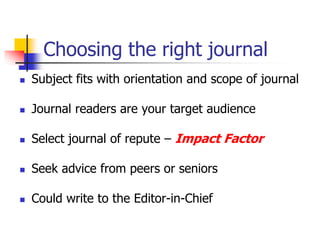
Choosing the right journal
 Subject fits with orientation and scope of journal
 Journal readers are your target audience
 Select journal of repute – Impact Factor
 Seek advice from peers or seniors
 Could write to the Editor-in-Chief
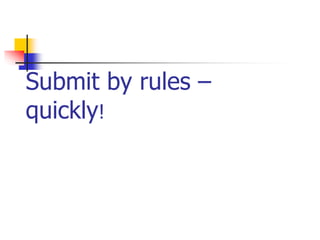
Submit by rules –
quickly!
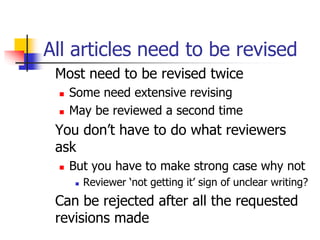
All articles need to be revised
Most need to be revised twice
 Some need extensive revising
 May be reviewed a second time
You don’t have to do what reviewers
ask
 But you have to make strong case why not
 Reviewer ‘not getting it’ sign of unclear writing?
Can be rejected after all the requested
revisions made
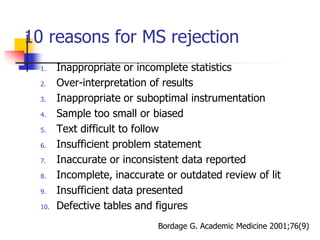
10 reasons for MS rejection
1. Inappropriate or incomplete statistics
2. Over-interpretation of results
3. Inappropriate or suboptimal instrumentation
4. Sample too small or biased
5. Text difficult to follow
6. Insufficient problem statement
7. Inaccurate or inconsistent data reported
8. Incomplete, inaccurate or outdated review of lit
9. Insufficient data presented
10. Defective tables and figures
Bordage G. Academic Medicine 2001;76(9)
Rejection hurts
But it’s part of the game, especially
when starting out
 Learn everything you can from it
 Rejection may point to some real problems
in how the MS was prepared
If a reviewer makes constructive
comments, use them
 Don’t just submit to another journal
 They may review for the other journal too
Be optimistic
Quality work will find quality journals
 They need you more than you need them
Writing is hard work but fun
 always have a Plan B
And a Plan C
THANK YOU

How to get ur paper published

  • 1.
    How to WriteDiscussion sections
  • 2.
    Rules about doingresearch  Choose the right research question  Use the most appropriate study design  Apply sound statistics  Consider external validity
  • 3.
    Writing papers  Goodwriters are good artists!  Be creative  Express your personal style - be persuasive  No place for political views
  • 4.
    Structure of aresearch paper  Title page  Abstract  Background (+objectives)  Methods  Results  Discussion  References  Acknowledgment  Figures and Tables  Covering letter – sell your product!
  • 5.
    Discussion  Summarise mainstudy findings  Interpret findings in light of research question  Point out strengths and weaknesses of study  Comparison with previous studies (be concise)  Implications for intended readers (be humble)  Make recommendations regarding future research
  • 6.
    Principal findings  Statethe main findings in one sentence in words.  “Our study shows that … .”  “Drinking coke causes cancer”.  “rates of pregnancy are falling”  Do not repeat data
  • 7.
    Interpret study findings Make sense of results in light of suggested hypothesis  Use references that support your interpretation
  • 8.
    Strengths and weaknesses Blow your own trumpet  “The strengths of this study are …”  The first, largest, best designed, only one from your country….etc.  Be honest  “But it has the following weaknesses...”  Low follow up, not randomised, sample size... etc
  • 9.
    Literature search  Comprehensive Learn what others have done before  Boundary between knowledge and ignorance  Helps defining your research question  Place your project within the context of existing knowledge – more in line
  • 10.
    Comparison with previousstudies  Previous studies or systematic reviews  Discuss differences in relation to each study’s strengths and weaknesses  Justify your own results  Don’t be too critical
  • 11.
    Implications for readers Be realistic  Only direct implications  Be modest!  Do not over-sell your paper
  • 12.
    Future research questions Unanswered questions  Only those directly related to the study  Future research  Specific recommendations  If you have none, say nothing  DO NOT say “further research is needed”
  • 13.
    Figures and tables Do numbers add up?  Should stand alone:  Descriptive legends  Foot-notes if necessary  Explain all abbreviation
  • 14.
    Objectives  Some rulesabout doing research  Some rules about writing up research  Submitting papers  Editorial process  Responding to editor’s decision
  • 15.
    Submitting your paper Choose the right journal  Read “Instructions for Authors”  Write paper according to instructions  Ask 2 colleagues to provide feedback  Proof read the manuscript  Submit the paper according to rules
  • 16.
    Choosing the rightjournal  Subject fits with orientation and scope of journal  Journal readers are your target audience  Select journal of repute – Impact Factor  Seek advice from peers or seniors  Could write to the Editor-in-Chief
  • 17.
    Submit by rules– quickly!
  • 18.
    All articles needto be revised Most need to be revised twice  Some need extensive revising  May be reviewed a second time You don’t have to do what reviewers ask  But you have to make strong case why not  Reviewer ‘not getting it’ sign of unclear writing? Can be rejected after all the requested revisions made
  • 19.
    10 reasons forMS rejection 1. Inappropriate or incomplete statistics 2. Over-interpretation of results 3. Inappropriate or suboptimal instrumentation 4. Sample too small or biased 5. Text difficult to follow 6. Insufficient problem statement 7. Inaccurate or inconsistent data reported 8. Incomplete, inaccurate or outdated review of lit 9. Insufficient data presented 10. Defective tables and figures Bordage G. Academic Medicine 2001;76(9)
  • 20.
    Rejection hurts But it’spart of the game, especially when starting out  Learn everything you can from it  Rejection may point to some real problems in how the MS was prepared If a reviewer makes constructive comments, use them  Don’t just submit to another journal  They may review for the other journal too
  • 21.
    Be optimistic Quality workwill find quality journals  They need you more than you need them Writing is hard work but fun  always have a Plan B And a Plan C
  • 22.