Chapter 6
Gathering Materials
         Gracea Elsa
          Sabandar
       Maria Kristina
           Pingkan
The Contents
 Using your own knowledge and
  experience.
 Doing library search.
 Searching the internet.
 Interviewing.
 Writing and calling for
  information.
 Tips for doing research.
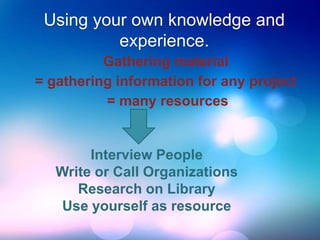
Using your own knowledge and
          experience.
          Gathering material
= gathering information for any project
          = many resources


        Interview People
   Write or Call Organizations
      Research on Library
    Use yourself as resource
Doing
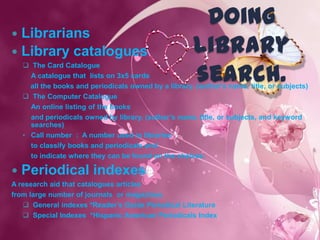
 Librarians
 Library catalogues                                    library
                                                        search.
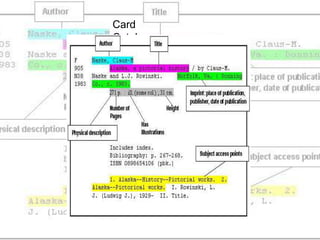
     The Card Catalogue
      A catalogue that lists on 3x5 cards
      all the books and periodicals owned by a library. (author’s name, title, or subjects)
     The Computer Catalogue
      An online listing of the books
      and periodicals owned by library. (author’s name, title, or subjects, and keyword
      searches)
    • Call number : A number used in libraries
      to classify books and periodicals and
      to indicate where they can be found on the shelves.

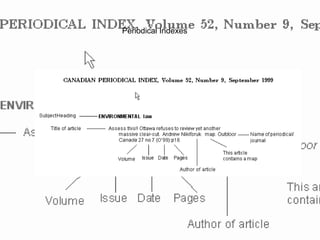
   Periodical indexes
A research aid that catalogues articles
from large number of journals or magazines.
    General indexes *Reader’s Guide Periodical Literature
    Special Indexes *Hispanic American Periodicals Index
Card
Catalogue
Periodical Indexes
Doing library search.
   Newspaper indexes
    A research aid that catalogues articles from one or more newspapers.
   Reference works
    A work that synthesizes a large amount of related information for easy access by
    researchers.
     Encyclopedias
      General Encyclopedia : A comprehensive work that provides information about all branches of
      human knowledge.
      Special Encyclopedia : A comprehensive reference work devoted to a specific subject such as
      religion, art, law, science, music, etc.
     Yearbook : A reference work published annually that contains information about the previous
      year.
     Dictionaries
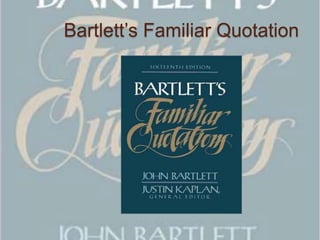
     Quotation books
     Biographical aids : A reference work that provides information about people.
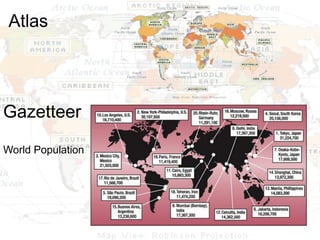
     Atlas : A book of maps.
     Gazetter : A geographical dictionary.
Bartlett’s Familiar Quotation
Searching the internet.
   Browsers.
    Computer programs for navigating the World Wide
    Web.
   Search Engines.
    Programs used in combination with a browser to find
    information on the World Wide Web.
   Keyword Searches.
    Search Box : The space provided by a search engine
    for entering the terms to be used in a keyword
    search.
   Subject Searches.
   Bookmarks.
    A feature in a Web browser that stores links to Web
    sites so they can be easily revisited
Atlas


Gazetteer

World Population
Searching the internet.
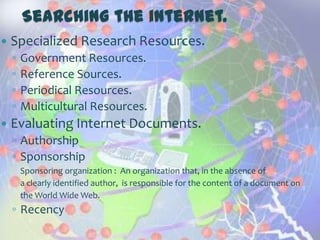
   Specialized Research Resources.
    ◦   Government Resources.
    ◦   Reference Sources.
    ◦   Periodical Resources.
    ◦   Multicultural Resources.
   Evaluating Internet Documents.
    ◦ Authorship
    ◦ Sponsorship
        Sponsoring organization : An organization that, in the absence of
        a clearly identified author, is responsible for the content of a document on
        the World Wide Web.
    ◦ Recency
Interviewing.
    Research interview : An interview conducted
    to gather information for a speech.

 Before the Interview
 During the Interview
 After the Interview
Before the Interview

 Define  the Purpose of
  the Interview
 Decide Whom to Interview
 Arrange the Interview
 Decide Whether or Not to
  Use a Tape Recorder.
 Prepare Your Questions.
During the Interview
 Dress Appropriately
  and Be on Time.
 Repeat the Purpose
  of the Interview.
 Set Up the Tape Recorder, If You Are Using
  One.
 Keep the Interview on Track.
 * Listen carefully.
 * Don’t overstay Your Welcome.
After the Interview


Review Your Notes As
Soon
As Possible.

  Transcribe Your
  Notes.
Writing and calling for
     information.
     Check facts and
     statistics against
     a more impartial
          source.
Tips for doing research.
 Start Early
 Make a Preliminary Bibliography
* Preliminary Bibliography is a list
    compiled early in the research process
    of works that look as if they might
    contain helpful information about a
    speech topic.
Tips for doing research.
   Take Notes Efficiently
    * Record notes on index cards.
    * On each card write the note, the
    source of the note, and a heading
    indicating the subject of the note.
    * Use a separate card for each note.

   Think About Your Materials As You Research
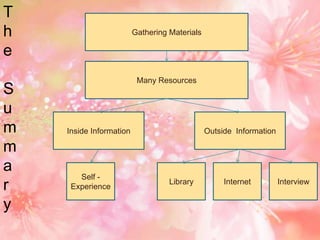
T
h                        Gathering Materials

e
                          Many Resources
S
u
m   Inside Information                         Outside Information

m
a
       Self -
r    Experience
                                   Library          Internet         Interview


y
Thank
 You
  

How to get material for presentation

  • 1.
    Chapter 6 Gathering Materials Gracea Elsa Sabandar Maria Kristina Pingkan
  • 2.
    The Contents  Usingyour own knowledge and experience.  Doing library search.  Searching the internet.  Interviewing.  Writing and calling for information.  Tips for doing research.
  • 3.
    Using your ownknowledge and experience. Gathering material = gathering information for any project = many resources Interview People Write or Call Organizations Research on Library Use yourself as resource
  • 4.
    Doing  Librarians  Librarycatalogues library search.  The Card Catalogue A catalogue that lists on 3x5 cards all the books and periodicals owned by a library. (author’s name, title, or subjects)  The Computer Catalogue An online listing of the books and periodicals owned by library. (author’s name, title, or subjects, and keyword searches) • Call number : A number used in libraries to classify books and periodicals and to indicate where they can be found on the shelves.  Periodical indexes A research aid that catalogues articles from large number of journals or magazines.  General indexes *Reader’s Guide Periodical Literature  Special Indexes *Hispanic American Periodicals Index
  • 5.
  • 6.
  • 8.
    Doing library search.  Newspaper indexes A research aid that catalogues articles from one or more newspapers.  Reference works A work that synthesizes a large amount of related information for easy access by researchers.  Encyclopedias General Encyclopedia : A comprehensive work that provides information about all branches of human knowledge. Special Encyclopedia : A comprehensive reference work devoted to a specific subject such as religion, art, law, science, music, etc.  Yearbook : A reference work published annually that contains information about the previous year.  Dictionaries  Quotation books  Biographical aids : A reference work that provides information about people.  Atlas : A book of maps.  Gazetter : A geographical dictionary.
  • 9.
  • 10.
    Searching the internet.  Browsers. Computer programs for navigating the World Wide Web.  Search Engines. Programs used in combination with a browser to find information on the World Wide Web.  Keyword Searches. Search Box : The space provided by a search engine for entering the terms to be used in a keyword search.  Subject Searches.  Bookmarks. A feature in a Web browser that stores links to Web sites so they can be easily revisited
  • 11.
  • 12.
    Searching the internet.  Specialized Research Resources. ◦ Government Resources. ◦ Reference Sources. ◦ Periodical Resources. ◦ Multicultural Resources.  Evaluating Internet Documents. ◦ Authorship ◦ Sponsorship Sponsoring organization : An organization that, in the absence of a clearly identified author, is responsible for the content of a document on the World Wide Web. ◦ Recency
  • 13.
    Interviewing. Research interview : An interview conducted to gather information for a speech.  Before the Interview  During the Interview  After the Interview
  • 14.
    Before the Interview Define the Purpose of the Interview  Decide Whom to Interview  Arrange the Interview  Decide Whether or Not to Use a Tape Recorder.  Prepare Your Questions.
  • 15.
    During the Interview Dress Appropriately and Be on Time.  Repeat the Purpose of the Interview.  Set Up the Tape Recorder, If You Are Using One.  Keep the Interview on Track. * Listen carefully. * Don’t overstay Your Welcome.
  • 16.
    After the Interview ReviewYour Notes As Soon As Possible. Transcribe Your Notes.
  • 17.
    Writing and callingfor information. Check facts and statistics against a more impartial source.
  • 18.
    Tips for doingresearch.  Start Early  Make a Preliminary Bibliography * Preliminary Bibliography is a list compiled early in the research process of works that look as if they might contain helpful information about a speech topic.
  • 19.
    Tips for doingresearch.  Take Notes Efficiently * Record notes on index cards. * On each card write the note, the source of the note, and a heading indicating the subject of the note. * Use a separate card for each note.  Think About Your Materials As You Research
  • 20.
    T h Gathering Materials e Many Resources S u m Inside Information Outside Information m a Self - r Experience Library Internet Interview y
  • 21.