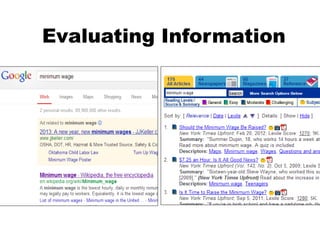
Evaluating Information
We’ve said that library resources
can help you find higher quality
information in less time.
But what exactly is it that makes a
piece of information high quality
anyway?
We don’t mean to say that you can’t
find any trustworthy information
using Google or another search
engine. (Of course you can.)
The point is you need to carefully
evaluate your sources before using
or trusting them.
A handy way to remember the
major criteria for evaluating
information is to always apply the
“CRAAP Test.”
What does that mean?
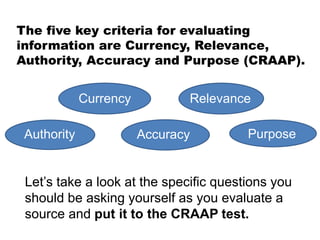
The five key criteria for evaluating
information are Currency, Relevance,
Authority, Accuracy and Purpose (CRAAP).
Currency Relevance
Authority Purpose
Accuracy
Let’s take a look at the specific questions you
should be asking yourself as you evaluate a
source and put it to the CRAAP test.
Currency: The timeliness of the
information
• When was the information published or
posted?
• Has it been revised or updated?
• Does your topic require current information,
or will older sources work as well? (Topics in
medicine or technology, for example,
change very quickly.)
Relevance: The importance of the
information for your needs
• Does the information relate to your topic or
help answer your question?
• Who is the intended audience?
• Is the information at an appropriate level
(i.e. not too elementary or advanced for
your needs)?
Authority: The source of the
information
• Who is the author and is he or she qualified to
write on the topic?
• Is there an organization that publishes,
sponsors or is otherwise responsible for the
content?
• What can you learn from the URL? (.edu and
.gov are usually better; .com and .org could
be created by anyone.)
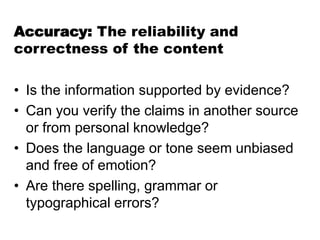
Accuracy: The reliability and
correctness of the content
• Is the information supported by evidence?
• Can you verify the claims in another source
or from personal knowledge?
• Does the language or tone seem unbiased
and free of emotion?
• Are there spelling, grammar or
typographical errors?
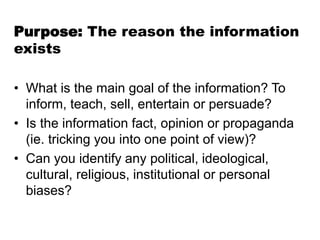
Purpose: The reason the information
exists
• What is the main goal of the information? To
inform, teach, sell, entertain or persuade?
• Is the information fact, opinion or propaganda
(ie. tricking you into one point of view)?
• Can you identify any political, ideological,
cultural, religious, institutional or personal
biases?
Every website is different, so there
aren’t clearly defined places where
you’ll always look for these criteria.
Instead, you need to bring a critical
eye to every source and hunt around
until you find what you need.
Let’s look at some examples.
Let’s say we
come across
this source
online.
One of the first
things to check
is when the
information
was published
or updated.
Currency
Here we can
find the
publication
date right
before the
article. This is
from 2022, so
it should
definitely pass
the currency
test!
Currency
But what about this example? It doesn’t
seem to have a publication date anywhere.
Currency
If you don’t see a date near the top, try the very
bottom.
Currency
In this case, we have to decide if this is fine for our
project or a bit older than we want to use.
If we need information on dinosaurs for a science
class, this kids site wouldn’t be appropriate.
Relevance
And neither
would this one,
although in this
case it’s
because the
source is too
advanced, and
certainly too
narrowly
focused, for
our needs.
Relevance
This site looks to be the right level for our
needs, so it passes the relevance test, and it
also gets into the next criterion: authority.
Relevance
Authority
Here we immediately see the organization
responsible for the site’s content, and in this
case it is a very trustworthy one.
Authority
If you aren’t familiar with an organization,
Google it to learn more and see if it’s trustworthy.
Sometimes it won’t
be.
In a well-known
example, the
website
MartinLutherKing.org
looks at first glance
like it might be a
good resource.
Authority
But for it to pass
the authority test,
we need to figure
out who is
responsible for the
content.
Authority
There is no
author listed, but
at the very
bottom there’s
the name of the
sponsoring
organization.
Let’s see what
we find when we
Google it.
Authority
Now we know MartinLutherKing.org
will have an extreme, hateful bias
even though this may not be clear at
first glance.
You should apply this same principle
to other situations, like a major drug
or food company sponsoring a health
study or food-related website.
Now let’s say we’re researching study habits.
Does this site pass the authority test?
Authority
First we should see what we can learn about
the author, and we find a bio below the article.
He certainly looks qualified to write about
this topic!
But it’s always a
good idea to try to
cross-reference
with another site,
since anyone could
create a website
and pretend to be
something (or
someone) they’re
not.
Authority
Authority
It’s a good idea to also check the authority
of the website itself, and you can usually find
an “About” page either in the top menu, at
the very bottom, or sometimes in a sidebar.
In this case it’s hidden on the bottom.
And what we find here only clinches what
we already figured: this is a very trustworthy
website that passes the authority test.
Authority
Now let’s check
the authority of
a second site on
study habits.
There’s no
author listed at
the top, so let’s
check the
bottom.
There’s a name but absolutely no real info here, so
now I’m very skeptical. This could even be a fake
person!
Authority
Accuracy
Also be sure to look for clues such as frequent
misspellings, bad grammar, and awkward
usage that indicate a low-quality source.
This site also has problems with accuracy, in
particular a number of claims made without any
sort of evidence or sources cited.
No sources given anywhere on the site
This site also demonstrates the next
criterion: purpose. Here it turns out the
motivation for the site is to sell an ebook,
which is linked to frequently.
Purpose
Takes you to the sales
page for an ebook of
questionable authority
The presence of ads or items for sale doesn’t
automatically disqualify a source, but it is
something you should weigh carefully against
the other criteria.
Purpose
The first site, on the other hand, was designed to
inform readers, not manipulate or sell to them.
The sites you come across will
rarely be 100% good or 100% bad.
They may have some high-quality
aspects and others that undermine
their credibility. It is up to you to
decide if a particular source passes
the CRAAP test for your needs.
Be sure to look at your assignment
or ask your instructor how many
web sources (ie. not found in a
library database) you can use, if
any.
The CRAAP test is most crucial for
evaluating sites found on the open
web but several of the criteria are
very important for library sources
as well.
Currency
For example, if we are researching online
privacy, a topic that changes fast, twelve years is
a very long time so this ebook found in
LibSearch is likely too old to use. But for some
other topics this year might be perfectly fine to
pass the currency test.
Relevance
And this journal article looks very authoritative
and current, but it does not pass the relevance
test: it is far too specific and technically
advanced for our needs. (Unless we are in an
upper-level computer networking course.)
Authority
For another example, if your instructor told
you to consult a scholarly source, this
news article would not pass the authority
test, since it is a popular source written by a
journalist for a general audience.
Next Steps: Look over the
resources in the “further activities”
section to the right and take the
Quiz below it.
Also, please leave any comments or
questions you have below this
presentation.
Credits
Slides 26-30 adapted from “Evaluating Sources.” Georgia Southwestern State University.
http://www.slideshare.net/goodset2/evaluating-sources-27544171
CRAAP test adapted from California State University, Chico’s “Evaluating Information: Applying
the CRAAP Test” 'http://www.csuchico.edu/lins/handouts/eval_websites.pdf
Key Takeaway: It’s important to evaluate the
information you come across, and a good way to
do it is to always apply the “CRAAP Test.” This
means to evaluate the Currency, Relevance,
Authority, Accuracy and Purpose of each source
you encounter. These criteria are important for
both websites found through search engines and
sources found in library databases.

Evaluating Information

  • 1.
  • 2.
    We’ve said thatlibrary resources can help you find higher quality information in less time. But what exactly is it that makes a piece of information high quality anyway?
  • 3.
    We don’t meanto say that you can’t find any trustworthy information using Google or another search engine. (Of course you can.) The point is you need to carefully evaluate your sources before using or trusting them.
  • 4.
    A handy wayto remember the major criteria for evaluating information is to always apply the “CRAAP Test.” What does that mean?
  • 5.
    The five keycriteria for evaluating information are Currency, Relevance, Authority, Accuracy and Purpose (CRAAP). Currency Relevance Authority Purpose Accuracy Let’s take a look at the specific questions you should be asking yourself as you evaluate a source and put it to the CRAAP test.
  • 6.
    Currency: The timelinessof the information • When was the information published or posted? • Has it been revised or updated? • Does your topic require current information, or will older sources work as well? (Topics in medicine or technology, for example, change very quickly.)
  • 7.
    Relevance: The importanceof the information for your needs • Does the information relate to your topic or help answer your question? • Who is the intended audience? • Is the information at an appropriate level (i.e. not too elementary or advanced for your needs)?
  • 8.
    Authority: The sourceof the information • Who is the author and is he or she qualified to write on the topic? • Is there an organization that publishes, sponsors or is otherwise responsible for the content? • What can you learn from the URL? (.edu and .gov are usually better; .com and .org could be created by anyone.)
  • 9.
    Accuracy: The reliabilityand correctness of the content • Is the information supported by evidence? • Can you verify the claims in another source or from personal knowledge? • Does the language or tone seem unbiased and free of emotion? • Are there spelling, grammar or typographical errors?
  • 10.
    Purpose: The reasonthe information exists • What is the main goal of the information? To inform, teach, sell, entertain or persuade? • Is the information fact, opinion or propaganda (ie. tricking you into one point of view)? • Can you identify any political, ideological, cultural, religious, institutional or personal biases?
  • 11.
    Every website isdifferent, so there aren’t clearly defined places where you’ll always look for these criteria. Instead, you need to bring a critical eye to every source and hunt around until you find what you need. Let’s look at some examples.
  • 12.
    Let’s say we comeacross this source online. One of the first things to check is when the information was published or updated. Currency
  • 13.
    Here we can findthe publication date right before the article. This is from 2022, so it should definitely pass the currency test! Currency
  • 14.
    But what aboutthis example? It doesn’t seem to have a publication date anywhere. Currency
  • 15.
    If you don’tsee a date near the top, try the very bottom. Currency In this case, we have to decide if this is fine for our project or a bit older than we want to use.
  • 16.
    If we needinformation on dinosaurs for a science class, this kids site wouldn’t be appropriate. Relevance
  • 17.
    And neither would thisone, although in this case it’s because the source is too advanced, and certainly too narrowly focused, for our needs. Relevance
  • 18.
    This site looksto be the right level for our needs, so it passes the relevance test, and it also gets into the next criterion: authority. Relevance
  • 19.
    Authority Here we immediatelysee the organization responsible for the site’s content, and in this case it is a very trustworthy one.
  • 20.
    Authority If you aren’tfamiliar with an organization, Google it to learn more and see if it’s trustworthy.
  • 21.
    Sometimes it won’t be. Ina well-known example, the website MartinLutherKing.org looks at first glance like it might be a good resource. Authority
  • 22.
    But for itto pass the authority test, we need to figure out who is responsible for the content. Authority
  • 23.
    There is no authorlisted, but at the very bottom there’s the name of the sponsoring organization. Let’s see what we find when we Google it. Authority
  • 25.
    Now we knowMartinLutherKing.org will have an extreme, hateful bias even though this may not be clear at first glance. You should apply this same principle to other situations, like a major drug or food company sponsoring a health study or food-related website.
  • 26.
    Now let’s saywe’re researching study habits. Does this site pass the authority test?
  • 27.
    Authority First we shouldsee what we can learn about the author, and we find a bio below the article. He certainly looks qualified to write about this topic!
  • 28.
    But it’s alwaysa good idea to try to cross-reference with another site, since anyone could create a website and pretend to be something (or someone) they’re not. Authority
  • 29.
    Authority It’s a goodidea to also check the authority of the website itself, and you can usually find an “About” page either in the top menu, at the very bottom, or sometimes in a sidebar. In this case it’s hidden on the bottom.
  • 30.
    And what wefind here only clinches what we already figured: this is a very trustworthy website that passes the authority test.
  • 31.
    Authority Now let’s check theauthority of a second site on study habits. There’s no author listed at the top, so let’s check the bottom.
  • 32.
    There’s a namebut absolutely no real info here, so now I’m very skeptical. This could even be a fake person! Authority
  • 33.
    Accuracy Also be sureto look for clues such as frequent misspellings, bad grammar, and awkward usage that indicate a low-quality source. This site also has problems with accuracy, in particular a number of claims made without any sort of evidence or sources cited. No sources given anywhere on the site
  • 34.
    This site alsodemonstrates the next criterion: purpose. Here it turns out the motivation for the site is to sell an ebook, which is linked to frequently. Purpose Takes you to the sales page for an ebook of questionable authority
  • 35.
    The presence ofads or items for sale doesn’t automatically disqualify a source, but it is something you should weigh carefully against the other criteria. Purpose The first site, on the other hand, was designed to inform readers, not manipulate or sell to them.
  • 36.
    The sites youcome across will rarely be 100% good or 100% bad. They may have some high-quality aspects and others that undermine their credibility. It is up to you to decide if a particular source passes the CRAAP test for your needs.
  • 37.
    Be sure tolook at your assignment or ask your instructor how many web sources (ie. not found in a library database) you can use, if any. The CRAAP test is most crucial for evaluating sites found on the open web but several of the criteria are very important for library sources as well.
  • 38.
    Currency For example, ifwe are researching online privacy, a topic that changes fast, twelve years is a very long time so this ebook found in LibSearch is likely too old to use. But for some other topics this year might be perfectly fine to pass the currency test.
  • 39.
    Relevance And this journalarticle looks very authoritative and current, but it does not pass the relevance test: it is far too specific and technically advanced for our needs. (Unless we are in an upper-level computer networking course.)
  • 40.
    Authority For another example,if your instructor told you to consult a scholarly source, this news article would not pass the authority test, since it is a popular source written by a journalist for a general audience.
  • 41.
    Next Steps: Lookover the resources in the “further activities” section to the right and take the Quiz below it. Also, please leave any comments or questions you have below this presentation.
  • 42.
    Credits Slides 26-30 adaptedfrom “Evaluating Sources.” Georgia Southwestern State University. http://www.slideshare.net/goodset2/evaluating-sources-27544171 CRAAP test adapted from California State University, Chico’s “Evaluating Information: Applying the CRAAP Test” 'http://www.csuchico.edu/lins/handouts/eval_websites.pdf Key Takeaway: It’s important to evaluate the information you come across, and a good way to do it is to always apply the “CRAAP Test.” This means to evaluate the Currency, Relevance, Authority, Accuracy and Purpose of each source you encounter. These criteria are important for both websites found through search engines and sources found in library databases.