How to create an interactive
map with Leaflet
Map Your Way: Creating Interactive Maps with Leaflet
Outline
 Introduction to Leaflet
 Getting Started with Leaflet
 Adding Interactivity to Your Map
 Working with GeoJSON Data
 Best Practices for Creating Interactive Maps
 Conclusion
Introduction to Leaflet
Leaflet is a popular open-source
JavaScript library used for creating
interactive maps on the web. It
provides an easy-to-use interface for
displaying various types of geographic
data, such as markers, polygons, and
tile layers.
One of the key features of Leaflet is its
flexibility - it can be used with a variety
of map providers, including
OpenStreetMap, Mapbox, and
Google Maps, among others. This
makes it a great choice for
developers who want to create
custom maps that fit their specific
needs.
Getting Started with
Leaflet
To get started with Leaflet, you'll need
to include the Leaflet CSS and
JavaScript files in your HTML
document. You can then create a
new map object using the L.map()
function and specify the map's initial
view (i.e., center and zoom level).
Next, you can add various layers to
the map, such as tile layers (using
L.tileLayer()) or marker layers (using
L.marker()). You can also customize
the appearance of these layers by
specifying options like color, opacity,
and icon images.
Adding Interactivity to
Your Map
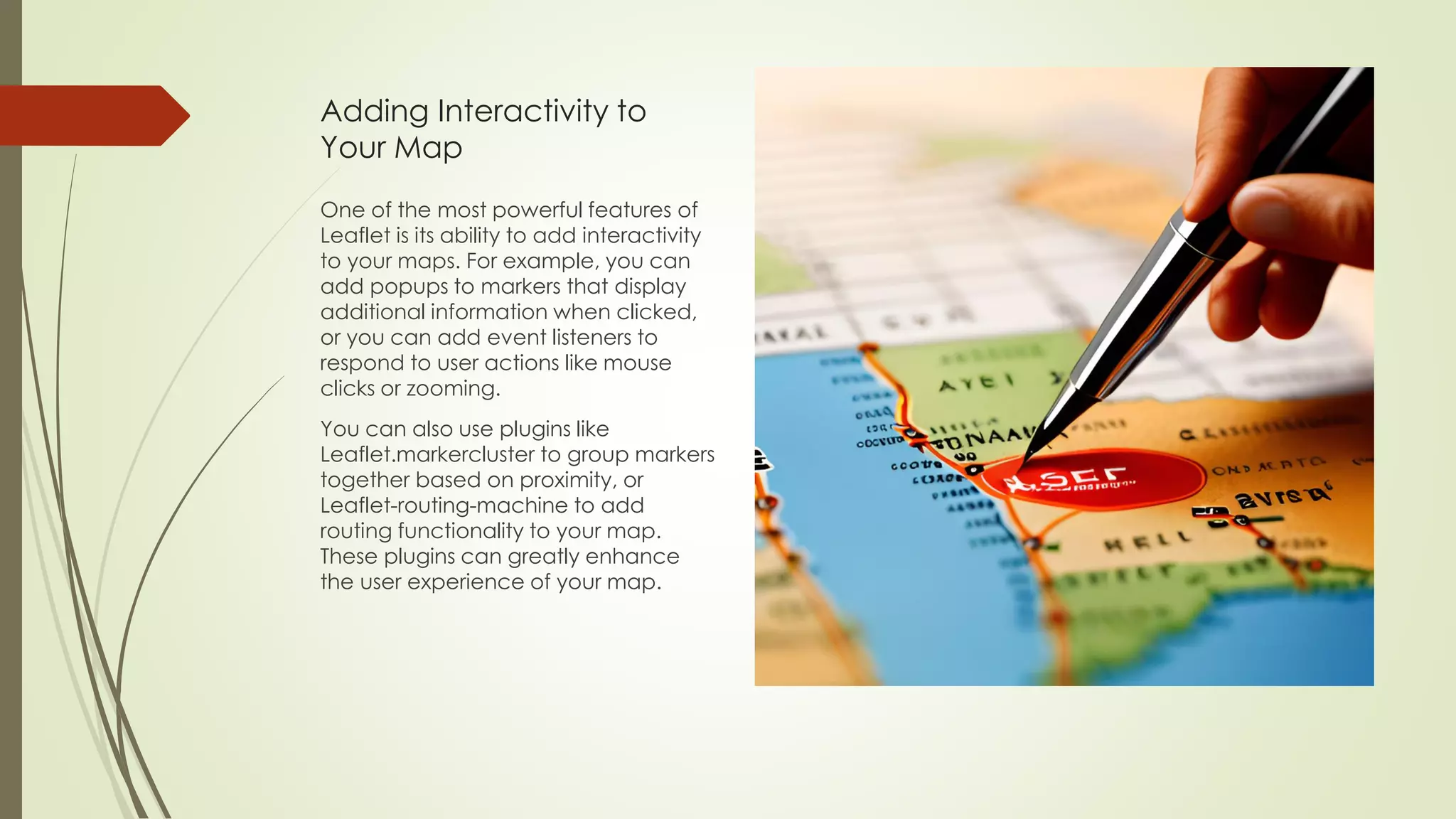
One of the most powerful features of
Leaflet is its ability to add interactivity
to your maps. For example, you can
add popups to markers that display
additional information when clicked,
or you can add event listeners to
respond to user actions like mouse
clicks or zooming.
You can also use plugins like
Leaflet.markercluster to group markers
together based on proximity, or
Leaflet-routing-machine to add
routing functionality to your map.
These plugins can greatly enhance
the user experience of your map.
Working with GeoJSON
Data
Another useful feature of Leaflet is its
ability to work with GeoJSON data.
GeoJSON is a format for encoding
geographic data structures using
JavaScript Object Notation (JSON).
With Leaflet, you can easily load
GeoJSON data from an external file
and display it on your map. You can
also style the data based on
properties like color or size, or use
plugins like Leaflet-omnivore to
convert other data formats like KML or
GPX to GeoJSON.
Best Practices for Creating
Interactive Maps
When creating interactive maps with
Leaflet, there are several best
practices to keep in mind. First, you
should aim to keep your map simple
and easy to navigate, avoiding clutter
and unnecessary elements.
You should also consider the
performance implications of your
map, especially if you're working with
large datasets or complex
visualizations. Finally, you should test
your map thoroughly across different
devices and browsers to ensure a
consistent user experience.
Conclusion
In conclusion, Leaflet is a powerful
and flexible tool for creating
interactive maps on the web. With its
wide range of features and plugins, it
can accommodate a variety of use
cases and data types.
Whether you're building a simple map
for a personal project or a complex
visualization for a business application,
Leaflet provides the tools you need to
bring your geographic data to life.
Thanks For Your Attention!
Presented by: Rakesh Purbey (Geomatic Engineer)
For More Visit Our Website: TheGISJournal.com

How to create an interactive map with Leaflet.pdf

  • 1.
    How to createan interactive map with Leaflet Map Your Way: Creating Interactive Maps with Leaflet
  • 2.
    Outline  Introduction toLeaflet  Getting Started with Leaflet  Adding Interactivity to Your Map  Working with GeoJSON Data  Best Practices for Creating Interactive Maps  Conclusion
  • 3.
    Introduction to Leaflet Leafletis a popular open-source JavaScript library used for creating interactive maps on the web. It provides an easy-to-use interface for displaying various types of geographic data, such as markers, polygons, and tile layers. One of the key features of Leaflet is its flexibility - it can be used with a variety of map providers, including OpenStreetMap, Mapbox, and Google Maps, among others. This makes it a great choice for developers who want to create custom maps that fit their specific needs.
  • 4.
    Getting Started with Leaflet Toget started with Leaflet, you'll need to include the Leaflet CSS and JavaScript files in your HTML document. You can then create a new map object using the L.map() function and specify the map's initial view (i.e., center and zoom level). Next, you can add various layers to the map, such as tile layers (using L.tileLayer()) or marker layers (using L.marker()). You can also customize the appearance of these layers by specifying options like color, opacity, and icon images.
  • 5.
    Adding Interactivity to YourMap One of the most powerful features of Leaflet is its ability to add interactivity to your maps. For example, you can add popups to markers that display additional information when clicked, or you can add event listeners to respond to user actions like mouse clicks or zooming. You can also use plugins like Leaflet.markercluster to group markers together based on proximity, or Leaflet-routing-machine to add routing functionality to your map. These plugins can greatly enhance the user experience of your map.
  • 6.
    Working with GeoJSON Data Anotheruseful feature of Leaflet is its ability to work with GeoJSON data. GeoJSON is a format for encoding geographic data structures using JavaScript Object Notation (JSON). With Leaflet, you can easily load GeoJSON data from an external file and display it on your map. You can also style the data based on properties like color or size, or use plugins like Leaflet-omnivore to convert other data formats like KML or GPX to GeoJSON.
  • 7.
    Best Practices forCreating Interactive Maps When creating interactive maps with Leaflet, there are several best practices to keep in mind. First, you should aim to keep your map simple and easy to navigate, avoiding clutter and unnecessary elements. You should also consider the performance implications of your map, especially if you're working with large datasets or complex visualizations. Finally, you should test your map thoroughly across different devices and browsers to ensure a consistent user experience.
  • 8.
    Conclusion In conclusion, Leafletis a powerful and flexible tool for creating interactive maps on the web. With its wide range of features and plugins, it can accommodate a variety of use cases and data types. Whether you're building a simple map for a personal project or a complex visualization for a business application, Leaflet provides the tools you need to bring your geographic data to life.
  • 9.
    Thanks For YourAttention! Presented by: Rakesh Purbey (Geomatic Engineer) For More Visit Our Website: TheGISJournal.com